1. Introduction
Communities across the Southwestern United States (US) and Northern Mexico are facing mounting pressures regarding how they plan for long-term water resilience at the local level. Local governments and water providers are responding to current or forecasted gaps between water supply and demand, an issue that is exacerbated by a litany of factors: climate change, population and concurrent demand growth, pressures to supply water for agriculture and growing industrial demands such as data centers, aging water infrastructure, and more. Most visibly, additional uncertainty is added to this equation for Colorado River-dependent communities as the 2007 Colorado River Interim Guidelines will expire at the end of 2026. Colorado River Basin states are currently negotiating the Post-2026 Operational Guidelines and Strategies for Lake Powell and Lake Mead (“Post-2026 Operational Guidelines”), which may result in changes to water allocations that had previously been guaranteed. However, while the Post-2026 Operational Guidelines negotiations may be the most high-profile discussions, water resilience planning efforts in this region have been underway for decades—whether communities depend on the Colorado River, adjacent surface waters, or groundwater—and critical water governance decisions are being made individually or collaboratively at several levels of government.
Many of the water issues in the Southwestern US and Northern Mexico also transcend borders—both in terms of geographical boundaries and disciplines. Watersheds in this region are influenced by the activities of hundreds of municipalities, counties, states, Tribes, and two nations. As a result, the policy decisions, development patterns, population growth, and industry approvals in one community or region often affect shared water supplies. Such impacts are evident in high-profile water governance contexts such as the Post-2026 Operational Guidelines negotiations but can be equally prevalent in lower-profile, localized examples.
Water resilience planning also transcends the disciplines of water resources management and land use planning, which have historically been conducted separately despite having significant implications for one another. At the same time, many of the decision-making processes regarding water resources management and land use planning are long-term in nature; while they have different planning horizons, water infrastructure updates are expensive and typically in place for several decades, while zoning and future land use plans typically have at least 5-to-10-year time frames and govern the way new developments and re-developments will use water and land space for decades to come. These time horizons raise the stakes of making efficient, informed, and collaborative decisions before water resources management and land use planning policies are enacted.
Despite these challenges, local communities are nevertheless moving forward in the pursuit of planning more resilient water futures. As they do so, working collaboratively across jurisdictions and disciplines can lead to more efficient and informed decision-making, result in resource and cost-sharing, and create broad support for water-efficient policies to proceed. Growing Water Smart (GWS)—a joint program of the Sonoran Institute and the Babbitt Center for Land & Water Policy (Babbitt Center), a center of the Lincoln Institute of Land Policy (Lincoln Institute)—is designed to achieve these objectives, fostering both inter- and intra-jurisdictional collaboration to address water scarcity and increase water resilience across a multitude of jurisdictional and disciplinary boundaries.
In this paper, the GWS program is presented as a model to collaboratively build local and regional water resilience at the nexus of water resources management and land use planning. First, core tenets of Collaborative Water Governance, Adaptive Water Governance, and other similar frameworks are analyzed as they relate to water resources management, as well as literature in the field of public administration that affirms the need for capacity-building and resource-sharing at the local government levels. This paper then seeks to convey how GWS community outcomes demonstrate these frameworks in practice, drawing from primary GWS program documents, participant evaluations, and the authors’ direct experiences as practitioners of these workshops. Three case studies of GWS in action are presented to demonstrate the program’s work to build water resilience in a variety of cross-jurisdictional contexts: a regional GWS workshop, intergovernmental agreement, and unified local regulations regarding water exports in the San Luis Valley of Colorado; a regional GWS workshop and emerging convening of jurisdictions within the Verde Watershed of central Arizona; and a binational GWS workshop between the cities of Douglas, Arizona and Agua Prieta, Sonora, Mexico resulting in a deepened understanding of each community’s relationship to shared effluent flows. This paper concludes with an analysis of common themes identified in these case studies, as well as recommendations for how elements of the GWS model can help address water challenges in the Southwestern US, Northern Mexico, and beyond.
2. Conceptual Framework: Governance Frameworks, Collaboration Across Boundaries, and Public Administration & Capacity Challenges
2.1. Overview of Water Governance Frameworks
The Colorado River provides water to over 40 million people throughout its basin, which includes seven US states, two Mexican states, and 30 Indigenous Tribes [
1]. It also supports over 5 million acres of irrigated agricultural land [
2]. Due to its extensive reach and jurisdiction- and border-crossing hydrology, the Colorado River Basin is a highly complex transboundary system. In recent decades, overuse of Colorado River water, compounded by climate change impacts, has triggered governance crises across the basin [
1]. Since the 1970s, in the Colorado River Basin and beyond, natural resource management has generally employed a “top-down” approach, relying upon centralized control from an authority such as a national government [
3]. The tie between water resource management issues and governance has been recognized for some time, demonstrated by a wealth of literature [
4] and encapsulated by the United Nations’ claim that the global “water crisis is essentially a crisis of governance” [
5]. This is underpinned by a widespread characterization of traditional approaches to water resources management as highly hierarchical, centralized, and technocratic, and that these approaches have not managed water resources sustainably, equitably, or in a manner that cultivates real water security [
6]. Further, these approaches have typically relied upon fixed functions, strict regulations, and engineering for the usage of natural resources, and have been shown to have limited flexibility and capacity to govern effectively in the face of variable future conditions, including due to climate change [
3,
6,
7,
8]. The literature suggests that to balance stewardship of water resources with effective usage, new approaches to governance are required [
9].
In contrast, alternative approaches including Collaborative Governance, Adaptive Governance, and Integrated Water Resources Management (IWRM) have emerged as policymakers become increasingly aware of the limitations of traditional, “top-down” approaches. Douglas et al. [
7] define Collaborative Governance as “a collective decision-making process based on more or less institutionalized interactions between two or more actors that aims to establish common ground for joint problem solving and value creation.” The Collaborative Governance of water resources promotes more integrated management and administration of water resources at international, regional, state, community, and watershed region levels [
10,
11]. Recognition has grown regarding the need for cooperation among a wider breadth of stakeholders engaged in water resources-related decision-making, and that roles and responsibilities should be shared between governments, private organizations, and communities. Further, research has identified a need to strengthen both public and private institutions to ensure that water systems and services are operated and maintained sustainably [
11]. More directly, Collaborative Water Governance is one framework that applies key Collaborative Governance principles such as cooperation among stakeholders, setting of common goals, inclusion of local knowledge, and transparency to water resources management [
12].
Adaptive Governance is an additional emergent approach aimed toward transforming conventional governance, and is defined by Akamani [
8] as “a concept that refers to institutional structures and decision-making processes that connect actors across multiple scales with the aim of managing the conflicting stakeholder values and uncertainties in knowledge that characterize the management of complex resource systems.”. The dissatisfaction of local communities with centralized governance practices, compounded by governmental limitations due to budget cuts, has given rise to more Collaborative Governance approaches [
4,
7,
10] and beckons for the “transformational change” that Adaptive Governance as a mechanism strives to cultivate [
8]. Aptly summarizing this trend, Douglas et al. [
7] note that “holistic, inclusive, cross sectoral initiatives to tackle complex public problems that exceed jurisdictional, sectoral, and professional boundaries or defy existing repertoires are flourishing”. Similarly, Adaptive Water Governance has come to the fore as an applied form of Adaptive Governance that fosters creation of flexibility within institutions and supports natural resource management under uncertain conditions [
13].
Related strategies such as IWRM have also become more commonplace in recent years, and share similar principles including decentralization of decision-making, integration of a wide variety of stakeholders and sectors, and maintaining flexibility for changing and uncertain conditions [
4,
6,
14]. Also important are additional components of governance, including data and information sharing, co-production of knowledge, leveraging support from intermediary organizations, and transparent communication mechanisms [
15]. In general, the core components of the aforementioned approaches have demonstrated that local communities, businesses, and other stakeholders have a significant and vested interest in playing a key role in decision-making [
10,
15]. Relatedly, the literature shows that participatory, deliberative, and collaborative approaches to water governance are increasing in prevalence [
10]. As a testament to this, IWRM is a widely accepted strategy that has been implemented in international, national, and regional water management guidelines [
16].
As these alternative governance frameworks grow in prominence, the literature also points to the concrete benefits of employing components of these approaches by leveraging the concepts of legitimacy, transparency, accountability, and increased public participation—all of which are notable components of what Cosens and Chaffin [
9] term “good governance”. Collaborative Water Governance, via the championing of participatory processes and focusing on “shared visions for shared outcomes,” has been reported to improve institutional capacity to manage conflicts and to advance inclusion, stakeholder participation, and knowledge transfer [
12]. Similarly, Adaptive Water Governance, which applies Adaptive Governance principles such as flexibility, “multi-scalar collaboration,” and “learning-based” approaches, supports the integration of a variety of nuanced drivers in complex decision-making settings [
13]. Additional research suggests that local or community-led approaches can result in better alignment of actions and responsibilities among a variety of actors engaged in governance [
15], support local compliance, accountability, and redundancy of solutions [
3], and in some cases even foster long-term engagements between communities and other stakeholders to improve the provision and monitoring of public services [
10].
2.2. Collaboration Across Boundaries
Effective water governance requires cross-border collaboration of many types, as water ignores jurisdictional, cultural, and economic boundaries [
9]. It relies heavily upon strong relationships amongst institutions and communities that build both “horizontally” (among organizations, cities, and communities) and “vertically” (upward and downward between the municipal and the international levels) [
7,
11,
16]. Specifically, IWRM requires that “institutional, cultural, spatial and/or temporal” boundaries are spanned, and that the systems surrounding water management are considered to be dynamic [
14]. According to United Nations Water, “transboundary basins and aquifers create a nexus of hydrological, economic, and social links between communities living in border areas, and beyond.” Adopting this collaborative perspective involves working across boundaries that exist across a variety of different scales, from watersheds or sub-catchments to international or jurisdictional boundaries [
17].
Further, disciplinary roles such as hydrologists, ecologists, and planners have historically siloed themselves using the boundaries of their specific water, land, or spatial focuses [
16]. Despite the inherent interdependent nature of these sectors, decision-making is often conducted in isolation. This disconnect among the disciplines, and actors themselves, has been recognized as leading to “siloed policy development, fragmented institutional arrangements, misaligned priorities, duplication of work and inefficient implementation” [
18]. Conversely, synergies can be harnessed by connecting relevant sectors, which can lead to efficiency, equity, and sustainability benefits [
18]. Cooperation between involved stakeholders, including developers, corporations, non-profit groups, and local water management and planning agencies is considered critical for integrating the water resources management and land use planning sectors and leading to long-term success [
19,
20,
21]. In addition, the integration of these sectors specifically can lead to more capable institutions that better deliver services including drinking water, wastewater, and stormwater [
19].
In general, approaches to Collaborative Governance inherently help to break down siloes between departments and distinct areas of expertise by integrating a wide variety of stakeholders and opening perspectives to include a greater range of potential solutions [
16]. Collaborative Governance also includes incorporation of stakeholders across levels of governance and through relationships with external sectors that are tied to the water sector, which can be interpreted to address both the necessary horizontality and verticality of collaboration for successful water governance [
16].
2.3. Public Administration and Capacity Challenges
The literature also points to a widespread lack of capacity within local governments, which can be traced to factors such as lower pay and lack of workplace flexibility compared to the private sector. As of October 2024, the most recent US Bureau of Labor Statistics monthly report showed 570,000 vacancies in state and local government, excluding education, while only 156,000 hires were made, resulting in a persistent vacancy-to-hire ratio that is 2.5 times higher than in the private sector [
22]. Relatedly, retirements in the aging local government workforce can result in lost institutional knowledge, and government workers are not following a broader trend of delayed retirement being seen across other sectors [
23,
24]. Lavigna [
22] argues that frequent vacancies lead to unmanageable workloads among local government employees, exacerbating turnover loops that make governance inefficient. However, policy tools including joint purchasing, joint contract agreements, and participation in grant programs that encourage regional cooperation can all help mitigate gaps in government capacity and funding shortages [
25].
The literature has frequently examined how lack of capacity and coordination within public administration settings limits the ability to respond to public health emergency responses [
26,
27,
28], with constraints such as “lack of coordination mechanisms” and “frequent rotations in civil service systems disrupting continuity of collaboration” being identified [
28]. However, peer-reviewed academic literature regarding how local government staff capacity affects water resources management and land use planning is less prevalent.
3. Approach and Methods
This paper presents GWS as a model for collaboration across borders in pursuit of water resilience, providing examples of local and regional water convenings, policies, and learning outcomes stemming from communities’ participation in the GWS workshop series in the Southwestern US and Northern Mexico. These examples are presented in alignment with Collaborative Water Governance and Adaptive Water Governance frameworks and implement core principles of these frameworks to support communities in advancing water resilience at the local and regional levels. The following sections include a brief history and the design of the GWS program, followed by three case studies of GWS community outcomes of collaboration across jurisdictional and disciplinary borders in the San Luis Valley in Colorado, Verde Watershed in Arizona, and between Douglas, Arizona and Agua Prieta, Sonora, Mexico across the US-Mexico border. A range of sources are used: primary GWS program documents including programmatic history documents; correspondences with Sonoran Institute staff present during the founding of the program; policy scan and opportunities reports; workshop applications; community self-assessments; technical assistance grant reports; participant evaluation responses including direct quotes and aggregated, anonymous participant responses, and an American Planning Association—Colorado Chapter Growing Water Smart Award video testimonial excerpt.
This paper incorporates the perspective of the authors as direct practitioners of this work—a perspective that is inherent to the ability to share programmatic resources and suggest lessons for other communities to advance collaborative water resilience based on GWS program outcomes. A limitation of this approach is that there may be bias in these primary perspectives. To mitigate this, this paper relies heavily on program participant perspectives throughout these case studies, including: direct quotes from GWS workshop applications, community self-assessments, evaluations, and technical assistance grant reports; aggregated anonymous participant responses regarding knowledge change and collaborative outcomes in workshop evaluations; and concrete programmatic outcomes (e.g., joint planning regulations, collaborative planning frameworks) that were completed following these workshops. Where more extensive participant quotes and technical assistance project outcomes are available, as in the San Luis Valley case study, they are relied upon more heavily to further mitigate this potential bias as direct practitioners.
It should also be noted that GWS was designed with the primary objective of advancing water and land use integration and collaboration at the local levels of government in practice, rather than as a controlled experiment or research design with quantitative outputs. As such, the findings presented in this paper do not embody a technical research design, nor should they be considered a full programmatic evaluation. The authors believe that this work is a valuable contribution to the literature as it helps to bridge a gap between governance frameworks in support of water resilience and examples of community implementation of these frameworks. This is done by presenting excerpts of community perspectives on local water scarcity concerns, examples of policy implementation and regional collaboration, and recommendations based on programmatic experience as practitioners in order to advance collaborative water resilience. In so doing, the authors of this work acknowledge the inherent limitations of this perspective.
4. The Growing Water Smart Program
4.1. Origins and Development
Growing Water Smart (GWS) is a training and assistance program designed to empower local leaders to implement plans and policies that support community and regional water resilience. GWS was initiated in 2017 as a joint program between the Sonoran Institute and the Babbitt Center. The Sonoran Institute is a binational environmental nonprofit organization headquartered in Tucson, Arizona and Mexicali, Baja California, primarily focused on water quantity, quality, and restoring ecosystem flows in the Southwestern US and Northern Mexico. The Babbitt Center, based in Phoenix, Arizona, is a center of the Lincoln Institute of Land Policy, a global private operating foundation, that advances the integration of land use planning and water management to support resilient communities and water systems across and beyond the Colorado River Basin.
The Sonoran Institute and the Lincoln Institute’s partnership began in 2006 through collaboration on state trust land management and land policy and later evolved to consider land use planning more broadly across the American West. Through periodic internal evaluations and structured listening sessions with land use planners and practitioners, both organizations assessed emerging needs and gaps in the field. Through one such evaluation process in 2016, the two organizations conducted interviews with approximately 60 planners and related practitioners to identify what they saw as priority or emerging issues in land use planning. A major theme of the responses was a need for greater collaboration between land use planners and water providers to better align planning decisions with projected future water supplies.
In addition, a major driver for the development of the program was the creation of the Colorado Water Plan in 2015, which set the objective that “by 2025, 75% of Coloradans will live in communities that have incorporated water-saving actions into land-use planning” [
29]. This state-level goal helped spur the need for a program that would help meet this objective.
With these factors in mind, the Sonoran Institute and Babbitt Center conducted a study examining the potential for a collaborative program focusing on the integration of water resources management and land use planning. The resulting report, produced by Innovative Conservation Solutions, LLC, provided a strategic framework for the creation of a joint land-based water policy program that focused on community-scale and watershed-scale efforts in the Colorado River Basin. The following year, the Sonoran Institute and Babbitt Center engaged Del Corazón Consulting to develop the water resource management and land use planning workshop curriculum, forming the basis for the first GWS workshop held in Keystone, Colorado in 2017. Since then, the GWS program has been continuously adapted based on participant and partner feedback, while maintaining a core approach focused on water resources management and land use planning integration and facilitated action planning. Over time, the program has evolved to include a greater emphasis on regional collaboration, with workshops bringing together multiple communities within a watershed to focus on regional and cross-jurisdictional collaboration opportunities.
Since 2017, Sonoran Institute and the Babbitt Center have continued to hold GWS workshops in Colorado and have also expanded to hold workshops in Arizona since 2020, California since 2023, and sister cities in the US-Mexico border region since 2024. Workshops held in Utah, starting in 2022, have been conducted through a partnership between the Babbitt Center and Utah State University. The frequency of the workshops in all program geographies varies based on factors including available funding, interested local program partners, and staff capacity. At the time of this writing, there have been 27 GWS workshops with over 1000 participants, including representatives from over 188 municipalities, counties, and water and flood control districts in the Southwestern US and Northern Mexico.
4.2. Program Scope and Definitions
The GWS program principally operates in the broader Colorado River Basin, including communities that rely upon the main river, its tributaries, and areas receiving Colorado River water through transfer projects (e.g., the Front Range of Colorado and Central Arizona Project canal allocation recipients in Arizona). This paper identifies the Colorado River Basin as a major hydrological context of the Southwestern US and Northern Mexico; however, GWS also operates in adjacent watersheds, and supports many communities in this region that are primarily groundwater dependent. These varying hydrological realities are reflected in the presented case studies.
The GWS program was developed to address a stated need for increased integration between water resources management and land use planning for enhanced water resilience. As land use planning authority exists at the local (e.g., municipal and county) levels, the curriculum was developed to support enhanced collaboration at these levels of government. This focus is not intended to minimize the role of other major water users, such as the agricultural sector, but rather addresses an identified need to build capacity for local governments to leverage policies and practices for enhanced water resilience in the municipal and industrial sectors. The potential to tailor future curriculum to other important water stakeholders, such as agricultural users and Tribes, is being assessed in internal strategic planning processes for appropriate fit as of this writing.
Finally, the presented case studies were selected because they provide tangible examples of collaborative decision-making and/or policy implementation to address water scarcity in a range of cross-border contexts: between disciplines, among jurisdictions within distinct regions, and across an international border. As this article is authored by Sonoran Institute staff, the three case studies were chosen given the authors’ extensive, firsthand experience in hosting these workshops and observing their outcomes. These case studies do not represent the extensive and valuable GWS programming conducted in Utah through a partnership between the Babbitt Center and Utah State University, which operates within the broader GWS framework, and are by no means a comprehensive list of all examples of regional collaboration stemming from the GWS workshop series in all program regions. The following case studies present workshops and technical assistance that were delivered collaboratively through the Sonoran Institute and Babbitt Center’s partnership. As a result, the phrases “GWS staff” and “the program” are used to refer to staff and programming from both partner organizations for the sake of simplicity.
4.3. Methodology of Program Delivery
4.3.1. Overview
The GWS workshop offers a strategic planning opportunity for local governments to reduce water demand by integrating water and land use planning strategies. Cities, towns, and counties (generally referred to as “communities”) build teams of decision makers related to water resource management and land use planning, who attend the workshop together and alongside other community teams—providing opportunity for dialogue and sharing of challenges and best practices both within and across jurisdictions. Workshop activities culminate in custom water resilience action plans developed by each attending community, tailored to their unique needs and goals.
The workshop is typically an in-person, multi-day event that consists of a combination of plenary and small-group breakout sessions. This structure is intended to help participants deepen their understanding of water resources management and land use planning integration opportunities and to develop their community water resilience action plans. In plenary, communities receive catered educational presentations on regional water issues and policy opportunities, case studies of water smart policies being implemented in other jurisdictions, existing resources in their region or state to help support their water resilience goals, and engage in “peer-to-peer exchanges” with fellow community teams attending the workshop. In small-group breakout sessions, each community team works independently with trained third-party facilitators (GWS staff and partners) through a series of strategic planning exercises that culminate in a 12–18-month water resilience action plan for each team. Then, as funding allows, communities become eligible to apply for follow-up technical assistance to support the implementation of the action plans developed at the workshop.
While the outcomes of teams’ participation in the GWS program are highly variable depending on the context and capacity of the team, frequent outcomes supporting water sustainability following the workshop by participating communities include: the addition of robust Water Resources Elements in General or Comprehensive Plan updates; landscape code updates to reduce outdoor water demand; the development of tools and dashboards to track water use intensity and develop benchmarks; and indoor water efficiency code revisions.
4.3.2. Team Composition
The workshop is designed for an interdisciplinary team of 6–8 decision makers from a given community to attend together. It requires that at least one participant from that community representing land use planning, and one participant representing water resources management, participate. These roles are often filled by land use planners or water resources specialists, but as many small and even mid-sized communities do not have these positions (or departments) formally established, this requirement can be met by including other staff who make decisions related to land use and/or water management. The program also strongly encourages teams to include an elected official such as a Mayor, County Supervisor/Commissioner, or Council Member to help bridge the gap between the staff and elected official levels, and to cultivate political will for implementation beyond the workshop.
Beyond these roles, the program defers to communities to recruit their GWS team based on their unique needs, while working in concert with them prior to the workshop to recommend team members that represent a diverse range of departments and perspectives. As possible, the program also encourages the attendance of senior-level staff to ensure departmental buy-in and to leverage institutional knowledge and experience while developing the water resilience action plan. Additional departments represented often include Public Works, Parks and Recreation, Economic Development, Communications, Sustainability or Resiliency (when applicable), and representatives from local non-profits with missions pertinent to water and ecosystem health. Smaller and/or lower-capacity communities may also choose to include members of community planning boards to provide additional planning expertise. Individual water users, including community members and farmers, are not typically represented by participating teams due to the workshop’s specific focus on reaching local government decision makers and addressing municipal and industrial water use. However, concerned community members and farmers have attended the workshop in certain cases when a team has considered these participants relevant to their workshop goals.
4.3.3. Water Resources Management and Land Use Planning Curriculum
Delivery of the GWS program incorporates core tenets of Collaborative Water Governance and Adaptive Water Governance as described in
Section 2. Participants are guided through curriculum that reinforces their collaboration across sectors, jurisdictions, and scales; encourages the development of common goals; and provokes consideration of flexibility in the face of uncertain future conditions.
The GWS program presents five toolboxes, also referred to as “intervention points,” for deepening the relationship between water resources management and land use planning for enhanced water resilience within planning frameworks and processes. These toolboxes are:
Visioning & Planning—Evaluates local water supplies, current and future demands, and related community, economic, and cultural values. Establishes goals and objectives for managing the intersection of natural resources and the built environment. Aligns and implements goals across multiple community and regional plans.
Sufficient & Sustainable Water Supply Standards—Links new development to water supply planning. Determines the requirements applied to new development for water resource management, conservation, and efficiency.
Land Use Policies & Processes—Directs how land is developed and the amount of water the development will require. Incentivizes or requires water conservation, efficiency, and reuse.
Watershed Health & Alternative Supplies—Protects regional water quality, ecosystem services, and other natural processes. Reduces flooding and the need for traditional stormwater infrastructure by promoting low-impact development and green infrastructure.
Efficient Water Demand Programs—Empowers and incentivizes occupants to reduce water consumption. Links community-wide programs to water supply planning.
Best practices for each of these toolboxes at the local and regional levels are presented in a workshop plenary session and described in detail in the Growing Water Smart Guidebooks—compendia for the workshop that are provided to each participant.
Curriculum modifications are made for the unique policy-enabling environments of each geographical area where workshops are held in order to maximize the advancement of water resilience outcomes. In Colorado, GWS communities are encouraged to consider strategies that align with the Colorado Water Plan by pursuing water conservation as a key component within their water supply and development approval processes [
30]. Further, the Colorado Water Plan connects to regional Basin Implementation Plans, which have been established for nine basins throughout the state, providing a connection between state-level goals and specific priorities for diverse regions across Colorado. In Arizona, GWS programming aligns with statewide planning frameworks such as the Arizona Growing Smarter Plus Act of 2000 (House Bill 2294), which requires Water Resources Elements in General and Comprehensive Plans for municipalities and counties that meet certain size and growth thresholds [
31]. Curriculum encourages best practices for General and Comprehensive Plan elements, including the alignment of water resources management and land use planning objectives in various plan sections and the inclusion of specific, measurable actions in Water Resources Elements. The application of the GWS methodology also supports the pursuit of water conservation and demand reduction goals set by the Arizona Department of Water Resources (ADWR), such as Active Management Area (AMA) Plans.
4.3.4. Pre-Workshop Activities
Several “pre-workshop” activities are undertaken to help set communities up for success at the workshop. Once the application window opens, GWS staff conduct targeted outreach to prospective community participants to explain the GWS program approach and encourage them to apply. This includes working with community representatives to develop their workshop team composition to help ensure a diverse representation of perspectives and fields of expertise, which are key to maximizing the impact of the workshop’s strategic planning sessions. Initial meetings between GWS staff and teams can also help communities define their shared workshop goals and identify key challenges. The submitted applications are then used by workshop organizers to assess community readiness, identify potential synergies between teams, and refine workshop content to maximize impact.
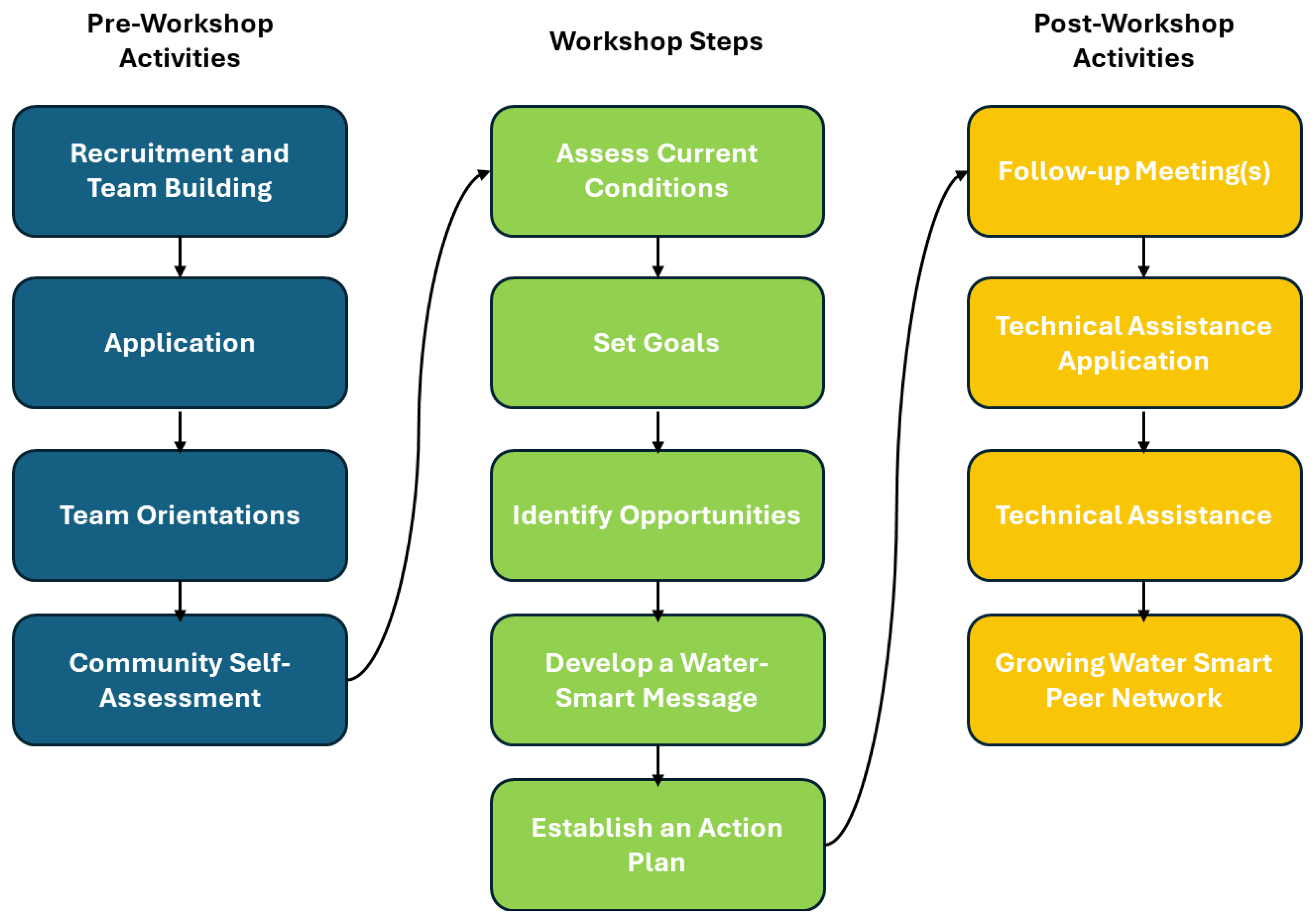
Once teams have been accepted, pre-workshop orientation sessions introduce the community’s full team to the GWS framework and expectations for the program. These sessions also introduce the community self-assessment, an in-depth inventory of a community’s existing water resources management and land use planning trends, programs, and policies that teams are asked to complete in advance of the workshop. This exercise helps identify strengths, gaps, and opportunities for progress in advance, setting the stage for meaningful discussions and goal identification in the workshop setting. The GWS program methodology is displayed in
Figure 1 below.
4.3.5. Follow-Up Support and Technical Assistance
GWS staff hold at least one post-workshop check-in call with community teams in the months following their workshop participation to provide ongoing support as teams work to implement their action plans. Often these calls provide updates on community actions taken since the workshop, help to troubleshoot roadblocks and adapt strategies as needed, and connect communities to existing resources. As funding allows, alumni communities are also invited to apply for technical assistance grants. Typically ranging from $10,000–$20,000 in value, these grants are intended to help sustain momentum by providing seed funding for actions identified or discussed during the workshop. Over 45 technical assistance grants have been administered as part of the GWS program since 2017; examples of projects include enhancing Water Resources Elements in Comprehensive or General Plans, updating landscape and zoning codes to enable more water smart practices, and developing metrics to support communities in reaching their long-range water demand reduction goals.
The GWS program also includes a Peer Network, intended to continue the sharing of best practices and case studies, and to build comradery among program alumni across various program regions. The GWS Peer Network offers ongoing opportunities for learning, collaboration, and resource-sharing and brings together expert presentations, case studies, and discussions on emerging challenges—fostering continued engagement and knowledge exchange among participants.
4.3.6. Workshop Evaluation
All participants of GWS workshops are asked to complete an anonymous evaluation upon completion of the workshop. In the evaluation, participants rank their amount of new knowledge gained from each workshop session; their level of change in knowledge on specific topics, such their understanding of water resource management and land use planning integration opportunities; and provide open-ended comments on aspects of the workshop that were most valuable, as well as those that could be improved. The evaluations are intended to capture participant perspectives and perceived sense of community readiness to act on water and land use issues following the workshop. GWS staff utilize the information provided in workshop evaluations to continuously hone the program’s curriculum and approach to meet program objectives.
There have been changes to the workshop evaluation questions over time to field participant responses to additional prompts, resulting in a lack of uniformity in the participant evaluation questions for all workshops since the program began. This is a limitation of the use of post-workshop evaluations as a source. However, the majority of questions have remained the same since the beginning of the program, providing a means to compare participant responses to many prompts over time. Evaluation questions were developed to address specific topic areas determined to be priorities by GWS staff when the program originated; this means responses include, but are not limited to, prompts regarding collaboration for the advancement of water resilience.
5. Case Studies of Cross-Boundary Collaboration
This section presents three case studies of GWS workshops that include jurisdictional and interdisciplinary collaboration in Colorado, Arizona, and across the US-Mexico border. Each case study section includes an overview and map of the region, key water and growth context, pre-workshop outreach and curriculum development, participant workshop evaluation responses, and detail regarding the collaborative outcomes to advance water resilience that were pursued following each workshop.
5.1. Case Study: San Luis Valley, Colorado
5.1.1. Overview
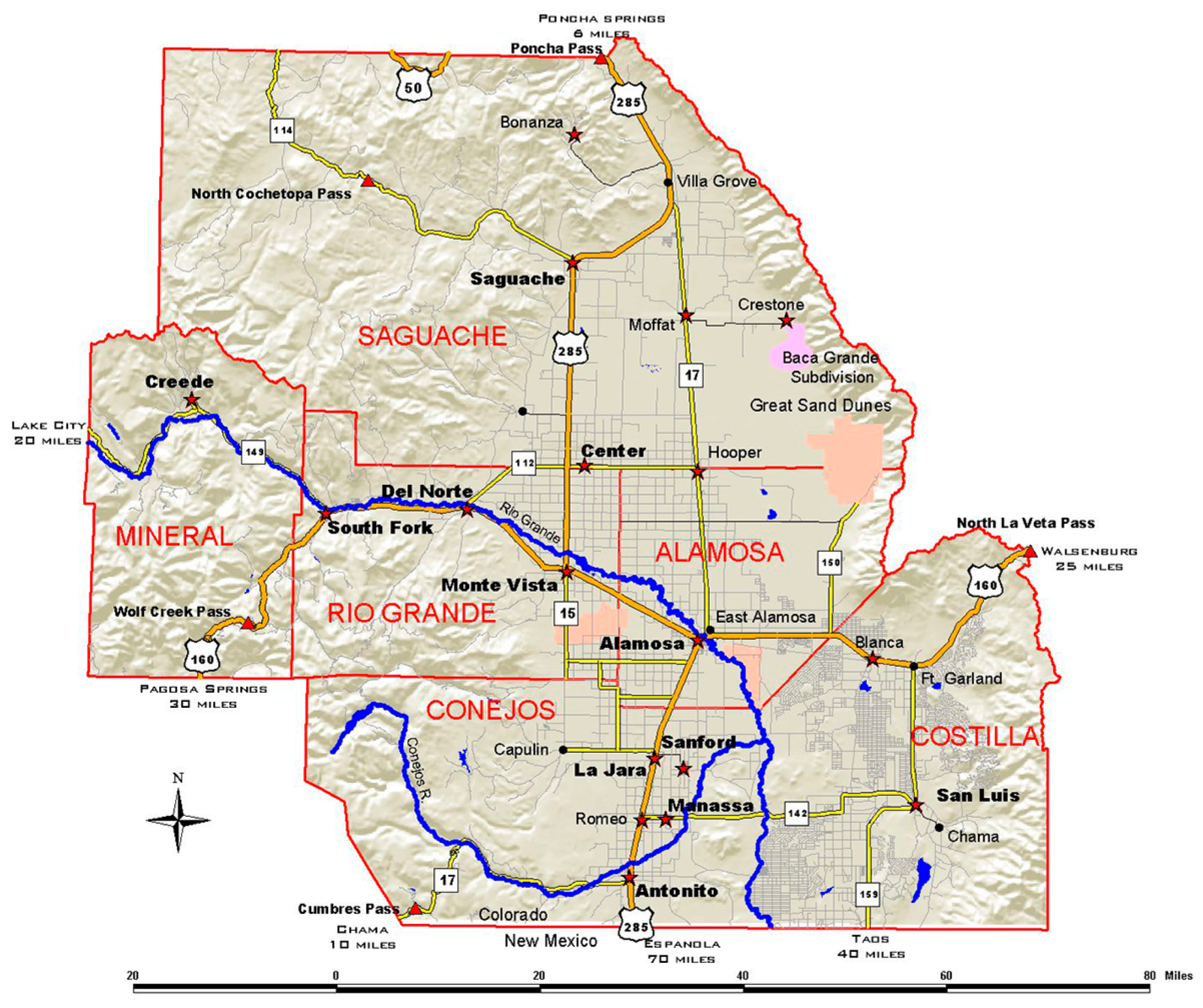
A GWS workshop was held in the San Luis Valley in Colorado in June 2022, with participating teams representing six counties in attendance: Alamosa County, Conejos County, Costilla County, Mineral County, Rio Grande County, and Saguache County. Each team was made up of local leaders from the county level, municipalities within that county, conservancy districts, non-profits, the San Luis Valley Council of Governments (SLVCOG), and regional and statewide subject matter experts. In total, the workshop included 43 participants.
Figure 2 below depicts a map of the San Luis Valley.
5.1.2. San Luis Valley Water and Growth Context
The San Luis Valley is a heavily agricultural region in the Rio Grande Basin that is home to approximately 46,000 people [
32]. It is supported by dwindling surface water supplies from winter snowpack and rapidly depleting groundwater sources, despite the efforts of agricultural water conservation programs [
33]. The Colorado Water Plan describes the Rio Grande Basin’s major water management concerns as “aquifer sustainability, maintaining and providing surface and groundwater supply for existing uses and new growth, and operating within the constraints of the Rio Grande Compact” [
29]. Through an exploratory scenario planning process, the Plan identified that most growth models indicated a moderate population increase, which would increase future water demand. The Plan also identified supply and demand gaps for the municipal and industrial sectors, with projections ranging from 3300 acre-feet to 7900 acre-feet by 2050. Further, a meta-analysis of the Comprehensive Plans of counties and municipalities in the San Luis Valley indicated that these communities have a clear interest in maintaining their agricultural economies [
29].
5.1.3. Pre-Workshop Outreach and Curriculum Development
Ahead of the San Luis Valley GWS workshop, Sonoran Institute partnered with Del Corazón Consulting to complete a policy scan and opportunities report identifying local and regional opportunities to protect water resources in the region. One of the identified areas of opportunity was for local governments to adopt coordinated 1041 regulations—powers provided to local jurisdictions in Colorado Revised Statute §§24-65.1-101, which give local governments the authority to review and approve or deny activities of statewide interest within their boundaries. As these regulations apply to areas including water, energy, and transportation projects, they can be used to regulate water infrastructure and transfer projects [
34]. The completed policy scan suggested that “rather than each county hiring a consultant to develop 1041 regulations, the counties could collaborate on the development of a high-quality regional model regulation that includes water projects and pays for the code integration into each community” [
35].
5.1.4. Workshop Curriculum: Jurisdictional and Regional Collaboration
In accordance with the standard GWS curriculum, each community in attendance developed a 12–18-month water resilience action plan with the guidance of facilitators. Case study presentations from the City of Fountain and Town of Pagosa Springs, representing regions of Colorado outside of the San Luis Valley, presented how these two communities had advanced the adoption of water conservation and efficiency programs and policies in their communities. These presentations were designed to provide the communities in attendance with concrete examples and insight into how to move their policy goals forward.
Additionally, the workshop was adapted to include a “Collaboration in the San Luis Valley” session, where communities discussed the major opportunities for regional collaboration identified through the pre-workshop policy scan process. These topics included: developing a Memorandum of Understanding to centralize resources for grant-writing, either through a grant template and/or hiring a grant writer whose services could be shared by all jurisdictions; creating a regional hydrologist position to address gaps in data, capacity, and resources at the local government and agency levels; and developing coordinated 1041 regulations to enable unified decision making among the jurisdictions regarding water export proposals.
Among these regional discussion topics, the concept of coordinated 1041 regulations had the most momentum coming out of the workshop. GWS staff who were present at this workshop attribute this to the presence of subject matter experts in the 1041 regulations discussion who had the appropriate legal backgrounds to approach this issue, as well as the opportunity to pursue technical assistance funding to bring this goal to fruition.
5.1.5. Participant Evaluation Responses
Of the 43 community participants who attended the workshop, 28 submitted evaluations, constituting a 65% response rate. When asked about the most valuable part of the workshop, responses addressed the following themes:
Collaboration and networking with key stakeholders (68%);
Developing tangible and action-oriented solutions and strategies (32%);
Addressing relevant or key issues in the community (16%);
Knowledge exchange (12%).
The majority of participant responses, 68%, pertained to inter-jurisdictional or regional collaboration opportunities. These responses included:
“Getting all the players together in a room and brainstorming.”
“Collaborating with peers, I think this event will result in better teamwork.”
“I feel the group sessions were valuable and [were a] good start to conversations we need to continue having.”
“The collaboration among my team and with the other [San Luis Valley] teams.”
“The peer to peer interaction, the six counties do not gather as often as we should.”
“City and County talking together.”
“The entire process—relationship building, understanding the issues and creating solutions together. Bringing all the Counties and Municipalities together.”
Participants were also asked to share how much knowledge they gained during the workshop regarding different topics, including several regarding inter-jurisdictional and regional collaboration and capacity-building. Evaluation responses are shown in
Table 1 below:
The most common response to “Understanding of best practices for collaboration across departments and jurisdictions” was a rating of “4–Learned a great deal of new info” with a 37% response rate.
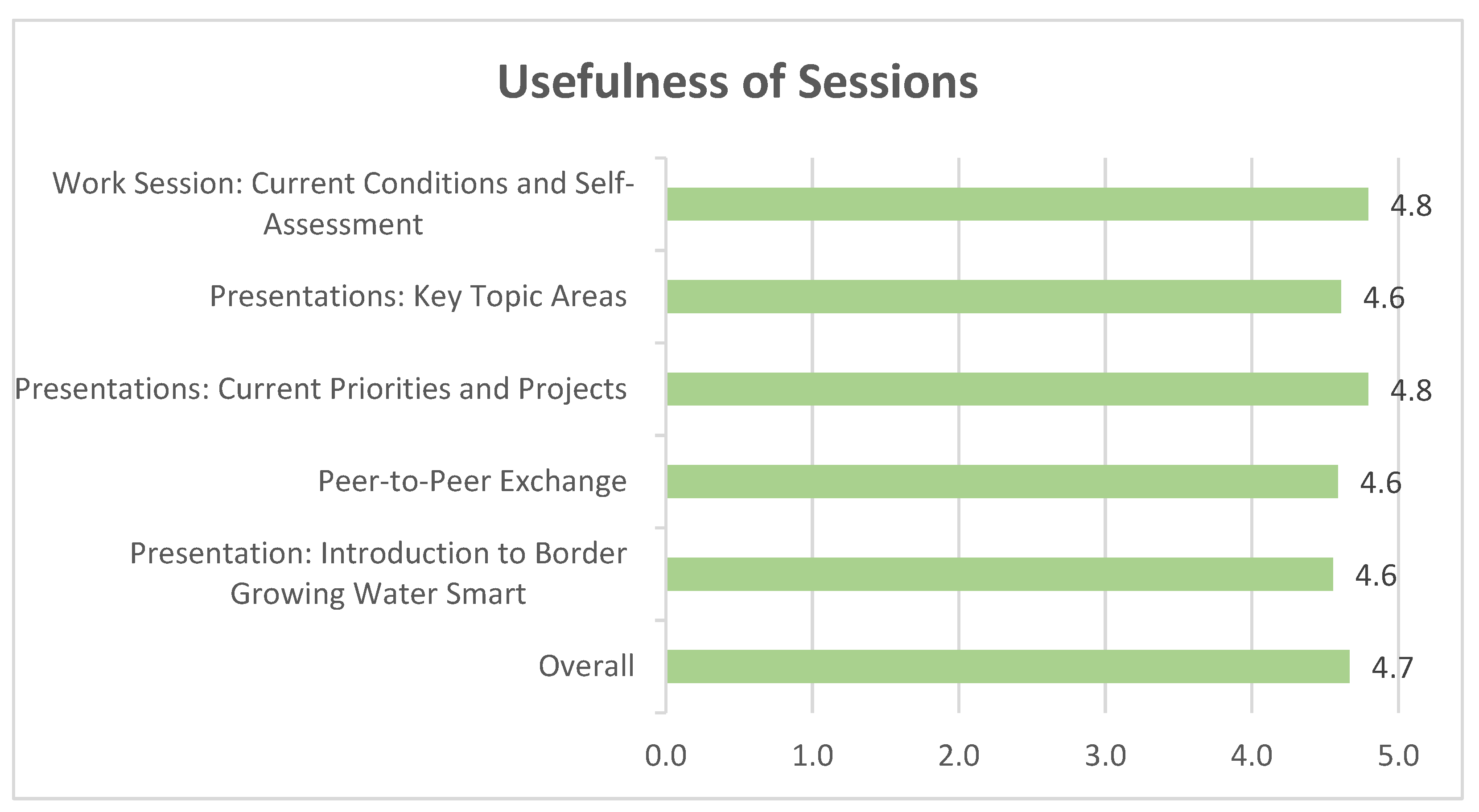
Group sessions that spurred regional collaboration were also highly rated; the average ratings for peer-to-peer exchange sessions, the “Regional Collaboration in the San Luis Valley” session, and an optional roundtable on 1041 regulations were rated on a score from “(1) Not At All Useful” to “(5) Extremely Useful.” Average participant responses for each of these group sessions rounded to a score of “(4) Very Useful.”
5.1.6. Post-Workshop Outcomes
Following the workshop, the SLVCOG applied on behalf of the six counties present at the workshop for a GWS technical assistance grant to coordinate the development of an intergovernmental agreement (IGA) and 1041 regulations aimed at protecting the region’s water from export out of the valley. The project began with a review of existing regulations, current land use and water quality data, and identification of regional priorities. This information was collected and synthesized based on meetings with local stakeholders, including counties dependent on the San Luis Valley aquifer, local water conservation and conservancy districts, non-profits, and public agencies.
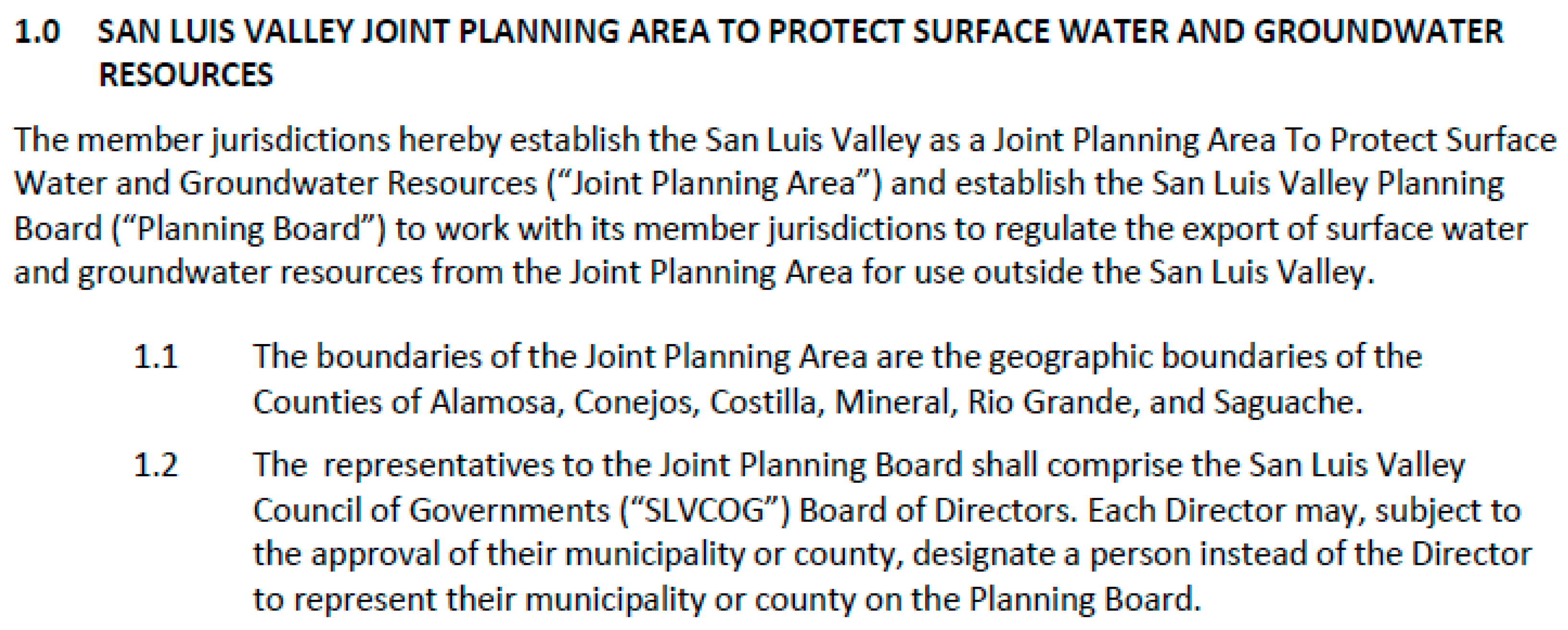
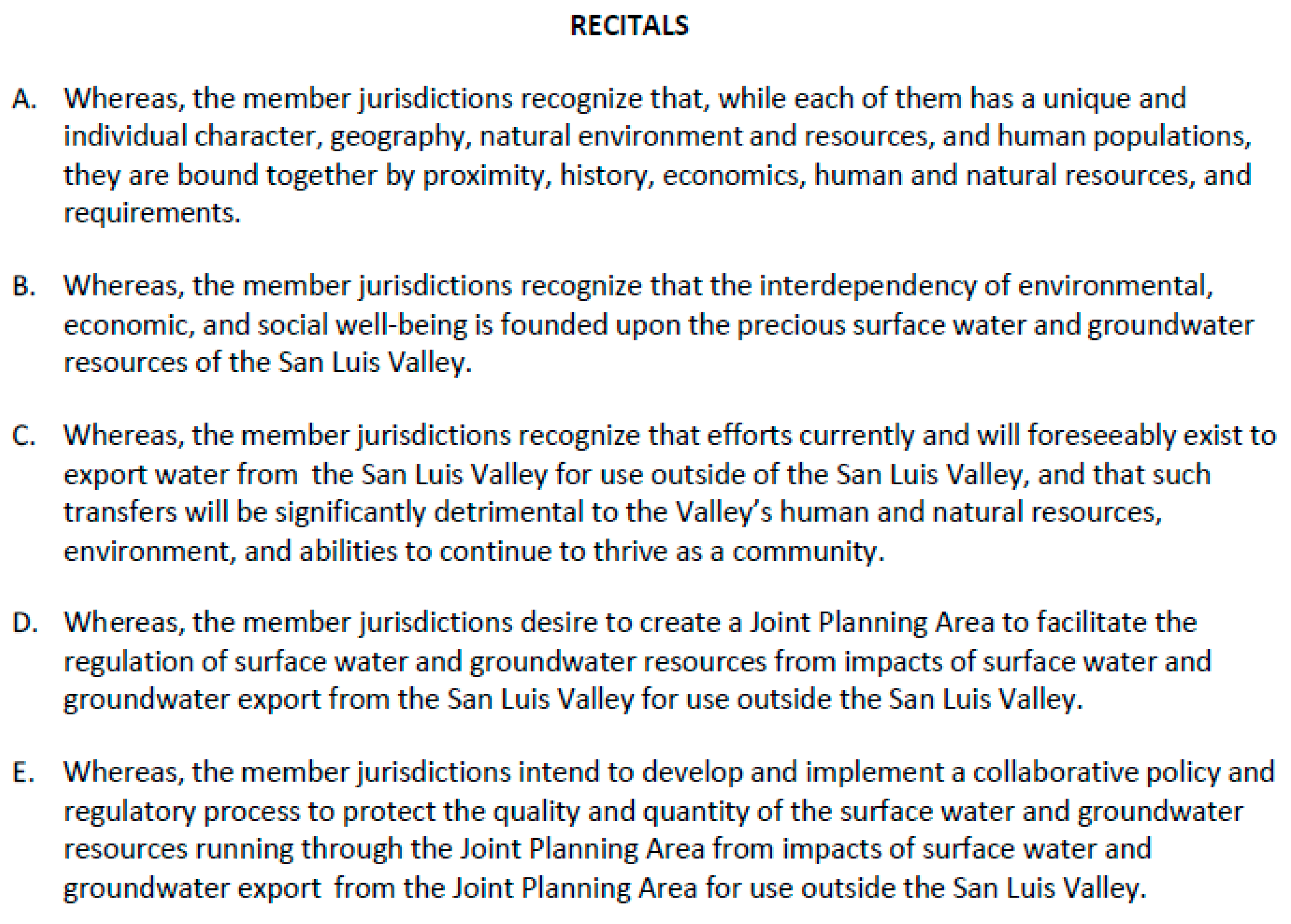
The SLVCOG and participating counties engaged a law firm, Sullivan Green Seavy and Jarvis LLC, to determine which statutory areas or activities of state interest were best suited to protect the aquifer from socioeconomic and environmental impacts. The firm then drafted and revised 1041 regulations for each participating county, as well as draft ordinances or resolutions for each jurisdiction to adopt these regulations. Key services included draft regulation and IGA language, legal support for jurisdictions considering adoption of 1041 regulations and entry into the IGA, and tracking of jurisdictions that formally adopted the regulations or joined the IGA. Excerpts of the draft recitals and IGA language are presented in
Figure 3 and
Figure 4 below to concretely demonstrate the collaborative output of the GWS workshop:
In a final deliverable for the GWS technical assistance grant, the SLVCOG stated, “this process and its outcomes demonstrated a strong, shared commitment to regional collaboration around the often-contentious issues of water quantity and quality. With the momentum and strengthened partnerships generated through this work, [San Luis Valley] communities—alongside SLVCOG—have continued exploring opportunities to build on this work. Notably, this was the first collaboration of its kind in Colorado and now serves as a model for similar regional efforts across the state.”
In 2024, the SLVCOG and Sullivan Green Seavy and Jarvis LLC were awarded the American Planning Association—Colorado Chapter award in the Growing Water Smart category, presented each year to a community demonstrating excellence in the advancement of water and land use integration. In the acceptance video for the award, Sarah Stoeber, Executive Director of the San Luis Valley Development Resources Group & Council of Governments, reflected:
“The key denominator was the desire to protect water from export from the San Luis Valley. Outside organizations had come in and made strong attempts to build infrastructure to export our water. The threat of losing what little water we already have became a huge concern for the livelihood of our entire region. This framework and the success that it exhibits is just the beginning of what we can do to not only protect the livelihood that we have here in the Valley, but to create more working groups and more efforts going forward, armed with the fact that we can now work together to collaborate on tough issues that are emotionally charged, and work through a lot of those to create a more vibrant and vital lifestyle for those that reside here in the valley.
It took a lot of patience. It took a lot of just working together and truly trying to understand instead of pushing our own thoughts onto other people, and that is the beauty of what this project created for us…Which has created a full circle, because the Growing Water Smart workshop is where this all began.”
Comments regarding the technical assistance project convey that the joint 1041 regulations were an outcome of regional collaboration discussions at the GWS workshop. Further, this process enforces the value of technical assistance funding to advance goals discussed at the workshop.
5.2. Case Study: Verde Watershed, Arizona
5.2.1. Overview
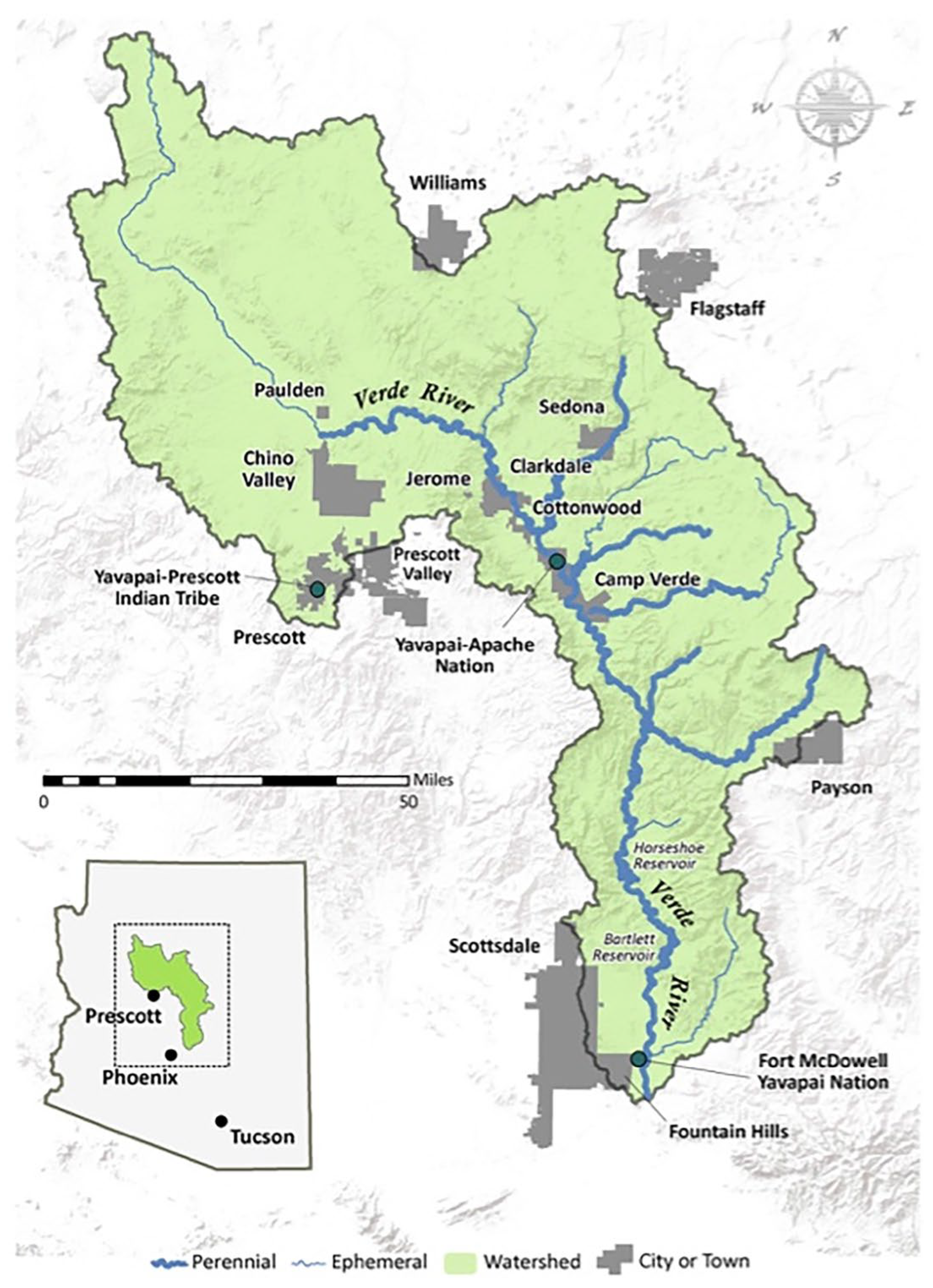
A GWS workshop was held in January 2025 in Clarkdale, Arizona for communities within central Arizona’s Verde Watershed. This region includes the Verde Valley, a sub-region within the watershed, while also encompassing additional geographical areas in the larger watershed. In total, the workshop consisted of 47 participants on six community teams representing the following municipalities and counties: the Towns of Camp Verde, Chino Valley, Clarkdale, Jerome, and Prescott Valley, and Yavapai County, which encompasses the other five communities.
Figure 5 below depicts a map of the Verde Watershed.
5.2.2. Verde Watershed Water and Growth Context
The Verde River begins with headwaters in Chino Valley and ends after flowing 192 miles southeast at its confluence with the Salt River. The watershed is also home to Arizona’s only two federally designated Wild & Scenic Rivers, the Verde River and Fossil Creek (a tributary of the Verde). Communities in the watershed include several municipalities, Yavapai County, and multiple Tribes.
One such Tribe, the Yavapai-Apache Nation, embarked upon resolving its water rights claims through the Yavapai-Apache Nation Water Rights Settlement Agreement, legislation that would confirm the Yavapai-Apache Nation’s rights to 6888.5 acre-feet of water per year [
36] while also “bring[ing] additional water rights to the Verde Valley, and help[ing] keep the Verde River flowing” [
37]. This agreement was first introduced to Congress in July of 2024 after a process that included decades of negotiation between the Yavapai-Apache Nation, neighboring jurisdictions, water providers, and other parties. While this legislation had not been ratified by Congress by the time the January 2025 GWS workshop occurred (and has not yet been ratified as of this writing), the process stimulated regional collaboration regarding water resilience in the Verde Watershed.
Parts of the Verde Watershed fall within the Prescott AMA—one of the initial AMAs that was provided specific groundwater regulations under Arizona’s Groundwater Management Act of 1980, and intended to prevent groundwater overdraft in the state’s most populous regions. The watershed has seen one of the fastest growth rates in the state in recent decades, as well as a great proliferation of unregulated new wells. This is true both outside of the Prescott AMA, where there are regulations for new wells, as well as within the AMA, where wells registered as “exempt wells” typically do not need to meet the groundwater regulations of the AMA framework. A 2020 Issue Brief published by ADWR reported that, of the five AMAs in existence at that time, the Prescott AMA has the highest density of exempt wells and “contains 30% of the exempt wells in all five AMAs but represents only 3% of AMA land area” [
38]. Simultaneously, the Verde River has seen a decrease in flow of 34% in the Upper Verde River and 41% in the Lower Verde River between 1990 and 2020 [
39].
5.2.3. Pre-Workshop Outreach and Curriculum Development
Outreach coordination meetings were held for several months in advance of the workshop among the Sonoran Institute, the Babbitt Center, The Nature Conservancy, and Southwest Decision Resources. Each of these partners brought a deep base of experience working on water and land use issues and/or specific expertise in the Verde Watershed, helping to cater the workshop to the unique context and create continuity between existing collaboration opportunities in the region. A key existing collaboration opportunity was the Sustaining Flows Council, a convening facilitated by Southwest Decision Resources and The Nature Conservancy, which brought together communities within the Verde Valley—a smaller sub-region within the Verde Watershed—to discuss water issues on a quarterly basis. Ahead of the GWS workshop, time was allotted at Sustaining Flows Council meetings to help prepare communities for the action planning process at the GWS workshop, including gathering input on priority regional collaboration opportunities and a case study presentation about the San Luis Valley’s GWS technical assistance project. Additionally, the pending Yavapai Apache-Nation’s Water Settlement Agreement built interest among some jurisdictions in the Verde Watershed in holding a regional GWS workshop. The Yavapai-Apache Nation was unable to commit to having a team attend the workshop; however, Chairwoman Tanya Lewis provided opening remarks at the event.
Three of the attending communities (Chino Valley, Prescott Valley, Yavapai County) are fully or partially within the Prescott AMA, while the rest are located outside of this regulatory framework. Regardless of their AMA status, the communities’ pre-workshop team applications, orientations, and community self-assessments all described a shared challenge of water demands exceeding supplies, whether presently or in the future. Other consistent challenges shared by communities were aging water infrastructure systems, lack of funding, lack of staff capacity, and stormwater quality.
The communities that fall within the Prescott AMA described additional challenges specific to the AMA framework. One participant described the challenge of exempt wells contributing to groundwater overdraft, citing close to 10,000 exempt wells and an overdraft of 20,000 acre-feet per year affecting the Upper Verde River [
38]. The communities within the AMA also described the challenge of addressing the demand for water to support new development due to “wildcat” lot splits. This phenomenon, widely considered to be a loophole of Arizona’s 1980 Groundwater Management Act, allows developers to build subdivisions without demonstrating a 100-year assured water supply within AMAs so long as there are six or fewer lots built in a given area. This results in significant increases in demand without ensuring that the checks in sufficient supply that were intended by the Groundwater Management Act are in place.
5.2.4. Workshop Curriculum: Jurisdictional and Regional Collaboration
GWS staff adapted the curriculum for this workshop to encourage and emphasize in-depth discussion of regional collaboration opportunities. The workshop’s opening context-setting session focused on implications of the Yavapai-Apache Nation Water Rights Settlement Agreement, with Yavapai-Apache Nation Chairwoman Tanya Lewis speaking to the significance of the agreement and the Nation’s desire for continued collaboration with the communities in attendance to pursue shared water resilience. Peer-to-peer exchange sessions throughout the workshop provided the opportunity for local leadership from each community to compare water resilience challenges and opportunities with their peers from across the region.
Additionally, a “Regional Collaboration” session was added to the curriculum, which presented four common themes that had been identified through a combination of participant input at a Sustaining Flows Council meeting prior to the workshop and in the workshop’s plenary and team work sessions. During this two-hour session, participants self-facilitated shared solutions to four categories of challenges, collaborating with their counterparts from the other community teams. The focus areas of these sessions were:
Water efficiency and conservation policies and incentives;
Water reuse and recycling infrastructure;
Stormwater and flood control policies and infrastructure;
Protecting and enhancing the watershed through regulatory and non-regulatory open space and natural area protection methods.
For each category, participants identified current and effective actions that could be scaled up, brainstormed new ideas to advance, and narrowed discussion to specific, actionable suggestions. In one instance, community members suggested collaborating on a regional water-wise landscape design manual, as similar climatic characteristics in the watershed would make one manual relevant and useful to several jurisdictions—saving the staff capacity and funding otherwise required to create several manuals independently. In another example, participants agreed to maximize the limited resources available to their staff by sharing a one-page communication document containing water-saving strategies for public consumption, which could then be adapted by individual communities as needed. Other outcomes included shared interest in a conservation easement campaign, establishing goals and setting policy standards for stormwater and flood control policies and infrastructure at the county level, and considering advocating as a region for greater investment in treatment for per- and polyfluoroalkyl substances (PFAS) at the state or federal levels. Several participants also expressed interest in Yavapai County being a convening body for ongoing collaboration on water issues in the watershed.
5.2.5. Participant Evaluation Responses
Anonymous evaluations were submitted by 34 out of 47 (72%) of participants. When asked about the most valuable part of the workshop, responses from participant evaluators addressed the following themes:
Collaboration within community teams or with other communities (67%);
Creation of an action plan (33%);
Gaining a better understanding of water issues and tools (10%);
Working with facilitators (3%).
A majority of participants described collaboration, whether within their own jurisdiction or with those from other jurisdictions, as the most valuable part of the workshop. Several of these responses also incorporated the value of having dedicated time to discuss water issues and getting to know those on their own team or in their region better. These responses included:
“Having the time to sit [with] other Council members & [department] heads & talk about a specific topic.”
“Being able to spend time with our town team to have in depth discussions.”
“Team collaboration and planning on projects, goals & outcomes. Putting schedule of steps on paper to get us to our goals. Bringing our team members together.”
“I came into this thinking it would be ‘just another workshop.’ It is probably one of the most productive and useful workshops I’ve attended in my 30+ years of public service. The time with peers was invaluable—we are all busy and this workshop gave us a chance to connect/reconnect and collaborate.”
“I enjoyed that our Town staff got to work together in ways we wouldn’t in our normal capacities. The approach to the conference with a clear, defined task list with designees & timelines was invaluable & extremely beneficial to our Town.”
Participants were also asked to gauge how much new, useful knowledge they gained during the workshop. Responses are shown in
Table 2 below:
The last three of these prompts gauged participants’ knowledge change regarding collaboration within and across jurisdictions. For these three prompts, at least 59% of respondents answered with the two highest scores, stating that they learned either “(4) A Great Deal of New Info” or “(5) New Info Beyond Expectations.” For the prompt regarding awareness of regional collaboration opportunities for water resilience, 84% of responses received a score of 4 or 5, indicating high participant satisfaction with the workshop’s collaborative components.
5.2.6. Post-Workshop Outcomes
The GWS program had funding to award technical assistance grants to two communities that attended this workshop: Yavapai County and the Town of Jerome.
Yavapai County was awarded funds to facilitate a regular, regional committee focused on water resources and open space for the Verde Watershed. This is intended to be a countywide effort that can further enhance multi-jurisdictional collaboration, with potential outcomes including the implementation of elements of the 2032 Yavapai County Comprehensive Plan regarding land use, water resources, and open space and preservation. The County outlines further potential outcomes of this facilitated body as developing a shared understanding and mapping of the complex hydrology throughout the county, as well as supporting the completion of a county-wide Open Space Plan. Yavapai County ties these outcomes back to goals that were identified at the Verde Watershed workshop. These goals include reconvening the Water and Open Space Committee, a dormant convening body that had previously served as a space for this inter-jurisdictional work, and encouraging and supporting conservation efforts.
Technical assistance support for Yavapai County is intended to sustain momentum from the workshop and provide space for the workshop’s dialogue and action planning from the regional collaboration discussions to continue. Supporting facilitation for this effort is also intended to mitigate the strain on staff and fiscal resources experienced by the local governments, while the regular convening by a broader entity ensures that water resilience strategies continue across jurisdictional borders.
In the words of a Town of Jerome GWS participant, Town staff face the predicament that “Jerome is the second smallest incorporated town/city in the State of Arizona yet must maintain our Town that sees millions of visitors annually.” Despite a population of only 457 in 2024, Jerome is a tourism magnet in Arizona due to its historic charm and features related to the copper mining boom. The technical assistance grant will be utilized to hire a consultant—helping to close the Town’s gap in staff capacity for these efforts—to address the water and land use nexus policy gaps identified in the process of completing the GWS community self-assessment. Deliverables include the completion of an updated landscape and streetscape design manual for the Town that incorporates low water use principles.
5.3. Case Study: Douglas, Arizona & Agua Prieta, Sonora, Mexico
5.3.1. Overview
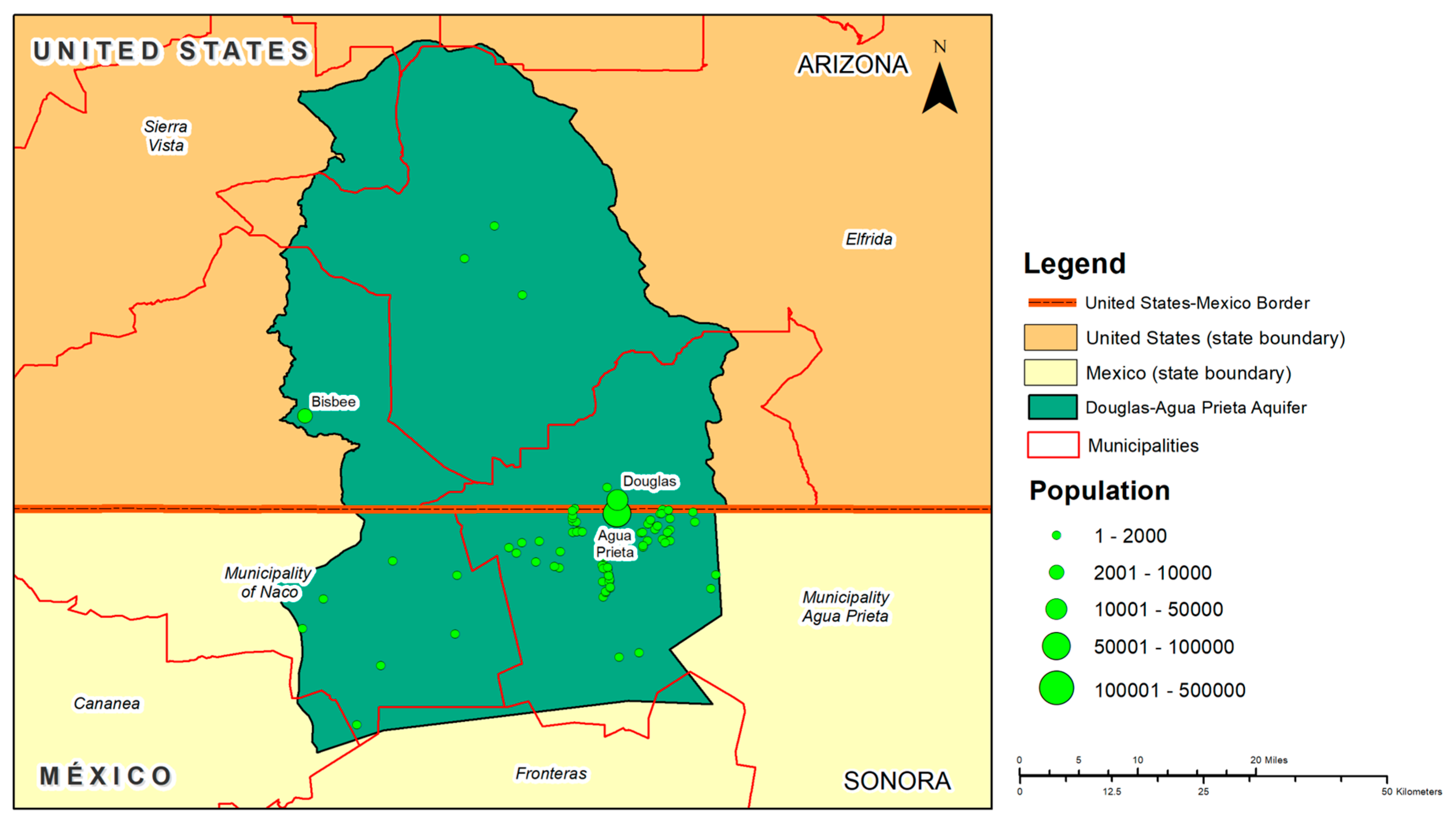
A US-Mexico border GWS workshop was held between the sister cities of Douglas, Arizona and Agua Prieta, Sonora, Mexico in June 2025 in Douglas. The workshop departed from traditional GWS curriculum that invites several community teams to the workshop by focusing on the sister city pair, which shares the cross-border Douglas-Agua Prieta aquifer. This workshop centered around the two cities and their staff, while also including additional stakeholders from county, state and regional authorities, federal agencies, water users’ associations, private sector entities, and leaders in academia. In total, the workshop included 47 participants representing agencies from Douglas and Agua Prieta and across the broader Arizona-Sonora region. The location of these cities, their populations, and the shared Douglas-Agua Prieta Aquifer are illustrated in
Figure 6 below.
5.3.2. Douglas-Agua Prieta Water and Growth Context
Located in southeast Arizona, Douglas is a small city with a population of approximately 16,071 that is expecting new growth in the coming decades [
40]. This anticipated growth is primarily due to new large-scale infrastructure projects being constructed in the area, including a Port of Entry, which is expected to drive greater access across the border as well as growing commerce. Just across the border sits Agua Prieta, Sonora, a much larger city with approximately 91,929 residents that is also steadily growing [
41].
Douglas and Agua Prieta are both largely dependent on groundwater from the transboundary Douglas-Agua Prieta aquifer [
42], which supports over 115,000 people. Groundwater levels in the aquifer are being depleted by significant cross-border commerce, manufacturing, and agriculture [
42], and population growth in both sister cities is expected to place a further strain on water supplies. In 2022, the Douglas AMA was established by popular vote in an election open to Cochise County residents, bringing new groundwater regulations to the Douglas Groundwater Basin on the US side of the border [
43]. Wastewater is also shared between the two cities, as high-quality, treated effluent from the Douglas Wastewater Treatment Plant flows across the border into Agua Prieta.
Previous collaborative efforts between stakeholders on both sides of the border have included the Transboundary Aquifer Assessment Program (TAAP). Formally established in 2009, the TAAP authorized the US Geological Survey and the Water Resource Research Institutes of Arizona, New Mexico, and Texas to formally collaborate with Mexican counterparts on aquifer assessments across the border [
42]. This process has provided valuable information in terms of evaluation of shared groundwater resources. However, despite ongoing depletion of the shared aquifer, there is currently no active, formal mechanism for collaborative management of this transboundary resource.
5.3.3. Pre-Workshop Outreach and Curriculum Development
Prior to the workshop, representatives from both cities described the management and reuse potential for wastewater effluent flows from Douglas into Agua Prieta as both a challenge and potential area of opportunity for future collaboration. The City of Douglas had previously participated in the January 2024 Arizona GWS workshop in Phoenix, where an outcome of the team’s participation was an interest in diversifying their water supply by considering use of the city’s wastewater effluent locally, rather than sending this water across the border into Mexico. By early 2025, Douglas was undertaking a feasibility study to determine possible local uses for these effluent flows, with the understanding that significant changes would first need to be discussed with Agua Prieta. Agua Prieta described aging and degraded water distribution infrastructure as a challenge, leading to a significant portion of the treated wastewater becoming contaminated shortly after crossing the border.
In preliminary context-setting conversations, leadership from both cities recognized the importance of cross-border collaboration around shared issues and opportunities related to water resources management. However, it was acknowledged that communication between the two cities regarding water had been mostly informal in recent years, and its effectiveness had dwindled due to staffing and capacity issues. The City of Douglas also experienced significant staff turnover after its previous participation in the Arizona GWS workshop in January 2024, and early communications between GWS staff and the City indicated that Douglas would welcome a workshop more explicitly focused on cross-border collaboration.
Ahead of the workshop, GWS staff identified key water and land use managers from both cities who brought forward a critical understanding of the context and championed their cities’ participation in the workshop. Additional participants representing organizations from across Arizona and Sonora more broadly were invited to join the workshop due to their vested interest, expertise, and insight related to water resources management and land use planning in this region.
5.3.4. Workshop Curriculum: Jurisdictional and Binational Collaboration
This one-day workshop followed an adapted version of the traditional GWS curriculum, as materials and sessions were modified to meet the needs of cross-border communities. These adjustments included making the workshop bilingual, with simultaneous interpretation available in both English and Spanish; broadening team composition to be inclusive of participants from agencies beyond solely city or county government; and providing participants with border-specific information and tools in plenary sessions. In addition, the development of curriculum for this workshop considered how decision-making structures and processes for water and land use in Mexico vary from those in the US.
The workshop curriculum included the opportunity for the leadership of each municipality to present their key ongoing projects, highest priorities, and future aspirations regarding water and land use planning. This session provided an opportunity for direct communication between the two cities in a structured and facilitated setting, including time for questions and answers from other regional stakeholders. Both cities focused on shared wastewater effluent flows and binational aquifer management as key issues and opportunity areas warranting creative and collaborative solutions. Additional presentations provided topical information relevant to both cities’ aspirations: researchers from the Universidad de Sonora and University of Arizona highlighted the Douglas-Agua Prieta aquifer as a priority aquifer for protection and investment within the region, and brought forth key information regarding the depletion of its groundwater levels [
42]. Further, research from the School of Transborder Studies at Arizona State University described cross-border green infrastructure master planning in the sister cities of Nogales, Arizona and Nogales, Sonora, and included recommendations for how to pursue similar planning processes in the Douglas-Agua Prieta region.
Following these presentations, participants were divided into two breakout groups, centering on each city. Teams were instructed to discuss their current conditions and opportunities for integration of water resources management and land use planning in greater depth and then embarked upon the action planning portion of the workshop. Each team’s composition was designed so that the “champion” organizations critical to water and land use for each city were present but also included other stakeholders from across the region who were able to provide key input related to state and regional regulations, ongoing initiatives, and available resources.
The Douglas team focused on expanding and building upon the action plan that had previously been developed by City staff at the January 2024 Arizona GWS workshop, while simultaneously considering current goals and leveraging new initiatives. The team’s work in this session prioritized addressing the management of the wastewater effluent flows currently being sent from Douglas into Mexico, including preparing to consider approaches to utilizing the City’s wastewater effluent locally rather than sending it across the border. The session identified actions that would build on the results of a pending wastewater effluent feasibility study—the results of which were expected a few months after the workshop—by seeking support for funding, permitting, and recharge credits from relevant binational and Arizona state parties. Additionally, the team created action items to consult with Tucson Water and Pima County to learn from examples of successful reuse projects elsewhere in southern Arizona.
The Douglas team also developed a goal to improve local and binational aquifer management, including by considering green infrastructure options that could be supported by funding agencies like the North American Development Bank (NADBank), and stormwater capture and recharge options through collaboration with Cochise County (the entity leading local stormwater management efforts). Communication also arose as a key action area, and action items were developed including coordinating official correspondence with Agua Prieta regarding water resources with support from the International Boundary and Water Commission (IBWC).
The Agua Prieta team, which included stakeholders from el Organismo Operador Municipal de Agua Potable, Alcantarillado y Saneamiento de Agua Prieta (Agua Prieta’s water, sewer, and sanitation utility), el Organismo de Limpia Descentralizado (Agua Prieta’s decentralized cleaning agency), the Agua Prieta City Council, and from Sonora more broadly, developed high-level goals for water management in Agua Prieta. These focused on the importance of managing wastewater effluent flows coming from Douglas into the city to make the best use of currently available water, while also recognizing that Douglas was working to utilize this resource locally instead of sending it across the border. Further, the team discussed the importance of infrastructure improvements that would keep the high-quality treated water entering their system separated from sewage to reduce the quantity of contaminated flows. Relatedly, the team developed a goal regarding the consideration of a phased approach to replace outdated infrastructure and achieve tangible improvements in water quality and distribution with support from the Comisión Internacional de Límites y Aguas (CILA), which serves as the Mexican Section of the IBWC.
In addition, the Agua Prieta team developed a goal regarding formalized processes and internal regulations for inter-agency coordination within the city. These regulations would mandate official communication between agencies, serve to improve operational efficiency and communication, and streamline authorization processes for water projects.
After the work session, each sister city team selected a volunteer who presented a summary of their discussion in a plenary session. This short recap allowed participants of both teams to understand what their counterparts had discussed and set the stage for continued cross-border communication and collaboration.
5.3.5. Participant Evaluation Responses
A bilingual evaluation was provided to all participants who attended the workshop. Of these 47 participants, 29 submitted evaluations, constituting a 62% response rate. When asked about the most valuable part of the workshop, responses addressed the following themes:
The facilitated team work sessions (34%);
Knowledge exchange/exchange of experiences between communities across the border (28%);
Presentations, including the Nogales case study (24%);
Contact-building and networking (17%);
Well-rounded/all valuable (3%).
The most common theme among responses was the facilitated team work sessions, followed by comments about knowledge exchange of experiences between communities across the border. Comments pertaining to the exchange of community experiences across the border often referenced increased collaboration binationally as well as within individual teams. Such comments included:
“The goal of understanding the needs of the neighboring city of Douglas and to present our own needs, in order to truly understand the current situation and determine how we can improve together.” [Translated from Spanish].
“The power of connecting/sharing knowledge. Bringing two countries together to discuss smart water was such a powerful experience.”
“The exchange of information between the different entities that participated.” [Translated from Spanish].
“The most valuable aspect was the exchange of experiences and the support that each of our organizations can receive from one another.” [Translated from Spanish].
Participants were also invited to provide testimonial quotes regarding their experiences. Several of these quotes spoke to regional collaboration:
“The Growing Water Smart workshops are exceptional in terms of the information provided, interdisciplinary collaboration, problem-solving, and identification of actions and stakeholders that can help improve smarter water use. Through these workshops, communities are brought together, and common goals are identified.”—Dr. Elia Tapia, Professor, University of Sonora [Translated from Spanish].
“GWS has opened doors/paved the way for the City [of Douglas] and Agua Prieta to partner on water issues that are critical for our shared use of the Douglas Basin/Aquifer.”—Ana Urquijo, City Manager, City of Douglas, Arizona.
This evaluation did not assess the perceived knowledge change among participants for various topics. However, participants were asked to rank the usefulness of each of workshop sessions from 0 to 5 (with 1 indicating “Not at all Useful” and 5 indicating “Extremely Useful”). Responses are shown in
Figure 7 below:
The team work session, which was titled “Current Conditions and Self-Assessment,” as well as the presentations on current priorities and projects were the most highly rated workshop sessions—each receiving a rating of 4.8. All workshop sessions received an average rating of 4.6 or higher.
5.3.6. Post-Workshop Outcomes
Two major themes for future collaborative binational work in Douglas-Agua Prieta were expanded upon and advanced at the workshop: strategic use of effluent crossing the border from Douglas to Agua Prieta, and collaborative management of the binational Douglas-Agua Prieta aquifer.
First, the convening allowed an opportunity for direct discussion about each community’s relationship to the effluent crossing the border. While Douglas was interested in exploring use of its effluent as a supply locally, the City was also aware that a change to the long-standing arrangement of sending effluent across the border could potentially be detrimental to Agua Prieta. However, discussions during the workshop revealed that due to degraded infrastructure, when the treated effluent arrived in Agua Prieta it almost immediately mixed with raw sewage—making it only minimally useful after that point. One participant at the workshop estimated that only 20% is utilized before contamination occurs, with the rest causing downstream challenges. In fact, workshop discussions illuminated that Douglas’ use of this water would potentially provide relief to Agua Prieta by reducing the volume of water coming across the border and becoming contaminated. At the same time, Douglas could redirect its effluent to be used for outdoor irrigation, while also using it as temporary water during the construction of the Port of Entry, both of which reduce strains on the groundwater aquifer and help close Douglas’ water supply and demand gap.
Second, while there is recognition on both sides of the border of the need to collaboratively manage and safeguard the shared Douglas-Agua Prieta aquifer—particularly while populations continue to grow—there is currently no formal mechanism for shared management practices. At the workshop, both cities recognized a need to work in conjunction with one another, and with additional support from state and federal agencies like the ADWR and IBWC/CILA, to develop formal communication channels to initiate and continue this work.
In the months following the workshop, collaboration initiated by the in-person convening continued, and goals were advanced by both communities. Douglas’ wastewater effluent feasibility study was completed, with results indicating that the best route forward would include using wastewater effluent locally for outdoor irrigation in parks and golf courses as well as for Port of Entry construction. However, the total available quantity of wastewater would exceed these needs, and it was determined to be suitable that the excess effluent flows would continue to flow southward into Agua Prieta. Using this information, and with permission from the IBWC, formal communications were sent in the form of a letter from the City Manager of Douglas to the Presidente Municipal (Mayor) of Agua Prieta, describing Douglas’ short-term plan for use of wastewater effluent during the Port of Entry construction and longer-term plan for local reuse. Agua Prieta responded positively to these communications, describing the beneficial impacts of this decrease in wastewater effluent flows. The two cities have since continued formal communications regarding both shared and individual conservation goals.
As of this writing, Douglas and Agua Prieta are also working collaboratively to communicate with funding agencies such as NADBank to build support to finance Agua Prieta’s own wastewater treatment plant. Douglas has also donated equipment from its wastewater treatment facility to aid Agua Prieta’s short-term generation of wastewater effluent. Further, Agua Prieta is in the process of obtaining permissions from the Comisión Nacional del Agua, the Mexican National Water Commission, to develop new and improve existing infrastructure that will better convey and store inbound wastewater effluent flows from Douglas.
6. Cross-Case Outcomes and Recommendations
These case studies point to several common outcomes of the GWS program process, many of which align with key Collaborative Water Governance and Adaptive Water Governance principles. Recommendations presented in this section have been identified and described in this section through the GWS team’s direct experience and observation. The following outcomes may be considered as recommendations to support additional communities in benefitting from inter-jurisdictional and inter-disciplinary collaboration to advance water resilience.
6.1. Facilitated Convenings Can Establish or Increase Communication Between Jurisdictions, Empowering Decision-Makers to Advance Water Resilience
In the example of Douglas and Agua Prieta, municipal staff charged with managing water utilities from both communities were able to connect directly through the GWS workshop to better understand one another’s relationship to shared wastewater effluent flows. This open communication in a structured, facilitated setting reduced a perception of potential conflict over the effluent, and helped Douglas to better understand its options for reusing the effluent locally, without harming Agua Prieta. Similarly, the San Luis Valley workshop allowed several counties to coalesce around a shared opportunity to safeguard regional water resources through coordinated 1041 regulations. This process and its outcomes, in the words of the SLVCOG Coordinator, “demonstrated a strong, shared commitment to regional collaboration around the often-contentious issues of water quantity and quality.” Additionally, the regional convening of jurisdictions within the Verde Watershed emerging after the GWS workshop shows promise to replicate this regional collaboration model for water resilience in Arizona.
6.2. Third-Party Conveners Can Help Fill Gaps in Capacity Among Local Governments, Providing Dedicated Time, Structure, and Facilitation to Advance Water Resilience Solutions Across Jurisdictions and Disciplines
A key challenge reported by communities that participate in the GWS program is a lack of staff capacity to advance water resilience goals. This can manifest in several ways, including: a lack of necessary or qualified staff, staff in local government taking on a range of responsibilities typically covered by multiple positions, loss of institutional knowledge when long-standing employees retire, or immediate and short-term needs taking precedence over longer-term challenges like water scarcity. Participant evaluations from each of the three case studies frequently expressed that having dedicated and structured time to discuss water resilience—both within and beyond their jurisdictions—was one of the most valuable parts of the GWS workshop. To support local governments that are often already stretched thin, third-party organizations like Sonoran Institute and its partners can act as conveners and provide structure and facilitation for collaborative discussions. Organizations in this role can help ensure that the rare opportunity for interdisciplinary, jurisdictional teams to plan water resilience actions is time well spent.
6.3. Resource and Knowledge Sharing Across Jurisdictions Can Help Communities Advance Water Resilience Strategies Despite Gaps in Capacity or Funding
All three case studies reflected the benefit of communities sharing resources and knowledge to collectively advance water resilience goals. Further, the case studies demonstrated the benefit of pursuing resources collaboratively, when possible, rather than developing or funding similar projects individually. This included the development of shared communications materials encouraging water conservation in the Verde Watershed, working in tandem with a single law firm to draft each community’s 1041 regulations in the San Luis Valley, and Douglas and Agua Prieta undertaking collaborative approaches to seek funding from financers such as NADBank. In these cases, interjurisdictional collaboration saves staff time and resources while sharing valuable knowledge and expertise, leading to more impactful materials or proposals. Resource and knowledge sharing can be especially impactful for small communities with few government staff, or when state and federal funding opportunities are limited. Additionally, economies of scale can be achieved among jurisdictions that share natural resources or have similar features. For instance, similar climatic characteristics across the Verde Watershed present an opportunity for communities to pursue a regional landscape design manual, rather than a separate manual being developed by each jurisdiction.
6.4. Enabling Policy at the State Level Can Have Profound Implications for Facilitating Collaboration at the Local Level
The Colorado Water Plan introduced a time-bound imperative for water resources management and land use planning integration—setting a goal that by 2025, 75% of Coloradans would “live in communities that have incorporated water-saving actions into land-use planning” [
29]. Having this goal at the state level propelled Colorado state and water provider interest and investment in building capacity for municipalities and counties to adopt water resources management and land use planning integration strategies. In so doing, it helped drive the establishment and growth of a program like GWS to help meet the statewide goal. In other contexts across the Southwestern US and Northern Mexico, similar legislation could have significant impacts in advancing water resources management and land use planning integration strategies. Similarly, Colorado Revised Statute §§24-65.1-101 established the ability for local communities to collaborate under 1041 regulations, with delegated authority beyond the scope of what land use authorities would normally manage. The nature of this state-level legislation in Colorado enabled regional collaboration among a variety of cities and counties. Local governments in states with similar authorities may also be able to leverage these powers to stimulate regional collaboration around key water and land use issues.
6.5. Post-Workshop Follow-Up and Funding Help Ensure That Collaboration Across Disciplines and Jurisdictions Continues Beyond the Workshop Setting
GWS workshops have resulted in key knowledge-sharing regarding how communities can coordinate around water resources collaboratively, as in the case study of Douglas and Agua Prieta. At the same time, communication and coordination must continue beyond the workshop setting for water resilience goals to be achieved. As demonstrated in the San Luis Valley case study, the follow-up GWS technical assistance grant awarded to pursue coordinated 1041 regulations—paired with ongoing facilitated discussions in the region over the course of a year—were key to the San Luis Valley’s success, resulting in the first IGA to provide shared protection of a natural resource in Colorado. Similarly, GWS technical assistance awarded to provide continued facilitation among the Verde Watershed communities is intended to help maintain momentum to reach goals discussed during the workshop. Communities’ participation in the workshop is a fundamental first step toward cultivating regional collaboration around key water resource and land use issues. However, the value of ongoing follow-up support and technical assistance funding cannot be understated, as it is critical to enabling jurisdictions to achieve their water resilience goals over the long term.
6.6. Collaboration Across Disciplines Results in More Robust Water Resilience Action Plans, Integrating Water Resilience Actions into Several Jurisdictional Departments and Generating Widespread Buy-In
The traditional separation of water resources management and land use planning means that bringing these disciplines together can result in significant knowledge-sharing and greater efficiencies. The GWS program’s interdisciplinary approach—which brings together not only water resources management and land use planning, but also fields such as parks and recreation, public works, economic development, and public policymaking—helps communities pursue many strategic levers outside of traditional water resources management to combat water scarcity. For instance, GWS teams often incorporate outdoor landscape code updates into their action plans to systematically reduce water consumption for entire categories of development, or include economic development specialists in their discussions to ensure that water resilience is a leading factor in the type of growth they attract to the community. This team structure also bridges together policy-oriented disciplines (e.g., planning and public decision making) and technical and hands-on disciplines (e.g., park management and wastewater treatment supervision), helping to fill in critical knowledge gaps that can arise between these fields. Additionally, the inclusion of team members with roles beyond water resources management builds capacity by embedding water resilience as a responsibility of several departments rather than only one, and creates broader buy-in for the action plan—increasing the likelihood that plan actions will be implemented and goals will be accomplished following the workshop. Participant evaluation responses for each of the three case studies reflected that the time spent intentionally working with other disciplines in their dedicated team work sessions was a novel and lasting benefit of their attendance.
7. Conclusions
The GWS program has brought teams representing local governments together to collaborate across jurisdictions and disciplines, resulting in knowledge-sharing, capacity-building, and sustained momentum for jurisdictions to pursue their water resilience goals. The program incorporates principles of Collaborative Water Governance, Adaptive Water Governance, and related emerging frameworks—addressing water management and governance by involving relevant stakeholders at several levels, supporting local collaboration and knowledge-sharing, and building support for joint participation in policymaking and implementation. Case studies of the GWS program in the San Luis Valley of Colorado, the Verde Watershed of Arizona, and across the US-Mexico border between Douglas, Arizona and Agua Prieta, Sonora, Mexico demonstrate the adaptability of the program to find success in a range of geographic contexts and across a range of “borders”: between disciplines, among jurisdictions within distinct regions, and across an international border.
This paper presents common themes from GWS from a range of sources, including GWS program materials (pre-workshop policy scans, community self-assessments, participant workshop evaluations, technical assistance reports), direct participant quotes, and GWS staff perspectives. The authors find that there are common challenges faced among local jurisdictions in pursuing water resilience strategies, as well as successful methods that can support communities to make progress despite these challenges. The common challenges of isolation between departments within jurisdictions, low staff capacity, and lack of funding may be mitigated through solutions described in this paper. These solutions include: resource and knowledge sharing among jurisdictions and between disciplines; structured, facilitated dialogue by a third-party convener; enabling policy at the state level; and sustained funding for projects or convenings that advance regional collaboration on water resilience. Such strategies can support local jurisdictions in advancing water resilience in the Southwestern US, Northern Mexico, and beyond.