Intelligent Safety Monitoring of Reservoir Slopes: A Multi-Point Deformation Prediction Approach Considering Spatiotemporal Lag Effects




Abstract
1. Introduction
- (a)
- A constrained lag-aware clustering method is proposed, which explicitly incorporates deformation response lags into similarity computation. The MIC is utilized to estimate the lag time of each monitoring point relative to water level fluctuations and rainfall. The maximum lag is then employed as the global constraint for DTW alignment paths, and the distance matrix is constructed for improved clustering.
- (b)
- A DTW-similarity-weighted MOGP modeling approach is developed. A weight matrix is constructed using DTW distances and embedded into the MOGP kernel function to account for heterogeneous deformation responses among monitoring points. This modification enhances the joint covariance structure of multiple outputs, enabling more accurate spatial modelling and inter-point information transfer.
- (c)
- The proposed LAC-MOGP model is applied to multi-point deformation prediction of reservoir bank slopes. Comparative experiments with traditional methods demonstrate that the proposed method yields higher predictive precision long-term stability, demonstrating its practical viability for field monitoring scenarios.
2. Model Development
2.1. MIC-Based Estimation of Temporal Lag
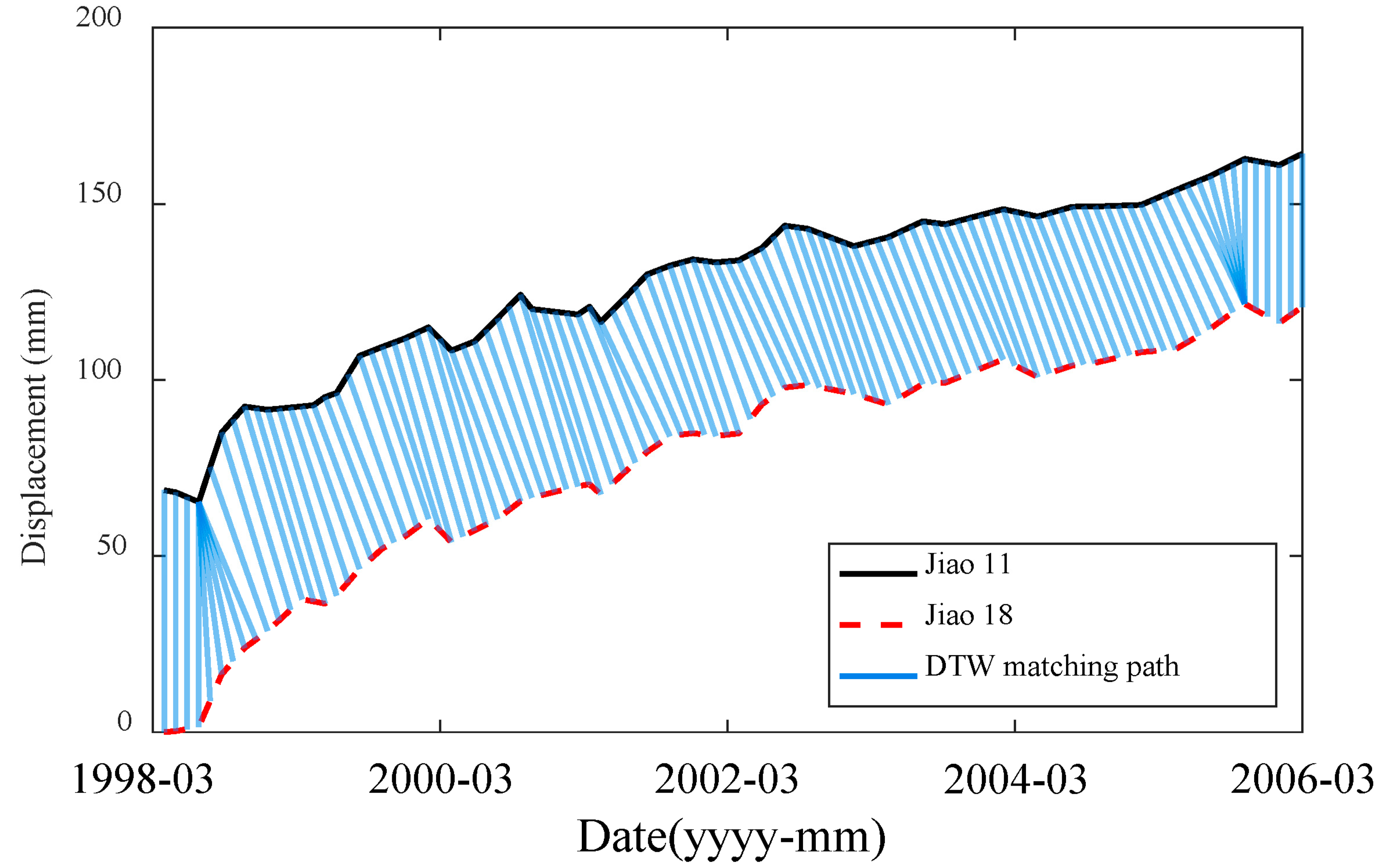
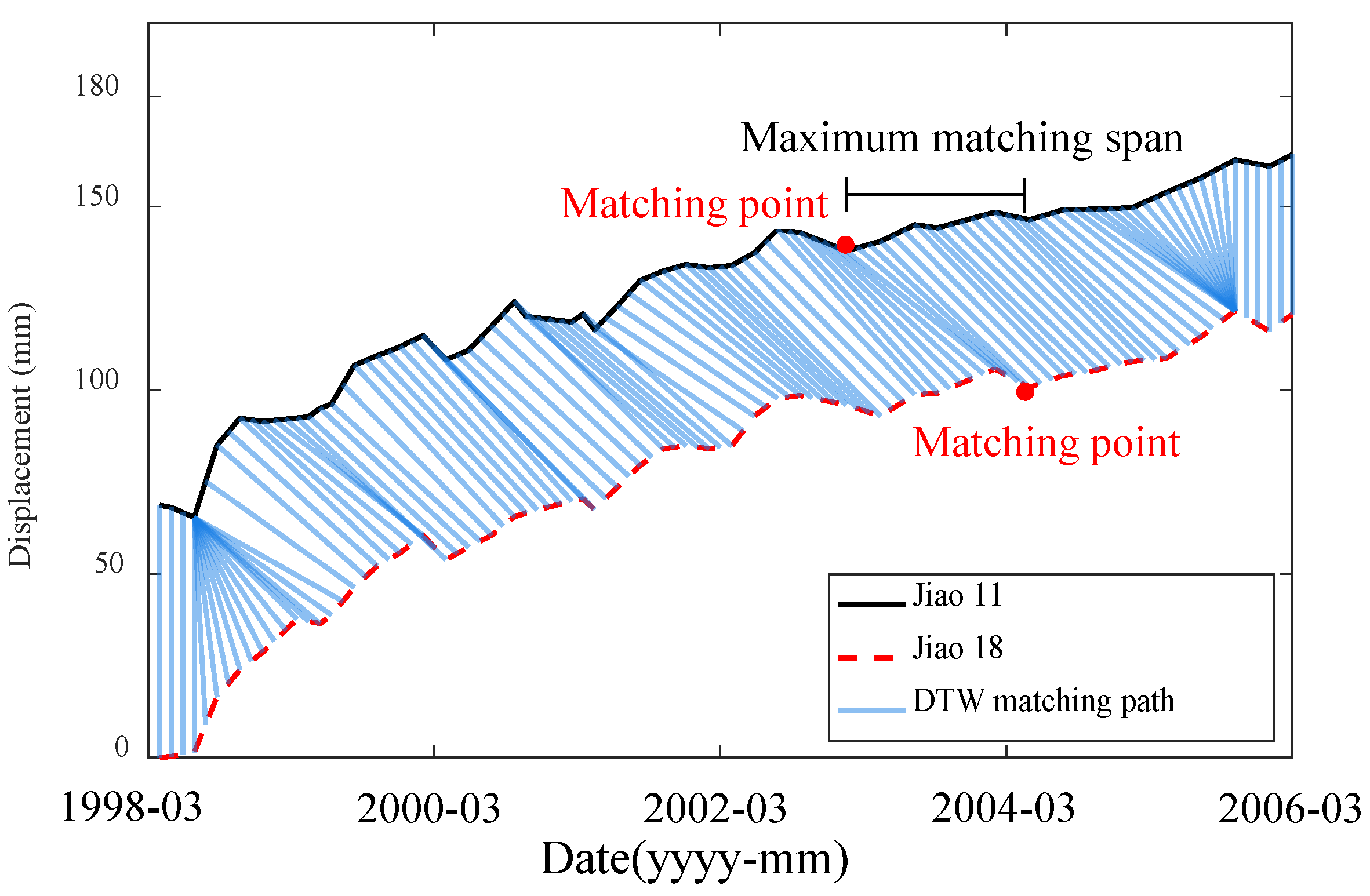
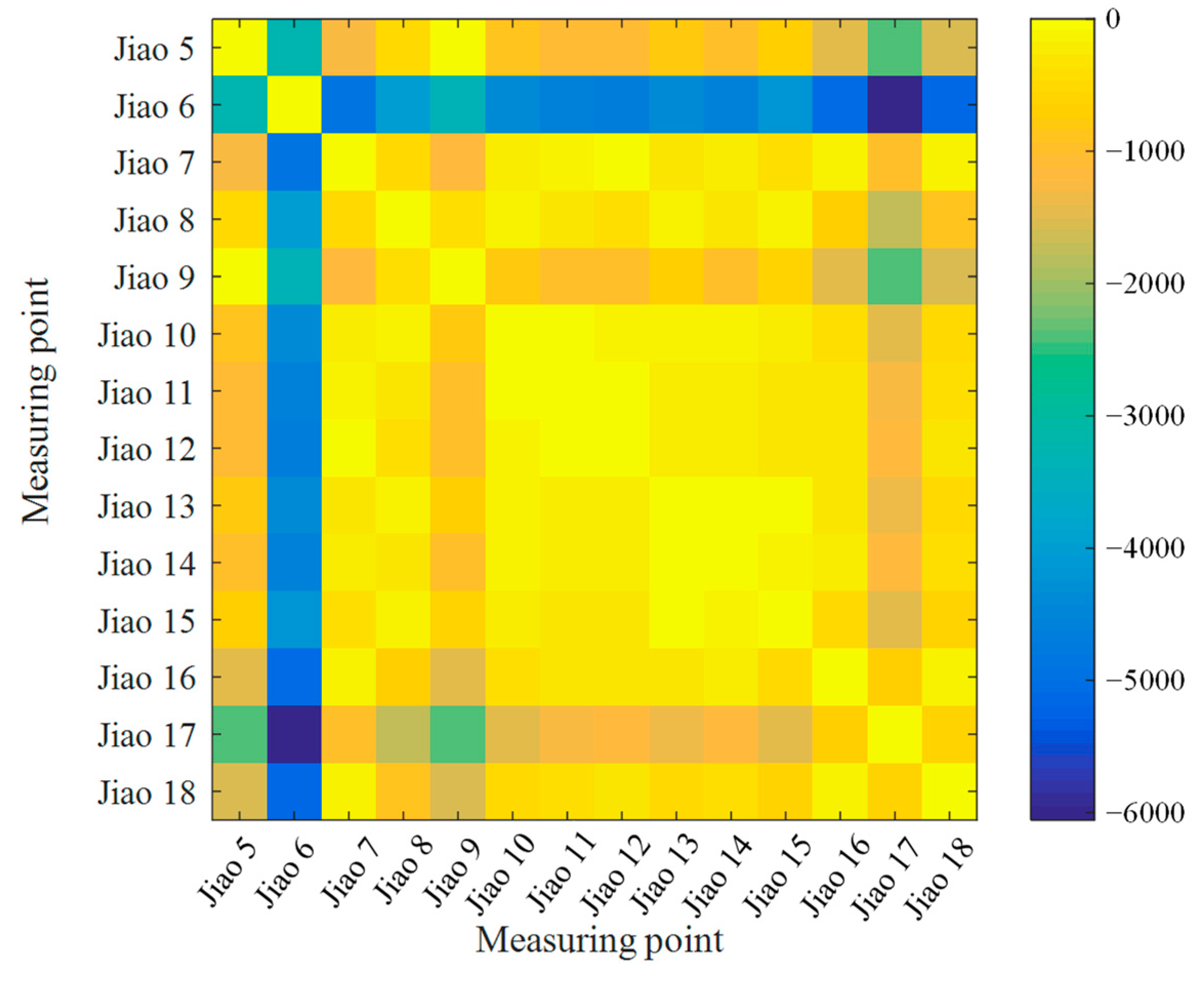
2.2. Improved DTW-AP-Based Clustering for Monitoring Points
2.2.1. Inter-Point Similarity Measurement Based on Improved DTW
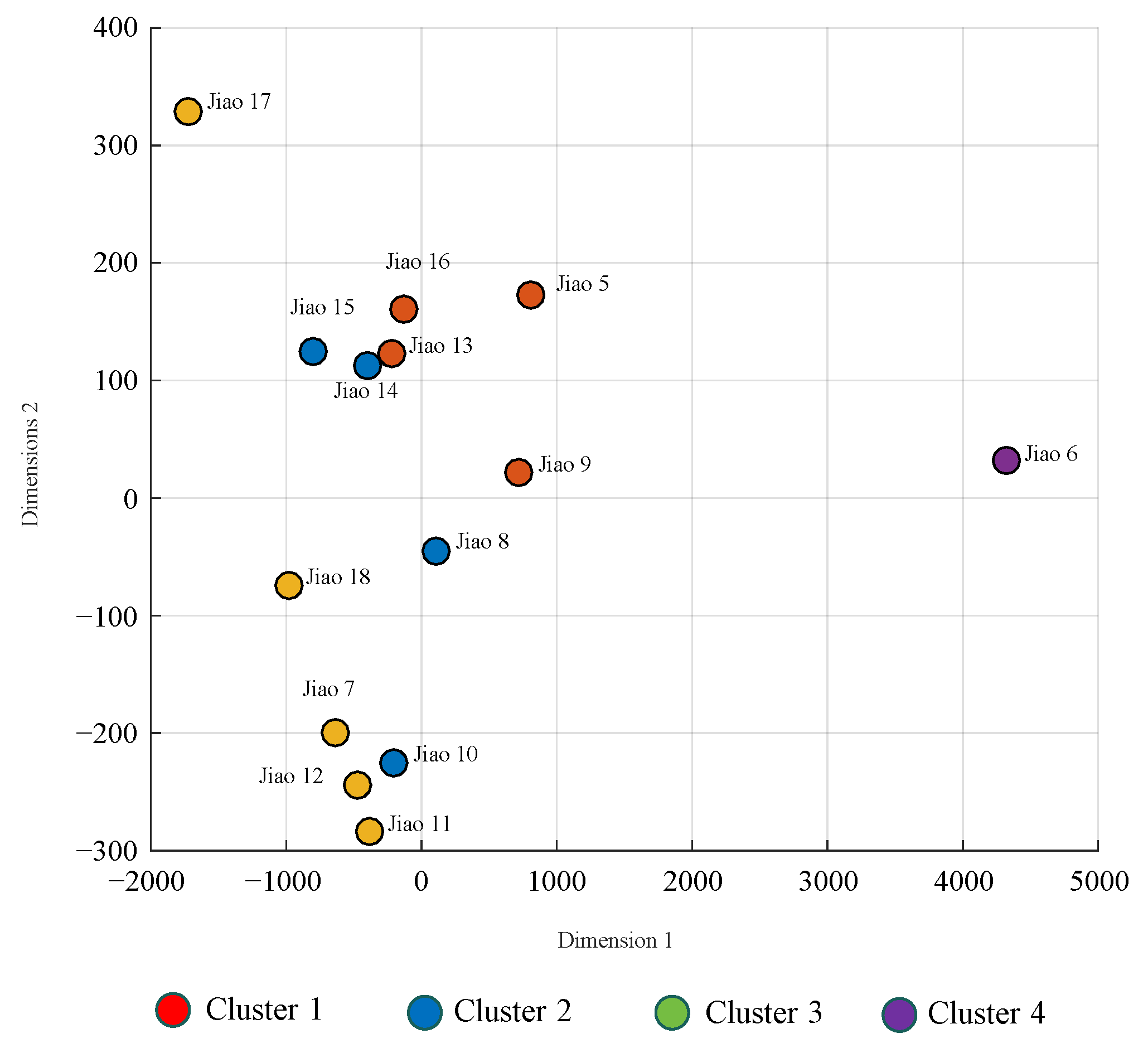
2.2.2. AP-Based Clustering of Slope Monitoring Points
2.3. Overview and Optimization of MOGP
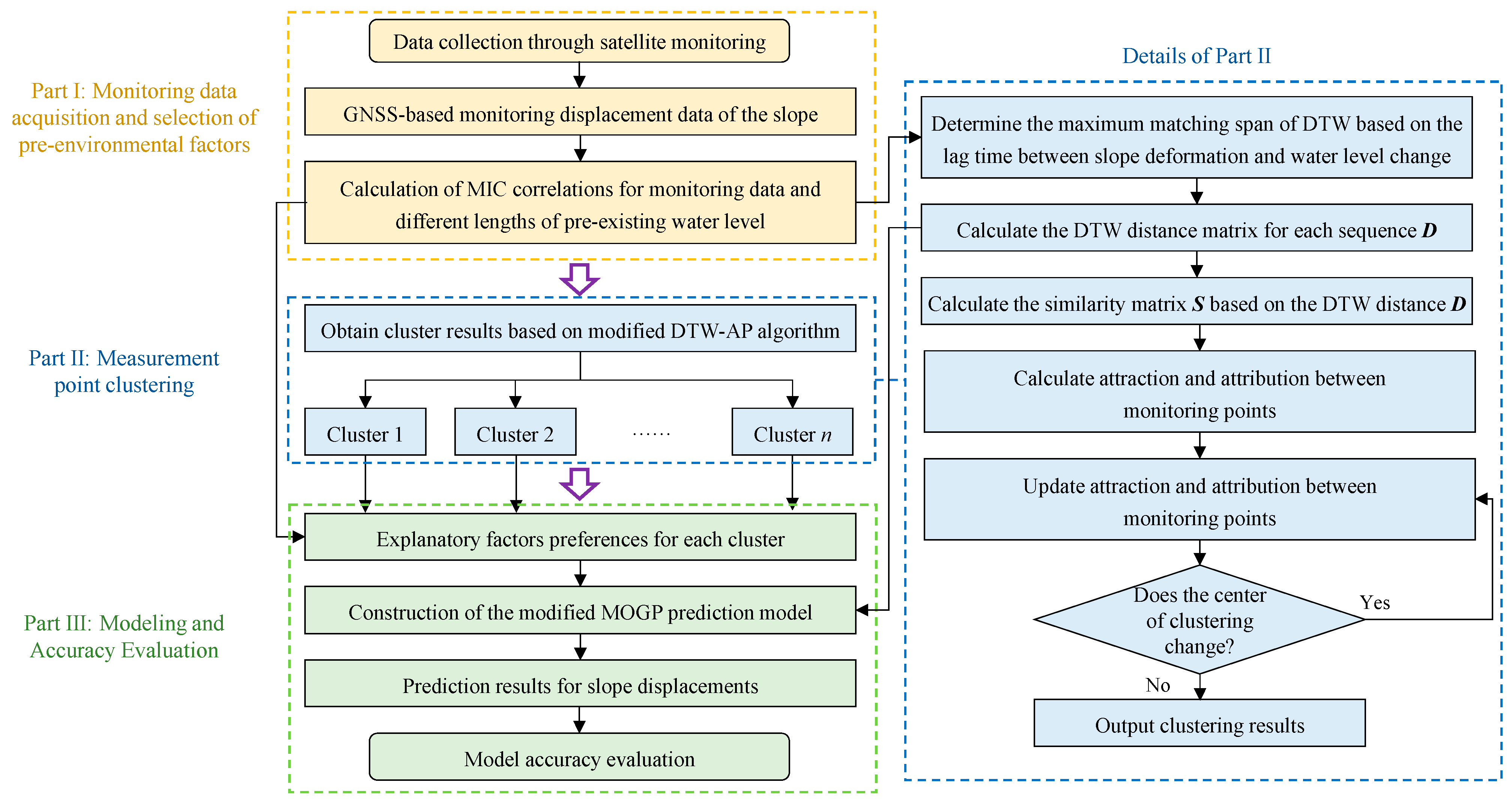
2.4. Construction Framework of the LAC-MOGP Model
- (1)
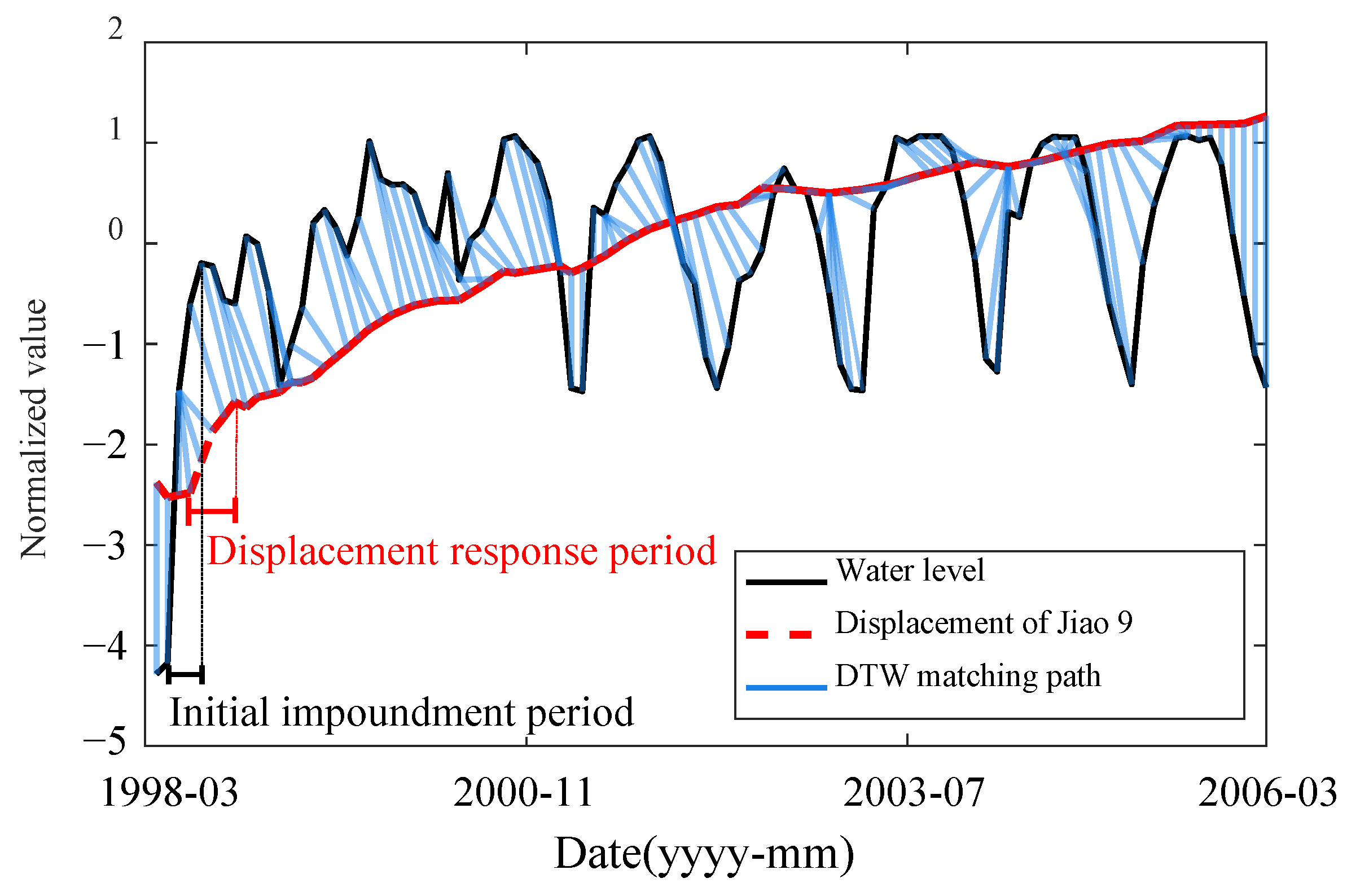
- Determination of Lag Time. MIC is calculated between each candidate environmental factor and the deformation response at each monitoring point. Factors with MIC values exceeding 0.3 are selected as explanatory factors. The maximum lag among the selected factors is employed to define the unified lag time window.
- (2)
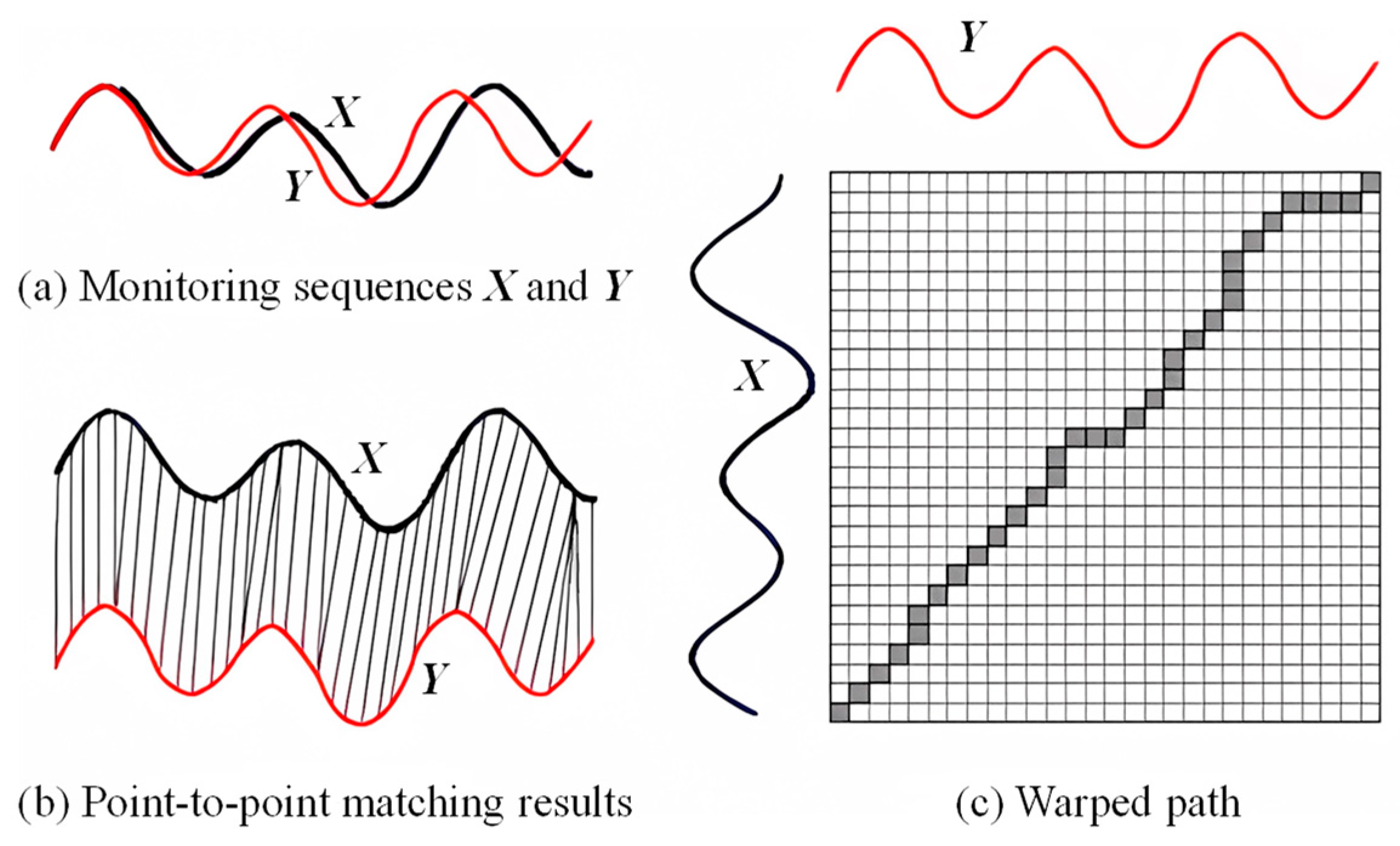
- Computation of Inter-Point Similarity. The improved DTW algorithm is employed to quantify the temporal similarity between all pairs of monitoring points.
- (3)
- Clustering of Monitoring Points. AP algorithm is applied to perform unsupervised clustering on deformation points, which enables the classification of monitoring points into sub-regions with similar spatiotemporal responses.
- (4)
- Training of the Modified MOGP Prediction Model. The data set is divided into training and testing subsets. Based on the X and Y, the MOGP model with DTW-based weighted covariance is trained within each cluster.
- (5)
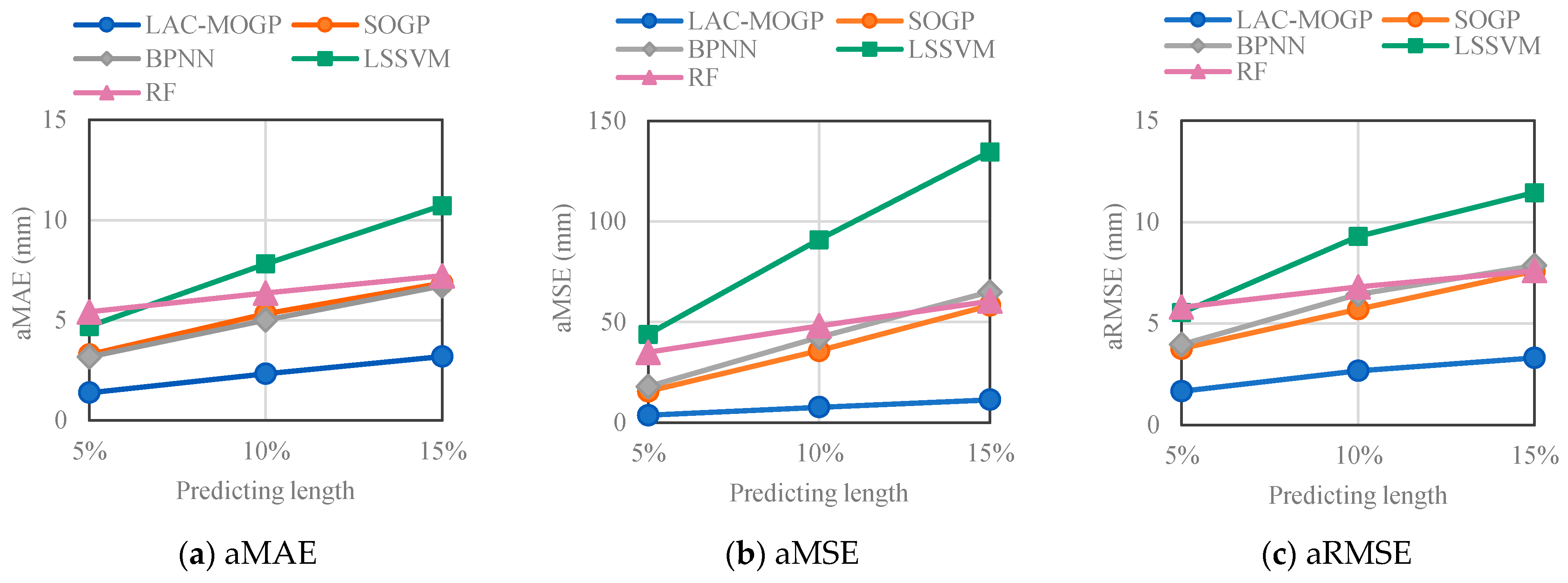
- Model Validation and Evaluation. The proposed model is validated through predictive experiments on multi-point slope displacement data and compared with representative methods. Evaluation metrics include the coefficient of determination (R2), root mean squared error (RMSE), and additional metrics such as the averaged MAE (aMAE), averaged MSE (aMSE), and averaged RMSE (aRMSE), to assess both fitting and forecasting performance.
3. Case Study
3.1. Study Area
3.2. Dataset
4. Results and Discussion
4.1. Spatiotemporal Analysis of Monitoring Points Considering Lag Effects
4.1.1. Screening of Explanatory Factors and Estimation of Lag Time
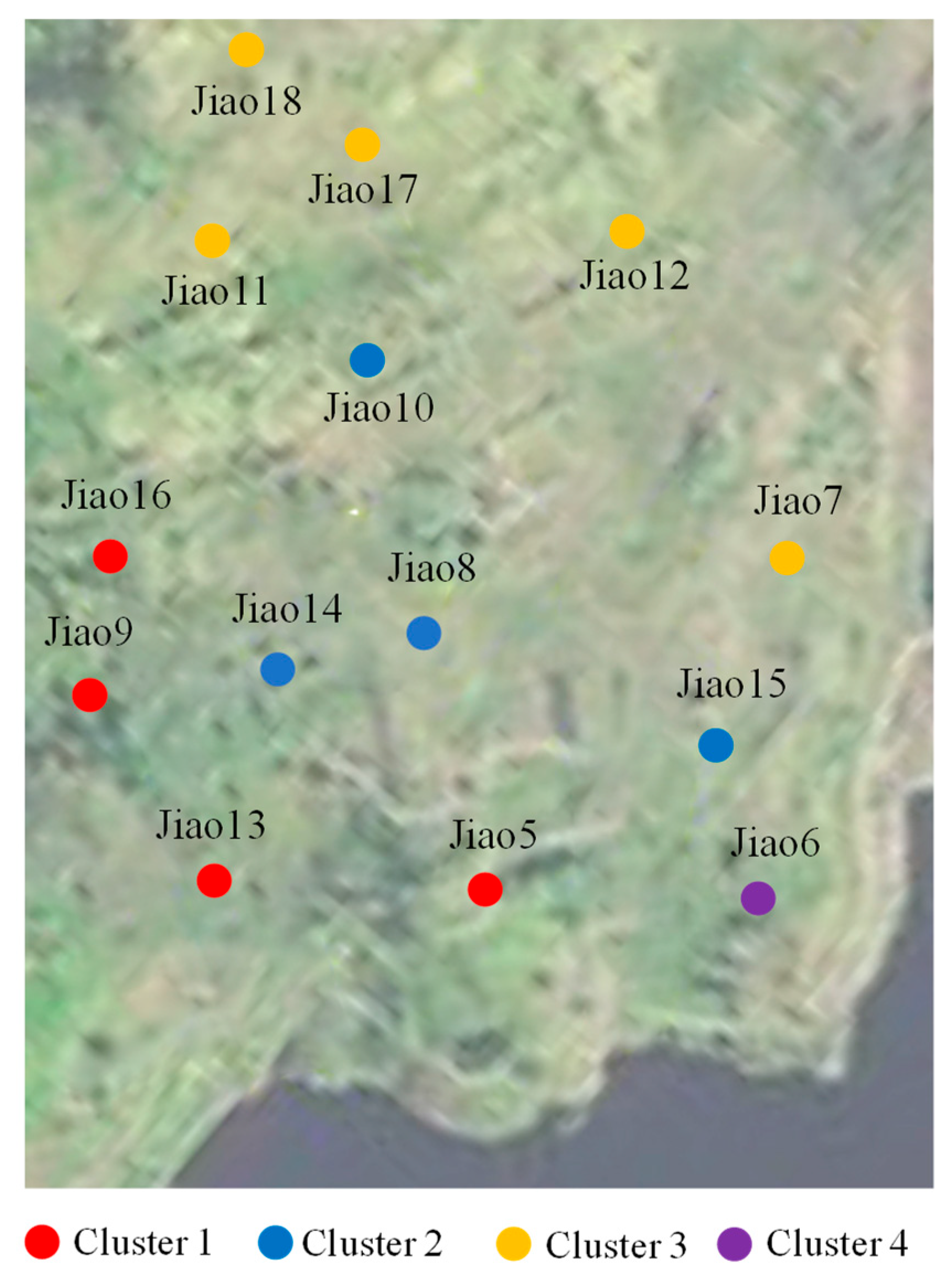
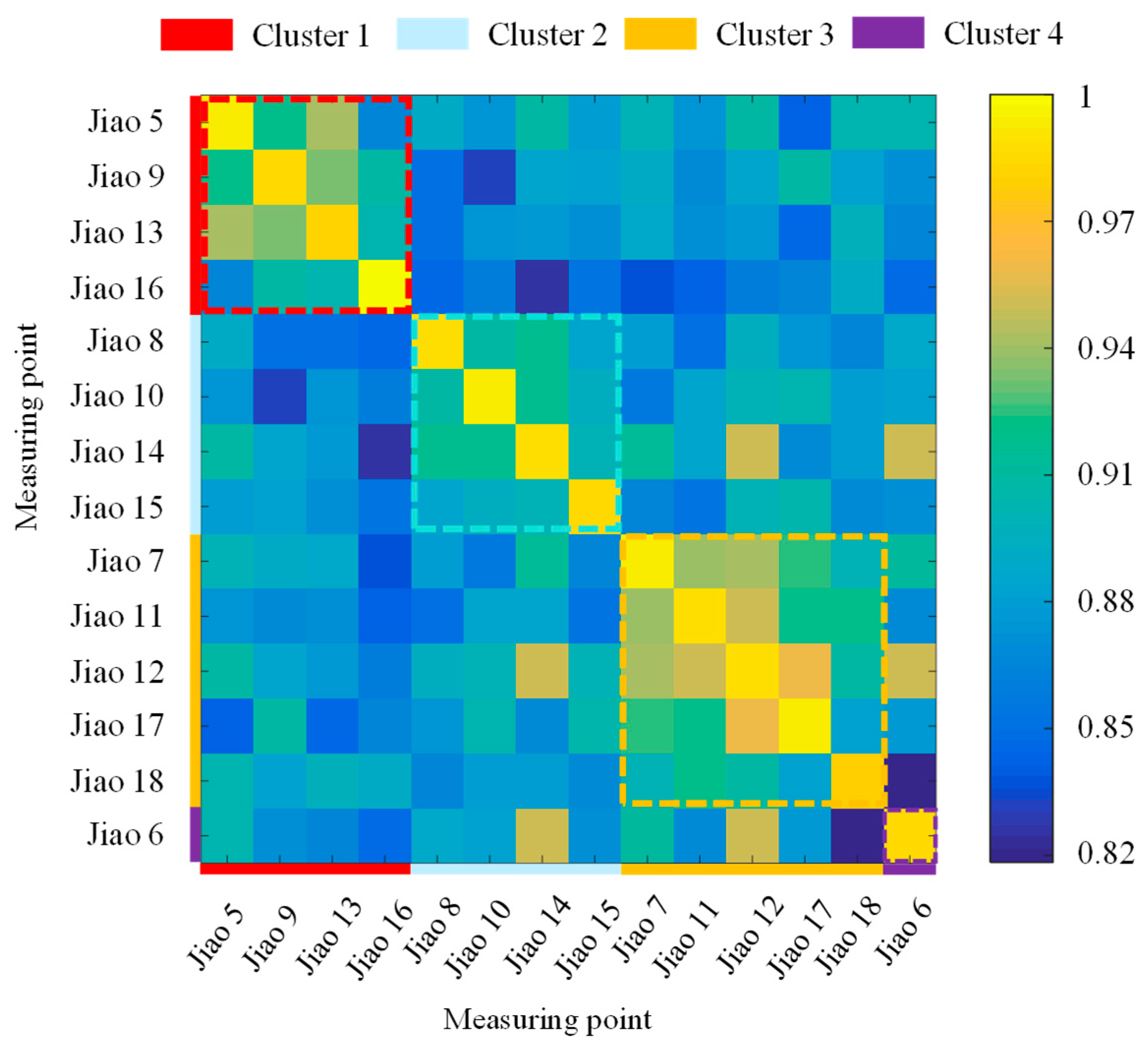
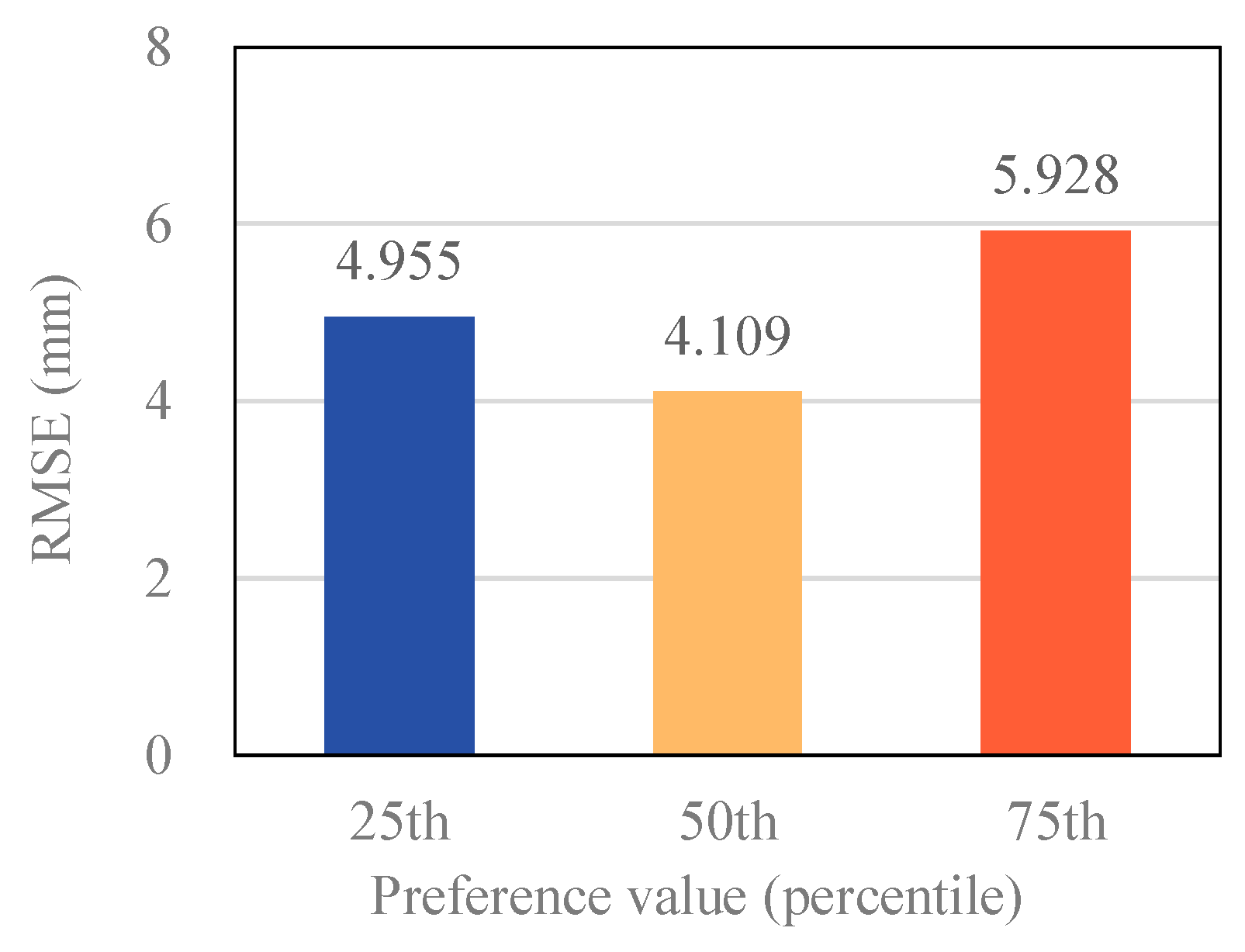
4.1.2. Monitoring Point Zoning
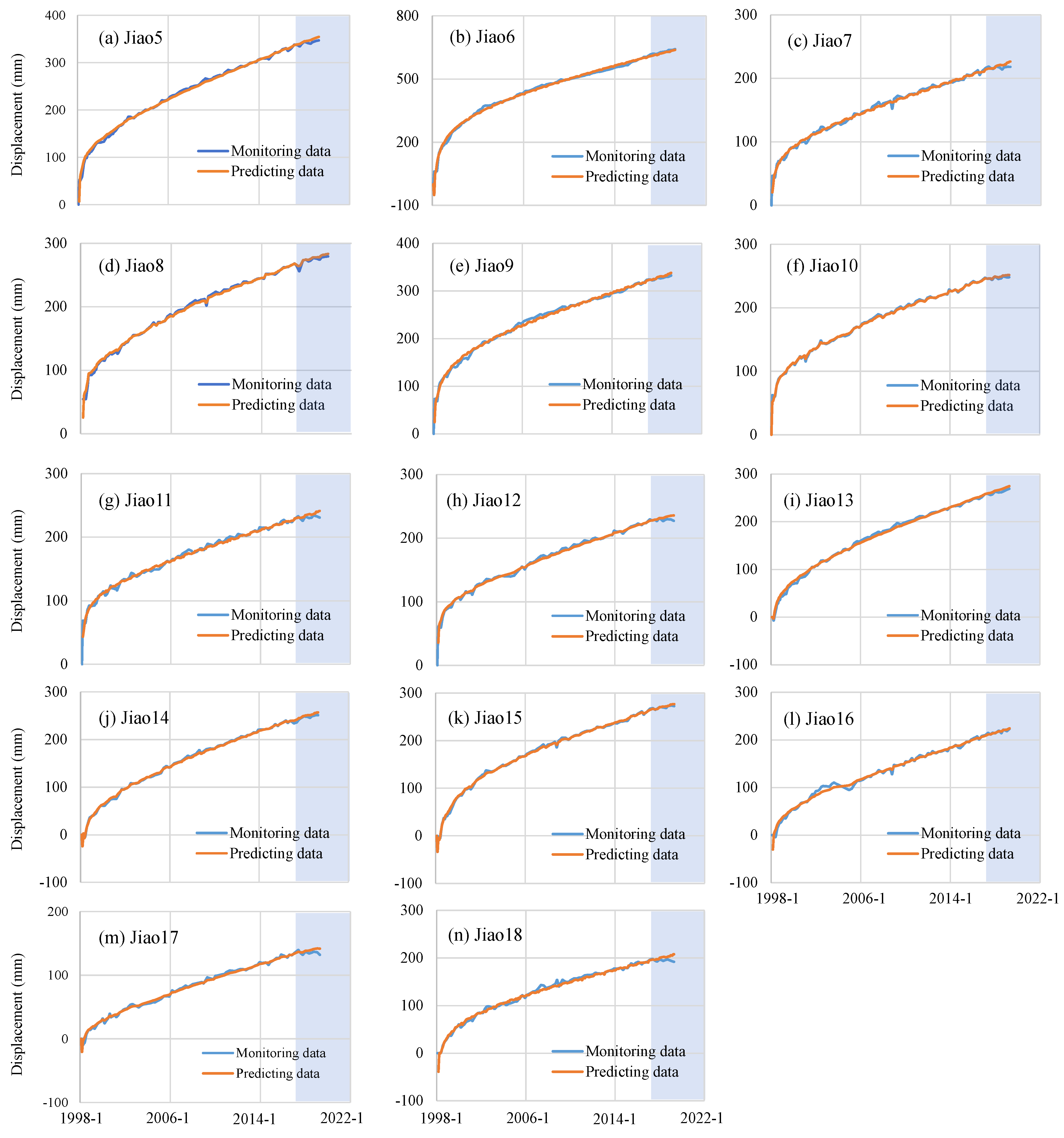
4.2. Prediction Using LAC-MOGP Model
4.3. Performance Comparison of LAC-MOGP with Baseline Models
- (1)
- Performance comparison within the same conditions
- (a)
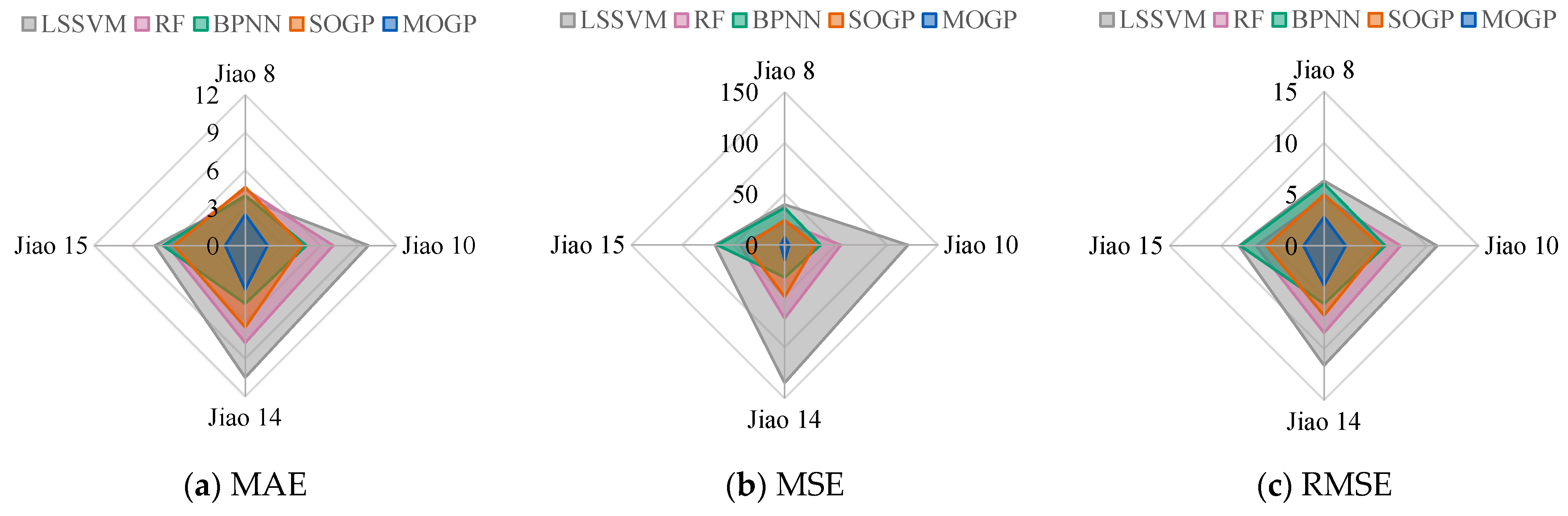
- The prediction metrics obtained by SOGP, BPNN, and RF are generally close in most cases, indicating comparable predictive capabilities among these classic single-point models. Although slight fluctuations exist across different monitoring points, they effectively capture the general deformation trend.
- (b)
- Among the baseline models, LSSVM exhibited the weakest predictive performance. Its overall error metrics were noticeably higher than those of the alternative methods. While LSSVM often serves as an effective standard regression tool, the empirical results indicate a limited capacity to map the complex, non-stationary local dynamics of this specific GNSS time series. Consequently, its generalization capability proved inferior to the ensemble mechanism of RF and the probabilistic architectures of SOGP and the proposed model.
- (c)
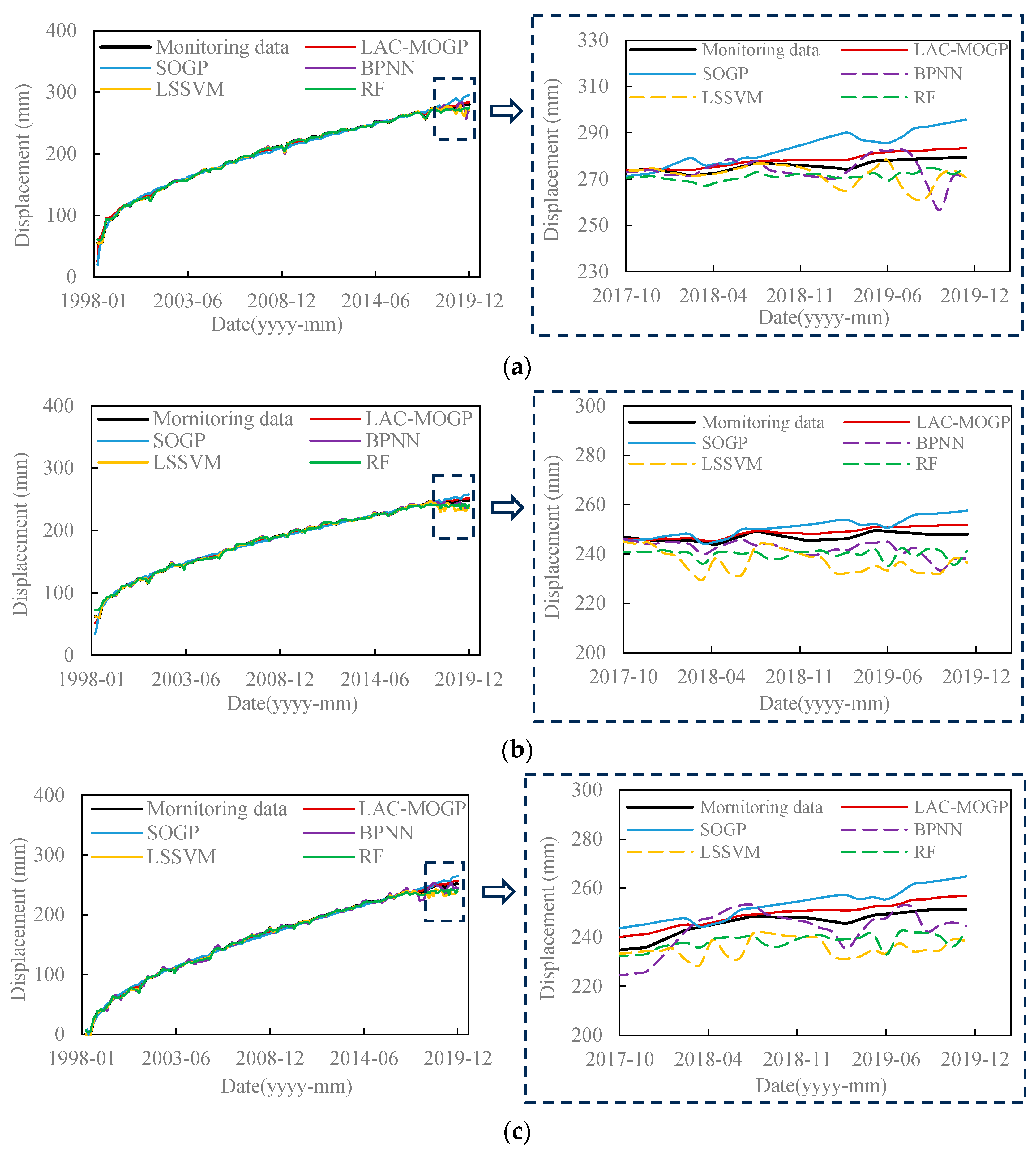
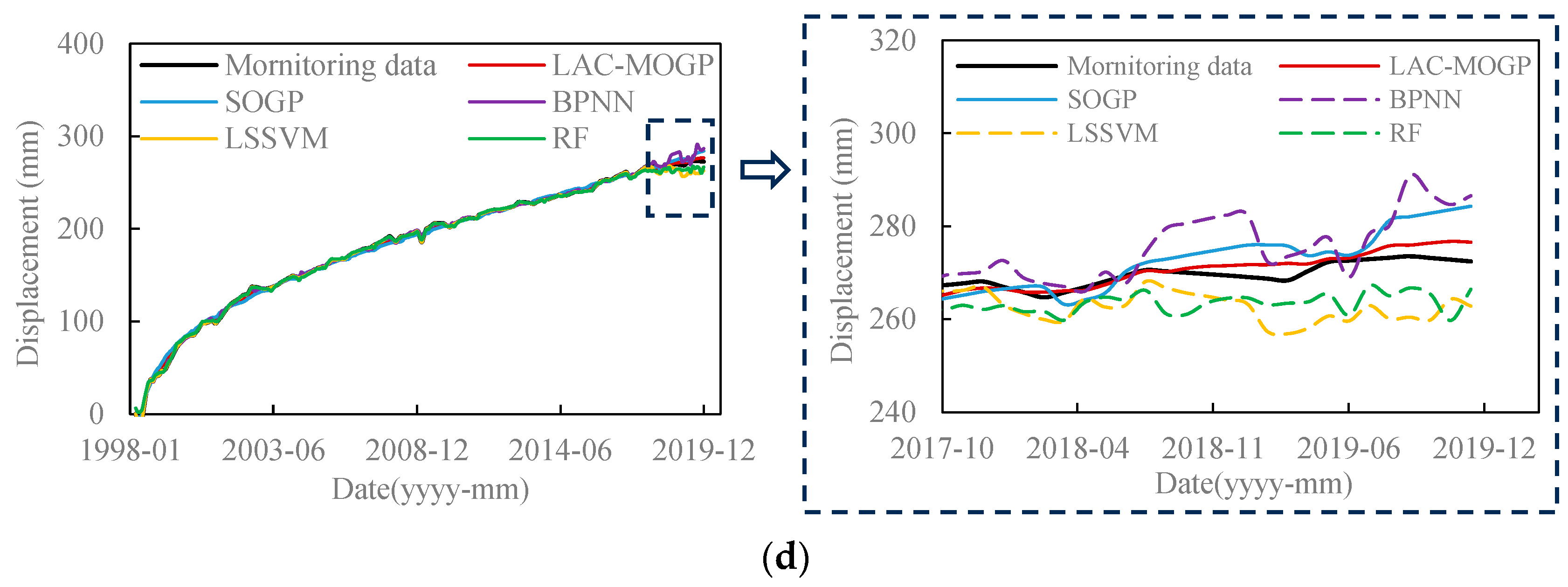
- The modified LAC-MOGP model consistently outperformed all baseline models across all monitoring points. As quantified in Table 5, LAC-MOGP achieved substantial error reductions compared to the best-performing baselines, with the RMSE decreasing by 31.96–64.40%. This enhanced accuracy is attributed to two primary mechanisms: First, the introduction of DTW-based lag estimation and AP-based clustering enables the model to effectively characterize the asynchronous temporal response and spatial similarity of the slope. Second, unlike the isolated learning of baseline models, the MOGP framework leverages the covariance structure among monitoring sequences. This facilitates the identification of inter-point dependencies and effectively filters out local noise by borrowing information from neighboring points, thereby significantly enhancing both prediction accuracy and long-term stability.
- (2)
- Performance comparison with different prediction lengths
4.4. Computational Cost and Scalability
5. Conclusions
- (1)
- A systematic approach was established for identifying the delayed response between reservoir water level variations and slope deformation. Effective explanatory factors and lag times are estimated for each monitoring point by MIC. It enabled the model to capture essential time-dependent influence patterns and define a meaningful DTW alignment window.
- (2)
- An improved DTW-based similarity measure is introduced and incorporated into AP clustering framework to partition the monitoring points. The clustering results revealed clear regional deformation patterns. The effectiveness and physical interpretability of the clustering scheme are confirmed by MIC similarity.
- (3)
- A covariance-enhanced MOGP regression model is developed by embedding DTW-based similarity weights into the LMC kernel structure. The proposed LAC-MOGP model demonstrated superior prediction performance compared to classic models, the lowest aRMSE of 2.677 mm and the lowest aMAE of 2.325 mm. Meanwhile, it maintains the favorable accuracy across different prediction lengths.
Author Contributions
Funding
Data Availability Statement
Conflicts of Interest
Abbreviations
| LAC | Lag-Aware Clustering |
| MOGP | Multi-Output Gaussian Process |
| MIC | Maximal Information Coefficient |
| DTW | Dynamic Time Warping |
| AP | Affinity Propagation |
| MAE | Mean Absolute Error |
| MSE | Mean Squared Error |
| RMSE | Root Mean Squared Error |
| aMAE | Averaged Mean Absolute Error |
| aMSE | Averaged Mean Squared Error |
| aRMSE | Averaged Root Mean Squared Error |
| MDS | Multidimensional Scaling |
| SOGP | Single-Output Gaussian Process |
| BPNN | Back Propagation Neural Network |
| LSSVM | Least Squares Support Vector Machine |
| RF | Random Forests |
Appendix A. Standard Formulation of Multi-Output Gaussian Process (MOGP)
References
- Ibañez, J.P.; Hatzor, Y.H. Rapid sliding and friction degradation: Lessons from the catastrophic Vajont landslide. Eng. Geol. 2018, 244, 96–106. [Google Scholar] [CrossRef]
- Schuster, R.L. Reservoir-induced landslides. Bull. Int. Assoc. Eng. Geol.-Bull. l’Association Int. Géologie l’Ingénieur 1979, 20, 8–15. [Google Scholar] [CrossRef]
- Zhang, Y.; Zhang, Z.; Xue, S.; Wang, R.; Xiao, M. Stability analysis of a typical landslide mass in the Three Gorges Reservoir under varying reservoir water levels. Environ. Earth Sci. 2020, 79, 42. [Google Scholar] [CrossRef]
- Zou, Z.; Luo, T.; Zhang, S.; Duan, H.; Li, S.; Wang, J.; Wang, J. A novel method to evaluate the time-dependent stability of reservoir landslides, exemplified by Outang landslide in the Three Gorges Reservoir. Landslides 2023, 20, 1731–1746. [Google Scholar] [CrossRef]
- Liu, S.; Wang, L.; Zhang, W.; Sun, W.; Fu, J.; Xiao, T.; Dai, Z. A physics-informed data-driven model for landslide susceptibility assessment in the Three Gorges Reservoir Area. Geosci. Front. 2023, 14, 101621. [Google Scholar] [CrossRef]
- Yin, Y.; Huang, B.; Wang, W.; Wei, Y.; Ma, X.; Ma, F.; Zhao, C. Reservoir-induced landslides and risk control in Three Gorges Project on Yangtze River, China. J. Rock Mech. Geotech. Eng. 2016, 8, 577–595. [Google Scholar] [CrossRef]
- Chen, M.; Feng, A.; Wei, W.; Jiang, Q. Statistical analysis of long-term deformations and determination of warning thresholds for near-dam reservoir bank slopes. Bull. Eng. Geol. Environ. 2024, 83, 437. [Google Scholar] [CrossRef]
- Zhang, Y.; Zhu, S.; Tan, J.; Li, L.; Yin, X. The influence of water level fluctuation on the stability of landslide in the Three Gorges Reservoir. Arab. J. Geosci. 2020, 13, 845. [Google Scholar] [CrossRef]
- Chen, S.; Lin, C.; Gu, Y.; Sheng, J.; Hariri-Ardebili, M.A. Dam Deformation Data Preprocessing with Optimized Variational Mode Decomposition and Kernel Density Estimation. Remote Sens. 2025, 17, 718. [Google Scholar] [CrossRef]
- Jia, L.; Wang, J.; Gao, S.; Fang, L.; Wang, D. Landslide risk evaluation method of open-pit mine based on numerical simulation of large deformation of landslide. Sci. Rep. 2023, 13, 15410. [Google Scholar] [CrossRef]
- Xu, W.; Xu, H.; Chen, J.; Kang, Y.; Pu, Y.; Ye, Y.; Tong, J. Combining numerical simulation and deep learning for landslide displacement prediction, An attempt to expand the deep learning dataset. Sustainability 2022, 14, 6908. [Google Scholar] [CrossRef]
- Xie, W.L.; Guo, Q.; Wu, J.Y.; Li, P.; Yang, H.; Zhang, M. Analysis of loess landslide mechanism and numerical simulation stabilization on the Loess Plateau in Central China. Nat. Hazards 2021, 106, 805–827. [Google Scholar] [CrossRef]
- Fang, X.; Wang, Y.; Wang, L.; Zhang, W.; Chen, C.; Deng, H. Evolution trend of reservoir bank landslides driven by numerical simulation and mechanism analysis. Bull. Eng. Geol. Environ. 2025, 84, 224. [Google Scholar] [CrossRef]
- Yan, Y.; Guo, C.; Zhang, Y.; Song, D.; Qiu, Z. Comprehensive evaluation and prediction of potential long-runout landslide in Songrong, Tibetan Plateau, insights from remote sensing interpretation, SBAS-InSAR, and Massflow numerical simulation. Bull. Eng. Geol. Environ. 2024, 83, 198. [Google Scholar] [CrossRef]
- Jiao, Y.Y.; Zhang, H.Q.; Tang, H.M.; Zhang, X.L.; Adoko, A.C.; Tian, H.N. Simulating the process of reservoir-impoundment-induced landslide using the extended DDA method. Eng. Geol. 2014, 182, 37–48. [Google Scholar] [CrossRef]
- Wang, H.; Sun, Y.; Tan, Y. Deformation characteristics and stability evolution behavior of Woshaxi landslide during the initial impoundment period of the Three Gorges reservoir. Environ. Earth Sci. 2019, 78, 592. [Google Scholar] [CrossRef]
- Wang, Z.; Tang, J.; Hou, S.; Wang, Y.; Zhang, A.; Wang, J.; Han, B. Landslide displacement prediction from on-site deformation data based on time series ARIMA model. Front. Environ. Sci. 2023, 11, 1249743. [Google Scholar] [CrossRef]
- Liao, K.; Zhang, W.; Zhu, H.H.; Zhang, Q.; Shi, B.; Wang, J.T.; Xu, W.T. Forecasting reservoir-induced landslide deformation using genetic algorithm enhanced multivariate Taylor series Kalman filter. Bull. Eng. Geol. Environ. 2022, 81, 104. [Google Scholar] [CrossRef]
- Huang, C.; Cao, Y.; Zhou, L. Application of optimized GM (1, 1) model based on EMD in landslide deformation prediction. Comput. Appl. Math. 2021, 40, 261. [Google Scholar] [CrossRef]
- Xu, J.; Jiang, Y.; Yang, C. Landslide displacement prediction during the sliding process using XGBoost, SVR and RNNs. Appl. Sci. 2022, 12, 6056. [Google Scholar] [CrossRef]
- Jiang, S.; Liu, H.; Lian, M.; Lu, C.; Zhang, S.; Li, J.; Li, P. Rock slope displacement prediction based on multi-source information fusion and SSA-DELM model. Front. Environ. Sci. 2022, 10, 982069. [Google Scholar] [CrossRef]
- Hu, X.; Wu, S.; Zhang, G.; Zheng, W.; Liu, C.; He, C.; Zhang, H. Landslide displacement prediction using kinematics-based random forests method, A case study in Jinping Reservoir Area, China. Eng. Geol. 2021, 283, 105975. [Google Scholar] [CrossRef]
- Shao, M.; Liu, F. Slope deformation prediction based on noise reduction and deep learning, A point prediction and probability analysis method. Front. Earth Sci. 2024, 12, 1399602. [Google Scholar] [CrossRef]
- Wang, S.; Lyu, T.L.; Luo, N.; Chang, P. Deformation prediction of rock cut slope based on long short-term memory neural network. Int. J. Mach. Learn. Cybern. 2024, 15, 795–805. [Google Scholar] [CrossRef]
- Guo, Z.; Chen, L.; Gui, L.; Du, J.; Yin, K.; Do, H.M. Landslide displacement prediction based on variational mode decomposition and WA-GWO-BP model. Landslides 2020, 17, 567–583. [Google Scholar] [CrossRef]
- Liu, Y.; Xu, C.; Huang, B.; Ren, X.; Liu, C.; Hu, B.; Chen, Z. Landslide displacement prediction based on multi-source data fusion and sensitivity states. Eng. Geol. 2020, 271, 105608. [Google Scholar] [CrossRef]
- Zhang, W.; Tang, L.; Li, H.; Wang, L.; Cheng, L.; Zhou, T.; Chen, X. Probabilistic stability analysis of Bazimen landslide with monitored rainfall data and water level fluctuations in Three Gorges Reservoir, China. Front. Struct. Civ. Eng. 2020, 14, 1247–1261. [Google Scholar] [CrossRef]
- Zhu, Y.; Qiu, H.; Liu, Z.; Ye, B.; Tang, B.; Li, Y.; Kamp, U. Rainfall and water level fluctuations dominated the landslide deformation at Baihetan Reservoir, China. J. Hydrol. 2024, 642, 131871. [Google Scholar] [CrossRef]
- Zhao, S.; Zeng, R.; Zhang, H.; Meng, X.; Zhang, Z.; Meng, X.; Liu, J. Impact of water level fluctuations on landslide deformation at Longyangxia reservoir, Qinghai province, China. Remote Sens. 2022, 14, 212. [Google Scholar] [CrossRef]
- Kafle, L.; Xu, W.J.; Zeng, S.Y.; Nagel, T. A numerical investigation of slope stability influenced by the combined effects of reservoir water level fluctuations and precipitation, A case study of the Bianjiazhai landslide in China. Eng. Geol. 2022, 297, 106508. [Google Scholar] [CrossRef]
- Chen, Q.; Chen, L.; Gui, L.; Yin, K.; Shrestha, D.P.; Du, J.; Cao, X. Assessment of the physical vulnerability of buildings affected by slow-moving landslides. Nat. Hazards Earth Syst. Sci. 2020, 20, 2547–2565. [Google Scholar] [CrossRef]
- Wen, N.; Dai, K.; Tomas, R.; Wu, M.; Chen, C.; Deng, J.; Feng, W. Revealing the time lag between slope stability and reservoir water fluctuation from InSAR observations and wavelet tools—A case study in Maoergai Reservoir (China). GISci. Remote Sens. 2023, 60, 2170125. [Google Scholar] [CrossRef]
- Xiong, Q.; Deng, H.; Zhang, W. Deformation monitoring and analysis of liujiaxia reservoir landslide based on time-series InSAR and wavelet transform. Geocarto Int. 2024, 39, 2339287. [Google Scholar] [CrossRef]
- Chen, G.; Zhang, G.; Lu, S.; Wang, X. An Attempt to Quantify the Lag Time of Hydrodynamic Action Based on the Long-Term Monitoring of a Typical Landslide, Three Gorges, China. Math. Probl. Eng. 2018, 2018, 5958436. [Google Scholar] [CrossRef]
- Ma, J.; Yao, L.; Deng, L.; Yang, Q.; Chen, Y.; Ouyang, C. Spatio-Temporal Deformation Prediction of Large Landslides in the Three Gorges Reservoir Area Based on Time-Series Graph Convolutional Network Model. Appl. Sci. 2025, 15, 4491. [Google Scholar] [CrossRef]
- Yuan, Z.; Bian, Y.; Liu, W.; Qi, F.; Ma, H.; Zheng, S.; Meng, Z. Predicting the Deformation of a Slope Using a Random Coefficient Panel Data Model. Fractal Fract. 2024, 8, 429. [Google Scholar] [CrossRef]
- Xi, N.; Yang, Q.; Sun, Y.; Mei, G. Machine Learning Approaches for Slope Deformation Prediction Based on Monitored Time-Series Displacement Data, A Comparative Investigation. Appl. Sci. 2023, 13, 4677. [Google Scholar] [CrossRef]
- Reshef, D.N.; Reshef, Y.A.; Finucane, H.K. Detecting novel associations in large data sets. Science 2011, 334, 1518–1524. [Google Scholar] [CrossRef]
- Kinney, J.B.; Atwal, G.S. Equitability, mutual information, and the maximal infor-mation coefficient. Proc. Natl. Acad. Sci. USA 2014, 111, 3354–3359. [Google Scholar] [CrossRef]
- Ge, Q.; Wang, J.; Liu, C.; Wang, X.; Deng, Y.; Li, J. Integrating Feature Selection with Machine Learning for Accurate Reservoir Landslide Displacement Prediction. Water 2024, 16, 2152. [Google Scholar] [CrossRef]
- Huang, D.; He, J.; Song, Y.; Guo, Z.; Huang, X.; Guo, Y. Displacement Prediction of the Muyubao Landslide Based on a GPS Time-Series Analysis and Temporal Convolutional Network Model. Remote Sens. 2022, 14, 2656. [Google Scholar] [CrossRef]
- Wang, Y.; Tang, H.; Wen, T.; Ma, J. A hybrid intelligent approach for construct-ing landslide displacement prediction intervals. Appl. Soft Comput. 2019, 81, 105506. [Google Scholar] [CrossRef]
- Sakoe, H.; Chiba, S. Dynamic programming algorithm optimization for spoken word recognition. IEEE Trans. Acoust. Speech Signal Process. 1978, 26, 43–49. [Google Scholar] [CrossRef]
- Frey, B.J.; Dueck, D. Clustering by passing messages between data points. Science 2007, 315, 972–976. [Google Scholar] [CrossRef]
- Alvarez, M.A.; Rosasco, L.; Lawrence, N.D. Kernels for vector-valued functions, A review. Found. Trends Mach. Learn. 2012, 4, 195–266. [Google Scholar] [CrossRef]
- Lomnitz, C. Creep measurements in igneous rocks. J. Geol. 1956, 64, 473–479. [Google Scholar] [CrossRef]






| Monitoring Point | Elevation (m) | Monitoring Point | Elevation (m) | Monitoring Point | Elevation (m) |
|---|---|---|---|---|---|
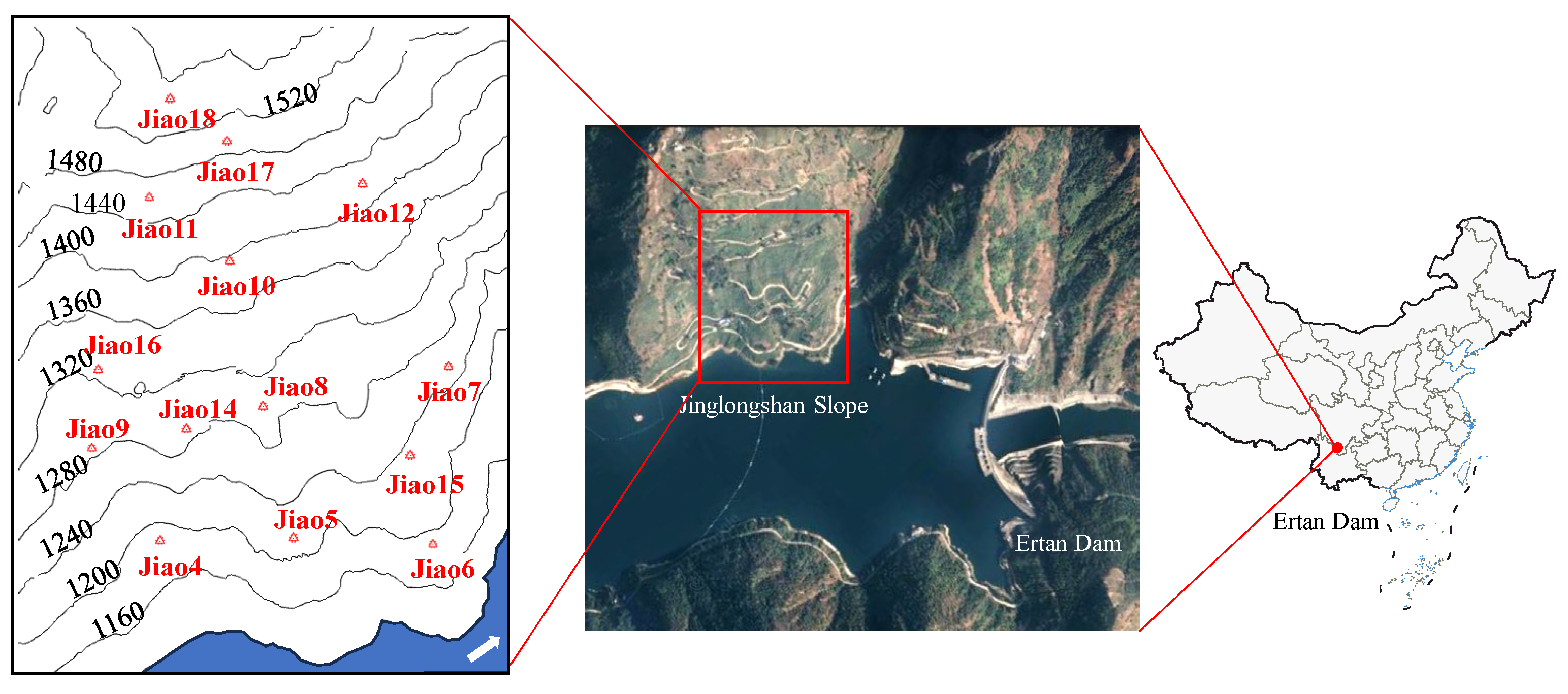
| Jiao5 | 1261.86 | Jiao10 | 1436.68 | Jiao15 | 1274.41 |
| Jiao6 | 1232.14 | Jiao11 | 1698.21 | Jiao16 | 1372.4 |
| Jiao7 | 1293.06 | Jiao12 | 1458.8 | Jiao17 | 1537.81 |
| Jiao8 | 1342.2 | Jiao13 | 1231.22 | Jiao18 | 1595.08 |
| Jiao9 | 1326.91 | Jiao14 | 1330.09 |
| Number | Candidate Factor | CMIC | Is the Correlation Significant | Number | Candidate Factor | CMIC | Is the Correlation Significant |
|---|---|---|---|---|---|---|---|
| 1 | H0 | 0.305 | Yes | 9 | R0–30 | 0.302 | Yes |
| 2 | H0–30 | 0.419 | Yes | 10 | R30–60 | 0.265 | No |
| 3 | H30–60 | 0.536 | Yes | 11 | R60–90 | 0.286 | No |
| 4 | H60–90 | 0.444 | Yes | 12 | R90–120 | 0.216 | No |
| 5 | H90–120 | 0.313 | Yes | 13 | R120–150 | 0.223 | No |
| 6 | H120–150 | 0.246 | No | 14 | R150–180 | 0.196 | No |
| 7 | H150–180 | 0.252 | No | 15 | θ | 0.912 | Yes |
| 8 | R0 | 0.307 | Yes | 16 | lnθ | 0.978 | Yes |
| Cluster | Monitoring Points | Lag Time of Water Level (d) | Lag Time of Rainfall (d) | Integrated Lag Time of Water Level (d) | Integrated Lag Time of Rainfall (d) |
|---|---|---|---|---|---|
| Cluster 1 | Jiao 5 | 120 | 30 | 120 | 30 |
| Jiao 9 | 90 | 30 | |||
| Jiao 13 | 120 | 60 | |||
| Jiao 16 | 90 | 30 | |||
| Cluster 2 | Jiao 8 | 120 | 30 | 90 | 30 |
| Jiao 10 | 90 | 30 | |||
| Jiao 14 | 90 | 30 | |||
| Jiao 15 | 90 | 30 | |||
| Cluster 3 | Jiao 7 | 120 | 30 | 120 | 30 |
| Jiao 11 | 90 | 30 | |||
| Jiao 12 | 90 | 30 | |||
| Jiao 17 | 120 | 30 | |||
| Jiao 18 | 120 | 60 | |||
| Cluster 4 | Jiao 6 | 120 | 30 | 120 | 30 |
| Monitoring Point | R2 | RMSE (mm) | Monitoring Point | R2 | RMSE (mm) |
|---|---|---|---|---|---|
| Jiao 5 | 0.996 | 4.526 | Jiao 12 | 0.994 | 3.133 |
| Jiao 6 | 0.993 | 10.562 | Jiao 13 | 0.996 | 3.885 |
| Jiao 7 | 0.993 | 3.522 | Jiao 14 | 0.998 | 2.793 |
| Jiao 8 | 0.996 | 3.162 | Jiao 15 | 0.997 | 3.022 |
| Jiao 9 | 0.993 | 5.237 | Jiao 16 | 0.993 | 4.585 |
| Jiao 10 | 0.998 | 1.600 | Jiao 17 | 0.994 | 2.807 |
| Jiao 11 | 0.992 | 3.728 | Jiao 18 | 0.990 | 4.969 |
| Monitoring Point | Metrics | LAC-MOGP | SOGP | BPNN | LSSVM | RF | Rel. Reduction 1 |
|---|---|---|---|---|---|---|---|
| Jiao 8 | MAE | 2.476 | 4.651 | 3.982 | 3.784 | 4.495 | 34.57% |
| MSE | 7.751 | 24.269 | 36.393 | 39.829 | 22.029 | 64.81% | |
| RMSE | 2.784 | 4.974 | 6.033 | 6.311 | 4.694 | 40.69% | |
| Jiao 10 | MAE | 1.769 | 4.518 | 4.864 | 9.810 | 7.007 | 60.85% |
| MSE | 4.433 | 29.791 | 35.310 | 120.654 | 55.158 | 85.12% | |
| RMSE | 2.106 | 5.472 | 5.942 | 10.984 | 7.427 | 61.51% | |
| Jiao 14 | MAE | 3.465 | 6.490 | 4.620 | 10.497 | 7.736 | 25.00% |
| MSE | 14.610 | 50.643 | 31.549 | 134.941 | 71.626 | 53.69% | |
| RMSE | 3.822 | 6.775 | 5.617 | 11.616 | 8.463 | 31.96% | |
| Jiao 15 | MAE | 1.592 | 5.658 | 6.562 | 7.175 | 6.161 | 71.86% |
| MSE | 3.989 | 37.948 | 65.958 | 68.184 | 43.606 | 89.49% | |
| RMSE | 1.997 | 5.609 | 8.121 | 8.257 | 6.603 | 64.40% |
| Indicators | LAC-MOGP | SOGP | BPNN | LSSVM | RF | |
|---|---|---|---|---|---|---|
| 5% | aMAE | 1.390 | 2.293 | 3.170 | 4.691 | 5.417 |
| aMSE | 3.675 | 9.573 | 17.960 | 43.869 | 34.927 | |
| aRMSE | 1.668 | 3.268 | 3.973 | 5.538 | 5.800 | |
| 10% | aMAE | 2.325 | 5.329 | 5.007 | 7.817 | 6.350 |
| aMSE | 7.696 | 35.663 | 42.302 | 90.902 | 48.105 | |
| aRMSE | 2.677 | 5.708 | 6.428 | 9.292 | 6.797 | |
| 15% | aMAE | 3.194 | 5.844 | 6.713 | 10.791 | 7.216 |
| aMSE | 11.430 | 58.192 | 64.906 | 134.575 | 60.341 | |
| aRMSE | 3.314 | 6.067 | 7.849 | 11.451 | 7.601 | |
Disclaimer/Publisher’s Note: The statements, opinions and data contained in all publications are solely those of the individual author(s) and contributor(s) and not of MDPI and/or the editor(s). MDPI and/or the editor(s) disclaim responsibility for any injury to people or property resulting from any ideas, methods, instructions or products referred to in the content. |
© 2026 by the authors. Licensee MDPI, Basel, Switzerland. This article is an open access article distributed under the terms and conditions of the Creative Commons Attribution (CC BY) license.
Share and Cite
Liang, J.; Cao, W.; Wang, T.; Huang, M.; Wu, B.; Lin, C. Intelligent Safety Monitoring of Reservoir Slopes: A Multi-Point Deformation Prediction Approach Considering Spatiotemporal Lag Effects. Water 2026, 18, 1335. https://doi.org/10.3390/w18111335
Liang J, Cao W, Wang T, Huang M, Wu B, Lin C. Intelligent Safety Monitoring of Reservoir Slopes: A Multi-Point Deformation Prediction Approach Considering Spatiotemporal Lag Effects. Water. 2026; 18(11):1335. https://doi.org/10.3390/w18111335
Chicago/Turabian StyleLiang, Jiachen, Wenhan Cao, Tian Wang, Mengjing Huang, Binqing Wu, and Chuan Lin. 2026. "Intelligent Safety Monitoring of Reservoir Slopes: A Multi-Point Deformation Prediction Approach Considering Spatiotemporal Lag Effects" Water 18, no. 11: 1335. https://doi.org/10.3390/w18111335
APA StyleLiang, J., Cao, W., Wang, T., Huang, M., Wu, B., & Lin, C. (2026). Intelligent Safety Monitoring of Reservoir Slopes: A Multi-Point Deformation Prediction Approach Considering Spatiotemporal Lag Effects. Water, 18(11), 1335. https://doi.org/10.3390/w18111335