Article

Prediction of Water-Conducting Fracture Zone Height in the Mines of Binchang Mining Area Based on Data-Driven Modeling


1
College of Energy and Mining Engineering, Xi’an University of Science and Technology, Xi’an 710054, China
2
Key Laboratory of Western Mine Exploration and Hazards Prevention, Ministry of Education, Xi’an University of Science and Technology, Xi’an 710054, China
*
Author to whom correspondence should be addressed.
Water 2026, 18(10), 1215; https://doi.org/10.3390/w18101215
Submission received: 3 April 2026 / Revised: 1 May 2026 / Accepted: 13 May 2026 / Published: 18 May 2026

Abstract

Given the severe water hazard in the coal seam roof of the Binchang mining area, existing research methods still primarily rely on traditional approaches such as empirical formula and numerical simulation—resulting in insufficient accuracy and convenience in predicting the height of the water-conducting fracture zone (WCFZ). By comprehensively considering three influencing factors—mining thickness, mining depth, and working face length—a data-driven approach was employed to construct a multiple nonlinear regression prediction model and a Convolutional Neural Network (CNN) prediction model based on 27 sets of measured data. Both models were subsequently applied to the ZF1403 and ZF1405 working faces in the Yadian coal mine. The results indicate that when considering only single factor of mining thickness, the coefficient of determination (R2) value of the multiple nonlinear regression model was 0.64. When considering all influencing factors, R2 improved to 0.84. The mean absolute percentage error (MAPE) of multiple nonlinear regression model was 7.52%. The established CNN model achieved a R2 of 0.97, a root mean square error (RMSE) of 9.78, and a MAPE of 4.67%. Compared to the Back Propagation Neural Network model, the prediction accuracy of the CNN model was significantly improved. The relative prediction errors of the developed height of WCFZ in the ZF1403 and ZF1405 working faces at Yadian mine were 6.30% and 2.54% for the multiple nonlinear regression model, respectively, and 0.97% and 3.15% for the CNN model, respectively. Both models met practical engineering requirements. This paper can provide reliable technical support for the prediction of water-conducting fracture zone height under mining conditions similar to the Binchang mining area.

1. Introduction

The Binchang mining area, one of China’s 13 large-scale coal bases, is located in the central Huanglong Jurassic Coalfield. Its primary mining target is the No. 4 coal seam of the Jurassic Yan’an Formation. In recent years, increasing mining thickness and depth have caused WCFZ, formed by coal extraction, to develop upward into the overlying Cretaceous Luohe Formation sandstone aquifer. Consequently, the normal water inflow in most mines has exceeded 1200 m3/h. Notably, the Gaojiapu Mine experienced a maximum inflow of nearly 3500 m3/h, posing severe threats to mine safety [1]. Therefore, accurately predicting the height of WCFZ is crucial for preventing water hazards from the roof in the Binchang mining area.
Current methodologies for predicting the height of WCFZ under varying geological conditions primarily include empirical formulas, in situ measurements, theoretical analysis, numerical simulation, and physical similarity simulation experiments [2]. Empirical formulas are mainly derived from the “Regulations for Building, Water Body, Railway and Main Shaft Protection Coal Pillar Retention and Under-Seam Mining” [3]. However, the applicable conditions of these standardized formulas are limited to single-seam mining with thicknesses of 1 ~ 3 m and cumulative mining thickness not exceeding 15 m, considering only the mining thickness as a single factor. Consequently, they are no longer fully applicable to the Binchang mining area. To address the inapplicability of empirical formulas in western mining areas, Yin et al. [4], Li [5], Wu et al. [6], and Feng et al. [7] developed regression fitting formulas. Nevertheless, due to the significant differences in hydrogeological condition and mining method between the coal mines of the Binchang mining area and other western mining areas, the above empirical formulas exhibit large errors in predicting the height of WCFZ in the Binchang mining area, which do not meet actual engineering requirements. In situ measurements [8,9], primarily utilizing borehole imaging and drilling fluid loss monitoring, provide the most accurate and reliable results for determining the height of WCFZ. However, these methods involve high construction costs and significant engineering workloads, making them inapplicable to the requirements of most coal mines. Theoretical analyses, based on theories such as the key stratum [10,11] and thin plate [12,13,14], are used to study overburden movement patterns and predict the height of WCFZ. While these methods are stable and reliable, they involve multiple simplified conditions and complex calculations, requiring researchers to have a solid foundation in mechanics, thus limiting their universal applicability for on-site technicians. With advancements in computer technology, scholars have combined numerical simulation [15,16] and physical similarity simulation experiments [17,18] to study the height of WCFZ. Numerical simulation can visually demonstrate the dynamic changes in overburden strata, but its accuracy depends on precise geological parameters. Physical similarity simulation experiments, on the other hand, struggle to fully satisfy all similarity criteria, making it difficult to achieve quantitative prediction for the height of WCFZ. Furthermore, the above methods are largely limited to research on individual and specific mining working faces. In recent years, the development of artificial intelligence technology has promoted its application in predicting the height of WCFZ, to some extent compensating for the shortcomings of the aforementioned methods and improving prediction accuracy. For example, Lou et al. [19], Xu et al. [20], and Wang et al. [21] utilized Back Propagation (BP) Neural Network, Support Vector Machines (SVMs), and improved Back Propagation Neural Network, respectively, to develop prediction models based on measured data, reducing prediction errors compared to empirical formulas. Additionally, some scholars have employed ensemble learning methods to predict the height of WCFZ [22,23,24], achieving significantly improved prediction accuracy compared to single models. The aforementioned models provide significant references for predicting the height of WCFZ. Nevertheless, their reliability and applicability in the Binchang mining area still require further verification and validation.
In summary, constrained by geological conditions and research methodologies, current height prediction for WCFZ of the Binchang mining area primarily relies on traditional approaches such as empirical formulas and numerical simulations, while there is also a lack of data-driven research on universal evolutionary laws specifically targeted at this mining area. Therefore, this paper collects actual measurement data on the development height of WCFZ in the Binchang mining area, analyzes the primary influencing factors affecting their development height, establishes a multiple nonlinear regression model, and develops an intelligent prediction model for the development height of WCFZ based on CNN. This provides relevant references for predicting the height of WCFZ in mines with similar conditions in the Binchang mining area.

2. Study Area

2.1. Overview of Study Area

The Binchang mining area is situated on the southwestern margin of the Ordos Basin, spanning between Binzhou City and Changwu County in Xianyang City, Shaanxi Province. The geographical location is shown in Figure 1. Covering an area of approximately 936 km2 with coal reserves of about 8.43 billion tonnes, it is the second largest coalfield in Shaanxi Province and a significant component of the Huanglong Jurassic Coalfield. Currently, apart from the Yangjiaping coal mine, which has been approved but has not yet commenced construction, the remaining 12 mines are all operational. Geologically, the mining area is characterized by a monoclinal structure gently dipping to the northwest. The primary target seam is the No. 4 coal seam in the middle-lower section of the Yan’an Formation, which exhibits the following typical characteristics:
(1)
The seam is classified as thick, with significant thickness variations ranging from 6 to 17 m, averaging 9.45 m, and reaching up to 9.91 m in localized areas.
(2)
The burial depth varies considerably, reaching 1300 m in the northwestern section and approximately 500 m in the southeastern section, with an overall range of 400 ~ 890 m.
(3)
The seam is nearly horizontal, with a dip angle generally less than 10°.
(4)
The prevalent mining method is fully mechanized top-coal caving.
(5)
The immediate roof strata are predominantly medium-hard, and the overburden structure typically exhibits a “two-thick, one-thin” profile: thick coal seam, thick key aquifer, and relatively thin bedrock aquifuge between the coal seam and the key aquifer.

2.2. Influencing Factor

Numerous field measurements and related studies indicate that the development height of WCFZ is influenced by coal seam mining thickness, mining depth, overburden rock type, working face length, and mining method. Since most mines in the Binchang mining area share similar mining methods and overburden rock types, mining thickness, mining depth, and working face length are selected as the key influencing factors for the development height of WCFZ in this area.
(1)
Mining thickness (M)
Mining thickness is a decisive factor affecting the development height of WCFZ. Its essence lies in disrupting the original stress equilibrium of the overlying strata, primarily manifested as changes in the vertical extent of the mined-out space. A greater mining thickness results in a larger vertical extraction space, leading to more severe failure of the overlying strata.
(2)
Mining depth (D)
Mining depth influences the development of WCFZ by altering stress environment and mechanical behavior of overlying rock mass. As mining depth increases, the in situ stress acting on the roof strata rises, and mining-induced pressure around the coal seam becomes more pronounced. This accelerates the failure of the roof strata, thereby extending the development height of WCFZ.
(3)
Working face length (L)
The working face length determines the span of goaf and directly affects the degree of full extraction. Under subcritical extraction conditions, the development height of WCFZ increases rapidly with the extension of working face length. However, once full extraction is achieved, the height of WCFZ no longer exhibits significant changes with further increases in working face dimensions.

2.3. Actual Measurement Data

Through the collection of engineering geological reports and relevant studies, 27 sets of field measurement data on the development height of WCFZ from mines in the Binchang mining area were obtained, as detailed in Table 1. The data indicate that mining thickness ranges from 4.36 to 17.5 m, the height of WCFZ varies between 82.26 and 288.68 m, and mining-induced failure ratio (ratio of fractured zone height to mining thickness) ranges from 11.12 to 26.77.

3. Prediction Model of Multiple Nonlinear Regression

3.1. Multiple Nonlinear Regression Theory

Regression analysis is a method used to examine the mathematical relationships between observed data statistics. It explains the dependent variable by analyzing changes in independent variables and subsequently predicts the values of dependent variable. Multiple regression analysis extends this approach by performing regression analysis on two or more independent variables and the dependent variable, establishing a well-correlated equation that can be used to predict future changes in the dependent variable. When the relationship between independent variables and dependent variable is nonlinear, it is referred to as multiple nonlinear regression. Given a set of observational data, the multiple nonlinear regression model can be expressed as
y i = f ^ ( x i , θ ) + ε i
In Equation (1), x i represents the independent variables, θ denotes the vector of unknown parameters, f ^ ( x i , θ ) refers to the regression fitted values, ε i is the random error, and y i is the dependent variable.
To solve for the parameters θ , the least squares method is used to estimate θ by minimizing the sum of squared residuals.
Q ( θ ) = i = 1 n ( y i f ^ ( x i , θ ) ) 2 = i = 1 n e i 2
In Equation (2), e i and Q ( θ ) represent the residual and the sum of squared residuals between the actual value y i and the fitted value f ^ ( x i , θ ) , respectively. When the Q ( θ ) is minimized, the corresponding θ ^ is termed the nonlinear least squares estimate of θ .
The coefficient of determination ( R 2 = 1 ( y ^ i y ¯ ) 2 ( y i y ¯ ) 2 ) is commonly used to evaluate the degree of association between independent and dependent variables in the regression equation (where y ^ i is the predicted value and y ¯ is the sample mean). The closer R2 is to 1, the better the model’s fitting performance.

3.2. Construction of Multiple Nonlinear Regression Model

Through analyzing the relationship between the height of WCFZ and various influencing factors, it is observed that height (H) exhibits an approximately linear relationship with mining thickness (M), generally follows a logarithmic function with working face length (L), and typically demonstrates an exponential function with mining depth (D) [6].
Based on the aforementioned functional relationships and taking into comprehensive consideration the three quantitative factors—mining thickness, mining depth, and working face length—a multiple nonlinear regression fitting formula under different influencing factors for the Binchang mining area was developed using nonlinear statistical methods and the measured data provided in Table 1. The results are presented in Table 2.
In Equations (3)–(9), Hli, M, D, and L represent the height of WCFZ, mining thickness, mining depth, and working face length, respectively, with all units in meters (m).
As shown in Table 2, when considering individual influencing factors, the overall model fit remains relatively low. Among these factors, mining thickness exhibits the most significant impact on the height of WCFZ, followed by working face length, while mining depth has the least influence. When two influencing factors are considered, the goodness of fit improves substantially. Equation (8) demonstrates a noticeably lower goodness of fit compared to Equations (6) and (7), indicating that mining thickness is the dominant factor affecting the height of WCFZ. When all three influencing factors are incorporated, the model achieves the highest overall fitting accuracy, confirming that more comprehensive consideration of factors leads to more precise predictions. Therefore, Equation (9) is selected as the multiple nonlinear regression prediction model for the height of WCFZ in the Binchang mining area.
To solve for the error S, the parameters of each working face from Table 1 were substituted into Equation (9) using Bessel’s formula, yielding S = 53.58. Consequently, the final prediction model for the height of WCFZ is expressed as
H l i = 100 M 0.16 M + 1.18 + 47.73 ln ( L ) + 5.59 D 547.62 ± 53.58
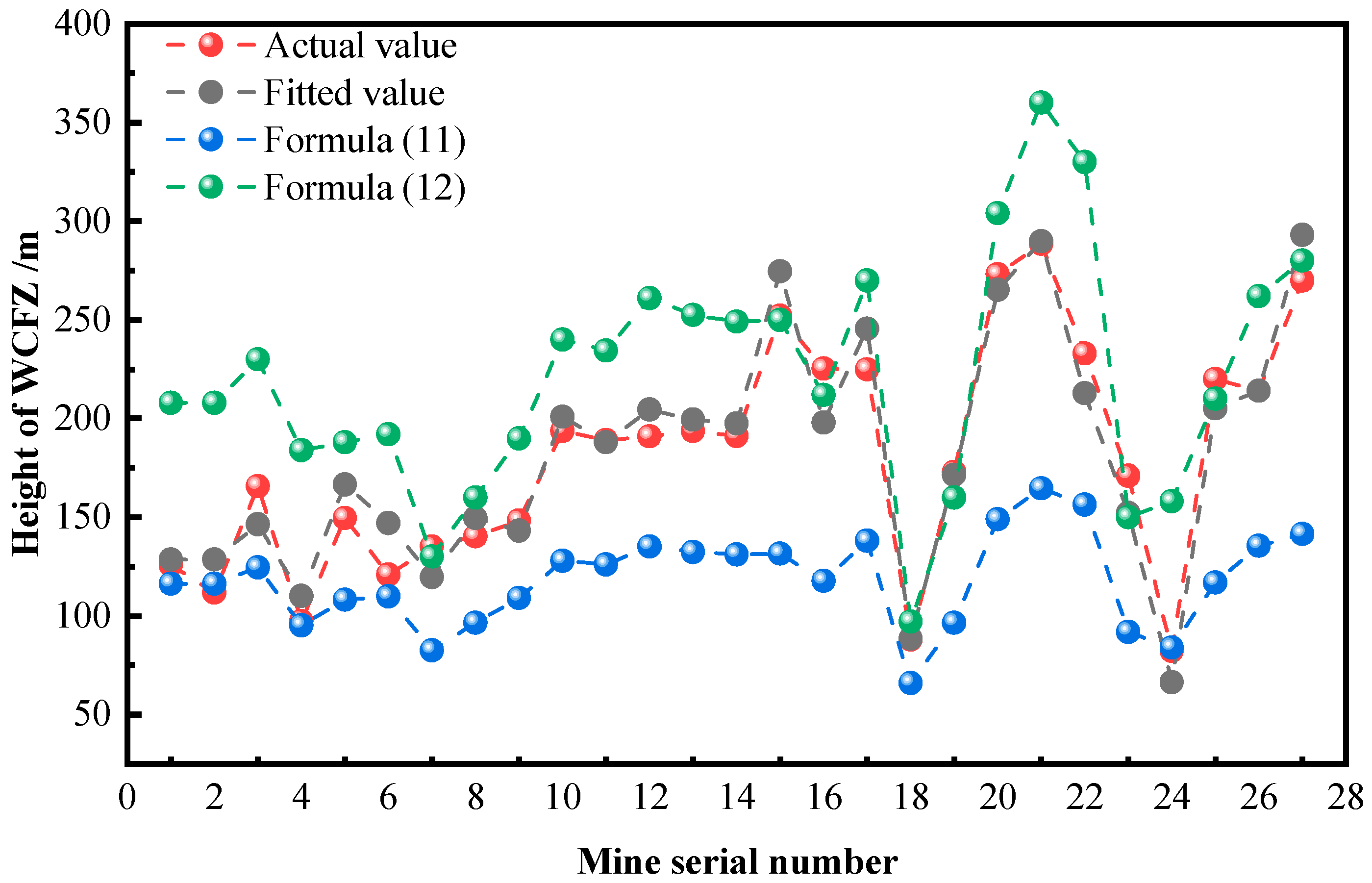
By substituting the working face parameters of each mine from Table 1 into Equation (10), a comparative analysis was conducted between the measured values and the heights of WCFZ calculated using the regression model, Empirical Formula (11) [25], and Empirical Formula (12) [26]. The results are presented in Table 3 and Figure 2; the mean absolute percentage error (MAPE) of the developed multiple nonlinear regression model is 7.52%, which is 23.45% and 22.55% lower than those of Empirical Formulas (11) and (12), respectively. Additionally, the predicted height curve of WCFZ by the multiple nonlinear regression model is more consistent with the measured height curve.
H l i = 100 M 0.26 M + 6.88 ± 11.49
H l i = 20 M + 10

3.3. Applicable Condition

According to statistical principles, all regression models have specific applicable ranges. Model predictions are most reliable when independent variables fluctuate within the original data range. When extrapolation is required, the maximum extrapolation range shall not exceed 10% of the original domain; otherwise, the model will become invalid. Therefore, by extrapolating each influencing factor’s data range by 10%, the applicable range of the multiple nonlinear regression prediction model for the Binchang mining area is determined (Table 4).

4. Prediction Model of Convolutional Neural Network

4.1. Convolutional Neural Network

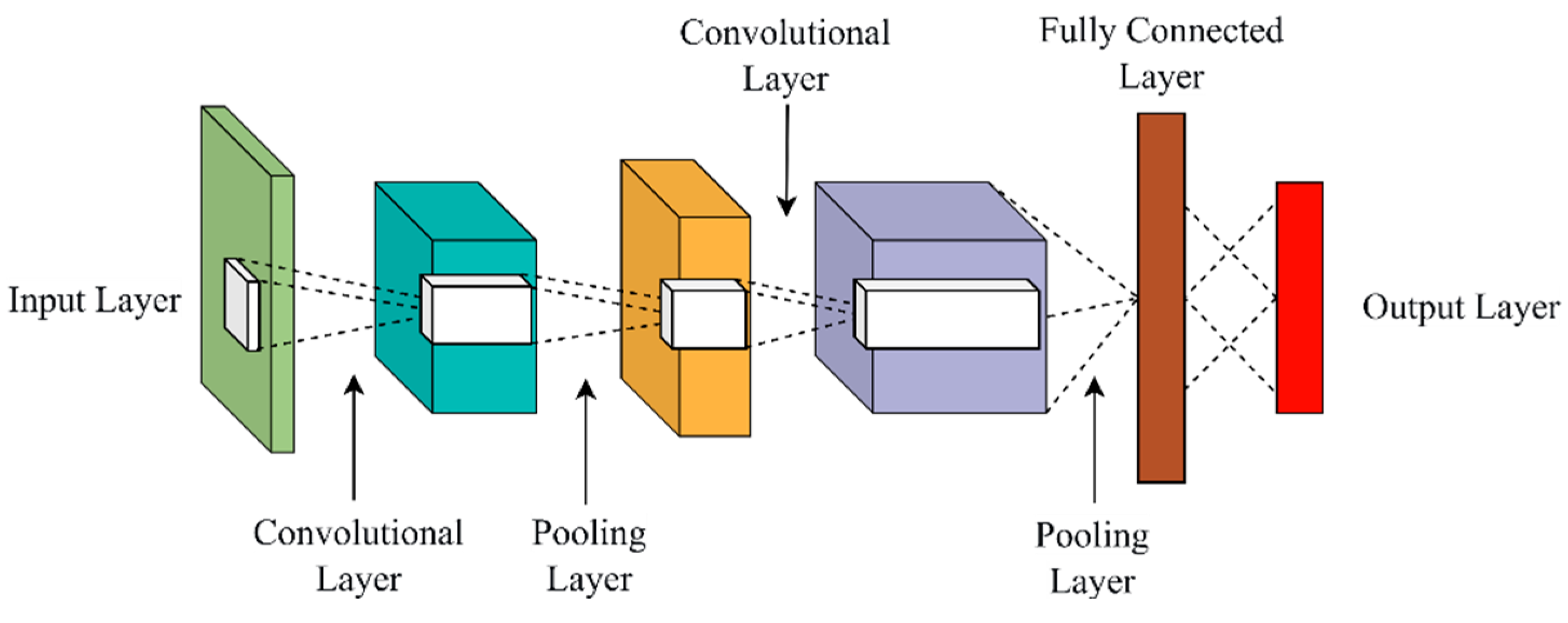
Convolutional Neural Network (CNN) is one of the classic neural network architectures in deep learning. Its unique spatial structure, characterized by local connectivity, weight sharing, and spatial downsampling, enables efficient processing of grid-structured topological data and the establishment of complex nonlinear mapping relationships. Widely applied in fields such as image classification, object detection, and time-series data prediction, the CNN model primarily consists of Convolutional Layers, Pooling Layers, and Fully Connected Layers. Through techniques like activation functions and regularization, it accomplishes input feature extraction, task mapping, and target output. The network structure is illustrated in Figure 3.

4.1.1. Convolution Layer

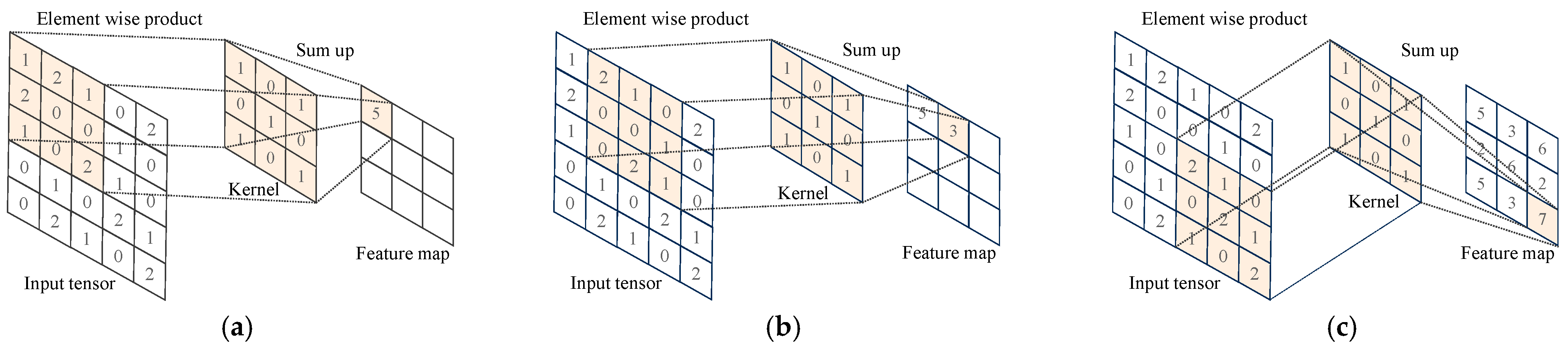
The Convolutional Layer serves as the core component of CNN. It operates by sliding convolutional kernels across the input data to extract local features. Furthermore, multiple Convolutional Layers can hierarchically combine these local features into comprehensive global representations. Activation functions are typically applied to the convolutional outputs to enable the learning of complex nonlinear relationships within the data. The process of convolutional scanning is illustrated in Figure 4.

4.1.2. Pooling Layer

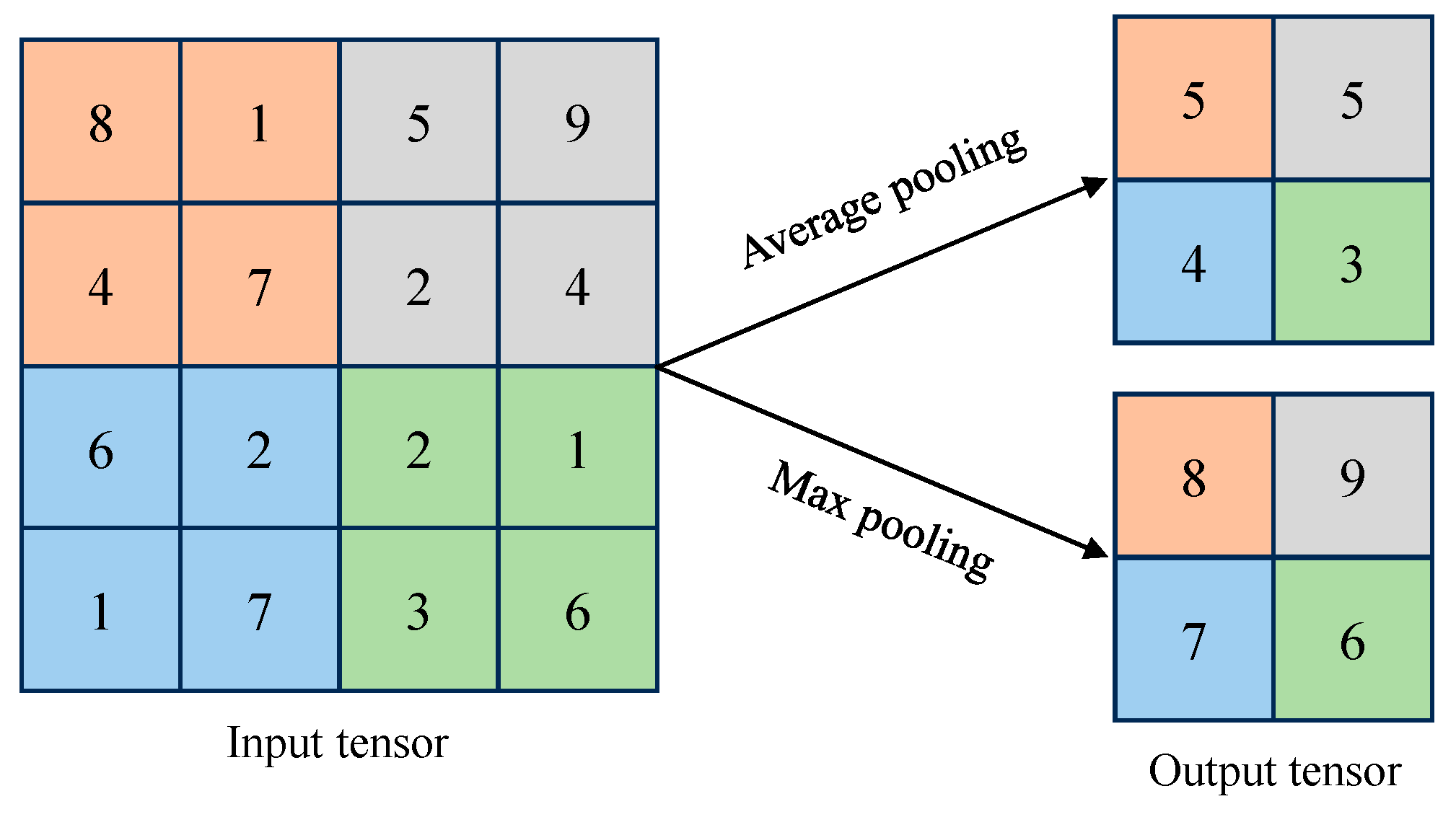
The pooling operation functions similarly to convolution, employing a sliding window to traverse the output matrix of the Convolutional Layer. This process further refines the data by extracting more representative and critical information, thereby achieving dimensionality reduction while maintaining feature invariance. Two common forms of pooling operations are max pooling and average pooling, both of which are illustrated in Figure 5.

4.1.3. Fully Connected Layer

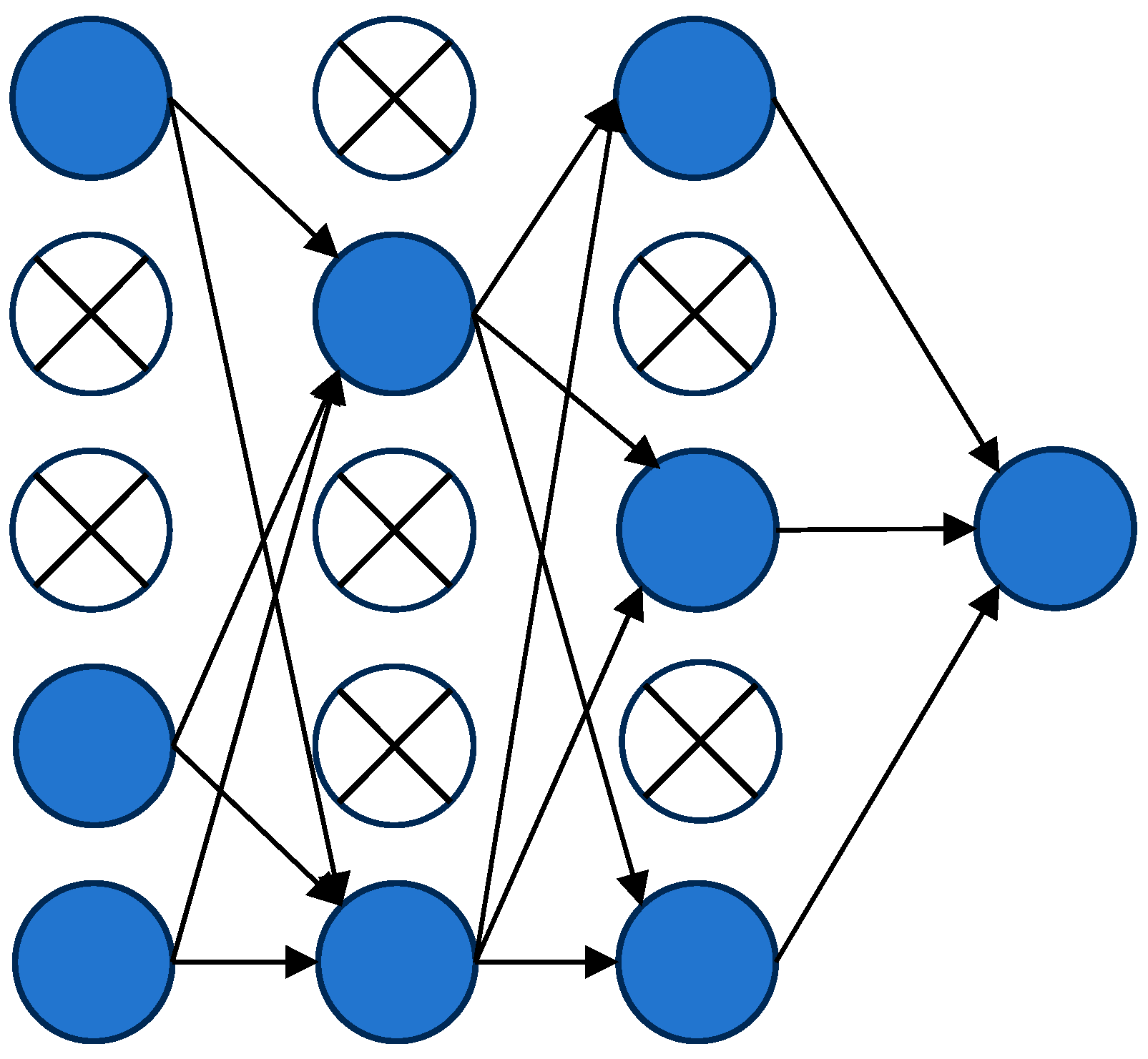
The Fully Connected Layer, positioned at the terminal stage of CNN, employs dense connections between all neurons of the preceding layer and all neurons of the subsequent layer to integrate features extracted by the Pooling Layers and perform regression tasks. To enhance the model’s nonlinear modeling capability and computational efficiency, Dropout [27] is typically incorporated into the Fully Connected Layer. During model training, Dropout randomly ignores a subset of neurons, effectively preventing overfitting while accelerating convergence. The structure of Dropout is illustrated in Figure 6.

4.2. Model Construction and Parameter Setting

4.2.1. Model Construction

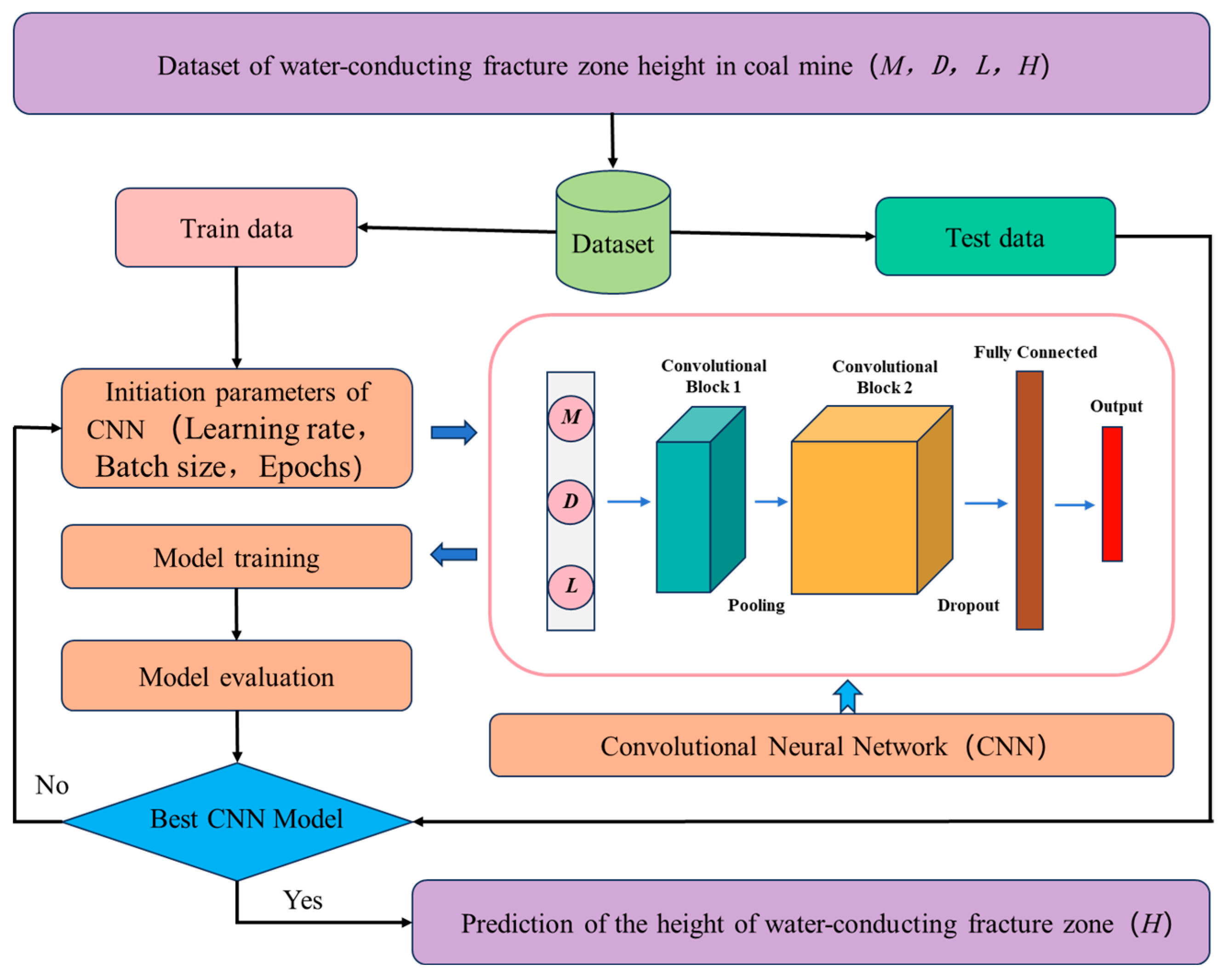
The overall framework of the model is illustrated in Figure 7. The sample dataset containing mining thickness (M), mining depth (D), working face length (L), and the height of WCFZ (H) is divided into a training set and a testing set. It is then fed into the CNN model for iterative training. The input layer of CNN has dimensions of 3 × 1 × 1. The network comprises two convolutional blocks with depths of 16 and 32, respectively, each using a convolutional kernel size of 3 × 1. These two convolutional blocks are connected via Pooling Layers, which employ a window size of 2 × 1, a stride of 1, and max pooling operations. The Fully Connected Layer incorporates the Dropout method to randomly discard a proportion of nodes. Finally, the training performance of the model is evaluated. Once optimal performance is achieved, the testing set samples are introduced to assess the prediction accuracy of the developed height of WCFZ model.

4.2.2. Parameter Setting

The key parameters of CNN include the optimization algorithm, batch size, learning rate, number of epochs, and Dropout rate. Based on practical requirements, the configuration of these parameters is specified in Table 5.

4.3. Model Training and Testing

4.3.1. Data Preparation

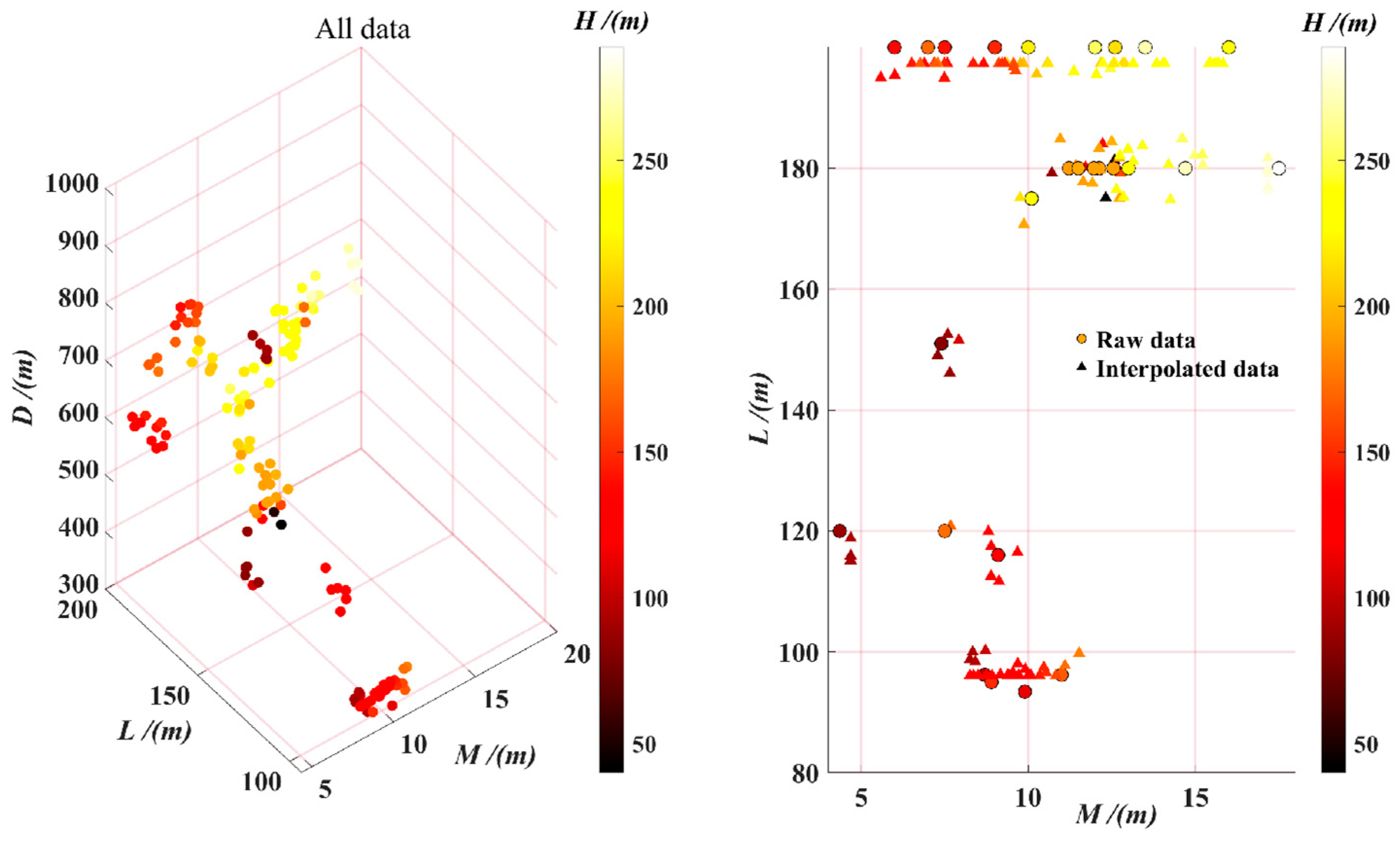
Due to the limited number of irregular scattered data points in Table 1, which hinders adequate learning by CNN, the scatteredInterpolant function in Matlab R2024b was employed to interpolate the original data, generating 150 sample data points. The distribution of the interpolated data is shown in Figure 8. Subsequently, the data were normalized using Equation (13). Finally, the randperm function was applied to randomly shuffle the sample data to eliminate any regularity introduced by the interpolation process.
Y i = x x min x max x min
In Equation (13), x represents the input value, x min and x max denote the minimum and maximum values in the input sample, respectively, and Y i is the normalized value.

4.3.2. Evaluation Metrics

When evaluating regression tasks, commonly used evaluation metrics include the coefficient of determination (R2), root mean square error (RMSE), and mean absolute percentage error (MAPE). The calculation formulas are as follows:
R 2 = 1 i = 1 n ( y i y ^ i ) 2 i = 1 n ( y i y ¯ ) 2
R M S E = 1 n i = 1 n ( y i y ^ i ) 2
M A P E = i = 1 n y i y ^ i y i n × 100 %
In Equations (14)–(16), n is the sample size, y i is the actual value, y ^ i is the predicted value, and y ¯ is the mean value. R 2 represents the goodness of fit of the model, where values closer to 1 indicate better predictive performance. RMSE and MAPE reflect the sample deviation and relative error between predicted and actual values, respectively, with values closer to 0 indicating better predictive performance.

4.3.3. Training and Testing

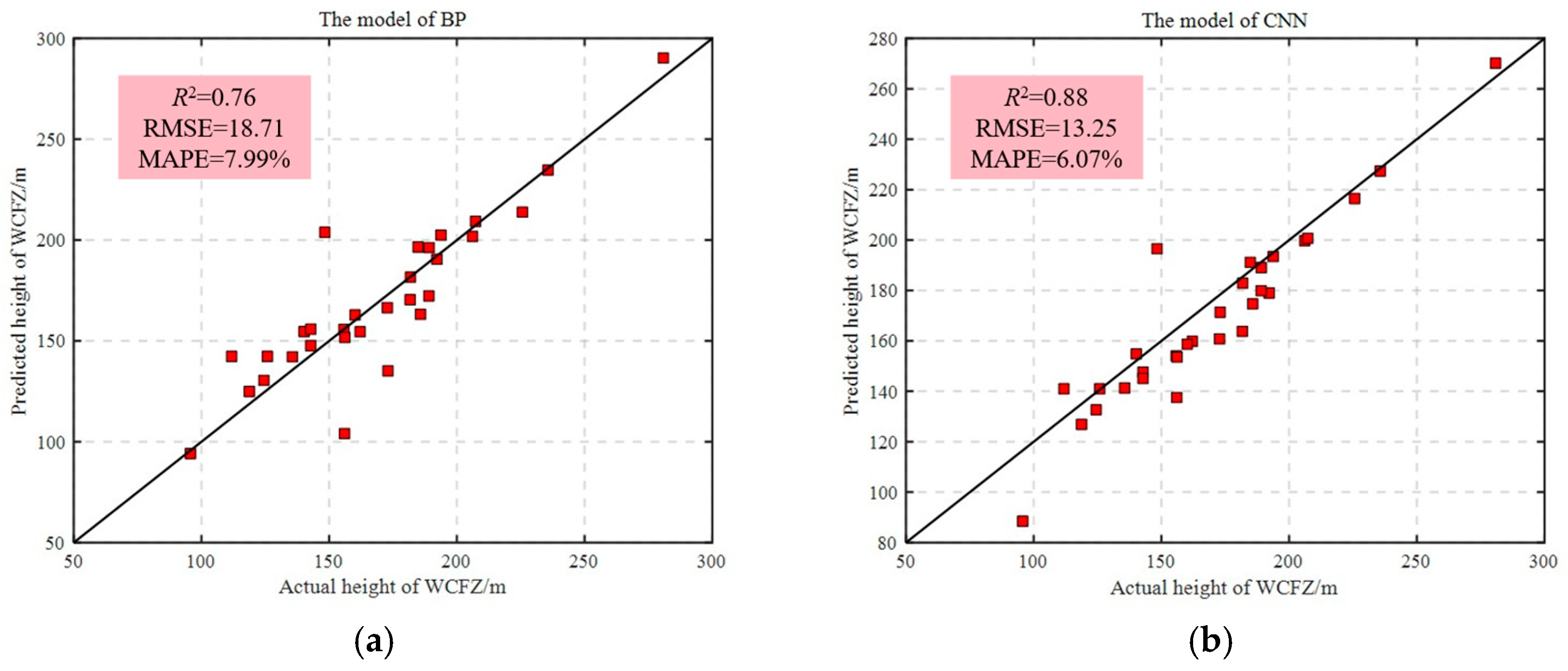
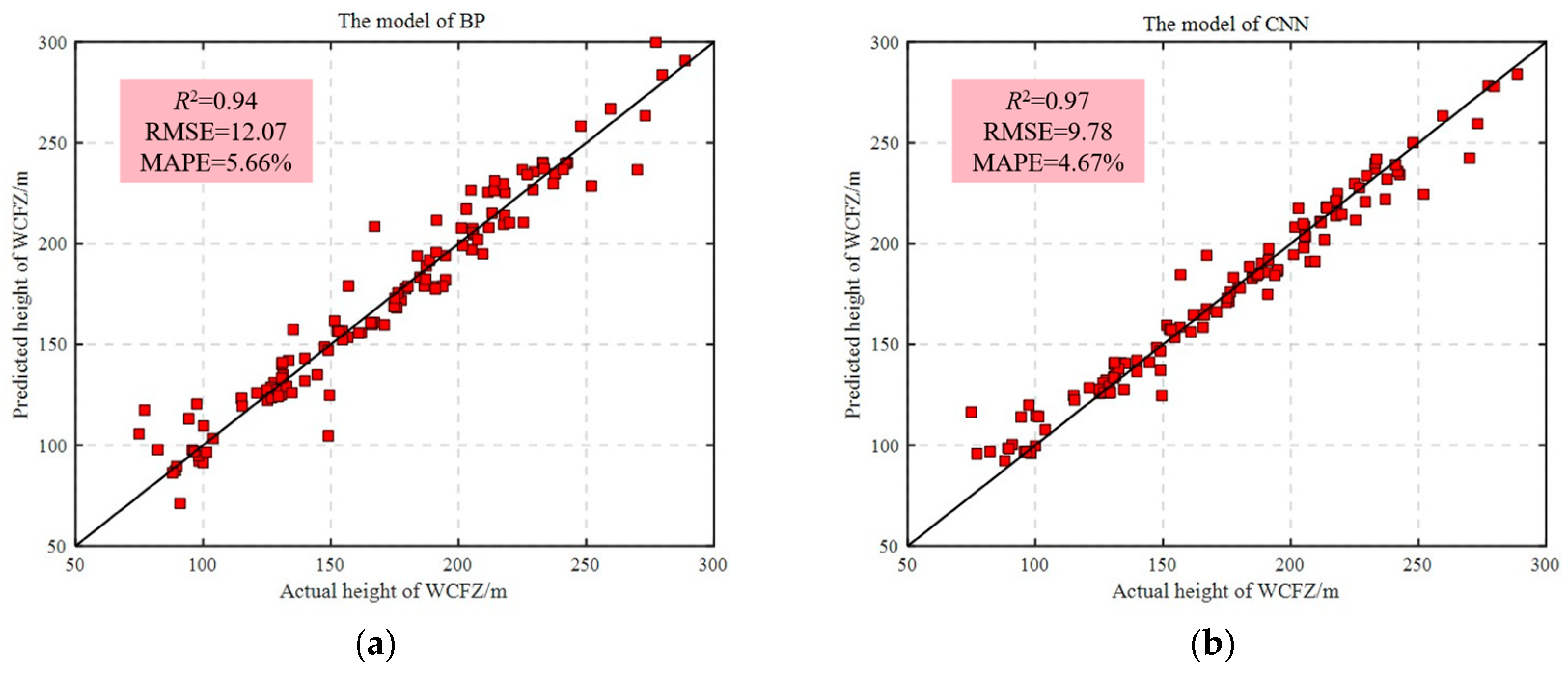
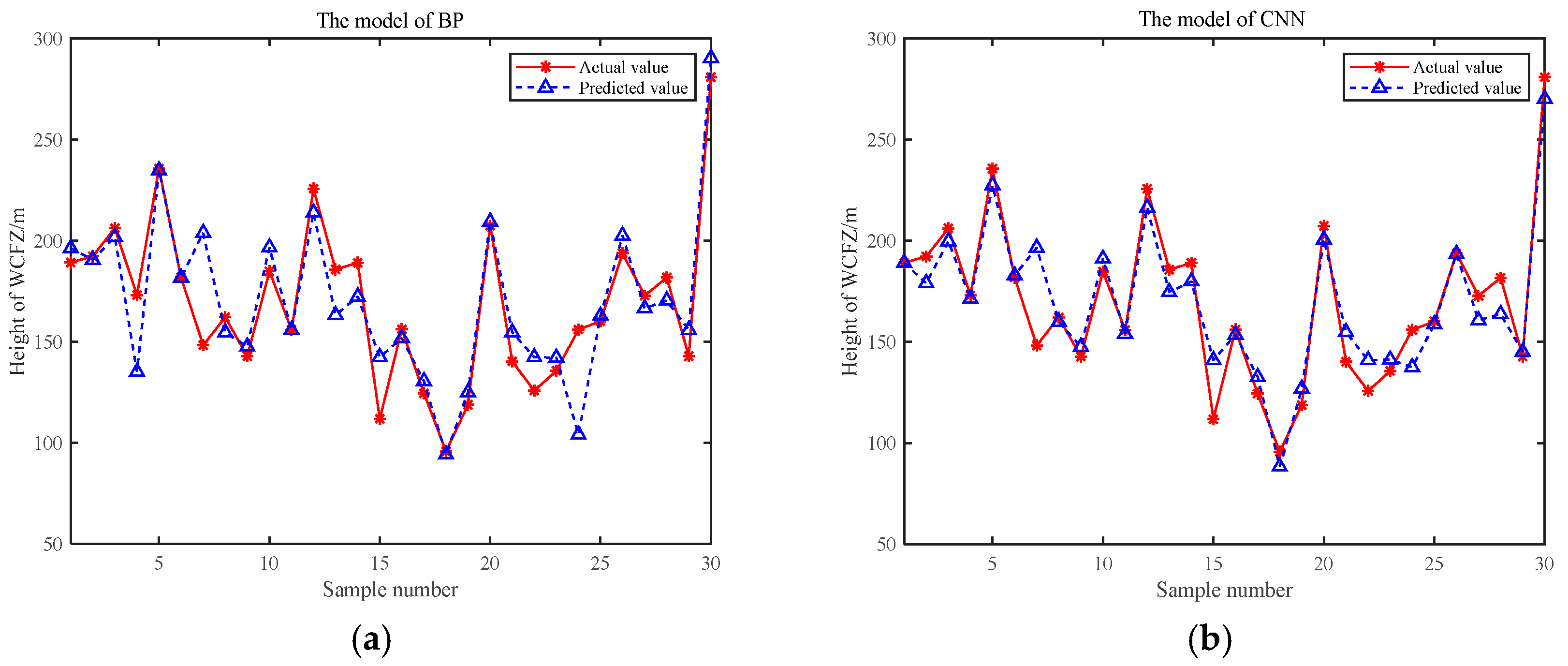
Considering the limited data scale, the sample data were divided into training and testing sets at a ratio of 80% to 20%, resulting in 120 training samples and 30 testing samples. The training set was used to develop the prediction model for the height of WCFZ, while the testing set was utilized to evaluate the model’s predictive accuracy. To validate the model’s effectiveness, comparative analysis was conducted with the BP neural network adopted in previous studies [28]. The BP neural network was established with two hidden layers, and each layer contains 10 neurons. Both models were constructed, trained, and tested in MATLAB, keeping the learning rate and iteration number consistent. The results for the training and testing sets are shown in Figure 9 and Figure 10, respectively. The CNN model achieved a coefficient of determination (R2) of 0.97, a RMSE of 9.78, and a MAPE of 4.67% on the training set. On the testing set, it attained an R2 of 0.88, RMSE of 13.25, and MAPE of 6.07%. Compared to the BP neural network model, the CNN model demonstrated superior performance across all evaluation metrics, with more pronounced improvements on the testing set. This indicates that the CNN model provides higher accuracy and better generalization capability for predicting the height of WCFZ in the Binchang mining area. Furthermore, these results indirectly demonstrate that deep neural network possess stronger modeling capabilities for complex nonlinear relationships compared to shallow neural network.
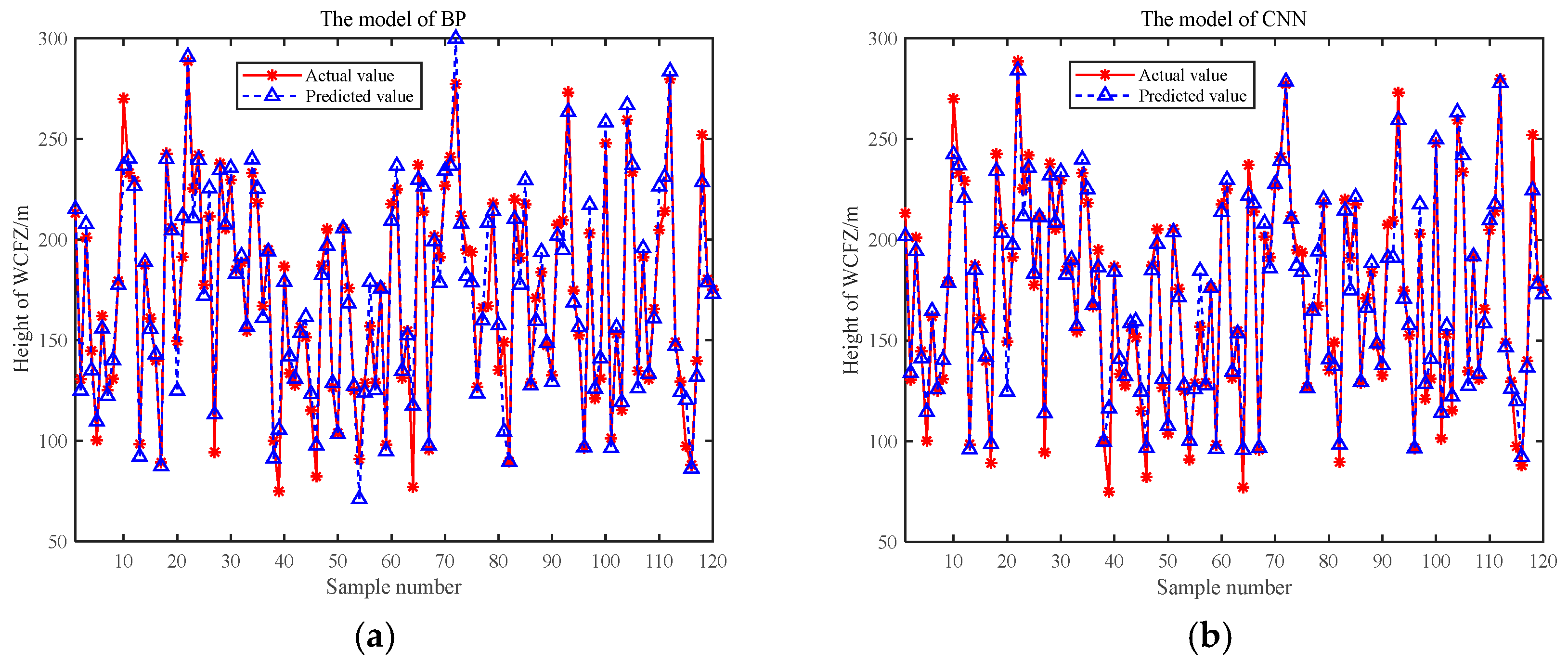
Additionally, the predicted heights of WCFZ from both the BP neural network and CNN models for the training and testing sets are plotted as line charts in Figure 11 and Figure 12, respectively. It can be observed that the prediction curve of the CNN model aligns more closely with the measured values of WCFZ height, further validating the effectiveness of the CNN model in predicting the development height of WCFZ in the Binchang mining area.

5. Engineering Application

To further validate the effectiveness of the multiple nonlinear regression model and CNN model, predictions were conducted for the height of WCFZ in the overburden strata induced by mining at the ZF1403 and ZF1405 working faces of the Yadian coal mine in the Binchang mining area. According to the literature [29,30], the ZF1403 and ZF1405 working faces in the Yadian Mine have a dip length of 200 m and an average coal seam burial depth of 700 m. The ZF1403 working face has an average mining thickness of 13.5 m and a WCFZ height of 242.1 m, while the ZF1405 working face has an average mining thickness of 12.07 m and a WCFZ height of 247.4 m. Both working faces adopted the fully mechanized top-coal caving method to extract the No. 4 coal seam of the Yan’an Formation, with medium-hard overburden rock types. The aforementioned parameters were input into the regression fitting formula and the CNN model, respectively, and the predicted heights of WCFZ are presented in Table 6.
As shown in Table 6, Empirical Formula (11) yields a considerable prediction error, and Empirical Formula 12 exhibits obvious fluctuations in predictive accuracy. In contrast, the established multiple nonlinear regression model and CNN model achieve lower prediction errors and superior stability. The multiple nonlinear regression model predicted heights of 257.36 m and 241.12 m for WCFZ in working faces ZF1403 and ZF1405, respectively. The absolute errors between predicted and measured values were 15.26 m and 6.28 m, with relative errors of 6.30% and 2.54%. In comparison, the CNN model predicted heights of 244.44 m and 239.61 m for the same working faces, with absolute errors of 2.34 m and 7.79 m, and relative errors of 0.97% and 3.15%. The results demonstrate that the multiple nonlinear regression model and CNN model achieve higher prediction accuracy than the empirical formulas established in previous studies [24,25], and the CNN model achieves superior predictive performance, exhibiting better accuracy and stability compared to the multiple nonlinear regression model.

6. Conclusions

6.1. Main Conclusions

(1) Based on a comprehensive analysis of the factors influencing the height of WCFZ in the Binchang mining area, three parameters—mining thickness, mining depth, and working face length—were selected as the primary controlling factors. This approach effectively overcomes the limitation of traditional empirical formulas that consider mining thickness as the sole influencing factor, which often leads to low prediction accuracy.
(2) Based on measured data, two prediction models for the height of WCFZ in the Binchang mining area were developed, a multiple nonlinear regression model and a Convolutional Neural Network (CNN) model, both incorporating the three influencing factors of mining thickness, mining depth, and working face length. The multiple nonlinear regression model achieved a goodness of fit (R2) of 0.84 and a mean absolute percentage error (MAPE) of 7.52%. In comparison, the CNN model attained a coefficient of determination (R2) of 0.97, with a root mean square error (RMSE) of 9.78 and a MAPE of 4.67%, demonstrating significantly enhanced predictive performance over the multiple nonlinear regression model.
(3) The multiple nonlinear regression model and the CNN model were applied to predict the height of WCFZ in the ZF1403 and ZF1405 working faces of the Yadian coal mine. Results demonstrate that the relative errors of the multiple nonlinear regression model remained below 7%, while those of the CNN model were within 4%. Both models meet the accuracy requirements for engineering applications, with the CNN model recommended for scenarios requiring higher precision.

6.2. Future Prospects

Although the present study achieved satisfactory prediction performance, there remains room for improvement in prediction accuracy. Future work can collect additional in situ measurements of the height of WCFZ within the mining area, analyze the relationships between the height of WCFZ and various influencing factors, and perform cross-validation of the machine learning models on the compiled dataset to enhance their generalization capability. Meanwhile, factors affecting the height of WCFZ under different hydrogeological conditions, such as the overlying strata structure and the coal seam dip angle, should be considered, so that more influencing variables can be incorporated into a comprehensive assessment of the development height of WCFZ. Furthermore, adopting more advanced modeling techniques and hybrid optimization models could provide more accurate guidance for predicting the height of WCFZ in the Binchang mining area and in regions with similar geological conditions.

Author Contributions

B.Z.: conceiving the idea and funding acquisition. F.L.: developing the approach, generating all results and drafting the manuscript. J.W., W.W. and Y.T.: performing data analysis and revising the manuscript. All authors have read and agreed to the published version of the manuscript.

Funding

The research was supported by the National Natural Science Foundation of China (Grant No. 52574160).

Data Availability Statement

The data that support the findings of this study are available from the corresponding author upon reasonable request.

Acknowledgments

The authors would also like to thank Feng and Chen for their valuable comments and suggestions for improvement of the manuscript.

Conflicts of Interest

The authors declare no conflicts of interest.

Abbreviations

The following abbreviations are used in this manuscript:
WCFZWater-conducting fracture zone
RMSERoot mean square error
MAPEMean absolute percentage error
BPBack propagation
CNNConvolutional neural network

References

  1. Feng, L.F.; Wang, S.M.; Wang, H.; Li, C.F.; Zhang, Y.H. Study on micro-pore characteristics of Luohe formation sandstone in typical roof water hazard mines of the Binchang mining area. Coal Sci. Technol. 2023, 51, 208–218. (In Chinese) [Google Scholar] [CrossRef]
  2. Cheng, L.; Luo, H.; Li, H.; Zhang, Y. Recent advances in research on the development height of water-conducting fracture zones in overlying rock affected by coal mining activities. Sci. Technol. Eng. 2022, 22, 28–38. (In Chinese) [Google Scholar]
  3. State Administration of Work Safety; State Administration of Coal Mine Safety; National Energy Administration; National Railway Administration. Specifications for the Placement of Coal Pillars and Coal Mining in Buildings, Water Bodies, Railways and Major Shafts and Roadways; China Coal Industry Publishing House: Beijing, China, 2017. (In Chinese) [Google Scholar]
  4. Yin, S.X.; Xu, B.; Xu, H.; Xia, X.X. Research on the height calculation of water-conducting fracture zone in coal seam roof under fully mechanized mining conditions. Coal Sci. Technol. 2013, 41, 138–142. (In Chinese) [Google Scholar] [CrossRef]
  5. Li, C.F. The highly developed characteristics of water-conducting fracture zones in the roof of fully mechanized caving coal mining in the Huanglong coalfield. Coal Geol. Explor. 2019, 47, 129–136. (In Chinese) [Google Scholar]
  6. Wu, J.H.; Pan, J.F.; Gao, J.M.; Yan, Y.D.; Ma, H.Y. Research on height prediction of water-conducting fissure zone in Huanglong Jurassic coalfield. Coal Sci. Technol. 2023, 51, 231–241. (In Chinese) [Google Scholar] [CrossRef]
  7. Feng, J.; Shi, X.; Chen, J.; Wang, K. Prediction of the Water-Conducting Fracture Zone Height Across the Entire Mining Area Based on the Multiple Nonlinear Coordinated Regression Model. Water 2025, 17, 1303. [Google Scholar] [CrossRef]
  8. Zhao, B.; He, S.; Bai, K.; Lu, X.; Wang, W. Elastic wave prospecting of water-conducting fractured zones in coal mining. Sci. Rep. 2024, 14, 7036. [Google Scholar] [CrossRef] [PubMed]
  9. Fan, H.; Wang, L.; Lu, Y.; Li, Z.; Li, W.; Wang, K. Height of water-conducting fractured zone in a coal seam overlain by thin bedrock and thick clay layer: A case study from the Sanyuan coal mine in North China. Environ. Earth Sci. 2020, 79, 125. [Google Scholar] [CrossRef]
  10. Xu, J.L.; Zhu, W.B.; Wang, X.Z. A method for predicting the height of water-conducting fracture zones based on the positions of key layers. J. China Coal Soc. 2012, 37, 762–769. (In Chinese) [Google Scholar] [CrossRef]
  11. Zhao, B.C.; Guo, Y.X.; Sun, H.; Yang, X.; Wang, J.B.; Zhao, Y. Study on stability of overburden aquiclude in near-shallow buried coal seam mining based on main key stratum position. J. Min. Saf. Eng. 2022, 39, 653–662. (In Chinese) [Google Scholar] [CrossRef]
  12. Ju, J.F.; Ma, X.; Zhao, F.Q.; Liu, Y.J.; Wang, Y.Z.; Liu, L.; Xu, J.L. Study on the development and zoning characteristics of water-conducting fissures in Dongsheng Coalfield. Coal Sci. Technol. 2022, 50, 202–212. (In Chinese) [Google Scholar] [CrossRef]
  13. Cao, Z.Y.; Yuan, L.; Xu, L.J.; Liu, X.P.; Sun, Z.H. Deformation law of single-sided caved overlying rocks and prediction of the development height of water-conducting fracture zones. Coal Sci. Technol. 2025, 53, 38–54. (In Chinese) [Google Scholar]
  14. Wu, F.; Gao, Z.; Liu, H.; Yu, X.; Gu, H. Theoretical discrimination method of water-flowing fractured zone development height based on thin plate theory. Appl. Sci. 2024, 14, 6284. [Google Scholar] [CrossRef]
  15. Tian, B.; Deng, Y.C.; Yang, S.Z.; Zhang, T.; Zhang, P.S. Research on the morphological characteristics of water-conducting fracture zones of overlying rocks in medium-thick and gently inclined coal seams. J. Shandong Univ. Sci. Technol. (Nat. Sci.) 2025, 44, 13–23. (In Chinese) [Google Scholar] [CrossRef]
  16. Mai, L.; Li, H. Finite–discrete element method simulation study on development of water-conducting fractures in fault-bearing roof under repeated mining of extra-thick coal seams. Sustainability 2024, 16, 5177. [Google Scholar] [CrossRef]
  17. Ma, X.D.; Wang, S.J.; Jiang, Z.Q.; Chen, T.; Li, W.L. Height prediction of water-conducting fracture zone in coal mining in Shennan mining area. J. Xi’an Univ. Sci. Technol. 2016, 36, 664–668. (In Chinese) [Google Scholar] [CrossRef]
  18. Xie, X.; Hou, E.; Wang, S.; Sun, X.; Hou, P.; Wang, S.; Xie, Y.; Huang, Y. Formation mechanism and the height of WCFZ induced by middle deep coal seam mining in a sandy region: A case study from the Xiaobaodang coal mne. Adv. Civ. Eng. 2021, 2021, 6684202. [Google Scholar] [CrossRef]
  19. Lou, G.Z.; Tan, Y. Height prediction of water-conducting fracture zones based on PSO-BP neural network. Coal Geol. Explor. 2021, 49, 198–204. (In Chinese) [Google Scholar]
  20. Xu, S.Y.; Zhang, Y.B.; Sun, H.D.; Hu, X.B. Research on the height prediction model of water-conducting fracture zone based on RBF core ε-SVR. J. Saf. Environ. 2021, 21, 2022–2029. [Google Scholar] [CrossRef]
  21. Wang, H.; Zhu, J.; Li, W. An Improved Back Propagation Neural Network Based on Differential Evolution and Grey Wolf Optimizer and Its Application in the Height Prediction of Water-Conducting Fracture Zone. Appl. Sci. 2024, 14, 4509. [Google Scholar] [CrossRef]
  22. Wang, Z.C.; Tang, X.H.; Zhang, W.Q.; Wang, Y.J.; Fan, J.Y.; Lv, W.M. Intelligent prediction of the development height of water-conducting fissure zones based on the SSA-RF model. Coal Sci. Technol. 2025, 53, 288–299. (In Chinese) [Google Scholar]
  23. Hou, E.; Bi, M.; Long, T.; Xie, X.; Hou, P.; Li, Q. Predicting height of water-conducting fissure zones in a Jurassic coalfield based on AdaBoost-WOA-BPNN. Mine Water Environ. 2025, 44, 372–388. [Google Scholar] [CrossRef]
  24. Xu, C.; Zhou, K.; Xiong, X.; Gao, F.; Zhou, J. Research on height prediction of water-conducting fracture zone in coal mining based on intelligent algorithm combined with extreme boosting machine. Expert Syst. Appl. 2024, 249, 123669. [Google Scholar] [CrossRef]
  25. Xu, Y.C.; Li, J.C.; Liu, S.Q.; Zhou, L. Calculation formula and applicability analysis of the height of the “two zones” of overlying rock in fully mechanized caving mining. J. Min. Strat. Control Eng. 2011, 16, 4–7+11. (In Chinese) [Google Scholar] [CrossRef]
  26. Teng, Y.H. The development characteristics and maximum height calculation of water-conducting fracture zones in fully mechanized caving mining. Coal Sci. Technol. 2011, 39, 118–120. (In Chinese) [Google Scholar] [CrossRef]
  27. Hinton, G.E.; Srivastava, N.; Krizhevsky, A.; Sutskever, L.; Salakhutdinov, R.R. Improving neural networks by preventing co-adaptation of feature detectors. arXiv 2012, arXiv:1207.0580. [Google Scholar] [CrossRef]
  28. Wang, X.; Yin, S.X.; Xu, B.; Cao, M.; Zhang, R.G.; Tang, Z.Y.; Huang, W.X.; Li, W.L. Optimization of the height prediction model for water-conducting fracture zones in overlying rocks under fully mechanized mining conditions. Coal Sci. Technol. 2023, 51, 284–297. (In Chinese) [Google Scholar] [CrossRef]
  29. Sheng, F.T.; Duan, Y.Q. Research on the height of the water-conducting fracture zone in fully Mechanized caving mining under the thick sandstone aquifer in Binchang mining area. Coal Eng. 2022, 54, 84–89. (In Chinese) [Google Scholar]
  30. Liu, C.Y.; Song, W.; Sheng, F.T.; Gu, W.Z.; Yuan, C.F.; Zhang, L. Development height of the water-conducting fracture zone in the fully-mechanized caving mining of extra-thick coal seams under strong aquifers. J. Min. Strat. Control Eng. 2024, 6, 114–124. (In Chinese) [Google Scholar] [CrossRef]
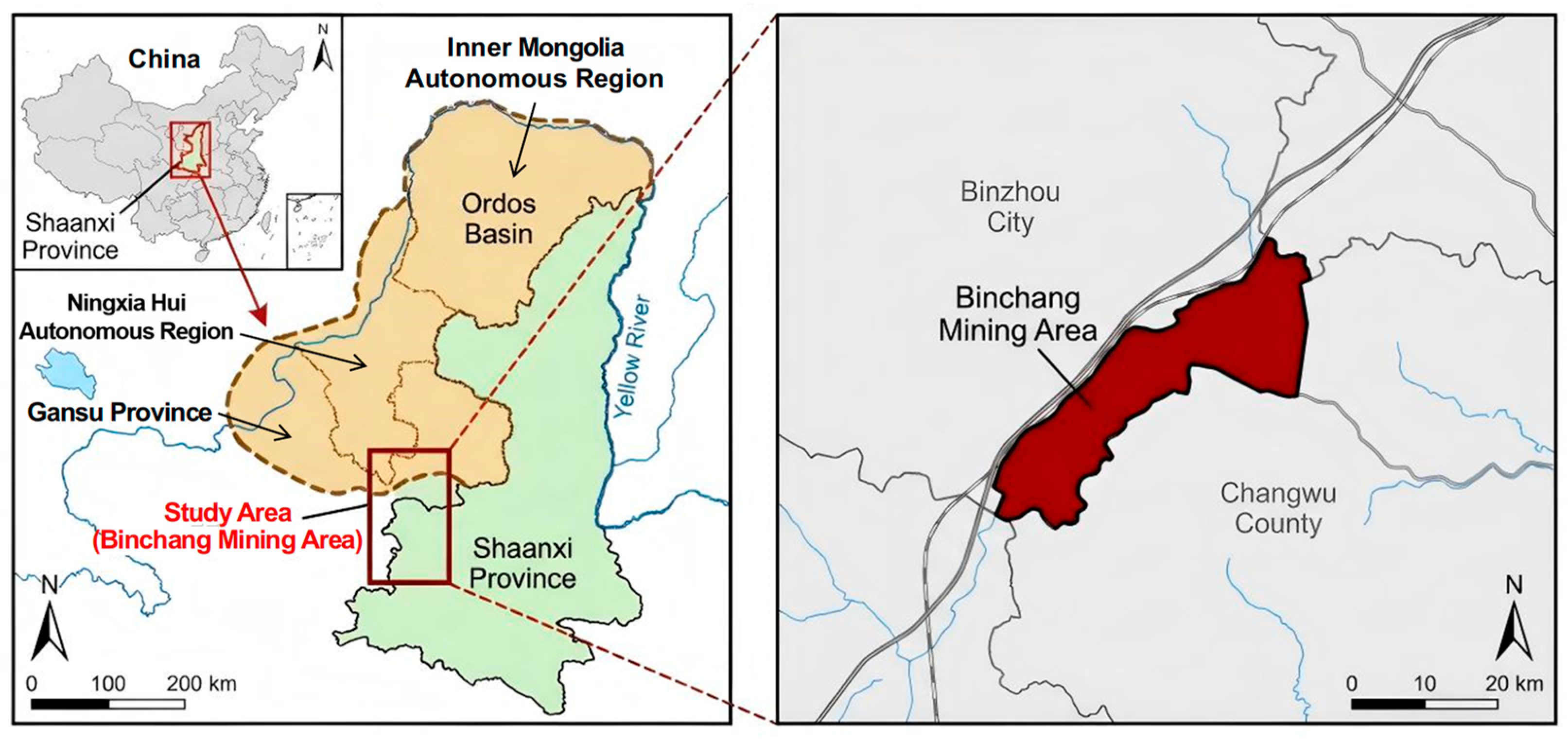
Figure 1. The geographical location of study area.
Water 18 01215 g001
Figure 2. Predicted height curve of different formulas.
Water 18 01215 g002
Figure 3. Structure of CNN.
Water 18 01215 g003
Figure 4. Convolution operation process: (a) the first convolution operation; (b) the second convolution operation; (c) the last convolution operation.
Water 18 01215 g004
Figure 5. Forms of pooling operation (colors represent different tensor blocks.).
Water 18 01215 g005
Figure 6. Dropout structure.
Water 18 01215 g006
Figure 7. Model framework.
Water 18 01215 g007
Figure 8. Data interpolation.
Water 18 01215 g008
Figure 9. Prediction results of the training set: (a) the training result of the BP model; (b) the training result of the CNN model.
Water 18 01215 g009
Figure 10. Prediction results of the test set: (a) the test result of the BP model; (b) the test result of the CNN model.
Water 18 01215 g010
Figure 11. Height prediction curves of WCFZ in the training set: (a) the height prediction curves of WCFZ of the BP model; (b) the height prediction curves of WCFZ of the CNN model.
Water 18 01215 g011
Figure 12. Height prediction curves of WCFZ in the test set: (a) the height prediction curves of WCFZ of the BP model; (b) the height prediction curves of WCFZ of the CNN model.
Water 18 01215 g012
Table 1. Dataset of WCFZ in Binchang mining area.
NumberMineWorking FaceMining Thickness/mMining Depth/mWorking Face Length/mMeasured Height of WCFZ/mMining-Induced Failure Ratio
1Xiagou MineZF28019.90330.0093.40125.8112.71
2ZF28019.90330.0093.40111.8111.29
3ZF280211.00331.9896.20165.6115.06
4ZF28038.70330.0096.2097.4711.20
5ZF28048.90330.0095.00149.4816.80
6Tingnan Mine1069.10480.03116.00121.0313.30
72046.00575.00200.00135.2322.54
82067.50533.20200.00140.2018.69
92069.00702.00200.00148.3016.48
10Dafosi Mine4010611.50460.00180.00193.7616.85
114010811.22391.50180.00189.0516.85
124010812.55391.50180.00191.0015.22
134010812.12391.50180.00193.7615.99
144010811.96391.50180.00191.2715.99
15Hujiahe Mine40112.00529.44200.00252.0021.00
1640110110.10608.40175.00225.4322.32
1740110513.00687.00180.00225.0017.31
18Gaojiabao Mine411014.36983.80120.0088.0320.19
191017.50 983.80120.00173.0023.07
20Mengcun Mine40110114.70709.11180.00273.1118.58
2140110117.50718.78180.00288.6816.50
22Xiaozhuang Mine4020416.00568.00200.00233.0514.57
23Wenjiapo Mine41017.00650.00200.00171.0024.43
24Jiangjiahe MineZF14107.40423.90151.0082.2611.12
25Huoshizui Mine871210.00628.16200.00220.0022.00
26Yadian MineZF141712.60420.00200.00214.0016.98
27ZF141713.50540.00200.00270.0020.00
Table 2. Multiple nonlinear regression models under different influencing factors.
Influencing FactorFitting FormulaR2Formula Number
M H l i = 100 M 0.09 M + 8.26 + 35.16 0.64(3)
D H l i = 3.63 D + 97.60 0.02(4)
L H l i = 118.74 ln ( L ) 419.56 0.34(5)
M, D H l i = 100 M 0.14 M + 0.91 + 7.29 D 417.63 0.79(6)
M, L H l i = 100 M 0.01 M + 7.89 + 73.22 ln ( L ) 326.06 0.76(7)
L, D H l i = 115.77 ln ( L ) + 0.68 D 420.43 0.31(8)
M, L, D H l i = 100 M 0.16 M + 1.18 + 47.73 ln ( L ) + 5.59 D 547.62 0.84(9)
Table 3. Prediction error of multiple nonlinear regression model.
Mine Serial NumberActual Height of WCFZ/mFitted Formula (10)Empirical Formula (11)Empirical Formula (12)
Predicted Height/mRelative Error/%Predicted Height/mRelative Error/%Predicted Height/mRelative Error/%
1125.81128.652.26116.217.63208.0065.33
2111.81128.6515.06116.213.93208.0086.03
3165.61146.3411.64124.4324.87230.0038.88
497.47110.1413.0095.172.36184.0088.78
5149.48166.6511.48108.2927.55188.0025.77
6121.03146.9621.43109.919.19192.0058.64
7135.23119.6911.4982.5838.93130.003.87
8140.20149.476.6196.4331.22160.0014.12
9148.30143.313.37109.1026.43190.0028.12
10193.76200.933.70128.0033.94240.0023.86
11189.05187.960.57126.0133.34234.4023.99
12191.00204.517.07135.2229.20261.0036.65
13193.76199.412.91132.3131.71252.4030.26
14191.27197.453.23131.2131.40249.2030.29
15252.00274.578.96131.4947.82250.000.79
16225.43198.0112.16117.7447.77212.005.96
17225.00245.539.12138.2038.58270.0020.00
1888.0388.430.4665.9025.1497.2010.42
19173.00171.350.9696.4344.26160.007.51
20273.11265.292.86148.8545.50304.0011.31
21288.68289.810.39164.6042.98360.0024.71
22233.05212.728.72156.4232.88330.0041.60
23171.00152.1311.0391.9546.23150.0012.28
2482.2666.4019.2984.052.18158.0092.07
25220.00205.086.78116.9846.83210.004.55
26214.00214.070.03135.5536.66262.0022.43
27270.00292.948.50141.4247.62280.003.70
MAPE7.52%30.97%30.07%
Table 4. Applicable condition of multiple nonlinear regression model.
Influencing FactorRaw DataExtrapolated Data
Mining thickness/m[4.36, 17.50][3.92, 19.25]
Mining depth/m[330.00, 983.80][297.00, 1082.18]
Working face length/m[93.40, 240.00][84.06, 264.00]
Mining methodFully mechanized top coal caving mining
Overlying rock typeMedium-hard
Table 5. Model parameter setting.
Parameter NameSetting
Optimization algorithmAdam
Batch size32
Learning rate0.0005
Epoch3600
Dropout rate0.3
Table 6. Comparison of prediction error.
Mine Working FaceActual Height of WCFZ /mEmpirical Formula (11) [24]Empirical Formula (12) [25]Multiple Nonlinear Regression ModelCNN Model
Predicted Height of WCFZ /mRelative ErrorPredicted Height of WCFZ /mRelative ErrorPredicted Height of WCFZ /mRelative ErrorPredicted Height of WCFZ /mRelative Error
ZF1403242.10141.4241.59%280.0015.65%257.366.30%244.440.97%
ZF1405247.40131.9746.66%251.401.62%241.122.54%239.613.15%
Disclaimer/Publisher’s Note: The statements, opinions and data contained in all publications are solely those of the individual author(s) and contributor(s) and not of MDPI and/or the editor(s). MDPI and/or the editor(s) disclaim responsibility for any injury to people or property resulting from any ideas, methods, instructions or products referred to in the content.