Article

Regionalized Rainfall Disaggregation Coefficients for the Rio de Janeiro Metropolitan Region, Brazil


by
Pedro Henrique Garcia de Souza Façanha
*,
Marcelo de Miranda Reis
and
Igor da Silva Rocha Paz
Instituto Militar de Engenharia (IME), Rio de Janeiro 22290-270, RJ, Brazil
*
Author to whom correspondence should be addressed.
Water 2026, 18(10), 1207; https://doi.org/10.3390/w18101207 (registering DOI)
Submission received: 6 April 2026 / Revised: 3 May 2026 / Accepted: 13 May 2026 / Published: 16 May 2026
(This article belongs to the Section Hydrology)

Abstract

This study estimates rainfall disaggregation coefficients for the State of Rio de Janeiro and for the Rio de Janeiro Metropolitan Region (RMRJ) based on automatic rain gauges from the CEMADEN network. A Python-based workflow collected time series, selected stations according to record length, extracted annual extreme events (10 min to 48 h), and calculated sub-daily to daily rainfall ratios for return periods of 2–100 years. The formulations proposed by Pfafstetter and Chen were evaluated through a case study to guide the model selection. In the RMRJ, 109 stations were analyzed and aggregated by municipality, resulting in the metropolitan mean disaggregation coefficient (COERM). The COERM values are close to those proposed by CETESB up to the 30 min–1 h duration range. However, the coefficients were up to 18.8% higher in the duration range between 1 h and 3 h relative to the 24 h rainfall, indicating a stronger temporal concentration of precipitation precisely in durations critical for urban drainage design.

1. Introduction

Design storms for urban drainage are highly sensitive to short-duration rainfall intensities, since durations comparable to the basin time of concentration control the peak discharge. In Brazil, intensity–duration–frequency (IDF) relationships are traditionally derived from pluviograph records; however, the limited availability and discontinuity of sub-daily series still restrict the local derivation of IDF curves in many municipalities [1,2].
To address this limitation, the disaggregation of daily rainfall remains widely used. The empirical framework proposed by Pfafstetter [3] and consolidated into national average coefficients by CETESB [4] enabled practical applications; however, the literature shows that IDF relationships and coefficients may vary among locations, and therefore the direct transfer of generalized values should be undertaken with caution [5]. At the national scale, reviews and reassessments of classical parameters indicate relevant differences when compared with more recent datasets, reinforcing the need to update the references used in engineering practice [6]. In regional applications, relationships between intense rainfall and daily totals may also differ across areas, influencing rainfall disaggregation and the consistency of estimates at different durations [7].
Recent studies have revisited rainfall disaggregation and the construction of IDF curves using expanded datasets and performance assessments. In Brazilian basins, the determination of regional coefficients and the evaluation of their applicability indicate that “average” coefficients do not necessarily capture local characteristics and that the influence of return period may be relevant for their application [8]. In Minas Gerais, the evaluation of ratios between daily and sub-daily extremes as disaggregation coefficients reinforces the local validity of these coefficients and highlights the importance of spatial validation and stationarity assumptions for their application [9]. Additionally, comparisons between intensities obtained through daily disaggregation and those derived from sub-daily data indicate improved performance when more specific coefficients validated against local records are used [10]. In other applications, comparisons of coefficients and IDF equation formulations based on reduced records show that methodological choices influence estimated rainfall intensities and should therefore be evaluated in the design context [11].
Alternative formulations for deriving intense rainfall equations from disaggregated daily series have been proposed and operationalized for engineering use [12], and updates at the state scale based on rainfall disaggregation have been reported for other Brazilian regions, reinforcing the need for local parameterization [13]. At the national scale, new datasets and regionalization approaches have contributed to improved spatial consistency and support for applications in areas with low monitoring density [14,15]. Satellite-based precipitation has also been explored as a complementary source for the development of IDF equations in ungauged areas, provided that bias correction procedures are applied [16]. Furthermore, recent methods propose strategies to transform daily maxima into shorter durations considering regional characteristics and information from nearby locations, as an alternative to traditional rainfall disaggregation in regions with limited data availability [17]. These advances, together with discussions on non-stationary IDF curves and their implications for hydraulic design, reinforce the need for updated and verified coefficients [18].
The regionalized coefficients obtained for the Rio de Janeiro Metropolitan Region were close to the CETESB values for shorter durations, with slightly lower COERM values for some sub-hourly ratios. The largest positive differences were observed between 1 h and 3 h relative to the 24 h rainfall, with higher COERM values in this range. This indicates a stronger temporal concentration of rainfall exactly in a duration range that is critical for hydrological response and peak-flow generation.
In the Rio de Janeiro Metropolitan Region, the automatic rain gauge network operated by CEMADEN offers recent high-resolution rainfall records, although the raw series require processing and conversion from UTC to local time [19]. Based on these data, this study estimates regionalized rainfall disaggregation coefficients for the metropolitan region and compares them with the classical CETESB coefficients [4]. To support the regional application, a pluviographic case study was first used to compare alternative formulations and select the most consistent one. The selected configuration was then implemented in an automated Python workflow and applied to the CEMADEN stations. In this way, the study combines methodological evaluation with large-scale application and provides updated coefficients for urban drainage studies in the region.

2. Material and Methods

The methodology adopted in this study is summarized in Figure 1 and is structured into two main stages. The first stage corresponds to the case study in Vassouras, based on the pluviographic data presented by Pfafstetter, with the purpose of testing, calibrating, and selecting the best-performing formulation. The second stage corresponds to the regional application of the selected methodology, including the selection of CEMADEN stations, the automated application of the model to the 109 selected stations, the estimation of rainfall disaggregation coefficients for each station, the aggregation by municipality, and the consolidation of the metropolitan coefficient (COERM), which was subsequently compared with the CETESB coefficients.
The procedure was structured in five steps: (1) definition of the disaggregation formulation to be adopted, through a pluviographic case study comparing Chen- and Pfafstetter-type models under different configurations; (2) implementation of an automated Python 3.12 routine to extract extremes by duration using partial duration series (California method) and apply the selected model (step 1), with coefficients calculated according to CETESB [4]; (3) estimation of coefficients by station and return period and spatial aggregation at the municipal level; (4) metropolitan consolidation based on municipal averages, defining the metropolitan mean coefficient (COERM); and (5) comparison with CETESB.

2.1. Study Area and Data

Rainfall time series were downloaded as CSV files from the CEMADEN Interactive Map, which provides raw data in UTC and enables the extraction of historical records for each rain gauge [19]. An initial statewide database comprising 420 automatic rain gauges in Rio de Janeiro was compiled. For the Rio de Janeiro Metropolitan Region (RMRJ), a stricter minimum record-length criterion of 10 years was applied, resulting in 109 stations considered suitable for the regional analysis.
Because the automatic monitoring network used in this study is relatively recent, no observation series longer than 12 years were available for the Rio de Janeiro Metropolitan Region. In view of this data-availability constraint, a minimum record length of 10 years was adopted to exclude very short series while preserving sufficient spatial coverage for the regional application. The resulting station-level coefficients were subsequently aggregated at the municipal and metropolitan scales.
The main preprocessing steps applied to the raw CEMADEN rainfall series are summarized below:
  • Recursive reading of the available CSV rainfall files.
  • Definition and organization of the essential fields required for the analysis, including date–time, rainfall value, station code, station name, and municipality.
  • Conversion of date–time records to a standard format and conversion of rainfall values to numeric format.
  • Exclusion of records with invalid or missing date–time or rainfall fields.
  • Chronological ordering of the rainfall series for each station.
  • Restriction of the database to the period ending on 31 December of the selected final analysis year.
  • Computation of the observation period of each station in fractional years, followed by the retention of stations with at least 10 years of available data.

2.2. Parametric Formulations and Pluviographic Case Study

As a preliminary step prior to the regional application, a case study was conducted using pluviographic data from the Vassouras station (station 717), presented in Chuvas intensas no Brasil by Pfafstetter [3], in order to compare alternative formulations for intense-rainfall modeling and define the most suitable configuration for the regional stage.
Four configurations were evaluated in the case study: (i) the IDF formulation proposed by Chen [20]; (ii) the original Pfafstetter formulation as presented in Chuvas intensas no Brasil [3]; (iii) a calibrated Pfafstetter-type configuration in which β was constrained to remain equal over the duration range from 60 to 2880 min, following the same rationale adopted by Pfafstetter [3]; and (iv) a calibrated Pfafstetter-type configuration in which β was allowed to vary as a function of duration.
The Chen formulation may be written as:
I = K · T a ( t + b ) c
where I is the rainfall intensity, t is the duration, T is the return period, and K, a, b, and c are fitted parameters. The Chen formulation has been discussed in studies on generalized IDF/DDF relationships, particularly in the context of approaches derived from the classical Bell equation [21], which has been widely used as a basis for regional analyses, including the developments discussed by Goel et al. [22].
The Pfafstetter formulation adopted in this study is based on the relationship between rainfall depth, duration, and return period, expressed as:
P = K · a · t + b · log ( 1 + c · t )
where P is the rainfall depth, t is the rainfall duration, and a, b, and c are fitted parameters. The probability factor K is defined as a function of the return period T:
K = T α + β T γ
where α , β , and γ are parameters associated with the frequency adjustment.
In the Vassouras case study, precipitation totals were manually obtained with millimetric precision for each analyzed duration. The tested configurations were adjusted and evaluated using the sum of squared errors (SSE) across the full set of durations, and the parameterization that yielded the lowest total SSE was adopted for the regional stage. In addition to SSE, complementary metrics such as RMSE, MAPE, and R 2 were also considered to provide a broader assessment of the agreement between observed and estimated rainfall values.
The analysis was conducted in two complementary steps. In the first, the base curve corresponding to T = 1 year was fitted in order to adequately represent the rainfall–duration relationship through the parameters a, b, and c. In the second, the behavior of the probability factor was evaluated as a function of return period, with emphasis on the role of β for each duration. This decomposition made it possible to separate the effects of duration and recurrence when comparing the tested formulations.

2.3. Performance Metrics for Model Evaluation

The performance of the tested configurations in the Vassouras case study was evaluated primarily through the sum of squared errors (SSE), which was adopted as the main objective function for model selection. In order to provide a broader assessment of the agreement between observed and estimated rainfall values, complementary metrics were also considered, namely the root mean square error (RMSE), the mean absolute percentage error (MAPE), and the coefficient of determination ( R 2 ). While SSE was used as the main criterion for selecting the most suitable configuration for the regional stage, the additional metrics were used to verify the consistency of model performance across the full set of analyzed durations.
In the equations presented in Table 1, P i denotes the observed rainfall value for duration i, P ^ i denotes the corresponding estimated rainfall value, P ¯ is the mean of the observed rainfall values, and n is the total number of analyzed durations.
In this study, cumulative SSE was prioritized because the purpose of the Vassouras case study was to support the subsequent regional application, which required a formulation with stable and coherent performance across the full set of analyzed durations and return periods. In this context, the objective was not to select the model that best reproduced one specific duration, but rather the one that provided the most consistent overall absolute fit over the entire adjustment domain. This choice is also justified from an engineering perspective, since absolute deviations in estimated rainfall depth tend to propagate directly into design intensities and peak-flow estimates. Therefore, MAPE was retained as a relevant complementary metric for relative error assessment, but not as the primary objective function for model selection.

2.4. Automated Routine and Extraction of Rainfall by Duration

After the selected Pfafstetter-based configuration had been defined in the Vassouras case study, an automated tool was developed to operationalize the computational workflow on a large scale. The extraction of rainfall values by duration followed the approach proposed by Pfafstetter [3], based on the California method, in which multiple extreme events per year are selected for each duration.
Following Pfafstetter’s classical approach, minimum event-selection thresholds were adopted for each duration in order to ensure the statistical representativeness of the annual partial duration series, with an average retention of approximately 10 valid events per year. Events associated with very short return periods were also disregarded so as to prevent excessively frequent occurrences from influencing the fitting of the frequency relationships. The minimum thresholds used in the present study are shown in Table 2.
For durations not explicitly listed by Pfafstetter, intermediate minimum thresholds were adopted in this study so as to remain compatible with the progression of the neighboring original thresholds and to preserve the same event-selection rationale in the partial duration series.
In the adopted configuration, γ was kept according to the procedure proposed by Pfafstetter [3]. The parameter α was also assigned according to Pfafstetter’s procedure for each duration; when no explicit value was available for a given duration, α was obtained by interpolation, following the same rationale adopted by Pfafstetter in the original formulation. In turn, β was adjusted as a function of duration in the calibrated configuration selected for the regional application. In the regional application, the analysis was restricted to durations of 10 min and longer, corresponding to the shortest temporal resolution directly supported by the available automatic rainfall series.The automated routine adopted for event extraction and screening by duration can be summarized as follows:
  • Resampling of the rainfall series to a 10 min time step and extraction of accumulated rainfall values by moving windows for each analyzed duration.
  • Adoption of duration-specific minimum rainfall thresholds for event selection (Table 2).
  • Application of duration-specific upper bounds as a quality-control measure during event screening (Table 3).
  • Selection of valid events according to the duration-specific screening criteria adopted in the study.

2.5. Reference Daily Rainfall and Gumbel Fitting (CETESB)

To obtain the reference daily rainfall used in the disaggregation ratios, the operational procedure disseminated by CETESB [4] was adopted. In this procedure, frequency analysis using the Gumbel distribution is applied to the series of maxima corresponding to 1 day and 2 days, yielding quantiles for each considered return period. Subsequently, for each T, the reference daily value is defined as the arithmetic mean between the quantiles estimated for 1 day and 2 days, according to the CETESB methodology. This value is then used in the construction of the ratios P 24 h ( T ) / P 1 d ( T ) and the other associated coefficients. In this study, the Gumbel distribution was adopted for the estimation of the reference daily rainfall because this choice is consistent with the traditional CETESB-based framework used in rainfall disaggregation studies in Brazil. In this context, its use should be understood as methodological consistency with an established operational procedure, rather than as an independent claim that Gumbel is universally superior to alternative probability models.

2.6. Calculation of Coefficients and Spatial Aggregation

The determination of rainfall disaggregation coefficients followed the operational procedure proposed by CETESB. For each station and each return period T, ratios were calculated between the estimated precipitation quantiles for each duration t and the reference 24 h quantile, i.e., P t ( T ) / P 24 h ( T ) , as well as the ratio P 24 h ( T ) / P 1 d ( T ) to ensure compatibility between 24 h and 1 day rainfall. These coefficients were organized by duration and return period, forming disaggregation tables for each station.
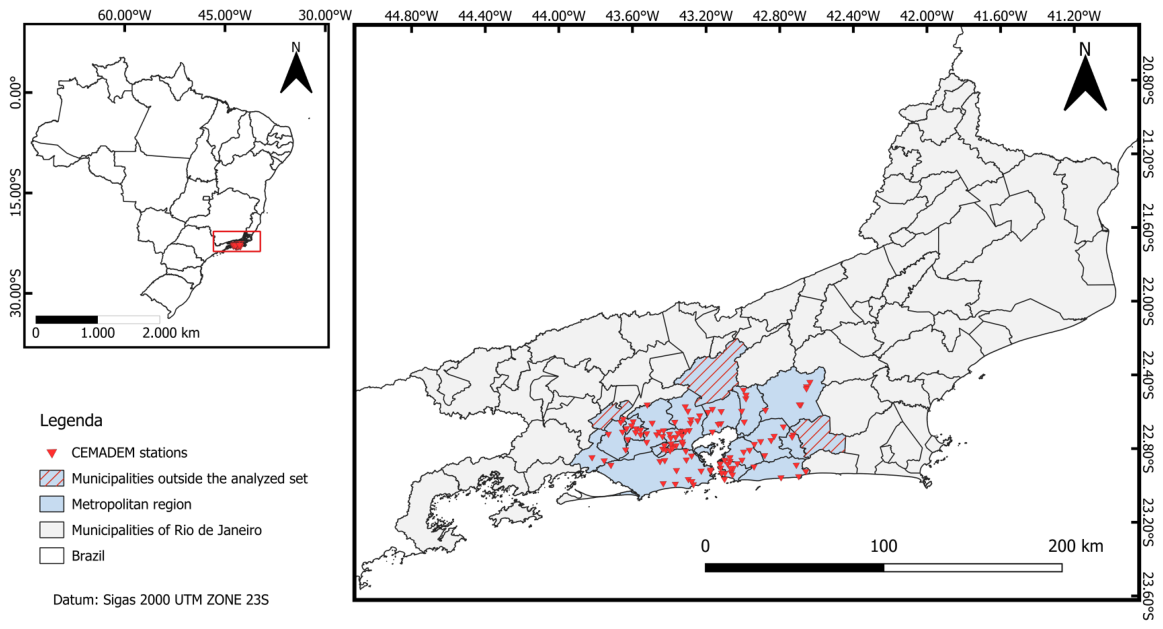
Subsequently, spatial aggregation was performed in two stages. First, the coefficients were averaged at the municipal level (mean of the available stations within each municipality). Then, the municipal averages were further averaged to produce a representative set for the Rio de Janeiro Metropolitan Region, defined as the metropolitan mean rainfall disaggregation coefficient (COERM). The study area, the delimitation of the RMRJ, and the spatial distribution of the stations used are presented in Figure 2 and detailed in Appendix A. Municipalities without stations were excluded from the analyzed dataset, as indicated in Figure 2. Additionally, the municipality of Petrópolis was not considered due to its rugged topography and distinct rainfall regime associated with orographic effects, which could compromise the homogeneity assumed for the metropolitan aggregation.
Although Petrópolis is currently included in the legal composition of the Rio de Janeiro Metropolitan Region [23], the municipality has also been associated with the Serrana Region in previous state regional divisions [24]. Its mountainous setting is also reflected in its elevation, with the urban core located at about 810 m above sea level and higher sectors exceeding 1000 m [25]. Thus, its current inclusion reflects a legal-administrative/metropolitan delimitation rather than necessarily hydrometeorological homogeneity. This interpretation is also consistent with the concentration of major rainfall disasters in the mountainous Serrana environment, such as the 2011 extreme rainfall event that affected Petrópolis, Teresópolis, and Nova Friburgo [26].

3. Results

3.1. Case Study (Vassouras Station 717)

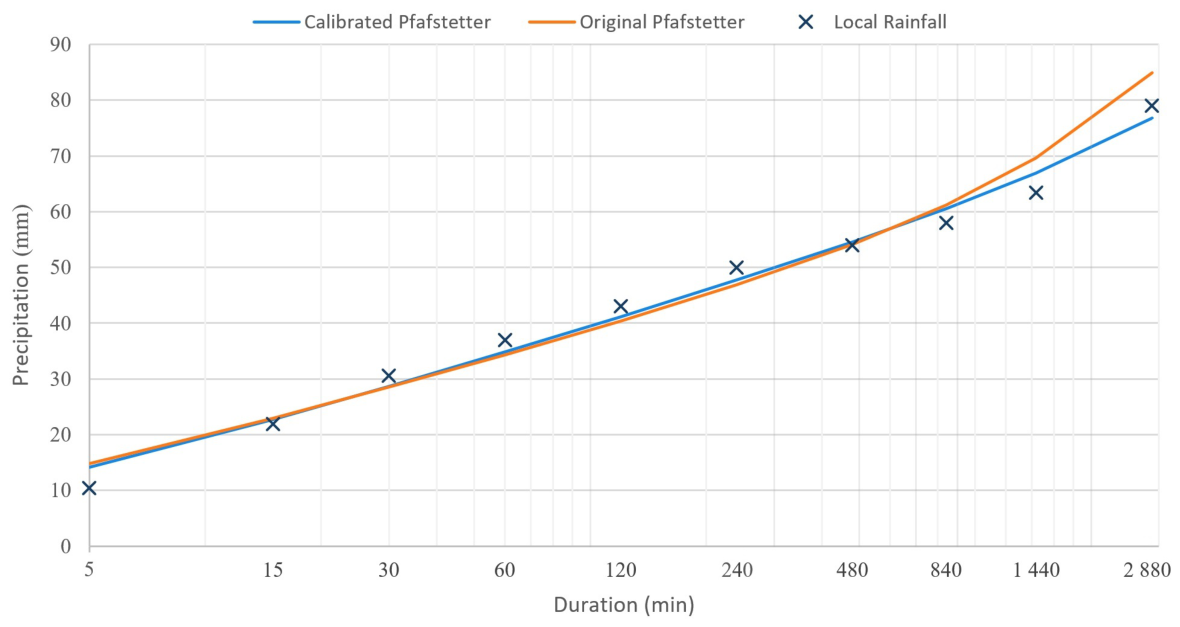
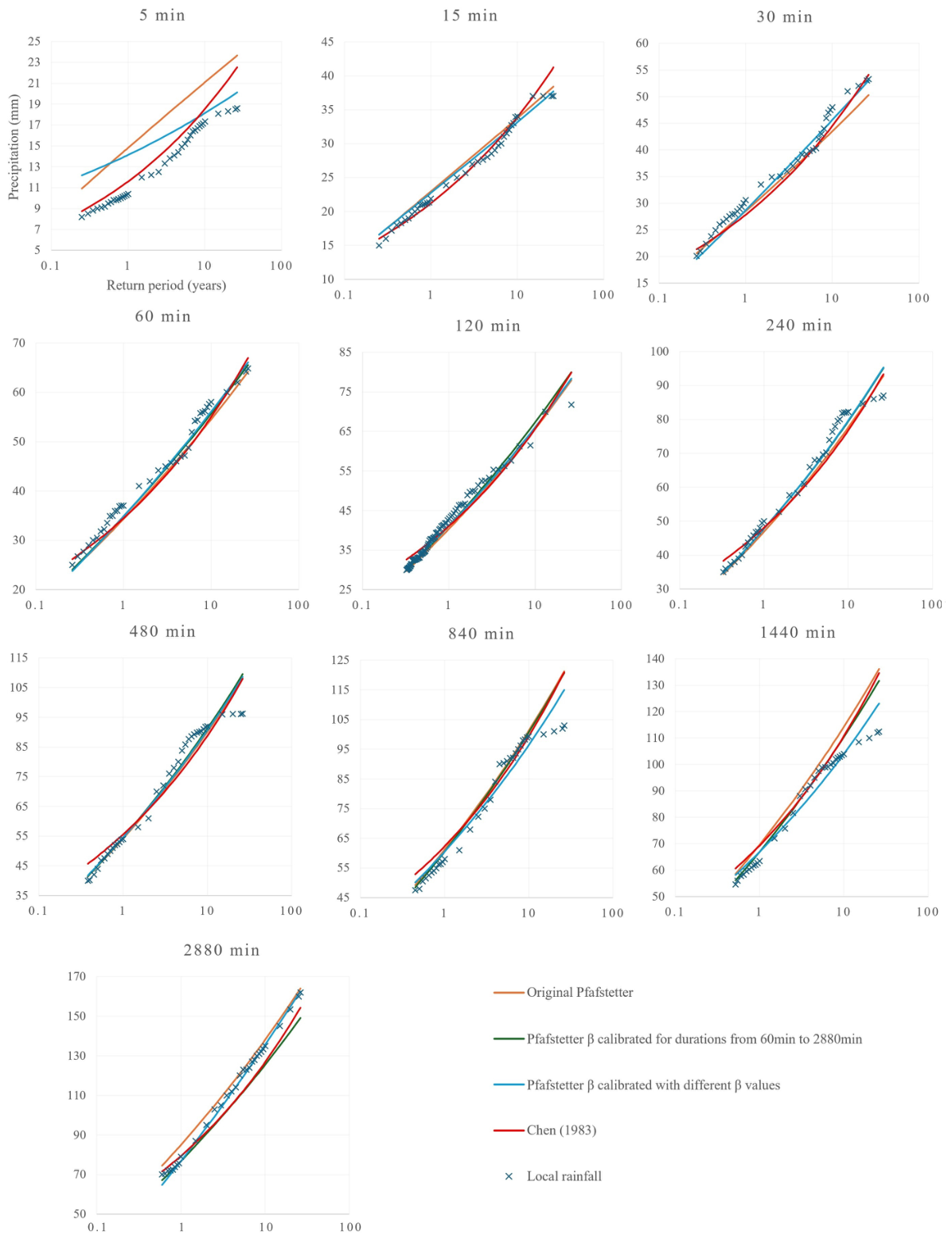
Four configurations were compared using the sum of squared errors (SSE) across the set of durations. The Chen [20] model was calibrated by minimizing SSE; the two Pfafstetter [3] variations (with a single β for durations ≥ 60 min and with β dependent on duration) were also calibrated by SSE minimization; the “Otto Pfafstetter” curve, however, was used exactly as presented in the book, without numerical calibration. The total SSE values obtained were 6875.24 for calibrated Chen, 6871.79 for Pfafstetter from the book (without calibration), 5879.47 for Pfafstetter calibrated with a single β for durations ≥ 60 min, and 3091.73 for Pfafstetter calibrated with β dependent on duration. Among the tested configurations, the duration-dependent β parameterization yielded the lowest total SSE, as shown in Figure 3 and Figure 4.
For the base curve with T = 1 year (Figure 3), the SSE decreased from 132.68 to 55.38 when the original Pfafstetter parameterization was replaced by the calibrated version, corresponding to an approximate 58% reduction.
Table 4 summarizes the statistical performance of the adjusted and original Pfafstetter curves for the Vassouras station at T = 1 year, based on SSE, RMSE, MAPE, and R 2 .
The adjusted curve also showed lower RMSE and MAPE values, together with a slightly higher R 2 , reinforcing its better overall agreement with the observed rainfall values for the base condition of T = 1 year.
Figure 4 presents the rainfall–return-period comparison by duration. For the 5 min duration, the Chen [20] model showed closer agreement with the observed values than the calibrated Pfafstetter model. For the full set of analyzed durations, however, the Pfafstetter configuration with duration-dependent β produced the lowest overall SSE.
This result reinforces that the model selection was not based on the best fit for a single duration, but rather on the most consistent overall performance across the full set of analyzed durations.
Table 5 summarizes the overall performance of the four tested configurations in the Vassouras case study, based on the cumulative SSE and on the complementary metrics RMSE, MAPE, and R 2 .
The global RMSE was recalculated from the cumulative SSE and the total number of observed–estimated pairs across all analyzed durations and return periods. The global MAPE was obtained by weighted averaging, and the coefficient of determination was summarized as a weighted mean R 2 .
The global performance metrics indicate that the duration-dependent β configuration yielded the best overall performance in terms of cumulative SSE and global RMSE, whereas Chen presented the lowest weighted global MAPE among the tested configurations. This result shows that model ranking depends on whether the emphasis is placed on absolute or relative error. For the purposes of this study, the duration-dependent β configuration was preferred because the regionalization stage required the most consistent overall absolute performance across durations, which was considered more compatible with the intended engineering application. Although Chen performed better in relative terms, the duration-dependent β formulation was considered more suitable for subsequent regional application because it minimized the accumulated absolute deviations throughout the full adjustment domain.
Table 6 and Table 7 present the duration-by-duration statistical performance of the tested configurations in the Vassouras case study, based on SSE, RMSE, MAPE, and R 2 .
The detailed statistics are consistent with the cumulative SSE results. Chen showed the best fit at 5 min, whereas the calibrated Pfafstetter formulation with duration-dependent β provided the most consistent overall performance across the full set of analyzed durations, especially for the longer durations, where the historical and equal- β configurations accumulated larger errors.
Based on this result, the Pfafstetter configuration with duration-dependent β was adopted for the regional stage and subsequently applied in an automated manner to the selected CEMADEN stations in the Rio de Janeiro Metropolitan Region.

3.2. Regional Coefficients and Comparison with CETESB

Rainfall disaggregation coefficients were obtained by station and return period, aggregated at the municipal level, and subsequently consolidated for the Rio de Janeiro Metropolitan Region, resulting in the metropolitan mean rainfall disaggregation coefficient (COERM). The regional mean values and their comparison with CETESB [4] are presented in Table 8, while the municipal coefficients are provided in Appendix B.
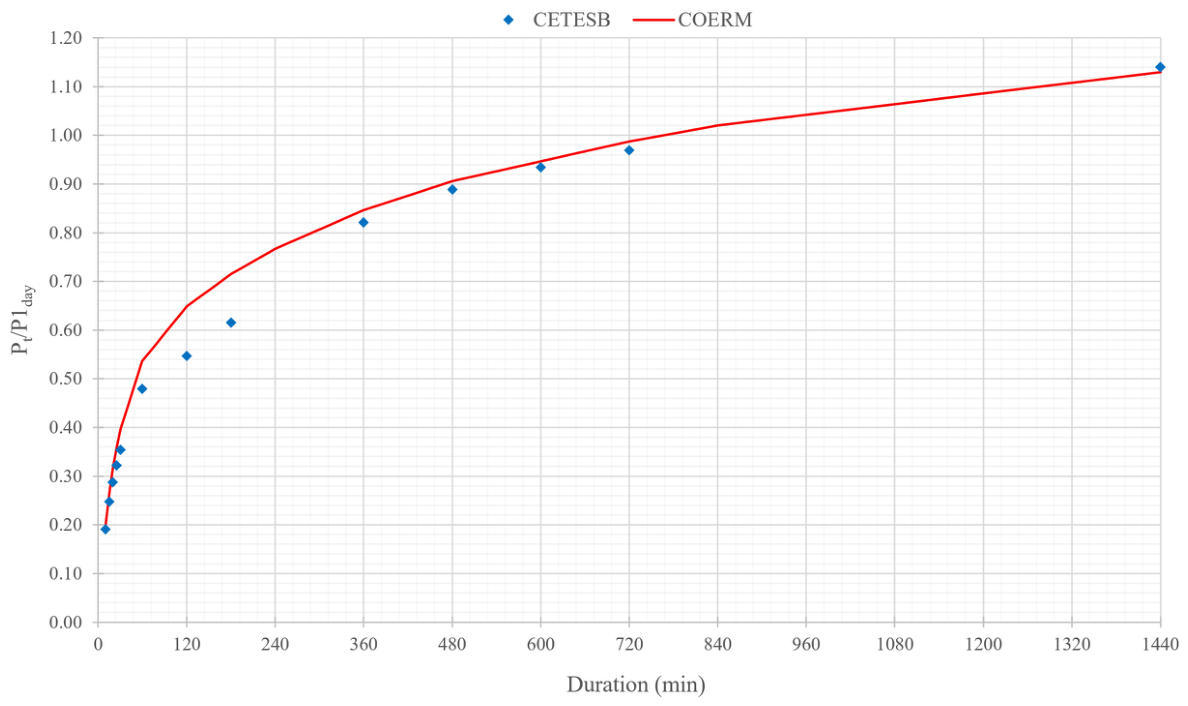
The results show close agreement between COERM and CETESB [4] for the shortest durations, with small negative differences for the sub-hourly ratios and practically no difference for the 30 min/1 h ratio. The largest differences were observed in the ratios from 1 h to 3 h relative to the 24 h rainfall, for which COERM presented higher values. For the longer durations, the ratios tended to progressively approach the 24 h/1 day relationship.
Figure 5 shows the ratio P t ( T ) / P 24 h ( T ) as a function of duration. The COERM curve was slightly below CETESB for the shortest sub-hourly ratios, coincided with CETESB at 30 min/1 h, and remained above CETESB from 1 h to 12 h. The municipal coefficients presented in Appendix B also indicate that the metropolitan mean does not eliminate internal spatial variability.

4. Discussion

4.1. Interpretation of the Case Study Results

To separate the effects of duration and return period in the Pfafstetter formulation, the decomposition P ( t , T ) = K ( T ) f ( t ) was considered. By imposing T = 1 , one obtains K ( 1 ) = 1 , and the formulation reduces to the temporal term alone:
P ( t , 1 ) = f ( t ) = a · t + b · ln ( 1 + c · t ) ,
which isolates the intrinsic curvature of precipitation with duration. In this case study, the reduction in SSE for the calibrated base curve indicates that the fitted temporal term represented the observed rainfall–duration relationship more closely than the original parameterization.
The better performance of the duration-dependent β configuration suggests that a single probability-factor adjustment was not sufficient to represent the full range of analyzed durations. Allowing β to vary with duration improved the overall fit, even though Chen [20] remained closer to the observed values at 5 min. This result is important because it shows that the best formulation for one duration is not necessarily the most consistent one across the entire set.
The additional metrics lead to the same general interpretation, but they also show that model ranking depends on the aspect of fit being emphasized. In particular, the global RMSE favored the duration-dependent β configuration, whereas Chen presented the lowest weighted global MAPE. This means that Chen was more advantageous from the perspective of relative error, while the duration-dependent β formulation was more advantageous from the perspective of accumulated absolute error. Because the aim of the case study was to identify the formulation with the most robust overall behavior for later regionalization, the criterion based on cumulative SSE and RMSE was considered more appropriate than the isolated minimization of relative error.
Pfafstetter’s original formulation [3] did not include a duration-dependent β . In this study, that flexibility was introduced during calibration in order to improve the fit across durations. For this reason, the comparison is not between two strictly equivalent procedures: one reproduces the historical formulation as originally published, while the others result from explicit numerical optimization. This helps explain why the calibrated versions achieved lower errors, and it is in line with recent studies that treat IDF adjustment as an optimization problem rather than a fixed analytical formulation [28,29].

4.2. Regional Behavior and Comparison with CETESB

At the regional scale, the close agreement between COERM and CETESB [4] for the shortest durations suggests that the classical coefficients remain broadly representative in this range. However, the systematic increase observed in COERM from 1 h to 3 h relative to the 24 h rainfall indicates that the metropolitan regionalization assigns a larger fraction of the daily rainfall total to sub-daily durations in this interval.
Figure 5 makes this pattern clearer: although the regionalized curve is slightly below CETESB for the shortest sub-hourly ratios, it remains above the CETESB coefficients from 1 h to 12 h, with the largest positive differences concentrated between 1 h and 3 h. As expected, the ratios gradually approach the P 24 h ( T ) / P 1 d ( T ) relationship as duration increases. From a hydrological standpoint, this suggests that CETESB produces a smoother temporal distribution, whereas COERM preserves a stronger concentration of rainfall over sub-daily durations in the study area.
These findings are consistent with recent studies on rainfall disaggregation and regionalization. Passos et al. [8] argued that the CETESB coefficients do not explicitly account for the rainfall characteristics of the location of interest or the influence of the return period. Likewise, Abreu et al. [9] emphasized the local validity of disaggregation coefficients and the importance of evaluating their spatial variability. In the same direction, Torres et al. [14] highlighted the relevance of regionalized IDF relationships and associated coefficients for design applications. In the present study, the two-stage aggregation procedure preserved a metropolitan synthesis while maintaining municipal-scale detail in Appendix B, which is important because the metropolitan mean does not fully remove internal spatial differences.

4.3. Implications for Urban Drainage

The differences observed between 1 h and 3 h relative to the 24 h rainfall are particularly relevant for urban drainage, because this duration range often overlaps with the time of concentration of urban catchments. Under these conditions, higher disaggregation coefficients lead to higher design intensities and, consequently, higher peak discharges. In practical terms, this means that the choice of coefficients can affect hydraulic sizing.
To make this practical implication more explicit, an illustrative example was considered using a hypothetical 24 h reference rainfall depth of 100 mm (Table 9). Under this assumption, the CETESB coefficients yield mean rainfall intensities of 42.0, 24.0, and 18.0 mm h−1 for the 1 h, 2 h, and 3 h durations, respectively, whereas the corresponding COERM coefficients yield 47.0, 28.5, and 21.0 mm h−1. Since this duration range frequently overlaps with the time of concentration of urban catchments, these differences may translate into higher peak-flow estimates and, consequently, into larger hydraulic design requirements.
Recent studies also highlight the methodological and practical importance of reliable sub-daily rainfall estimates. Fauer et al. [28] emphasized that consistency across durations is an important condition for improving the overall fit of IDF estimates, especially where sub-daily observations are limited. Fatone et al. [30] showed that rainfall temporal distribution can substantially affect the hydrological response of urban catchments. In addition, Soto-Escobar et al. [31] and Gutierrez-lopez & Ramirez [29] pointed out that the limited availability of long sub-daily rainfall series remains a major constraint and that recalibration procedures can improve statistical performance across durations and return periods.
Overall, these results indicate that the use of regionalized coefficients for the Rio de Janeiro Metropolitan Region can improve the representation of rainfall temporal structure and may provide more realistic design rainfall estimates for urban drainage projects than the direct adoption of generalized coefficients.

5. Conclusions

The regionalized coefficients obtained for the Rio de Janeiro Metropolitan Region were close to the CETESB values for shorter durations, whereas the largest differences were observed between 1 h and 3 h relative to the 24 h rainfall, with higher COERM values in this range. This indicates a stronger temporal concentration of rainfall exactly in a duration range that is critical for hydrological response and peak-flow generation.
The pluviographic case study also showed that the Pfafstetter [3] formulation with duration-dependent β presented better overall performance than the historical parameterization used directly from the original book. Therefore, the difference relative to the classical CETESB [4] coefficients should not be interpreted solely as a regional update, but also as a methodological refinement. Although derived from the classical Pfafstetter [3] framework, the CETESB [4] coefficients essentially correspond to generalized mean values resulting from successive aggregations across return periods and stations, which makes them operationally useful but less sensitive to local and regional rainfall characteristics. In this sense, numerical calibration with an explicit objective function tends to produce better agreement with observations than non-recalibrated formulations [28,29].
The COERM constitutes an adequate regional synthesis to represent the average metropolitan behavior, but it does not replace municipal or local coefficients when sufficient observational data are available. For urban drainage applications at smaller scales, dominated by short critical durations and with relatively small differences compared to CETESB [4], the classical coefficients may still provide a practical approximation. However, for applications more sensitive to the 1 h to 3 h duration range, including larger catchments, critical flood scenarios, and events with greater damage potential, the regionalized coefficients proved to be more representative of the rainfall regime of the region.
One limitation of this study is the relatively short record length of part of the automatic rain gauge series, especially considering that the automatic monitoring network used here is relatively recent and no observation series longer than 12 years were available for the Rio de Janeiro Metropolitan Region. This limitation is partially mitigated by the large number of stations distributed across different parts of the metropolitan region, which improves the regional representativeness and robustness of the results. Accordingly, the estimated coefficients should be interpreted primarily as a regional synthesis rather than as definitive local values for individual stations.
Another limitation concerns the estimation of the reference daily rainfall, which followed the operational CETESB procedure based on the Gumbel distribution, without a formal comparative assessment of alternative probability models or goodness-of-fit tests within the scope of the present analysis. Accordingly, the results should be interpreted within the methodological framework adopted here.
Finally, the continued expansion of monitoring networks and the availability of longer sub-daily rainfall records, especially with 5 min resolution, will likely improve the robustness of these estimates and allow further refinement of the proposed coefficients. In addition, further analyses could evaluate the sensitivity of the fitted relationships to the parameter γ , for example by testing values within a range such as 0.15 to 0.60 instead of fixing γ = 0.25 . This may be particularly relevant for short durations, especially from 5 to 60 min, for which the current results suggest lower adherence and indicate that duration-specific γ values may improve the precision of the adjusted coefficients.

Author Contributions

Conceptualization, P.H.G.d.S.F.; methodology, P.H.G.d.S.F., M.d.M.R. and I.d.S.R.P.; software, P.H.G.d.S.F.; validation, M.d.M.R. and I.d.S.R.P.; formal analysis, P.H.G.d.S.F.; investigation, P.H.G.d.S.F.; data curation, P.H.G.d.S.F.; visualization, P.H.G.d.S.F.; writing—original draft preparation, P.H.G.d.S.F.; writing—review and editing, M.d.M.R. and I.d.S.R.P.; supervision, M.d.M.R. and I.d.S.R.P. All authors have read and agreed to the published version of the manuscript.

Funding

This research received no external funding. The APC was funded by the corresponding author.

Data Availability Statement

The raw data supporting the conclusions of this article will be made available by the authors on request.

Acknowledgments

Igor Paz acknowledges the support of Fundação Carlos Chagas Filho de Amparo à Pesquisa do Estado do Rio de Janeiro (FAPERJ), grant number SEI-260003/020458/2025. The corresponding author gratefully acknowledges his family for their personal financial support with the publication expenses. He also gratefully acknowledges his wife for her support in the organization and verification of the rainfall data used in this study.

Conflicts of Interest

The authors declare no conflicts of interest.

Appendix A. Rain Gauge Stations and Record Length

This appendix presents the list of automatic rain gauge stations used in the analysis and their respective observation periods. The stations were selected according to the data availability and quality control criteria adopted in this study.
Table A1. Automatic rain gauge stations used in the study and their corresponding observation periods.
StationObs. YearsStationObs. YearsStationObs. Years
330045601A11.22330227005A10.10330350009A10.30
330045602A11.58330227009H10.00330350010A10.32
330045603A11.58330250201A11.62330414401A11.03
330045604A10.25330250204A10.83330414403A11.67
330045605A10.32330250205A11.13330414405A10.43
330045607A10.19330250206A11.42330414406A10.44
330080302A11.42330250207A11.67330455701A11.41
330080304A11.57330250208A11.42330455705A11.42
330080305A11.67330250209A11.63330455706A10.51
330080306A11.67330250211A11.67330455709A11.42
330080307A11.54330270002A11.58330455711A10.34
330080309A10.08330270003A11.10330455712A10.34
330170201A11.42330270004A11.54330455713A10.05
330170202A11.57330270006A11.58330455716A10.34
330170206A11.42330270007A11.58330455718A10.17
330170207A11.12330270008A11.58330455719A10.34
330170209A10.90330285801A11.42330455721A10.32
330170210A11.67330285803A10.45330455722A10.34
330170211A10.73330320302A10.44330455725A10.33
330170213A11.42330320303A10.30330455728A10.30
330170214A11.49330330201A11.08330455729A10.03
330185001A11.67330330202A10.42330490402A11.67
330185002A10.50330330203A11.67330490403A11.67
330185003A11.65330330204A11.67330490408A11.56
330185004A11.67330330205A11.18330490412A11.67
330185006A11.67330330207A11.66330510901A11.43
330190001A11.11330330209A10.83330510902A11.56
330190002A10.70330330211A11.58330510905A10.31
330190003A11.77330330212A11.67330510906A10.32
330190006A10.42330330213A11.45330510908A10.33
330190007A11.67330330214A10.90330555401A11.30
330190008A10.56330330216A11.67330555402A12.00
330200702A10.07330350002A11.42330555404A10.33
330200703A10.29330350003A11.19330575201A11.58
330227001A11.67330350006A11.42330575202A11.65
330227002A11.42330350007A11.58
330227004A10.04330350008A10.30

Appendix B. Mean Disaggregation Coefficients for the Municipalities of the Metropolitan Region of Rio de Janeiro

This appendix presents the mean rainfall disaggregation coefficients obtained for the municipalities of the Metropolitan Region of Rio de Janeiro, together with the number of stations used to calculate the municipal averages.
Table A2. Mean rainfall disaggregation coefficients for the municipalities of the Metropolitan Region of Rio de Janeiro and the corresponding number of stations used to calculate the municipal averages.
MunicipalityNo. of Stations10 min/30 min15 min/30 min20 min/30 min25 min/30 min30 min/1 h1 h/24 h2 h/24 h3 h/24 h4 h/24 h6 h/24 h8 h/24 h10 h/24 h12 h/24 h14 h/24 h24 h/1 Day
Belford Roxo60.490.710.840.930.730.520.670.730.760.810.840.860.900.921.10
C. de Macacu60.530.660.780.900.700.540.640.670.700.750.810.840.870.901.10
D. de Caxias90.540.670.790.900.810.420.490.550.610.690.750.790.830.861.13
Guapimirim50.470.650.790.900.720.480.610.670.710.770.820.840.870.891.17
Itaboraí60.520.670.810.910.760.560.580.620.660.720.800.830.860.881.12
Itaguaí20.510.660.790.910.690.380.490.550.610.670.740.810.840.871.14
Japeri50.580.720.830.930.780.460.610.620.660.740.810.870.920.951.12
Magé80.530.690.810.920.740.480.560.620.670.740.790.830.860.891.14
Maricá60.480.630.770.890.740.510.620.680.730.780.840.880.910.941.11
Mesquita20.410.680.820.920.790.460.540.640.690.830.920.950.980.981.20
Niterói120.500.650.770.890.740.460.580.640.680.750.790.810.840.881.11
Nilópolis20.590.720.830.930.780.400.500.610.670.800.870.940.970.981.18
Nova Iguaçu70.470.670.810.910.760.470.600.650.690.760.810.850.890.921.11
Queimados40.570.710.830.930.720.460.550.610.680.770.810.850.900.931.10
Rio de Janeiro150.480.650.780.900.720.450.550.620.660.730.780.820.870.901.14
São Gonçalo40.550.650.740.880.760.590.680.720.760.820.840.860.880.921.16
S. J. de Meriti50.570.720.830.920.750.460.560.630.680.800.850.890.920.961.10
Seropédica30.500.650.780.900.730.440.510.590.640.720.790.830.880.921.14
Tanguá20.470.650.820.920.720.670.780.850.870.890.910.940.950.951.06

References

  1. Tucci, C.E.M. Hidrologia: Ciência e Aplicação; Editora da UFRGS/ABRH: Porto Alegre, Brazil, 1997. [Google Scholar]
  2. Canholi, A.P. Drenagem Urbana e Controle de Enchentes; Oficina de Textos: São Paulo, Brazil, 2005. [Google Scholar]
  3. Pfafstetter, O. Chuvas Intensas no Brasil: Relações Entre Precipitação, Duração e Frequência de Chuvas em 98 Postos com Pluviógrafos; DNOS: Rio de Janeiro, Brazil, 1957. [Google Scholar]
  4. Companhia de Tecnologia de Saneamento Ambiental (CETESB). Drenagem Urbana: Manual de Projeto, 3rd ed.; CETESB/ASCETESB: São Paulo, Brazil, 1986.
  5. Genovez, A.M.; Zuffo, A.C. Chuvas intensas no Estado de São Paulo: Estudos existentes e análise comparativa. Rev. Bras. Recur. Hídricos 2000, 5, 45–58. [Google Scholar] [CrossRef]
  6. Basso, R.E.; Allasia, D.G.; Tassi, R.; Pickbrenner, K. Revisão das isozonas de chuvas intensas do Brasil. Eng. Sanit. Ambient. 2016, 21, 635–641. [Google Scholar] [CrossRef]
  7. Back, Á.J.; Oliveira, J.L.R.; Henn, A. Relationships between intense rainfall and daily rainfall in Santa Catarina. Rev. Bras. Eng. Agríc. Ambient. 2012, 16, 391–398. [Google Scholar] [CrossRef]
  8. Passos, J.B.M.C.; Silva, D.D.; Lima, R.P.C. Daily rainfall disaggregation coefficients for the Doce River Basin, Brazil: Regional applicability and the return period influence. Eng. Agríc. 2021, 41, 223–234. [Google Scholar] [CrossRef]
  9. Abreu, M.C.; Pereira, S.B.; Cecílio, R.A.; Pruski, F.F.; Almeida, L.T.; Silva, D.D. Assessing the application of ratios between daily and sub-daily extreme rainfall as disaggregation coefficients. Phys. Chem. Earth 2022, 128, 103223. [Google Scholar] [CrossRef]
  10. Abreu, M.C.; Cecílio, R.A.; Pruski, F.F.; Almeida, L.T.; Santos, G.R.; Zanetti, S.S.; Pereira, S.B.; Silva, D.D. Daily rainfall disaggregation to estimate the intensity-duration-frequency relationship in Minas Gerais State, Brazil. Braz. Arch. Biol. Technol. 2022, 65, e22210694. [Google Scholar] [CrossRef]
  11. Penner, G.C.; Wendland, E.; Gonçalves, M.M.; Adam, K.N. Methodology for IDF equation based on reduced pluviograph records. Rev. Bras. Ciênc. Ambient. 2023, 58, 365–374. [Google Scholar] [CrossRef]
  12. Back, Á.J. Alternative model of intense rainfall equation obtained from daily rainfall disaggregation. Rev. Bras. Recur. Hídricos 2020, 25, e31. [Google Scholar] [CrossRef]
  13. Back, Á.J.; Cadorin, S.B. Extreme rainfall and intensity-duration-frequency equations for the State of Acre, Brazil. Rev. Bras. Ciênc. Ambient. 2020, 55, 159–170. [Google Scholar] [CrossRef]
  14. Torres, I.P.; Cecílio, R.A.; de Almeida, L.T.; Abreu, M.C.; da Silva, D.D.; Zanetti, S.S.; Xavier, A.C. Rainfall intensity-duration-frequency curves dataset for Brazil. Data 2025, 10, 17. [Google Scholar] [CrossRef]
  15. Rodrigues, A.A.; Siqueira, T.M.; Beskow, T.L.C.; Timm, L.C. Ordinary cokriging applied to generate intensity-duration-frequency equations for Rio Grande do Sul State, Brazil. Theor. Appl. Climatol. 2024, 155, 2365–2378. [Google Scholar] [CrossRef]
  16. Garrido, R.B.; Fontes, A.S.; Silva, S.F.; Souza, N.C.R.; Assis, J.M.O. Using satellite-based precipitation for developing intense rainfall equations for ungauged areas of the Southern Bahia Mesoregion. Rev. Bras. Recur. Hídricos 2025, 30, e13. [Google Scholar] [CrossRef]
  17. de Almeida, L.T.; Cecílio, R.A.; Abreu, M.C.; Torres, I.P. Method for establishing heavy rainfall equations based on regional characteristics: Transformation of maximum daily precipitation. Hydrology 2025, 12, 211. [Google Scholar] [CrossRef]
  18. Silva, D.F.; Simonovic, S.P.; Schardong, A.; Goldenfum, J.A. Introducing non-stationarity into the development of intensity-duration-frequency curves under a changing climate. Water 2021, 13, 1008. [Google Scholar] [CrossRef]
  19. Centro Nacional de Monitoramento e Alertas de Desastres Naturais (CEMADEN). Pluviômetros Automáticos. Available online: https://mapainterativo.cemaden.gov.br/ (accessed on 15 January 2026).
  20. Chen, C.L. Rainfall intensity-duration-frequency formulas. J. Hydraul. Eng. 1983, 109, 1603–1621. [Google Scholar] [CrossRef]
  21. Bell, F.C. Generalized rainfall-duration-frequency relationships. J. Hydraul. Div. 1969, 95, 311–327. [Google Scholar] [CrossRef]
  22. Goel, N.K.; Sarkar, S. Regional rainfall intensity-duration-frequency relationships. In Design Flood Analyses for Hydropower Projects; Department of Hydrology, IIT Roorkee: Roorkee, India, 2007. [Google Scholar]
  23. Assembleia Legislativa do Estado do Rio de Janeiro (ALERJ). Lei Complementar No. 184, de 27 de Dezembro de 2018: Dispõe Sobre a Região Metropolitana do Rio de Janeiro, sua Composição, Organização e Gestão. Available online: https://alerjln1.alerj.rj.gov.br/contlei.nsf/a99e317a9cfec383032568620071f5d2/1865e2c565e1e547832583d1005da99f?OpenDocument= (accessed on 26 April 2026).
  24. Instituto de Pesquisa Econômica Aplicada (Ipea). Arranjos Institucionais de Gestão Metropolitana da Região Metropolitana do Rio de Janeiro. Available online: https://www.ipea.gov.br/redeipea/images/pdfs/governanca_metropolitana/150820_relatorio_arranjos_riode_janeiro.pdf (accessed on 26 April 2026).
  25. Prefeitura Municipal de Petrópolis. PTS Petrópolis—VR-II. Available online: https://web3.petropolis.rj.gov.br/e-gov/sad/licitacoes_contratos/files/anexo_licitacao/605/PTS%20%20PETR%C3%93POLIS%20-%20VR-II_%286_%29.pdf (accessed on 26 April 2026).
  26. Instituto Nacional de Pesquisas Espaciais (INPE). Floods and Landslides in Rio de Janeiro: Charter Activation #294, Call ID #351, PM Report. Available online: https://data.inpe.br/charter/data/Call_0351/ACT294_C351_Brazil_FL_RJ_2011.pdf (accessed on 26 April 2026).
  27. Aragão, R.; Santana, G.R.; Costa, C.E.F.F.; Cruz, M.A.S.; Figueiredo, E.E.; Srinivasan, V.S. Chuvas intensas para o estado de Sergipe com base em dados desagregados de chuva diária. Rev. Bras. Eng. Agríc. Ambient. 2013, 17, 243–252. [Google Scholar] [CrossRef]
  28. Fauer, F.S.; Ulrich, J.; Jurado, O.E.; Rust, H.W. Flexible and consistent quantile estimation for intensity-duration-frequency curves. Hydrol. Earth Syst. Sci. 2021, 25, 6479–6494. [Google Scholar] [CrossRef]
  29. Gutierrez-Lopez, A.; Ramirez, R.R. Mathematical formulation of intensity-duration-frequency curves and their hydrological risk implications in civil engineering design. AppliedMath 2025, 5, 125. [Google Scholar] [CrossRef]
  30. Fatone, F.; Szeląg, B.; Kiczko, A.; Majerek, D.; Majewska, M.; Drewnowski, J.; Łagód, G. Advanced sensitivity analysis of the impact of the temporal distribution and intensity of rainfall on hydrograph parameters in urban catchments. Hydrol. Earth Syst. Sci. 2021, 25, 5493–5516. [Google Scholar] [CrossRef]
  31. Soto-Escobar, C.; Zambrano-Bigiarini, M.; Tolorza, V.; Garreaud, R. Developing intensity-duration-frequency (IDF) curves using sub-daily gridded and in situ datasets: Characterising precipitation extremes in a drying climate. Hydrol. Earth Syst. Sci. 2026, 30, 91–117. [Google Scholar] [CrossRef]
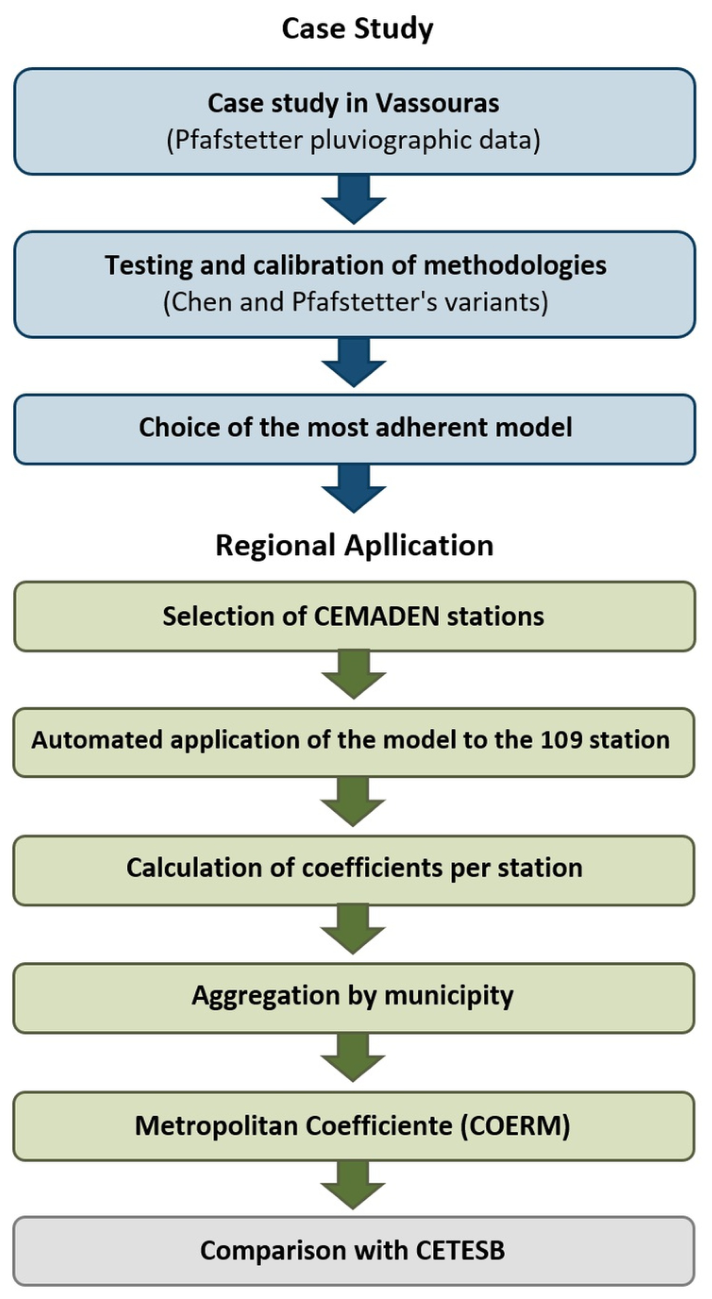
Figure 1. Flowchart of the methodology adopted in the study, divided into the Vassouras case-study stage and the regional application stage using CEMADEN stations in the Rio de Janeiro Metropolitan Region.
Water 18 01207 g001
Figure 2. Study area (RMRJ) and CEMADEN automatic rain gauges used in the analysis. Hatched municipalities: outside the analyzed dataset. Inset: location in Brazil. Datum: SIRGAS 2000/UTM Zone 23S.
Water 18 01207 g002
Figure 3. Base curve of the case study (Vassouras, station 717) with T = 1 year ( K = 1 ). Rainfall–duration comparison (x-axis: duration; y-axis: precipitation). Lines: Pfafstetter from the book (“Otto Pfafstetter”) and calibrated Pfafstetter (Solver). Points: observed values.
Water 18 01207 g003
Figure 4. Rainfall–return-period comparison in the case study (Vassouras, station 717), by duration. x-axis: return period (years; log scale). y-axis: precipitation (mm). Curves: Pfafstetter (book), calibrated Pfafstetter (Solver), calibrated Pfafstetter with a single β (≥60 min), and calibrated Chen [20]; panels indicate the analyzed durations.
Water 18 01207 g004
Figure 5. Ratio P t ( T ) / P 24 h ( T ) as a function of duration: comparison between the CETESB [4] mean coefficients and the regionalized coefficient for the Rio de Janeiro Metropolitan Region (COERM).
Water 18 01207 g005
Table 1. Performance metrics adopted for model evaluation in the Vassouras case study.
MetricEquationInterpretation
SSE i = 1 n ( P i P ^ i ) 2 Lower values indicate better fit.
RMSE 1 n i = 1 n ( P i P ^ i ) 2 Lower values indicate smaller typical errors.
MAPE 100 n i = 1 n P i P ^ i P i Lower values indicate smaller relative errors.
R 2 1 i = 1 n ( P i P ^ i ) 2 i = 1 n ( P i P ¯ ) 2 Values closer to 1 indicate better agreement.
Table 2. Minimum rainfall thresholds adopted for event selection by duration. Original values proposed by Pfafstetter [3] were used whenever available, whereas thresholds for the additional durations considered in this study were adopted following the same event-selection logic.
DurationMinimum Threshold (mm)Source
10 min10.0Adopted in this study
20 min15.0Adopted in this study
30 min20.0Pfafstetter
1 h25.0Pfafstetter
2 h30.0Pfafstetter
3 h31.0Adopted in this study
4 h35.0Pfafstetter
6 h38.0Adopted in this study
8 h40.0Pfafstetter
10 h44.4Adopted in this study
12 h46.0Adopted in this study
14 h47.0Pfafstetter
24 h55.0Pfafstetter
48 h70.0Pfafstetter
Table 3. Maximum rainfall thresholds adopted as upper bounds for event screening by duration in the automated routine. These limits were used as a quality-control measure to avoid implausibly large accumulated rainfall values from influencing the partial duration series analysis.
DurationMaximum Threshold (mm)
10 min60.0
20 min100.0
30 min140.0
1 h180.0
2 h300.0
3 h335.0
4 h450.0
6 h485.0
8 h700.0
10 h700.0
12 h705.0
14 h800.0
24 h900.0
48 h1200.0
Table 4. Performance of the adjusted and original Pfafstetter curves for the Vassouras station at T = 1 year.
MetricAdjusted CurveOriginal Pfafstetter Curve
SSE (mm2)55.38132.68
RMSE (mm)2.353.64
MAPE (%)7.459.70
R 2 0.9850.975
Table 5. Overall performance of the four tested configurations in the Vassouras case study, based on cumulative SSE, recalculated global RMSE, weighted global MAPE, and weighted mean R 2 .
ConfigurationSSE (mm2)RMSE (mm)MAPE (%) R 2
Chen6875.244.134.870.963
Original Pfafstetter (book)6871.794.127.280.978
Equal β from 60 to 2880 min5879.473.815.560.978
Duration-dependent β 3091.732.775.380.977
Table 6. Duration-by-duration statistical performance of the Chen and original Pfafstetter formulations in the Vassouras case study.
DurationChenOriginal Pfafstetter (Book)
SSERMSEMAPE (%) R 2 SSERMSEMAPE (%) R 2
5 min79.171.4417.3060.977627.994.0732.4280.983
15 min49.111.144.8540.98456.021.214.6430.990
30 min135.631.892.0340.982174.862.154.5490.985
60 min202.152.312.0550.979234.152.485.3240.988
120 min349.832.084.4020.954298.231.923.6940.980
240 min579.963.963.0190.959441.913.464.2500.975
480 min904.895.012.9500.938605.104.103.8070.959
840 min1300.796.192.4500.9301173.995.884.8290.951
1440 min1913.867.622.4830.9392617.898.917.9260.962
2880 min1359.856.627.4030.991641.654.554.4100.998
Table 7. Duration-by-duration statistical performance of the calibrated Pfafstetter configurations in the Vassouras case study.
DurationCalibrated Pfafstetter (Equal β )Calibrated Pfafstetter (Duration-Dependent β )
SSERMSEMAPE (%) R 2 SSERMSEMAPE (%) R 2
5 min306.522.8423.5830.984306.522.8423.5830.984
15 min37.520.993.8430.99037.520.993.8430.990
30 min86.661.514.1360.98486.661.514.1360.984
60 min142.741.944.3360.988139.321.914.4390.988
120 min197.481.562.3660.980175.241.472.5170.979
240 min319.652.943.2060.975319.162.943.1950.975
480 min601.244.093.4250.960594.164.063.6140.959
840 min1052.585.564.1500.952728.654.634.9270.947
1440 min1301.816.284.3370.963585.564.214.1260.956
2880 min1833.277.695.3480.998118.941.961.5870.998
Table 8. Metropolitan mean rainfall disaggregation coefficients (COERM) for the RMRJ and comparison with reference coefficients adapted from CETESB [4], as reproduced by Aragão et al. (2013) [27], including signed and relative differences.
Duration RatioCOERM (RMRJ)CETESBDifferenceRelative Difference (%)
10 min/30 min0.510.54−0.03−5.6%
15 min/30 min0.670.70−0.03−4.3%
20 min/30 min0.790.81−0.02−2.5%
25 min/30 min0.900.91−0.01−1.1%
30 min/1 h0.740.740.000.0%
1 h/24 h0.470.42+0.05+11.9%
2 h/24 h0.570.48+0.09+18.8%
3 h/24 h0.630.54+0.09+16.7%
4 h/24 h0.68
6 h/24 h0.750.72+0.03+4.2%
8 h/24 h0.800.78+0.02+2.6%
10 h/24 h0.840.82+0.02+2.4%
12 h/24 h0.870.85+0.02+2.4%
14 h/24 h0.90
24 h/1 day1.131.14−0.01−0.9%
Table 9. Illustrative mean rainfall intensities for a hypothetical 24 h reference rainfall depth of 100 mm.
Duration RatioCETESBCOERMIntensityIntensity
CETESB (mm h−1)COERM (mm h−1)
1 h/24 h0.420.4742.047.0
2 h/24 h0.480.5724.028.5
3 h/24 h0.540.6318.021.0
Disclaimer/Publisher’s Note: The statements, opinions and data contained in all publications are solely those of the individual author(s) and contributor(s) and not of MDPI and/or the editor(s). MDPI and/or the editor(s) disclaim responsibility for any injury to people or property resulting from any ideas, methods, instructions or products referred to in the content.