


Abstract
Satellite remote sensing-based soil moisture (SM) retrieval quantifies the spatial and temporal distributions of SM to support Earth system modeling. However, existing SM products, including satellite remote sensing, model-simulated, and land data assimilation products, are plagued by large measurement errors. The Triple Collocation (TC) method can systematically quantify these errors and generate spatially and temporally continuous SM. In this study, we analyzed SM over the Qinghai-Tibetan Plateau (QTP) using three mainstream products: The European Centre for Medium-Range Weather Forecasts interim reanalysis (ERA-interim) SM, the National Centers for Environmental Prediction Climate Forecast System version 2 (CFSv2) SM, and the China Meteorological Administration Land Data Assimilation System Version 1.0 (CLDAS-V1.0) SM. Results show that the ERA-interim contributes the largest weight to the TC-blended SM over the QTP, followed by CFSv2, while CLDAS-V1.0 makes the minimum contribution. The three products yield consistent results in the eastern and southern QTP but show significant discrepancies in the northwestern region. The TC-blended SM performs well across most land cover categories in the QTP, except Alpine swamp meadow areas. Our findings confirm that this SM blending technique effectively improves the accuracy of existing SM products, with wide application potential in future research.
1. Introduction
Soil moisture (SM) is a crucial land surface parameter that can be used to simulate land–atmosphere interactions [1,2], and it is also imperative for establishing the variability of regional or global feedback between the climate and the water cycle [3,4,5]. Therefore, it is essential to accurately constrain the spatial and temporal variation in SM in a given region [6]. In most cases, SM measurements are available from in situ observations; on a regional or global scale, SM data can be obtained using satellite observations [7,8,9,10,11], model simulations [12,13,14], or land data assimilation [15,16,17].
Satellites commonly used for these applications include those of the Soil Moisture and Ocean Salinity (SMOS) mission [18], the European Space Agency (ESA), the Soil Moisture Active/Passive (SMAP) mission [19], and the National Aeronautics and Space Administration (NASA) [20]. Data assimilation technology provides SM data by linking satellite and in situ observations; examples of this technology include the North American Land Data Assimilation System (NALDAS) [21], the European Land Data Assimilation System (ELDAS) [22], the Global Land Data Assimilation System (GLDAS) [23], the European Centre for Medium-Range Weather Forecasts interim reanalysis (ERA-interim) [24], the National Centers for Environmental Prediction (NCEP) Climate Forecast System (CFS) and the Climate Forecast System version 2 (CFSv2), as well as the recently updated CLDAS-V1.0. In estimating SM from these models, inaccurate atmospheric forcing data and model limitations contribute to uncertainties [25]. Using reanalysis SM products combines the advantages of model simulations, satellite remote sensing, and in situ observations, allowing it to be used on large spatial scales and over long periods of time [25,26]. However, these global assimilation SM products are also associated with large uncertainties [27].
Many studies have previously compared different kinds of SM products, with results demonstrating that these products perform inconsistently in different study areas. For example, in the southwest region of China, the ERA-interim SM product performed better than a series of SM products, including the Advanced Microwave Scanning Radiometer-Earth Observing System (AMSR-E), the Advanced Scatterometer (ASCAT), the SMOS, the Climate Change Initiative (CCI), and the ECMWF [28]. Comparing the results obtained from the SMOS, AMSR-E, ECMWF, and GLDAS systems indicates that the ERA-interim SM yielded the highest correlation coefficient, thus implying that this product can best capture temporal SM dynamics in the Mongolia Plateau [29] (pp. 103–110). Zeng et al. [30] further demonstrated that the ERA-interim SM product outperformed the AMSR-E, Japan Aerospace Exploration Agency (JAXA), NASA, Land Parameter Retrieval Model (LPRM), SMOS, and Essential Climate Variable (ECV) SM products. This product yielded the lowest RMSE value and relatively higher correlation coefficient values in analyses of the Coordinated Enhanced Observing Period Asia–Australia Monsoon Project in the Tibetan Plateau (CAMP/Tibet) network [9,31,32].
Therefore, considering the high errors associated with the satellite remote sensing SM, model simulation SM, and data assimilation SM products, it is essential to establish a method combining the advantages of each of these distinct SM products. The Triple Collocation (TC) method provides a rigorous analytical platform for quantifying the uncertainties associated with three or more products that retrieve the same geophysical quantity [11]. The TC method considers a minimum of three spatiotemporal variables under investigation to resolve a set of equations and quantify the variations in error between each of these variables; it has previously been used to estimate errors in SM products [11,33,34,35,36]. Over the Qinghai-Tibetan Plateau, the application of the TC method has also received increasing attention in recent years.
The TC method has proven highly effective for evaluating and merging multi-source SM products across the QTP. While previous studies have successfully utilized TC to integrate satellite and reanalysis data for improved accuracy [11,37] and expanded the framework to map spatial error distributions [38], the mixed distribution characteristics of SM across the region remain underexplored. Specifically, the synergistic fusion and evaluation of climate datasets such as CFSv2, ERA-interim, and CLDAS-V1.0 require further investigation to capture these complex patterns.
The Qinghai-Tibetan Plateau (QTP), also known as the “Third Pole” or as the “Roof of the World”, is the highest and most extensive plateau worldwide [39]. Numerous studies have indicated that the QTP influences its peripheral climate and environment through a series of atmospheric and hydrologic dynamics, which in turn greatly influence circulation across China, Asia, and the entire globe due to its unique geophysical position and climatic system [40,41]. Due to its topography, the QTP undergoes dramatic seasonal fluctuations in its surface SM [42]. However, identifying a single satellite remote sensing product or unified model dataset capable of comprehensively covering the entire QTP remains challenging. Furthermore, the time series spanned by these methods are often not long enough to allow researchers to distinguish variations in SM from recent background climate changes. Against this background, the unique geographical and climatic characteristics of the QTP further exacerbate the challenges of SM monitoring.
To address the challenges in SM monitoring over the QTP, this study aims to investigate the error characteristics of three mainstream reanalysis SM products (ERA-interim, CFSv2, and CLDAS-V1.0) using the TC method and generate an improved spatiotemporally continuous dataset. Specifically, we first evaluate the error performance of each individual product and derive optimal fusion weights based on TC analysis. We then merge the three products to construct a dataset covering the entire QTP (26°00′ N–39°47′ N, 73°19′ E–104°47′ E) from December 2012 to November 2013. Finally, we analyze the seasonal performance of the fused product and quantify the regional and seasonal contribution weights of each input product to reveal their mixed distribution characteristics, followed by comprehensive validation using in situ observations from multiple stations across the QTP.
2. Data and Methodology
2.1. In Situ Observations
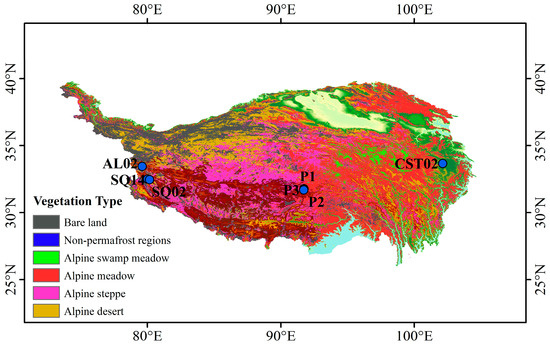
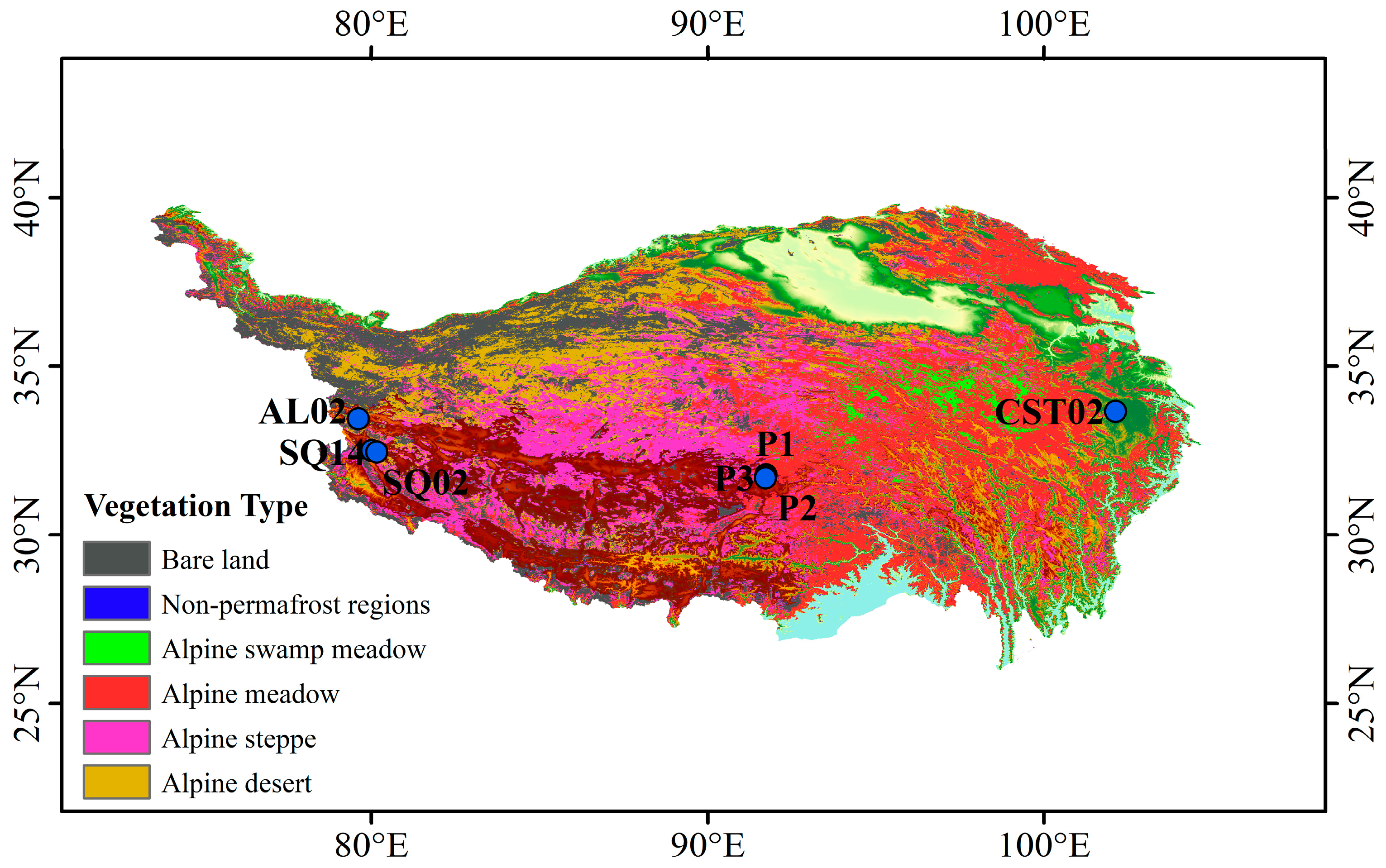
The QTP observatory of plateau-scale SM comprises three regional ground-based reference networks: Naqu under cold semi-arid conditions, Maqu with a cold humid environment, and Ali featured by a cold arid climate. These networks effectively represent various climate and land surface hydrometeorological settings over the QTP [43]. These stations provide typical coverage of varied climates and land surface hydrometeorological conditions within the QTP (Figure 1 and Table 1) [27,44,45,46]. The in situ SM observations used in this study cover the period from December 2012 to November 2013, and valid measurements are concentrated in the thawing season (May–October 2013) due to the sensor limitations of liquid water detection. Within the vegetated area of the permafrost region of the QTP, 50,260 km2 (4%) are areas of alpine swamp meadow, 583,909 km2 (49%) are areas of alpine meadow, 332,754 km2 (28%) are areas of alpine steppe, and 234,828 km2 (19%) are areas of alpine desert [47]. Therefore, these monitoring stations are potentially representative of different underlying surface conditions.
Figure 1.
Distribution of altitude and locations of in situ SM observations within the QTP.
Table 1.
Geographic positions and depths of SM observation sites on the QTP.
For spatial matching, the nearest neighbor method was applied to collocate each in situ station with the closest grid center of the reanalysis products, thereby facilitating point-to-pixel validation without spatial upscaling. Regarding data quality control, the 3σ criterion was first utilized to detect and remove outliers. Subsequently, Cubic Convolution Interpolation was adopted to fill short-term missing values, whereas records with continuous data gaps exceeding 24 h were strictly excluded.
SM was measured using EC-TM and 5TM capacitance probes (Decagon, San Francisco, CA, USA) that had an accuracy of ±2% volumetric water content (VWC), and a resolution of 0.1% VWC for mineral soil [48]. Given that the deployed capacitance probes exclusively detect liquid water, our evaluations are strictly confined to the thawing period. Previous literature relying on field measurements has confirmed that localized points of SM data can be representative of larger areas [44,46,49]. Therefore, in this paper, we evaluate the blended SM based on observations from stations throughout the permafrost region across the QTP.
2.2. ERA-Interim Reanalysis Data
ERA-interim is the global atmospheric reanalysis product produced by the European Centre for Medium-Range Weather Forecasts (ECMWF), which has been in operation since 1 January 1979 [50]. This product is based on the ECMWF Integrated Forecast System model, which utilizes the tiled ECMWF Scheme for Surface Exchanges over Land [51]. The ERA-interim SM includes some major advancements, particularly with respect to determining observational SM [52]. The lower boundaries of each layer are set at depths of 0.07, 0.28, 1.0, and 2.89 m, with an original spatial resolution of 0.75° × 0.75° and a temporal resolution of 6-hourly (0:00, 6:00, 12:00, 18:00 UTC) in units of m3·m−3 [53]. In this study, to align with the measurement depth of the in situ capacitance probes, the first-layer SM data (0–7 cm) were selected. The original 6-hourly data were averaged to a daily scale and resampled to a uniform 0.25° × 0.25° grid using Cubic Convolution Interpolation. The temporal coverage of the extracted data spanned from December 2012 to November 2013.
2.3. CFSv2 Data
The National Centers for Environmental Prediction (NCEP) Climate Forecast System Version 2 (CFSv2) reanalysis uses the Noah land surface model for land surface analysis with observed global precipitation analyses as direct forcing [54]. It is a fully coupled model that represents the interactions between the Earth’s atmosphere, oceans, land, and sea ice [55]. CFSv2 data are generated at 6-hourly intervals (0:00, 6:00, 12:00, and 18:00 UTC) with an original spatial resolution of 0.5° × 0.5° [56], and data are obtained from four vertical layers at depths of 0.1, 0.4, 1.0, and 2.0 m. In this study, to align with the measurement depth of the in situ observations, the first-layer SM data (0–10 cm) were selected. The original 6-hourly data were averaged to a daily scale and resampled to a uniform 0.25° × 0.25° grid using Cubic Convolution Interpolation. The temporal coverage of the extracted data spanned from December 2012 to November 2013.
2.4. CLDAS-V1.0 Data
The China Meteorological Administration Land Data Assimilation System Version 1.0 (CLDAS-V1.0) SM data are produced by linking in situ measurements, satellite observations, and numerical models using data fusion and assimilation techniques [22]. CLDAS-V1.0 coverage spans the East Asian region (0–60° N, 70–150° E) with an original spatial resolution of 1/16° × 1/16° (0.0625° × 0.0625°) and a temporal resolution of one hour. CLDAS-V1.0 data are obtained from four vertical layers at depths of 0.1, 0.4, 1.0, and 2.0 m. In this study, to align with the measurement depth of the in situ observations, the first-layer soil moisture data (0–10 cm) were selected. The original hourly data were averaged to a daily scale and resampled to a uniform 0.25° × 0.25° grid using Cubic Convolution Interpolation. The temporal coverage of the extracted data spanned from December 2012 to November 2013.
2.5. Triple Collocation Method
The TC technique is designed to estimate the random error variance of three collocated datasets measuring the same geophysical variable. [57]. This method therefore does not require the availability of a high-quality reference dataset, and without knowledge of the true SM conditions, these differences cannot be attributed to errors in a particular dataset. TC has the advantage of being able to unify uncertainties associated with separate SM products [58]. To reliably estimate the relative errors among the three SM products using the TC method, a minimum of 100 observation triplets is generally required. The continuous daily time series utilized in this study yields 365 collocated samples, ensuring robust error estimation.
TC has previously been applied to estimate errors of merged SM products [11,59,60] and this technique has been further successfully utilized to quantify a range of additional geophysical quantities, including those of ocean wind speed, wave height [61], leaf area index [62], absorbed fractions of photosynthetically active radiation [63], sea-ice thickness [64], atmospheric columnar integrated water vapor contents [65], sea surface salinity [66], precipitation [67], and land water storage [68].
We assume that a linear relationship exists between the three estimates of truth, defined as , , and , as well as the hypothetical truth, T, where , , and represent the respective random errors of the product datasets , , and . The goal of this technique is to estimate an error value characterizing the variation in these error terms within each dataset [69]
After dividing Equation (1) by the regression slope and using the known relationships of and , we can obtain the following equations:
Through the manipulation and removal of the unknown truth, we can determine that
These errors are independent; that is, = = = 0. Although this assumption of zero error cross-correlation may be partially violated in practice due to shared atmospheric forcings or land surface models among the reanalysis products, recent evaluations [57,69] demonstrate that the TC method remains robust for calculating relative blending weights. After first performing the cross-multiplication of each pair of equations in Equation (3) and then averaging the estimates, the variance of these error terms can be derived using the following equations:
If these errors are uncorrelated, only three collocated datasets are needed to estimate error variance. Next, it is necessary to solve for the calibration expressed in Equation (1). Here, we arbitrarily choose as a reference and set and . Due to the symmetry of Equation (1), the estimates of , , and are invariant to the specific choice made. The gain parameters, , and , , are determined via a standard least-squares approximation accounting for the uncertainties of both variables [70]. Furthermore, we apply a recursive approach to this calculation as the determination of these and rescaling parameters directly influences our ability to estimate the errors of , , and . To initiate the estimation, the starting values of the calibration parameters are defined by assuming , followed by an iterative solution of the governing equations until the system converges. This quantified uncertainty is then subsequently derived using Equation (2) as established by Fan et al. [71].
After calibrating the TC method for each product, we use the objective methodology introduced by Yilmaz et al. [72] for blended satellite and model-based SM products in the least squares framework. Least squares estimation provides the fundamental framework for most current data assimilation methods [73]. By using a blend of different data sources with the least squares framework, the desired SM estimate can be expressed as
In this equation, , , and are the ERA-interim, CFSv2, and CLDAS-V1.0 SM products, respectively, and , , and are their respective relative weights. To have an unbiased optimal merged estimation, it is required that . The fractional contributions of these various SM datasets can be formulated as
In this equation, , , and are the variances of the ERA-interim, CFSv2, and CLDAS-V1.0 SM products, respectively. The TC is applied at a grid space of 0.25°; datasets with higher native resolutions have been aggregated to fit this common grid.
The accuracy of the fused product and the three individual reanalysis products were comprehensively evaluated using in situ observations as an independent reference. Four widely used quantitative metrics were employed: the Pearson correlation coefficient (R), root mean square error (RMSE), mean absolute error (MAE), and mean bias error (MBE).
Pearson correlation coefficient (R): It measures the strength and direction of the linear relationship between the product and in situ observations. Values range from −1 to 1, with absolute values closer to 1 indicating a stronger linear correlation.
Root mean square error (RMSE): It measures the square root of the average squared differences between the product and observations. It penalizes large errors more heavily and has the same unit as soil moisture (m3·m−3). Lower values indicate higher accuracy.
Mean absolute error (MAE): It measures the average of the absolute differences between the product and observations. It is less sensitive to extreme outliers than RMSE and has the unit of m3·m−3. Lower values indicate higher accuracy.
Mean bias error (MBE): It measures the average systematic deviation between the product and observations. It reflects the overall overestimation or underestimation tendency of the product. A positive value indicates that the product overestimates soil moisture, while a negative value indicates underestimation. The closer the value is to 0, the smaller the systematic bias.
In the above equations, is the in situ observation value at time i, is the corresponding product value, and are the mean values of the observations and products over the validation period, respectively, and n is the number of valid collocated samples.
3. Results
3.1. Blended Results
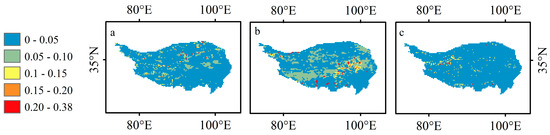
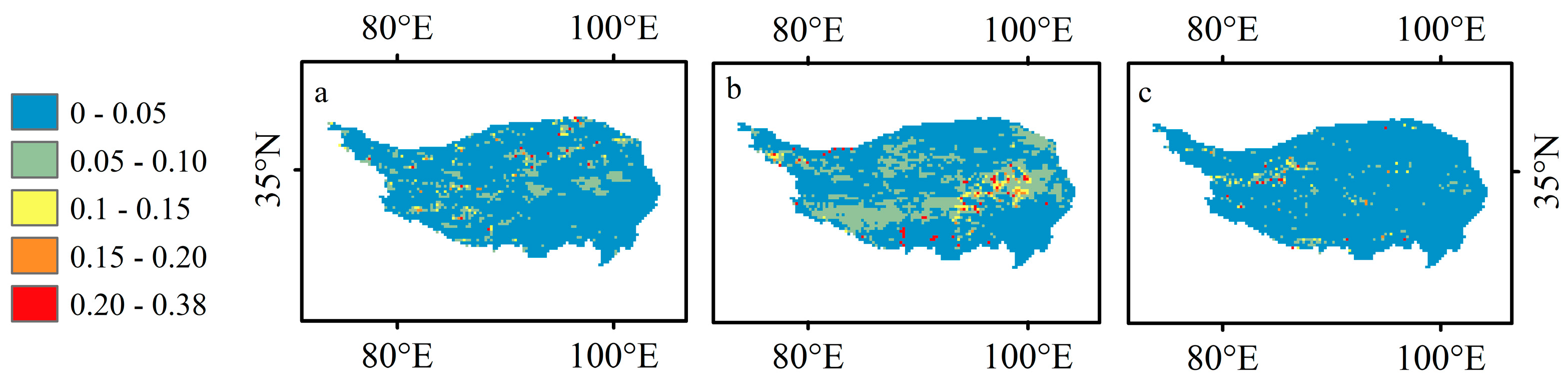
In this paper, the TC technique is used to calculate estimated errors, weights, and correlation coefficients for each SM product. The estimated errors of each product, as determined using Equation (4), are shown in Figure 2. The results of these estimates suggest that all three datasets are characterized by relatively low errors. Across the three SM datasets, the ERA-interim yields the minimum error (0.023 m3·m−3), while the CLDAS-V1.0 yields the largest error (0.055 m3·m−3), and the CFSv2 yields an intermediate error value of 0.036 m3·m−3 (Figure 2).
Figure 2.
The estimation errors of the three SM products used in the weight blending (m3·m−3) ((a) CFSv2; (b) CLDAS–V1.0; (c) ERA–interim).
Characteristic differences in the spatial distribution of these errors can be observed in Figure 2a–c. In dry areas, such as the central region of the QTP, in which SM is relatively low, error estimates derived from the ERA-interim SM are lower than those derived from the CLDAS-V1.0 and CFSv2.
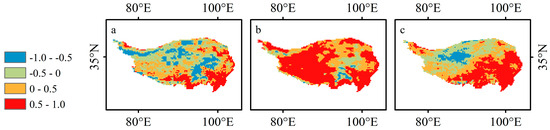
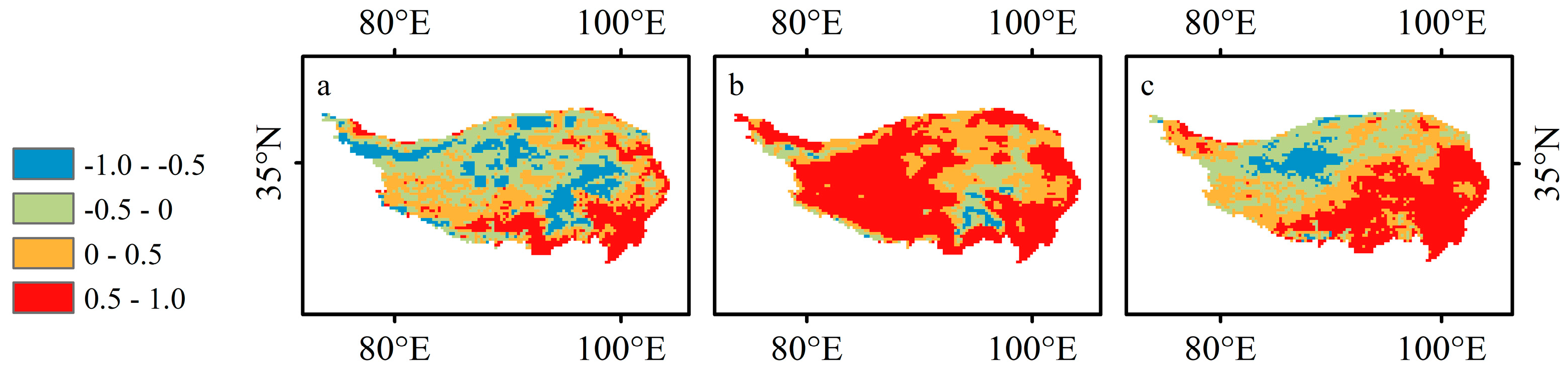
The proposed model will produce meaningful error estimates if the three datasets represent the same physical quantity. Here, we calculate the correlations between each collocated dataset to ensure that this prerequisite is met (Figure 3). A very low, or even negative correlation between the data of two different products clearly indicates that neither dataset’s estimate can provide meaningful SM information. The estimated correlation coefficients between each SM product are shown in Figure 3 (Figure 3a: CLDAS-V1.0 vs. CFSv2; Figure 3b: ERA-interim vs. CFSv2; Figure 3c: ERA-interim vs. CLDAS-V1.0). The ERA-interim correlates most strongly with the CFSv2 in most of its pixels, with an average R value of 0.50. The R value between the ERA-interim and CLDAS-V1.0 is ranked second highest, with an average R value of 0.36, and the lowest R value appears between the CFSv2 and CLDAS-V1.0, with an average R value of 0.31. This analysis therefore indicates the presence of a pattern in which the eastern and southern regions of the QTP have higher correlation coefficients than other regions. Furthermore, a low correlation can be observed in the desert areas of the northwestern region of the QTP, suggesting that correlation is affected by noise when the ranges of SM are small. The collective results from these error estimates and correlation coefficients demonstrate that, out of the three products, the CFSv2 appears to feature the best performance. This is because the errors of the CFSv2 display relatively little variation across the QTP, as well as the fact that it performs better in regions with complex terrains.
Figure 3.
Correlation coefficients observed between each SM product. ((a) CLDAS–V1.0 vs. CFSv2; (b) ERA–interim vs. CFSv2; (c) ERA–interim vs. CLDAS–V1.0).
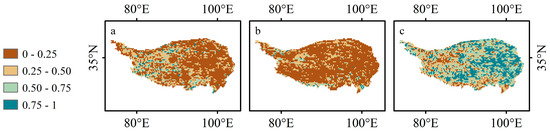
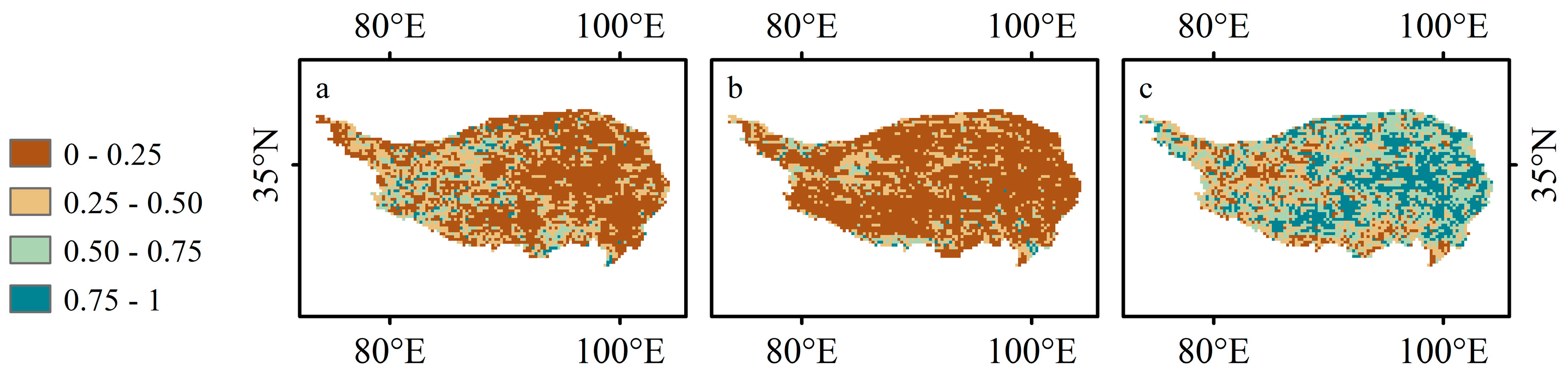
The weights of the ERA-interim, CFSv2 and CLDAS-V1.0, as determined using the TC and least squares methods, are shown in Figure 4. The ERA-interim contributes the dominant influence (0.57) of the merged SM product followed by CFSv2 (0.25), with CLDAS-V1.0 contributing the smallest weight (0.18). This indicates that CFSv2 and CLDAS-V1.0 make far less contribution to the merged soil moisture over the Tibetan Plateau than ERA-interim. The geographical distribution of higher weights (those >0.5) reveals that the ERA-interim yields higher weights and lower errors, and is thus a more reliable method, in the densely vegetated southeastern region of the QTP, as well as in the Qaidam Basin in the arid northern region of the QTP. In contrast, the CLDAS-V1.0 is a more reliable product in the arid southwestern region of the QTP.
Figure 4.
Weights of the three SM datasets utilized in the weight blending ((a) CFSv2; (b) CLDAS–V1.0; (c) ERA–interim).
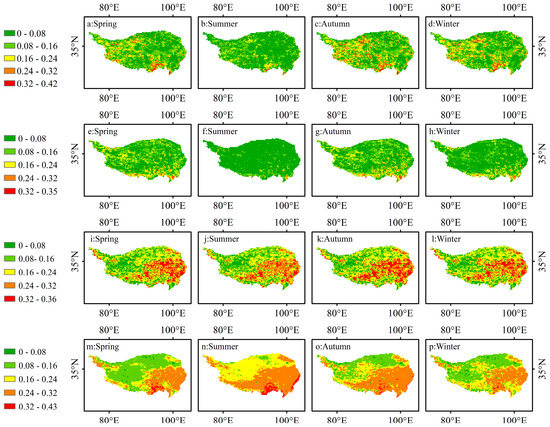
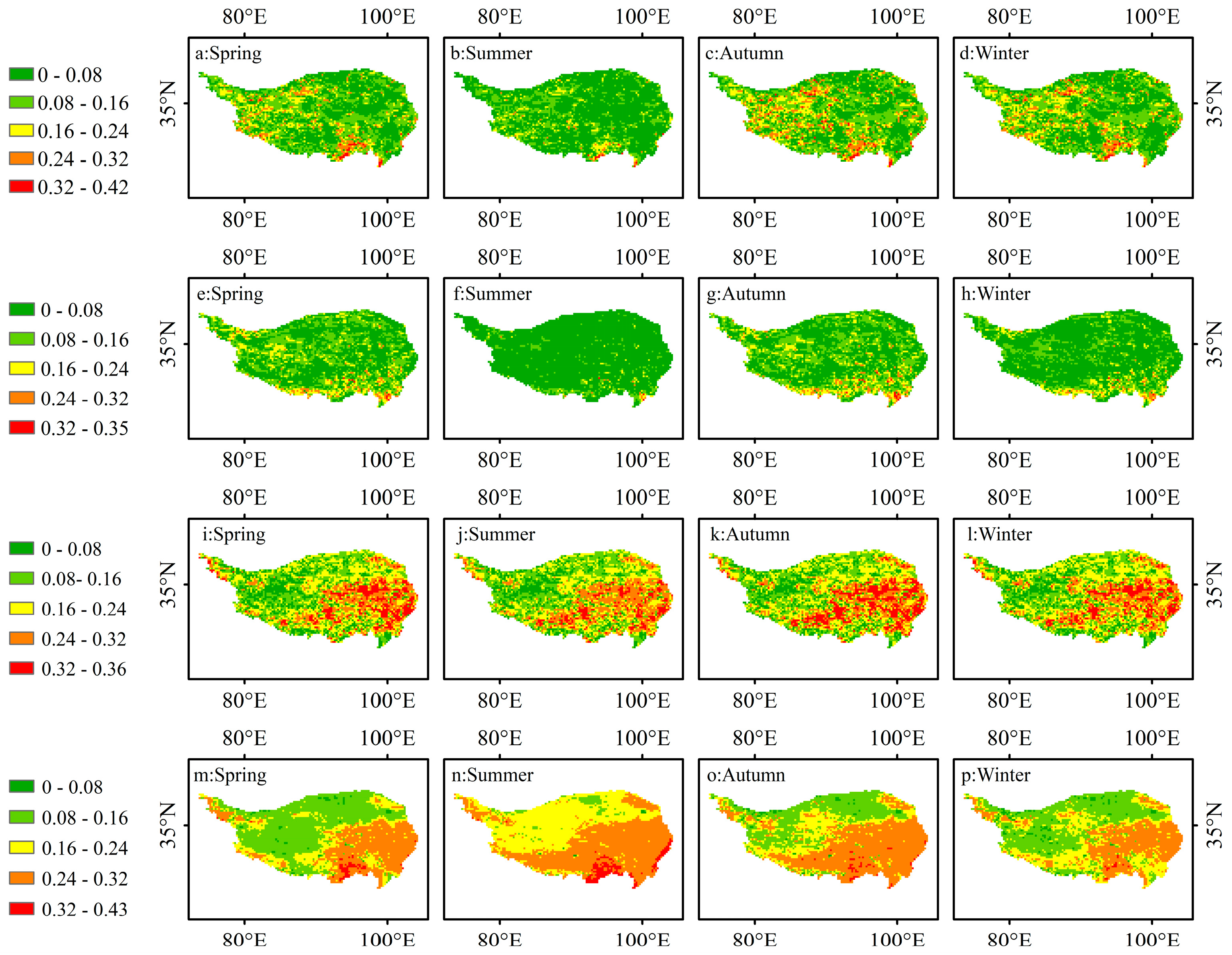
All three SM products can accurately record the climatological conditions of the western QTP, where it is dry, and in the eastern QTP, where it is wet during monsoon season. Therefore, blended SM products reflect seasonal variations in SM throughout the QTP and depict the relative dryness observed in the western QTP during monsoons (Figure 5). Comparing the spatial distribution of estimated errors (Figure 2) with their corresponding seasonal climatology maps derived directly from the respective SM datasets (Figure 5) demonstrates that the errors associated with each product are similar to their respective SM climatology values.
Figure 5.
Climatology of SM (m3·m−3) throughout the QTP, as determined by separate SM products and the final combined estimate ((a–d) CFSv2; (e–h) CLDAS–V1.0; (i–l) ERA–interim; (m–p) blended SM).
3.2. Assessment of Blended SM Using In Situ Observations
Against the background of the thawing season, the overall accuracy of the three individual reanalysis products and the TC fused product were systematically evaluated using all valid in situ observations from the seven monitoring stations. The quantitative comparison results are summarized in Table 2, which intuitively shows that the fused product outperforms all individual reanalysis products.
Table 2.
Accuracy comparison of the fused product and individual reanalysis products.
Although the fused product shows an improved Pearson R compared to ERA-interim, its RMSE is slightly higher due to a positive mean bias error (MBE = 0.0609). This bias is mainly caused by the relatively large systematic errors of CFSv2 and CLDAS-V1.0. Nevertheless, compared with the other two individual products (CFSv2 and CLDAS-V1.0), the fused product still reduces the RMSE significantly by 42% and 43%, respectively, demonstrating an obvious improvement in overall performance.
Given the remarkable seasonal variability of SM over the QTP, the performance of the fused product was further examined across three key months within the thawing season: May, July, and October. These months represent the typical conditions of soil thawing onset, vigorous vegetation growth, and the late freezing transition, respectively.
To evaluate performance across the QTP’s seasonal variability, the fused product was examined in May (thawing onset), July (vegetation growth), and October (freezing transition). Results showed the highest correlation in July (Pearson R = 0.610) compared to May (Pearson R = 0.350) and October (Pearson R = 0.591). While the fused product’s absolute error (RMSE: 0.0855–0.1134 m3·m−3) did not outperform the best single input, ERA-interim (RMSE: 0.0419–0.0815 m3·m−3), it significantly mitigated the extreme deviations of CFSv2 and CLDAS-V1.0. This reflects the TC method’s inherent mechanism of seeking a global optimal compromise among inputs rather than strictly aligning with the single best product, thereby ensuring greater robustness across complex freeze–thaw cycles.
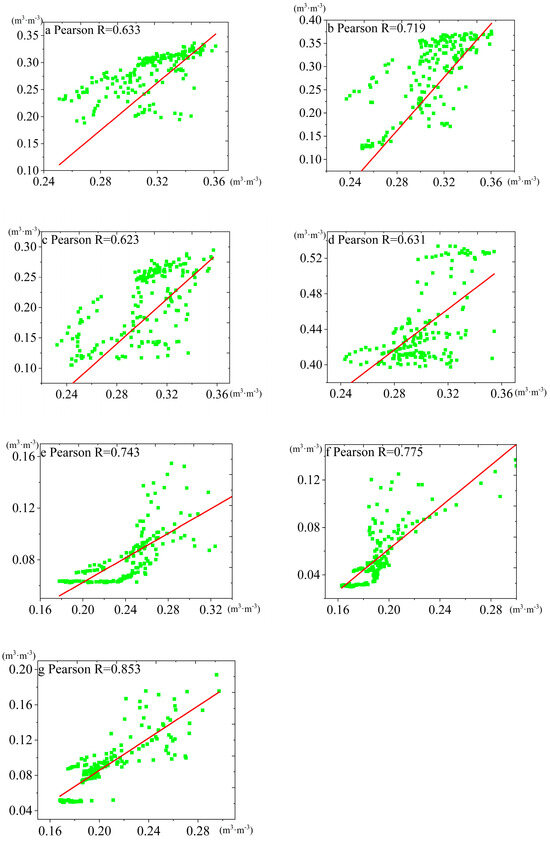
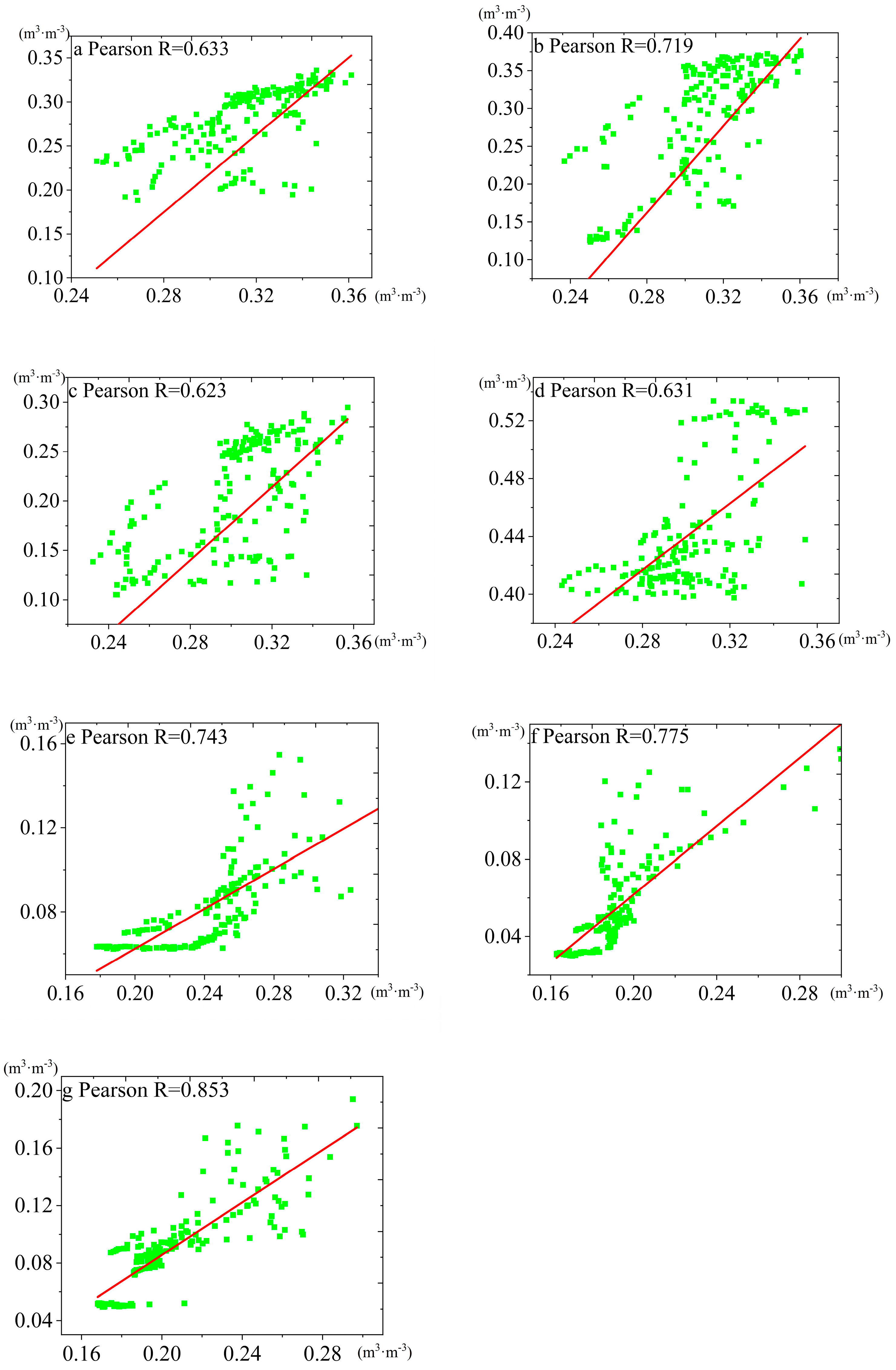
Here, the blended SM data are compared with in situ observations made during the period from December 2012 to November 2013 on the QTP (Figure 1). Scatter plots presenting the observed and blended SM data for the thawing season in this period are presented in Figure 6.
Figure 6.
Scatter plots of blended SM and observed SM at a series of stations. ((a) P1, (b) P2, (c) P3, (d) CST02, (e) AL02, (f) SQ02, and (g) SQ14).
Comparing the merged SM data with in situ measurements from seven monitoring sites shows a prevailing trend of underestimation across most locations (Table 3). The merged product yielded negative Mean Bias Errors (MBE) at six out of the seven stations (P1, P2, P3, AL02, SQ02, and SQ14). CST02 was the only site where the product generated an overestimation. Despite these systematic biases, the merged dataset successfully tracked the seasonal trends and temporal variations in SM throughout the study area.
Table 3.
Statistics of comparison between in situ SM data and blended SM data.
Evaluating the site-specific statistics reveals how performance fluctuates across different land covers. The product achieved its highest overall accuracy at the P1 alpine meadow site, which recorded the lowest RMSE (0.0453 m3·m−3) and the smallest absolute bias (MBE = −0.0342 m3·m−3). The evaluation at P2, another alpine meadow, was similarly reliable with an RMSE of 0.0653 m3·m−3. For the alpine desert sites, the merged data proved highly effective at reproducing temporal dynamics; SQ14 reached a Pearson R of 0.853, closely followed by SQ02 (Pearson R = 0.775). However, it is critical to acknowledge that the absolute deviations at these sites (e.g., MBE of −0.1372 and −0.1148 m3·m−3) are comparable in magnitude to the actual average SM values, which are inherently low in such arid environments. This large relative error indicates that while the fused product successfully captures temporal variability, it is potentially unsuitable for absolute estimates of regional water balance in alpine deserts without additional local calibration. In contrast, the most significant underestimation occurred at AL02, an alpine steppe environment, resulting in the largest negative bias (−0.1587 m3·m−3) and the highest RMSE (0.1603 m3·m−3). At the CST02 alpine swamp meadow, the model heavily overestimated the actual conditions, producing a positive MBE of 0.1401 m3·m−3.
The variations in error can largely be attributed to local vegetation structures and background surface conditions. The distinct overestimation at CST02 is likely driven by the abundant standing water and high vegetation water content inherent to swamp meadows. Such wet conditions often alter surface dielectric properties, causing microwave signals to saturate and retrieval algorithms to overestimate actual soil wetness. Additionally, CST02 is located at a much lower elevation (3449 m) than the rest of the network, meaning different thermal and atmospheric forcings might influence the local error structure. Conversely, the pervasive underestimation seen in the arid regions (AL02, SQ02, SQ14) typically stems from strong volume scattering over highly dry and rough soil surfaces, which weakens the emission signal. For the alpine meadow sites (P1, P2), the moderate vegetation density and soil texture appear to fall squarely within the optimal sensitivity range of the algorithm, yielding the most stable and accurate results.
Ultimately, while the merged product displays systematic overestimation in swamp meadows alongside underestimations in regular meadows, steppes, and deserts, the overall statistical metrics validate the proposed fusion method. The approach provides a robust and practical assessment of SM dynamics across these four primary vegetation types, which collectively cover 80.7% of the permafrost zones on the QTP [47].
4. Discussion
This blended approach has the potential to consistently generate blended SM data throughout the QTP. Although its errors are expressed in the dynamic range of the ERA-interim, it is important to realize that TC analysis is reliable, with conclusions that are generally not dependent on the selection of reference datasets [74]. Among the three SM products assessed in this work, the ERA-interim SM product exhibited the lowest error (0.023 m3·m−3), the CLDAS-V1.0 SM product showed the highest error (0.055 m3·m−3), and the CFSv2 SM product yielded an intermediate error value of 0.036 m3·m−3. In addition, the error of the ERA-interim SM product derived from our study (0.023 m3·m−3) shows high consistency with the global mean errors documented in previous studies: 0.020 m3·m−3 from Scipal et al. [75] and 0.018 m3·m−3 from Dorigo et al. [76], respectively.
The selection of the optimal SM product plays an essential role in one’s ability to produce high-quality blended SM data. Zeng et al. [30] demonstrated that the ERA-interim SM product outperformed the AMSR-E, JAXA, NASA, LPRM, SMOS, and ECV SM products in the CAMP/Tibet network by yielding the lowest RMSE value and a relatively higher R value. In northeast China, the CLDAS-V1.0 performed better than the CLM, Mosaic, Noah, and VIC, R values between the CLDAS-V1.0 data and observed SM data exceeding 0.9, as well as MBE and RMSE values of 0.097 m3·m−3 and 0.099 m3·m−3, respectively [77]. Therefore, CLDAS-V1.0 SM is optimal for collecting SM data in dry regions.
Generally, errors of all products are lowest in arid regions, such as the central and northern regions of the QTP. Errors of each product are similar to the climatology of SM; this aligns with previous findings indicating that the average error of SM estimations scales with the mean SM climatology. [76]. The TC method allows us to identify systematic trends and differences among various kinds of reanalyzed SM products with respect to varying amounts of land cover.
In this paper, we also compare blended SM values to observed in situ values over the QTP. Here, RMSE values of blended SM data are higher than they are in recent work studying the performance of ECV SM products in the CAMP/Tibet network. However, the biases of our blended SM data are much smaller than those of the ECV SM products. While remote sensing satellite SM products lack temporal continuity, our TC method allows us to develop spatially and temporally continuous SM measurements in areas that are hard to observe, such as the QTP.
Previous work has indicated that, in some areas, the TC method cannot be used to sufficiently describe deviations in SM, particularly in regions with high SM dynamics and low signal-to-noise ratios of SM. Our findings align with those reported in earlier research; the TC method is still limited in its ability to measure SM in densely vegetated or desert-like regions. A possible explanation for these errors is the difference in spatial scales between in-situation observations and SM product pixels. Specifically, due to the sparse distribution of the current observation network across the QTP, conducting a rigorous quantitative spatial upscaling analysis (e.g., via variograms or spatial autocorrelation) within individual 0.25° grid footprints is unfeasible. Consequently, the interpretation of absolute RMSE and MBE metrics inherently encompasses spatial representativeness errors. However, since this scale mismatch affects all datasets equally, their relative performances, especially the improved R values—remain statistically valid. Therefore, although the TC method can produce high quality SM data in the QTP, future work should focus on more deeply investigating the data generation algorithms (such as satellite, reanalysis, and model) of each SM product.
Despite the promising results, several limitations should be acknowledged for future improvements. Currently, the fusion framework relies solely on three reanalysis datasets; future studies could integrate high-precision satellite retrievals to further enhance spatiotemporal resolution and accuracy. Furthermore, while the traditional TC method is effective, its strict underlying assumptions introduce inherent uncertainties over the complex QTP terrain. Specifically, the potential cross-correlation of errors among ERA-interim, CFSv2, and CLDAS-V1.0, arising from shared forcing mechanisms or land surface models (e.g., Noah) represents a structural limitation [78]. However, because our ultimate objective is to determine optimal relative weights for data fusion rather than to precisely quantify absolute error variances, the impact of this partial violation is significantly mitigated. The consistent spatial performance of our blended product further supports the practical efficacy of this approach. Adopting advanced TC variants or machine learning-assisted algorithms could effectively mitigate these methodological constraints [11]. A further limitation is the relatively short temporal coverage of our dataset. Although the 365 collocated daily samples (December 2012–November 2013) well exceed the 100-triplet threshold required for robust TC analysis, a single year cannot capture long-term climate dynamics, such as the interannual variability of monsoon cycles or permafrost degradation [79]. Lastly, to better capture the extreme spatial heterogeneity of the region, future validations should leverage denser and more extensive ground observation networks, thereby ensuring a more robust evaluation of the fused soil moisture products.
5. Conclusions
The temporal and spatial discontinuities of SM measurements limit the applications of SM in climatic modeling, global change research, active layer thickness simulations, and permafrost distributions. By using the TC and least squares methods, the ERA-interim, CFSv2, and CLDAS-V1.0 SM products are blended to generate SM data within the QTP. Results demonstrate that TC can efficiently reconstruct high quality, spatially and temporally continuous SM data within the QTP and is thus a promising method of estimating the errors of SM products. All three datasets are characterized by relatively low errors; the ERA-interim yields the smallest errors (0.023 m3·m−3), the CLDAS-V1.0 yields the largest errors (0.055 m3·m−3), and the CFSv2 yields intermediate errors (0.036 m3·m−3). Distribution errors of each product are similar to their respective climatology. Within the QTP, the ERA-interim SM contributes the greatest weights (0.57) to the total blended SM, followed by CFSv2 (0.25), while CLDAS-V1.0 makes the smallest contribution (0.18). Higher weights demonstrate that ERA-interim SM is more reliable in arid or density vegetated regions, while the CLDAS-V1.0 SM is more reliable within the southwestern region of the QTP. The blended SM products reflect the seasonal variation in SM over the QTP for the blended season and can represent the relatively dry western QTP during the monsoon. The blended SM method is suitable for retrieving SM data in the corresponding vegetation-covered areas of the QTP. Specifically, when validated primarily during the thawing season, the merged product displays systematic overestimation in swamp meadows alongside underestimations in regular meadows, steppes, and deserts; nevertheless, the overall statistical metrics validate the proposed fusion method.
Further efforts will be devoted to addressing the limitations identified in this study and extending the application of the proposed fusion framework. High-precision satellite SM retrievals, such as SMAP and SMOS, will be incorporated into the TC fusion system to enhance the accuracy and spatial resolution of the resulting dataset. Additionally, expanding the ground observation network across the QTP and applying the fused SM dataset to cryospheric hydrological simulations, particularly permafrost active layer thickness prediction, will be key priorities for future work.
Author Contributions
Conceptualization, X.Z. and Y.Q.; methodology, X.Z.; software, X.Z.; validation, X.Z.; formal analysis, J.Y.; investigation, J.Y.; resources, X.Y.; data curation, X.Y.; writing—original draft preparation, X.Z.; writing—review and editing, Y.Q.; visualization, X.Z.; supervision, Y.Q.; project administration, J.Y.; funding acquisition, J.Y. and Y.Q. All authors have read and agreed to the published version of the manuscript.
Funding
This research was funded by the Shandong Provincial Natural Science Foundation, grant number ZR2023MD036.
Data Availability Statement
The original contributions presented in this study are included in the article. Further inquiries can be directed to the corresponding author.
Acknowledgments
The authors are grateful to the developers of the ERA-interim, CFSv2, and CLDAS-V1.0 SM products for providing open access data. The authors are also grateful to the National Tibetan Plateau/Third Pole Environment Data Center (TPDC) for providing open access in situ SM observation data. The authors also thank the anonymous reviewers for their constructive comments and suggestions.
Conflicts of Interest
Author Jianbao Yuan was employed by the company Longfor Group Holdings Limited. The remaining authors declare that the research was conducted in the absence of any commercial or financial relationships that could be construed as potential conflicts of interest.
Abbreviations
The following abbreviations are used in this manuscript:
| SM | Soil Moisture |
| TC | Triple Collocation |
| QTP | The Qinghai-Tibetan Plateau |
| ECMWF | European Centre for Medium-Range Weather Forecasts |
| CFSv2 | Climate Forecast System Version 2 |
| ERA-interim | European Centre for Medium-Range Weather Forecasts interim reanalysis |
| CLDAS-V1.0 | The China Meteorological Administration Land Data Assimilation System Version 1.0 |
References
- Seneviratne, S.; Wilhelm, M.; Stanelle, T.; van den Hurk, B.; Hagemann, S.; Berg, A.; Cheruy, F.; Higgins, M.; Meier, A.; Brovkin, V.; et al. Impact of soil moisture-climate feedbacks on CMIP5 projections: First results from the GLACE-CMIP5 experiment. Geophys. Res. Lett. 2013, 40, 5212–5217. [Google Scholar] [CrossRef] [Scilit]
- Petropoulos, G.; Lekka, C. Recent Developments to the SimSphere Land Surface Modelling Tool for the Study of Land-Atmosphere Interactions. Sensors 2024, 24, 3024. [Google Scholar] [CrossRef] [Scilit] [PubMed]
- Zhou, S.; Williams, A.; Lintner, B.; Berg, A.; Zhang, Y.; Keenan, T.; Cook, B.; Hagemann, S.; Seneviratne, S.; Gentine, P. Soil moisture-atmosphere feedbacks mitigate declining water availability in drylands. Nat. Clim. Change 2021, 11, 38–44. [Google Scholar] [CrossRef] [Scilit]
- Mondal, S.; Mishra, A. Quantifying the Precipitation, Evapotranspiration, and Soil Moisture Network’s Interaction over Global Land Surface Hydrological Cycle. Water Resour. Res. 2024, 60, e2023WR034861. [Google Scholar] [CrossRef] [Scilit]
- Liu, Y.; Yang, Y. Advances in the Quality of Global Soil Moisture Products: A Review. Remote Sens. 2022, 14, 3741. [Google Scholar] [CrossRef] [Scilit]
- Legates, D.; Mahmood, R.; Levia, D.; DeLiberty, T.; Quiring, S.; Houser, C.; Nelson, F. Soil moisture: A central and unifying theme in physical geography. Prog. Phys. Geogr. Earth Environ. 2011, 35, 65–86. [Google Scholar] [CrossRef] [Scilit]
- Qiu, J.; Gao, Q.; Wang, S.; Su, Z. Comparison of temporal trends from multiple soil moisture data sets and precipitation: The implication of irrigation on regional soil moisture trend. Int. J. Appl. Earth Obs. Geoinf. 2016, 48, 17–27. [Google Scholar] [CrossRef] [Scilit]
- Beck, H.; Pan, M.; Miralles, D.; Reichle, R.; Dorigo, W.; Hahn, S.; Sheffield, J.; Karthikeyan, L.; Balsamo, G.; Parinussa, R.; et al. Evaluation of 18 satellite- and model-based soil moisture products using in situ measurements from 826 sensors. Hydrol. Earth Syst. Sci. 2021, 25, 17–40. [Google Scholar] [CrossRef] [Scilit]
- Ling, X.; Huang, Y.; Guo, W.; Wang, Y.; Chen, C.; Qiu, B.; Ge, J.; Qin, K.; Xue, Y.; Peng, J. Comprehensive evaluation of satellite-based and reanalysis soil moisture products using in situ observations over China. Hydrol. Earth Syst. Sci. 2021, 25, 4209–4229. [Google Scholar] [CrossRef] [Scilit]
- Zeng, J.; Yuan, X.; Ji, P. The important role of reliable land surface model simulation in high-resolution multi-source soil moisture data fusion by machine learning. J. Hydrol. 2024, 630, 130700. [Google Scholar] [CrossRef] [Scilit]
- Ming, W.; Ji, X.; Zhang, M.; Li, Y.; Liu, C.; Wang, Y.; Li, J. A Hybrid Triple Collocation-Deep Learning Approach for Improving Soil Moisture Estimation from Satellite and Model-Based Data. Remote Sens. 2022, 14, 1744. [Google Scholar] [CrossRef] [Scilit]
- Li, Q.; Shi, G.; Shangguan, W.; Nourani, V.; Li, J.; Li, L.; Huang, F.; Zhang, Y.; Wang, C.; Wang, D.; et al. A 1 km daily soil moisture dataset over China using in situ measurement and machine learning. Earth Syst. Sci. Data 2022, 14, 5267–5286. [Google Scholar] [CrossRef] [Scilit]
- Chen, Y.; Feng, X.; Fu, B. An improved global remote-sensing-based surface soil moisture (RSSSM) dataset covering 2003–2018. Earth Syst. Sci. Data 2021, 13, 1–31. [Google Scholar] [CrossRef] [Scilit]
- Yao, P.; Lu, H.; Shi, J.; Zhao, T.; Yang, K.; Cosh, M.; Gianotti, D.; Entekhabi, D. A long term global daily soil moisture dataset derived from AMSR-E and AMSR2 (2002–2019). Sci. Data 2021, 8, 143. [Google Scholar] [CrossRef] [Scilit]
- Al-Yaari, A.; Wigneron, J.; Ducharne, A.; Kerr, Y.; de Rosnay, P.; de Jeu, R.; Govind, A.; Al Bitar, A.; Albergel, C.; Muñoz-Sabater, J.; et al. Global-scale evaluation of two satellite-based passive microwave soil moisture datasets (SMOS and AMSR-E) with respect to Land Data Assimilation System estimates. Remote Sens. Environ. 2014, 149, 181–195. [Google Scholar] [CrossRef] [Scilit]
- Wang, Y.; Li, G. Evaluation of simulated soil moisture from China Land Data Assimilation System (CLDAS) land surface models. Remote Sens. Lett. 2020, 11, 1060–1069. [Google Scholar] [CrossRef] [Scilit]
- Bonan, B.; Albergel, C.; Zheng, Y.; Barbu, A.; Fairbairn, D.; Munier, S.; Calvet, J. An ensemble square root filter for the joint assimilation of surface soil moisture and leaf area index within the Land Data Assimilation System LDAS-Monde: Application over the Euro-Mediterranean region. Hydrol. Earth Syst. Sci. 2020, 24, 325–347. [Google Scholar] [CrossRef] [Scilit]
- Boutin, J.; Yueh, S.; Bindlish, R.; Chan, S.; Entekhabi, D.; Kerr, Y.; Kolodziejczyk, N.; Lee, T.; Reul, N.; Zribi, M. Soil Moisture and Sea Surface Salinity Derived from Satellite-Borne Sensors. Surv. Geophys. 2023, 44, 1449–1487. [Google Scholar] [CrossRef] [Scilit]
- Pierdicca, N.; Comite, D.; Camps, A.; Carreno-Luengo, H.; Cenci, L.; Clarizia, M.; Costantini, F.; Dente, L.; Guerriero, L.; Mollfulleda, A.; et al. The Potential of Spaceborne GNSS Reflectometry for Soil Moisture, Biomass, and Freeze-Thaw Monitoring Summary of a European Space Agency-funded study. IEEE Geosci. Remote Sens. Mag. 2022, 10, 8–38. [Google Scholar] [CrossRef] [Scilit]
- Colliander, A.; Reichle, R.; Crow, W.; Cosh, M.; Chen, F.; Chan, S.; Das, N.; Bindlish, R.; Chaubell, J.; Kim, S.; et al. Validation of Soil Moisture Data Products from the NASA SMAP Mission. IEEE J. Sel. Top. Appl. Earth Obs. Remote Sens. 2022, 15, 364–392. [Google Scholar] [CrossRef] [Scilit]
- Xu, Y.; Wang, L.; Ross, K.; Liu, C.; Berry, K. Standardized Soil Moisture Index for Drought Monitoring Based on Soil Moisture Active Passive Observations and 36 Years of North American Land Data Assimilation System Data: A Case Study in the Southeast United States. Remote Sens. 2018, 10, 301. [Google Scholar] [CrossRef] [Scilit]
- Liu, Y.; Jing, W.; Sun, S.; Wang, C. Multi-Scale and Multi-Depth Validation of Soil Moisture from the China Land Data Assimilation System. IEEE J. Sel. Top. Appl. Earth Obs. Remote Sens. 2021, 14, 9913–9930. [Google Scholar] [CrossRef] [Scilit]
- Ling, X.; Gao, J.; Tang, Z.; Liu, W. Assimilation of Remotely Sensed Leaf Area Index for Improving Land Surface Simulation Performance at a Global Scale. IEEE J. Sel. Top. Appl. Earth Obs. Remote Sens. 2024, 17, 9226–9239. [Google Scholar] [CrossRef] [Scilit]
- Enenkel, M.; Reimer, C.; Dorigo, W.; Wagner, W.; Pfeil, I.; Parinussa, R.; De Jeu, R. Combining satellite observations to develop a global soil moisture product for near-real-time applications. Hydrol. Earth Syst. Sci. 2016, 20, 4191–4208. [Google Scholar] [CrossRef] [Scilit]
- Cheng, S.; Huang, J.; Ji, F.; Lin, L. Uncertainties of soil moisture in historical simulations and future projections. J. Geophys. Res. Atmos. 2017, 122, 2239–2253. [Google Scholar] [CrossRef] [Scilit]
- He, Q.; Lu, H.; Yang, K. Soil Moisture Memory of Land Surface Models Utilized in Major Reanalyses Differ Significantly from SMAP Observation. Earths Future 2023, 11, e2022EF003215. [Google Scholar] [CrossRef] [Scilit]
- Su, Z.; Wen, J.; Dente, L.; van der Velde, R.; Wang, L.; Ma, Y.; Yang, K.; Hu, Z. The Tibetan Plateau observatory of plateau scale soil moisture and soil temperature (Tibet-Obs) for quantifying uncertainties in coarse resolution satellite and model products. Hydrol. Earth Syst. Sci. 2011, 15, 2303–2316. [Google Scholar] [CrossRef] [Scilit]
- Peng, J.; Niesel, J.; Loew, A.; Zhang, S.; Wang, J. Evaluation of Satellite and Reanalysis Soil Moisture Products over Southwest China Using Ground-Based Measurements. Remote Sens. 2015, 7, 15729–15747. [Google Scholar] [CrossRef] [Scilit]
- Wen, X.; Lu, H.; Li, C.; Koike, T.; Kaihotsu, I. Inter-comparison of soil moisture products from SMOS, AMSR-E, ECWMF and GLDAS over the Mongolia Plateau. In Proceedings of the Land Surface Remote Sensing II, Beijing, China, 13–16 October 2014; pp. 103–110. [Google Scholar]
- Zeng, J.; Li, Z.; Chen, Q.; Bi, H.; Qiu, J.; Zou, P. Evaluation of remotely sensed and reanalysis soil moisture products over the Tibetan Plateau using in-situ observations. Remote Sens. Environ. 2015, 163, 91–110. [Google Scholar] [CrossRef] [Scilit]
- Luo, M.; Sa, C.; Meng, F.; Duan, Y.; Liu, T.; Bao, Y. Assessing remotely sensed and reanalysis products in characterizing surface soil moisture in the Mongolian Plateau. Int. J. Digit. Earth 2021, 14, 1255–1272. [Google Scholar] [CrossRef] [Scilit]
- Wang, W.; Feng, S.; Zhang, Y.; Wei, Z.; Dong, J.; Weihermüller, L.; Liu, C.; Vereecken, H. Fusing ERA5-Land and SMAP L4 for an improved global soil moisture product (1950–2025). Earth Syst. Sci. Data 2026, 18, 1061–1088. [Google Scholar] [CrossRef] [Scilit]
- Su, C.; Ryu, D.; Crow, W.; Western, A. Beyond triple collocation: Applications to soil moisture monitoring. J. Geophys. Res. Atmos. 2014, 119, 6419–6439. [Google Scholar] [CrossRef] [Scilit]
- Pierdicca, N.; Fascetti, F.; Pulvirenti, L.; Crapolicchio, R.; Muñoz-Sabater, J. Analysis of ASCAT, SMOS, in-situ and land model soil moisture as a regionalized variable over Europe and North Africa. Remote Sens. Environ. 2015, 170, 280–289. [Google Scholar] [CrossRef] [Scilit]
- Zhao, H.; Montzka, C.; Vereecken, H.; Franssen, H. A Comparative Analysis of Remote Sensing Soil Moisture Datasets Fusion Methods: Novel LSTM Approach Versus Widely Used Triple Collocation Technique. IEEE J. Sel. Top. Appl. Earth Obs. Remote Sens. 2024, 17, 16659–16671. [Google Scholar] [CrossRef] [Scilit]
- Wang, Q.; Lu, C.; Zheng, Y.; Wang, Z.; Li, J.; Tan, Y. In-situ and triple collocation-based evaluations of Tianmu-1 global soil moisture products. Remote Sens. Environ. 2025, 328, 114892. [Google Scholar] [CrossRef] [Scilit]
- Lyu, F.; Tang, G.; Behrangi, A.; Wang, T.; Tan, X.; Ma, Z.; Xiong, W. Precipitation Merging Based on the Triple Collocation Method Across Mainland China. IEEE Trans. Geosci. Remote Sens. 2021, 59, 3161–3176. [Google Scholar] [CrossRef] [Scilit]
- Wei, L.; Jiang, S.; Dong, J.; Ren, L.; Yong, B.; Yang, B.; Li, X.; Duan, Z. A combined extended triple collocation and cumulative distribution function merging framework for improved daily precipitation estimates over mainland China. J. Hydrol. 2024, 641, 131757. [Google Scholar] [CrossRef] [Scilit]
- Li, H.; Tan, L.; Li, X.; Cai, Q. Aquatic protected area system in the Qinghai-Tibet Plateau: Establishment, challenges and prospects. Front. Ecol. Evol. 2024, 12, 1204494. [Google Scholar] [CrossRef] [Scilit]
- Huang, J.; Zhou, X.; Wu, G.; Xu, X.; Zhao, Q.; Liu, Y.; Duan, A.; Xie, Y.; Ma, Y.; Zhao, P.; et al. Global Climate Impacts of Land-Surface and Atmospheric Processes over the Tibetan Plateau. Rev. Geophys. 2023, 61, e2022RG000771. [Google Scholar] [CrossRef] [Scilit]
- Yang, K.; Ye, B.; Zhou, D.; Wu, B.; Foken, T.; Qin, J.; Zhou, Z. Response of hydrological cycle to recent climate changes in the Tibetan Plateau. Clim. Change 2011, 109, 517–534. [Google Scholar] [CrossRef] [Scilit]
- Li, H.; Liu, F.; Zhang, S.; Zhang, C.; Zhang, C.; Ma, W.; Luo, J. Drying-Wetting Changes of Surface Soil Moisture and the Influencing Factors in Permafrost Regions of the Qinghai-Tibet Plateau, China. Remote Sens. 2022, 14, 2915. [Google Scholar] [CrossRef] [Scilit]
- Su, Z.; de Rosnay, P.; Wen, J.; Wang, L.; Zeng, Y. Evaluation of ECMWF’s soil moisture analyses using observations on the Tibetan Plateau. J. Geophys. Res. Atmos. 2013, 118, 5304–5318. [Google Scholar] [CrossRef] [Scilit]
- Ding, X.; Lai, X.; Fan, G.; Wen, J.; Yuan, Y.; Wang, X.; Wang, Z.; Zhu, L.; Zhang, Y.; Wang, B. Analysis on the applicability of reanalysis soil temperature and moisture datasets over Qinghai-Tibetan Plateau. Plateau Meteorol. 2018, 37, 626–641. [Google Scholar]
- Qin, J.; Yang, K.; Lu, N.; Chen, Y.; Zhao, L.; Han, M. Spatial upscaling of in-situ soil moisture measurements based on MODIS-derived apparent thermal inertia. Remote Sens. Environ. 2013, 138, 1–9. [Google Scholar] [CrossRef] [Scilit]
- Chen, Y.; Yang, K.; Qin, J.; Cui, Q.; Lu, H.; La, Z.; Han, M.; Tang, W. Evaluation of SMAP, SMOS, and AMSR2 soil moisture retrievals against observations from two networks on the Tibetan Plateau. J. Geophys. Res. Atmos. 2017, 122, 5780–5792. [Google Scholar] [CrossRef] [Scilit]
- Wang, Z.; Wang, Q.; Zhao, L.; Wu, X.; Yue, G.; Zou, D.; Nan, Z.; Liu, G.; Pang, Q.; Fang, H.; et al. Mapping the vegetation distribution of the permafrost zone on the Qinghai-Tibet Plateau. J. Mt. Sci. 2016, 13, 1035–1046. [Google Scholar] [CrossRef] [Scilit]
- Yang, K.; Qin, J.; Zhao, L.; Chen, Y.; Tang, W.; Han, M.; Lazhu; Chen, Z.; Lv, N.; Ding, B. A multiscale soil moisture and freeze–thaw monitoring network on the third pole. Bull. Am. Meteorol. Soc. 2013, 94, 1907–1916. [Google Scholar] [CrossRef] [Scilit]
- Qing, F.; Kun, Y.; Yingying, C. Impact of soil organic matter content on soil moisture and temperature at different depths in the central Qinghai-Xizang Plateau. Gaoyuan Qixiang 2022, 41, 1097–1108. [Google Scholar]
- Clelland, A.; Marshall, G.; Baxter, R. Evaluating the performance of key ERA-Interim, ERA5 and ERA5-Land climate variables across Siberia. Int. J. Climatol. 2024, 44, 2318–2342. [Google Scholar] [CrossRef] [Scilit]
- Boussetta, S.; Balsamo, G.; Arduini, G.; Dutra, E.; McNorton, J.; Choulga, M.; Agustí-Panareda, A.; Beljaars, A.; Wedi, N.; Munoz-Sabater, J.; et al. ECLand: The ECMWF Land Surface Modelling System. Atmosphere 2021, 12, 723. [Google Scholar] [CrossRef] [Scilit]
- Fairbairn, D.; de Rosnay, P.; Weston, P. Evaluation of an Adaptive Soil Moisture Bias Correction Approach in the ECMWF Land Data Assimilation System. Remote Sens. 2024, 16, 493. [Google Scholar] [CrossRef] [Scilit]
- Yang, K.; Wang, C. East-West Reverse Coupling Between Spring Soil Moisture and Summer Precipitation and Its Possible Responsibility for Wet Bias in GCMs Over Tibetan Plateau. J. Geophys. Res. Atmos. 2022, 127, e2021JD036286. [Google Scholar] [CrossRef] [Scilit]
- Zhou, X.; Zhu, Y.; Hou, D.; Fu, B.; Li, W.; Guan, H.; Sinsky, E.; Kolczynski, W.; Xue, X.; Luo, Y.; et al. The Development of the NCEP Global Ensemble Forecast System Version 12. Weather Forecast. 2022, 37, 1069–1084. [Google Scholar] [CrossRef] [Scilit]
- Docquier, D.; Koenigk, T.; Fuentes-Franco, R.; Karami, M.; Ruprich-Robert, Y. Impact of ocean heat transport on the Arctic sea-ice decline: A model study with EC-Earth3. Clim. Dyn. 2021, 56, 1407–1432. [Google Scholar] [CrossRef] [Scilit]
- Ha, S.; Wang, Q.; Hur, J.; Im, E. Evaluating interannual variability in 1-month CFSv2 forecasts with different lead times at monthly and daily scales in South Korea. Environ. Res. Commun. 2025, 7, 041013. [Google Scholar] [CrossRef] [Scilit]
- Balasubramaniam, R.; Ruf, C. The Impact on Triple/N-Way Collocation-Based Validation of Remote Sensing Products Due to Non-Ideal Error Statistics. Remote Sens. 2025, 17, 3751. [Google Scholar] [CrossRef] [Scilit]
- Lu, X.; Tang, G.; Liu, X.; Wang, X.; Liu, Y.; Wei, M. The potential and uncertainty of triple collocation in assessing satellite precipitation products in Central Asia. Atmos. Res. 2021, 252, 105452. [Google Scholar] [CrossRef] [Scilit]
- Xu, L.; Ye, Z.; Dai, J.; Li, Q.; Hong, Y.; Tao, Y.; Yu, H.; Zhang, C.; Chen, Z.; Chen, N. Spatiotemporal Seamless Estimation of Global Surface Soil Moisture Using Triple Collocation, Machine Learning, and Data Assimilation. IEEE Trans. Geosci. Remote Sens. 2025, 63, 4505216. [Google Scholar] [CrossRef] [Scilit]
- Hong, Z.; Moreno, H.; Alvarez, L.; Li, Z.; Hong, Y. Triple Collocation of Ground-, Satellite- and Land Surface Model-Based Surface Soil Moisture Products in Oklahoma Part II: New Multi-Sensor Soil Moisture (MSSM) Product. Remote Sens. 2023, 15, 3450. [Google Scholar] [CrossRef] [Scilit]
- Jiang, H.; Fu, G.; Ren, L. Evaluation of Coastal Altimeter Wave Height Observations Using Dynamic Collocation. IEEE Trans. Geosci. Remote Sens. 2022, 60, 1–8. [Google Scholar] [CrossRef] [Scilit]
- Zhou, P.; Geng, L.; Li, J. Enhancing Uncertainty Assessment of LAI Remote Sensing Products Through Multiple Collocation Methods and Error Separation Techniques. IEEE J. Sel. Top. Appl. Earth Obs. Remote Sens. 2025, 18, 22573–22588. [Google Scholar] [CrossRef] [Scilit]
- Nwokolo, S.; Meyer, E.; Ahia, C. Exploring the Interactive Influences of Climate Change and Urban Development on the Fraction of Absorbed Photosynthetically Active Radiation. Atmosphere 2024, 15, 253. [Google Scholar] [CrossRef] [Scilit]
- Li, T.; Wang, Y.; Wang, B.; Liu, K.; Chen, X.; Sun, R. Evaluation and fusion of multi-source sea ice thickness products with limited in-situ observations. Front. Mar. Sci. 2024, 11, 1464391. [Google Scholar] [CrossRef] [Scilit]
- Fersch, B.; Wagner, A.; Kamm, B.; Shehaj, E.; Schenk, A.; Yuan, P.; Geiger, A.; Moeller, G.; Heck, B.; Hinz, S.; et al. Tropospheric water vapor: A comprehensive high-resolution data collection for the transnational Upper Rhine Graben region. Earth Syst. Sci. Data 2022, 14, 5287–5307. [Google Scholar] [CrossRef] [Scilit]
- Han, X.; Wang, Y.; Zhang, D.; Lin, W.; Wei, D. Evaluation of SMOS Sea Surface Salinity Products based on Triple Collocation Method. In Proceedings of the IGARSS 2025–2025 IEEE International Geoscience and Remote Sensing Symposium, Brisbane, Australia, 3–8 August 2025; pp. 4914–4917. [Google Scholar]
- Shah, S.; Liu, Y.; Kim, S.; Sharma, A. Advancing High-Mountain Precipitation Reconstruction Through Merging of Multiple Data Sources: Triple Collocation Versus Signal-to-Noise Ratio Optimization. IEEE Trans. Geosci. Remote Sens. 2024, 62, 4212315. [Google Scholar] [CrossRef] [Scilit]
- Yin, G.; Park, J. The use of triple collocation approach to merge satellite- and model-based terrestrial water storage for flood potential analysis. J. Hydrol. 2021, 603, 127197. [Google Scholar] [CrossRef] [Scilit]
- Tan, S.; Wang, J.; Ji, J.; Liu, M.; Zhan, Z.; Liu, M.; Wang, L.; Hu, X. Investigating the impact of violations in orthogonality and zero cross-correlation assumption upon the accuracy of triple collocation methods. J. Geo-Inform. Sci. 2024, 26, 591–603. [Google Scholar]
- Rasoolimanesh, S.; Ringle, C.; Sarstedt, M.; Olya, H. The combined use of symmetric and asymmetric approaches: Partial least squares-structural equation modeling and fuzzy-set qualitative comparative analysis. Int. J. Contemp. Hosp. Manag. 2021, 33, 1571–1592. [Google Scholar] [CrossRef] [Scilit]
- Fan, Y.; Qiu, J.; Dong, J.; Zhang, X.; Wang, D. Error characteristics of microwave soil moisture products based on triple collocation and its spatial-temporal pattern. Remote Sens. Technol. Appl. 2020, 35, 85–96. [Google Scholar]
- Yilmaz, M.; Crow, W.; Anderson, M.; Hain, C. An objective methodology for merging satellite-and model-based soil moisture products. Water Resour. Res. 2012, 48, W11502. [Google Scholar] [CrossRef] [Scilit]
- Liu, X.; Li, Q.; Song, S. Fusion and Downscaling of Multi-Source Remote Sensing Soil Moisture based on 2D Triple-Collocation and Machine Learning Methods. Remote Sens. Technol. Appl. 2023, 38, 1317–1327. [Google Scholar]
- Chen, P.; Huang, H.; Shi, W.; Chen, R. A Reference-Free Method for the Thematic Accuracy Estimation of Global Land Cover Products Based on the Triple Collocation Approach. Remote Sens. 2023, 15, 2255. [Google Scholar] [CrossRef] [Scilit]
- Scipal, K.; Holmes, T.; de Jeu, R.; Naeimi, V.; Wagner, W. A possible solution for the problem of estimating the error structure of global soil moisture data sets. Geophys. Res. Lett. 2008, 35, L24403. [Google Scholar] [CrossRef] [Scilit]
- Dorigo, W.; Scipal, K.; Parinussa, R.; Liu, Y.; Wagner, W.; de Jeu, R.; Naeimi, V. Error characterisation of global active and passive microwave soil moisture datasets. Hydrol. Earth Syst. Sci. 2010, 14, 2605–2616. [Google Scholar] [CrossRef] [Scilit]
- Sun, S.; Shi, C.; Pan, Y.; Bai, L.; Xu, B.; Zhang, T.; Han, S.; Jiang, L. Applicability Assessment of the 1998–2018 CLDAS Multi-Source Precipitation Fusion Dataset over China. J. Meteorol. Res. 2020, 34, 879–892. [Google Scholar] [CrossRef] [Scilit]
- Gruber, A.; Su, C.; Crow, W.; Zwieback, S.; Dorigo, W.; Wagner, A. Estimating error cross-correlations in soil moisture data sets using extended collocation analysis. J. Geophys. Res. Atmos. 2016, 121, 1208–1219. [Google Scholar] [CrossRef] [Scilit]
- González-Gambau, V.; Turiel, A.; González-Haro, C.; Martínez, J.; Olmedo, E.; Oliva, R.; Martín-Neira, M. Triple Collocation Analysis for Two Error-Correlated Datasets: Application to L-Band Brightness Temperatures over Land. Remote Sens. 2020, 12, 3381. [Google Scholar] [CrossRef] [Scilit]

Disclaimer/Publisher’s Note: The statements, opinions and data contained in all publications are solely those of the individual author(s) and contributor(s) and not of MDPI and/or the editor(s). MDPI and/or the editor(s) disclaim responsibility for any injury to people or property resulting from any ideas, methods, instructions or products referred to in the content. |
© 2026 by the authors. Licensee MDPI, Basel, Switzerland. This article is an open access article distributed under the terms and conditions of the Creative Commons Attribution (CC BY) license.