Article

Coupled SWAT–MODFLOW Model for the Interaction Between Groundwater and Surface Water in an Alpine Inland River Basin


1
Qinghai Bureau of Environmental Geology Exploration, Xining 810001, China
2
China Institute of Geo-Environment Monitoring, Beijing 100081, China
3
State Key Laboratory of Urban and Regional Ecology, Research Center for Eco-Environmental Sciences, Chinese Academy of Sciences, Beijing 100085, China
*
Author to whom correspondence should be addressed.
Water 2026, 18(1), 85; https://doi.org/10.3390/w18010085
Submission received: 14 November 2025 / Revised: 12 December 2025 / Accepted: 24 December 2025 / Published: 29 December 2025
(This article belongs to the Section Hydrology)

Abstract

For an alpine inland river basin affected by climate change, the interaction between groundwater (GW) and surface water (SW) within the watershed plays a crucial role in water resource management. To explore the bidirectional dynamic coupling of surface water and groundwater, this work adopted the extensively employed SWAT–MODFLOW model. Results indicate that statistical parameters including R2 (0.81 for calibration periods and 0.79 for validation), NSE (0.79 for calibration periods and 0.75 for validation), RMSE (0.59~1.25 m), and PBIAS (15.21%) demonstrate the dependability of the SWAT–MODFLOW model in evaluating groundwater–surface water exchange processes within alpine inland river basins. Long-term monitoring data show that groundwater levels exhibited an upward trend, rising from 2895.35 m in 2005 to 2906.75 m in 2022. Notably, since 2018, groundwater levels have entered a period of being consistently above the long-term average. In terms of spatial distribution, the groundwater level patterns in 2005, 2010, and 2015 remained relatively consistent, marked by a west-to-east decreasing gradient. However, by 2020, this spatial distribution pattern shifted, marked by an east-to-west decreasing gradient. Meanwhile, our results reveal a pattern of upstream surface water recharge, bidirectional fluctuation in the middle reaches, and downstream groundwater-dominated recharge during the period of 2000~2023. During the 2000–2009 period, groundwater in sub5 received recharge from surface water, with the exchange rate ranging from −4987.75 to −374.82 m3/d. Conversely, during 2010–2023, groundwater in sub5 discharged into surface water, with the exchange rate ranging from 1136.75 to 56,646.56 m3/d. Moreover, there is seasonal variability in the SW–GW interchange relationship. In spring and summer, surface water primarily replenishes groundwater, whereas in autumn and winter, groundwater primarily replenishes surface water. This study provides a foundational method for assessing groundwater–surface water interactions in alpine inland river basins, which will contribute to the evaluation and management of local water resources.

1. Introduction

Groundwater–surface water interchange is a nearly ubiquitous phenomenon and constitutes a critical component of the global water cycle. In tandem with this water exchange process, human-induced pollutants are likewise transferred between groundwater and surface water bodies. These contaminants can deteriorate water resources, thereby impacting the health of coastal ecological systems and rendering water resources unfit for direct use in drinking water supplies or industrial activities [1,2,3]. As a result, the SW–GW exchange has long been a critical concern in the context of water recharge and discharge dynamics, as well as the ecological balance of natural systems [4,5]. Identifying the patterns of SW–GW exchange is fundamental to the rational management of water resources [6].
A wide range of approaches have been employed to determine the patterns of water exchange between groundwater and surface water. Direct quantification of water exchange flux can be achieved through on-site measurements using seepage meters [7]. The water balance serves as a crucial method for estimating the magnitude of SW–GW interchange in a region or watershed [8,9]. Moreover, stable isotopes like 18O and 2H, along with radioisotopes like radon (Rn) and radium (Ra), serve as crucial instruments for analyzing the SW–GW interactions across various scales [10,11]. In comparison with the aforementioned approaches, numerical model-based analysis has been widely used to quantify water exchange processes, as well as their spatial and temporal variations at a regional scale, such as SWAT [12,13,14] and MODFLOW [15,16,17]. The SWAT model, a semi-distributed hydrological model, lacks the consideration of specific aquifer stratification and key hydrogeological parameters like permeability coefficient and storage coefficient. This inherent limitation makes it challenging for the model to accurately simulate the dynamics of groundwater level. At the same time, the traditional MODFLOW model relies on the precipitation infiltration coefficient method to compute precipitation recharge, yet this approach struggles to accommodate complex underlying surface characteristics and the spatial distribution patterns of precipitation. Owing to the respective limitations of SWAT in simulating groundwater hydrological processes and MODFLOW in representing land surface hydrological dynamics, integrated modeling frameworks—encompassing fully coupled models such as HydroGeoSphere [18] and loosely integrated models exemplified by GSFLOW [19] and SWAT–MODFLOW [20,21,22,23]—have emerged as alternative approaches for water interaction between groundwater and surface water. Given that the SWAT–MODFLOW coupled model possesses distinctive advantages in characterizing surface water–groundwater interactions, a number of research studies have already been conducted based on this model [10,24,25]. Nevertheless, the applicability of these coupled models across diverse regional contexts still requires further exploration, especially in the alpine and cold inland river basins of the Qinghai-Tibet Plateau where basic data are lacking.
Thus, taking the Bayin River Basin as a case study, this research implements an integrated SWAT–MODFLOW model and unifies the temporal and spatial computational units of these two models in alpine mountainous areas and inland river basins. The coupled model’s applicability was validated using observation data, including river runoff and groundwater level. Additionally, this research aims to (1) explore the temporal variations and spatial distributions of groundwater levels and (2) analyze the interactions and quantify the exchange flux between GW and SW. To some extent, clarifying SW–GW conversion can provide valuable insights for understanding hydrological processes and evaluating local water resources in endorheic river basins of alpine regions.

2. Description of the Study Area

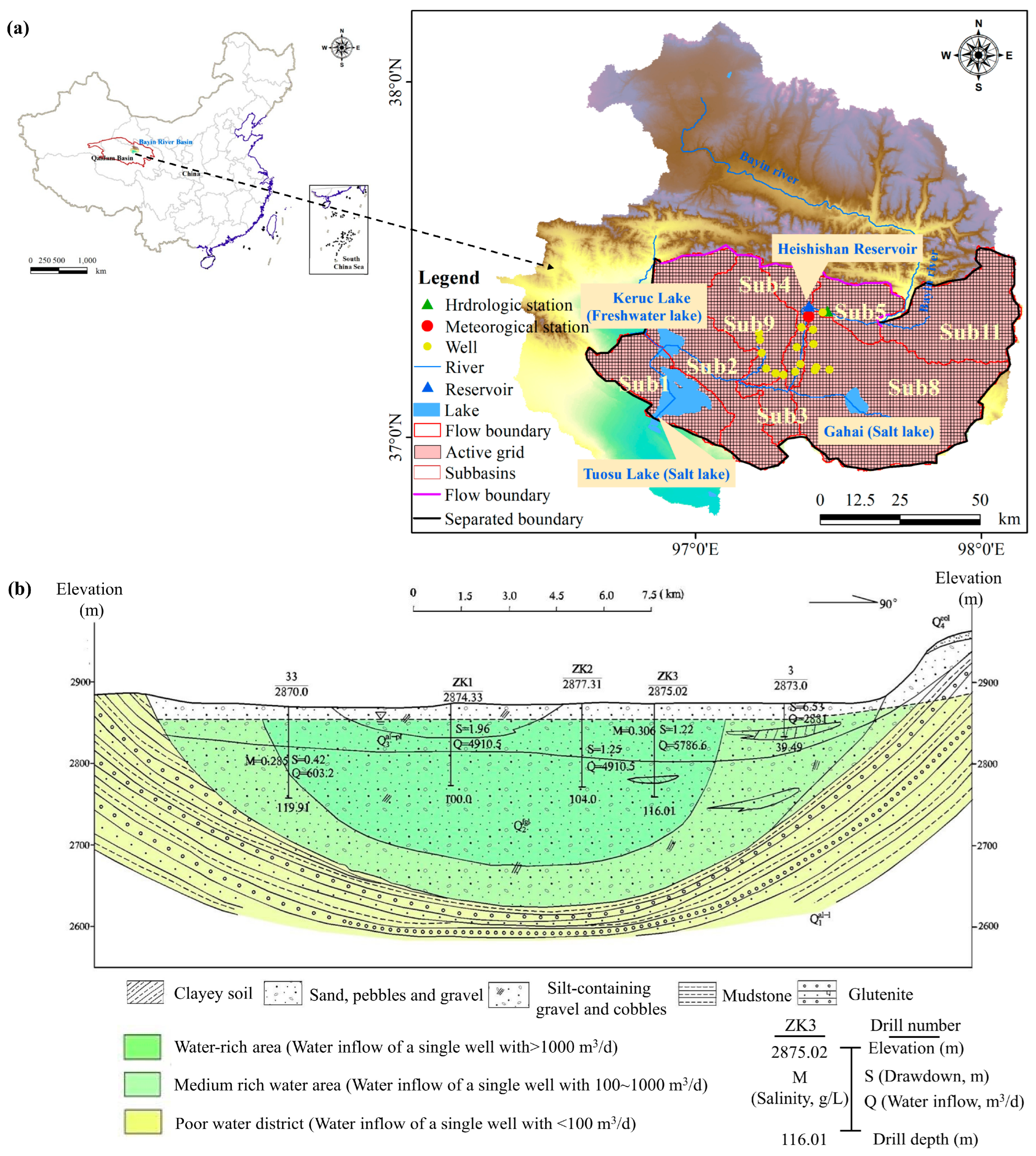
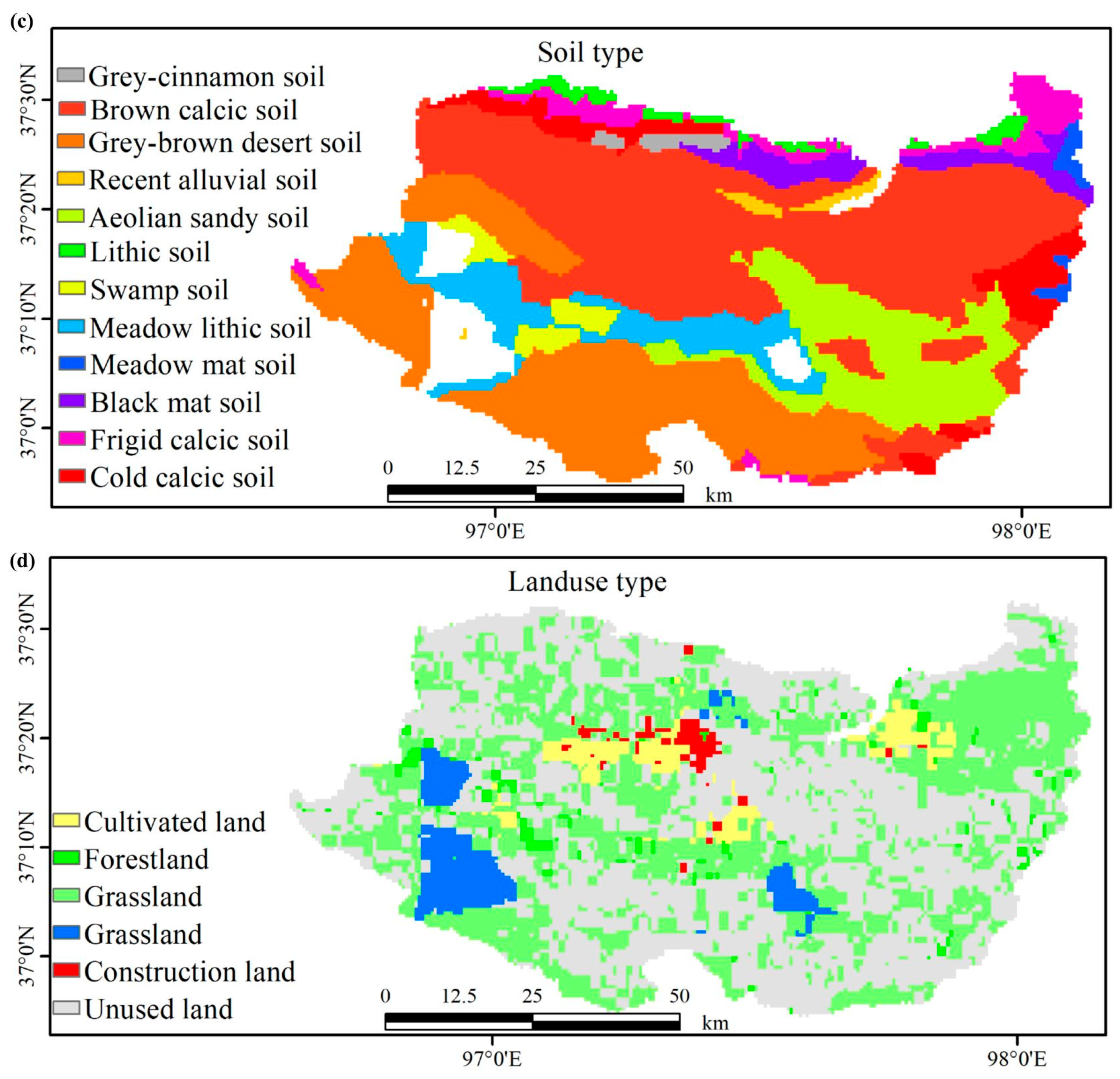
The Bayin River is a vital inland river located in the Qaidam Basin of Qinghai Province, China (Figure 1). Its headwaters lie in the Zongwulong Mountain, which is situated in the southern foothills of the Qilian Mountains. The river then traverses Delingha City, with its waters eventually emptying into Keruc Lake in the southwest and Gahai Lake in the southeast, respectively [26]. The Bayin River primarily obtains its water supply from two sources, including glacial meltwater originating in the Qilian Mountains and seasonal rainfall, covering an area of 17,608 km2, and performing an indispensable role within the regional hydrological system. In our study, the area of the alluvial–proluvial and alluvial–lacustrine plain in front of the mountain is 6447 km2, and it was chosen as the research region, characterized by loose Quaternary sediments (Figure 1a). The topography of research area changes gradually, spanning from the upstream piedmont to the downstream alluvial plain, and its elevation falls within the range of 2800~3200 m. The climate is typically featured with a plateau-type continental pattern. Annual rainfall is 120~192 mm, and evaporation is 1400~1900 mm. The natural vegetation is dominated by grasslands, shrubs, and some desert plants, adapting to the harsh dry conditions. Soil types are dominated by alpine meadow soil, cold desert soil, desert soil, saline soil, alluvial soil and meadow soil (Figure 1c). The soil in the watershed is generally sandy, with good overall permeability.
The focus of this study was placed on the aquifer composed of Quaternary unconsolidated sediments. The geological units mainly include the Holocene Epoch, Upper Pleistocene Epoch, and the middle-lower Pleistocene Epoch, and these units are dominated by alluvial and lacustrine facies [27,28]. The porous groundwater aquifer system of the study area is composed of these Quaternary sedimentary deposits. The types of aquifers mainly include loose rock pore aquifers and bedrock fissure aquifers. The aquifer layer in the alluvial plain region, which has a thickness of more than 200 m, is primarily constituted by sand and gravel cobbles and muddy sand cobbles. The lithology is uncomplicated, and it possesses both favorable recharge conditions and robust water yield properties. The recharge of groundwater and surface water is mainly based on the melting of ice and snow in high mountains, supplemented by atmospheric precipitation and lateral runoff recharge. The depth of the groundwater level ranges from 2.0 to 79.0 m. The permeability coefficient is generally 80–150 m/d, and the pumping capacity of individual well exceeds 5000 m3/d. And the aquifer layer in the Delingha Basin, with a thickness of 5.0–31.5 m, is mainly constituted by alluvial–proluvial sand and gravel, and alluvial–lacustrine fine silt (Figure 1d). The depth of the groundwater level varies between 3.0 m and 24.7 m. The permeability coefficient is generally 1.18–4.68 m/d, and the single-well pumping yield is between 100–1000 m3/d.

3. Methodology

3.1. Data Collection and Sources

To establish the SWAT model, the required meteorological data comprise daily precipitation, temperature, relative humidity, wind speed, and solar radiation, all of which are obtained from the National Meteorological Center (http://data.cma.cn/en, accessed on 16 April 2023). Digital Elevation Model (DEM) and land use are acquired from the website (https://www.resdc.cn/, accessed on 16 April 2023). The resolutions of DEM and land use are 30 m and 1000 m in the spatial dimension, respectively. Soil types are determined based on a 1:1 million soil map released by National Soil Survey Office (Figure 1c), and the corresponding hydrological characteristics of each soil type are obtained from the China Soil Database (http://vdb3.soil.csdb.cn/, accessed on 15 May 2024). The soil particle size data obtained from the China Soil Database requires appropriate conversion (see Table S1). In addition, the monthly river flow data employed for validating the simulated flow were acquired from the local hydrological station.
For the construction of the MODFLOW model, the digital elevation data of the land surface was used to determine the aquifer’s top elevation. The aquifer’s bottom elevation was established by the difference between the surface elevation and the bedrock’s burial depth, where the burial depth of bedrock is sourced from the website (http://globalchange.bnu.edu.cn/research/cdtb.jsp, accessed on 25 April 2024), with a resolution of 100 m. Hydraulic conductivity and specific yield, as key parameters for defining aquifer hydraulic characteristics, were retrieved from the hydrogeological survey report of Qinghai [29]. The groundwater level data were retrieved from official monitoring of 16 wells during the periods of 2018~2023.

3.2. SWAT Model

SWAT, which was developed by the United States Department of Agriculture–Agriculture Research Service, functions as a continuous, semi-distributed, process-based hydrological model [30]. The SWAT model possesses a solid physical foundation, making it fit for simulating long-period hydrological system dynamics in the river basin with highly heterogeneous underlying surfaces, and applicable to modeling in data-scarce regions [31,32]. SWAT is applicable for simulating groundwater recharge, which is a vital input for MODFLOW. The calculation of groundwater recharge in the SWAT model can be expressed as:
w r c h r g , i = ( 1 e x p [ 1 δ g w ] ) · w s e e p + e x p [ 1 δ g w ] · w r c h r g , i 1
where wrchrg,i is the recharge amount (mm), δgw is the drainage duration (days), wseep is the overall water volume that flows out from the base of the soil profile on day i (mm), and wrchrg,i−1 is the recharge amount penetrating into the aquifers on dayi−1 (mm).
The required input data for the SWAT model include DEM, land use, soil physicochemical properties, weather data (Pre, TMP, SR, WD, and RHU), and reservoir information. In the SWAT model, computations are based on hydrological response units (HRU) [33]. Within a delineated basin, the HRU functions as the minimum structural unit, made up of a unique combination of land use, soil type, and slope. Determining the ideal number of HRUs is pivotal for optimizing the model size without losing critical information [34]. The SWAT model offers multiple options for HRU definition, and in this study, we adopted the dominant HRU approach with zero threshold values. Given the high level of detail in the regional data, applying the commonly used 5–10% thresholds would lead to the loss of substantial information.
A digital elevation model (DEM) with 30 m resolution was used to delineate the watersheds, which were further divided into eight sub-basins. Subsequently, by integrating slope classes, soil data, and LULC (Land Use and Land Cover) data, 112 HRUs were generated via the dominant HRU option with a zero-threshold value. In the region, there is one weather station (Figure 1a). Daily data including WD, PRE, RHU, TMP, and SR were inputted and written. The simulation was conducted for 24 years (2000–2023). The first two simulation years were designated as a spin-up period, from which the model yielded no corresponding data outputs.

3.3. MODFLOW Model

This study focused on characterizing the discharge flux of groundwater and its spatial–temporal variation in the Bayin River Basin, and, accordingly, a three-dimensional model of groundwater flow was established, applying the well-known MODFLOW-2005 [35], due to its extensive recognition and capability to tackle hydrological issues. The Newton–Raphson formulation was selected in this study [36]. The three-dimensional flow of constant-density groundwater through porous media is described in MODFLOW using the following partial-differential equation:
x ( K x x H x ) + y ( K y y H y ) + z ( K z z H z ) + W = S s H t
where, Kxx, Kyy, and Kzz denote the values hydraulic conductivity along the x, y, and z coordinate axes (LT−1); H refers to the piezometric head (L); W represents a volumetric flux per unit volume that accounts for water sources and/or sinks (T−1); SS denotes the storage capacity of the porous media, defined as the water volume an aquifer discharges or retains per unit aquifer surface area and per unit change in hydraulic head (L−1); and t represents time (T).
MODFLOW uses Darcy’s law to compute the cell-to-cell flow flux corresponding to surface water and the aquifer, with the premise that surface water–aquifer flow is uniform. This surface water–groundwater interaction flux is calculated in the following way:
Q = K v × L × W M ( h H )
where Q represents the flux exchange between the surface water and the aquifer (L3T−1); Kv stands for the vertical hydraulic conductance of riverbed or streambed sediment matrix (LT−1); L represents the length of river or stream reach through a cell (L); W is the width of the river or stream in the cell (L), M is the distance between cells of river and aquifer (L); h is the water level of the river or stream (L); and H denotes the piezometric head in the model cell beneath the river or stream, computed via the MODFLOW model (L).
The watershed boundaries delineated via the SWAT model were adopted as the impermeable boundaries for MODFLOW. The spatial coverage of the groundwater flow model encompasses the eight sub-basins, and the model area was discretized with a horizontal resolution of 1000 m × 1000 m. This discretization resulted in 6734 active cells within the model area, while the stream network delineated by the SWAT model was incorporated into MODFLOW to construct the stream cells (see Figure 1a). The model’s top elevation was derived from a 30 m resolution DEM. The bottom boundary was determined based on the difference between the surface elevation and the bedrock burial depth. Meanwhile, interpolation was performed on initial head and hydraulic conductivity parameters, with input data sourced from field-monitored head records and in-situ pumping tests (Figures S1–S3). The aquifer thickness and hydraulic conductivities were listed in Table 1. This study conceptualizes the shallow aquifer as heterogeneous and isotropic and defines groundwater movement as two-dimensional unsteady flow.

3.4. Coupled SWAT–MODFLOW Model

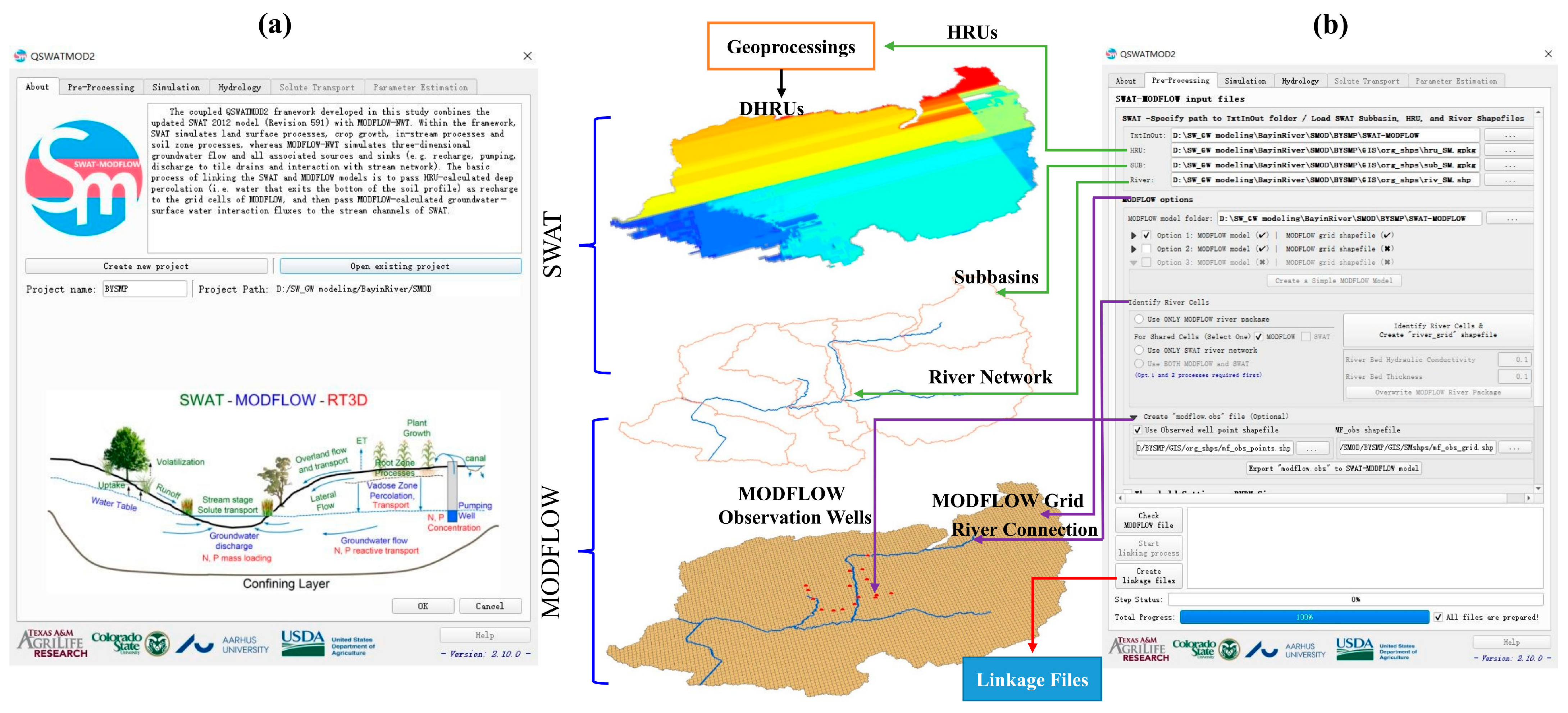
QSWATMOD, a GUI plugin built on QGIS that links the SWAT model with the MODFLOW model in a GIS context, was employed in this study. The two models are enabled to share their computational results on a daily basis through the coupling script, eliminating the necessity of rewriting and loading model inputs. The two interfaces facilitate either the creation of a basic MODFLOW model or the importation of a pre-built groundwater flow model for subsequent coupling with the SWAT model. Notably, in the integrated model, the groundwater function of SWAT is substituted by the MODFLOW code. The coupled modeling framework is established on geographically referenced disaggregated HRUs (DHRUs) and the MODFLOW grid (Figure 2 and Figure S4).
The coupling procedure requires importing all necessary inputs including subbasin, HRUs, and river network shapefiles and ‘TxtInout’ from the SWAT model, as well as grid shapefile and native text files of the MODFLOW model (‘bas’, ‘dis’, ‘nam’, ‘nwt’, ‘oc’, ‘rch’, ‘riv’, and ‘upw’ file) from the MODFLOW-NWT simulation. The stream network can originate from either the MODFLOW or SWAT model. Given that the riverbed conductance has undergone modifications, MODFLOW stream cells were selected for direct application. Subsequently, the HRUs disaggregated to DHRUs and connected with the MODFLOW grid cells. Upon the integration of the models, all needed linking files were produced.
Over the course of the simulation, daily computation exchanges were conducted. Deep seepage calculated at the HRU scale is first routed to DHRUs and then spatially mapped onto MODFLOW grid cells to generate stress values for the recharge package. The water flux of aquifer–stream system, calculated through the river package of the MODFLOW model, was totaled for each sub-basin. Ultimately, SWAT’s routing algorithm was executed to route the calculated runoff and groundwater discharge amount. Detailed information regarding the construction of the coupled model is available in Bailey et al. (2016) [20].

3.5. Model Sensitivity, Calibration, and Validation Method

On the basis of the previous studies [37,38], a total of 22 parameters were selected for the automatic calibration of the SWAT model, utilizing the sequential uncertainty fitting (SUFI-2) algorithm—a semi-automated inverse modeling technique employed for calibration, along with sensitivity and uncertainty analyses (Table S2). Coefficient of determination (R2) (Equation (4)) was applied as the objective function, although Nash–Sutcliffe efficiency (NS) (Equation (5)) was calculated concerning the simulations derived from applying (R2) as the objective function. In addition, root mean square error (RMSE) and percent bias (PBIAS) were also considered important indicators to evaluate the accuracy of simulation results.
R 2 = [ i = 1 n ( Q m , i Q m , a v g ) ( Q s , i Q s , a v g ) ] 2 i = 1 n ( Q m , i Q m , a v g ) 2 i = 1 n ( Q s , i Q s , a v g ) 2
R M S E = i = 1 n ( Q s , i Q m , i ) 2 n
P B I A S = [ i = 1 n ( Q m , i Q s , i ) i = 1 n Q m , i ] × 100 %
N S E = 1 i = 1 n ( Q m , i Q s , i ) 2 i = 1 n ( Q m , i Q m , a v g ) 2
where Qs,i denotes the simulated flow rate, m3/s; Qm,i denotes the measured flow rate, m3/s; Qm,avg represents the annual average value of measured flow, m3/s; Qs,avg represents the annual average value of simulated flow, m3/s; n represents the length of the measured time series. When the R2 and NSE values are closer to 1, the simulation results are better.
The calibration of SWAT–MODFLOW aims to acquire reasonable results that align with observed groundwater level data. This is achieved by adjusting hydraulic parameters, which in turn enables scientific characterization of the hydrogeological conditions of the aquifer system [39]. In this study, calibration was performed using PEST, a nonlinear inverse modeling package [40]. After specifying initial values and reasonable ranges for hydraulic parameters (i.e., hydraulic conductivity, specific yield) within the PEST package, we ran the PEST to derive the calibrated hydraulic parameter values for our numerical model. Moreover, the model was calibrated and validated using groundwater level data from sixteen wells over the 2018–2023 period.

4. Results

4.1. Model Calibration and Validation Performance

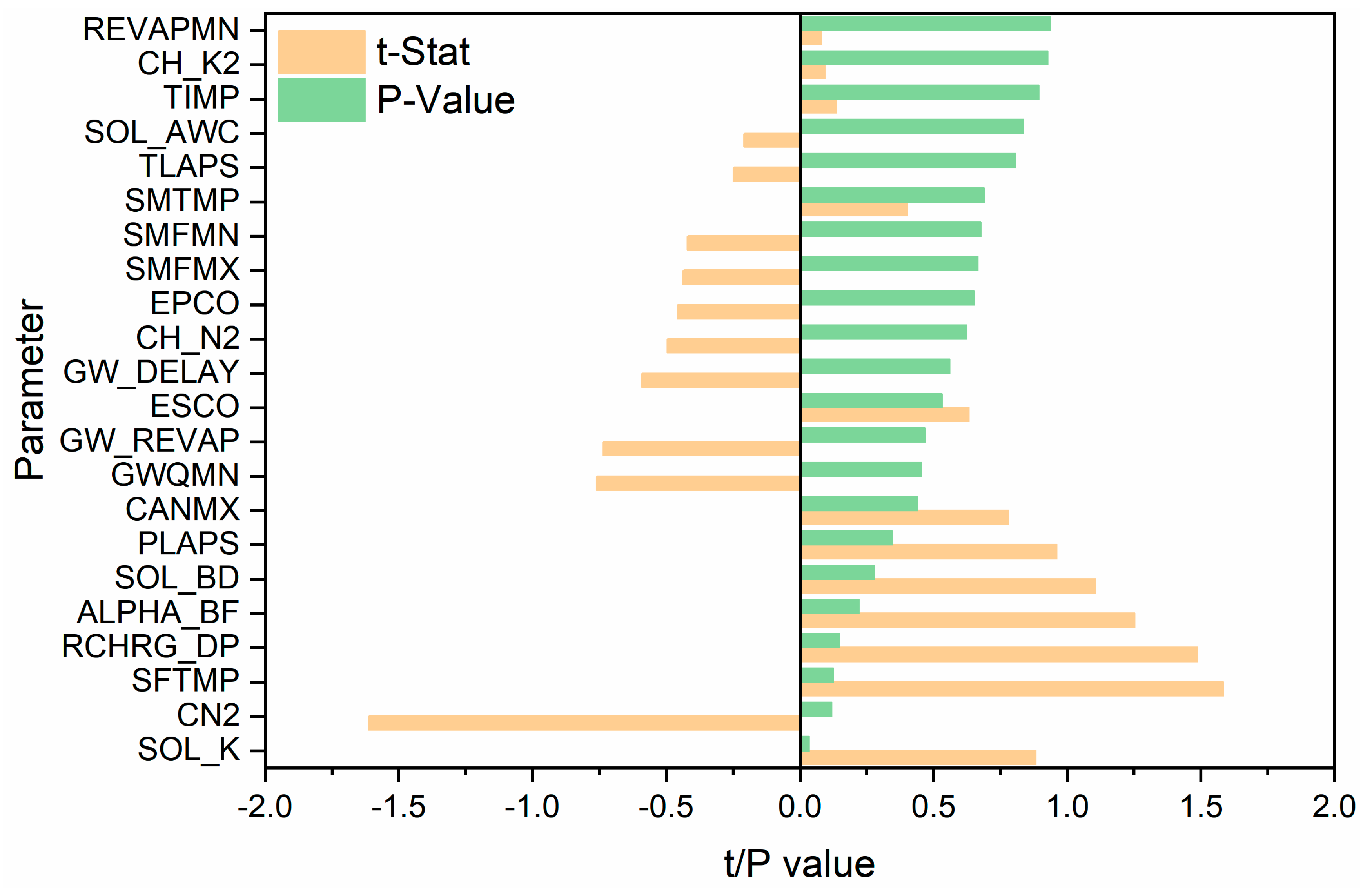
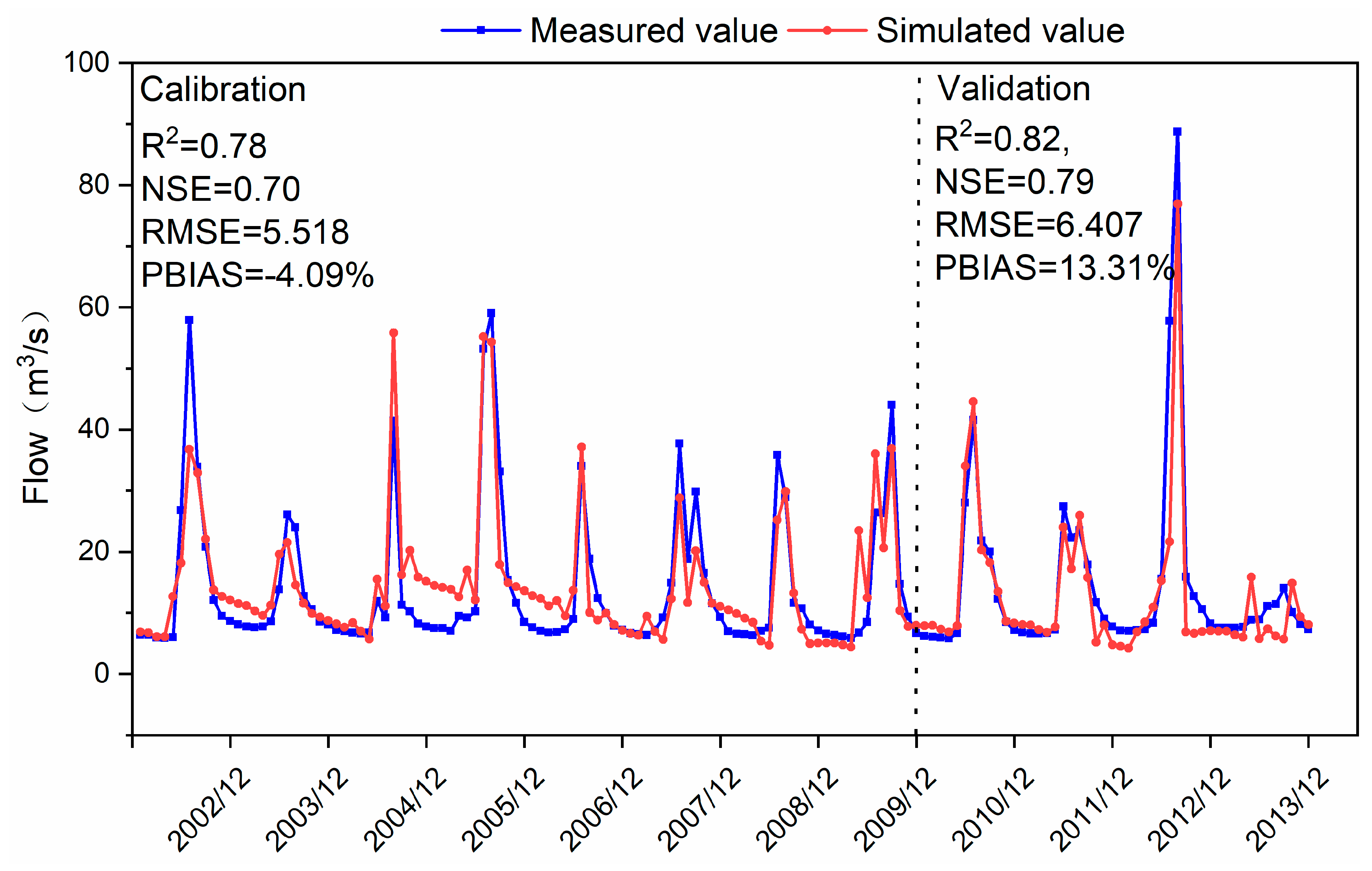
The 22 parameters selected for calibration and validation, including their final ranges and reasonable values, are provided in Table S2. It is evident that the primary sensitive parameters influencing surface runoff primarily consist of the saturated hydraulic conductivity parameter (SOL_K. sol) and the SCS runoff curve (CN2. mgt) (Figure 3), implying that physical attributes like precipitation and soil permeability play a significant role in shaping the simulation outcomes. A comparative analysis of modeled and observed monthly streamflow at a single gauge was performed for model calibration and validation, as illustrated in Figure 4. When the R2 and NSE values exceeded 0.5, the model simulation results were judged to be satisfactory for both the calibration and validation phases. The result suggested that the calibrated and validated simulation results were reliable in capturing streamflow dynamics within the study region.
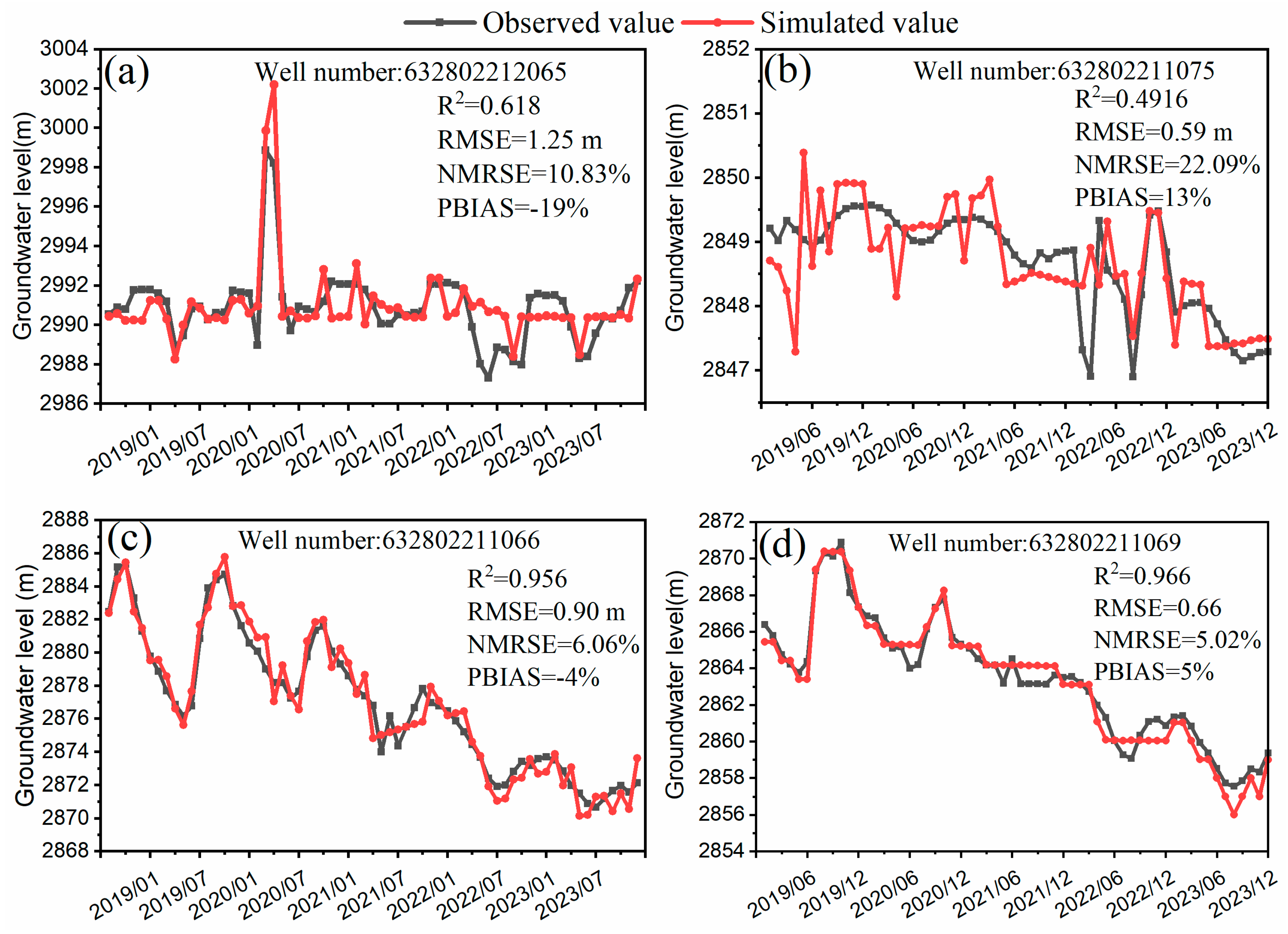
Upon completion of model coupling, specific storage and specific yield underwent calibration. And the finalized parameter values were 1 × 10⁻⁴ m−1 (specific storage) and 0.18 (specific yield). In comparison with the calibrated simulation results of SWAT, the SWAT–MODFLOW model gained more notable enhancements (Table S3). A comparative analysis of SWAT and SWAT–MODFLOW simulation results is not the focus of this section, as such a comparison was already made in earlier sections. Nevertheless, the notable enhancements in model performance reaffirm the preference for adopting SWAT–MODFLOW in groundwater flow-dominated regions. The monitoring of groundwater head was conducted from August 2018 to December 2023, and four monitoring wells with relatively continuous measurement data over a certain period were selected to validate the simulation of the SWAT–MODFLOW model. The results showed that the SWAT–MODFLOW model effectively simulated the groundwater levels in the study area (Figure 5). R2 was between 0.419~0.966 for validation, and RMSE values were between 0.59 m and 1.25 m for validation. On the whole, the simulated values show good consistency with the monitored values. Under-estimation (simulated values < observed values) or over-estimation (simulated values > observed values) in hydrological modeling exhibits distinct seasonal characteristics, closely linked to seasonal variations in hydrological processes (e.g., snowmelt, precipitation, groundwater–surface water interaction) and mismatches between model structure/parameters and actual basin conditions.

4.2. Temporal and Spatial Dynamics of Groundwater Level

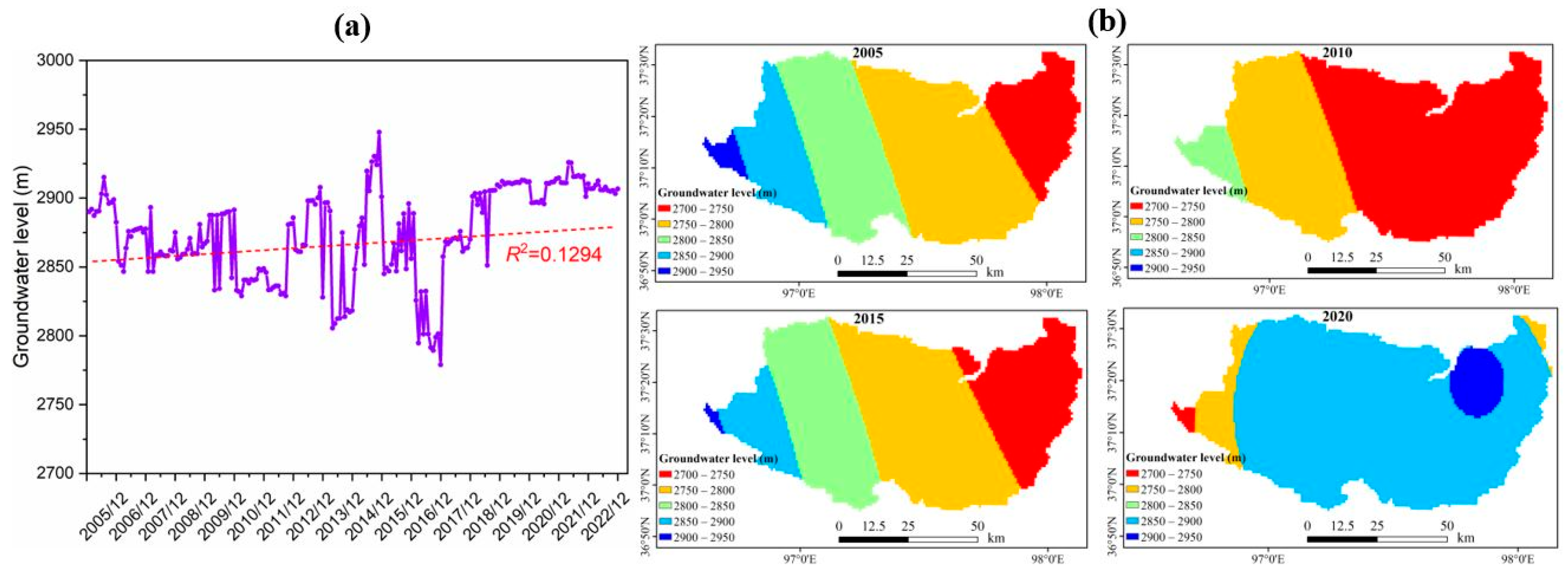
The spatial distributions of simulated groundwater levels from 2000 to 2023 are displayed in Figure 6a. Under the influence of global warming, the temperature has been rising at a rate of 0.45 °C per decade, which in turn has increased the volume of snow and ice meltwater. Overall, the runoff of the Bayin River has exhibited a slight upward trend. This warming and wetting climatic pattern directly causes a notable rise in groundwater levels in the middle–lower reaches of the basin during wet years [41], with some areas experiencing an increase of more than 10 m. Long-term monitoring results suggested that the groundwater level showed a decreasing trend, with values rising from 2895.35 m in 2005 to 2906.75 m in 2022. Especially in the past few years, the groundwater level has been in a period of exceeding the average level ever since 2018 (Figure 6b).
The middle and upper reaches of the Bayin River are primarily composed of sand, gravel, and cobbles. The aquifer here features a thickness ranging from 50 to 100 m, with excellent water conductivity. The groundwater level in this section is relatively low, and the hydraulic gradient is approximately 4.57‰. In the downstream areas, however, the water-blocking effect of the Denan hills and the fine soil belt hinders groundwater runoff, leading to the formation of backwater zones in locations such as Gahai Town and Keluke Town. Here, the groundwater level is relatively high (less than 5 m), and the hydraulic gradient drops to 2.33‰—a condition that makes surface overflow prone during the wet season. Overall, the spatial distribution of groundwater levels in 2005, 2010, and 2015 showed relatively consistent patterns, marked by a west-to-east decreasing gradient. By 2020, though, this spatial pattern has shifted, with an east-to-west decreasing gradient. This phenomenon may stem from the combined impacts of climate and human activities, including irrigation replenishment, reservoir operations, and river channel hardening.

4.3. Exchange Rate Between Groundwater and Surface Water and Its Intra-Year Temporal Variation

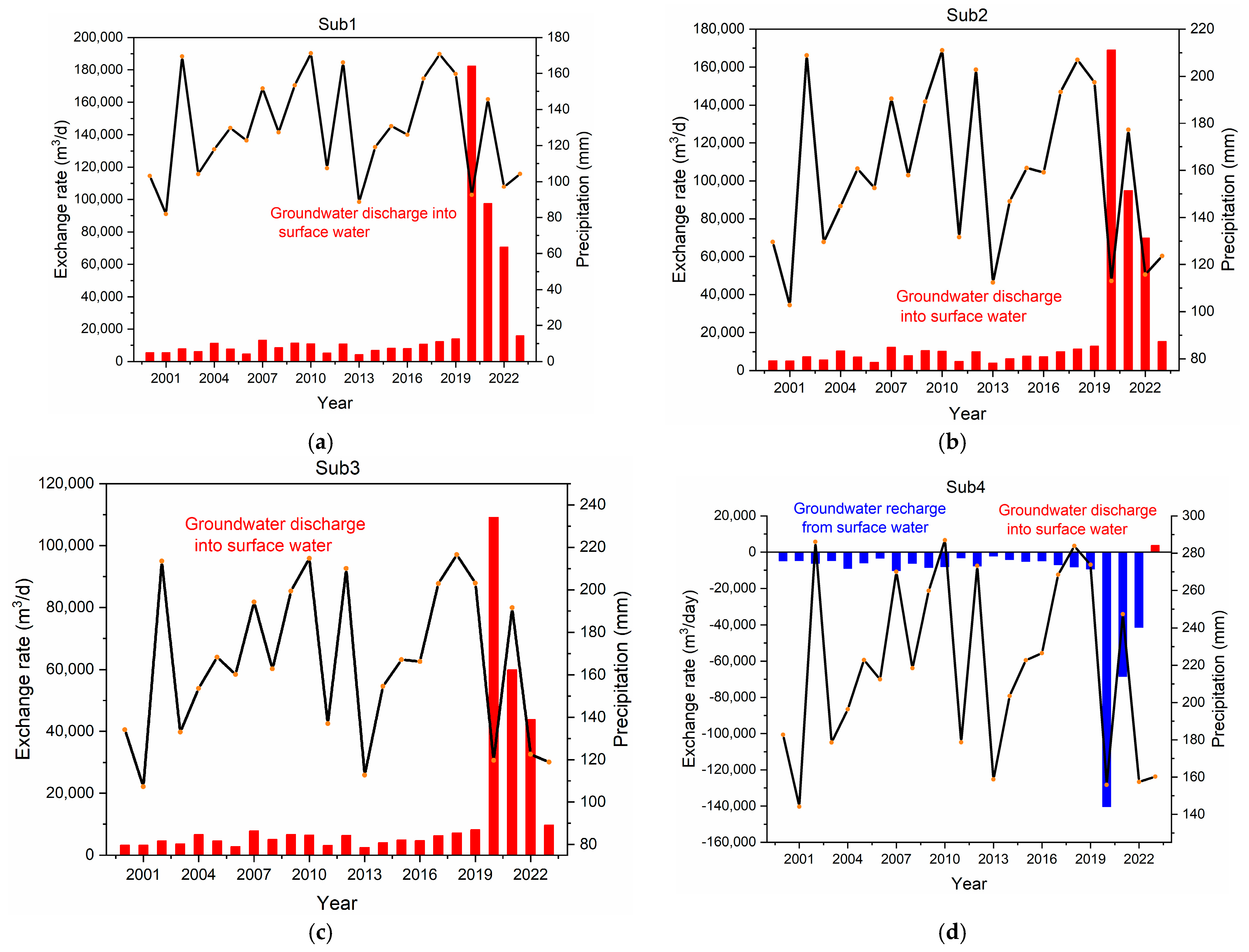
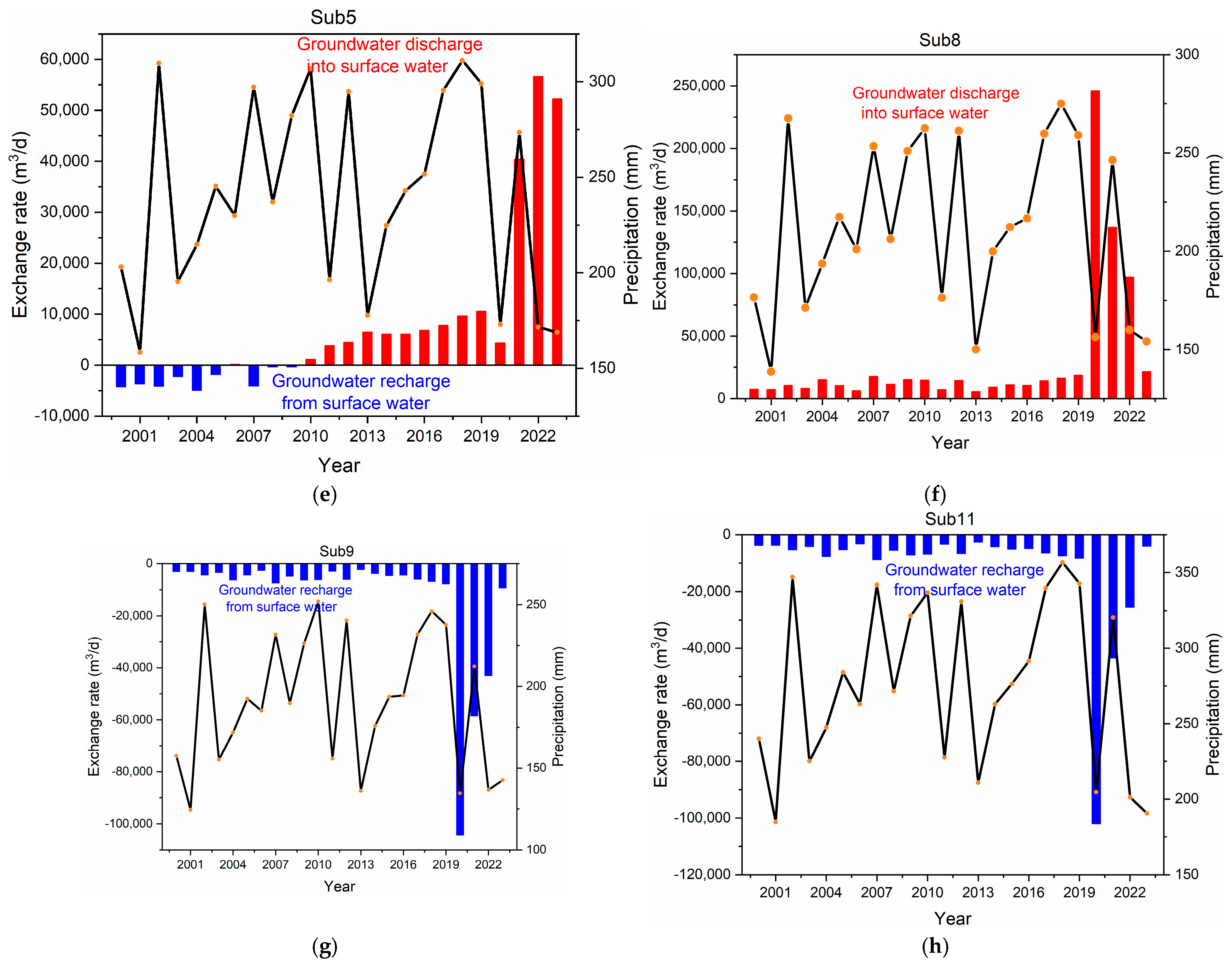
The interaction between surface water and groundwater constitutes a vital component of a watershed’s water balance, and gaining an understanding of its spatiotemporal distribution is essential for the efficient management of water resources [42,43]. Figure 7 depicts the spatiotemporal distribution of surface water–groundwater exchange in various sub-basins. As shown in Figure 6, during the 2000–2023 period, the simulated water exchange between groundwater and surface water exhibited a distinct pattern: surface water recharge in the upstream reach, bidirectional fluctuation in the middle reaches, and groundwater-dominated recharge in the downstream area. During the 2000–2009 period, groundwater in sub5 received recharge from surface water, with the exchange rate ranging from −4987.75 to −374.82 m3/d. Conversely, during 2010–2023, groundwater in sub5 discharged into surface water, with the exchange rate ranging from 1136.75 to 56,646.56 m3/d. In the downstream alluvial–lacustrine area (encompassing sub1, sub2, sub3, and sub8), river channels are mostly dry seasonally or maintain extremely low water levels. The replenishment of groundwater by surface water is inefficient, whereas groundwater at higher levels supplies surface water through evaporation, lateral discharge, and spring overflow. Take the vicinity of Gahai Wetland as an instance: groundwater depth here is under 2 m, and surface water relies primarily on groundwater recharge year-round, with an exchange rate remaining stable at 0.05–0.15 m3/(d·m). This process acts as the core water source for the Keluke Lake–Tuosu Lake ecosystem. Since 2018, the groundwater level rise has led to a roughly 10% increase in the exchange rate and a 5% expansion of the wetland area.
Moreover, there is a seasonal pattern in the surface water–groundwater exchange rate (Table 2). Surface water primarily replenishes groundwater in spring (March to May) and summer (June to August), with the exchange rate rising steadily. Meanwhile, in autumn (September to November) and winter (December to February), the exchange direction shifts—groundwater mainly recharges surface water, and the exchange rate decreases gradually. The seasonal variability of the exchange rate is driven by the combined impacts of glacial meltwater, precipitation, and irrigation [44,45].

5. Discussion

5.1. Factors Affecting the Interaction Between Groundwater and Surface Water

The surface water–groundwater interaction processes in the Bayin River Basin are primarily influenced by both natural geographical conditions and human activities [46]. Affected by climate change, glacier melting and permafrost degradation in the upstream areas have led to an increase of approximately 15% in upstream runoff [47,48], directly driving the proportion of surface water recharging groundwater to reach 65.33%. The increasing temperature will also increase evapotranspiration, which will increase the mineralization of groundwater, thereby affecting the recharge of groundwater. In addition, extreme precipitation also plays an important role in the interaction between surface water and groundwater in the middle reaches of the river basin. During the flood season (July to August), the rate of surface water recharging to groundwater reaches 1.5–2.0 m3/s, accounting for over 60% of the annual recharge.
Apart from natural factors, human factors are also the key driving force behind the changes in the interaction relationship [45,48], such as reservoir regulation, groundwater extraction, and agricultural irrigation. The interaction between groundwater and surface water is primarily influenced by reservoir regulation in the middle reaches of the river basin. During the irrigation period (April to September), the discharge flow from the reservoir increases, raising the proportion of surface water recharging groundwater to 70%. During the non-irrigation period, the reservoir’s water storage leads to an increase in the upstream groundwater level, forming a reverse recharge of groundwater to surface water. And, due to the impact of agricultural irrigation, groundwater is being over-extracted in the downstream region [46,49]. The annual average decline in groundwater is 0.3–0.5 m, disrupting the original groundwater recharge–surface water balance and reducing the downstream groundwater recharge by approximately 40%. Overall, the interaction is primarily influenced by climatic factors in the upstream region and affected by human activities in the middle and downstream regions.

5.2. Uncertainties and Limitations

Given the complexity of hydrological processes, it is unavoidable that there are substantial uncertainties in the simulation of groundwater–surface water interaction [50,51]. This study involves multiple sources of uncertainty, including data-related factors, the structural uncertainty of the model, the setting of initial conditions, and parameter calibration. The coupled model demands high-precision data for both surface water (e.g., precipitation, runoff, land use, irrigation, and reservoir data) and groundwater (e.g., aquifer parameters, groundwater depth, and pumping data). In data-scarce regions—such as inland basins in arid areas—the shortage of long-term groundwater dynamic observation data and detailed aquifer structure data may amplify errors in model inputs and lower the reliability of simulation results [52]. Due to the complexity of natural systems, the uncertainty of model structure arises from the simplification and assumptions of the model [53], which will result in inaccurate characterization of hydrological processes in high-altitude and cold regions. Uncertainty from initial conditions can generally be eliminated once the simulation runs for a certain time, a stage referred to as the model warm-up period. Presently, there is a shortage of reliable algorithms for estimating the warm-up period length, so the present study established the warm-up period based on subjective experience. Moreover, the calibration of model parameters—such as the selection of sensitive parameters, the adoption of calibration methods, and the setting of objective functions—directly affects simulation outcomes and results in different errors and uncertainties [54]. SWAT inherently contains dozens of sensitive parameters (such as soil hydraulic parameters), and MODFLOW similarly possesses several key parameters (e.g., permeability coefficient, storage rate, and boundary conditions). Conventional calibration approaches, like manual parameter tuning and single-objective function optimization, have difficulty reaching global optimality and tend to fall into local optimal solutions [55,56]. The uncertainty of model parameters is essentially a comprehensive reflection of the heterogeneity of groundwater systems, data acquisition errors, and limitations of parameter estimation methods, and is the primary source of model uncertainty [57]. Due to the lack of hydrogeological boreholes, the lateral recharge along the piedmont boundary was assumed on the basis of the hydraulic gradient between the boreholes in the front of the alluvial fans. In addition, there is a certain deviation between the predicted results of MODFLOW on target variables (such as groundwater depth, spring flow rate, etc.) and the actual results. It is a concentrated manifestation of multiple types of uncertainties such as parameter uncertainty, model structure uncertainty, boundary condition and initial condition uncertainty in the prediction process, which directly affects the formulation of water resources management decisions. Overall, in comparison to the fully coupled model such as the HydroGeoSphere model, the temporal resolution mismatches and the recharge routing is simplified in the integrated SWAT–MODFLOW model. And it is unable to naturally model the bidirectional and instantaneous SW–GW interaction, especially in areas with complex river aquifer relationships [58]. And it also lacks a mechanism to connect groundwater, soil water, and surface water into a complete system, especially in unsaturated zones and strong interaction areas.
The core of this modeling study was to quantify the water exchange between groundwater and surface water, and on this basis, it concluded the temporal characteristics of the water exchange process. However, on account of insufficient data availability, in-depth analysis and comprehensive discussion pertaining to the spatial variability characteristics of the groundwater–surface water exchange have been constrained. In subsequent work, hydrogeological survey and more observational wells will be conducted to improve aquifer characterization in this region. Although there are these limitations, this research can still offer a basic framework for evaluating the interaction between groundwater and surface water in alpine inland river basins.

6. Summary and Conclusions

The interactions between groundwater and surface water in an alpine inland river basin were examined using the newly developed SWAT–MODFLOW model. Prior to the coupling of SWAT and MODFLOW, the foundational steps including basic setup, parameter optimization, and validation of the SWAT and MODFLOW models were completed. Calibration of the coupled model was conducted manually by comparing the observed hydraulic head and river flow, and the statistical parameters including R2, NSE, RMSE, and PBIAS suggested that SWAT–MODFLOW exhibits satisfactory reliability for evaluating groundwater–surface water exchange in such alpine inland river basins. The results revealed that the groundwater level has entered a period of higher-than-average levels since 2018, and the upward trend has continued in recent years. Additionally, the spatial distribution of groundwater levels showed relatively consistent patterns in 2005, 2010, and 2015, characterized by lower levels in the east and higher levels in the west. By 2020, however, this spatial pattern had shifted, with an east-to-west decreasing gradient.
Meanwhile, our results reveal a pattern of upstream surface water recharge, bidirectional fluctuation in the middle reaches, and downstream groundwater-dominated recharge during the periods of 2000~2023. Additionally, the interchange relationship between surface water and groundwater exhibits seasonal variability—surface water primarily replenishes groundwater in spring and summer, while the reverse occurs in autumn and winter, with groundwater becoming the primary recharge source for surface water.
In our future modeling research on groundwater–surface water interactions, we will incorporate the impacts of climatic factors and human activities, while also conducting quantitative analysis of their respective contributions to surface water–groundwater interchange. Furthermore, given that climate change may alter these water interaction processes, we plan to apply future climate change projections from CMIP6 in our upcoming modeling work. This will enable us to explore the long-duration variability of SW–GW interaction in the alpine inland river basin.

Supplementary Materials

The following supporting information can be downloaded at: https://www.mdpi.com/article/10.3390/w18010085/s1, Figure S1: The initial head in the modeling area of Bayin River Basin; Figure S2: The hydraulic conductivity in the modeling area of Bayin River Basin; Figure S3: The specific yield in the modeling area of Bayin River Basin; Figure S4: Flowchart of the modelling of the surface–groundwater interactions in SWAT-MODFLOW-NW; Table S1: Soil particle size of various soil types in Bayin River Basin; Table S2: SWAT-model parameters considered for the calibration process; Table S3: Statistical model performance indicators for SWAT and SWAT-MODFLOW models in the calibration and validation periods.

Author Contributions

Z.Z. and X.C. collected and analyzed the data and drafted the paper; Y.Z. and W.L. supervised this study; G.Q. and S.S. edited and revised the paper and the figures. All authors have read and agreed to the published version of the manuscript.

Funding

This work was funded by the Basic Research Plan Project of Qinghai Province (grant no. 2024-KJ-02), the Cooperation project between the Ministry of Natural Resources and Qinghai Province (grant no. 2024ZRBSHZ020), the Xinjiang Uygur Autonomous Region Water Conservancy Special Development Fund Project (2022.B-004), and the key project supported by the National Natural Science Foundation of China (grant no. U21A20155).

Data Availability Statement

The original contributions presented in this study are included in the article. Further inquiries can be directed to the corresponding author.

Conflicts of Interest

The authors declare that they have no conflicts of interest.

References

  1. Panagopoulos, A. Techno-economic assessment of zero liquid discharge (ZLD) systems for sustainable treatment, minimization and valorization of seawater brine. J. Environ. Manag. 2022, 306, 114488. [Google Scholar] [CrossRef] [PubMed]
  2. Pont’er, S.; Rodushkin, I.; Engström, E.; Rodushkina, K.; Paulukat, C.; Peinerud, E.; Widerlund, A. Early diagenesis of anthropogenic uranium in lakes receiving deep groundwater from the Kiruna mine, northern Sweden. Sci. Total Environ. 2021, 793, 148441. [Google Scholar] [CrossRef] [PubMed]
  3. Stoliker, D.L.; Repert, D.A.; Smith, R.L.; Song, B.; Leblanc, D.R.; Mccobb, T.D.; Conaway, C.H.; Hyun, S.P.; Koh, D.C.; Moon, H.S. Hydrologic controls on nitrogen cycling processes and functional gene abundance in sediments of a groundwater flow-through lake. Environ. Sci. Technol. 2016, 50, 3649–3657. [Google Scholar] [CrossRef] [PubMed]
  4. Brunner, P.; Therrien, R.; Renard, P.; Simmons, C.T. Advances in understanding river-groundwater interactions. Rev. Geophys. 2017, 55, 818–854. [Google Scholar] [CrossRef]
  5. Guevara-Ochoa, C.; Medina Sierra, A.; Vives, L.; E Zimmermann, E.; Bailey, R. Spatio-temporal patterns of the interaction between groundwater and surface water in plains. Hydrol. Process. 2020, 34, 1371–1392. [Google Scholar] [CrossRef]
  6. Duque, C.; Russoniello, C.J.; Rosenberry, D.O. History and evolution of seepage meters for quantifying flow between groundwater and surface water: Part 2—Marine settings and submarine groundwater discharge. Earth-Sci. Rev. 2020, 204, 103168. [Google Scholar] [CrossRef]
  7. Abraha, T.; Tibebu, A.; Ephrem, G. Rapid urbanization and the growing water risk challenges in Ethiopia: The need for water sensitive thinking. Front. Water 2022, 4, 890229. [Google Scholar] [CrossRef]
  8. Langston, G.; Hayashi, M.; Roy, J.W. Quantifying groundwater-surface water interactions in a proglacial moraine using heat and solute tracers. Water Resour. Res. 2013, 49, 5411–5426. [Google Scholar] [CrossRef]
  9. Li, Y.L.; Zhang, Q.; Liu, X.G.; Yao, J. Water balance and flashiness for a large floodplain system: A case study of Poyang Lake. China. Sci. Total Environ. 2020, 710, 135499. [Google Scholar] [CrossRef]
  10. Jafari, T.; Kiem, A.S.; Javadi, S.; Nakamura, T.; Nishida, K. Using insights from water isotopes to improve simulation of surface water-groundwater interactions. Sci. Total Environ. 2021, 798, 149253. [Google Scholar] [CrossRef]
  11. Yang, N.; Zhou, P.P.; Wang, G.C.; Zhang, B.; Gu, X. Hydrochemical and isotopic interpretation of interactions between surface water and groundwater in Delingha, Northwest China. J. Hydrol. 2021, 598, 126243. [Google Scholar] [CrossRef]
  12. Khadka, A. Runoff Modeling Using SWAT Model in Little Wabash River Watershed; Southern Illinois University at Edwardsville: Edwardsville, IL, USA, 2022. [Google Scholar]
  13. Luo, Z.; Shao, Q. A modified hydrologic model for examining the capability of global gridded PET products in improving hydro-logical simulation accuracy of surface runoff, streamflow and baseflow. J. Hydrol. 2022, 3, 127960. [Google Scholar] [CrossRef]
  14. Park, S.; Nielsen, A.; Bailey, R.T.; Dennis Trolle, D.; Bieger, K. A QGIS-based graphical user interface for application and evaluation of SWAT-MODFLOW models. Environ. Model. Soft 2019, 111, 493–497. [Google Scholar] [CrossRef]
  15. Karki, R.; Srivastava, P.; Kalin, L.; Mitra, S.; Singh, S. Assessment of impact in groundwater levels and stream-aquifer interaction due to increased groundwater withdrawal in the lower Apalachicola-Chattahoochee-Flint (ACF) River Basin using MODFLOW. J. Hydrol. Reg. Stud. 2021, 34, 100802. [Google Scholar] [CrossRef]
  16. Mondal, N.C.; Singh, V.S. Mass transport modeling of an industrial belt using Visual MODFLOW and MODPATH: A case study. J. Geogr. Reg. Plan. 2009, 2, 1–19. [Google Scholar]
  17. Matusiak, M.; Dragon, K.; Gorski, J.; Kruc-Fijakowska, R.; Przybylek, J. Surface water and groundwater interaction at long-term exploited riverbank filtration site based on groundwater flow modelling (Mosina-Krajkowo, Poland). J. Hydrol. Reg. Stud. 2021, 37, 100882. [Google Scholar] [CrossRef]
  18. Brunner, P.; Simmons, C.T. HydroGeoSphere: A Fully Integrated, Physically Based Hydrological Model. Groundwater 2016, 50, 170–176. [Google Scholar] [CrossRef]
  19. Markstrom, S.L.; Niswonger, R.G.; Regan, R.S.; Prudic, D.E.; Barlow, P.M. GSFLOW—Coupled Groundwater and Surface-Water Flow Model Based on the Integration of the Precipitation-Runoff Modeling System (PRMS) and the Modular Ground-Water Flow Model (MODFLOW-2005); US Geological Survey Techniques and Methods; U.S. Geological Survey: Reston, VA, USA, 2008; Volume 6, p. 240. [Google Scholar]
  20. Bailey, R.T.; Wible, T.C.; Arabi, M.; Records, R.M.; Jeffrey, D. Assessing regional-scale spatiotemporal patterns of groundwater-surface water interactions using a coupled SWAT-MODFLOW model. Hydrol. Process. 2016, 30, 4420–4433. [Google Scholar] [CrossRef]
  21. Mengistu, T.D.; Chung, I.M.; Kim, M.; Chang, S.W. Coupled SWAT-MODFLOW model for assessing watershed responses to groundwater sustainability: A novel ensemble approach. J. Hydrol. Reg. Stud. 2025, 61, 102689. [Google Scholar] [CrossRef]
  22. Bailey, R.T.; Park, S.; Bieger, K.; Arnold, J.G.; Allen, P.M. Enhancing SWAT+ simulation of groundwater flow and groundwater-surface water interactions using MODFLOW routines. Environ. Model. Softw. 2020, 126, 104660. [Google Scholar] [CrossRef]
  23. Li, Z.; Fang, Y.; Meng, B.; Guo, H.; Du, X.Q. Identification of groundwater–surface water interaction using combined hydraulic and hydrogeochemical methods. Water 2024, 16, 2777. [Google Scholar] [CrossRef]
  24. Frederiksen, R.R.; Molina Navarro, E. The importance of subsurface drainage on model performance and water balance in an agricultural catchment using SWAT and SWAT-MODFLOW. Agric. Water Manag. 2021, 255, 107058. [Google Scholar] [CrossRef]
  25. Petpongpan, C.; Ekkawatpanit, C.; Bailey, R.T.; Kositgittiwong, D. Improving integrated surface water- groundwater modelling with groundwater extraction for water management. Hydrol. Sci. J. 2021, 66, 1513–1530. [Google Scholar] [CrossRef]
  26. Jin, X.; Jin, Y.X.; Mao, X.F. Ecological risk assessment of cities on the Tibetan Plateau based on land use/land cover changes—Case study of Delingha City. Ecol. Indic. 2019, 101, 185–191. [Google Scholar] [CrossRef]
  27. Yang, H.; Wei, J.; Shi, K. Hydrochemical and Isotopic Characteristics and the Spatiotemporal Differences of Surface Water and Groundwater in the Qaidam Basin, China. Water 2024, 16, 169. [Google Scholar] [CrossRef]
  28. Xu, Z.M.; Li, G.; Xin, H.C.; Tang, J.T.; Lv, F.J. Hydrogeological prospecting in the Da Qaidam area of the Qaidam Basin using the audio-frequency magnetotelluric method. J. Appl. Geophys. 2020, 182, 104179. [Google Scholar] [CrossRef]
  29. Li, X.N.; Li, X.L.; Zhao, Z.; Xu, Q.L.; Yang, S.K. Hydrogeological and Environmental Geological Survey and Evaluation Report in Delingha Circular Economy Zone, Qinghai Province; National Geological Data Center: Beijing, China, 2013. [Google Scholar]
  30. Arnold, J.G.; Moriasi, D.N.; Gassman, P.W.; Abbaspour, K.C.; Srinivasan, R.; White, M.J.; Santhi, C.; Harmel, R.D.; van Griensven, A. SWAT: Model use, calibration, and validation. Trans. ASABE 2012, 55, 1491–1508. [Google Scholar] [CrossRef]
  31. Schuol, J.; Abbaspour, K.C.; Srinivasan, R.; Hong, Y. Estimation of freshwater availability in the West African sub-continent using the SWAT hydrologic model. J. Hydrol. 2008, 352, 30–49. [Google Scholar] [CrossRef]
  32. Jin, X.; Zhang, L.H.; Gu, J.; Zhao, C.; Tian, J.; He, C. Modelling the impacts of spatial heterogeneity in soil hydraulic properties on hydrological process in the upper reach of the Heihe River in the Qilian Mountains, Northwest China. Hydrol. Process. 2015, 29, 3318–3327. [Google Scholar] [CrossRef]
  33. Abbaspour, K.C.; Yang, J.; Maximov, I.; Siber, R.; Srinivasan, R. Modelling hydrology and water quality in the pre-alpine/alpine Thur watershed using SWAT. J. Hydrol. 2007, 333, 413–430. [Google Scholar] [CrossRef]
  34. Aliyari, F.; Bailey, R.T.; Tasdighi, A.; Dozier, A.; Arabi, M.; Zeiler, K. Coupled SWAT-MODFLOW model for large-scale mixed agro-urban river basins. Environ. Model. Softw. 2019, 115, 200–210. [Google Scholar] [CrossRef]
  35. Harbaugh, A.W. MODFLOW-2005, the U.S. Geological Survey modular ground-water model-the Ground-Water Flow Process. In U.S. Geological Survey Techniques and Methods 6-A16; US Department of the Interior, US Geological Survey: Reston, VA, USA, 2005. [Google Scholar]
  36. Niswonger, R.G.; Panday, S.; Motomu, I. MODFLOW-NWT, A Newton Formulation for MODFLOW-2005: Techniques and Methods 6–A37; U.S. Geological Survey: Reston, WV, USA, 2011.
  37. Faramarzi, M.; Abbaspour, K.C.; Schulin, R. Modelling blue and green water resources availability in Iran. Hydrol. Process. 2009, 23, 486–501. [Google Scholar] [CrossRef]
  38. Daggupati, P.; Pai, N.; Ale, S.; Douglas-Mankin, K.; Zeckoski, R.; Jeong, J.; Parajuli, P.; Saraswat, D.; Youssef, M. A recommended calibration and validation strategy for hydrologic and water quality models. Trans. ASABE 2015, 58, 1705–1719. [Google Scholar] [CrossRef]
  39. Zhou, P.P.; Wang, G.C.; Mao, H.R.; Liao, F.; Shi, Z.M.; Huang, H.X. Numerical modeling for the temporal variations of the water interchange between groundwater and surface water in a regional great lake (Poyang Lake, China). J. Hydrol. 2022, 610, 127827. [Google Scholar] [CrossRef]
  40. Doherty, J.E.; Hunt, R.J.; Tonkin, M.J. Approaches to highly parameterized inversion: A guide to using PEST for model-parameter and predictive-uncertainty analysis. In U.S. Geological Survey Scientific Investigations Report; US Department of the Interior, US Geological Survey: Reston, VA, USA, 2010. [Google Scholar]
  41. Li, J.; Zhao, Z.; Zhang, J.; Zhou, Y.X. Climate Change-Induced Hydrological Extremes and Groundwater Surge in the Bayin River Basin, Tibetan Plateau. Sci. Total Environ. 2024, 915, 164321. [Google Scholar]
  42. Yifru, B.A.; Chung, I.M.; Kim, M.G.; Chang, S.W. Assessment of Groundwater Recharge in Agro-Urban Watersheds Using Integrated SWAT-MODFLOW Model. Sustainability 2020, 12, 6593. [Google Scholar] [CrossRef]
  43. Ahmadi, H. Modeling of groundwater-surface water interactions: A review of integration strategies. ISH J. Hydraul. Eng. 2023, 30, 132–146. [Google Scholar] [CrossRef]
  44. Li, X.; Wang, J.; Zhang, Y.; Shi, D.P.; Rao, W.B.; Zhang, X.Y. Isotopic variations in surface waters and groundwaters of an extremely arid basin and their responses to climate change. Hydrol. Earth Syst. Sci. 2023, 27, 4019–4036. [Google Scholar] [CrossRef]
  45. Wang, J.; Li, X.; Zhang, Y.; Li, W.P. Impact of agricultural water management on surface water-groundwater interaction in the Qaidam Oasis. Agric. Water Manag. 2023, 325, 107634. [Google Scholar]
  46. Zhao, W.; Lin, Y.Z.; Zhou, P.P.; Zhao, Z. Characteristics of groundwater in Northeast Qinghai-Tibet Plateau and its response to climate change and human activities: A case study of Delingha, Qaidam Basin. China Geol. 2021, 4, 377–388. [Google Scholar] [CrossRef]
  47. Gan, L.; Hu, L.; Wang, Z.; Zhang, N.; Yang, G.; Yu, S. Decoding the nexus of surface water and groundwater in Northwestern China: Insights from long-term irrigation activities and numerical modeling. J. Hydrol. 2025, 654, 150308. [Google Scholar] [CrossRef]
  48. Yang, Y.; Li, Z.; Wang, L. Climate change impacts on runoff in the Qaidam Basin, Northwest China: A multi-model approach. J. Hydrol. 2021, 598, 126289. [Google Scholar]
  49. Wang, Y.J.; Qin, D.H. Influence of climate change and human activity on water resources in arid region of Northwest China: An overview. Adv. Clim. Change Res. 2017, 8, 268–278. [Google Scholar] [CrossRef]
  50. Montanari, A. What do we mean by ‘uncertainty’? The need for a consistent wording about uncertainty assessment in hydrology. Hydrol. Process. 2007, 21, 841–845. [Google Scholar] [CrossRef]
  51. Pechlivanidis, I.G.; Jackson, B.M.; Mcintyre, N.R.; Wheater, H. Catchment scale hydrological modelling: A review of model types, calibration approaches and uncertainty analysis methods in the context of recent developments in technology and applications. Global NEST J. 2011, 13, 193–214. [Google Scholar]
  52. Clark, M.P.; Schaefli, B.; Schymanski, S.J.; Samaniego, L.; Luce, C.H.; Jackson, B.M.; Freer, J.E.; Arnold, J.R.; Moore, R.D.; Istanbulluoglu, E. Improving the theoretical underpinnings of process-based hydrologic models. Water Resour. Res. 2016, 52, 2350–2365. [Google Scholar] [CrossRef]
  53. Shu, L.; Chen, H.; Meng, X.; Li, M.Y. A review of integrated surface–subsurface numerical hydrological models. Sci. China Earth Sci. 2024, 67, 1459–1479. [Google Scholar] [CrossRef]
  54. Flipo, N.; Gallois, N.; Schuite, J. Regional coupled surface-subsurface hydrological model fitting based on a spatially distributed minimalist reduction of frequency domain discharge data. Geosci. Model Dev. Discuss. 2023, 16, 353–381. [Google Scholar] [CrossRef]
  55. Cuntz, M.; Mai, J.; Zink, M.; Thober, S.; Kumar, R.; David, S.; Martin, S.L.; Craven, J. Computationally inexpensive identification of non-informative model parameters by sequential screening. Water Resour. Res. 2015, 51, 6417–6441. [Google Scholar] [CrossRef]
  56. Shi, Y.; Davis, K.J.; Zhang, F.; Zhang, F.Q.; Davis, K.J. Parameter estimation of a physically based land surface hydrologic model using the ensemble Kalman filter: A synthetic experiment. Water Resour. Res. 2014, 50, 706–724. [Google Scholar] [CrossRef]
  57. Li, J.; Zhou, Y.X.; Wang, W.K.; Liu, S.F.; Wu, P. Response of hydrogeological processes in a regional groundwater system to environmental changes: A modeling study of Yinchuan Basin, China. J. Hydrol. 2022, 615, 128619. [Google Scholar] [CrossRef]
  58. Boubacar, A.B.; Moussa, K.; Yalo, N.; Berg, S.J.; Erler, A.R.; Hwang, H.T.; Khader, O.; Sudicky, E.A. Characterization of groundwater–surface water interactions using high resolution integrated 3D hydrological model in semiarid urban watershed of Niamey Niger. J. Afr. Earth Sci. 2020, 162, 103739. [Google Scholar] [CrossRef]
Figure 1. Geographic position of the Bayin River basin. (a) Boundary of the research region. (b) Hydrogeological profile of the alluvial–proluvial plain in front of the mountain of Bayin River Basin. (c) Soil type of the research region. (d) Land use type of the research region.
Water 18 00085 g001aWater 18 00085 g001b
Figure 2. Schematic demonstrating the SWAT–MODFLOW coupling and spatial interaction from SWAT Hydrologic Response Units (HRUs) to MODFLOW grid cells on the basis of the QSWATMOD GUI platform. (a) The coupling mechanism of SWAT-MODFLOW; (b) The pre-processing of SWAT-MODFLOW.
Water 18 00085 g002
Figure 3. The sensitivity of SWAT model parameters.
Water 18 00085 g003
Figure 4. Comparisons between simulated and measured values in the hydrologic station of Delingha.
Water 18 00085 g004
Figure 5. Comparisons between simulated and measured values in the groundwater level. (a) Well number: 632802212065; (b) Well number:632802211075; (c) Well number: 632802211066; (d) Well number: 632802211069.
Water 18 00085 g005
Figure 6. (a) Temporal trends of the groundwater level; (b) spatial variations of the groundwater level.
Water 18 00085 g006
Figure 7. Spatial and temporal variations in the exchange rate during the periods 2000–2023. Sub1 (a), Sub2 (b), Sub3 (c), Sub4 (d), Sub5 (e), Sub8 (f), Sub9 (g), and Sub11 (h) represents each sub-basin, respectively. This figure was created using ArcGIS 10.6.1 (https://www.esri.com/en-us/arcgis/geospatial-platform/overview, accessed on 5 April 2025).
Water 18 00085 g007aWater 18 00085 g007b
Table 1. Aquifer thickness, hydraulic conductivities, specific storages, and specific yields from hydrogeological survey report.
Sub-BasinsAquifer Thickness (m)Hydraulic Conductivity (m/d)SsSy
Sub1200.00410.00030.045
Sub2200.00360.00020.121
Sub336.46132.650.00030.043
Sub477.2441.7270.00020.089
Sub580.0035.120.00030.097
Sub837.32150.360.00020.043
Sub934.35101.380.00030.151
Sub1130.0045.190.00030.146
Table 2. The amount of surface water–groundwater interaction in different seasons.
SeasonsInteraction TypeInteraction Amount (108 m3)Proportion in the Annual Replenishment or Discharge Amount (%)
Spring (March to May)Surface water replenishes groundwater.0.6–0.818–22%
Summer (June to August)Surface water replenishes groundwater.2.1–2.665–75%
Autumn (September to November)Groundwater replenishes surface water.0.3–0.470–80%
Winter (December to February)Groundwater replenishes surface water.0.05–0.085–10%
Disclaimer/Publisher’s Note: The statements, opinions and data contained in all publications are solely those of the individual author(s) and contributor(s) and not of MDPI and/or the editor(s). MDPI and/or the editor(s) disclaim responsibility for any injury to people or property resulting from any ideas, methods, instructions or products referred to in the content.