Review

Biofilm Control in Wastewater Treatment: A Review Regarding the Application of Quorum Sensing and Quenching Processes and Future Perspectives

by
Ioannis Masatlis
,
Alexandros Chatzis
and
Anastasios Zouboulis
*
Laboratory of Chemical and Environmental Technology, Department of Chemistry, Faculty of Sciences, Aristotle University of Thessaloniki, 54124 Thessaloniki, Greece
*
Author to whom correspondence should be addressed.
Water 2026, 18(1), 77; https://doi.org/10.3390/w18010077 (registering DOI)
Submission received: 21 November 2025 / Revised: 19 December 2025 / Accepted: 22 December 2025 / Published: 27 December 2025
(This article belongs to the Section Wastewater Treatment and Reuse)

Abstract

Wastewater treatment (WWT) is among the main challenges in environmental engineering. However, conventional wastewater treatment methods are limited by several aspects, mostly related to efficiency, excessive energy requirements, and surplus sludge production. Thus, the alternative use of biofilms (instead of suspended biomass/activated sludge systems) has garnered particular interest, especially due to their ability to sustain high microbial activity and withstand extreme conditions. This review aims to provide an interdisciplinary and comprehensive approach to understanding the main interactions occurring in biofilms, emphasizing, specifically, the quorum sensing (QS) and the quorum quenching (QQ) mechanisms, as well as to address their relative applications in controlling biofouling problems, e.g., during the operation of membrane bioreactors (MBRs). The review summarizes and analyzes the latest developments, highlights the relevant research gaps in the literature, and links microbiological knowledge with related technological applications.

Graphical Abstract

1. Introduction

Wastewater treatment is among the largest emerging issues in the field of environmental engineering. Although the application of conventional methods, such as activated sludge treatments, has been widely accepted, they may face certain limitations, mainly due to concerns about the required treatment efficiency, high energy consumption, and the management of excess sludge produced [1]. Recently, specific attention has shifted towards the need for more efficient, sustainable, and cost-effective technologies. Therefore, alternative wastewater treatment methods have been examined and developed, such as systems enhancing the action of microorganisms, aiming to improve biological degradation, especially of refractory pollutants [2].
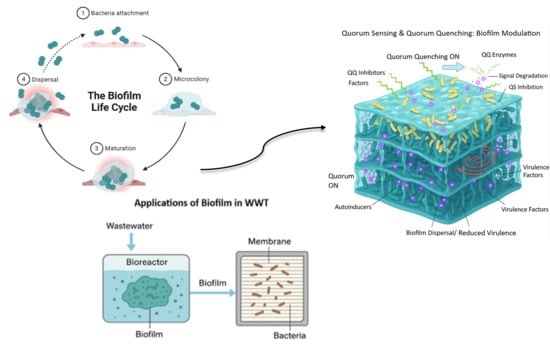
In this sense, biofilm-based systems have attracted particular interest (Figure 1) due to their ability to maintain high microbial activity and withstand problematic environmental conditions, e.g., due to the presence of toxic compounds. More specifically, biofilm is composed of an organized community of microorganisms usually embedded in a complex matrix, which is also produced by microorganisms and is commonly known as an Extracellular Polymeric Substance (EPS). This biofilm matrix provides protection and a relatively stable environment, facilitating the interactions among the microorganisms and enhancing the degradation of pollutants [3].
A key factor contributing to biofilm formation and ultimately to membrane biofouling (e.g., when the relevant systems are used in MBRs) is attributed to the presence of a specific bacterial communication mechanism between the microorganisms, known as quorum sensing (QS). Specifically, QS represents a chemical signaling system among them, based on the synthesis and detection of signals mainly through the Acyl-homoserine Lactone (AHL) category of organic compounds. Once the concentration of these molecules surpasses a defined threshold limit [4], the bacteria can then activate or suppress certain genes relevant to collective behaviors such as toxin production, biofilm development, mobility, and antibiotic resistance [5].
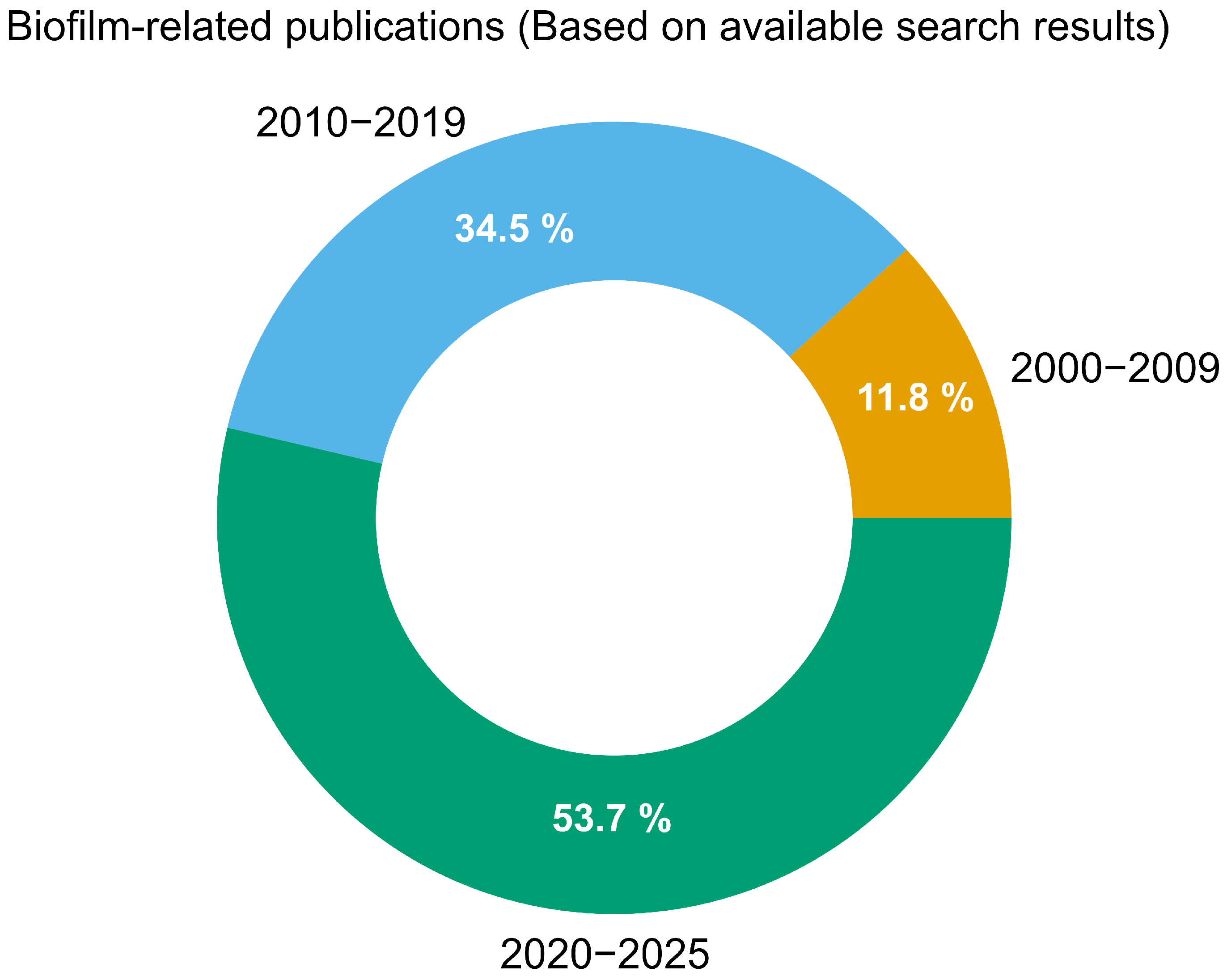
As illustrated in the doughnut chart above, the highest research activity on biofilms occurred during the past five years, accounting for 53.7% of all publications. This upward trend is also evident in the preceding decade “2010–2019“, which contributes to an additional 34.5% of the total research output. Together, these data highlight a steadily increasing scientific interest in the study of biofilms.
However, despite their benefits, the use of biofilm systems also presents certain drawbacks. Among them, as a major concern, is QS activation, which is directly linked to biofouling problems, particularly when the use of biofilms is associated with the application of MBR wastewater treatment systems. The accumulation of organic material, microbial biomass, and insoluble components onto membrane surfaces can lead to reduced flows, increased trans-membrane pressures (TMPs), and the need for frequent maintenance or cleaning of membranes [6]. These issues can result in the compromising of both the energy efficiency and economic viability aspects of relevant systems, while the challenge of predicting and fully controlling proper membrane operation remains [7]. In contrast, quorum quenching (QQ) involves the disruption or inhibition of QS signaling pathways, effectively preventing bacteria from coordinating these (undesirable) group behaviors. This can be achieved mainly through the enzymatic breakdown of AHLs, the inhibition of signal molecule synthesis, or the obstruction of signal reception, positioning QQ as a promising strategy for managing biofilm development, resulting in better membrane biofouling control [8].
Furthermore, the existing literature exhibits certain research gaps. Studies often focus on microbial communities, the applications of biofilms in wastewater treatment, and the materials used for the construction of membranes [2]. However, there is a lack of more detailed investigations regarding QS mechanisms and their disruption via the application of QQ techniques. These processes can play a critical role in biofilm regulation, although they remain underexplored in the context of large-scale biofilm control and mitigation strategies.
Although several enzymes, such as lactonases, acylases, as well as other materials capable of disrupting the QS signals, have been proposed [9], there is no clear picture concerning their effectiveness under real-world conditions or how they can be integrated into the existing wastewater treatment systems. Nevertheless, the interactions among the biofilm-associated bacteria and especially their signaling mechanisms among them can play a key role in the biofouling process [10]. This review aims to fill these gaps by providing a comprehensive and interdisciplinary approach regarding the bacterial interactions occurring in biofilms, gathering and analyzing the recent developments in QS and QQ approaches, especially in the context of membrane-based wastewater treatment systems. Specific emphasis is placed on the mechanisms of QQ action, the experimental results that document the reduction in biofouling in membrane treatment systems, and the prospects for integrating these strategies into existing technologies. Conclusively, this review aims to connect the use of biofilm microorganisms with their respective wastewater technological applications, providing a unified framework approach.

2. Biofilm

Biofilm-based technologies are gaining popularity in both municipal and industrial wastewater treatment systems because of their stability and high treatment efficiency. Biofilms provide physical and biochemical protection to contained microbes through buffering the presence of toxic substances and the environmental fluctuations or other harsh conditions [11]. Additionally, they are expecting to produce less sludge for handling and may be more stable under variable waste loads, which can also lower the respective operating costs. also It should also be noted that the microbial population in biofilms may vary between 108 and 1011 cells/g of wet weight [5].

2.1. Definition and Formation of Biofilms

A biofilm is a structured microbial community, composed of one or more types of microorganisms that adhere permanently to biotic or abiotic surfaces and are embedded within a self-produced EPS [12]. This concept of “biofilm” was first introduced by Casterton et al. [13].
The EPS matrix provides essential protection, shielding microbes from external environmental stresses, toxic compounds, and predatory protozoa. It is composed of a variety of biopolymers, such as proteins, lipids, polysaccharides, nucleic acids, humic substances, and surfactants [14].
Water, which constitutes approximately 97% of the total biofilm volume, plays a critical role in nutrient transport within the biofilm matrix. The EPS layer typically ranges in thickness from 0.2 to 1.0 mm, whereas the respective biofilm layer is generally much thinner, usually between 10 and 30 μm. The EPS accounts for 65–95% of biofilm dry mass, while the microbial cells make up the remainder [15]. According to Fourier Transformed Infrared Spectroscopy (FTIR) analyses, proteins and carbohydrates are the dominant components of biofilm matrix [15].

Biofilm Formation Mechanisms

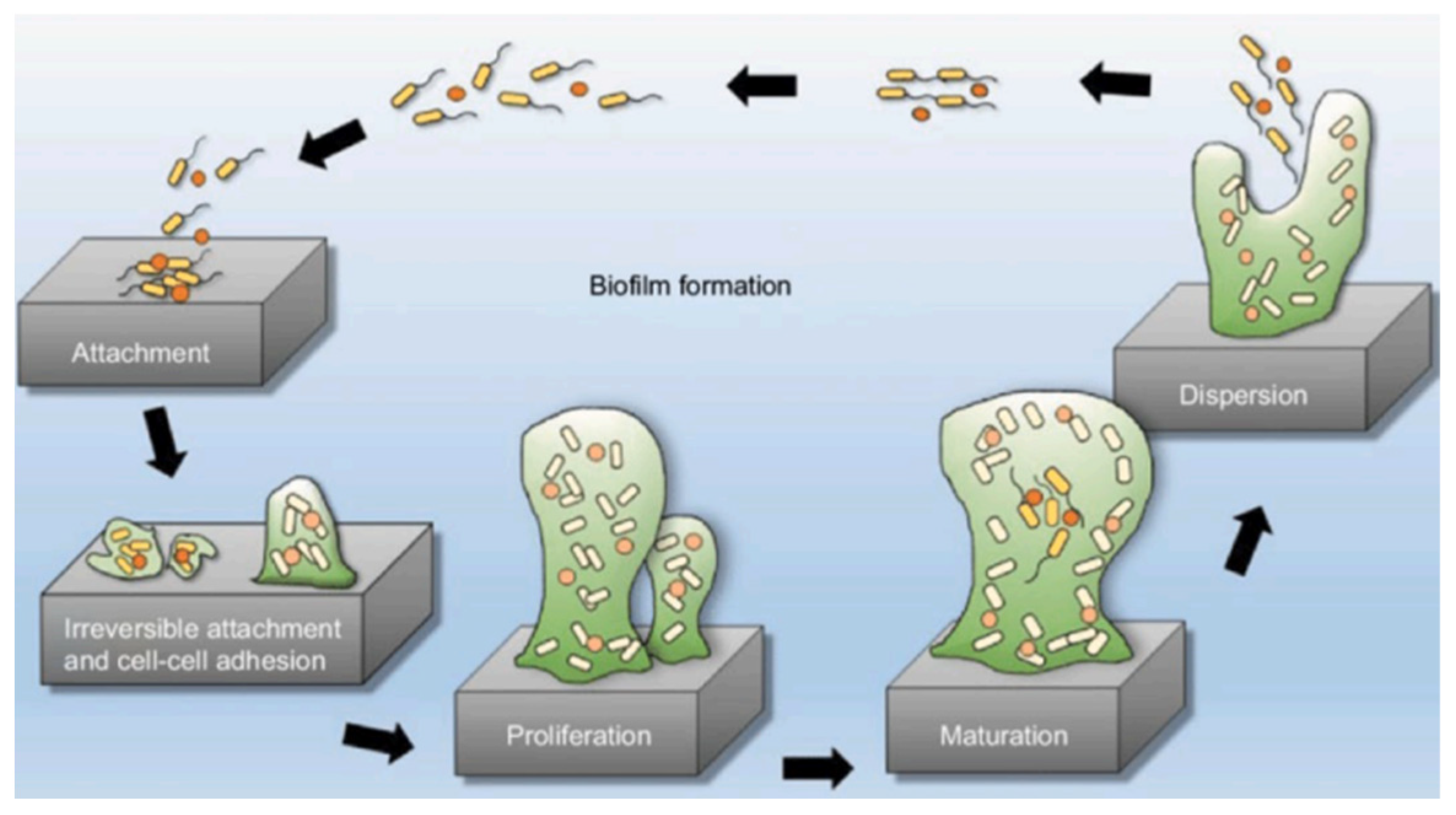
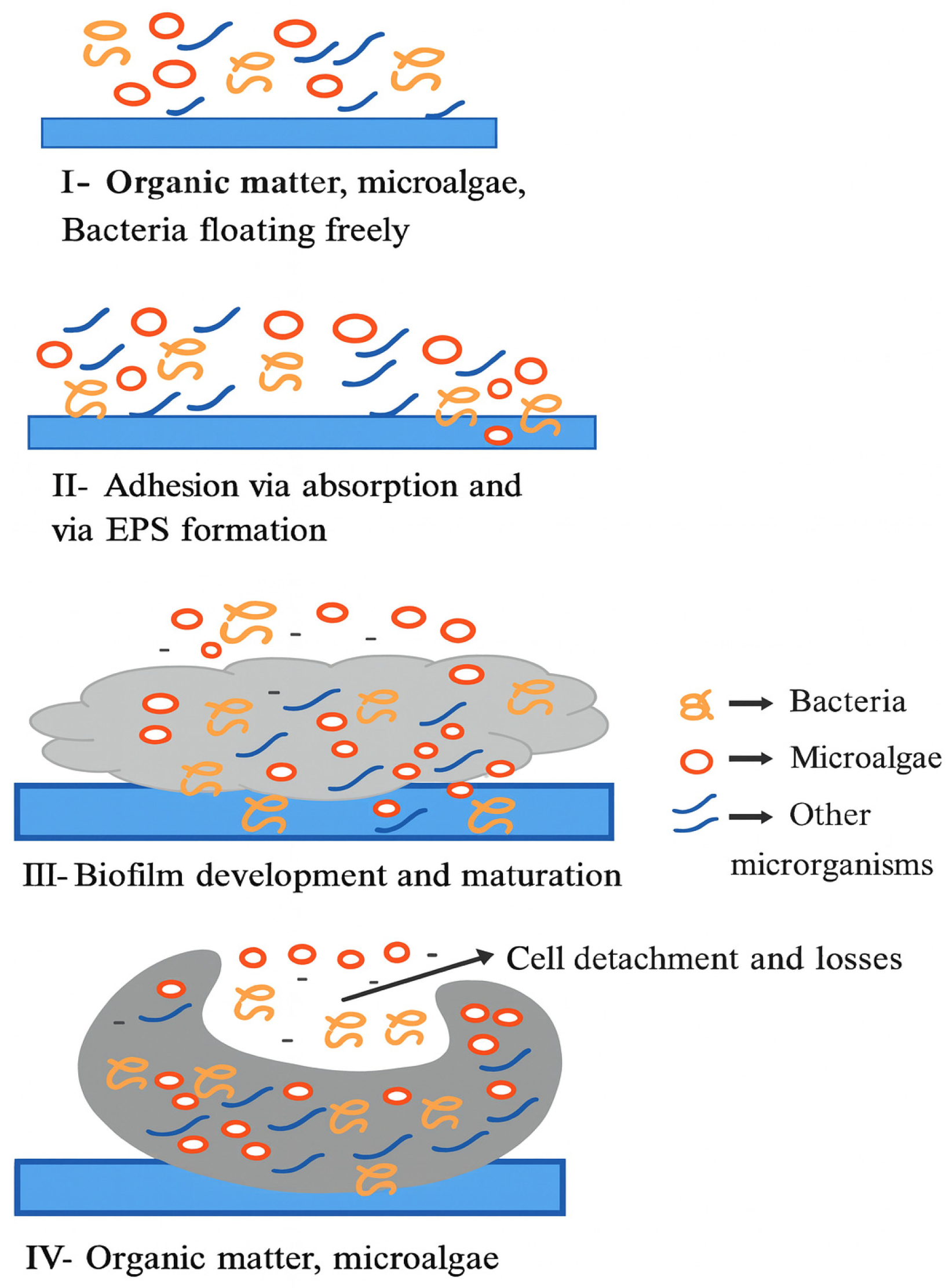
The formation of a biofilm is a dynamic, multi-step process (Figure 2). It begins with the adsorption of organic macromolecules (e.g., proteins, polysaccharides, nucleic acids, and humic acids), smaller molecules (e.g., fatty acids, lipids), and pollutants, such as polycyclic aromatic hydrocarbons and polychlorinated biphenyls, onto solid surfaces commonly present in wastewater treatment systems (e.g., membranes, pipes, and reactor walls). These adsorbed molecules create conditioning films that modify the surface properties in several ways, e.g., they can alter the physicochemical characteristics of the surface, provide nutrient sources for microorganisms, modulate the release of toxic metal ions, trace elements for the development of biofilm, and even trigger the biofilm detachment. Once the surface is conditioned, microbial cells begin to attach [16].
Following initial adhesion, microorganisms begin producing EPS—mainly polysaccharides and proteins—which stabilizes the development of biofilm. While the role of EPS in the initial adhesion phase remains uncertain, its importance for the development of mature biofilms is clearly demonstrated. The EPS forms the slimy matrix/background that can further stabilize the biofilm, retain water, and support the overall structure [17].
As a biofilm matures, it continues to develop and can ultimately colonize the entire substrate. Biofilm can inhabit various environmental interfaces, including solid/gas, liquid/liquid, and solid/liquid interactions. The physicochemical forces that bind the EPS components (e.g., hydrogen bonding, ionic interactions, van der Waals forces) help the biofilm to maintain its structural integrity throughout its life cycle. In the early stages of development, planktonic bacteria adhere to surfaces mainly through van der Waals and electrostatic forces [2]. Planktonic bacteria are free-living microorganisms that have not yet attached to a surface.
Bacterial adhesion is reinforced by additional interactions, including hydrogen bonding and ionic forces. The development of three-dimensional structures and microcolonies is also a key component of the processes correlated to biofilm formation [2]. Microcolonies are composed of either single bacterial strains or of mixed microbial communities. They may exhibit varied morphologies, such as smooth or flat surfaces, rough filamentous textures, mushroom-like structures, or fluffy formations. These microcolonies are interspersed with void spaces filled with water, which contribute to nutrient transport and secondary by-products’ removal [18]. The quantity of EPS in a microcolony is influenced by the density of bacterial cells, with EPS comprising approximately 75–90% of total biomass, while the remainder consists of cells [14].

2.2. Biofilm Composition

Biofilm formation begins when microorganisms, including microalgae and bacteria, adhere to the substrate surface. The adhesion of microalgae is influenced by multiple factors, including the physical properties of the surface (e.g., surface free energy, roughness, and contact angle), specific environmental conditions (e.g., pH), and the presence of bacterial communities. However, microalgae can initially reversibly attach to existing bacterial biofilms, allowing easy detachment under certain conditions [2]. The secretion of EPS by microorganisms is expected to strengthen the biofilm, enhancing its structural integrity and stability. Within the biofilm, microalgae require light for photosynthesis, while bacteria can benefit from the oxygen produced by them. This complementary relationship allows the biofilm to retain sufficient oxygen internally, reducing or even eliminating the need for an external oxygen supply [19], thereby reducing aeration costs.

2.2.1. Biological Composition

The formation of biofilms is a common strategy used by bacteria, fungi, and microalgae under certain favorable environmental conditions. Depending on the system, biofilms may consist of a single microbial group or a mixed microbial community, with mixed biofilms ubiquitous in engineered wastewater treatment systems. Despite their biological differences, these organisms share fundamental processes during biofilm initialization and stabilization, including surface adhesion, extracellular matrix production, and community structuring [20].
The filamentous fungi secrete amphiphilic proteins, i.e., compounds containing both hydrophilic and hydrophobic domains, facilitating the attachment to surfaces, especially to the hydrophobic ones. For example, Aspergillus fumigatus produces hydrophobic proteins with cysteine-rich motifs that can promote robust adhesion. Several fungal species, such as Candida albicans, Penicillium rubrum, and Fusarium spp., are known biofilm creators. However, in polymicrobial systems, fungi are generally less dominant than bacteria [21].
Bacterial biofilms are highly responsive to external environmental and biochemical conditions, including the presence of extracellular proteins, polysaccharide composition, glucose levels, pH, temperature, and metal ion concentrations. As biofilms mature, they can develop heterogeneity in space (i.e., location within the substrate), time (i.e., growth stages), and structure (i.e., biofilm morphology). The EPS matrix (Figure 3), especially the nature and organization of polysaccharide content, is crucial in determining the biofilm’s morphology [22].
Algal biofilms, though less frequently studied in this context, can also form stable, adherent structures that are commonly observed in both natural environments and engineered systems. Early studies focused on their control, due to fouling and safety concerns. Still, growing interest in other fields, such as biofuel production, wastewater treatment, and nutrient recovery, has highlighted their potential as beneficial participants in biofilms [23].
In natural and engineered systems, biofilms are rarely composed of a single microbial group. Instead, bacteria, fungi, and microalgae often co-exist and interact, creating complex, mutually supportive communities that can enhance biofilm resilience and performance [2]. Fungi and bacteria collaborate in the degradation of complex organic polymers, such as cellulose, lignin, and chitin. Fungi contribute powerful enzymatic activity that can break down these complex substrates, while bacteria enhance the fungal growth by producing growth factors and fixing nitrogen. Additionally, bacteria can metabolize the fungal by-products, further reinforcing the mutualistic development [24]. These interactions can stabilize biofilm structures and enhance organic matter degradation in the respective treatment systems.
Microalgae–bacteria consortia represent another meaningful biofilm interaction. Bacteria mineralize the organic compounds into forms that microalgae can use, while microalgae produce oxygen via photosynthesis, supporting the aerobic bacterial metabolism. This mutualistic interaction improves both the efficiency and the long-term sustainability of wastewater treatment systems. For example, the co-cultivation of bacteria with Chlorella vulgaris has been shown to improve flocculation, aiding in biomass settling and harvesting [25].
Research has demonstrated that integrating microalgae with activated sludge can effectively remove nutrients, achieving high reductions in nitrogen and phosphorus [26]. In the respective photobioreactor systems, this combined approach has also demonstrated high Chemical Oxygen Demand (COD) removal efficiencies, reaching up to 98% [27]. Overall, biofilm composition and performance are highly variable and depend primarily on multiple environmental factors, such as substrate availability, oxygen levels, and temperature. The bacterial community composition, for instance, is known to shift in response to environmental conditions [28]. Particular species, such as Cronobacter sakazakii, Enterobacter agglomerans, and Pantoea agglomerans, have exhibited high bioremediation potential in nutrient-rich environments. At the same time, the detection of pathogens, such as Salmonella, in rotating biological contactor treatment systems indicates the challenges of entirely eliminating the potentially harmful microorganisms through the application of biofilm-based systems alone [28].
Fungal components may vary in abundance, depending on surface properties and local conditions. While they tend to be less dominant in mixed biofilms, their enzymatic capabilities are critical in breaking down recalcitrant substrates, making them indispensable in specific treatment contexts [20]. Algal biofilms; meanwhile, thrive in illuminated, oxygen-rich environments, with productivity and biofilm structure heavily influenced by light availability and CO2 concentration. However, key challenges persist in scaling up algal biofilm systems due to incomplete knowledge of optimal growth surfaces, biofilm developmental dynamics, and operational standardization [29].
Major environmental parameters, such as pH, dissolved oxygen (DO), and temperature, can play crucial roles across all microbial groups. For example, the photosynthetic CO2 uptake by microalgae can elevate the pH levels, potentially impacting the microbial growth and the enzymatic activity [30].
Meanwhile, the biodegradation efficiency is closely tied to microbial community composition and the respective growth conditions. The integration of bacteria, fungi, and microalgae into engineered wastewater systems offers a promising approach to more sustainable, highly efficient biological treatment processes. The combined functional traits can improve pollutant degradation, nutrient recovery, and biomass production [31]. Continuous interdisciplinary research into microbial interactions, EPS composition, environmental modulation, and the design of appropriate reactors will be crucial for realizing the full potential of mixed biofilm systems across different biotechnological applications.

2.2.2. Chemical Composition

Biofilm formation begins when microbial cells adhere to a surface or to one another. As the cell population density increases, the biofilm begins to mature through the production of an extracellular matrix [32]. The EPS matrix is synthesized throughout biofilm development. It is thought to govern several chemical and physiological properties of the biofilm, though these properties can differ depending on the presence of specific microbial species.
The chemical composition of EPS is highly variable and depends on several factors, including microbial species, nutrient availability, temperature, and environmental shear forces. The primary macromolecular components of EPS include polysaccharides, proteins, nucleic acids, glycoproteins, and phospholipids [33,34]. Among these, proteins and polysaccharides are the most extensively studied constituents, due to their significant structural and functional roles.
Much of the current understanding of EPS matrix composition comes from the studies of biofilms formed by both Gram-positive and Gram-negative bacteria. Enzymes and structural proteins within the EPS matrix can also play crucial roles in regulating the intracellular communication (e.g., quorum sensing), matrix remodeling, and adhesion to surfaces. For instance, specific enzymes, such as proteases and lipases, can catalyze the biochemical reactions that facilitate both biofilm development and maintenance aspects. Polysaccharides; meanwhile, serve as essential structural components, providing both surface adhesion and increased mechanical stability to the biofilm matrix [35].

2.3. Biofilms in Wastewater Treatment

The use of biofilms for the removal of pollutants is the most appealing, cost-effective, and environmentally friendly strategy [36]. Their three-dimensional architecture, enriched with EPS, creates stratified microenvironments that enable the coexistence of aerobic and anaerobic metabolic pathways. This structural complexity enhances the system’s capacity for simultaneous organic matter degradation, nitrification–denitrification, and biological phosphorus removal. Annually, industrial facilities all over the world emit a substantial amount of harmful materials into nearby ecosystems, including toxic sludge, heavy metals, solvents, suspended particles and other biological wastes [37].
Biofilm-based and anaerobic–aerobic bioreactors, such as trickling filters (TFs), rotating biological contactors (RBC), MBR, and up-flow anaerobic sludge blanket (UASB), are used commercially for the sorption and biochemical conversion of heavy metals and hydrocarbons from municipal and industrial wastewaters [38]. These reactors have several advantages over conventional treatment processes. By retaining biofilm biomass in an attached form, these systems minimize sludge production, stabilize process performance, and maintain microorganisms in situ for extended periods [39].
For instance, rotating biological contactors provide a large surface area for biofilm formation and ensure efficient oxygen transfer through their cyclic rotation between air and wastewater. Biofilm systems developed on RBC disks have demonstrated high biosorption capacities for heavy metals such as Zn2+, Cu2+, and Cd2+ [40]. In industrial wastewater applications, RBC units achieved removal efficiencies exceeding 80% for these metals, due to the interaction of heavy metals with the functional groups of EPS, which promote complexation, sorption, and precipitation. These systems are advantageous because they maintain stable performance across multiple cycles, even as metal loads increase. EPS thickness and composition play a key role in metal sequestration, making RBC-based biofilms suitable for metal-plating and mining wastewater treatment [41].
Furthermore, the fluidized-bed biofilm reactor (FBR) is a modern, efficient biological waste-treatment technology. It is based on the use of small, fluidized particles as carriers for immobilizing microorganisms. The upward flow of waste fluidizes the bed, allowing the development of high concentrations of active biomass and providing a large specific surface area for biological reactions [42].
Puhakka et al. [43] utilized Rhodococcus sp. and Pseudomonas sp. in a lab-scale fluidized-bed biofilm reactor for the remediation of chlorophenol-contaminated groundwater. The system achieved extensive mineralization of chlorophenols, operating at loading rates up to 1000 mg L−1 d−1 with hydraulic retention time of less than 1 h, while attaining removal efficiencies exceeding 99.9% for pentachlorophenol, 2,4,6-trichlorophenol, and 2,3,4,6-tetachlorophenol [43].
Integrated Fixed-Film Activated Sludge (IFAS) is considered one of the most attractive wastewater treatment processes. Specifically, it represents a further development of Moving Bed Biofilm Reactors (MBBRs), as it integrates both attached and suspended growth biological processes. Compared to the conventional activated sludge process, IFAS offers notable advantages, including reduced footprint requirements, enhanced nutrient removal efficiency, reliable complete nitrification, longer solids retention time, and better removal of anthropogenic compounds [44].
The reactors have several advantages over the conventional treatment processes. By retaining biofilm biomass in an attached form, these systems minimize sludge production, stabilize process performance and maintain microorganisms in situ for extended periods [39]. Table 1 summarizes the applications.

3. Quorum Sensing

The bacteria in wastewater treatment systems use the QS mechanism to coordinate their metabolic activities, which also affects the decomposition of organic substances/pollutants. The challenge of applying QS during wastewater treatment lies in the complexity of microbial communities and the understanding of how the QS signals can affect their functions. However, the application of quorum sensing remains an area of ongoing research, with several challenges yet to be addressed, such as a better understanding of precise communication mechanisms and how to integrate them effectively into the respective processes. Despite these obstacles, research in this field is progressing rapidly toward optimizing biological wastewater treatment, achieving greater efficiency and environmental sustainability [10].

3.1. Definition of Quorum Sensing Mechanism

Quorum sensing is defined as the communication mechanism among bacterial cells within a biofilm, enabling them to coordinate collective behavior by exchanging chemical signals that reflect the respective population density [4]. This process is regulated by specific signaling molecules known as autoinducers (AIs). Their concentration determines the activation of specific genes involved in key biological functions, such as bioremediation, biological regeneration, antibiotic production, and the regulation of toxicity factors. QS is integral to biofilm development and exopolysaccharide secretion, both of which are highly dependent on microbial population density within the biofilm [5].
The bacteria release autoinducers (specific organic molecules) into their surrounding environment, where they can be detected by the same or neighboring cells, thereby amplifying the process. When the concentration of these molecules reaches a critical threshold, known as the quorum, the QS mechanism triggers coordinated gene expression that governs behaviors such as toxin production, biofilm development, mobility, and antibiotic resistance [4].

3.2. Mechanism

Based on bacterial classification, QS systems are broadly divided into two major types. Gram-negative bacteria utilize AHLs as signaling molecules, which can passively diffuse through their relatively thin cell walls [45]. In contrast, Gram-positive bacteria rely on the autoinducing peptides (AIPs), or other small signaling molecules, to facilitate the communication between them [46].
The fundamental mechanism of QS is relatively simple. Bacterial cells synthesize and release the AI molecules, creating small chemical signals that accumulate in the surrounding environment. As the bacterial population grows, the levels of these AIs increase proportionally. Once a critical threshold concentration is reached, the bacteria can sense these signals through specific receptors on their surfaces or within their cells. Signal detection initiates a regulatory cascade that activates specific gene expression, enabling the bacteria to coordinate collective behaviors. Similarly to higher organisms, this form of chemical communication is essential for coordinating activities across large populations of microbial cells [47].
The genes activated by QS may regulate the following [48]:
  • Autoinduction—stimulating further AHL production.
  • Biofilm formation.
  • Antibiotic resistance mechanisms.
  • Production of toxins or other pathogenic factors.
  • Mobility behaviors, such as swarming.
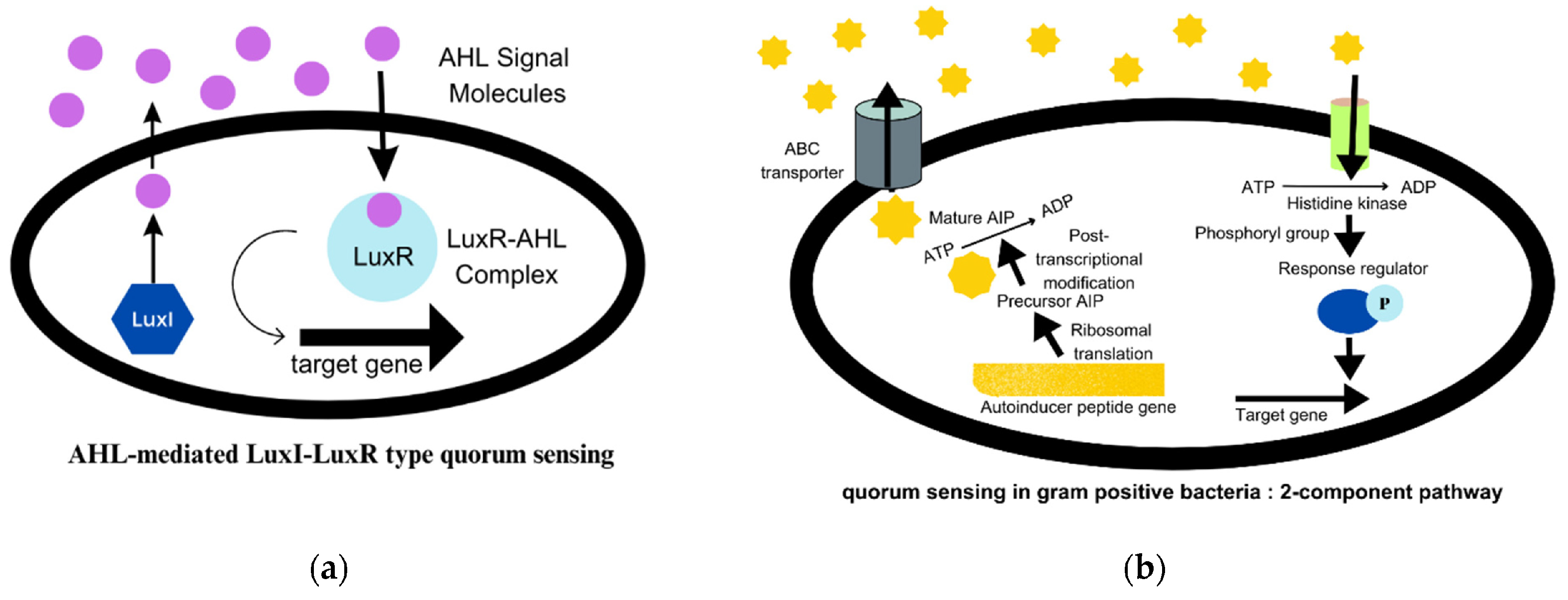
In Gram-negative bacteria, AHL-based QS systems—also referred to as autoinducer type 1 (AI-1)—represent the most extensively studied signaling mechanisms. In these systems, AHL molecules freely diffuse across the cell membrane and, upon reaching a threshold concentration, bind to cytoplasmic LuxR-type receptors. The resulting AHL-LuxR complex functions as a transcriptional regulator, activating genes associated with virulence, extracellular enzyme production, and biofilm development [49,50,51].
From a structural perspective, limited information is currently available regarding the large family of LuxR-type QS receptors. The three-dimensional structures have been resolved for only a small number of these proteins, including TraR from Agrobacterium tumefaciens [52], LasR [53] and QscR from Pseudomonas aeruginosa [54], CviR from Chromobacterium violaceum [55], and SdiA from Escherichia coli [56]. Among these, full-length crystal structures have been obtained only for TraR, QscR, CviR, and SdiA, whereas for LasR, structural data are available solely for the ligand-binding domain (LBD). Although the tertiary structures of these receptors exhibit considerable similarity, their quaternary arrangements are highly dynamic, complicating the identification of a universal functional mechanism. Consequently, these findings underscore the necessity for additional structural investigations of other AHL-binding QS systems [57].
In Gram-positive bacteria, QS signaling is primarily mediated by AIPs, which are short peptides that undergo post-translational modifications and cannot passively cross the cell membrane. These peptides are actively exported into the extracellular environment and are detected by membrane-bound histidine kinase receptors as part of a two- component regulatory system. Upon reaching a threshold concentration, AIPs bind to the sensor kinase, triggering autophosphorylation and subsequent transfer of the phosphate group to a response regulator. The activated response regulator then binds to specific promoter regions, initiating transcription of QS-controlled genes involved in virulence and biofilm formation [46,49].
Figure 4a displays the most investigated signaling system [49]. AIPs, which are little peptide chains that go through post-translational modification and are unable to pass through the cell membrane, are also secreted by Gram-positive bacteria [46]. Figure 4b provides a detailed description of Gram-positive bacteria’s two-component signaling system [49].
The behavior of the entire biofilm microbial community can be influenced by this communication form, which can alter specific gene expression in response to the concentrations of specific QS molecules [58,59]. Bacterial virulence, pathogenicity, and ultimately survival issues can all be impacted by the control of gene expression [60]. Consequently, QS can provide an evolutionary advantage by coordinating gene expression across the population, allowing bacteria to optimize the timing and extent of expressing attributes that depend on group behavior [25,61,62,63,64,65,66,67].

3.3. Applications of QS in Wastewater Treatment Through Biofilm Formation

Biological wastewater treatment (BWT) is a method for removing contaminants, such as organic matter, nitrogen, and phosphorus, by harnessing microbial communities [68]. Recently, the role of QS in this process has attracted significant interest, as this bacterial communication mechanism critically regulates the formation, stability, and function of biofilms and is essential for wastewater treatment.
The microbial populations in BWT systems produce various QS signaling molecules, including AHLs, Diffusible Signal Factor (DSF), and autoinducer-2 (AI-2), which can activate specific pathways that govern cooperative behaviors [69]. This is particularly relevant for the Gram-negative bacteria, which are predominant in these systems [70,71,72,73]. Several technologies, such as MBBRs, trickling filters, and granular sludge processes, utilize robust biofilms to achieve highly efficient wastewater treatment, rapidly removing pollutants with reduced sludge production [74,75].
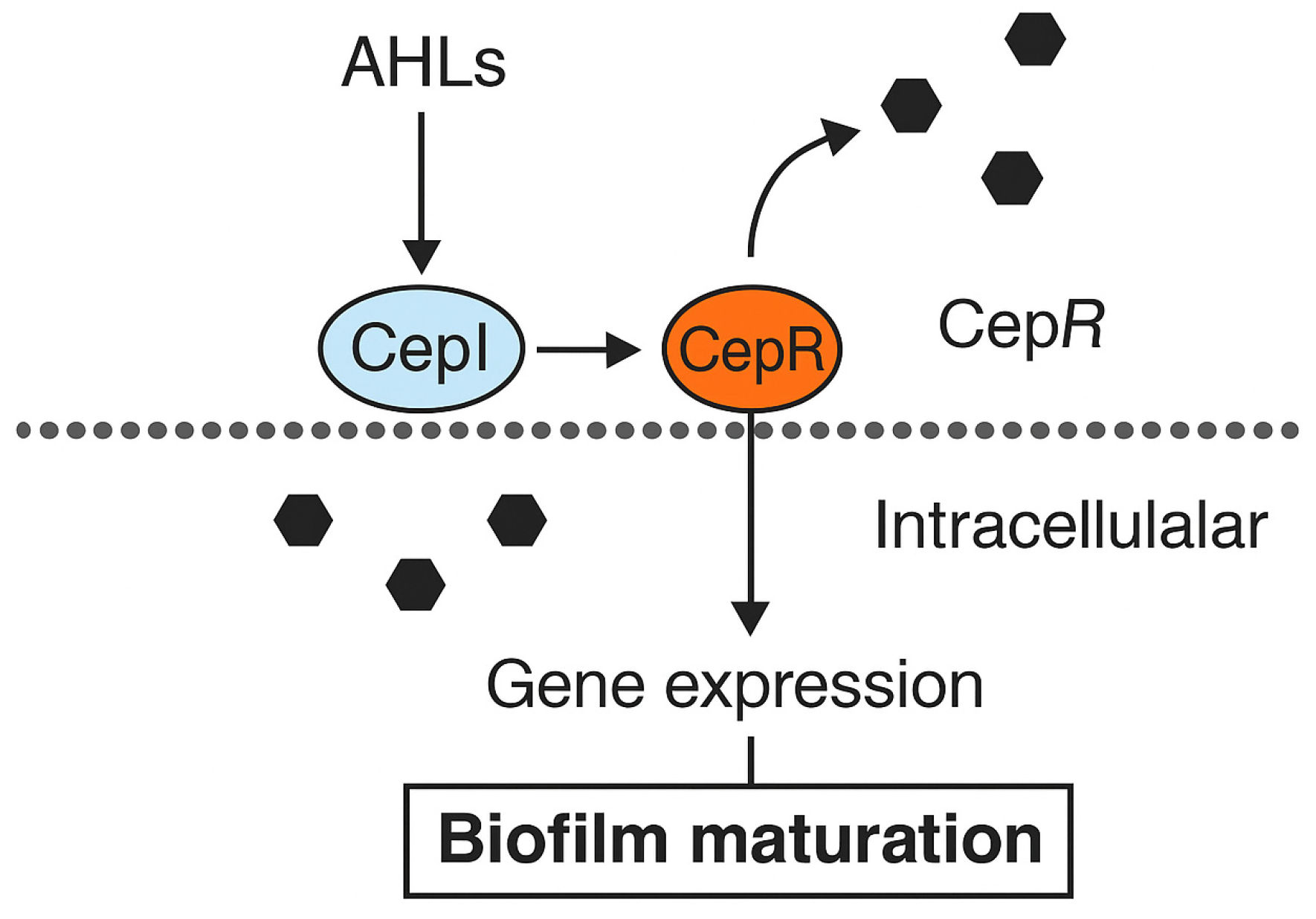
QS directly mediates the functional regulation of these critical biofilms. For instance, research relevant to wastewater treatment has demonstrated a strong correlation between AHL concentrations and the successful formation and activation of biofilms [76]. Specific bacteria known for their treatment capabilities, such as Pseudomonas, Agrobacterium, and Aeromonas, are significant producers of AHL signals [76]. Furthermore, the CepI/R QS system (Figure 5) in Burkholderia cepacia complex, a member of the membrane system, has been shown to control biofilm maturation directly [77].
Evidence for QS’s crucial role is demonstrated in experiments in which mutant bacteria lacking a QS system form biofilms that are thinner, flatter, and lack a complex three-dimensional architecture. These deficient biofilms are also more susceptible to biocide treatment. Notably, the addition of exogenous AHL molecules to such systems can restore the wild-type biofilm structure, confirming the direct link between them [78].
This understanding also has some practical applications. One significant operational challenge is the extended time required to establish stable biofilms during the start-up of biofilm-based processes; immature biofilms are prone to sloughing, severely reducing treatment efficiency. Targeted QS regulation offers a strategy to accelerate biofilm formation, enhance the system’s resistance to operational shocks, and ultimately improve the overall stability and reliability of wastewater treatment processes.
Moreover, quinolone-type QS molecules constitute an important class of signals that regulate biofilm formation in wastewater-associated microbial communities. These molecules, which act through LuxR-family regulatory proteins, have been shown to enhance biofilm development under engineered treatment conditions significantly. In Halanaerobium, the addition of 100 nM quinolone-type signals resulted in a 95% increase in biofilm mass, accompanied by a 30% increase in power density in microbial fuel cell systems [79].
Consistently, Valle et al. [80] demonstrated that phenol-degrading activated sludge contained seven proteobacterial strains exhibiting acyl HSL activity, indicating that pollutant-degrading communities rely heavily on QS interactions. Collectively, these studies highlight the crucial role of QS—through both AHL and quinolone-type signals—in coordinating microbial behavior, strengthening biofilm structure and enhancing biodegradation efficiency in wastewater treatment processes.

3.4. Detection Methods for QS

Several chemical methods, such as chromatography and mass spectrometry, can be employed to characterize acyl HSLs [81]. However, these techniques require specialized equipment and expertise, which may limit their routine application, especially in resource-limited settings. By contrast, QS bioassays are relatively low-cost and accessible [82], enabling the screening of QS inhibitors and acyl HSLs even in regions with high biodiversity, such as tropical areas, where financial and technical resources may be limited.
Agrobacterium tumefaciens is a Gram-negative plant pathogen that induces crown gall formation via transfer into host cells. Its conjunction-based gene transfer is regulated by a 3-oxo-C8-HSL-dependent QS system, with tral and traR controlling signal synthesis and response regulation, respectively [83].
Reporter strains, A136 [84,85] and KYC55 [86], are widely used to detect acyl HSLs. These strains lack tral, overexpress traR, and carry lacZ as a reporter gene. Detection requires a β-galactosidase substrate, such as 5-bromo-4-chloro-3-indolyl β-d-galactopyranoside (X-gal), to visualize acyl HSL recognition. KYC55 is more sensitive and detects a broader range of acyl HSLs, including the cognate 3-oxo-C8-HSL, which is recognized at sub-picomolar levels. These bioassays can be combined with reverse-phase thin-layer chromatography (TLC) [87] and high-performance liquid chromatography (HPLC) [88]. Alternatively, β-galactosidase activity assays (LacZ gene product) can be employed to gain quantitative data [86].
Furthermore, in Pseudomonas aeruginosa, two AHLs—3-oxo-C12-HSL, synthesized by LasI, and C4-HSL, synthesized by RhlI—regulate virulence factor production, iron acquisition, and biofilm formation [89,90]. Accurate detection and quantification of these molecules are essential to understanding their role in the bacterium’s life cycle and pathogenicity. Recent approaches include the cultivation of biofilms in controlled-flow cell systems and the analysis of AHLs and their derivatives, tetramic acids (e.g., C12-TA), using acidified ethyl acetate extraction followed by liquid chromatography–mass spectrometry (LC–MS) analysis [91].
Biofilm samples are processed through centrifugation and concentration, and quantitative analysis is performed using calibration curves of 3-oxo-C12-HSL and C12-TA [92]. This methodology enables precise quantification of QS signaling molecules within biofilms, providing valuable insights into their regulatory roles in microbial behavior and into engineering strategies for biofilm control.

3.5. Optimization of QS Utilization

Although essential for wastewater treatment, uncontrolled biofilm accumulation can lead to system deterioration and increased operational costs [93,94]. Therefore, optimizing QS regulation is critical for improving process control.
A prominent strategy involves the use of specific nanomaterials, such as silver nanoparticles (AgNPs), titanium dioxide nanoparticles (TiO2, NPs), zinc oxide nanoparticles (ZnO NPs), cerium oxide nanocubes (CeO2 NCs), quantum dots coated with molecularly imprinted polymers (QDs@MIP), and carbon nanomaterials (carbon nanotubes), to modulate bacterial QS, an approach recently gaining significant attention, due to the unique physicochemical properties and excellent designability of nanomaterials [95]. These QS-regulatory nanomaterials can enhance biological nitrogen removal processes, including nitrification and denitrification, in activated sludge systems, thereby effectively maintaining water cleanliness and preventing eutrophication [96].
The nanomaterials’ mechanism of action differs, e.g., between the two nitrogen commonly applied major removal phases:
  • During nitrification, nanomaterials function primarily as carriers that facilitate the attachment and growth of specific Anaerobic Ammonium-Oxidizing Bacteria (AnAOB). This increases AnAOB abundance and enhances the population density-dependent nitrification process [97].
  • During denitrification, QS activation can inhibit bacterial denitrification efficiency. Conversely, nanomaterials can stimulate bacterial denitrification by acting as QQ agents to inhibit bacterial QS [94]. Dosage is critical; an appropriate dose of QQ-active nanomaterials stimulates denitrification, whereas higher doses can directly disrupt the expression of key genes involved in nitrogen metabolism, electron transfer, and transport, all of which are essential for this process [98].
The integration of these processes can be achieved in Simultaneous Nitrification and Denitrification (SND) technology. This innovative approach utilizes specific Heterotrophic Nitrification–Aerobic Denitrification (HNAD) bacteria and offers advantages, such as a shortened process duration, reduced energy expenditure, and simplified system design [99].
Recently, the further optimization of denitrification demonstrates that the specific QS signal molecule N-3-oxo-tetradecanoyl-L-Homoserine lactone (N-3-oxo-C14-HSL) can be used strategically. In a Hydrogen-Based Membrane Biofilm Reactor (H2-MBfR), 3-oxo-C14-HSL has been found to promote the proliferation and synergistic activity of denitrifying bacteria [100]. Crucially, this molecule not only inhibited the excessive biofilm overgrowth but also enhanced the system’s denitrification performance. Model simulations indicated that 3-oxo-C14-HSL reduced overall biofilm thickness and optimized the spatial distribution of the electron donor (H2) and acceptor (NO3), thereby expanding the metabolically active zone and enhancing overall treatment performance [100].
Microbial ecological changes underpinned this performance enhancement:
  • The addition of 3-oxo-C14-HSL increased the abundance of key denitrifying genera, such as Thauera, Comamonas, and notably Pannonibacter, while also strengthening the synergistic interactions within the microbial community network [100,101].
  • At the genetic level, this treatment approach has increased the expression of genes involved in both the synthesis and detection of AHL signals, as well as key denitrifying enzymes (nirAB, norBC, and nosZ) [100,102].
The targeted activation of QS with specific molecules, such as 3-oxo-C14-HSL, is an effective strategy for controlling biofilm structure, enhancing microbial cooperation, and increasing nitrogen removal efficiency. However, significant challenges remain regarding large-scale implementation, including the relatively high cost of commercial AHLs, the need to precisely define the respective activation thresholds, and the requirement to enrich the endogenous AHL-producing bacteria within the treatment system [100].
Practical engineering applications of QS regulation have also been demonstrated in Moving Bed Biofilm Reactors (MBBRs) during process start-up. Fu et al. [103] reported that bioaugmentation with an immobilized quorum sensing bacterium (Sphingomonas rubra) significantly accelerated biofilm formation at low temperature, increasing biofilm thickness by more than 60% and improving COD and NH4+-N removal efficiencies. Importantly, the QS-assisted approach shortened reactor start-up time, highlighting its potential to improve operational stability during the critical initial phases of biofilm-based wastewater treatment systems.
More recently, Gao et al. [104] extended this concept to long-term reactor operation under high-salinity stress by bioaugmenting an MBBR with an immobilized QS-active strain (Vibrio sp. LV-Q1). The QS-enhanced reactor maintained elevated AHL concentrations, increased EPS production and biofilm adhesion strength, and achieved significantly higher nitrogen and COD removal efficiencies than the control system. These findings demonstrate that QS-based bioaugmentation is a scalable and robust engineering strategy for enhancing biofilm performance under harsh wastewater treatment conditions.

4. Quorum Quenching

In contrast to QS, QQ is a concept derived from QS. There has been a lot of interest in the application of the QQ method to suppress the QS mechanism and to control the critical problem of biofouling, which is mainly due to the creation of biofilms onto the surface of membranes or on other surfaces (e.g., pipes). This approach can effectively reduce EPS synthesis and prevent biofilm formation and spread [105]. The goal is to block the production or action of signaling molecules (autoinducers) that bacteria use to coordinate collective behaviors, such as biofilm production and the fact that several microorganisms may exhibit resistance to the presence of antibiotics. Therefore, new control methods are required that do not rely on inhibiting their growth but on neutralizing their communication routes.
The principal experimental approaches used to evaluate bacterial QQ activity include minimal-medium biosensor assays, plate-based inhibition assays, and measurements of residual AHLs following bacterial treatment [106]. Currently, colorimetry, bioluminescence, chemiluminescence, fluorescence, mass spectrometry, and electrochemistry are the main methods employed for both quantitative and qualitative studies of QQ and QS molecules [107].

4.1. Mechanisms of QS Inhibition—Application of QQ Approach

There are multiple mechanisms by which QS can be inhibited. Quorum Sensing Inhibitors (QSIs) are natural or synthetic molecules that interfere with bacterial communication. The main categories of QSIs are the following:
Inhibitors of signaling molecule synthesis. These molecules can block certain enzymes, such as synthases (Luxl), which are considered responsible for AHL synthesis in Gram-negative bacteria, and LuxS, which plays a major role in AI-2 production, a signal molecule used by both Gram-positive and Gram-negative bacteria. Parsek et al. [108] demonstrated that structural analogs of AHL, such as L/D-S-adenosyl-homocysteine, cinnamaldehyde, and butyryl-S-adenosyl-methionine (butyryl-SAM), act as inhibitors for AHL synthesis in vitro. Similarly, curcumin has been shown to suppress the virulence factors of Pseudomonas Aeruginosa (PAO1) and to reduce the biofilm formation by interfering with AHL production. However, its precise inhibitory mechanism remains somewhat unclear [109]. On the other hand, the enzyme LuxS, which catalyzes the conversion of S-ribosyl-homocysteine (SRH) to AI-2, can also be targeted, as several SRH analogs have been reported to inhibit LuxS activity [110,111]. Brominated furanones have also been shown to interfere with LuxS [112].
Enzymatic degradation of AHL molecules. This is the most well-known mechanism of QQ. The reaction can be catalyzed by four distinct enzyme groups. Lactonases and acylases hydrolyze the Homoserine Lactone (HSL) ring of AHL molecules, while the oxidoreductases can modify the AHLs chemically, reducing their activity [113]. For example, the enzyme AHL-lactonase derived from Bacillus cereus (VT96) has the unique ability to directly control the production of virulence factors, such as exopolysaccharides, biofilm formation, and pyocyanin in Pseudomonas aeruginosa (PAO1) [114]. Another example is that particular bacterial species, including Agrobacterium tumefaciens, Pseudomonas aeruginosa, Klebsiella pneumoniae, and several Bacillus species, produce enzymes that may degrade AHL molecules. Muricauda olearia Th120’s lactonase (MomL) can equally hydrolyze long- and short-chain AHLs, reducing the pathogenicity of several bacteria [115]. Furthermore, plants and fungi, such as Pachyrhizus erosus, Lotus corniculatus, and Hordeum vulgare, have been reported to produce enzymes that degrade AHL molecules, thereby disrupting bacterial QS.
Competitive receptors. In addition, communication between bacteria can be disrupted by competitive receptors that block the binding of signaling molecules [116]. Essentially, these are molecules that can mimic signaling molecules, meaning they have a similar shape or chemical structure. However, the difference with the previous cases is that they bind to the same receptors, preventing the other molecule from attaching, i.e., showing competitive action. On the other hand, in non-competitive action, the molecule binds to a different site on the receptor (i.e., not where the natural signal binds) but changes the shape of the receptor; therefore, it avoids the activation of the receptor; thus, the sequence of commands that would lead to biofilm formation does not start. In some cases, they can also cause receptor deactivation or its breakdown.
For instance, the first anti-QS molecules identified to act by competitive binding with LuxR-type proteins were halogenated furanones produced by the marine macroalga Delisea pulchra. The increased proteolytic degradation of LuxR-type proteins is the result of this mechanism/action [117]. They are quite similar to AHLs, but when they bind to the receptor (e.g., LuxR), they do not activate it; instead, they cause its destruction.
Blocking signal transduction cascades, e.g., by inhibiting AI-receptor complex formation [118]. Savrin, a small-molecule inhibitor, has been shown to bind DNA and interfere with AgrA in Staphylococcus aureus (a transcriptional regulator of QS), thereby preventing the synthesis of RNAIII, which, in conjunction with AgrA, is responsible for producing numerous virulence factors [119].

4.2. Application Fields of QQ

Bacterial QQ can contribute to controlling biofouling on surfaces (e.g., membrane surfaces). Particularly in the MBR, biofilm formation and EPS production can lead to severe biofouling, causing operational problems. In the study by Ergön-Can et al. [120], a new bacterial immobilization system, the Rotary Microbial Carrier Frame (RMCF), was designed.
The RMCF consists of a circular frame made of polycarbonate, covered with a microfiltration membrane outside the frame, while the genus Rhodococcus sp. is trapped inside, which is known for its ability to produce specific enzymes that exhibit QQ activity. The RMCF system is submerged within the tank containing the MBR and rotates independently of the main filtration membrane system, thus combining a simple dual biofouling control mechanism. As a result, the physical and biological mechanisms are combined, as the rotation generates sufficient shear forces at its surface, which reduce bacterial adhesion. In contrast, the biological mechanism, although it still degrades the AHL signaling molecules, also prevents bacterial communication and simultaneously inhibits biofilm formation.
The experimental results showed that integrating RMFC into MBR systems can reduce TMP by approximately 65% compared to conventional MBR reactors, indicating a longer membrane lifespan and lower energy consumption. Subsequently, the RMCF reduced the polysaccharide and protein content of EPS by 25% and 50%, respectively. Additionally, Confocal Laser Scanning Microscopy (CLSM) confirmed the formation of thinner, sparser biofilms in treatment systems containing the RMFC [121].
Furthermore, Song et al. [122] focused on developing a marine bacterial community with QQ properties to control biofouling in MBRs. The conventional QQ strategy proved ineffective under high-salinity conditions (>2% NaCl) due to the severe suppression of bacterial activity. For this reason, the study introduced an innovative system, based on the cultivation of a salt-tolerant QQ consortium, which includes marine bacterial species, such as Pseudomonas aeruginosa, Rhodococcus hoagii, and Rhodococcus erythropolis, maintaining high AHL degradation activity (>80%) in a broad salinity range (1–5% NaCl). Then, salt-tolerant QQ hydrogels were designed using Polyvinyl Alcohol (PVA) with the freeze–thaw method, which maintained their structure and functionality even at 5% NaCl.
The obtained results showed that the application of these QQ hydrogels in MBR treatment systems, performing under high-salinity conditions (~3.5% NaCl), can lead to a significant reduction in biofouling and a fivefold extension of the membrane life cycle, i.e., from 4 up to 17 days, thus significantly exceeding the performance of NQQ-based MBRs (being initially 6–7 days). This study shows that marine QQ bacteria can be an effective strategy for controlling biofouling under high-salinity conditions, facilitating the use of MBRs even in seawater substrates and for the treatment of saline wastes, thereby enhancing the industrial applicability of QQ strategies [122].

5. Future Perspectives

The development of mixed microalgae biofilms is still in its early stages for wastewater treatment. Therefore, it offers a wide range of opportunities for future research and applications. Although examining monospecific biofilms may provide valuable insights under controlled laboratory conditions, their ability to adapt in complex, changing natural environments remains somewhat limited. Mixed biofilms can exhibit greater environmental resilience, higher efficiency in removing toxic pollutants, heavy metals, antibiotics, and nutrients, as well as greater potential for biomass production when needed [123].
Future research will focus on the systematic application of the DCEO framework (i.e., Design, Construction, Evaluation, & Optimization), a circular process that involves all previous steps. The design and construction stages are necessary for the careful selection and proper combination of microorganisms with complementary metabolic capabilities. However, the rational design of mixed species remains rather incomplete [121]. The development of 3D bio-printing technology can also help in this regard [124]. Nevertheless, the cost of bio-printing remains relatively high, limiting its large-scale applications [121].
At the evaluation stage, it is essential to integrate multi-omics approaches in combination with advanced monitoring tools, such as reflectance spectroscopy and relevant indices [125]. The use of dynamic models is expected to play a decisive role in predicting performance and defining optimization strategies [126]. Finally, the degradation of pollutants is a dynamic process and creating the respective dynamic model with limited parameters available is a very complex procedure. Nevertheless, the optimization efforts will benefit from the multiple analyses of microbial interactions and of EPS production. However, critical gaps remain in understanding how quorum sensing and quorum quenching regulate EPS production, biofilm stability, and nutrient removal efficiency in mixed biofilms under realistic wastewater treatment conditions.

6. Conclusions

Reducing pollutants in wastewater through increased biofilm efficiency is among the main approaches used in recent years. Therefore, optimizing biofilm formation has the potential to improve effluent quality and reduce treatment energy costs. Understanding the mechanisms governing the structure and function of biofilms is crucial. In particular, QS regulates the communication pathways between microorganisms and EPS production, thereby determining the morphology and stability of the resulting biofilms. Similarly, the application of QQ strategies, aimed at breaking down the signaling molecules, offers an innovative way to control biofouling by hindering its formation. Future research highlights the value of mixed biofilms, e.g., between microalgae and bacteria, which are more resistant to environmental changes and can increase the removal of organic and inorganic pollutants. Integrating planktonic bacteria-based treatment processes with biofilm reactors can enhance the strengths of individual treatment systems. Continuous efforts are required to develop stable biofilm-based reactors for effective wastewater remediation. At the same time, the application of the DCEO concept in combination with 3D printing and multi-omics approaches will enable better construction and understanding of the microbial communities involved. Overall, the future perspectives include the development of biofilms with targeted microorganisms’ design, the application of the QS/QQ approach to control their growth and stability, the use of advanced real-time monitoring tools, and their adaptation to an industrial/real-world scale.

Supplementary Materials

The following supporting information can be downloaded at https://www.mdpi.com/article/10.3390/w18010077/s1. Table S1: Publications related to biofilm research per year.

Author Contributions

Conceptualization, I.M. and A.Z.; methodology, I.M.; validation, I.M. and A.Z.; formal analysis, I.M.; investigation, I.M.; resources, A.Z.; writing—original draft preparation, I.M.; writing—review and editing, I.M., A.C. and A.Z.; supervision, A.Z.; project administration, A.Z.; funding acquisition, A.Z. All authors have read and agreed to the published version of the manuscript.

Funding

This research received no external funding.

Data Availability Statement

No new data were created or analyzed in this study.

Conflicts of Interest

The authors declare no conflicts of interest.

Abbreviations

The following abbreviations are used in this manuscript:
AHLsAcyl-homoserine Lactones—AHLs
AIPsAutoinducing Peptides
AIsAutoinducers
BWTBiological Wastewater Treatment
DCEODesign, Construction, Evaluation, Optimization
CLSMConfocal Laser Scanning Microscopy
CODChemical Oxygen Demand
CWsConstructed Wetlands
DODissolved Oxygen
EPSExtracellular Polymeric Substances
FBRFluidized-bed Biofilm Reactor
FTIRFourier Transform Ιnfrared Spectroscopy
H2-MBRHydrogen-Based Membrane Biofilm Reactor
HNADHeterotrophic Nitrification-Aerobic Denitrification
HPLCHigh-Performance Liquid Chromatography
IFASIntegrated Fixed-film Activated Sludge
LBDLigand-Binding Domain
LCLiquid Chromatography
MBBRMoving Bed Biofilm Reactor
MBRMembrane Biofilm Reactor
MSMass Spectrometry
MQQMarine Quorum Quenching consortium
NQQNormal Quorum Quenching consortium
QQQuorum Quenching
RBCRotating Biological Contactors
SNDSimultaneous Nitrification and Denitrification
SVISludge Volume Index
TF Trickling Filters, rotating biological contactors (RBC),
TKNTotal Kjeldahl Nitrogen
TPTotal Phosphorus
PVAPolyvinyl Alcohol
QSQuorum Sensing
QSIsQuorum Sensing Inhibitors
ROReverse Osmosis
RMCFRotary Microbial Carrier Frame
ΤΜPTrans-Membrane Pressure
TLCThin-Layer Chromatography
UASB Up-flow Anaerobic Sludge Blanket
WWTWastewater Treatment

References

  1. Shamshad, J.; Rehman, R.U. Innovative Approaches to Sustainable Wastewater Treatment: A Comprehensive Exploration of Conventional and Emerging Technologies. Environ. Sci. Adv. 2025, 4, 189–222. [Google Scholar] [CrossRef]
  2. Saini, S.; Tewari, S.; Dwivedi, J.; Sharma, V. Biofilm Mediated Wastewater Treatment: A Comprehensive Review. Mater. Adv. 2023, 4, 1415–1443. [Google Scholar] [CrossRef]
  3. Krsmanovic, M.; Biswas, D.; Ali, H.; Kumar, A.; Ghosh, R.; Dickerson, A.K. Hydrodynamics and Surface Properties Influence Biofilm Proliferation. Adv. Colloid Interface Sci. 2021, 288, 102336. [Google Scholar] [CrossRef]
  4. Rajamanikandan, S.; Jeyakanthan, J.; Srinivasan, P. Molecular Docking, Molecular Dynamics Simulations, Computational Screening to Design Quorum Sensing Inhibitors Targeting LuxP of Vibrio Harveyi and Its Biological Evaluation. Appl. Biochem. Biotechnol. 2017, 181, 192–218. [Google Scholar] [CrossRef] [PubMed]
  5. Chattopadhyay, I.; Banu, R.; Usman, T.M.M.; Varjani, S. Exploring the Role of Microbial Biofilm for Industrial Effluents Treatment. Bioengineered 2022, 13, 6420–6440. [Google Scholar] [CrossRef]
  6. Gkotsis, P.K.; Zouboulis, A.I. Biomass Characteristics and Their Effect on Membrane Bioreactor Fouling. Molecules 2019, 24, 2867. [Google Scholar] [CrossRef] [PubMed]
  7. Zouboulis, A.I.; Katsoyiannis, I.A. Recent Advances in Water and Wastewater Treatment with Emphasis in Membrane Treatment Operations. Water 2019, 11, 45. [Google Scholar] [CrossRef]
  8. Sikdar, R.; Elias, M. Quorum Quenching Enzymes and Their Effects on Virulence, Biofilm, and Microbiomes: A Review of Recent Advances. Expert Rev. Anti Infect. Ther. 2020, 18, 1221–1233. [Google Scholar] [CrossRef]
  9. Zeng, X.; Zou, Y.; Zheng, J.; Qiu, S.; Liu, L.; Wei, C. Quorum Sensing-Mediated Microbial Interactions: Mechanisms, Applications, Challenges and Perspectives. Microbiol. Res. 2023, 273, 127414. [Google Scholar] [CrossRef]
  10. Hu, H.; Luo, F.; Liu, Y.; Zeng, X. Function of Quorum Sensing and Cell Signaling in Wastewater Treatment Systems. Water Sci. Technol. J. Int. Assoc. Water Pollut. Res. 2021, 83, 515–531. [Google Scholar] [CrossRef]
  11. Mahto, K.U.; Das, S. Bacterial Biofilm and Extracellular Polymeric Substances in the Moving Bed Biofilm Reactor for Wastewater Treatment: A Review. Bioresour. Technol. 2022, 345, 126476. [Google Scholar] [CrossRef]
  12. Costerton, J.W.; Lewandowski, Z.; Caldwell, D.E.; Korber, D.R.; Lappin-Scott, H.M. Microbial Biofilms. Annu. Rev. Microbiol. 1995, 49, 711–745. [Google Scholar] [CrossRef] [PubMed]
  13. Costerton, J.W.; Geesey, G.G.; Cheng, K.J. How Bacteria Stick. Sci. Am. 1978, 238, 86–95. [Google Scholar] [CrossRef] [PubMed]
  14. Maurya, A.; Kumar, R.; Raj, A. Biofilm-Based Technology for Industrial Wastewater Treatment: Current Technology, Applications and Future Perspectives. World J. Microbiol. Biotechnol. 2023, 39, 112. [Google Scholar] [CrossRef]
  15. Mosharaf, M.K.; Tanvir, M.Z.H.; Haque, M.M.; Haque, M.A.; Khan, M.a.A.; Molla, A.H.; Alam, M.Z.; Islam, M.S.; Talukder, M.R. Metal-Adapted Bacteria Isolated From Wastewaters Produce Biofilms by Expressing Proteinaceous Curli Fimbriae and Cellulose Nanofibers. Front. Microbiol. 2018, 9, 1334. [Google Scholar] [CrossRef]
  16. Dufour, D.; Leung, V.; Levesque, C. Bacterial Biofilm: Structure, Function, and Antimicrobial Resistance. Endod. Top. 2010, 22. [Google Scholar] [CrossRef]
  17. Lewandowski, Z.; Boltz, J.P. Biofilms in Water and Wastewater Treatment. In Treatise on Water Science; Elsevier: Amsterdam, The Netherlands, 2011; pp. 529–570. ISBN 978-0-444-53199-5. [Google Scholar]
  18. Ghanbari, A.; Dehghany, J.; Schwebs, T.; Müsken, M.; Häussler, S.; Meyer-Hermann, M. Inoculation Density and Nutrient Level Determine the Formation of Mushroom-Shaped Structures in Pseudomonas Aeruginosa Biofilms. Sci. Rep. 2016, 6, 32097. [Google Scholar] [CrossRef]
  19. Vo, T.P.; Danaee, S.; Chaiwong, C.; Pham, B.T.; Poddar, N.; Kim, M.; Kuzhiumparambil, U.; Songsomboon, C.; Pernice, M.; Ngo, H.H.; et al. Microalgae-Bacteria Consortia for Organic Pollutants Remediation from Wastewater: A Critical Review. J. Environ. Chem. Eng. 2024, 12, 114213. [Google Scholar] [CrossRef]
  20. Karygianni, L.; Ren, Z.; Koo, H.; Thurnheer, T. Biofilm Matrixome: Extracellular Components in Structured Microbial Communities. Trends Microbiol. 2020, 28, 668–681. [Google Scholar] [CrossRef] [PubMed]
  21. Douterelo, I.; Fish, K.E.; Boxall, J.B. Succession of Bacterial and Fungal Communities within Biofilms of a Chlorinated Drinking Water Distribution System. Water Res. 2018, 141, 74–85. [Google Scholar] [CrossRef]
  22. Mosharraf, F.B.; Chowdhury, S.S.; Ahmed, A.; Hossain, M.M. A Comparative Study of Static Biofilm Formation and Antibiotic Resistant Pattern between Environmental and Clinical Isolate of Pseudomonas Aeruginosa. Adv. Microbiol. 2020, 10, 663–672. [Google Scholar] [CrossRef]
  23. Posadas, E.; García-Encina, P.-A.; Soltau, A.; Domínguez, A.; Díaz, I.; Muñoz, R. Carbon and Nutrient Removal from Centrates and Domestic Wastewater Using Algal–Bacterial Biofilm Bioreactors. Bioresour. Technol. 2013, 139, 50–58. [Google Scholar] [CrossRef]
  24. Gulis, V.; Suberkropp, K. Effect of Inorganic Nutrients on Relative Contributions of Fungi and Bacteria to Carbon Flow from Submerged Decomposing Leaf Litter. Microb. Ecol. 2003, 45, 11–19. [Google Scholar] [CrossRef] [PubMed]
  25. Lee, J.; Cho, D.-H.; Ramanan, R.; Kim, B.-H.; Oh, H.-M.; Kim, H.-S. Microalgae-Associated Bacteria Play a Key Role in the Flocculation of Chlorella Vulgaris. Bioresour. Technol. 2013, 131, 195–201. [Google Scholar] [CrossRef]
  26. Praveen, P.; Loh, K.-C. Photosynthetic Aeration in Biological Wastewater Treatment Using Immobilized Microalgae-Bacteria Symbiosis. Appl. Microbiol. Biotechnol. 2015, 99, 10345–10354. [Google Scholar] [CrossRef]
  27. Foladori, P.; Petrini, S.; Andreottola, G. Evolution of Real Municipal Wastewater Treatment in Photobioreactors and Microalgae-Bacteria Consortia Using Real-Time Parameters. Chem. Eng. J. 2018, 345, 507–516. [Google Scholar] [CrossRef]
  28. Turki, Y.; Mehri, I.; Lajnef, R.; Rajeb, A.; Khessairi, A.; Cherif, H.; Ouzari, H.I.; Hassen, A. Biofilms in Bioremediation and Wastewater Treatment: Characterization of Bacterial Community Structure and Diversity during Seasons in Municipal Wastewater Treatment Process. Environ. Sci. Pollut. Res. 2017, 24, 3519–3530. [Google Scholar] [CrossRef]
  29. Boelee, N.C.; Temmink, H.; Janssen, M.; Buisman, C.J.N.; Wijffels, R.H. Scenario Analysis of Nutrient Removal from Municipal Wastewater by Microalgal Biofilms. Water 2012, 4, 460–473. [Google Scholar] [CrossRef]
  30. Zerveas, S.; Mente, M.S.; Tsakiri, D.; Kotzabasis, K. Microalgal Photosynthesis Induces Alkalization of Aquatic Environment as a Result of H+ Uptake Independently from CO2 Concentration—New Perspectives for Environmental Applications. J. Environ. Manag. 2021, 289, 112546. [Google Scholar] [CrossRef]
  31. Dai, C.; Wang, F. Potential Applications of Microalgae–Bacteria Consortia in Wastewater Treatment and Biorefinery. Bioresour. Technol. 2024, 393, 130019. [Google Scholar] [CrossRef]
  32. Khan, M.S.A.; Altaf, M.M.; Ahmad, I. Chemical Nature of Biofilm Matrix and Its Significance. In Biofilms in Plant and Soil Health; Ahmad, I., Husain, F.M., Eds.; Wiley: Hoboken, NJ, USA, 2017; pp. 151–177. ISBN 978-1-119-24634-3. [Google Scholar]
  33. Branda, S.S.; Vik, S.; Friedman, L.; Kolter, R. Biofilms: The Matrix Revisited. Trends Microbiol. 2005, 13, 20–26. [Google Scholar] [CrossRef] [PubMed]
  34. Sutherland, I.W. The Biofilm Matrix—An Immobilized but Dynamic Microbial Environment. Trends Microbiol. 2001, 9, 222–227. [Google Scholar] [CrossRef]
  35. Balducci, E.; Papi, F.; Capialbi, D.E.; Del Bino, L. Polysaccharides’ Structures and Functions in Biofilm Architecture of Antimicrobial-Resistant (AMR) Pathogens. Int. J. Mol. Sci. 2023, 24, 4030. [Google Scholar] [CrossRef]
  36. Asri, M.; El Abed, S.; Saad, I.; El Ghachtouli, N. Biofilm-Based Systems for Industrial Wastewater Treatment. In Handbook of Environmental Materials Management; Springer: Berlin/Heidelberg, Germany, 2018; ISBN 978-3-319-58538-3. [Google Scholar]
  37. Choudhary, M.; Peter, C.N.; Shukla, S.K.; Govender, P.P.; Joshi, G.M.; Wang, R. Environmental Issues: A Challenge for Wastewater Treatment. In Green Materials for Wastewater Treatment; Naushad, M., Lichtfouse, E., Eds.; Springer International Publishing: Cham, Switzerland, 2020; pp. 1–12. ISBN 978-3-030-17724-9. [Google Scholar]
  38. Dhiman, S.; Sharma, A. Secondary Clarification of Wastewater Relying on Biological Treatment Processes: Advancements and Drawbacks. In Wastewater Treatment; CRC Press: Boca Raton, FL, USA, 2022. [Google Scholar]
  39. Mitra, A.; Mukhopadhyay, S.; Mitra, A.; Mukhopadhyay, S. Biofilm Mediated Decontamination of Pollutants from the Environment. AIMS Bioeng. 2016, 3, 44–59. [Google Scholar] [CrossRef]
  40. Costley, S.C.; Wallis, F.M. Bioremediation of Heavy Metals in a Synthetic Wastewater Using a Rotating Biological Contactor. Water Res. 2001, 35, 3715–3723. [Google Scholar] [CrossRef]
  41. Sharma, A.; Dhiman, S. Microbial Biofilms in Wastewater Remediation. In Microbial Technologies in Industrial Wastewater Treatment; Shah, M.P., Ed.; Springer Nature: Singapore, 2023; pp. 101–118. ISBN 978-981-99-2435-6. [Google Scholar]
  42. Ingole, N.V. Fluidized Bed Biofilm Reactor—A Novel Wastewater Treatment Reactor. Int. J. Res. Environ. Sci. Technol. 2013, 3, 145–155. [Google Scholar]
  43. Puhakka, J.A.; Melin, E.S.; Järvinen, K.T.; Koro, P.M.; Rintala, J.A.; Hartikainen, P.; Shieh, W.K.; Ferguson, J.F. Fluidized-Bed Biofilms for Chlorophenol Mineralization. Water Sci. Technol. 1995, 31, 227–235. [Google Scholar] [CrossRef]
  44. Waqas, S.; Bilad, M.R.; Man, Z.; Wibisono, Y.; Jaafar, J.; Indra Mahlia, T.M.; Khan, A.L.; Aslam, M. Recent Progress in Integrated Fixed-Film Activated Sludge Process for Wastewater Treatment: A Review. J. Environ. Manag. 2020, 268, 110718. [Google Scholar] [CrossRef] [PubMed]
  45. Whiteley, M.; Diggle, S.P.; Greenberg, E.P. Progress in and Promise of Bacterial Quorum Sensing Research. Nature 2017, 551, 313–320. [Google Scholar] [CrossRef] [PubMed]
  46. Verbeke, F.; De Craemer, S.; Debunne, N.; Janssens, Y.; Wynendaele, E.; Van de Wiele, C.; De Spiegeleer, B. Peptides as Quorum Sensing Molecules: Measurement Techniques and Obtained Levels In Vitro and In Vivo. Front. Neurosci. 2017, 11, 183. [Google Scholar] [CrossRef]
  47. Waters, C.M.; Bassler, B.L. Quorum Sensing: Cell-to-Cell Communication in Bacteria. Annu. Rev. Cell Dev. Biol. 2005, 21, 319–346. [Google Scholar] [CrossRef]
  48. Paluch, E.; Rewak-Soroczyńska, J.; Jędrusik, I.; Mazurkiewicz, E.; Jermakow, K. Prevention of Biofilm Formation by Quorum Quenching. Appl. Microbiol. Biotechnol. 2020, 104, 1871–1881. [Google Scholar] [CrossRef]
  49. Zhou, L.; Zhang, Y.; Ge, Y.; Zhu, X.; Pan, J. Regulatory Mechanisms and Promising Applications of Quorum Sensing-Inhibiting Agents in Control of Bacterial Biofilm Formation. Front. Microbiol. 2020, 11, 589640. [Google Scholar] [CrossRef]
  50. Ali, A.; Zahra, A.; Kamthan, M.; Husain, F.M.; Albalawi, T.; Zubair, M.; Alatawy, R.; Abid, M.; Noorani, M.S. Microbial Biofilms: Applications, Clinical Consequences, and Alternative Therapies. Microorganisms 2023, 11, 1934. [Google Scholar] [CrossRef]
  51. Coquant, G.; Grill, J.-P.; Seksik, P. Impact of N-Acyl-Homoserine Lactones, Quorum Sensing Molecules, on Gut Immunity. Front. Immunol. 2020, 11, 1827. [Google Scholar] [CrossRef] [PubMed]
  52. Vannini, A.; Volpari, C.; Gargioli, C.; Muraglia, E.; Cortese, R.; De Francesco, R.; Neddermann, P.; Di Marco, S. The Crystal Structure of the Quorum Sensing Protein TraR Bound to Its Autoinducer and Target DNA. EMBO J. 2002, 21, 4393–4401. [Google Scholar] [CrossRef] [PubMed]
  53. Bottomley, M.J.; Muraglia, E.; Bazzo, R.; Carfì, A. Molecular Insights into Quorum Sensing in the Human Pathogen Pseudomonas Aeruginosa from the Structure of the Virulence Regulator LasR Bound to Its Autoinducer. J. Biol. Chem. 2007, 282, 13592–13600. [Google Scholar] [CrossRef]
  54. Lintz, M.J.; Oinuma, K.-I.; Wysoczynski, C.L.; Greenberg, E.P.; Churchill, M.E.A. Crystal Structure of QscR, a Pseudomonas Aeruginosa Quorum Sensing Signal Receptor. Proc. Natl. Acad. Sci. USA 2011, 108, 15763–15768. [Google Scholar] [CrossRef] [PubMed]
  55. Chen, G.; Swem, L.R.; Swem, D.L.; Stauff, D.L.; O’Loughlin, C.T.; Jeffrey, P.D.; Bassler, B.L.; Hughson, F.M. A Strategy for Antagonizing Quorum Sensing. Mol. Cell 2011, 42, 199–209. [Google Scholar] [CrossRef]
  56. Kim, T.; Duong, T.; Wu, C.; Choi, J.; Lan, N.; Kang, S.W.; Lokanath, N.K.; Shin, D.; Hwang, H.-Y.; Kim, K.K. Structural Insights into the Molecular Mechanism of Escherichia Coli SdiA, a Quorum-Sensing Receptor. Acta Crystallogr. D Biol. Crystallogr. 2014, 70, 694–707. [Google Scholar] [CrossRef]
  57. Lixa, C.; Mujo, A.; Anobom, C.D.; Pinheiro, A.S. A Structural Perspective on the Mechanisms of Quorum Sensing Activation in Bacteria. An. Acad. Bras. Ciências 2015, 87, 2189–2203. [Google Scholar] [CrossRef] [PubMed]
  58. Abdul Hamid, N.W.; Nadarajah, K. Microbe Related Chemical Signalling and Its Application in Agriculture. Int. J. Mol. Sci. 2022, 23, 8998. [Google Scholar] [CrossRef]
  59. Sonwani, R.K.; Swain, G.; Giri, B.S.; Singh, R.S.; Rai, B.N. A Novel Comparative Study of Modified Carriers in Moving Bed Biofilm Reactor for the Treatment of Wastewater: Process Optimization and Kinetic Study. Bioresour. Technol. 2019, 281, 335–342. [Google Scholar] [CrossRef]
  60. Sakarikou, C.; Kostoglou, D.; Simões, M.; Giaouris, E. Exploitation of Plant Extracts and Phytochemicals against Resistant Salmonella Spp. in Biofilms. Food Res. Int. 2020, 128, 108806. [Google Scholar] [CrossRef]
  61. Cornforth, D.M.; Popat, R.; McNally, L.; Gurney, J.; Scott-Phillips, T.C.; Ivens, A.; Diggle, S.P.; Brown, S.P. Combinatorial Quorum Sensing Allows Bacteria to Resolve Their Social and Physical Environment. Proc. Natl. Acad. Sci. USA 2014, 111, 4280–4284. [Google Scholar] [CrossRef]
  62. Duan, K.; Surette, M.G. Environmental Regulation of Pseudomonas Aeruginosa PAO1 Las and Rhl Quorum-Sensing Systems. J. Bacteriol. 2007, 189, 4827. [Google Scholar] [CrossRef]
  63. Ha, J.-H.; Hauk, P.; Cho, K.; Eo, Y.; Ma, X.; Stephens, K.; Cha, S.; Jeong, M.; Suh, J.-Y.; Sintim, H.O.; et al. Evidence of Link between Quorum Sensing and Sugar Metabolism in Escherichia Coli Revealed via Cocrystal Structures of LsrK and HPr. Sci. Adv. 2018, 4, eaar7063. [Google Scholar] [CrossRef] [PubMed]
  64. Horswill, A.R.; Stoodley, P.; Stewart, P.S.; Parsek, M.R. The Effect of the Chemical, Biological, and Physical Environment on Quorum Sensing in Structured Microbial Communities. Anal. Bioanal. Chem. 2007, 387, 371–380. [Google Scholar] [CrossRef]
  65. Mellbye, B.; Schuster, M. Physiological Framework for the Regulation of Quorum Sensing-Dependent Public Goods in Pseudomonas Aeruginosa. J. Bacteriol. 2014, 196, 1155–1164. [Google Scholar] [CrossRef] [PubMed]
  66. Moreno-Gámez, S.; Sorg, R.A.; Domenech, A.; Kjos, M.; Weissing, F.J.; van Doorn, G.S.; Veening, J.-W. Quorum Sensing Integrates Environmental Cues, Cell Density and Cell History to Control Bacterial Competence. Nat. Commun. 2017, 8, 854. [Google Scholar] [CrossRef]
  67. Slager, J.; Kjos, M.; Attaiech, L.; Veening, J.-W. Antibiotic-Induced Replication Stress Triggers Bacterial Competence by Increasing Gene Dosage near the Origin. Cell 2014, 157, 395–406. [Google Scholar] [CrossRef]
  68. Li, D.; Guo, W.; Liang, D.; Zhang, J.; Li, J.; Li, P.; Wu, Y.; Bian, X.; Ding, F. Rapid Start-up and Advanced Nutrient Removal of Simultaneous Nitrification, Endogenous Denitrification and Phosphorus Removal Aerobic Granular Sequence Batch Reactor for Treating Low C/N Domestic Wastewater. Environ. Res. 2022, 212, 113464. [Google Scholar] [CrossRef]
  69. Dobretsov, S.; Teplitski, M.; Paul, V. Mini-Review: Quorum Sensing in the Marine Environment and Its Relationship to Biofouling. Biofouling 2009, 25, 413–427. [Google Scholar] [CrossRef]
  70. Shrout, J.D.; Nerenberg, R. Monitoring Bacterial Twitter: Does Quorum Sensing Determine the Behavior of Water and Wastewater Treatment Biofilms? Environ. Sci. Technol. 2012, 46, 1995–2005. [Google Scholar] [CrossRef]
  71. Song, X.-N.; Cheng, Y.-Y.; Li, W.-W.; Li, B.-B.; Sheng, G.-P.; Fang, C.-Y.; Wang, Y.-K.; Li, X.-Y.; Yu, H.-Q. Quorum Quenching Is Responsible for the Underestimated Quorum Sensing Effects in Biological Wastewater Treatment Reactors. Bioresour. Technol. 2014, 171, 472–476. [Google Scholar] [CrossRef] [PubMed]
  72. Thakur, K.; Kuthiala, T.; Singh, G.; Arya, S.K.; Iwai, C.B.; Ravindran, B.; Khoo, K.S.; Chang, S.W.; Awasthi, M.K. An Alternative Approach towards Nitrification and Bioremediation of Wastewater from Aquaponics Using Biofilm-Based Bioreactors: A Review. Chemosphere 2023, 316, 137849. [Google Scholar] [CrossRef]
  73. Oh, H.-S.; Lee, C.-H. Origin and Evolution of Quorum Quenching Technology for Biofouling Control in MBRs for Wastewater Treatment. J. Membr. Sci. 2018, 554, 331–345. [Google Scholar] [CrossRef]
  74. Escudié, R.; Cresson, R.; Delgenès, J.-P.; Bernet, N. Control of Start-up and Operation of Anaerobic Biofilm Reactors: An Overview of 15 Years of Research. Water Res. 2011, 45, 1–10. [Google Scholar] [CrossRef]
  75. Huang, H.; Peng, C.; Peng, P.; Lin, Y.; Zhang, X.; Ren, H. Towards the Biofilm Characterization and Regulation in Biological Wastewater Treatment. Appl. Microbiol. Biotechnol. 2019, 103, 1115–1129. [Google Scholar] [CrossRef] [PubMed]
  76. Feng, L.; Wu, Z.; Yu, X. Quorum Sensing in Water and Wastewater Treatment Biofilms. J. Environ. Biol. 2013, 34, 437–444. [Google Scholar] [PubMed]
  77. Huber, B.; Riedel, K.; Hentzer, M.; Heydorn, A.; Gotschlich, A.; Givskov, M.; Molin, S.; Eberl, L. The Cep Quorum-Sensing System of Burkholderia Cepacia H111 Controls Biofilm Formation and Swarming Motility. Microbiology 2001, 147, 2517–2528. [Google Scholar] [CrossRef]
  78. Davies, D.G.; Parsek, M.R.; Pearson, J.P.; Iglewski, B.H.; Costerton, J.W.; Greenberg, E.P. The Involvement of Cell-to-Cell Signals in the Development of a Bacterial Biofilm. Science 1998, 280, 295–298. [Google Scholar] [CrossRef]
  79. Monzon, O.; Yang, Y.; Li, Q.; Alvarez, P.J.J. Quorum Sensing Autoinducers Enhance Biofilm Formation and Power Production in a Hypersaline Microbial Fuel Cell. Biochem. Eng. J. 2016, 109, 222–227. [Google Scholar] [CrossRef]
  80. Valle, A.; Bailey, M.J.; Whiteley, A.S.; Manefield, M. N-Acyl-l-Homoserine Lactones (AHLs) Affect Microbial Community Composition and Function in Activated Sludge. Environ. Microbiol. 2004, 6, 424–433. [Google Scholar] [CrossRef]
  81. Charlton, T.S.; de Nys, R.; Netting, A.; Kumar, N.; Hentzer, M.; Givskov, M.; Kjelleberg, S. A Novel and Sensitive Method for the Quantification of N-3-Oxoacyl Homoserine Lactones Using Gas Chromatography-Mass Spectrometry: Application to a Model Bacterial Biofilm. Environ. Microbiol. 2000, 2, 530–541. [Google Scholar] [CrossRef] [PubMed]
  82. Steindler, L.; Venturi, V. Detection of Quorum-Sensing N-Acyl Homoserine Lactone Signal Molecules by Bacterial Biosensors. FEMS Microbiol. Lett. 2007, 266, 1–9. [Google Scholar] [CrossRef]
  83. Fuqua, W.C.; Winans, S.C. A LuxR-LuxI Type Regulatory System Activates Agrobacterium Ti Plasmid Conjugal Transfer in the Presence of a Plant Tumor Metabolite. J. Bacteriol. 1994, 176, 2796–2806. [Google Scholar] [CrossRef]
  84. Zhu, J.; Beaber, J.W.; Moré, M.I.; Fuqua, C.; Eberhard, A.; Winans, S.C. Analogs of the Autoinducer 3-Oxooctanoyl-Homoserine Lactone Strongly Inhibit Activity of the TraR Protein of Agrobacterium Tumefaciens. J. Bacteriol. 1998, 180, 5398–5405. [Google Scholar] [CrossRef] [PubMed]
  85. Fuqua, C.; Winans, S.C. Conserved Cis-Acting Promoter Elements Are Required for Density-Dependent Transcription of Agrobacterium Tumefaciens Conjugal Transfer Genes. J. Bacteriol. 1996, 178, 435–440. [Google Scholar] [CrossRef] [PubMed]
  86. Zhu, J.; Chai, Y.; Zhong, Z.; Li, S.; Winans, S.C. Agrobacterium Bioassay Strain for Ultrasensitive Detection of N-Acylhomoserine Lactone-Type Quorum-Sensing Molecules: Detection of Autoinducers in Mesorhizobium Huakuii. Appl. Environ. Microbiol. 2003, 69, 6949–6953. [Google Scholar] [CrossRef]
  87. Shaw, P.D.; Ping, G.; Daly, S.L.; Cha, C.; Cronan, J.E.; Rinehart, K.L.; Farrand, S.K. Detecting and Characterizing N-Acyl-Homoserine Lactone Signal Molecules by Thin-Layer Chromatography. Proc. Natl. Acad. Sci. USA 1997, 94, 6036–6041. [Google Scholar] [CrossRef]
  88. Moré, M.I.; Finger, L.D.; Stryker, J.L.; Fuqua, C.; Eberhard, A.; Winans, S.C. Enzymatic Synthesis of a Quorum-Sensing Autoinducer through Use of Defined Substrates. Science 1996, 272, 1655–1658. [Google Scholar] [CrossRef] [PubMed]
  89. de Kievit, T.R.; Kakai, Y.; Register, J.K.; Pesci, E.C.; Iglewski, B.H. Role of the Pseudomonas Aeruginosa Las and Rhl Quorum-Sensing Systems in rhlI Regulation. FEMS Microbiol. Lett. 2002, 212, 101–106. [Google Scholar] [CrossRef]
  90. Wagner, V.E.; Li, L.-L.; Isabella, V.M.; Iglewski, B.H. Analysis of the Hierarchy of Quorum-Sensing Regulation in Pseudomonas Aeruginosa. Anal. Bioanal. Chem. 2007, 387, 469–479. [Google Scholar] [CrossRef] [PubMed]
  91. Kaufmann, G.F.; Sartorio, R.; Lee, S.-H.; Rogers, C.J.; Meijler, M.M.; Moss, J.A.; Clapham, B.; Brogan, A.P.; Dickerson, T.J.; Janda, K.D. Revisiting Quorum Sensing: Discovery of Additional Chemical and Biological Functions for 3-Oxo-N-Acylhomoserine Lactones. Proc. Natl. Acad. Sci. USA 2005, 102, 309–314. [Google Scholar] [CrossRef]
  92. Lowery, C.A.; Park, J.; Gloeckner, C.; Meijler, M.M.; Mueller, R.S.; Boshoff, H.I.; Ulrich, R.L.; Barry, C.E.; Bartlett, D.H.; Kravchenko, V.V.; et al. Defining the Mode of Action of Tetramic Acid Antibacterials Derived from Pseudomonas Aeruginosa Quorum Sensing Signals. J. Am. Chem. Soc. 2009, 131, 14473–14479. [Google Scholar] [CrossRef]
  93. Jiang, M.; Zheng, J.; Perez-Calleja, P.; Picioreanu, C.; Lin, H.; Zhang, X.; Zhang, Y.; Li, H.; Nerenberg, R. New Insight into CO2-Mediated Denitrification Process in H2-Based Membrane Biofilm Reactor: An Experimental and Modeling Study. Water Res. 2020, 184, 116177. [Google Scholar] [CrossRef] [PubMed]
  94. Lu, D.; Bai, H.; Kong, F.; Liss, S.; Liao, B. Recent Advances in Membrane Aerated Biofilm Reactors. Crit. Rev. Environ. Sci. Technol. 2020, 51, 1–55. [Google Scholar] [CrossRef]
  95. Hu, C.; He, G.; Yang, Y.; Wang, N.; Zhang, Y.; Su, Y.; Zhao, F.; Wu, J.; Wang, L.; Lin, Y.; et al. Nanomaterials Regulate Bacterial Quorum Sensing: Applications, Mechanisms, and Optimization Strategies. Adv. Sci. 2024, 11, 2306070. [Google Scholar] [CrossRef]
  96. Sahreen, S.; Mukhtar, H.; Imre, K.; Morar, A.; Herman, V.; Sharif, S. Exploring the Function of Quorum Sensing Regulated Biofilms in Biological Wastewater Treatment: A Review. Int. J. Mol. Sci. 2022, 23, 9751. [Google Scholar] [CrossRef]
  97. Ma, Y.; Wei, D.; Zhang, X.; Fu, H.; Chen, T.; Jia, J. An Innovative Strategy for Inducing Anammox from Partial Nitrification Process in a Membrane Bioreactor. J. Hazard. Mater. 2019, 379, 120809. [Google Scholar] [CrossRef]
  98. Su, Y.; Zheng, X.; Chen, Y.; Li, M.; Liu, K. Alteration of Intracellular Protein Expressions as a Key Mechanism of the Deterioration of Bacterial Denitrification Caused by Copper Oxide Nanoparticles. Sci. Rep. 2015, 5, 15824. [Google Scholar] [CrossRef]
  99. Ji, J.; Peng, Y.; Li, X.; Zhang, Q.; Liu, X. A Novel Partial Nitrification-Synchronous Anammox and Endogenous Partial Denitrification (PN-SAEPD) Process for Advanced Nitrogen Removal from Municipal Wastewater at Ambient Temperatures. Water Res. 2020, 175, 115690. [Google Scholar] [CrossRef]
  100. Chen, Y.; Yang, W.; Xu, L.; Zhou, L.; Jiang, M.; Xu, Y.; Wang, D.; Zhang, X.; Dong, K.; Zheng, J.; et al. Quorum Sensing-Driven Control of Hydrogenotrophic Biofilms: Toward Energy-Efficient Wastewater Treatment Systems. Chem. Eng. J. 2025, 520, 166326. [Google Scholar] [CrossRef]
  101. Mao, Y.; Xia, Y.; Wang, Z.; Zhang, T. Reconstructing a Thauera Genome from a Hydrogenotrophic-Denitrifying Consortium Using Metagenomic Sequence Data. Appl. Microbiol. Biotechnol. 2014, 98, 6885–6895. [Google Scholar] [CrossRef]
  102. Braker, G.; Zhou, J.; Wu, L.; Devol, A.H.; Tiedje, J.M. Nitrite Reductase Genes (nirK and nirS) as Functional Markers to Investigate Diversity of Denitrifying Bacteria in Pacific Northwest Marine Sediment Communities. Appl. Environ. Microbiol. 2000, 66, 2096–2104. [Google Scholar] [CrossRef] [PubMed]
  103. Fu, H.; Wang, J.; Liu, Q.; Ding, L.; Ren, H. The Role of Immobilized Quorum Sensing Strain in Promoting Biofilm Formation of Moving Bed Biofilm Reactor during Long-Term Stable Operation. Environ. Res. 2022, 215, 114159. [Google Scholar] [CrossRef]
  104. Gao, Z.; Wang, Y.; Chen, H.; Lv, Y. Enhanced Pollutant Removal in Moving Bed Biofilm Reactor under High-Salinity Condition via Specialized Quorum Sensing Bacteria. Environ. Res. 2025, 285, 122610. [Google Scholar] [CrossRef]
  105. Siddiqui, M.F.; Rzechowicz, M.; Harvey, W.; Zularisam, A.W.; Anthony, G.F. Quorum Sensing Based Membrane Biofouling Control for Water Treatment: A Review. J. Water Process Eng. 2015, 7, 112–122. [Google Scholar] [CrossRef]
  106. Tang, K.; Zhang, X.-H. Quorum Quenching Agents: Resources for Antivirulence Therapy. Mar. Drugs 2014, 12, 3245–3282. [Google Scholar] [CrossRef]
  107. van der Meer, J.R.; Belkin, S. Where Microbiology Meets Microengineering: Design and Applications of Reporter Bacteria. Nat. Rev. Microbiol. 2010, 8, 511–522. [Google Scholar] [CrossRef]
  108. Parsek, M.R.; Val, D.L.; Hanzelka, B.L.; Cronan, J.E.; Greenberg, E.P. Acyl Homoserine-Lactone Quorum-Sensing Signal Generation. Proc. Natl. Acad. Sci. USA 1999, 96, 4360–4365. [Google Scholar] [CrossRef]
  109. Rudrappa, T.; Bais, H.P. Curcumin, a Known Phenolic from Curcuma Longa, Attenuates the Virulence of Pseudomonas Aeruginosa PAO1 in Whole Plant and Animal Pathogenicity Models. J. Agric. Food Chem. 2008, 56, 1955–1962. [Google Scholar] [CrossRef] [PubMed]
  110. Alfaro, J.F.; Zhang, T.; Wynn, D.P.; Karschner, E.L.; Zhou, Z.S. Synthesis of LuxS Inhibitors Targeting Bacterial Cell-Cell Communication. Org. Lett. 2004, 6, 3043–3046. [Google Scholar] [CrossRef] [PubMed]
  111. Zhao, G.; Wan, W.; Mansouri, S.; Alfaro, J.F.; Bassler, B.L.; Cornell, K.A.; Zhou, Z.S. Chemical Synthesis of S-Ribosyl-L-Homocysteine and Activity Assay as a LuxS Substrate. Bioorg. Med. Chem. Lett. 2003, 13, 3897–3900. [Google Scholar] [CrossRef] [PubMed]
  112. Zang, T.; Lee, B.W.K.; Cannon, L.M.; Ritter, K.A.; Dai, S.; Ren, D.; Wood, T.K.; Zhou, Z.S. A Naturally Occurring Brominated Furanone Covalently Modifies and Inactivates LuxS. Bioorg. Med. Chem. Lett. 2009, 19, 6200–6204. [Google Scholar] [CrossRef]
  113. Rehman, Z.U.; Leiknes, T. Quorum-Quenching Bacteria Isolated From Red Sea Sediments Reduce Biofilm Formation by Pseudomonas Aeruginosa. Front. Microbiol. 2018, 9, 1354. [Google Scholar] [CrossRef]
  114. P Shastry, R.; Ravishankar, R. Inhibition of QS-Regulated Virulence Factors in Pseudomonas Aeruginosa PAO1 and Pectobacterium Carotovorum by AHL-Lactonase of Endophytic Bacterium Bacillus Cereus VT96. Biocatal. Agric. Biotechnol. 2016, 7, 154–163. [Google Scholar] [CrossRef]
  115. Wang, J.; Lin, J.; Zhang, Y.; Zhang, J.; Feng, T.; Li, H.; Wang, X.; Sun, Q.; Zhang, X.; Wang, Y. Activity Improvement and Vital Amino Acid Identification on the Marine-Derived Quorum Quenching Enzyme MomL by Protein Engineering. Mar. Drugs 2019, 17, 300. [Google Scholar] [CrossRef]
  116. Ni, N.; Li, M.; Wang, J.; Wang, B. Inhibitors and Antagonists of Bacterial Quorum Sensing. Med. Res. Rev. 2009, 29, 65–124. [Google Scholar] [CrossRef]
  117. Asfour, H.Z. Anti-Quorum Sensing Natural Compounds. J. Microsc. Ultrastruct. 2018, 6, 1–10. [Google Scholar] [CrossRef]
  118. Rampioni, G.; Leoni, L.; Williams, P. The Art of Antibacterial Warfare: Deception through Interference with Quorum Sensing-Mediated Communication. Bioorg. Chem. 2014, 55, 60–68. [Google Scholar] [CrossRef] [PubMed]
  119. Sully, E.K.; Malachowa, N.; Elmore, B.O.; Alexander, S.M.; Femling, J.K.; Gray, B.M.; DeLeo, F.R.; Otto, M.; Cheung, A.L.; Edwards, B.S.; et al. Selective Chemical Inhibition of Agr Quorum Sensing in Staphylococcus Aureus Promotes Host Defense with Minimal Impact on Resistance. PLoS Pathog. 2014, 10, e1004174. [Google Scholar] [CrossRef]
  120. Ergön-Can, T.; Kose Mutlu, B.; Koyuncu, I.; Lee, C.-H. Biofouling Control Based on Bacterial Quorum Quenching with a New Application: Rotary Microbial Carrier Frame. J. Membr. Sci. 2016, 525, 116–124. [Google Scholar] [CrossRef]
  121. Liang, Z.; Zhong, H.; Zhao, Q. Enhancing Mixed-Species Microalgal Biofilms for Wastewater Treatment: Design, Construction, Evaluation and Optimisation. Bioresour. Technol. 2025, 430, 132600. [Google Scholar] [CrossRef]
  122. Song, W.; Wan, C.; Ding, Z.; Xu, B.; Zhao, P.; Wang, X.; Ng, H.Y. Marine Quorum Quenching Consortium for Biofouling Control in Membrane Bioreactor under Salinity Stress. Water Res. 2025, 286, 124271. [Google Scholar] [CrossRef] [PubMed]
  123. Cheng, Y.; Wang, J.; Quan, L.; Li, D.; Chen, Y.; Zhang, Z.; Yang, L.; Li, B.; Wu, L. Construction of Microalgae-Bacteria Consortium to Remove Typical Neonicotinoids Imidacloprid and Thiacloprid from Municipal Wastewater: Difference of Algae Performance, Removal Effect and Product Toxicity. Biochem. Eng. J. 2022, 187, 108634. [Google Scholar] [CrossRef]
  124. Johnson, I.; Girijan, S.; Tripathy, B.; Ali, M.; Kumar, M. Algal–Bacterial Symbiosis and Its Application in Wastewater Treatment. In Emerging Technologies in Environmental Bioremediation; Elsevier: Amsterdam, The Netherlands, 2020; pp. 341–372. ISBN 978-0-12-819860-5. [Google Scholar]
  125. Morgado, D.; Fanesi, A.; Martin, T.; Tebbani, S.; Bernard, O.; Lopes, F. Non-Destructive Monitoring of Microalgae Biofilms. Bioresour. Technol. 2024, 398, 130520. [Google Scholar] [CrossRef]
  126. Xia, L.; Wu, B.; Cui, X.; Ran, T.; Li, Q.; Zhou, Y. Machine Learning-Based Prediction of Non-Aeration Linear Alkylbenzene Sulfonate Mineralization in an Oxygenic Microalgal-Bacteria Biofilm. Bioresour. Technol. 2025, 419, 132028. [Google Scholar] [CrossRef]
Figure 1. The interest in scientific research regarding biofilms over the past 25 years. The percentages shown in the pie chart were derived from a systematic count of the corresponding scientific publications within each period, based on data extracted from publications indexed in the ScienceDirect database (retrieved in September 2025) (See Supplementary Materials).
Water 18 00077 g001
Figure 2. Life cycle of a biofilm in a particular environment.
Water 18 00077 g002
Figure 3. Structure and development of microalgae–bacteria biofilm [2].
Water 18 00077 g003
Figure 4. (a) Gram-negative bacteria AHL quorum sensing and (b) Gram-positive bacteria quorum signaling mechanism [50].
Water 18 00077 g004
Figure 5. CepI/R mechanism.
Water 18 00077 g005
Table 1. Biofilm-based reactors applied in wastewater treatment and their experimentally demonstrated functions.
Biofilm-Based ReactorDominant Biofilm MechanismExperimentally Demonstrated Performance
Trickling Filters (TFs)Aerobic biofilm oxidation supported by EPS-rich structureStable organic matter removal through attached biofilm biomass with reduced sludge production [38,39]
Rotating Biological Contactors (RBCs)EPS-mediated biosorption, complexation, and precipitation>80% removal of Zn2+, Cu2+, and Cd2+ via interaction with EPS functional groups in industrial applications [40]
Membrane Bioreactors (MBRs)Biofilm-assisted biological degradation and biomass retentionEnhanced process stability and reduced sludge production due to attached biofilm growth [38,39]
Up-flow Anaerobic Sludge Blanket (UASB)Anaerobic biofilm-mediated biochemical conversionEfficient sorption and biodegradation of hydrocarbons in high-strength wastewater streams [38]
Fluidized-bed Biofilm
Reactor (FBR)
Biofilm immobilization on fluidized carriers enabling intensified mass transfer and high active biomass concentration>99.9% removal of chlorophenols (pentachlorophenol, 2,4,6-trichlorophenol, 2,3,4,6-tetachlorophenol) at loading rates up to 1000 mg L−1 d−1 and HRT < 1 h in lab-scale groundwater remediation studies [42,43]
Integrated Fixed-film Activated Sludge (IFAS)Combined attached and suspended growth biofilm mechanisms enhancing biomass retention and nutrient conversionImproved nitrification performance, enhanced nutrient removal efficiency, extended solids retention time and superior removal of anthropogenic compounds compared to conventional activated sludge systems [44]
Disclaimer/Publisher’s Note: The statements, opinions and data contained in all publications are solely those of the individual author(s) and contributor(s) and not of MDPI and/or the editor(s). MDPI and/or the editor(s) disclaim responsibility for any injury to people or property resulting from any ideas, methods, instructions or products referred to in the content.