Article

Multicriteria Analysis of the Effects of Sewage Sludge Conditioning Prior to the Dewatering Process


by
Stanisław Miodoński
1,2,*,
Aleksy Ruszkowski
1,
Bartłomiej Pietura
1 and
Mateusz Muszyński-Huhajło
1
1
Faculty of Environmental Engineering, Wroclaw University of Science and Technology, Wybrzeże Wyspiańskiego 27, 50-370 Wroclaw, Poland
2
Wroclaw Municipal Water and Sewage Company, Na Grobli 14/16, 50-421 Wroclaw, Poland
*
Author to whom correspondence should be addressed.
Water 2026, 18(1), 76; https://doi.org/10.3390/w18010076 (registering DOI)
Submission received: 28 November 2025 / Revised: 22 December 2025 / Accepted: 26 December 2025 / Published: 27 December 2025
(This article belongs to the Section Wastewater Treatment and Reuse)

Abstract

Dewatering of sewage sludge is a key operational element of wastewater treatment plants and has major economic implications, as it entails the costs of thickening, transport, and disposal. The aim of this study was to determine the influence of selected polyelectrolytes and their dosages on dewatering efficiency and to present an innovative, multicriteria method of result evaluation using radar charts. In this research, 10 different polyelectrolytes were assessed in terms of sludge dewaterability, considering conditioning parameters including Specific Resistance to Filtration (SRF), Capillary Suction Time (CST), and centrifugation performance. The results were presented in the form of radar charts, enabling both an overall evaluation of the effectiveness of each product and an assessment of their suitability for specific dewatering technologies, such as belt filter presses and centrifuges. The analysis showed that polyelectrolytes with higher cationic charge provided better dewatering performance. The proposed visualization method allows us to analyze the effects across different conditioners and technologies. The best sludge conditioning effect (maximum radar chart area) was achieved with Praestol 665, a polyelectrolyte with a high cationic charge level. This method is a practical tool for selecting the optimal agent for sewage sludge dewatering.

1. Introduction

Dewatering of sewage sludge constitutes a key stage of sludge processing, as it leads to a significant reduction in sludge volume, lowers transportation and disposal costs, enhances the efficiency of energy recovery, and minimizes environmental risks associated with the presence of pathogens and toxic contaminants. At the same time, despite the wide range of available physical and chemical technologies, there remains a lack of a clear, standardized methodology for selecting an appropriate dewatering technology. This results from insufficient understanding of water-binding mechanisms in sludge and the absence of reliable indicators that would enable matching a given dewatering method to the physicochemical properties of a specific sludge [1].
Sewage sludge is a colloidal system in which fine solid-phase particles form a stable suspension in water, which significantly hinders their separation from the liquid phase. To enhance phase separation efficiency, particularly in mechanical dewatering processes, chemical conditioning agents in the form of coagulants and flocculants are commonly applied. Their action is based on destabilization of the colloidal system and aggregation of sludge particles into larger structures (flocs), thereby facilitating the separation of the solid and liquid phases [2].
One of the main technological challenges associated with sludge dewatering is the high compressibility of the solid particles, which can lead to clogging of both the filter media and the forming filter cake. As a consequence, this results in a reduction in process efficiency, necessitating longer compression times or higher applied pressures to achieve the desired dry solids content in the sludge. Among the most commonly used mechanical dewatering methods are centrifugation and belt-press filtration, implemented in both batch and continuous-flow systems [3].
For many years, intensive research has been conducted to improve the efficiency of sludge dewatering, encompassing the application of various physical and chemical methods. These include, among others, advanced oxidation processes using different oxidizing agents [4], sludge conditioning with the use of microbial fuel cells [5], and the addition of unconventional conditioning materials such as cement or zeolite, which may enhance the filtration properties of sludge [6]. These approaches aim to replace or supplement conventional sewage sludge conditioning methods based on the application of organic coagulants and flocculants.
Regardless of whether unconventional methods or conventional chemical agents are applied in the dewatering process, a reliable assessment of conditioning effects is of key importance prior to the selection of a target technology. Full-scale tests conducted using filter presses or centrifuges allow for a direct evaluation of process performance under operational conditions; however, they are time-consuming and, when multiple chemical agents need to be compared, often difficult to implement within a reasonable timeframe. In addition, improper selection of a conditioning method or chemical agent may result in sludge with unfavorable post-dewatering characteristics, which can negatively affect the operation of the entire wastewater treatment plant. Therefore, a considerably safer and more rational approach is to conduct laboratory-scale tests and implement at the technical scale only the most promising solutions.
A commonly used and relatively rapid method for evaluating the effects of sludge conditioning is the Capillary Suction Time (CST) [7]. In theory, the CST could serve as an alternative to other methods for measuring dewatering efficiency. However, it should be emphasized that the Capillary Suction Time (CST) is not a universal parameter in the strict sense of the term [8]. Instead, it functions as a comparative indicator, valid only for a specific type of sludge and the particular measuring apparatus employed [9]. Maintaining a constant temperature during the test, as well as consistent temperature conditions between successive tests, is of great importance. A significant influence of temperature on both the repeatability and accuracy of CST measurements has been demonstrated [10].
A more complex test is the measurement of specific resistance to filtration (SRF), developed by Coakley and Jones [11]. This method requires more complex equipment, and the test itself is usually longer. In contrast to CST, the SRF allows the evaluation of the influence of conditioning methods under various operating pressures, providing the opportunity to better simulate different zones occurring during filtration processes, such as those in filter presses. No reasonable correlation has been found between CST and SRF results [12]. The lack of correlation may indicate that these parameters should not be considered interchangeable but rather complementary, together serving as indicators for assessing the effects of sludge conditioning.
Apart from standardized tests such as CST and SRF, other straightforward approaches can be used to evaluate sludge dewatering efficiency. For centrifuges, which under full-scale conditions operate as continuous-flow units, the process can be reproduced in laboratory settings using batch centrifuges. However, relying solely on dewatering results obtained from such simulations may not provide a reliable basis for predicting large-scale performance [13]. A key advantage of the laboratory centrifuge test is that it also allows assessment of another important parameter, namely the concentration of total suspended solids in the centrifuge effluent.
The applied method enabled a broad, multicriteria assessment of the sludge conditioning process and allowed for a clear distinction between the parameters relevant to dewatering in centrifuges and belt filter presses. The layout of the radar chart axes was designed to group the indicators characteristic of centrifuge performance within one sector, while the parameters related to the filter press were placed on the opposite side. The parameter common to both technologies, the Capillary Suction Time (CST), was positioned centrally, providing a clear division of the chart area corresponding to the different dewatering mechanisms. This arrangement facilitates a comprehensive interpretation of the results and allows for effective comparison of the performance of various polyelectrolytes within the context of a specific dewatering technology.
Despite many years of intensive research on sewage sludge dewatering, a robust, rapid, and unambiguous methodology for selecting dewatering technologies has still not been developed. This is due to the high variability of the physicochemical properties of sludge and the incomplete understanding of water-binding mechanisms within floc structures [14]. Consequently, there is also a lack of a simple and reliable approach for selecting the type of polyelectrolyte and its optimal dosage, as the analysis of a single dewaterability indicator alone does not allow for fast and precise process control. Instead, it is necessary to simultaneously consider multiple indicators and the relationships (correlations) between them [15].

2. Materials and Methods

2.1. Sludge and Polyelectrolytes

The sludge examined was digested sludge originating from the anaerobic digester of a large wastewater treatment plant (>500,000 P.E.) located in southwestern Poland. All sludge samples were collected from the same sampling point, directly from the digester effluent. Subsequently, the sludge was cooled to a temperature of approximately 22–25 °C. Table 1 presents the basic parameters of the investigated sludge, whereas Table 2 summarizes the types of conditioning agents tested, i.e., polyelectrolytes, together with their characteristic properties.

2.2. Dewaterability Assessment

To determine the Capillary Suction Time (CST), 10 mL of conditioned sludge was applied onto Whatman No. 17 filter paper (Cytiva, Marlborough, MA, USA) placed in a funnel with a 1.8 cm diameter. The capillary action of the thick filter paper facilitates the removal of water from the sludge sample [7]. The time required for the liquid to pass through the filter paper (across a section with a diameter of 1 cm) is automatically recorded from changes in conductivity at the CST meter’s (ProLabTech, Ujazd, Poland) contact points. The CST measurements enabled the assessment of the dewatering rate of conditioned sludge, in accordance with Method 2710G [16]. For raw, unconditioned sludge, the CST value ranged from 362 to 718 s.
The Specific Resistance to Filtration (SRF) test evaluates the permeability of Whatman No. 4 filter paper under vacuum pressures of 25 and 50 kPa, using 50 mL of conditioned sludge. The measurement is conducted with a Büchner funnel apparatus, following the procedure described in the operational control test for wastewater treatment plants sponsored by the USEPA and in Method 2710GH of the Standard Methods [16,17]. The specific resistance to filtration (SRF) of the sludge was determined under vacuum pressures of 25 and 50 kPa (corresponding to 187.5 and 375.0 mmHg, respectively). A Büchner funnel with a diameter of 50 mm and a filtration area of 19.63 cm2 was used for the measurements. The viscosity of the filtrate was assumed to be equal to that of water at 20 °C, i.e., 0.001 Pa·s. The total solids (TS) content was 111 kg/m3. For raw, unconditioned sludge, the SRF value ranged from 49.89 to 197.68 m/kg.
The centrifugation test of anaerobically digested sludge was carried out using an MPW 350 laboratory centrifuge at an acceleration of approximately 5600 g. The key operating parameters included a constant rotational speed of 5000 RPM and a centrifugation time of 10 min. After centrifugation, the volume of the supernatant was measured, and its quality was assessed by determining the Total Suspended Solid (TSS) concentration. The determination of TSS was performed by filtration through glass fiber filters, as described in the Standard Methods [16].
Polyelectrolyte dosages of 4, 8, and 16 kg per ton of dry solids (kg/t ds) were selected for the study, as they cover both the range of typical operational dosages and elevated values that allow for the assessment of overdosing effects. The unit kg/t ds refers to the mass of polyelectrolyte applied per one tonne of sludge dry solids, enabling unambiguous comparison of results regardless of the sample moisture content. As indicated in the literature, increasing the polymer dosage beyond the optimal value does not improve dewatering performance and may even deteriorate the filtration properties of sludge; therefore, the use of differentiated dosages allows for the identification of the process optimum [18].

2.3. Description of Radar Chart Methodology

Radar charts are used to present multidimensional data, enabling the simultaneous comparison of several parameters across analyzed objects. Each axis represents a different variable, with values plotted radially and connected to form a polygon. The area enclosed by the polygon depends not only on the values of the variables but also on their arrangement. The literature emphasizes that treating the chart area as an objective evaluation criterion is methodologically flawed; therefore, it should be used for illustrative purposes only. To enhance reliability and clarity, it is essential to maintain a consistent and logical order of the axes [19].
The surface area was determined based on the normalized parameter values, which were treated as the lengths of radii evenly distributed on the radar chart. The calculations were performed according to the following formula:
P = 1 2 · i = 1 n r i r i + 1 sin 2 π n   [ u 2 ]
where
rᵢ—denotes the radius corresponding to a given criterion
n—denotes the number of analyzed parameters
u 2 —square units as surface area.
To enable direct comparison of parameters with different units and value ranges, all variables presented in the radar charts were normalized to the range from zero to one. A dimensionless scale was adopted, in which 1 represents the most favorable outcome and 0 the least favorable, while intermediate values are proportional. As a result, each axis of the radar chart has an identical scale, and no single parameter dominates the visualization. Consequently, the radar chart reflects the relative assessment of the variants within each criterion rather than their absolute values.
The area enclosed by the polygon on the radar chart was determined using normalized, unitless data; therefore, no physical unit can be assigned to it. For consistency, the area was expressed in square units [u2], which represents a dimensionless measure of the chart’s surface. This value should be interpreted purely as a geometric indicator used to facilitate comparative and synthetic assessment, without any direct physical interpretation. The calculated area served as an integrated measure of dewatering efficiency for a given polyelectrolyte dosage and was reported in square units.
In the case of a parameter relevant to both the filter press and the centrifuge, the area associated with this indicator was divided into two equal parts. The CST was treated as a common parameter, while the remaining indicators were grouped as follows: liquid and suspended solids for centrifuges, and filtration resistance for filter presses. This approach resulted in two polygons with vertices corresponding to CST and the two centrifuge parameters, and CST with the two press parameters, enabling simultaneous evaluation of both device types.
The division applied only to the surface area and did not alter the radius values or normalization. In the calculations, this parameter was treated as two arms, each occupying half of the angle assigned to one variable, allowing its influence to be considered in both processes without disturbing the balance among the other criteria.

2.4. Statistical Analysis

Based on the research results, a correlation matrix was developed to identify relationships and assess the possibility of substituting certain measurements with others that are simpler to perform while maintaining the overall diagnostic value of the analysis. A similar approach has been adopted by other researchers, who used correlations between laboratory tests and sludge properties to identify predictors of dewaterability. The correlation matrix was calculated using the Pearson correlation coefficient, which enabled the identification of linear relationships between variables.

3. Results

3.1. Statistical Analysis

The obtained results indicate that the relationships between the analyzed parameters are generally weak. The strongest correlation, identified between filtration resistance measured at pressures of 25 and 50 kPa (r ≈ 0.89, p < 0.0001), results from the fact that both parameters describe the same physical phenomenon, observed under slightly different measurement conditions. Therefore, this correlation is of a purely technical nature and does not provide significant interpretative insight. The second strongest positive correlation (r ≈ 0.75, p < 0.0001) was observed between the polyelectrolyte dosage and the volume of released liquid. This relationship confirms the internal consistency of the dataset, as an increase in polyelectrolyte dosage promotes enhanced sludge dewatering; however, in this case as well, the explanatory value of the correlation remains limited.
Although the p-values of most correlation coefficients were below p < 0.01 (with the exceptions of Dose vs. TSS, p = 0.0105, Amount vs. SRF at 25 kPa, p = 0.0225, Amount vs. TSS, p = 0.324, and CST vs. TSS, p = 0.0376), the analysis of the correlation matrix did not reveal any unambiguous relationships that would allow selected parameters to be replaced by others, nor did it enable a reduction in the dataset to a single generalized descriptive model. Attempts to fit such a model were characterized by low quality, with correlation coefficients not exceeding 0.33.
In the absence of a universal parameter and the inability to formulate a general relationship among the analyzed indicators, a simultaneous analysis of all values obtained within individual tests was adopted. In such cases, radar charts constitute an appropriate analytical tool, as they allow for the concurrent evaluation of multiple parameters and their mutual comparison. The correlation coefficients describing the relationships between the analyzed parameters are presented in Table 3.

3.2. Test Results

Two selected radar charts are presented below solely to provide a technical illustration of their construction and the method used to display normalized data. Their inclusion allows for a clear linkage between the methodological description and its graphical representation, which is essential for a proper understanding of the principles underlying result interpretation. Presenting these issues exclusively in a descriptive form could lead to ambiguity, particularly for readers without prior experience in analyzing this type of visualization. These charts do not constitute a separate analysis of the results but serve an illustrative and referential function for the subsequent discussion.
Each axis corresponds to one of the analyzed parameters. All parameters shown in the chart are dimensionless. To obtain dimensionless parameters, all data were normalized to the range between zero and one. A value of 0 was assigned to the polyelectrolyte that achieved the poorest performance for a given parameter, whereas a value of 1 was assigned to the polyelectrolyte that achieved the best performance for that parameter [20].
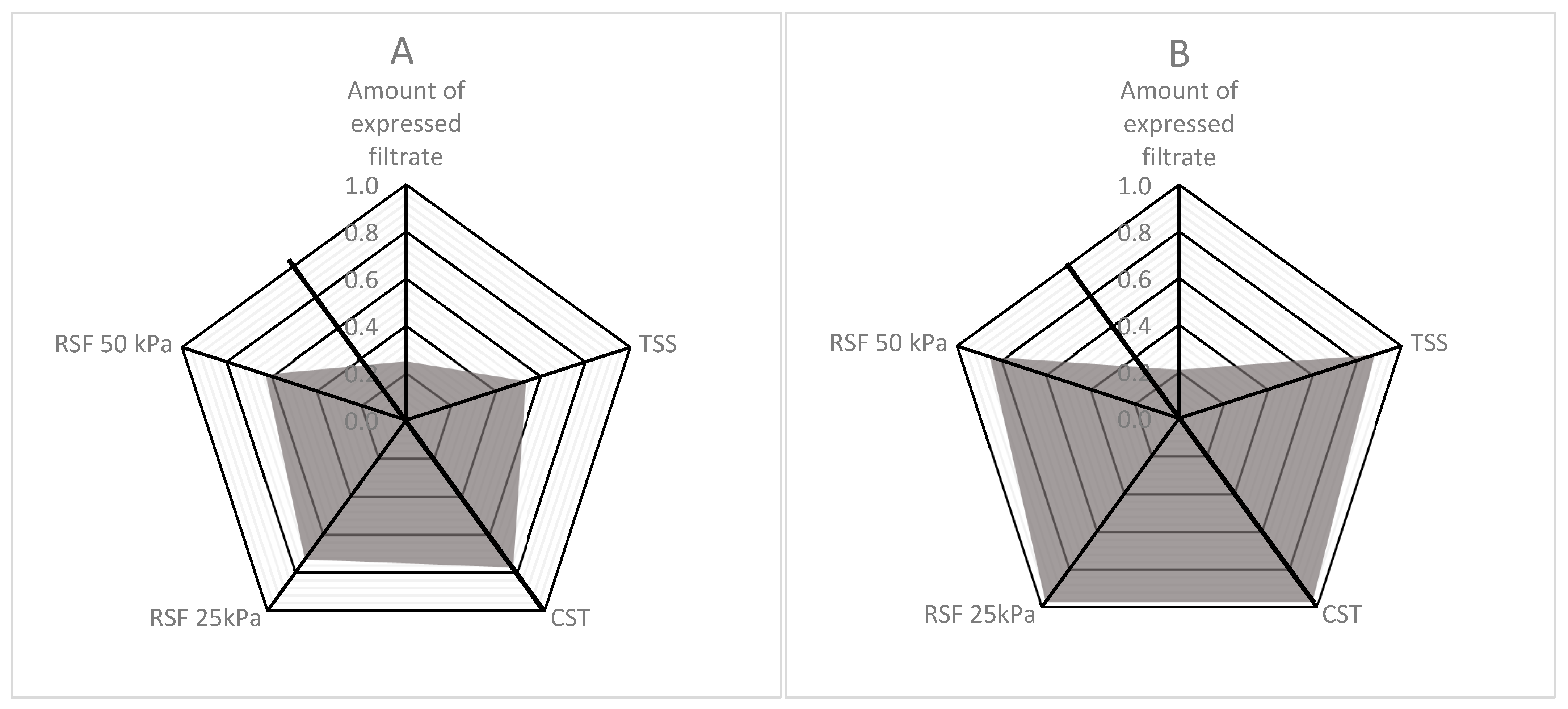
Radar charts are based on the geometric comparison of axis lengths; therefore, the absence of a common scale would lead to the dominance of parameters with large numerical values. The applied normalization preserves proportional relationships between values without altering their ranking or relative differences. Assigning a value of 1 to the best-performing variant, 0 to the worst-performing variant, and intermediate values accordingly enables an unambiguous qualitative interpretation of each parameter. As a result, all axes of the radar chart are dimensionless and equivalent. Consequently, the shape and area of the radar chart can be interpreted as an aggregated measure of performance within a multicriteria analysis. Representative radar charts are shown at Figure 1 to aid in understanding the above explanation of their construction; charts A and B present polyelectrolyte ZETAG 7557 at dosages of 4 and 8 kg/t ds, respectively.
The arrangement of parameters on the radar chart axes was designed so that the criteria describing the centrifuge were placed adjacent to each other, while the indicators related to the filter press were positioned on the opposite side. The Capillary Suction Time (CST), being a parameter common to both devices, was placed centrally, delineating the division between the areas corresponding to the analyzed dewatering mechanisms.
The ends of the radii plotted along each axis were connected with lines to form a polygon, the shape of which reflects the relationships among the individual parameters for the analyzed variant. The entire figure is presented in a polar coordinate system, with axes separated by equal angles to ensure a symmetrical chart design. The value of each parameter can be determined based on its distance from the chart’s center, while comparisons between variants are made by examining the shapes and areas of analogous polygons on corresponding charts [21].
In addition, the included charts serve as a reference point for the discussion presented in the subsequent part of the article, facilitating the tracking of the comparison approach and the interpretation of both the shape and the area of the radar plots. This allows the reader to better understand how simultaneous changes in multiple parameters translate into the conclusions formulated in the Section 4, without the need to repeatedly refer back to the methodological description.

3.3. Radar Charts Analysis

Sludge dewatering performed in centrifuges and filter presses pursues the same objective; however, it is based on different phase separation mechanisms, which affect the relevance of individual process parameters. Consequently, changes in polyelectrolyte dosage influence dewatering efficiency in different ways depending on the applied technology and therefore cannot be interpreted uniformly.
In centrifuges, separation occurs in a centrifugal force field and requires the formation of stable, shear-resistant flocs; therefore, effective dewatering is typically achieved at higher polyelectrolyte dosages. Increasing the dosage improves phase separation and centrate clarity but simultaneously increases the sensitivity of the process to variations in sludge properties. In filter presses, dewatering proceeds through pressure-driven filtration, and the key factor is the ability of the sludge to form a permeable filter cake structure. Under these conditions, favorable effects are often obtained already at lower polyelectrolyte dosages, whereas overdosing may lead to deterioration of filtration performance [22]. Table 4 summarizes the specific values of the analyzed parameters before and after treatment, along with the corresponding efficiency.
A comprehensive analysis of the radar charts indicates that, with increasing polyelectrolyte dosage, the polygon areas expand noticeably and assume a more regular shape. The radius corresponding to the volume of released liquid becomes longer, while the values of CST and filtration resistance decrease, reflecting a simultaneous improvement in the measured parameters. Within each individual polyelectrolyte, a gradual development of the polygon shape can be observed as the dosage increases—initially, the areas are small and the radii limited, whereas at higher dosages, the charts exhibit a pronounced extension toward more favorable values.
For each of the tested polyelectrolytes, an increase in dosage results in a distinct enlargement of the polygon area and a more uniform distribution of the radii; however, the rate and nature of these changes differ depending on the product. Certain polyelectrolytes, such as Zetag 7557 and Super Floc C446, cause a marked elongation of the radius corresponding to the volume of released liquid and a simultaneous shortening of the radii representing CST and filtration resistance, even at low dosages [23]. This indicates the rapid attainment of favorable dewatering conditions, the sludge becomes more susceptible to water separation, and flow resistance decreases. The charts for these formulations quickly assume the form of an expanded, symmetrical polygon, suggesting that small amounts of polyelectrolyte are sufficient to achieve a balanced relationship among the parameters.
A comparison of polygon shapes between polyelectrolytes at identical dosages also reveals which of them act more selectively on specific groups of parameters. Some polyelectrolytes enhance the indicators associated with centrifuge performance to a greater extent, while others primarily influence parameters relevant to the operation of filter presses (SRF). In each case, the CST—positioned as the dividing point between the chart sectors—makes it possible to assess how uniformly the individual criteria respond to increasing dosage and in which part of the diagram the improvement is most pronounced. The positive correlation between polyelectrolyte dosage and the volume of released liquid results in the elongation of the corresponding radius, whereas the negative relationship with CST and filtration resistance leads to a shortening of their radii at higher dosages.
The analysis of the largest radar chart areas reveals a distinct shift in the hierarchy of polyelectrolyte effectiveness with increasing dosage. At a dose of 4 kg/t ds, Zetag 7557 and the emulsion Zetag 9249FS show the best performance, whereas at 8 kg/t ds, Super Floc C446 performs best in the filter press and Zetag 8190 in the centrifuge. At the highest dosage of 16 kg/t ds, ACE 80202 and Praestol 665 again stand out, achieving the maximum radar chart areas. The data summarized in the table indicate that, with increasing dosage, not only does the size of the polygons change, but the arrangement of the most effective polyelectrolytes changes as well. The best results are obtained for those formulations that exhibit a consistent increase in efficiency across the entire dosage range.
To enable a quantitative comparison of the results obtained for the centrifuge and the filter press, the outcomes of the radar chart analyses were additionally presented in the form of bar charts. These charts were based on the analysis of the radar chart area, which was treated as a synthetic indicator describing the overall effect of sludge conditioning. This value reflects the combined influence of all analyzed process parameters, allowing a transition from a qualitative interpretation of radar chart shapes to a clear quantitative assessment.
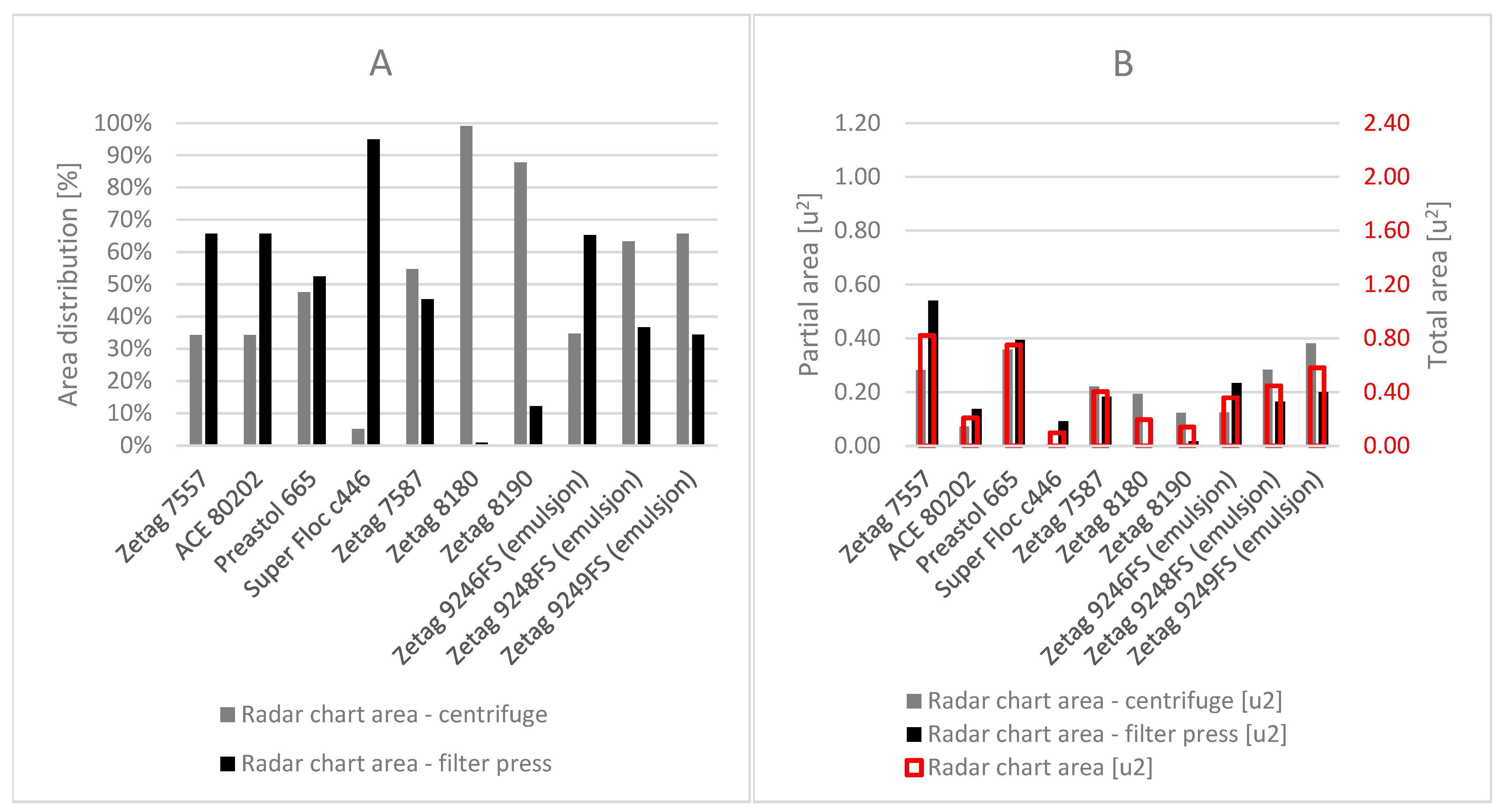
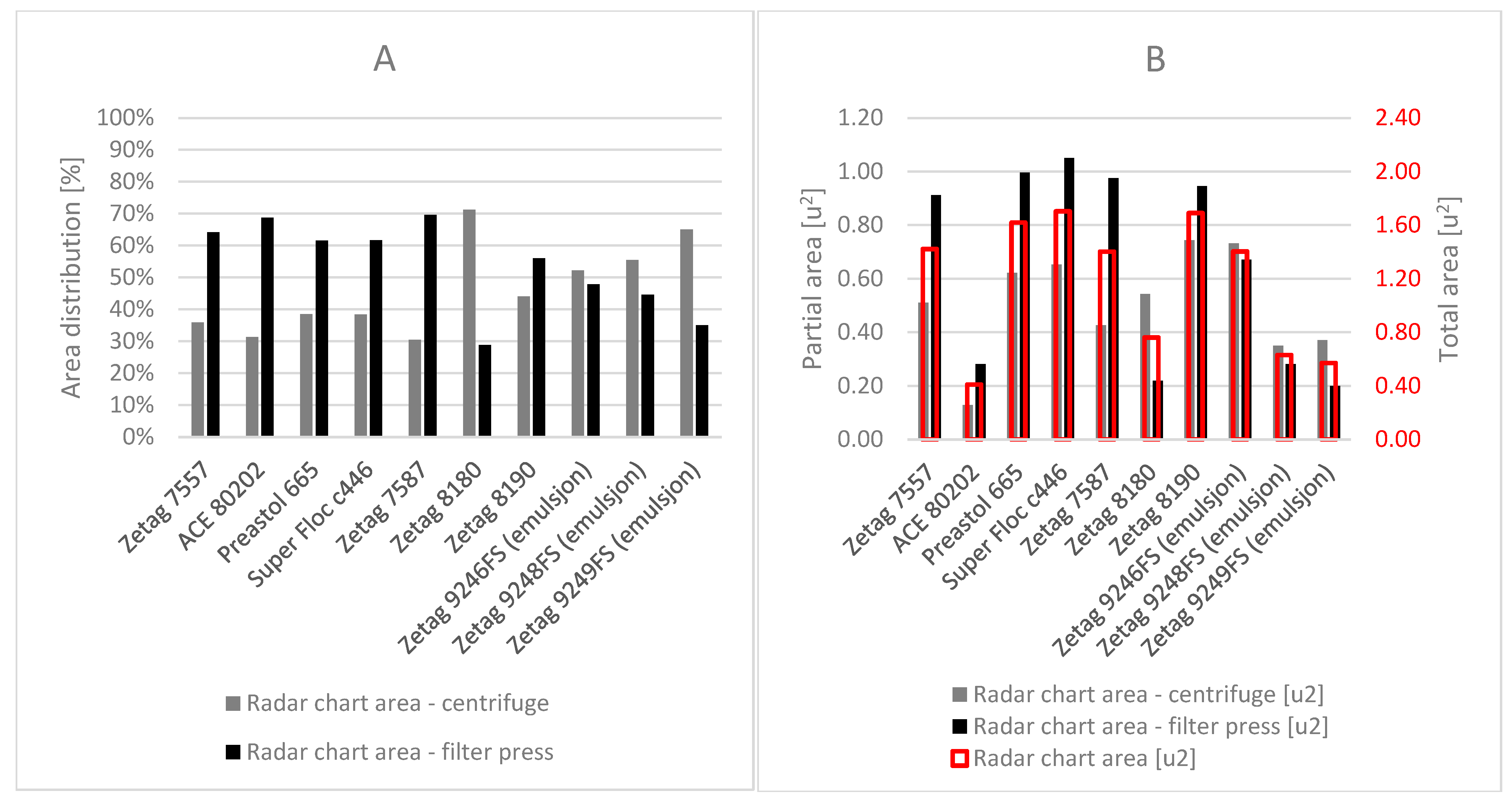
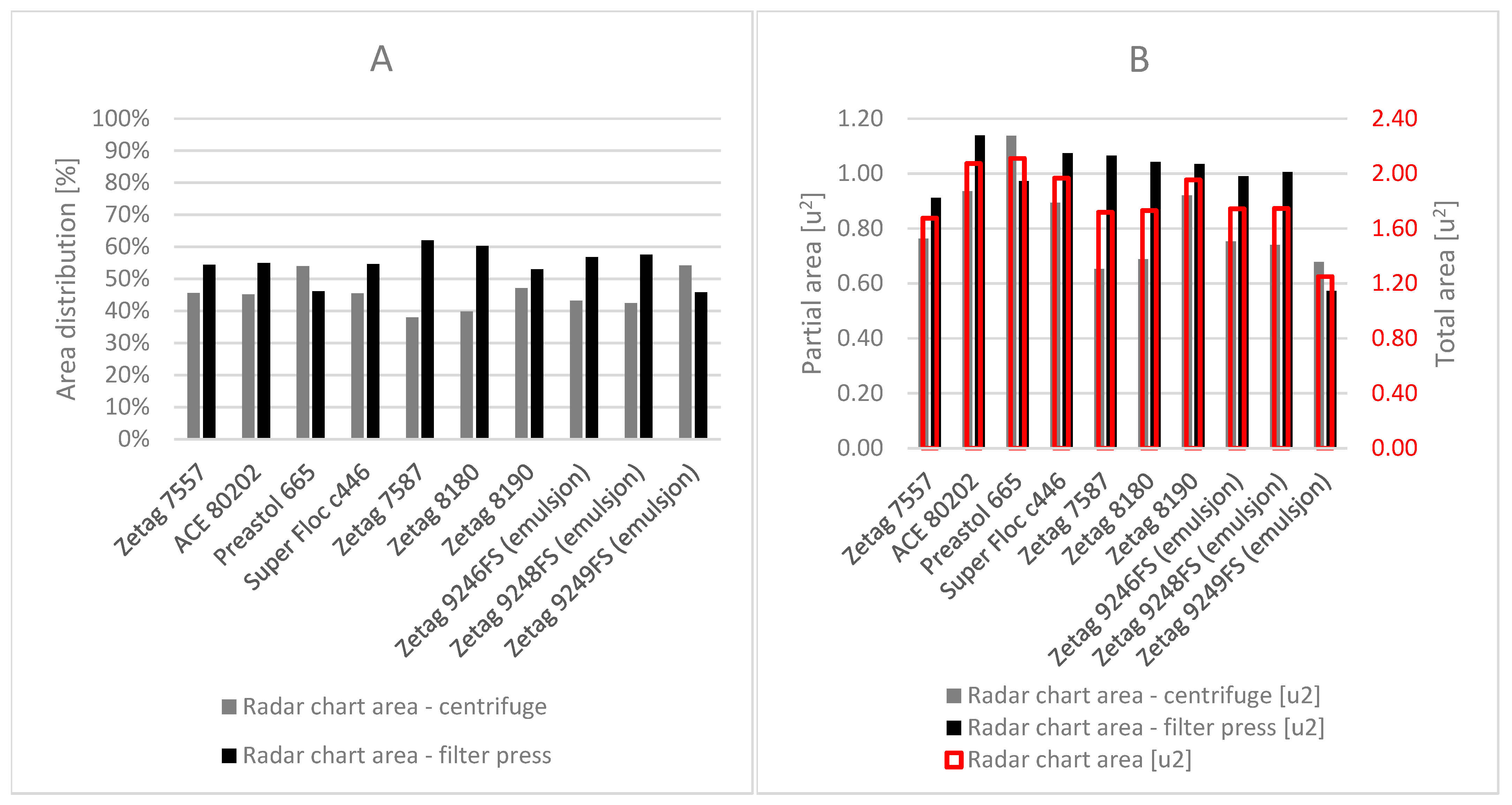
Figure 2A, Figure 3A and Figure 4A presents the percentage contribution of the radar chart area attributed to the centrifuge and the filter press relative to the total area obtained for a given polyelectrolyte. This form of presentation makes it possible to assess the extent to which a given conditioning strategy favors one dewatering mechanism over the other. The percentage share indicates whether the process effect is clearly dominated by a single device or exhibits a more balanced distribution between the two technologies [24].
Figure 2B, Figure 3B and Figure 4B shows the absolute values of the radar chart areas obtained for the centrifuge and the filter press, as well as their sum for individual polyelectrolytes. This presentation provides information on the overall intensity of the conditioning effect, enabling an evaluation of whether a given reagent generates a relatively strong or weak total process effect, regardless of the applied dewatering method. However, this chart does not indicate how the effect is distributed between the analyzed devices, which is intentionally addressed by Figure 2A, Figure 3A and Figure 4A.
The combined analysis of both charts allows for a simultaneous assessment of the magnitude of the total conditioning effect and its distribution between the centrifuge and the filter press. This approach eliminates the need for direct comparison of multiple individual process parameters and enables rapid, visual identification of polyelectrolytes with a universal character or those clearly favoring a single dewatering method. Accordingly, Figure 2, Figure 3 and Figure 4 present three successive sets of bar charts corresponding to polyelectrolyte dosages of 4, 8, and 16 kg/t ds, respectively.
When comparing the formulations, it is evident that at a dose of 4 kg/t ds, Zetag 9249FS (emulsion) achieves the best performance in the centrifuge, while Zetag 7557 performs best in the filter press. At a dose of 8 kg/t ds, the leading products are Zetag 8190 and Super Floc C446, respectively, indicating a shift in the hierarchy of the most effective polyelectrolytes compared to the 4 kg/t ds dosage. For centrifuges, emulsions did not show improvement, suggesting limited effectiveness of increasing the dosage in this range. In contrast, for filter presses, Zetag 7557 significantly improved its performance, although Super Floc C446 maintained a slight advantage, achieving the highest efficiency in this group.
At a dose of 16 kg/t ds, the radar plots culminate with Praestol 665 in the centrifuge and ACE 80202 in the filter press. It is noteworthy that at the highest dosages, the differences between the total radar chart areas become considerably smaller than at lower dosages, indicating a gradual equalization of performance levels. For ACE 80202, relatively poor results are observed at low dosages, while satisfactory performance is achieved only at higher dosages. Meanwhile, Praestol 665 maintains consistently high conditioning efficiency, which at the maximum dosage becomes comparable to the values obtained for ACE 80202. The largest increase in bar height occurs between 4 and 8 kg/t ds, suggesting a threshold for dosage intensification. Increasing it to 16 kg/t ds sustains the upward trend and stabilizes the relationship between technologies at a high level.
The polyelectrolyte doses applied during sludge dewatering with filter presses and centrifuges showed a clear trend: higher dosages led to greater process efficiency. The total area of the radar chart, which served as a composite indicator representing both technologies, increased from less than 0.5 at zero dosage to more than 1.8 at a dosage of 16 kg/t ds.
In the partial areas, the filter press showed an advantage at both the lowest and the highest dosages, whereas at 4 kg/t ds, the centrifuge temporarily achieved better performance. Both technologies, however, responded similarly to increasing dosage, with the most significant efficiency gain observed between 4 and 8 kg/t ds.
In summary, the results indicate that an increase in polyelectrolyte dosage enhances not only the overall synthetic efficiency indicators but also promotes a more balanced conditioning effect across both dewatering technologies. At higher dosages, the operational performance of the filter press and the centrifuge becomes comparable, whereas at lower polyelectrolyte concentrations, the centrifuge demonstrates reduced efficiency. This relationship is clearly reflected in the radar chart analysis.
The volume of released liquid increased systematically, reaching more than four times the control value. In the correlation matrix, calculated from raw data, a negative relationship was observed between dosage and CST, suspended solids, and filtration resistance. This indicates a conflict between dewatering efficiency and the quality of the supernatant liquid. The strong correlation between filtration resistances measured at different pressures confirmed that this parameter is crucial for both technologies, justifying its inclusion in both radar chart fields.
In summary, increasing the polyelectrolyte dosage significantly enhances sludge dewatering efficiency, as reflected in the growing radar chart areas and the convergence of performance between the filter press and centrifuge. The greatest improvement in efficiency occurs between 4 and 8 kg/t ds, after which the process stabilizes at a high level of 16 kg/t ds. With further dosage increases, the differences between the technologies become progressively less significant, indicating a balance in their performance. The selection of a specific polyelectrolyte and technology should therefore depend on the intended compromise between dewatering efficiency and process quality and stability.

4. Discussion

Although the concept underlying the use of the correlation matrix is to identify potential predictors of sludge dewaterability, the obtained results did not allow such predictors to be determined. This was due either to the low levels of correlation or to the fact that the detected relationships did not provide meaningful information. It is worth noting, however, that other researchers have obtained promising results, successfully applying this method to predict dewatering efficiency.
Notably, they extended the correlation matrix analysis by incorporating a range of additional physicochemical parameters of sludge, such as cation content (Na, K, Ca, Mg, Fe, Al), extracellular polymeric substances (EPS), zeta potential, rheological parameters, and particle size distribution (PSD). Among the additional variables analyzed, the strongest correlations with sludge dewaterability were reported for the rheological index n and sludge dryness (r = +0.92), aluminum (Al) content and polyelectrolyte consumption (r = +0.87), and calcium (Ca) content and polyelectrolyte consumption (r = +0.86), as well as total extracellular polymeric substances (bulk EPS) and sludge dryness (r = +0.81).
The correlation coefficient r values were derived from the determination coefficients (R2) provided in the report, preserving the sign of the relationship described in the source text. This conversion is statistically justified, since for simple linear relationships (with one independent variable), the determination coefficient R2 is the square of the Pearson correlation coefficient r. The conversion was necessary to enable comparison with the data obtained in the present study, where correlations were also expressed in terms of the r coefficient. Including these variables allowed for a comprehensive assessment of the influence of sludge properties on its dewaterability [8].
In this study, the correlation matrix analysis did not provide meaningful results; therefore, the data were presented using radar charts. This form of visualization was selected due to its greater effectiveness compared with conventional bar or line plots. Radar charts allow for multidimensional assessment and enable the simultaneous comparison of multiple performance indicators within a single graphical framework. As a result, they facilitate rapid identification of both favorable and unfavorable effects associated with individual dosages and tested polyelectrolytes across all evaluated variables, which is essential for optimizing their use in different dewatering technologies A key novelty of this research was the introduction of an additional subdivision of the radar chart into two distinct sections, an approach that has not been previously described in the literature. This modification made it possible not only to determine a single composite value for the entire chart area but also to calculate separate composite indicators for centrifuges and filter presses. Consequently, the proposed methodology constitutes an innovative extension of existing analytical approaches.
For each of the tested polyelectrolytes, an increase in dosage led to a distinct enlargement of the polygon area and a more uniform distribution of the radii; however, the dynamics and character of these changes varied depending on the agent applied. Highly cationic polyelectrolytes, such as Zetag 7557 and Super Floc C446, produced a significant increase in the radius corresponding to the volume of released liquid even at low dosages, while simultaneously reducing the radii representing CST and filtration resistance. This effect results from their strong ability to neutralize the negative surface charges of sludge particles, leading to the rapid formation of compact and highly permeable flocs.
The literature confirms the relationship between polyelectrolyte dosage and dewatering efficiency, although it is not linear. Up to a certain dosage level (approximately 3.5–4.0 g/kg ds for sewage sludge), a systematic improvement in process parameters is observed; however, beyond this range, a threshold effect occurs. Further increases in dosage no longer yield significant improvement and may even impair dewatering efficiency due to surface overcharging of particles and clogging of filtration pores [25]. Owing to their high cationicity, the dewatering effect becomes noticeable even at lower dosages and further increases in concentration enhance these changes more effectively than in the case of polyelectrolytes with lower cationicity.
Effective optimization of sewage sludge dewatering requires a comprehensive evaluation of the relationships between polyelectrolyte type and dosage, as well as the rheological properties and dewaterability of the sludge. The selection of an appropriate conditioning agent for a specific dewatering technology should therefore be based on a holistic analysis that considers multiple key parameters rather than isolated indicators. Dependence solely on the Capillary Suction Time (CST) as a measure of conditioning effectiveness is insufficient and may result in suboptimal technological decisions. Despite this limitation, CST is still frequently used in practice by researchers and plant operators as the primary and sometimes the only criterion for assessing polyelectrolyte performance in sludge dewatering processes [26]. The results of the present study indicate that although CST reflects the rate of water removal, it does not enable a clear or definitive evaluation of polyelectrolyte efficiency within a given dewatering technology. Analysis of the radar charts confirms that informed decision making requires a broader assessment that includes, among other factors, centrifugation tests, determination of specific filtration resistance, and evaluation of suspended solids in the separated liquid phase.
The study focused on the two most commonly used dewatering technologies—belt filtration using a filter press and centrifugation. To determine the most appropriate polyelectrolyte for use in a filter press, both the universal CST indicator and the parameter directly related to press performance, namely the specific resistance to filtration evaluated at pressures of 25 and 50 kPa, were applied. In laboratory experiments, SRF measurements were carried out within a pressure range of 30 to 80 kPa, which is consistent with standard conditions used for sewage sludge filtration testing. This pressure interval ensures adequate filtration force while preventing excessive compaction of the floc structure, thereby enabling the determination of reliable and repeatable SRF values. According to the literature, pressures above 100 kPa alter flow behavior and result in an overestimation of filtration resistance [27].
Such pressure levels also allow the identification of the boundary between efficient water removal and excessive sludge compaction, which is essential for understanding sludge rheological behavior and for optimizing process operating conditions [28]. The specific resistance to filtration is derived from Darcy’s law, which describes liquid flow through a porous medium. Determination of this parameter makes it possible to distinguish the initial resistance of the filter medium from the progressively increasing resistance of the developing sludge cake. In a filter press, a similar mechanism occurs, as the sludge layer becomes thicker and more compact over time, leading to higher flow resistance and the need for increased pressure to sustain filtration. Consequently, the SRF parameter effectively represents the mechanisms governing practical filtration processes. Nevertheless, it has been reported that despite its strong theoretical basis, this method may exhibit limited correlation with actual filtration performance, depending on sludge characteristics and the presence of impurities [29].
To identify the most suitable polyelectrolyte for centrifuge operation, the assessment was based on the volume of the separated liquid phase, the concentration of suspended solids in this liquid, and, similarly to the filter press evaluation, the CST as a rapid and broadly applicable indicator. The applicability of laboratory-scale centrifugation to simulate industrial centrifuge performance has been confirmed in previous studies, which reported a high degree of agreement between laboratory and full-scale systems with respect to supernatant volume and suspended solids concentration. Consequently, direct comparison with results obtained from full-scale centrifuges is not required, as laboratory measurements conducted under appropriate centrifugal acceleration and operating time (gt) conditions accurately represent actual process behavior. Evaluation of both the quantity and clarity of the supernatant liquid therefore provides a reliable characterization of dewatering efficiency, and the results obtained can be directly related to industrial scale performance [30].
The parameters of 5600 g acceleration, 5000 rpm rotational speed, and 10 min centrifugation time fall within the commonly applied ranges for laboratory-scale sludge separation studies. Researchers have typically used values of 4500–6000 g at 4500–5500 rpm for 8–12 min, confirming effective particle separation under laboratory conditions. Similarly, tests conducted at 5000 rpm (~5600 g) for 10 min produced stable and reproducible dewatering results. These settings provide sufficient centrifugal force and time for the formation of a sludge layer while minimizing excessive shear of the flocculant polymer. Therefore, the adopted parameters are appropriate and consistent with literature recommendations [31].

5. Conclusions

The greatest improvement in sludge dewatering efficiency was observed at polyelectrolyte dosages in the range of 4–8 kg/t ds. At dosages above 16 kg/t ds, the process stabilizes, and further increases in dosage yield only marginal benefits. Table 5 presents the best results obtained for the individual polyelectrolyte dosages.
Statistical analysis of the results based on the correlation matrix did not allow for the identification of a universal parameter describing sludge dewaterability, as the obtained correlation coefficients were low and no statistically significant relationships were demonstrated between the analyzed indicators. In particular, it was shown that capillary suction time (CST) cannot be treated as the primary criterion for assessing sludge dewaterability, as it does not fully reflect conditioning effects, and its use as a decision making parameter may lead to inadequate technological choices.
The application of separated radar charts enabled independent assessment of dewatering performance in filter presses and centrifuges, allowing for more accurate matching of polyelectrolytes to specific technologies. The obtained results confirm that the effectiveness of individual polyelectrolytes depends on both the applied dosage and the type of dewatering equipment, which is reflected in the changing ranking of the best-performing products as the dosage increases. At high polyelectrolyte dosages, filter presses and centrifuges exhibit comparable performance; however, at low dosages, filter presses reach near-maximum efficiency more rapidly, whereas parameters characteristic of centrifuges attain their maximum values only at higher dosages.
At the same time, it was found that increasing the polyelectrolyte dosage, although conducive to improving dewatering efficiency, occurs at the expense of supernatant liquid quality, manifested by an increase in suspended solids concentration. This phenomenon necessitates a conscious compromise at the stage of the sludge conditioning process design. Consequently, the optimal selection of a polyelectrolyte should not be based on a single indicator but rather on a multicriteria assessment that accounts for the specificity of the applied technology, making the radar chart-based approach a useful decision-support tool for technological optimization.

Supplementary Materials

The following supporting information can be downloaded at https://www.mdpi.com/article/10.3390/w18010076/s1, The complete results of the calculated radar chart areas and the radar charts themselves are included in the Supplementary Materials. Table S1. Radar chart areas divided for centrifuge and filter press. Table S2. Measurement data for each polyelectrolyte. Figure S1. Radar charts for polyelectrolyte ZETAG 7557 with dosages. Figure S2. Radar charts for polyelectrolyte ACE 80202 with dosages. Figure S3. Radar charts for polyelectrolyte PREASTOL 665 with dosages. Figure S4. Radar charts for polyelectrolyte SUPER FLOC C446 with dosages. Figure S5. Radar charts for polyelectrolyte ZETAG 7587 with dosages. Figure S6. Radar charts for polyelectrolyte ZETAG 8180 with dosages. Figure S7. Radar charts for polyelectrolyte ZETAG 8190 with dosages. Figure S8. Radar charts for polyelectrolyte ZETAG 9246FS (EMULSION) with dosages. Figure S9. Radar charts for polyelectrolyte ZETAG 9248FS (EMULSION) with dosages. Figure S10. Radar charts for polyelectrolyte ZETAG 9249FS (EMULSION) with dosages.

Author Contributions

Conceptualization: S.M.; methodology, S.M. and M.M.-H.; formal analysis, A.R. and B.P.; investigation, S.M., A.R. and B.P.; resources, S.M.; data curation, S.M., A.R. and B.P.; writing—original draft preparation, S.M., A.R., B.P. and M.M.-H.; writing—review and editing, S.M., A.R., B.P. and M.M.-H.; visualization, A.R. and B.P.; supervision, S.M. and M.M.-H. All authors have read and agreed to the published version of the manuscript.

Funding

This research received no external funding.

Data Availability Statement

The original contributions presented in this study are included in the article/Supplementary Materials. Further inquiries can be directed to the corresponding author.

Acknowledgments

The authors would like to express great appreciation to the Municipal and Sewage Company in Wrocław.

Conflicts of Interest

Author Stanisław Miodoński is employed by the company Wroclaw Municipal Water and Sewage Company. The remaining authors declare that the research was conducted in the absence of any commercial or financial relationships that could be construed as a potential conflict of interest.

References

  1. Wu, B.; Dai, X.; Chai, X. Critical Review on Dewatering of Sewage Sludge: Influential Mechanism, Conditioning Technologies and Implications to Sludge Re-Utilizations. Water Res. 2020, 180, 115912. [Google Scholar] [CrossRef]
  2. Qi, Y.; Thapa, K.B.; Hoadley, A.F.A. Application of Filtration Aids for Improving Sludge Dewatering Properties—A Review. Chem. Eng. J. 2011, 171, 373–384. [Google Scholar] [CrossRef]
  3. Wakeman, R.J. Separation Technologies for Sludge Dewatering. J. Hazard. Mater. 2007, 144, 614–619. [Google Scholar] [CrossRef]
  4. Liu, J.; Yang, Q.; Wang, D.; Li, X.; Zhong, Y.; Li, X.; Deng, Y.; Wang, L.; Yi, K.; Zeng, G. Enhanced Dewaterability of Waste Activated Sludge by Fe(II)-Activated Peroxymonosulfate Oxidation. Bioresour. Technol. 2016, 206, 134–140. [Google Scholar] [CrossRef]
  5. Shen, J.; Zhou, X.; Zhou, L.; Huang, Z.; Huang, S. Effect of Sludge Conditioning by Microbial Fuel Cell on Electro-Dewatering Performance. J. Water Process Eng. 2023, 55, 104137. [Google Scholar] [CrossRef]
  6. Kowalczyk, M. The Influence of the Addition of Cement and Zeolite on the Increase in the Efficiency of Sewage Sludge Dewatering in the Pressure Filtration Process. Energies 2024, 17, 685. [Google Scholar] [CrossRef]
  7. Sawalha, O.; Scholz, M. Assessment of Capillary Suction Time (CST) Test Methodologies. Environ. Technol. 2007, 28, 1377–1386. [Google Scholar] [CrossRef] [PubMed]
  8. Lin, Y.; Xu, Z.; Jiang, Y.; Jiang, Y.; Xiao, K. Correlating Parameters Evaluating Sludge Dewaterability and Morphological Characteristics of Sludge Flocs by a Commercial Smartphone and Image Analysis. Water 2025, 17, 2019. [Google Scholar] [CrossRef]
  9. Gray, N.F. Capillary Suction Time (CST). In Progress in Filtration and Separation; Academic Press: Cambridge, MA, USA, 2015; pp. 659–670. [Google Scholar] [CrossRef]
  10. Sawalha, O.; Scholz, M. Impact of Temperature on Sludge Dewatering Properties Assessed by the Capillary Suction Time. Ind. Eng. Chem. Res. 2012, 51, 2782–2788. [Google Scholar] [CrossRef]
  11. Volume 28, No. 8, August 1956 of Sewage and Industrial Wastes on JSTOR. Available online: https://www.jstor.org/stable/i25033124 (accessed on 3 November 2025).
  12. Fitria, D.; Scholz, M.; Swift, G.M. Sludge Dewaterability Testing: Relationship Between Capillary Suction Time (CST) and Specic Resistance to Filtration (SRF) for Coagulation Occulation Sludge. Res. Sq. 2023. [Google Scholar] [CrossRef]
  13. Ginisty, P.; Mailler, R.; Rocher, V. Sludge Conditioning, Thickening and Dewatering Optimization in a Screw Centrifuge Decanter: Which Means for Which Result? J. Environ. Manag. 2021, 280, 111745. [Google Scholar] [CrossRef] [PubMed]
  14. Pambou, Y.B.; Fraikin, L.; Salmon, T.; Crine, M.; Léonard, A. Enhanced Sludge Dewatering and Drying Comparison of Two Linear Polyelectrolytes Co-Conditioning with Polyaluminium Chloride. In Proceedings of the ECSM 2014—4th European Conference on Sludge Management, Izmir, Turkey, 26–27 May 2014. [Google Scholar]
  15. Bień, B. The Effect of PIX 123 and Polyelectrolyte Zetag 8160 on the Conditioning and Dewatering of Sewage Sludge. Eng. Prot. Environ. 2017, 20, 165–174. [Google Scholar] [CrossRef]
  16. Rice, E.W.; Baird, R.B.; Eaton, A.D. Standard Methods for the Examination of Water and Wastewater, 23rd ed.; American Public Health Association: Washington, DC, USA, 2017. [Google Scholar]
  17. Wooley, J.F. Specific Resistance. Operational Control Tests for Mwastewater Facilities. Instructor’s Manual [and] Student Workbook; Linn-Benton Community College: Albany, OR, USA, 1982. Available online: https://files.eric.ed.gov/fulltext/ED221401.pdf (accessed on 10 October 2025).
  18. Cydzik-Kwiatkowska, A.; Nosek, D.; Wojnowska-Baryła, I.; Mikulski, A. Efficient Dewatering of Polymer-Rich Aerobic Granular Sludge with Cationic Polymer Containing Hydrocarbons. Int. J. Environ. Sci. Technol. 2020, 17, 361–370. [Google Scholar] [CrossRef]
  19. Duan, R.; Tong, J.; Sutton, A.J.; Asch, D.A.; Chu, H.; Schmid, C.H.; Chen, Y. Origami Plot: A Novel Multivariate Data Visualization Tool That Improves Radar Chart. J. Clin. Epidemiol. 2023, 156, 85–94. [Google Scholar] [CrossRef]
  20. Zavadskas, E.K.; Turskis, Z. Multiple Criteria Decision Making (MCDM) Methods in Economics: An Overview. Technol. Econ. Dev. Econ. 2011, 17, 397–427. [Google Scholar] [CrossRef]
  21. Kalonia, C.; Kumru, O.S.; Kim, J.H.; Middaugh, C.R.; Volkin, D.B. Radar Chart Array Analysis to Visualize Effects of Formulation Variables on IgG1 Particle Formation as Measured by Multiple Analytical Techniques. J. Pharm. Sci. 2013, 102, 4256–4267. [Google Scholar] [CrossRef]
  22. Smyth, M.; Minall, R. Predicting Sludge Dewaterability: A Reverse-Run Mass Balance Approach to Close the Expectation Gap. In Proceedings of the European Biosolids and Organic Resources Conference, Edinburgh, Scotland, 15–16 November 2016. [Google Scholar]
  23. Kamizela, T.; Kowalczyk, M. Dewaterability of Digested Sludge Conditioned with Sludge from a Water Treatment Plant. Rocz. Ochr. Sr. 2019, 21, 217–233. [Google Scholar]
  24. Cheng, C.F.; Lin, C.J.; Liu, I.C. Mobile Data Visualisation Interface Design for Industrial Automation and Control: A User-Centred Usability Study. Appl. Sci. 2025, 15, 10832. [Google Scholar] [CrossRef]
  25. Qi, S.; Song, Y.; Zhou, S.; Zhang, J.; Peng, Y. Effect of Ion Type and Molecular Weight of Polyacrylamide on Dewatering Performance of Flotation Clean Coal. Physicochem. Probl. Miner. Process. 2025, 61, 204126. [Google Scholar] [CrossRef]
  26. Wang, H.-F.; Wang, H.-J.; Hu, H.; Zeng, R.J. Applying Rheological Analysis to Understand the Mechanism of Polyacrylamide (PAM) Conditioning for Sewage Sludge Dewatering. RSC Adv. 2017, 7, 30274–30282. [Google Scholar] [CrossRef]
  27. Qi, Y.; Chen, J.; Xu, H.; Wu, S.; Yang, Z.; Zhou, A.; Hao, Y. Optimizing Sludge Dewatering Efficiency with Ultrasonic Treatment: Insights into Parameters, Effects, and Microstructural Changes. Ultrason. Sonochem. 2024, 102, 106736. [Google Scholar] [CrossRef]
  28. Sveegaard, S.G.; Keiding, K.; Christensen, M.L. Compression and Swelling of Activated Sludge Cakes During Dewatering. Water Res. 2012, 46, 4999–5008. [Google Scholar] [CrossRef] [PubMed]
  29. Sanchis-Perucho, P.; Torres, K.M.M.; Ferrer, J.; Robles, Á. Evaluating the Potential of Off-Line Methodologies to Determine Sludge Filterability from Different Municipal Wastewater Treatment Systems. Chem. Eng. J. 2023, 468, 143537. [Google Scholar] [CrossRef]
  30. To, V.H.P.; Nguyen, T.V.; Vigneswaran, S.; Duc Nghiem, L.; Murthy, S.; Bustamante, H.; Higgins, M. Modified Centrifugal Technique for Determining Polymer Demand and Achievable Dry Solids Content in the Dewatering of Anaerobically Digested Sludge. Desalin. Water Treat. 2016, 57, 25509–25519. [Google Scholar] [CrossRef]
  31. Kang, X.; Cai, L.; Li, Y.; Gao, X.; Bai, G. Investigation on the Separation Performance and Multiparameter Optimization of Decanter Centrifuges. Processes 2022, 10, 1284. [Google Scholar] [CrossRef]
Figure 1. Radar chart for Polyelectrolyte ZETAG 7557 (A)—dose 4 kg/t ds, (B)—dose 8 kg/t ds.
Water 18 00076 g001
Figure 2. Radar chart area: (A)—Radar chart area distribution dose 4 kg/t ds, (B)—Radar chart area dose 4 kg/t ds.
Water 18 00076 g002
Figure 3. Radar chart area: (A)—Radar chart area distribution dose 8 kg/t ds, (B)—Radar chart area dose 8 kg/t ds.
Water 18 00076 g003
Figure 4. Radar chart area: (A)—Radar chart area distribution dose 16 kg/t ds, (B)—Radar chart area dose 16 kg/t ds.
Water 18 00076 g004
Table 1. Sludge parameters.
Parameter-
pH7.5–8.2
Temperature22–25 °C
Colorblack
Structurehomogeneous, dense
Odornon-offensive odor
Moisture content (MC)96.56%
Total solids33,677 g/m3
Density1025–1034 kg/m3
Table 2. Polyelectrolyte parameters and pricing.
NameFormCation LevelActive SubstancePrice for Active
Substance [€/kg]
Zetag 7557 1Pearla60%100%€ 5.65
Zetag 8180 1Powder80%100%€ 4.71
Zetag 8190 1Powder90%100%€ 4.71
Zetag 9249FS 1Emulsion90%46%€ 5.62
Zetag 9246FS 1Emulsion60%41%€ 6.31
Zetag 9248FS 1Emulsion80%46%€ 5.62
Zetag 7587 1Pearla80%100%€ 5.65
Superflock C446 2Powder60%100%€ 4.71
Praestol 665 3Powder60%100%€ 4.71
Ace 80202 4Powder80%100%€ 4.71
1 (Brentag Polska Sp. z o.o., Kędzierzyn-Koźle, Poland); 2 (Kemipol Sp. z o.o., Police, Poland); 3 (Klimapol Sp. z o.o., Jastków, Poland); 4 (Allied Solutions Poland Sp. z o.o., Warszawa, Poland).
Table 3. Correlation coefficient.
Dose Amount of
Expressed Filtrate
CST
[Average]
SRF 25 kPaSRF 50 kPaTSS
Dose 1.000.75−0.80−0.59−0.63−0.40
Amount of expressed filtrate 0.751.00−0.56−0.36−0.42−0.16
CST [average]−0.800.561.000.600.680.33
SRF 25 kPa−0.590.360.601.000.890.58
SRF 50 kPa−0.630.420.680.041.000.59
TSS −0.400.160.330.580.591.00
Table 4. Specific values obtained for the parameters with the efficiency of the parameter.
Test NameUnitsAverage Value Before TreatmentAverage Value After Treatment with Highest DosageEfficiency [%]
CSTs487.8444.6591%
SRF 25 kPam/kg82.0918.4778%
SRF 50 kPam/kg146.8329.0580%
Amount of expressed filtratemL117.56129.799%
TSSg/m398.5644.6555%
Table 5. Best results in different categories.
CategoryGeneralCentrifugeFilterpress
Best polyelectrolyte (dose 4 kg/t ds)Preastol 665Zetag 9249FS (emulsion)Zetag 7557
Best polyelectrolyte (dose 8 kg/t ds)Zetag 8180Zetag 8190Super Floc C446
Best polyelectrolyte (dose 16 kg/t ds)Preastol 665Preastol 665Ace 80202
Disclaimer/Publisher’s Note: The statements, opinions and data contained in all publications are solely those of the individual author(s) and contributor(s) and not of MDPI and/or the editor(s). MDPI and/or the editor(s) disclaim responsibility for any injury to people or property resulting from any ideas, methods, instructions or products referred to in the content.