Article

Analytical Description and Evaluation of Soil Infiltration Processes Under Horizontal Moistube Irrigation


Institute of Geological Hazards Prevention, Gansu Academy of Sciences, Lanzhou 730099, China
*
Authors to whom correspondence should be addressed.
Water 2026, 18(1), 35; https://doi.org/10.3390/w18010035
Submission received: 14 November 2025 / Revised: 15 December 2025 / Accepted: 18 December 2025 / Published: 22 December 2025
(This article belongs to the Special Issue Assessment and Management of Soil Salinity: Methods and Technologies)

Abstract

In the optimal design and operation of moistube irrigation systems, a wetted body and its components are important factors. This study presents an analytical characterization of the soil wetted body under horizontal moistube irrigation. In the laboratory experiment, the temporal and spatial changes in the wetted body during irrigation were observed. Specifically, the maximum wetting distances in the horizontal, vertical upward, and vertical downward directions on the soil profile were measured every 30 min. Additionally, images documenting the wetted body’s changes at different time points were recorded throughout the experiment. On this basis, by locating the soil profile of the wetted body in a coordinate system, the main motion equations describing the temporal and spatial changes in the wetted body’s soil profile were derived. Through integral processing of these motion equations, an analytical model for the wetted body under horizontal moistube irrigation was constructed. Finally, the model was validated using the experimental data. The results show that the model outcomes are consistent with the natural movement of water in the soil. Therefore, when characterizing the size of the wetted body under horizontal moistube irrigation using the soil profile area, the proposed method, which involves analyzing the shape and components of the wetted body’s soil profile at different time points and determining its soil profile size by integrating four distinct parabolas, is feasible.

1. Introduction

The adoption of efficient irrigation systems is a key measure to reduce water loss in irrigated agriculture. Among these systems, moistube technology is widely used due to its relatively high water use efficiency [1,2]. Moistube irrigation is an emerging micro-irrigation technology. In this technology, moistubes enable continuous water outflow along their entire lateral length, with the water seepage rate primarily adjusted by the applied water pressure [3,4,5,6].
During irrigation, water infiltrates the soil and forms wetted bodies of varying shapes. The size of these wetted bodies is determined by three key factors: the volume of water applied to the soil, the outflow rate of the emitter, and the soil’s hydraulic properties [7,8,9]. Wetted body shapes differ across irrigation methods. In surface drip irrigation, water creates a wetted body in the soil that resembles a truncated sphere or ellipsoid [10,11]. For horizontal moistube irrigation, by contrast, the soil wetted body takes the approximate shape of an elliptical cylinder, with the moistube serving as its central axis [12,13]. The size of a wetted body is closely tied to its shape; selecting the appropriate shape allows for accurate identification of the key components that define the wetted body’s size. Studies indicate that, for surface drip irrigation, the primary components characterizing the soil wetted body are the wetting depth in the soil profile and the wetting radius at the soil surface [7,8,14]. For subsurface drip irrigation, the key components include the wetting depth, wetting radius, and upward wetting distance within the soil profile [15,16]. As a subsurface irrigation technology, horizontal moistube irrigation’s soil wetted body is defined by three main components: the wetting distances in the horizontal direction, vertical upward direction, and vertical downward direction of the soil profile [5,13,17].
To quantify the size of soil wetted bodies, Thorburn et al. (2003) employed the Philip model to investigate the wetted body dimensions of 29 soil types under drip irrigation conditions, and their findings revealed that the field structure of soil exerts a significant influence on the wetted bodies [18]. Cook et al. (2003) estimated the approximate radial and vertical wetting distances of emitters in homogeneous soil using the developed software tool WetUp and compared these distances with those obtained from an elliptical plotting function [19]. The results showed that for low-permeability soils, the ellipsoidal approximation can well describe the wetted body; however, in high-permeability soils, this method tends to underestimate radial wetting, especially as irrigation volume increases. Moncef et al. (2016) proposed an analytical method for predicting the soil wetted volume in surface drip irrigation based on the Green–Ampt assumption, and they validated this method by comparing it with the Healy and Warrick models. The results indicated that the soil wetted volumes predicted by this method are close to those predicted by the Healy and Warrick models [20]. Kilic et al. (2019) constructed an analytical model for calculating the three-dimensional (3D) volumetric wetting pattern of surface drip irrigation based on laboratory experiments, and they further analyzed and evaluated the model using experimental data. The results demonstrated that the model outputs are consistent with the infiltration characteristics of soil and the natural movement patterns of water in the soil profile [11]. Although many scholars have developed various analytical models for drip irrigation systems, there have been no corresponding studies, either domestically or internationally, focused on analytical models constructed with moistube irrigation systems as the research object. Furthermore, the analytical models currently being developed for drip irrigation systems are not applicable to moistube irrigation systems. Therefore, it is particularly necessary to establish an analytical model dedicated to analyzing wetted bodies in moistube irrigation, as it can provide a new tool for researching soil wetted bodies in moistube irrigation.
Based on experiments, this study analyzed time-series photographs of soil wetted bodies under horizontal moistube irrigation to obtain temporal variations in their shape and size. Using parabolic equations, an analytical model of the moistube irrigation wetted body was then established via integration. Finally, experimental data were used to determine the model parameters, and the model was evaluated against the natural water infiltration characteristics in the soil profile. The results provide a scientific basis for the design, operation, and management of moistube irrigation projects.

2. Materials and Methods

The soil wetted body under horizontal moistube irrigation exhibits an approximately elliptic cylindrical shape, with the moistube serving as its central axis. In practical irrigation scenarios, however, the area of the wetted soil profile can effectively characterize the soil wetting status in the vicinity of the moistube. Consequently, this study investigates the temporal and spatial variations in the wetted soil profile under horizontal moistube irrigation and further proposes a novel method for analyzing the soil wetted body in horizontal moistube irrigation.

2.1. Laboratory Experiment

Loam soil was selected as the experimental soil, with samples collected from the 0–40 cm depth horizon. The soil was subjected to air-drying, crushing, thorough homogenization, and passed through a 2 mm sieve to obtain dry soil particles. Distilled water was added and mixed thoroughly, after which the soil was sealed for 24 h, after completion the sealing process, the initial moisture content of the sample was determined to be 3% using the oven-drying method (105 °C for 24 h), and the saturated hydraulic conductivity of the soil was determined using a double-ring infiltrometer, with the measurement results summarized in Table 1. To achieve a homogeneous soil profile, after the soil moisture had reached a uniform distribution, the soil was packed into the experimental column in 5 cm thick layers at the preset bulk density, The dimensions of the soil column were 50 cm in length, 20 cm in width, and 70 cm in height. For the experiment, moistubes with a diameter of 2 cm and a length of 20 cm were employed; additional irrigation technical parameters are detailed in Table 1. Given the continuous operation of moistube irrigation and the low water outflow rate of moistubes, the dimensions of the wetted body were precisely measured at 30 min intervals over a continuous monitoring period under the condition of homogeneous soil texture.

2.2. Feature Analysis and Model Development

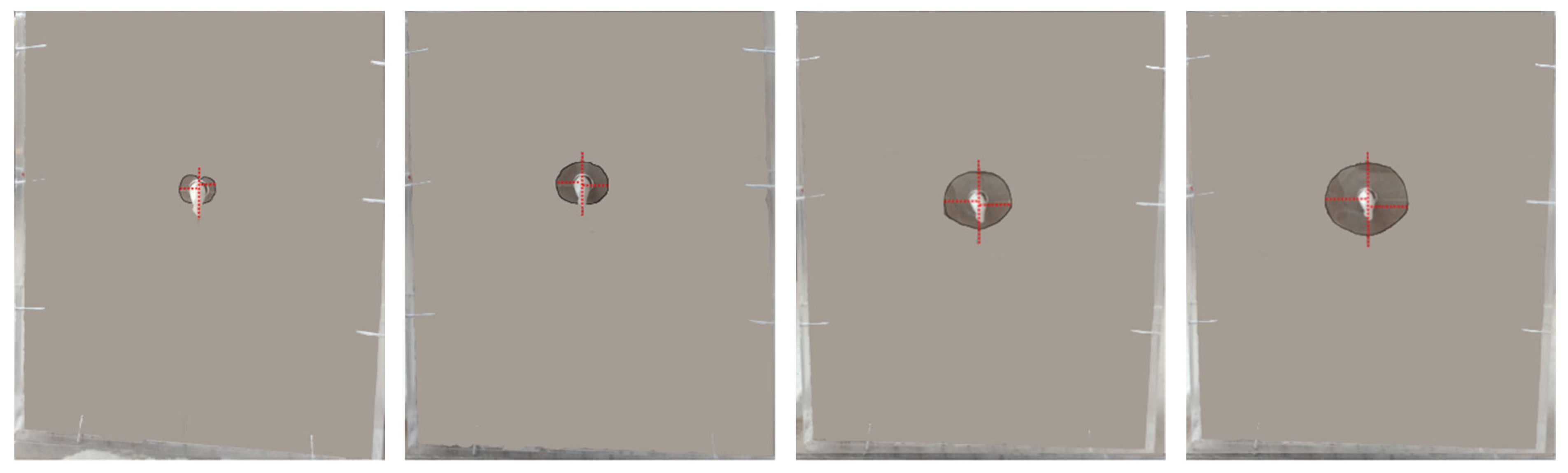
To determine the components and characteristics of the wetted body in horizontal moistube irrigation, real-time video recordings were made during the experiment, followed by temporal and spatial analysis of the footage. Figure 1 illustrates the partial movement of the wetted body captured in these real-time recordings. At the onset of irrigation, the wetted area was split into two parts (left and right) with the moistube as its central axis. As irrigation progressed, the wetted contour expanded outward, exhibiting a pattern where the wetting front moved fastest downward, followed by horizontal movement, and slowest upward.
Analysis of wetted body photographs captured during the initial irrigation stage revealed that the wetted body in horizontal moistube irrigation migrates horizontally (leftward and rightward) with the vertical central axis of the moistube as the pivot. After irrigation had proceeded for a specified duration, the left and right parts converge at the vertical central axis of the moistube. Based on this observation, the wetted area in Figure 1 was processed to delineate the wetted body’s contour lines. Additionally, the maximum distances from the left and right wetted contours to the moistube’s vertical central axis were annotated, with specific details illustrated in Figure 2.
As shown in Figure 2, the components of the wetted body exhibit continuous yet unsteady changes across time and space, with the maximum dimension of the wetted body occurring in the direction downward from the moistube. Since the moistube has a diameter of 2 cm, which is significantly smaller than the migration distance of the soil wetted body, the influence of the moistube’s cross-sectional area on investigating the soil wetted body in moistube irrigation is negligible. Thus, the wetted body presented in Figure 2 was simplified, and the simplified version is illustrated in Figure 3.
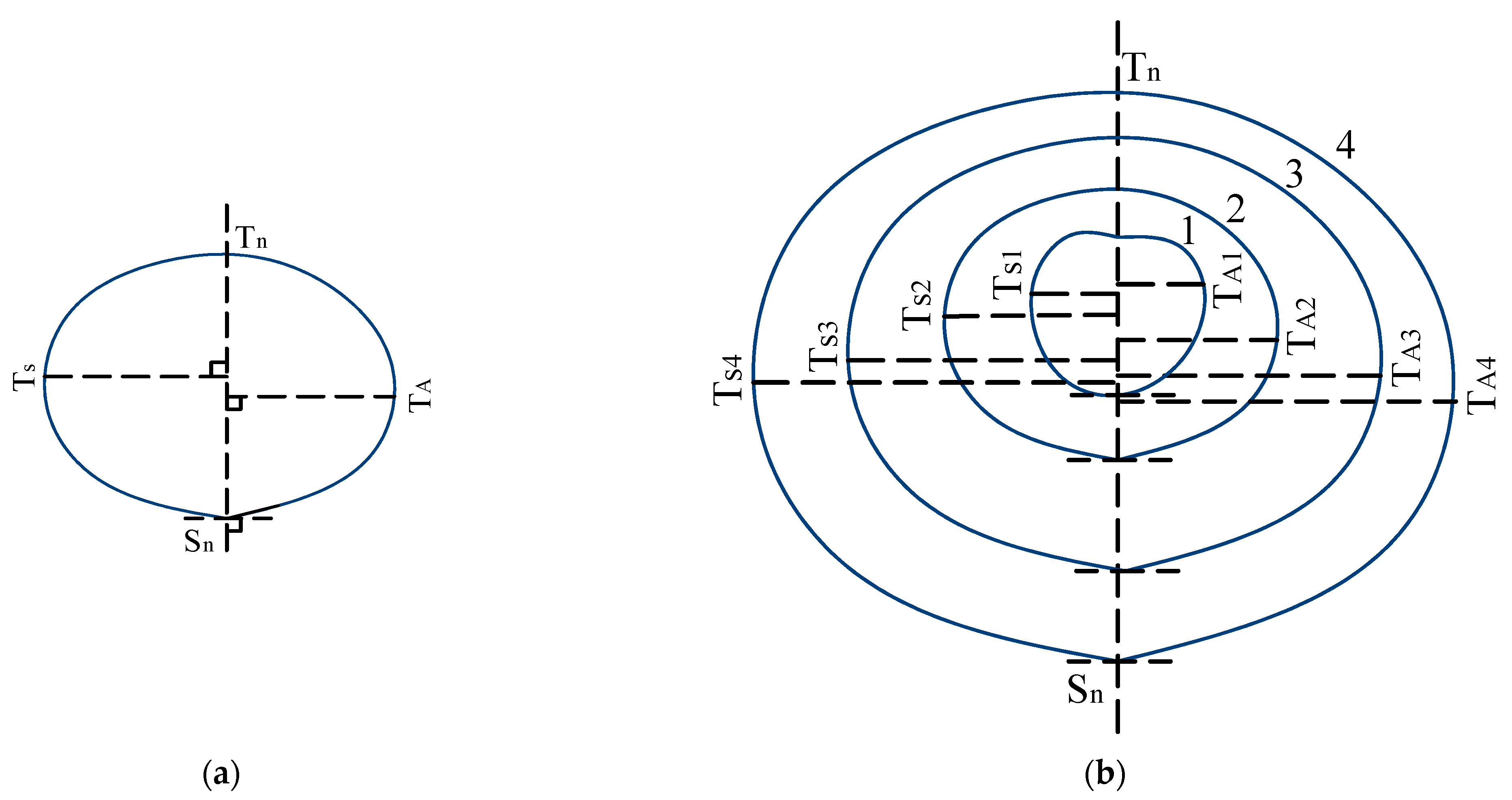
Considering the single wetted body in Figure 3a, the line TnSn denotes the vertical central line of the moistube. Points Ts and TA are the horizontally farthest points from the line TnSn, while the intersections between the wetted body’s contour line and the line TnSn correspond to the tangent points where a horizontal line touches the lowest and highest points of the wetted body’s contour line, respectively. Figure 3b schematically illustrates the wetted body’s contour lines at distinct time points (t1, t2, t3, and t4). It can be observed that the soil profiles of the wetted body at all these time points satisfy all the aforementioned conditions concurrently.
As shown in Figure 3, the maximum width of the wetted body within the soil profile is denoted by the symbols Ts and TA. The points Tn, TA, Ts, and Sn associated with the wetted body exhibit continuous yet unsteady variations across both time and space. For instance, the line TnSn is perpendicular to the soil surface and intersects Sn, which is the deepest point of the wetted body in the soil profile, and this line does not serve as an axis of symmetry. Furthermore, points Ts and TA are asymmetric relative to one another. Throughout the irrigation process, each component of the wetted body at every time point undergoes continuous, unsteady changes. Consequently, distinct wetting patterns emerge within the soil profile over the duration of irrigation. The wetted body formed at each distinct time point connects to that formed at the subsequent time point, collectively constituting the overall wetted body (Figure 3).
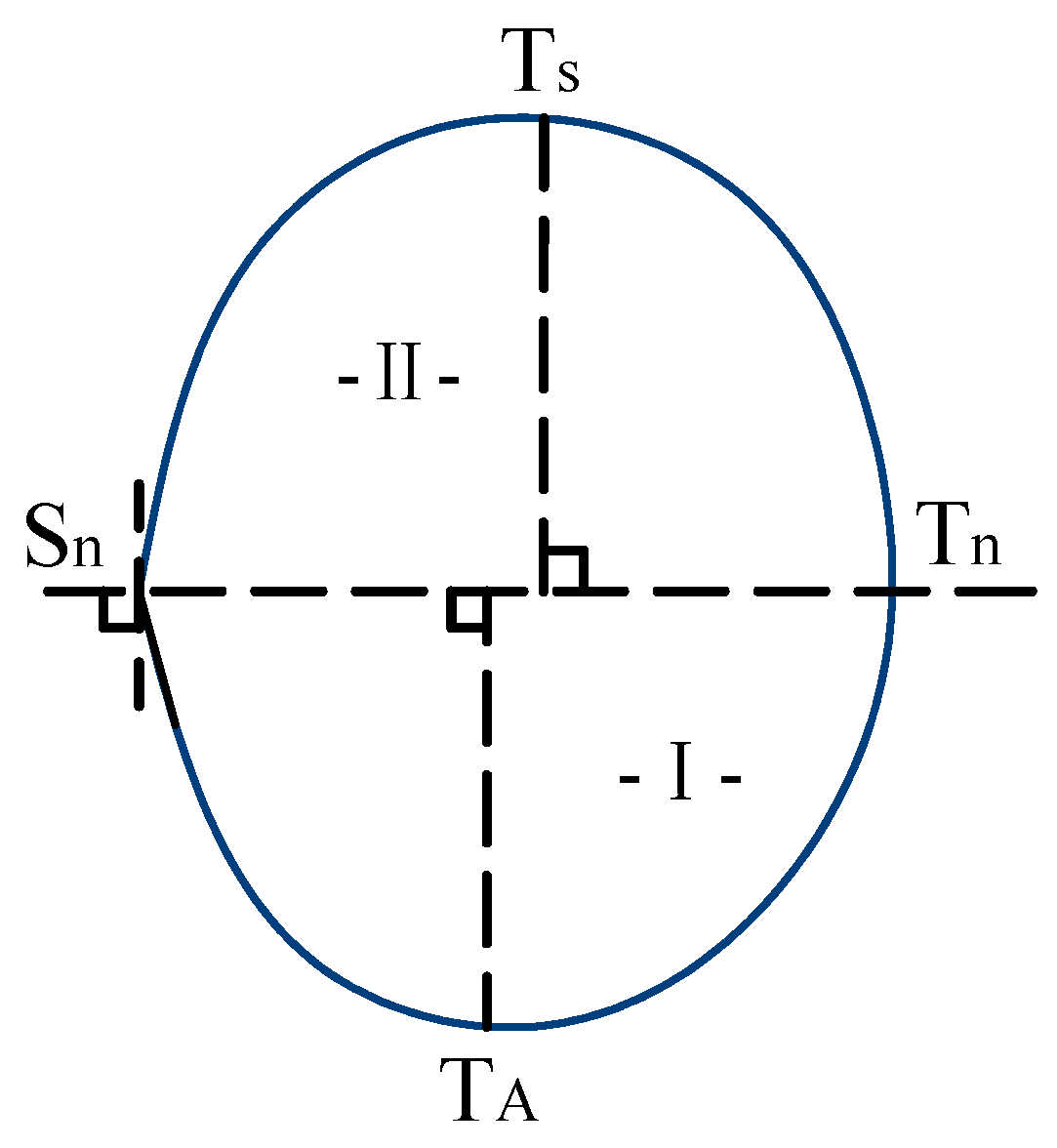
According to the characteristics of soil water movement, the contour of the wetted body is placed in a coordinate system for analytical description. Rotating the wetted body in Figure 3a clockwise by 90° makes it easier to place it in the coordinate system. This process is schematically illustrated in Figure 4:
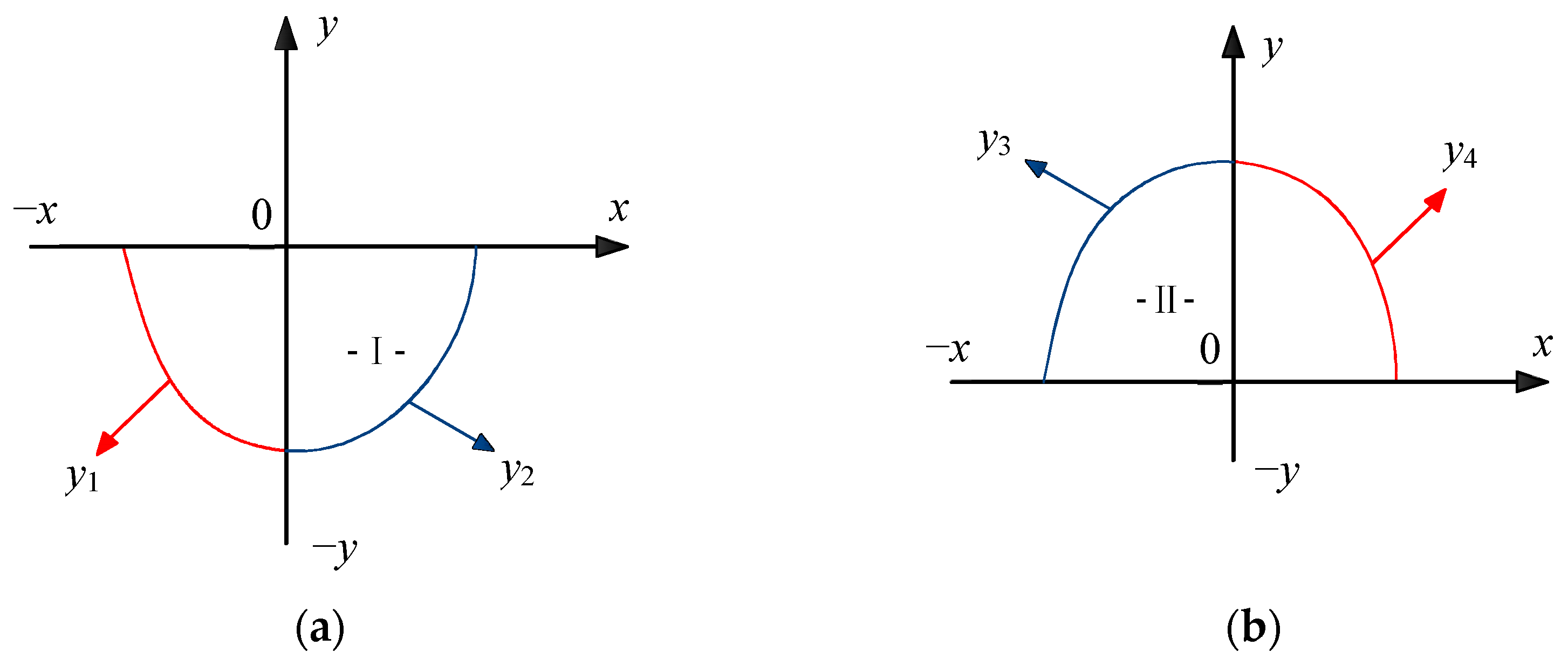
In Figure 4, for Soil Profile I, the TnSn line serves as the horizontal x-axis, and the perpendicular line extending from point TA to the TnSn line is designated as the y-axis. For Soil Profile II, the horizontal x-axis is consistent with that of Soil Profile I, while the y-axis is defined as the perpendicular line extending from point Ts to the TnSn line; details are illustrated in Figure 5.
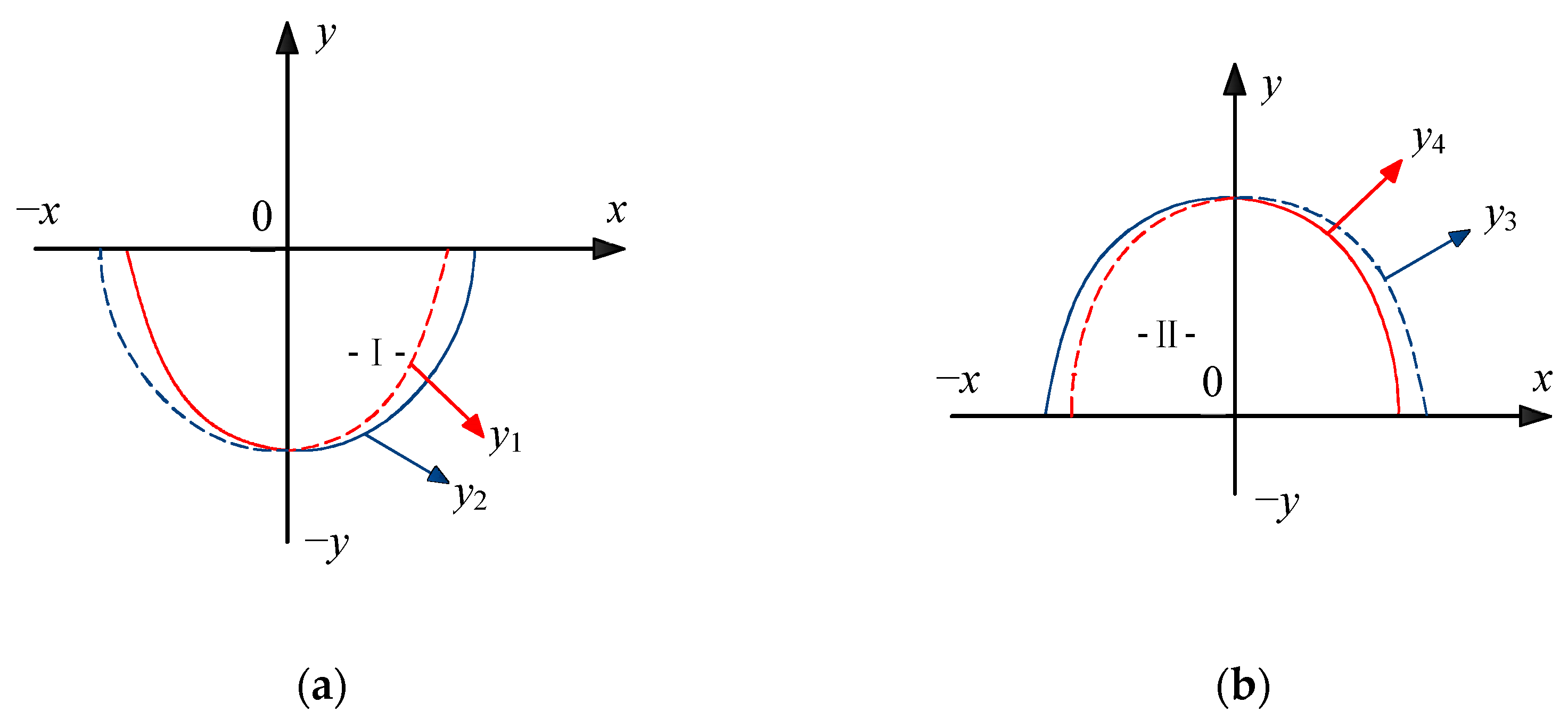
As shown in Figure 5, neither Soil Profile I nor Soil Profile II exhibits symmetry about the y-axis. Consequently, the curve located on the negative x-semi-axis of Soil Profile I was denoted as y1, whereas that on the positive x-semi-axis of Profile I was designated as y2. Similarly, for Soil Profile II, the curve on its negative x-semi-axis was marked as y3, and the curve on its positive x-semi-axis was labeled as y4. When symmetric transformations were performed on curves y1, y2, y3, and y4 with respect to the y-axis, respectively, the curves presented in Figure 6 were obtained.
As observed in Figure 6, curves y1, y2, y3, and y4 are all quadratic parabolas, and their general form can be expressed as:
y = a x 2 + b x + c
Given that the curves presented in Figure 6 are symmetric about the y-axis, the quadratic parabolas may be expressed using their standard equations, as follows:
y = a ( x r ) 2 + k
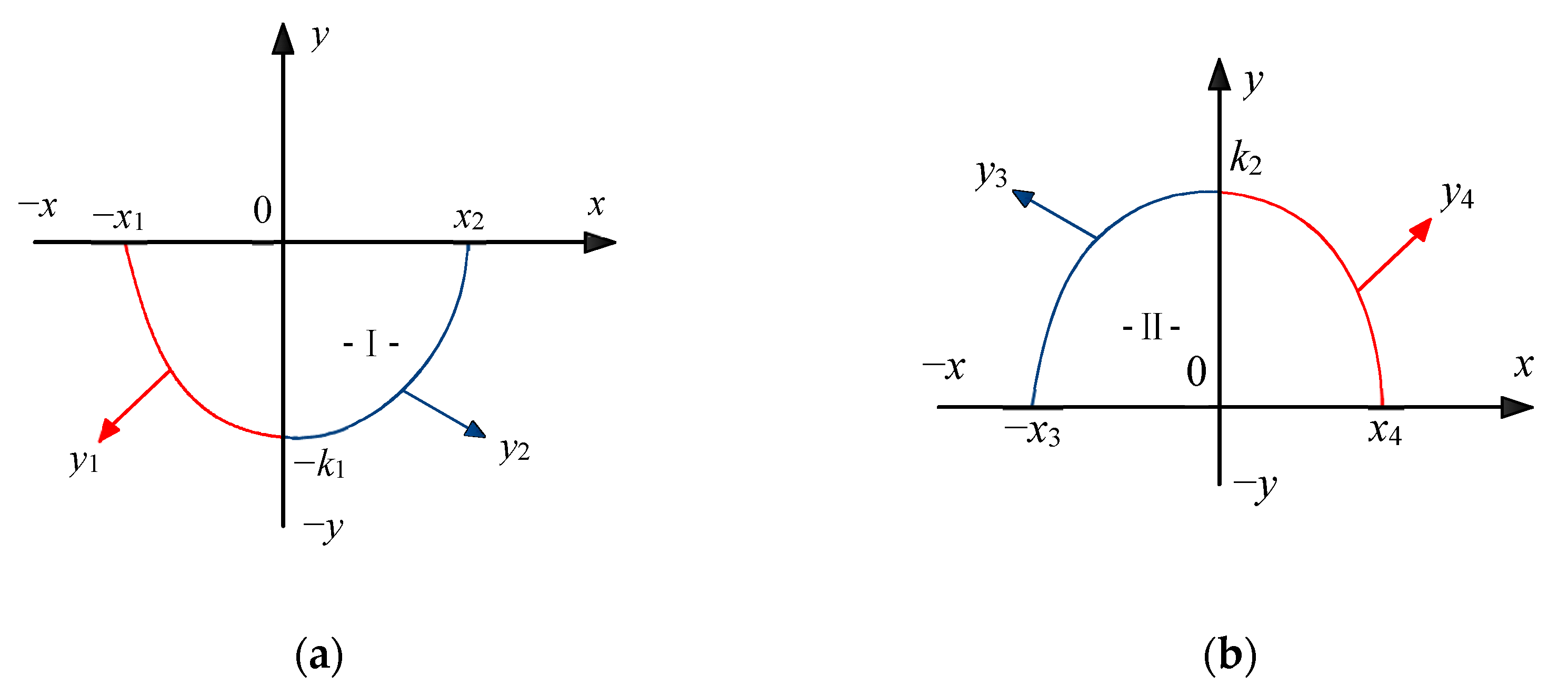
The coordinates of the intersection points between the curves and the coordinate axes are specified in Figure 7. Curves y1 and y2 possess the same vertex, with its coordinates given as (0, −k1). The intersection point of curve y1 with the x-axis is denoted as (−x1, 0), whereas the intersection point of curve y2 with the x-axis is designated as (x2, 0). In a similar manner, curves y3 and y4 share an identical vertex, whose coordinates are defined as (0, k2). The intersection point of curve y3 with the x-axis is marked as (−x3, 0), and the intersection point of curve y4 with the x-axis is labeled as (x4, 0).
Upon substituting the coordinates (0, −k1) specified in Figure 7a into Equation (2), the functional expression for curve y1 is derived as follows:
y 1 = a 1 x 2 k 1
Among these parameters, the value of a1 is k1/x12.
Treating y1 as the integrand, the integration is performed over the interval [−x1, 0], with the specific process as follows:
S 1 = x 1 0 y 1 d x = x 1 0 ( a 1 x 2 k 1 ) d x
S 1 = ( 1 3 a 1 x 3 k 1 x ) x 1 0
S 1 = 1 3 a 1 ( x 1 ) 3 k 1 ( x 1 ) = 1 3 a 1 x 1 3 k 1 x 1
Since the definite integral of a curve over a given interval geometrically represents the area of the curvilinear figure bounded by the curve, the corresponding straight lines, and the coordinate axes, the area enclosed by curve y1 and the coordinate axes is given by:
S 1 = S 1
Upon substituting the coordinates (0, −k1) specified in Figure 7a into Equation (2), the functional expression corresponding to curve y2 is derived as follows:
y 2 = a 2 x 2 k 1
Among these parameters, the value of a2 is k1/x22.
Treating y2 as the integrand, the integration is performed over the interval [0, x2], with the specific process as follows:
S 2 = 0 x 2 y 2 d x = 0 x 2 ( a 2 x 2 k 1 ) d x
S 2 = ( 1 3 a 2 x 3 k 1 x ) 0 x 2
S 2 = 1 3 a 2 x 2 3 k 1 x 2
The area enclosed by curve y2 and the coordinate axes are given by:
S 2 = S 2
In summary, the area of Soil Profile I is given by:
S I = S 1 + S 2
By substituting the coordinates (0, k2) specified in Figure 7b into Equation (2), the functional expression for curve y3 is derived as follows:
y 3 = a 3 x 2 + k 2
Among these parameters, the value of a3 is k1/x32.
Treating y3 as the integrand, the integration is performed over the interval [−x3, 0], with the specific process as follows:
S 3 = x 3 0 y 3 d x = x 3 0 ( a 3 x 2 + k 2 ) d x
S 3 = ( 1 3 a 3 x 3 + k 2 x ) x 3 0
S 3 = 1 3 a 3 ( x 3 ) 3 k 2 ( x 3 ) = 1 3 a 3 x 3 + k 2 x 3
By substituting the coordinates (0, k2) specified in Figure 7b into Equation (2), the functional expression for curve y4 is derived as follows:
y 4 = a 4 x 2 + k 2
Among these parameters, the value of a4 is k1/x42.
Treating y4 as the integrand, the integration is performed over the interval [0, x4], with the specific process as follows:
S 4 = 0 x 4 y 4 d x = 0 x 4 ( a 4 x 2 + k 2 ) d x
S 4 = ( 1 3 a 4 x 3 + k 2 x ) 0 x 4
S 4 = 1 3 a 4 x 4 3 + k 2 x 4
In summary, the area of Soil Profile II is given by:
S II = S 3 + S 4
Based on this, the area of the soil profile of the soil wetted body in horizontal moistube irrigation is as follows:
S = S I + S I I

3. Results and Analysis

By analyzing and describing two distinct, concurrent soil profiles (I and II) within a coordinate system using four distinct parabolic equations across temporal and spatial dimensions, a calculation model for the soil profile area of the wetted body in horizontal moistube irrigation was established. Table 2 provides the values of parameters a and k for soil profiles I and II, where these parameters were derived from experimental data.
For soil profile I, the parameters a1 and a2 corresponding to functions y1 and y2 consistently assume positive values (a1 > 0, a2 > 0) (Table 2), which aligns with the convex structure of soil profile I (Figure 6a and Figure 7a). Furthermore, the point (0, −k1) serves as the vertex of functions y1 and y2 for soil profile I. Based on the position of soil profile I within the coordinate system, the parameter −k1 consistently takes a negative value (−k1 < 0) (Table 2, Figure 6a and Figure 7a).
For soil profile II, the parameters a3 and a4 corresponding to functions y3 and y4 are negative (a3 < 0, a4 < 0) (Table 2), which aligns with the concave structure of soil profile II (Figure 6b and Figure 7b). Furthermore, the point (0, k2) acts as the common vertex of parabolas y3 and y4, with these two parabolas located in Zones I and II of the coordinate system, respectively. In other words, soil profile II is composed of two concurrently concave parabolas that share a single common vertex. Based on the positional distribution of soil profile II within the coordinate system (Table 2, Figure 7b), k2 consistently maintains a positive value (k2 > 0).
Table 3 presents the areas of wetted soil profiles I and II calculated via the established model at 30 min intervals. Soil profiles I and II, which form the wetted body, exhibit an asymmetric structure. Consequently, no linear relationship exists between the area increments of the soil profiles over time, and this observation aligns with the inherent movement characteristics of soil moisture [11].
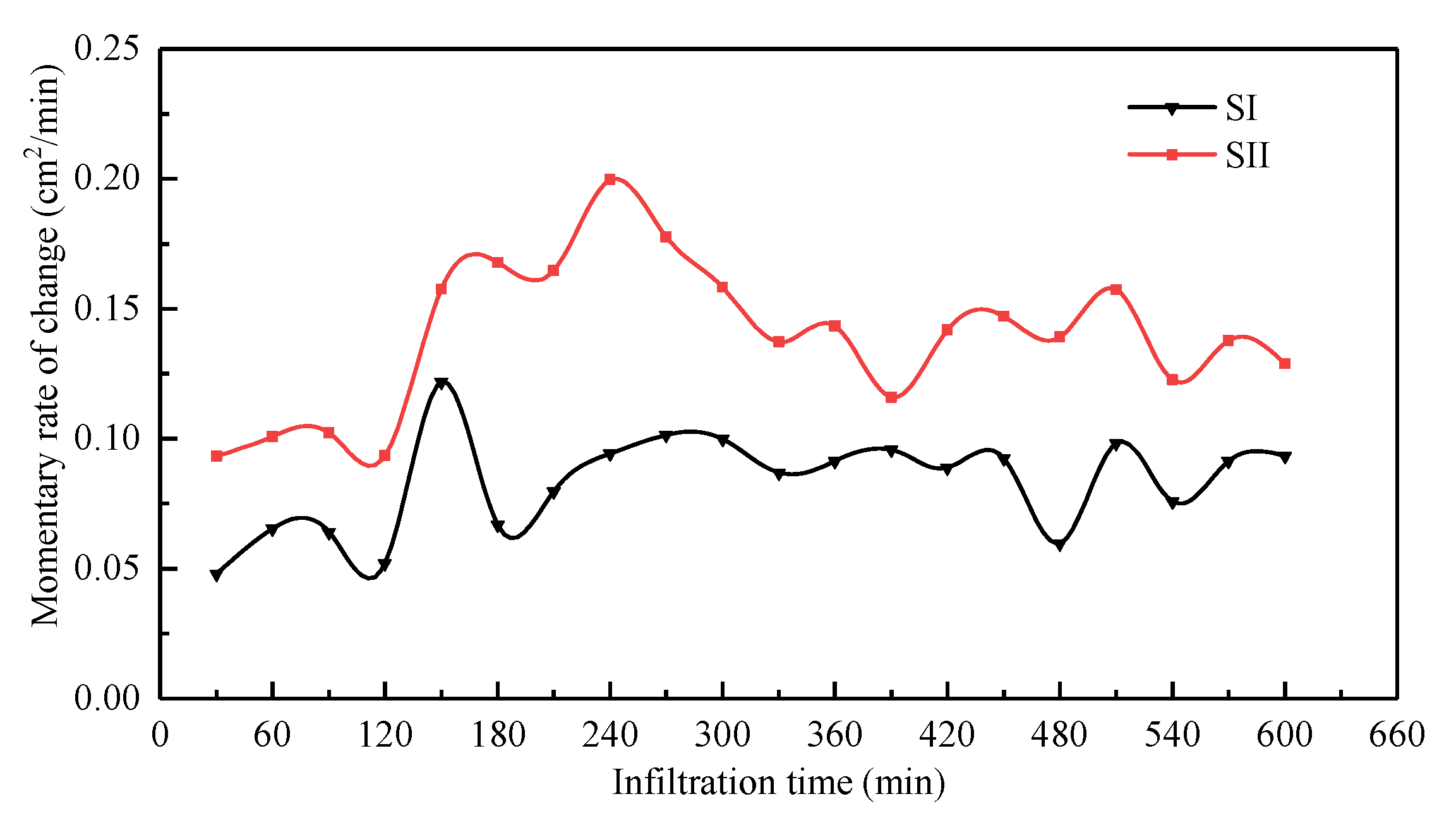
Figure 8 shows the instantaneous spatiotemporal variation rate of the areas of wetted soil profiles I and II. The instantaneous area variation rates of soil profiles I and II exhibit continuous nonlinear changes in both temporal and spatial dimensions. This is attributed to the fact that soil profiles contain soil particles of varying diameters; in addition, the pores in the soil have different shapes and volumes. Owing to the irregular and asymmetric distribution of soil particles and these pores with distinct characteristics across soil profile, soil profiles I and II also exhibit an asymmetric structure. This further directly affects the irregularity of the instantaneous area variation rate of the soil profiles. This process is consistent with the normal movement characteristics of soil moisture in the soil profile [11].
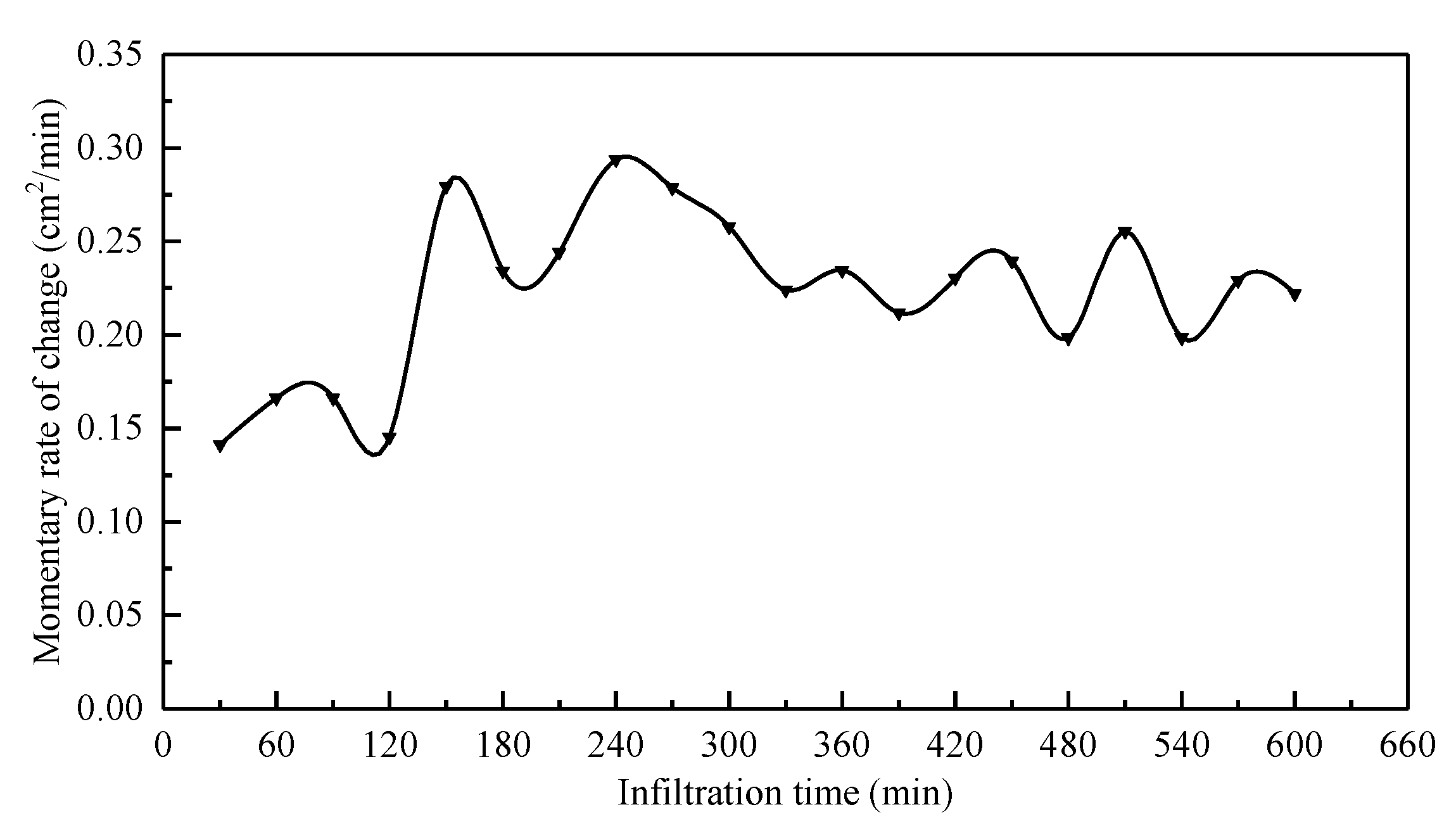
Figure 9 illustrates the instantaneous spatiotemporal variation rate of the total wetted soil profile area (S), which is the sum of soil profiles I and II. Similarly, the instantaneous area variation rate of the total wetted soil also exhibits continuous irregular changes across temporal and spatial dimensions, and it concurrently characterizes the area variation features of both soil profiles I and II. This process is also consistent with the inherent movement characteristics of soil water [11].
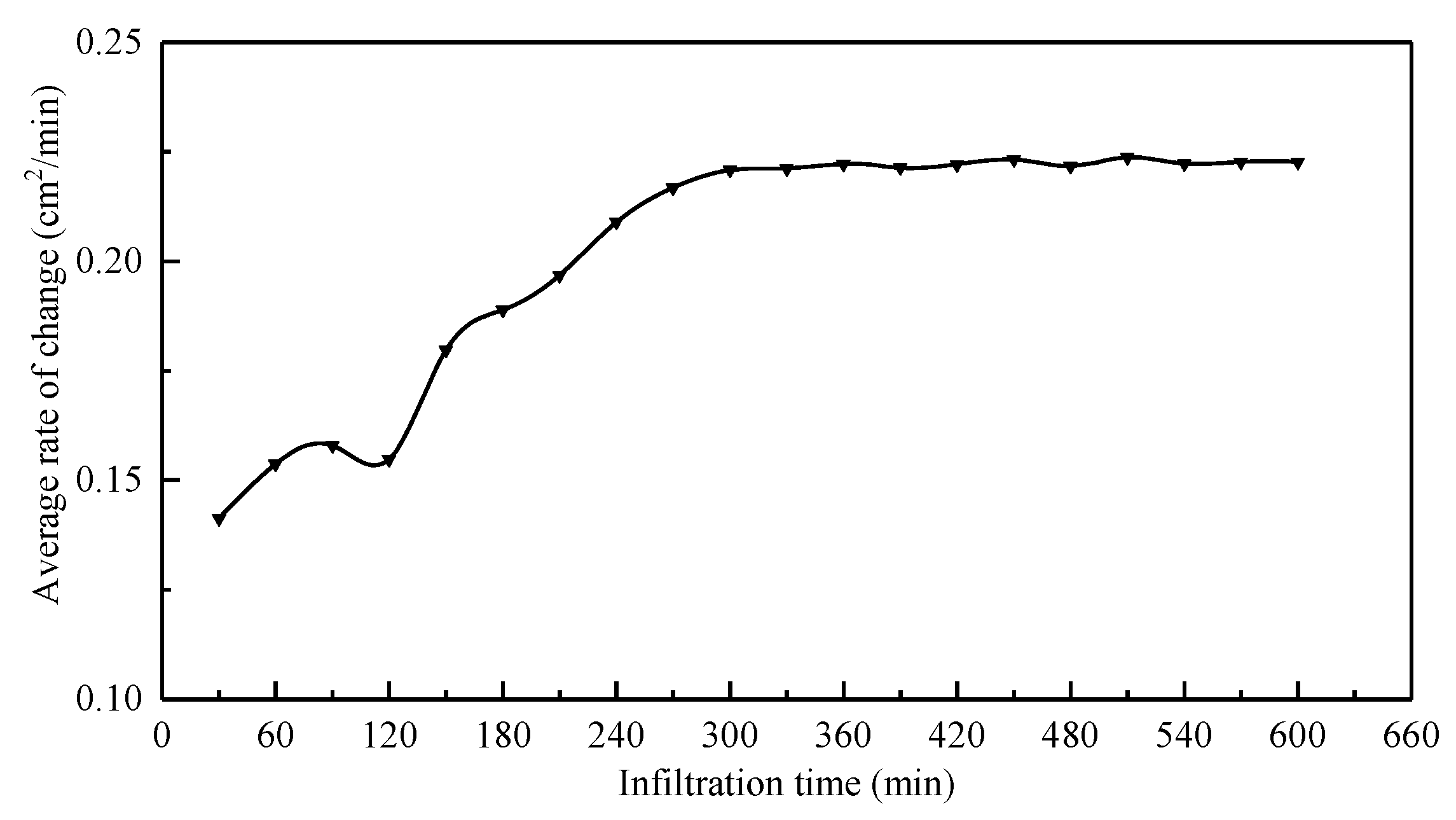
Figure 10 presents the average area variation rate, which serves to evaluate the entire wetting process. During the operation of horizontal moistube irrigation, the average variation rate of the wetted soil profile area exhibits a curve with concave characteristics. As irrigation time elapses, this average variation rate approaches a constant value and remains relatively stable thereafter. This observation is consistent with the inherent infiltration properties of the soil.
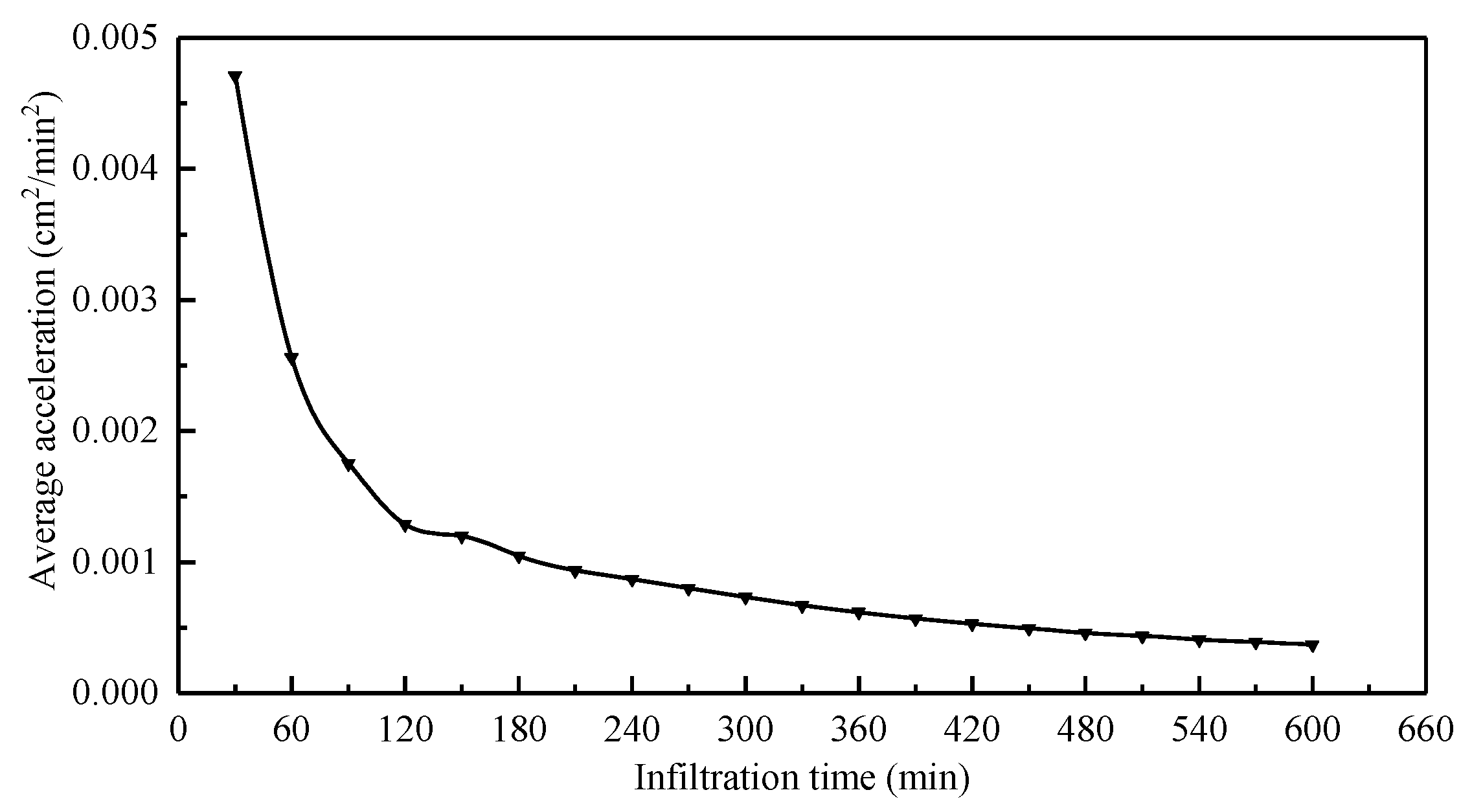
Figure 11 presents the average acceleration of wetted soil profile area variation, which describes the entire process across spatiotemporal dimensions. In horizontal moistube irrigation, the magnitude of the wetted soil area increases as its variation rate decreases (Figure 11). Although the wetted area exhibits an increase in magnitude with a relatively high variation rate at the initiation of irrigation, this increasing rate gradually diminishes over time and eventually stabilizes at a constant value. This observation aligns with both the infiltration properties of the soil and the inherent movement characteristics of soil moisture within the soil profile [11].
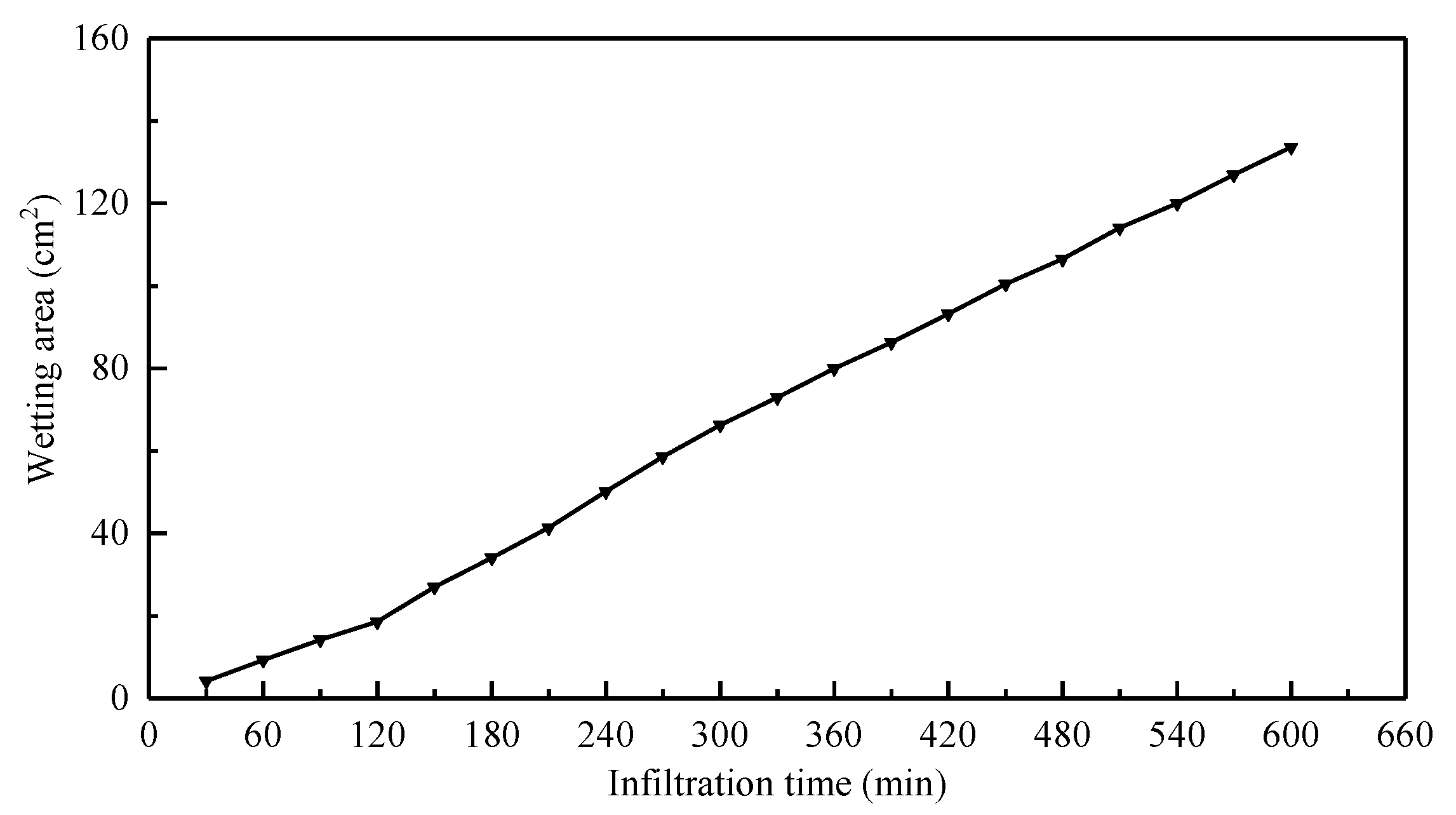
Figure 12 illustrates the temporal variation in the wetted soil profile area during irrigation. The wetted area within the soil profile increases over time. However, the instantaneous incremental rate of the wetted area exhibits a nonlinear trend (Figure 9). It can be further confirmed that as irrigation proceeds, the rate of increase in the wetted area decreases, while the magnitude of the area itself continues to increase (Figure 11). This observation aligns with both the infiltration properties of the soil and the inherent movement characteristics of soil moisture within the soil profile [11].

4. Limitations of the Study

The analytical model developed in this study reveals that the wetting pattern of horizontal moistube irrigation forms a continuous elliptical cylinder along the tube axis, which differs significantly from the truncated sphere or ellipsoid patterns typically observed in surface drip irrigation [10,11]. While surface or subsurface drip irrigation represents typical point-source infiltration where water diffuses hemispherically [15,16], moistube irrigation functions as a line-source technology with continuous water release. This distinction has important implications for irrigation system design: unlike drip systems that require precise emitter spacing based on wetting bulb radii, horizontal moistube irrigation naturally creates a continuous wetting strip. Consequently, design optimization should focus more on burial depth and lateral spacing to match the vertical distribution and lateral spread of crop roots. For row crops with dense root systems, this continuous cylindrical wetting pattern may offer a more uniform root-zone moisture environment compared to the discrete wetting bulbs of drip irrigation, potentially enhancing water use efficiency.
Although the proposed analytical model based on parabolic integration effectively describes the infiltration process, certain limitations must be acknowledged. First, the experiment was conducted under strictly controlled laboratory conditions using homogeneous, reconstructed loam soil, without considering soil stratification, cracks, or spatial heterogeneity often found in field conditions which could induce preferential flow or retardation. Second, to simplify model variables, the experiment was performed under a single constant pressure head (160 cm), and did not cover the wetting pattern variations under low or variable pressure operating conditions. Finally, and most critically, this study was conducted in a non-vegetated environment, excluding the dynamic sink term introduced by root water uptake. In actual agro-ecosystems, root extraction significantly alters soil moisture gradients, thereby influencing the final shape and volume of the wetting pattern.
In light of these limitations, future research should focus on the following aspects to enhance practical applicability: (1) Conducting infiltration experiments in heterogeneous and layered soils to refine the model’s adaptability to complex soil structures; (2) Investigating the spatiotemporal evolution of wetting patterns under variable pressure heads to provide a theoretical basis for variable-pressure irrigation scheduling; (3) Performing in situ field experiments incorporating crop growth to couple a root water uptake model with the existing analytical model. This will quantify the interaction between root distribution and wetting pattern development, providing more comprehensive scientific support for the precision application of moistube irrigation across different crops.

5. Conclusions

Based on experimental work, this study analyzed camera-captured images of the soil wetted body under horizontal moistube irrigation at various time intervals. This analysis yielded the temporal variation characteristics of the shape and size of the wetted body in moistube irrigation. Subsequently, an analytical model for the moistube irrigation wetted body was developed via integration, using a parabolic equation as the foundational framework. Finally, experimental data were employed to calibrate the model parameters, and the model was validated by incorporating the natural infiltration behavior of water within the soil profile. The key conclusions derived from this research are as follows:
(1)
Experimental data were utilized to determine the values of parameters a and k in the model at each time step. For soil profile I, parameters a1 and a2 were consistently positive (a1 > 0, a2 > 0). Meanwhile, based on the location of the vertex (0, −k1) of the convex parabola on the negative side of the y-axis, the parameter −k1 remained consistently negative (−k1 < 0). For parameters a3 and a4 in the model corresponding to soil profile II, both were assigned negative values (a3 < 0, a4 < 0) in accordance with the concave characteristic of the parabola. Simultaneously, considering the location of the vertex (0, k2) of the concave parabola on the positive side of the y-axis, the parameter k2 was consistently positive (k2 > 0).
(2)
The instantaneous variation rate of the wetted area within soil profiles exhibits continuous nonlinear changes across both temporal and spatial dimensions. The average acceleration of wetted area variation characterizes the overall spatiotemporal dynamics of soil profiles, with the magnitude of the wetted area increasing as its variation rate decreases.
(3)
Moistube irrigation can be implemented in soils with varying textures, under different moistube discharge rates, and under distinct water-use periods. Under these diverse conditions, the maximum wetting distances of the wetted soil profile differ in the horizontal direction, vertical upward direction, and vertical downward direction. However, the key variables and parameters of the proposed model are derived from the primary components of these distinct wetted soil profiles. When the model is operated at any given time step, it generates coordinate values that represent the dimensions and positions of each component within the wetted soil profile. In other words, the primary components of the wetted body in the moistube irrigation system form the basis of the variables and parameters for the model developed in this study. Consequently, to determine the wetted body at any moment during moistube irrigation application under different conditions, it is sufficient to input the values of each component of the wetted soil profile and execute the established model.
The above conclusions confirm the following: Based on experiments, the method of analyzing the shape and components of the wetted soil profile at different time points and determining its size via integrating four distinct parabolas is feasible. Experimental data were used to analyze the established model, and the results align with the natural movement of soil water. Thus, the derived analytical model is applicable, and using the soil profile area to characterize the size of the horizontal moistube irrigation wetted body is a viable approach.

Author Contributions

Conceptualization, D.L. and Z.Y.; methodology, Z.Y. and Y.H.; validation, X.W. and X.L.; formal analysis, T.L. and G.Z.; investigation, D.L. and Y.H.; Data curation, Y.H., G.Z. and T.L.; Writing—original draft preparation, D.L.; Writing—review and editing, Z.Y. All authors have read and agreed to the published version of the manuscript.

Funding

This research was funded by Youth Fund of Gansu Province Science and Technology Program grant number 24JRRA1141 and Youth Team Building Program of the Gansu Academy of Sciences grant number 2025CXTD-02 and National Natural Science Foundation of China grant number 42567023 and Key Research and Development Program of Gansu Province grant number 25YFFA090 and Major Special Project of the Gansu Academy of Sciences grant number 2024ZDZX-02. The APC was funded by Youth Team Building Program of the Gansu Academy of Sciences.

Data Availability Statement

Data are available from the authors upon reasonable request.

Acknowledgments

The author would like to thank the data source institution, as well as the editor and reviewers for their valuable suggestions and constructive comments.

Conflicts of Interest

The authors declare no conflicts of interest.

References

  1. Namara, R.E.; Nagar, R.K.; Upadhyay, B. Economics, adoption determinants, and impacts of micro-irrigation technologies: Empirical results from India. Irrig. Sci. 2007, 25, 283–297. [Google Scholar] [CrossRef]
  2. Li, L.S.; Li, Y.F.; Wang, J.; Wang, Z.; Zhao, W.X. Microirrigation in China: History, current situation and prospects. J. Hydraul. Eng. 2016, 47, 372–381. [Google Scholar] [CrossRef]
  3. Niu, W.Q.; Zhang, J.; Zhang, L.L.; Xue, W.L.; Zhang, L.T. Effects of Buried Depth and Pressure Head on Water Movement of Wetted Soil during Moistube-irrigation. Trans. Chin. Soc. Agric. Mach. 2013, 44, 128–134. [Google Scholar] [CrossRef]
  4. Kanda, E.K.; Mabhaudhi, T.; Senzanje, A. Hydraulic and clogging characteristics of Moistube irrigation as influenced by water quality. J. Water Supply Res. Technol.—AQUA 2018, 67, 438–446. [Google Scholar] [CrossRef]
  5. Fan, Y.W.; Zhao, T.; Bai, G.L.; Liu, W.G. HYDRUS-2D simulation of soil wetting pattern with horizontal moistube-irrigation and analysis of its influencing factors. Trans. Chin. Soc. Agric. Eng. 2018, 34, 115–124. [Google Scholar] [CrossRef]
  6. Fan, Y.W.; Huang, N.; Zhang, J.; Zhao, T. Simulation of soil wetting pattern of vertical moistube-irrigation. Water 2018, 10, 601. [Google Scholar] [CrossRef]
  7. Naglič, B.; Kechavarzi, C.; Coulon, F.; Pintar, M. Numerical investigation of the influence of texture, surface drip emitter discharge rate and initial soil moisture condition on wetting pattern size. Irrig. Sci. 2014, 32, 421–436. [Google Scholar] [CrossRef]
  8. Al-Ogaidi, A.A.; Wayayok, A.; Rowshon, M.K.; Abdullah, A.F. Wetting patterns estimation under drip irrigation systems using an enhanced empirical model. Agric. Water Manag. 2016, 176, 203–213. [Google Scholar] [CrossRef]
  9. Su, L.J.; Lin, S.D.; Wang, Q.J.; Wang, K. Influence of Soil Hydraulic Parameters on Soil Wetting Pattern Shape of Point Source Infiltration. Trans. Chin. Soc. Agric. Mach. 2020, 51, 264–274. [Google Scholar] [CrossRef]
  10. Zhang, Z.H.; Cai, H.J.; Guo, Y.C.; Geng, B.J. Experimental Study on Factors Effecting Soil Wetted Volume of Clay Loam Under Drip Irrigation. Trans. Chin. Soc. Agric. Eng. 2002, 18, 17–20. [Google Scholar]
  11. Kilic, M. A new analytical method for estimating the 3D volumetric wetting pattern under drip irrigation system. Agric. Water Manag. 2019, 228, 105898. [Google Scholar] [CrossRef]
  12. Zhang, J.; Niu, W.Q.; Zhang, L.L.; Shi, L.Y. Experimental study on characters of wetted soil in moistube irrigation. Sci. Soil Water Conserv. 2012, 10, 32–38. [Google Scholar] [CrossRef]
  13. Fan, Y.W.; Yang, Z.W.; Hu, W.L. Establishment and validation of wetting pattern model of moistube irrigation in homogeneous soil. Trans. Chin. Soc. Agric. Eng. 2020, 36, 83–91. [Google Scholar] [CrossRef]
  14. Dabral, P.P.; Pandey, P.K.; Pandey, A.; Singh, K.P.; Singh, M.S. Modelling of wetting pattern under trickle source in sandy soil of Nirjuli, Arunachal Pradesh (India). Irrig. Sci. 2012, 30, 287–292. [Google Scholar] [CrossRef]
  15. Molael, K.M.; Liaghat, A.; Abbasi, F. Estimation of soil moisture pattern in subsurface drip irrigation using dimensional analysis method. Iran. J. Agric. 2008, 39, 371–378. [Google Scholar]
  16. Yao, W.W.; Ma, X.Y.; Li, J.; Parkes, M. Simulation of point source wetting pattern of subsurface drip irrigation. Irrig. Sci. 2011, 29, 331–339. [Google Scholar] [CrossRef]
  17. Kanda, E.K.; Senzanje, A.; Mabhaudhi, T. Soil water dynamics under Moistube irrigation. Phys. Chem. Earth Parts A/B/C 2020, 115, 102836. [Google Scholar] [CrossRef]
  18. Thorburn, P.J.; Cook, F.J.; Bristow, K.L. Soil-dependent wetting from trickle emitters: Implications for system design and management. Irrig. Sci. 2003, 22, 121–127. [Google Scholar] [CrossRef]
  19. Cook, F.J.; Thorburn, P.J.; Fitch, P.; Bristow, K.L. WetUp: A software tool to display approximate wetting patterns from drippers. Irrig. Sci. 2003, 22, 129–134. [Google Scholar] [CrossRef]
  20. Moncef, H.; Khemaies, Z. An analytical approach to predict the moistened bulb volume beneath a surface point source. Agric. Water Manag. 2016, 166, 123–129. [Google Scholar] [CrossRef]
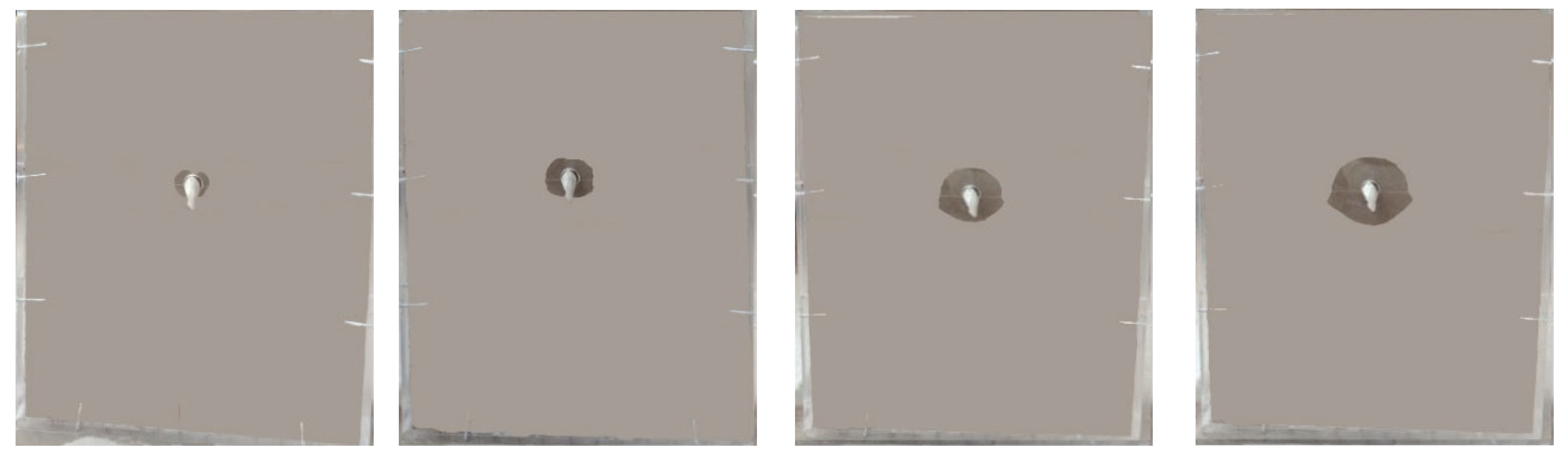
Figure 1. Temporal and spatial variation in the wetting pattern in the soil profile in the horizontal moistube irrigation.
Water 18 00035 g001
Figure 2. Composition of wetting pattern under horizontal moistube irrigation.
Water 18 00035 g002
Figure 3. Schematic diagram of the wetting pattern: (a) Components of the wetting pattern; (b) Temporal and spatial variation in components of the wetting pattern.
Water 18 00035 g003
Figure 4. Soil profile of wetting pattern under horizontal moistube irrigation after 90° rotation.
Water 18 00035 g004
Figure 5. Schematic diagram of function representation of soil profiles: (a) Soil profile I; (b) Soil profile II.
Water 18 00035 g005
Figure 6. Symmetry transformations of soil profiles: (a) Symmetry transformation of soil profile I; (b) Symmetry transformation of soil profile II.
Water 18 00035 g006
Figure 7. Coordinate description of correlation curves of soil profiles: (a) Correlation curves of soil profile I; (b) Correlation curves of soil profile II.
Water 18 00035 g007
Figure 8. Momentary spatiotemporal rate of change in soil profiles I and II.
Water 18 00035 g008
Figure 9. Momentary spatiotemporal rate of change in the whole wetting soil profile.
Water 18 00035 g009
Figure 10. The average rate of variation in the whole wetting soil profile.
Water 18 00035 g010
Figure 11. The average acceleration of area change in whole wetting soil profile.
Water 18 00035 g011
Figure 12. The variation in area of soil profile with time.
Water 18 00035 g012
Table 1. Characteristic parameters of soil sample and irrigation technical parameters.
Soil TextureBulk Density
γ/(g·cm−3)
Soil Saturated Hydraulic Conductivity Ks/(cm·min−1)Moistube Burial Depth D/cmPressure Head H/cm
Loam 1.350.018630160
Table 2. Values of parameters a and k of the function describing soil profiles I and II.
Soil
Texture
Infiltration Time/minIII
a1a2−k1a3a4k2
Loam0000000
301.201.88−1.2−1.50−2.341.50
600.660.87−1.7−0.74−0.971.90
900.530.65−2.1−0.58−0.712.30
1200.500.54−2.4−0.56−0.612.70
1500.460.50−3.1−0.47−0.513.20
1800.370.45−3.3−0.41−0.513.70
2100.290.42−3.5−0.33−0.484.00
2400.220.39−3.7−0.26−0.454.30
2700.200.37−4.0−0.23−0.424.60
3000.190.33−4.3−0.22−0.384.90
3300.190.30−4.5−0.21−0.345.10
3600.180.27−4.7−0.20−0.305.30
3900.170.24−4.9−0.19−0.275.40
4200.170.23−5.1−0.19−0.255.60
4500.160.22−5.3−0.18−0.245.80
4800.160.22−5.4−0.17−0.246.00
5100.150.21−5.6−0.17−0.236.20
5400.140.20−5.7−0.16−0.226.30
5700.140.19−5.9−0.16−0.216.50
6000.140.17−6.0−0.16−0.186.60
Table 3. Temporal and spatial variation in soil wetting area in soil profiles I and II.
Soil
Texture
Infiltration
Time/min
IIIS
S1S2SIS3S4SII
Loam00000000
300.80 0.64 1.44 2.00 0.80 2.80 4.24
601.81 1.59 3.40 4.05 1.77 5.83 9.23
902.80 2.52 5.32 6.13 2.76 8.89 14.21
1203.52 3.36 6.88 7.92 3.78 11.70 18.58
1505.37 5.17 10.54 11.09 5.33 16.43 26.97
1806.60 5.94 12.54 14.80 6.66 21.46 34.00
2108.17 6.77 14.93 18.67 7.73 26.40 41.33
24010.11 7.65 17.76 23.51 8.89 32.39 50.15
27012.00 8.80 20.80 27.60 10.12 37.72 58.52
30013.47 10.32 23.79 30.71 11.76 42.47 66.26
33014.70 11.70 26.40 33.32 13.26 46.58 72.98
36015.98 13.16 29.14 36.04 14.84 50.88 80.02
39017.31 14.70 32.01 38.16 16.20 54.36 86.37
42018.70 15.98 34.68 41.07 17.55 58.61 93.29
45020.14 17.31 37.45 44.08 18.95 63.03 100.48
48021.24 18.00 39.24 47.20 20.00 67.20 106.44
51022.77 19.41 42.19 50.43 21.49 71.92 114.11
54023.94 20.52 44.46 52.92 22.68 75.60 120.06
57025.17 22.03 47.20 55.47 24.27 79.73 126.93
60026.00 24.00 50.00 57.20 26.40 83.60 133.60
Disclaimer/Publisher’s Note: The statements, opinions and data contained in all publications are solely those of the individual author(s) and contributor(s) and not of MDPI and/or the editor(s). MDPI and/or the editor(s) disclaim responsibility for any injury to people or property resulting from any ideas, methods, instructions or products referred to in the content.