
Investigation of the Impact of Wastewater from Waste Oil In-Stallation on the Activated Sludge Process, to Ensure the Proper Operation of Municipal Wastewater Treatment Plant



Abstract
1. Introduction
2. Materials and Methods
2.1. Real Wastewater
2.2. Experimental System
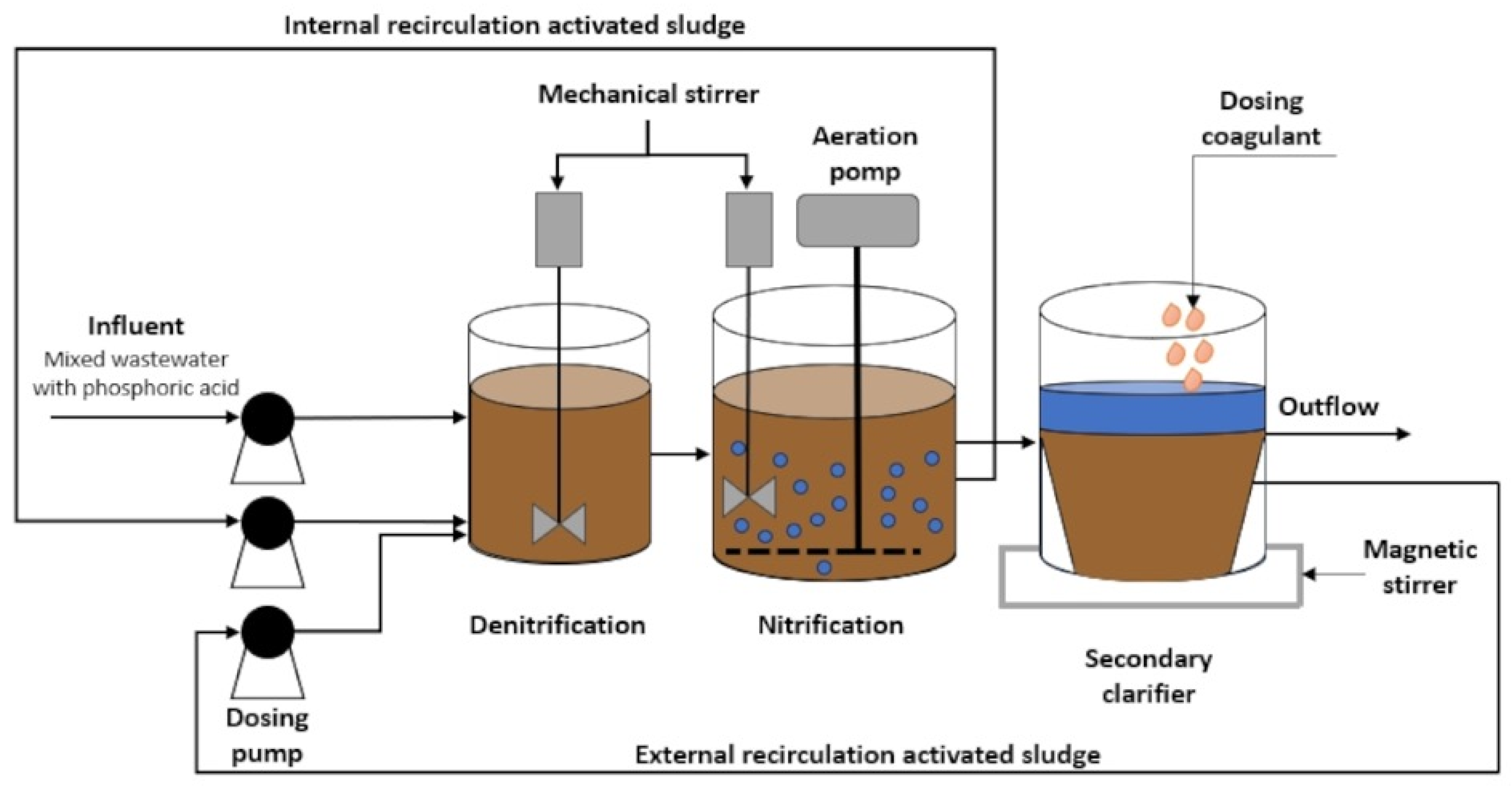
- Raw wastewater tank with a working volume of 30.0 L, daily replenished with fresh wastewater, to prevent putrefaction. A peristaltic pump (KAMOER X1 PRO T2) operating at a flow rate of 1.0 L/h was used to feed wastewater into the denitrification reactor. During the adaptation (P0), only domestic wastewater was introduced into the raw wastewater tank. Subsequently, during the research phases on industrial wastewater (P1–P7), domestic wastewater was mixed with industrial wastewater after distillation in the tank. Since the wastewater was phosphorus-deficient, an orthophosphoric acid solution of 73% concentration (v/v) was added.
- A denitrification reactor with a working volume of 8.0 L was equipped with a mechanical stirrer (JOANLAB OS-15S), maintaining a rotational speed of 300–400 rpm. The denitrification reactor was connected to the nitrification reactor via gravitational flow. In the denitrification reactor, bacteria use the carbon source to reduce nitrates to N2.
- Nitrification reactor with a working volume of 16.0 L was equipped with a Sicce Voyager Nano 100 stirrer, with a capacity of 1000.0 L/h. The reactor was aerified using a dual-channel air pump with aeration curtains. In the nitrification reactor, ammonia is oxidized to nitrites, then to nitrates.
- Secondary clarifier with a working volume of 20.0 L. A coagulant, in the form of a 35% (v/v) ferric chloride (III) solution, was added to the sludge-containing wastewater to enhance sludge sedimentation. The tank was equipped with a magnetic stirrer operating at 120 rpm.
- For internal and external recirculation, a KAMOER X1 PRO T2 peristaltic pump was used, operating at flow rates of 4.0 and 1.5 L/h, respectively. Internal recirculation allows for the reduction in total nitrogen, while the external recirculation maintains a stable bacterial population.
2.3. Data and Study Area
3. Results and Discussion
4. Summary and Future Research
Author Contributions
Funding
Data Availability Statement
Acknowledgments
Conflicts of Interest
Abbreviations
| B | Boron |
| AOX | Adsorbable organic halides |
| MOI | Mineral oil index |
| COD | Chemical oxygen demand |
| BOD5 | Biological oxygen demand |
| TSS | Total suspended solids |
| TN | Total nitrogen |
| TP | Total phosphorus |
| NH4+-N | Ammonium nitrogen |
| PO43−-P | Orthophosphates |
| CFA | Continuous flow analysis |
| NO3−-N | Nitrate |
| NO2−-N | Nitrite |
| Norg | Organic nitrogen |
| SRT | Solids retention time |
| P1–P7 | Phases |
| S2− | Sulfides |
| PAO | Poly(α-olefin) |
| ABC | Algal–bacterial consortia |
| EC | Electrocoagulation |
References
- Chen, J.; Chen, J.; Zheng, L.; Zheng, H. Cellulose-based aerogels for efficient dye sorption and oil-water separation in textile wastewater treatment. Int. J. Biol. Macromol. 2025, 310, 143612. [Google Scholar] [CrossRef] [PubMed]
- Parekh, K.; Shahabuddin, S.; Gaur, R.; Dave, N. Prospects of conducting polymer as an adsorbent for used lubricant oil reclamation. Mater. Today Proc. 2022, 62, 7053–7056. [Google Scholar] [CrossRef]
- Muvel, H.; Jindal, M.K.; Tewari, P.K.; Anand, V. Advancements in electrocoagulation for oily wastewater treatment: Mechanisms, efficiency, and applications. J. Water Process Eng. 2024, 68, 106291. [Google Scholar] [CrossRef]
- Larki, A.; Nasiri, E.; Sedagheh, K.; Jalilian, M. Cladophora-based magnetic nanocomposites for eco-friendly wastewater treatment: Removal of dyes and oil. Algal Res. 2025, 89, 104107. [Google Scholar] [CrossRef]
- Nor El Houda, M.; Chabani, M.; Bouafia-Chergui, S.; Touil, A. Removal of chemical oxygen demand from real petroleum refinery wastewater through a hybrid approach: Electrocoagulation and adsorption. Chem. Eng. Process.-Process Intensif. 2024, 196, 109680. [Google Scholar] [CrossRef]
- Javed, F.; Hassan, A.A.; Al Zuhair, S. Microalgae–bacteria consortia for the treatment of fat, oil, and grease wastewater: Recent progress, interaction mechanisms, and application prospects. J. Hazard. Mater. Adv. 2025, 19, 100797. [Google Scholar] [CrossRef]
- Silva, T.A.; de Jesus Junior, M.M.; Magalhães, I.B.; Ananias, M.S.; Pereira, A.S.A.P.; Rodrigues, F.Á.; Delgado dos Reis, A.J.; Calijuri, M.L. Bio-oil from hydrothermal liquefaction of microalgae cultivated in wastewater: An economic and life cycle approach. J. Clean. Prod. 2025, 512, 145719. [Google Scholar] [CrossRef]
- Ferreira, R.M.; Ribeiro, B.D.; Stapelfeldt, D.M.A.; Nascimento, R.P.; Moreira, M.d.F.R. Oil biodegradation studies with an immobilized bacterial consortium in plant biomass for the construction of bench-scale bioreactor. Clean. Chem. Eng. 2023, 6, 100107. [Google Scholar] [CrossRef]
- Eregie, S.B.; Sanusi, I.A.; Olaniran, A.O. Bibliometric review of transcriptomic microalgae-based biodegradation of lubricant oil waste hydrocarbon: Current research outlook. Bioresour. Technol. Rep. 2025, 29, 102074. [Google Scholar] [CrossRef]
- Parekh, K.; Gaur, R.; Shahabuddin, S. A facile approach for refining waste lubricant oil: A hazardous water contaminant. Mater. Today Proc. 2024, in press. [Google Scholar] [CrossRef]
- Dyguła, P.; Kucharska, K.; Kamiński, M. Separation and determination of the group-type composition of modern base and lubricating oils with a wide range of polarity, especially emitted to the environment. J. Chromatogr. B 2022, 1192, 123137. [Google Scholar] [CrossRef] [PubMed]
- Nowak, P.; Kucharska, K.; Kamiński, M. Ecological and Health Effects of Lubricant Oils Emitted into the Environment. Int. J. Environ. Res. Public Health 2019, 16, 3002. [Google Scholar] [CrossRef] [PubMed]
- Beran, E. Experience with evaluating biodegradability of lubricating base oils. Tribol. Int. 2008, 41, 1212–1218. [Google Scholar] [CrossRef]
- García-Gutiérrez, P.; Tonini, D.; Klenert, D.; Marschinski, R.; Saveyn, H.G.M. Environmental and economic assessment of waste lubricant oil management in the EU. J. Clean. Prod. 2025, 492, 144878. [Google Scholar] [CrossRef]
- EL-Seesy, A.I.; El-Zoheiry, R.M.; Hassan Ali, M.I. Recycling of waste lubricant oil using two-step pyrolysis to produce fuel-like diesel and enhancing its combustion and emission parameters in diesel engines using linseed biodiesel. Energy Convers. Manag. X 2025, 26, 100924. [Google Scholar] [CrossRef]
- Chen, W.; Ou, J.; Sheu, Y.; Surampalli, R.Y.; Chen, S.C.; Kao, C. Application of composite persulfate oxidation to remediate weathered lubricating oil-contaminated soils: Batch and pilot-scale studies. J. Environ. Chem. Eng. 2024, 12, 114158. [Google Scholar] [CrossRef]
- Hu, J.; Yanga, S.; Guoa, L.; Xu, X.; Yao, T.; Xie, F. Microscopic investigation on the adsorption of lubrication oil on microplastics. J. Mol. Liq. 2017, 227, 351–355. [Google Scholar] [CrossRef]
- Hamid, M.; Dayana, I.; Sholeha, D.; Siregar, M.F.; Roza, I.; Junaidi, J.; Rianna, M.; Wijoyo, H. Eco-friendly utilization of chitosan from shrimp shells for used lubricating oil cleaning. Results Surf. Interfaces 2025, 18, 100368. [Google Scholar] [CrossRef]
- Adetunji, A.I.; Olaniran, A.O. Treatment of industrial oily wastewater by advanced technologies: A review. Appl. Water Sci. 2021, 11, 98. [Google Scholar] [CrossRef]
- Noman, A.; Shoudho, K.N.; Shawon, Z.B.Z.; Alam, M.K.; Ahmed, S.; Khan, I.A. Synergistic effects of hydroxylation and structural defects in hexagonal boron nitride for dye removal from wastewater. R. Soc. Chem. Adv. 2025, 15, 29528. [Google Scholar] [CrossRef]
- Xie, L.; Wu, X.; Pan, Y.; Lv, M.; Liu, Y.; Lian, R.; Jiang, J.; Chen, R.; Ding, R.; Liu, J. Boron recovery from wastewater using a self-powered bipolar membrane electrodialysis system. Sep. Purif. Technol. 2025, 364, 132439. [Google Scholar] [CrossRef]
- Adavodi, R.; Ullah, M.; Romano, P.; Giovannone, L.; Vegliò, F.; Ippolito, N.M. Boron extraction from wastewater using a phosphonium-based ionic liquid. J. Water Process Eng. 2025, 76, 108223. [Google Scholar] [CrossRef]
- Shih, Y.J.; Liu, C.H.; Lan, W.C.; Huang, Y.H. A novel chemical oxo-precipitation (COP) process for efficient remediation of boron wastewater at room temperature. Chemosphere 2014, 111, 232–237. [Google Scholar] [CrossRef] [PubMed]
- Lv, M.; Liu, Y.; Jiang, J.; Lian, R.; Xue, H.; Chen, R.; Ding, R.; Liu, J. Recovery of boron and zinc from wastewater via electrodialytic metathesis. Desalination 2024, 586, 117900. [Google Scholar] [CrossRef]
- Xu, R.; Tian, J.; Chen, L. A novel oxidation-reduction combined treatment of dye wastewater: Dual-target removal of conventional pollutants and AOX. J. Environ. Manag. 2025, 385, 125701. [Google Scholar] [CrossRef]
- Erhardt, C.S.; Basegio, T.M.; Capela, I.; Rodríguez, A.L.; Machado, Ê.L.; Rodríguez López, D.A.; Tarelho, L.; Bergmann, C.P. AOX degradation of the pulp and paper industry bleaching wastewater using nZVI in two different agitation processes. Environ. Technol. Innov. 2021, 22, 101420. [Google Scholar] [CrossRef]
- Ribeiro, J.P.; Marques, C.C.; Portugal, I.; Nunes, M.I. Fenton processes for AOX removal from a kraft pulp bleaching industrial wastewater: Optimisation of operating conditions and cost assessment. J. Environ. Chem. Eng. 2020, 8, 104032. [Google Scholar] [CrossRef]
- Ribeiro, J.P.; Marques, C.C.; Portugal, I.; Nunes, M.I. AOX removal from pulp and paper wastewater by Fenton and photo-Fenton processes: A real case-study. Energy Rep. 2020, 6, 770–775. [Google Scholar] [CrossRef]
- Mehra, K.S.; Abrar, I.; Bhatia, R.K.; Goel, V. A comprehensive review of algae consortium for wastewater bioremediation and biodiesel production. Energy Convers. Manag. 2025, 325, 119428. [Google Scholar] [CrossRef]
- Chen, D.; Zhang, R.; He, J.; Xu, M.; Li, Z.; Liu, Y.; Peng, L. Surface self-assembly of tannic acid network to enhance wastewater treatment and oil-water separation performance of dual-bismuth BiOBr–BiOCOOH/PVDF membranes. J. Environ. Chem. Eng. 2025, 13, 117577. [Google Scholar] [CrossRef]
- Kishor, R.; Verma, M.; Saratale, G.D.; Romanholo Ferreira, L.F.; Kharat, A.S.; Chandra, R.; Raj, A.; Bharagava, R.N. Treatment of industrial wastewaters by algae-bacterial consortium with Bio-H2 production: Recent updates, challenges and future prospects. Chemosphere 2024, 349, 140742. [Google Scholar] [CrossRef] [PubMed]
- Tajik, M.; Lashkarbolooki, M.; Peyravi, M. Mechanistic study of fouling hybrid PES-ionic liquid ultrafilter membrane during oily wastewater treatment; effect of surfactant type, salinity, and pH. J. Mol. Liq. 2025, 427, 127320. [Google Scholar] [CrossRef]
- Cong, S.; Wang, M.; Sun, S.; Zhang, Y.; Jia, Z.; Zhao, Y.; He, R.; Peng, J.; Pang, H. Designing and construction of 2D MXene membranes for advanced separation. Sep. Purif. Technol. 2025, 378, 134687. [Google Scholar] [CrossRef]
- Kadier, A.; Al-Qodah, Z.; Akkaya, G.K.; Song, D.; Peralta-Hernández, J.M.; Wang, J.; Phalakornkule, C.; Bajpai, M.; Niza, N.M.; Gilhotra, V.; et al. A state-of-the-art review on electrocoagulation (EC): An efficient, emerging, and green technology for oil elimination from oil and gas industrial wastewater streams. Case Stud. Chem. Environ. Eng. 2022, 6, 100274. [Google Scholar] [CrossRef]
- Kishor, R.; Raj, A.; Bharagava, R.N. Synergistic role of bacterial consortium (RKS-AMP) for treatment of recalcitrant coloring pollutants of textile industry wastewater. J. Water Process Eng. 2022, 47, 102700. [Google Scholar] [CrossRef]
- Raja, W.; Kumar, P. Domestic sewage management for elevated phenol and surfactant levels using Algal Bacterial Consortia (ABC) in a hybrid moving bed membrane bioreactor (MBMBR) system. Algal Res. 2025, 86, 103961. [Google Scholar] [CrossRef]
- Barbusiński, K.; Salwiczek, S.; Paszewska, A. The use of chitosan for removing selected pollutants from water and wastewater—Short review. Archit. Civ. Eng. Environ. 2016, 9, 107–115. [Google Scholar] [CrossRef]
- Eregie, S.B.; Sanusi, I.A.; Kana, G.E.B.; Ademola, O.O. Synergistic effect of process parameters and nanoparticles on spent lubricant oil waste biodegradation by UV-exposed Scenedesmus vacuolatus: Process modelling, kinetics and degradation pathways. Bioresour. Technol. Rep. 2023, 24, 101627. [Google Scholar] [CrossRef]
- Amari, A.; Noreen, A.; Osman, H.; Sammen, S.S.; Al-Ansari, N.; Salman, H.M. Investigation of the viable role of oil sludge-derived activated carbon for oily wastewater remediation. Front. Environ. Sci. 2023, 11, 1138308. [Google Scholar] [CrossRef]
- Yu, L.; Yang, Y.; Yang, B.; Li, Z.; Zhang, X.; Hou, Y.; Lei, L.; Zhang, D. Effects of solids retention time on the performance and microbial community structures in membrane bioreactors treating synthetic oil refinery wastewater. Chem. Eng. J. 2018, 344, 462–468. [Google Scholar] [CrossRef]
- Wang, Q.; Deng, J.; Liang, J.; Jiang, L.; Arslan, M.; Gamal El-Din, M.; Wang, X.; Chen, C. Biochar immobilized petroleum degrading consortium for enhanced granulation and treatment of synthetic oil refinery wastewater. Bioresour. Technol. Rep. 2022, 17, 100909. [Google Scholar] [CrossRef]
- Wang, T.; Zhang, Y.; Yang, X.; Li, Q.; Zhang, Y.; Xu, Z.; Luo, D.; Wang, Y.; Chen, J. Enhancement of Rhodococcus erythropolis KB1 on SBR treatment of oily wastewater: Effects of SRT, filler, and HRT. J. Water Process Eng. 2025, 69, 106861. [Google Scholar] [CrossRef]
- PN-EN ISO 10523; Water Quality—Determination of pH (ISO 10523:2008). Polish Committee for Standardization: Warsaw, Poland, 2012.
- PN-EN 27888; Water Quality—Determination of Electrical Conductivity (ISO 7888:1985). Polish Committee for Standardization: Warsaw, Poland, 1999.
- PN-EN ISO 15681-2; Water Quality—Determination of Orthophosphate and Total Phosphorus Contents by Flow Analysis (FIA and CFA)—Part 2: Method by Continuous Flow Analysis (CFA) (ISO 15681-2:2003). Polish Committee for Standardization: Warsaw, Poland, 2006.
- PN-EN ISO 11732; Water Quality—Determination of Ammonium Nitrogen—Method by Flow Analysis (CFA and FIA) and Spectrometric Detection (ISO 11732:2005). Polish Committee for Standardization: Warsaw, Poland, 2007.
- PN-C-04576-08; Water and Waste Water—Tests for Content of Nitrogen Compounds—Determination of Nitrate Nitrogen by Colorimetric Method with Sodium Salicylate. Polish Committee for Standardization: Warsaw, Poland, 1982.
- PN-C-04576-06; Water and Waste Water—Tests for Content of Nitrogen Compounds—Determination of Nitrite Nitrogen by Colorimetric Method with Sulphanilic Acid and 1-Naphtylamine. Polish Committee for Standardization: Warsaw, Poland, 1973.
- PN-EN 872; Water Quality—Determination of Suspended Solids—Method by Filtration Through Glass Fibre Filters. Polish Committee for Standardization: Warsaw, Poland, 2007.
- PN-EN ISO 9377-2; Water Quality—Determination of Hydrocarbon Oil Index—Part 2: Method Using Solvent Extraction and Gas Chromatography (ISO 9377-2:2000). Polish Committee for Standardization: Warsaw, Poland, 2003.
- Zabermawi, N.M.; El Bestawy, E. Effective treatment of petroleum oil–contaminated wastewater using activated sludge modified with magnetite/silicon nanocomposite. Sustain. Waste Manag. Circ. Econ. 2023, 31, 17634–17650. [Google Scholar] [CrossRef] [PubMed]
- Hamimed, S.; Merazka, R.; Keroui, M.; Chatti, A. Insights into PET-Microplastics effect on pathogenic bacteria. World J. Microbiol. Biotechnol. 2025, 41, 468. [Google Scholar] [CrossRef]
- Barani, M.; Helchi, S.; Shirazi, M.M.A.; Emamshoushtari, M.M.; Shariati, F.P.; Bazgir, S. Investigation of biomass and pollutant kinetics In batch bioreactors for effective industrial oil wastewater treatment. J. Water Process Eng. 2025, 70, 107115. [Google Scholar] [CrossRef]
- Wei, Y.; Jin, Y.; Zhang, W. Treatment of High-Concentration Wastewater from an Oil and Gas Field via a Paired Sequencing Batch and Ceramic Membrane Reactor. Int. J. Environ. Res. Public Health 2020, 17, 1953. [Google Scholar] [CrossRef]
- Hamimed, S.; Ben Ammar, N.E.; Slimi, H.; Asses, N.; Hamzaoui, A.H.; Chatti, A. Innovative entrapped Yarrowia lipolytica within polyvinylpyrrolidone (PVP)/polyethylene glycol (PEG) /agar for improving olive mill wastewater bioremediation. J. Clean. Prod. 2024, 449, 141828. [Google Scholar] [CrossRef]



| Wastewater Before Distillation | |||||||
| Phases | Average Concentration of Pollutants (mg/L) | ||||||
| COD | TSS | TN | TP | AOX | B | MOI | |
| P1 | 218,000 | 47 | 2954.0 | 1.22 | 47.0 | 626.0 | 229.0 |
| P2 | 178,000 | 23 | 2479.0 | 0.83 | 29.1 | 524.0 | 100.0 |
| P3 | 224,000 | 40 | 2140.0 | 0.53 | 29.4 | 636.0 | 100.0 |
| P4 | 219,500 | 46 | 1783.3 | 0.61 | 61.1 | 590.5 | 364.0 |
| P5 | 209,500 | 37 | 1870.0 | 0.65 | 116.4 | 532.5 | 961.5 |
| P6 | 190,000 | 35 | 1900.0 | 0.53 | 73.0 | 442.5 | 246.0 |
| P7 | 220,000 | 69 | 1983.0 | 0.50 | 57.7 | 423.0 | 3093.0 |
| Min | 154,000 | 23 | 1358.0 | 0.32 | 29.1 | 403.0 | 92.0 |
| Max | 238,000 | 69 | 2954.0 | 1.22 | 168.0 | 636.0 | 3093.0 |
| SD | 25,019 | 14 | 458.0 | 0.27 | 40.0 | 87.6 | 995.3 |
| Wastewater after distillation | |||||||
| Phases | Average concentration of pollutants (mg/L) | ||||||
| COD | TSS | TN | TP | AOX | B | MOI | |
| P1 | 51,200 | 20 | 2647.0 | 1.11 | 27.8 | 20.6 | 97.0 |
| P2 | 51,367 | 21 | 2093.3 | 0.41 | 21.9 | 33.6 | 61.7 |
| P3 | 55,838 | 38 | 1316.5 | 0.45 | 21.7 | 26.9 | 65.6 |
| P4 | 60,240 | 26 | 1475.8 | 0.31 | 22.0 | 17.1 | 85.4 |
| P5 | 57,774 | 20 | 1466.1 | 0.35 | 51.2 | 23.4 | 67.6 |
| P6 | 58,054 | 33 | 1471.8 | 0.38 | 54.4 | 13.1 | 91.4 |
| P7 | 58,025 | 29 | 1572.6 | 0.39 | 54.2 | 12.8 | 111.8 |
| Min | 45,200 | 4 | 950.0 | 0.02 | 11.6 | 2.5 | 16.0 |
| Max | 63,000 | 94 | 2960.0 | 1.11 | 137.0 | 82.9 | 145.0 |
| SD | 3925 | 19 | 485.6 | 0.25 | 33.4 | 19.8 | 34.3 |
| Phases | Share of Industrial Wastewater Relative to Domestic Wastewater (% v/v) | Activated Sludge Loading (kgBOD5/kgMLSS d) | Activated Sludge Loading (kgCOD/kgMLSS d) | Duration of the Research (Days) |
|---|---|---|---|---|
| P0 | 0.00 | 0.09 ± 0.03 | 0.14 ± 0.04 | 76 |
| P1 | 1.30 | 0.24 ± 0.01 | 0.34 ± 0.02 | 7 |
| P2 | 0.50 | 0.17 ± 0.40 | 0.27 ± 0.08 | 38 |
| P3 | 0.75 | 0.23 ± 0.05 | 0.34 ± 0.07 | 39 |
| P4 | 1.00 | 0.26 ± 0.03 | 0.39 ± 0.04 | 28 |
| P5 | 1.30 | 0.31 ± 0.06 | 0.43 ± 0.09 | 28 |
| P6 | 1.60 | 0.38 ± 0.10 | 0.51 ± 0.14 | 28 |
| P7 | 1.90 | 0.71 ± 0.08 | 0.71 ± 0.06 | 21 |
| Phases | Days | Concentration of Pollutants (mg/L) | |||||
|---|---|---|---|---|---|---|---|
| COD | BOD5 | TN | NH4+-N | TP | PO43−-P | ||
| P0 | 76 | 509.8 ± 136.8 | 337.1 ± 133.2 | 50.49 ± 9.80 | 43.98 ± 8.93 | 12.10 ± 3.25 | 10.85 ± 3.22 |
| P1 | 7 | 1648.0 ± 42.4 | 1175.0 ± 35.4 | 110.50 ± 3.54 | 108.49 ± 2.89 | 27.40 ± 11.17 | 25.68 ± 11.46 |
| P2 | 38 | 1103.4 ± 240.9 | 718.2 ± 140.1 | 74.85 ± 11.75 | 69.83 ± 10.22 | 19.72 ± 8.74 | 18.15 ± 8.68 |
| P3 | 39 | 1400.8 ± 238.1 | 954.5 ± 203.0 | 74.58 ± 8.19 | 67.38 ± 7.35 | 12.80 ± 2.09 | 10.37 ± 1.99 |
| P4 | 28 | 1749.3 ± 142.5 | 1181.3 ± 113.2 | 77.79 ± 11.36 | 72.70 ± 9.32 | 14.76 ± 1.61 | 13.62 ± 2.62 |
| P5 | 28 | 1973.3 ± 257.2 | 1402.5 ± 157.4 | 88.46 ± 14.36 | 80.18 ± 12.27 | 15.79 ± 2.53 | 13.60 ± 3.07 |
| P6 | 28 | 2277.8 ± 474.4 | 1693.8 ± 380.3 | 93.69 ± 22.69 | 89.36 ± 24.02 | 15.31 ± 1.90 | 13.51 ± 1.02 |
| P7 | 21 | 2810.8 ± 427.0 | 2791.7 ± 280.0 | 101.86 ± 8.46 | 98.46 ± 7.64 | 13.18 ± 3.19 | 11.73 ± 3.45 |
| Phases | Days | Removal (%) | |||||
|---|---|---|---|---|---|---|---|
| COD | BOD5 | TN | NH4+-N | TP | PO43−-P | ||
| P0 | 76 | 92.1 ± 2.8 | 96.2 ± 1.8 | 73.2 ± 9.8 | 98.7 ± 1.0 | 99.0 ± 0.6 | 99.2 ± 0.4 |
| P1 | 7 | 94.2 ± 1.3 | 97.9 ± 0.1 | 64.0 ± 3.5 | 65.0 ± 4.2 | 99.3 ± 0.3 | 99.3 ± 0.4 |
| P2 | 38 | 95.0 ± 1.1 | 98.9 ± 0.4 | 78.0 ± 13.7 | 84.4 ± 17.8 | 97.4 ± 1.7 | 97.6 ± 1.7 |
| P3 | 39 | 94.5 ± 1.3 | 98.9 ± 0.3 | 89.0 ± 2.4 | 98.0 ± 1.1 | 94.4 ± 3.9 | 96.0 ± 5.0 |
| P4 | 28 | 95.4 ± 0.7 | 99.1 ± 0.2 | 91.3 ± 1.0 | 98.4 ± 0.7 | 98.0 ± 1.7 | 98.5 ± 1.9 |
| P5 | 28 | 95.6 ± 0.6 | 99.2 ± 0.1 | 92.7 ± 1.8 | 98.9 ± 0.5 | 97.2 ± 3.9 | 97.7 ± 3.2 |
| P6 | 28 | 95.0 ± 1.5 | 99.1 ± 0.2 | 89.3 ± 2.7 | 95.4 ± 2.0 | 94.0 ± 5.0 | 94.9 ± 4.8 |
| P7 | 21 | 93.3 ± 2.3 | 98.4 ± 0.5 | 70.6 ± 12.3 | 72.6 ± 14.1 | 82.5 ± 9.9 | 89.4 ± 7.8 |
| Oil Wastewater | Pollution | Average Initial Concentration (mg/L) | Methods of Degradation | Efficiency/Concentration | Ref. |
|---|---|---|---|---|---|
| Industrial wastewater from an oil refinery | BOD5 | 1200 ± 0.38 | The activated sludge (AS) using sequencing batch reactor (SBR) | 50.0 ± 0.07% | [51] |
| COD | 2342 ± 0.57 | 40.22 ± 0.17% | |||
| OG (oil and grease) | 380 ± 0.61 | 56.84 ± 0.36% | |||
| BOD5 | 1700 ± 0.37 | The activated sludge (AS)—modified Fe3O4/silica nanocomposite (NC), using sequencing batch reactor (SBR) | 87.65 ± 0.44% | [51] | |
| COD | 2900 ± 0.41 | 85.17 ± 0.44% | |||
| OG (oil and grease) | 480 ± 0.37 | 92.92 ± 0.84% | |||
| Refinery plant | BOD5 | 247 | The activated sludge (AS) | 68% | [53] |
| COD | 264 | 67% | |||
| N (nitrate) | 131 | 78% | |||
| P (phosphate) | 205 | 67% | |||
| TOG (total oil and grease) | 22 | 65% | |||
| Synthetic oily wastewater | COD | 3162.3–3280.4 | The biofortification of sequencing batch reactor (SBR) using strain Rhodococcus eryth ropolis KB1 | 94.2% | [42] |
| NH4+-N | 47.9–53.3 | 98.4% | |||
| TP | 6.3–7.7 | 94.4% | |||
| Oil | 137.9–150.2 | 91.6% | |||
| Petrochemical industry wastewater | COD | 30,000–40,000 | A full-scale sequencing batch reactor and a ceramic membrane bioreactor (SBR + CMBR) | <250 mg O2/L | [54] |
| TN | 1400–1620 | <70 mg N/L | |||
| TP | 22–25 | <5 mg P/L | |||
| Oil | 600–2200 | <2 mg/L | |||
| Real wastewater from waste oil installation with domestic wastewater (present research) | COD | 2277.8 ± 474.4 | The activated sludge (AS) | 95.0 ± 1.5 | |
| BOD5 | 1693.8 ± 380.3 | 99.1 ± 0.2 | |||
| TN | 93.69 ± 22.69 | 89.3 ± 2.7 | |||
| NH4+-N | 89.36 ± 24.02 | 95.4 ± 2.0 | |||
| TP | 15.31 ± 1.90 | 94.0 ± 5.0 | |||
| PO43−-P | 13.51 ± 1.02 | 94.9 ± 4.8 | |||
| MOI | 10.9 ± 9.6 | 98.5 ± 1.0 |
Disclaimer/Publisher’s Note: The statements, opinions and data contained in all publications are solely those of the individual author(s) and contributor(s) and not of MDPI and/or the editor(s). MDPI and/or the editor(s) disclaim responsibility for any injury to people or property resulting from any ideas, methods, instructions or products referred to in the content. |
© 2026 by the authors. Licensee MDPI, Basel, Switzerland. This article is an open access article distributed under the terms and conditions of the Creative Commons Attribution (CC BY) license.
Share and Cite
Bluszcz, A.; Barbusiński, K.; Pieczykolan, B.; Alwaeli, M. Investigation of the Impact of Wastewater from Waste Oil In-Stallation on the Activated Sludge Process, to Ensure the Proper Operation of Municipal Wastewater Treatment Plant. Water 2026, 18, 108. https://doi.org/10.3390/w18010108
Bluszcz A, Barbusiński K, Pieczykolan B, Alwaeli M. Investigation of the Impact of Wastewater from Waste Oil In-Stallation on the Activated Sludge Process, to Ensure the Proper Operation of Municipal Wastewater Treatment Plant. Water. 2026; 18(1):108. https://doi.org/10.3390/w18010108
Chicago/Turabian StyleBluszcz, Agnieszka, Krzysztof Barbusiński, Barbara Pieczykolan, and Mohamed Alwaeli. 2026. "Investigation of the Impact of Wastewater from Waste Oil In-Stallation on the Activated Sludge Process, to Ensure the Proper Operation of Municipal Wastewater Treatment Plant" Water 18, no. 1: 108. https://doi.org/10.3390/w18010108
APA StyleBluszcz, A., Barbusiński, K., Pieczykolan, B., & Alwaeli, M. (2026). Investigation of the Impact of Wastewater from Waste Oil In-Stallation on the Activated Sludge Process, to Ensure the Proper Operation of Municipal Wastewater Treatment Plant. Water, 18(1), 108. https://doi.org/10.3390/w18010108