Article

Analysis of the First Flush Effect of Rainfall Runoff Pollution in Typical Livestock and Poultry Breeding Areas


1
Key Laboratory for Lake Pollution Control of the Ministry of Ecology and Environment, Chinese Research Academy of Environmental Sciences, Beijing 100012, China
2
National Engineering Laboratory for Lake Pollution Control and Ecological Restoration, Chinese Research Academy of Environmental Sciences, Beijing 100012, China
3
Yunnan Dali Research Institute of Shanghai Jiao Tong University, Dali 671000, China
4
Department of Water & Soil Sciences, China Agricultural University, Beijing 100193, China
*
Authors to whom correspondence should be addressed.
These authors contributed equally to this work.
Water 2025, 17(24), 3487; https://doi.org/10.3390/w17243487
Submission received: 8 November 2025 / Revised: 3 December 2025 / Accepted: 4 December 2025 / Published: 10 December 2025
(This article belongs to the Section Water Quality and Contamination)

Abstract

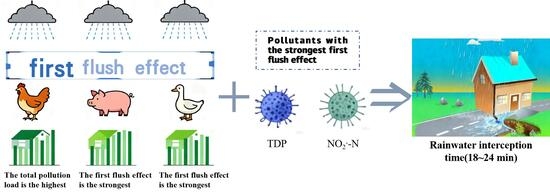
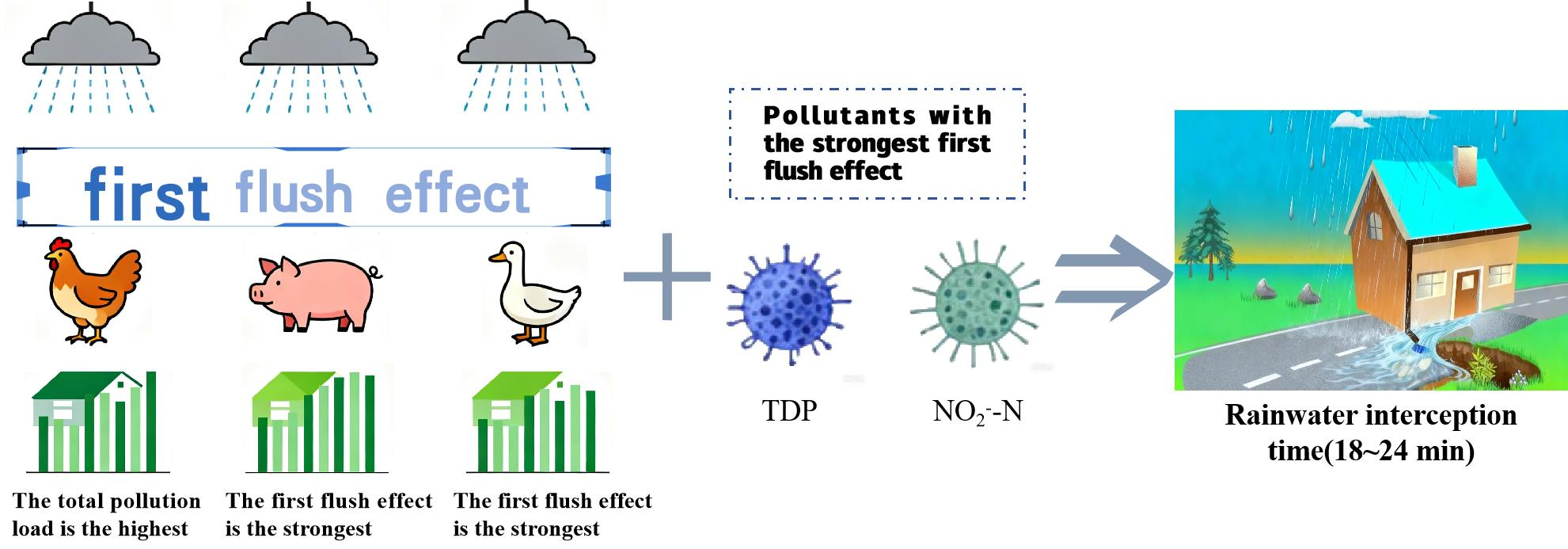
Livestock manure is currently one of the major sources of non-point source pollution. Reasonably determining the impact of rainfall runoff on free-range livestock areas and identifying the rainfall interception time for different pollutants are of great significance for managing watershed water environments. Using the Yongchuan District of Chongqing as a case study, the runoff water pollution scouring results (M(V) curve) of typical areas, including free-range livestock and poultry breeding areas and park impermeable road, were tested and analyzed by using an artificial rainfall simulation device under 45 and 90 mm/h, aiming to provide a reference for the efficient interception of main pollutants in different livestock and poultry breeding areas. The results of the M(V) curve analysis revealed the following: (1) Among the 15 pollutants in the livestock and poultry breeding area of the study area, the first flushing effect of total dissolved phosphorus and nitrite nitrogen was the most obvious. After 24 min of rainfall, the cumulative load of total dissolved phosphorus in this area accounted for 85.71% of the total load, while the cumulative load of nitrite nitrogen accounted for 83.41% of the total load at this time. (2) The first flush effect of pollutants at 45 mm/h is higher than that at 90 mm/h. At 45 mm/h, the first flush effect of pollutants is in the order of total dissolved phosphorus > nitrite nitrogen > total nitrogen > ammonia nitrogen > permanganate index, while at 90 mm/h, it is nitrite nitrogen > permanganate index > ammonia nitrogen > total dissolved phosphorus > total nitrogen. This phenomenon can be attributed to the distinct existence forms of pollutants in road runoff (dissolved and particulate phases), combined with the smaller raindrop diameter and steeper wash-off slope under 45 mm/h. (3) Distinct patterns in total pollution load and first flush effects were observed across different livestock and poultry breeding areas. The highest total pollutant load was recorded in the hen farm, whereas the most intensive first flush occurred in large-scale pig and goose farms. Furthermore, 52.68 to 82.63% of pollutants in Yongchuan District’s livestock and poultry breeding areas can be effectively intercepted by setting the initial rainfall interception time to within 18~24 min after rainfall runoff, as indicated by comparative analysis with relevant water quality standards. Research demonstrates significant first flush effects in livestock and poultry breeding areas of Yongchuan District, Chongqing. It is recommended to implement rainfall interception measures within 18~24 min after rainfall runoff. These findings provide valuable references for effective pollution control of rainfall runoff from impervious surfaces.

1. Introduction

Currently, significant progress has been achieved in point source pollution, yet non-point source pollution remains a critical factor affecting water quality [1,2,3]. With the rapid pace of urbanization, impervious surfaces are gradually replacing the permeable soil and vegetation underlying the surface, reducing the infiltration of rainfall and increasing the pollutant concentrations in surface runoff, which further exacerbates the problem of non-point source pollution [4,5]. Moreover, urban rainfall runoff was identified by the U.S. Environmental Protection Agency (EPA) as the third largest source of pollution contributing to the impairment of rivers and lakes across the United States in 1993 [6]. Rainfall runoff pollution not only poses significant threats to aquatic ecosystems but also has severe impacts on human health and economic development in severe cases. The transport process of pollutants during rainfall events involves the wash-off of accumulated contaminants from dry periods into surface runoff, which subsequently transfers these pollutants to receiving water bodies and ultimately disrupts aquatic ecosystems [7]. Given the higher pollutant concentrations during the initial phase of rainfall events, it is essential to investigate the wash-off characteristics and transport mechanisms of pollutants from various underlying surfaces during this critical first flush stage. Identifying key interception times for different pollution parameters is crucial for effective management and control of rainfall runoff pollution [8,9,10].
Research on non-point source pollution in China began in the 1960s, and the issue of rainfall runoff pollution gradually emerged as a focus of scientific attention. Early studies revealed that urban rainfall runoff exhibited significantly impaired water quality, with initial runoff displaying contamination levels even higher than those of municipal wastewater [11]. Subsequent investigations by Chang Jing et al. [12] in typical functional areas of Shanghai demonstrated that higher rainfall intensities resulted in more pronounced wash-off effects, and notable variations in first flush effects were observed across different functional zones. The formation of rainfall runoff pollution is influenced by multiple factors, including rainfall intensity, rainfall duration, impervious area, the number of antecedent dry days, and the underlying surface type [13,14,15]. Extensive studies have been conducted on the first flush effect and rainfall interception time by domestic and international scholars in recent years. For instance, Ma Jiun-Shiu et al. [16] demonstrated that first flush effects are more likely to occur on road surfaces with higher impervious surface ratios. Tan Chao et al. [17] proposed an initial rainfall interception standard for the central urban area of Guangzhou: 8–10 mm for combined sewer systems and 5–6 mm for separate sewer systems. Similarly, Cao Lijin et al. [18] determined that the optimal interception volume ranges from 45 to 50% of the total rainfall runoff volume. These studies provide valuable practical foundations for effective urban rainfall runoff pollution control.
Most of the above-mentioned studies have focused on urban areas with high population density. However, surface runoff [19] is not only a major source of urban non-point source pollution but also an important component of agricultural non-point source pollution. This issue is particularly pronounced in the context of livestock and poultry breeding, where manure spillage or temporary stockpiling during collection, storage, transportation, and field application can be transported by rainfall runoff into the soil and ultimately discharged into receiving water bodies [19,20,21,22]. This process gives rise to a range of complex environmental problems, including water eutrophication, transmission of pathogenic microorganisms, and soil contamination, thereby posing significant threats to aquatic organism and public health [23,24]. Furthermore, the randomness and uneven temporal and spatial distribution of natural rainfall result in significant variations in rainfall runoff volume and concentration under different rainfall intensities, and the interception standards for the first flush of rainfall, leading to diverse interception standard for the first flush effect. To address this research gap, this study selected backyard poultry and pig farms lacking comprehensive manure management systems as typical research objects. Experimental sites were established within a 200 m radius of various scales and types of livestock and poultry breeding areas. Under controlled conditions involving antecedent dry days, rainfall intensity, and rainfall duration, artificial rainfall simulation experiments were conducted on impervious road surfaces. This study systematically analyzes the first flush effects under varying livestock types, farming scales, and rainfall intensities, providing a critical basis for rainfall interception management in livestock and poultry breeding areas. The findings also offer essential data support for comprehensive accounting of regional non-point source pollution contributions to watershed contamination.

2. Materials and Methods

2.1. Sampling Site Selection

Located in the core area of the Chengdu-Chongqing Economic Corridor and Western Chongqing Economic Zone, Yongchuan District of Chongqing Municipality features a subtropical monsoon humid climate characterized by abundant rainfall. The average annual precipitation over the past decade (2013–2022) was 1015.0 mm [25]. Accurate accounting of non-point source pollution loads in this region is crucial for maintaining water health and ecological security in the Yangtze River Basin. Preliminary field investigations revealed the existence of free-range poultry areas and piggeries lacking comprehensive manure treatment systems in Yongchuan District, Chongqing. Most of the livestock and poultry are transported and returned to the fields in a centralized manner, but distinct traces of livestock manure were observed on surrounding impervious underlying surfaces. Therefore, we selected free-range poultry of different sizes (C and G) and farms without centralized treatment of feces in the whole process (PS and PL) in Yongchuan District, along with a park near a gas station (B1) and Shisun Mountain park (B2) as typical study areas for livestock and poultry breeding regions, as illustrated in Figure 1 (relative information can be found in the previous investigation and statistical results of this laboratory [26]).
The investigation focused on impervious road surfaces within a 200 m radius around these farming areas to examine the scouring characteristics and migration patterns of pollutants in the road runoff in this area under rainfall conditions. Since livestock manure is primarily managed through centralized transport for field application, the documented farming scales serve only as reference data and are not considered as research factors in this study. The detailed parameters of the selected typical livestock and poultry breeding areas are shown in Table 1.

2.2. Apparatus and Sample Collection

In the experiment, we utilized a custom-made artificial rainfall simulation device (Model ZYJY-DZ02, Jiangsu Yunuo Electronic Technology Co., Ltd., Nanjing, China), with a length and width of 2 m × 2 m, respectively, and a rainfall area of 4 m2. Based on preliminary statistical analysis of natural rainfall characteristics in Yongchuan District, Chongqing, from 2013 to 2022 conducted by our laboratory, this study employed the median (45 mm/h) and mean (90 mm/h) values of multi-year rainfall intensity in Chongqing to conduct the experiments. Furthermore, according to calibration results of this rainfall simulation device from previous laboratory studies [29], a rainfall height of 2 m was adopted, achieving a rainfall uniformity greater than 60%.
A total of 12 artificial rainfall simulation experiments were conducted across six monitoring points under two rainfall intensities. The artificial rainfall simulation used local well water as the water source. The concentrations of the main agricultural non-point source pollutants were TN, 0.926 mg/L; TP, 0.013 mg/L; SS, 4 mg/L; and CODMn, 3.52 mg/L, with a pH value of 7.88. Except for the pH value, the concentrations of all of the above pollutants were significantly lower than the measured concentrations of the corresponding pollutants in the runoff from impervious roads. Each rainfall event maintained a duration of 30 min. The test site was selected as the impervious road within a radius of 200 m around the typical livestock and poultry breeding area in Yongchuan District, with an average slope ranging from 2.58° to 6.90°. No fences were set up to allow water to converge in one direction as much as possible. Runoff generated within every 6 min interval was comprehensively collected using pre-cleaned high-absorption towels and transferred to sanitized buckets. All samples were properly labeled and weighed with a precision of 0.05 kg to calculate runoff yield (based on the calibration results of this artificially simulated rainfall device [29], the calculated runoff collection efficiency for both 45 and 90 mm/h ranged between 60% and 90%). Every 6 min, all the runoff water was stirred and mixed evenly, and 500 mL was placed in a polyethylene plastic bottle as a runoff sample for a certain time point to determine the pollutant concentration. A total of 5 water samples were collected for each rainfall event, and a total of 60 mixed water samples from different time points were collected for all the rainfall experiments. After collection, they were all sent to the laboratory for storage at 4 °C [4,7].

2.3. Sample Analysis

The monitoring parameters for runoff water samples included total nitrogen (TN), total dissolved nitrogen (TDN), nitrate nitrogen ( N O 3 - -N), ammonia nitrogen ( N H 4 + -N), nitrite nitrogen ( N O 2 - -N), total phosphorus (TP), total dissolved phosphorus (TDP), orthophosphate ( P O 4 3 - ), suspended solids (SS), permanganate index (CODMn), and the physical parameter electrical conductivity. Particulate nitrogen (PN) was calculated as the difference between total nitrogen (TN) and total dissolved nitrogen (TDN), while particulate phosphorus (PP) was determined by subtracting total dissolved phosphorus (TDP) from total phosphorus (TP). The discrepancy between TN and the sum of three ionic nitrogen species was defined as dissolved organic nitrogen (DON). Similarly, dissolved organic phosphorus (DOP) was characterized as the difference between TDP and orthophosphate concentration ( P O 4 3 - ). All the instruments for determining the indicators were ultraviolet-visible spectrophotometers (UV-1800, Shimadzu Corporation, Tokyo, Japan). Total nitrogen (TN) was analyzed using the alkaline potassium persulfate digestion–UV spectrophotometric method (HJ 636-2012) [30]. Total phosphorus (TP) and total dissolved phosphorus (TDP) were determined by the ammonium molybdate spectrophotometric method (GB 11893-1989) [31]. Suspended solids (SS) were measured via the gravimetric method (GB 11901-1989) [32]. Nitrite nitrogen ( N O 2 -N) was quantified by N-(1-naphthyl) ethylenediamine dihydrochloride spectrophotometry (GB 7493-1987) [33]. Ammonia nitrogen ( N H 4 + -N) was assessed using Nessler’s reagent spectrophotometry (HJ 535-2009) [34]. The permanganate index (CODMn) was determined following the standard permanganate index method (GB/T 15456-2019) [35]. The physical indicators such as pH and electrical conductivity were measured using a YSI ProQuatro multi-parameter water quality meter (ProQuatro-606950, YSI Incorporated, 1725 Brannum Lane, Yellow Springs, OH 45387, USA). After calibration was confirmed to be accurate, the clean probe was placed into the water sample. Once the reading stabilized, it was recorded [25,26].

2.4. Analytical Methods

At home and abroad, scholars commonly use the M(V) curve [36] to describe the cumulative pollutant transport patterns and determine the occurrence of the first flush effect in the identification methods for the initial pollutant flush phenomenon. Thus, a dimensionless cumulative curve is constructed by plotting the ratio of the cumulative load proportion of each pollutant in the runoff effluent against the cumulative flow proportion. This curve illustrates the variation in the ratio between cumulative pollutant mass and total pollutant mass relative to the ratio between cumulative runoff volume and total runoff volume. When the slope of the M(V) curve is greater than 1 or when the M(V) curve is above the diagonal line and the maximum dispersion is greater than 20, it indicates that initial scouring has occurred.
The formula for the M(V) curve is as follows:
M ( t ) V ( t ) = 0 t Q t ρ t d t / 0 T Q ( t ) ρ ( t ) d t 0 t Q t d t / 0 T Q ( t ) d t
i = 0 k Q ¯ t i ρ ¯ t i t / i = 0 n Q ¯ t i ρ ¯ t i t i = 0 k Q ¯ t i t / i = 0 n Q ¯ t i t
In the formula, M(t) represents the cumulative load proportion of pollutants in the rainfall process at time t (unit: %); V(t) represents the cumulative flow proportion in the rainfall process at time t (unit: %); Q(t) represents the surface runoff flow rate at time t (unit: mL/s); C(t) represents the pollutant concentration at time t (unit: mg/L); T represents the total duration of runoff (unit: s); Δt represents the computational time interval (unit: s); Q ¯ t i represents the average runoff flow rate during the computational time interval at time i (unit: mL/s); and ρ ¯ t i represents the average pollutant mass concentration during the computational time interval at time i (unit: mg/L).
Bai Jianguo et al. [27], in their analysis of road runoff in Xuzhou City, identified this period as the critical timeframe for initial rainwater interception during which pollutant concentrations are highest and subsequently decline gradually. Similarly, Hu Wenli [28] confirmed that the first 30 min constitute the dominant phase for pollutant export in surface runoff. Given our focus on the concentrations of the most critical pollutants during this decisive interval, the initial 30 min period of rainfall was designated as the primary analysis period for surface runoff in this experiment. The “Integrated Wastewater Discharge Standard” (GB 8978-1996) [37] and the “Environmental Quality Standards for Surface Water” (GB 3838-2002) [38] were used as the reference standard limits for runoff pollution indicators. A characteristic analysis of pollutants (TN, SS, N H 4 + -N, TP and CODMn) in the initial rainfall under two rainfall intensities was conducted to determine the interception time.

3. Results and Discussion

3.1. Screening of Indicators for the First Flush Effect in Rainfall Runoff

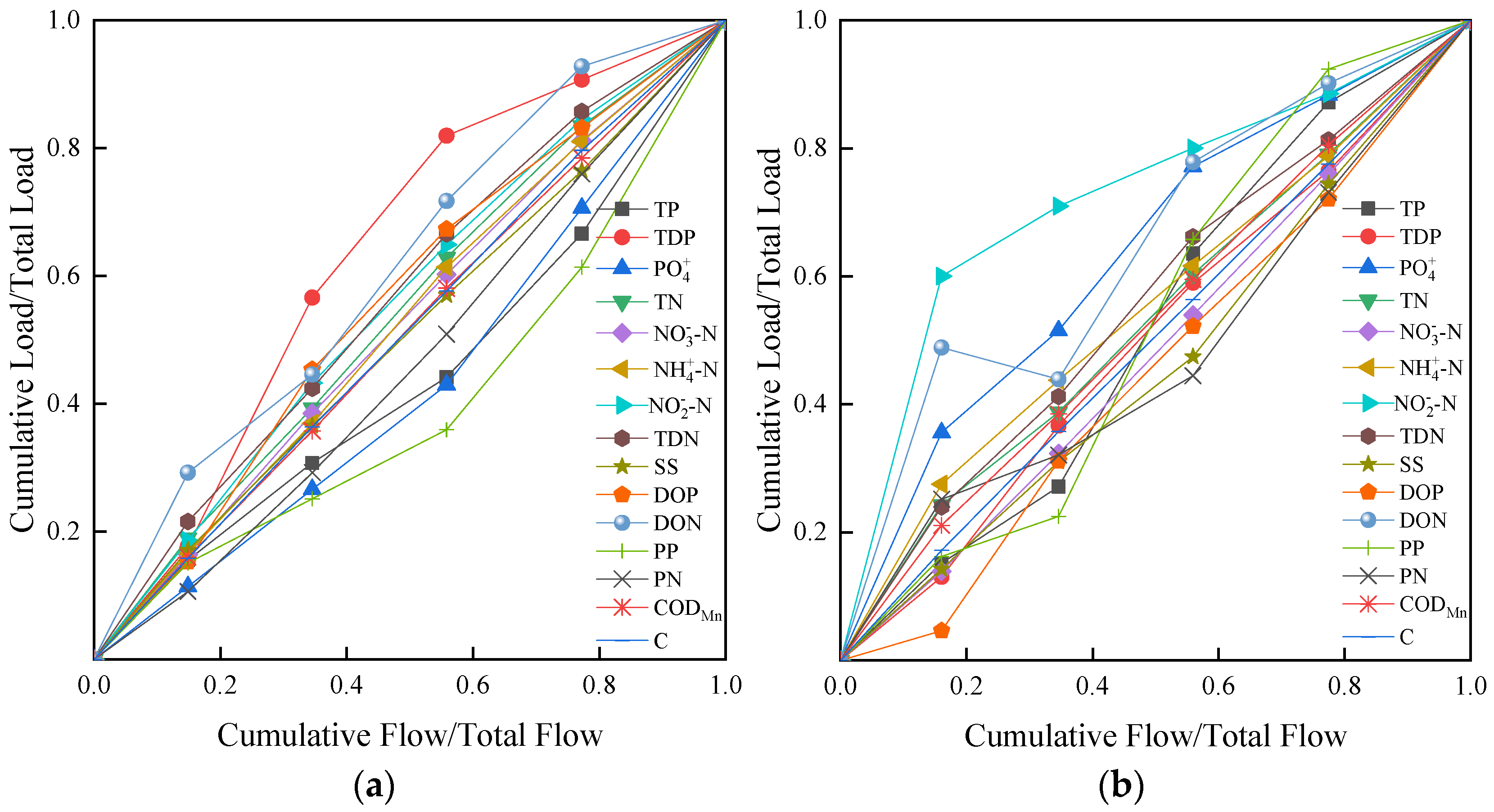
Artificial simulated rainfall was conducted at a small-scale piggery (a) without comprehensive centralized manure treatment of feces and a free-range goosery (b) with values of 45 and 90 mm/h, respectively. pH is not a factor of concern for agricultural non-point source pollution, and it does not directly produce a “first flush effect” by itself. Therefore, this study did not conduct an in-depth M(V) curve analysis on pH. As shown in Figure 2, analysis of the first flush effect of pollutants in the rainfall runoff indicated that non-point source pollution indicators from the different livestock and poultry breeding areas exhibited distinct first flush patterns under the same rainfall intensity. The first flush effect of TDP in the runoff water near the piggery was the most obvious, followed by DON, DOP, TDN, TN, N H 4 + -N, and other pollution indicators. The cumulative wash-off effect of PP and TP was significant (below the diagonal of the M(V) curve). Most of the pollution indicators in the runoff water near the goosery show a first flush effect, among which the first flush effect of N O 2 -N exhibited the most pronounced effect, followed by DON, P O 4 + , N H 4 + -N, CODMn, TDN, and other pollution indicators. Furthermore, we found that the runoff volume gradually increases as the duration of rainfall extends. This is because impermeable roads have a strong infiltration capacity at the beginning of rainfall under the initial dry conditions, thereby suppressing the formation of surface runoff.
Analysis of the TDP and N O 2 - N data from the livestock and poultry breeding areas in Yongchuan District under two rainfall intensities revealed that at 45 mm/h, the cumulative load of TDP accounted for 85.71% of the total load by 24 min of rainfall, with the cumulative load of N O 2 - N reaching 83.41% at the same time. At 90 mm/h, after 24 min of rainfall, the cumulative load of TDP accounted for 79.37% of the total load, and at this time, the cumulative load of N O 2 - N accounted for 68.14% of the total load. Combining the first flush effects of runoff pollutants from roads in two types of livestock and poultry breeding areas, and referring to the research results of Li Chunlin et al. [8] on the runoff from three typical underlying surfaces in Shenyang City, it is believed that TN is prone to strong first flush. Che Wu et al. [11] found that the CODMn concentration in the initial runoff can reach a relatively high level. Finally, TDP, TN, N H 4 + -N, N O 2 -N, and CODMn were selected as the five main pollutants for the analysis of first flush effects.

3.2. The Influence of Rainfall Intensity on the First Flush Effect from Livestock and Poultry Breeding Areas

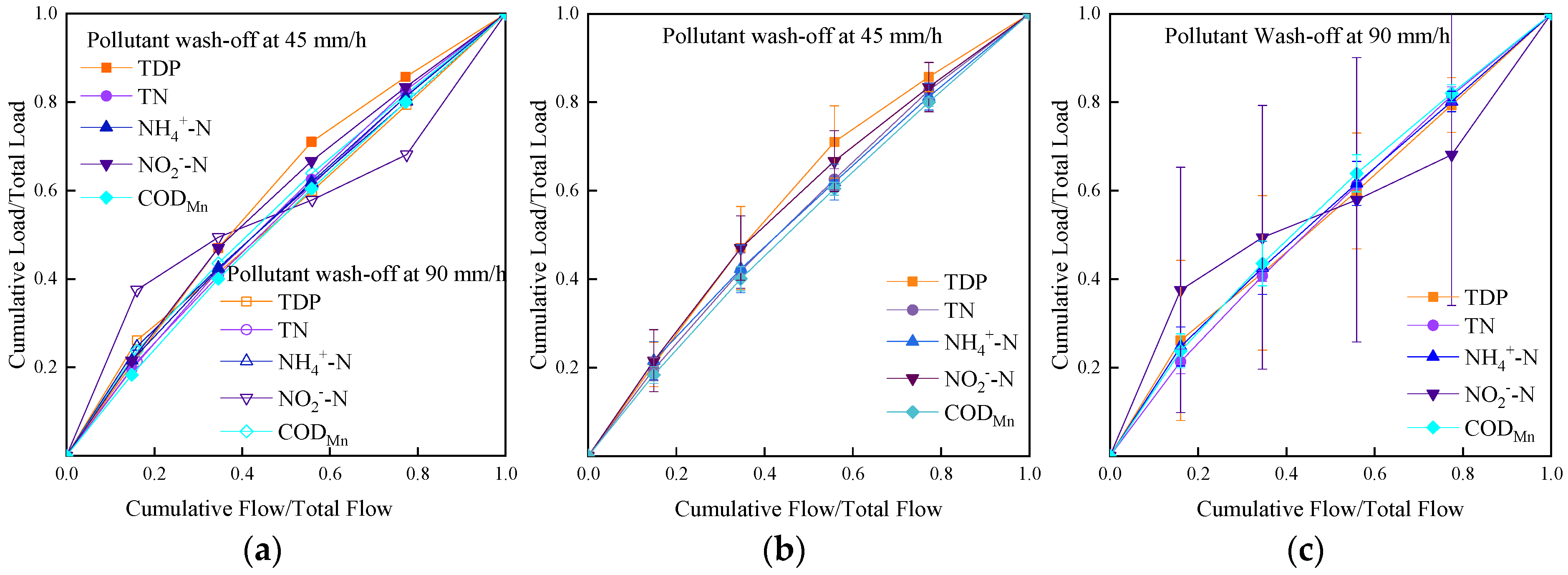
As shown in Figure 3, the first flush effects varied among different non-point source pollution parameters under the same rainfall intensity. This study analyzed the first flush effects of TDP, TN, N H 4 + - N , N O 2 - N , and CODMn in runoff from roads adjacent to livestock and poultry breeding areas (the M(V) curves represent the average from four rainfall events across the farming areas) under 45 and 90 mm/h. Overall, with the exception of the 90 mm/h scenario—where a cumulative effect began to gradually emerge after 18 min of rainfall, the first flush effect was always present in the cumulative curves of other indicator pollutants. At 45 mm/h, the first flush effect decreased in the following order: TDP > N O 2 - N > TN >   N H 4 + - N   > CODMn. In contrast, under 90 mm/h, the sequence for the five pollutants was N O 2 - N > CODMn > N H 4 + - N > TDP > TN. We found that the first flush effect of N O 2 - N on the road surface near the livestock and poultry breeding area was relatively strong under two rainfall intensities, while the first flush effect of TN was not obvious. This is consistent with the research conclusions of Qi Li et al. [39].
The first flush effect of non-point source pollution parameters under different rainfall intensities also varies. We found in this experiment that the first flush effect of pollutants under 45 mm/h is slightly higher than that under 90 mm/h. Among them, the cumulative curve for TDP at 45 mm/h exhibited the greatest deviation from the diagonal, indicating the most pronounced first flush effect. Under 45 and 90 mm/h, the several indicators with a relatively strong first flush effect for the five pollutants are N O 2 - N (90 mm/h) > TDP (45 mm/h) > N O 2 - N (45 mm/h) > CODMn (90 mm/h) > TN (45 mm/h). As the intensity of rainfall increases, the first flush effect of CODMn and N O 2 - N becomes significantly enhanced, while that of TDP and TN is the opposite. CODMn exhibited a distinct first flush effect under 90 mm/h, which is related to its existence form in road stormwater runoff (particulate-bound state) and the size of raindrops (the median diameters of raindrops at 45 and 90 mm/h were 0.98 and 2.28 mm, respectively, according to the calibration results of the simulated rainfall device [29]). Overall, given the same number of antecedent dry days, the more pronounced first flush effect under 45 mm/h is attributable to the steeper slope of the scoured slope subjected to this intensity, as presented in Table 1. This is in agreement with Lyu Zhidan et al. [40] regarding pollutants in Xuzhou road runoff, with the strength of the first flush effect across different rainfall intensities following the sequence of light rain > moderate rain > heavy rain.

3.3. The First Flush Effect of Runoff Pollutants from Different Livestock and Poultry Breeding Areas

Under the same rainfall intensity (45 mm/h), the types and concentrations of pollutants in rainfall runoff differ across various livestock and poultry breeding areas, as shown in Table 2. In terms of pollutant types, the runoff from the hen farm exhibited higher values of TN, N H 4 + - N , TP, and SS. The runoff pollutants from the small-scale piggery (800 heads) were similar to those from the goosery, with both being predominantly composed of N H 4 + - N and nitrite nitrogen. In the large-scale piggery (over 3000 heads), contamination by TDP, N H 4 + - N , and SS was relatively severe. In contrast, the N H 4 + - N content in the two parks was significantly lower. Specifically, the total load of N H 4 + - N over 30 min in the hen farm was approximately 63 times that of the park gas station (B1) and 19 times that of Shisun Mountain (B2).
In terms of pollutant concentration, under identical rainfall intensity conditions, the hen farm generally exhibited a higher total runoff pollutant load than other livestock and poultry breeding areas, particularly for TP, N H 4 + - N , and N O 2 - N . Specifically, the total TP load was approximately five times greater than that from the small-scale piggery, which was related to the hen farm having the steepest road surface scour slope (5.87°) and the longer free-range duration at this facility. The small-scale piggery exhibited relatively low total loads for most pollutants, particularly for phosphorus. Overall, the total pollutant loads over 30 min followed the order of livestock and poultry breeding areas > park areas, and large-scale piggery > small-scale piggery, which aligns with the general pattern of pollutant concentrations in rainfall runoff.
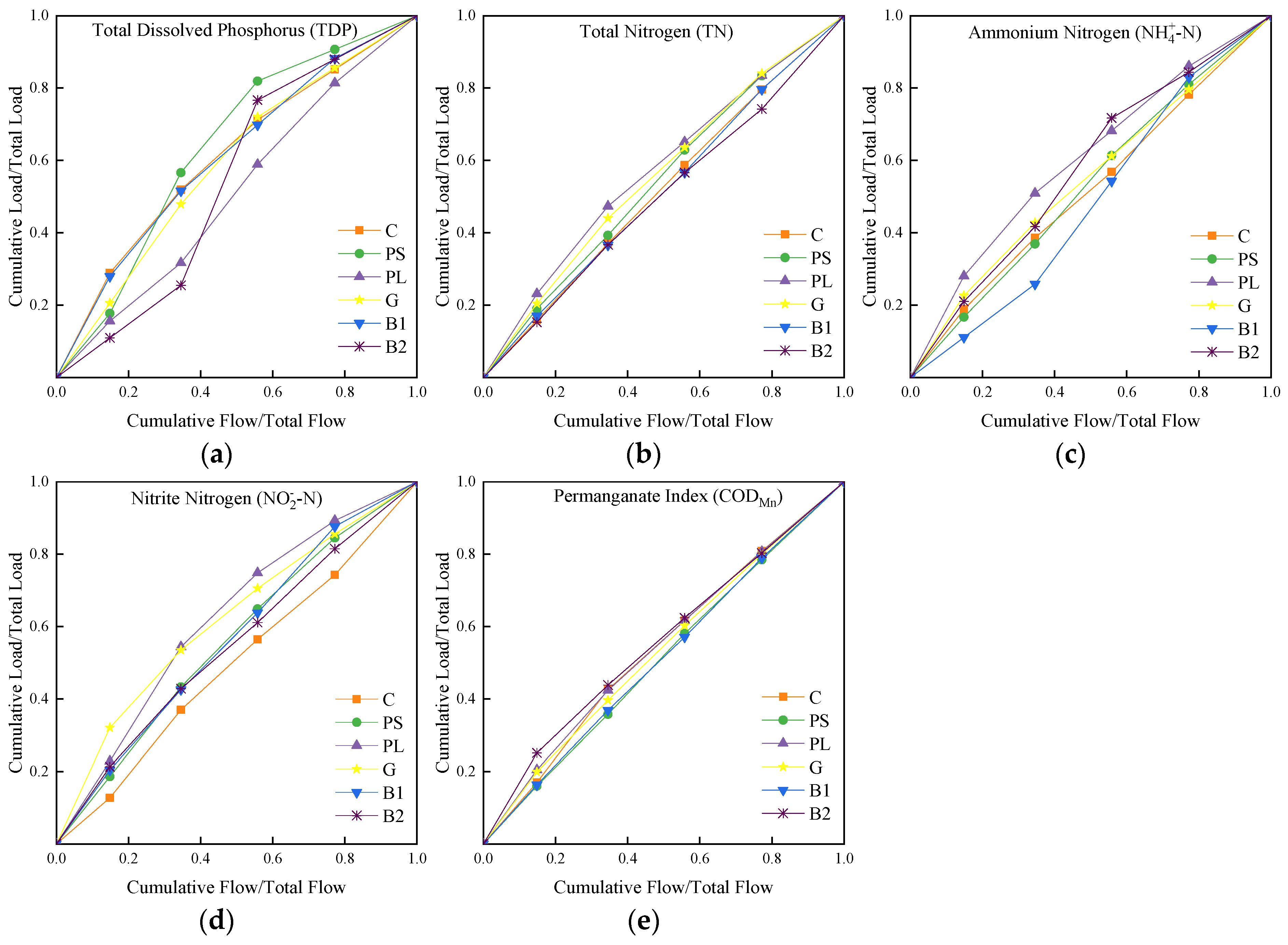
A comparison of the first flush effects of five runoff pollutants between livestock and poultry breeding areas and park areas under 45 mm/h is presented, and it can be seen from Figure 4 that the same pollution parameter shows different intensities of first effects in different livestock and poultry breeding areas. For the pollutant TDP, a first flush effect occurred in the small-scale piggery, hen farm, goosery, and park gas station (B1) areas. The first flush effect of TN and CODMn is weaker than that of other pollutant indicators, but it still occurs in areas such as the large-scale piggery and hen farm. For nitrogen species, no first flush effect occurred in the small-scale piggery and park gas station (B1), while it occurred in all areas except for the hen farm.
Overall, the first flush effect in the blank area is weaker than that in other regions. The first flush effect in the areas with the large-scale piggery and goosery is relatively strong, especially in large-scale piggery, which is most significant in terms of nitrogen. This is primarily due to the large-scale piggery having the highest stocking capacity (over 3000 heads), while parks are generally cleaner, have less animal feces, and experience lower traffic volume. Livestock manure represents the primary source of pollution in livestock and poultry breeding areas. For example, the concentrations of nitrogen and phosphorus in the hen farm are the highest among all sampling sites, which is consistent with the findings of Li Shutian et al. [41] regarding the nitrogen and phosphorus nutrient contents in manure from poultry and swine operations.

3.4. Determination of the Initial Stormwater Interception Time

3.4.1. Analysis of TN and N H 4 + -N Rainfall Interception Time Under Different Rainfall Intensities

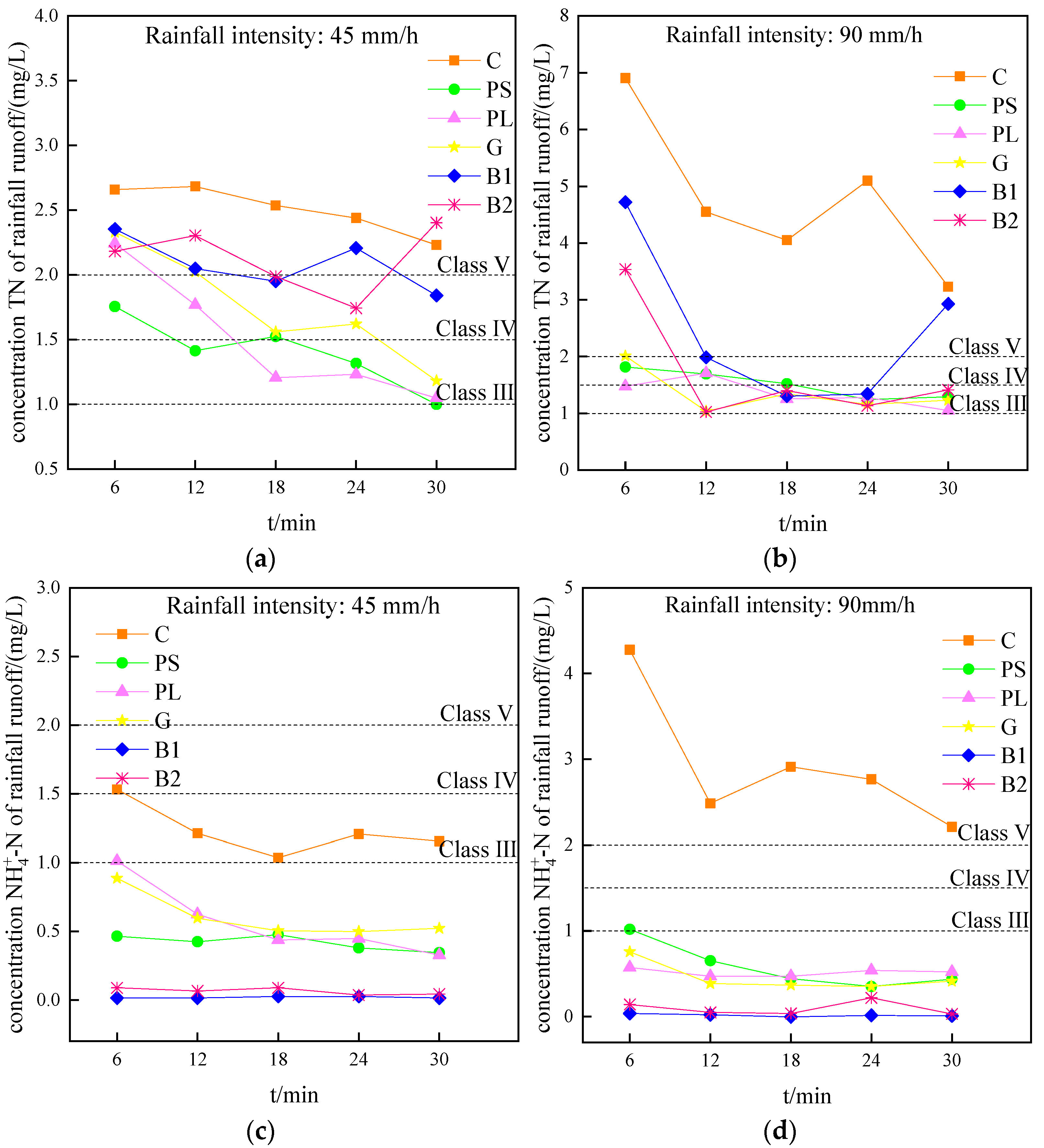
Taking the temporal variation in TN concentration in 12 rainfall events across six study areas under two rainfall intensities as an example, it can be seen from Figure 5 that within the same rainfall event, the TN concentration in the runoff effluent decreased with increasing rainfall duration. Its peak concentration occurred around the initial 6 min, after which it continuously decreased and gradually stabilized. The TN concentration in the runoff effluent under 90 mm/h was generally higher than that under 45 mm/h. Even 30 min into the rainfall even, the TN concentration in the road runoff effluent near the hen farm still exceeded the Class V limit specified in the “Environmental Quality Standards for Surface Water” (GB 3838-2002) [38]. Across the two rainfall events of different intensities, the average TN concentration value exceeded the limit of Class V of surface water by 1.82 times.
Under 45 mm/h, the TN concentration dropped below the Class V surface water standard within 18 min in all areas except the hen farm. Under 90 mm/h, the TN concentration fell below the Class V standard within 12 min and below the Class IV standard within 24 min. The TN removal rates in the livestock and poultry breeding areas at 12 and 24 min were 41.55% and 80.23%, respectively. Therefore, to achieve a water quality standard better than Class V, 18 min can be set as the time point for the TN concentration to meet the standard for interception.
With increasing rainfall duration, the concentration of N H 4 + -N in the runoff showed an overall decreasing trend. The peak concentration for all 12 rainfall events occurred during the initial stage. The peak concentration for all 12 rainfall events occurred during the initial stage. The N H 4 + -N concentration in the runoff effluent from the hen farm was significantly higher than that from other areas. Moreover, with the increase in rainfall intensity, the N H 4 + -N concentration also rose. When the rainfall intensity reached 90 mm/h, the peak N H 4 + -N concentration reached 4.28 mg/L, and it remained above the Class V limit of the “Environmental Quality Standards for Surface Water” (GB 3838-2002) [38] throughout the rainfall event. Furthermore, the low values of N H 4 + -N concentration in this area at 90 and 45 mm/h were observed at 12 and 18 min of rainfall, respectively. At 18 min of rainfall, the N H 4 + -N retention rate was 42.01 to 71.70%, but there was a rebound in ammonium nitrogen concentration in all cases.
Ammonium nitrogen (N H 4 + -N), an inorganic nitrogen species, is one of the transport forms of total nitrogen (TN) in runoff and also a primary source contributing to water eutrophication. With the exception of the hen farm, the N H 4 + -N concentration in rainfall runoff effluent from other areas generally complied with the Class III surface water standard. However, it can be seen from Figure 5 that after 18 min of rainfall, the rate of decrease in N H 4 + -N concentration began to diminish and eventually stabilized. Therefore, the runoff volume from the first 18 min of rainfall can be selected for capture to control the migration and transformation of ammonium nitrogen in the study area.

3.4.2. Analysis of SS and CODMn Rainfall Interception Time Under Different Rainfall Intensities

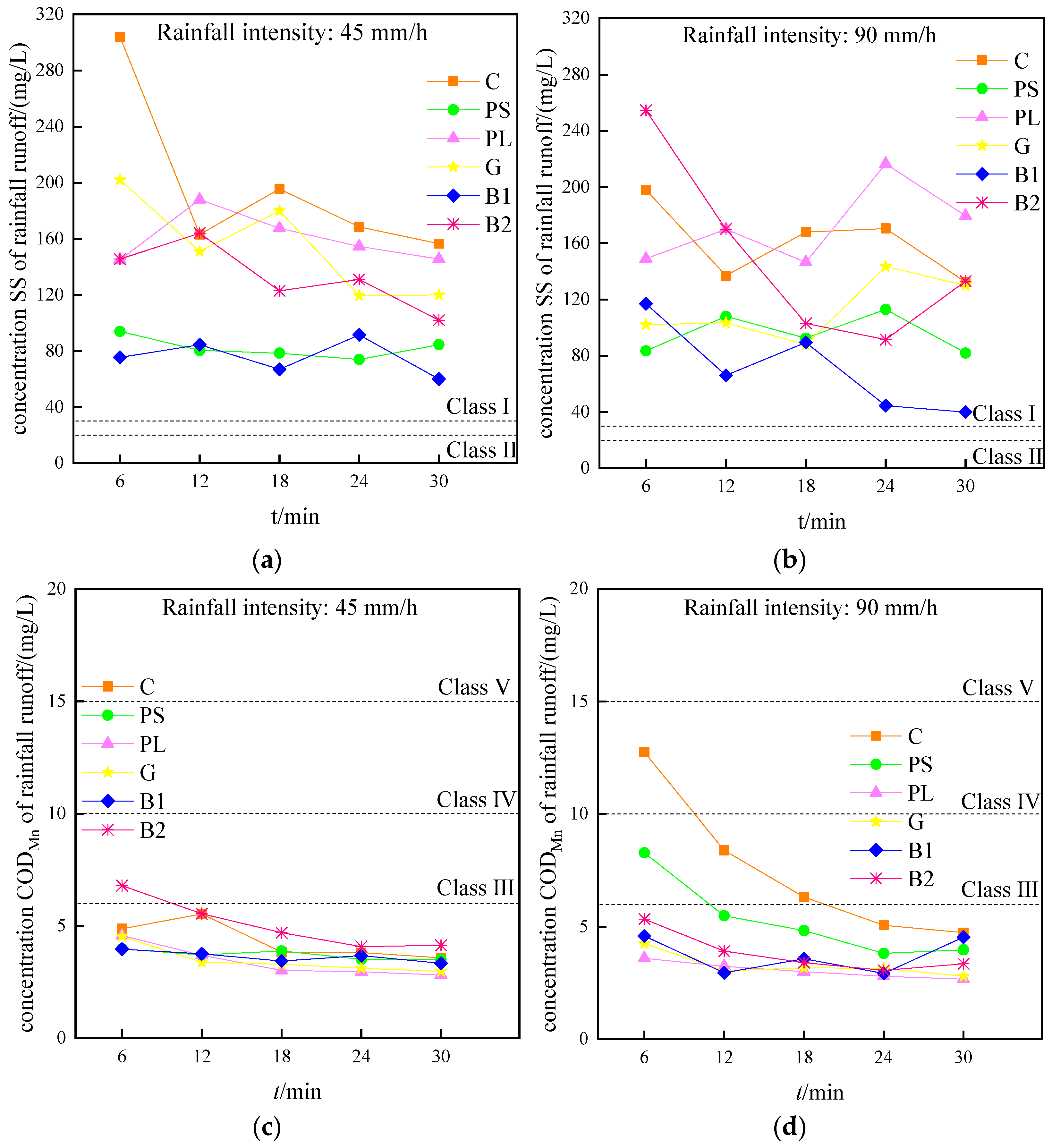
As shown in Figure 6, the SS concentration in the runoff effluent from all 12 rainfall events exceeded the Grade 2 limit of the “Integrated Wastewater Discharge Standard” (GB 8978-1996) [37], with the highest concentration reaching 304 mg/L, approximately 10.13 times the Grade 2 limit. Under 45 mm/h, the SS concentration exhibited a decreasing trend with runoff scouring. Under 90 mm/h, it also showed a declining tendency over time; however, the first flush effect was not pronounced. In the same study area, the overall SS concentration under 90 mm/h was slightly higher than that under 45 mm/h.
Under 45 mm/h, the SS concentration in runoff effluent from the hen farm and small-scale piggery (800 heads) decreased significantly within the first 12 min. The lowest concentration values for both the large-scale piggery (over 3000 heads) and the park areas occurred within 18 min, while that of the goosery appeared within 24 min. Under 90 mm/h, the variation in SS concentration over time in the runoff effluent from the various study areas showed no clear trend. However, the concentrations generally began to stabilize within 24~30 min. The average SS removal rate in the livestock and poultry breeding areas within 18~24 min ranged from 59.11 to 80.19%. Although compliance with the discharge standard could not be achieved within 30 min, intercepting the rainfall volume within the first 24 min of rainfall could effectively control the runoff pollution in the study area.
The CODMn concentration in the rainfall runoff effluent remained below the Class V limit of the “Environmental Quality Standards for Surface Water” (GB 3838-2002) [38] under both 45 mm/h and 90 mm/h, and especially at 45 mm/h, the CODMn concentration of the runoff water was even lower. The CODMn concentration showed a decreasing trend with the increase in rainfall intensity at both 45 and 90 mm/h, but the decreasing trend was more pronounced under 90 mm/h. As can be seen from Figure 6 that the CODMn concentration gradually leveled off within the first 18 min of rainfall. At this time, the CODMn removal rate in the runoff effluent from the Yongchuan livestock and poultry breeding areas ranged from 55.35 to 69.64%. Therefore, 18 min can be designated as the capture time for CODMn concentration.

3.4.3. Analysis of TP Rainfall Interception Time Under Different Rainfall Intensities

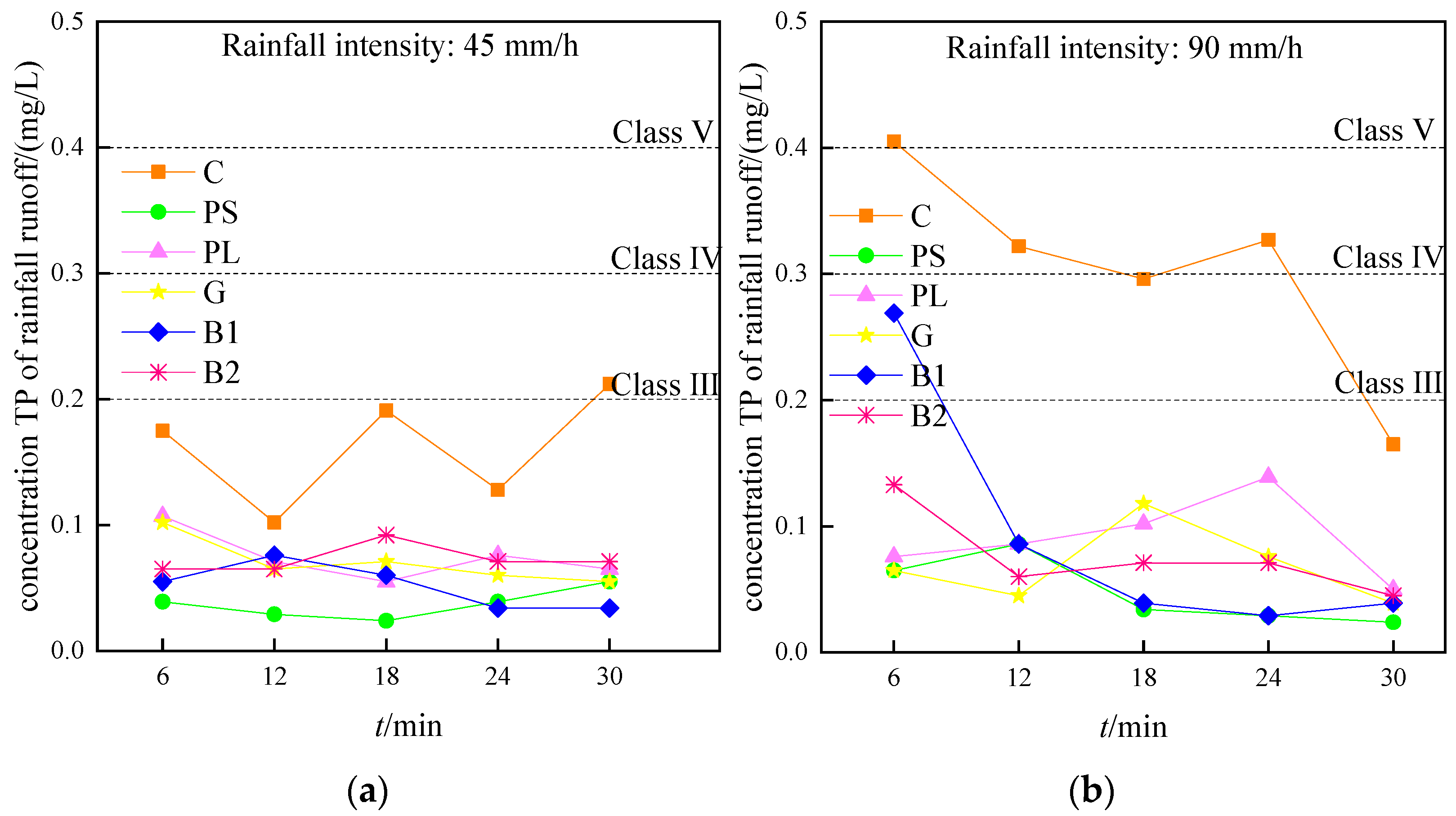
As illustrated in Figure 7, at 45 mm/h, the TP concentration exhibited a general decreasing trend with elapsed rainfall time across all study areas except for the hen farm. A similar temporal pattern was observed under the 90 mm/h condition, whereas the decreasing trend was more pronounced, indicating a more evident first flush effect. The TP concentration demonstrated a consistent positive correlation with rainfall intensity, a pattern that aligns with other runoff pollutant indicators.
Under 45 mm/h, the overall TP concentrations across the study area were consistently below the Class III limit of the “Environmental Quality Standards for Surface Water” (GB 3838-2002) [38], with a notable decrease observed at the 12 min mark. While the TP concentration in road runoff near the hen farm under 90 mm/h decreased to within Class IV limits within 18 min and subsequently to Class III limits within 30 min, concentrations in other study areas dropped to low levels within 12 min, followed by a more gradual decline. Therefore, 12 to 18 min can be taken as the time point for TP concentration interception at which the interception rates of TP range from 27.15 to 71.61% and from 44.14 to 63.60%, respectively.
Based on the above analysis, CODMn has always met the Class V limit values stipulated in the “Environmental Quality Standards for Surface Water” (GB 3838-2002) [38], while SS remained non-compliant even 30 min after the rainfall event. Moreover, the pollutant concentrations under 90 mm/h rainfall were generally higher than those at 45 mm/h, which can be attributed to the positive correlation between rainfall intensity and the total pollutant mass exported by runoff. The current determination of the initial rainfall interception time in this paper is based on the study of the variation law of pollutant concentration in surface runoff and the calculation of the interception rate, which has certain limitations. Future research will optimize the method for determining the interception time through long-term monitoring or big data analysis. Based on the analysis of the interception time of five pollution indicators and considering the effectiveness and economy of the interception of initial rainfall, the interception time of initial rainfall can be set at 18 to 24 min after the onset of rainfall runoff.

4. Conclusions

This study systematically investigated the first flush effects and pollutant characteristics in road runoff from livestock and poultry breeding areas in Chongqing. The main conclusions of this study can be summarized as follows:
(a)
In Chongqing, Distinct, first flush effects were identified for TDP and N O 2 -N in the road runoff of research areas, as evidenced by their cumulative loads accounting for 85.71% and 83.41% of the total loads, respectively, within the first 24 min of rainfall.
(b)
Although the first flush effect was generally more pronounced at 45 mm/h than at 90 mm/h, the dominant pollutants differed: TDP and N O 2 -N showed stronger effects at 45 mm/h, whereas N O 2 -N and CODMn were more dominant at 90 mm/h. Furthermore, the first flush of CODMn intensified with increasing rainfall intensity.
(c)
At 45 mm/h, the first flush effect was most pronounced in the large-scale piggery and goosery. The total pollutant load was the highest in the hen farm, where the main types of pollutants were TN, N H 4 + -N, TP, and SS. In the small-scale piggery (approximately 800 heads) and goosery, the dominant pollutants were N H 4 + -N and N O 2 -N, while the large-scale piggery (over 3000 heads) primarily released TDP, N H 4 + -N, and SS.
(d)
The pollutant concentrations of rainfall runoff at 90 mm/h were higher than those under 45 mm/h. SSs (suspended solids) exhibited the highest concentration, which continued to exceed the Class II limit of the “Integrated Wastewater Discharge Standard” (GB 8978-1996) [37] even 30 min after rainfall began, followed by TN (total nitrogen). It is recommended that rainfall higher than 45 mm/h for these areas be set between 18 and 24 min after runoff initiation. This measure can effectively intercept 52.68 to 82.63% of pollutants.

Author Contributions

Conceptualization, C.L. and C.Y.; methodology, Y.W.; software, J.W.; validation, J.W., Y.W., C.L. and C.Y.; formal analysis, J.W.; investigation, J.W. and Y.W.; resources, C.L. and C.Y.; data curation, J.W. and Y.W.; writing—original draft preparation, J.W.; writing—review and editing, Y.W.; visualization, J.W. and Y.W.; supervision, C.L. and C.Y.; project administration, C.L. and C.Y.; funding acquisition, C.L. and C.Y. All authors have read and agreed to the published version of the manuscript.

Funding

This research was funded by the National Key Research and Development Program of China [No. 2021YFC3201502], and the APC was funded by Li Chunhua and Ye Chun.

Data Availability Statement

The original contributions presented in this study are included in the article. Further inquiries can be directed to the corresponding author.

Conflicts of Interest

The authors declare no conflicts of interest.

References

  1. Li, Z.; Dai, J.; Li, Z.; Liu, Y.; Xu, J.; Zhang, Z.; Xu, B. Simulation Study on the Effect of Non-Point Source Pollution on Water Quality in the Upper Reaches of the Lijiang River. Water 2022, 14, 3995. [Google Scholar] [CrossRef]
  2. Zou, L.; Liu, Y.; Wang, Y.; Hu, X. Assessment and analysis of agricultural non-point source pollution loads in China: 1978–2017. J. Environ. Manag. 2020, 263, 110400. [Google Scholar] [CrossRef] [PubMed]
  3. Xiao, C.X.; Wang, H.W.; Dai, X.H. A review of characteristics and control technologies of urban non-point source pollution. Environ. Eng. 2023, 41, 21–31. [Google Scholar] [CrossRef]
  4. Ren, Y.F.; Wang, X.K.; Ouyang, Z.Y.; Hou, P.Q. Analysis of first flush effect of typical underlying surface runoff in Beijing urban city. Environ. Sci. 2013, 34, 373–378. [Google Scholar] [CrossRef]
  5. Zhao, C.; Li, C.; Hu, Q.; Qi, F.; Sun, D.Z. Review of urban non-point source pollution control technologies and optimization strategies. Environ. Eng. 2023, 41, 11–20+75. [Google Scholar] [CrossRef]
  6. US EPA. National Water Quality Inventory, Report to Congress Executive Summary; US Environmental Protection Agency: Washington, DC, USA, 1995; p. 497.
  7. Wang, B.S.; Huang, T.L.; Nie, X.B.; Chai, B.B. Study on rainwater pollutant washoff rate in impervious surface. Chin. J. Environ. Eng. 2010, 4, 1950–1954. [Google Scholar]
  8. Li, C.L.; Liu, M.; Hu, Y.M.; Xu, Y.Y.; Sun, F.Y.; Chen, T. Analysis of first flush in rainfall runoff in Shenyang urban city. Acta Ecol. Sin. 2013, 33, 5952–5961. [Google Scholar] [CrossRef]
  9. Stenstrom, M.; Kayhanian, M. First Flush Phenomenon Characterization; Caltrans: Sacramento, CA, USA, 2005.
  10. Ma, Y. Research on Transportation Simulation of Urban Rainfall-Runoff Non-Point Source Pollution and the First Flush Effects; South China University of Technology: Guangzhou, China, 2012. [Google Scholar]
  11. Che, W.; Ou, L.; Wang, H.Z.; Li, J.Q. The quality and major influential factors of runoff in Beijing urban area. Tech. Equip. Environ. Pollut. Control. 2002, 3, 33–37. [Google Scholar] [CrossRef]
  12. Chang, J.; Liu, M.; Xu, S.Y.; Hou, L.J.; Wang, H.Y.; Ballo, S. Temporal-spatial distribution and first flush effect of urban stormwater runoff pollution in Shanghai city. Geogr. Res. 2006, 25, 994–1002. [Google Scholar]
  13. Brezonik, L.P.; Stadelmann, H.T. Analysis and predictive models of stormwater runoff volumes, loads, and pollutant concentrations from watersheds in the Twin Cities metropolitan area, Minnesota, USA. Water Res. 2002, 36, 1743–1757. [Google Scholar] [CrossRef] [PubMed]
  14. Gnecco, I.; Berretta, C.; Lanza, L.G.; La Barbera, P. Storm water pollution in the urban environment of Genoa, Italy. Atmos. Res. 2004, 77, 60–73. [Google Scholar] [CrossRef]
  15. Gupta, K.; Saul, A.J. Specific relationships for the first flush load in combined sewer flows. Water Res. 1996, 30, 1244–1252. [Google Scholar] [CrossRef]
  16. Ma, J.S.; Khan, S.; Li, Y.X.; Kim, L.H.; Ha, S.; Lau, S.L.; Kayhanian, M.; Stenstrom, M.K. First Flush Phenomena for Highways: How It Can Be Meaningfully Defined. In Proceedings of the 9th International Conference on Urban Drainage, Portland, OR, USA, 8–13 October 2002. [Google Scholar] [CrossRef]
  17. Tan, C.; Liu, D.; Huang, B.S.; Liu, M.T.; Luo, Z.F. Initial rainwater interception standard for central urban area of megacities based on river in welling capacity. Water Resour. Power 2024, 42, 125–128+196. [Google Scholar] [CrossRef]
  18. Cao, L.J.; Hu, Z.H. Analysis on initial rainwater pollution characteristics and cut-off volume. Ind. Water Wastewater 2023, 54, 47–53. [Google Scholar] [CrossRef]
  19. Zhu, S.; Fang, P.N.; Lan, X.C. Comment on rainfall runoff pollution. Chin. Agric. Sci. Bull. 2009, 25, 240–245. [Google Scholar]
  20. Hu, Y.A.; Cheng, H.F.; Tao, S. Environmental and human health challenges of industrial livestock and poultry farming in China and their mitigation. Environ. Int. 2017, 107, 111–130. [Google Scholar] [CrossRef]
  21. Qian, Y.; Song, K.H.; Hu, T.; Ying, T.Y. Environmental status of livestock and poultry sectors in China under current transformation stage. Sci. Total Environ. 2018, 622–623, 702–709. [Google Scholar] [CrossRef]
  22. Zhang, C.Z.; Liu, S.; Wu, S.X.; Jin, S.Q.; Reis, S.; Liu, H.B.; Gu, B.J. Rebuilding the linkage between livestock and cropland to mitigate agricultural pollution in China. Resour. Conserv. Recycl. 2019, 144, 65–73. [Google Scholar] [CrossRef]
  23. Andretta, I.; Hickmann, F.M.; Remus, A.; Franceschi, C.H.; Mariani, A.B.; Orso, C.; Kipper, M.; Létourneau-Montminy, M.P.; Pomar, C. Environmental impacts of pig and poultry prodcution: Insights from a systematic review. Front. Vet. Sci. 2021, 8, 750733. [Google Scholar] [CrossRef]
  24. Zhu, Z.; Zhang, X.; Dong, H.; Wang, S.; Reis, S.; Li, Y.; Gu, B. Integrated livestock sector nitrogen pollution abatement measures could generate net benefits for human and ecosystem health in China. Nat. Food 2022, 3, 161–168. [Google Scholar] [CrossRef]
  25. Wang, Y.; Wang, J.; Xie, Z.J.; Li, C.H.; Ye, C.; Miao, K.X.; Wei, W.W.; Zheng, Y. Non-point source pollutions in typical river basins in hilly and mountainous areas and plain river network area in China. Environ. Eng. 2024, 42, 33–40. [Google Scholar] [CrossRef]
  26. Wang, J.; Ye, C.; Miao, K.X.; Wang, Y.; Li, C.H.; Xu, Y.B.; Shi, J.L. Analysis of the First Flush Effect in Rainfall Runoff Pollution from Urban and Non-Urban Areas. Res. Environ. Sci. 2025, 38, 1783–1798. [Google Scholar] [CrossRef]
  27. Bai, J.G.; Zhu, X. Preliminary analysis of interception measures on initial rainwater runoff. South-North Water Sci. Technol. 2013, 11, 215–217. [Google Scholar]
  28. Hu, W.L. Initial analysis on preliminary rainwater quality and abandon water. Shanxi Archit. 2011, 37, 129–130. [Google Scholar] [CrossRef]
  29. Wang, J.; Li, C.H.; Ye, C.; Miao, J.X.; Wang, Y.; Feng, J.W.; Wang, Y.; Wang, H. Parameter calibration for the effect of simulated rainfall on the non-point source pollution. J. Environ. Eng. Technol. 2024, 14, 1686–1694. [Google Scholar] [CrossRef]
  30. HJ 636—2012; Water Quality—Determination of Total Nitrogen—Alkaline Potassium Persulfate Digestion UV Spectrophotometric Method. Ministry of Ecological Environment of the People’s Republic of China: Beijing, China, 2012.
  31. GB 11893—1989; Water Quality—Determination of Total Phosphorus-Ammonium Molybdate Spectrophotometric Method. National Environmental Protection Agency: Beijing, China, 1989.
  32. GB 11901—1989; Water Quality—Determination of Suspended Substance-Gravimetric Method. National Environmental Protection Agency: Beijing, China, 1989.
  33. GB 7493—1987; Water Quality—Determination of Nitrogen (Nitrite)-Spectrophotometric Method. National Environmental Protection Agency: Beijing, China, 1987.
  34. HJ 535—2009; Water Quality—Determination of Ammonia Nitrogen—Nessler’s Reagent Spectrophotometry. Ministry of Ecological Environment of the People’s Republic of China: Beijing, China, 2009.
  35. GB/T 15456—2019; Determination of the Chemical Oxygen Demand in Industrial Circulating Cooling Water—Permanganate Index Method. State Administration of Market Supervision and Administration. China National Standardization Management Committee: Beijing, China, 2019.
  36. Geiger, W. Flushing effects in combined sewer systems. Urban Storm Drain. 1987, 4, 40–46. [Google Scholar]
  37. GB 8978—1996; Integrated Wastewater Discharge Standard. National Environmental Protection Agency: Beijing, China, 1996.
  38. GB 3838—2002; Environmental Quality Standards for Surface Water. State Environmental Protection Administration, the State Administration of Quality Supervision, Inspection and Quarantine: Beijing, China, 2002.
  39. Li, Q.; Zhang, N.; Luo, Y.J.; Wang, X.; Jing, Y.C. The first flush effect of urban rainfall runoff based on MFF30 method. J. Univ. Chin. Acad. Sci. 2019, 36, 650–662. [Google Scholar] [CrossRef]
  40. Lv, Z.D.; Li, H.X.; Liu, Y.; Liang, S.; Wang, L.F. First flush and initial split-flow time in the initial rainfall: A case study of urban roads in Xuzhou city. Ecol. Environ. Monit. Three Gorges 2024, 9, 28–37. [Google Scholar] [CrossRef]
  41. Li, S.T.; Liu, R.L.; Shan, H. Nutrient contents in main animal manures in China. J. Agro-Environ. Sci. 2009, 28, 179–184. [Google Scholar]
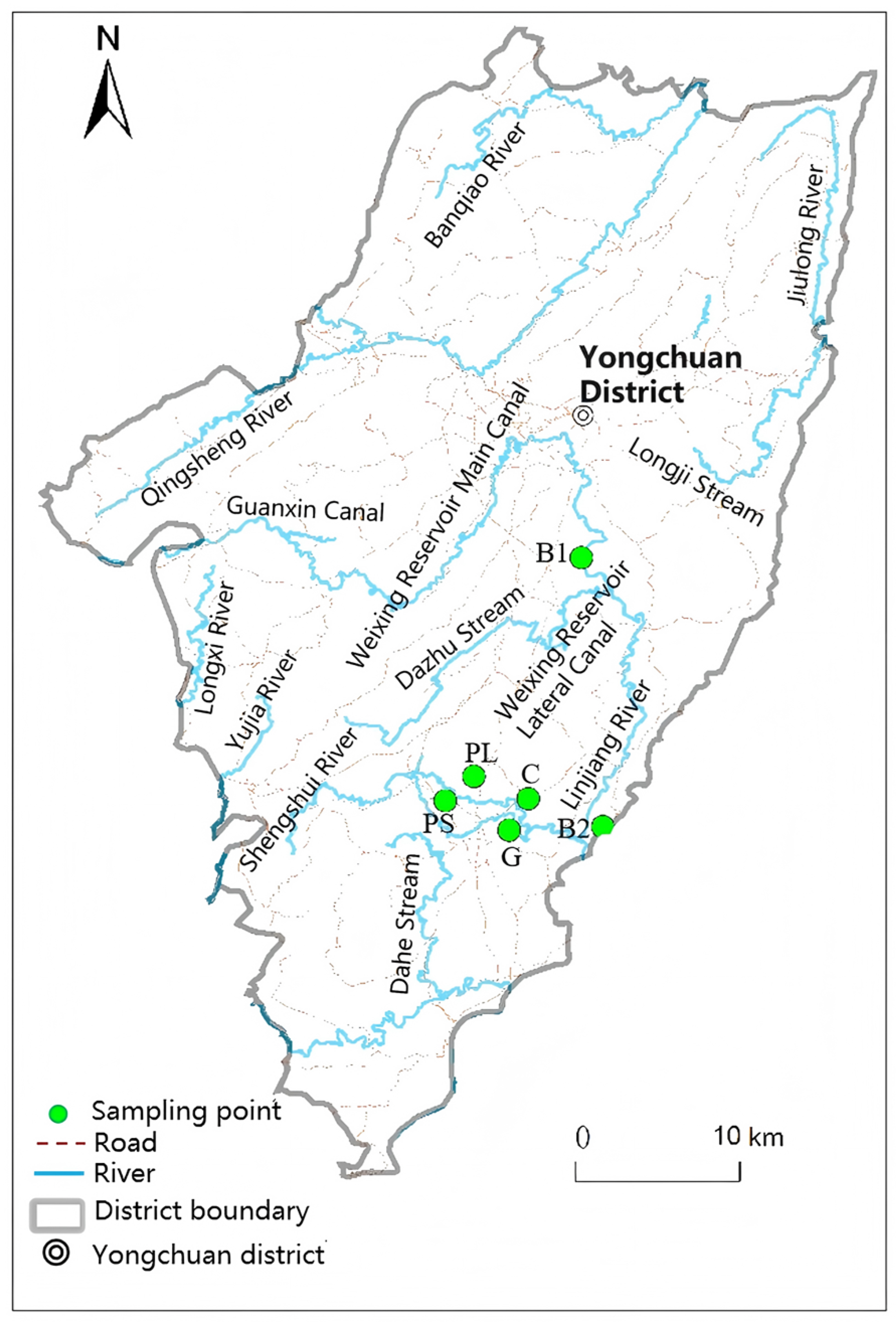
Figure 1. Distribution of sampling points for rainfall runoff pollutants in livestock and poultry breeding areas, Yongchuan District, Chongqing. The green circles represent different rainfall sampling points: C (hen farm), PS (small-scale piggery), PL (large-scale piggery), G (goosery), B1 (gas station park), and B2 (Shisun Mountain park).
Water 17 03487 g001
Figure 2. M(V) curves of the first flush effect in rainfall runoff from typical livestock and poultry breeding areas under different rainfall intensities in Yongchuan District, Chongqing: (a) a small-scale piggery under 45 mm/h rainfall intensity; (b) a goosery under 90 mm/h rainfall intensity. Different marker shapes indicate the M(V) curves for the first flush effect of different pollutant indicators under varying rainfall intensities.
Water 17 03487 g002
Figure 3. M(V) curves of the first flush effect for different pollutants in runoff under varying rainfall intensities in Yongchuan District, Chongqing: (a) comparison of the first flush effect of TDP, TN, N H 4 + - N , N O 2 - N , and CODMn in runoff under 45 and 90 mm/h; (b) M(V) curve of the first flush effect for TDP, TN, N H 4 + - N , N O 2 - N , CODMn in runoff under 45 mm/h; and (c) M(V) curve of the first flush effect for TDP, TN, N H 4 + - N , N O 2 - N , and CODMn in runoff under 90 mm/h. The legend, from top to bottom, corresponds to the initial flush M(V) curves for TDP, TN, N H 4 + - N , N O 2 - N , and CODMn, respectively.
Water 17 03487 g003
Figure 4. (a) First flush M(V) curves of rainfall runoff pollutants TDP; (b) first flush M(V) curves of rainfall runoff pollutants TN; (c) first flush M(V) curves of rainfall runoff pollutants N H 4 + - N ; (d) first flush M(V) curves of rainfall runoff pollutants N O 2 - N ; and (e) first flush M(V) curves of rainfall runoff pollutants CODMn. In the legend, C, PS, PL, G, B1, and B2 represent hen farm, small-scale piggery, large-scale piggery, goosery, gas station park, and Shisun Mountain park, respectively, in Yongchuan District, Chongqing.
Water 17 03487 g004
Figure 5. (a) The TN concentration of runoff water at different points under 45 mm/h and a duration of 30 min. (b) The TN concentration of runoff water at different points under 90 mm/h and a duration of 30 min. (c) The N H 4 + - N concentration of runoff water at different points under 45 mm/h and a duration of 30 min. (d) The N H 4 + - N concentration of runoff water at different points under 90 mm/h and a duration of 30 min. In the legend, C, PS, PL, G, B1, and B2 represent hen farm, small-scale piggery, large-scale piggery, goosery, gas station park, and Shisun Mountain park, respectively, in Yongchuan District, Chongqing. Class III, Class IV, and Class V correspond to the limits of TN and N H 4 + - N for Class III, Class IV, and Class V water quality, respectively, as stipulated in the “Environmental Quality Standards for Surface Water” (GB 3838-2002) [38].
Water 17 03487 g005
Figure 6. (a) The SS concentration of runoff water at different points under 45 mm/h and a duration of 30 min. (b) The SS concentration of runoff water at different points under 90 mm/h and a duration of 30 min. (c) The CODMn concentration of runoff water at different points under 45 mm/h and a duration of 30 min. (d) The CODMn concentration of runoff water at different points under 90 mm/h and a duration of 30 min. In the legend, C, PS, PL, G, B1, and B2 represent hen farm, small-scale piggery, large-scale piggery, goosery, gas station park, and Shisun Mountain park, respectively, in Yongchuan District, Chongqing. Class I and Class II correspond to the Class I and Class II water quality criteria for suspended solids (SS) specified in the “Integrated Wastewater Discharge Standard” (GB 8978-1996) [37], respectively; Class III, Class IV, and Class V correspond to the water quality limits for CODMn stipulated in Class III, Class IV, and Class V of the “Environmental Quality Standards for Surface Water” (GB 3838-2002) [38], respectively.
Water 17 03487 g006
Figure 7. (a) The TP concentration of runoff water at different points under 45 mm/h and a duration of 30 min. (b) The TP concentration of runoff water at different points under 90 mm/h and a duration of 30 min. In the legend, C, PS, PL, G, B1, and B2 represent hen farm, small-scale piggery, large-scale piggery, goosery, gas station park, and Shisun Mountain park, respectively, in Yongchuan District, Chongqing. Class III, Class IV, and Class V correspond to the water quality limits for TP stipulated in Class III, Class IV, and Class V of the “Environmental Quality Standards for Surface Water” (GB 3838-2002) [38], respectively.
Water 17 03487 g007
Table 1. Basic information on road runoff sampling sites in livestock and poultry breeding areas of Yongchuan District, Chongqing.
Point NumberGeographical LocationAverage Slope/(°)Rainfall Intensity/(mm/h)Early Sunny Days Time/dDuration of Rainfall/minNote
C29°09′01″ N, 105°53′36″ E5.8745630highway adjacent to hen farm (1300 birds)
5.2890
PS29°08′57″ N, 105°50′53″ E2.7845630highway adjacent to small-scale piggery (800 heads)
2.5890
PL29°09′45″ N, 105°51′49″ E5.1445630highway adjacent to large-scale piggery (800 heads)
4.4490
G29°07′59″ N, 105°52′59″ E4.5245630highway adjacent to goosery (500 birds)
4.2590
B129°16′55″ N, 105°55′21″ E3.1945930highway adjacent to gas station park
4.9190
B229°08′06″ N, 105°57′03″ E4.2345930highway adjacent to Shisun Mountain park
6.9090
Note: To ensure comparability among different treatment methods and effectively reflect the accumulation and migration process of pollutants through rainfall runoff, this study set a drought period of no less than six days before the artificial simulated rainfall experiment. Duration of rainfall event is 30 min, based on criteria for characterizing initial rainwater runoff [27,28]. C, PS, PL, G, B1, and B2 denote hen farm, small-scale piggery, large-scale piggery, goosery, gas station park, and Shisun Mountain park, respectively.
Table 2. Total load of major pollutants in rainfall runoff from livestock and poultry breeding areas, Yongchuan District, Chongqing.
Point NumberTotal Pollution Load/[mg/(30 min)]
TPTDPTN N H 4 + -N N O 2 -NSSCODMn
C13.7961.719211.641102.5802.75516,178.075362.277
PS3.1860.567116.52735.1512.3506927.850314.242
PL6.1781.914122.27545.5972.52313,618.192282.378
G5.8201.769143.71349.4554.00012,814.208287.795
B14.3321.304174.8541.6303.0766398.533306.580
B26.2292.122180.0675.3162.22211,152.108565.364
Note: C, PS, PL, G, B1, and B2 represent hen farm, small-scale piggery, large-scale piggery, goosery, gas station park, and Shisun Mountain park, respectively.
Disclaimer/Publisher’s Note: The statements, opinions and data contained in all publications are solely those of the individual author(s) and contributor(s) and not of MDPI and/or the editor(s). MDPI and/or the editor(s) disclaim responsibility for any injury to people or property resulting from any ideas, methods, instructions or products referred to in the content.