Article

Effects of Forest Thinning on Water Yield and Runoff Components in Headwater Catchments of Japanese Cypress Plantation


1
Graduate School of Agricultural and Life Sciences, The University of Tokyo, Bunkyo 113-8657, Japan
2
The University of Tokyo Hokkaido Forest, Graduate School of Agricultural and Life Sciences, The University of Tokyo, Furano 079-1563, Japan
3
Faculty of Regional Environmental Science, Tokyo University of Agriculture, Setagaya 156-8502, Japan
4
Ecohydrology Research Institute, Graduate School of Agricultural and Life Sciences, The University of Tokyo, Seto 489-0031, Japan
5
Faculty of International Studies, Setsunan University, Osaka 572-8508, Japan
6
Faculty of Tropical Forestry, Universiti Malaysia Sabah, Kota Kinabalu 88-400, Malaysia
7
Forest GX/DX Co-Creation Center, Graduate School of Agricultural and Life Sciences, The University of Tokyo, Bunkyo 113-8657, Japan
8
Executive Office, Graduate School of Agricultural and Life Sciences, The University of Tokyo, Bunkyo 113-8657, Japan
*
Author to whom correspondence should be addressed.
Water 2025, 17(24), 3461; https://doi.org/10.3390/w17243461
Submission received: 7 November 2025 / Revised: 30 November 2025 / Accepted: 3 December 2025 / Published: 5 December 2025
(This article belongs to the Section Hydrology)

Abstract

Forests play a key role in sustaining global water cycles by regulating precipitation partitioning, which in turn influences both water yield and ecosystem stability. Thinning is a silvicultural tool used to improve forest plantation productivity, but it is increasingly recognized as a means for water resource management. This study investigated hydrological changes following 40% thinning of tree density with contour-aligned log placement in paired headwater catchments of a Japanese cypress forest. Annual runoff in the treated catchment was 108.7 mm above the pre-thinning baseline in the thinning year (2020), followed by smaller increases of 99.7 mm, 43.7 mm, and 0.4 mm in 2021 to 2023, after which annual yields effectively returned to pre-thinning levels. Despite these temporary increases, peak discharge and storm quickflow metrics remained within the pre-thinning range. Flow duration curve analysis revealed a sustained enhancement of low-flow discharge and baseflow throughout the post-thinning period, indicating improved low-flow resilience without increased stormflow risk. These findings demonstrate that moderate thinning combined with contour felled logs can enhance water availability in plantation forests while maintaining flood protection. They also highlight the need for long-term, multi-site studies to test the persistence and generality of these low-flow benefits under varying forest and climate conditions.

1. Introduction

Forests are integral to the global hydrological cycle, regulating how precipitation is partitioned into interception, evapotranspiration, infiltration, and runoff [1]. Through their structural and biogeochemical processes [2,3], forests influence water availability [4], maintain ecosystem stability [5], and mitigate flood and erosion risk [6], thereby serving as a critical link between terrestrial ecosystems and river systems [7]. However, the rapid expansion of plantation forests worldwide, driven by timber demand, climate mitigation, and restoration policies [8,9,10], has raised concerns about their hydrological impacts [11,12]. Sun et al. [13] reported that planted forests, which are often dominated by fast-growing species at high stand densities, exhibit lower water yield coefficients (0.29) compared to natural forests (0.34), particularly in humid and sub-humid climates, indicating greater evapotranspiration and reduced runoff efficiency. The observed trade-offs between carbon sequestration, economic productivity, and downstream water supply call for sustainable forest management strategies that balance ecological productivity with hydrological resilience.
Approximately 67% of Japan’s land area is forested, and about 40% of this is composed of plantation forest characterized by evergreen coniferous species, mainly Japanese cedar (Cryptomeria japonica) and Japanese cypress (Chamaecyparis obtusa) [14]. Most of these plantations were established soon after World War II to meet the nation’s demand. Nevertheless, by the 1980s, falling domestic wood prices driven by cheaper timber imports [15,16], along with labor shortages and fragmented ownership, led to a progressive decline in management activity. As a result, many forest stands are now over 50 years old and largely under-managed [14], with dense, even-aged canopies that intensify rainfall interception and evapotranspiration [17,18], severely limiting understory development [19]. This promotes non-uniform throughfall, which intensifies raindrop impact on bare soil [20]. Such a condition enhances overland flow and accelerates surface runoff on steep slopes, thereby diminishing infiltration capacity and reducing the forest’s water retention potential [21]. In response, thinning has been increasingly promoted to improve not only the stand productivity but also ecohydrology functions [22,23].
Forest thinning is a silvicultural practice that involves selectively removing smaller or less vigorous trees to open canopy gaps and improve the stand structure of the remaining trees [22]. This intervention typically reduces canopy density, resulting in decreased rainfall interception and lower evapotranspiration losses [23]. Kubota et al. [24] have reported that 50% thinning of Japanese cypress reduced canopy interception loss by approximately 4% in the first year, with evapotranspiration in the growing season dropping by 140 mm (17%). These shifts can increase soil moisture, promote understory growth, and enhance subsurface flow, and they often moderate surface runoff [25]. Subsequently, annual runoff yield has been found to increase by 20% following 58.3% thinning in Mie, Japan [26]. Long-term studies on thinning [27,28] have also documented an increase in annual runoff persisting for nearly a decade. However, the effects are highly variable, as, for instance, thinning had negligible impacts on evapotranspiration in managed pine plantations on the coastal plain of the southeastern United States [29]. Together, these findings highlight complex interactions among management, site condition, and hydrology, making it unclear which components of water yield and flow are most responsive to forest thinning.
Forest removal, like thinning, often increases runoff once a certain threshold is surpassed [23,30], but the degree and duration of these changes are highly variable, influenced by forest type, climate, and specific management practices [31,32]. Water yield increases reported in previous studies range from negligible to approximately 20–30%, with more limited responses observed in drier regions or forests that recover rapidly [23,24,26,30,31,32]. In Japanese plantation forests, paired catchment studies demonstrate that thinning tends to increase sustained baseflow over the long term, while effects on storm-driven quickflow and peak discharge are weaker and more variable, particularly following minimal disturbance thinning practices that involve placement of logs parallel to contour [25,26]. However, existing studies have reported mixed findings regarding the effects on annual runoff yield, and most have overlooked potential changes in inflow regimes throughout the year, particularly as captured by flow duration curve analysis. Even when annual runoff remains similar, thinning may alter the distribution of high-flow and low-flow conditions, with important implications for hydrological resilience. Most past research has focused primarily on changes in annual water yield, providing limited insights into how different components of streamflow respond to thinning at finer temporal scales. Tamai [33] specifically introduced the use of flow duration curve ratio analysis to assess the impacts of forest treatment on streamflow characteristics, offering a more detailed quantification of flow regime changes. Despite its value, this approach remains underutilized and, therefore, applying the flow duration curve ratio analysis and hydrograph separation could deepen the understanding of thinning impacts runoff component.
The objective of this study is to investigate how forest thinning influences rainfall–runoff characteristics in a Japanese cypress headwater catchment. We hypothesized that thinning with minimal disturbance, where felled logs were placed parallel to the contour lines, would increase annual water yield and enhance baseflow contributions while producing negligible changes in storm quickflow and peak discharge. To test these hypotheses, we applied a paired catchment design and analyzed thinning effects across three dimensions: (i) annual water yield, (ii) ratio flow duration curves, and (iii) storm event hydrograph separation. Together, these elements represent a novel combination that allows us to clarify how minimal disturbance thinning with contour-aligned felled logs alters annual water yield, baseflow, and storm quickflow in Japanese cypress headwater catchments. By combining these complementary approaches, this study provides a more detailed assessment of how minimal-disturbance thinning modifies both overall water yield and the distribution of flow conditions throughout the year. The outcomes are intended to test the proposed hypotheses by clarifying which runoff components are most sensitive to thinning in Japanese plantation forests and to inform thinning practices that enhance water resource provision while maintaining hydrological stability.

2. Materials and Methods

2.1. Site Description and Catchment Treatment

This study implemented the paired-catchment experimental design to investigate the effects of forest thinning on hydrological responses. It is a well-established framework for detecting changes in water yield since it enables treatment effects to be distinguished from natural climatic variability by incorporating a control catchment [30,31,32,33]. The validity of this method rests on selecting the treatment and control catchments that are in close proximity, ensuring that they receive similar atmospheric inputs and share broadly comparable soil properties, geological setting, and vegetation structure [31]. The paired catchment approach further limits confounding factors by simultaneously monitoring both catchments, thereby increasing the efficiency and reliability of change detection [34]. Equally important is establishing a robust pre-treatment relationship between the catchments that captures the natural variability, allowing deviations observed following treatment to be attributed to experimental manipulation [31].
This research was carried out in two headwater catchments (A1 and A2) at Obora Experimental Watershed (OEW), located north of Toyota City, Aichi Prefecture, Japan (35°16′ N, 137°15′ E; Figure 1a,b). The region has a warm temperate climate [35], with rainfall reaching its annual maximum during the Baiu season (June–July) and a secondary peak associated with the typhoon season (August–October). Snowfall is minimal in winter and typically melts within a few days. The mean annual precipitation is approximately 2000 mm, and the mean annual temperature is about 15 °C. The bedrock comprises medium-grained granodiorite [36] with soils classified as Cambisol [37] with a bulk density of 0.6 g cm−3 [38]. The experimental watershed is covered by a Japanese cypress (Chamaecyparis obtusa) plantation established in 1991. Japanese cypress is a non-coppicing evergreen conifer widely planted in Japanese forest plantations [14], notable for its tall, straight stems and dense, broadly conical crowns [39]. Its roots are shallow and highly lateral, with dense fine roots spreading horizontally near the soil surface [40].
Catchments A1 and A2 have drainage areas of 2.27 ha and 1.45 ha, respectively (Figure 1c). Elevation in the study area ranges from 577 to 644 m above sea level, with A1 spanning 586–644 m and A2 574–644 m. Catchment boundaries and contributing streams were delineated using topographic maps and on-site surveys, during which outlet points were identified, and stream channels and ridgelines were carefully traced to minimize cross-boundary runoff [41]. This procedure ensured that each unit functions as a hydrologically independent headwater catchment while retaining close similarity in climatic forcing, geological setting, and stand structure [31]. The mean slopes of A1 and A2 are 22° and 27°, respectively, and the proportion of steep slopes (>30°) is greater in A2 (46%) than in A1 (13%), likely contributing to systemically higher runoff in A2 [42]. This inherent difference is accounted for by a strong pre-treatment relationship between the catchments, enabling post-treatment deviations from baseline to be attributed to the treatment [31].
Observations in the experimental watershed began in March 2016, when both catchments were covered by Japanese cypress at a density of 2100 trees ha−1, and the forest floor was sparsely covered with litter and had little understory vegetation. The interval from March 2016 to December 2019 is treated as the pre-thinning (calibration) period. A1 was designated as the treatment catchment, whereas A2 served as the control. Thinning was carried out from January to March 2020, and the post-thinning period was from April 2020 to December 2023. In A1, 40% of tree density was reduced by forest workers using chainsaws to promote understory development and improve conditions of the remaining trees [22], in accordance with the maximum thinning intensity permitted under Toyota City’s forest management guidelines [43]. The thinning mainly targeted smaller-diameter trees to regulate tree density. To minimize soil disturbance, the felled logs, including twigs and branches, were carefully placed parallel to the contour lines (Figure 1d).

2.2. Hydrological Measurements

Streamflow was monitored at the outlet of catchments A1 and A2 using 90° V-notch gauging weirs equipped with Thalimedes shaft encoder data loggers (OTT MESSETECHNIK GmbH & Co. KG, Kempten, Germany) recording at 5 min intervals (Figure 1c). The weirs were constructed by excavating to bedrock and sealing concrete dams. Water level loggers were installed in protective wells adjacent to the weirs to shield the instruments from debris while allowing water to flow through the opening [44]. Recorded water level data were converted to discharge using rating curves derived from manual measurements of weir outflow with a measuring cylinder and stopwatch [44]. Rainfall was measured at 10 min intervals using an OW-34-BP tipping bucket rain gauge (0.5 mm per tip; Ota Keiki Seisakusho Co., Ltd., Tokyo, Japan) at a weather station located 300 m east of the watershed (Figure 1c) [44]. Rainfall and runoff data were processed into annual totals, daily totals, and storm event hydrographs for analyses at multiple temporal scales. To enable synchronized event delineation, runoff data were first aggregated to 10 min intervals to match the temporal resolution of rainfall.

2.3. Annual Water Yield Estimation

The estimated runoff was obtained by developing a simple linear regression between annual runoff in the thinning catchment A1 and the control catchment A2 during the pre-thinning period (2016–2019) [31]. For 2016, annual runoff was calculated from March to December since observations began in March, whereas January–February are relatively dry in this region, and their exclusion has a negligible effect on the annual relationship. The regression takes the following form:
Q A 1   p r e = a   Q A 2   p r e + b
where Q A 1   p r e and Q A 2   p r e are annual runoff (mm) in catchments A1 and A2, respectively, and a and b are the regression coefficients. Given the limited number of pre-thinning years (n = 4), the 95% confidence interval of the regression was calculated to evaluate the uncertainty of the estimated runoff. This relationship was then applied to the thinning year and post-thinning period (2020–2023) to estimate the annual runoff in A1 under the assumption that no thinning had taken place as follows:
Q A 1   p o s t e s t = a   Q A 2   p o s t o b s + b
where Q A 1   p o s t e s t is the estimated annual runoff (mm) in the thinning catchment A1 for each year from 2020 to 2023, Q A 2   p o s t o b s is the observed annual runoff in control catchment A2 in the same years, and a and b are the coefficients derived from the pre-thinning relationship. In 2020, thinning was carried out from January to March. Therefore, 2020 is treated as a thinning year, while 2021–2023 represent hydrological responses under fully post-thinning stand conditions and are referred to as the post-thinning period. The change in water yield during the post-thinning period was then calculated as follows:
W Y = Q A 1   p o s t o b s Q A 1   p o s t e s t
Here, W Y is the change in annual water yield (mm) and Q A 1   p o s t o b s is the observed annual runoff in A1 during the post-thinning period.

2.4. Flow Duration Curve

Flow duration curves (FDCs) were constructed from daily discharge to evaluate the effects of thinning across the flow regime. An FDC summarizes the proportion of time that specified discharges are equaled or exceeded and is widely used to characterize streamflow variability [45]. Previous studies have used long-term datasets to conduct regressions at fine temporal resolution, such as developing a regression relationship at each daily discharge [33] or by focusing on selected percentiles (e.g., 5th, 10th, 20th) to represent different parts of the flow regime [46]. For the FDC analysis, only three complete daily discharge records (2017–2019) were available in the pre-thinning period. The year 2016 was excluded because observations began in March, and the daily record for that year was incomplete. Therefore, the individual percentile-based regression was not feasible. Instead, following the classification proposed by Nakano et al. [47], FDCs for each year were divided into four runoff categories based on the rank of daily flow within the water year: plentiful runoff (days 1–140, corresponding to 0–38% exceedance), ordinary runoff (days 141–230, 39–63% exceedance), low runoff (days 231–315, 64–86% exceedance), and scanty runoff (days 316–365, 87–100% exceedance). For each runoff category, a simple linear regression was developed between daily runoff in the selected categories in A1 and A2 during the pre-thinning period as follows:
Q A 1 , i = a i   Q A 2 , i + b i
where Q A 1 , i is the daily runoff (mm day−1) in A1 for the flow category i , Q A 2 , i is daily runoff (mm day−1) in A2, and a i and b i are the regression coefficients for category i . The regression relationships derived from the pre-thinning period were then applied to the post-thinning period (2020–2023) to estimate runoff in A1 at selected percentiles of the FDC under the assumption that no thinning had occurred. Treatment effects in each flow category were quantified as the percentage of the ratio observed to estimated runoff as follows:
R i =   Q A 1 , i o b s Q A 1 , i e s t   × 100 %
where R i is the observed-to-estimated runoff ratio (%) for runoff category i , Q A 1 , i o b s is the observed runoff (mm day−1) in A1 at the selected percentiles during the post-thinning period, and Q A 1 , i e s t is the corresponding estimated runoff (mm day−1). Ratios greater than 100% indicate an increase in runoff relative to the pre-thinning relationship, while ratios less than 100% indicate a decrease in runoff for that specific exceedance percentile.

2.5. Storm Event Hydrographs and Analysis

Storm event hydrographs were derived from rainfall–runoff records and analyzed to quantify runoff response. Each hydrograph was separated into quickflow and baseflow using the straight-line method [48,49]. A line connecting the discharge at the start of a storm event (Qinitial, defined as the discharge immediately before streamflow begins to rise in response to rainfall) and the discharge at the end of the event (Qend) was used for separation. The portion of discharge below this line was defined as baseflow (Qbase), while the portion above it was defined as quickflow (Qquick). Hydrograph separation and metric extraction were performed using GNU Fortran (gfortran) 10.3.0 [50], conforming to the ISO/IEC 1539-1:1997 (Fortran 95) standard [51], while graphical inspection and quality checks were carried out in R version 4.4.1 [52]. During inspection, storm events with rainfall totals <10 mm were found to lack clear quickflow–baseflow separation and were, therefore, excluded from the dataset. For each retained event, the following characteristics were determined: Qinitial—discharge at the onset of event response (mm h−1), Qpeak—maximum discharge during the event (mm h−1), Qtotal—total event runoff volume (mm), Qquick—quickflow volume (portion above separation line, mm), Qbase—baseflow volume (portion below separation line, mm), and time to peak, Tpeak—elapsed time between Qinitial and Qpeak (min). For storm event analysis, the post-thinning period was defined from April 2020 to December 2023, excluding events during thinning operations (January–March 2020).
We employed analysis of covariance (ANCOVA) to evaluate differences in the slopes of regression lines between the thinning catchment A1 and the control catchment A2 during the pre- and post-thinning periods. This approach allowed us to test whether the runoff response of the thinning catchment deviated from the expected relationship with the control catchment after thinning. In addition, the Mann–Whitney U test was applied as a non-parametric alternative to compare distributions of storm event characteristics between pre- and post-thinning periods.

3. Results

3.1. Rainfall–Runoff Analysis

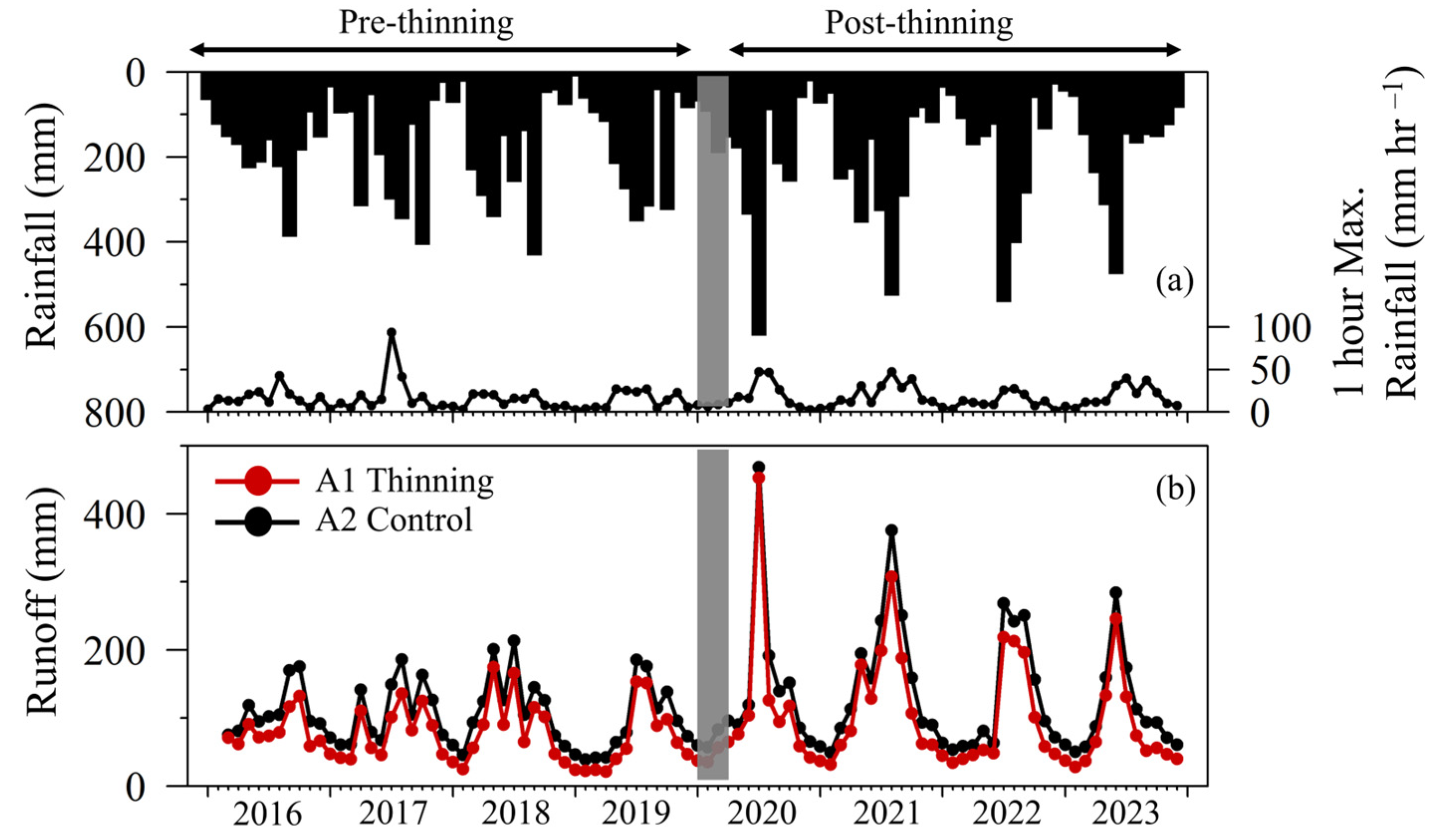
Mean annual precipitation over the 8-year monitoring period (2016–2023) was 2154.5 mm, calculated as the average of the eight annual precipitation totals, with notable differences between the pre-thinning (2030.3 mm) and post-thinning (2272.0 mm) periods (Table 1). The highest monthly precipitation occurred in July 2020 with 620.5 mm, while the lowest was 11.5 mm in January 2019 (Figure 2a). The largest storm events were recorded on 4–7 July 2018 (229.5 mm, pre-thinning) and 12–15 August 2021 (317 mm, post-thinning).
In the thinning catchment (A1), mean annual runoff increased from 885.2 mm in the pre-thinning period to 1164.6 mm in the post-thinning period, with corresponding runoff coefficients of 43.5% and 50.9%, respectively (Table 1). The control catchment (A2) consistently exhibited higher runoff and runoff coefficients than A1 in both periods. Mean annual runoff in A2 increased from 1218.9 mm (59.9%) before thinning to 1549.2 mm (67.9%) after thinning (Table 1).

3.2. Water Yield Response to Thinning

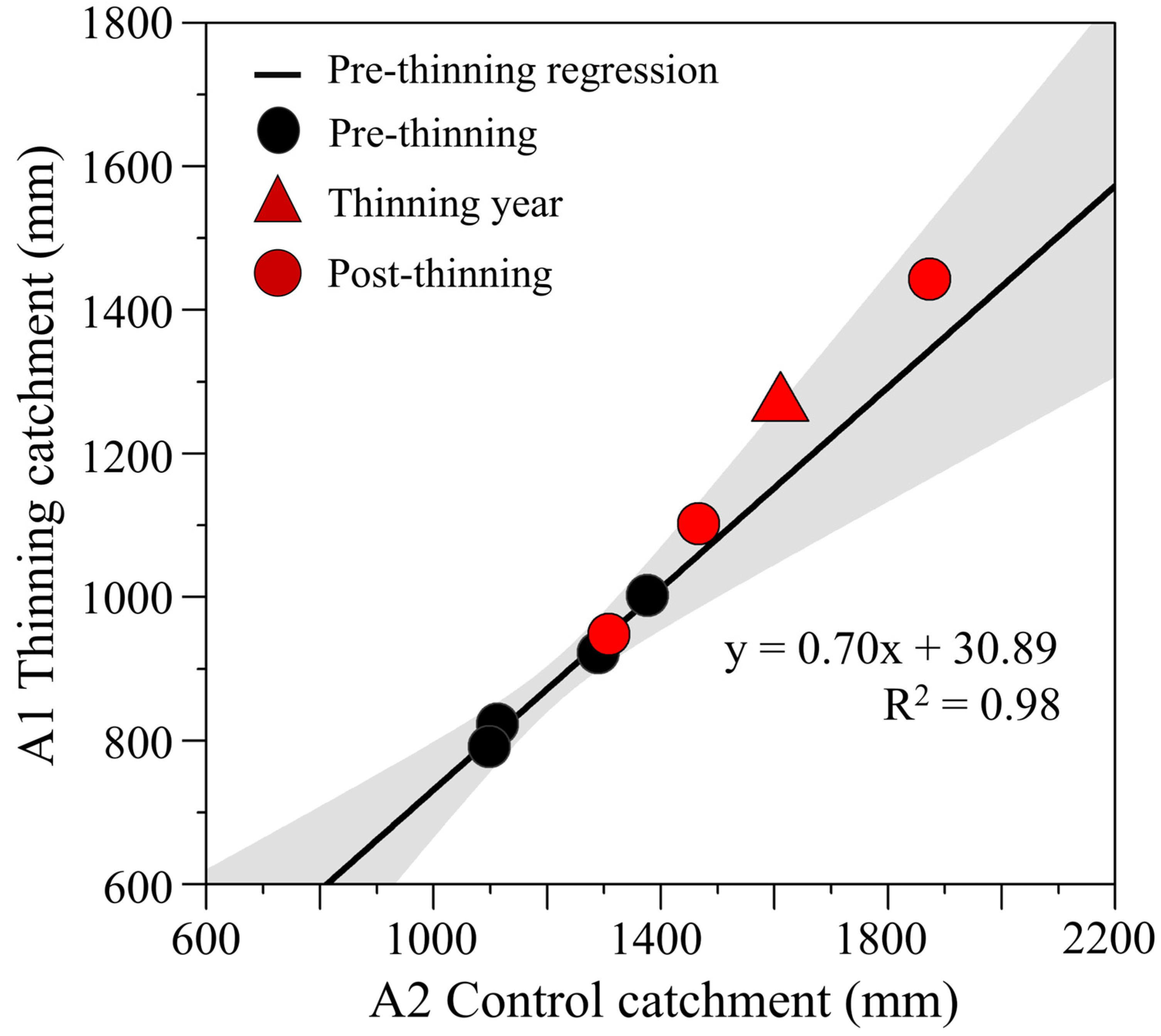
Annual water yield in the thinning catchment (A1) was strongly related to that of the control catchment (A2) in the pre-thinning period (R2 = 0.98) (Figure 3). The 95% confidence interval around the pre-thinning regression represents the range in which annual water yields are statistically consistent with the pre-thinning relationship and can, therefore, be attributed to variability shared by both catchments. In this study, that relationship was calibrated under comparatively moderate precipitation conditions in 2016–2019, whereas the thinning year and post-thinning period include much wetter years (Table 1). After thinning, all annual observations for A1 shifted above pre-thinning regression, with increases in water yield of 108.7 mm in 2020, 99.7 mm in 2021, 43.7 mm in 2022, and 0.4 mm in 2023 relative to the expected values from the pre-thinning relationship (Table 1, Figure 3). Post-thinning observations consistently plotted above the regression line but remained within the confidence interval. The thinning year (2020) showed the largest increase and lay closest to the upper confidence bound, whereas subsequent years fell progressively nearer to the regression line.

3.3. Flow Duration Curves Based on Observed/Estimated Ratios

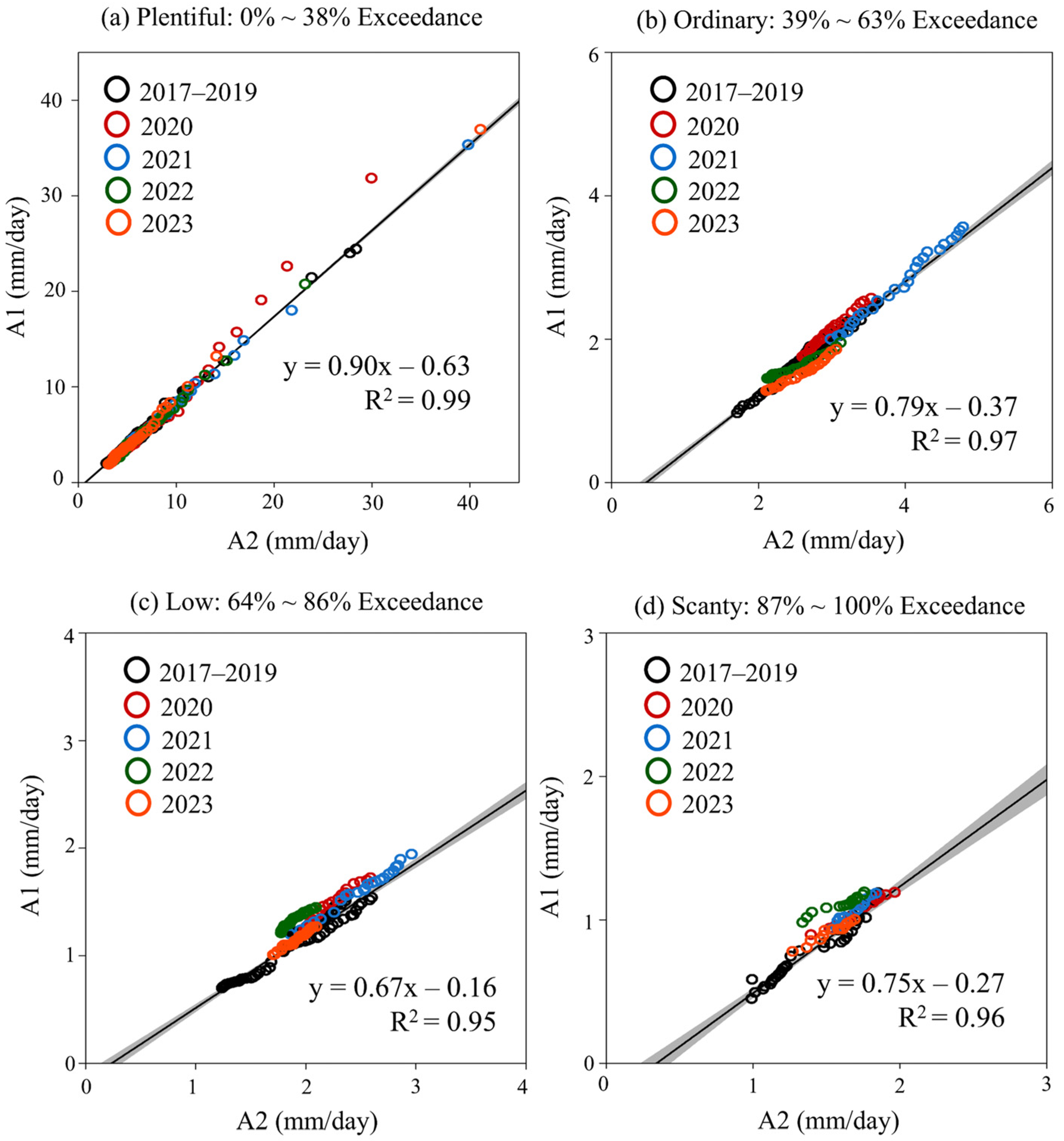
Across all four exceedance classes (0–38%, 39–63%, 64–86%, and 87–100%), runoff from A1 and A2 showed strong linear relationships, with coefficients of determination ranging from 0.95 to 0.99 (Figure 4). Slopes varied among flow ranges, from 0.90 in the plentiful runoff class (0–38% exceedance) to 0.67 in the low runoff class (64–86% exceedance). These pre-thinning regressions were used to estimate expected daily runoff in A1 from A2 for each exceedance class and formed the basis for the observed-to-estimated (Obs/Est) ratio shown in Figure 5. Post-thinning points in Figure 4 were generally positioned above the pre-thinning regression line, with the thinning year (2020) lying near or above the upper limit of the 95% confidence interval, particularly in the plentiful runoff range.
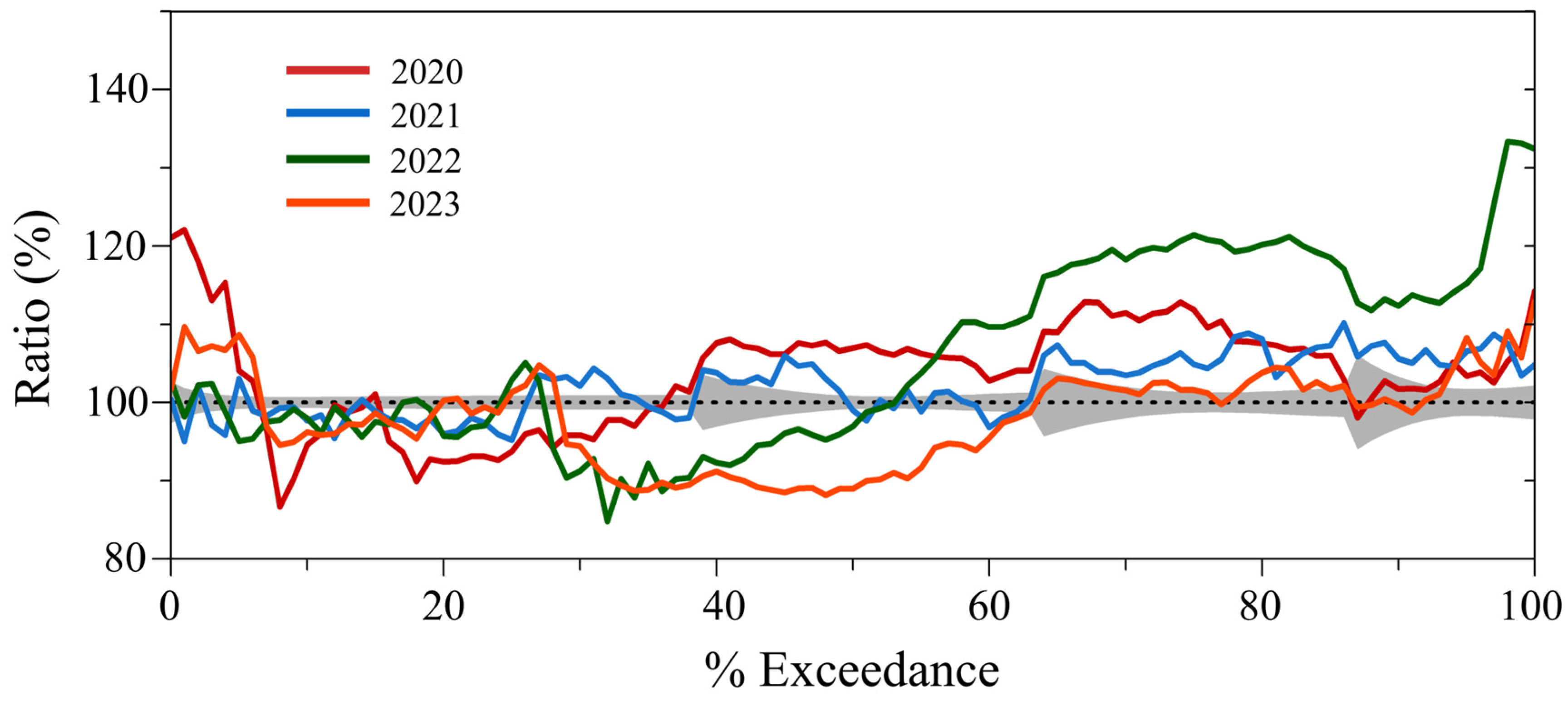
The annual Obs/Est ratios of runoff in A1 (Figure 5) remained close to the 100% reference line, typically between 96% and 105%. The shaded band around this line represents the 95% confidence interval of the pre-thinning relationship and shows the range of ratios that are statistically consistent with pre-thinning conditions. A consistent feature across all years was a gradual increase in ratios toward higher exceedance levels, indicating that low-flow conditions tended to show higher observed runoff than expected. In 2020, ratios exceeded 120% in the 1–5% exceedance range and locally rose above the upper confidence limit, while in 2021 and 2022, the ratios at high flows were closer to or below 100%. By 2023, ratios fluctuated around the reference line without a consistent pattern, but the elevated ratios at low flows persisted throughout the post-thinning period (Figure 5).

3.4. Storm Event Scale Analysis

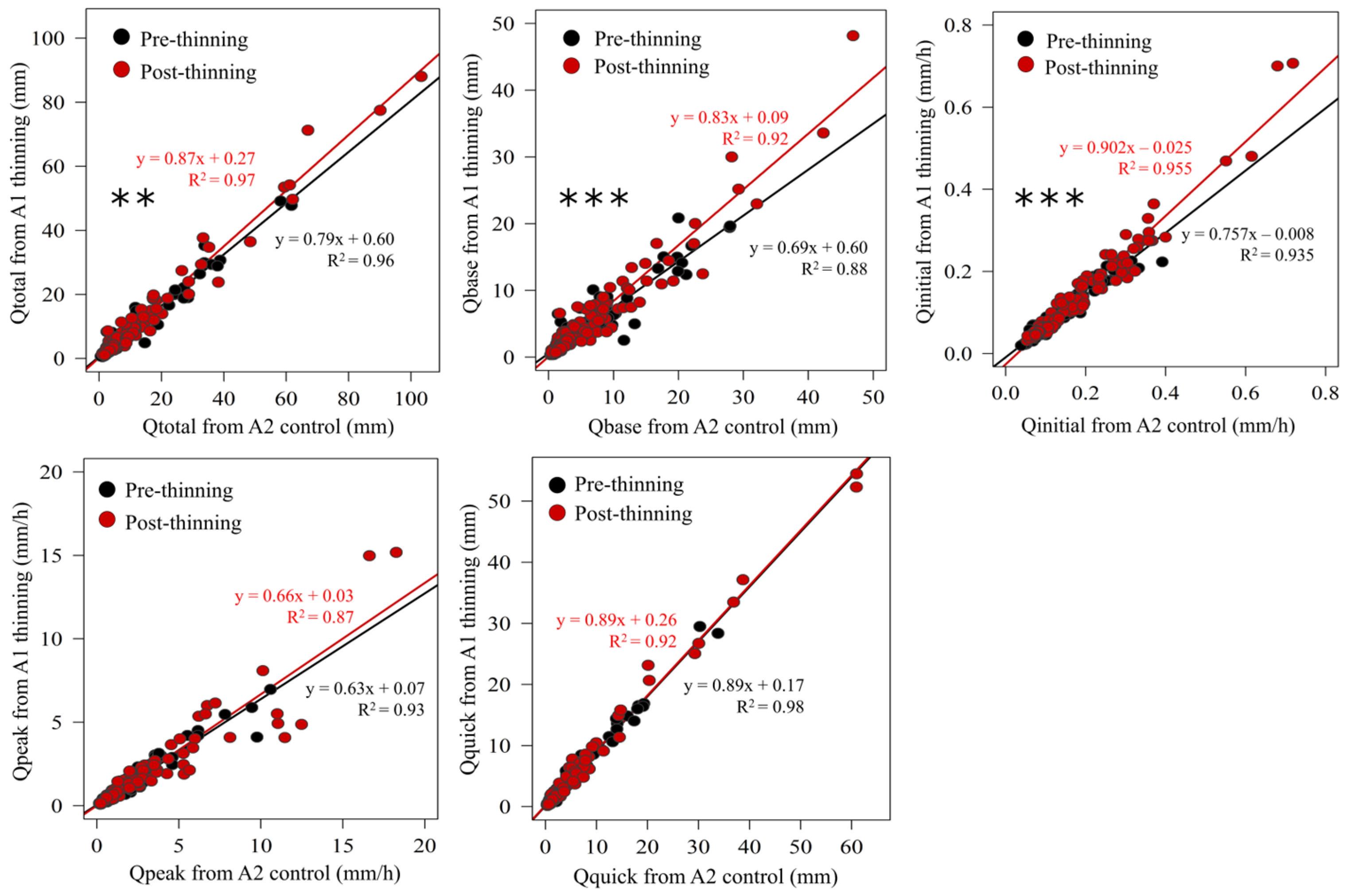
A total of 256 storm events were analyzed, comprising 123 pre-thinning and 133 post-thinning events. Qtotal showed a significant slope increase of 9% after thinning (ANCOVA, p < 0.01), although Mann–Whitney tests indicated no significant differences between periods (Figure 6). Qinitial and Qbase also exhibited significant slope increases of 19% and 21%, respectively (ANCOVA, p < 0.001). Mann–Whitney tests further indicated significant distributional differences in Qinitial for both catchments (p < 0.05), whereas Qbase distributions did not differ significantly.
By contrast, Qquick and Qpeak did not differ significantly between periods, with slope changes of only 0.3% and 5%, respectively (ANCOVA, p > 0.05). However, Mann–Whitney tests indicated significant distributional differences in Qpeak for both catchments (p < 0.05), while Qquick remained unchanged (Figure 6). Tpeak did not differ significantly (ANCOVA, p > 0.05). Overall, thinning altered Qinitial and Qbase but had a negligible effect on Qtotal, Qquick, Qpeak, and Tpeak.

4. Discussion

4.1. Runoff Response to Thinning

Reducing tree density by 40% through thinning produced a transient increase in both runoff magnitude and efficiency in our study. In the thinning year (2020), total precipitation reached 2299 mm, exceeding the pre-thinning average of 2030.3 mm by 13% (Table 1) with an exceptional peak of 620.5 mm in July (Figure 2a). This unusually high precipitation during the growing season, combined with reduced canopy interception and evapotranspiration following canopy opening, temporarily enhanced net precipitation [23]. Consequently, the annual runoff yield rose to 108.7 mm with a runoff coefficient of 55.2%.
In the first post-thinning year (2021), annual precipitation rose further to 2587.0 mm, the highest in the observation period, yet the runoff yield remained moderate at 99.7 mm, with a runoff coefficient of 55.8%. This muted response indicates that catchment-level buffering processes were already mitigating the direct increase in runoff. Such stabilization is consistent with stand-scale physiological adjustments reported by Iida et al. [53], in which transpiration in a 38% thinned Japanese cedar plantation initially declined to about 70% of pre-thinning levels but returned to baseline within two to three years as canopy function recovered. By the third year in the present study, both runoff yield and runoff coefficient had similarly returned to pre-thinning ranges, demonstrating rapid re-equilibration of hydrological processes following thinning.
These results are consistent with global paired-catchment findings. Brown et al. [31] reported that moderate thinning (20–40%) typically produces short-lived increases in water yield that diminish within a few years as canopy cover regenerates. Heavier thinning, on the other hand, generally prolongs hydrological impacts because of the greater canopy openness, and the reduced leaf area delays the recovery of interception and transpiration. For instance, Yang et al. [27] observed a sustained mean runoff increase of 260 mm yr −1 lasting over a decade after 45% thinning in a temperate coniferous forest of South Korea, while Junsuk et al. [28] recorded elevated water yields averaging 143 mm yr −1 for 12 years following 50% thinning in Ibaraki, Japan. The global synthesis by del Campo et al. [23] likewise identified an approximately 50% stand density reduction as the threshold at which hydrological responses shift from short-term to prolonged. Their analysis further emphasized that the extent and persistence of such effects are highly context-dependent, varying with local forest structure, climate, and rates of ecosystem recovery.
This pattern reinforces the context-specific framework proposed by Goeking and Tarboton [32], who argued that the traditional assumption of increased water yield following forest cover reduction [30] is not universally valid. Hydrological outcomes are determined by interacting site-level factors, including vegetation recovery rate, soil water retention, and management design. In the present study, rapid canopy regrowth combined with contour-aligned log placement [54] curtailed overland flow and enhanced infiltration, allowing the catchment to regain pre-thinning hydrological balance while maintaining stable low-flow discharge. Collectively, these results demonstrate that hydrological recovery after thinning depends on both management strategy and ecosystem resilience, underscoring the importance of site-specific approaches to sustaining balanced forest–water relationships. At the same time, pre-thinning regression relationships were calibrated under comparatively moderate rainfall as compared to the early post-thinning year, which had much higher precipitation. Hence, the regression may not fully represent catchment behavior under a wetter regime. This mismatch between the pre- and post-treatment period climate highlights a limitation of the classical paired-catchment approach, in which treatment effects may be underestimated when post-treatment conditions fall outside the pre-treatment climate range [34].

4.2. Flow Duration Curve and Event-Scale Runoff Dynamics

Beyond the observed changes in annual runoff, alterations in hydrological regimes were further evaluated using flow duration curves (FDCs) and storm event analyses to determine how thinning influenced flow variability and event-scale runoff behavior. Event-scale hydrograph separation revealed that thinning exerted negligible effects on storm quickflow (Qquick), peak discharge (Qpeak), and time to peak (Tpeak). Although both total and baseflow runoff increased following thinning, stormflow dynamics displayed minimal variation. This outcome aligns with previous observations from multiple catchments. Grace et al. [55] reported that only extensive canopy removal (~70%) increased peak flows by approximately 40% in a North Carolina pine forest, while Rahman et al. [56] and Dung et al. [26] documented negligible peak flow changes under selective thinning in a Japanese forest.
Building upon the event-scale findings, flow duration curve analysis provides an integrated lens through which changes across the entire discharge spectrum could be examined. In this study, the upper portion of the FDC (0–38% exceedance) showed little difference between pre- and post-thinning conditions (Figure 4a and Figure 5), indicating that stormflow generation was effectively buffered by contour-felled logs and rapid canopy recovery. A brief deviation appeared during the thinning year, when exceptionally high July precipitation combined with temporary canopy reduction elevated high-flow discharge. At the same site, Farahnak et al. [57] observed that contour-felled logs stabilized overland flow after thinning but also increased soil and litter erosion due to ground exposure. Collectively, these features contributed to maintaining overall hydrological stability during the early post-thinning recovery period.
In contrast to high-flow behavior, thinning effects were more evident at the low-flow range of FDCs. Both Qbase and Qinitial increased following thinning (Figure 6), while the lower-end of the FDC (64–100% exceedance) (Figure 4c,d and Figure 5) shifted upward, signifying enhanced subsurface contributions and greater baseflow stability. Field investigations [25,26,54] attributed these improvements to contour-aligned log placement, which reduced surface flow connectivity and promoted infiltration. However, Momiyama et al. [58] suggested through catchment-scale modeling that baseflow recovery primarily results from increased net precipitation and reduced evapotranspiration following canopy opening. Together, these previous studies point to both surface-level stabilization measures and catchment-scale hydrological adjustments as plausible controls on low-flow resilience after thinning, although these mechanisms were not directly measured in this study.

4.3. Limitations and Future Research Direction

The primary limitation of this study is the relatively short post-thinning monitoring period, which constrains the ability to evaluate whether runoff responses persist, attenuate, or reverse as forest recovery advances. Another limitation arises from the restricted scope of a single forest type (Japanese cypress) managed under one thinning regime (40% tree density reduction with contour felled logs), which limits the generalization across varying forest structures, climates, and management strategies. In addition, potential changes in soil structure, infiltration capacity, and related physical properties were not measured directly. Thus, their contribution to the observed hydrological responses remains uncertain.
Future research should extend monitoring to capture longer-term hydrological trajectories and explore the effects of varying thinning intensities, species compositions, and log management configurations. Event-based measurements of soil moisture and infiltration would help in elucidating the mechanisms governing post-thinning hydrological responses. In particular, combining runoff monitoring with direct observations of soil structure before and after thinning would clarify how physical changes in the soil profile contribute to changes in baseflow and stormflow. Furthermore, integrating long-term field observations with ecohydrological simulations, such as those conducted by Momiyama et al. [58], which highlighted how forest thinning influences evapotranspiration and water retention, would enable a broader assessment of the transferability of these findings across diverse forested headwater systems.

5. Conclusions

Runoff responses were examined in paired headwater catchments of a Japanese cypress forest, where tree density in one catchment was reduced by 40% and logs were placed parallel to the contour after a pre-thinning period (2016–2019). Thinning produced a temporary increase in annual runoff in the treated catchment, with a runoff increase of 108.7 mm above the pre-thinning baseline in the thinning year (2020) and increases of 99.7 mm, 43.7 mm, and 0.4 mm in the subsequent post-thinning years (2021–2023), indicating a strong but short-lived enhancement in water yield. Event-based analyses revealed negligible changes in storm quickflow, peak discharge, and time to peak, suggesting that stormflow behavior remained stable after canopy reduction. Flow duration curves supported these results, as the observed-to-estimated ratios were generally near 100% at high flows but shifted above 100% over much of the 64–100% exceedance range in all post-thinning years, reflecting persistent strengthening of baseflow and low-flow conditions. These hydrological responses are consistent with a combination of reduced evapotranspiration and interception following canopy opening and the stabilizing influence of contour-felled logs that promoted infiltration and subsurface recharge while limiting surface runoff. The increase in Qinitial demonstrated its sensitivity as an indicator of low-flow recovery following thinning. Overall, moderate thinning with contour-felled log placement enhanced water yield and strengthened low-flow discharge without amplifying stormflow risk. Long-term, multi-site monitoring across different forest types and thinning intensities is needed to confirm the persistence and transferability of these findings for sustainable forest-water management.

Author Contributions

Conceptualization, I.M.G. and N.T.; methodology, A.N., T.S. and M.F.; software, A.N., T.S., M.G. and M.F.; validation, A.N., T.S. and M.F.; formal analysis, I.M.G. and T.S.; investigation, M.F., Y.O. and M.G.; resources, T.S.; data curation, I.M.G.; writing—original draft preparation, I.M.G.; writing—review and editing, I.M.G.; visualization, I.M.G.; supervision, N.T.; project administration, K.K.; funding acquisition, K.K. All authors have read and agreed to the published version of the manuscript.

Funding

This research was supported by the project of monitoring the water conservation function granted by the Toyota City government.

Data Availability Statement

The original contributions presented in this study are included in the article. Further inquiries can be directed to the corresponding author.

Acknowledgments

We sincerely thank the staff of the Ecohydrology Research Institute, The University of Tokyo, for their dedicated assistance during fieldwork. We also extend our gratitude to Haruhiko Suzuki and Yoshimasa Nakane of the Toyota City Municipality for their kind cooperation and continuous support throughout this study.

Conflicts of Interest

The authors declare no conflicts of interest.

References

  1. Williams, T.M. Forest Runoff Processes. In Forest Hydrology: Processes, Management and Assessment; Amatya, D.M., Williams, T.M., Bren, L., de Jong, C., Eds.; CABI: Wallingford, UK, 2016; pp. 17–31. [Google Scholar]
  2. Sun, J.; Yu, X.; Wang, H.; Jia, G.; Zhao, Y.; Tu, Z.; Deng, W.; Jia, J.; Chen, J. Effects of forest structure on hydrological processes in China. J. Hydrol. 2018, 561, 187–199. [Google Scholar] [CrossRef]
  3. Pypker, T.G.; Levia, D.F.; Staelens, J.; Van Stan, J.T. Canopy Structure in Relation to Hydrological and Biogeochemical Fluxes. In Forest Hydrology and Biogeochemistry; Levia, D., Carlyle-Moses, D., Tanaka, T., Eds.; Ecological Studies; Springer: Dordrecht, The Netherlands, 2011; Volume 216, pp. 391–409. [Google Scholar] [CrossRef]
  4. Wei, X.; Jons, J.; Hou, Y.; Liu, S.; Asbjornsen, H.; Zhang, Z.; Shah, N.; Wang, Y.; Zhang, M.; Zhang, M.; et al. Local considerations are the key to managing global forests for water. Sci. Bull. 2025, 70, 448–451. [Google Scholar] [CrossRef]
  5. Liu, X.; Feng, Y.; Hu, T.; Luo, Y.; Zhao, X.; Wu, J.; Maeda, E.E.; Ju, W.; Liu, L.; Guo, Q.; et al. Enhancing ecosystem productivity and stability with increasing canopy structural complexity in global forests. Sci. Adv. 2024, 10, eadl1947. [Google Scholar] [CrossRef]
  6. Bonnesoeur, V.; Locatelli, B.; Guariguata, M.R.; Ochoa-Tocachi, B.F.; Vanacker, V.; Mao, Z.; Stokes, A.; Mathez-Stiefel, S.L. Impacts of forests and forestation on hydrological services in the Andes: A systematic review. For. Ecol. Manag. 2019, 433, 569–584. [Google Scholar] [CrossRef]
  7. Fuller, I.C.; Death, R.G. The science of connected ecosystems: What is the role of catchment-scale connectivity for healthy river ecology? Land Degrad. Dev. 2018, 29, 1413–1426. [Google Scholar] [CrossRef]
  8. Upadhyay, V.K.; Tailor, R.; Shanbhag, R.R.; Murthy, N.; Kushwaha, P.K.; Ranjan, M. Status and Trend Analysis of the Production, Export and Import of Wood and Wood Products in the G20 Countries from 2004 to 2021. J. For. Sci. 2025, 71, 159–170. [Google Scholar] [CrossRef]
  9. Cameron, A.D. Positive Environmental Impact of Productive Forest Expansion on Mitigating Climate Change and Reducing Natural and Semi-Natural Forest Loss. Scott. For. 2022, 76, 36–43. [Google Scholar]
  10. Forster, E.J.; Styles, D.; Healey, J.R. Temperate Forests Can Deliver Future Wood Demand and Climate-Change Mitigation Dependent on Afforestation and Circularity. Nat. Commun. 2025, 16, 3872. [Google Scholar] [CrossRef]
  11. Garcia, L.G.; Salemi, L.F.; de Paula Lima, W.; de Barros Ferraz, S.F. Hydrological Effects of Forest Plantation Clear-Cut on Water Availability: Consequences for Downstream Water Users. J. Hydrol. Reg. Stud. 2018, 19, 17–24. [Google Scholar] [CrossRef]
  12. Dye, P.; Versfeld, D. Managing the Hydrological Impacts of South African Plantation Forests: An Overview. For. Ecol. Manag. 2007, 251, 121–128. [Google Scholar] [CrossRef]
  13. Sun, S.; Xiang, W.; Ouyang, S.; Hu, Y.; Peng, C. Balancing Water Yield and Water Use Efficiency between Planted and Natural Forests: A Global Analysis. Glob. Change Biol. 2024, 30, e17561. [Google Scholar] [CrossRef] [PubMed]
  14. Japan Forest Agency. Annual Report on Forest and Forestry in Japan—Fiscal Year 2022. 2023. Available online: https://www.maff.go.jp/e/data/publish/attach/pdf/index-193.pdf (accessed on 13 March 2024).
  15. Fujiwara, M. Silviculture in Japan. In Forestry and the Forest Industry in Japan; Iwai, Y., Ed.; UBC Press: Vancouver, BC, Canada, 2002; pp. 10–23. [Google Scholar]
  16. Paletto, A.; Sereno, C.; Furuido, H. Historical Evolution of Forest Management in Europe and in Japan. Bull. Tokyo Univ. For. 2008, 119, 25–44. [Google Scholar]
  17. Komatsu, H.; Shinohara, Y.; Kume, T.; Otsuki, K. Relationship between Annual Rainfall and Interception Ratio for Forest across Japan. For. Ecol. Manag. 2008, 256, 1189–1197. [Google Scholar] [CrossRef]
  18. Komatsu, H. Modelling Evapotranspiration Changes with Managing Japanese Cedar and Cypress Plantations. For. Ecol. Manag. 2020, 475, 118395. [Google Scholar] [CrossRef]
  19. Takafumi, H.; Hiura, T. Effects of Disturbance History and Environmental Factors on the Diversity and Productivity of Understory Vegetation in a Cool-Temperate Forest in Japan. For. Ecol. Manag. 2009, 257, 843–857. [Google Scholar] [CrossRef]
  20. Nanko, K.; Hotta, N.; Suzuki, M. Assessing Raindrop Impact Energy at the Forest Floor in a Mature Japanese Cypress Plantation Using Continuous Raindrop-Sizing Instruments. J. For. Res. 2004, 9, 157–164. [Google Scholar] [CrossRef]
  21. Gomi, T.; Sidle, R.C.; Ueno, M.; Miyata, S.; Kosugi, K.I. Characteristics of Overland Flow Generation on Steep Forested Hillslopes of Central Japan. J. Hydrol. 2008, 361, 275–290. [Google Scholar] [CrossRef]
  22. Fujimori, T. Control of Individual Tree Growth and Quality in Relation to Stand Density. In Ecological and Silvicultural Strategies for Sustainable Forest Management; Elsevier: Amsterdam, The Netherlands, 2001; pp. 139–162. [Google Scholar]
  23. del Campo, A.D.; Otsuki, K.; Serengil, Y.; Blanco, J.A.; Yousefpou, R.; Wei, X. A Global Synthesis on the Effects of Thinning on Hydrological Processes: Implications for Forest Management. For. Ecol. Manag. 2022, 519, 120324. [Google Scholar] [CrossRef]
  24. Kubota, T.; Tsuboyama, Y.; Nobuhiro, T. Effects of Thinning on Canopy Interception Loss, Evapotranspiration, and Runoff in a Small Headwater Chamaecyparis obtusa Catchment in Hitachi Ohta Experimental Watershed in Japan. Bull. For. For. Prod. Res. Inst. 2018, 17, 63–73. [Google Scholar] [CrossRef]
  25. Kuraji, K.; Gomyo, M.; Nainar, A. Thinning of cypress forest increases subsurface runoff but reduces peak storm-runoff: A lysimeter observation. Hydrol. Res. Lett. 2019, 13, 49–54. [Google Scholar] [CrossRef]
  26. Dung, B.X.; Gomi, T.; Miyata, S.; Sidle, R.C.; Kosugi, K.; Onda, Y. Runoff responses to forest thinning at plot and catchment scales in a headwater catchment draining Japanese cypress forest. J. Hydrol. 2012, 444–445, 51–62. [Google Scholar] [CrossRef]
  27. Yang, H.; Choi, H.T.; Lim, H. Effects of Forest Thinning on the Long-Term Runoff Changes of Coniferous Forest Plantation. Water 2019, 11, 2301. [Google Scholar] [CrossRef]
  28. Junsuk, K.; Kubota, T.; Shiraki, K. Long-term effects of thinning on runoff changes from coniferous forest plantations in headwater catchments. Hydrol. Res. Lett. 2025, 19, 72–79. [Google Scholar] [CrossRef]
  29. Liu, X.; Sun, G.; Mitra, B.; Noormets, A.; Gavazzi, M.J.; Domec, J.C.; McNulty, S.G. Drought and thinning have limited impacts on evapotranspiration in a managed pine plantation on the southeastern United States coastal plain. Agric. For. Meteorol. 2018, 262, 14–23. [Google Scholar] [CrossRef]
  30. Bosch, J.M.; Hewlett, J.D. A review of catchment experiments to determine the effect of vegetation changes on water yield and evapotranspiration. J. Hydrol. 1982, 55, 3–23. [Google Scholar] [CrossRef]
  31. Brown, A.E.; Zhang, L.; McMahon, T.A.; Western, A.W.; Vertessy, R.A. A review of paired catchment studies or determining changes in water yield resulting from alterations in vegetation. J. Hydrol. 2005, 310, 28–61. [Google Scholar] [CrossRef]
  32. Goeking, S.A.; Tarboton, D.G. Variable Streamflow Response to Forest Disturbance in the Western US: A Large-Sample Hydrology Approach. Water Resour. Res. 2022, 58, e2021WR031575. [Google Scholar] [CrossRef]
  33. Tamai, K. Comparison of Discharge Duration Curves from Two Adjacent Forested Catchments—Effect of Forest Age and Dominant Tree Species. J. Water Resour. Prot. 2010, 2, 742–750. [Google Scholar] [CrossRef][Green Version]
  34. Tanaka, T. Vulnerability of the Paired Watershed Method. Suiri Kagaku (Water Sci.) 2012, 56, 42–61. [Google Scholar]
  35. Japan Meteorological Agency. Climate of Tokai District. 2020. Available online: https://www.data.jma.go.jp/cpd/longfcst/en/tourist/file/Tokai.html (accessed on 3 February 2024).
  36. Tobe, H.; Chigira, M.; Doshida, S. Comparison of Landslide Densities between Rock types in Weathered Granitoid in Obara Village, Aichi Prefecture. J. Jpn. Soc. Eng. Geol. 2007, 48, 66–79, (In Japanese with English Abstract). [Google Scholar] [CrossRef]
  37. IUSS Working Group WRB. World Reference Base for Soil Resources, International Soil Classification system for Naming Soils and Creating Legends for Soil Maps; World Soil Resources Reports; Food and Agriculture Organization of the United Nations: Rome, Italy, 2015; Volume 106, 192p. [Google Scholar]
  38. Sato, T.; Tanaka, N.; Nainar, A.; Kuraji, K.; Gomyo, M.; Suzuki, H. Soil erosion and overland flow in Japanese cypress plantations: Spatio-temporal variations and a sampling strategy. Hydrol. Sci. J. 2020, 65, 2322–2335. [Google Scholar] [CrossRef]
  39. Eckenwalder, J.E. Conifers of the World: The Complete Reference; Timber Press: Portland, OR, USA, 2009; pp. 204–205. [Google Scholar]
  40. Karizumi, N. The Latest Illustration of Tree Roots; Seibundo Shinkosha: Tokyo, Japan, 2010; pp. 156–163. [Google Scholar]
  41. Sheng, T.C. Watershed Management Field Manual: Watershed Survey and Planning; FAO Conservation Guide 13/6; Food and Agriculture Organization of the United Nations: Rome, Italy, 1990. [Google Scholar]
  42. Fujimoto, M.; Ohte, N.; Tani, M. Effects of hillslope topography on runoff response in a small catchment in the Fudoji Experimental Watershed, central Japan. Hydrol. Process. 2011, 25, 1874–1886. [Google Scholar] [CrossRef]
  43. Toyota City. Toyota City Forest Conservation Guidelines; Toyota City Industry Department, Agriculture and Forestry Promotion Office, Forestry Division: Toyota, Japan, 2019; Available online: https://www.city.toyota.aichi.jp/_res/projects/default_project/_page_/001/035/013/r0301_honpen.pdf (accessed on 18 November 2025). (In Japanese)
  44. Viessman, W., Jr.; Lewis, G.L. Introduction to Hydrology, 4th ed.; HarperCollins: New York, NY, USA, 1996. [Google Scholar]
  45. Vogel, R.M.; Fennessey, N.M. Flow duration curves II: A review of applications in water resources planning. Water Resour. Bull. 1995, 31, 1029–1039. [Google Scholar] [CrossRef]
  46. Brown, A.E.; Western, A.W.; McMahon, T.A.; Zhang, L. Impact of forest cover changes on annual streamflow and flow duration curves. J. Hydrol. 2013, 483, 39–50. [Google Scholar] [CrossRef]
  47. Nakano, H.; Kikuya, A.; Morisawa, M. Effects of changes in forest conditions, especially cutting on runoff (1): Effects on water-yearly, plentiful, ordinary, low and scanty runoffs. Bull. Gov. For. Exp. Stn. 1963, 156, 1–84, (In Japanese, with English Summary). [Google Scholar]
  48. Hewlett, J.D.; Hibbert, A.R. Factors affecting the response of small watersheds to precipitation in humid areas. In Forest Hydrology; Sopper, W.E., Lull, H.W., Eds.; Pergamon Press: New York, NY, USA, 1967; pp. 275–290. [Google Scholar] [CrossRef]
  49. Nainar, A.; Tanaka, N.; Sato, T.; Mizuuchi, Y.; Kuraji, K. A comparison of hydrological characteristics between a cypress and mixed-broadleaf forest: Implication on water resource and floods. J. Hydrol. 2021, 595, 125679. [Google Scholar] [CrossRef]
  50. Free Software Foundation. GNU Fortran Compiler, version 10.3.0; Free Software Foundation: Boston, MA, USA, 2020; Available online: https://gcc.gnu.org/fortran/ (accessed on 24 February 2022).
  51. ISO/IEC 1539-1:1997; Information Technology—Programming Languages—Fortran—Part 1: Base Language. International Organization for Standardization: Geneva, Switzerland, 1997.
  52. R Core Team. R: A Language and Environment for Statistical Computing; R Foundation for Statistical Computing: Vienna, Austria, 2024; Available online: https://www.R-project.org/ (accessed on 24 August 2024).
  53. Iida, S.; Noguchi, S.; Levia, D.F.; Araki, M.; Nitta, K.; Wada, S.; Narita, Y.; Tamura, H.; Abe, T.; Kaneko, T. Effects of forest thinning on sap flow dynamics and transpiration in a Japanese cedar forest. Sci. Total Environ. 2024, 912, 169060. [Google Scholar] [CrossRef] [PubMed]
  54. Farahnak, M.; Tanaka, N.; Sato, T.; Nainar, A.; Gomyo, M.; Kuraji, K.; Suzaki, T.; Suzuki, H.; Nakane, Y. Enhancing Overland Flow Infiltration through Sustainable Well-Managed Thinning: Contour-Aligned Felled Log Placement in a Chamaecyparis obtusa Plantation. Sustainability 2023, 15, 14124. [Google Scholar] [CrossRef]
  55. Grace, J.M., III; Skaggs, R.W.; Chescheir, G.M. Hydrologic and water quality effects of thinning loblolly pine. Trans. ASABE 2006, 49, 645–654. [Google Scholar] [CrossRef]
  56. Rahman, A.F.M.A.; Hiura, H.; Shino, K.; Takase, K. Effects of forest thinning on direct runoff and peak runoff properties in a small mountainous watershed in Kochi Prefecture, Japan. Pak. J. Biol. Sci. 2005, 8, 259–266. [Google Scholar] [CrossRef]
  57. Farahnak, M.; Sato, T.; Tanak, N.; Nainar, A.; Mohd Ghaus, I.; Kuraji, K. Impact of Thinning and Contour-Felled Logs on Overland Flow, Soil Erosion, and Litter Erosion in a Monoculture Japanese Cypress Forest Plantation. Water 2024, 16, 2874. [Google Scholar] [CrossRef]
  58. Momiyama, H.; Kumagai, T.; Egusa, T. Model analysis of forest thinning impacts on the water resources during hydrological drought periods. For. Ecol. Manag. 2021, 499, 119593. [Google Scholar] [CrossRef]
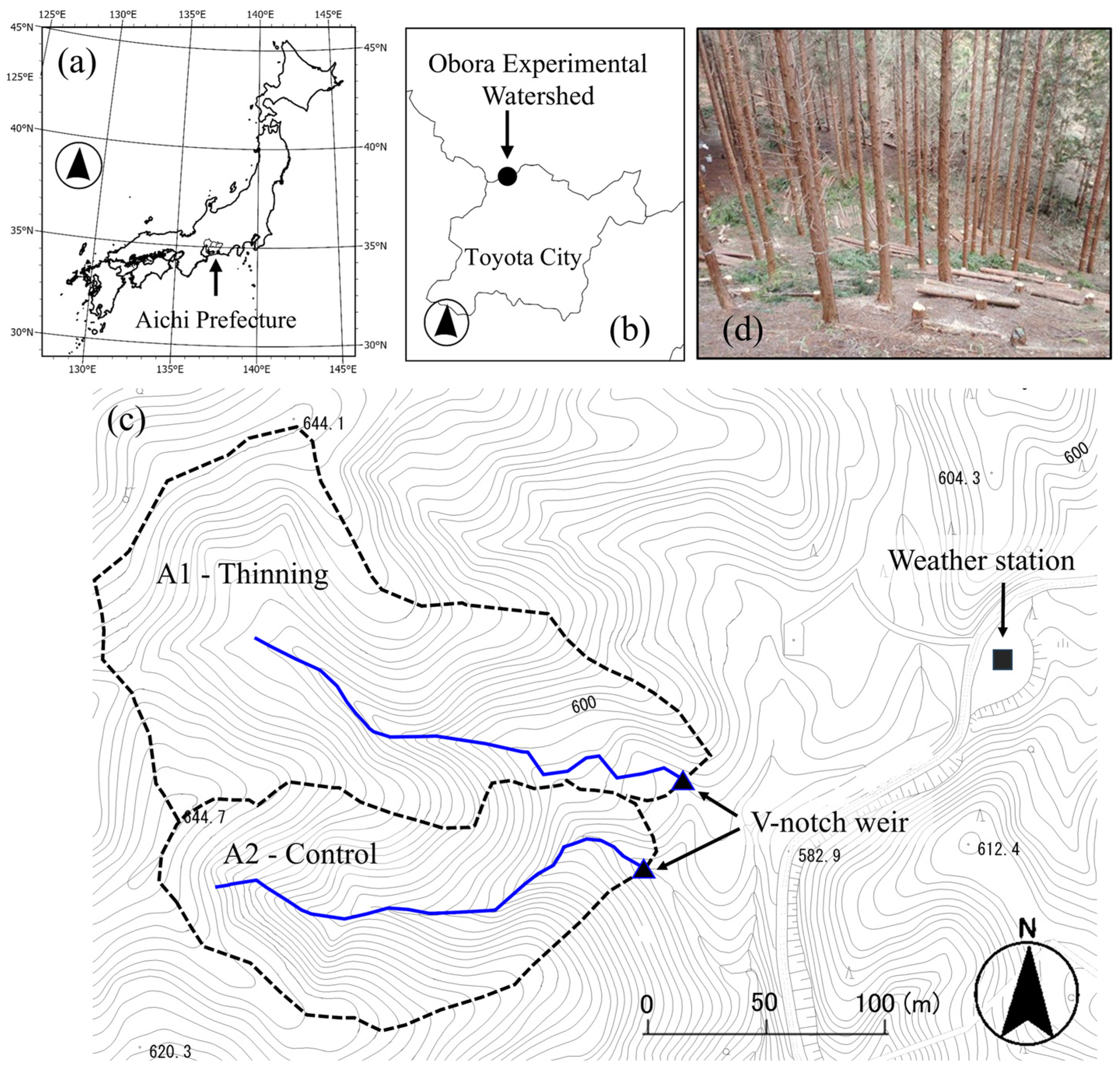
Figure 1. Overview of study site: (a) location of Aichi Prefecture, (b) location of Obora Experimental Watershed, (c) location and topography of study site, (d) condition of A1 catchment in the post-thinning period with felled logs aligned to contour lines.
Water 17 03461 g001
Figure 2. Monthly rainfall (mm), 1 h maximum rainfall (mm h−1, black dots) (a) and monthly runoff responses (mm) (b) at catchments during the pre- and post-thinning period. The gray area shows the period in which the thinning operation took place.
Water 17 03461 g002
Figure 3. Relationship between the annual runoff of catchment A1 and A2 and the coefficient of determination (R2 = 0.98). Gray shading indicates a 95% confidence interval around the fitted regression line.
Water 17 03461 g003
Figure 4. Relationships between daily runoff of catchment A1 and A2 across different exceedance percentage ranges: (a) plentiful: 0–38%, (b) ordinary: 39–63%, (c) low: 64–86%, and (d) scanty: 87–100%. The gray shading represents the 95% confidence interval.
Water 17 03461 g004
Figure 5. Ratio of observed to estimated daily runoff in the A1 thinning catchment across percentage of exceedance for thinning (2020) and post-thinning years (2021–2023). The dotted horizontal line at 100% marks the baseline where observed runoff equals estimated runoff, and the shaded band represents the 95% confidence interval of the pre-thinning relationship.
Water 17 03461 g005
Figure 6. Paired catchment analysis of storm events. The asterisk defines the significant differences between the slope of the pre- and post-thinning regression line based on the results of ANCOVA. **: p-value < 0.01, ***: p-value < 0.001.
Water 17 03461 g006
Table 1. Annual precipitations, runoffs, and runoff coefficients in the A2 control and A1 thinning catchment with thinning effects on water yield estimated by paired catchment analysis.
YearPrecipitation (mm)A2 Control CatchmentA1 Thinning Catchment
Runoff (mm)Runoff Coefficient (%)Runoff (mm)Runoff Coefficient (%)Estimated Runoff (mm)Water Yields (mm)
Pre-thinning
March–December 20161975.01112.456.3823.441.7810.612.8
20172071.51289.562.3922.744.5934.7−12.0
20182118.51375.964.91002.847.3995.37.6
20191956.01097.656.1791.840.5800.2−8.4
Mean2030.31218.959.9885.243.5885.20.0
Thinning
20202299.01610.370.01268.255.21159.5108.7
Post-thinning
20212587.01872.772.41443.255.81343.599.7
20222118.01466.169.21102.252.01058.543.7
20232111.01308.762.0948.544.9948.10.4
Mean2272.01549.167.91164.650.91116.747.9
Disclaimer/Publisher’s Note: The statements, opinions and data contained in all publications are solely those of the individual author(s) and contributor(s) and not of MDPI and/or the editor(s). MDPI and/or the editor(s) disclaim responsibility for any injury to people or property resulting from any ideas, methods, instructions or products referred to in the content.