Article

Assessment of Groundwater Environmental Quality and Analysis of the Sources of Hydrochemical Components in the Nansi Lake, China

1
Geophysical Prospecting and Surveying Team of Shandong Bureau of Coal Geological, Jinan 250014, China
2
College of Earth Science and Engineering, Shandong University of Science and Technology, Qingdao 266590, China
*
Author to whom correspondence should be addressed.
Water 2025, 17(23), 3398; https://doi.org/10.3390/w17233398
Submission received: 7 October 2025 / Revised: 26 November 2025 / Accepted: 26 November 2025 / Published: 28 November 2025
(This article belongs to the Section Hydrogeology)

Abstract

Groundwater in the Nansi Lake Basin, a key reservoir of the South-to-North Water Diversion Project, supports domestic, agricultural, and ecological needs but faces pressure from overexploitation and pollution. This study clarifies the hydrochemical characteristics, controlling processes, environmental quality, and source contributions of shallow groundwater in the basin. Hydrochemical data from 67 wells were interpreted using Piper and Schukalev diagrams, Gibbs and ion-ratio plots, the entropy-weight water quality index (EWQI), and an absolute principal component scores–multiple linear regression (APCS-MLR) model. Groundwater shows high mineralization and hardness, with 35.82% and 55.22% of samples exceeding standard limits for total dissolved solids and total hardness, respectively. The dominant facies are HCO3-Ca, HCO3-Ca·Mg, and HCO3·Cl-Na·Ca, indicating dissolution and ion exchange involving carbonate and silicate rocks. Gibbs and ion-ratio analyses demonstrate that rock–water interaction is the main control, with secondary influence from evaporation. EWQI results indicate generally good groundwater quality (68.66% Class I, 20.90% Class II). APCS-MLR identifies natural, agricultural, ion-exchange, and anthropogenic sources, contributing 53.34%, 22.71%, 4.79% and 19.14%, respectively. These findings show that protection should focus on pollution control in northern agricultural and mining zones while conserving high-quality groundwater elsewhere in the basin.

1. Introduction

Groundwater is a vital water source for domestic, agricultural, and industrial uses in China. It supports socioeconomic development and plays an important role in maintaining ecological balance [1,2]. With rapid economic growth and urbanization, groundwater has been overexploited and polluted by human activities, leading to serious quantity and quality problems [3,4]. Nansi Lake, an important reservoir of the South-to-North Water Diversion Project, has a long history of aquaculture, agriculture, and coal mining. In recent years, tourism has also developed rapidly under local government initiatives. However, improper discharge of pollutants has placed great pressure on the groundwater environment [5]. Under the goals of improving the South-to-North Water Diversion Project and protecting the Yellow River Basin, studying the hydrochemical characteristics and water quality of groundwater in the Nansi Lake Basin is essential. Such work can help understand the current water quality, support groundwater pollution control, and promote sustainable water resource management in the North China Plain.
During its migration, groundwater interacts with the surrounding environment through various physical and chemical processes. Over time, these interactions form unique hydrochemical characteristics that reflect the geological setting [6]. To analyze groundwater hydrochemistry, researchers commonly employ Piper diagrams, Gibbs diagrams, statistical analysis, ion ratios, and correlation analysis to identify water types, evolution pathways, and controlling mechanisms [7,8,9]. Numerous case studies from arid and semi-arid regions, as well as from the North China Plain and other intensively cultivated basins, have demonstrated that such approaches are effective for characterizing groundwater evolution under the combined impacts of natural background conditions and anthropogenic activities [6,10,11]. Groundwater quality assessment is also an effective way to evaluate contamination, ensure water safety, and protect the ecosystem. Among various methods, the Water Quality Index (WQI) has been widely applied to classify groundwater suitability for drinking and irrigation purposes [11,12]. More recently, the Entropy Weight Water Quality Index (EWQI) has been introduced to combine information entropy and WQI, thereby reducing the subjectivity of expert-based weighting and improving the robustness of evaluation results in complex hydrochemical environments [6,10,13,14,15].
Identifying the sources of hydrochemical components and pollutants is also important for improving groundwater quality and formulating targeted management measures. A wide range of source-identification techniques has been applied in groundwater and surface-water studies, including cluster analysis, stable isotope tracers, principal component analysis (PCA), and receptor models such as the Absolute Principal Component Scores–Multiple Linear Regression (APCS–MLR) model [12,16]. In groundwater systems, combinations of PCA, APCS–MLR, and other receptor models have been successfully used to distinguish geogenic background from anthropogenic inputs and to quantify the relative contributions of agricultural activities, mining, industrial discharge, and urbanization to major ions and trace contaminants [17,18]. In river basins, APCS–MLR and positive matrix factorization have also been shown to effectively apportion the contributions of point and nonpoint sources to nutrients and other pollutants, thereby supporting pollution-control strategies [16,19,20,21,22]. These studies demonstrate that APCS–MLR provides a useful framework to interpret PCA results and to obtain quantitative estimates of source contributions to each water-quality parameter. Therefore, in this study, the APCS–MLR model was adopted to identify and quantify natural and anthropogenic sources affecting groundwater quality in the Nansi Lake Basin [23].
Considering the current status of groundwater quality in China and its potential risks to ecosystems and human health, this study focuses on the Nansi Lake Basin, where groundwater safety is vital for local residents, the Yellow River Basin ecosystem, and the South-to-North Water Diversion Project. In the Nansi Lake Basin, previous research has primarily focused on the surface-water and sediment environment of the lake itself. Earlier studies examined the occurrence, fractionation, and ecological risk of heavy metals in surface sediments, revealing significant accumulation linked to industrial discharge, coal mining, and other human activities [24,25]. More recent work has evaluated heavy metal concentrations in the upper lake water and associated human health risks, highlighting the pressure exerted by aquaculture, agriculture, and tourism on the aquatic ecosystem [26]. At the basin scale, fuzzy comprehensive evaluation and PCA have been used to assess surface-water quality and its spatiotemporal variations in the Nansi Lake Basin, while other studies have investigated the coupling between socioeconomic development and overall water environmental quality in the catchment [27,28]. For groundwater, hydrochemical characteristics, EWQI-based water quality, and nitrate-related health risks have been evaluated in the northwestern part of the Nansi Lake catchment, indicating that intensive agricultural activities can significantly affect shallow groundwater quality at the local scale [29]. Existing research in the Nansi Lake region has mainly addressed surface-water hydrochemistry, while systematic, basin-scale assessments of shallow groundwater quality and its controlling factors remain scarce. Moreover, conventional groundwater quality evaluations have usually relied on subjective weighting schemes in WQI indices and have seldom been coupled with quantitative source apportionment models. In contrast, this study integrates Schukalev Classification, Piper and Gibbs diagrams, entropy-weighted water quality index (EWQI), and the APCS–MLR model to characterize the hydrochemical types and evolution of shallow groundwater around Nansi Lake, objectively evaluate groundwater environmental quality based on the latest Chinese groundwater standard, and quantitatively distinguish the contributions of natural processes, agricultural activities, ion exchange, and other anthropogenic inputs. This combined framework provides a more spatially resolved understanding of groundwater degradation processes than single-method approaches.

2. Materials and Methods

2.1. Study Area and Sample Collection

Nansi Lake is located between 34°27′–35°20′ N and 116°34′–117°21′ E. It is a collective name for four interconnected lakes—Nanyang Lake, Dushan Lake, Zhaoyang Lake, and Weishan Lake—situated in the southwestern part of Shandong Province, China. Administratively, the lake belongs to Jining City and is the largest freshwater lake in North China, as well as one of the most prominent freshwater lakes in China. The maximum water surface area of Nansi Lake is about 1266 km2, accounting for 45% of the province’s total freshwater area. The region lies in southern Shandong Province and is characterized by low-lying hills and plains. In 1960, a dam, known as the Secondary Dam, was built across the middle section of Nansi Lake, dividing it into the Upper and Lower Lakes. The Upper Lake, located north of the dam, covers an area of approximately 602 km2, while the Lower Lake, located south of the dam, covers about 664 km2. In the East Route of the South-to-North Water Diversion Project, Nansi Lake serves as both a water transport and storage system, with the Lower Lake functioning as a regulation reservoir.
Shallow groundwater samples were collected in August 2023 from 67 wells and springs distributed in the plain areas of the Nansi Lake Basin surrounding Nansi Lake. Sampling sites were selected to represent different lithological conditions and areas associated with local agriculture, mining, aquaculture, and domestic water use. Wells and springs with practical utilization value were selected for sampling, and all sampling depths exceeded 1.5 m. The locations of the sampling sites and study area are shown in Figure 1. For each sampling point, 2000 mL of groundwater was collected in pre-cleaned polyethylene bottles. Samples were analyzed for pH, total hardness (TH), total dissolved solids (TDS), calcium (Ca2+), magnesium (Mg2+), sodium (Na+), potassium (K+), ammonium (NH4+), chloride (Cl), bicarbonate (HCO3), carbonate (CO32−), and sulfate (SO42−). After collection, samples were sealed with Parafilm, preserved below 4 °C, and transported to the laboratory for analysis. Sampling and preservation followed the Methods for Analysis of Groundwater Quality (DZ/T 0064–2021) [30]. All analyses were conducted at the Lunan Geological Exploration Institute of Shandong Province.
A total of 12 hydrochemical parameters were measured for the groundwater samples. The total hardness (TH) was determined using the gravimetric titration method, and the total dissolved solids (TDS) were measured by the weighing method. Bicarbonate (HCO3) and carbonate (CO32−) were determined by titration. According to the Water Quality—Determination of Water-Soluble Cations by Ion Chromatography (HJ 812–2016) standard [31], Na+, K+, Ca2+, and Mg2+ were analyzed using ion chromatography (Aquion, Thermo Fisher Scientific, Waltham, MA, USA). The detection limits for Na+, K+, Ca2+, and Mg2+ were 0.02, 0.02, 0.03, and 0.02 mg/L, respectively. Following the Water Quality—Determination of Inorganic Anions by Ion Chromatography (HJ 84–2016) standard [32], Cl and SO42− were measured using the same ion chromatograph (Aquion, Thermo Fisher Scientific, Waltham, MA, USA). The detection limits for Cl and SO42− were 0.007 mg/L and 0.018 mg/L, respectively. In accordance with the Water Quality—Determination of Ammonium Nitrogen by Flow Injection Analysis (FIA) and Salicylic Acid Spectrophotometry (HJ 666–2013) standard [33], NH4+ concentrations were determined using salicylic acid spectrophotometry, performed on a UV–visible spectrophotometer (TU-1900, Beijing Puxi General Instrument Co., Ltd., Beijing, China) and an automated flow injection analyzer (BDFIA-8000, Beijing Baode Instruments Co., Ltd., Beijing, China). The NH4+ detection limit is 0.01 mg/L. Duplicate analyses were performed for all samples. The relative error between duplicates was less than the preset threshold of 10%, indicating that the analytical results were reliable and met the quality control requirements.

2.2. Geological Structure of the Study Area

The Nansi Lake region is located in the western part of the Shandong first-order neotectonic unit within the North China tectonic zone. It lies in the second-order neotectonic unit, positioned to the west of an uplifted fault block and to the south of a subsiding fault block. Due to regional tectonic movements, the area exhibits a complex structural form, predominantly characterized by fault structures. In the northeastern hilly region of the watershed, the surface lithology is mainly composed of large exposed limestone beds, with localized occurrences of granite. The southeastern part of the region has a more complex lithology, including sporadic occurrences of porphyritic fine-grained amphibole granodiorite, porphyritic fine-grained granite-granodiorite, fine-grained biotite granite, and fine-grained aegirine quartz syenite.
The structural features in this region mainly follow northwest, northeast, and east–west orientations. Some faults are distributed in linear or dotted patterns, with local fault zones extending east–west, controlling the development of the regional drainage system. The area is significantly affected by northwest–northeast linear tectonic structures.

2.3. Groundwater Resources in the Study Area

The unconfined groundwater dynamics in the Nansi Lake study area are primarily characterized by an infiltration–extraction pattern. Groundwater generally flows from the higher elevations surrounding the lake toward the lake basin. This dynamic regime is jointly influenced by atmospheric precipitation and anthropogenic pumping. Recharge to the unconfined aquifer is dominated by precipitation, whereas discharge is mainly controlled by groundwater abstraction and drainage toward the lake. The rise of the groundwater table typically coincides with the rainy season, while the decline generally corresponds to periods of intensive groundwater extraction.
After June, although precipitation gradually increases, agricultural irrigation withdrawals rise sharply, causing a rapid drop in the groundwater table and the development of a low-water period. The major irrigation season extends from late June to early August, during which the groundwater table remains at a low level. Beginning in September, as irrigation demand decreases and rainfall infiltration intensifies, groundwater levels gradually recover across the study area.
Based on the lithological characteristics, groundwater occurrence conditions, and hydraulic connectivity of aquifers in the Nansi Lake region, the groundwater-bearing formations can be classified into three major aquifer groups: (1) unconsolidated porous aquifers, (2) carbonate fractured–karst aquifers, and (3) clastic and intrusive rock fractured aquifers. The dynamic characteristics of the underlying Ordovician limestone aquifer are mainly divided into infiltration–extraction and lateral recharge–extraction types. In areas where the Ordovician limestone is exposed, the aquifer receives direct recharge from atmospheric precipitation and surface water, exhibiting an infiltration–extraction pattern. In contrast, in covered areas where direct recharge is absent, the aquifer is replenished only through lateral subsurface flow, forming a lateral recharge–extraction pattern. Overall, groundwater levels in this aquifer exhibit a persistent declining trend, indicating intensive groundwater exploitation and insufficient recharge at the regional scale.

2.4. Schukalev Classification Method (SCM)

The Schukalev Classification Method classifies groundwater types based on the concentrations of major cations and anions. Ions with an equivalent percentage greater than 25% are used for combination, resulting in 49 hydrochemical types, each associated with distinct hydrochemical genesis characteristics (Table 1) [34,35].

2.5. Entropy-Weight Quality Index (EWQI) Method

The Entropy-Weight Water Quality Index (EWQI) is an improved version of the traditional Water Quality Index (WQI). It determines the weight of each hydrochemical parameter using information entropy ( e j ), and transforms groundwater data into EWQI values that represent water quality status. This approach reduces subjectivity in assigning parameter weights and effectively minimizes human bias [36,37]. In this study, six groundwater parameters—TH, TDS, Na+, NH4+, Cl, and SO42−—were used for EWQI calculation to evaluate groundwater quality. The calculation procedure includes the following steps:
Establish the initial evaluation matrix X . In matrix X , x is the raw data, n is the total number of indicators, and m is the total number of samples.
X = x 11 x 12 x 1 n x 21 x 22 x 2 n x m 1 x m 2 x m n
To eliminate the effects of factors such as dimensions and magnitude, matrix X is standardized according to Equation (2).
y i j = x i j x i j m i n x i j m a x x i j m i n
where y i j denotes the standardized value corresponding to the j-th indicator of the i-th sample.
The proportion ( P i j ) of the j-th parameter value for the i-th sample relative to the total indicator value, and the information entropy ( e j ), are calculated using Equations (3) and (4).
P i j = y i j / i = 1 m y i j
e j = 1 l n m i = 1 m P i j l n P i j
Using Equations (5) and (6), the entropy weight ( w j ) of each parameter is determined, and the grading index of the j-th indicator ( q j ) is subsequently calculated.
w j = 1 e j j = 1 n 1 e j
q j = 100 C j S j
where C j is the observed concentration of the j-th hydrochemical parameter in groundwater, and S j corresponds to the allowable concentration limit for Class III groundwater specified in the Groundwater Quality Standard (GB/T 14848–2017) [38].
The EWQI value is calculated using Equation (7), and the groundwater quality is subsequently classified into five grades based on the EWQI value, as summarized in Table 2.
E W Q I i = j = 1 n w j q i j

2.6. Absolute Principal Component Scores-Multiple Linear Regression (APCS-MLR) Model

The APCS–MLR model integrates principal component analysis (PCA) and multiple linear regression (MLR) to identify and quantify the contributions of different pollution sources [39]. PCA is first used to extract standardized factor scores and eigenvectors, which reduce data dimensionality. MLR is then applied to estimate the contribution rates of various sources.
Prior to analysis, all groundwater data were standardized using the Z-score method. A virtual sample, in which all groundwater parameters were set to zero, was constructed. Factor scores for both the actual samples and the virtual sample were obtained. The Absolute Principal Component Scores (APCS) were then calculated by subtracting the virtual sample scores from the real sample scores. The equation is expressed as:
C j = b j 0 + p = 1 n b p j + A P C S n
In this equation, C j denotes the total concentration of parameter j for all samples, b j 0 is the intercept of parameter j in the multiple regression model, b p j represents the regression coefficient of factor p for parameter j, A P C S n refers to the absolute principal component score of factor p, and n indicates the total number of samples.
The contribution of factor p to the hydrochemical parameter j ( P C p j ) is evaluated using Equation (9), whereas the contribution of the unidentified source ( B 0 ) is computed using Equation (10).
P C p j = b p j × A P C S p ¯ b 0 + p = 1 n b p j × A P C S p ¯
B 0 = b 0 b 0 + p = 1 n b p j × A P C S p ¯

3. Results and Discussion

3.1. Statistical Characteristics of Groundwater Hydrochemical Parameters

To investigate the hydrochemical characteristics of groundwater in the Nansi Lake Basin, statistical analyses were performed on the measured parameters, including pH, TH, TDS, Na+, Mg2+, Ca2+, K+, NH4+, Cl, SO42−, CO32−, and HCO3. The statistical results of these parameters are summarized in Table 3.
From Table 3, it can be observed that both TDS and TH levels in the groundwater are relatively high, with 35.82% and 55.22% of the samples exceeding the standard limits, respectively. This indicates that the groundwater in the study area is characterized by high hardness and strong mineralization. Among the cations, NH4+ exhibited relatively low concentrations, with a mean value of 0.12 mg/L, while Ca2+ showed the highest average concentration at 134.27 mg/L. Among the anions, Cl presented a relatively low mean concentration of 132.07 mg/L, whereas HCO3 displayed the highest mean value at 380.58 mg/L. In addition to TDS and TH, approximately 28.35% of the samples exceeded the standard limit for SO42−, suggesting that the source and enrichment of sulfate in groundwater warrant further attention.
The coefficient of variation (CV) directly reflects the variability of ion concentrations in groundwater. Based on conventional classification, the degree of variation can be categorized as strong (CV > 1), moderate (0.1 < CV < 1), or weak (CV < 0.1), where CV is the ratio of the standard deviation to the mean. The pH values in the study area range from 6.62 to 10.66, with an average of 7.41. Although some groundwater samples are slightly alkaline, the CV of pH is 0.08, indicating a low degree of variation. This suggests that groundwater acidity and alkalinity in the region are relatively stable and less affected by external disturbances. The speciation of carbonates in groundwater is largely influenced by pH. Regardless of whether the environment is slightly acidic, neutral, or weakly alkaline, HCO3 remains the dominant carbonate species. In weakly alkaline environments, the equilibrium between CO32− and HCO3 tends to be unstable, favoring the conversion of carbonate ions to bicarbonate ions. In comparison, the CV values of CO32−, K+, NH4+, and SO42− are relatively high—5.56, 2.76, 2.42, and 1.02, respectively—indicating strong variability. The large spatial variation in the concentrations of these ions suggests heterogeneity in their distribution across the basin.

3.2. Groundwater Hydrochemical Classification

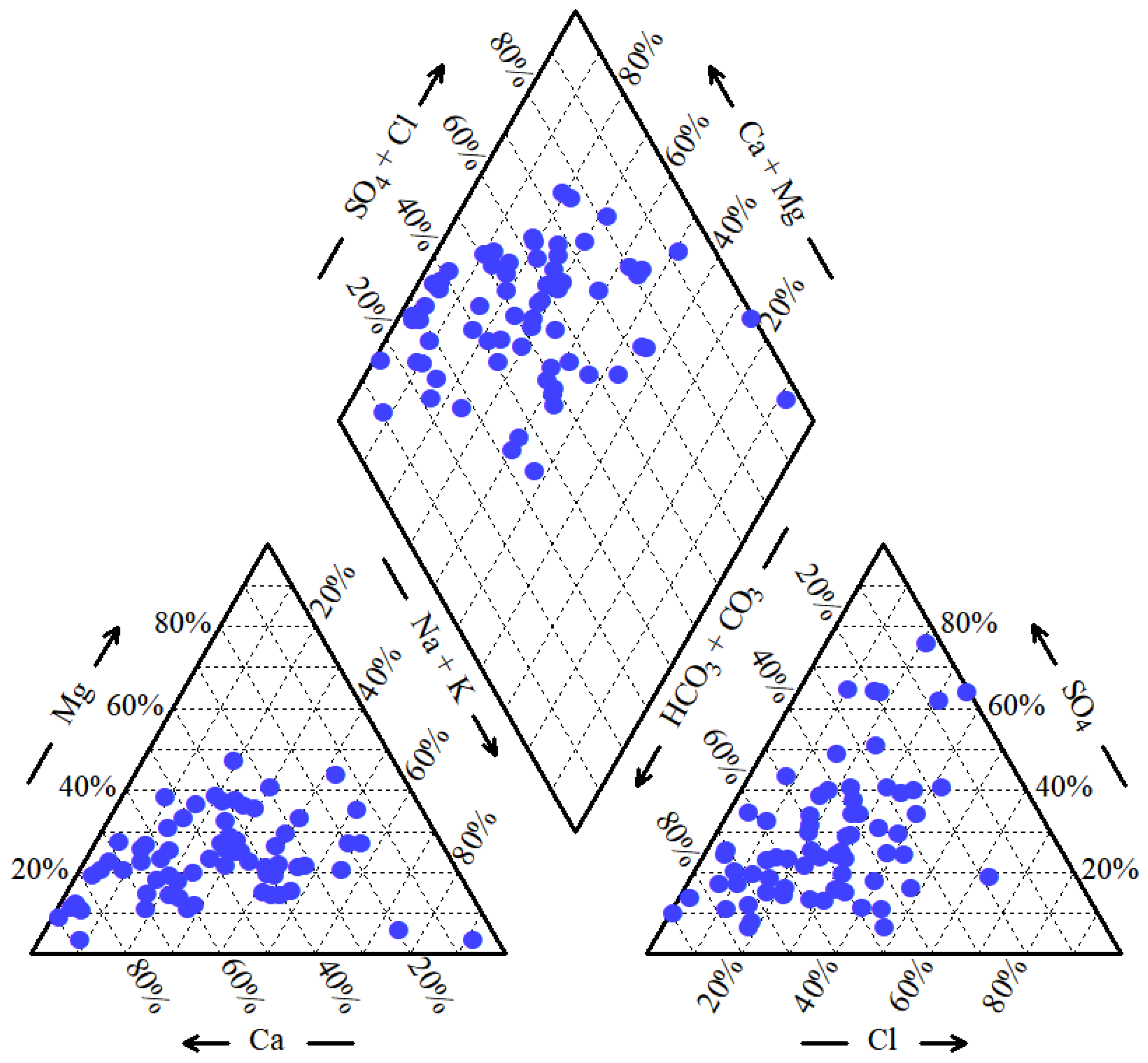
The Piper trilinear diagram of the groundwater samples (Figure 2) was generated using AqQA1.5. As shown in the figure, Ca2+ and Na+ are the dominant cations in the groundwater, followed by Mg2+. Among the anions, HCO3 and SO42− are the most prevalent, while Cl occurs at relatively lower concentrations.
According to the Shukalev classification method, groundwater in the Nansi Lake Basin can be categorized into 17 hydrochemical types, as summarized in Table 4.
Among these, the HCO3–Ca type is the most common, accounting for 9 samples (13.43%) of the total. The HCO3–Ca·Mg type ranks second, with 7 samples (10.45%), followed by the HCO3·Cl–Na·Ca type, with 5 samples (7.46%). The dominance of HCO3 and Ca2+ ions indicates that groundwater in the region is primarily associated with carbonate and silicate rock formations, or transitional zones between them. This pattern also suggests that, during prolonged subsurface circulation, groundwater has undergone complex ion-exchange and dissolution processes involving both carbonate and silicate minerals.

3.3. Evolutionary Processes of Groundwater Hydrochemistry

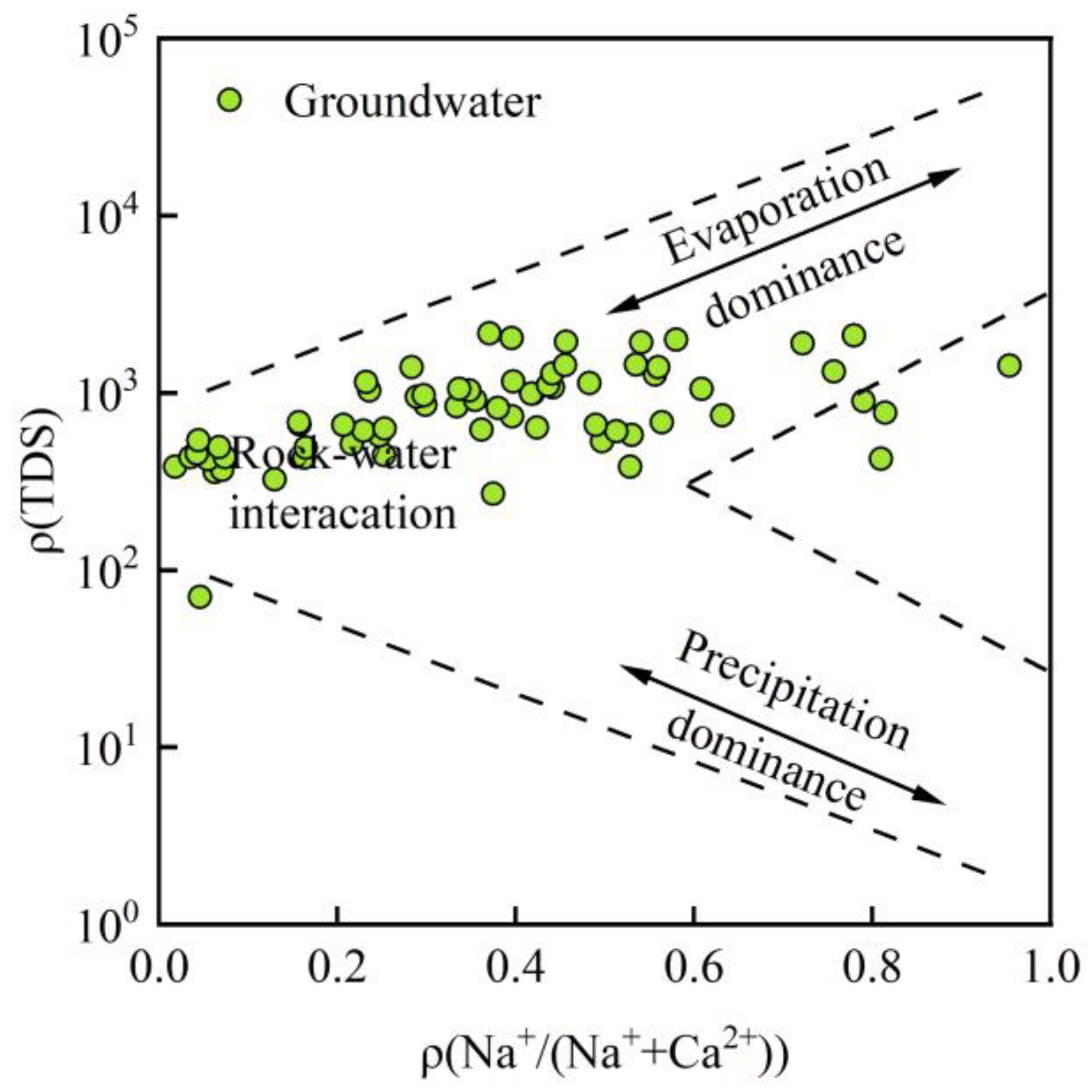
The sources and evolution of chemical components in groundwater are largely governed by water–rock interactions. To evaluate the relative influence of precipitation, rock weathering, and evaporation–concentration processes on the major ions in shallow groundwater, Gibbs diagrams were employed for analysis. As shown in Figure 3, the molar ratio of Na+/(Na+ + Ca2+) in groundwater ranges from 0.01 to 0.95. This distribution indicates that the groundwater cation composition in the Nansi Lake Basin is primarily controlled by rock–water interaction, with evaporation dominance exerting a secondary influence.
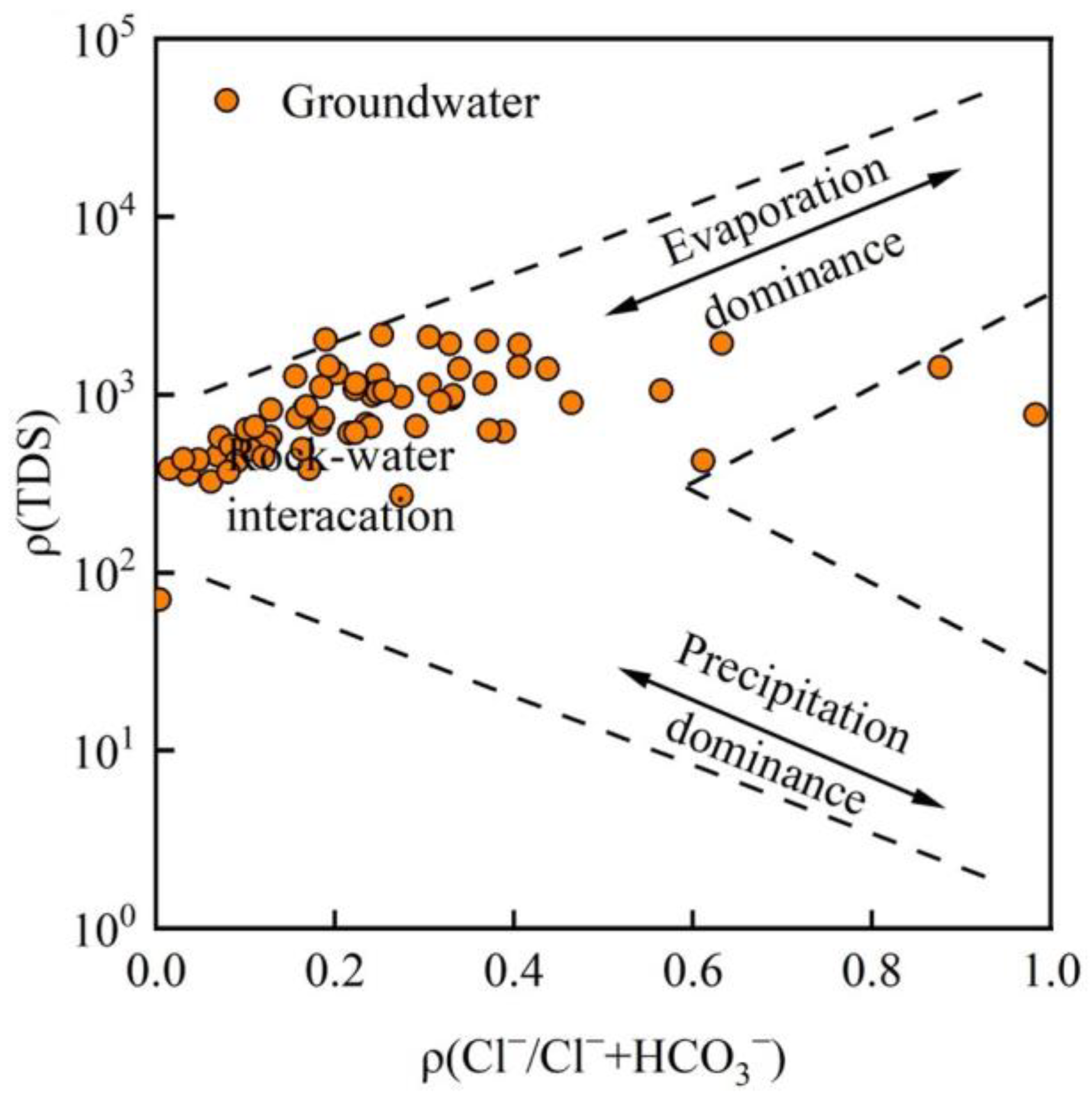
Similarly, as shown in Figure 4, the equivalent ratio of Cl/(Cl + HCO3) ranges from 0.003 to 0.98. This suggests that the anionic composition of groundwater is likewise mainly influenced by rock–water interaction, with evaporation processes playing a secondary role.
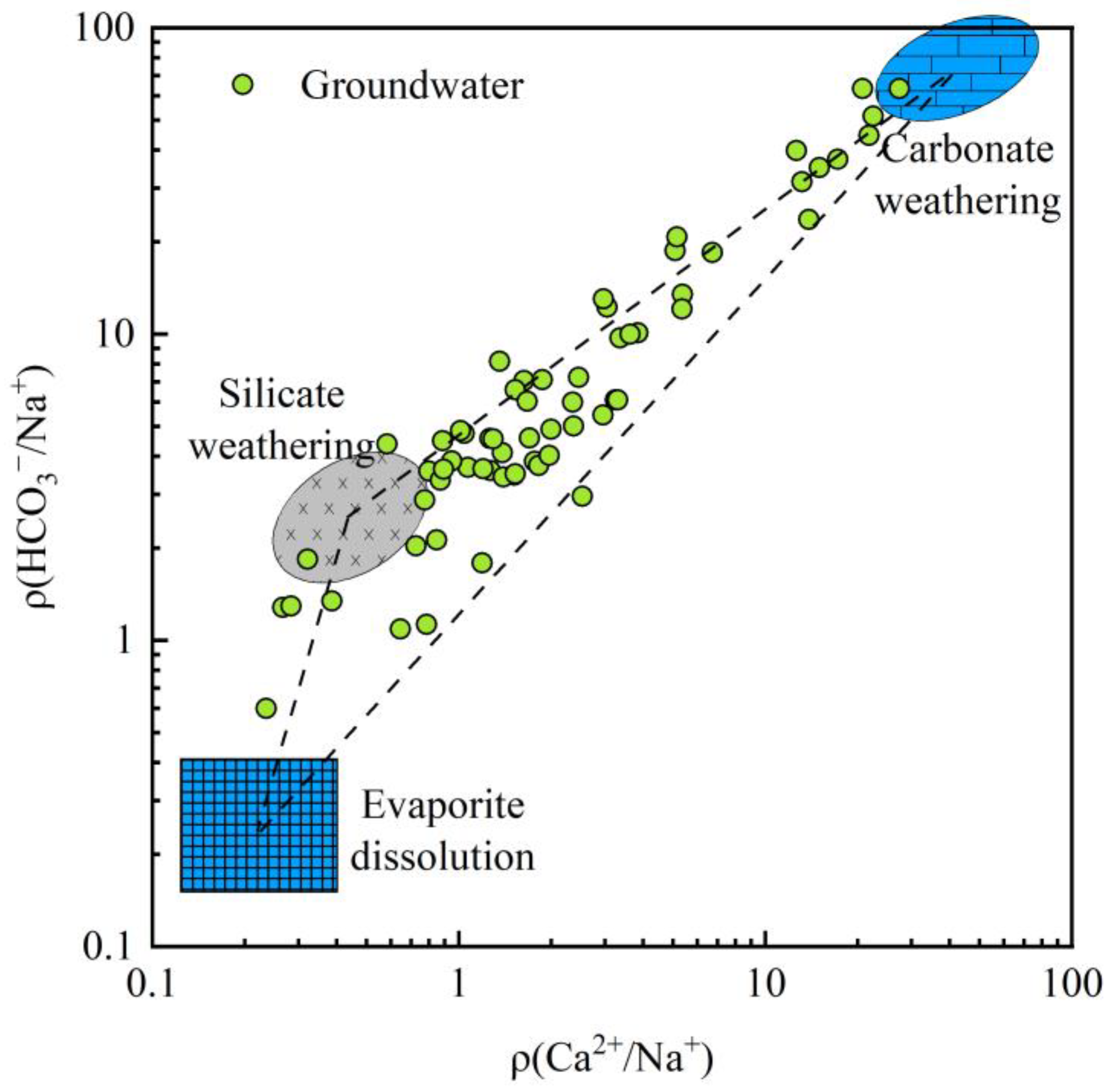
To further elucidate the geochemical evolution pathways and identify the types of rocks involved in water–rock interactions [40,41], the relationships between HCO3/Na+ and Ca2+/Na+ molar ratios were analyzed (Figure 5). In the groundwater samples from the Nansi Lake Basin, the HCO3/Na+ ratio varies widely from 0.01 to 146.31, while the Ca2+/Na+ ratio ranges from 0.05 to 55.51. As illustrated in Figure 5, the hydrochemical characteristics of most groundwater samples are mainly affected by the weathering and dissolution of silicate and carbonate rocks, with a secondary contribution from the weathering of silicate and evaporite minerals. This further confirms that mixed influences of silicate and carbonate rock weathering play a significant role in controlling the hydrochemical evolution of groundwater in the Nansi Lake Basin.

3.4. Groundwater Quality Assessment

Based on 67 groundwater sampling sites, six hydrochemical parameters—TDS, TH, Na+, NH4+, Cl, and SO42−—were selected as evaluation indices for the EWQI. These indicators correspond to the key items with explicit standard limits in the Standard for Groundwater Quality (GB/T 14848–2017) [38], which are defined according to the current groundwater quality status in China and human health risks, with reference to the quality requirements for domestic, industrial, and agricultural water use. The EWQI was then calculated for each sampling site, and the spatial distribution of groundwater environmental quality in the Nansi Lake Basin was subsequently mapped.
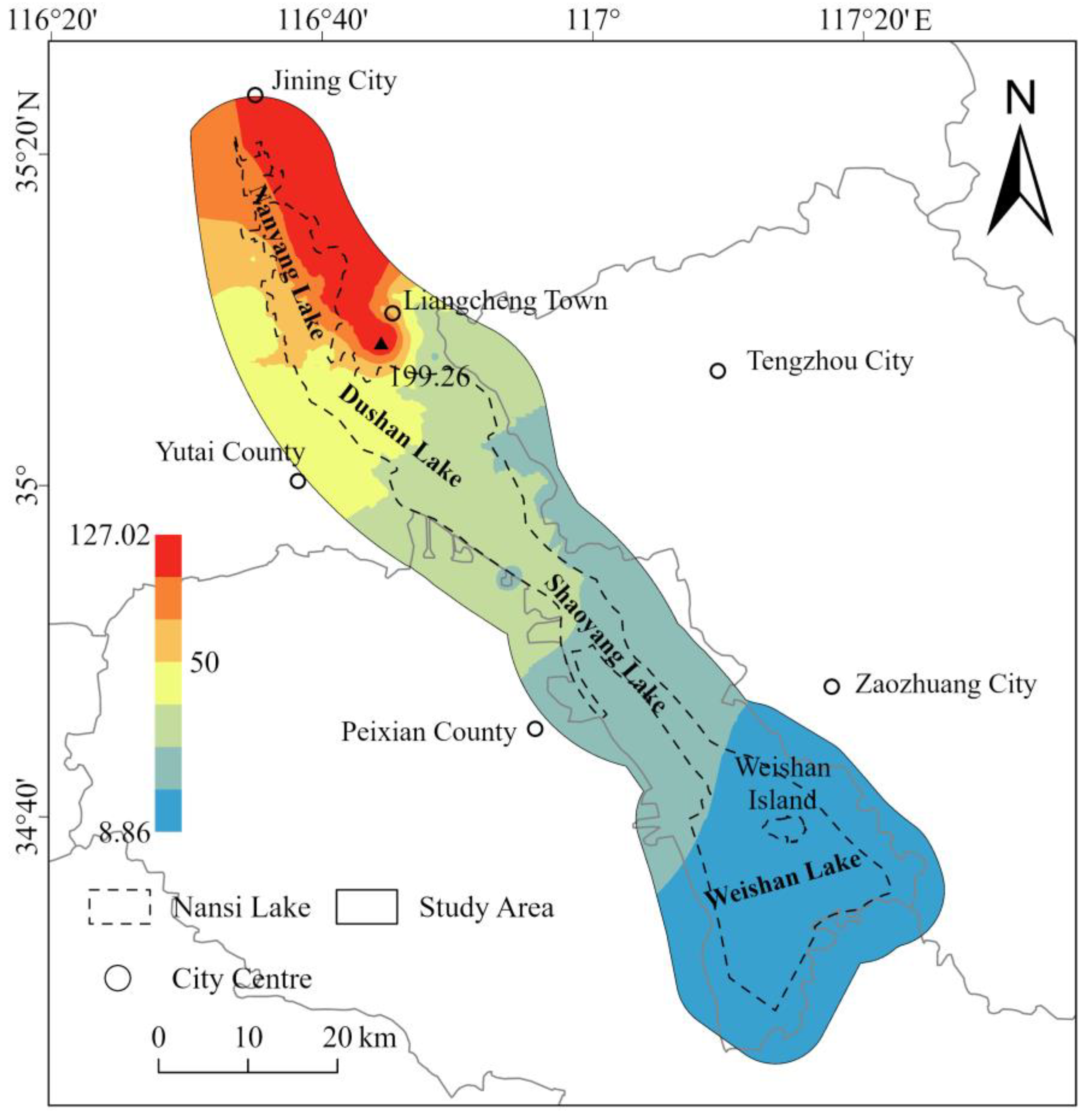
The EWQI values of groundwater in the Nansi Lake Basin range from 8.86 to 199.37, with an average value of 45.49. As summarized in Table 5, 46 samples (68.66%) fall within Class I, representing unpolluted groundwater. In total, 14 samples (20.90%) belong to Class II, corresponding to a low pollution level. Generally, Class I and Class II groundwater are suitable for centralized domestic water supply and can be directly used for local drinking and household purposes. Six samples (8.96%) fall into Class III, which also indicates a low pollution level. Groundwater of this class is generally suitable for agricultural and industrial uses, and—with appropriate treatment—can serve as potable water. Only one sample (1.49%) falls into Class IV, categorized as highly polluted, while no samples belong to Class V. Groundwater in Classes IV and V is unsuitable for drinking water supply sources [42].
The spatial distribution of EWQI (Figure 6) reveals that most areas in the central to southern parts of the Nansi Lake Basin exhibit low EWQI values, indicating generally good groundwater quality. The EWQI values show a gradual increasing trend from south to north. Weishan Island is the key area for tourism and resort development within the basin, and both Shaoyang Lake and Weishan Lake have a long history of aquaculture activities. Nevertheless, groundwater quality in these regions remains excellent and exhibits no signs of contamination, reflecting the effectiveness of local groundwater protection and management policies. This suggests that human activities in these zones have had a limited impact on groundwater quality.
In contrast, groundwater environments of lower quality (below Class I) are predominantly distributed in the northern part of the basin, particularly around Dushan Lake and Nanyang Lake. The southern area of Jining City, the western region of Liangcheng Town, and the eastern bank of Nanyang Lake represent the most contaminated zones within the study area, with the highest EWQI values observed near the northern shore of Dushan Lake and southern Liangcheng Town.
The western shores of Dushan Lake and Nanyang Lake are important agricultural zones, primarily cultivating wheat and maize. Additionally, the historical coal mining and mineral extraction activities around Liangcheng Town may have left behind abandoned mines and pits, potentially disrupting the aquifer structure and hydrogeological balance. Such alterations can affect groundwater flow dynamics and environmental equilibrium in the Nansi Lake Basin.
Improper use of fertilizers and pesticides, together with coal mining and transportation activities, are likely the main contributing factors to the elevated EWQI values and degraded groundwater quality observed in these northern regions.

3.5. Source Apportionment by APCS-MLR

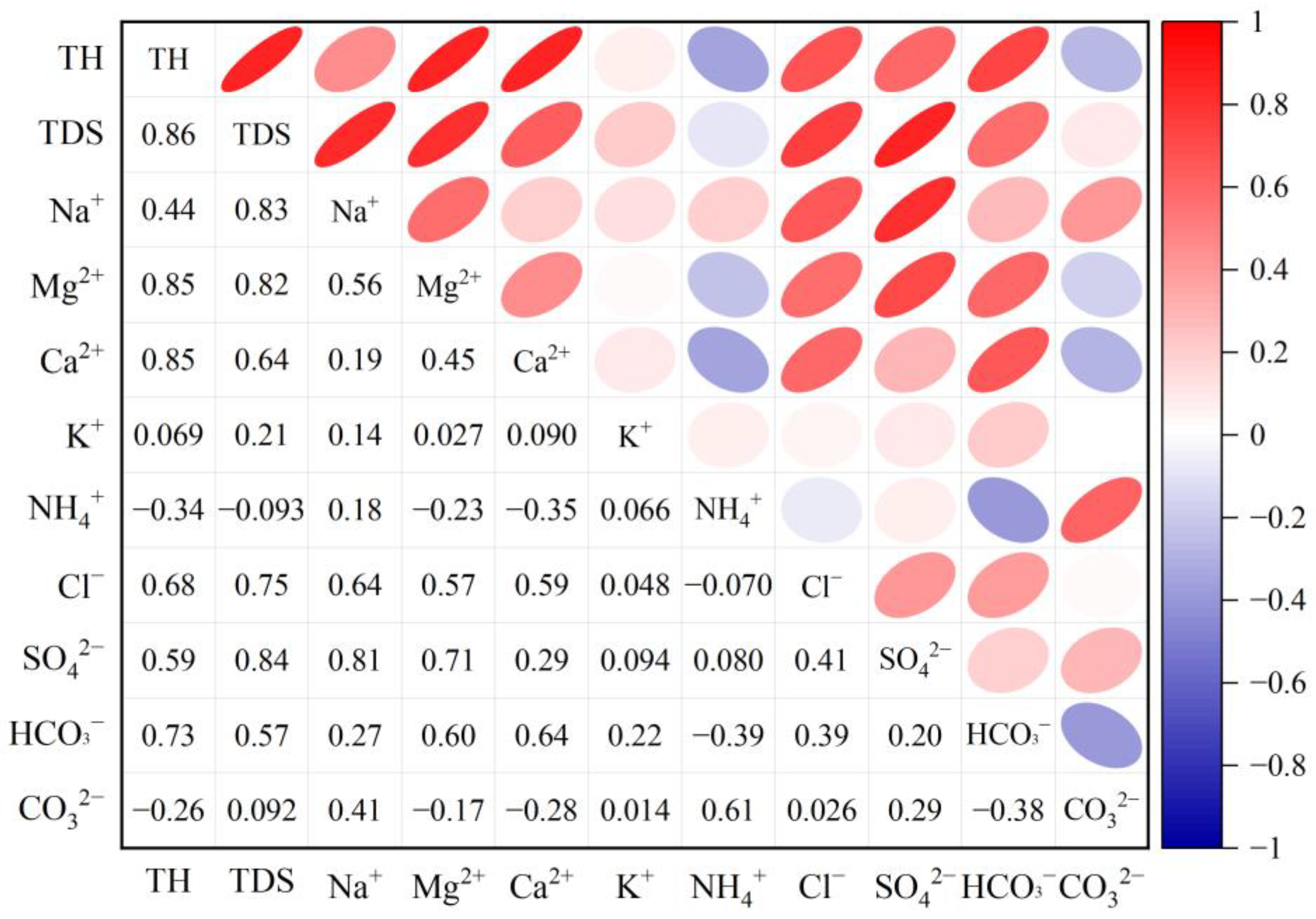
To quantify the relationships among hydrochemical parameters, the Pearson correlation coefficient was applied. The correlation heatmap (Figure 7) was used to identify parameters with strong interrelationships, suggesting potential information redundancy among them. Such redundancy is beneficial for the APCS–MLR model, as it helps to uncover latent relationships between hydrochemical variables. As shown in Figure 7, both TDS and TH exhibit significant correlations with most ionic parameters, except for K+, NH4+, and CO32−. The NH4+ parameter shows a negative correlation with TDS, TH, Mg2+, Ca2+, Cl, and HCO3, indicating that NH4+ is governed by distinct hydrogeochemical or anthropogenic processes. The absolute values of correlation coefficients between K+ and other ions are below 0.25, suggesting weak associations and implying that K+ is controlled by relatively independent geochemical factors, potentially reflecting groundwater quality from a different perspective.
Groundwater in the Nansi Lake Basin is generally weakly alkaline, and CO32− was rarely detected, indicating limited association with other hydrochemical parameters. Based on the Pearson correlation analysis, nine indicators—TH, TDS, Na+, Ca2+, Mg2+, NH4+, Cl, SO42−, and HCO3—were selected to construct the dataset for the APCS–MLR model to determine the dominant sources of groundwater solutes and the factors influencing groundwater quality. Principal Component Analysis (PCA) was conducted to reduce data dimensionality while retaining the essential information from the original dataset. Bartlett’s sphericity test yielded a significance value of p = 0.000, confirming the suitability of PCA. The Kaiser–Meyer–Olkin (KMO) value was 0.63, exceeding the minimum threshold of 0.5, indicating adequate correlations among the variables for PCA. Using varimax orthogonal rotation, three principal components were extracted, cumulatively explaining 86.24% of the total variance. Therefore, three common factors—P1, P2, and P3—were retained (Table 6).
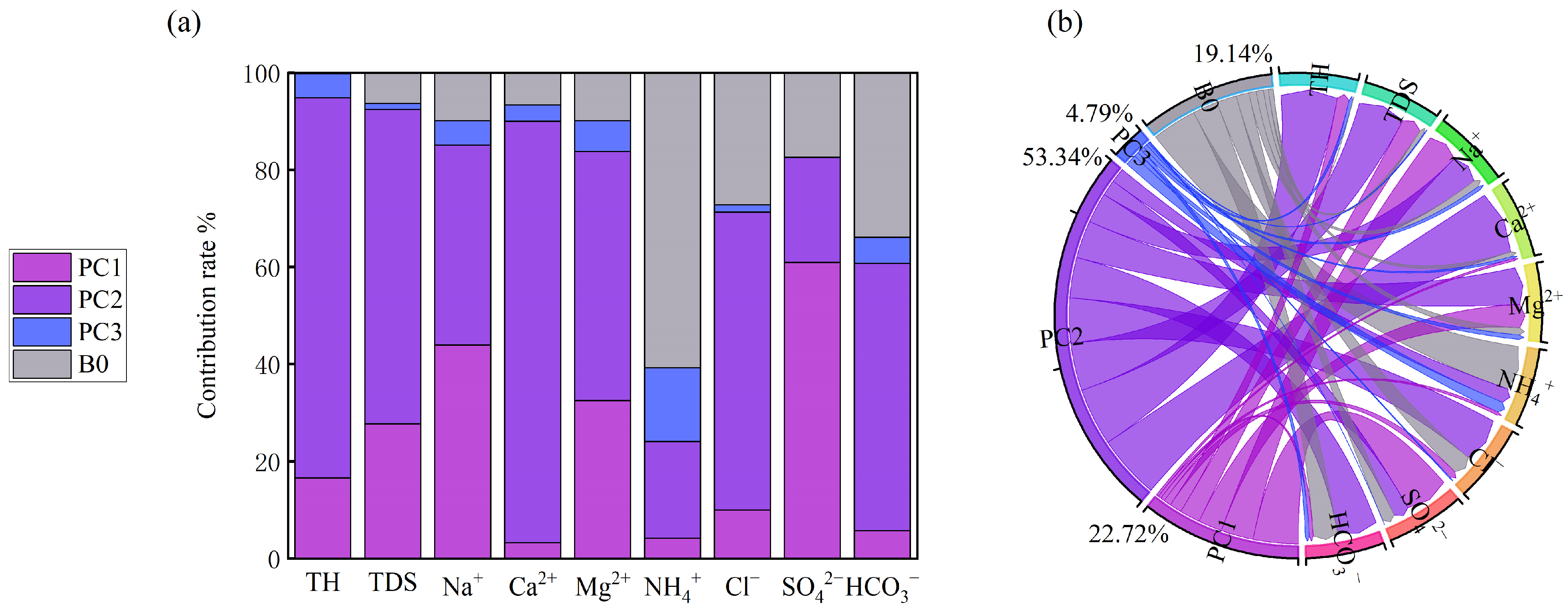
Based on the PCA results, the APCS–MLR model was applied to quantify the contributions of each factor to major ionic species in the shallow groundwater. Four source factors were identified: PC1, PC2, PC3, and an unknown source (B0). Their respective contribution rates are presented in Figure 8 and Table 7.
PC1 shows high contributions to SO42− (60.9%), Na+ (43.92%), and Mg2+ (32.47%), accounting for 22.71% of the total source variance. As SO42− is commonly present in synthetic fertilizers and MgSO4 is frequently used in agricultural applications, excessive or inefficient fertilizer use can increase the concentrations of Na+ and K+ in groundwater. Therefore, PC1 was identified as the agricultural source factor.
PC2, which contributes the most (53.34%), is characterized by high loadings of Ca2+ (86.75%), Mg2+ (51.27%), Cl (61.32%), HCO3 (55.05%), TH (78.27%), and TDS (64.73%). The presence of Mg2+ can be attributed to the dissolution of silicate minerals (e.g., olivine, pyroxene, amphibole) and carbonate rocks (e.g., dolomite). Dolomite reacts with dissolved CO2 to produce Mg2+ and HCO3, consistent with the predominance of the HCO3–Ca·Mg water type in the study area [43]. Similarly, Ca2+ and HCO3 originate mainly from carbonate dissolution, explaining their strong association with TDS. These shared origins indicate that groundwater chemistry in the Nansi Lake Basin is primarily governed by silicate–carbonate weathering and water–rock interactions. Thus, PC2 represents the natural source.
PC3 contributes the least (4.79%) and is mainly associated with NH4+ (19.94%). Previous studies have shown that during high-flow periods, recharge from surface water with low NH4+ concentrations promotes desorption of NH4+ from sediments, leading to ion exchange between NH4+ and Ca2+/Mg2+. This process increases NH4+ and decreases Ca2+/Mg2+ concentrations in groundwater [44], consistent with the observed negative correlations. According to existing research, this ion exchange process is relatively weak. Therefore, PC3 is identified as the ion-exchange source factor.
The unknown source (B0) showed major contributions to NH4+ (60.74%), Cl (27.21%), HCO3 (33.91%), and SO42− (17.39%), accounting for 19.14% of the total source variance. Groundwater NH4+ concentrations are often influenced by domestic sewage and organic wastewater discharges, while Cl and SO42− can also increase due to agricultural inputs [45]. Given the Nansi Lake Basin’s long history of agricultural, fishery, and industrial development—as well as the recent expansion of tourism—this source likely reflects the combined impact of human production and daily life activities.
In summary, the contributions of the four identified sources to groundwater chemistry in the Nansi Lake Basin were as follows: agricultural source (22.71%), natural source (53.34%), ion-exchange source (4.79%), and unknown source (19.14%). These results indicate that the natural geologic environment and water–rock interactions are the dominant factors controlling groundwater chemistry, while human activities also exert a measurable influence on groundwater quality evolution.

3.6. Implications for Similar Large Lake Basins and Plain Regions

The findings of this study hold clear reference value for large lake basins and plain regions sharing similar hydrogeological backgrounds with the South Four Lakes. The integrated methodology employed in this study—identifying evolutionary processes through hydrogeochemical mapping, objectively assessing environmental quality using the Entropy Weighted Quality Index (EWQI), and quantitatively analyzing pollution sources via the APCS-MLR model—constitutes a transferable technical framework. This framework systematically reveals groundwater environmental issues in such regions driven by dual factors: natural background conditions and human activities. Core findings indicate that while natural water-rock interactions form the foundation controlling regional groundwater chemistry, human activities such as agriculture and mining are decisive factors driving localized water quality deterioration and spatial differentiation. Consequently, groundwater management and protection strategies for similar regions should transcend homogeneous controls and shift toward targeted, zoned interventions based on quantitative source analysis results. While respecting the overall natural hydrogeochemical background, prioritizing limited management resources toward controlling key anthropogenic sources—such as agricultural nonpoint sources and historical industrial/mining pollution—represents an effective pathway to achieving sustainable groundwater resource utilization.

4. Conclusions

This study combined hydrochemical characterization (Piper and Schukalev classification), Gibbs and ion ratio diagrams, the Entropy-Weight Water Quality Index (EWQI), and the APCS–MLR receptor model to evaluate groundwater environmental quality and identify the sources of hydrochemical components in the Nansi Lake Basin.
(1)
Hydrochemical characteristics and evolution. Groundwater in the study area is characterized by relatively high mineralization and hardness, with 55.22% of samples exceeding the Grade III standard limit for TH and 35.82% exceeding the limit for TDS. The dominant hydrochemical facies are HCO3–Ca, HCO3–Ca·Mg, and HCO3·Cl–Na·Ca, accounting for 13.43%, 10.45% and 7.46% of the samples, respectively. These types indicate that HCO3 and Ca2+ are the prevailing ions and that groundwater has undergone extensive ion exchange and dissolution processes involving carbonate and silicate rocks.
(2)
Controlling processes. Gibbs plots and key ion ratios show that rock–water interaction is the primary process controlling the present groundwater hydrochemical environment, while evaporation–concentration plays a secondary role. The mixed weathering and dissolution of carbonate and silicate minerals are the main natural mechanisms driving the evolution of groundwater chemistry in the basin.
(3)
Groundwater environmental quality pattern. EWQI results indicate that groundwater quality in most of the Nansi Lake Basin is good: 68.66% of samples are classified as Class I and 20.90% as Class II, which are suitable for centralized domestic supply and general household use. However, areas with poorer groundwater quality (Classes III–IV) are mainly concentrated in the northern part of the basin, particularly around Dushan Lake and the eastern shore of Nanyang Lake, where intensive agriculture and historical mining activities are likely to have degraded groundwater quality.
(4)
Source apportionment and management implications. APCS–MLR source apportionment identifies four major sources: natural (53.34%), agricultural (22.71%), ion-exchange (4.79%), and an unknown anthropogenic source (19.14%). These results confirm that natural geologic conditions and water–rock interaction dominate groundwater chemistry, but anthropogenic impacts from fertilizer application, sewage discharge, and legacy mining cannot be neglected—especially in the northern agricultural and mining zones. To safeguard groundwater used for domestic and ecological purposes, it is necessary to strengthen groundwater pollution early-warning systems, remediate historical agricultural and industrial problems, improve rural and small-town wastewater treatment, and promote experience sharing in groundwater protection with well-managed areas such as Weishan Lake.

Author Contributions

Conceptualization, investigation, methodology, writing—original draft, B.Y. and M.W.; methodology, writing—review and editing, supervision, T.W. and R.Z.; Data curation, C.S.; methodology, data curation, validation, X.S. and H.Z.; Supervision, funding acquisition, project administration, X.L. All authors have read and agreed to the published version of the manuscript.

Funding

This research was funded by the 2023 special scientific research project of Shandong Coalfield Geology Bureau, China, grant number LMDK[2023]10.

Data Availability Statement

The original contributions presented in this study are included in the article. Further inquiries can be directed to the corresponding author.

Conflicts of Interest

The authors declare no conflicts of interest.

References

  1. Yao, Y.; Guo, S.; Andrews, C.B.; Zhang, F.; Lancia, M.; Kuang, X.; Zheng, C. Seeing China’s Invisible Groundwater: Advances and Challenges. Water Resour. Res. 2025, 61, e2024WR038980. [Google Scholar] [CrossRef]
  2. Li, P. Groundwater Quality in Western China: Challenges and Paths Forward for Groundwater Quality Research in Western China. Expo. Health 2016, 8, 305–310. [Google Scholar] [CrossRef]
  3. Aarnoudse, E.; Bluemling, B.; Qu, W.; Herzfeld, T. Groundwater Regulation in Case of Overdraft: National Groundwater Policy Implementation in North-West China. Int. J. Water Resour. Dev. 2019, 35, 264–282. [Google Scholar] [CrossRef]
  4. Wu, A.; Jin, J.; Song, B. Water Safety Issues of China and Ensuring Roles of Groundwater. Acta Geol. Sin. 2016, 90, 2939–2947. [Google Scholar]
  5. Kong, S.; Yi, J.; Xu, M. Analysis of surface water hydro-chemical characteristics in the Nansihu Lake basin. Tech. Superv. Water Resour. 2023, 7, 206–209. [Google Scholar]
  6. Yuan, Z.; Jian, Y.; Chen, Z.; Jin, P.; Gao, S.; Wang, Q.; Ding, Z.; Wang, D.; Ma, Z. Distribution of Groundwater Hydrochemistry and Quality Assessment in Hutuo River Drinking Water Source Area of Shijiazhuang (North China Plain). Water 2024, 16, 175. [Google Scholar] [CrossRef]
  7. Ebrahimi, M.; Kazemi, H.; Ehtashemi, M.; Rockaway, T.D. Assessment of Groundwater Quantity and Quality and Saltwater Intrusion in the Damghan Basin, Iran. Chem. Erde-Geochem. 2016, 76, 227–241. [Google Scholar] [CrossRef]
  8. Kou, X.; Zhao, Z.; Duan, L.; Sun, Y. Hydrogeochemical Behavior of Shallow Groundwater around Hancheng Mining Area, Guanzhong Basin, China. Water 2024, 16, 660. [Google Scholar] [CrossRef]
  9. Zhang, X.; Zhao, R.; Wu, X.; Mu, W. Hydrogeochemistry, Identification of Hydrogeochemical Evolution Mechanisms, and Assessment of Groundwater Quality in the Southwestern Ordos Basin, China. Environ. Sci. Pollut. Res. 2022, 29, 901–921. [Google Scholar] [CrossRef]
  10. Chen, J.; Huang, Q.; Lin, Y.; Fang, Y.; Qian, H.; Liu, R.; Ma, H. Hydrogeochemical Characteristics and Quality Assessment of Groundwater in an Irrigated Region, Northwest China. Water 2019, 11, 96. [Google Scholar] [CrossRef]
  11. Shuaibu, A.; Kalin, R.M.; Phoenix, V.; Banda, L.C.; Lawal, I.M. Hydrogeochemistry and Water Quality Index for Groundwater Sustainability in the Komadugu-Yobe Basin, Sahel Region. Water 2024, 16, 601. [Google Scholar] [CrossRef]
  12. Marín Celestino, A.E.; Ramos Leal, J.A.; Martínez Cruz, D.A.; Tuxpan Vargas, J.; De Lara Bashulto, J.; Morán Ramírez, J. Identification of the Hydrogeochemical Processes and Assessment of Groundwater Quality, Using Multivariate Statistical Approaches and Water Quality Index in a Wastewater Irrigated Region. Water 2019, 11, 1702. [Google Scholar] [CrossRef]
  13. Kumar, P.J.S.; Augustine, C.M. Entropy-Weighted Water Quality Index (EWQI) Modeling of Groundwater Quality and Spatial Mapping in Uppar Odai Sub-Basin, South India. Model. Earth Syst. Environ. 2022, 8, 911–924. [Google Scholar] [CrossRef]
  14. Egbueri, J.C.; Ezugwu, C.K.; Ameh, P.D.; Unigwe, C.O.; Ayejoto, D.A. Appraising Drinking Water Quality in Ikem Rural Area (Nigeria) Based on Chemometrics and Multiple Indexical Methods. Environ. Monit. Assess. 2020, 192, 308. [Google Scholar] [CrossRef]
  15. Naik, M.R.; Mahanty, B.; Sahoo, S.K.; Jha, V.N.; Sahoo, N.K. Assessment of Groundwater Geochemistry Using Multivariate Water Quality Index and Potential Health Risk in Industrial Belt of Central Odisha, India. Environ. Pollut. 2022, 303, 119161. [Google Scholar] [CrossRef]
  16. Mamun, M.; An, K.-G. Application of Multivariate Statistical Techniques and Water Quality Index for the Assessment of Water Quality and Apportionment of Pollution Sources in the Yeongsan River, South Korea. Int. J. Environ. Res. Public Health 2021, 18, 8268. [Google Scholar] [CrossRef]
  17. Zhang, H.; Cheng, S.; Li, H.; Fu, K.; Xu, Y. Groundwater Pollution Source Identification and Apportionment Using PMF and PCA-APCA-MLR Receptor Models in a Typical Mixed Land-Use Area in Southwestern China. Sci. Total Environ. 2020, 741, 140383. [Google Scholar] [CrossRef] [PubMed]
  18. Li, W.; Wu, J.; Zhou, C.; Nsabimana, A. Groundwater Pollution Source Identification and Apportionment Using PMF and PCA-APCS-MLR Receptor Models in Tongchuan City, China. Arch. Environ. Contam. Toxicol. 2021, 81, 397–413. [Google Scholar] [CrossRef]
  19. Zhang, S.; Wang, S.; Li, F.; Liu, S.; You, Y.; Liu, C. Enhanced Assessment of Water Quality and Pollutant Source Apportionment Using APCS-MLR and PMF Models in the Upper Reaches of the Tarim River. Water 2024, 16, 3061. [Google Scholar] [CrossRef]
  20. Chen, Z.; Zhou, Q.; Lv, J.; Jiang, Y.; Yang, H.; Yang, H.; Mei, S.; Jia, Z.; Zhang, H.; Jin, Y.; et al. Assessment of Groundwater Quality Using APCS-MLR Model: A Case Study in the Pilot Promoter Region of Yangtze River Delta Integration Demonstra-tion Zone, China. Water 2023, 15, 225. [Google Scholar] [CrossRef]
  21. Meng, L.; Zuo, R.; Wang, J.; Yang, J.; Teng, Y.; Shi, R.; Zhai, Y. Apportionment and Evolution of Pollution Sources in a Typical Riverside Groundwater Resource Area Using PCA-APCS-MLR Model. J. Contam. Hydrol. 2018, 218, 70–83. [Google Scholar] [CrossRef]
  22. Gao, M.; Li, X.; Qian, J.; Wang, Z.; Hou, X.; Gui, C.; Bai, Z.; Fu, C.; Li, J.; Zuo, X. Hydrochemical Characteristics and Controlling Factors of Shallow and Deep Groundwater in the Heilongdong Spring Basin, Northern China. Sustainability 2023, 15, 15447. [Google Scholar] [CrossRef]
  23. Jin, L.; Ye, H.; Shi, Y.; Li, L.; Liu, R.; Cai, Y.; Li, J.; Li, F.; Jin, Z. Using PCA-APCS-MLR Model and SIAR Model Combined with Multiple Isotopes to Quantify the Nitrate Sources in Groundwater of Zhuji, East China. Appl. Geochem. 2022, 143, 105354. [Google Scholar] [CrossRef]
  24. Li, Z.; Yue, Q.; Ni, H.; Gao, B. Fractionation and Potential Risk of Heavy Metals in Surface Sediment of Nansi Lake, China. Desalination Water Treat. 2011, 32, 10–18. [Google Scholar] [CrossRef]
  25. Guo, S.; Zhang, Y.; Xiao, J.; Zhang, Q.; Ling, J.; Chang, B.; Zhao, G. Assessment of Heavy Metal Content, Distribution, and Sources in Nansi Lake Sediments, China. Environ. Sci. Pollut. Res. 2021, 28, 30929–30942. [Google Scholar] [CrossRef] [PubMed]
  26. Qu, X.; Xin, Y. Detection and Health Risk Assessment of Heavy Metals in Upper Water of Nansi Lake, China. Water Air Soil Pollut. 2025, 236, 79. [Google Scholar] [CrossRef]
  27. Xu, S.; Cui, Y.; Yang, C.; Wei, S.; Dong, W.; Huang, L.; Liu, C.; Ren, Z.; Wang, W. The Fuzzy Comprehensive Evaluation (FCE) and the Principal Component Analysis (PCA) Model Simulation and Its Applications in Water Quality Assessment of Nansi Lake Basin, China. Environ. Eng. Res. 2021, 26, 200022. [Google Scholar] [CrossRef]
  28. Liu, Y.; Yang, L.; Jiang, W. Coupling Coordination and Spatiotemporal Dynamic Evolution between Social Economy and Water Environmental Quality—A Case Study from Nansi Lake Catchment, China. Ecol. Indic. 2020, 119, 106870. [Google Scholar] [CrossRef]
  29. Gao, Z.; Han, C.; Yuan, S.; Liu, J.; Peng, Y.; Li, C. Assessment of the Hydrochemistry, Water Quality, and Human Health Risk of Groundwater in the Northwest of Nansi Lake Catchment, North China. Environ. Geochem. Health 2022, 44, 961–977. [Google Scholar] [CrossRef]
  30. DZ/T 0064–2021; Methods for Analysis of Groundwater Quality. Ministry of Natural Resources of the People’s Republic of China: Beijing, China, 2021.
  31. HJ 812–2016; Water Quality-Determination of Water Soluble Cations (Li+, Na+, NH4+, K+, Ca2+, Mg2+) -Ion Chromatography. Ministry of Ecology and Environment of the People’s Republic of China: Beijing, China, 2016.
  32. HJ 84–2016; Water Quality-Determination of Inorganic Anions (F, Cl, NO2, Br, NO3, PO43−, SO32−, SO42−)-Ion Chromatography. Ministry of Ecology and Environment of the People’s Republic of China: Beijing, China, 2016.
  33. HJ 666–2013; Water Quality-Determination of Ammonium Nitrogen by Flow Injection Analysis (FIA) and Salicylic Acid Spectrophotometry. Ministry of Ecology and Environment of the People’s Republic of China: Beijing, China, 2013.
  34. Liu, Q.; Sun, Y.; Xu, Z.; Xu, G. Application of the Comprehensive Identification Model in Analyzing the Source of Water Inrush. Arab. J. Geosci. 2018, 11, 189. [Google Scholar] [CrossRef]
  35. Li, X.; Liu, X.; Du, J.; Cui, Y.; Sun, F. Hydrogeochemical Characteristics of the Haiyuan-Liupanshan Seismic Belt at the Northeastern Edge of the Tibet Plateau. Geofluids 2022, 2022, 6894229. [Google Scholar] [CrossRef]
  36. Du, Y.; He, P.; Wei, L.; Huang, L.; He, M. Chemical Characteristics and Water Quality Assessment of Groundwater in Wusheng Section of Jialing River. Sustainability 2025, 17, 4695. [Google Scholar] [CrossRef]
  37. Wei, S.; Zhang, Y.; Cai, Z.; Bi, D.; Wei, H.; Zheng, X.; Man, X. Evaluation of Groundwater Quality and Health Risk Assessment in Dawen River Basin, North China. Environ. Res. 2025, 264, 120292. [Google Scholar] [CrossRef]
  38. GB/T 14848–2017; Standard for Groundwater Quality. Ministry of Natural Resources of the People’s Republic of China: Beijing, China, 2017.
  39. Zheng, J.; Guo, X.; Cai, Y.; Liu, J.; Wang, D.; Gao, X.; Tan, B. Source Apportionment and Health Risks of Nitrate Pollution in Shallow Groundwater in the Agricultural Northern Xiaoxing’ an Mountains Region of China. J. Hydrol. Reg. Stud. 2025, 59, 102394. [Google Scholar] [CrossRef]
  40. Fan, B.-L.; Zhao, Z.-Q.; Tao, F.-X.; Liu, B.-J.; Tao, Z.-H.; Gao, S.; Zhang, L.-H. Characteristics of Carbonate, Evaporite and Silicate Weathering in Huanghe River Basin: A Comparison among the Upstream, Midstream and Downstream. J. Asian Earth Sci. 2014, 96, 17–26. [Google Scholar] [CrossRef]
  41. Zhu, B.; Yang, X.; Rioual, P.; Qin, X.; Liu, Z.; Xiong, H.; Yu, J. Hydrogeochemistry of Three Watersheds (the Erlqis, Zhungarer and Yili) in Northern Xinjiang, NW China. Appl. Geochem. 2011, 26, 1535–1548. [Google Scholar] [CrossRef]
  42. Wu, X.; Zhou, S.; Yuan, D.; Li, L.; Yao, F.; Dong, H.; Zheng, J. Evaluation of groundwater quality and source analysis of hydrochemical components in the Oujiang River Basin. Environ. Chem. 2025, 44, 1877–1892. [Google Scholar] [CrossRef]
  43. Li, P.; Wu, J.; Qian, H. Assessment of Groundwater Quality for Irrigation Purposes and Identification of Hydrogeochemical Evolution Mechanisms in Pengyang County, China. Environ. Earth Sci. 2013, 69, 2211–2225. [Google Scholar] [CrossRef]
  44. Zheng, A.; Liang, Y.; Ma, R. Adsorption/Desorption Behavior of NH4-N under Surface Water-Groundwater Interaction and Its Impact on N Migration and Transformation. Earth Sci. 2024, 49, 3761–3772. [Google Scholar] [CrossRef]
  45. Zhang, Y.; Yan, K.; Chen, C. Hydrochemical and Multi-Isotope Analysis of Nitrogen Sources and Transformation Processes in the Wetland-Groundwater System of Honghu Lake. Earth Sci. 2024, 49, 3946–3959. [Google Scholar] [CrossRef]
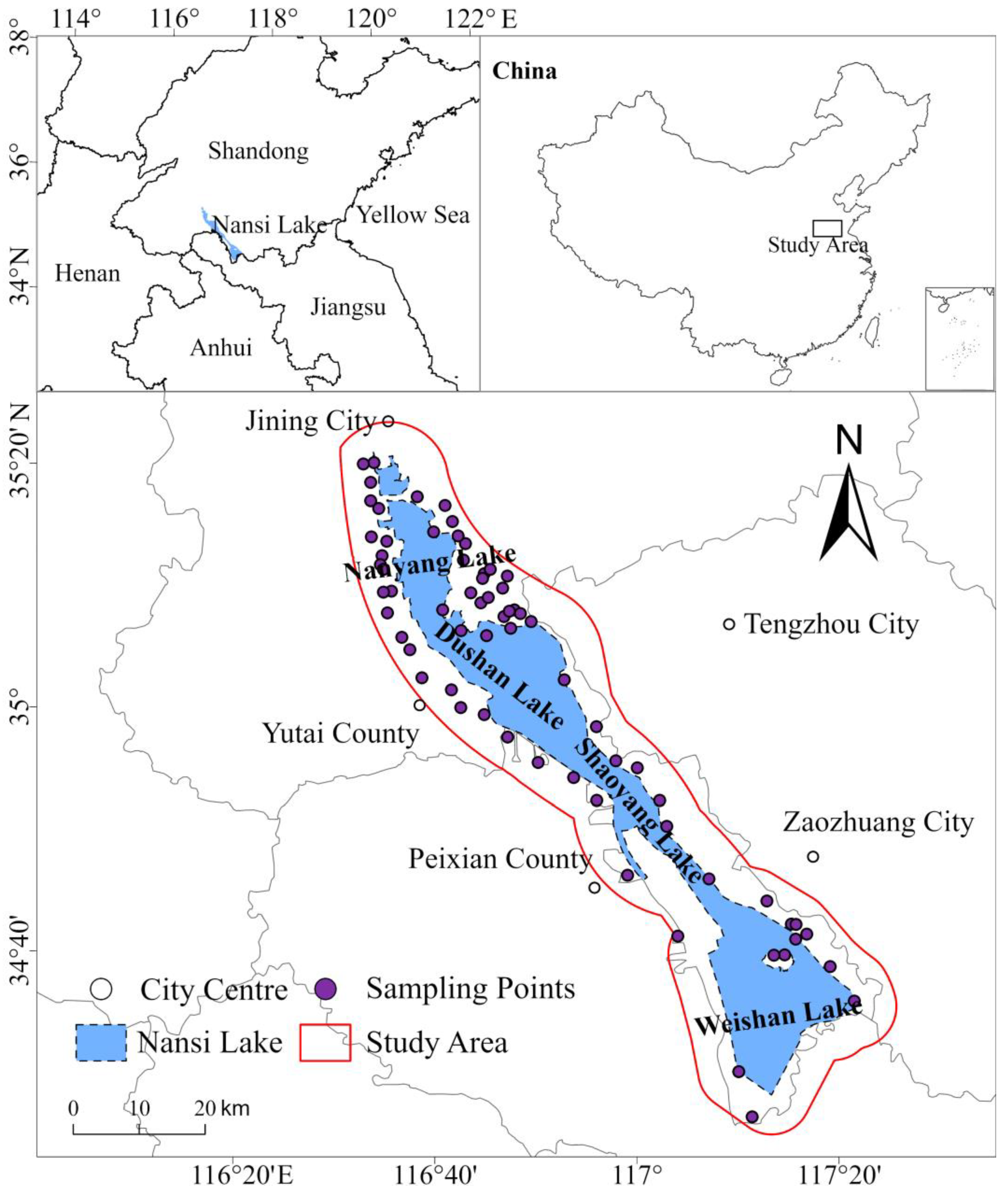
Figure 1. Geographical map of the study area.
Water 17 03398 g001
Figure 2. Groundwater Piper trilinear diagram.
Water 17 03398 g002
Figure 3. Cation Gibbs diagram of groundwater in Nansi Lake.
Water 17 03398 g003
Figure 4. Anion Gibbs diagram of groundwater in Nansi Lake.
Water 17 03398 g004
Figure 5. Ionic ratio plot of HCO3/Na+ versus Ca2+/Na+ in Nansi Lake groundwater.
Water 17 03398 g005
Figure 6. Spatial distribution of the EWQI value in groundwater.
Water 17 03398 g006
Figure 7. Correlation heatmap of groundwater hydrochemical parameters.
Water 17 03398 g007
Figure 8. (a) Contribution rates and (b) factor loadings of different sources based on the APCS–MLR model.
Water 17 03398 g008
Table 1. Hydrochemistry types of groundwater by SCM.
Over 25% Ion ContentHCO3HCO3·SO4HCO3·SO4·ClHCO3·ClSO4SO4·ClCl
Ca181522293643
Ca·Mg291623303744
Mg3101724313845
Na·Ca4111825323946
Na·Ca·Mg5121926334047
Na·Mg6132027344148
Na7142128354249
Table 2. Classification Levels of Groundwater Quality Based on EWQI.
Classification LevelIIIIIIIVV
EWQI value≤5050~100100~150150~200≥200
DescriptionUnpollutedLow pollutionModerate pollutionHigh pollutionSignificant pollution
Table 3. Statics of hydrochemical parameters of groundwater (unit: mg/L, except pH).
ParametersMaxMinMeanStandard DeviationCoefficient of VariationStandard Limits *Percentage
Exceeding the Standard
pH10.666.627.40.580.076.5~8.52.98
TH1370.8953.82523.38272.60.5245055.22
TDS2171.7170.47905.29498.150.55100035.82
Na+421.951103.1393.290.920011.94
Mg2+192.970.4445.6739.030.85--
Ca2+332.1718.09134.2664.030.47--
K+138.50.18.3322.972.75--
NH4+1.550.010.120.32.410.647.46
Cl743.380.22132.07118.360.8925011.94
SO42−1028.713.81216.57221.851.0225028.35
HCO3892.432.43380.57162.840.42--
CO32−19.1300.462.715.85--
Note: * Standard Limits represent the values of grade III standards in Standard for groundwater quality (GB/T 14848-2017) [38].
Table 4. Classification of groundwater hydrochemical types according to the SCM.
Hydrochemistry TypeAnion TypeCation TypeQuantityPercentage %
1HCO3Ca913.43
2HCO3Ca·Mg710.45
25HCO3·ClNa·Ca57.46
4HCO3Na·Ca45.97
8HCO3·SO4Ca45.97
22HCO3·ClCa45.97
26HCO3·ClNa·Ca·Mg45.97
11HCO3·SO4Na·Ca34.48
12HCO3·SO4Na·Ca·Mg34.48
18HCO3·SO4·ClNa·Ca34.48
23HCO3·ClCa·Mg34.48
9HCO3·SO4Ca·Mg22.99
15HCO3·SO4·ClCa22.99
19HCO3·SO4·ClNa·Ca·Mg22.99
5HCO3Na·Ca·Mg11.49
13HCO3·SO4Na·Mg11.49
16HCO3·SO4·ClCa·Mg11.49
20HCO3·SO4·ClNa·Mg11.49
21HCO3·SO4·ClNa11.49
32SO4Na·Ca11.49
34SO4Na·Mg11.49
35SO4Na11.49
39SO4·ClNa·Ca11.49
41SO4·ClNa·Mg11.49
42SO4·ClNa11.49
46ClNa·Ca11.49
Table 5. Classification of Groundwater Quality Levels According to EWQI Values.
Quality LevelQuantityPercentage %
I4668.66
II1420.9
III68.96
IV11.49
V00
Table 6. Rotated component matrix of groundwater hydrochemical parameters.
ParametersP1P2P3
TH0.177−0.1480.037
Na+0.1350.343−0.037
Ca2+0.137−0.2680.501
Mg2+0.1640.015−0.435
TDS0.1830.112−0.008
Cl0.1460.0480.635
SO42−0.1410.292−0.451
HCO30.129−0.277−0.002
NH4+−0.0440.4310.603
Eigenvalue5.3121.7430.707
Cumulative Variance Explained (%)59.0278.3886.24
Table 7. Contribution rates (%) of different sources based on the APCS–MLR model.
SourcesPC1PC2PC3B0
TH16.5578.274.990.18
TDS27.6964.721.196.38
Na+43.9241.125.029.92
Ca2+3.286.753.386.65
Mg2+32.4751.276.329.91
NH4+4.1119.9415.1960.74
Cl9.9561.321.527.21
SO42−60.921.610.0817.39
HCO35.6455.055.3833.91
Percentage of the total22.7153.344.7919.14
Disclaimer/Publisher’s Note: The statements, opinions and data contained in all publications are solely those of the individual author(s) and contributor(s) and not of MDPI and/or the editor(s). MDPI and/or the editor(s) disclaim responsibility for any injury to people or property resulting from any ideas, methods, instructions or products referred to in the content.