
Article

Physiological and Productive Characteristics of Castanea sativa Mill. Under Irrigation Regimes in Mediterranean Region


by
Ioanna Tsintsirakou
and
George D. Nanos
*
Laboratory of Pomology, School of Agricultural Sciences, University of Thessaly, Fitoko Str., 38446 Volos, Greece
*
Author to whom correspondence should be addressed.
Water 2025, 17(23), 3393; https://doi.org/10.3390/w17233393
Submission received: 27 October 2025 / Revised: 26 November 2025 / Accepted: 27 November 2025 / Published: 28 November 2025

Abstract

Chestnut (Castanea sativa Mill.) cultivation holds significant ecological and economic importance in Greece and other Mediterranean regions, where it represents a traditional crop with growing commercial demand in mountainous areas. Irrigation is critical for maintaining orchard productivity, especially under Mediterranean conditions where present climate conditions intensify heat stress and late-summer drought. In this study, the effects of different irrigation regimes—full irrigation (FI), deficit irrigation (DI), and no irrigation (NI)—were evaluated over two consecutive years (2017–2018) in an intensively managed chestnut orchard in Greece. FI enhanced fruit yield, nut size, and edible fraction, whereas DI and NI significantly reduced production and fruit set, while increasing nut dry matter and perisperm proportion of chestnuts. Plant physiological parameters, including midday stem water potential and chlorophyll fluorescence, confirmed the strong sensitivity of chestnut trees to water stress. Leaf dry matter, specific leaf weight, and total leaf chlorophyll content demonstrated either steady trends or slight reductions across years and treatments. Year-to-year variation was considerable, driven primarily by different summer temperatures, June to September rainfall, and the number of nuts per tree. Supplemental irrigation during nut development is essential for commercial chestnut production in the Mediterranean increasingly affected by climate.

1. Introduction

Chestnut cultivation is of high ecological, cultural, and economic importance in several Mediterranean regions [1]. Greece ranked seventh worldwide in in-shell chestnut production during the period 2013–2023 [2]. The country has a long tradition of chestnut cultivation, with extensive production areas across multiple regions. Historical records indicate that these regions have produced chestnuts for centuries, relying on traditional farming practices followed across generations. In recent years, interest in chestnut cultivation in Greece has increased, as chestnuts represent a product in short supply not only in the domestic market but also globally. Consequently, the growing commercial demand has led to the systematic expansion of chestnut cultivation, aiming to achieve both quantitatively sufficient and qualitatively improved nut production.
For the production of high-quality and marketable chestnuts, irrigation of chestnut orchards is essential today. Irrigation has been reported to increase chestnut yield, similarly to its positive effects observed in other nut crops [3,4,5,6,7]. Ref. [8] further emphasized that adequate irrigation is essential to maintain orchard vigor and ensure the long-term productivity of chestnut trees. Evidence from recent years demonstrates that insufficient rainfall at the end of summer or during early autumn severely constrains chestnut development in non-irrigated orchards, resulting in reduced productivity and significant economic losses for the chestnut sector [3,4,9,10].
Climate change has emerged as one of the most critical factors influencing agricultural systems worldwide, with Mediterranean countries being particularly vulnerable. In this region, the combined effects of increasing air temperatures and declining precipitation patterns have intensified the risks of water scarcity and drought, therefore creating marked constraints for agricultural production and sustainability [11]. At the same time, irrigation becomes increasingly critical in the context of climate change, which intensifies drought frequency and severity through rising temperatures, reduced precipitation, and higher evapotranspiration [12,13]. Irrigation in chestnut orchards has been demonstrated to ensure more stable and increased yields across years [6].
The climate of Greece generally exhibits the characteristics of the Mediterranean type, namely mild and rainy winters and relatively warm and dry summers. Although chestnut shows a degree of tolerance to drought [14], it thrives in areas where annual precipitation exceeds 700 mm [15,16,17]. Chestnut trees display increased water requirements during the summer months, beginning at fruit set (June) and continuing throughout the season, with the highest demands occurring during the nut enlargement stage (August–September) [4,6,14]. In most Mediterranean regions, however, summer precipitation does not exceed 96 mm [10]. Consequently, irrigation is essential during the vegetative period of chestnut trees, for minimizing drought stress and for achieving reliable and increased yields, with a particular emphasis on the production of nuts suitable for commercial markets [14,18,19].
The main objective of the present study was to investigate the effects of restricted or no irrigation on chestnut cultivation. Irrigation has been shown to enhance chestnut productivity and increase nut size [3,6,9,20]. However, research on the impact of irrigation practices in chestnut cultivation remains insufficiently investigated, especially regarding leaf physiological characteristics, such as leaf chlorophyll content and dry matter, which are closely interrelated indicators of fruit set, nut development, and tree productivity. Specifically, the study aimed to assess how water limitation influences leaf physiology, fruit set, burr growth rate, yield, and qualitative characteristics of nuts.

2. Materials and Methods

2.1. Experimental Orchard

The experiment was performed in a 2-ha commercial chestnut orchard during 2017 and 2018, located in Melivia Agias, eastern Greece (39°45′1″ N 22°47′43″ E, 400 m altitude). The rootstocks were Castanea sativa Mill seedlings budded with locally used Castanea sativa selections. The trees were 15 years old, planted at 6 m × 6 m spacing. The chestnut orchard was managed under an intensive cultivation regime receiving systematic fertilization, irrigation, and pruning practices. The soil was classified as loam, with an organic matter content of approximately 2.5% in the 0–30 cm surface layer. Available phosphorus and potassium concentrations were 4 mg kg−1 and 85 mg kg−1, respectively, while soil pH was 5.3. The volumetric soil moisture content at field capacity, wilting point, and saturation were 0.30, 0.25, and 0.40 m3 m−3, respectively. The irrigation water used in the orchard had a pH of 7.8 and an electrical conductivity of 216 μS/cm. The average concentrations of the main anions were as follows: chloride (Cl) at 9 mg/L, nitrate (NO3) at 3.5 mg/L, nitrite (NO2) below 0.005 mg/L, sulfate (SO42−) at 13 mg/L, and bicarbonate (HCO3) at 197 mg/L. Regarding cations, sodium (Na+), potassium (K+), calcium (Ca2+), and magnesium (Mg2+) exhibited mean concentrations of 3, 1.2, 53, and 15 mg/L, respectively. Irrigation in the orchard was applied using a low-pressure micro sprinkler placed 3 m away from the trunk of each tree. The application of irrigation was initiated during the flowering period, typically commencing in mid-June to meet the increasing water demands associated with fruit set, and it continued until mid-September.

2.2. Treatments and Experimental Design

To investigate the effects of water stress, the experimental design consisted of three treatments: (a) full irrigation (FI), in which trees were irrigated every six days for different periods of time based on around 80% of crop evapotranspiration (ETc) using sprinklers with a discharge rate of 160 L h−1; (b) deficit irrigation (DI), in which trees received one-quarter of the FI treatment using 40 L h−1 sprinklers; and (c) no irrigation (NI), in which trees received no supplemental water throughout the growing season. Ten sample trees (two trees per 4-tree block, five randomly set blocks) per treatment were selected. Crop evapotranspiration (ETc) was determined by multiplying the daily reference evapotranspiration (ETo) by the crop coefficient (Kc), following the FAO Penman–Monteith approach described by [21]. For this calculation, Kc values of 0.85, 1.0, 1.0, and 0.95 for June, July, August, and September, respectively, were applied based on FAO-24 for walnut (as no Kc values were found for chestnut). The total amount of water supplied to the trees on each irrigation event was 2017 5400 L/tree for FI and 1350 L/tree for DI, and 2018 4320 L/tree and 1080 L/tree for the FI and DI treatments, respectively. Beginning in 2016, all experimental trees were subjected to the above irrigation treatments, so that by the first year of data collection (2017), they had already undergone the respective stress conditions.

2.3. Climatic Measurements

Meteorological parameters were recorded at a meteorological station positioned about 5 km from the experimental site, and daily reference evapotranspiration (ETo) was calculated. The average monthly minimum and maximum temperatures and rainfall from June to September (2017 and 2018) are shown in Figure 1.

2.4. Plant Measurements

Chlorophyll fluorescence, expressed as the intrinsic photochemical efficiency of PSII (Fv/Fm), was measured on 20 sun-exposed leaves (two per experimental tree) per treatment between 09:00 and 13:00, using a chlorophyll fluorometer (model OS-30p, Opti-Sciences Inc., Tyngsboro, MA, USA). Midday stem water potential (Ψstem) was determined on 20 shaded leaves (two per experimental tree) located close to the trunk for each treatment. The leaves were covered with aluminum foil from 12:00 to 14:00, excised, and subsequently, Ψstem was measured with a pressure chamber (model SKPM 1400, Skye Instruments Ltd., Isle of Skye, Scotland) [22]. Both measurements were conducted in the middle of the chestnut growing season, in early August, when the trees had already been subjected to prolonged summer drought.
To further assess water stress in chestnut cultivation and its effects on leaf physiological traits, leaf sampling was conducted both at the beginning (July) and at the end (September) of the growing season. A total of ten six-leaf replicates (one per experimental tree) per treatment were collected from fruiting shoots, placed in plastic bags, and transported to the Laboratory of Pomology, University of Thessaly. Leaves were washed with deionized water, and surface water was removed with paper towels. Leaf discs were excised using a 9 mm diameter corer, their fresh weight and surface area were recorded, and they were subsequently oven-dried at 80 °C to constant weight. Dry matter content (DM, %) and specific leaf weight (SLW, g DM per m2) were calculated. Additional leaf discs were macerated, extracted in 95% ethanol, and total leaf chlorophyll concentration was determined spectrophotometrically and expressed as mg m−2 leaf surface area [23].

2.5. Nut Measurements

To estimate fruit set, from each tree in every treatment, four 4–5-year-old shoots were tagged during the flowering period. Between 15 and 20 days after flowering and burr appearance, the total number of young burrs formed was recorded. Fifteen days prior to harvest, the number of remaining burrs was counted, and fruit set was calculated. On the same tagged branches, burr horizontal diameter (2 burrs per branch) was measured once per month from July to September to determine the burr growth rate per day throughout the growing season. Fruit set and burr growth rate measurements were conducted in all three treatments only in 2018.
In mid-September, chestnuts were collected daily from the ground beneath each experimental tree and weighed fresh to determine total tree yield. Additionally, chestnuts were randomly selected (five replications of ten nuts per treatment, five nuts per experimental tree) for nut quality and dry matter assessment. The perisperm (skin of chestnuts) together with the pellicle (inner shell) were separated by hand peeling, weighed, and their proportion relative to total fresh nut weight was calculated. Dry matter content was determined from samples of the edible part of the nut by recording fresh weight and dry weight after oven-drying at 80 °C.

2.6. Statistical Analysis

Analysis of variance was performed with two factors, treatment and date of measurements, wherever applied per year, using the SPSS statistical package (SPSS 29.0, Chicago, IL, USA). Similarly, analysis of variance was also performed with two factors, treatment and year of measurements per date of measurements. The differences among treatments and years were evaluated using the least significant difference (LSD) and Tukey mean separation for the p ≤ 0.05 significance level.

3. Results

3.1. Climatic Conditions

The climatic data from 2017 and 2018 reveal substantial interannual variability in both rainfall and temperature during the critical chestnut growing season (June–September) (Figure 1). In 2017, rainfall was relatively low and unevenly distributed, with the highest precipitation recorded in July (113.4 mm) and notably reduced volumes in June (34.2 mm), August (47.6 mm), and September (41.2 mm). This irregular distribution, combined with extreme maximum temperatures exceeding 40 °C in June (40.6 °C) and July (41.8 °C), suggests that chestnut trees were exposed to pronounced drought and heat stress during early and mid-summer. By contrast, 2018 presented a different rainfall pattern, with exceptionally high precipitation in June (150.6 mm), followed by substantially lower values in July (36.4 mm), August (48.4 mm), and September (42.2 mm). Maximum temperatures in 2018 remained consistently below those of 2017, with the highest value observed in July (35.8 °C). The 2018 moderate temperatures, coupled with the high early-season rainfall, may have mitigated water stress during fruit set and initial phases of nut development, although the decline in precipitation later in the season could have imposed water limitations during the critical period of nut filling (August–September).

3.2. Leaf Physiological Parameters

The measurements of Ψstem across the two years (2017 and 2018) indicated clear differences among the three irrigation treatments (FI, DI, NI) (Table 1). In both years, trees subjected to FI exhibited the highest Ψstem values (−0.71 MPa in 2017 and −0.90 MPa in 2018), reflecting the lowest water stress compared with the other treatments (DI and NI). DI resulted in intermediate values (−0.92 and −1.18 MPa for 2017 and 2018, respectively), while NI showed the lowest Ψstem values (−1.23 and −1.41 MPa for 2017 and 2018, respectively), indicating the highest water stress.
The chlorophyll fluorescence parameter Fv/Fm, which reflects the maximum quantum efficiency of photosystem II, showed clear differences among treatments and years (Table 1). In 2017, the FI trees exhibited the highest Fv/Fm value (0.77), indicating optimal photosynthetic performance. Both DI (0.70) and NI (0.72) treatments displayed lower values, suggesting some degree of stress. In 2018, FI again recorded the highest Fv/Fm (0.80), slightly improved compared to the previous year, confirming that adequate water availability maintained the physiological efficiency of the photosynthetic apparatus. DI trees also performed relatively well (0.76) in 2018, showing a modest increase compared to 2017, which implies that moderate water restriction did not strongly impair PSII efficiency in 2018. By contrast, NI trees exhibited a reduced Fv/Fm (0.68) in 2018, the lowest value across treatments and years, indicating a stronger negative impact of water deficit under drier conditions.
In 2017, leaf DM was highest under FI, reaching 46.2% in July and 51.5% in September (Table 2). These values were greater than those observed under DI (43.1% in July, 49.7% in September) and NI, with NI exhibiting the lowest leaf DM concentrations (36.2% in July, 43.3% in September). A comparison between July and September revealed an increase in leaf DM across all irrigation treatments. Specific leaf weight (SLW) differed significantly among irrigation treatments in July 2017 (Table 2). FI leaves exhibited the highest SLW (11.8 g DM per m2), followed by DI leaves with intermediate values (10.4 g DM per m2), while NI leaves showed the lowest SLW (7.6 g DM per m2). In September 2017, SLW values converged across treatments (10.8, 11.2, and 10.0 g DM per m2 for FI, DI, and NI, respectively), with no significant differences. In 2017, no differences in SLW were observed between July and September across all three irrigation treatments (FI, DI, and NI). Concerning total leaf chlorophyll content in 2017, FI and DI showed comparable values (340.7 mg m−2 in July–359.8 mg m−2 in September and 318.2 mg m−2 in July–342.2 mg m−2 in September, respectively), whereas NI presented the lowest values (238.7 mg m−2 in July and 230.5 mg m−2 in September) (Table 2). When comparing sampling periods within each treatment, no significant seasonal changes for leaf chlorophyll content were observed for FI, DI, or NI trees.
In 2018, the leaf characteristics trends were markedly different, reflecting the influence of year-to-year climatic variability (Table 2). Leaf DM content was highest under DI and NI without differences between them (45.6% in July, 47.7% September, and 46.1% in July, 46.7% in September, respectively), whereas FI recorded significantly lower values for leaf DM (40.8% in July and 38,8% in September). Comparisons across periods revealed no significant seasonal differences for leaf DM within treatments. In July 2018, both DI and NI exhibited the highest SLW values (11.3 g DM per m2), which were greater than FI trees (9.2 g DM per m2). In September 2018, NI again exhibited the highest SLW (9.9 g DM per m2), whereas FI (6.7 g DM per m2) and DI (7.5 g DM per m2) displayed significantly lower values for SLW, which were similar between them. When comparing sampling periods within each treatment in 2018, FI and DI showed significant reductions in SLW from July to September, while NI maintained stable SLW values across the two periods. Regarding total leaf chlorophyll content in July 2018, DI reached the highest concentration (366.2 mg m−2), followed by FI (357.1 mg m−2) and NI (335.3 mg m−2). However, by September 2018, NI maintained the highest leaf chlorophyll concentration (353.6 mg m−2), which was greater than FI trees (318.6 mg m−2), while DI trees displayed intermediate values (329.0 mg m−2). Seasonal comparison showed a significant decline in leaf chlorophyll from July to September under FI and DI treatments, whereas NI had similar values across both measurement periods.
Comparison of leaf DM between 2017 and 2018 revealed significant interannual differences depending on the irrigation treatment (Table 2). In July, leaf DM in FI differed significantly between the two years, with higher values in 2017 (46.2%) compared to 2018 (40.8%). DI also showed significant year-to-year variation in leaf DM, rising from 43.1% in 2017 to 45.6% in 2018. In the NI treatment, leaf DM increased from 36.2% in 2017 to 46.1% in 2018. In September, leaf DM in FI leaves reached 51.5% in 2017, but dropped significantly to 38.8% in 2018. Leaf DM in DI leaves changed slightly from 49.7% in 2017 to 47.8% in 2018. DM in NI leaves rose significantly from 43.3% in 2017 to 46.7% in 2018. Overall, these results demonstrate that leaf DM was consistently higher in 2017 under FI, whereas in 2018 the highest leaf DM values were recorded under DI and NI.
In July, clear interannual differences in SLW were recorded across the irrigation treatments. In FI trees, SLW values decreased from 11.8 g DM per m2 in 2017 to 9.2 g DM per m2 in 2018. In the DI treatment, SLW increased slightly from 10.4 g DM per m2 in 2017 to 11.3 g DM per m2 in 2018. Similarly, in the NI treatment, SLW values increased markedly from 7.6 g DM per m2 in 2017 to 11.3 g DM per m2 in 2018. Overall, in July, SLW showed a general increasing trend from 2017 to 2018 under both DI and NI treatments, while the opposite pattern was observed under FI. In September, the FI treatment showed a decrease in SLW from 10.8 g DM per m2 in 2017 to 6.7 g DM per m2 in 2018. Similarly, in the DI treatment, SLW declined from 11.2 g DM per m2 in 2017 to 7.5 g DM per m2 in 2018. In contrast, the NI treatment exhibited relatively stable SLW values between the two years, with 10.0 g DM per m2 in 2017 and 9.9 g DM per m2 in 2018 in the September measurements.
Comparison between years revealed clear differences in total leaf chlorophyll content (TotChl). In July, FI and DI maintained similar TotChl values across years, while NI total leaf chlorophyll content increased significantly from 238.7 mg m−2 in 2017 to 335.3 mg m−2 in 2018. In September, FI total leaf chlorophyll content decreased from 359.8 mg m−2 in 2017 to 318.6 mg m−2 in 2018, whereas NI showed the opposite trend, rising from 230.5 mg m−2 to 353.6 mg m−2. These patterns indicate a year-dependent response of leaf chlorophyll content, with NI improving markedly in 2018 and FI showing a significant reduction.

3.3. Fruit Set, Burr Growth Rate per Day, and Nut Yield

Fruit set (i.e., the young fruitlets remaining until harvest) in 2018 was significantly affected by different irrigation treatments (Table 3). Trees under FI exhibited the highest fruit set (42.3%), which was statistically greater than both DI (34.4%) and NI (33.4%).
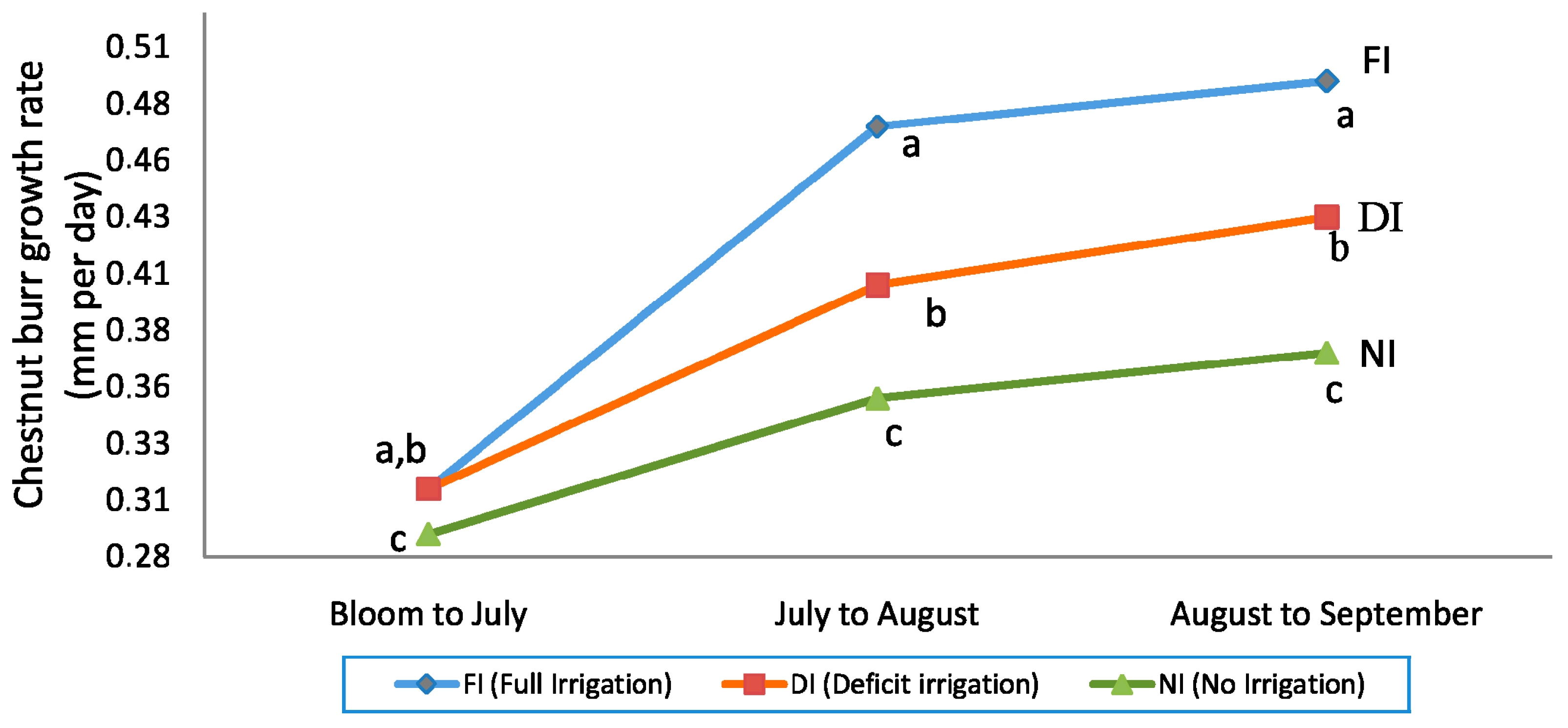
FI consistently resulted in the highest chestnut burr growth rates across all periods, with a marked increase from July to August and sustained high burr growth rates through September (Figure 2). DI showed lower chestnut burr growth rates compared to FI but retained higher burr growth rates than NI trees, highlighting DI’s partial yet positive effect. NI resulted in the lowest chestnut burr growth rates throughout the growing season, indicating substantial water stress even though the NI leaves remained in better physiological condition (% DM, SLW) than the FI leaves.
The results indicate clear differences in chestnut yield among the three irrigation treatments across both years (Table 3). In 2017, the FI trees achieved the highest production with 13 kg per tree, followed by the DI treatment with 9 kg, while the NI trees produced only 3.63 kg. A similar trend was observed in 2018, with FI trees again showing the highest yield (15.07 kg per tree), DI trees achieving an intermediate value (10.97 kg), and NI trees displaying the lowest yield (7.36 kg).

3.4. Nut Quality

Chestnut quality parameters were significantly influenced by irrigation regime in both study years (Table 4). In 2017, nut mass and edible portion were highest under FI (26.4 g and 25.6 g, respectively), intermediate under DI (25.4 g and 21.8 g), and lowest under NI (19.1 g and 15.6 g). Conversely, chestnut DM content was lower under FI (46.9%) compared to NI (49.8%). In 2017, perisperm percentage of the total chestnut increased progressively with water deficit, from 9.8% in FI to 11.8% in NI. In 2018, similar patterns were observed. FI maintained the greatest nut mass (26.8 g), while NI produced significantly smaller chestnuts (20.1 g) with intermediate values for DI nut mass. In 2018, chestnut DM content increased with water limitation, from 46.7% in FI to 50.1% in NI. Perisperm percentage again reflected the effect of irrigation, ranging from 8.1% under FI to 10.5% under NI, with intermediate values for DI.

4. Discussion

The climatic patterns observed in 2017 and 2018 provide important insights into the challenges faced by chestnut cultivation under Mediterranean conditions. The data from 2017 suggest that extremely high summer temperatures combined with uneven and overall limited rainfall create severe drought stress for chestnut trees. Maximum temperatures exceeding 35 °C in June and July, together with reduced precipitation during critical growth stages, must have exacerbated soil water deficits. Such conditions would be expected to negatively affect fruit set, nut filling, and overall tree productivity depending on the period severe stress took place, demonstrating the vulnerability of chestnut orchards to heat and drought stress when irrigation is not sufficiently applied [13,24].
Stem water potential (Ψstem) is widely regarded as one of the most reliable indicators of plant water stress and irrigation requirements [15], as it reflects the integrated effects of soil moisture availability, plant physiological responses, and atmospheric demand on internal water balance [25,26,27]. In particular, Ψstem in trees is less affected by short-term environmental fluctuations [25,28] and has been shown to exhibit a stronger relationship with soil–water conditions. Moreover, midday Ψstem, as opposed to midday leaf water potential, has been identified as a highly sensitive measure of plant water status throughout the day [25,29,30]. According to [26], maintaining the midday Ψstem approximately 0.1–0.2 MPa below the fully irrigated baseline (−1 MPa for almonds and prunes) prevents both water deficit and excessive irrigation. By extension, Ref. [3] inferred that for chestnut trees, a Ψstem value around −1.2 MPa constitutes a balanced threshold that ensures adequate photosynthetic performance and a stable midday water status. The results of the present study are consistent with these findings for another Mediterranean region with chestnut orchards. FI trees maintained relatively high Ψstem values (−0.71 MPa in 2017 and −0.90 MPa in 2018), reflecting favorable water conditions and limited stress, in line with the concept of a fully watered baseline. In contrast, non-irrigated (NI) trees exhibited markedly lower Ψstem values (−1.23 and −1.41 MPa in 2017 and 2018, respectively), which correspond to the threshold as reported by [3] as an indication of water stress onset in chestnuts. Deficit-irrigated (DI) trees displayed intermediate values (−0.92 and −1.18 MPa), demonstrating that partial irrigation alleviates but does not fully eliminate water stress. These results corroborate the proposed Ψstem thresholds from previous studies, while highlighting that in Mediterranean environments, chestnut trees under limited irrigation may approach critical stress levels more rapidly than other species such as almonds or prunes. Comparison between years reveals that Ψstem was consistently lower in 2018 across all treatments, suggesting that environmental conditions in that year imposed greater water limitations on the trees even though temperatures were lower than 2017. This effect was most pronounced in the NI treatment, where Ψstem decreased in 2018 by almost 0.2 MPa compared to 2017. Furthermore, the overall reduction in Ψstem values observed in 2018 compared to 2017 suggests that interannual variation may have been influenced not only by climatic conditions, such as higher evaporative demand, but also by the cumulative effects of water stress carried over from the previous season or the higher yields.
The chlorophyll fluorescence (Fv/Fm) is the maximum efficiency at which light is absorbed by PSII [31]. In non-stressed plants, this ratio is found in a range between 0.75 and 0.80 [32]. The Fv/Fm values obtained in this study highlight the influence of irrigation on PSII efficiency in chestnut trees. Under FI, values reached 0.77 in 2017 and 0.80 in 2018. These values are very close or even within the range of 0.800–0.836 reported in the literature for well-watered chestnut trees, supporting previous findings on the stability of PSII under non-stress conditions [31]. Although the Fv/Fm value in FI (0.77) was slightly below the optimal range in 2017, it still indicates minimal impairment of PSII and may reflect environmental variability rather than significant water stress. DI resulted in moderate reductions in Fv/Fm, with values of 0.70 in 2017 and 0.76 in 2018. These results are consistent with previous observations of [33], where Fv/Fm often remained near optimal under field conditions (with values at 0.75) even in stressed oak trees. The decline in Fv/Fm under different irrigation regimes demonstrated the adverse effects of water deficit on the photosynthetic apparatus of pistachio trees, with values decreasing to approximately 0.64, indicating a marked reduction in PSII efficiency [34]. Similarly, in the present study, NI chestnut trees exhibited comparable reductions, with Fv/Fm dropping to 0.68 in 2018, suggesting a response pattern consistent with that observed in pistachio under drought stress. This indicates that under conditions of prolonged drought, chestnut trees may exhibit measurable reductions in PSII efficiency, deviating from the stability typically observed under moderate stress. Taken together, these results suggest that, while chestnut trees maintain relatively stable PSII function under adequate or moderate water supply, severe and persistent drought stress can reduce Fv/Fm below the near-optimal threshold, indicating a significant impact on the photosynthetic apparatus. Interestingly, the parameters Ψstem and Fv/Fm changed in a different manner in 2018 compared to 2017. In 2018, Ψstem values decreased, and Fv/Fm values increased possibly showing a different reaction to environmental conditions, i.e., high summer temperatures and lack of soil water due to lower rainfall.
Leaf chlorophyll content and SLW are key indicators of the tree’s photosynthetic capacity, which consequently supports successful fruit set and subsequent nut growth [35,36]. Moreover, leaf DM content provides insights into the plant’s nutritional and metabolic status, reflecting the balance between structural and functional compounds, photosynthetic performance, and the ability to allocate assimilates to developing fruits. Leaf structural traits, including DM and SLW, exhibited clear responses to the irrigation treatments and interannual variation. In 2017, FI consistently supported greater leaf DM accumulation and higher SLW, whereas DI and NI trees displayed the strongest signs of stress with lower values for the above parameters, reflecting the positive effect of water availability on leaf structural development. These findings indicate that reduced or no irrigation decreased leaf DM accumulation compared to full irrigation. Conversely, in 2018, leaves under DI and NI developed denser leaves with higher dry matter content and maintained or increased SLW, reflecting an adaptive response to drier conditions or the need to support the growth of higher nut numbers. These patterns indicate that leaf structural components are highly plastic and capable of adjusting to both seasonal progression and interannual differences in soil water availability and temperatures, and in yield.
Previous studies have consistently reported that total leaf chlorophyll content declines during the summer months under water-limited conditions. Ref. [37] demonstrated that reductions in leaf chlorophyll concentration are a characteristic symptom of oxidative stress induced by drought. Similarly, higher leaf chlorophyll content has been observed in irrigated peach trees compared to non-irrigated ones [38], while comparable reductions in total leaf chlorophyll content under drought stress have also been documented in pear [39], fig [40], and pistachio, and is accepted as a widely reported phenomenon [27,34,41]. The results of the present study in 2017 are consistent with these observations, as leaves from trees receiving FI maintained higher total leaf chlorophyll concentrations compared to those under DI or NI. As previously mentioned, total leaf chlorophyll content declines during the summer months under water-limited conditions [37,42]. In contrast to these pronounced seasonal declines, total chestnut leaf chlorophyll content in 2017 did not show significant changes between July and September within each irrigation treatment. These findings suggest that, while water availability exerts a clear influence on leaf chlorophyll concentration, the seasonal stability observed here may indicate species-specific tolerance mechanisms or adaptive adjustments that mitigate leaf chlorophyll degradation under progressive summer conditions. On the other hand, the results of the present experiment in 2018 showed a decrease in total leaf chlorophyll content over the summer period for FI and DI treatments. Nevertheless, in 2018, leaves from DI trees exhibited the highest leaf chlorophyll content in July, whereas by September, NI trees maintained significantly greater values than FI ones, with DI displaying intermediate concentrations. Chestnut is known to exhibit thermoinhibition when air temperatures exceed 32 °C, a physiological constraint that may further affect its seasonal performance under Mediterranean conditions [43,44,45]. At the same time, the species exhibits remarkable adaptability to abiotic stresses, a trait attributed to its inherent genetic and physiological characteristics that allow it to maintain functional integrity under adverse environmental conditions [17,46,47]. From the perspective of drought resistance, this adaptability is further supported by the observation that plants with higher leaf chlorophyll content generally display stronger tolerance to water deficit, as elevated chlorophyll levels are often associated with sustained photosynthetic activity and improved physiological resilience under drought stress [48]. Within this context, the findings of the two-year irrigation trial indicate that in 2018, both DI and NI chestnut trees developed adaptive mechanisms in leaf physiology, reflecting their ability to cope with prolonged water limitations, but cooler air temperatures than in 2017.
Across both experimental years, FI consistently resulted in the highest yields per tree, while DI achieved intermediate values, and NI trees recorded the lowest yield. The comparison of irrigation regimes across the two experimental years demonstrates relatively small differences in the reduction in trees’ yield, observed under DI compared to FI. However, the effect of NI was far more variable, showing pronounced year-to-year changes both in relation to FI and DI. Specifically, DI trees relative to FI ones had similar differences in yield between the two years, with a decrease of 31% in 2017 and 27% in 2018. In contrast, the absence of irrigation produced a much stronger and more variable year-to-year effect. Yield losses in NI trees reached 60% compared to DI in 2017, but only 33% in 2018. These differences can be attributed to several factors. First, the climatic conditions in 2018 were milder, with lower average temperatures and higher precipitation, particularly in June, possibly minimizing water stress, enhancing fruit set, and thereby reducing the productivity differences between the irrigated treatments. Second, it is possible that trees progressively adapted to water stress after two years of exposure (since 2016). Such adaptation may have involved improved root system development and resource allocation, leading to reduced yield penalties in DI and NI treatments during the second year. Third, it is probable that both climatic moderation and physiological acclimation contributed simultaneously to the observed pattern. Similarly, fruit set (here the young fruitlets remaining until harvest) in 2018 was markedly higher in FI trees compared with DI and NI treatments. The latter two treatments did not differ significantly from one another, indicating that water stress initiated in June with the onset of irrigation treatment, whether partial or complete (NI effect could be minimized due to high June rainfall in 2018), reduced fruit set to a similar extent.
The reduction in chestnut production per tree was further exacerbated by the lack of rainfall in the period immediately preceding harvest (Figure 1), highlighting the sensitivity of chestnut productivity to late summer soil water availability. These findings are consistent with [49], who demonstrated that rainfall during the chestnut development and maturation phases is crucial for sustaining yield. Similarly, Ref. [6,49] reported that water availability in the month prior to harvest plays a decisive role in determining chestnut size and overall yield. Furthermore, Ref. [49] found that burr growth dynamics retain the ability to sustain elevated growth rates during the latter stages of the season, particularly from mid-to-late August until burr dehiscence in autumn. Our findings corroborate previous evidence, indicating that irrigation not only mitigated the adverse effects of limited precipitation during the growing season of chestnuts but also enhanced nut quality and overall yield.
After some further data calculations, we found that, in 2017, the number of nuts per tree in DI was 72% of FI, and in NI, it was 39% of FI (in 2017, FI was harvested to 493, DI to 356, and NI to 191 nuts). Similarly, in 2018, the number of nuts per tree in DI was 81% of FI, and in NI, it was 65% of FI (in 2018, FI was harvested to 562, DI to 457, and NI to 366 nuts). The increased number of nuts per tree in 2018 must be due to higher soil water availability due to the rainfall close to fruit set. This points out the significance of soil water availability for fruit set in chestnut trees. As fruit set was calculated in 2018, we found that FI and DI trees had a similar number of young fruitlets, and NI trees had 18% fewer fruitlets than FI. From these findings, we can conclude that DI had minimal effect on young fruitlet density, but NI trees showed a mild reduction in the fruitlet density. As the number of nuts during 2018 for NI trees almost doubled compared to 2017, it is possible that the pressure exhibited by the growing nuts on leaf functioning can explain the results in our study on leaf chlorophyll content and SLW.
Daily growth rates of chestnut burrs clearly demonstrate the pivotal role of irrigation in sustaining nut development. Trees under FI consistently exhibited the highest burr growth per day across all developmental stages, particularly from August to September, when chestnut expansion is most pronounced. The results of the present study are consistent with the findings of [20], who reported that chestnut burrs exhibit and sustain higher growth rates during the latter part of the season, from mid-to-late August through burr dehiscence in autumn. DI maintained intermediate burr growth rates, indicating that partial water supply can partially mitigate the negative effects of drought stress. In contrast, NI trees showed the lowest daily burr growth, underscoring the strong limitation imposed by water scarcity on nut enlargement. Interestingly, this reduction in reproductive growth occurred even though, in 2018, leaves from NI trees remained in relatively good condition, as reflected by their comparatively high total leaf chlorophyll content and SLW. These observations are the result of the large number of chestnuts in 2018 for the NI trees. The nuts, as strong sinks, possibly kept the leaves better functioning, but were unable to sustain nut growth due to the large number of nuts per tree. Nevertheless, in NI nut mass was not reduced in 2018 compared to 2017, although there was a large number of nuts per tree in 2018.
The importance of water supply aligns with earlier findings, which highlight that water stress negatively impacts chestnut physiology by reducing fruit growth [3,6]. In the present study, the substantial reduction in yields under NI further supports this relationship, as trees deprived of water were unable to sustain sufficient fruit set or nut enlargement during the summer drought. In 2018, this decline in reproductive performance occurred even though leaves remained in good condition, as indicated by their relatively high total leaf chlorophyll content and SLW. These data in NI, together with increased nut number per tree, show that the leaves worked successfully to support nut growth, but due to a lack of soil water, the nuts remained small. DI resulted in significantly higher yields compared to NI, suggesting that even limited water application can partially mitigate the negative effects of drought. This observation is consistent with [3,4], which reported that minimal irrigation, regulated according to tree water potential, was sufficient to enhance chestnut production compared to dry cultivation.
Comparison between years indicated that FI stabilized the chestnut mass across years. In addition, DI and NI showed almost no reductions in chestnut mass in 2018 relative to 2017, even though the trees had a larger number of nuts in 2018 compared to 2017. The positive role of irrigation in determining nut size is consistent with the observations of [3], who reported that water supply contributes directly to larger chestnuts. Similarly, Ref. [9] also found that irrigation led to a significant increase in nut size. However, the environmental conditions, i.e., rainfall and air temperatures during nut growth, also have a significant impact on chestnut mass. The DM content of chestnuts observed in the present study is consistent with the values reported by [50], who found 52.7% DM, and by [49], who reported 50% DM. Lower values were described by [51], with DM contents ranging between 48.4% and 40.6%, and by [52], who recorded 43.3% DM. Similarly, elsewhere [3] reported values were consistently below 50% DM. In comparison, our findings revealed that chestnut DM percentages were broadly in line with these previous studies, though with clear differences among irrigation treatments. FI produced the lowest nut % DM contents (around 47%) across both years, whereas DI and NI treatments yielded higher DM values (between 48% and 50%).
Perisperm percentage also varied systematically with irrigation level. FI chestnuts had the lowest percentage of perisperm fraction, whereas NI chestnuts showed the largest perisperm proportion, and DI chestnuts exhibited intermediate values. These trends suggest that water deficit promotes a relative increase in perisperm growth, potentially as a protective response of the nut to limited water availability. These results indicate a consistent decline in the edible fraction with increasing soil water limitation. When comparing across years, FI maintained relatively stable edible mass, suggesting that adequate irrigation buffered trees against interannual variability. In contrast, NI trees exhibited slightly higher edible mass in 2018, with almost double the yield compared to 2017, which may be due to climatic influences and leaf functioning performance. Collectively, these findings highlight that soil water availability not only determines the absolute size of the edible portion but also modulates its stability across growing seasons.

5. Conclusions

The findings of this study emphasize the pivotal role of irrigation in sustaining both yield and nut quality in chestnut cultivation. Fully irrigated trees consistently produced higher yields, larger nut size with a greater proportion of edible part, whereas deficit- and non-irrigated treatments resulted in marked reductions in fruit set, nut development, and overall productivity.
Environmental conditions showed significant year-to-year effects on yield and leaf functioning, mainly due to June rainfall (increased fruit set) and summer temperatures. It is possible that nut density and growth positively modulate leaf functioning.
Under prolonged periods of limited or absent irrigation, chestnut trees displayed clear indications of water stress, particularly in leaf physiological traits. Nevertheless, evidence of tolerance mechanisms and adaptive adjustments suggests that the species can partially mitigate chlorophyll degradation and maintain a degree of leaf functional stability under progressive summer drought, reflecting its inherent capacity to cope with Mediterranean climatic constraints. The results support that efficient irrigation management is essential for securing stable yields, maintaining marketable nut quality, and ensuring the long-term sustainability of chestnut orchards in the face of increasing climatic variability. Severe deficit irrigation partially mitigates water stress in chestnuts, but with significant losses in yield and commercial value of the chestnuts.

Author Contributions

Conceptualization, G.D.N. and I.T.; methodology, G.D.N.; formal analysis, I.T.; investigation, I.T. and G.D.N.; resources, I.T.; data curation, I.T. and G.D.N.; writing—original draft preparation, I.T. and G.D.N.; writing—review and editing, I.T. and G.D.N.; visualization, G.D.N. and I.T.; supervision, G.D.N.; project administration, G.D.N. All authors have read and agreed to the published version of the manuscript.

Funding

This research received no external funding.

Data Availability Statement

The original contributions presented in this study are included in the article. Further inquiries can be directed to the corresponding author. All data are included in the tables and the figures.

Conflicts of Interest

The authors declare no conflicts of interest.

References

  1. Chaves, M.M.; Pereira, J.S.; Marôco, J.; Rodrigues, M.L.; Ricardo, C.P.P.; Osório, M.L.; Carvalho, I.; Faria, T.; Pinheiro, C. How Plants Cope with Water Stress in the Field. Photosynthesis and Growth. Ann. Bot. 2002, 89, 907–916. [Google Scholar] [CrossRef]
  2. Data Releases |FAO| Food and Agriculture Organization of the United Nations. Statistics. Available online: https://www.fao.org/statistics/data-releases/en (accessed on 18 July 2025).
  3. Mota, M.; Pinto, T.; Marques, T.; Borges, A.; Caço, J.; Veiga, V.; Raimundo, F.; Gomes-Laranjo, J. Monitorizar Para Regar: O Caso Do Castanheiro (Castanea sativa). Rev. Ciências Agrárias 2017, 40, 133–143. [Google Scholar] [CrossRef]
  4. Mota, M.; Pinto, T.; Marques, T.; Borges, A.; Raimundo, F.; Veiga, V.; Gomes-Laranjo, J. Efeito Da Rega Na Produtividade Fotossintética Dos Castanheiros. Actas Port. Hortic. 2014, 23, 166–173. [Google Scholar]
  5. Goldhamer, D.; Beede, R. Regulated Deficit Irrigation Effects on Yield, Nut Quality and Water-Use Efficiency of Mature Pistachio Trees. J. Hortic. Sci. Biotechnol. 2004, 79, 538–545. [Google Scholar] [CrossRef]
  6. Breisch, H. The Chestnut Industry in France. Acta Hortic. 2007, 784, 31–36. [Google Scholar] [CrossRef]
  7. Garrot Jr, D.J.; Kilby, M.W.; Fangmeier, D.D.; Husman, S.H.; Ralowicz, A.E. Production, Growth, and Nut Quality in Pecans under Water Stress Based on the Crop Water Stress Index. J. Am. Soc. Hortic. Sci. 1993, 118, 694–698. [Google Scholar] [CrossRef]
  8. Dengiz, O.; Ic, S.; Sarioglu, F. Physico-Chemical and Morphological Properties of Soils for Castanea sativa in the Central Black Sea Region. Int. J. Agric. Res. 2011, 6, 410–419. [Google Scholar] [CrossRef]
  9. Martins, A.; Marques, G.; Borges, O.; Portela, E.; Lousada, J.; Raimundo, F.; Madeira, M. Management of Chestnut Plantations for a Multifunctional Land Use under Mediterranean Conditions: Effects on Productivity and Sustainability. Agrofor. Syst. 2011, 81, 175–189. [Google Scholar] [CrossRef]
  10. Bratanova-Doncheva, S.; Methy, M. Castanea sativa Mill.: Response of Water Stress. Application of the Chlorophyll Fluorescence. In Proceedings of the 2nd Congress of Ecologists of Macedonia, Ohrid, North Macedonia, 25–29 October 2003; pp. 43–48. [Google Scholar]
  11. Mariotti, A.; Zeng, N.; Yoon, J.-H.; Artale, V.; Navarra, A.; Alpert, P.; Li, L.Z. Mediterranean Water Cycle Changes: Transition to Drier 21st Century Conditions in Observations and CMIP3 Simulations. Environ. Res. Lett. 2008, 3, 044001. [Google Scholar] [CrossRef]
  12. Miranda, P.; Coelho, F.E.S.; Tomé, A.R.; Valente, M.A.; Carvalho, A.; Pires, C.; Pires, H.O.; Pires, V.C.; Ramalho, C. 20th Century Portuguese Climate and Climate Scenarios. In Climate Change in Portugal: Scenarios, Impacts and Adaptation Measures (SIAM Project); Gradiva: Lisboa, Portugal, 2002; Volume 27, p. 83. [Google Scholar]
  13. Gomes-Laranjo, J.; Peixoto, F.; Sang, H.W.W.F.; Torres-Pereira, J. Study of the Temperature Effect in Three Chestnut (Castanea sativa Mill.) Cultivars’ Behaviour. J. Plant Physiol. 2006, 163, 945–955. [Google Scholar] [CrossRef] [PubMed]
  14. Menéndez-Miguélez, M.; Álvarez-Álvarez, P.; Majada, J.; Canga, E. Effects of Soil Nutrients and Environmental Factors on Site Productivity in Castanea sativa Mill. Coppice Stands in NW Spain. New For. 2015, 46, 217–233. [Google Scholar] [CrossRef]
  15. Peretz, J.; Evans, R.G.; Proebsting, E.L. Leaf Water Potentials for Management of High Frequency Irrigation on Apples. Trans. ASAE 1984, 27, 437–442. [Google Scholar] [CrossRef]
  16. Baptista, P.; Martins, A.; Tavares, R.M.; Lino-Neto, T. Diversity and Fruiting Pattern of Macrofungi Associated with Chestnut (Castanea Sativa) in the Trás-Os-Montes Region (Northeast Portugal). Fungal Ecol. 2010, 3, 9–19. [Google Scholar] [CrossRef]
  17. Freitas, T.R.; Santos, J.A.; Silva, A.P.; Fraga, H. Influence of Climate Change on Chestnut Trees: A Review. Plants 2021, 10, 1463. [Google Scholar] [CrossRef]
  18. Bounous, G.; Beccaro, G. Chestnut Culture: Directions for Establishing New Orchards; e-NUCIS: Online, 2002; pp. 30–34. [Google Scholar]
  19. Vossen, P. Chestnut Culture in California; UCANR Publications: Oakland, CA, USA, 2000. [Google Scholar]
  20. Perulli, G.D.; Boini, A.; Morandi, B.; Corelli Grappadelli, L.; Manfrini, L. Irrigation Improves Tree Physiological Performances and Nut Quality in Sweet Chestnut. Italus Hortus 2022, 29, 156–169. [Google Scholar] [CrossRef]
  21. Allen, R.G.; Pereira, L.S.; Raes, D.; Smith, M. FAO Irrigation and Drainage Paper No. 56; Food and Agriculture Organization of the United Nations: Rome, Italy, 1998; 97; pp. 60–64. [Google Scholar]
  22. Begg, J.E.; Turner, N.C. Water Potential Gradients in Field Tobacco. Plant Physiol. 1970, 46, 343–346. [Google Scholar] [CrossRef] [PubMed]
  23. Wintermans, J.; De Mots, A. Spectrophotometric Characteristics of Chlorophylls a and b and their Phenophytins in Ethanol. Biochim. Biophys. Acta (BBA)-Biophys. Incl. Photosynth. 1965, 109, 448–453. [Google Scholar] [CrossRef]
  24. Gomes-Laranjo, J.; Araújo-Alves, J.; Ferreira-Cardoso, J.; Pimentel-Pereira, M.; Abreu, C.G.; Torres-Pereira, J. Effect of Chestnut Ink Disease on Photosynthetic Performance. J. Phytopathol. 2004, 152, 138–144. [Google Scholar] [CrossRef]
  25. McCutchan, H.; Shackel, K.A. Stem-Water Potential as a Sensitive Indicator of Water Stress in Prune Trees (Prunus domestica L. Cv. French). J. Am. Soc. Hortic. Sci. 1992, 117, 607–611. [Google Scholar] [CrossRef]
  26. Lampinen, B.D.; Shackel, K.A.; Southwick, S.M.; Olson, W.H.; Dejong, T.M. Leaf and Canopy Level Photosynthetic Responses of French Prune (Prunus Domestica L. ‘French’) to Stem Water Potential Based Deficit Irrigation. J. Hortic. Sci. Biotechnol. 2004, 79, 638–644. [Google Scholar] [CrossRef]
  27. Shackel, K.A.; Lampinen, B.; Southwick, S.; Olson, W.; Sibbett, S.; Krueger, W.; Yeager, J.; Goldhamer, D. Deficit Irrigation in Prunes: Maintaining Productivity with Less Water. HortScience 2000, 35, 1063–1066. [Google Scholar] [CrossRef]
  28. Meyer, W.S.; Green, G.C. Plant Indicators of Wheat and Soybean Crop Water Stress. Irrig. Sci. 1981, 2, 167–176. [Google Scholar] [CrossRef]
  29. Naor, A.; Wample, R.L. Gas Exchange and Water Relations of Field-Grown Concord (Vitis labruscana Bailey) Grapevines. Am. J. Enol. Vitic. 1994, 45, 333–337. [Google Scholar] [CrossRef]
  30. Sellés, G.; Berger, A. Physiological indicators of plant water status as criteria for irrigation scheduling. Acta Hortic. 1990, 278, 87–100. [Google Scholar] [CrossRef]
  31. Bratanova-Doncheva, S. Photosystem II activity in drought and high light conditions of Castanea sativa Mill. Saplings. Acta Hortic. 2014, 1043, 191–198. [Google Scholar] [CrossRef]
  32. Bolhàr-Nordenkampf, H.R.; Öquist, G. Chlorophyll Fluorescence as a Tool in Photosynthesis Research. In Photosynthesis and Production in a Changing Environment: A Field and Laboratory Manual; Hall, D.O., Scurlock, J.M.O., Bolhàr-Nordenkampf, H.R., Leegood, R.C., Long, S.P., Eds.; Springer: Dordrecht, The Netherlands, 1993; pp. 193–206. [Google Scholar]
  33. Epron, D.; Dreyer, E.; Bréda, N. Photosynthesis of Oak Trees [Quercus petraea (Matt.) Liebl.] during Drought under Field Conditions: Diurnal Course of Net CO2 Assimilation and Photochemical Efficiency of Photosystem II. Plant Cell Environ. 1992, 15, 809–820. [Google Scholar] [CrossRef]
  34. Ranjbar, A. The Study of Different Water Regimes on Photosynthetic Performance and Leaf Water Status of Pistachio Trees (Pistacia vera L.). J. Nuts 2019, 10, 25–34. [Google Scholar]
  35. Hepaksoy, S.; Bahaulddin, A.; Kukul Kurttas, Y.S. The Effects of Irrigation on Leaf Nutrient Content in Pomegranate ‘İzmir 1513’. Acta Hortic. 2016, 1139, 581–586. [Google Scholar] [CrossRef]
  36. Merzlyak, M.N.; Gitelson, A.A.; Chivkunova, O.B.; Rakitin, V.Y. Non-Destructive Optical Detection of Pigment Changes during Leaf Senescence and Fruit Ripening. Physiol. Plant. 1999, 106, 135–141. [Google Scholar] [CrossRef]
  37. Bacelar, E.A.; Santos, D.L.; Moutinho-Pereira, J.M.; Gonçalves, B.C.; Ferreira, H.F.; Correia, C.M. Immediate Responses and Adaptative Strategies of Three Olive Cultivars under Contrasting Water Availability Regimes: Changes on Structure and Chemical Composition of Foliage and Oxidative Damage. Plant Sci. 2006, 170, 596–605. [Google Scholar] [CrossRef]
  38. Basiouny, F.M. The Use of Municipal Treated Effluent for Peach Tree Irrigation. Proc. Fla. State Hortic. Soc. 1984, 97, 345–347. [Google Scholar]
  39. Javadi, T.; Arzani, K.; Ebrahimzadeh, H. Study of proline, soluble sugar and chlorophyll a and b changes in nine Asian and one European pear cultivar under drought stress. Acta Hortic. 2008, 769, 241–246. [Google Scholar] [CrossRef]
  40. Mi, A.-D.; Abd El-Rhman, I.E.; Sahar, A.F. Effect of Some Antitranspirants and Supplementary Irrigation on Growth, Yield and Fruit Quality of Sultani Fig (Ficus carica) Grown in the Egyptian Western Coastal Zone under Rainfed Conditions. Res. J. Agric. Biol. Sci. 2009, 5, 899–908. [Google Scholar]
  41. Khaleghi, E.; Arzani, K.; Moallemi, N.; Barzegar, M. Evaluation of Chlorophyll Content and Chlorophyll Fluorescence Parameters and Relationships between Chlorophyll a, b and Chlorophyll Content Index under Water Stress in Olea europaea Cv. Dezful. World Acad. Sci. Eng. Technol. 2012, 68, 1154–1157. [Google Scholar]
  42. Proietti, P.; Famiani, F. Diurnal and Seasonal Changes in Photosynthetic Characteristics in Different Olive (Olea europaea L.) Cultivars. Photosynthetica 2002, 40, 171–176. [Google Scholar] [CrossRef]
  43. Pereira, M.G.; Caramelo, L.; Gouveia, C.; Gomes-Laranjo, J.; Magalhães, M. Assessment of Weather-Related Risk on Chestnut Productivity. Nat. Hazards Earth Syst. Sci. 2011, 11, 2729–2739. [Google Scholar] [CrossRef]
  44. Gomes-Laranjo, J.; Almeida, P.; Ferreira-Cardoso, J.; Peixoto, F. Ecophysiological Characterization of C. sativa Tress Growing under Different Altitudes. Acta Hortic. 2009, 844, 119–126. [Google Scholar] [CrossRef]
  45. Calheiros, T.; Pereira, M.G.; Pinto, J.G.; Caramelo, L.; Gomes-Laranjo, J.; Dacamara, C.C. Assessing Potential Changes of Chestnut Productivity in Europe under Future Climate Conditions. In Proceedings of the EGU General Assembly 2012, Vienna, Austria, 22–27 April 2012; p. 12312. [Google Scholar]
  46. Ciordia, M.; Feito, I.; Pereira-Lorenzo, S.; Fernández, A.; Majada, J. Adaptive Diversity in Castanea sativa Mill. Half-Sib Progenies in Response to Drought Stress. Environ. Exp. Bot. 2012, 78, 56–63. [Google Scholar] [CrossRef]
  47. Santos, M.; Fraga, H.; Belo-Pereira, M.; Santos, J.A. Assessment of Growing Thermal Conditions of Main Fruit Species in Portugal Based on Hourly Records from a Weather Station Network. Appl. Sci. 2019, 9, 3782. [Google Scholar] [CrossRef]
  48. Yang, X.; Lu, M.; Wang, Y.; Wang, Y.; Liu, Z.; Chen, S. Response Mechanism of Plants to Drought Stress. Horticulturae 2021, 7, 50. [Google Scholar] [CrossRef]
  49. Almeida, P.; Dinis, L.; Coutinho, J.; Pinto, T.; Anjos, R.; Ferreira-Cardoso, J.; Pimentel-Pereira, M.; Peixoto, F.; Gomes-Laranjo, J. Effect of Temperature and Radiation on Photosynthesis Productivity in Chestnut Populations (Castanea sativa Mill. Cv. Judia). Acta Agron. Hung. 2007, 55, 193–203. [Google Scholar] [CrossRef]
  50. Ferreira-Cardoso, J.V.; Torres-Pereira, J.M.G.; Sequeira, C.A. Effect of Year and Cultivar on Chemical Composition of Chestnuts from Northeastern Portugal. Acta Hortic. 2005, 693, 271–278. [Google Scholar] [CrossRef]
  51. Bernárdez, M.M.; De la Montaña Miguélez, J.; Queijeiro, J.G. HPLC Determination of Sugars in Varieties of Chestnut Fruits from Galicia (Spain). J. Food Compos. Anal. 2004, 17, 63–67. [Google Scholar] [CrossRef]
  52. Poljak, I.; Idžojtić, M.; Šatović, Z.; Ježić, M.; Ćurković-Perica, M.; Simovski, B.; Acevski, J.; Liber, Z. Genetic Diversity of the Sweet Chestnut (Castanea sativa Mill.) in Central Europe and the Western Part of the Balkan Peninsula and Evidence of Marron Genotype Introgression into Wild Populations. Tree Genet. Genomes 2017, 13, 18. [Google Scholar] [CrossRef]
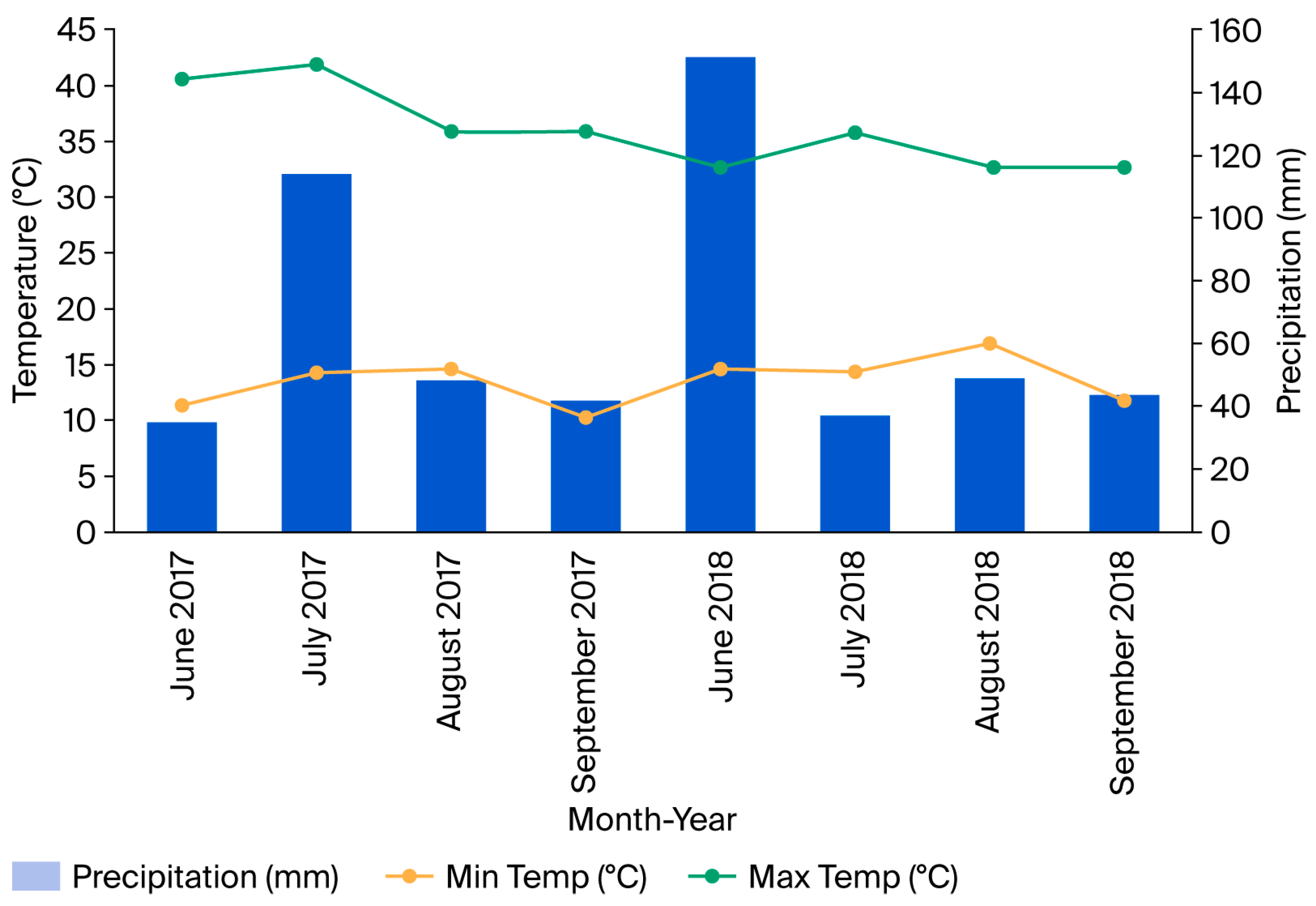
Figure 1. Monthly rainfall (mm), minimum temperature (°C), and maximum temperature (°C) recorded from June to September in 2017 and 2018, representing the main growing season of chestnut trees.
Water 17 03393 g001
Figure 2. Chestnut burr growth rate per day (mm) under three irrigation treatments in 2018: full irrigation (FI), deficit irrigation (DI), and no irrigation (NI), from bloom until September. Different letters per measurement period are significantly different using Tukey mean separation at p ≤ 0.05.
Water 17 03393 g002
Table 1. Stem water potential (MPa) and quantum efficiency of photosystem II (Fv/Fm) of chestnut trees under three irrigation treatments: full irrigation (FI), deficit irrigation (DI), and no irrigation (NI) during 2017 and 2018.
TreatmentStem Water Potential
(MPa)
Quantum Efficiency of Photosystem II
(Fv/Fm)
2017201820172018
FI−0.71 c−0.90 c0.77 a0.80 a
DI−0.92 b−1.18 b0.70 b0.76 b
NI−1.23 a−1.41 a0.72 b0.68 c
Note: Means in the same column with different letters indicate significant differences (p < 0.05, Tukey test).
Table 2. Leaf physiological characteristics of chestnut trees under full irrigation (FI), deficit irrigation (DI), and no irrigation (NI) treatments during July and September of 2017 and 2018. Parameters include leaf dry matter content (DM), specific leaf weight (SLW), and leaf total chlorophyll content (TotChl).
TreatmentsDM
(%)
SLW
(g DM per m−2)
TotChl
(mg m−2)
2017
JulySeptemberJulySeptemberJulySeptember
FI46.2 aΒ51.5 aA11.8 aA10.8 aA 340.7 abA359.8 aA
DI43.1 bB49.7 abA10.4 abA11.2 aA318.2 bA 342.2 abA
NI36.2 dB43.3 cA7.6 cA10.0 aA238.7 cA230.5 cA
2018
FI40.8 cA38.8 dA9.2 bA6.7 bB357.1 aA318.6 bB
DI45.6 aA47.8 bA11.3 aA7.5 bB366.1 aA 329.0 abB
NI46.1 aA46.7 bA11.3 aA9.9 aA335.3 abA353.6 aA
Notes: Means in the same column with different letters indicate significant differences per treatment. Means in the same row with different capital letters indicate significant differences between measurement periods (p < 0.05, Tukey test).
Table 3. Fruit set (%) of chestnut and chestnut yield per tree under full irrigation (FI), deficit irrigation (DI), and no irrigation (NI) across the two experimental years (2017–2018). Fruit set (%) recorded in 2018 under the same irrigation practices.
TreatmentsFruit Set
(%)
Yield
(kg/Tree)
201820172018
FI42.3 a13.02 a15.07 a
DI34.4 b9.04 b10.97 b
NI33.4 b3.63 c7.36 c
Note: Means in the same column with different letters indicate significant differences (p < 0.05, Tukey test).
Table 4. Nut mass (g), nut dry matter (DM), and perisperm (%) of chestnut under three irrigation treatments, full irrigation (FI), deficit irrigation (DI), and no irrigation (NI), during 2017 and 2018.
TreatmentsNut Mass
(g)
DM
(%)
Perisperm
(%)
2017
FI26.4 a46.9 c9.8 c
DI25.4 ab48.1 b10.7 b
NI19.1 c49.8 a11.8 a
2018
FI26.8 a46.7 c8.1 d
DI24.0 b48.6 b9.5 c
NI20.1 c50.1 a10.5 b
Note: Means in the same column with different letters indicate significant differences (p < 0.05, Tukey test).
Disclaimer/Publisher’s Note: The statements, opinions and data contained in all publications are solely those of the individual author(s) and contributor(s) and not of MDPI and/or the editor(s). MDPI and/or the editor(s) disclaim responsibility for any injury to people or property resulting from any ideas, methods, instructions or products referred to in the content.