Article

Spatiotemporal Analysis of Water Quality Conditions in High-Andean Lakes Based on Satellite Indicators Using Sentinel 2 and Landsat 8/9 Images


by
Valeria Fernanda Flores Cantos
1,
Patricio X. Lozano Rodríguez
2,3,
Johanna Elizabeth Ayala Izurieta
4,
Carlos Arturo Jara Santillán
2,
Antonio Ruiz-Verdú
1,
Jochem Verrelst
1,
Peter L. M. Goethals
3 and
Jesús Delegido
1,*
1
Image Processing Laboratory (IPL), University of Valencia, 46980 Paterna, Spain
2
Faculty of Natural Resources, Escuela Superior Politécnica de Chimborazo (ESPOCH), Riobamba 060155, Ecuador
3
Department of Animal Sciences and Aquatic Ecology, Ghent University, 9000 Ghent, Belgium
4
Group of Research for Watershed Sustainability (GISOCH), Faculty of Sciences, Escuela Superior Politécnica de Chimborazo (ESPOCH), Riobamba 060155, Ecuador
*
Author to whom correspondence should be addressed.
Water 2025, 17(21), 3145; https://doi.org/10.3390/w17213145
Submission received: 16 September 2025 / Revised: 30 October 2025 / Accepted: 30 October 2025 / Published: 2 November 2025
(This article belongs to the Section Hydrology)

Abstract

High-Andean lakes are strategic freshwater ecosystems whose monitoring is essential for effective water resource management. However, their optical complexity limits the applicability of conventional methods. In this study, the water quality conditions of the Ozogoche lakes, located in Sangay National Park (PNS), were assessed using Sentinel-2 (S2), Landsat-8 OLI (L8), and Landsat-9 (L9) imagery processed with automated water products from the Case 2 Regional Coast Colour (C2RCC) processor, including the C2RCC, C2X-COMPLEX, and C2X versions. Comparisons between in situ chlorophyll-a (Chl-a) measurements and satellite-derived products confirmed that C2RCC achieved the lowest error (RMSE = 0.68 mg/m3). The multitemporal analysis (2016–2024) of Chl-a, total suspended solids (TSSs), and the diffuse attenuation coefficient (kd_z90max) revealed interannual variations. The results consistently classified the lakes as ultra-oligotrophic, providing an integrated perspective of their environmental quality. This study demonstrates the reliability of C2RCC products for monitoring high-Andean aquatic ecosystems and underscores the potential of remote sensing to overcome accessibility and cloud cover constraints, delivering valuable insights for the sustainable management of water resources in protected areas.

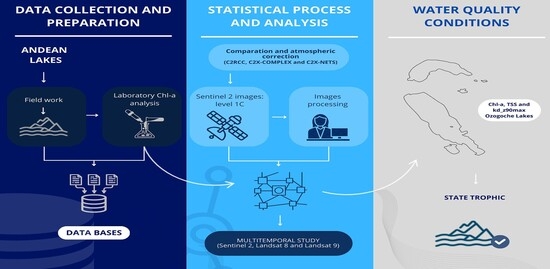
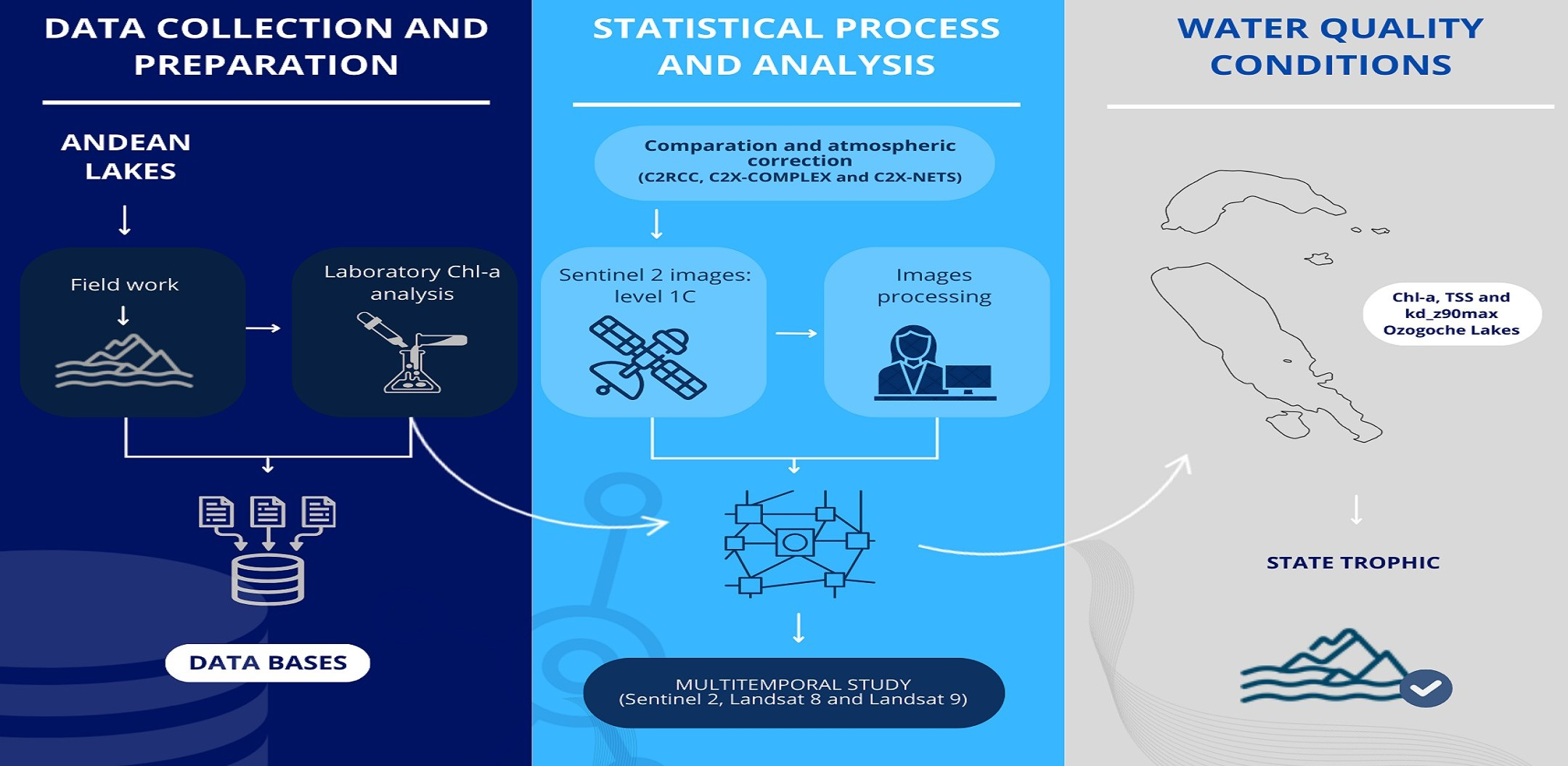
Graphical Abstract

1. Introduction

Lakes produce half of the world’s freshwater resources, supplying millions of people with water for drinking, hydroelectric power generation, irrigation, and domestic and industrial uses. In South America, Andean lakes are characterized by having low average temperatures and a low quantity of nutrients [1]. Andean lakes are classified into páramo lakes and glacial origin lakes. Páramo lakes are located at elevations ranging from approximately 3200 to 4500 m above sea level (m a.s.l.), and they originate from rain or groundwater. Glacier lakes are situated at higher elevations and are directly fed by the meltwater from glaciers [2]. In the past decade, these ecosystems have been subjected to significant anthropogenic pressure due to population growth and unequal distribution of wealth and productive systems [3]. In this context, the monitoring of Andean lakes has scientific interest, involving a wide range of interdisciplinary fields [4]. However, the techniques used for their study are mainly based on in situ sample extraction and laboratory studies. This demands high budgets and long monitoring times, and additionally, the process can be challenging due to the limited accessibility to remote study sites. Similarly, the results often come from a limited number of sampling points, which hinders detailed knowledge of spatial patterns [5,6].
The exploitation of satellite images such as Sentinel-2 (S2), Landsat 8 (L8) and Landsat 9 (L9) optimizes efforts and resources in environmental studies. Therefore, they can be used to assess the spatial and temporal changes to an ecosystem [5,7,8]. Optical remote sensing studies of water quality are based on the analysis of key variables such as (1) turbidity, which is the lack of transparency due to the presence of suspended or dissolved particles [9]; (2) Chlorophyll-a (Chl-a), which is an optically active compound commonly used as an measure of phytoplankton biomass [10,11] and acts as an indicator of trophic status [5]; and also (3) Total Suspended Solids (TSSs) whose presence reduces light availability and is composed of suspended particles [12,13,14].
Thanks to the constellation of the S2-A and S2-B satellites, S2 imagery has a high spatial resolution of up to 10 m, and a high frequency of data capture with a temporal resolution of up to 5 days. S2 imagery can be useful for studying the central Andean lakes; in earlier studies, they were successfully applied to the estimation of water biophysical parameters and continuous monitoring [5,15,16,17,18]. However, due to the low reflectance of water, the atmospheric correction process is crucial for this type of study [19]. The free Sentinel Application Platform (SNAP) software (version 10.0) includes various atmospheric correction methods. The Case 2 Regional Coast Colour (C2RCC) processor has been adapted to S2 and L8; it currently includes three versions in SNAP (C2RCC, C2X, and C2X-COMPLEX), which are based on a neural network approach [20]. The automatic products generated by applying these processors in SNAP are the absolute concentrations of Chl-a (conc_chl [mg/m3]), TSSs (conc_tsm [g/m3]), and the light attenuation coefficient with the variable kd_z90max (m), which is related to the maximum depth to which light can penetrate a water body. This parameter is crucial for assessing water clarity, as it provides a measure of the decrease in light intensity as depth increases [21].
In this context, these parameters constitute fundamental bio-optical indicators for characterizing water quality and, in particular, for approximating the trophic state of Andean lakes, whose monitoring is essential for conservation management [5]. The trophic state of lakes is commonly assessed using Carlson’s Trophic State Index (TSI), which integrates Chl-a, total phosphorus, and water transparency [22]. However, in high-Andean ecosystems, obtaining phosphorus and transparency measurements is often limited by logistical difficulties and persistent cloud cover. Therefore, Chl-a is frequently employed as a proxy indicator of trophic conditions, as it is directly related to phytoplankton biomass and eutrophication processes [23]. Consequently, this study adopts a trophic classification approach based on Chl-a concentrations derived from satellite products, comparing them with Carlson’s reference ranges to approximate the trophic state of the Ozogoche lakes. Accordingly, the objectives of this study were to (1) compare satellite-derived Chl-a values with in situ measurements in order to identify the C2RCC processor version with the highest accuracy; (2) analyze the spatiotemporal dynamics (2016–2024) of Chl-a, TSS, and kd_z90max; and (3) approximate the trophic state of the Ozogoche lakes using Chl-a as a proxy indicator to assess their water quality conditions.

2. Materials and Methods

2.1. Study Area

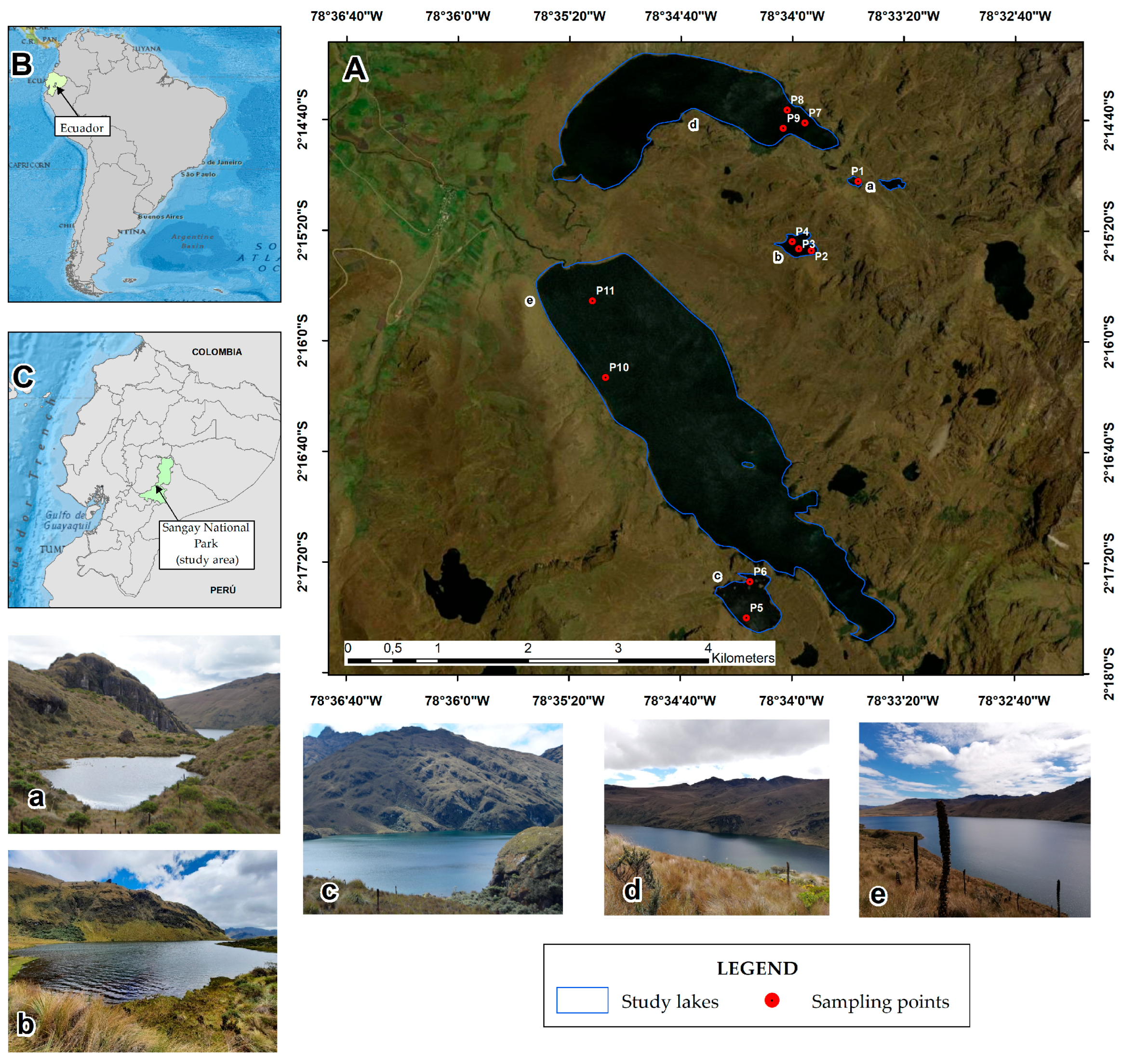
Lakes of the central Andes are distributed throughout the páramo ecoregion in Venezuela, Colombia, Ecuador, Perú, Bolivia, and Chile [21] at elevations ranging from 2800 to 4330 m a.s.l. [24]. Surrounded by herbaceous páramo, these ecosystems have dominant features in the landscape, including Calamagrostis sp. and Stipa sp. grasslands, as well as moss. The local average daily temperatures range from 6 °C to 8 °C, with varying precipitation. The study area corresponds to Ozogoche lakes in the highland zone of Sangay National Park (PNS). These lakes are located in the Chimborazo province, approximately 63.5 km from Riobamba city (Figure 1).
The PNS has an area of 502,229 ha, and it extends between 78°39′ W and 1°39′ S to 79°34′ W and 3°54′ S. The elevation ranges from 3588 to 4080 m a.s.l. and it is characterized by rough topography with steep slopes that are difficult to access and numerous waterfalls and cliffs. The highland area is represented by mountains, such as Tungurahua, Altares, Sangay, Cubillines, Atillo, and Ozogoche [25].
The ecosystems in the regional scope of the PNS include páramo, i.e., low and high mountain forests along the mountain range where ecological processes intercept water from the evapotranspiration of the Amazon watershed, and rainy subtropical lowland forests [25]. The Ozogoche lake system consists of 67 lakes. Lakes with an impact on the Ozogoche micro-watershed are Magtayan, Cubillin, Magan, Patoguambuna, Verdecocha, Tolicocha, Yanacocha, Arrayán, Yanahurcu, Pichahuiña, Jacsín, Boazo, and Tinguicocha.
These lakes are within the Pastaza watershed and the micro-watershed of the Ozogoche River. Flows into lakes come from the main river systems in the study area (i.e., Napo, Pastaza, Palora, Upano, Abanico, Patate, and Chambo). Regarding the climate, Ozogoche has an average annual temperature of 7.9 °C, with daily temperatures fluctuating between 0 and 17 °C, and it has an average relative humidity of 82.6% [25]. Regarding the communities surrounding the Ozogoche lakes, tourism, agricultural, and livestock activities are carried out. This has led to an expansion of land use and, consequently, an increase in the demand for water for both human consumption and production [23,26]. Considering the geographical, climatic, and accessibility conditions of the area, this study focuses on five high-Andean lakes within the Ozogoche lake system (Table 1).

2.2. Methodology

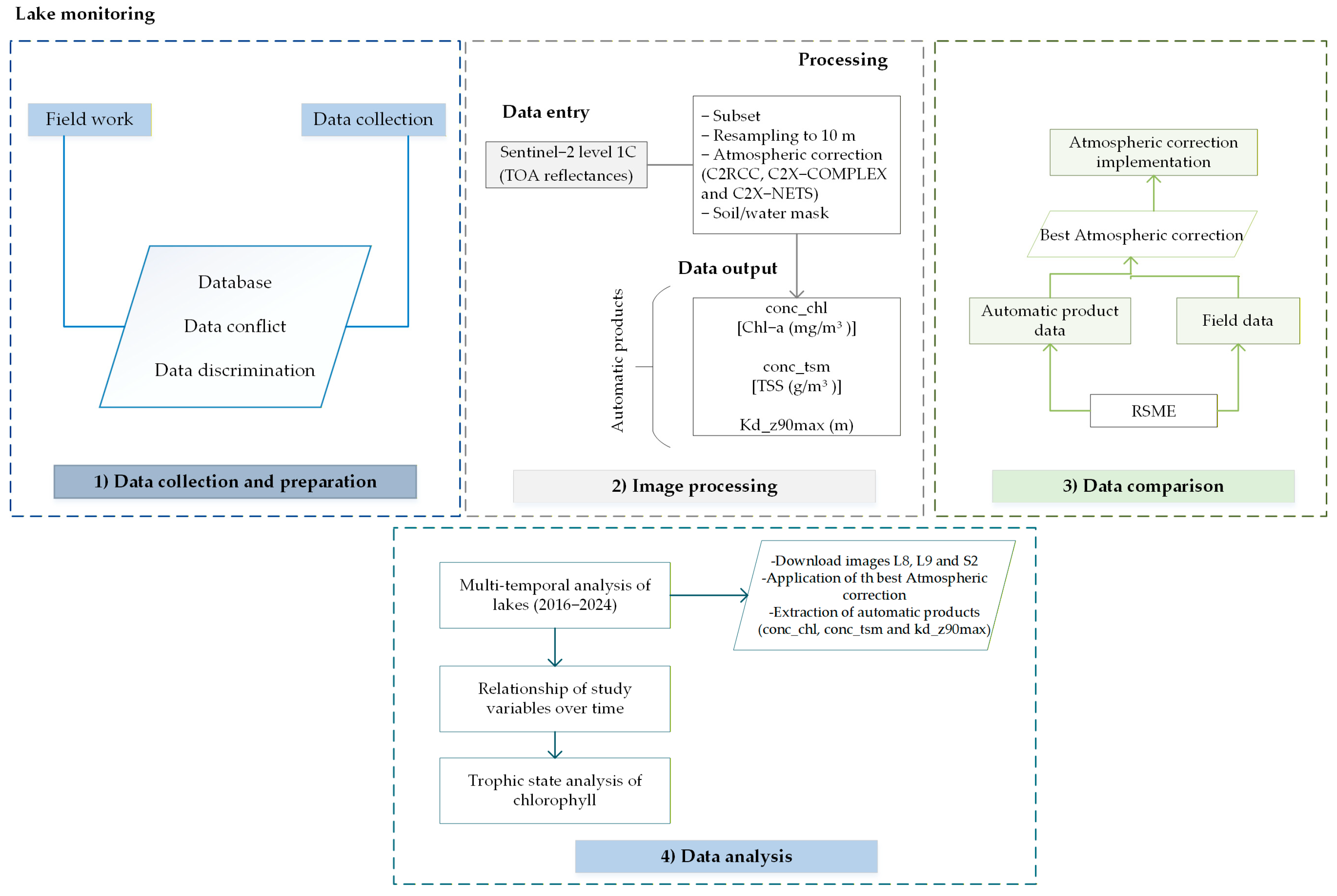
This study was carried out through four phases (Figure 2). The first phase involved data collection and preparation (i.e., downloading satellite images and in situ data sampling). In the second phase, the Sentinel-2 image closest to the monitoring dates was atmospherically corrected using the three available C2RCC versions in SNAP, from which automatic products for Chl-a, TSS, and kd_z90max were generated. The third phase consisted of selecting the most suitable atmospheric correction and applying it to the spatial and temporal assessment of the trophic state of the Ozogoche lakes. Finally, in the fourth phase, the behavior of the variables was analyzed.

2.2.1. In Situ Data Sampling and Laboratory Measurements

In situ data collection was conducted in August and September 2021 in the five study lakes located in the mountainous area of the PNS. The specific sampling dates for each lake are detailed in Table 2. Between one and three sampling points were identified in each lake (Figure 1), resulting in a total of 11 water samples collected in 1-L plastic bottles. All samples were transported under refrigerated conditions to the laboratory for further processing.
At each sampling point, Chl-a samples were extracted through the filtration method using a Whatman GF/F filter (47 mm in diameter and 0.7 μm pore size). Due to the pore size and the water transparency, approximately 3500 mL of samples were filtered in each lake. The samples were analyzed in the laboratory following the Standard Methods for the Examination of Water and Wastewater [27]. A photographic log was compiled to document watershed characteristics, vegetation, land uses, and visible environmental impacts, as well as site conditions at the time of sampling. The geographic position of each sampling point (altitude, latitude, and longitude) was recorded using UTM coordinates (WGS84 datum, Zone 17S). In addition, in situ physical water parameters were measured. Air temperature (AT) and relative humidity (RH) were obtained with a thermo-hygrometer, whereas water temperature (WT), pH, electrical conductivity (EC), total dissolved solids (TDS), and dissolved oxygen (DO) were measured with a Hach HQ40D multiparameter meter.

2.2.2. Satellite Image Processing

The lakes were analyzed using S2 images downloaded from the Copernicus Data Space Ecosystem [28]. The S2 images have a spatial resolution of 10–60 m and a temporal resolution of 5 days using S2-A and S2-B [29], with tiles of 10,000 km2 [30]. The preprocessing level of the images used is 1C, i.e., top-of-atmosphere (TOA).
Although S2 offers high temporal frequency, in the study area, the high-mountain climatic conditions (persistent cloud cover) and the difficult accessibility limited the availability of usable, cloud-free images coinciding with the sampling dates. Therefore, the image acquired on 5 July 2021 was selected, as it simultaneously covered all lakes of the Ozogoche system. Since these water bodies are located in a protected area with low anthropogenic pressure, their limnological conditions exhibit limited short-term variability, allowing the selected image to be considered representative of the sampling temporal window. Table 2 summarizes the imagery used in this study.
The images underwent an atmospheric correction process to obtain reflectance values from the top-of-atmosphere (TOA) radiance data of the studied lakes. However, due to the presence of small water bodies (less than 2 ha) and the spatial resolution of the images, a resampling of the bands to 10 m for S2 was employed to identify small lakes. Subsequently, a subset of the study area was created, and atmospheric correction methods from the C2RCC module available in ESA’s free software, SNAP, were applied separately to the MSI sensor of S2 (i.e., C2RCC, C2X-COMPLEX, and C2X) [19] based on neural networks, and each processor is applicable to distinct water bodies. For example, C2X-COMPLEX is used for turbid waters [19], while C2RCC and C2X are used for deep and clear waters [9]. In each atmospheric correction process, in addition to the method-specific configurations, the elevation value of the lakes was included.
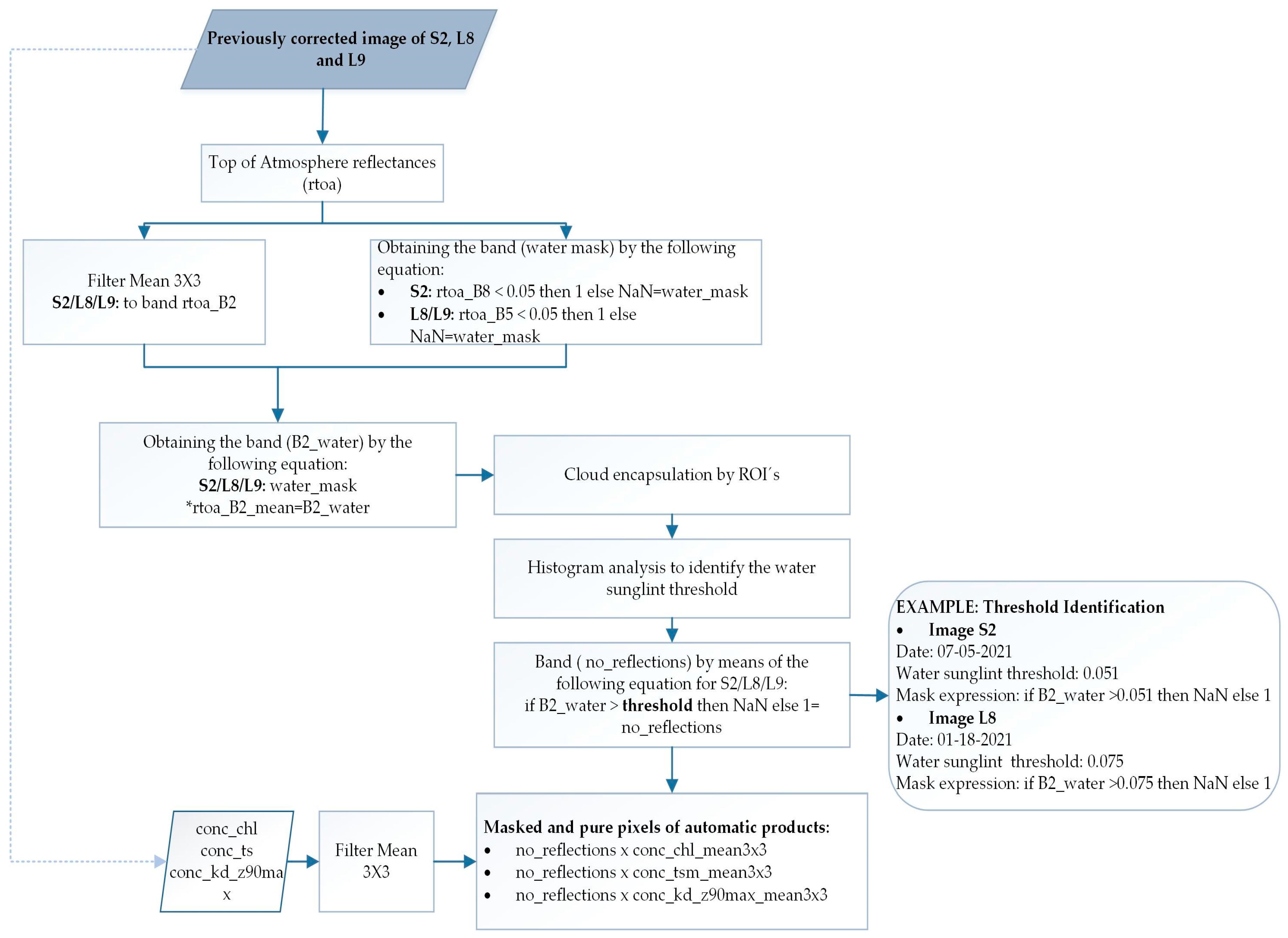
After applying atmospheric corrections, Chl-a (conc_chl), TSS (conc_tsm), and kd_z90max products were automatically generated in SNAP. However, due to cloud cover in the study area and cloud shadows over water bodies, manual delineation of Regions of Interest (ROIs) was performed for each lake. This process was carried out in three phases. In the first phase, lake ROIs were generated through visual interpretation, aiming to include the maximum number of pure water pixels, avoiding interferences from soil, clouds, or edges. Then, a new band was generated that highlights water features derived from the multiplication of the near-infrared (NIR) spectrum and the blue band (B2). In the second phase, ROIs encapsulating clouds were created, and all pixels affected by wind wave reflections (sunglint) were masked. Subsequently, the histogram of the B8 band reflectance was analyzed, and using a threshold derived from the histogram, a mask was generated in which the sunglint effect was removed.
Finally, in the third phase, the three products obtained by the C2RCC processors were filtered and masked using the sunglint-free band (Figure 3). After image cleaning, field data was compared with the automated products of C2RCC to select the best of the 3 versions. This process was conducted with the S2 image of 5 July 2021.
To select the best processor, the Root Mean Square Error (RMSE) was determined. This process was carried out using the automated conc_chl product data generated by the C2RCC, C2X-COMPLEX, and C2X-NETS processors, along with retrieved Chl-a data, based on the following formula:
R M S E = i = 1 N ( x i e s t i m a t e d x i m e a s u r e d ) 2 N
Quantitative comparison was conducted only for chlorophyll-a. Subsequently, a spatial analysis of lake behavior was performed using the TSS and kd_z90max products. These are satellite-derived products and lack in situ validation; therefore, they were used solely for qualitative interpretation of surface patterns. Finally, the relationships between the observed variations, land use, and the hydrological network of the Ozogoche River basin were examined. For this purpose, we used the image corresponding to the sampling date and two additional images from August 2024 (S2 and L9), all previously corrected with the selected version of the C2RCC processor.

2.2.3. Multitemporal Analysis Based on the Trophic State of Ozogoche Lakes

Given the extreme weather conditions and the unusual seasonality of Andean lakes [23], a multitemporal analysis was conducted using S2, L8, and L9 imagery, making use of the automatic products of the selected C2RCC version. In order to obtain a comprehensive view of the lakes and complete the temporal series, Landsat data were incorporated to better assess the temporal behavior of the water bodies. The use of these sensors was essential due to their high data acquisition frequency and spectral coverage, allowing us to address challenges associated with cloud cover and shade, which are common problems in remote sensing of water bodies in tropical environments. Table 3 presents the spectral characteristics of the MSI (S2) and OLI (L8/L9) sensor bands, along with their corresponding spatial resolution.
A total of 16 satellite images, S2, L8, and L9 images, were downloaded from 2016 to 2024 (Table 4). It is important to note that the downloaded images were resampled to 10 m for S2 and 15 m for L8/L9, and then underwent atmospheric correction using the processor with the lowest RMSE (Section 2.2.2). Additionally, masking and dehazing processes were employed before extracting the means of conc_chl, conc_tsm, and kd_z90max products. To compare the data of the automatic sensor products, a representative image per sensor and month was selected, but from different years. It should be noted that S2 and Landsat scenes did not always coincide in their acquisition dates due to differences in orbital revisit cycles and persistent cloud cover. For this reason, images were selected within the same seasonal window. Although persistent cloud cover limits the availability of cloud-free scenes in the study area, equatorial conditions reduce marked seasonal fluctuations and vegetation maintains a perennial phenological cycle, which favors temporal comparability across sensors and years [23].
Finally, a common area of interest was defined in all images to extract product values and compare them among S2, L8, and L9, with the RMSE calculated to evaluate the performance of the automatic C2RCC processors.
To analyze the possible correlation of the remote sensing water quality automatic products with climatic data, the monthly accumulated precipitation for each study image was extracted using the PAM-CHIRPS product provided by the Environmental Developments and Solutions Area (ADeSA) of the National Commission on Space Activities (CONAE), with an approximate spatial resolution of 5 km2 [31]. Additionally, the air temperature for the same dates was obtained from TerraClimate images, which have a spatial resolution of approximately 7 km2 [32]. These products were selected due to their high spatial and temporal resolution. TerraClimate (1958-) and PAM-CHIRPS (1981-) enable long-term trend analysis [32,33]. Additionally, both products are freely accessible, which facilitates their use in this research.

2.2.4. Approximation of the Surface Trophic State by Means of Chl-a Obtained by Remote Sensing

The trophic status of the Ozogoche lakes was approximated from surface Chl-a concentrations derived from S2 imagery using a multitemporal analysis. Chl-a values were compared with the concentration ranges of Carlson’s trophic classification [22] to assign indicative categories. This procedure uses Chl-a as a proxy and does not constitute a full trophic-status calculation, which would additionally require in situ Secchi depth and total phosphorus. Similar surface-based approximations have been reported for high-Andean lakes using automatic remote-sensing products, with Chl-a employed as an indicator of trophic conditions [23,34,35]. In this study, these assignments are explicitly interpreted as surface layer approximations, given the optical nature of the observations and the absence of field measurements (Table 5).

3. Results

3.1. Selection of the Atmospheric Correction Method

Average Chl-a values estimated from automated products were compared to in situ measurements. In situ values were found to be significantly lower compared to data obtained using C2X-COMPLEX and C2X-NETS (the latter to a lesser extent), although they tended to be higher than those generated by the C2RCC algorithm. Table 6 presents the RMSE values calculated from S2 imagery. After data analysis, it was found that the closest values to field data were obtained through the C2RCC atmospheric correction with an RMSE of 0.68 mg/m3, designed for less turbid waters.
In contrast, the C2X-COMPLEX method obtained an RMSE of 5.66 mg/m3, and C2X obtained an RMSE value of 20.65 mg/m3. Therefore, the C2RCC version was selected for the multi-temporal study.
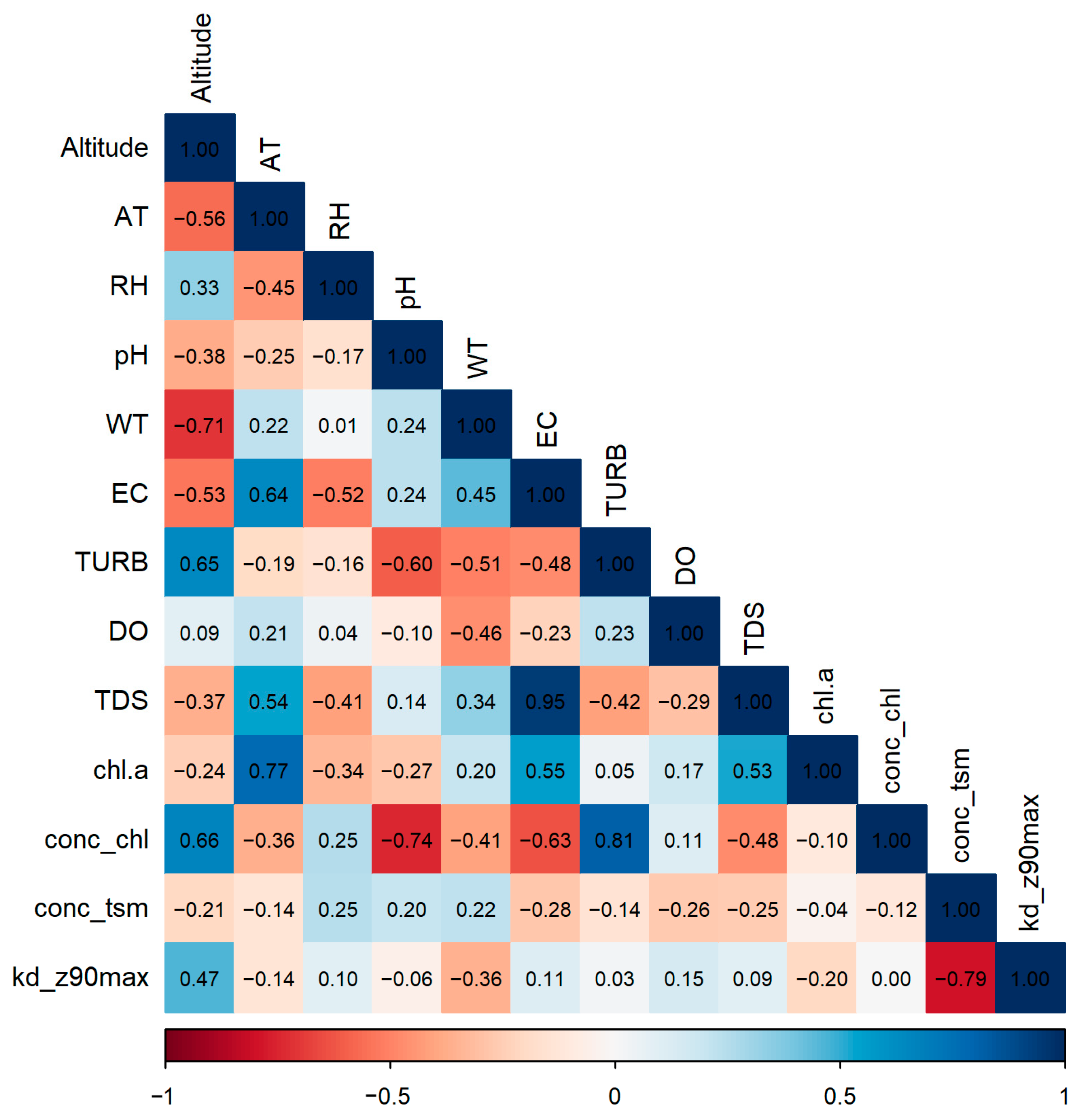
After selecting the most suitable processing algorithm, a Spearman correlation analysis was performed between the C2RCC satellite products (conc_chl, conc_tsm, and kd_z90max) and the in situ physical variables (Figure 4). Altitude shows negative correlations with AT (r = −0.56), WT (r = −0.71), CE (r = −0.53), and TDS (r = −0.37), indicating colder and less mineralized environments at higher elevations, while it is positively correlated with HR (r = 0.33) and TURB (r = 0.66). Complementarily, AT shows positive correlations with CE and TDS (r ≈ 0.64 and 0.54), consistent with higher mineralization under warmer conditions.
The strongest relationship is observed between conc_tsm and kd_z90max (r = −0.79), confirming that higher TSS concentrations reduce light penetration depth, as expected from water optical properties. This dominant effect of TSS explains most of the variability in water transparency across the study sites. Although conc_chl shows positive correlations with altitude (r = 0.66) and TURB (r = 0.81), its values remain low overall, resulting in a weaker correlation with kd_z90max. Therefore, the apparent increase in Kd with altitude is primarily driven by the decrease in TSS, while the concurrent increase in Chl-a is too small to offset this effect. Consequently, the positive association between Chl-a and altitude should be interpreted considering the stronger negative influence of TSS on water transparency in this dataset.
In situ Chl-a is positively correlated with AT and TDS (r ≈ 0.77 and 0.53), while its correlation with conc_chl is weak (r ≈ −0.10). This discrepancy is explained by scale differences (point samples vs. satellite pixels), spatial heterogeneity within the water body, and the sensitivity of the algorithms to local optical conditions.
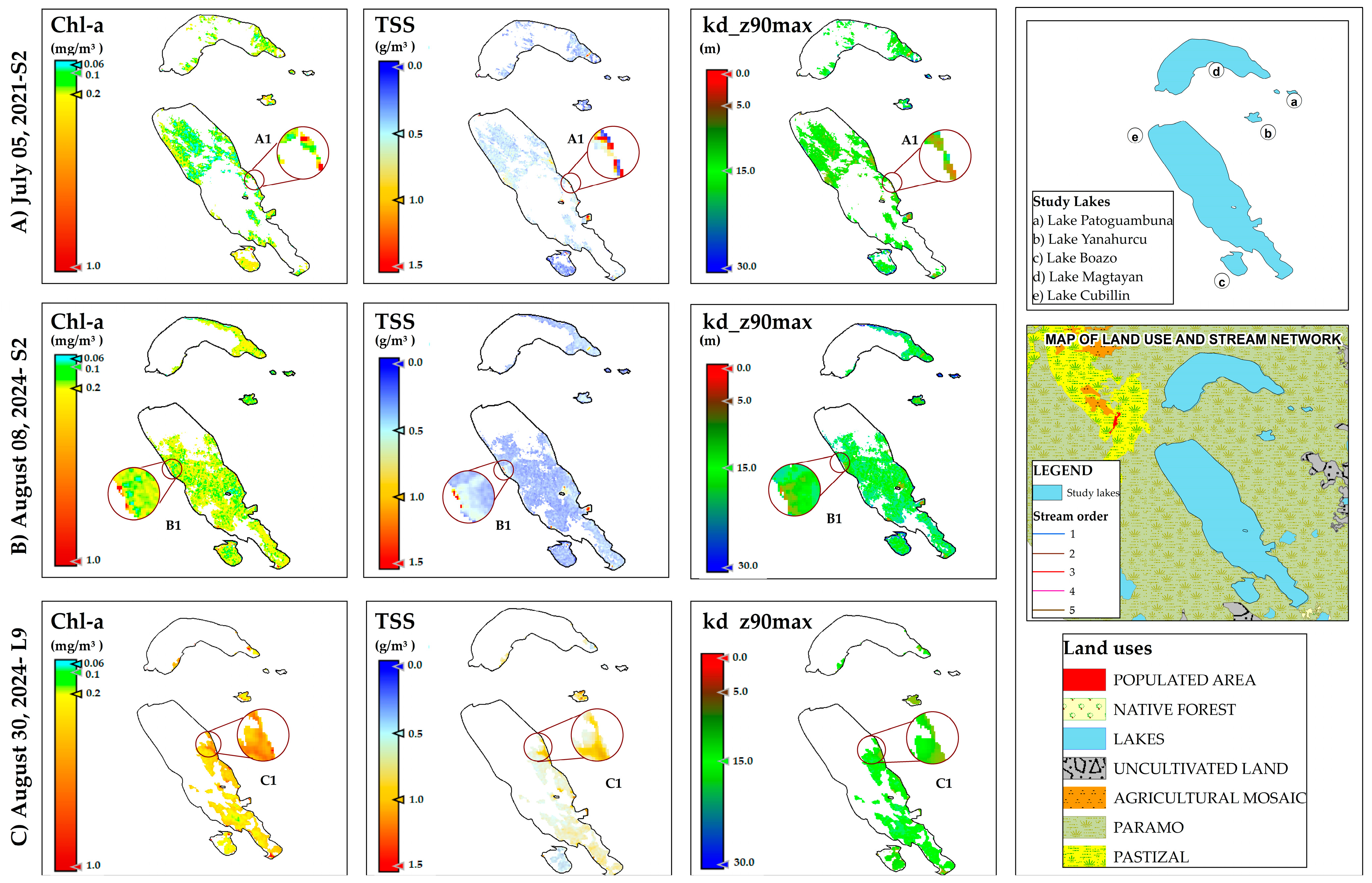
At the same time, a comparative spatial analysis was performed between the image corresponding to the sampling year and the most recent satellite images (2024), considering land uses and the hydrological network of the study area (Figure 4). Once the influence of sunglint was removed, Chl-a concentrations for the sampling year generally remained between 0.1 and 0.2 mg/m3 (Figure 5).
However, in Cubillin Lake, specifically in zone A1, a localized increase of up to 1.0 mg/m3 of Chl-a was identified, represented in red in the image. This increase coincides with the presence of first and second-order tributary streams, suggesting an external input of nutrients. In the same area, an increase in TSS concentration was also observed, reaching 1.5 g/m3, along with a decrease in kd_z90max, which is attributed to the inflow of riverine discharge.
This pattern is repeated in the August 2024 S2 image, where increases in both parameters (Chl-a and TSS) are again evident in Cubillin Lake. Correlating these data with the land use map and the hydrographic network confirms the proximity of fluvial inflows in areas of higher concentration, suggesting that water inputs directly influence the increase in nutrients and sediments, reducing water transparency to values between 5 and 15 m.
In the August 2024 L9 image, similar behavior is observed in zone C1 of Cubillin Lake, where a first-order tributary coincides with an increase in Chl-a and TSS, in addition to a decrease in the Kd_z90max value. Although the effect of sunglint may have partially limited detection accuracy, the trends are consistent.
In the case of Boazo Lake, the 2024 S2 image shows a localized increase in Chl-a up to 1.0 mg/m3 in an area with third-order fluvial outlets. This lake is connected to Cubillin Lagoon, and a similar pattern was observed in the inlet channel, suggesting a possible transfer of nutrients between both water bodies. Regarding TSS, during the sampling year and in the S2 image, values ranged between 0.0 and 0.5 g/m3. However, in the L9-2024 image, an increase in TSS up to 1.0 g/m3 was detected, reflected in a decrease in transparency (Kd_z90max).
In Yanahurco Lake, according to the L9-2024 image, TSS concentrations varied between 1.0 and 1.5 g/m3, which caused an additional reduction in transparency to values below 5 m. This lake receives water inputs from Magtayan Lake, suggesting a possible transport of sediments through the connected fluvial system.
Despite these increases, the analyzed water bodies continue to be classified as ultraoligotrophic. This trophic state can be explained by the predominant shrub páramo coverage in the surroundings of the lakes, which limits nutrient input and maintains water quality.

3.2. Multitemporal Study

Temporal reconstruction of Chl-a, TSS, and kd_z90max variables was performed using the automatic products generated with the C2RCC version of the atmospheric correction applied to S2 images. To complete the time series, L8 and L9 images were included, taking advantage of the spectral compatibility between the sensors. It is worth noting that the integration of these satellites allows for the detection of subtle variations in the study area, since the spectral and spatial configuration of S2 was designed to be comparable to that of the Landsat OLI (Operational Land Imager) sensor [36,37].
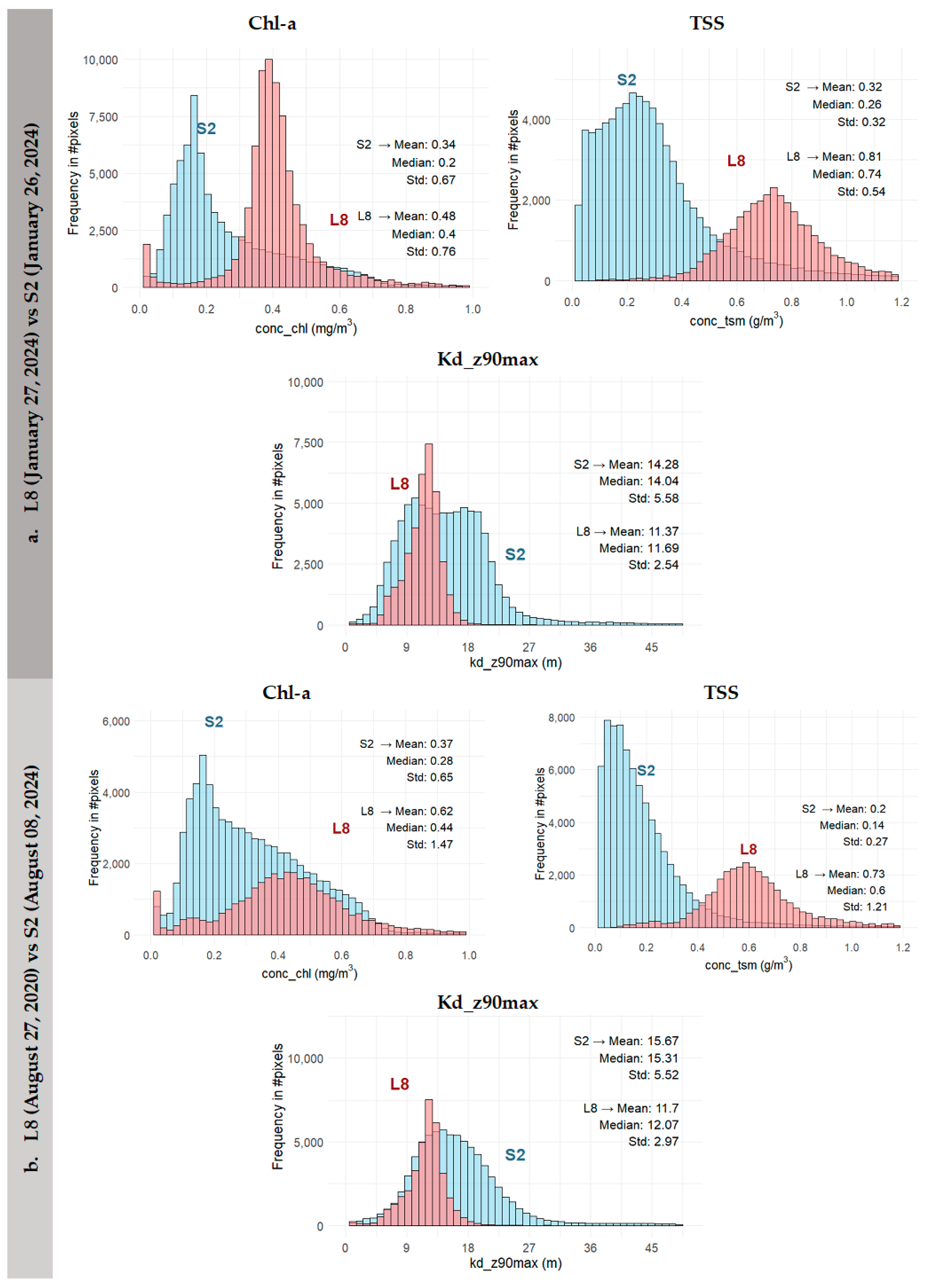
To evaluate the compatibility between the sensors, histograms of the automatic products were generated. From this analysis, representative images were selected for detailed comparison of spectral distributions and validation of the combined use of both sensors. Figure 6 shows the histograms of the automatic products obtained by L8 and S2 on the only two dates where they coincided with a small difference of days.
The dates were in August 2020, with an L8 image on day 27 and an S2 image on day 4, and in January 2024, with an S2 image on day 26 and an L8 image on day 27.
The comparison of automatically generated products for January 2024 and August 2020 indicates that S2 and L8 preserve spatial patterns and comparable value ranges across the five lakes. This preservation of patterns supports the joint use of both sensors for the temporal reconstruction of water quality variables. Note that the histograms were created prior to removing the sunglint effect.
Even with differences in acquisition dates (1 day in January 2024 and 23 days in August 2020), coherence between sensors is observed. For instance, Chl-a ranges from 0–0.6 mg/m3 in 2024 and 0–0.7 mg/m3 in 2020 for both sensors, while TSS remains at 0–1 g/m3 in both years. Consistently, kd_z90max (m) preserves the spatial structure, with a slight underestimation in L8 compared to S2.
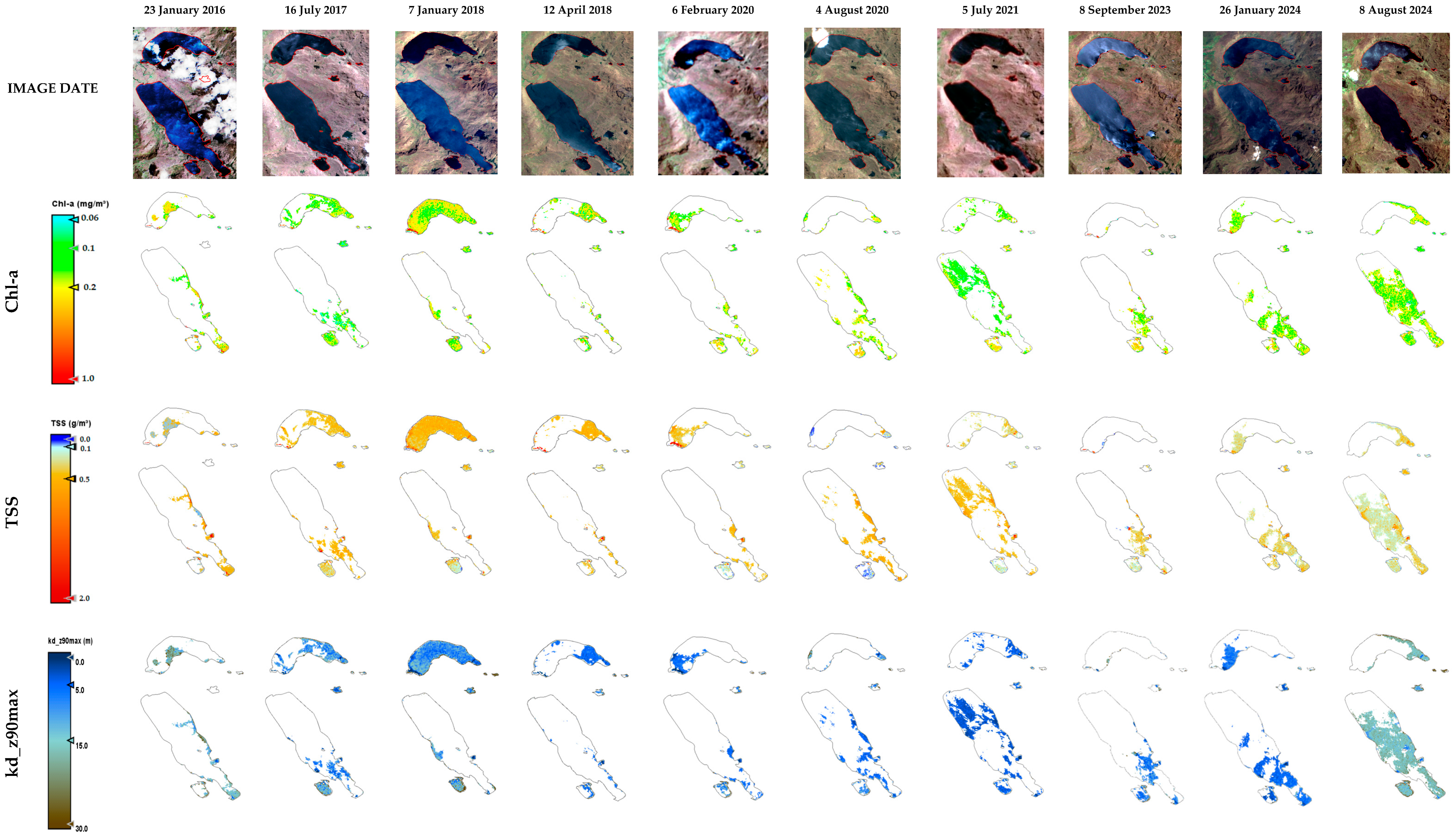
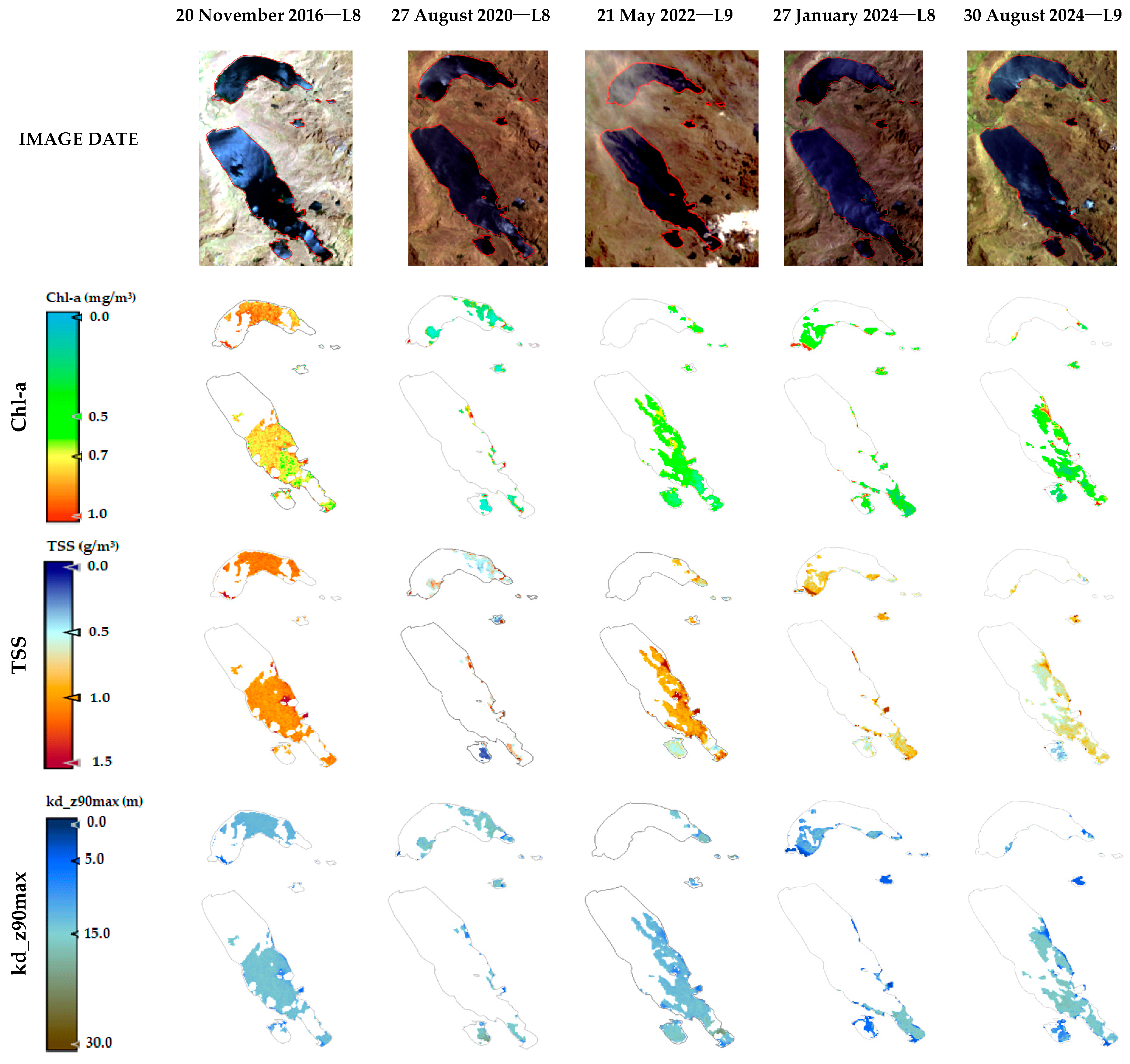
A more detailed analysis suggests that the difference in acquisition dates explains part of the variations in the distributions. In block (b), corresponding to late August 2020 (L8), Chl-a shows greater dispersion, whereas the early August 2020 S2 scene does not exhibit these peaks, indicating more homogeneous conditions. A similar pattern is observed in kd_z90max (m), with a slight increase in mean and dispersion in L8, while the TSS and Chl-a distributions in S2 remain skewed but less dispersed between (a) and (b). These results emphasize two points: (i) the operational robustness of C2RCC in generating comparable products across sensors, and (ii) the need to consider temporal and environmental context when interpreting nearly coincident, but not simultaneous, scenes. Based on these observations, a multitemporal analysis was performed. After removing sunglint, only portions of the water bodies in S2, L8, and L9 were cloud-free. In some years (e.g., 2016 and 2024), the correction led to the exclusion of certain lagoons (e.g., Yanahurcu and Boazo), limiting access to key information on the spatiotemporal behavior of variables in these lacustrine systems (Figure 7 and Figure 8).
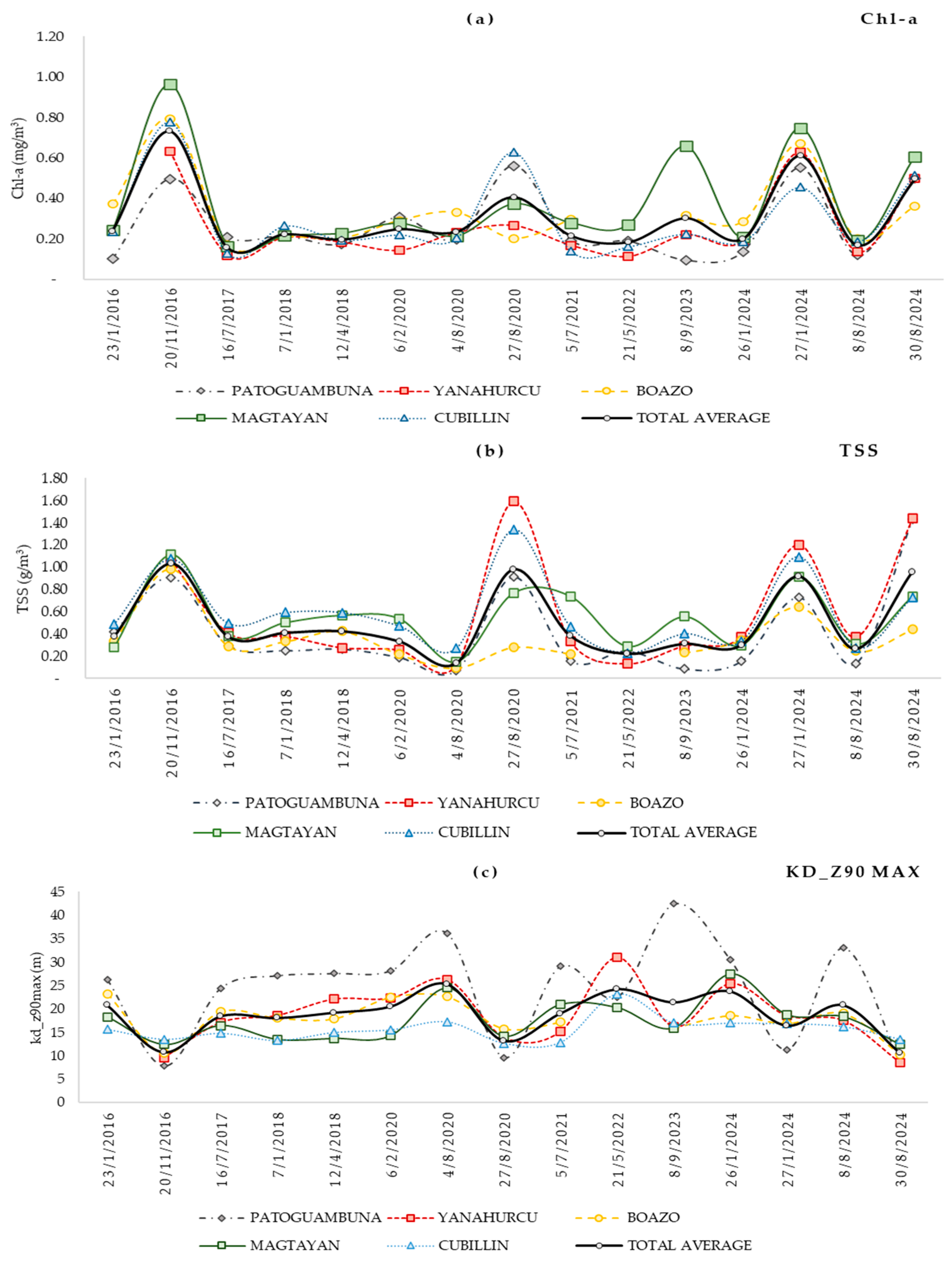
Figure 9 depicts the temporal variation in the products (the average of all lakes, eliminating clouds, shadows, and sunshine). Regarding Chl-a levels over time in the five lakes, it is observed that, as of 18 January 2021, lakes Cubillin, Magtayan, and Patoguambuna present low values, from 0.08 to 0.32 mg/m3. These peaks may be related to changes in lake conditions, such as changes in nutrients. On the other hand, Lake Yanahurcu for this same date shows elevated Chl-a values of 0.66 mg/m3, remaining below 1 mg/m3.
Regarding mean TSS, in the five lakes for 27 August 2020, there are relative maximum values of 0.77 to 1.59 g/m3, which could be related to rainfall in the basin leading to the entry of sediments. Conversely, it can be observed that for the same date, there is a decrease in the kd_z90max variable, which is related to the high presence of TSS. Likewise, it is observed that for 21 May 2022, there is a reduction in the TSS concentration in the five lakes, resulting in high kd_z90max values (Figure 9).
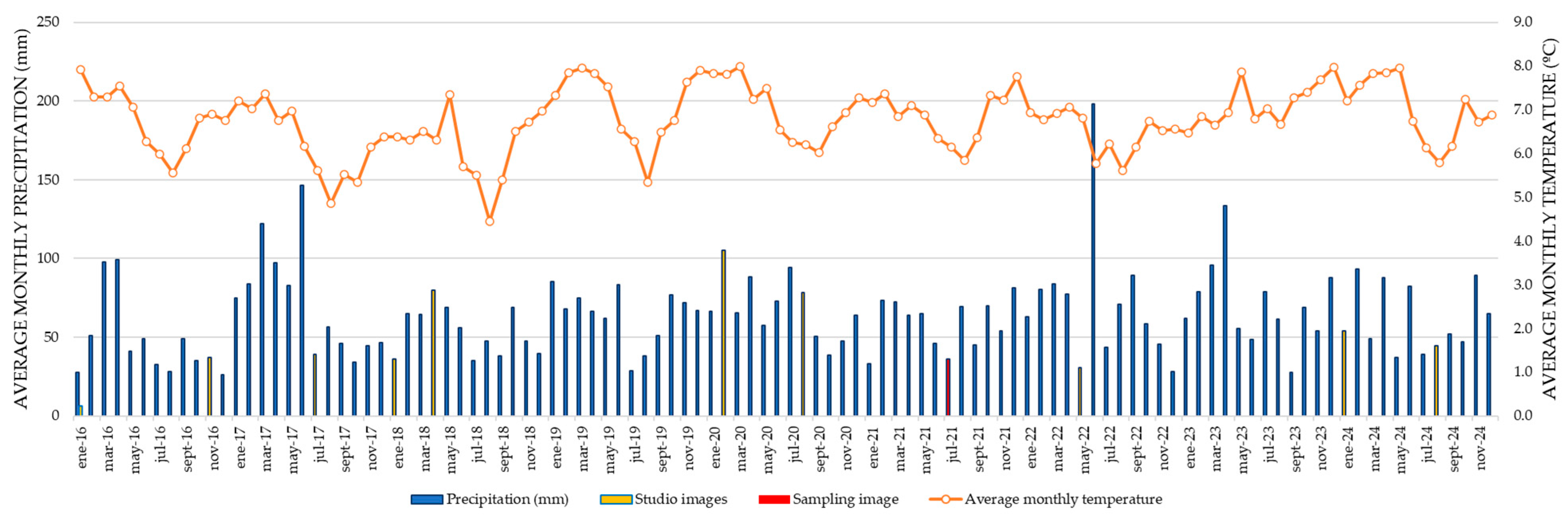
To better understand the temporal dynamics of the lakes, the means of the climatic variables were obtained, where data on temperature, precipitation, Chl-a, TSS, and kd_z90max from the total average of the 5 lakes were analyzed. The results (Figure 10) show that 78.1 mm of precipitation was recorded in August 2020, a value considerably higher than the monthly historical average for that time of year in the Andean region. This rainfall anomaly, recorded in the middle of the dry season, suggests an unusual meteorological event that may have induced an increase in TSS levels, possibly as a result of sediment-laden runoff entering the lakes.
This increase in suspended particles in the water column would have significantly reduced light penetration, which is reflected in the low kd_z90max values observed on 27 August 2020 (Figure 9). In contrast, in September 2023, there was a decrease in precipitation, which is associated with low TSS concentrations and higher kd_z90max values, suggesting better water quality. Additionally, the low precipitation in September 2023 coincided with reduced chlorophyll-a concentrations, which could be explained by a decrease in the inputs of nutrients (phosphorus and nitrogen) essential for phytoplankton growth [38].
These findings indicate that the concentrations of TSS and kd_z90max in the Ozogoche lakes are sensitive to variations in local climatic conditions. On the other hand, the Chl-a values generally remain low and constant, a characteristic of these high Andean lakes. It is worth noting that the Andean climate is strongly influenced by topography. The high altitude of the Ozogoche lakes contributes to low to moderate precipitation levels, which can affect the productivity of the lakes [39].
Finally, with the aim of providing an overall view of the lake conditions, Chl-a concentrations derived from the C2RCC processor were used to determine their trophic classification. The results consistently showed that all five lakes fell within the ultra-oligotrophic category, with Chl-a values below 1 mg/m3. These low values suggest that nutrient concentrations in the lakes are insufficient to support significant phytoplankton growth, which is consistent with their location in a high-Andean protected area subject to limited anthropogenic influence.

4. Discussion

The atmospheric conditions and optical characteristics of the Ozogoche lakes pose a challenge for the analysis of water properties using the S2, L8, and L9 sensors. Therefore, the atmospheric correction process was essential for data processing and obtaining automatic products. In this regard, the C2RCC processor was used, which is a derivative of the Case 2 regional processor [34]. After analyzing the RMSE of each atmospheric correction version with Chl-a field data, it was found that the C2RCC processor compared best with the in situ data. This may be because this processor was developed for waters with greater transparency [19].
Thus, the conc_chl product obtained by the C2RCC processor in SNAP is considered useful for estimating Chl-a in the Ozogoche lakes. However, the applicability of the C2RCC method can be influenced by the typical climatological conditions of high mountain areas in equatorial regions, such as the high presence of cloud cover, which can modify the recovery of the sensor’s optical signal [23], affecting the values of the automated products. Indeed, it is emphasized that the processes of sunglint and reflection removal in Andean lakes are necessary, as they can significantly increase reflectance values in the study area [40].
Therefore, the use of S2, L8, and L9 images after their atmospheric correction and sunglint removal process allows for the analysis of the most common water body parameters, such as Chl-a, which is used to detect algal blooms and evaluate eutrophication levels [41]. As a result of this research and analysis of the C2RCC processor’s application, it was found that Chl-a provides estimates ranging from 0.08 mg/m3 to 0.96 mg/m3, thus categorizing the five lakes as ultra-oligotrophic. Similarly, the use of OLI and MSI sensors shows consistency in the automatic product data, suggesting that the C2RCC processor is robust and suitable for estimating the analyzed variables.
It is important to note that the Ozogoche lakes are located within the National System of Protected Areas, which limits anthropogenic activities [23]. In the multitemporal analysis conducted in this study, low concentrations of Chl-a were found in July 2017 (0.16 mg/m3), which coincided with average temperatures of 6 °C and precipitation of 39.1 mm. In high-mountain lakes, temperatures below 8 °C, combined with moderate precipitation, generate a vertical mixing of the water column. While this redistributes the available nutrients, it does not incorporate new nutrients from the basin. This limitation, coupled with thermal stress on the phytoplankton, explains the low Chl-a concentrations [42].
In contrast, in November 2016 and January 2024, specific increases in Chl-a were observed, reaching 1.0 mg/m3. Although these values represent a slight increase, they do not indicate a change in the trophic state but rather a natural variability within a healthy range [43]. It is worth noting that this increase occurred in months with low precipitation and temperatures of up to 7 °C. Therefore, this combination may have favored the accumulation and retention of nutrients in the surface layer, which could trigger a slight response from the phytoplankton [44]. In high-mountain systems, especially in protected areas with low anthropogenic activity, these fluctuations are common and do not compromise the ecological quality of the water [45]. Rather, they reflect the ecosystem’s sensitivity to small variations in the balance between hydrological stability, nutrient input, and the lake’s internal dynamics [46,47].
According to Carlson’s trophic [22] classification ranges, the studied lakes present an ultra-oligotrophic condition, since their Chl-a values do not exceed 1 mg/m3. Previous studies conducted in the Atillo lakes and in Cajas National Park (Ecuador) also reported extremely oligotrophic conditions, with Chl-a concentrations below 1 mg/m3 [23,48]. Such trophic states are typical of high-mountain lakes where nutrient concentrations are naturally low and anthropogenic activity has not significantly altered the ecosystems [43]. These conditions, however, also imply ecological fragility, as even small increases in nutrient inputs could lead to marked changes in phytoplankton dynamics.
Management implications.
The spatial and temporal products generated in this study provide actionable inputs for water-resource management in high-Andean lakes. In particular, surface Chl-a estimates enable managers to identify areas at higher risk of eutrophication (e.g., near inflows), prioritize field monitoring by triggering in situ sampling when indicative thresholds are exceeded, and guide preventive measures during critical periods (rainy season or extreme events). These indicators can be integrated into local and regional management plans to support campaign scheduling, the definition of alert thresholds, and the assessment of interannual trends, even under persistent cloudiness and operational constraints.
Concretely, we recommend (i) seasonal tracking (dry/wet) with monthly updates when cloud cover allows; (ii) Chl-a action thresholds—<1 mg/m3 = stable condition; 1–3 mg/m3 = surveillance with in situ verification within ≤2 weeks; >3 mg/m3 = immediate sampling (≤72 h); (iii) spatial prioritization of control points at inflows and areas with recurrent peaks; and (iv) periodic reporting on water conditions to support decision-making.
Limitations of the study.
This study does not incorporate hydrodynamic modeling, nor does it reconstruct velocity fields or wind-driven forcing. The analysis is limited to surface mapping derived from optical remote sensing, whose signal represents only a shallow layer of the water column. Additionally, persistent cloud cover restricted the number of usable scenes in some years, reducing temporal representativeness. Therefore, the results should be interpreted as indicative surface patterns suitable for low-cost operational monitoring.
The in situ validation was punctual and limited (n = 11) and focused exclusively on chlorophyll-a. Consequently, the reported trophic classification represents a superficial approximation based solely on Chl-a following the ranges established by Carlson’s classification and does not constitute a complete Trophic State Index (which would additionally require concurrent measurements of total phosphorus and Secchi depth). Thus, the results should be considered exploratory and require additional field campaigns (including total phosphorus, Secchi depth, and vertical profiles) for a comprehensive trophic assessment.
Despite these limitations, the information generated in this study provides a relevant baseline for the conservation of these lacustrine ecosystems, which are strategic freshwater sources for Andean communities, and supports the strengthening of early warning monitoring against potential eutrophication processes.

5. Conclusions

This study identified that the C2RCC processor is the most suitable for monitoring the Ozogoche lakes, as it provides consistent estimates of Chl-a in optically complex water bodies, typical of high-mountain systems. The Chl-a derived values ranged between 0.08 mg/m3 and 0.96 mg/m3, coinciding with in situ measurements and validating the reliability of this satellite product.
The spatial analysis identified that the studied lakes maintain stable ultra-oligotrophic conditions, with isolated exceptions possibly linked to river inflows. In the TSS analysis, the differences between sensors highlight the importance of validating results with in situ data.
The multitemporal analysis revealed that the levels of TSS and kd_z90max are mainly influenced by the presence of rainfall, while Chl-a concentrations showed greater sensitivity to climatic conditions such as cloud cover and temperature. It is noteworthy that slight interannual fluctuations of Chl-a were detected, including specific increases in November 2016 and January 2024, reflecting a natural response of phytoplankton under variable climatic conditions.
Finally, the use of S2, L8, and L9 optical sensors, in conjunction with field measurements, proved to be an effective strategy for assessing the trophic state of high-Andean aquatic ecosystems. The integration of automated satellite products enables monitoring at broader spatial and temporal scales, overcoming the accessibility and cost limitations of traditional methods. Although persistent cloud cover in the study area represents a common challenge in high-mountain ecosystems, it does not diminish the effectiveness of the C2RCC processor demonstrated in this work. Instead, it highlights the importance of considering complementary strategies such as integrating radar data, applying temporal compositing techniques, or planning in situ campaigns during periods of lower cloudiness to optimize future monitoring efforts.

Author Contributions

Conceptualization V.F.F.C., P.X.L.R., C.A.J.S. and J.E.A.I.; methodology V.F.F.C., P.X.L.R., C.A.J.S., and A.R.-V.; software, V.F.F.C. and J.E.A.I.; validation, P.X.L.R., J.V. and J.E.A.I.; formal analysis V.F.F.C., P.X.L.R., A.R.-V., J.V. and J.D.; investigation V.F.F.C., J.E.A.I. and P.X.L.R.; resources, P.X.L.R. and J.D.; data curation, J.D.; writing—original draft preparation V.F.F.C.; writing—review and editing V.F.F.C., P.X.L.R., J.E.A.I., A.R.-V., J.V., C.A.J.S. and J.D.; supervision J.V., J.D., and J.E.A.I.; project administration, P.X.L.R.; funding acquisition, P.X.L.R., P.L.M.G. and J.D. All authors have read and agreed to the published version of the manuscript.

Funding

This research was funded by “Evaluación de la calidad de los ecosistemas acuáticos de la zona alta del Parque Nacional Sangay aplicando múltiples líneas de evidencia (EEA-PNS) (IDIPI-269) Project, Escuela Superior Politécnica de Chimborazo (ESPOCH), Riobamba, Ecuador” and “Applying new methodologies based on remote sensing and environmental modeling to assess the eutrophication state of lakes and lakes in the Inter-Andean region of Ecuador (IDIPI-336) Project, Escuela Superior Politécnica de Chimborazo (ESPOCH), Riobamba, Ecuador”. J.V. was supported by ERC-2022-COG FLEXINEL project (grant agreement 101086622). Finally, P.X.L.R. was supported by the Global Minds Funds of VLIR-UOS of Ghent University.

Data Availability Statement

The original contributions presented in the study are included in the article. For any further inquiries, please contact the corresponding author.

Acknowledgments

Thanks to the Escuela Politécnica Superior de Chimborazo (ESPOCH) and Ghent University for its institutional support, Sangay National Park for granting research permits MAAE-ARSFC-2021-1405.

Conflicts of Interest

The authors declare that they have no conflicts of interest.

Abbreviations

The following abbreviations are used in this manuscript:
S2Sentinel-2
L8Landsat-8
L9Landsat-9
SNAPSentinel Application Platform
C2RCCCase 2 Regional Coast Colour processor
Chl-aChlorophyll-a
TSSTotal Suspended Solids
kd_z90maxDiffuse attenuation coefficient at 90% light depth penetration
RMSERoot Mean Square Error
TSITrophic State Index
TOATop of Atmosphere
ROI(s)Regions of Interest
PNSSangay National Park
TSICarlson’s Trophic State Index
NIRNear-infrared
CCCloud cover
ADeSAEnvironmental Developments and Solutions Area
OLIOperational Land Imager

References

  1. Salazar, R.N.; Aguirre, C.; Soto, J.; Salinas, P.; Salinas, C.; Prieto, H.; Paneque, M. Physicochemical Parameters Affecting the Distribution and Diversity of the Water Column Microbial Community in the High-Altitude Andean Lake System of La Brava and La Punta. Microorganisms 2020, 8, 1181. [Google Scholar] [CrossRef] [PubMed]
  2. Cartuche, A.; Guan, Z.; Ibelings, B.W.; Venail, P. Phytoplankton Diversity Relates Negatively with Productivity in Tropical High-Altitude Lakes from Southern Ecuador. Sustainability 2019, 11, 5235. [Google Scholar] [CrossRef]
  3. Terneus, E.; Vallejo, B.; Gómez, M.; Larenas, C. Trophic Status Index of Lentic Systems from the Diversity of Aquatic Plants from Continental Ecuador (IMAE). Caldasia 2020, 42, 115–128. [Google Scholar] [CrossRef]
  4. Yang, H.; Shao, X.; Wu, M. A Review on Ecosystem Health Research: A Visualization Based on CiteSpace. Sustainability 2019, 11, 4908. [Google Scholar] [CrossRef]
  5. Barraza, F.; Alcayaga, H.; Pizarro, A.; Félez-Bernal, J.; Urrutia, R. Estimation of Chlorophyll-a Concentrations in Lanalhue Lake Using Sentinel-2 MSI Satellite Images. Remote Sens. 2022, 14, 5647. [Google Scholar] [CrossRef]
  6. Zhang, J.J.; Sheng, Y.F.; Chen, W.D.; Lin, H.J.; Sun, G.; Guo, P. Design and Analysis of a Water Quality Monitoring Data Service Platform. Comput. Mater. Contin. 2021, 66, 389–405. [Google Scholar] [CrossRef]
  7. Ade, C.; Khanna, S.; Lay, M.; Ustin, S.L.; Hestir, E.L. Genus-Level Mapping of Invasive Floating Aquatic Vegetation Using Sentinel-2 Satellite Remote Sensing. Remote Sens. 2022, 14, 3013. [Google Scholar] [CrossRef]
  8. Gao, M.; Gu, X.; Liu, Y.; Zhan, Y.; Wei, X.; Yu, H.; Liang, M.; Weng, C.; Ding, Y. An Improved Spatiotemporal Data Fusion Method for Snow-Covered Mountain Areas Using Snow Index and Elevation Information. Sensors 2022, 22, 8524. [Google Scholar] [CrossRef]
  9. Soomets, T.; Uudeberg, K.; Jakovels, D.; Brauns, A.; Zagars, M.; Kutser, T. Validation and Comparison of Water Quality Products in Baltic Lakes Using Sentinel-2 MSI and Sentinel-3 OLCI Data. Sensors 2020, 20, 742. [Google Scholar] [CrossRef]
  10. Yadav, S.; Yamashiki, Y.; Susaki, J.; Yamashita, Y.; Ishikawa, K. Chlorophyll Estimation of Lake Water and Coastal Water Using Landsat-8 and Sentinel-2A Satellite. Int. Arch. Photogramm. Remote Sens. Spat. Inf. Sci. 2019, 42, 77–82. [Google Scholar] [CrossRef]
  11. Maslukah, L.; Wirasatriya, A.; Wijaya, Y.J.; Ismunarti, D.H.; Widiaratih, R.; Krisna, H.N. The Assessment of Chlorophyll-a Retrieval Algorithm and Its Spatial-Temporal Distribution Using Sentinel-2 MSI off the Banjir Kanal Timur River, Semarang, Indonesia. Reg. Stud. Mar. Sci. 2024, 75, 103556. [Google Scholar] [CrossRef]
  12. DeLuca, N.M.; Zaitchik, B.F.; Curriero, F.C. Can Multispectral Information Improve Remotely Sensed Estimates of Total Suspended Solids? A Statistical Study in Chesapeake Bay. Remote Sens. 2018, 10, 1393. [Google Scholar] [CrossRef]
  13. Jensen, D.; Simard, M.; Cavanaugh, K.; Sheng, Y.; Fichot, C.G.; Pavelsky, T.; Twilley, R. Improving the Transferability of Suspended Solid Estimation in Wetland and Deltaic Waters with an Empirical Hyperspectral Approach. Remote Sens. 2019, 11, 1629. [Google Scholar] [CrossRef]
  14. Maslukah, L.; Basayep, I.; Wirasatriya, A.; Indrayanti, E.; Prasetyawan, I.B.; Wijaya, Y.J. Application of Sentinel-2 Imagery for Total Suspended Solids Mapping off the Bodri River, Kendal Regency, Indonesia. Remote Sens. Appl. Soc. Environ. 2024, 36, 101379. [Google Scholar] [CrossRef]
  15. Caballero, I.; Román, A.; Tovar-Sánchez, A.; Navarro, G. Water Quality Monitoring with Sentinel-2 and Landsat-8 Satellites during the 2021 Volcanic Eruption in La Palma (Canary Islands). Sci. Total Environ. 2022, 822, 153433. [Google Scholar] [CrossRef]
  16. Erdanaev, E.; Kappas, M.; Wyss, D. Irrigated Crop Types Mapping in Tashkent Province of Uzbekistan with Remote Sensing-Based Classification Methods. Sensors 2022, 22, 5683. [Google Scholar] [CrossRef]
  17. Sirin, A.A.; Medvedeva, M.A.; Makarov, D.A.; Maslov, A.A.; Joosten, H. Multispectral Satellite Based Monitoring of Land Cover Change and Associated Fire Reduction after Large-Scale Peatland Rewetting Following the 2010 Peat Fires in Moscow Region (Russia). Ecol. Eng. 2020, 158, 106044. [Google Scholar] [CrossRef]
  18. Liu, H.; Li, Q.; Shi, T.; Hu, S.; Wu, G.; Zhou, Q. Application of Sentinel 2 MSI Images to Retrieve Suspended Particulate Matter Concentrations in Poyang Lake. Remote Sens. 2017, 9, 761. [Google Scholar] [CrossRef]
  19. Brockmann, C.; Doerffer, R.; Peters, M.; Stelzer, K.; Embacher, S.; Ruescas, A. Evolution of the C2RCC Neural Network for Sentinel 2 and 3 for the Retrieval of Ocean Colour Products in Normal and Extreme Optically Complex Waters. In Proceedings of the Living Planet Symposium, Prague, Czech Republic, 9–13 May 2016. [Google Scholar]
  20. Kyryliuk, D.; Kratzer, S. Evaluation of Sentinel-3A OLCI Products Derived Using the Case-2 Regional Coastcolour Processor over the Baltic Sea. Sensors. Sensors 2019, 19, 3609. [Google Scholar] [CrossRef]
  21. Comas, X.; Terry, N.; Hribljan, J.A.; Lilleskov, E.A.; Suarez, E.; Chimner, R.A.; Kolka, R.K. Estimating Belowground Carbon Stocks in Peatlands of the Ecuadorian Páramo Using Ground-Penetrating Radar (GPR). Biogeosciences 2017, 122, 370–386. [Google Scholar] [CrossRef]
  22. Carlson, R.E. A Trophic State Index for Lakes1. Limnol. Oceanogr. 1977, 22, 361–369. [Google Scholar] [CrossRef]
  23. Ayala Izurieta, J.; Beltrán Dávalos, A.; Jara Santillán, C.A.; Godoy Ponce, S.; Van Wittenberghe, S.; Verrelst, J.; Delegido, J. Spatial and Temporal Analysis of Water Quality in High Andean Lakes with Sentinel-2 Satellite Automatic Water Products. Sensors 2023, 23, 8774. [Google Scholar] [CrossRef]
  24. Terneus, E. Vegetación Acuática y Estado Trófico de Las Lagunas Andinas de San Pablo y Yahuarcocha, Provincia de Imbabura, Ecuador. Rev. Ecuat. Med. Cienc. Biol. 2017, 35, 121–131. [Google Scholar] [CrossRef]
  25. Instituto Ecuatoriano Forestal y de Áreas Naturales y Vida Silvestre Dirección Nacional de Areas Naturales y Vida Silvestre. MAATE Plan de Manejo Estratégico Del Parque Nacional Sangay; Instituto Ecuatoriano Forestal y de Áreas Naturales y Vida Silvestre Dirección Nacional de Areas Naturales y Vida Silvestre: Quito, Ecuador, 2014; pp. 1–179. [Google Scholar]
  26. Pazmiño, Y.C.; Felipe, J.J.D.; Vallbé, M.; Pazmiño, Y. Modeling the Influence of Changes in the Edaphic Environment on the Ecosystem Valuation of the Zone of Influence of the Ozogoche and Atillo Lake Systems in Ecuador. Appl. Sci. 2024, 14, 2249. [Google Scholar] [CrossRef]
  27. Jenkins, S.H. Standard Methods for the Examination of Water and Wastewater, 2nd ed.; American Public Health Association: Washington, DC, USA, 1982; Volume 16. [Google Scholar]
  28. European Space Agency Sentinel-2 Data. Available online: https://dataspace.copernicus.eu (accessed on 15 September 2022).
  29. ESA. Sentinel-2 User Handbook; European Space Agency: Paris, France, 2015; pp. 1–64. [Google Scholar]
  30. Sofan, P.; Bruce, D.; Jones, E.; Khomarudin, M.R.; Roswintiarti, O. Applying the Tropical Peatland Combustion Algorithm to Landsat-8 Operational Land Imager (Oli) and Sentinel-2 Multi Spectral Instrument (Msi) Imagery. Remote Sens. 2020, 12, 3958. [Google Scholar] [CrossRef]
  31. Pascualone, F. Producto: PAM-CHIRPS Precipitación Acumulada Mensual CHIRPS; Comisión Nacional de Actividades Espaciales: Buenos Aires, Argentina, 2022; pp. 1–18. [Google Scholar]
  32. Abatzoglou, J.T.; Dobrowski, S.Z.; Parks, S.A.; Hegewisch, K.C. TerraClimate, a High-Resolution Global Dataset of Monthly Climate and Climatic Water Balance from 1958–2015. Sci. Data 2018, 5, 170191. [Google Scholar] [CrossRef] [PubMed]
  33. Du, H.; Tan, M.L.; Zhang, F.; Chun, K.P.; Li, L.; Kabir, M.H. Evaluating the Effectiveness of CHIRPS Data for Hydroclimatic Studies. Theor. Appl. Climatol. 2024, 155, 1519–1539. [Google Scholar] [CrossRef]
  34. Sòria, X.; Vicente, E.; Urrego, P.; Pereira, M.; Tenjo, C.; Ruíz-Verdú, A.; Delegido, J.; Soria, J.M.; Peña, R.; Moreno, J. Validation of Water Quality Monitoring Algorithms for Sentinel-2 and Sentinel-3 in Mediterranean Inland Waters with in Situ Reflectance Data. Water 2021, 13, 686. [Google Scholar] [CrossRef]
  35. Sòria-Perpinyà, X.; Urrego, E.P.; Pereira-Sandoval, M.; Ruiz-Verdú, A.; Soria, J.M.; Delegido, J.; Vicente, E.; Moreno, J. Monitoring Water Transparency of a Hypertrophic Lake (The Albufera of València) Using Multitemporal Sentinel-2 Satellite Images. Limnetica 2020, 39, 373–386. [Google Scholar] [CrossRef]
  36. Cao, H.; Han, L.; Li, L. Harmonizing Surface Reflectance between Landsat-7 ETM +, Landsat-8 OLI, and Sentinel-2 MSI over China. Environ. Sci. Pollut. Res. 2022, 29, 70882–70898. [Google Scholar] [CrossRef] [PubMed]
  37. Drusch, M.; Del Bello, U.; Carlier, S.; Colin, O.; Fernandez, V.; Gascon, F.; Hoersch, B.; Isola, C.; Laberinti, P.; Martimort, P.; et al. Sentinel-2: ESA’s Optical High-Resolution Mission for GMES Operational Services. Remote Sens. Environ. 2012, 120, 25–36. [Google Scholar] [CrossRef]
  38. Fox, J.; Behrenfeld, M.J.; Haëntjens, N.; Chase, A.; Kramer, S.J.; Boss, E.; Karp-Boss, L.; Fisher, N.L.; Penta, W.B.; Westberry, T.K.; et al. Phytoplankton Growth and Productivity in the Western North Atlantic: Observations of Regional Variability From the NAAMES Field Campaigns. Front. Mar. Sci. 2020, 7, 24. [Google Scholar] [CrossRef]
  39. Bioweb Ecuador Geografía y Clima Del Ecaudor. Available online: https://bioweb.bio/fungiweb/GeografiaClima/ (accessed on 15 September 2025).
  40. Wang, Q.; Liu, H.; Wang, D.; Li, D.; Liu, W.; Si, Y.; Liu, Y.; Li, J.; Duan, H.; Shen, M. Assessment of Atmospheric Correction Algorithms for Correcting Sunglint Effects in Sentinel-2 MSI Imagery: A Case Study in Clean Lakes. Remote Sens. 2024, 16, 3060. [Google Scholar] [CrossRef]
  41. Chen, J.; Zhu, W.; Tian, Y.Q.; Yu, Q.; Zheng, Y.; Huang, L. Remote Estimation of Colored Dissolved Organic Matter and Chlorophyll-a in Lake Huron Using Sentinel-2 Measurements. J. Appl. Remote Sens. 2017, 11, 036007. [Google Scholar] [CrossRef]
  42. Vincent, W.F. Effects of Climate Change on Lakes. In Encyclopedia of Inland Waters; ScienceDirect: Amsterdam, The Netherlands, 2009; pp. 55–60. [Google Scholar] [CrossRef]
  43. López, M.L.; Madroñero, S.M. Estado Trófico de Un Lago Tropical de Alta Montaña: Caso Laguna de La Cocha. Cienc. e Ing. Neogranadina 2015, 25, 21–42. [Google Scholar] [CrossRef]
  44. Williamson, C.E.; Saros, J.E.; Vincent, W.F.; Smol, J.P. Lakes and Reservoirs as Sentinels, Integrators, and Regulators of Climate Change. Limnol. Oceanogr. 2009, 54, 2273–2282. [Google Scholar] [CrossRef]
  45. Marchetto, A.; Mosello, R.; Rogora, M.; Manca, M.; Boggero, A.; Morabito, G.; Musazzi, S.; Tartari, G.A.; Nocentini, A.M.; Pugnetti, A.; et al. The Chemical and Biological Response of Two Remote Mountain Lakes in the Southern Central Alps (Italy) to Twenty Years of Changing Physical and Chemical Climate. J. Limnol. 2004, 63, 77–89. [Google Scholar] [CrossRef]
  46. Margalida, A. Importance of Long-Term Studies to Conservation Practice: The Case of the Bearded Vulture in the Pyrenees. In High Mountain Conservation in a Changing World; Springer: Cham, Switzerland, 2017; Volume 62, ISBN 9783319559810. [Google Scholar]
  47. Psenner, R.; Schmidt, R. Climate-Driven PH Control of Remote Alpine Lakes and Effects of Acid Deposition. Nature 1992, 356, 781–783. [Google Scholar] [CrossRef]
  48. Van Colen, W.R.; Mosquera, P.; Vanderstukken, M.; Goiris, K.; Carrasco, M.C.; Decaestecker, E.; Alonso, M.; León-Tamariz, F.; Muylaert, K. Limnology and Trophic Status of Glacial Lakes in the Tropical Andes (Cajas National Park, Ecuador). Freshw. Biol. 2017, 62, 458–473. [Google Scholar] [CrossRef]
Figure 1. Geographical location of the study lakes in Sangay National Park (PNS), Ozogoche Lake Complex. (A) Main map showing the five study lakes; blue polygons represent lake boundaries and red dots indicate sampling sites. (B) Location of Ecuador within South America. (C) General position of the study area within the Ozogoche Lake Complex and its relation to Ecuador. Photographs of the study lakes are also shown: (a) Patoguambuna, (b) Yanahurucu, (c) Boazo, (d) Magtayan, and (e) Cubillín.
Water 17 03145 g001
Figure 2. Methodological scheme of the study.
Water 17 03145 g002
Figure 3. Methodology for masking and removing pixels affected by the sunglint effect.
Water 17 03145 g003
Figure 4. Spearman correlation matrix between in situ physical variables and the automatically generated C2RCC products (conc_chl, conc_tsm, and kd_z90max) for the Ozogoche lake complex. Cell values indicate the strength and direction of pairwise relationships; blue denotes positive correlations and red denotes negative correlations. Variables included: EC = electrical conductivity (µS/cm); RH = relative humidity (%); TURB = turbidity (NTU); DO = dissolved oxygen (mg/L); AT = air temperature (°C); TDS = total dissolved solids (mg/L); WT = water temperature (°C); chl-a = chlorophyll-a (mg/m3).
Water 17 03145 g004
Figure 5. Spatial distribution of Chl-a, TSS, and kd_z90max in the Ozogoche lakes, derived from (A) S2 on 5 July 2021, (B) S2 on August 8, 2024, and (C) L9 on 30 August 2024. Highlighted areas (A1, B1, C1) indicate zones with variations in limnological parameters, analyzed in relation to land use and the surrounding stream network. The maps on the right show the location of the study lakes, the stream network, and land use cover.
Water 17 03145 g005
Figure 6. Comparison of histograms between automatically generated products. (a) L8 (January 27, 2024) vs. S2 (January 26, 2024); (b) L8 (27 August 2020) vs. S2 (8 August 2024). L8 data are shown in red, and S2 data in light blue.
Water 17 03145 g006
Figure 7. Multi-temporal variability of Chl-a, TSS, and kd_z90max derived from S2 for the lakes within the National Park from 2016 to 2024. Sunglint, clouds and shadows are removed (Section 2.2.2). White areas correspond to pixels excluded by clouds/shadows or residual sunglint.
Water 17 03145 g007
Figure 8. Multi-temporal variability of Chl-a, TSS, and kd_z90max derived from L8 and L9 for the lakes within the National Park from 2016 to 2024. Sunglint, clouds, and shadows are removed (Section 2.2.2). White areas correspond to pixels excluded by clouds/shadows or residual sunglint.
Water 17 03145 g008
Figure 9. Temporal variability of (a) [Chl-a (mg/m3)]; (b) [TSS (g/m3)]; and (c) [kd_z90max (m)]. Only averages calculated from valid open-water pixels (i.e., free of clouds/shadows and residual sunglint) are plotted. For this reason, YANAHURCU (23 January 2016) and BOZO (21 May 2023) are not shown, since no valid water pixels remained after correction and masking to compute a representative average.
Water 17 03145 g009
Figure 10. Temporal variability of precipitation and average temperatures. Monthly precipitation: blue bars (mm/month). In situ sampling: red marker. Satellite acquisition dates used in the analysis: orange markers (10 total).
Water 17 03145 g010
Table 1. Study high Andean lakes.
LakeAltitude (m a.s.l.)Extension (ha)
Patoguambuna40504.3
Yanahurcu40808.1
Boazo358829.9
Magtayan3802230.9
Cubillin3876551.0
Table 2. Matching between sampling dates and satellite image dates.
LakeSampling DateImage DateS2 Image Reference
Patoguambuna7 August 20215 July 2021S2A_MSIL1C_20210705T153621_N0301_R068_T17MQT_20210705T205715
Yanahurcu9 August 2021
Boazo12 August 2021
Magtayan13 August 2021
Cubillin2 September 2021
Table 3. Spectral information and spatial resolution of the MSI (S2) and OLI (L8/L9).
BANDS
S2
Central Wavelength
S2 (nm)
Spatial
Resolution
S2 (m)
BANDS
L8/L9
Central Wavelength
L8/L9 (nm)
Spatial
Resolution L8/L9 (m)
B1 (Coastal aerosol)442.760B1 (Coastal aerosol)44330
B2 (Blue)492.410B2 (Blue)48230
B3 (Green)559.810B3 (Green)56130
B4 (Red)664.610B4 (Red)65530
B5 (Red-edge1)704.120B5 (NIR)86530
B6 (Red-edge2)740.520B6 (SWIR1)161030
B7 (Red-edge3)782.820B7 (SWIR2)220030
B8 (NIR)832.810B8 (Panchromatic)59015
B8a (NIR narrow)864.720B9 (Cirrus)137530
B9 (Water vapor)945.160B10 (Thermal)10,895100
B10 (SWIR/Cirrus)1373.560B11 (Thermal)12,005100
B11 (SWIR1)1613.720
B12 (SWIR2)2202.420
Table 4. S2 and L8/9 images used for multitemporal analysis for each study lake.
LakeImage Date (Month-Day-Year) 2%CC 1Platform
Patoguambuna

Yanahurcu

Boazo

Magtayan

Cubillin
23 January 201614.13S2-A
20 November 201627.76L8
16 July 201719.31S2-A
7 January 201811.68S2-B
12 April 201814.01S2-A
6 February 202018.25S2-B
4 August 20205.26S2-B
27 August 202031.37L8
5 July 20215.39S2-A
21 May 202223.48L9
8 September 202313.23S2-B
26 January 202431.58S2-B
27 January 202447.30L8
30 August 202414.52L9
8 August 202417.12S2-A
1 Cloud cover (CC) percentage for the entire S2/L8-L9 image; 2 Each image simultaneously covers the five lakes studied.
Table 5. Carlson Trophic State Index (TSI) based on Chl-a ranges [22].
Chl-a Range (mg/m3)Trophic StateDescription
<1UltraoligotrophicThe environment is low in nutrients but highly oxygenated throughout its depth, and the water clarity is very good.
1–2.5OligotrophicHigh transparency, allowing light penetration to the bottom, with low levels of nutrients.
2.5–8MesotrophicWater bodies with intermediate characteristics between extreme states of nutrient concentration and biomass.
9–25EutrophicWater bodies with high biological productivity due to an excess of nutrients, especially nitrogen and phosphorus. These bodies of water can support a large number of aquatic plants.
≥25HypertrophicWater bodies characterized by frequent and severe occurrences of troublesome algae blooms and low transparency.
Table 6. RMSE comparison of automatic Chl-a for S2 images using different C2RCC corrections.
LAKESampling DateImage DateSensorSITEIn Situ Chl-a (mg/m3)C2RCCC2XC2X-Complex
Patoguambuna7 August 20215 July 2021S2P11.100.162.0015.63
Yanahurcu9 August 2021P20.330.262.642.60
P30.290.246.1926.27
P40.500.354.5127.42
Boazo12 August 2021P50.050.172.534.97
P60.870.2915.3331.85
Magtayan13 August 2021P70.640.170.814.64
P80.150.132.575.86
P90.350.161.174.08
Cubillin2 September 2021P101.080.230.9115.45
P111.830.1310.3844.49
RMSE0.685.6620.65
Disclaimer/Publisher’s Note: The statements, opinions and data contained in all publications are solely those of the individual author(s) and contributor(s) and not of MDPI and/or the editor(s). MDPI and/or the editor(s) disclaim responsibility for any injury to people or property resulting from any ideas, methods, instructions or products referred to in the content.