Article

Kernel-Based Versus Tree-Based Data-Driven Models: On Applying Suspended Sediment Load Estimation


by
Mohammad Taghi Sattari
1,2,*,
Halit Apaydin
2 and
Adam Milweski
3,*
1
Department of Water Engineering, Faculty of Agriculture, University of Tabriz, Tabriz 5166616471, Iran
2
Department of Agricultural Engineering, Faculty of Agriculture, Ankara University, Ankara 06110, Turkey
3
Department of Geology, University of Georgia, 210 Field Street, Athens, GA 30602, USA
*
Authors to whom correspondence should be addressed.
Water 2024, 16(20), 2973; https://doi.org/10.3390/w16202973
Submission received: 29 July 2024 / Revised: 21 September 2024 / Accepted: 15 October 2024 / Published: 18 October 2024

Abstract

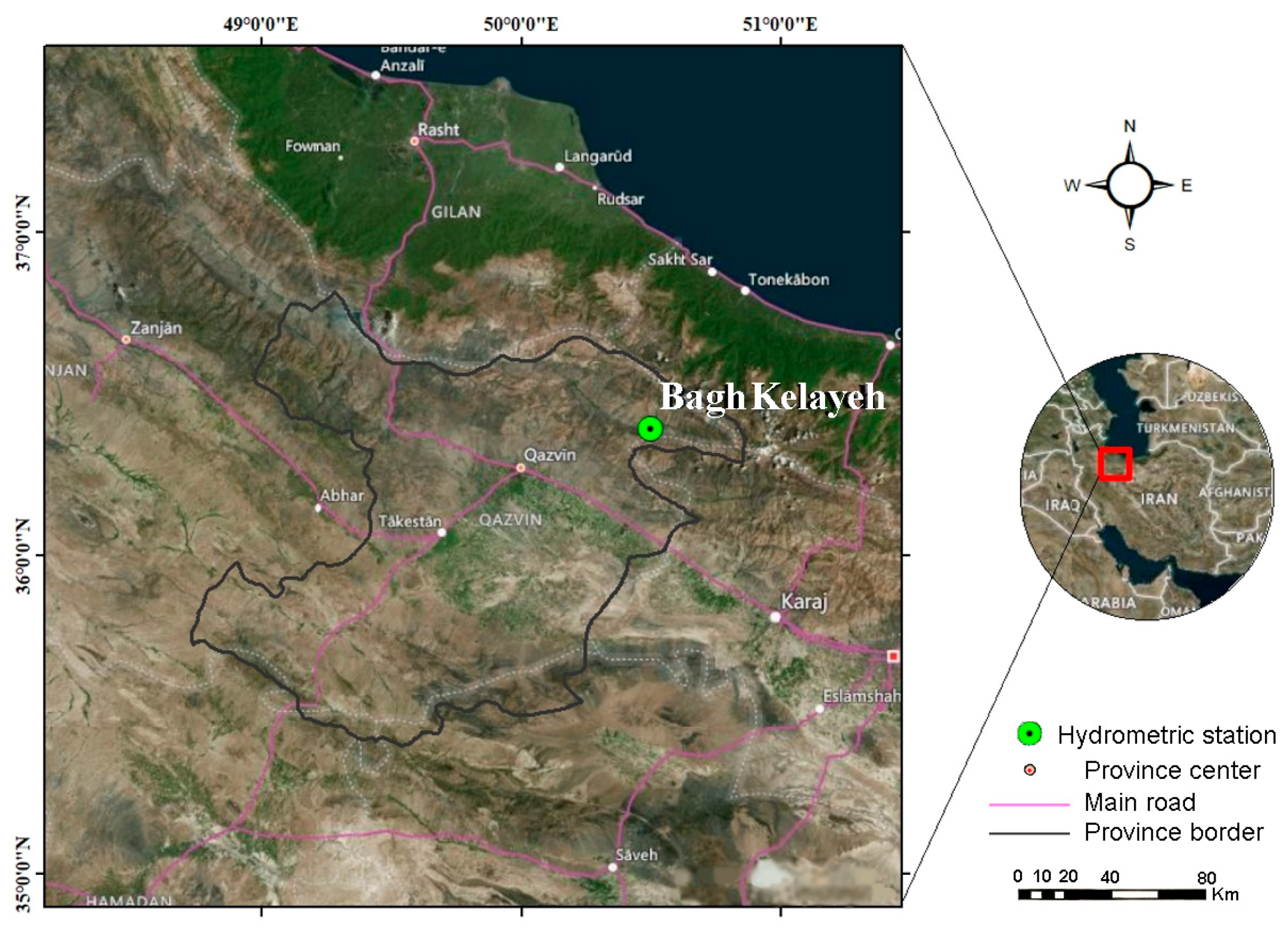
River sediment load estimation poses a critical challenge for water engineers due to its complex and nonlinear hydrological processes. This study assessed the amount of suspended sediment at the Bagh-e-Kalayeh hydrometric station on the Alamut River in the Qazvin province of Iran using two hydrological and meteorological variables, including discharge and rainfall, by considering three scenarios (discharge, discharge + monthly rainfall, and discharge + monthly rainfall + daily rainfall). For modeling, kernel-based data-driven methods, including Gaussian process regression (GPR) and support vector regression (SVR), and tree models, including the M5 tree, random forest (RF), random tree (RT), extra trees, reduced error pruning tree (REPT), and multi-search methods, were used. The results showed that the best performance was achieved by the SVR, with r = 0.948, Wilmot index = 0.965, and RMSE = 0.011 in the first scenario (only discharge). Discharge had the most significant impact on sediment estimation compared to rainfall. It was determined that the suspended sediment load in the Alamut River can be successfully estimated by the SVR method, where only the discharge was used as the input parameter. Additionally, the results indicated that given its characteristics and inherent features, the multi-search method can be used as a complementary approach in sediment modeling, especially in situations where the data volume is not extensive.
Keywords: extra trees; kernel functions; multiple search method; suspended sediment; tree methods extra trees; kernel functions; multiple search method; suspended sediment; tree methods