


Research on the Non-Point Source Pollution Characteristics of Important Drinking Water Sources

Abstract
1. Introduction
2. Materials and Methods
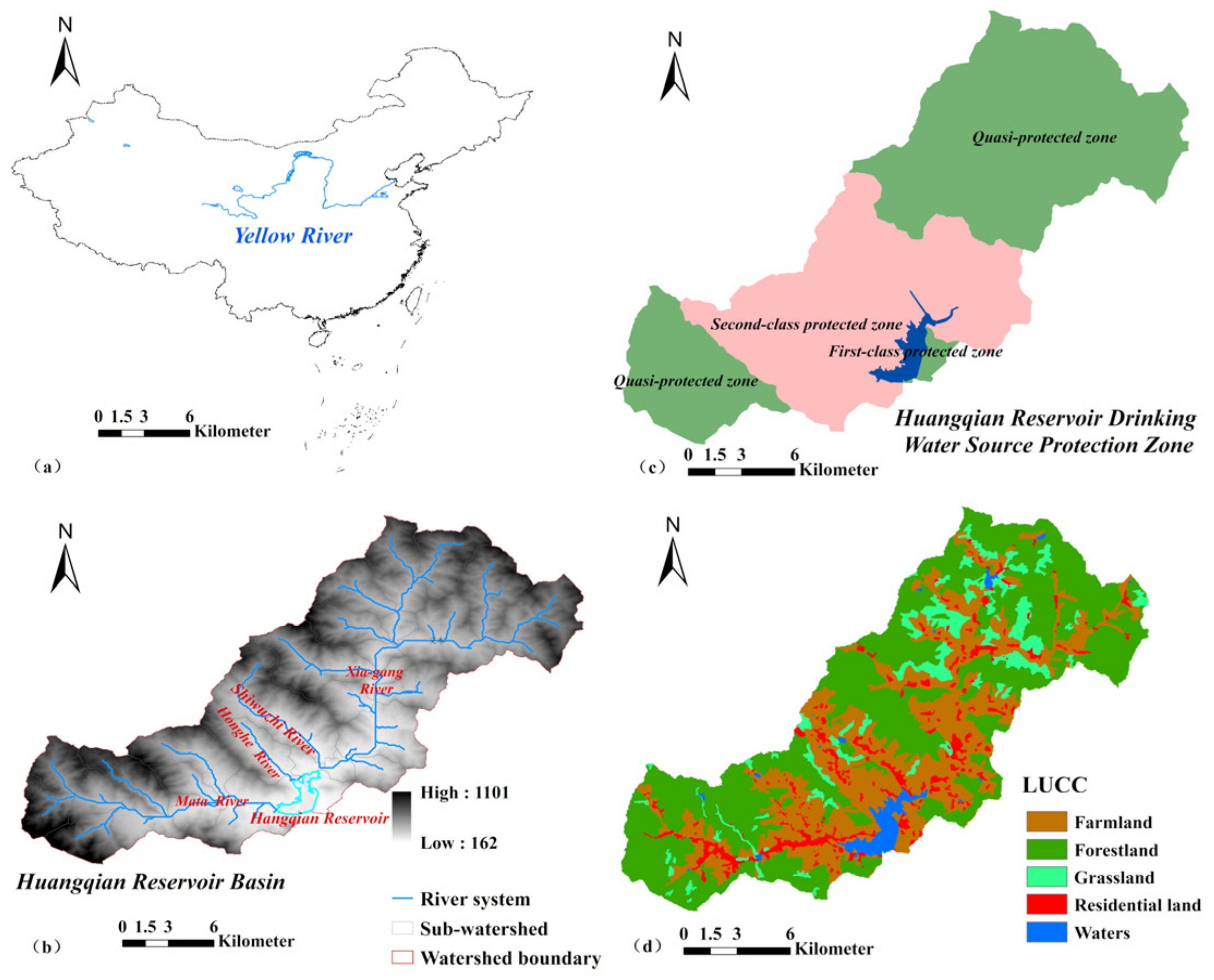
2.1. Study Area
2.2. Data Sources
2.3. The Modified Export Coefficient Model and Export Coefficient Determination
2.3.1. The Modified Export Coefficient
- (1)
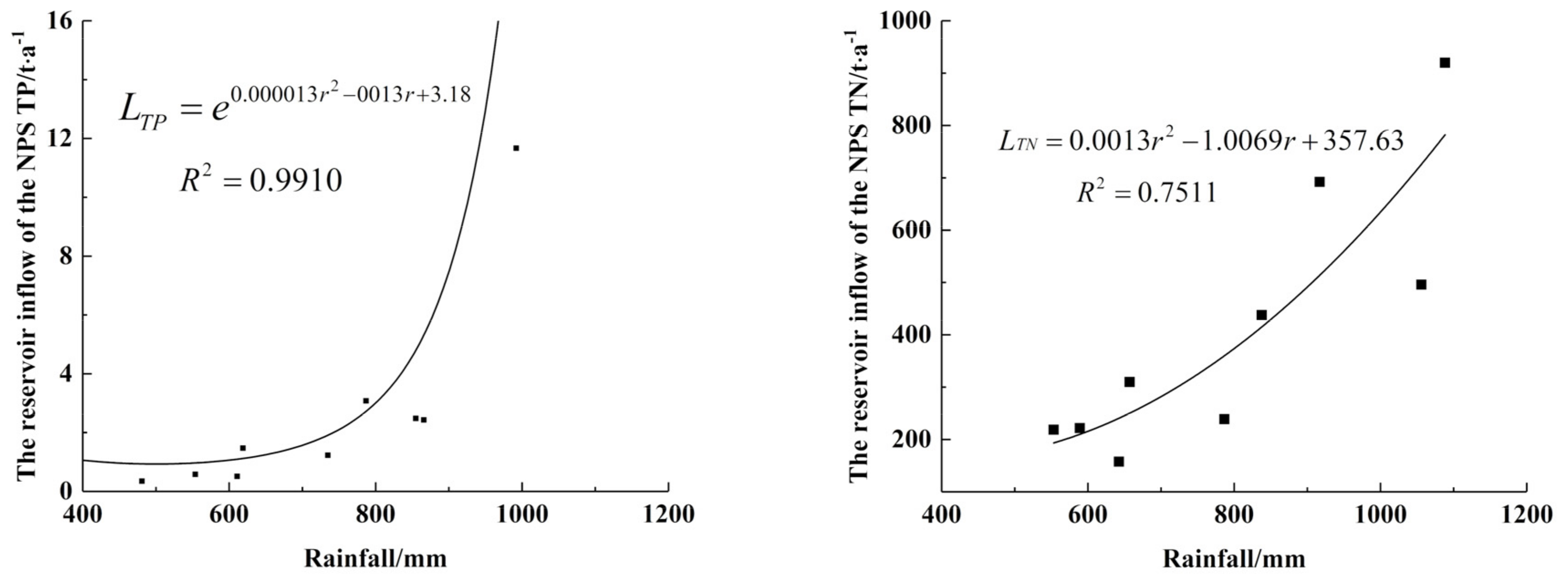
- Precipitation impact factor
- (2)
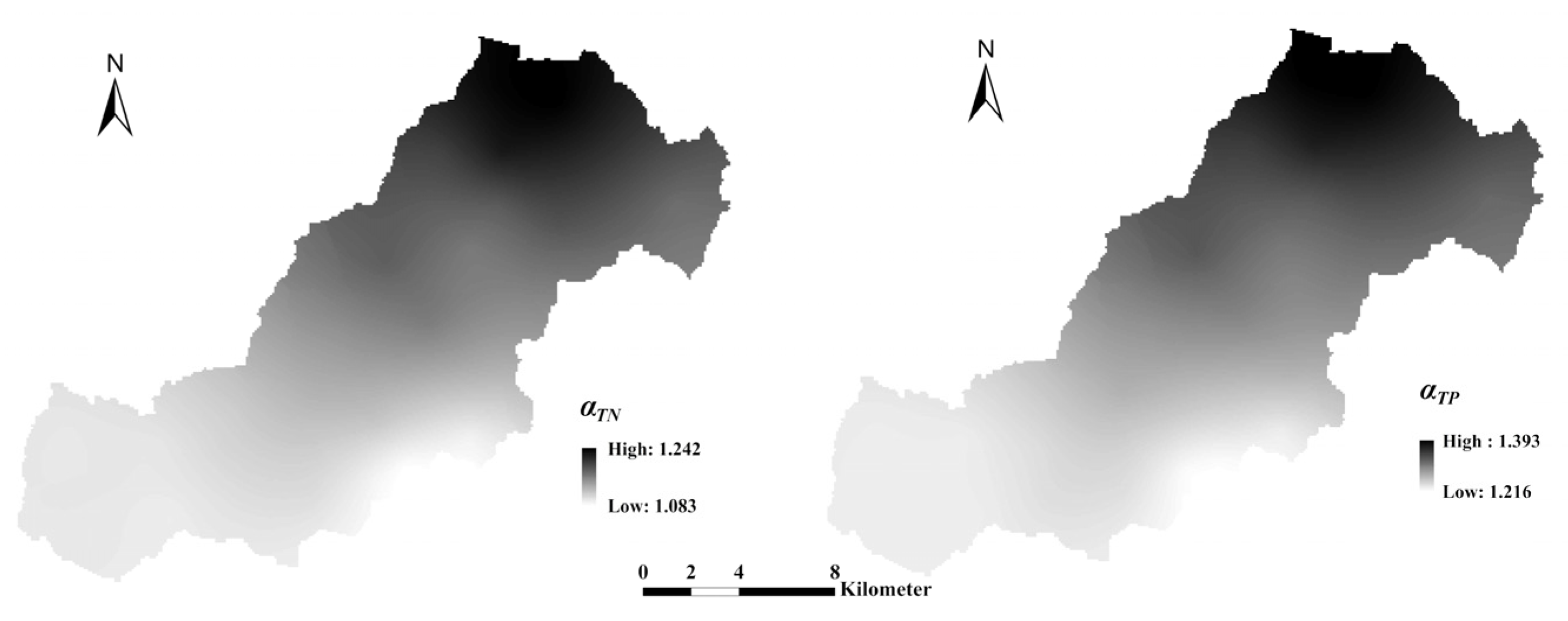
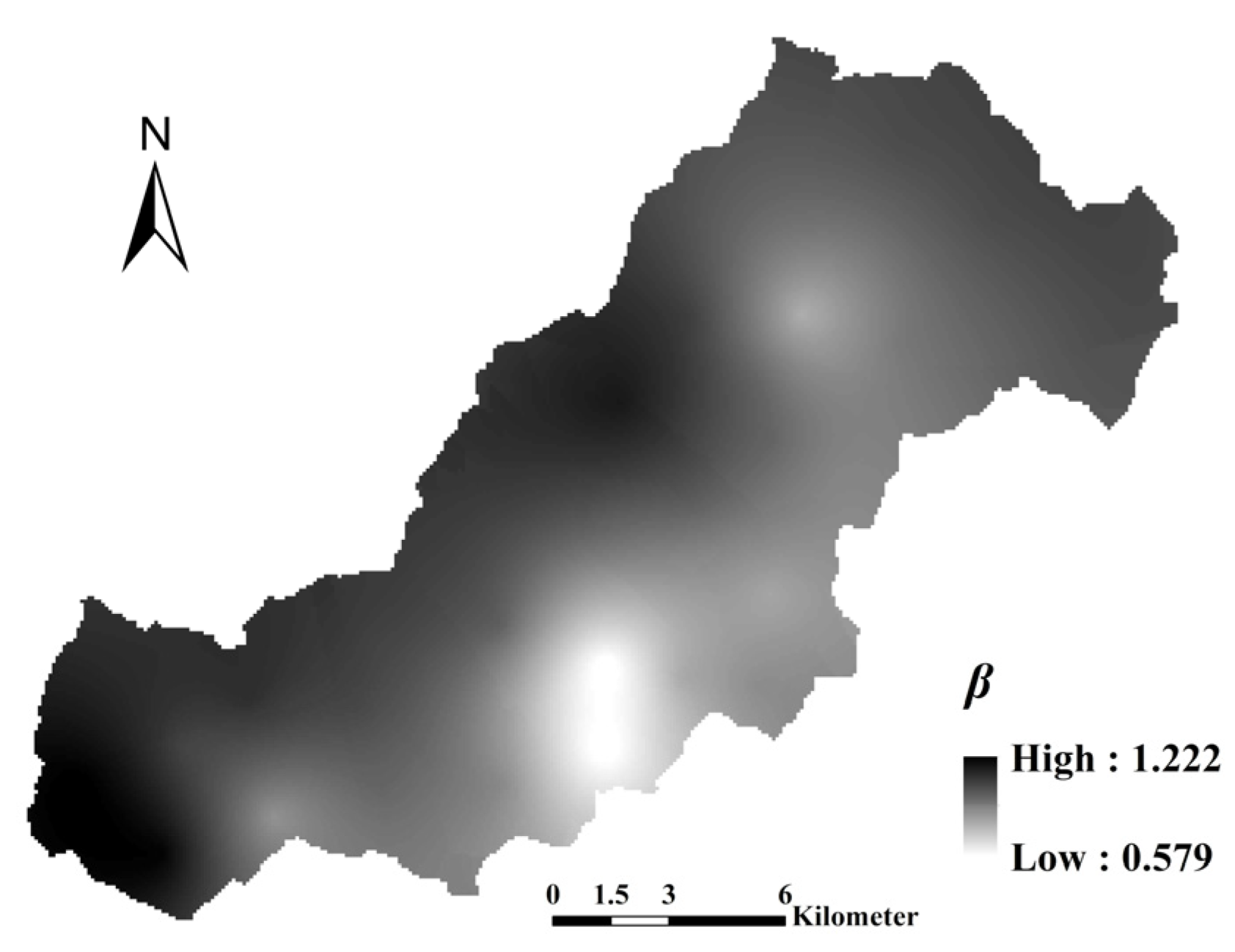
- Terrain influence factor
2.3.2. Determination of Export Coefficient Values
2.4. Non-Point Source Pollution Load Estimation and Model Validation
3. Results and Discussion
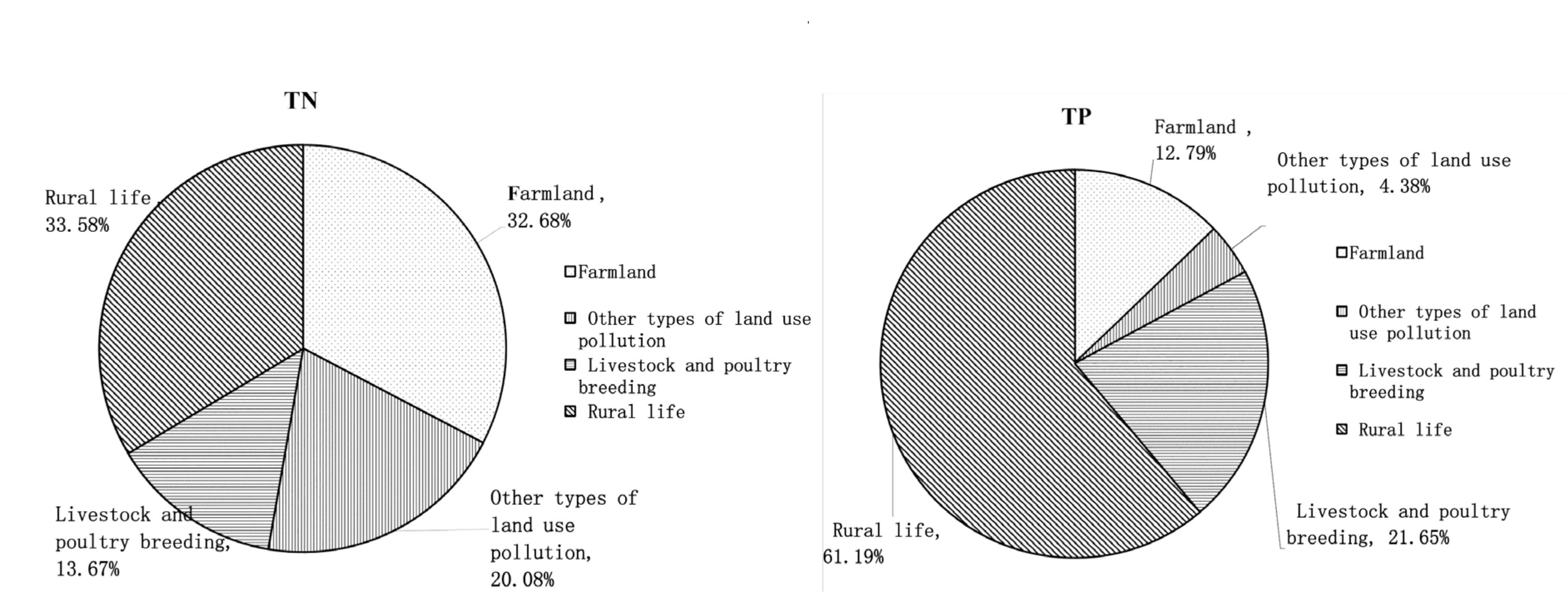
3.1. Source Analysis of Non-Point Source Total Nitrogen and Total Phosphorus Pollution in the Watershed
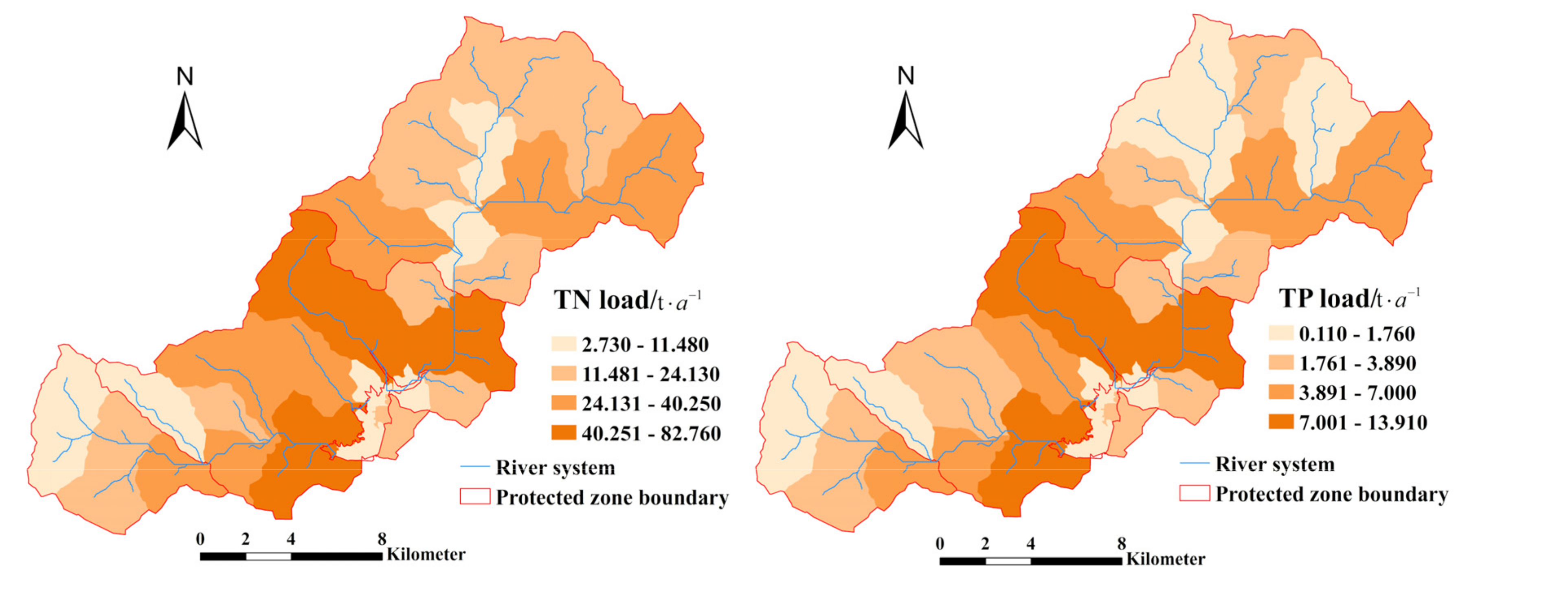
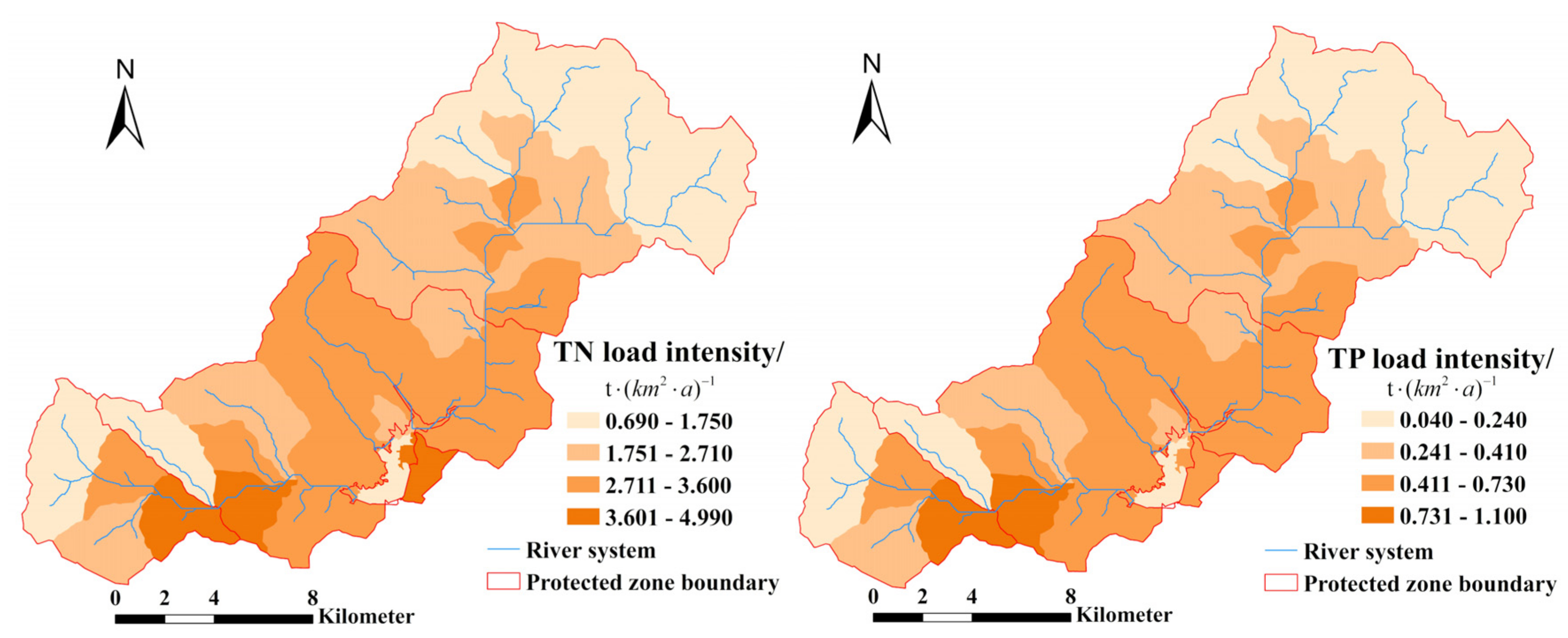
3.2. Spatial Distribution Characteristics of Non-Point Source Pollution in the Watershed
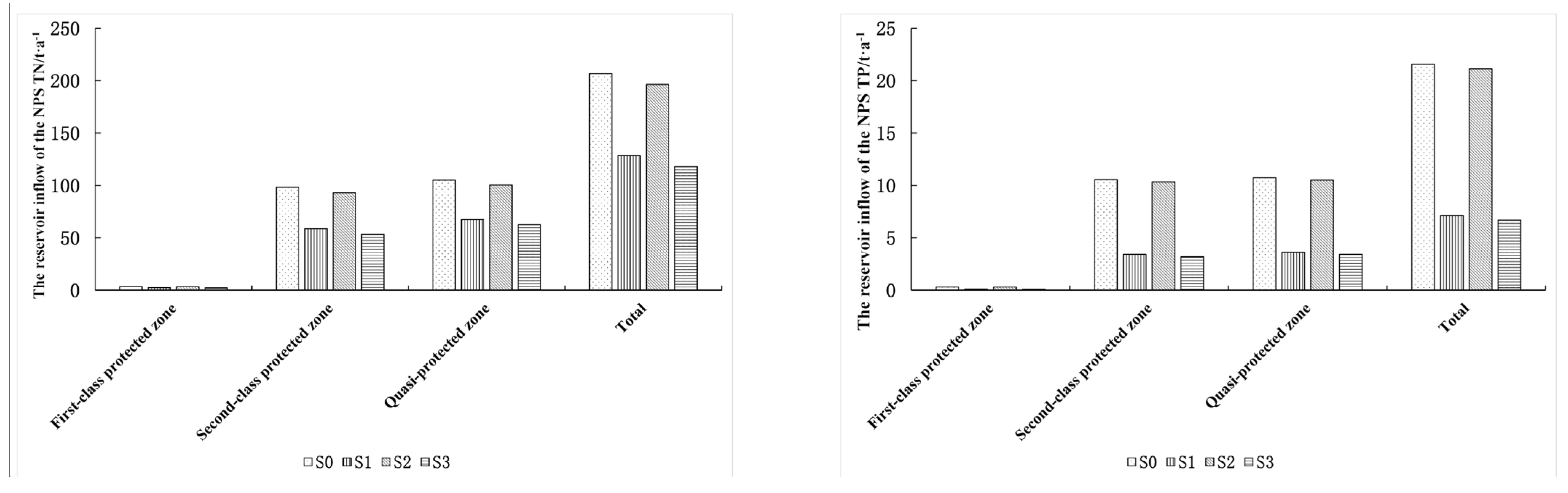
3.3. Analysis of Watershed Non-Point Source Pollution Load Control Scheme
4. Conclusions
Author Contributions
Funding
Institutional Review Board Statement
Data Availability Statement
Acknowledgments
Conflicts of Interest
References
- Wang, R.J.; Wang, Q.B.; Dong, L.S.; Zhang, J. Cleaner agricultural production in drinking-water source areas for the control of non-point source pollution in China. J. Environ. Manag. 2021, 285, 112096. [Google Scholar] [CrossRef] [Scilit]
- Wang, G.Q.; Li, J.W.; Sun, W.C.; Xue, B.; Yinglan, A.; Liu, T. Non-point source pollution risks in a drinking water protection zone based on remote sensing data embedded within a nutrient budget model. Water Res. 2019, 157, 238–246. [Google Scholar] [CrossRef] [Scilit] [PubMed]
- Yu, L.A.; Liu, X.D.; Hua, Z.L. Occurrence, distribution, and risk assessment of perfluoroalkyl acids in drinking water sources from the lower Yangtze River. Chemosphere 2021, 287, 132064. [Google Scholar] [CrossRef] [Scilit]
- He, J.; Charlet, L. A review of arsenic presence in China drinking water. J. Hydrol. 2013, 492, 79–88. [Google Scholar] [CrossRef] [Scilit]
- Ou, Y.; Wang, X. Identification of critical source areas for non-point source pollution in Miyun reservoir watershed near Beijing, China. Water Sci. Technol. 2008, 58, 2235–2241. [Google Scholar] [CrossRef] [Scilit]
- Zhang, M.; Xu, J. Nonpoint source pollution, environmental quality, and ecosystem health in China: Introduction to the special section. J. Environ. Qual. 2011, 40, 1685. [Google Scholar] [CrossRef] [Scilit]
- Xu, Q.G.; Xi, B.D.; Cao, J.L. Eutrophication and Regional Differences of Lakes in China; Science Press: Beijing, China, 2016. [Google Scholar]
- Ongley, E.D.; Zhang, X.L.; Yu, T. Current status of agricultural and rural non-point source Pollution assessment in China. Environ. Pollut. 2010, 158, 1159–1168. [Google Scholar] [CrossRef] [Scilit] [PubMed]
- Cheng, H.; Lin, C.; Wang, L.; Xiong, J.; Peng, L.; Zhu, C. The Influence of Different Forest Characteristics on Non-point Source Pollution: A Case Study at Chaohu Basin, China. Int. J. Environ. Res. Public Health 2020, 17, 1790. [Google Scholar] [CrossRef] [Scilit]
- Zhu, Q.D.; Sun, J.H.; Hua, G.F.; Wang, J.H.; Wang, H. Runoff characteristics and non-point source pollution analysis in the Taihu Lake Basin: A case study of the town of Xueyan, China. Environ. Sci. Pollut. Res. 2015, 22, 15029–15036. [Google Scholar] [CrossRef] [Scilit]
- Dong, Y. Coupling Simulation and Control Strategy of Urban and Rural Non-Point Source Pollution in Dianchi Lake Basin. Ph.D. Thesis, Tsinghua University, Beijing, China, 2016. [Google Scholar]
- Geng, R.Z.; Wang, X.Y.; Jiao, S.; Meng, F. Estimation and characteristic analysis of non-point source pollution load in the Miyun Reservoir watershed. Acta Sci. Circumstantiae 2013, 33, 1484–1492. [Google Scholar]
- Worrall, F.; Burt, T.P. The impact of land-use change on water quality at the catchment scale: The use of export coefficient and structural models. J. Hydrol. 1999, 221, 75–90. [Google Scholar] [CrossRef] [Scilit]
- Lam, Q.D.; Schmalz, B.; Fohrer, N. Assessing the spatial and temporal variations of water quality in lowland areas, Northern Germany. J. Hydrol. 2012, 438–439, 137–147. [Google Scholar] [CrossRef] [Scilit]
- Abdelwahab, O.M.M.; Ricci, G.F.; De Girolamo, A.M.; Gentile, F. Modelling soil erosion in a Mediterranean watershed: Comparison between SWAT and AnnAGNPS models. Environ. Res. 2018, 166, 363–376. [Google Scholar] [CrossRef] [Scilit] [PubMed]
- Shamshad, A.; Leow, C.S.; Ramlah, A.; Hussin, W.M.A.W.; Sanusi, S.A.M. Applications of AnnAGNPS model for soil loss estimation and nutrient loading for Malaysian conditions. Int. J. Appl. Earth Obs. Geoinf. 2008, 10, 239–252. [Google Scholar] [CrossRef] [Scilit]
- Tamanna, M.; Pradhanang, S.M.; Gold, A.J.; Addy, K.; Vidon, P.G.; Bingner, R.L. Evaluation of AnnAGNPS Model for Runoff Simulation on Watersheds from Glaciated Landscape of USA Midwest and Northeast. Water 2020, 12, 3525. [Google Scholar] [CrossRef] [Scilit]
- Yang, Y.F. Simulation of Non-Point Source Pollution in Yixing Plain River Network Based on HSPF Model. Master’s Thesis, Xi’an University of Architecture and Technology, Xi’an, China, 2015. [Google Scholar]
- Bai, X.Y.; Wei, S.; Shi, X.; Chen, X.H. Impact analysis of precipitation in Dongjiang River Basin on non-point source pollution based on HSPF model. J. Irrig. Drain. 2018, 37, 112–119. [Google Scholar]
- Johnes, P.J.; Heathwaite, A.L. Modelling the impact of land use change on water quality in agricultural catchments. Hydrol. Processes 1997, 11, 269–286. [Google Scholar] [CrossRef] [Scilit]
- Cai, M.; Li, H.E.; Zhuang, Y.T. Application of improved export coefficient method in non-point source pollution load estimation of watershed. J. Hydraul. Eng. 2004, 35, 40–45. [Google Scholar]
- Cheng, X.; Chen, L.D.; Sun, R.H.; Jing, Y.C. An improved export coefficient model to estimate non-point source phosphorus pollution risks under complex precipitation and terrain conditions. Environ. Sci. Pollut. Res. 2018, 25, 20946–20955. [Google Scholar] [CrossRef] [Scilit]
- Singh, J.; Knapp, H.V.; Arnold, J.G.; Demissie, M. Hydrological modeling of the iroquois river watershed using HSPF and SWAT. J. Am. Water Resour. Assoc. 2005, 41, 343–360. [Google Scholar] [CrossRef] [Scilit]
- Li, J.K.; Peng, K.; Hao, G.R.; Li, H.E.; Li, S. Research progress on quantification and control of non-point source pollution load in the Yellow River Basin. Water Resour. Prot. 2021, 37, 90–102. [Google Scholar]
- Ding, X.; Shen, Z.; Hong, Q.; Yang, Z.; Wu, X.; Liu, R. Development and test of the Export Coefficient Model in the Upper Reach of the Yangtze River. J. Hydrol. 2010, 383, 233–244. [Google Scholar] [CrossRef] [Scilit]
- Ding, Y.; Zhao, J.Y.; Dong, F.; Xu, Z.H.; Ma, B.; Peng, W.Q. Estimation and analysis of agricultural non-point source pollution load in Guishui River Basin. Water Resour. Hydropower Technol. 2020, 51, 139–146. [Google Scholar]
- Liu, Q.Q.; Singh, V.P. Effect of Microtopography, Slope Length and Gradient, and Vegetative Cover on Overland Flow through Simulation. J. Hydrol. Eng. 2004, 9, 375–382. [Google Scholar] [CrossRef] [Scilit]
- Aschmann, S.G.; Anderson, D.P.; Croft, R.J.; Cassell, E.A. Using a watershed nutrient dynamics model, WEND, to address watershed-scale nutrient management challenges. J. Soil Water Conserv. 1999, 54, 630. [Google Scholar]
- Zhang, N.M.; Yu, Y.; Hong, B.; Chen, J. Influencing factors of phosphorus pollution load in farmland soil runoff in Dianchi Lake Basin. Environ. Sci. 2003, 24, 155–157. [Google Scholar]
- Liu, R.M.; Yang, Z.F.; Ding, X.W.; Shen, Z.Y.; Wu, X.; Liu, F. Research on the impact of land use/cover change on non-point source pollution in the upper reaches of the Yangtze River. Environ. Sci. 2006, 27, 2407–2414. [Google Scholar]
- Li, G.; Mao, F. Evaluation of my country’s soil erosion-type non-point source pollution load and its economic loss. China Soil Water Conserv. 2008, 9–11, 60. [Google Scholar]
- Xing, B.X.; Chen, H. Estimation of agricultural non-point source pollution load and river inflow coefficient in Beijing. China Soil Water Conserv. 2016, 34–37, 77. [Google Scholar]
- Li, N.; Han, W.Z.; Shen, M.N.; Yu, S. Estimation of agricultural non-point source pollution load in reservoir catchment area based on export coefficient model. J. Agric. Eng. 2016, 32, 224–230. [Google Scholar]
- Liang, C.D.; Long, T.Y.; Li, J.C.; Liu, L.M. Research on Non-point Source Nitrogen and Phosphorus Loads in the Three Gorges Reservoir. Resour. Environ. Yangtze River Basin 2007, 16, 26–30. [Google Scholar]
- Wang, Y.X.; Zhong, P.L.; Yu, G.; Zou, L.; Zhen, Y.; Li, L. Estimation and time-space analysis of non-point source pollution load of nitrogen and phosphorus in Jiaozhou Bay. J. Ocean. Univ. China 2019, 49, 85–97. [Google Scholar]
- Hao, G.Z.; Song, F.Z.; Xu, L.; Zhu, G.Y. Estimation of agricultural non-point source pollution load in the upper reaches of Qingshui River based on the export coefficient model. Sci. Technol. Eng. 2020, 20, 13919–13927. [Google Scholar]
- Jing, Y.D.; Zhang, H.M.; Sun, X.X. Non-point source pollution output risk assessment based on the export coefficient model in Nansi Lake Basin. Bull. Soil Water Conserv. 2017, 37, 270–274, 278. [Google Scholar]
- Zhang, J.; He, J.S.; Zhou, F.; Yin, Z. Estimation and analysis of non-point source pollution load in the Hunhe River Basin. South--North Water Divers. Water Conserv. Sci. Technol. 2011, 9, 69–73. [Google Scholar]
- Meng, X.Y.; Yu, X.X.; Pan, X.Q. The impact of land use change on non-point source nitrogen pollution load in Yunmeng Lake Basin. Environ. Sci. 2012, 33, 1789–1794. [Google Scholar]
- Department of Natural Ecology Protection, General Administration of Environmental Protection China. Investigation and Control Measures of Pollution in Large-Scale Livestock and Poultry Breeding Industry; China Environmental Science Press: Beijing, China, 2002. [Google Scholar]
- Ye, F.; Bian, X.M.; Hu, D.W.; Li, S.M. Regional Difference Evaluation and Control Countermeasures of Agricultural Non-point Source Pollution in Jiangsu Province. Water Resour. Prot. 2006, 22, 86–88. [Google Scholar]
- Zheng, Y.T.; Wang, X.Y.; Yin, J.; Wang, L.R. Analysis on the characteristics of domestic waste generation in different types of villages in water source protection areas. J. Agric. Environ. Sci. 2008, 27, 1450–1454. [Google Scholar]
- Feng, Q. Investigation of Rural Living Pollution Characteristics and Public Environmental Awareness. Master’s thesis, Capital Normal University, Beijing, China, 2006. [Google Scholar]
- Zhu, M. Estimation and Evaluation of Agricultural Non-Point Source Pollution Load in Haihe River Basin. Ph.D. Thesis, Chinese Academy of Agricultural Sciences, Beijing, China, 2011. [Google Scholar]
- Chen, X.K.; Liu, X.B.; Peng, W.Q.; Dong, F.; Huang, Z.H.; Feng, S.X.; Wang, R.N. Estimation of non-point source pollution load in Chenghai Basin and its control countermeasures. Environ. Sci. 2018, 39, 77–88. [Google Scholar]
- Gao, X.Z. Fertilizer Practical Manual; China Agricultural Press: Beijing, China, 2002. [Google Scholar]

| Data Type | Resolution /Coverage Range | Utilization | Data Sources |
|---|---|---|---|
| Land use data | 30 × 30 m | Land use types and pollution source analysis | Chinese Academy of Sciences Resource and Environment Data Center |
| Meteorological data | Daily rainfall from five rainfall stations in Pengjiayu, Ximata, Qincun, Huangqian Reservoir, and Xiagang—2010 to 2018 | Rainfall influence analysis | Tai’an Hydrological Center; China Meteorological Data Network |
| Water quality and quantity data | Runoff and water quality data for 2018 | Model calibration | Tai’an Hydrological Center; Huangqian Reservoir Management Bureau |
| Digital elevation data (DEM) | 30 m | Terrain impact analysis | China Geospatial Data Cloud |
| Socioeconomic data | Huangqian reservoir water source area | Livestock breeding and rural life pollution analysis | Daiyue District Statistical Yearbook of Tai’an City, Shandong Province (2018) |
| Pollution Source | Unit | Category | TN Export Coefficient | TP Export Coefficient |
|---|---|---|---|---|
| Land use | t·km−2·a−1 | Farmland | 2.302 | 0.13 |
| Forestland | 0.434 | 0.015 | ||
| Grassland | 1.152 | 0.035 | ||
| Residential land | 1.296 | 0.032 | ||
| Water area | 1.500 | 0.036 | ||
| Livestock/ poultry breeding | kg·head (only)−1·a−1 | Bovine | 16.412 | 1.204 |
| Pig | 1.208 | 0.243 | ||
| Sheep | 0.37 | 0.132 | ||
| Poultry | 0.023 | 0.01 | ||
| Rural life | kg·a−1 | Domestic sewage | 0.4607 | 0.0587 |
| kg·person−1·a−1 | Domestic waste | 0.9806 | 0.337 | |
| Feces, urine | 1.1242 | 0.2792 |
| Pollution Source | Category | TN | TP | ||||
|---|---|---|---|---|---|---|---|
| Load/t·a−1 | Load Percentage/% | Load Intensity /t·(km2·a)−1 | Load/t·a−1 | Load Percentage/% | Load Intensity /t·(km2·a)−1 | ||
| Land use | Farmland | 231.08 | 61.94 | 2.53 | 14.63 | 74.47 | 0.16 |
| Forestland | 76.83 | 20.60 | 0.52 | 3.01 | 15.33 | 0.02 | |
| Grassland | 32.16 | 8.62 | 1.36 | 1.10 | 5.62 | 0.05 | |
| Waters | 8.17 | 2.19 | 1.26 | 0.22 | 1.12 | 0.03 | |
| Residential land | 24.81 | 6.65 | 1.40 | 0.68 | 3.47 | 0.04 | |
| Total | 373.05 | 100.00 | 7.07 | 19.64 | 100.00 | 0.30 | |
| Livestock and poultry breeding | Cattle | 39.28 | 40.65 | - | 3.23 | 13.04 | - |
| Pig | 15.05 | 15.57 | - | 3.39 | 13.69 | - | |
| Sheep | 28.20 | 29.18 | - | 11.28 | 45.54 | - | |
| Poultry | 14.10 | 14.59 | - | 6.87 | 27.74 | - | |
| Total | 96.63 | 100.00 | - | 24.77 | 100.00 | - | |
| Rural life | Domestic sewage | 42.64 | 17.96 | - | 6.09 | 8.70 | - |
| Domestic garbage | 90.75 | 38.22 | - | 34.96 | 49.94 | - | |
| Stool and urine | 104.04 | 43.82 | - | 28.96 | 41.37 | - | |
| Total | 237.43 | 100.00 | - | 70.01 | 100.00 | - | |
| Scheme | Fertilizer Application | Rural Livestock and Poultry Manure Utilization Rate | Rural Domestic Sewage Utilization Rate | Domestic Waste and Fecal Pollutant Utilization Rate |
|---|---|---|---|---|
| Present Situation (S0) | Unchanged | Unchanged | Unchanged | Unchanged |
| Scheme 1 (S1) | Unchanged | Reached 90% | Reached 63% | Reached 81% |
| Scheme 2 (S2) | Reduced 15% | Unchanged | Unchanged | Unchanged |
| Scheme 3 (S3) | Reduced 15% | Reached 90% | Reached 63% | Reached 81% |
Publisher’s Note: MDPI stays neutral with regard to jurisdictional claims in published maps and institutional affiliations. |
© 2022 by the authors. Licensee MDPI, Basel, Switzerland. This article is an open access article distributed under the terms and conditions of the Creative Commons Attribution (CC BY) license (https://creativecommons.org/licenses/by/4.0/).
Share and Cite
Hou, L.; Zhou, Z.; Wang, R.; Li, J.; Dong, F.; Liu, J. Research on the Non-Point Source Pollution Characteristics of Important Drinking Water Sources. Water 2022, 14, 211. https://doi.org/10.3390/w14020211
Hou L, Zhou Z, Wang R, Li J, Dong F, Liu J. Research on the Non-Point Source Pollution Characteristics of Important Drinking Water Sources. Water. 2022; 14(2):211. https://doi.org/10.3390/w14020211
Chicago/Turabian StyleHou, Lei, Zhongyuan Zhou, Ruyan Wang, Jianxin Li, Fei Dong, and Jingqiang Liu. 2022. "Research on the Non-Point Source Pollution Characteristics of Important Drinking Water Sources" Water 14, no. 2: 211. https://doi.org/10.3390/w14020211
APA StyleHou, L., Zhou, Z., Wang, R., Li, J., Dong, F., & Liu, J. (2022). Research on the Non-Point Source Pollution Characteristics of Important Drinking Water Sources. Water, 14(2), 211. https://doi.org/10.3390/w14020211

