Article

Influence of NOx on the Physical and Chemical Properties of Isoprene SOA

by
Charalampos Aristotelis Tzouvaras
1,2,
Anna Manouka
1,
Anna Maria Paspala
1,
Alexandros Naidos
1,
Eleni Karnezi
3 and
Evangelia Kostenidou
1,2,*
1
Department of Environmental Engineering, Democritus University of Thrace, 67100 Xanthi, Greece
2
Unit of Environmental and Networking Technologies and Applications, ATHENA-RIC, University Campus, Kimmeria, 67100 Xanthi, Greece
3
Earth Sciences Department, Barcelona Supercomputing Center, 08034 Barcelona, Spain
*
Author to whom correspondence should be addressed.
Atmosphere 2026, 17(4), 344; https://doi.org/10.3390/atmos17040344
Submission received: 3 February 2026 / Revised: 18 March 2026 / Accepted: 24 March 2026 / Published: 29 March 2026
(This article belongs to the Section Aerosols)

Abstract

Isoprene is a significant source of secondary organic aerosol (SOA) in the atmosphere. This study investigates the physicochemical properties of isoprene-derived SOA formed through ozonolysis and photooxidation under varying NOx conditions in an environmental chamber. SOA produced by dark ozonolysis and under low NOx conditions had a density of 1.35–1.38 g cm−3 and an organic-to-carbon (O:C) ratio of 0.89–0.97. It was relatively volatile, consisting of semi-volatile organic compounds (SVOCs, 40%) and low-volatility organic compounds (LVOCs, 52%), with a small fraction of extremely low-volatility organic compounds (ELVOCs, ~7%); its vaporization enthalpy (ΔHvap) was 90–106 kJ mol−1. Under high NOx conditions (isoprene/NOx ratios = 1.2–6.8, with isoprene units in ppbC), SOA exhibited lower density (1.26–1.29 g cm−3) and lower O:C ratios (0.62–0.72). It was also less volatile than SOA formed under dark ozonolysis and low NOx conditions; volatility decreased with decreasing isoprene/NOx ratio, while ΔHvap increased from 65 to 95 kJ mol−1. SOA formed under very high NOx conditions (isoprene/NOx ratio = 0.6) was characterized by a higher density (1.34 g cm−3) and O:C ratio (0.88). However, it was the least volatile, comprising 68% LVOCs and 32% ELVOCs, and had the highest ΔHvap of 114 kJ mol−1. At low isoprene/NOx ratios (0.6–1.2) yields were suppressed (0.6%) in comparison to those (6.8%) at higher isoprene/NOx ratios (5–7).

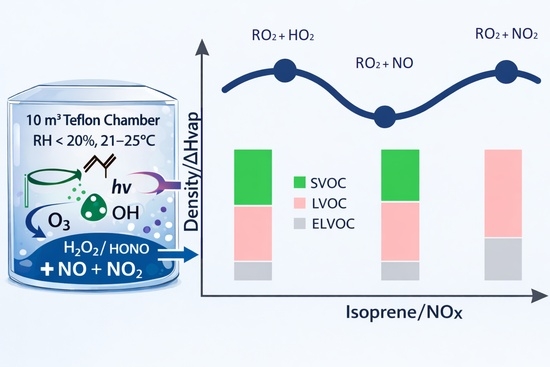
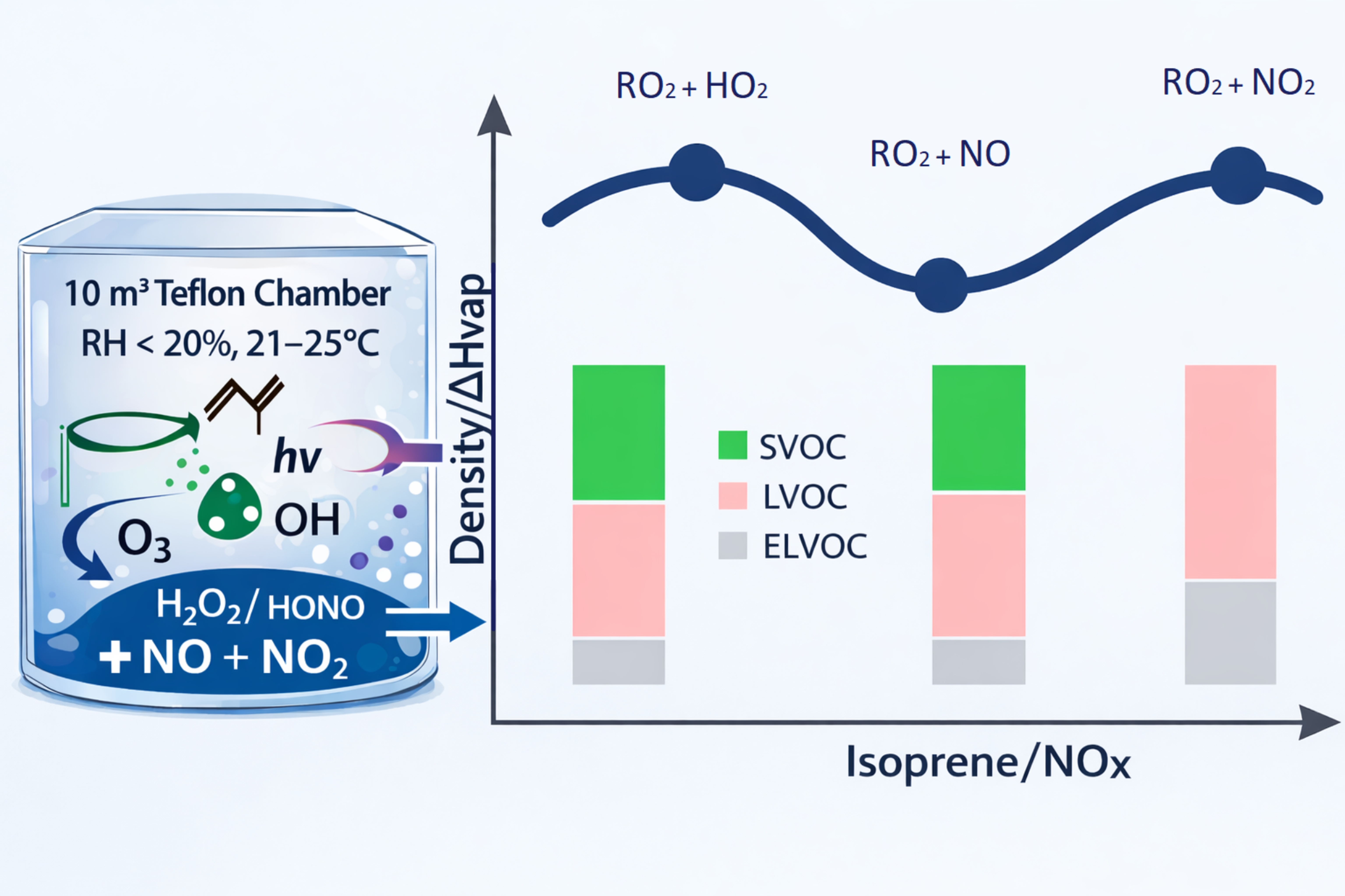
Graphical Abstract

1. Introduction

Isoprene (2-methyl-1,3-butadiene, C5H8) is the most abundant nonmethane hydrocarbon emitted into the atmosphere with a global flux of approximately 535 Tg/year [1]. Isoprene reacts with atmospheric oxidants and the lower-volatility oxidation products are transferred to the particulate phase, forming SOA [2,3]. Isoprene SOA formation has been studied both in field measurements and laboratory experiments with a focus on chemical composition and yield [4,5,6,7,8,9,10,11,12]. Nitrogen oxides (NOx = NO + NO2) strongly influence SOA formation through their impact on organic peroxy radical (RO2) chemistry [5,13,14,15]. However, relatively few studies have examined how NOx affects the physicochemical properties of isoprene SOA.
Although biogenic SOA density has been broadly investigated [16,17,18], data specific to isoprene SOA density remains limited and inconsistent. Kroll et al. [19] estimated a density of~1.4 g cm−3 under high NOx conditions using Differential Mobility Analyzer (DMA) and Aerosol Mass Spectrometer (AMS) data. Later, Kroll et al. [5] reported densities of 1.25 ± 0.01 g cm−3 and 1.35 ± 0.05 g cm−3 for low and high NOx, respectively, by using the AMS vacuum aerodynamic diameter and the Scanning Mobility Particle Sizer (SMPS) mobility diameter. The same technique was applied by Xu et al. [13] who found isoprene SOA densities 1.3 g cm−3 and 1.4 g cm−3 for low and high NOx experiments correspondingly. Clark et al. [14] using an Aerosol Particle Mass Analyzer (APM) and an SMPS measured the isoprene SOA densities at various temperatures, and they found values of 1.35 g cm−3, 1.4 g cm−3 and 1.32 g cm−3 for ozonolysis, low and high NOx conditions respectively at 300 K. These discrepancies indicate that there is an uncertainty regarding the isoprene SOA density at various conditions and highlight the need for more systematic investigation.
Volatility is another underexplored parameter of isoprene SOA. In the ambient, isoprene SOA volatility distribution has been estimated in three studies, all of them during the Southern Oxidant and Aerosol Study (SOAS) that took place in the southeastern United States. During this campaign, isoprene epoxydiols IEPOX SOA (i.e., low NOx isoprene SOA products) were identified. Based on the Filter Inlet for Gases and AEROsols coupled to a Chemical-Ionization Mass Spectrometer (FIGAERO-CIMS) signals of C5H12O4 and C5H10O3, Lopez-Hilfiker et al. [20] suggested that the IEPOX SOA had a very low saturation concentration of C* = 10−4 μg m−3. Hu et al. [21] using ambient and thermodenuded AMS measurements, Positive Matrix Factorization (PMF) analysis and the technique of Faulhaber et al. [22], estimated an average volatility of C* = 5.2 × 10⁻⁵ μg m−3 for the IEPOX SOA. Kostenidou et al. [23] found an IEPOX SOA saturation concentration of C* = 1.05 ± 0.3 μg m−3 and a vaporization enthalpy of 63 ± 15 kJ mol−1 using AMS measurements (both ambient and thermodenuded), PMF analysis and applying the dynamic mass transfer model of Riipinen et al. [24]. These results suggest large uncertainties in the volatility distribution of low NOx isoprene SOA.
Smog chamber studies on isoprene SOA volatility are also limited. Xu et al. [13] performed thermodenuder measurements on isoprene photooxidation SOA at low and high NOx conditions. Using the thermograms, they found that low NOx SOA was more volatile than high NOx SOA and they concluded that at high NOx conditions the volatility exhibits a non-linear dependence on NOx levels. Clark et at. [14], deploying a thermodenuder at 100 °C and size selected particles, found that ozonolysis and low NOx isoprene SOA was more volatile compared to high NOx SOA. Kleindienst et al. [7] reported an effective vaporization enthalpy of 42 kJ mol−1 for isoprene ozonolysis SOA, while Kleindienst et al. [8] found that the effective vaporization enthalpy from isoprene photooxidation SOA in the absence and presence of NOx were 38.4 and 43.2 kJ mol−1, respectively. However, no comprehensive study has yet addressed the volatility distribution of isoprene SOA across ozonolysis, low, and high NOx regimes.
In this work we conducted smog chamber isoprene ozonolysis, low and high NOx photooxidation experiments at varying NOx concentrations. SOA was chemically characterized, and at the same time the density, volatility distribution, vaporization enthalpy and yield were quantified. In addition, the effect of NOx concentration on the above properties was investigated. To our knowledge, this is the first study to systematically investigate how isoprene SOA density, volatility distribution, and vaporization enthalpy vary with NOx concentration across a range of isoprene/NOx ratios. While previous chamber studies have reported SOA densities and vaporization enthalpies under high- and low NOx conditions, they did not examine their evolution as the isoprene/NOx ratio changes. Regarding volatility, only one previous chamber study [13] examined the mass fraction remaining (MFR) as a function of NOx concentration. Here, we go beyond MFR measurements by deriving the volatility distribution and vaporization enthalpy of isoprene SOA as a function of the isoprene/NOx ratio. A list of abbreviations used throughout this manuscript is provided in the abbreviations section.

2. Materials and Methods

The experiments were conducted at the environmental chamber facilities of the Foundation for Research and Technology-Hellas (FORTH-ASC) in Patras. Isoprene reacted with ozone in the dark or with OH radicals produced either by H2O2 or by HONO photolysis under UV illumination ( j N O 2 = 0.59 min−1). SOA formation started within a few minutes to approximately 2.5 h after the initiation of photooxidation or ozonolysis.

2.1. Experimental Set Up

A 10 m3 Teflon environmental chamber was used for the experiments. The relative humidity (RH) was consistently maintained below 20% to minimize the influence of aerosol liquid water and aqueous-phase chemistry and to isolate the effect of NOx levels on SOA formation and properties. Τhe temperature ranged between 21 °C and 25 °C. Prior to each experiment, the chamber was flushed with purified dry air for 12–15 h and then filled with clean air containing fewer than 1 particle cm−3. Isoprene (Sigma-Aldrich, St. Louis, MO, USA; purity ≥ 99.5%) was subsequently injected. In the dark ozonolysis experiment, ozone was generated using an ozone generator (Azco Industries Inc., Cincinnati, OH, USA; HTU500ACPS), without OH scavenger added. For the OH photooxidation experiments, either an H2O2 solution (35 wt% in H2O2, Sigma-Aldrich, St. Louis, MO, USA) or a HONO solution, prepared as described in Kostenidou et al. [25] was introduced into the chamber via a bubbler. In each HONO experiment, the bubbling time varied, resulting in different OH radical and NOx concentrations produced through HONO photolysis. For the photolysis experiments, UV lamps (Osram GmbH, Munich, Germany; model L36W/73) were used as the light source. The experimental parameters are summarized in Table 1.
The size-resolved chemical composition and mass concentration of the SOA were measured using an Aerodyne High-Resolution Time-of-Flight Aerosol Mass Spectrometer (HR-ToF-AMS; Aerodyne Research Inc., Billerica, MA, USA) [26]. A Scanning Mobility Particle Sizer (SMPS; classifier model 3080, DMA model 3081, CPC model 3775, TSI Inc., Shoreview, MN, USA) provided measurements of particle size, number, and volume distributions.
A thermodenuder (TD) [25,27,28] was employed to measure the mass fraction remaining (MFR), providing information about the volatility of isoprene SOA. The aerosol flow alternated every 3 min between a bypass line and the thermodenuder line. In both cases, the sample was analyzed by the HR-ToF-AMS and the SMPS. The thermodenuder was operated at temperatures between 25 °C and 250 °C, with a centerline residence time of 14 s. Τhermodenuder measurements began after the SOA mass concentration had reached its maximum value.
Volatile organic compound (VOC) concentrations were monitored using a Proton Transfer Reaction Mass Spectrometer (PTR-MS, Ionikon Analytik GmbH, Innsbruck, Austria) for 48 different m/z values, with a resolution of 11 s. The inlet tube and reaction chamber were maintained at 60 °C, while the drift tube pressure was 2.2 mbar, and the applied voltage was 600 V. NOx and O3 concentrations were measured using the corresponding analyzers (Teledyne Instruments Inc., San Diego, CA, USA; models T201 and 400E, respectively). T201 employs a molybdenum catalytic converter to convert NO2 to NO prior to detection. Under these conditions, other oxidized nitrogen species such as HONO may also be partially converted to NO in the converter and contribute to the reported NO2 signal. Therefore, during the HONO photolysis experiments, the reported NO2 (and consequently NOx) concentrations may include significant contributions from HONO present in the chamber. Therefore, the reported NOx values should be interpreted as NOy-like measurements. Gas standards (Air Liquide, Paris, France) were used for calibration.

2.2. Data Analysis

2.2.1. AMS Data Analysis

HR-ToF-AMS data were analyzed using standard HR-ToF-AMS softwares, SQUIRREL v1.60A and PIKA v1.20A, with Igor Pro 9 (Wavemetrics, Portland, OR, USA). Elemental ratios were estimated using the method of Canagaratna et al. [29] and the fragmentation table of Aiken et al. [30].

2.2.2. OH Calculation

OH concentrations were calculated based on isoprene decay by tracking the m/z 69 signal in PTR-MS and using a reaction rate constant of 1.01 × 10⁻¹⁰ cm3 molecule−1 s−1 for OH [31]. For the photooxidation experiments, the OH concentration ranged between 8 × 10⁵ and 2.5 × 10⁷ molecules cm−3.

2.2.3. Particle Wall-Loss Corrections

Particle wall-losses in the smog chamber were corrected using the approach described by Wang et al. [32] which accounts for size-dependent particle correction. The wall loss rate constant (k) was determined using dry polydisperse ammonium sulfate particles. These measurements were performed between experiments.

2.2.4. SOA Density and Collection Efficiency (CE)

The density of SOA and the CE of the HR-ToF-AMS (both bypass and thermodenuded) were estimated by applying the algorithm of Kostenidou et al. [6] which matches AMS mass distributions to SMPS volume distributions.

2.2.5. Thermodenuder Loss Corrections

To correct for particle losses inside the thermodenuder, we followed the procedure suggested by Louvaris [28]. Ammonium sulfate particles were passed through the bypass and TD line at different temperatures. For the particle losses quantification, we compared the bypass and TD SMPS distributions for each size bin and temperature.

2.2.6. Mass Fraction Remaining

MFR was calculated based on SMPS measurements. The TD volume concentrations were first corrected for particle losses inside the thermodenuder, and then the volume fraction remaining (VFR) was determined. VFR was converted to MFR using the bypass and the TD SOA densities measured for each experiment.

2.2.7. Volatility Distributions

SOA volatility was estimated using the dynamic mass transfer model of Riipinen et al. [24]. The model simulates particle evaporation inside the thermodenuder using experimental parameters as inputs, including the loss-corrected MFR, thermodenuder temperature and residence time, the average bypass particle size and SOA concentration as well as the accommodation coefficient (αm). This model outputs the predicted MFR, the SOA volatility distribution at 298 K and the effective vaporization enthalpy by minimizing the error between model predictions and measurements. This constrained optimization reduces the number of free parameters and therefore limits the possibility of overfitting the thermodenuder data. In this analysis we investigated a 6-bin solution with a variable mass fraction value for each bin in the range of C* = 10−6 to 10 µg m−3 and assuming a mass accommodation coefficient of unity. The optimal bin range for each experiment was determined using the error analysis method proposed by Karnezi et al. [33], which identifies an ensemble of parameter combinations that reproduce the measured thermograms and uses them to derive uncertainty ranges.

2.2.8. Yield Calculation

SOA yields were calculated from SMPS volume concentrations, corrected for particle losses on the chamber walls and converted to mass using the experimentally determined SOA density. For both low and high NOx conditions we used the final mass concentrations. The yield (Y) was calculated using the following equation:
Y = CSOA/ΔVOC
where CSOA is the SOA mass concentration and ΔVOC is the mass concentration of VOC (isoprene) that reacted during photooxidation.

3. Results and Discussion

Isoprene oxidation proceeds through different pathways depending on NOx levels. Under low NOx conditions, RO2 radicals primarily react with HO2, leading to the formation of IEPOX and subsequent SOA products such as 2-methyltetrols and 2-methyl alkenetriols. Under high NOx conditions, RO2 reacts mainly with NO forming intermediates such as methacrolein-derived peroxy radical (MACRO2), which can subsequently react with NO2 to form methacryloyl peroxy nitrate (MPAN) and lead to products such as 2-methylglyceric acid (2-MG), oligomers and organic nitrates. At higher NOx concentrations, MACRO2 reacts preferentially with NO rather than NO2, resulting in fragmentation into smaller, more volatile species and/or the formation of organic nitrate compounds, and at the same time the formation of lower amounts of 2-MG. These pathways influence the oxidation state, volatility distribution, and density of the resulting SOA. Scheme S1 shows a schematic representation of the main chemical pathways. It should be noted that in this study the reported NOx concentrations in the HONO experiments correspond to NOy-like measurements due to potential HONO interference. However, HONO photolysis leads to the formation of NO and OH, and therefore the isoprene/NOx ratio can still be interpreted as an indicator of the prevailing RO2 reaction regimes.

3.1. HR-ToF-AMS Mass Spectrum and O:C Ratio

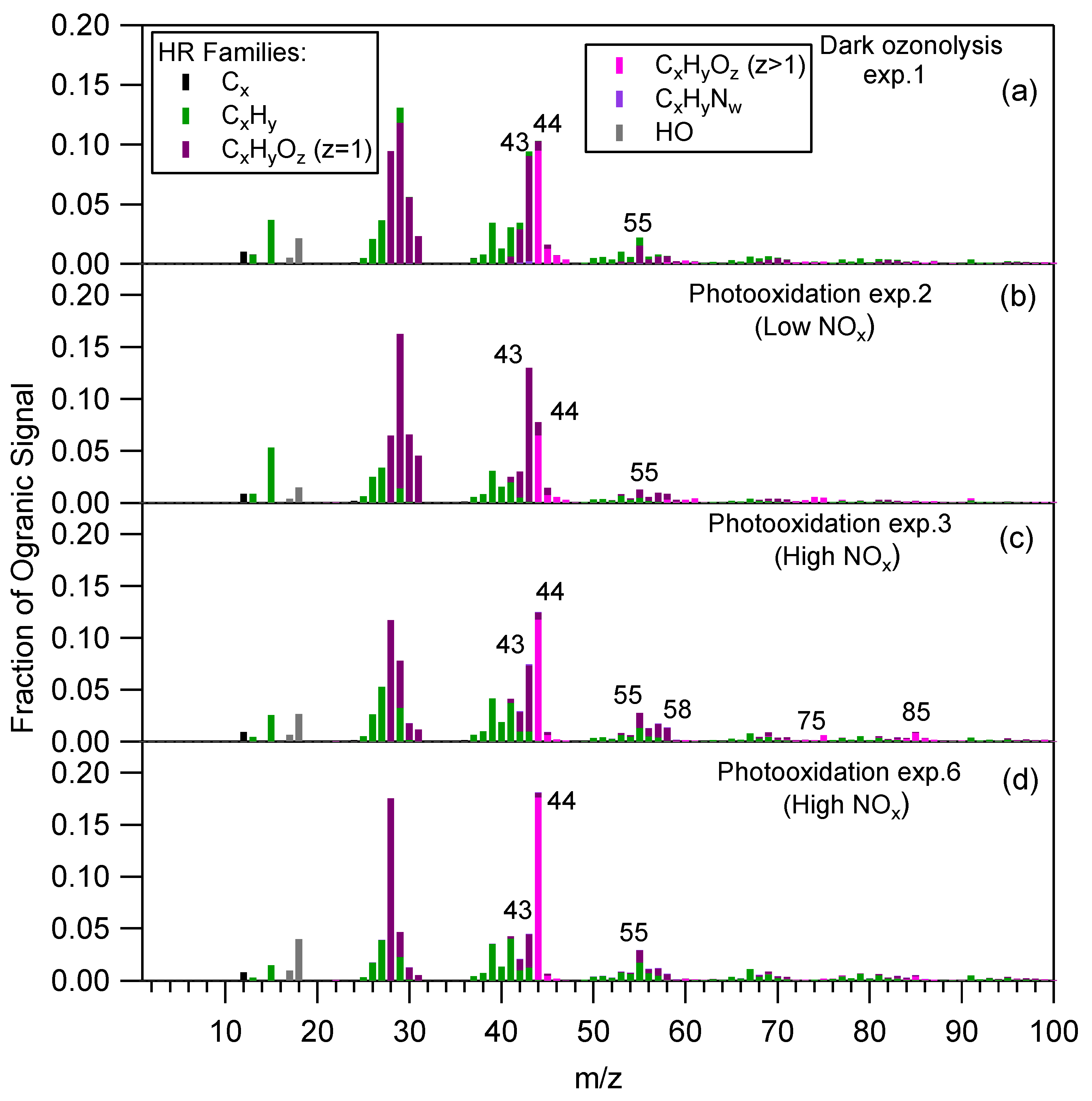
The high-resolution mass spectra for experiments 1, 2, 3 and 6 and for experiments 4, 5 and 7 are shown in Figure 1 and Figure S1, respectively. In the high NOx cases (experiments 3–7) m/z 44 (i.e., CO2+ fragment) was the dominant peak. This could be attributed mainly to 2-MG (and its oligomers) as well as to organic nitrate compounds formed under high NOx conditions through the pathway of MACRO2 + NO2 that produces MPAN [4,6]. The fraction of m/z 44 (f44) increased from 0.11 to 0.22 with increasing initial NOx levels, indicating a greater contribution from 2-MG, its oligomers, and organic nitrates at higher NOx. In experiments 6 and 7, where NOx levels were particularly high, the SOA mass concentration remained low (0.3–0.6 μg m−3). This is likely due to MACRO2 reacting preferentially with NO rather than NO2 leading to fragmentation into smaller and more volatile species (e.g., hydroxyacetone and methylglyoxal) and/or to formation of organic nitrate compounds, thereby suppressing 2-MG formation [9]. This is supported by the increasing aerosol NO3/organics ratio in the formed aerosol with NOx levels (Figure S2). Aerosol NO3 was measured using the HR-ToF-AMS. The NO3 signal (i.e., NO+ and NO2+ fragments) represent total particulate nitrate, including both organic and inorganic nitrate species. The average NO2+/NO+ ratio was low (0.17 ± 0.03), indicating that the nitrate signal is dominated by organic nitrate species. This interpretation is further supported by the low RH conditions (<20%) and the absence of ammonia, which limit the formation of inorganic nitrate. Other characteristic peaks include m/z’s 58 (C3H6O+), 75 (C3H7O2+) and 85 (C4H5O2+), which were also reported under high NOx by Chhabra et al. [10] and Xu et al. [13]. Their relative intensities decreased with increasing NOx, indicating changes in SOA chemical composition. Notably, higher NOx concentrations also suppressed particle growth, resulting in smaller particle sizes. Figure S3 presents the mode diameter obtained by the number size distributions as a function of the isoprene/NOx ratio.
At low NOx levels, (experiment 2), the mass spectrum was characterized by m/z’s 29 (COH+), 43 (C2H3O+) and 44 (80% CO2+ and 20% C2H4O+). m/z 43 (C2H3O+) was more abundant than m/z 44, likely due to the IEPOX products (2-methy alkenetriols and 2-methyl-tetrols) and the reduced presence of 2-MG. Similar trends were observed by Chhabra et al. [10] under low NOx conditions.
For the ozonolysis case (experiment 1) m/z 43 and m/z 44 had similar intensities. As no OH scavenger was used, it is expected that approximately 50% of the SOA products originated from HO2. channel [7]. Thus, alongside acidic compounds from isoprene ozonolysis (e.g., pyruvic acid, glycolic acid, acrylic acid, succinic acid, etc.) [11], IEPOX-derived products and 2-MG contributed to SOA load.
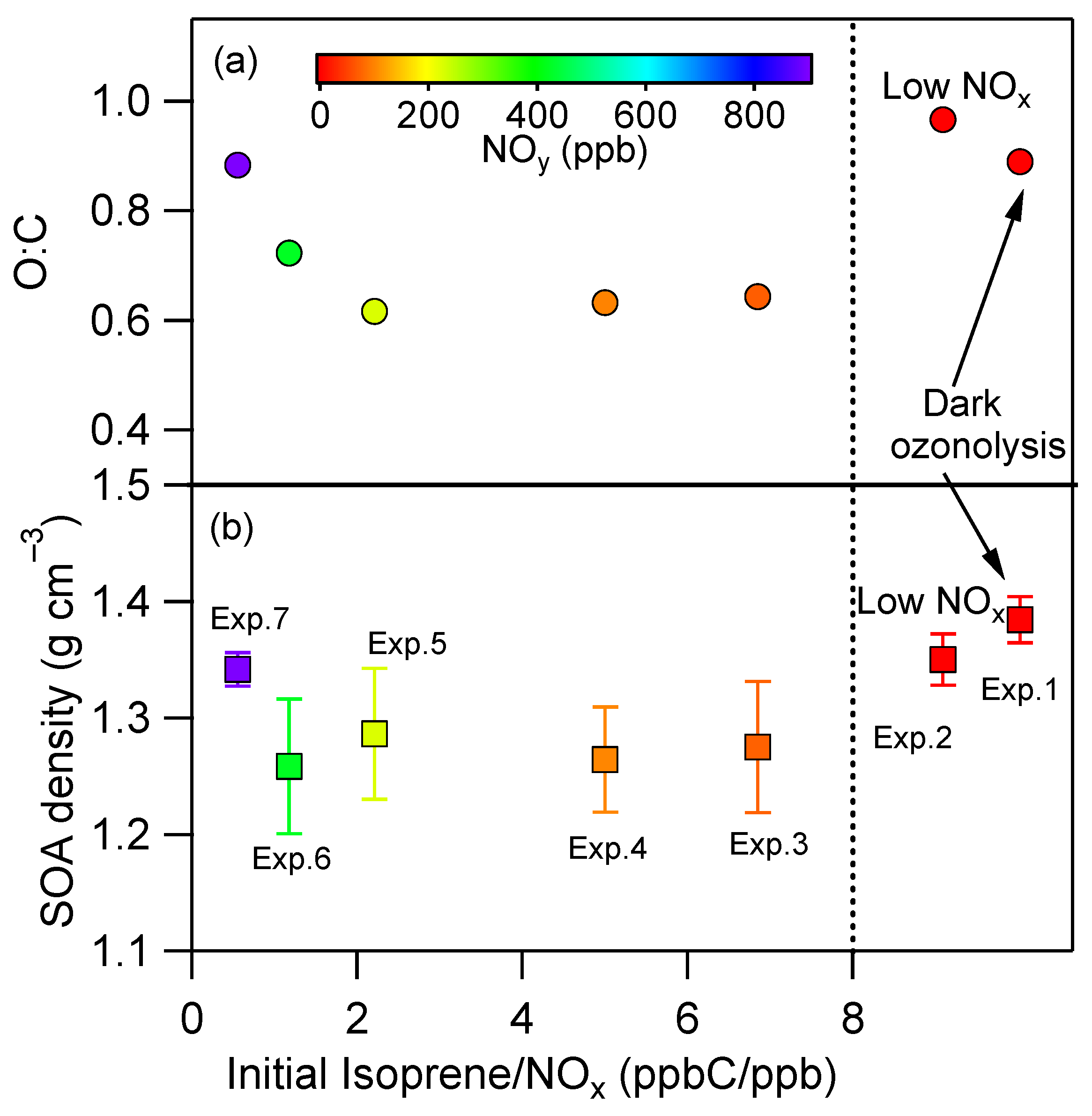
The O:C ratio as a function of the isoprene/NOx ratio for each experiment is depicted in Figure 2a. The O:C ratio was higher (0.9–1.0) in experiments 1 and 2, where IEPOX products dominated, and lower (0.62–0.72) in high NOx experiments, (3–6), (isoprene/NOx ratios 1.2–6.8), where 2-MG, its oligomers, and nitrates were more prominent. However, in experiment 7 (isoprene/NOx = 0.6), the O:C increased again to 0.88. This could be explained by an increased role of MACRO2 + NO reactions at high NOx, promoting fragmentation, reducing 2-MG formation and favoring organic nitrate production. The smaller fragmentation products are more volatile and tend to remain in the gas phase. As a result, a larger fraction of the compounds that partition to the particulate phase is likely composed of organic nitrate species.

3.2. Density and AMS CE

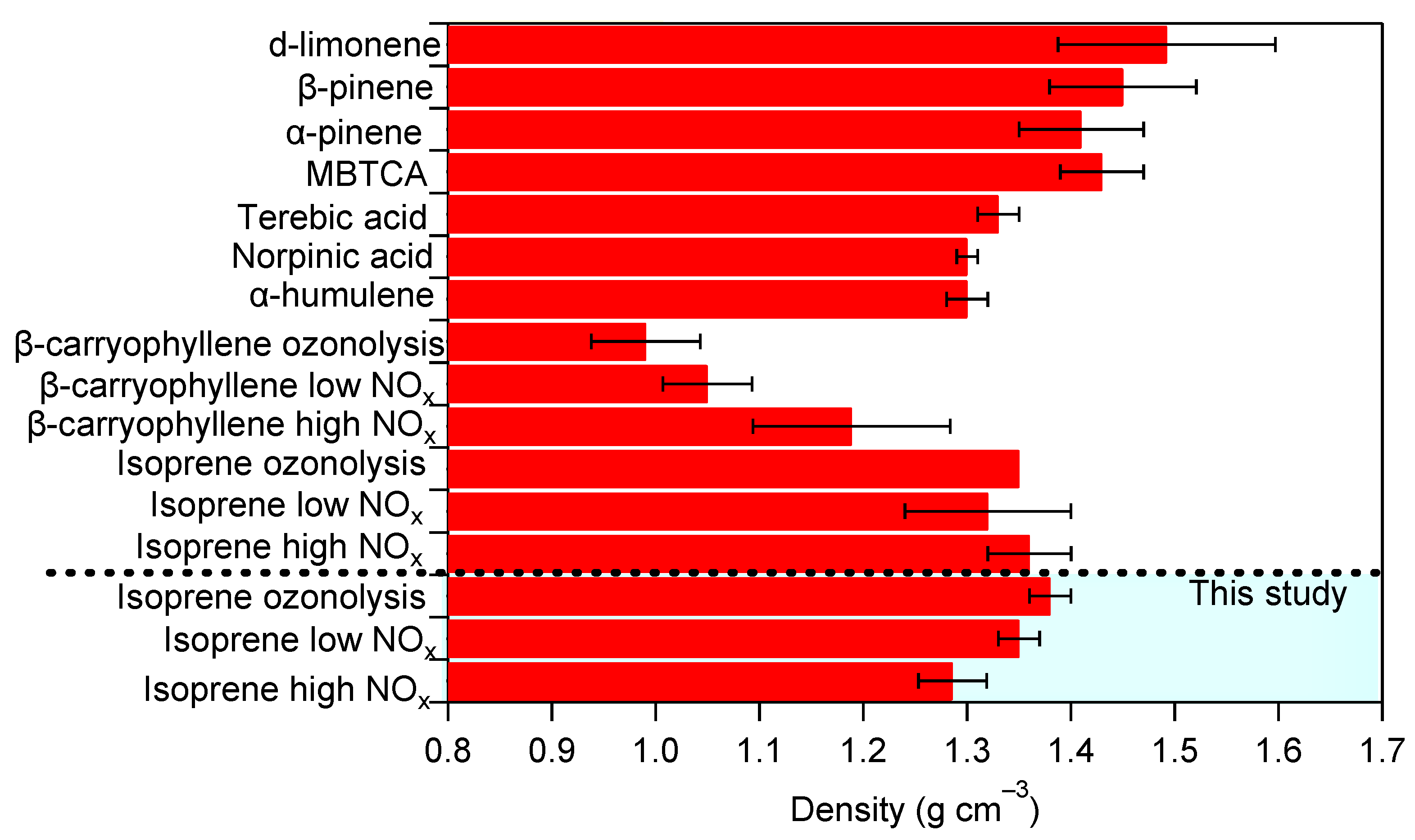
Figure 2b shows the average SOA density calculated for each experiment. Isoprene SOA density was highest during dark ozonolysis (1.38 ± 0.02 g cm−3) and at low NOx conditions (1.35 ± 0.02 g cm−3). In HONO experiments at NOx levels 73–425 ppb (isoprene/NOx ratios 1.2–6.8), SOA density decreased to (1.26–1.29 g cm−3). Interestingly, at the highest NOx (900 ppb, isoprene/NOx = 0.6), the density increased again to 1.35 ± 0.01 g cm−3. Reported values of isoprene SOA density in previous chamber studies span a relatively wide range (1.25–1.40 g cm−3) depending on the oxidation conditions. For example, Clark et al. [14] reported lower SOA densities in the presence of NOx compared to low NOx conditions, consistent with the decrease observed in our experiments at high NOx levels. In addition, they found similar densities for ozonolysis SOA. However, Xu et al. [13], Kroll et al. [5] and Kroll et al. [19] reported higher SOA densities under high NOx conditions compared to those in the present study. Part of this discrepancy may arise from methodological differences. For instance, Kroll et al. [5] and Kroll et al. [19] used seed particles in their high NOx experiments, and their approach assumes a constant particle density with particle size. In addition, Xu et al. [13] estimated SOA density by comparing mobility and aerodynamic diameters, but the corresponding size distributions were not explicitly matched. Overall, our results for low NOx cases fall within the range reported in the literature, whereas for high NOx conditions our densities are in a lower regime (Figure 3).
The results of the present work reveal a non-linear dependence of SOA density on the isoprene/NOx ratio. This behavior suggests that RO2 chemistry plays a key role in determining SOA density. Products associated with the IEPOX pathway (e.g., 2-methyltetrols and 2-methyl alkenetriols) under low NOx conditions, as well as products formed through RO2 + NO reactions (likely organic nitrate compounds), may lead to relatively high particle densities. In contrast, products formed through RO2 + NO2 reactions may generate compounds with different molecular structures (e.g., 2-MG, 2-MG dimers, and 2-MG organonitrates), resulting in lower densities at intermediate NOx levels. Figure 2 compares isoprene SOA density to that of other biogenic SOAs, and key constituent compounds identified in biogenic SOA systems [16,17,18,25,34,35]. Isoprene SOA density was similar to that of norpinic acid, terebic acids and α-humulene SOA, but lower than α-pinene, β-pinene, and d-limonene SOA, and higher than β-caryophyllene SOA.
CE did not exhibit a trend, and it was around 1 in all experiments except for the low NOx experiment where it was 0.7 ± 0.1. CE and density for thermodenuded and bypass SOA were similar during TD sampling (Figures S4 and S5).

3.3. Volatility

3.3.1. Thermodenuder Measurements

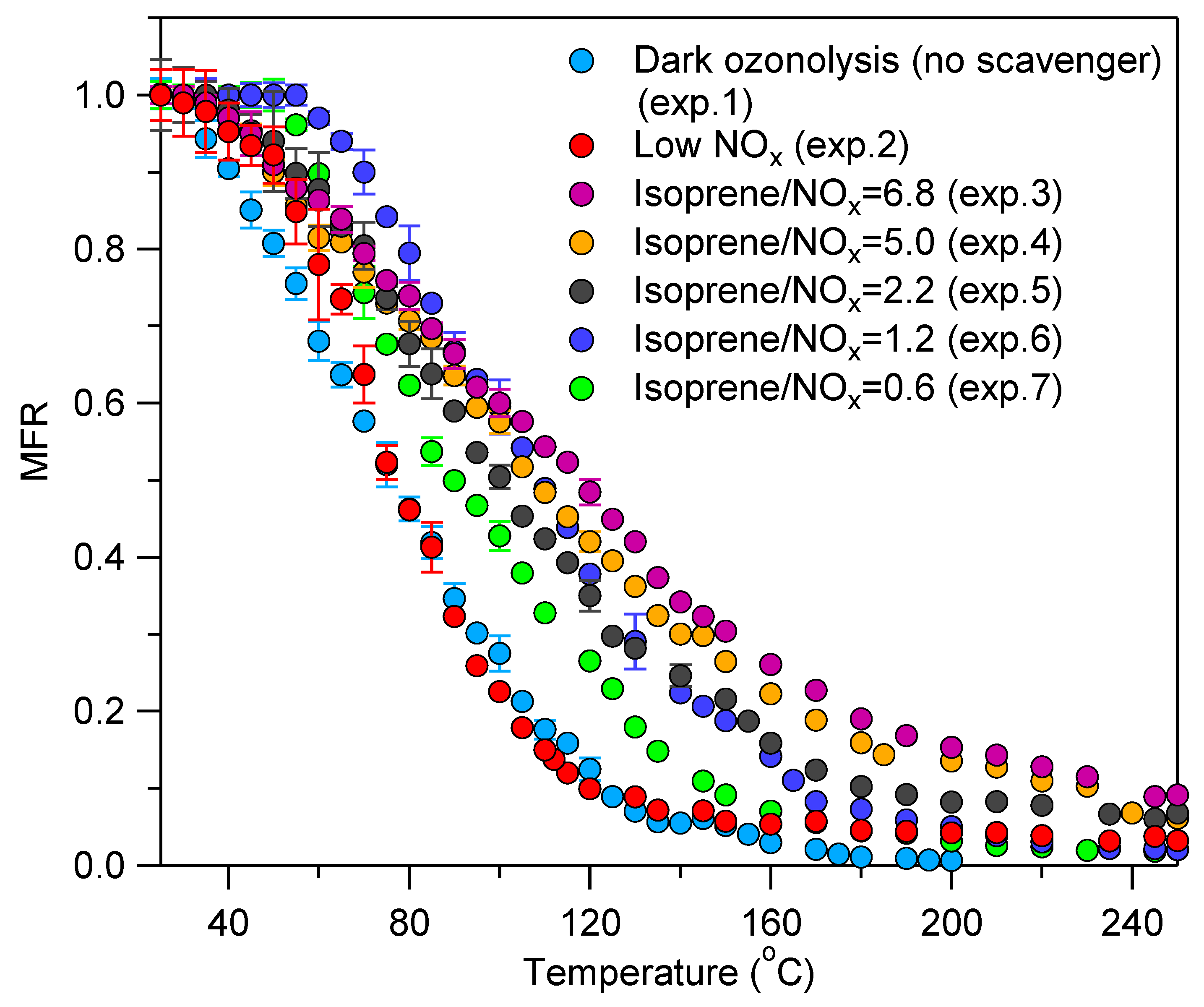
Figure 4 shows the measured MFR as a function of the thermodenuder temperature. SOA from experiments 1 and 2, where there was no NOx present, was more volatile as half of the SOA evaporated at 75 °C. At high NOx conditions SOA was less volatile since half of the SOA was evaporated at higher temperatures (90–115 °C). This behavior shows that the IEPOX products are more volatile than the MACRO2 products. Similar trends were observed by Xu et al. [13] and Clark et al. [14]. Our results suggest an inverse relationship between SOA volatility and NOx concentration within the range of conditions investigated, with lower NOx (higher isoprene/NOx ratios) producing less volatile SOA. At lower NOx levels 2-MG and its oligomers contributed more, while high NOx favors fragmentation. Xu et al. [13] reported similar but more complex behavior, with volatility decreasing, reaching a minimum, then increasing with NOx. The thermodenuded mass spectra at the temperature where half of the SOA was evaporated were similar to the corresponding bypass ones with angle thetas ranging between 3.6 and 15.6 degrees (R2 = 0.930–0.996). The angle theta is described in Kostenidou et al. [36].

3.3.2. Volatility Distributions and Vaporization Enthalpy

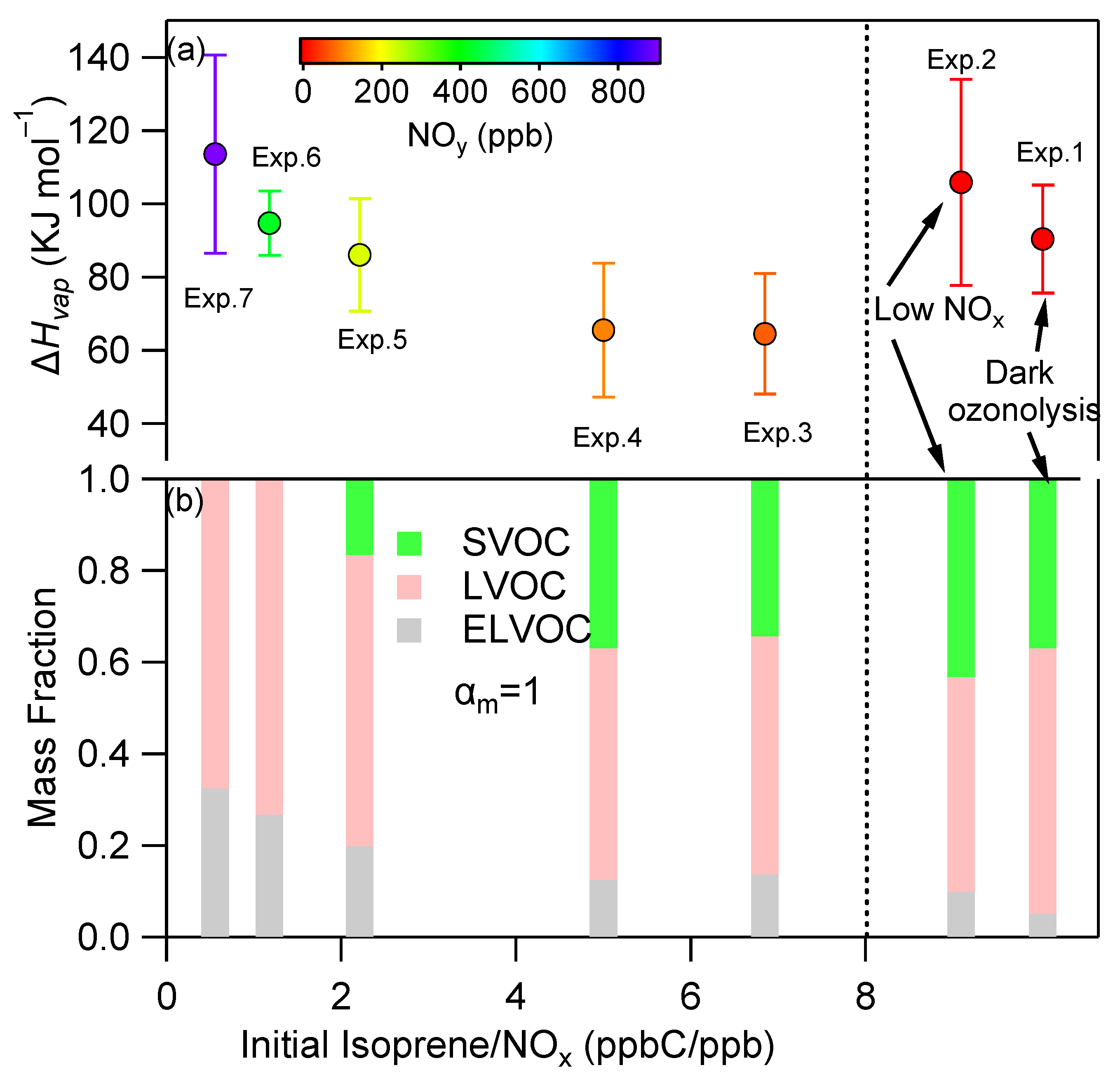
Figure S6 depicts the measured versus the modeled MFR for each experiment. The optimal 6-bin solution for each experiment is shown in Table S1. Figure S7 shows the estimated volatility distribution for all experiments. Figure 5 presents vaporization enthalpy and volatility composition at 298 K versus the isoprene/NOx ratio, based on the volatility basis set (VBS) framework proposed by Donahue et al. [37]. Under ozonolysis and at low NOx, SOA consisted of ~40% SVOCs, ~52% LVOCs, and ~7% ELVOCs. At high NOx SVOCs decreased with NOx (or as the isoprene/NOx ratio decreased) and at very high NOx (very low isoprene/NOx ratio) their contribution was practically zero. ELVOCs became important as NOx increased (or as the isoprene/NOx ratio decreased) and reached around 32% at very high NOx levels. The presence of EVOCs may be explained partially by low-volatility nitrates and dinitrates [38] supported by increasing NO3/Organics ratios along with NOx levels (Figure S2). ΔHvap was 90–106 kJ mol−1 under low NOx and ozonolysis. For high NOx conditions ΔHvap varied from 65 to 114 kJ mol−1 increasing with NOx.

3.3.3. Sensitivity Analysis of Accommodation Coefficient

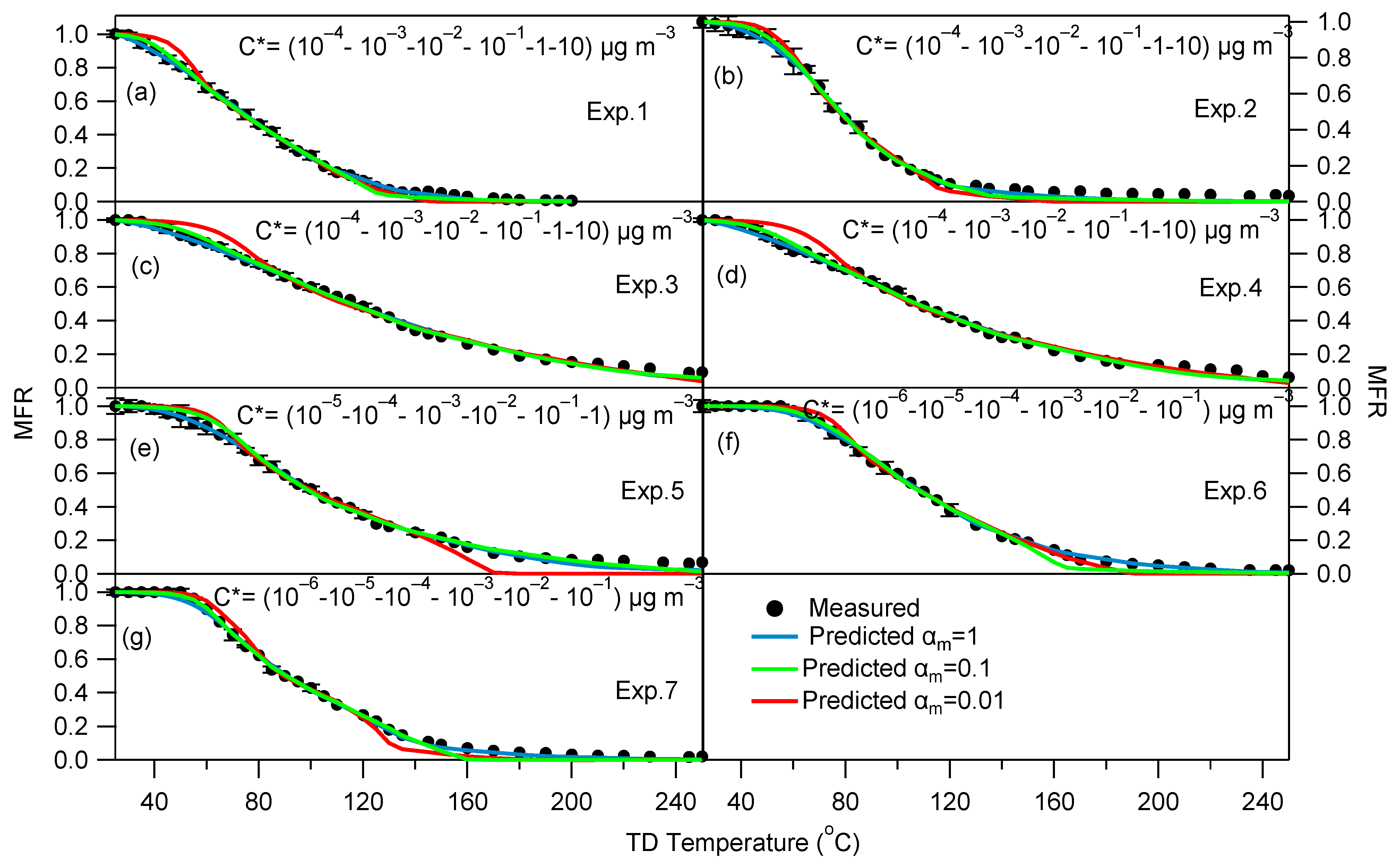
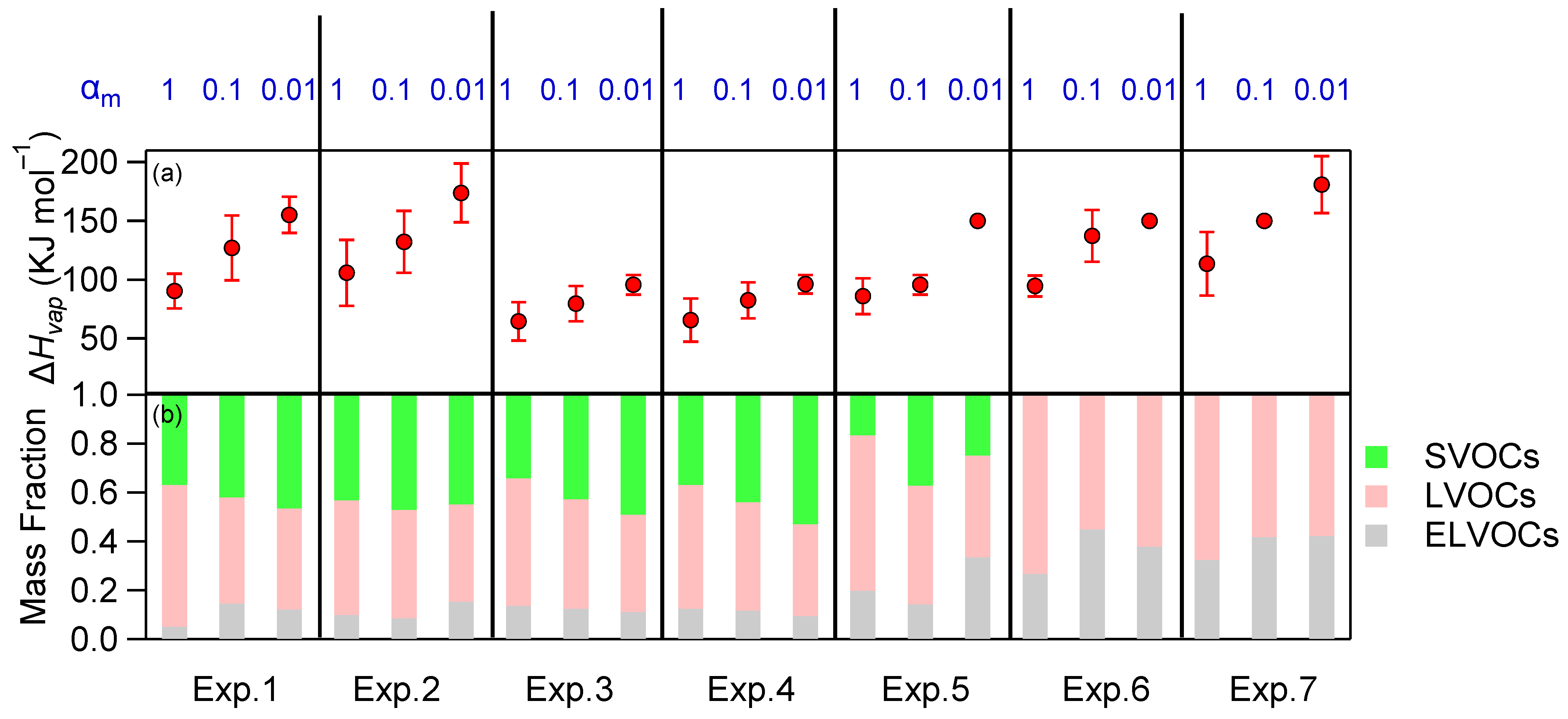
In the above analysis we assumed no resistance to SOA evaporation in the thermodenuder and a mass accommodation coefficient (αm) equal to unity. To examine the sensitivity of the results to this assumption, additional simulations were performed using αm values of 0.1 and 0.01. The resulting volatility distributions and vaporization enthalpies for each experiment are presented in Table S2 in the Supplement. The corresponding modeled MFR curves are shown in Figure A1 (Appendix A), while the volatility composition and the corresponding ΔHvap values are presented in Figure A2 (Appendix A).
The predicted thermograms for αm = 0.01 were inconsistent with the measurements for all experiments, while αm = 0.1 reproduced the thermograms within experimental uncertainty only for experiments 3 and 4. Despite these differences, the derived volatility distributions remained relatively similar to the base case (αm = 1), whereas the inferred vaporization enthalpies (ΔHvap) were more sensitive to the assumed accommodation coefficient. For example, in experiment 3 the SVOC and LVOC fractions changed from 34% and 52% in the optimal solution to 43% and 45% for αm = 0.1, while ΔHvap increased by approximately 16 kJ mol−1. Overall, these sensitivity tests indicate that the estimated volatility distributions are relatively insensitive to the assumed accommodation coefficient, whereas ΔHvap is more strongly affected. Similar behavior was reported by Kostenidou et al. [23], although it differs from the results of Riipinen et al. [24].

3.4. Yields

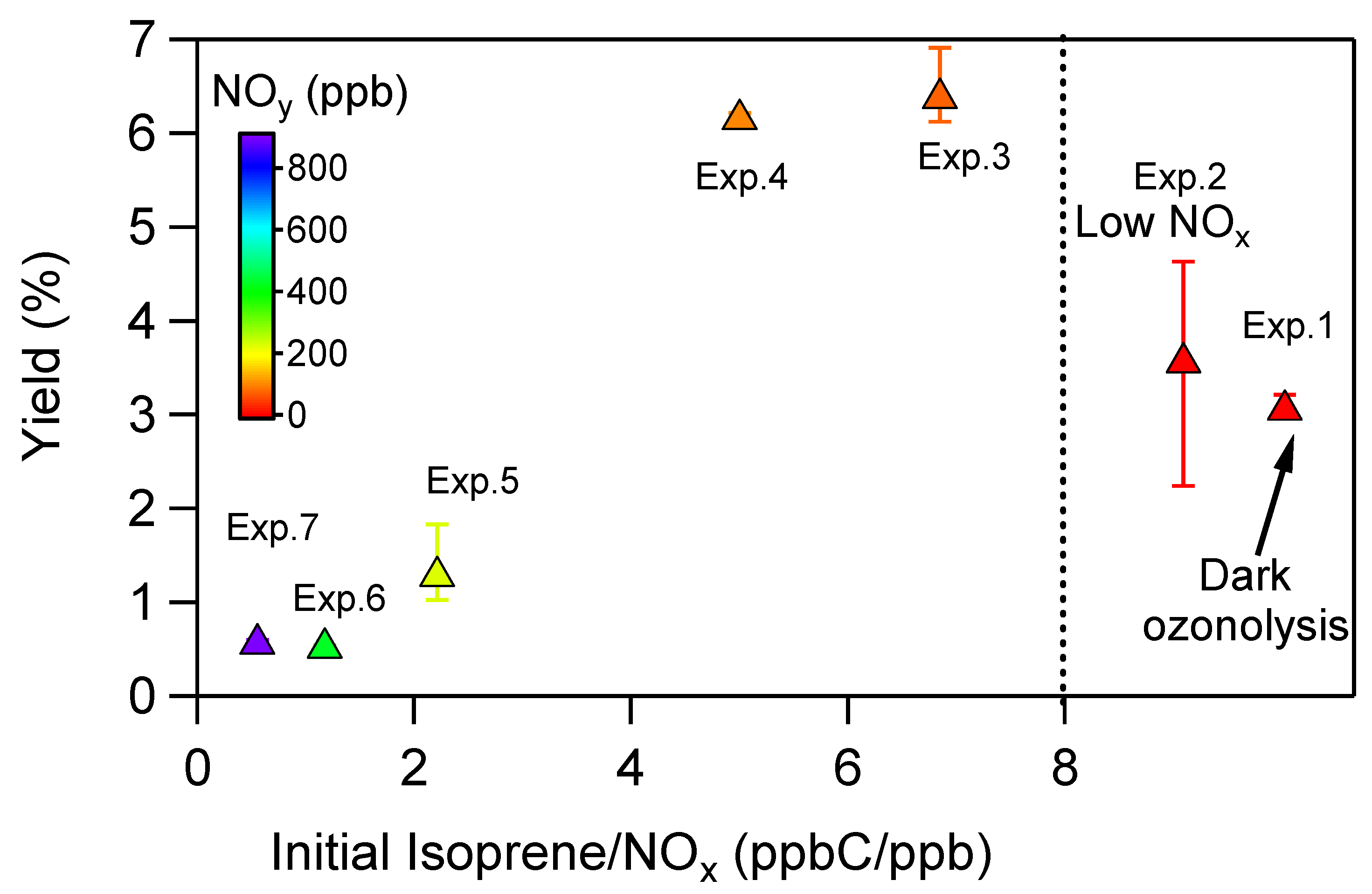
Figure 6 shows SOA yields calculated for each experiment. For high NOx cases at low isoprene/NOx ratios (0.6–1.2) yields were low (0.6%), while at higher isoprene/NOx ratios (5–7), yields reached 6.8%. For low NOx experiments (<1 ppb NOx) yields were ~3.5%. This non-linear trend has been observed previously [6,13]. At high NOx levels (lower isoprene/NOx ratio) yields were suppressed, due to fragmentation and formation of small compounds. Recently Xu et al. [12] proposed that NOx could influence the formation of low, extremely low and ultralow volatility organic compounds (LVOCs/ELVOCs/ULVOCs) by altering the RO2 fates, which are the critical compounds for the formation of the particulate phase. Combining the volatility and yield results, we observe that the contribution of LVOC and ELVOC fractions increases at lower isoprene/NOx ratios, where the SOA yield is suppressed (Figure S8). This suggests that the small amount of SOA formed under low isoprene/NOx conditions consists predominantly of low-volatility compounds. At higher isoprene/NOx ratios, a larger fraction of semi-volatile compounds (SVOCs) is produced; a fraction of these species condenses and partitions into the particulate phase, increasing the SOA yield while simultaneously reducing the relative contributions of the LVOC and ELVOC fractions.
Our low NOx yields align with Kroll et al. [5], Chhabra et al. [10], Xu et al. [13] and Clark et al. [14], (Figure S9) where the conditions were similar (i.e., absence of (NH4)2SO4 seeds, similar isoprene and NOx concentrations). Yields in our study are lower than those reported by Kroll et al. [15], likely because they employed ammonium sulfate seeds, which enhance SOA formation by capturing early oxidation products. High NOx yields derived from this study are in good agreement with Xu et al. [13] and Clark et al. [16], where the conditions were similar (i.e., no ammonium sulfate seeds, similar isoprene and NOx levels) (Figure S10). However, our yields are lower than Kroll et al. [5], since they used (NH4)2SO4 seeds. These results highlight the importance of chemical pathways (ozonolysis, low and high NOx photooxidation) and the associated products—acids, IEPOX + HO2 products, MACRO2 + NO2 products, and MACRO2 + NO products—in defining isoprene SOA physicochemical properties. Our findings suggest that RO2 chemistry modulates isoprene SOA properties in a non-linear way.

4. Conclusions

This study examined the influence of NOx concentration on the physicochemical properties of isoprene-derived SOA formed via ozonolysis and photooxidation in an environmental chamber. Isoprene SOA produced under dark ozonolysis and low NOx conditions exhibited higher densities, higher O:C ratios, and greater volatility, dominated by semi-volatile and low-volatility organic compounds. In contrast, SOA formed under high NOx conditions displayed lower density and O:C ratios over a broad range of isoprene/NOx ratios, accompanied by reduced volatility and increasing vaporization enthalpy, indicating enhanced formation of lower-volatility material. At very high NOx levels, SOA density and O:C ratios increased again, while volatility was minimized and extremely low-volatile compounds became a substantial fraction of the aerosol, consistent with the formation of organic nitrates and multifunctional products.
Although the MFR curves suggest that SOA formed at higher NOx levels evaporates more readily, the application of the thermodenuder modeling framework indicates that this SOA actually contains a larger fraction of low-volalite compounds. This result highlights that MFR measurements alone are insufficient to constrain SOA volatility distributions and that modeling is required for a more comprehensive interpretation of the thermodenuder data, an approach that has not been applied in previous studies of isoprene SOA volatility. SOA yields exhibited a pronounced non-linear dependence on NOx, with strong suppression at low isoprene/NOx ratios due to enhanced fragmentation pathways.
Overall, these results demonstrate that NOx-driven RO2 chemistry exerts a critical and non-linear control on isoprene SOA density, volatility distribution, vaporization enthalpy, and yield, highlighting the importance of accurately representing NOx-dependent pathways in atmospheric aerosol models. Future work should further investigate the role of additional atmospheric variables, such as relative humidity and aerosol phase state, on the physicochemical properties of isoprene SOA across a wider range of atmospheric conditions.

Supplementary Materials

The following supporting information can be downloaded at: https://www.mdpi.com/article/10.3390/atmos17040344/s1, Figure S1: HR mass spectra at maximum mass concentration for experiments 4, 5 and 7; Figure S2: Aerosol NO3/organic ratio as a function of the NOx concentration; Figure S3: SOA Mode diameter for various conditions at high NOx levels; Figure S4: Average bypass and thermodenuded CE for all experiments; Figure S5: Average bypass and thermodenuded SOA density for all experiments; Figure S6: Measured and predicted MFR for each experiment; Figure S7: Estimated volatility distributions for all experiments; Figure S8: Fraction of ELVOC and LVOC as a function of the yield; Figure S9: SOA yields for experiments 1 and 2; Figure S10: SOA yields for experiments 3–7; Scheme S1. Main chemical pathways of isoprene photooxidation; Table S1: Optimal 6-bin solution for each experiment; Table S2: Volatility distribution and vaporization enthalpy for each experiment for αm = 1, 0.1 and 0.01.

Author Contributions

Conceptualization, E.K. (Evangelia Kostenidou); methodology, E.K. (Evangelia Kostenidou) and E.K. (Eleni Karnezi); experimental work, E.K. (Evangelia Kostenidou); formal analysis, C.A.T., A.M., A.M.P., A.N. and E.K. (Eleni Karnezi); investigation, E.K. (Evangelia Kostenidou) and E.K. (Eleni Karnezi); writing—original draft preparation, C.A.T. and E.K. (Evangelia Kostenidou); writing—review and editing, all authors; supervision, E.K. (Evangelia Kostenidou); All authors have read and agreed to the published version of the manuscript.

Funding

This research received no external funding.

Data Availability Statement

The data presented in this study is available on request from the corresponding author.

Acknowledgments

We would like to thank Spyros Pandis (University of Patras and ICE-HT Patras) as all the experiments were performed at the ICE-HT smog chamber facilities in Patras, Greece.

Conflicts of Interest

The authors declare no conflicts of interest.

Abbreviations

The following abbreviations are used in this manuscript:
SOASecondary Organic Aerosol
VOCVolatile Organic Compound
SVOCsSemi-volatile Organic Compounds
LVOCsLow-volatility Organic Compounds
ELVOCsExtremely Low-volatility Organic Compounds
ΔHvapVaporization enthalpy
αmAccommodation coefficient
HR-ToF-AMSHigh-Resolution Time-of-Flight Aerosol Mass Spectrometer
MFRMass Fraction Remaining
SMPSScanning Mobility Particle Sizer
TDThermodenuder
PTR-MSProton Transfer Reaction Mass Spectrometer
CECollection Efficiency
2-MG2-methylglyceric acid
MACRO2Methacrolein-derived peroxy radical
MPANMethacryloyl peroxy nitrate
IEPOXIsoprene epoxydiols

Appendix A

Figure A1. Measured and predicted MFR for each experiment for various accommodation coefficients: (a) experiment 1, (b) experiment 2, (c) experiment 3, (d) experiment 4, (e) experiment 5, (f) experiment 6, and (g) experiment 7. The circles denote the measurements, the blue lines represent the best-predicted MFR for αm = 1 (base case), the green lines correspond to the best-predicted MFR for αm = 0.1 and the red lines stand for the predicted MFR for αm = 0.01.
Atmosphere 17 00344 g0a1
Figure A2. Predicted vaporization enthalpy (red circles) (a) and predicted volatility composition at 298 K (b) for all 7 experiments for various accommodation coefficients.
Atmosphere 17 00344 g0a2

References

  1. Guenther, A.B.; Jiang, X.; Heald, C.L.; Sakulyanontvittaya, T.; Duhl, T.; Emmons, L.K.; Wang, X. The Model of Emissions of Gases and Aerosols from Nature version 2.1 (MEGAN2.1): An extended and updated framework for modeling biogenic emissions. Geosci. Model Dev. 2012, 5, 1471–1492. [Google Scholar] [CrossRef]
  2. Claeys, M.; Wang, W.; Ion, A.C.; Kourtchev, I.; Gelencser, A.; Maenhaut, W. Formation of secondary organic aerosols from isoprene and its gas-phase oxidation products through reaction with hydrogen peroxide. Atmos. Environ. 2004, 38, 4093–4098. [Google Scholar] [CrossRef]
  3. Claeys, M.; Maenhaut, W. Secondary Organic Aerosol Formation from Isoprene: Selected Research, Historic Account and State of the Art. Atmosphere 2021, 12, 728. [Google Scholar] [CrossRef]
  4. Edney, E.O.; Kleindienst, T.E.; Jaoui, M.; Lewandowski, M.; Offenberg, J.H.; Wang, W.; Claeys, M. Formation of 2-methyl tetrols and 2-methylglyceric acid in secondary organic aerosol from laboratory irradiated isoprene/NOx/SO2/air mixtures and their detection in ambient PM2.5 samples collected in the eastern United States. Atmos. Environ. 2005, 39, 5281–5289. [Google Scholar] [CrossRef]
  5. Kroll, J.H.; Ng, N.L.; Murphy, S.M.; Flagan, R.C.; Seinfeld, J.H. Secondary organic aerosol formation from isoprene photooxidation. Environ. Sci. Technol. 2006, 40, 1869–1877. [Google Scholar] [CrossRef]
  6. Surratt, J.D.; Murphy, S.M.; Kroll, J.H.; Ng, N.L.; Hildebrandt, L.; Sorooshian, A.; Szmigielski, R.; Vermeylen, R.; Maenhaut, W.; Claeys, M.; et al. Chemical composition of secondary organic aerosol formed from the photooxidation of isoprene. J. Phys. Chem. A 2006, 110, 9665–9690. [Google Scholar] [CrossRef]
  7. Kleindienst, T.E.; Lewandowski, M.; Offenberg, J.H.; Jaoui, M.; Edney, E.O. Ozone-isoprene reaction: Re-examination of the formation of secondary organic aerosol. Geophys. Res. Lett. 2007, 34, L01805. [Google Scholar] [CrossRef]
  8. Kleindienst, T.E.; Lewandowski, M.; Offenberg, J.H.; Jaoui, M.; Edney, E.O. The formation of secondary organic aerosol from the isoprene plus OH reaction in the absence of NOx. Atmos. Chem. Phys. 2009, 9, 6541–6558. [Google Scholar] [CrossRef]
  9. Surratt, J.D.; Chan, A.W.H.; Eddingsaas, N.C.; Chan, M.N.; Loza, C.L.; Kwan, A.J.; Hersey, S.P.; Flagan, R.C.; Wennberg, P.O.; Seinfeld, J.H. Reactive intermediates revealed in secondary organic aerosol formation from isoprene. Proc. Natl. Acad. Sci. USA 2010, 107, 6640–6645. [Google Scholar] [CrossRef] [PubMed]
  10. Chhabra, P.S.; Flagan, R.C.; Seinfeld, J.H. Elemental analysis of chamber organic aerosol using an aerodyne high-resolution aerosol mass spectrometer. Atmos. Chem. Phys. 2010, 10, 4111–4131. [Google Scholar] [CrossRef]
  11. Nguyen, T.B.; Bateman, A.P.; Bones, D.L.; Nizkorodov, S.A.; Laskin, J.; Laskin, A. High-resolution mass spectrometry analysis of secondary organic aerosol generated by ozonolysis of isoprene. Atmos. Environ. 2010, 44, 1032–1042. [Google Scholar] [CrossRef]
  12. Xu, X.; Wang, G.; Gao, Y.; Zhang, S.; Chen, L.; Li, R.; Li, Z.; Li, R. Smog chamber study on the NOx dependence of SOA from isoprene photo-oxidation: Implication on RO2 chemistry. J. Environ. Sci. 2026, 161, 752–760. [Google Scholar] [CrossRef] [PubMed]
  13. Xu, L.; Kollman, M.S.; Song, C.; Shilling, J.E.; Ng, N.L. Effects of NOx on the volatility of secondary organic aerosol from isoprene photooxidation. Environ. Sci. Technol. 2014, 48, 2253–2262. [Google Scholar] [CrossRef]
  14. Clark, C.H.; Kacarab, M.; Nakao, S.; Asa-Awuku, A.; Sato, K.; Cocker, D.R., 3rd. Temperature effects on secondary organic aerosol (SOA) from the dark ozonolysis and photo-oxidation of isoprene. Environ. Sci. Technol. 2016, 50, 5564–5571. [Google Scholar] [CrossRef]
  15. Sato, K.; Nakao, S.; Clark, C.H.; Qi, L.; Cocker, D.R. Secondary organic aerosol formation from the photooxidation of isoprene, 1,3-butadiene, and 2,3-dimethyl-1,3-butadiene under high NOx conditions. Atmos. Chem. Phys. 2011, 11, 7301–7317. [Google Scholar] [CrossRef]
  16. Kostenidou, E.; Pathak, R.K.; Pandis, S.N. An algorithm for the calculation of secondary organic aerosol density combining AMS and SMPS data. Aerosol Sci. Technol. 2007, 41, 1002–1010. [Google Scholar] [CrossRef]
  17. Tasoglou, A.; Pandis, S.N. Formation and chemical aging of secondary organic aerosol during the β-caryophyllene oxidation. Atmos. Chem. Phys. 2015, 15, 6035–6046. [Google Scholar] [CrossRef]
  18. Sippial, D.J. Secondary Organic Aerosol Formation from Biogenic and Anthropogenic VOCs. Ph.D. Thesis, Carnegie Mellon University, Pittsburgh, PA, USA, 2023. [Google Scholar]
  19. Kroll, J.H.; Ng, N.L.; Murphy, S.M.; Flagan, R.C.; Seinfeld, J.H. Secondary organic aerosol formation from isoprene photooxidation under high-NOx conditions. Geophys. Res. Lett. 2005, 32, L18808. [Google Scholar] [CrossRef]
  20. Lopez-Hilfiker, F.D.; Mohr, C.; D’Ambro, E.L.; Lutz, A.; Riedel, T.P.; Gaston, C.J.; Iyer, S.; Zhang, X.; Gold, A.; Surratt, J.D.; et al. Molecular composition and volatility of organic aerosol in the Southeastern U.S.: Implications for IEPOX derived SOA. Environ. Sci. Technol. 2016, 50, 2200–2209. [Google Scholar] [CrossRef]
  21. Hu, W.; Palm, B.B.; Day, D.A.; Campuzano-Jost, P.; Krechmer, J.E.; Peng, Z.; de Sá, S.S.; Martin, S.T.; Alexander, M.L.; Baumann, K.; et al. Volatility and lifetime against OH heterogeneous reaction of ambient isoprene-epoxydiols derived secondary organic aerosol (IEPOX-SOA). Atmos. Chem. Phys. 2016, 16, 11563–11580. [Google Scholar] [CrossRef]
  22. Faulhaber, A.E.; Thomas, B.M.; Jimenez, J.L.; Jayne, J.T.; Worsnop, D.R.; Ziemann, P.J. Characterization of a thermodenuder-particle beam mass spectrometer system for the study of organic aerosol volatility and composition. Atmos. Meas. Tech. 2009, 2, 15–31. [Google Scholar] [CrossRef]
  23. Kostenidou, E.; Karnezi, E.; Hite, J.R., Jr.; Bougiatioti, A.; Cerully, K.; Xu, L.; Ng, N.L.; Nenes, A.; Pandis, S.N. Organic Aerosol Sources in the summertime Southeastern United States: Components and their link to volatility distribution, oxidation state and hygroscopicity. Atmos. Chem. Phys. 2018, 18, 5799–5819. [Google Scholar] [CrossRef]
  24. Riipinen, I.; Pierce, J.R.; Donahue, N.M.; Pandis, S.N. Equilibration time scales of organic aerosol inside thermodenuders: Evaporation kinetics versus thermodynamics. Atmos. Environ. 2010, 44, 597–607. [Google Scholar] [CrossRef]
  25. Kostenidou, E.; Karnezi, E.; Kołodziejczyk, A.; Szmigielski, R.; Pandis, S.N. Physical and chemical properties of 3-methyl-1,2,3-butanetricarboxylic acid (MBTCA) aerosol. Environ. Sci. Technol. 2018, 52, 1150–1155. [Google Scholar] [CrossRef]
  26. DeCarlo, P.F.; Kimmel, J.R.; Trimborn, A.; Northway, M.J.; Jayne, J.T.; Aiken, A.C.; Gonin, M.; Fuhrer, K.; Horvath, T.; Docherty, K.S.; et al. Field-deployable, High-Resolution, Time-of-Flight Aerosol Mass Spectrometer. Anal. Chem. 2006, 78, 8281–8289. [Google Scholar] [CrossRef] [PubMed]
  27. An, W.J.; Pathak, R.K.; Lee, B.H.; Pandis, S.N. Aerosol volatility measurement using an improved thermodenuder: Application to secondary organic aerosol. J. Aerosol Sci. 2007, 38, 305–314. [Google Scholar] [CrossRef]
  28. Louvaris, E. Volatility Measurements of Atmospheric Organic Aerosols. Ph.D. Thesis, University of Patras, Patra, Greece, 2016. [Google Scholar]
  29. Canagaratna, M.R.; Jimenez, J.L.; Kroll, J.H.; Chen, Q.; Kessler, S.H.; Massoli, P.; Ruiz, L.H.; Fortner, E.C.; Williams, L.R.; Wilson, K.R.; et al. Elemental ratio measurements of organic compounds using aerosol mass spectrometry: Characterization, improved calibration, and implications. Atmos. Chem. Phys. 2015, 15, 253–272. [Google Scholar] [CrossRef]
  30. Aiken, A.C.; DeCarlo, P.F.; Kroll, J.H.; Worsnop, D.R.; Huffman, J.A.; Docherty, K.S.; Ulbrich, I.M.; Mohr, C.; Kimmel, J.R.; Sueper, D.; et al. O/C and OM/OC ratios of primary, secondary, and ambient organic aerosols with High Resolution Time-of-Flight Aerosol Mass Spectrometry. Environ. Sci. Technol. 2008, 42, 4478–4485. [Google Scholar] [CrossRef]
  31. Atkinson, R. Gas-phase tropospheric chemistry of volatile organic compounds: 1. Alkanes and alkenes. J. Phys. Chem. Ref. Data 1997, 26, 215–290. [Google Scholar] [CrossRef]
  32. Wang, N.; Jorga, S.D.; Pierce, J.R.; Donahue, N.M.; Pandis, S.N. Particle Wall-Loss Correction Methods in Smog Chamber Experiments. Atmos. Meas. Tech. 2018, 11, 6577–6588. [Google Scholar] [CrossRef]
  33. Karnezi, E.; Riipinen, I.; Pandis, S.N. Measuring the atmospheric organic aerosol volatility distribution: A theoretical analysis. Atmos. Meas. Tech. 2014, 7, 2953–2965. [Google Scholar] [CrossRef]
  34. Kostenidou, E.; Jorga, S.; Kodros, J.K.; Florou, K.; Kołodziejczyk, A.; Szmigielski, R.; Pandis, S.N. Properties and Atmospheric Oxidation of Norpinic Acid. Atmosphere 2022, 13, 1481. [Google Scholar] [CrossRef]
  35. Florou, K.; Błaziak, A.; Jorga, S.; Uruci, P.; Vasilakopoulou, C.N.; Szmigielski, R.; Pandis, S.N. Properties and Atmospheric Oxidation of Terebic Acid Aerosol. ACS Earth Space Chem. 2024, 8, 2090–2100. [Google Scholar] [CrossRef]
  36. Kostenidou, E.; Lee, B.H.; Engelhart, G.J.; Pierce, J.R.; Pandis, S.N. Mass spectra deconvolution of low, medium and high volatility biogenic secondary organic aerosol. Environ. Sci. Technol. 2009, 43, 4884–4889. [Google Scholar] [CrossRef]
  37. Donahue, N.M.; Kroll, J.H.; Pandis, S.N.; Robinson, A.L. A two-dimensional volatility basis set—Part 2: Diagnostics of organic-aerosol evolution. Atmos. Chem. Phys. 2012, 12, 615–634. [Google Scholar] [CrossRef]
  38. Schwantes, R.H.; Charan, S.M.; Bates, K.H.; Huang, Y.; Nguyen, T.B.; Mai, H.; Kong, W.; Flagan, R.C.; Seinfeld, J.H. Low-volatility compounds contribute significantly to isoprene secondary organic aerosol (SOA) under high-NOx conditions. Atmos. Chem. Phys. 2019, 19, 7255–7278. [Google Scholar] [CrossRef]
Figure 1. HR mass spectra for experiments 1 (a), 2 (b), 3 (c) and 6 (d).
Atmosphere 17 00344 g001
Figure 2. (a) O:C ratio and (b) average SOA density for each experiment. For high NOx cases the O:C ratio and the average SOA density are expressed as a function of the initial isoprene/NOx ratio. The dashed line denotes the separation between high-NOx and low-NOx/ozonolysis experiments.
Atmosphere 17 00344 g002
Figure 3. Densities of biogenic SOA and derived compounds from previous literature [5,13,14,16,17,18,19,25,34,35] as well as isoprene SOA densities from this study. The dashed line denotes the separation between results from this study and literature values.
Atmosphere 17 00344 g003
Figure 4. MFR versus temperature inside the thermodenuder for each experiment. The MFR has been calculated using the VFR from SMPS after applying the wall losses corrections inside the thermodenuder and the estimated density.
Atmosphere 17 00344 g004
Figure 5. Vaporization enthalpy (a) and volatility composition at 298 K (b) for each experiment using the dynamic mass transfer model of Riipinen et al. [24] and selecting the best fit and associated uncertainty applying the algorithm of Karnezi et al. [33]. For high NOx cases vaporization enthalpy and volatility composition are depicted versus the initial isoprene/NOx ratio. The dashed line denotes the separation between high-NOx and low-NOx/ozonolysis experiments.
Atmosphere 17 00344 g005
Figure 6. Yield after wall-loss corrections for each experiment. For high NOx experiments the yield is expressed as a function of the initial isoprene/NOx ratio. The dashed line denotes the separation between high-NOx and low-NOx/ozonolysis experiments.
Atmosphere 17 00344 g006
Table 1. Experimental conditions and resulting SOA properties for the seven chamber experiments. The table reports the initial concentrations of isoprene, O3, and NOx, as well as the corresponding NOx/isoprene ratios. In addition, the estimated initial OH concentrations, the maximum SOA mass concentrations formed during the experiments, the average SOA density, CE values, and the corresponding SOA yields are shown.
Experiment
1 a234567
Initial isoprene (ppb)200150100100100100100
Initial O3 (ppb)770------
H2O2-Yes-----
HONO--YesYesYesYesYes
Initial NOy (ppb) b0.43<173100226425900
NOx/Isoprene (ppb/ppb) c0.2150.130.7312.264.259
Isoprene/NOx (ppbC/ppb) c46537.56.852.21.20.6
Initial OH concentration (molecules cm−3)NA8.05 × 1052.53 × 1063.47 × 1069.58 × 1061.37 × 1072.53 × 107
Maximum SOA mass concentration (μg m−3) d14.712.87.39.11.30.60.3
Average SOA density (g cm−3) 1.38 ± 0.021.35 ± 0.021.28 ± 0.061.26 ± 0.051.29 ± 0.061.26 ± 0.061.34 ± 0.01
CE0.99 ± 0.060.7 ± 0.11.04 ± 0.091.08 ± 0.111.05 ± 0.150.94 ± 0.060.96 ± 0.26
Yield (%) e
(Yield range (%))
3.0
(3.0–3.2)
3.6
(2.2–4.6)
6.4
(6.1–6.9)
6.1
(5.9–6.7)
1.3
(1.2–1.3)
0.5
(0.5–0.5)
0.6
(0.5–0.6)
a Dark ozonolysis experiment without OH scavenger. b The reported NOy concentrations were measured using a chemiluminescence analyzer with a molybdenum converter and may include contributions from HONO. c The reported isoprene/NOx ratios are calculated using the measured NOy concentrations (see note above) and should be interpreted as operational indicators of the oxidation regime. d Using the SMPS data and applying the density found (no particle wall-loss corrections). e After applying for particle wall-loss corrections.
Disclaimer/Publisher’s Note: The statements, opinions and data contained in all publications are solely those of the individual author(s) and contributor(s) and not of MDPI and/or the editor(s). MDPI and/or the editor(s) disclaim responsibility for any injury to people or property resulting from any ideas, methods, instructions or products referred to in the content.