Article

Statistical Associations Between 3-Hourly Geomagnetic Variations and Psychological Problems in Patients After Open-Heart Surgery During the Period of Lowest Solar-Geomagnetic Activity


by
Jone Vencloviene
1,2,*,
Margarita Beresnevaite
2,
Egle Ereminiene
2,3 and
Rimantas Benetis
2,4
1
Department of Environmental Sciences, Faculty of Natural Sciences, Vytautas Magnus University, Donelaicio St. 58, LT-44248 Kaunas, Lithuania
2
Institute of Cardiology, Lithuanian University of Health Sciences, Sukileliu St. 15, LT-50103 Kaunas, Lithuania
3
Department of Cardiology, Lithuanian University of Health Sciences, Eiveniu St. 2, LT-50161 Kaunas, Lithuania
4
Heart Centre, Lithuanian University of Health Sciences, Eivenių St. 2, LT-50161 Kaunas, Lithuania
*
Author to whom correspondence should be addressed.
Atmosphere 2026, 17(4), 343; https://doi.org/10.3390/atmos17040343
Submission received: 25 February 2026 / Revised: 21 March 2026 / Accepted: 27 March 2026 / Published: 29 March 2026
(This article belongs to the Section Biometeorology and Bioclimatology)

Abstract

The aim of this study was to assess the impact of variations in the 3-hourly geomagnetic activity level during the period of the lowest solar and geomagnetic activity on the psychological state of patients who underwent coronary artery bypass grafting or valve surgery. The study was performed in Kaunas, Lithuania, during 2008–2012. The psychological state of 233 patients was assessed using the Symptom Checklist-90-Revised instrument (SCL-90-R) at 1.5 months, 1 year, and 2 years after the surgery (N = 531). During days of a negative difference between k-index sums at 18:00–00:00 h and 06:00–12:00, all SCL scores were statistically significantly higher. A low k- sum during 18:00–00:00 on the previous day was associated with an increase in anxiety, anger–hostility, phobic anxiety, paranoid ideation, and psychoticism. The combination of these conditions was associated with higher values of the SCL scores. These effects were observed at 1.5 and 12 months after the surgery. During the period lasting from 18:00 on the previous day to 12:00 on the day of the test, variations in k-indices that were not in line with the general trend of changes in the k-index were associated with a poorer psychological state in patients after open-heart surgery.

1. Introduction

Over the past few decades, a growing number of studies have documented associations between geomagnetic activity and human health. Geomagnetic activity (GMA) positively correlates with arterial blood pressure [1,2,3], heart rate [4,5,6], the risk of myocardial infarction [4,7,8], stroke [7,9,10], and cardiovascular mortality [11,12], and negatively correlates with heart rate variability [4,13,14,15]. In addition, it is linked to a reduced secretion of melatonin [16,17]. Apart from this, geomagnetic activity positively correlates with cognitive decline [18], hospital admissions for psychotic depression among males [19], the rate of subjective psychophysiological complaints [20,21], and suicides [22,23].
One of the plausible biological mechanisms explaining the associations between GMA and human health is disruption of the 24 h circadian rhythm. Several previous studies have stated that the geomagnetic field may act as a Zeitgeber [24,25], similarly to light and air temperature [26,27]. In the past ten years, an increasing number of studies on animals and humans have explained the effect of geomagnetic activity by the disruption of the circadian rhythms [13,26,27,28]. For humans, these mechanisms include the modulation of the autonomic nervous system (ANS) and an alteration in systemic melatonin levels, and thus the changes in circadian rhythms due to ANS dysregulation and impaired melatonin secretion [15]. The circadian clock system controls various parameters of the respiratory, endocrine, immune, neurological, hematologic, and cardiovascular systems, and the disruptions in circadian rhythms lead to neurologic, metabolic, immunologic, and cardiovascular disorders [29]. Circadian changes in mood have also been described [30].
A negative impact of a higher GMA was observed mostly in susceptible groups. The sensitivity of the persons to the increase in GMA rises with an increase in blood pressure [20]. Based on the data of elderly men from the Normative Aging Study, the periods of an increased GMA result in reduced heart rate variability [15], a lower white blood cell count [28], and an increase in endothelial and inflammation markers [31]. In addition, they also contribute to impaired pulmonary function [32]. Thus, mostly statistically significant results on the effect of GMA on physiological parameters were found for participants from susceptible groups. This proves that it is possible to detect the impact of GMA on physiological parameters in patients who underwent open-heart surgery. Its impact on the psychological state of such patients, however, remains unclear.
Substantial variations in geomagnetic activity arise due to perturbations in Earth’s magnetosphere caused by variations in solar wind currents, plasmas, and magnetic properties. The main drivers of stronger geomagnetic disturbances are coronal mass ejections, mostly occurring during the rising and maximum phase of the solar cycle, and high-speed solar wind streams, which mostly occur during the descending phase of the solar cycle. The geoeffective space weather conditions are the southward orientation of the interplanetary magnetic field [33,34]. The solar quiet variation is caused by electrical currents in the ionosphere due to the effects of sunlight radiation. The regular diurnal geomagnetic field oscillations on the ground on the order of a few tens of nanoteslas are caused by these disturbances in the ionosphere [35]. It is probable that these diurnal oscillations are associated with the circadian rhythm in humans.
The aim of the study was to assess the impact of variations in the 3-hourly local GMA level during the period of the lowest solar and geomagnetic activity on the psychological state in patients who underwent coronary artery bypass grafting (CABG) or heart valve surgery. We hypothesised that disruption in the circadian variation in GMA affected the psychological state, especially in susceptible patients.

2. Methods

2.1. The Data of Geomagnetic Activity and Other Environmental Variables

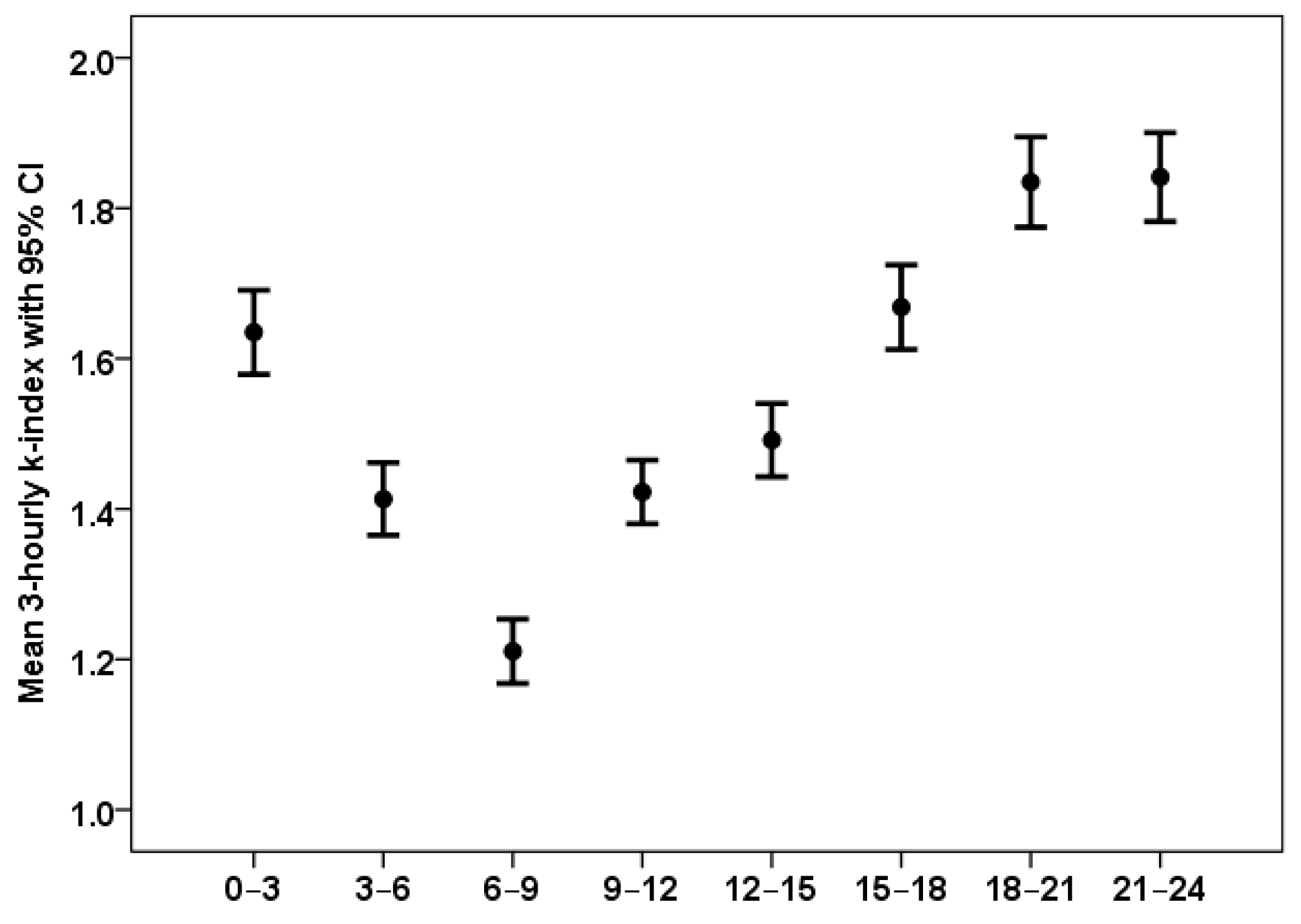
The study was conducted in Kaunas city (geographic coordinates 54.90° N; 23.91° E; geomagnetic latitude 52.38° N), Lithuania, during 2008–2012, when the descending-minimum phase of the 23rd solar cycle and the ascending phase of the 24th solar cycle occurred. We used the 3-hourly k-index of the Niemegk observatory (ftp://ftp.gfz-potsdam.de/pub/home/obs/monrep/ (accessed on 3 February 2026)), whose geomagnetic latitude (52.04° N) is close to that of Kaunas. The k-index is defined as a quasi-logarithmic measure of the range of geomagnetic disturbance at a geomagnetic observatory in a three-hourly UT interval (00–03, 03–06, …, 21–24). It is derived from the maximum fluctuations of the horizontal components of the Earth during a three-hour interval. Data from the observatory magnetometers are used to assign an integer number in the range 0–9 to each 3 h interval, with k = 0 indicating very little geomagnetic activity, 5 or more indicating a geomagnetic storm, and k = 9 representing an extreme geomagnetic storm. Based on the station-specific k-index, the a-index is derived as the three-hourly equivalent amplitude for geomagnetic activity (unit nT) at a specific station [34]. Certain trends were observed in the variation in the mean values of the 3-hourly k-index: statistically significantly higher values at 15:00–18:00, 18:00–21:00, and 21:00–00:00 in Universal time (UT) and a fall in the k-index during the period of 00:00–09:00 (UT), as well as during the maximum of the 23rd and the 24th solar cycles (Figure 1). When switching to local time (UT + 3 h), the mean differences between the k-index in late evening and at midnight (21:00–03:00) and in the morning (06:00–09:00)/before noon (09:00–12:00) were, respectively, 0.42 and 0.62.
As studies have revealed that the geomagnetic field may act as a Zeitgeber and have explained that geomagnetic activity manifested itself through the disruption of the circadian rhythms [13,18,28,29], it is probable that the deviations of changes in the 3-hourly GMA from the general tendency, occurring due to variations in solar wind or high-speed streams, affect human health. We hypothesised that the differences between the 15:00–18:00, 18:00–21:00, and 21:00–24:00 (in UT) k-index on the previous day and the 03:00–06:00 and 06:00–09:00 (in UT) k-index on the same day might be associated with variables reflecting the psychological state. We used these differences in k-indices as changes: D62 = k1518(lag1) − k36(lag0), D72 = k1821(lag1) − k36(lag0), D82 = k2124(lag1) − k36(lag0), D63 = k1518(lag1) − k69(lag0), D73 = k1821(lag1) − k69(lag0), and D83 = k2124(lag1) − k69(lag0), where subscript indices mark the hourly interval in UT, lag1 and lag0 mark the previous and the same day, and indices I and J in DIJ mark the number of the daily k-index (1–00:00–03:00, 2–03:00–06:00, etc.).
Data on the mean daily air temperature (T, °C), atmospheric pressure (AP, hPa), relative humidity (RH, %), and wind speed (WS, knots) were obtained from the Lithuanian Hydrometeorological Service Kaunas Meteorological Station located in the suburbs of Kaunas city.

2.2. Patients and Outcomes

We used data of 233 patients who underwent CABG (n = 144), valve replacement, or valve repair (n = 49), or a combination of these surgeries (n = 40) in the Clinical Department of Cardiac, Thoracic and Vascular Surgery of Kaunas Medical University Hospital (currently, the Heart Centre at Kauno Klinikos). The mean age of the patients was 58.8 years, and 168 (72.1%) of the patients were men.
The psychological problems of patients were assessed by using the Symptom Checklist-90-Revised (SCL-90-R) instrument (https://arc.psych.wisc.edu/self-report/symptom-checklist-90-scl90/, accessed on 24 February 2026). We used T-scores of 9 scales: Somatisation (SOM), Obsessive-compulsive (OC), Interpersonal sensibility (IS), Depression (DEP), Anxiety (ANX), Anger-hostility (HOS), Phobic-anxiety (PHOB), Paranoid ideation (PARAN), and Psychoticism (PSY). The SCL-90-R instrument was used 1.5 months after surgery (n = 213), 1 year after surgery (n = 183), and 2 years after surgery (n = 135). In total, data from 531 measurements of psychological states were used. Detailed characteristics of the patients are presented in our previous work [36]. The study was approved by Kaunas Regional Biomedical Research Ethics Committee; all participants provided written informed consent.

2.3. Statistical Analysis

Bivariate associations between SCL scores and k-indices were evaluated by using Spearman’s correlation. To assess the associations between psychological scores and the k-indices and differences in 3-hourly k-indices, a mixed linear model was used. In the model for each SCL scores, the following covariates were included: age, sex, the type of surgery (a categorical predictor), marital status (living together: yes vs. no), the presence of arterial hypertension (AH), diabetes mellitus (DM), major depressive disorders (MDD), dysthymic disorders, and agoraphobia diagnosed by the Mini-International Neuropsychiatric Interview [37] (yes vs. no), smoking before the surgery (yes vs. no), myocardial infarction (MI) in the anamnesis, the month as a categorical variable, and air temperature two days before. Additionally, the models included categorical weather variables (different for each SCL score) detected in our previous study [36]. We used the presence of WS ≤ 2.85 knots two days before (for all scales excluding HOS, PHOB, and PARAN), an increase in AP on the previous day by 5.15 hPa as compared to the day before it (for DEPR), low RH (≤ 65%) on the previous day (for all scales excluding HOS, PARAN, and PSY), daily T < 0.35 °C (for ANX, HOS, and PHOB), AP < 1015 hPa on the previous day (for DEPR, ANX, and PSY), and a fall in AP on the previous day by 6.2 hPa as compared to the day before it (for SOM). For sensitivity analysis, we created models with the above-mentioned patients’ characteristics and additionally included all the above-mentioned weather variables.
To assess the links between psychological scores and geomagnetic variables during different times of the surveys, a multivariate linear regression model with the same covariates was used. In the analysis, k-indices were used as continuous predictors. The differences between k-indices were used both as continuous and categorical predictors.
We presented the standardised beta coefficients in the multivariate model with standard errors (SE) and the p-value of beta, or with the 95% confidence interval. Statistical analysis was performed using SPSS 20 software (IBM Corp. Released 2011. IBM SPSS Statistics for Windows, Version 20.0. Armonk, NY, USA: IBM Corp.). A p-value < 0.05 was regarded as statistically significant.

3. Results

Most of the surveys (97.4%) were conducted on days without geomagnetic storms (3-hourly k-index < 5) during the period lasting from 18:00 on the previous day to 12:00 on the day of the survey. Descriptive characteristics of k-indices and their differences are presented in Table 1. The mean sum of the k-index for the period of 18:00–03:00 and the difference in k-indices were statistically significantly higher during surveys performed 2 years after the surgery. For differences in the k-indices, about 61–64% of values were 0 and 1, 20–22% of them were <0, and about 16–19% of them were >1.
Statistically significant negative correlations between the SCL scores, except for SOM, and k1518 on the previous day and D63 were observed. Also, negative correlations of D62 and D73 with the majority of the SCL scores with p < 0.1 were found. In the multivariate mixed model, the continuous D63 was negatively associated with all SCL scores except for SOM, IS, and PARAN, and k1518 on the previous day was negatively associated with ANX, HOS, PHOB, and PSY (Table 2). Zero k1518 on the previous day (97 cases) was associated with an increase in ANX, HOS, PARAN, and PSY scores. Associations of k1821 with SCL scores were similar to those with k1518. A low k-sum during 15:00–21:00 (UT) on the previous day (109 cases) and a negative D63 (105 cases) were associated with an increase in most scores. Associations with a negative D73 were similar. During days of a negative difference between the k-index sums during 15:00–21:00 and 03:00–09:00 UT (132 cases), all SCL scores were statistically significantly higher by 2–3 points (Table 2). We did not find any statistically significant associations of the SCL scores with the k-index sum on the previous day or with any categorical variable of this k-index sum.
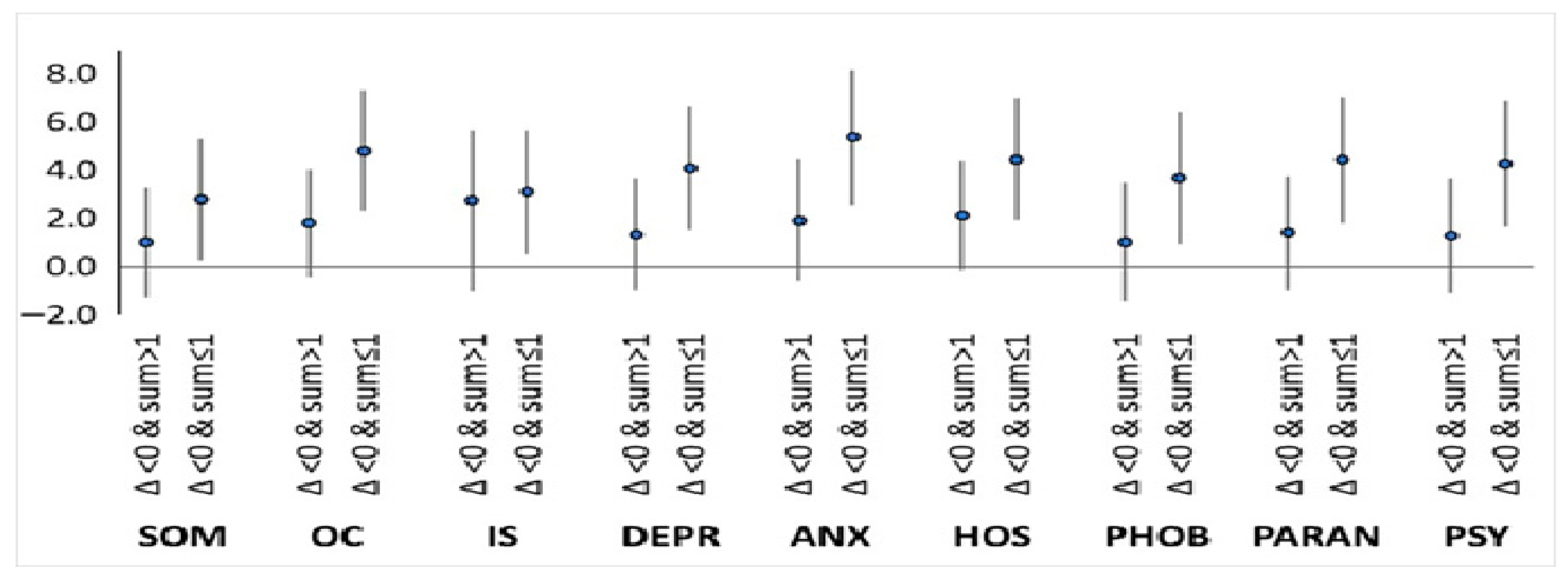
A low k-sum (≤ 1) during 15:00–21:00 (UT) on the previous day, in conjunction with a negative difference between the k-index sums during 15:00–21:00 and 03:00–09:00 UT (58 cases), had a stronger impact on SCL scores. Such variations in k-indices were associated with an increase of 4–6 points in T-scores of OC, DEPR, ANX, HOS, PARAN, and PSY (Figure 2).
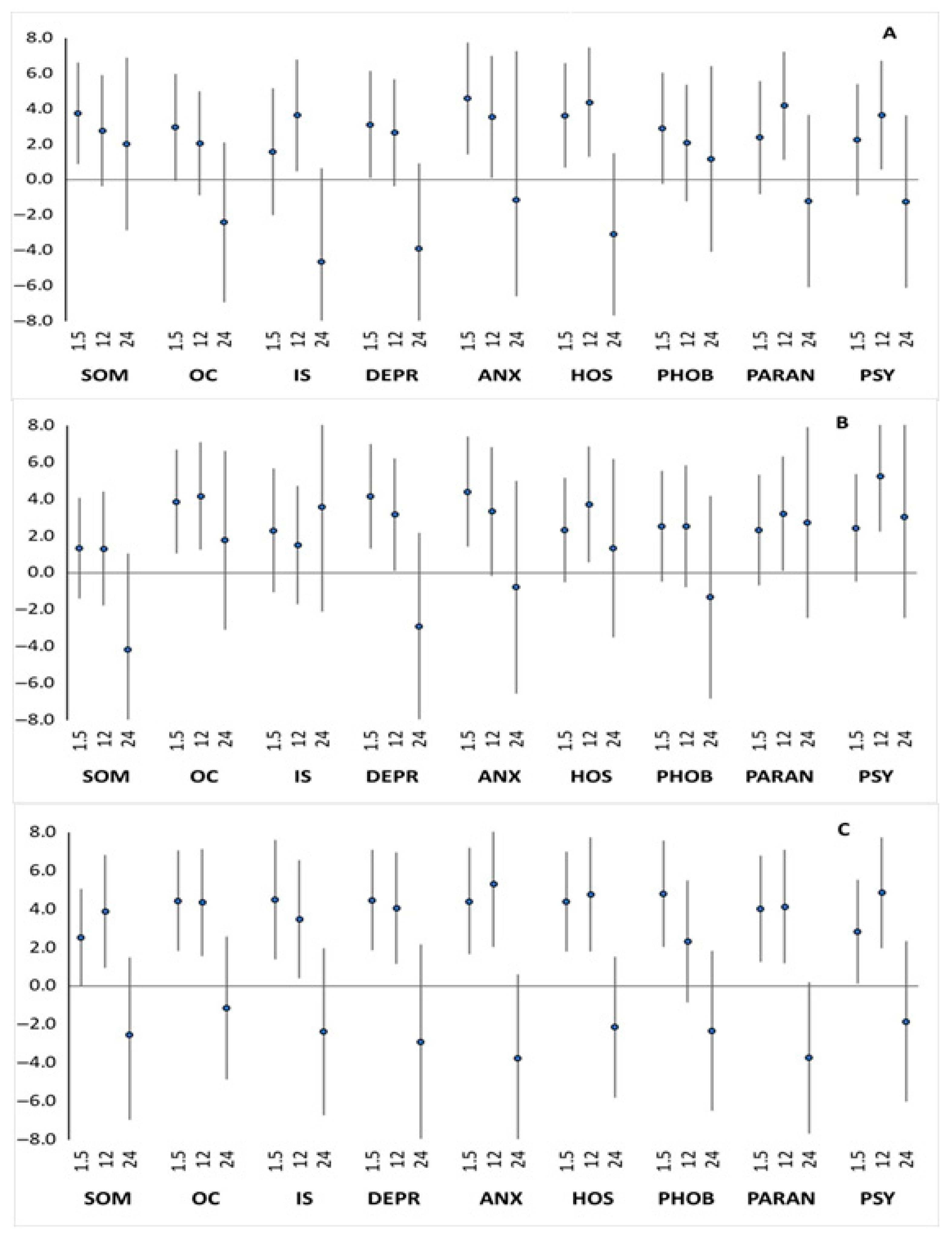
At 1.5, 12, and 24 months after the surgery, (k1518 + k1821) ≤ 1 was observed during, respectively, 47, 47 and 15 tests; a negative D63, respectively, during 51, 41, and 13 tests; and a negative (k1518 + k1821 − k36 − k69), respectively, during 60, 48, and 24 tests. Positive associations between a low k-sum during 15:00–21:00 (UT) on the previous day, a negative D63, and a negative difference between k-index sums during 15:00–21:00 and 03:00–09:00 (UT) and SCL scores were found only for data from surveys performed at 1.5 months and 12 months after the surgery; a negative difference was associated with an increase of 2–4 points in the majority of the T-scores (Figure 3). For the survey performed 2 years after the surgery, these associations tended to be negative but were statistically non-significant.
For different times after the surgery, a low k-sum (≤ 1) during 15:00–21:00 (UT) on the previous day in conjunction with a negative difference between the k-index sums during 15:00–21:00 and 03:00–09:00 UT had a stronger impact on OC, ANX, HOS, PARAN, and PSY scores at 1.5 and 12 months after the surgery (Table 3). Such variations in k-indices were associated with an increase in T-scores of OC, DEPR, ANX, HOS, PARAN, and PSY by 6 points (Figure 2). This combined effect was stronger for tests conducted at 1.5 and 12 months after the surgery (Table 3). The statistical significance of the beta coefficients in Table 2 and Table 3 and Figure 2 and Figure 3 did not change after the inclusion of all the weather variables in the models.

4. Discussion

For the first time, we found a possible impact of variations in local GMA on the psychological state of patients after open-heart surgery. We found that during the period lasting from 18:00 on the previous day to 12:00 on the day of the test (local time), variations in k-indices that were not in line with the general trend of changes in the k-index were associated with a higher level of psychological symptoms in patients after open-heart surgery. We found that low GMA late at night and a fall in k-sums from 18:00–00:00 to 06:00–12:00 were associated with a worsening of the patients’ psychological state at 1.5 and 12 months after the surgery, and a combination of these factors had a stronger effect. The results were obtained by adjusting for patients’ characteristics and weather variables.
The ion cyclotron resonance (ICR) is presented as a mechanism of geomagnetic effects on living organisms [25,38]. The ICR mechanism is based on the observation that a combination of a static magnetic field and a time-varying or oscillating magnetic/electric field of extremely low intensity can produce biological effects [25,38,39]. It is possible that low and high amplitudes of the variation in the H-component of the geomagnetic field had negative biological effects.
We did not find any statistically significant associations between the k-index sum on the previous day and SCL scores, but we found that a low sum of k-indices (0 or 1) during 18:00–00:00 on the previous day—the period of lower light exposure—was associated with higher SCL scores. On days when the sum of k-indices during 18:00–00:00 was ≤1, the difference in the values of the H-component of the geomagnetic field between 18:00–00:00 and 09:00–12:00 was significantly lower than the average of this daily variation (about 20 nT) at latitudes of 50–55o N [35]. The period of 18:00–00:00 approximately coincided with the period of a rise in melatonin levels [40]. It is possible that certain changes in GMA during this period relative to midday (an increase at latitudes >30° N and a decrease at latitudes 30° N–−30° N [35]) affected melatonin production. A reduced nocturnal secretion of a melatonin metabolite on days of geomagnetic storms was observed [16,17], while a decrease in melatonin levels occurred during geomagnetic storms [14,41]. It is possible that both low and high amplitudes of the variation in the H-component of the geomagnetic field cause a lower melatonin level. A study with a depressive rat showed reduced melatonin levels, melatonin metabolism, and biochemical indicators related to melatonin synthesis when the animal was exposed to an extreme geomagnetic storm (500 nT) and when it was shielded from geomagnetic storms (0 nT) [42]. We hypothesised that low GMA during 18:00–00:00 reduced the melatonin level and, at the same time, disrupted the circadian rhythm.
Other studies also found a negative impact of low GMA on human health. The periods of the lowest GMA (the quiet level) are associated with an increased electrical instability of the heart [43,44] and a higher rate of sudden cardiac death [44]. A higher rate of arrhythmias was observed in patients with implantable cardioverter defibrillators during the lowest GMA level [45,46]. Our patients had a higher risk of arrhythmias [47]; therefore, low GMA may be associated with arrhythmias, and symptoms of arrhythmias (a fast or slow heartbeat, chest pain, anxiety, feeling light-headed, or sweating) may impair sleep and cause a poorer psychological state. A possible negative impact of low GMA on the psychological state has been confirmed in experiments with animals. In a study with depressive rats, shielding from geomagnetic storms (0 nT) inhibited melatonin synthesis and metabolism and increased depressive behaviour, while moderate geomagnetic storms (50 nT) increased melatonin synthesis and metabolism and protected against depressive behaviours [42].
During tests conducted 2 years after the surgery, we did not find any increase in SCL scores after low GMA during 18:00–00:00 or a fall in k-sums from 18:00–00:00 to 06:00–12:00. This may be explained by a smaller sample size, a higher overall GMA level, and better cardiovascular health of the patients compared to the findings one year after the surgery.
We found that low GMA during 18:00–00:00 in conjunction with a decrease in k-sums from 18:00–00:00 to 06:00–12:00 had a stronger impact on SCL scores. This may be explained by an additional negative impact of the disruption of circadian rhythms. We found that deviations from the circadian variation in GMA—a decrease in the k-index between 18:00–21:00 and 09:00–12:00—might lead to a poorer psychological state. Our results are in line with those of other studies explaining the effect of GMA through the disruption of circadian rhythms. Apart from this, on 21% of the above-mentioned days, an increase in GMA was observed after midday (k-index ≥4). This suggests that other space weather disturbances might negatively affect the patients’ psychological state.
The study was performed during 2008–2012, the years of lower GMA, and almost all psychological assessments of the patients were conducted on days without geomagnetic storms (GSs) (k-index < 5). During the years of a higher level of GMA, such a low GMA level would be rare, and it is debatable whether a decrease in the k-index between 18:00–21:00 and 09:00–12:00 would be associated with changes in psychological indicators during other stages of the solar cycle. Other researchers have stated that GSs disturb the circadian rhythm. During the maximum-descending phase of the solar cycle, the mean values of the k-indices are increased, and it is likely that human health may be affected not only by the decrease in the k-indices in the morning but also by the level of GMA. In our study, the daily GMA level did not have any effect on SCL scores.
We found associations between variations in k-indices and psychological variables in susceptible populations. Patients with coronary arterial disease have lower melatonin production rates [48,49]. Impairment of the ANS function (decreased HRV) has been observed in patients after CABG [50] and valve surgery [51]; recovery of the ANS in CABG patients has been observed after 2–3 months [50,52]. Therefore, the associations obtained between changes in the k-indices and psychological scores in healthy individuals are disputable.
A limitation of the study is that 51.5% of the patients dropped out or did not provide data for all time points. In addition, other factors such as preoperative stress, changes in cardiovascular health, modifications in medications, sleep problems, stressful events that occurred during the previous period, low quality of life, levels of daily stress and so on might have influenced the patients’ psychological status. In the models, we included the variables influencing cardiovascular health and the psychological state after open cardiac surgery: age, sex, the presence of co-morbidities, and the assessment of psychiatric disorders by the Mini-International Neuropsychiatric Interview. Our sample size was quite small for such research, especially at 1 and 2 years after the surgery.

5. Conclusions

During years of lower GMA, in the period lasting from 18:00 on the previous day to 12:00 on the day of the test, variations in k-indices that were not in line with the general trend of changes in the k-index were associated with a higher level of psychological symptoms in patients after open-heart surgery. Low GMA late at night and a fall in k-sums from 18:00–00:00 to 06:00–12:00 were associated with a worsening of the patients’ psychological state at 1.5 and 12 months after the surgery. Our results confirm the effect of GMA through the disruption of circadian rhythms.

Author Contributions

J.V. conceived the idea, was responsible for the environmental data, performed statistical analyses, interpreted the results, and was the lead writer; M.B., E.E. and R.B. were responsible for the medical data and read and approved the final manuscript. All authors have read and agreed to the published version of the manuscript.

Funding

This research received no external funding.

Institutional Review Board Statement

The study was conducted in accordance with the Declaration of Helsinki and was approved by the Kaunas Regional Biomedical Research Ethics Committee; all participants provided written informed consent.

Informed Consent Statement

Informed consent was obtained from all subjects involved in the study.

Data Availability Statement

Data on geomagnetic activity were obtained from the Niemegk observatory (ftp://ftp.gfz-potsdam.de/pub/home/obs/monrep/ (accessed on 4 January 2026)). Weather data were obtained from the Kaunas Meteorological Station. The medical data are not publicly available. These data will be made available by the authors upon request (responsible M. Beresnevaite).

Acknowledgments

The authors are grateful to the members of the Clinical Department of Cardiac Thoracic and Vascular Surgery (currently, the Heart Centre) for their invaluable assistance in data collection.

Conflicts of Interest

The authors declare no conflicts of interest.

References

  1. Ghione, S.; Mezzasalma, L.; Del Seppia, C.; Papi, F. Do geomagnetic disturbances of solar origin affect arterial blood pressure? J. Hum. Hypertens. 1998, 12, 749–754. [Google Scholar] [CrossRef]
  2. Wang, V.A.; Zilli Vieira, C.L.; Garshick, E.; Schwartz, J.D.; Garshick, M.S.; Vokonas, P.; Koutrakis, P. Solar Activity Is Associated with Diastolic and Systolic Blood Pressure in Elderly Adults. J. Am. Heart Assoc. 2021, 10, e021006. [Google Scholar] [CrossRef]
  3. He, P.; Li, C.; Xu, M.; Guo, R.; Degeling, A.W.; Pitkänen, T.; Bu, Y.; Zheng, X.; Zhang, Y.; Jia, X.; et al. Potential influence of geomagnetic activity on blood pressure statistical fluctuations at mid-magnetic latitudes. Commun. Med. 2025, 5, 143. [Google Scholar] [CrossRef]
  4. Cornelissen, G.; Halberg, F.; Breus, T.; Syutkina, E.V.; Baevsky, R.; Weydahl, A.; Watanabe, Y.; Otsuka, K.; Siegelova, J.; Fiser, B.; et al. Non-photic solar associations of heart rate variability and myocardial infarction. J. Atmos. Sol.-Terr. Phys. 2002, 64, 707–720. [Google Scholar] [CrossRef]
  5. Galata, E.; Ioannidou, S.; Papailiou, M.; Mavromichalaki, H.; Paravolidakis, K.; Kouremeti, M.; Rentifis, L.; Simantirakis, E.; Trachanas, K. Impact of space weather on human heart rate during the years 2011–2013. Astrophys. Space Sci. 2017, 362, 138. [Google Scholar] [CrossRef]
  6. Papailiou, M.; Ioannidou, S.; Tezari, A.; Lingri, D.; Konstantaki, M.; Mavromichalaki, H.; Dimitrova, S. Space weather phenomena on heart rate: A study in the Greek region. Int. J. Biometeorol. 2023, 67, 37–45. [Google Scholar] [CrossRef]
  7. Shaposhnikov, D.; Revich, B.; Gurfinkel, Y.; Naumova, E. The influence of meteorological and geomagnetic factors on acute myocardial infarction and brain stroke in Moscow, Russia. Int. J. Biometeorol. 2013, 58, 799–808. [Google Scholar] [CrossRef]
  8. Vencloviene, J.; Radisauskas, R.; Vaiciulis, V.; Kiznys, D.; Bernotiene, G.; Kranciukaite-Butylkiniene, D.; Tamosiunas, A. Associations between Quasi-biennial Oscillation phase, solar wind, geomagnetic activity, and the incidence of acute myocardial infarction. Int. J. Biometeorol. 2020, 64, 1207–1220. [Google Scholar] [CrossRef]
  9. Feigin, V.L.; Parmar, P.G.; Barker-Collo, S.; Derrick, A.; Bennett, D.A.; Anderson, C.S.; Thrift, A.G.; Stegmayr, B.; Rothwell, P.M.; Giroud, M.; et al. Geomagnetic Storms Can Trigger Stroke Evidence From 6 Large Population-Based Studies in Europe and Australasia. Stroke 2014, 45, 1639–1645. [Google Scholar] [CrossRef]
  10. Vencloviene, J.; Radisauskas, R.; Tamosiunas, A.; Luksiene, D.; Sileikiene, L.; Milinaviciene, E.; Rastenyte, D. Possible Associations between Space Weather and the Incidence of Stroke. Atmosphere 2021, 12, 334. [Google Scholar] [CrossRef]
  11. Caswell, J.M.; Carniello, T.N.; Murugan, N.J. Annual incidence of mortality related to hypertensive disease in Canada and associations with heliophysical parameters. Int. J. Biometeorol. 2016, 60, 9–20. [Google Scholar] [CrossRef]
  12. Zilli Vieira, C.L.; Alvares, D.; Blomberg, A.; Schwartz, J.; Coull, B.; Huang, S.; Koutrakis, P. Geomagnetic disturbances driven by solar activity enhance total and cardiovascular mortality risk in 263 U.S. cities. Environ. Health 2019, 18, 83. [Google Scholar] [CrossRef]
  13. McCraty, R.; Atkinson, M.; Stolc, V.; Alabdulgader, A.A.; Vainoras, A.; Ragulskis, M. Synchronization of Human Autonomic Nervous System Rhythms with Geomagnetic Activity in Human Subjects. Int. J. Environ. Res. Public Health 2017, 14, 770. [Google Scholar] [CrossRef] [PubMed]
  14. Alabdulgader, A.; McCraty, R.; Atkinson, M.; Dobyns, Y.; Vainoras, A.; Ragulskis, M.; Stolc, V. Long-Term Study of Heart Rate Variability Responses to Changes in the Solar and Geomagnetic Environment. Sci. Rep. 2018, 8, 2663. [Google Scholar] [CrossRef]
  15. Zilli Vieira, C.L.; Chen, K.; Garshick, E.; Liu, M.; Vokonas, P.; Ljungman, P.; Schwartz, J.; Koutrakis, P. Geomagnetic disturbances reduce heart rate variability in the Normative Aging Study. Sci. Total Environ. 2022, 839, 156235. [Google Scholar] [CrossRef]
  16. Weydahl, A.; Sothern, R.B.; Cornellissen, G.; Wetterburg, L. Geomagnetic activity influences the melatonin secretion at 70 degrees N. Biomed. Pharmocother. 2001, 55, 57–62. [Google Scholar] [CrossRef]
  17. Burch, J.B.; Reif, J.S.; Yost, M.G. Geomagnetic activity and human melatonin metabolite excretion. Neurosci. Lett. 2008, 438, 76–79. [Google Scholar] [CrossRef]
  18. Liddie, J.M.; Vieira, C.L.Z.; Coull, B.A.; Sparrow, D.; Koutrakis, P.; Weisskopf, M.G. Associations between solar and geomagnetic activity and cognitive function in the Normative Aging study. Environ. Int. 2024, 187, 108666. [Google Scholar] [CrossRef] [PubMed]
  19. Kay, R.W. Geomagnetic Storms: Association with Incidence of Depression as Measured by Hospital Admission. Br. J. Psychiatry 1994, 164, 403–409. [Google Scholar] [CrossRef]
  20. Dimitrova, S. Relationship between human physiological parameters and geomagnetic variations of solar origin. Adv. Space Res. 2006, 37, 1251–1257. [Google Scholar] [CrossRef]
  21. Dimitrova, S.; Angelov, I.; Petrova, E. Solar and geomagnetic activity effects on heart rate variability. Nat. Hazards 2013, 69, 25–37. [Google Scholar] [CrossRef]
  22. Gordon, C.; Berk, M. The effect of geomagnetic storms on suicide. S. Afr. Psychiatry Rev. 2003, 6, 24–27. Available online: https://hdl.handle.net/10520/EJC72999 (accessed on 24 February 2026).
  23. Tada, H.; Nishimura, T.; Nakatani, E.; Matsuda, K.; Teramukai, S.; Fukushima, M. Association of geomagnetic disturbances and suicides in Japan, 1999–2010. Environ. Health Prev. Med. 2014, 19, 64–71. [Google Scholar] [CrossRef]
  24. Cremer-Bartels, G.; Krause, K.; Mitoskas, G.; Brodersen, D. Magnetic field of the earth as additional zeitgeber for endogenous rhythms? Die Naturwiss. 1984, 71, 567–574. [Google Scholar] [CrossRef]
  25. Liboff, A.R. Why are living things sensitive to weak magnetic fields? Electromagn. Biol. Med. 2014, 33, 241–245. [Google Scholar] [CrossRef]
  26. Krylov, V.V. Biological effects related to geomagnetic activity and possible mechanisms. Bioelectromagnetics 2017, 38, 497–510. [Google Scholar] [CrossRef]
  27. Martel, J.; Chang, S.H.; Chevalier, G.; Ojcius, D.M.; Young, J.D. Influence of electromagnetic fields on the circadian rhythm: Implications for human health and disease. Biomed. J. 2023, 46, 48–59. [Google Scholar] [CrossRef] [PubMed]
  28. Tracy, S.M.; Vieira, C.L.Z.; Garshick, E.; Wang, V.A.; Alahmad, B.; Eid, R.; Schwartz, J.; Schiff, J.E.; Vokonas, P.; Koutrakis, P. Associations between solar and geomagnetic activity and peripheral white blood cells in the Normative Aging Study. Environ. Res. 2022, 204, 112066. [Google Scholar] [CrossRef] [PubMed]
  29. Fishbein, A.B.; Knutson, K.L.; Zee, P.C. Circadian disruption and human health. J. Clin. Investig. 2021, 131, e148286. [Google Scholar] [CrossRef] [PubMed]
  30. Cornélissen, G.; Watson, D.; Mitsutake, G.; Fišer, B.; Siegelová, J.; Dušek, J.; Vohlídalová, I.; Svaèinová, H.; Halberg, F. Mapping of circaseptant and circadian changes in mood. Scr. Med. 2005, 78, 89–98. Available online: https://pmc.ncbi.nlm.nih.gov/articles/PMC2577283/ (accessed on 24 February 2026).
  31. Schiff, J.E.; Vieira, C.L.Z.; Garshick, E.; Wang, V.; Blomberg, A.; Gold, D.R.; Schwartz, J.; Tracy, S.M.; Vokonas, P.; Koutrakis, P. The role of solar and geomagnetic activity in endothelial activation and inflammation in the NAS cohort. PLoS ONE 2022, 17, e0268700. [Google Scholar] [CrossRef]
  32. Anand, K.; Vieira, C.L.Z.; Garshick, E.; Wang, V.; Blomberg, A.; Gold, D.R.; Schwartz, J.; Vokonas, P.; Koutrakis, P. Solar and geomagnetic activity reduces pulmonary function and enhances particulate pollution effects. Sci. Total Environ. 2022, 838, 156434. [Google Scholar] [CrossRef]
  33. Singh, A.K.; Siingh, D.; Singh, R.P. Space Weather: Physics, Effects and Predictability. Surv. Geophys. 2010, 31, 581–638. [Google Scholar] [CrossRef]
  34. United Nations Office for Disaster Risk Reduction (UNDRR); International Science Council (ISC). UNDRR–ISC Hazard Information Profiles—2025 Update: ET0101 Geomagnetic Disturbance United Nations Office for Disaster Risk Reduction; International Science Council. 2025. Available online: https://www.undrr.org/terms/hips/ET0101 (accessed on 24 February 2026).
  35. Yamazaki, Y.; Maute, A. Sq and EEJ—A Review on the Daily Variation of the Geomagnetic Field Caused by Ionospheric Dynamo Currents. Space Sci. Rev. 2017, 206, 299–405. [Google Scholar] [CrossRef]
  36. Vencloviene, J.; Beresnevaite, M.; Cerkauskaite, S.; Lopatiene, K.; Grizas, V.; Benetis, R. The effects of weather on depressive symptoms in patients after cardiac surgery. Psychol. Health Med. 2023, 28, 682–692. [Google Scholar] [CrossRef] [PubMed]
  37. Sheehan, D.V.; Lecrubier, Y.; Sheehan, K.H.; Amorin, P.; Janavs, J.; Weiller, E.; Hegueta, T.; Baker, R.; Dunbar, G.C. The mini-international neuropsychiatric Interview (M.I.N.I.): The development and validation of a structured diagnostic psychiatric interview for DSM-IV and ICD-10. J. Clin. Psychiatry 1998, 59, 22–33. Available online: https://www.psychiatrist.com/jcp/mini-international-neuropsychiatric-interview-mini/ (accessed on 24 February 2026).
  38. Martel, J.; Rouleau, N.; Murugan, N.J.; Chin, W.C.; Ojcius, D.M.; Young, J.D. Effects of light, electromagnetic fields and water on biological rhythms. Biomed. J. 2025, 48, 100824. [Google Scholar] [CrossRef]
  39. Liboff, A.R. A Role for the Geomagnetic Field in Cell Regulation. Electromagn. Biol. Med. 2010, 29, 105–112. [Google Scholar] [CrossRef]
  40. Skubic, C.; Zevnik, U.; Nahtigal, K.; Dolenc Grošelj, L.; Rozman, D. Circadian Biomarkers in Humans: Methodological Insights into the Detection of Melatonin and Cortisol. Biomolecules 2025, 15, 1006. [Google Scholar] [CrossRef] [PubMed]
  41. Rapoport, S.I.; Shatalova, A.M.; Oraevskii, V.N.; Malinovskaia, N.K.; Vetterberg, L. Melatonin production in hypertonic patients during magnetic storms. Ter. Arkh. 2001, 73, 29–33. (In Russian) [Google Scholar]
  42. Wu, H.; Yang, Y.; Chang, W.; Chen, X.; Yang, S.; Xu, M.; Liu, K.; Yun, Y.; Dong, L. Research on the effects and related mechanisms of geomagnetic storm on depression. Brain Res. Bull. 2025, 226, 111369. [Google Scholar] [CrossRef] [PubMed]
  43. Stoupel, E.; Martfel, J.V.; Rotenberg, Z. Paroxysmal atrial fibrillation and stroke (CVA) on males and females above and below age 65 on days of different geomagnetic activity levels. J. Basic Clin. Physiol. Pharmacol. 1994, 5, 315–329. [Google Scholar] [CrossRef]
  44. Stoupel, E. The effect of geomagnetic activity on cardiovascular parameters. Biomed. Pharmacother. Biomed. Pharmacother. 2002, 56, 247–256. [Google Scholar] [CrossRef] [PubMed]
  45. Stoupel, E. Cardiac arrhythmia and geomagnetic activity. Indian Pacing Electrophysiol. J. 2006, 6, 49–53. Available online: https://pmc.ncbi.nlm.nih.gov/articles/PMC1501097/ (accessed on 24 February 2026).
  46. Ebrille, E.; Konecny, T.; Konecny, D.; Spacek, R.; Jones, P.; Ambroz, P.; DeSimone, C.V.; Powell, B.D.; Hayes, D.L.; Friedman, P.A.; et al. Correlation of geomagnetic activity with implantable cardioverter defibrillator shocks and antitachycardia pacing. Mayo Clin. Proc. 2015, 90, 202–208. [Google Scholar] [CrossRef] [PubMed]
  47. Kornej, J.; Börschel, C.S.; Benjamin, E.J.; Schnabel, R.B. Epidemiology of Atrial Fibrillation in the 21st Century: Novel Methods and New Insights. Circ. Res. 2020, 127, 4–20. [Google Scholar] [CrossRef]
  48. Yaprak, M.; Altun, A.; Vardar, A.; Aktoz, M.; Ciftci, S.; Ozbay, G. Decreased nocturnal synthesis of melatonin in patients with coronary artery disease. Int. J. Cardiol. 2003, 89, 103–107. [Google Scholar] [CrossRef]
  49. Tengattini, S.; Reiter, R.J.; Tan, D.X.; Terron, M.P.; Rodella, L.F.; Rezzani, R. Cardiovascular diseases: Protective effects of melatonin. J. Pineal Res. 2008, 44, 16–25. [Google Scholar] [CrossRef]
  50. Soares, P.P.; Moreno, A.M.; Cravo, S.L.; Nóbrega, A.C. Coronary artery bypass surgery and longitudinal evaluation of the autonomic cardiovascular function. Crit. Care 2005, 9, R124–R131. [Google Scholar] [CrossRef]
  51. Lakusic, N.; Slivnjak, V.; Baborski, F.; Sonicki, Z. Heart rate variability in patients after cardiac valve surgery. Cent. Eur. J. Med. 2008, 3, 65–70. [Google Scholar] [CrossRef]
  52. Van Thanh, N.; Hien, N.S.; Son, P.N.; Son, P.T. Pattern Changes in the Heart Rate Variability of Patients Undergoing Coronary Artery Bypass Grafting Surgery. Cardiol. Res. Pract. 2022, 2022, 1455025. [Google Scholar] [CrossRef]
Figure 1. The mean values of the 3-hourly k-index with 95% confidence intervals (CI) during 2008–2012 (Niemegk observatory).
Atmosphere 17 00343 g001
Figure 2. Associations of SCL scores with a negative (k1518 + k1821 − k36 − k69) with and without (k1518 + k1821) ≤ 1. Y axis presents the standardised beta-coefficients; Δ= k1518 + k1821 − k36 − k69, sum= k1518 + k1821.
Atmosphere 17 00343 g002
Figure 3. Associations of SCL scores with (k1518 + k1821) ≤ 1 (A), a negative D63 (B), and a negative (k1518 + k1821 − k36 − k69) (C) at 1.5, 12 and 24 months after the surgery. Y axis presents the standardised beta-coefficients.
Atmosphere 17 00343 g003
Table 1. Descriptive characteristics of the k-indices and their differences (times in LT).
VariableTime (Months)RangeMeanSD
Sum of the k-index during 18:00–03:00, LT, lag 11.50–144.892.88
120–164.362.92
240–175.65 *2.87
Sum of the k-index during 03:00–12:00, LT, lag 11.50–134.012.64
120–143.602.44
240–144.272.54
Difference in the k-index during 18:00–21:00 and 09:00–12:001.5−2–40.351.11
12−2–40.271.13
24−2–40.62 *1.06
Difference in the k-index during 21:00–00:00 h and 09:00–12:001.5−2–40.541.31
12−2–30.361.09
24−2–30.67 *1.26
Difference in the k-index during 00:00–03:00 and 09:00–12:001.5−2–40.531.14
12−2–40.321.10
24−2–40.81 *1.35
LT local time = UT + 3; SD standard deviation; * statistically significantly higher than at 1.5 months.
Table 2. Multivariate associations between the difference in the k-index and SCL scores.
SLC Scalek1518 lag 1k1518 lag 1 = 0D63
β (SE)pβ (SE)pβ (SE)p
SOM−0.18 (0.36)0.6251.35 (1.07)0.208−0.08 (0.36)0.821
OC−0.69 (0.36)0.0531.53 (1.06)0.151−0.89 (0.36)0.012
IS−0.54 (0.41)0.1921.60 (1.21)0.186−0.67 (0.41)0.105
DEPR−0.71 (0.37)0.0551.39 (1.39)0.205−0.88 (0.37)0.016
ANX−1.41 (0.40)<0.0013.32 (1.19)0.005−1.15 (0.40)0.005
HOS−1.07 (0.36)0.0032.56 (1.07)0.038−1.02 (0.36)0.005
PHOB−0.88 (0.39)0.0241.83 (1.16)0.115−0.85 (0.39)0.026
PARAN−0.65 (0.380.0852.28 (1.11)0.041−0.72 (0.37)0.055
PSY−0.93 (0.38)0.0143.17 (1.10)0.004−0.94 (0.37)0.012
(k1518 + k1821) ≤ 1D63 < 0(k1518 + k1821 − k36 − k69) < 0
β (SE)pβ (SE)pβ (SE)p
SOM2.62 (1.01)0.0100.18 (1.01)0.8561.80 (0.91)0.049
OC1.62 (1.00)0.0993.71 (1.00)<0.0013.14 (0.90)0.001
IS1.74 (1.14)0.1282.45 (1.15)0.0332.97 (1.04)0.004
DEPR1.75 (1.03)0.0892.71 (1.02)0.0082.56 (0.93)0.006
ANX3.63 (1.12)0.0013.05 (1.12)0.0073.45 (1.02)0.001
HOS2.54 (1.01)0.0122.30 (1.02)0.0243.17 (0.91)0.001
PHOB2.39 (1.09)0.0292.09 (1.09)0.0562.21 (0.99)0.026
PARAN2.62 (1.05)0.0132.97 (1.05)0.0052.76 (0.95)0.004
PSY2.10 (1.04)0.0453.52 (1.04)0.0012.61 (0.95)0.006
Adjusting for age, sex, the type of surgery, marital status, the presence of AH, DM, MDD, dysthymic disorders, and agoraphobia, smoking, MI in the anamnesis, the month, air temperature two days before, and categorical weather variables; D63 = k1518(lag1) − k69(lag0).
Table 3. Multivariate associations between the combined impact of a low k-sum (≤ 1) during 15:00–21:00 (UT) on the previous day and a negative difference between k-index sums during 15:00–21:00 and 03:00–09:00 and SCL scores during different times after the surgery.
SLC ScaleVariableData at 1.5 Months After the SurgeryData at 1 Year After the SurgeryData at 2 Years After the Surgery
β (SE)pβ (SE)pβ (SE)p
SOM(1)1.61 (1.70)0.3443.86 (1.96)0.049−3.06 (2.41)0.204
(2)−0.81 (1.94)0.6783.88 (2.04)0.057−1.31 (3.63)0.718
OC(1)3.97 (1.77)0.0252.54 (1.85)0.169−2.04 (2.24)0.362
(2)4.97 (1.82)0.0066.32 (1.92)0.0010.99 (3.37)0.769
IS(1)5.38 (2.09)0.0103.31 (2.03)0.104−1.88 (2.62)0.473
(2)3.55 (2.15)0.0993.65 (2.12)0.085−3.57 (3.95)0.366
DEPR(1)2.61 (1.76)0.1383.86 (1.89)0.041−3.72 (2.36)0.116
(2)6.42 (1.79)<0.0014.27 (2.02)0.034−3.81 (3.57)0.286
ANX(1)1.82 (1.85)0.3244.67 (2.17)0.032−2.59 (2.62)0.323
(2)7.20 (1.91)<0.0016.00 (2.26)0.008−6.47 (3.94)0.101
HOS(1)2.62 (1.73)0.1304.01 (1.98)0.043−1.29 (2.19)0.555
(2)6.29 (1.79)<0.0015.56 (2.04)0.006−4.19 (3.35)0.211
PHOB(1)2.79 (1.83)0.1272.37 (2.12)0.264−2.44 (2.50)0.329
(2)6.94 (1.89)<0.0012.24 (2.18)0.306−2.13 (3.82)0.577
PARAN(1)2.94 (1.86)0.1153.13 (1.96)0.111−4.05 (2.36)0.104
(2)5.16 (1.92)0.0075.22 (2.04)0.011−1.34 (3.57)0.707
PSY(1)0.71 (1.81)0.6964.07 (1.92)0.034−0.77 (2.51)0.751
(2)5.06 (1.85)0.0065.72 (1.98)0.004−4.37 (3.80)0.251
Reference category (k1518 + k1821 − k36 − k69) ≥ 0; (1): (k1518 + k1821 − k36 − k69) <0 and (k1518 + k1821) > 1; (2): (k1518 + k1821 − k36 − k69) < 0 and (k1518 + k1821) ≤ 1. Adjustment by covariates is presented in Table 2.
Disclaimer/Publisher’s Note: The statements, opinions and data contained in all publications are solely those of the individual author(s) and contributor(s) and not of MDPI and/or the editor(s). MDPI and/or the editor(s) disclaim responsibility for any injury to people or property resulting from any ideas, methods, instructions or products referred to in the content.