Article

Taming the Fine Particulate–Mortality Curve

by
Richard Thomas Burnett
Environmental Health Directorate, Health Canada, Ottawa, ON K1A 0P8, Canada
Atmosphere 2026, 17(2), 185; https://doi.org/10.3390/atmos17020185
Submission received: 8 January 2026 / Revised: 6 February 2026 / Accepted: 9 February 2026 / Published: 10 February 2026
(This article belongs to the Section Air Quality and Health)

Abstract

Estimating the population-level mortality burden attributable to exposure to outdoor fine particulate matter  P M 2.5  requires characterizing both the magnitude and shape of the relative risk function that mathematically models how exposure affects response. The relationship can be derived using cohort studies where the association between  P M 2.5  exposure and mortality is directly observed. As policy issues of interest can involve exposures that exceed by several-fold those observed in cohort studies, how the association is extrapolated to these high concentrations is a major source of uncertainty. To address this issue, we suggest the extrapolation criterium that the estimated proportion of deaths attributed to exposure above the observed cohort exposure range is no more than that below the range. This criterion implies that the relative risk function must be bounded from above with marginal changes in risk, rapidly declining with increasing concentration. We illustrated the approach with the use of meta-data from 44 cohorts conducted in North America, Western Europe, Asia, and China, examining the association between long-term exposure to outdoor  P M 2.5  and non-accidental mortality.

1. Introduction

Fine particulate matter  P M 2.5  is a leading contributor to the global disease burden examined by the Global Burden of Disease 2023  G B D 2023  program [1]. Estimating this burden requires, in part, characterization of both the magnitude and shape of the association between exposure and a health response. For the case of mortality, this association is determined using meta-data (slope estimate from a survival model using cohort data, its standard error and its cohort-specific exposure distribution) [1,2,3]. Cohort studies of outdoor  P M 2.5  observed exposures well below  100   μ g / m 3 , while policy analyses involving exposure scenarios can be more than 10-fold that of the figure [4].
The very first attempt at constructing a relative risk model for the association between  P M 2.5  and mortality over the global exposure range was part of the very first  G B D  program in 2004 [5]. At the time, only two cohort studies existed, both conducted in the United States [6,7], with the highest observed exposure concentration of  30   μ g / m 3 [6]. A linear-in-concentration relative risk model was assumed up to  30   μ g / m 3  with no increase in risk above this level. This extreme form of bounding was used based on concerns that this linear-in-concentration model would yield unacceptably high risks at the concentrations observed globally [5].
The next attempt was the  I n t e g r a t e d   E x p o s u r e R e s p o n s e   I E R , where risks associated with much higher particulate exposure sources (second-hand smoke, household pollution, and active smoking) of  P M 2.5  were integrated with outdoor sources by transforming total inhaled dose of  P M 2.5  to the equivalent ambient concentration [8]. Several assumptions, however, had to be made, including assuming that the toxicity of  P M 2.5  is the same for each source at the same inhaled dose, and that toxicity is not a function of the timing of exposure (i.e., smoking a cigarette versus living with a smoker) [8]. An algebraic function was used to model relative risk predictions. Since the equivalent  P M 2.5  exposure from active smoking yielded concentrations much larger than any possible outdoor concentration  ( > 10,000   μ g / m 3 ) , predicting the risk at even very high outdoor levels was a matter of interpolation.  G B D  dropped active smoking and second-hand smoking from the  I E R , leaving household pollution as the highest  P M 2.5  exposure source [1]. They also replaced the algebraic function with a monotonically increasing concave smoothing spline [1]. They extrapolated the risk beyond the observed exposure data with a linear function [1]. Although this method offered a mathematical framework for risk extrapolation and enabled simultaneous assessment of the mortality burden from multiple sources [1], its reliability relied on strong assumptions that have not been empirically tested or verified. In addition, since the exposure distributions of the cohorts in each of the sources can overlap, a common fitted model will not necessarily provide an adequate fit to any single source, as it is highly influenced by the differences in the magnitude in risk between sources [3]. This is a limitation of the  I E R  approach if one is interested in modeling exposure specifically from outdoor sources.
The third attempt, the  G l o b a l   E x p o s u r e   M o r t a l i t y   M o d e l   G E M M , focused on the case where only risk assessment from outdoor sources of  P M 2.5  was of interest [2], and as such, only information from cohort studies of outdoor-sourced  P M 2.5  was used. The product of a generalized logarithmic function and a sigmodal function was used to characterize the shape of the concentration–response relationship. The algebraic form of the function formed the basis for predictions beyond the cohort exposure range.
The fourth approach, the  F u s i o n  model [3], used a parametric spline with two knots composed as a fusion of three algebraic forms of the derivative of the logarithm of the relative risk model. The first form was a constant up to a concentration, the first knot, and then a function that declines with concentration up to the upper limits of the observed cohort exposure distribution, the second knot. A simplistic algebraic form was suggested as a means to extrapolate risk beyond the observable exposure range, where the derivative declines as the inverse of concentration [3]. This assumption on the derivative implies that the relative risk increases as the logarithm of concentration beyond the observed cohort exposure range. Although this assumption was conservative in the sense that the derivative of the model is always greater over the cohort exposure range than a logarithm model predicts beyond that range, relative risk predictions are unbounded, and at concentrations much higher than observed, the relative risk estimate could be extreme, so much so that they are reasonably questioned [9].
In this paper, we propose a specific criterion to guide extrapolation of the relative risk beyond concentrations observed in health studies of outdoor  P M 2.5 . We suggest that the range in the population attributable fraction (proportion of total deaths due to  P M 2.5  ) [5] based on concentrations above the cohort exposure range should not be greater than that observed over the cohort exposure range itself. In addition, we require a relative risk estimate at the end of the cohort exposure range to be insensitive to the shape and magnitude of the relative risk predictions above this range. Our approach does not require additional assumptions on the extrapolated risk except that it is bounded from above. We illustrated our model using meta-data from 44 cohort mortality studies of outdoor  P M 2.5  conducted globally.

2. Materials and Methods

2.1. Previous Relative Risk Models

Consider a relative risk function,  R g z , for concentration  z , with the general form
R g z = g γ 0 z D x x
where the link function  g  is continuous, differentiable, and monotonically increasing and  γ D z  represents the derivative of  g 1 R g z  with respect to concentration  z  with  γ > 0  being the derivative at the origin, implying  D 0 = 1 . We further assumed that  D z  is greater than 0 and bounded above by 1; is continuous; and is both integrable and differentiable.
Two forms of  g  have been previously considered:  g x = e x  and  g x = 1 + x . If  D z = 1 , z  and  g x = e x , then  l n R e x z = γ z  is the  L o g L i n e a r  relative risk function [5], and if  D z = 1 / 1 + z , then  l n R e x z = γ ln 1 + z  is the  L o g L o g  relative risk function [5], with  R e x =  for both models. A truncated function of the form  D z = 1  if  z < C  and zero otherwise, with  g x = 1 + x  being suggested as a means of limiting the magnitude of the relative risk at high global concentrations [5] with  R 1 + x = 1 + γ C < . The algebraic version of the  I E R [8] sets  g x = 1 + x , and  0 z D x x = 1 e ν z δ  with  R 1 + x = 1 + γ < . The power functional form  0 z D x x = z ψ  and  g x = 1 + x  has also been proposed [10] with  R 1 + x = .
When  g x = e x , a number of forms have been considered. For example, a smoothing spline [1] has been proposed for  0 z D x x , with a linear-in-concentration functional form used to extrapolate the risk beyond observed exposures, with  R e x = . The  F u s i o n  model assumes that  D z  is a monotonically non-increasing regression spline and a logarithm-in-concentration risk model for the concentration above those observed in cohort studies, again with  R e x = . The  G E M M  assumes that  0 z D x x = l n z / α + 1 / 1 + e z μ / τ . This functional form is approximated by a logarithmic function for exposures above those observed in the cohorts, and thus,  R e x = .

2.2. Criterion for Risk Extrapolation

We suggest examining the population attributable fraction,  P A F l , u = 1 1 / R g l , u , for concentrations  l < u  as a means to define a criterion for extrapolating the risk beyond the cohort exposure range, where
R g l , u = g γ 0 u D x x / g γ 0 l D x x
Our extrapolation criterion is based on the following assumptions:
  • We have no direct (observable) information on the magnitude or shape of the relative risk function over the extrapolated exposure range;
  • We should not be generating more change in the  P A F  when extrapolating than we observe;
  • The magnitude of the change in the  P A F  over the observed exposure range is the sole determinant of the magnitude of the  P A F  over the extrapolated exposure range;
  • The magnitude and shape of the relative risk function over the extrapolated exposure range should not influence the magnitude and shape of the relative risk function over the observed exposure range.
The first assumption is the main motivating factor for our approach: that there does exist any relevant information on the risk beyond that observed from cohort studies of outdoor air pollution. The  I E R , on the other hand, assumes that the risk observed from other particulate sources, such as second-hand smoke, household pollution, and active smoking, are relevant and can provide direct information to determine the magnitude and shape of the relative risk function for concentrations above those observed in cohort studies of outdoor air pollution. However, the assumption that the toxicity of these sources is entirely due to the total inhaled dose [8] has not ever been tested or verified.
Our second assumption suggests that we should be cautious in extrapolating the risk for concentrations where no relevant information is available, and that we should not be “artificially” generating more risk than we observe. The third assumption is that we can only use information on risk that we observed to form a basis for extrapolating risk. And finally, the fourth assumption is that we do not want to alter our understanding of how exposure affects the risk over the observed exposure range in order to derive a model for extrapolation of risk.
We can mathematically model assumption (2) by assuming that the  P A F  over the concentration range  0 , θ , where  θ  represents a high percentile of the cohort exposure distribution (see Appendix A), should be equal to the  P A F  over the extrapolated range  θ , , or  P A F 0 , θ = P A F θ , . That is, we do not want to create more change in the  P A F  when extrapolating than we observed over the cohort exposure range. This equivalence implies
R g 0 , θ = R g θ , = R g 0 , R g 0 , θ   o r   R g 0 , = R g 0 , θ 2
meeting our third assumption that the magnitude of the relative risk over the cohort exposure range determines the magnitude of the relative risk over the extrapolated exposure range.
This also implies that the risk must be bounded from above:  R g 0 , < . [To simplify the notation, we denote  R g 0 , θ  as  R g θ  when the lower concentration is zero.] We therefore equated the magnitude of the relative risk over the extrapolated concentrations to equal the magnitude of the relative risk over the observed cohort concentrations, without constraining the magnitude at  θ .
To do this, we required  D z  to decline with  z  at high concentrations at a fast enough rate such that  R g < . For our model to meet this criterion,  D z  must, at high concentrations—say  z > θ —decline at a rate faster than  1 / z , since  θ z 1 z = log θ = . We effectively discounted marginal changes in the relative risk when the concentrations were above  θ , with the discounting increasing as the concentrations get farther away from  θ .
We can characterize the magnitude and shape of  D ( z )  over the cohort exposure range using evidence of the association between concentrations of outdoor  P M 2.5  and mortality observed from cohort studies. These studies are now conducted worldwide, including North America, Europe, India, China, Asia, and Africa [1,3].
All these studies use survival analysis models relating the logarithm of the instantaneous probability of death to a subject’s exposure, controlling for other known mortality risk factors such as smoking, diet, body mass index, education, and income. The exposure–response relationship is almost always assumed to be linear in concentration.
Let  β i  for the  i t h  of  I  cohorts represent the slope of that association and let  β ^ i  represent the parameter estimate of  β i , with  v ^ i  representing its standard error estimate. We interpret  β ^ i  as the average derivative of the logarithm of the relative risk over the  i t h  cohort exposure distribution when  g x = e x . If  g x = 1 + x , we replace  β ^ i  with the average derivative of the relative risk, denoted by  δ ^ i  (see Appendix A). Let  z i L , z i U  represent the lower and upper limit of that distribution.
Each  β ^ i  (or  δ ^ i  ) gives us some insight on what  D z  looks like over its respective exposure range. For example, if  D z  is nearly constant, then there should be no discernible relationship with concentration. If  D z  is decreasing/increasing, then the  β ^ i  (or  δ ^ i  ) should decrease/increase with concentration. We can mathematically characterize that relationship using meta-regression [11].

3. Results

We illustrated our method with an analysis of the association between non-accidental mortality and  P M 2.5  using meta-data on 28 cohorts that were previously examined [3], with the addition of 16 cohorts published since 2021 (one in Canada [12]; one in China [13]; one in England [14]; seven in Europe [14]; and six in Asia [15]), totaling 44 cohorts.
We defined two exposure ranges based on observed outdoor-monitored  P M 2.5  concentrations [16] and specific high-exposure situations [4]. For the purposes of this example, we define the global outdoor exposure range as  0 120   μ g / m 3  based on the highest global annual concentration in cities in 2024 (Byrnihat, India, at 128   μ g / m 3  and Delhi, India, at 108   μ g / m 3  ) [16]. We also define an extended exposure range as  0 1000   μ g / m 3  in order to more clearly illustrate the differences in model predictions over high exposures that have been observed [4].
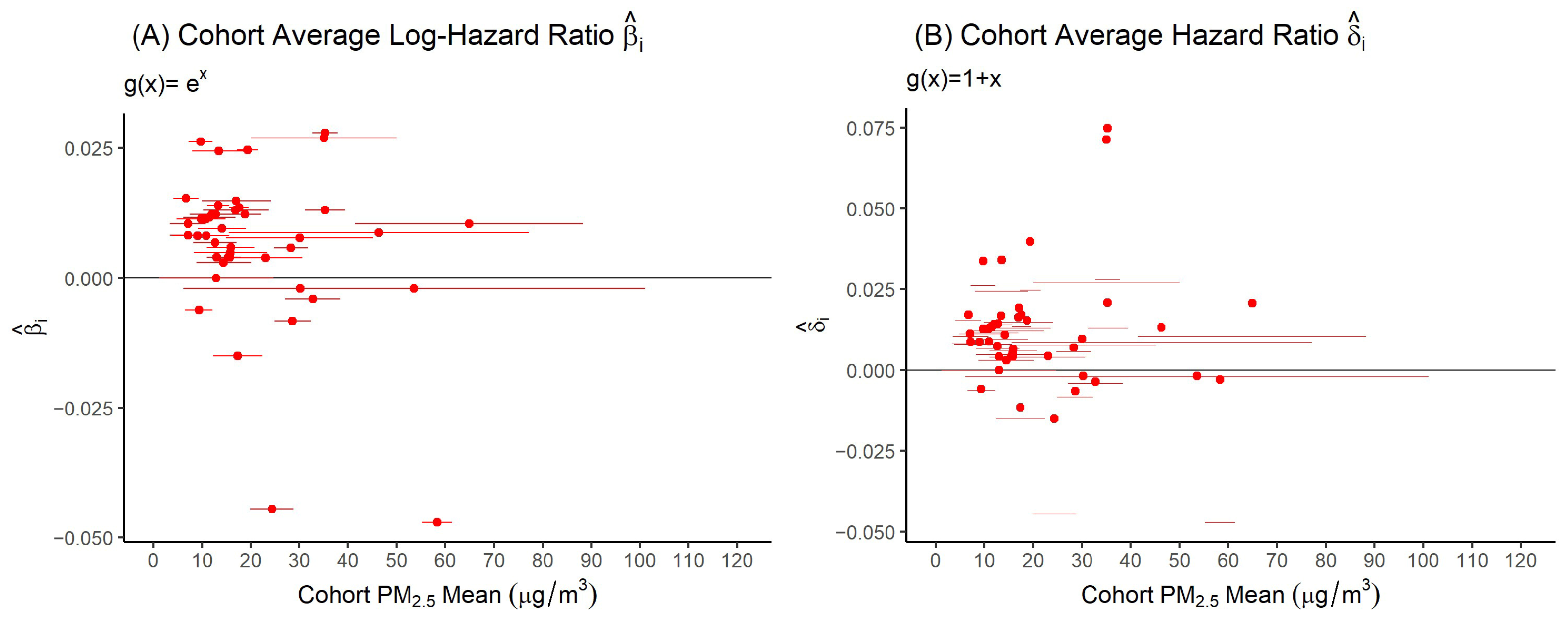
The meta-data are displayed in Figure 1, when the logarithm of the hazard ratio is used  ( β ^ i )  (Panel (A)) or when the hazard ratio is used directly  ( δ ^ i )  (Panel (B)) as red dots, along with the fifth and 95th percentiles of the cohort-specific exposure distributions (red horizontal lines). A great deal of scatter was observed for the meta-data, for either  β ^  or  δ ^ i , and there was no apparent pattern with concentration, suggesting that a constant over concentration maybe an appropriate derivative model.
If  D z = 1 , z  and  g x = e x , then  R e x z = e γ z , defining the  L o g L i n e a r  model. Our estimate of  γ = 0.0092  yields a relative risk of 3.0 at  120   μ g / m 3  and 9897 at  1000   μ g / m 3 . Estimates as large as 9897 appear biologically implausible.
We thus require a model that is flexible within the cohort exposure range, yet yields not such extreme values as the  L o g L i n e a r  model above the cohort exposure range. One such model is the  G E M M [2], as it was specifically designed to model a variety of shapes (near linear, sub-linear, supra-linear, and sigmodal) within the cohort exposure range, yet approximate a logarithmic model for concentrations above the range. This is accomplished by limiting the  G E M M  parameters  α , μ , τ  to lie within the cohort exposure range [2].
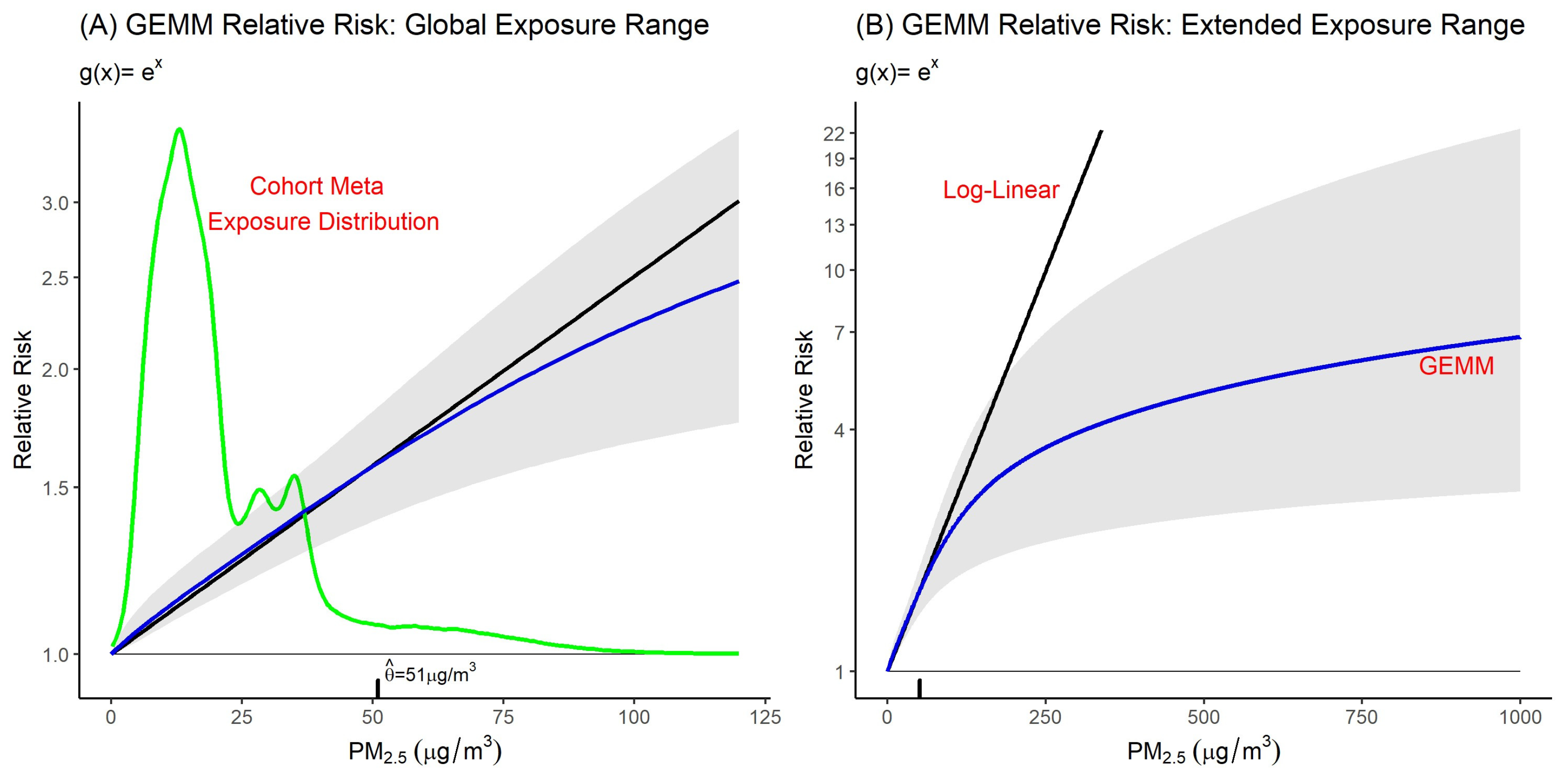
We fit the  G E M M  to our meta-data and displayed the relative risk predictions (blue line) and uncertainty interval (grey shaded area) over the global (Figure 2, Panel (A)) and extended (Figure 2, Panel (B)) exposure ranges. In addition, the cohort meta-distribution is displayed in Panel (A) (green line) along with our estimate of  θ  (see Appendix A) along with the  L o g L i n e a r  model predictions (black line). The  G E M M  and  L o g L i n e a r  predictions are similar when concentrations are less than  θ ^ = 51   μ g / m 3 . There is some departure between the model predictions between  51   μ g / m 3  and 120   μ g / m 3  (Figure 2, Panel (A)), with the  G E M M  displaying more curvature than the  L o g L i n e a r  model. Thus, the  G E M M  is performing as it was designed. Concerns are raised, however, when the  G E M M  predictions are extrapolated well beyond the global concentration range (Panel (B)) with  G E M M 1000   μ g / m 3 = 6.8  and an upper uncertainty limit of 22. The  G E M M  is thus limited by the use of a single algebraic function over both the cohort and extended exposure ranges.
Burnett and collogues [3] approached this problem by specifying two separate functions; one over the cohort exposure range (see Appendix A) and another, a logarithmic function, used to extrapolate the risk beyond the cohort exposure range, denoted as the  F u s i o n  model.
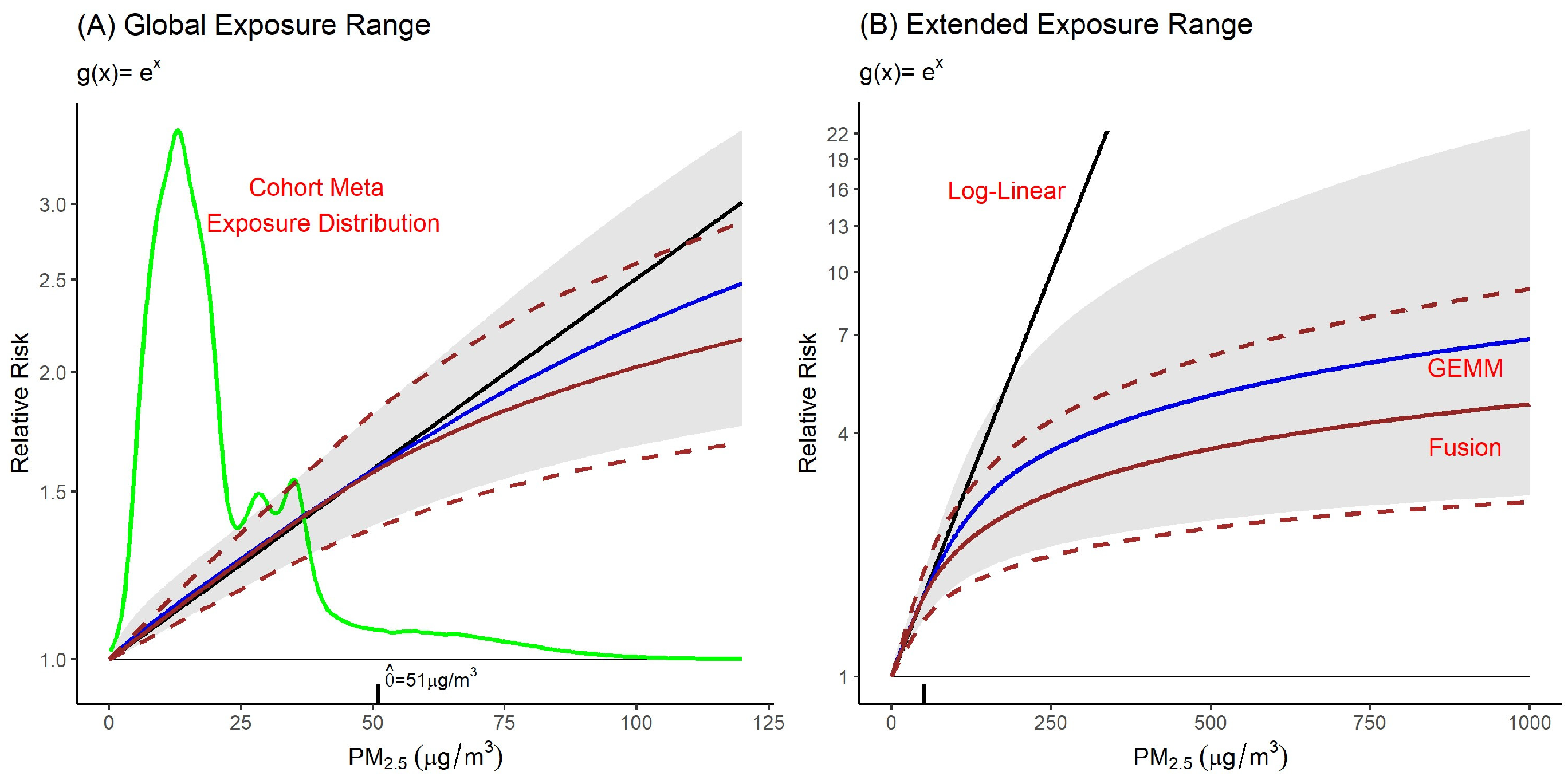
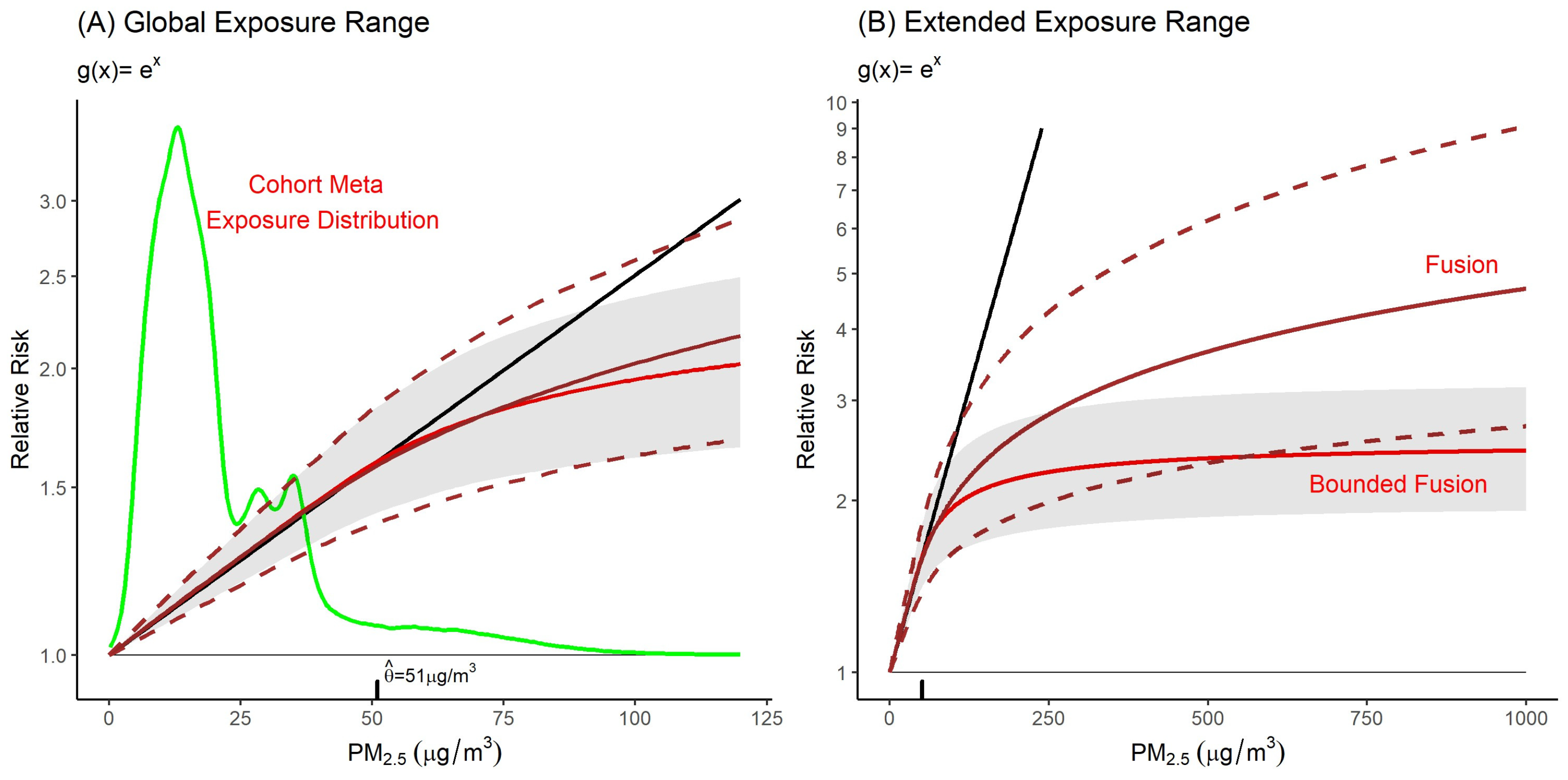
All three—the  G E M M  (blue line: Figure 3),  L o g L i n e a r  (black line: Figure 3), and  F u s i o n  (brown line: Figure 3) relative risk predictions—were similar over the cohort exposure range (Panel (A)), but differed over the extended exposure range (Panel (B)), with the  L o g L i n e a r  predictions being greater than the  G E M M  predictions, which were in turn greater than the  F u s i o n  model predictions. We noted that the  G E M M  uncertainty interval was clearly wider than the  F u s i o n  model’s uncertainty interval (Panel (B)). However, the  F u s i o n  model prediction at  1000   μ g / m 3 , 4.7, was still very large, implying that 79% of all deaths are attributable to  P M 2.5  exposure. In addition,  F u s i o n =  is an unbounded function.
We next considered applying our extrapolation criterion with the implication that  R g < . The  F u s i o n  model [3] specified  D z = D θ θ z ,   z θ , with the derivative declining at a rate of the inverse of the concentration above the cohort exposure range. We propose an alternative derivative model of the form  D z = D θ θ z α ,   z θ  and  α > 1  with the property  D θ θ   D ( x ) x = D θ θ   θ x α x = θ D θ α 1 <  being bounded from above for all concentrations. We propose using the same algebraic form of the derivative for concentrations within the cohort exposure range as the  F u s i o n  model. The restriction that the derivative of  D z  be continuous at  z = θ  in order for a smooth transition between different algebraic forms below and above  θ  implies that  D z , when  z < θ , must be a function of the decay parameter  α  (see Appendix A). We term this new model the  B o u n d e d   F u s i o n  model with a comparison to the  F u s i o n  model presented in Figure 4. Methods for selecting the value of  α  and characterizing the magnitude and shape of  D z  are provided in Appendix A.
The  F u s i o n and Bounded Fusion relative risk predictions were similar over the cohort exposure range (Figure 4, Panel (A)), with the  B o u n d e d   F u s i o n  being slightly less than the  F u s i o n  model predictions between the cohort and global concentration ranges (Panel (A)). However, the  B o u n d e d   F u s i o n  model predictions were clearly less than those of the  F u s i o n  model over the extended concentration range, with narrower uncertainty intervals (Panel (B)). The property of similar risk predictions over the cohort exposure range between the    F u s i o n  and  B o u n d e d   F u s i o n  models indicates that our method meets our fourth assumption that the extrapolation model does not influence risk predictions within the cohort exposure range.
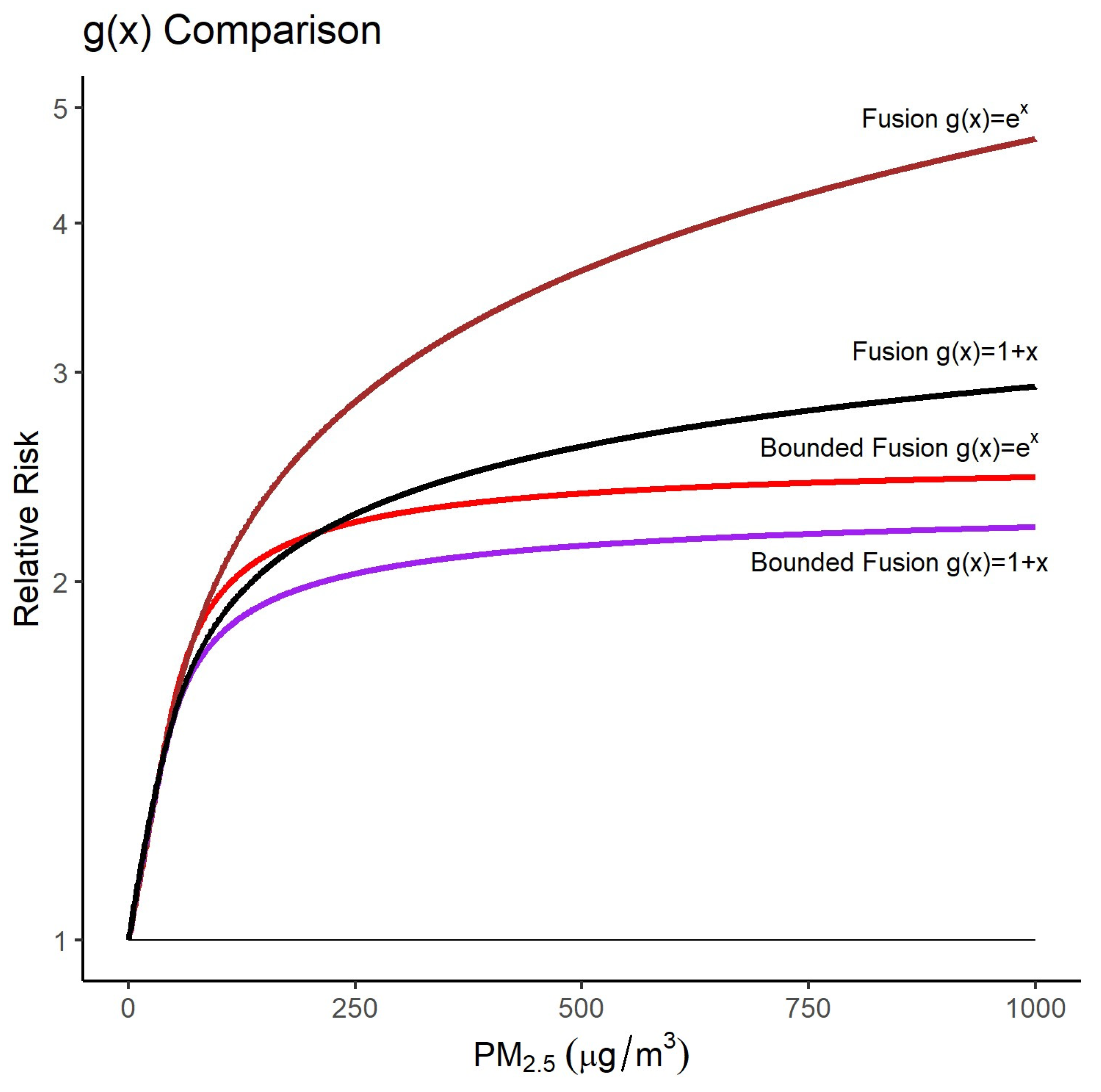
We next compared the  F u s i o n  and  B o u n d e d   F u s i o n  model predictions between the two specifications of the link function  g  in Figure 5. The predictions were larger when the  g x = e x  form was used compared to the  g x = 1 + x  form due to taking exponentials. The difference between the two link specifications increased with the relative risk estimate at  z = θ ^ , with a larger difference observed for the  F u s i o n  model compared to the  B o u n d e d   F u s i o n  model specification.

Setting an Upper Bound on Risk

Suppose one assumes a biological bound in risk  R = B > R θ ^ . The closer the value of  B  is to  R θ ^ , the larger the value of  α , resulting in more curvature in the model predictions for higher concentrations (see Appendix A). If  B  is only slightly greater than  R θ ^ α  can be very large. In the extreme case,  B = R θ ^  and  α = . If  B  is much larger than  R θ ^ α  would be only slightly greater than unity and the extrapolated relative risk would be approximately logarithmic. In this case, the  F u s i o n  and  B o u n d e d   F u s i o n  relative risk predictions would be similar.
It is not clear, however, how to select such a bound in practice. Relative risks due to active smoking were used to bound the risk in the original  I E R [8]. Using the active smoking risk as a guide, we noted that the relative risk of a current smoker to a never smoker for all causes of death was 2.78 [17]. Our upper bounds of  R = 2.58    ( g x = e x )  and  R = 2.41    ( g x = 1 + x )  are less than the active-smoking-related relative risk. The resulting relative risk estimates for concentrations above  θ ^  would be larger than those displayed in Figure 4 if this smoking-based upper bound was used.

4. Discussion

Exposure to fine particulate matter is a leading contributor to mortality and morbidity globally [1]. As such, there is great interest in characterizing the association between exposure and health over the global exposure range [1,2,3]. Although there have been several cohort studies examining this association, only a few have been conducted in situations where the subject’s exposure is similar to the highest global outdoor concentrations. There are cases of interest, however, where people are exposed to much higher levels than in any of the cohorts [4]. Even if new cohorts are established in regions with high exposures, they are not likely to completely cover all cases of policy interest. Relative risk models are thus required to not only cover the global range of outdoor exposure to the general population, but also to much more extreme exposure scenarios that are observed today and for potential cases of changing future atmospheric conditions leading to even higher levels [18]. Methods are thus required to extrapolate the risk potentially well beyond the risks observed in epidemiological studies, yet meet the requirements of biological plausibility when the extrapolated risks may be potentially so large that they are viewed with skepticism [9].
We proposed a method of risk extrapolation for which the  P A F  over the extrapolated concentration range [ θ ^ ,   )  is equal to that over the observed exposure range  [ 0 , θ ^ ] . This approach does not require strong additional assumptions like those needed for the  I E R [8]. We do not specifically bound the magnitude of the relative risk in absolute terms, but in relative terms with  R θ ^ , = R θ ^ . The larger the value of  R θ ^ , the larger the magnitude of the bound  R .
We suggest that the link function  g x = 1 + x  be used when predictions of risk at very high concentrations are of interest, as it yields lower relative risk predictions and narrower uncertainty intervals compared to using the  g x = e x  link function. The difference between the two forms increases as risk predictions increase. We suggest that it is unnecessary to inflate these predictions at high concentrations, given that we have no data to provide guidance at concentrations well beyond the cohort data exposure concentrations.
The cohort studies typically use a multi-year average of estimates of ambient concentration at a subject’s home address [1,2,3]. However, cases of interest may involve situations where a subject is exposed to potentially very high concentrations for short periods of time, such as riding a motorcycle in Deli, India [4]. In order to use our relative risk function for burden analyses, one would have to convert their estimated time-integrated exposure to a multi-year average equivalent.
We also suggest an alternative approach to bounding relative risk predictions by fixing the value of an upper bound that is not related to the prediction of risk over the cohort exposure range. This approach allows for the policy analyst to decide on what is an acceptable upper bound on risk.
The motivation of developing our model is also its major limitation, in that we have no observed evidence of risk at these extremely high concentrations. Ideally, one should conduct studies in these cases. In the absence of such evidence, ancillary information can provide some guidance as to the reliability of our model predictions. These include information on risk from other particulate sources at very high concentrations or a comparison of our high concentration model predictions with those of the 88 mortality risk factors reported by the  G B D [1].

5. Conclusions

We provided a mathematical means to estimate the relative risk over the exposure range where relevant information exists, and to predict the risk at concentrations well above that range, where no information exits. The major limitation of our method, and its motivation, is the lack of direct information at very high concentrations of interest. There is a need to conduct studies at these very high concentrations to assess the reliability of our approach.

Funding

This research received no external funding.

Institutional Review Board Statement

Not applicable.

Informed Consent Statement

Not applicable.

Data Availability Statement

The meta-data used to fit the model can be obtained from the corresponding author, in addition to 1000 sets of parameter estimates and the R code to calculate the relative risk.

Conflicts of Interest

The author declares no conflicts of interest.

Appendix A

Appendix A.1. A Candidate Model for  D

We illustrate our approach with a candidate form for  D . For the purposes of this illustration, we assume the derivative has these properties: positive, continuous and differentiable and integrable for all concentrations. We first consider the derivative when  z θ , with the general form: D  θ f α z , where  f α z  is a continuous, differentiable and integrable, and monotonically decreasing function of  z  with the rate of decline or discounting governed by the parameter  α , such that  f α θ = 1 , ensuring continuity at  z = θ , and
D θ θ f α x x <
We add the restriction that the derivative of  D z  be continuous throughout the concentration range for a smooth transition at  z = θ . This implies that
D z z | z = θ = D θ f α z z | z = θ
which also implies that  D z  must be dependent on  α  when  z < θ . We then need to find the value of  α  that meets our extrapolation criterion:  R g θ , = R g θ . If  g x = e x , then
θ ^ f α x x = 0 θ D x x / D θ
independent of  γ . If  g x = 1 + x , then
θ f α x x = 0 θ D x x / D θ 1 + γ 0 θ D x x
An example of  f α  is  f α z = θ z α  with
θ max z , θ θ x α x = θ α 1 1 θ max z , θ α 1
and
θ θ x α x = θ α 1 <
which meets our boundedness criterion if  α  is strictly greater than one. The smoothness requirement at  z = θ  implies  D z z | z = θ = D θ θ z α z | z = θ = α D θ / θ .  We then have
α ^ = 1 + D θ θ 0 θ D x x
if  g x = e x . If  D z  is monotonically non-increasing for  z < θ , then  D θ θ = 0 θ D θ x 0 θ D x x  since  D θ D z  for  z 0 , θ . This limits the allowable values of  α  to the range  1 < α < 2 . We then need to search over the range  1 < α < 2  and find the value,  α ^ , that satisfies
min 1 < α < 2 d α min 1 < α < 2 α 1 + 0 θ D θ x 0 θ D x x
If  g x = 1 + x , then
α ^ = 1 + 0 θ D θ x 0 θ D x x 1 + γ 0 θ D x x
Here, we note that
0 θ D θ x 0 θ D x x 1 + γ 0 θ D x x < 0 θ ϕ x 0 θ D x x
since  γ 0 θ D x x > 0 . This implies that our estimate of  α  when  g x = 1 + x  is less than the  α  estimate when  g x = e x , with both estimates bounded by  1 < α < 2 . We can think about the extrapolated relative risk as being bounded from above by a logarithmic function ( α = 1 )  whose derivative declines by the inverse of the concentration and from below by an arctangent function  α = 2  whose derivative declines by the inverse of the square of the concentration.
We next need to define a functional form for  D z  when  0 z θ . For the purposes of this illustration, we assume  D z  is composed of two algebraic terms indexed by the tuple of parameters  μ , ρ , λ . The first term is a unit constant over the concentration interval  0 , μ , yielding the same derivative as the  L o g L i n e a r  model. The second term is defined over the interval  μ , θ  and is restricted to be monotonically decreasing with  D μ = 1  and  0 < D θ ρ < 1 . One example that meets our requirements is given by
D z = 1   z μ 1 + 1 ρ ρ z μ θ μ λ 1   μ z θ ρ θ z α   z θ
where  λ = α 1 ρ θ μ θ    satisfies the requirement that the derivative of  D  is continuous for all concentrations. We can control the rate at which the derivative declines for concentrations a small amount larger than  z = μ  by adding the restriction  λ = α 1 ρ θ μ θ > 1 . This makes for a smooth transition from a constant derivative to a declining derivative [3]. To meet this requirement, we need to add the restriction  μ < θ 1 1 ρ α .
We can then write  g 1 R g z  as
γ z   z μ μ + μ z 1 + 1 ρ ρ x μ θ μ λ 1 x   μ z θ μ + μ θ 1 + 1 ρ ρ x μ θ μ λ 1 x + ρ α 1 θ θ α z α 1   z θ
When  λ = 0 ρ = 1 , and  g x = e x , then  0 z D x x = z , representing the  L o g L i n e a r    model, and when  λ = 1 μ = 0 , then  0 z D x x = ρ θ 1 ρ l n 1 + 1 ρ ρ z θ 1 , representing the  L o g L o g  model.
We note that  1 + 1 ρ ρ z μ θ μ α 1 ρ θ μ θ 1  cannot be explicitly integrated unless  α 1 ρ θ μ θ = 1  (logarithmic function) if  μ = θ 1 1 ρ α  or  α 1 ρ θ μ θ = 2  (arctangent function) if  μ = θ 1 2 1 ρ α .

Appendix A.2. Parameter Estimation

If  g x = e x , then the meta-regression model has the form
β ^ i = γ z i U z i L z i L z i U D x x + η i + ξ i
where  ξ i ~ N 0 ,   v ^ i  and  η i ~ N 0 , τ  models the unexplained variation in the responses among cohorts with standard deviation  τ . If  g x = 1 + x , we construct meta-data by a similar method except that we use the hazard ratio, e β ^ i z , itself and not the logarithm, with the response in the meta-regression model given by
δ ^ i = 1 z i U z i L z i L z i U e β ^ i x x = e β ^ i z i U e β ^ i z i L z i U z i L
Note that the algebraic form of the meta-regression model is the same whether  g x = e x  or  g x = 1 + x  is assumed. However, their parameter estimates will be different since the input data,  β ^ i  or  δ ^ i , and their standard errors are different. The meta-regression also requires calculating the variance of  δ ^ i , which is given by
v a r δ ^ i = ν ^ i 2 z i U e β ^ i z i U z i L e β ^ i z i L z i U z i L 2
In practice, we set  z i L  to the fifth percentile of the  i t h  cohort exposure distribution and  z i U  to its 95th percentile [3].
In some cases, the variance in  δ ^ i  can be very large. This generally happens when the magnitude of  β ^ i , either positive or negative, is large;  v ^ i  is large; and the concentrations  z i L ,   z i U  are large. Given these conditions, the use of the exponential function creates very large uncertainty estimates, making the parameter estimates based on the meta-regression model unstable. We identify these cases and remove them prior to model fitting.
To set the value of  θ , we constructed a meta-analytic exposure distribution based on the exposure distributions of each of the cohorts [3]. We then sampled from each cohort’s distribution using sampling weights based on the cohort’s meta-weight from the  L o g L i n e a r    model [11]. Cohorts with more influence in the meta-regression get more sampling weight when constructing the meta-exposure distribution. We do this so that a very small cohort with very large concentrations will not unduly skew the meta-exposure distribution to the right. We then select a high percentile, such as the  95 t h , of the resulting meta-exposure distribution as our estimate,  θ ^ , of  θ .
We want to select a high percentile since our model assumes that the derivative is declining at the rate  z α  when  z > θ , independent of the pattern that the meta-data has with the concentration. The higher the percentile selected, the larger the estimates of relative risk, since the derivative when  z < θ  is always greater than the derivative when  z > θ  by design. We suggest that the percentile should be at least 0.95, as we do not want the extrapolated model to influence the derivative model over the cohort exposure range. Setting  θ ^  to the  95 t h  percentile would then be considered a conservative choice, resulting in the lowest relative risk estimates compared to the  θ ^  values based on higher percentiles.
Our model has three parameters,  ( γ , μ , ρ ) , that are estimated with uncertainty given fixed values  ( θ ^ , α ^ ) . We first simulated a large number of realizations from a uniform distribution in the interval [ 0.01,0.99 ]  to form a sequence of  ρ  values,  ρ ( m ) ,   m = 1 , , M , and then simulated one realization from the uniform distribution  U 0 , θ ^ 1 1 ρ ( m ) α ^  for  m = 1 , , M , denoted by  μ ( m ) . We then fit  M  meta-regression models with
z i ( L ) z i ( U ) D ( m ) ( x ) x / z i ( U ) z i ( L )
i = 1 , , I  as the covariate and obtained  M  estimates of  γ γ ^ ( m ) ,   m = 1 , M , with corresponding standard errors  v ^ ( m ) ,   m = 1 , , M , with  D m ( z )  being the derivative model defined with  μ ( m ) , ρ ( m )   . We next constructed an ensemble model weighting function with the weights,  w ( m ) , proportional to the likelihood value for the  m t h  transformation,  Γ m . We then simulated  K w ( m )  realizations of a normal random variate,  N γ ^ ( m ) , v ^ ( m )    for all  m , generating  K  values  γ ^ k ,   k = 1 , , K , with  K M . The ensemble weighting selected  K w ( m )  values of  ( μ , ρ ) . Our uncertainty characterization generated  K  sets of parameter estimates  γ ^ k ,   μ ^ k , ρ ^ k , i = 1 , , K . Since a large number of transformations are created, with  M  typically equal to 1000, we retain any transformation whose corresponding ensemble weight  w ( m ) > 1 / M , thus eliminating transformations that predict the outcome with less likelihood than random chance. Given our estimate of  α α ^ , we characterized the uncertainty distribution in  α ^  by the joint uncertainty distribution of  γ ^ ,   μ ^ ,   ρ ^ . Results of the model fitting are displayed in Figure A1.
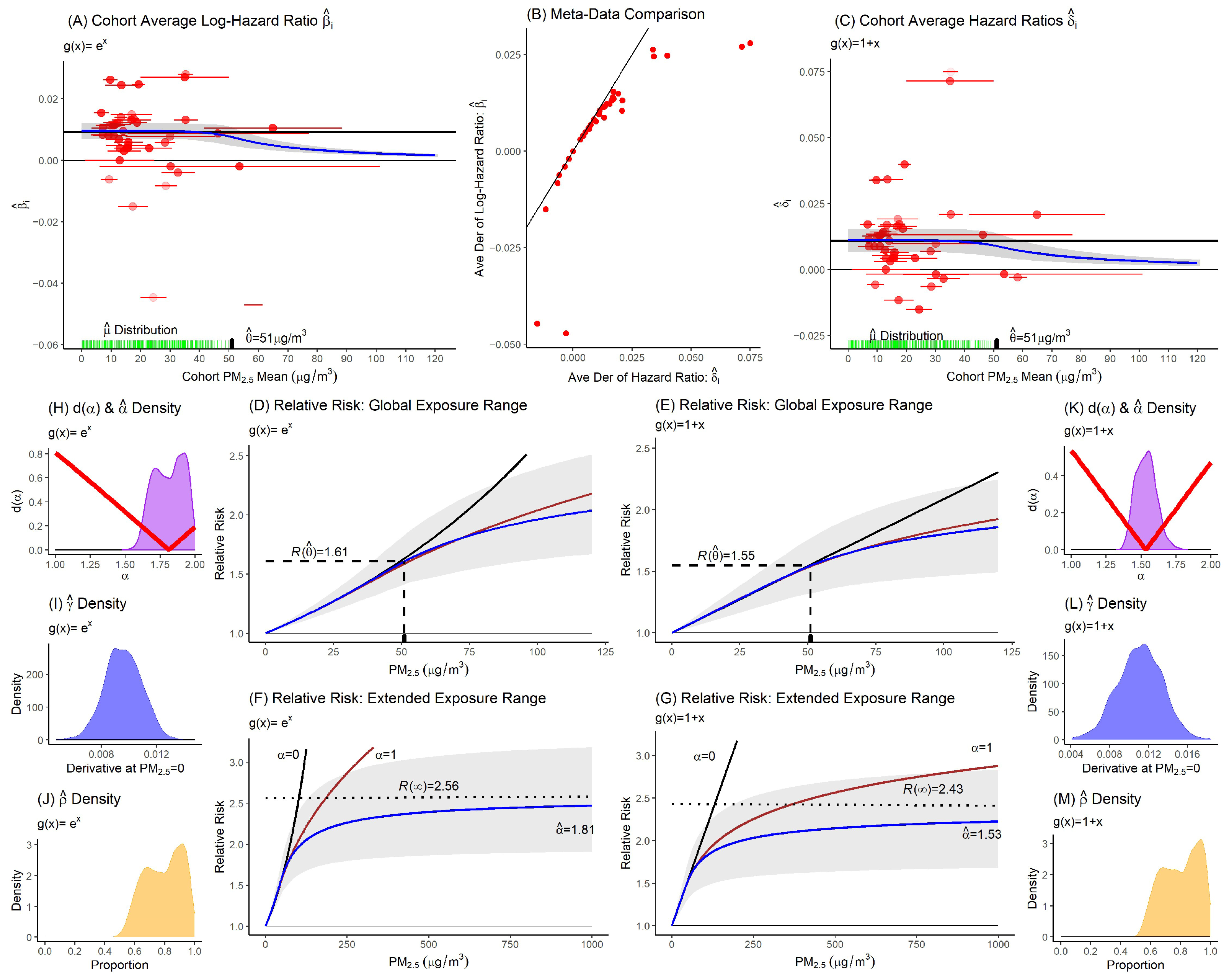
Figure A1. Logarithm of the hazard ratios per  μ g / m 3  for each cohort  ( β ^ i —red dots) and 5th and 95th percentiles of the cohort-specific  P M 2.5  distribution (horizontal red lines) are presented in Panel (A). The intensity of the color of the dots is proportional to the meta-analytic heterogeneity variance, indicating the relative influence of each cohort in the meta-analysis. The predicted values of  γ D P M 2.5  when  α > 1  are also represented in Panel (A) (mean: solid blue line; 95% CI: grey shaded area). Here,  θ ^ = 51   μ g / m 3  is represented as a black x-axis tick mark with the uncertainty distribution of  μ  represented as green x-axis tick marks. Meta-values  β ^ i  are plotted against  δ ^ i  in Panel (B). The same information is presented in Panel (C) as in (Panel (A)) using  δ ^ i . Corresponding relative risk predictions are presented if  g x = e x  in Panel (D) and if  g x = 1 + x  in Panel (E) over the global concentration range and extended range (Panels (F) and (G), respectively). The mean relative risk predictions for the case when  α = 0  (black line) and  α = 1  (brown line) are also presented in Panels (DG). Uncertainty intervals are displayed by the grey shaded area. Values of  R ( θ ^ )  are annotated in Panels (D) and (E) along with  R ( )  in Panels (F,G). Panels (HJ) display  d α  and the estimated uncertainty distributions of  ( α ^ , γ ^ , ρ ^ ) , respectively, if  g x = e x  and if  g x = 1 + x  (Panels (KM)).
Atmosphere 17 00185 g0a1

Appendix A.3. Setting an Upper Bound on Risk

Suppose one assumes a biological bound in risk  R = B > R θ ^ . Then
α = 1 + γ θ ^ ρ / l n B / R θ ^
if  g x = e x  or
α = 1 + γ θ ^ ρ / B R θ ^
if  g x = 1 + x . The closer the value of  B  is to  R θ ^ , the larger the value of  α , resulting in more curvature in the model predictions for higher concentrations. If  B  is only slightly greater than  R θ ^ α  can be very large. In the extreme case,  B = R θ ^  and  α = . In this case, the relative risk function is nearly linear for  z < θ  with a sharp decline when  z θ , since the derivative must equal  ρ  at  z = θ . The extrapolated risk is almost constant, a shape similar to that previously proposed [5]. If  B  is much larger than  R θ ^ α  would be only slightly greater than unity and the extrapolated relative risk would be approximately logarithmic.
Setting an upper bound risk violates all four of our assumptions.
  • It suggests that there is some information on risk above the cohort exposure range;
  • If  B > R θ ^ 2 , the range in the extrapolated risk will be greater than the range in the observed risk;
  • The range in the extrapolated risk is not solely determined by the range in the observed risk, since the equation to estimate  α , and thus the value of  R , is a function of  B ;
  • Our assumption that the relative risk model over the extrapolated range does not influence the model over the observed exposure range does not necessary hold, especially when  B R θ ^
Finally, our method will not work if  B < R θ ^ , with the selected upper bound being less than the predicted relative risk over the observed exposure range.

References

  1. GBD2023 Risk Factors Collaborators. Burden of 375 diseases injuries risk-attributable burden of 88 risk factors healthy life expectancy in 204 countries territories including 660 subnational locations 1990–2023: A systematic analysis for the Global Burden of Disease Study 2023. Lancet 2025, 406, 1873–1922. [Google Scholar] [CrossRef] [PubMed]
  2. Burnett, R.T.; Chen, H. Global mortality and long-term ambient exposure to fine particulate matter. a new relative risk estimator. Proc. Natl. Acad. Sci. USA 2018, 115, 9592–9597. [Google Scholar] [CrossRef] [PubMed]
  3. Burnett, R.T.; Spadaro, J.V.; Carcia, G.R.; Pope, C. Designing health impact functions to assess marginal changes in outdoor fine particulate matter. Environ. Res. 2021, 204, 112245. [Google Scholar] [CrossRef] [PubMed]
  4. Saksena, S.; Prasad, R.K.; Shankar, V.R. Daily Exposure to Air Pollutants in Indoor, Outdoor and In-Vehicle Micro-environments: A Pilot Study in Delhi. Indoor Built Environ. 2007, 16, 39–46. [Google Scholar] [CrossRef]
  5. Cohen, A.J.; Anderson, H.R.; Ostro, B.; Pandey, K.D.; Krzyzanowski, M.; Kuenzli, N.; Gutschmidt, K.; Pope, C.A.; Romieu, I.; Samet, J.M.; et al. Mortality impacts of urban air pollution. In Comparative Quantification of Health Risks: Global and Regional Burden of Disease Due to Selected Major Risk Factors; Ezzati, M., Lopez, A.D., Rodgers, A., Murray, C.J.L., Eds.; World Health Organization: Geneva, Switzerland, 2004; Volume 2. Available online: https://www.academia.edu/90729391/Comparative_quantification_of_health_risks (accessed on 13 January 2025).
  6. Dockery, D.W.; Pope, C.A.; Xu, X.; Spengler, J.D.; Ware, J.H.; Fay, M.E.; Ferris, B.G., Jr.; Speizer, F.E. An Association between Air Pollution and Mortality in Six U.S. Cities. N. Engl. J. Med. 1993, 329, 1753–1759. [Google Scholar] [CrossRef] [PubMed]
  7. Pope, C.A.; Thun, M.J.; Namboodiri, M.M.; Dockery, D.W.; Evans, J.S.; Speizer, F.E.; Heath, C.W., Jr. Particulate air pollution as a predictor of mortality in a prospective study of U.S. adults. Am. J. Respir. Crit. Care Med. 1995, 151, 669–674. [Google Scholar] [CrossRef] [PubMed]
  8. Burnett, R.T.; Pope, C.A.; Ezzati, M.; Olives, C.; Lim, S.S.; Mehta, S.; Shin, H.H.; Singh, G.; Hubbel, B.; Brauer, M.; et al. An integrated risk function for estimating the global burden of disease attributable to ambient fine particulate matter exposure. Environ. Health Perspect. 2013, 122, 397–403. [Google Scholar] [CrossRef] [PubMed]
  9. Hystad, P.; Yusuf, S.; Brauer, M. Pollution Health Impacts—The Knowns and Unknowns for Reliable Global Burden Calculations. Cardiovasc. Res. 2020, 116, 1794–1796. [Google Scholar] [CrossRef] [PubMed]
  10. Pope, C.A., III; Burnett, R.T.; Krewski, D.; Jerrett, M.; Shi, Y.; Calle, E.; Thun, M.J. Cardiovascular mortality and exposure to airborne fine particulate matter and cigarette smoke: Shape of the exposure-response relationship. Circulation 2009, 120, 941–948. [Google Scholar] [CrossRef] [PubMed]
  11. Stanley, T.D.; Jarrell, S.B. Meta-regression analysis: A quantitative method of literature surveys. J. Econ. Surv. 1989, 19, 299–308. [Google Scholar] [CrossRef]
  12. Chen, H.; Quicke, M.; Kaufmanf, J.S.; Chen, C.; Kwongb, J.C.; van Donkelaar, A.; Meng, J.; Martin, R.V.; Kim, J.; Lavignel, E.; et al. Impact of lowering fine particulate matter from major emission sources on mortality in Canada: A nationwide causal analysis. Proc. Natl. Acad. Sci. USA 2022, 19, 49. [Google Scholar] [CrossRef] [PubMed]
  13. Lin, X.; Burnett, R.T.; Xi, J.; Bai, J.; Xiang, Y.; Tian, T.; Li, Z.; Chen, S.; Jiang, J.; Hu, W.X.; et al. Health impact assessment on life expectancy gains ascribed to particulate matter reduction. Clim. Atmos. Sci. 2025, 8, 66. [Google Scholar] [CrossRef]
  14. Brunekreef, B.; Strak, M.; Chen, J.; Andersen, Z.J.; Atkinson, R.; Bauwelinck, M.; Bellander, T.; Boutron, M.-C.; Brandt, J.; Carey, I.; et al. Mortality and Morbidity Effects of Long-Term Exposure to Low-Level PM2.5, BC, NO2, and O3: An Analysis of European Cohorts in the ELAPSE Project; Research Report 208; Health Effects Institute: Boston, MA, USA, 2021. [Google Scholar]
  15. Downward, G.S.; Vermeulen, R.; Asia Cohort Consortium Executive Board. Ambient Air Pollution and All-Cause and Cause-Specific Mortality in an Analysis of Asian Cohorts; Research Report 213; Health Effects Institute: Boston, MA, USA, 2023. [Google Scholar]
  16. IQAir. World’s Most Polluted Cities in 2023—PM2.5 Ranking. Available online: https://www.iqair.com/world-air-quality-ranking (accessed on 12 March 2025).
  17. Thun, M.J.; Carter, B.D.; Feskanich, D.; Freedman, P.R.; Lopez, A.D.; Hartge, P.; Gapstur, S. 50-Year Trends in Smoking-Related Mortality in the United States. N. Engl. J. Med. 2013, 368, 351–364. [Google Scholar] [CrossRef] [PubMed]
  18. Park, S.; Allen, J.R.; Lim, C.H. A likely increase in fine particulate matter and premature mortality under future climate change. Air Qual. Atmos. Health 2020, 13, 143–151. [Google Scholar] [CrossRef]
Figure 1. Average derivative of logarithm of hazard ratios for each cohort  ( β ^ i —red dots) and 5th and 95th percentiles of cohort-specific  P M 2.5  distribution (horizontal red lines) presented in Panel (A) with corresponding information for the average derivative of the hazard ratio itself  ( δ ^ i )  presented in Panel (B).
Atmosphere 17 00185 g001
Figure 2. G E M M  relative risk predictions on the log-scale (blue line) and uncertainty interval (grey shaded area) over the global (Panel (A)) and extended (Panel (B)) exposure ranges. Cohort meta exposure distribution displayed as green line (Panel (A)) with  θ ^  as x-axis tick mark.  L o g L i n e a r predictions displayed as black line.
Atmosphere 17 00185 g002
Figure 3. G E M M ,   L o g L i n e a r ,   a n d   F u s i o n  relative risk predictions over cohort exposure range (Panel (A)) and extended exposure range (Panel (B)).
Atmosphere 17 00185 g003
Figure 4. L o g L i n e a r , Fusion, and Bounded Fusion relative risk predictions over global exposure range (Panel (A)) and extended exposure range (Panel (B)).
Atmosphere 17 00185 g004
Figure 5. Relative risk predications for  F u s i o n  and  B o u n d e d   F u s i o n  models by link specification:  g x = e x  or  g x = 1 + x .
Atmosphere 17 00185 g005
Disclaimer/Publisher’s Note: The statements, opinions and data contained in all publications are solely those of the individual author(s) and contributor(s) and not of MDPI and/or the editor(s). MDPI and/or the editor(s) disclaim responsibility for any injury to people or property resulting from any ideas, methods, instructions or products referred to in the content.