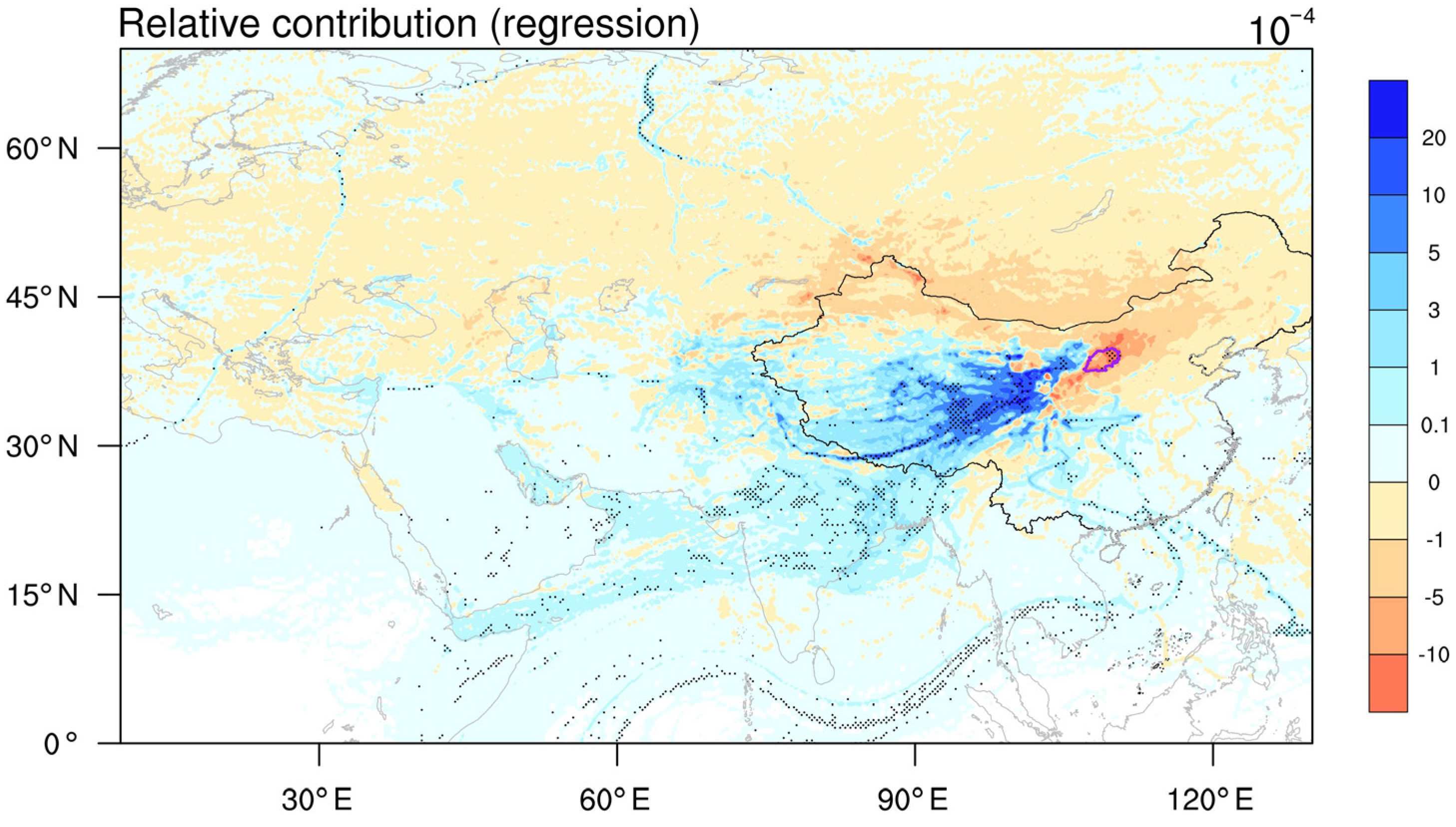

Moisture Source and Atmospheric Circulation Differences for Summer Rainfall in Different Intensity Classes over Mu Us Sandy Land, China


Abstract
1. Introduction
2. Data and Methodology
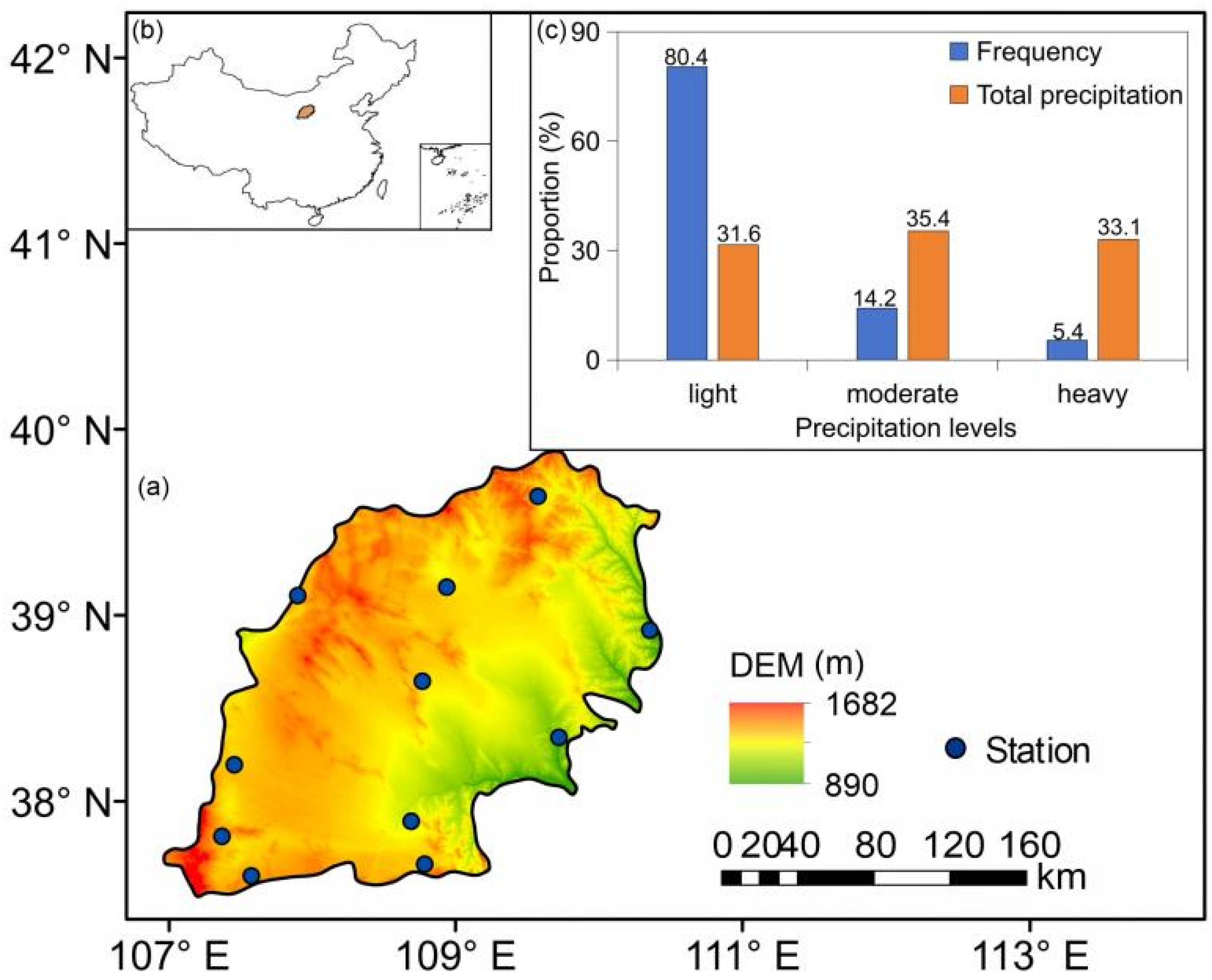
2.1. Station Data and the Classification Method of Precipitation Events
2.2. ERA-5 Reanalysis Data
2.3. Dynamical Recycling Model
3. Results
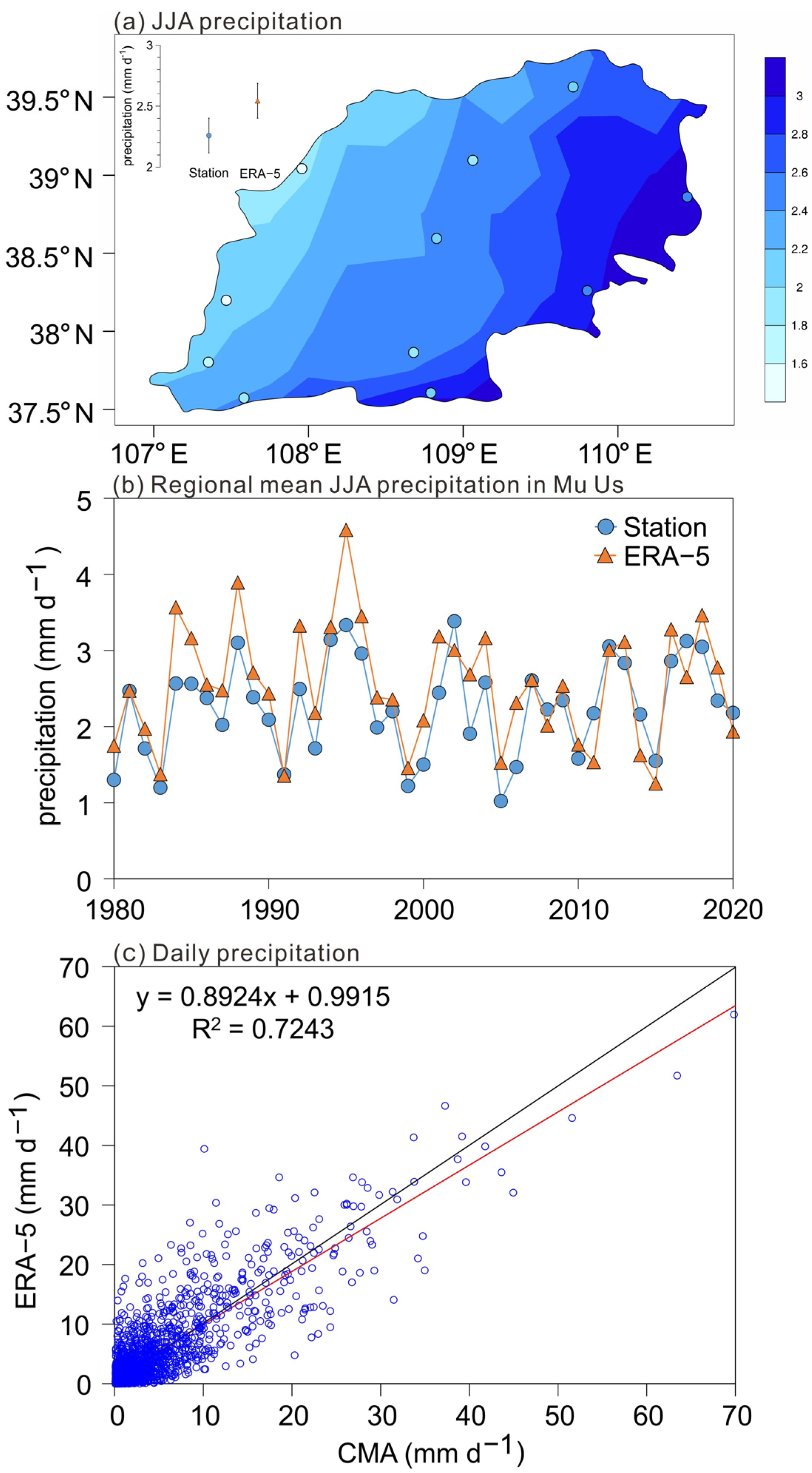
3.1. Temporal and Spatial Distribution in Summer Precipitation in MUSL
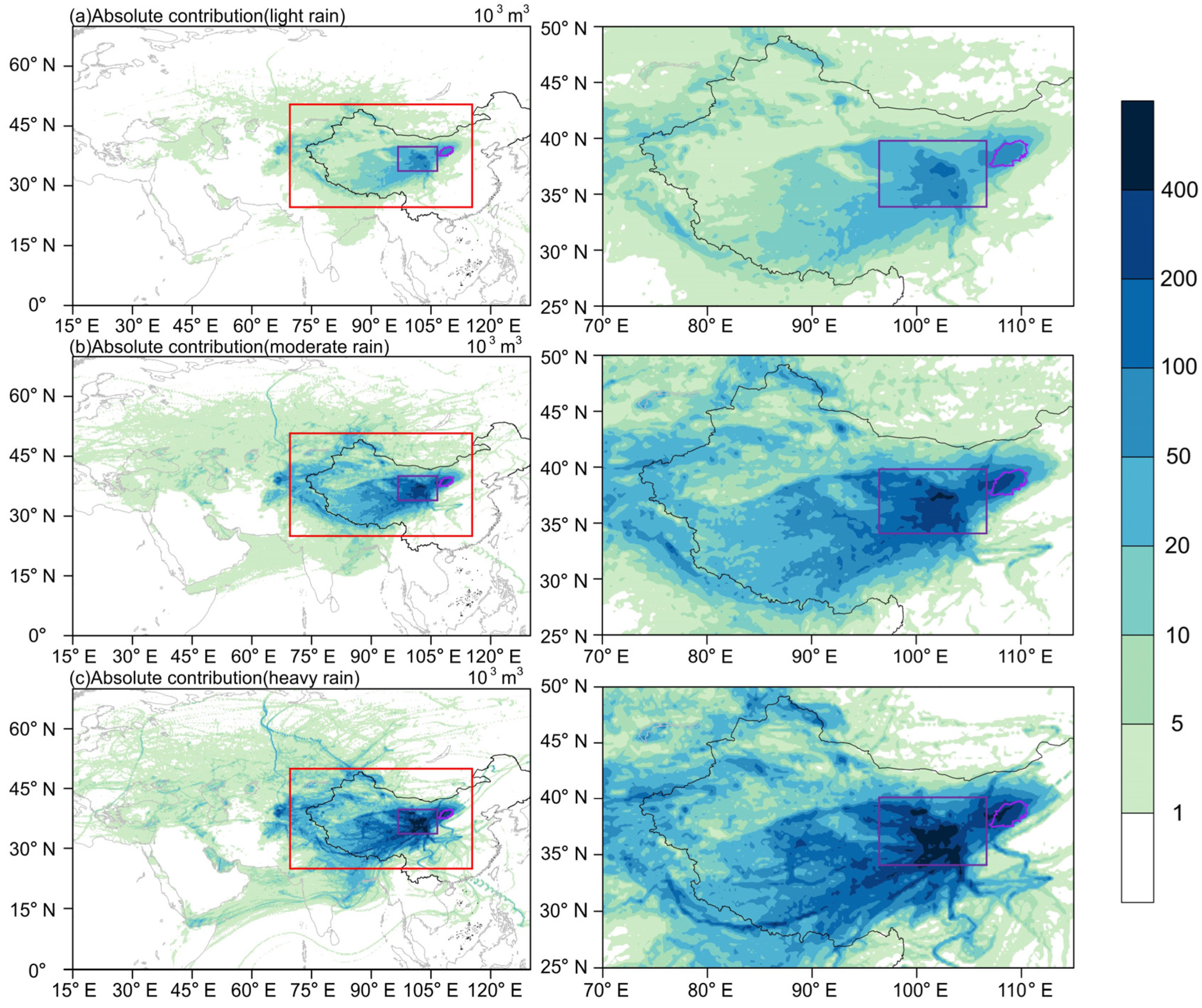
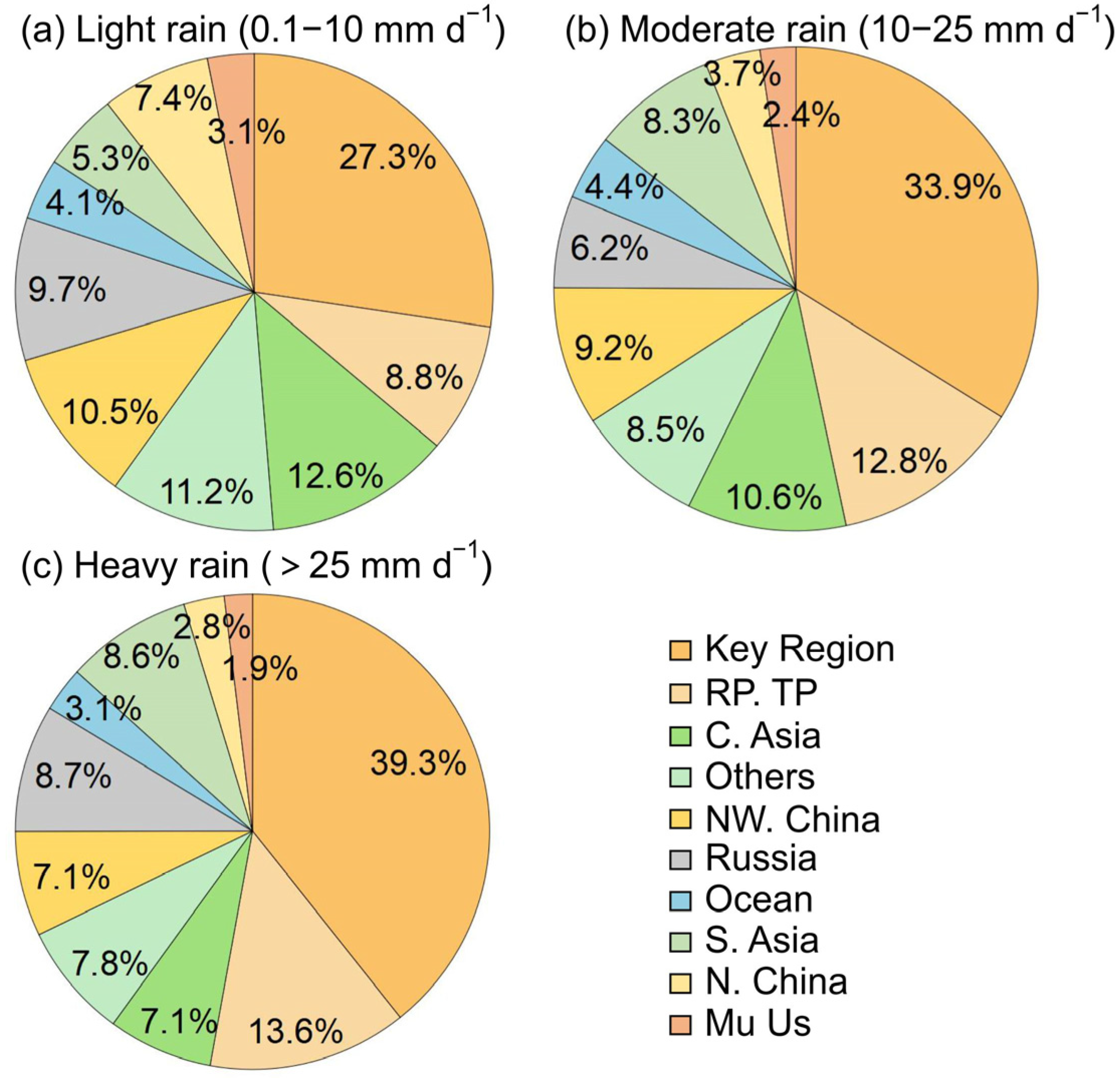
3.2. Characteristics of Moisture Contribution for Different Rainfall Intensities
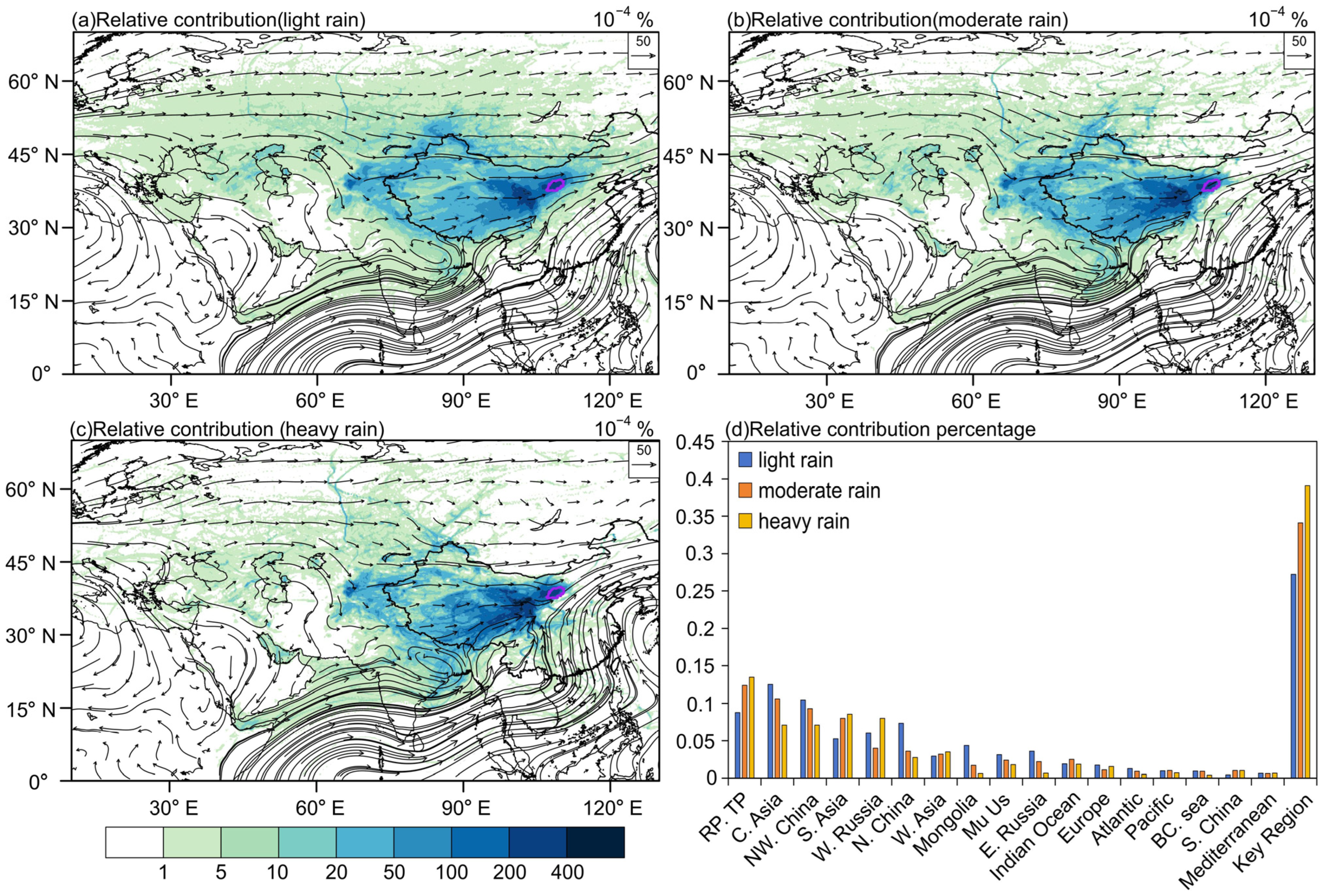
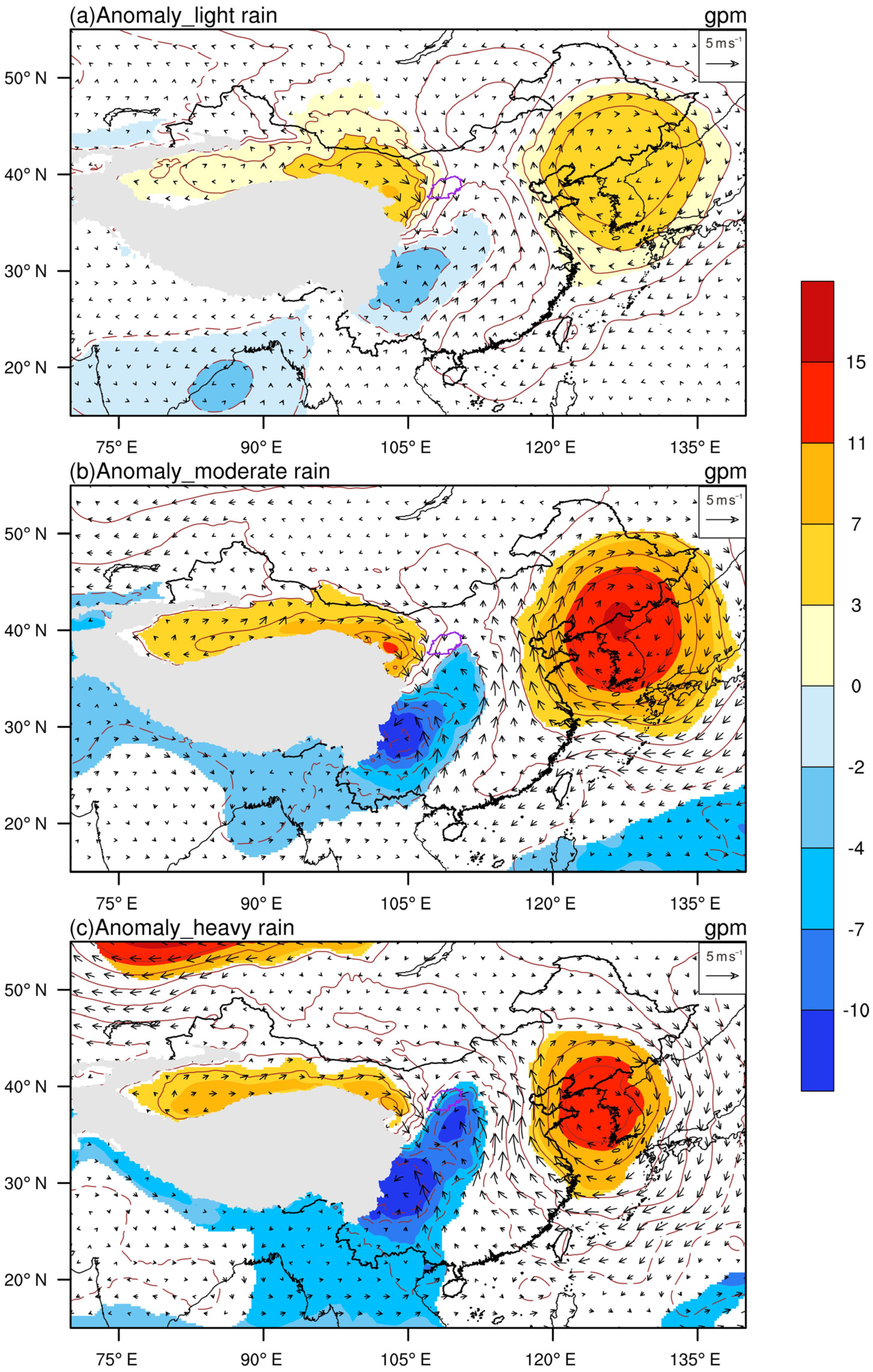
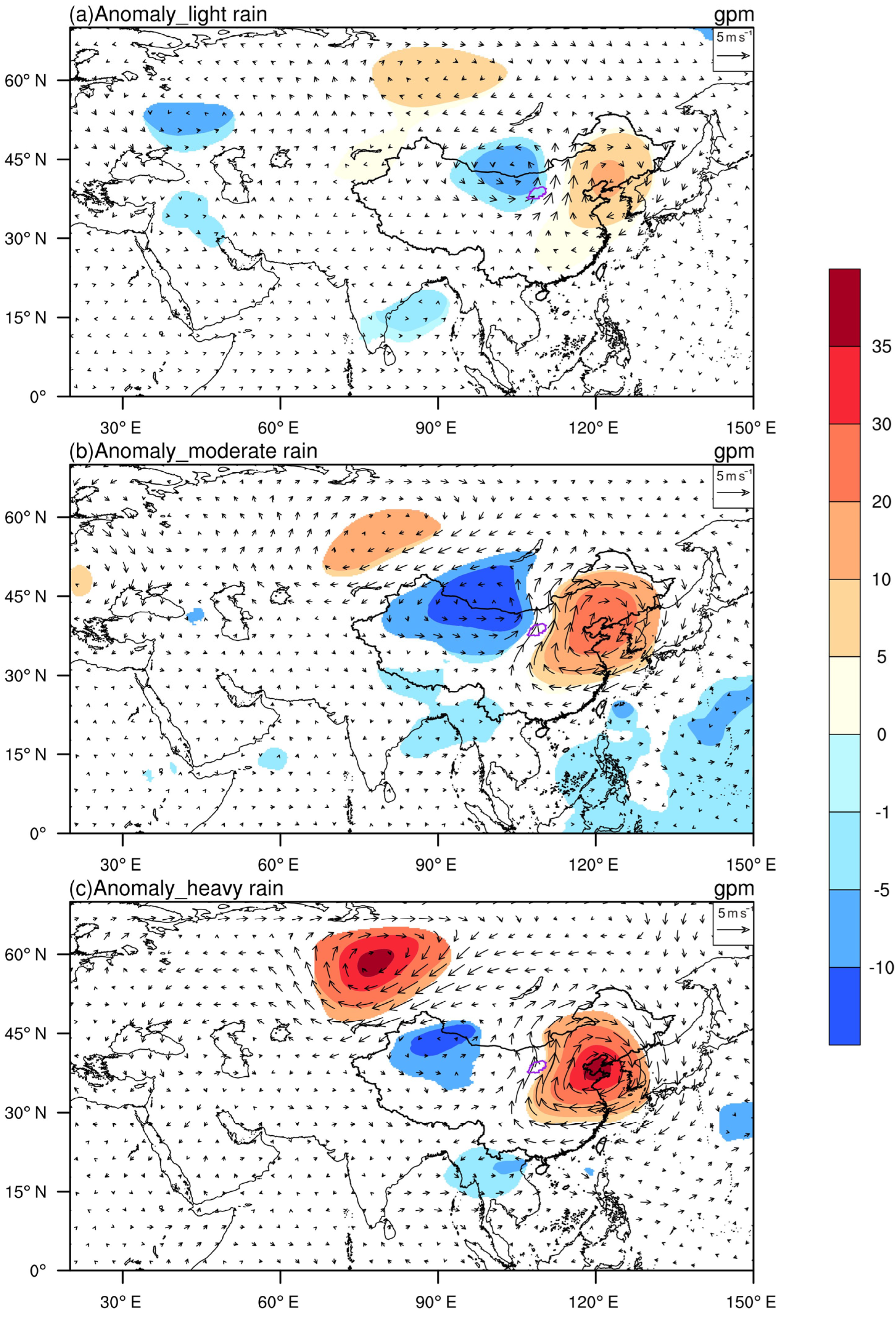
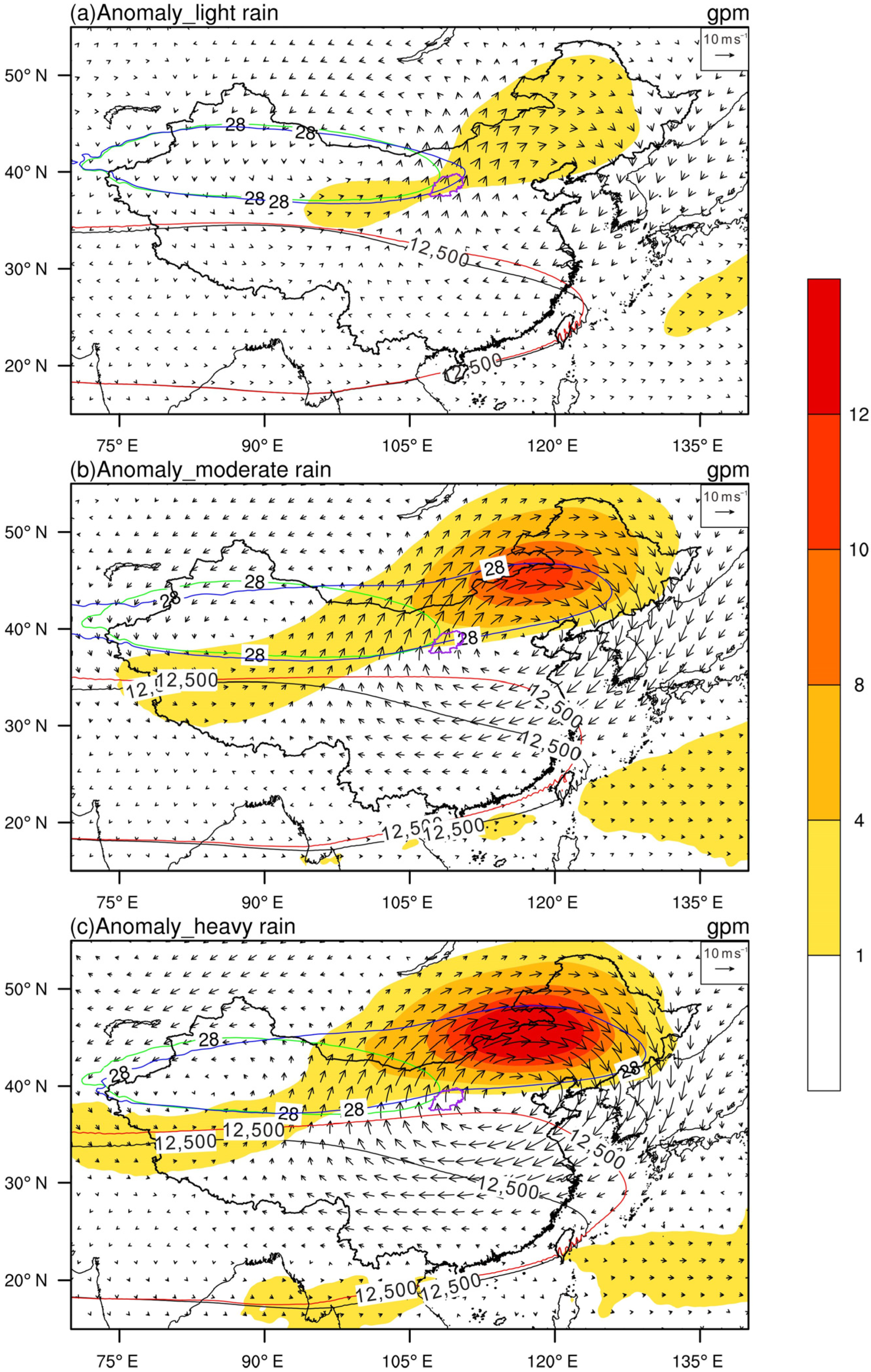
3.3. Atmospheric Circulation Responsible for Different Rainfall Intensities
4. Discussion
4.1. Impact of Threshold Selections for Different Precipitation Intensities
4.2. Limitations
4.3. Forcing Mechanism Behind Rainfall Events in Different Intensities
5. Conclusions
Supplementary Materials
Author Contributions
Funding
Institutional Review Board Statement
Informed Consent Statement
Data Availability Statement
Acknowledgments
Conflicts of Interest
References
- He, Q.; Liu, Z.Q. Mu Us Sandy Land-The World’s Desert Rainstorm Center. Meteorol. J. Inn. Mong. 1996, 2, 5–15. (In Chinese) [Google Scholar] [CrossRef]
- Fang, X.; Liu, X.K.; Yue, D.P. Analysis of climate change characteristics and influencing factors in Mu Us sandy land from the 1960–2018. Res. Soil Water Conserv. 2022, 29, 163–169. (In Chinese) [Google Scholar]
- Yang, L.; Li, Y.; Fan, H.; Wang, Y. Temporal and spatial distribution and influencing factors of evapotranspiration in Mu Us Sandy Land. J. Agric. Sci. Technol. 2022, 24, 169–178. (In Chinese) [Google Scholar]
- Wang, S.W.; Gong, D.Y.; Ye, J.L.; Chen, Z.H. Seasonal precipitation series of eastern China since 1880 and the variability. Acta Geogr. Sin. 2000, 55, 281–293. [Google Scholar] [CrossRef]
- Liu, Y.; Wei, Z. Comparison of the Precipitation Cycle and Trend in Different Areas of Northern China in Recent 50 years. Adv. Earth Sci. 2012, 27, 337. (In Chinese) [Google Scholar]
- Lu, L.H.; Zhang, D.E. Spatio-temporal variation of annual precipitation in China and its relationship with the East Asian summer monsoon. Quat. Res. 2013, 33, 97–107. [Google Scholar] [CrossRef]
- Reboita, M.S.; Mattos, E.V.; Capucin, B.C.; Souza, D.O.D.; Ferreira, G.W.D.S. A multi-scale analysis of the extreme precipitation in southern Brazil in April/May 2024. Atmosphere 2024, 15, 1123. [Google Scholar] [CrossRef]
- Li, X.D.; Zhao, T.T.G. Climatological characteristics on the links between moisture transport and extreme precipitation events in China. Clim. Dyn. 2025, 63, 212. [Google Scholar] [CrossRef]
- Fu, J.L.; Qian, W.H.; Lin, X.; Chen, D.L. Trends in graded precipitation in China from 1961 to 2000. Adv. Atmos. Sci. 2008, 25, 267–278. [Google Scholar] [CrossRef]
- Hu, M.L.; Dong, M.Y.; Tian, X.Y.; Wang, L.X.; Jiang, Y. Trends in different grades of precipitation over the Yangtze River Basin from 1960 to 2017. Atmosphere 2021, 12, 413. [Google Scholar] [CrossRef]
- Cheng, S.J.; Xie, J.; Ma, N.; Liang, S.J.; Guo, J.; Fu, N. Variations in summer precipitation according to different grades and their effects on summer drought/flooding in Haihe River Basin. Atmosphere 2022, 13, 1246. [Google Scholar] [CrossRef]
- Varikoden, H.; Preethi, B.; Samah, A.A.; Babu, C.A. Seasonal variation of rainfall characteristics in different intensity classes over Peninsular Malaysia. J. Hydrol. 2011, 404, 99–108. [Google Scholar] [CrossRef]
- Qin, N.X.; Wang, J.N.; Gao, L.; Hong, Y.; Huang, J.L.; Lu, Q.Q. Observed trends of different rainfall intensities and the associated spatiotemporal variations during 1958–2016 in Guangxi, China. Int. J. Climatol. 2021, 41, E2880–E2895. [Google Scholar] [CrossRef]
- Camberlin, P.; Kpanou, M.; Roucou, P. Classification of intense rainfall days in southern West Africa and associated atmospheric circulation. Atmosphere 2020, 11, 188. [Google Scholar] [CrossRef]
- Miao, C.Y.; Duan, Q.Y.; Sun, Q.H.; Lei, X.H.; Li, H. Non-uniform changes in different categories of precipitation intensity across China and the associated large-scale circulations. Environ. Res. Lett. 2019, 14, 025004. [Google Scholar] [CrossRef]
- Huang, Y.J.; Cui, X.P. Moisture sources of torrential rainfall events in the Sichuan Basin of China during summers of 2009-13. J. Hydrometeorol. 2015, 16, 1906–1917. [Google Scholar] [CrossRef]
- Zhang, M.X.; Zhong, D.Y.; Huang, W.Y.; Zhang, Y.; Wang, G.Q.; Li, T.J.; Tian, Y.L.; Xie, D. Major moisture source patterns for extreme precipitation events over the Chinese Loess Plateau. Int. J. Climatol. 2022, 42, 7951–7967. [Google Scholar] [CrossRef]
- Bottyán, E.; Czuppon, G.; Weidinger, T.; Haszpra, L.; Kármán, K. Moisture source diagnostics and isotope characteristics for precipitation in east Hungary: Implications for their relationship. Hydrol. Sci. J. 2017, 62, 2049–2060. [Google Scholar] [CrossRef]
- Kong, Y.L.; Wang, K.; Li, J.; Pang, Z.H. Stable isotopes of precipitation in China: A consideration of moisture sources. Water 2019, 11, 1239. [Google Scholar] [CrossRef]
- Jiang, J.; Zhou, T.J.; Wang, H.L.; Qian, Y.; Noone, D.; Man, W. Tracking moisture sources of precipitation over central Asia: A study based on the water-source-tagging method. J. Clim. 2020, 33, 10339–10355. [Google Scholar] [CrossRef]
- Nie, Y.B.; Sun, J.Q. Moisture sources and transport for extreme precipitation over Henan in July 2021. Geophys. Res. Lett. 2022, 49, e2021GL097446. [Google Scholar] [CrossRef]
- Gimeno, L.; Dominguez, F.; Nieto, R.; Trigo, R.; Drumond, A.; Reason, C.J.C.; Taschetto, A.S.; Ramos, A.M.; Kumar, R.; Marengo, J. Major mechanisms of atmospheric moisture transport and their role in extreme precipitation events. Annu. Rev. Environ. Resour. 2016, 41, 117–141. [Google Scholar] [CrossRef]
- Huang, X.Q.; Guan, X.D.; Zhu, K.W.; Gu, T.H.; Huang, J.P.; He, Y.L. Influence of water vapor influx on interdecadal change in summer precipitation over the source area of the Yellow River Basin. Atmos. Res. 2022, 276, 106270. [Google Scholar] [CrossRef]
- Liu, R.; Wang, X.; Wang, Z.L.; Quan, R. Characteristics of water vapor sources and precipitation contributions to drought and wet events on the Chinese Loess Plateau. Theor. Appl. Climatol. 2022, 150, 1613–1626. [Google Scholar] [CrossRef]
- Jiang, Z.H.; Jiang, S.; Shi, Y.; Liu, Z.Y.; Li, W.; Li, L. Impact of moisture source variation on decadal-scale changes of precipitation in North China from 1951 to 2010. J. Geophys. Res. Atmos. 2017, 122, 600–613. [Google Scholar] [CrossRef]
- Guo, L.; van der Ent, R.J.; Klingaman, N.P.; Demory, M.; Vidale, P.L.; Turner, A.G.; Stephan, C.C.; Chevuturi, A. Moisture sources for East Asian precipitation: Mean seasonal cycle and interannual variability. J. Hydrometeorol. 2019, 20, 657–672. [Google Scholar] [CrossRef]
- Li, J.; Zhao, Y.; Chen, D.L.; Zhao, P.; Zhang, C.; Wang, Y.J. The quantitative role of moisture and vertical motion in shaping summer heavy rainfall over North China under two distinct large-scale weather patterns. J. Clim. 2024, 37, 2655–2672. [Google Scholar] [CrossRef]
- Stohl, A.; James, P. A Lagrangian analysis of the atmospheric branch of the global water cycle. Part I: Method description, validation, and demonstration for the August 2002 flooding in central Europe. J. Hydrometeorol. 2004, 5, 656–678. [Google Scholar] [CrossRef]
- Sodemann, H.; Schwierz, C.; Wernli, H. Interannual variability of Greenland winter precipitation sources: Lagrangian moisture diagnostic and North Atlantic Oscillation influence. J. Geophys. Res. Atmos. 2008, 113, D03107. [Google Scholar] [CrossRef]
- Dominguez, F.; Kumar, P.; Liang, X.Z.; Ting, M.F. Impact of atmospheric moisture storage on precipitation recycling. J. Clim. 2006, 19, 1513–1530. [Google Scholar] [CrossRef]
- Wang, N.; Zeng, X.M.; Guo, W.D.; Chen, C.H.; You, W.; Zheng, Y.Q.; Zhu, J. Quantitative diagnosis of moisture sources and transport pathways for summer precipitation over the mid-lower Yangtze River Basin. J. Hydrol. 2018, 559, 252–265. [Google Scholar] [CrossRef]
- Martinez, J.A.; Dominguez, F. Sources of atmospheric moisture for the La Plata River basin. J. Clim. 2014, 27, 6737–6753. [Google Scholar] [CrossRef]
- Arias, P.A.; Rendón, M.L.; Martínez, J.A.; Allan, R.P. Changes in atmospheric moisture transport over tropical South America: An analysis under a climate change scenario. Clim. Dyn. 2023, 61, 4949–4969. [Google Scholar] [CrossRef]
- Liang, F.; Tao, S.Y.; Wei, J.; Bueh, C. Variation in summer rainfall in North China during the period 1956–2007 and links with atmospheric circulation. Adv. Atmos. Sci. 2011, 28, 363–374. [Google Scholar] [CrossRef]
- Ning, G.C.; Luo, M.; Zhang, Q.; Wang, S.G.; Liu, Z.; Yang, Y.Y.; Wu, S.J.; Zeng, Z.L. Understanding the mechanisms of summer extreme precipitation events in Xinjiang of arid Northwest China. J. Geophys. Res. Atmos. 2021, 126, e2020JD034111. [Google Scholar] [CrossRef]
- Soares, P.M.M.; Lima, D.C.A.; Nogueira, M. Global offshore wind energy resources using the new ERA-5 reanalysis. Environ. Res. Lett. 2020, 15, 1040a2. [Google Scholar] [CrossRef]
- Rivoire, P.; Martius, O.; Naveau, P. A comparison of moderate and extreme ERA-5 daily precipitation with two observational data sets. Earth Space Sci. 2021, 8, e2020EA001633. [Google Scholar] [CrossRef]
- Hersbach, H.; Bell, B.; Berrisford, P.; Hirahara, S.; Horányi, A.; Muñoz-Sabater, J.; Nicolas, J.; Peubey, C.; Radu, R.; Schepers, D.; et al. The ERA5 global reanalysis. Q. J. R. Meteorol. Soc. 2020, 146, 1999–2049. [Google Scholar] [CrossRef]
- Hassler, B.; Lauer, A. Comparison of reanalysis and observational precipitation datasets including ERA5 and WFDE5. Atmosphere 2021, 12, 1462. [Google Scholar] [CrossRef]
- Wei, F.F.; Tang, J.P.; Wang, S.Y. A reliability assessment of upper-level reanalysis datasets over China. Chin. J. Geophys. 2015, 58, 383–397. [Google Scholar] [CrossRef]
- Liu, T.T.; Zhu, X.F.; Guo, R.; Xu, K.; Zhang, S. Applicability of ERA5 reanalysis of precipitation data in China. Arid Land Geogr. 2022, 45, 66–79. (In Chinese) [Google Scholar]
- Li, Y.; Su, F.G.; Tang, Q.H.; Gao, H.K.; Yan, D.H.; Peng, H.; Xiao, S.B. Contributions of moisture sources to precipitation in the major drainage basins in the Tibetan Plateau. Sci. China Earth Sci. 2022, 65, 1088–1103. [Google Scholar] [CrossRef]
- Yan, L.B.; Liu, X.D.; Zhou, Y. Variation in rainy season precipitation and associated water vapor transport over the Chinese Loess Plateau during 1961–2012. Clim. Res. 2013, 58, 43–53. [Google Scholar] [CrossRef]
- Hu, Q.; Jiang, D.B.; Lang, X.M. Sources of moisture for different intensities of summer rainfall over the Chinese Loess Plateau during 1979–2009. Int. J. Climatol. 2018, 38, e1280–e1287. [Google Scholar] [CrossRef]
- Wang, C.H.; Li, J.M.; Zhang, F.M.; Yang, K. Changes in the moisture contribution over global arid regions. Clim. Dyn. 2023, 61, 543–557. [Google Scholar] [CrossRef]
- Bosilovich, M.G. On the vertical distribution of local and remote sources of water for precipitation. Meteorol. Atmos. Phys. 2002, 80, 31–41. [Google Scholar] [CrossRef]
- Goessling, H.F.; Reick, C.H. On the “well-mixed” assumption and numerical 2-D tracing of atmospheric moisture. Atmos. Chem. Phys. 2013, 13, 5567–5585. [Google Scholar] [CrossRef]
- Hua, L.J.; Zhong, L.H.; Gong, Z.H.; Ma, Z.G. The role of extreme precipitation in driving the humidification of northwest China from 1961 to 2020. Weather Clim. Extremes 2025, 49, 10797. [Google Scholar] [CrossRef]
- Dominguez, F.; Miguez-Macho, G.; Hu, H.C. WRF with water vapor tracers: A study of moisture sources for the North American monsoon. J. Hydrometeorol. 2016, 17, 1915–1927. [Google Scholar] [CrossRef]
- Dominguez, F.; Hu, H.; Martinez, J.A. Two-layer dynamic recycling model (2L-DRM): Learning from moisture tracking models of different complexity. J. Hydrometeorol. 2020, 21, 3–16. [Google Scholar] [CrossRef]
- Gimeno, L.; Stohl, A.; Trigo, R.M.; Dominguez, F.; Yoshimura, K.; Yu, L.S.; Drumong, A.; Durán-Quesada, A.M.; Nieto, R. Oceanic and terrestrial sources of continental precipitation. Rev. Geophys. 2012, 50, RG4003. [Google Scholar] [CrossRef]
- Zhao, Y.; Xu, X.D.; Li, J.; Zhang, R.; Kang, Y.Z.; Huang, W.B.; Xia, Y.; Liu, D.; Sun, X.Y. The large-scale circulation patterns responsible for extreme precipitation over the North China plain in midsummer. J. Geophys. Res. Atmos. 2019, 124, 12794–12809. [Google Scholar] [CrossRef]
- Xie, Z.Q.; Du, Y.; Yang, S. Zonal extension and retraction of the subtropical westerly jet stream and evolution of precipitation over East Asia and the western Pacific. J. Clim. 2015, 28, 6783–6798. [Google Scholar] [CrossRef]



| Regions | Light Rain | Moderate Rain | Heavy Rain |
|---|---|---|---|
| Southwestern Source Regions | 41.3% | 54.5% | 61.2% |
| Western Source Regions | 23.0% | 19.9% | 14.2% |
| Northern/Eastern Source Regions | 17.0% | 9.8% | 11.4% |
| Mu Us Sandy Land | 3.1% | 2.4% | 1.8% |
Disclaimer/Publisher’s Note: The statements, opinions and data contained in all publications are solely those of the individual author(s) and contributor(s) and not of MDPI and/or the editor(s). MDPI and/or the editor(s) disclaim responsibility for any injury to people or property resulting from any ideas, methods, instructions or products referred to in the content. |
© 2026 by the authors. Licensee MDPI, Basel, Switzerland. This article is an open access article distributed under the terms and conditions of the Creative Commons Attribution (CC BY) license.
Share and Cite
Xu, J.; Hua, T.; Du, J.; Zhang, Y. Moisture Source and Atmospheric Circulation Differences for Summer Rainfall in Different Intensity Classes over Mu Us Sandy Land, China. Atmosphere 2026, 17, 138. https://doi.org/10.3390/atmos17020138
Xu J, Hua T, Du J, Zhang Y. Moisture Source and Atmospheric Circulation Differences for Summer Rainfall in Different Intensity Classes over Mu Us Sandy Land, China. Atmosphere. 2026; 17(2):138. https://doi.org/10.3390/atmos17020138
Chicago/Turabian StyleXu, Jiajie, Ting Hua, Jiahui Du, and Yuanzhu Zhang. 2026. "Moisture Source and Atmospheric Circulation Differences for Summer Rainfall in Different Intensity Classes over Mu Us Sandy Land, China" Atmosphere 17, no. 2: 138. https://doi.org/10.3390/atmos17020138
APA StyleXu, J., Hua, T., Du, J., & Zhang, Y. (2026). Moisture Source and Atmospheric Circulation Differences for Summer Rainfall in Different Intensity Classes over Mu Us Sandy Land, China. Atmosphere, 17(2), 138. https://doi.org/10.3390/atmos17020138