Article

Research on the Cumulative Dust Suppression Effect of Foam and Dust Extraction Fan at Continuous Miner Driving Face

1
State Key Laboratory of Intelligent Construction and Healthy Operation and Maintenance of Deep Underground Engineering, China University of Mining & Technology, Xuzhou 221116, China
2
Shaanxi Yanchang Petroleum Group, Hengshan Weiqiang Coal Industry Co., Ltd., Yulin 719199, China
3
State Key Laboratory of Coal Mine Disaster Prevention and Control, China University of Mining & Technology, Xuzhou 221116, China
4
Institute of Ecology and Environment, Xinjiang University, Urumqi 830017, China
*
Authors to whom correspondence should be addressed.
Atmosphere 2025, 16(11), 1290; https://doi.org/10.3390/atmos16111290
Submission received: 9 September 2025 / Revised: 4 November 2025 / Accepted: 5 November 2025 / Published: 13 November 2025
(This article belongs to the Section Air Pollution Control)

Abstract

The heading face is one of the zones most severely affected by dust pollution in underground coal mines, and dust control becomes even more challenging during roadway excavation with continuous miners. To improve dust mitigation in environments characterized by intense dust generation, high ventilation demand, and large cross-sectional areas, this study integrates numerical simulations, laboratory experiments, and field tests to investigate the physicochemical properties of dust, airflow distribution, dust migration behavior, and a comprehensive dust control strategy combining airflow regulation, foam suppression, and dust extraction fan systems. The results show that dust dispersion patterns differ markedly between the left-side advancement and right-side advancement of the roadway; however, the wind return side of the continuous miner consistently exhibits the highest dust concentrations. The most effective purification of dust-laden airflow is achieved when the dust extraction fan delivers an airflow rate of 500 m3/min and is positioned behind the continuous miner on the return side. After optimization of foam flow rate and coverage based on the cutting head structure of the continuous miner, the dust suppression efficiency reached 78%. With coordinated optimization and on-site implementation of wall-mounted ducted airflow control, foam suppression, and dust extraction fan systems, the total dust reduction rate at the heading face reached 95.2%. These measures substantially enhance dust control effectiveness, improving mine safety and protecting worker health. The resulting reduction in dust concentration also improves visibility for underground intelligent equipment and provides practical guidance for industrial application.

1. Introduction

Mine dust not only poses a serious occupational risk of pneumoconiosis but also presents a significant explosion hazard [1,2]. Once pneumoconiosis develops, lung lesions continue to progress, ultimately leading to impaired pulmonary function and even respiratory failure [3,4,5], with a reported mortality rate of up to 22.04% [6,7]. Coal workers’ pneumoconiosis alone accounts for more than 50% of all reported cases. In China, 14 of the 24 major coal mine accidents—each causing more than 100 fatalities—were attributed to dust explosions [8,9]. In addition, high dust concentrations in underground coal mines reduce visibility, increasing the likelihood of accidents caused by human operational errors and severely limiting the perception accuracy of unmanned intelligent equipment. Therefore, effective prevention and control of mine dust are essential for ensuring production safety and protecting miners’ health.
The heading face in underground coal mines is among the zones most severely affected by dust pollution. Cutting operations performed by roadheaders on coal and rock generate substantial quantities of dust, with instantaneous concentrations frequently exceeding 1000 mg/m3 [10]. With the rapid development of tunneling machinery and increasing demands for higher advance rates, the use of continuous miners equipped with transverse cutting heads has increased. Compared with axial roadheaders, continuous miners have significantly larger cutting heads, which enlarge the cutting zone and intensify cutting activity, thereby further aggravating the difficulty of dust control.
To address dust control at the heading face, several technologies have been developed, including water mist dust suppression, foam dust suppression, dust extraction using a dust extraction fan, and ventilation-based control. Water mist dust suppression primarily relies on two mechanisms: pre-wetting of the cutting zone and capture of suspended dust particles. However, because both water mist and dust exist as dispersed phases, the collision probability between them is relatively low, and on-site dust suppression efficiencies are typically only 40–60% [9,11].
Foam dust suppression technology leverages the advantages of gas–liquid two-phase foam, including strong adhesion, excellent wetting ability, extensive coverage, and good continuity. By forming a continuous foam layer over the cutting area via foam jetting, this method effectively reduces dust dispersion at the source. However, during operation, the cutting head is embedded in the coal–rock mass and performs high-intensity cutting, which limits the ability of the foam jet to penetrate and wet the interior of the cutting zone. As a result, coverage is largely restricted to the surface, and overall dust suppression efficiency typically ranges from 60% to 80% [12,13,14,15]. A dust extraction fan operates by drawing in dust-laden airflow and purifying it using internal filter screens or water mist. The dust removal efficiency of the extracted airflow can exceed 95% [16,17,18]. However, the effective suction range of a dust extraction fan is limited, and its intake flow rate is often lower than the incoming airflow in the roadway, leaving a substantial portion of the dust-laden air unfiltered.
Ventilation-based dust control primarily uses auxiliary facilities such as wall-mounted air ducts and air curtains to regulate wind velocity distribution. This approach reduces airflow speed and turbulence intensity at key dust sources such as cutting, crushing, and loading points, thereby limiting dust diffusion. Moreover, by redirecting airflow, dust-laden air can be guided toward the inlets of the dust extraction fan or into spray zones, which enhances the overall effectiveness of dust suppression.
Previous research and technological developments in heading-face dust control have largely focused on axial roadheader operations. However, compared with roadheader working faces, continuous miner heading faces are characterized by significantly larger cross-sectional areas, higher airflow volumes, deeper cutting depths, higher dust generation rates, and fundamentally different excavation processes. As a result, dust control at continuous miner faces is considerably more challenging, and the performance of existing single dust suppression technologies remains unsatisfactory. Owing to the unique operating conditions at continuous miner working faces, the direct application of technologies that have proven effective for roadheader operations—such as foam dust suppression, airflow regulation, and dust extraction fan systems—is no longer sufficient. Achieving high-efficiency dust suppression under these conditions requires a comprehensive technological upgrade; however, relevant systematic studies remain limited.
This study addresses the specific characteristics of continuous miner heading faces. It investigates airflow distribution in large-section tunneling environments and analyzes the influence of wall-mounted ventilation duct structures and layout configurations on airflow behavior. It further examines how dust extraction fan type and spatial arrangement affect dust extraction performance and develops a foam dust suppression system tailored to the structural configuration and cutting characteristics of continuous miners. On this basis, a comprehensive dust control system integrating ventilation regulation, foam suppression, and fan-assisted dust extraction is established. Field experiments are then carried out to evaluate the performance of the integrated system, providing practical guidance and theoretical reference for effective dust control at continuous miner tunneling faces.

2. Materials and Methods

2.1. Research Method

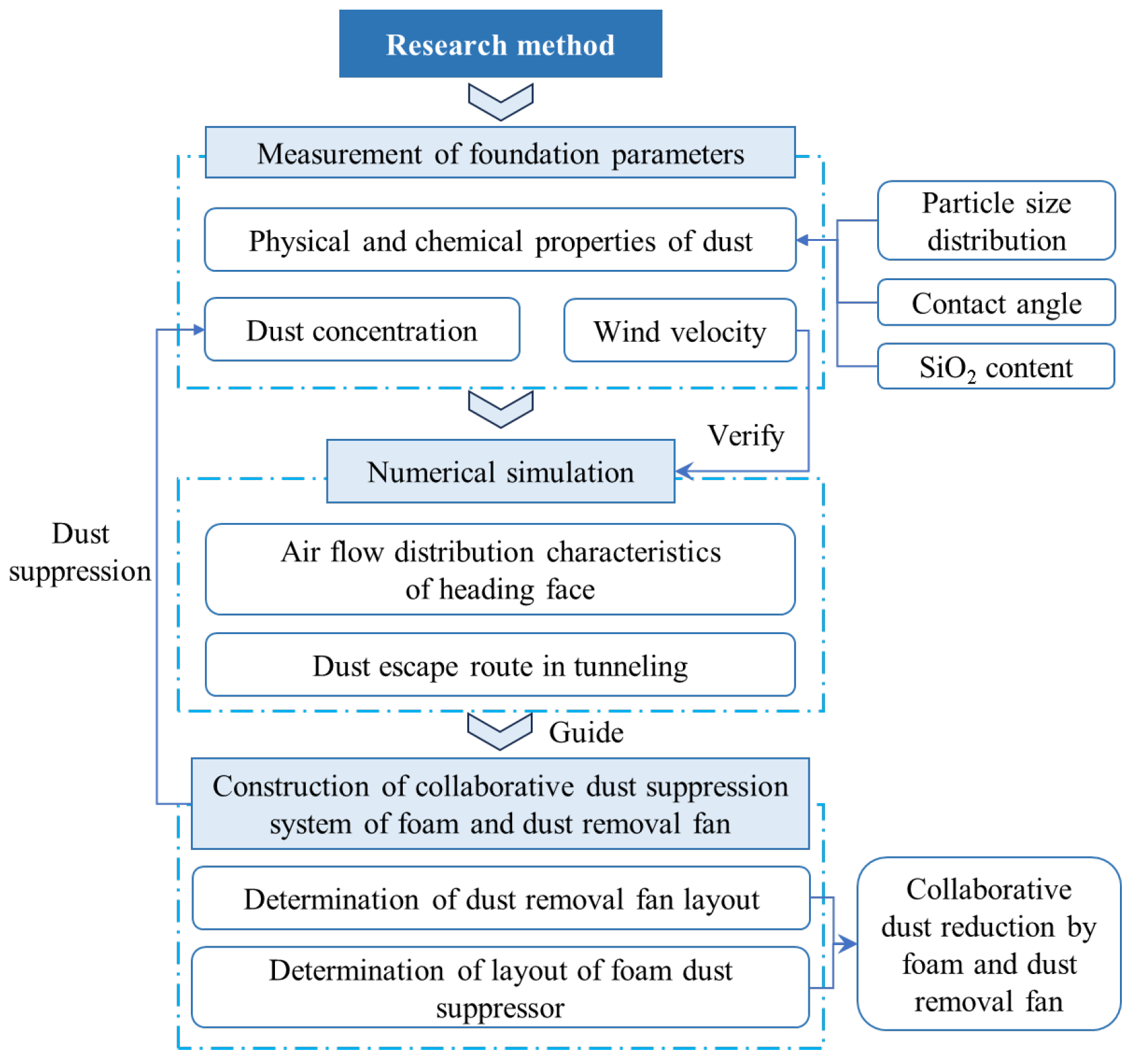
The overall workflow of this study is as follows: on-site measurement of airflow and dust parameters; numerical analysis of dust dispersion laws at the tunneling face; construction of a dust extraction fan and foam dust suppression collaborative system; and on-site implementation and evaluation of the collaborative dust suppression system. First, fundamental input parameters such as wind speed and dust concentration were obtained through on-site measurements. Then, based on the spatial layout of the Weiqiang heading face, a numerical model of airflow and dust migration at the heading face was established and validated using field measurements. Finally, the simulation results were used to guide the design of the combination dust suppression system, and comparative field experiments were conducted to evaluate the dust suppression performance of different system combinations (Figure 1).

2.2. Field Conditions of the Continuous Miner Tunneling Face

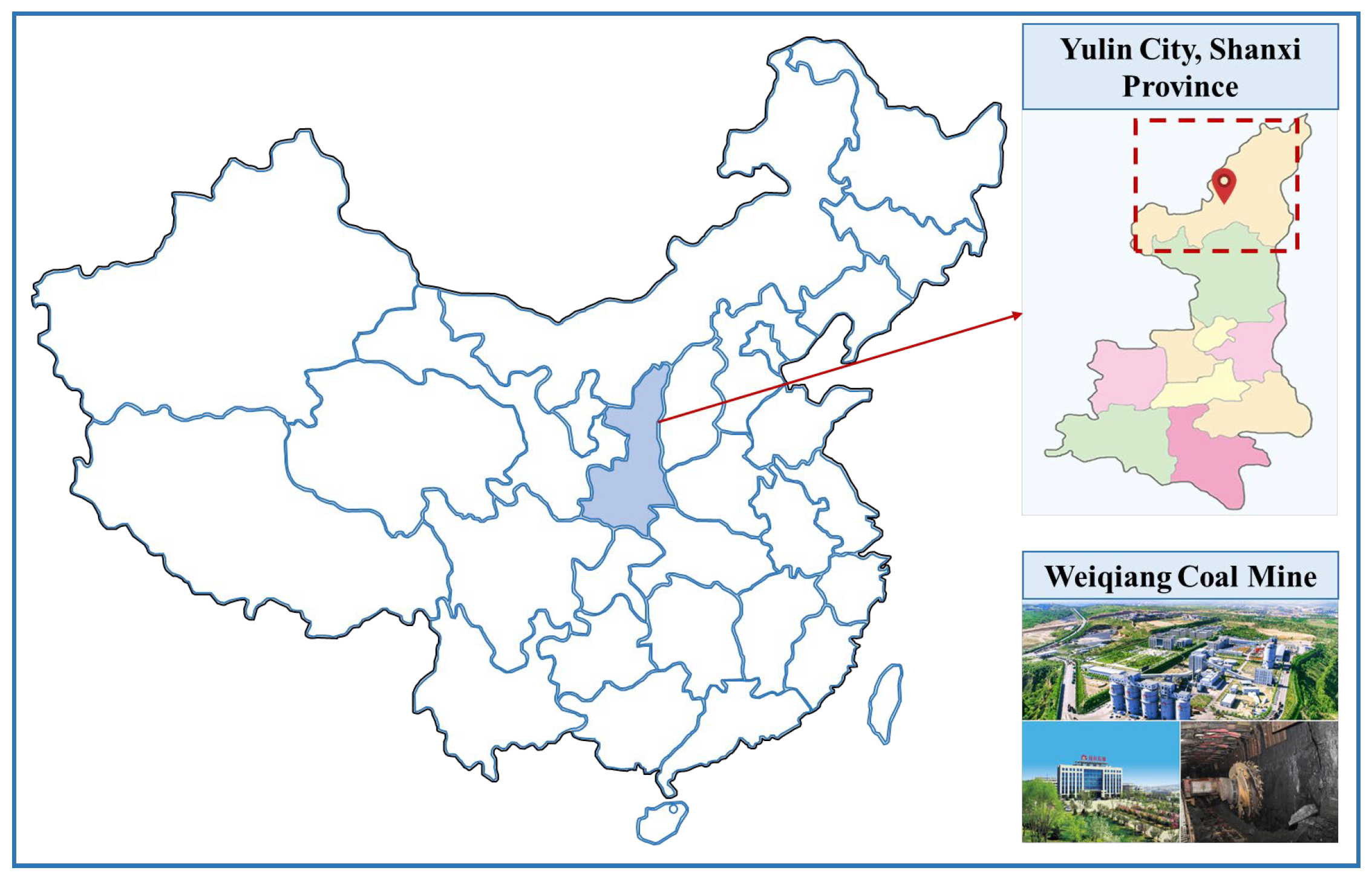
This study conducted on-site dust suppression experiments in the 3305 auxiliary transportation roadway and belt roadway of the Weiqiang Coal Mine in Yulin, Shaanxi Province, as shown in Figure 2. The working face, with a coal seam dip angle close to 0°, is a semi-coal–rock roadway. Excavation simultaneously cuts both the coal seam and the overlying roof rock, providing an ideal basis for comparing the pollution characteristics and dust suppression effectiveness for coal dust and rock dust. The roadway has a large designed cross-section (6.3 m × 3.1 m) and is classified as a low-gas mine, which is favorable for the combined application of multiple dust suppression techniques. A 12CM15-10D-type continuous miner (JOY Global, Milwaukee, WI, USA) with a 3.3 m wide cutting head is used for excavation at the working face. The large cutting area, involving both coal and roof rock, leads to high generation rates of coal dust and rock dust, creating substantial challenges for dust control. Therefore, this excavation site provides high research value for the study of dust control technology.

2.3. Measurement and Analysis of Airflow at the Continuous Miner Excavation Face

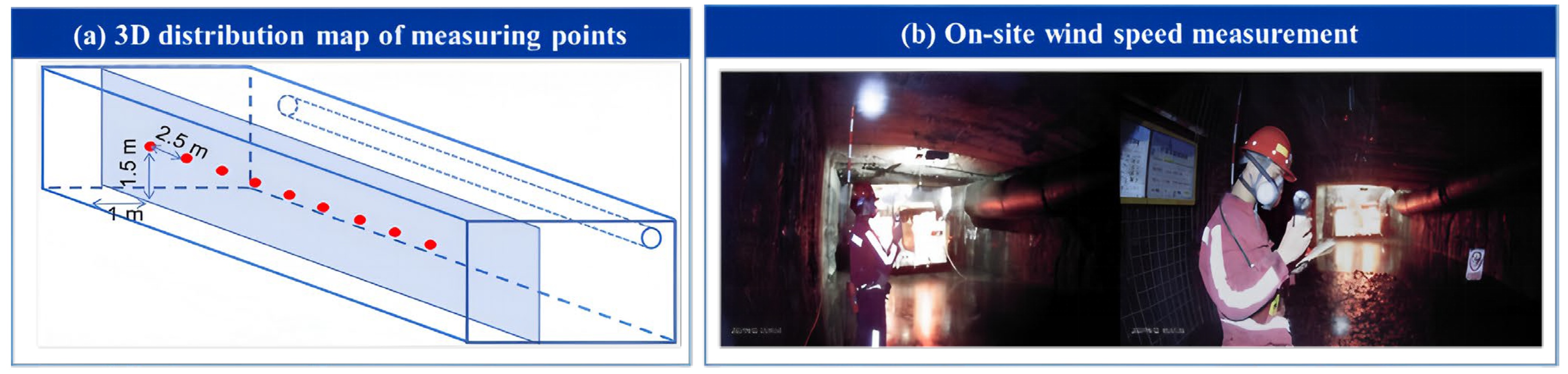
To characterize airflow distribution at the excavation face and to provide validation data for the numerical simulation, airflow velocity was measured using a CFJD5 mine anemometer (Astar, Shenzhen, China). Nine measurement points, labeled a, b, c, d, e, f, g, h, and i, were arranged in the auxiliary transportation roadway at a lateral offset of 1 m from the left sidewall and at distances of 2.5 m, 5 m, 7.5 m, 10 m, 15 m, 20 m, 25 m, 30 m, and 40 m from the working face, as shown in Figure 3.

2.4. Dust Concentration Measurement

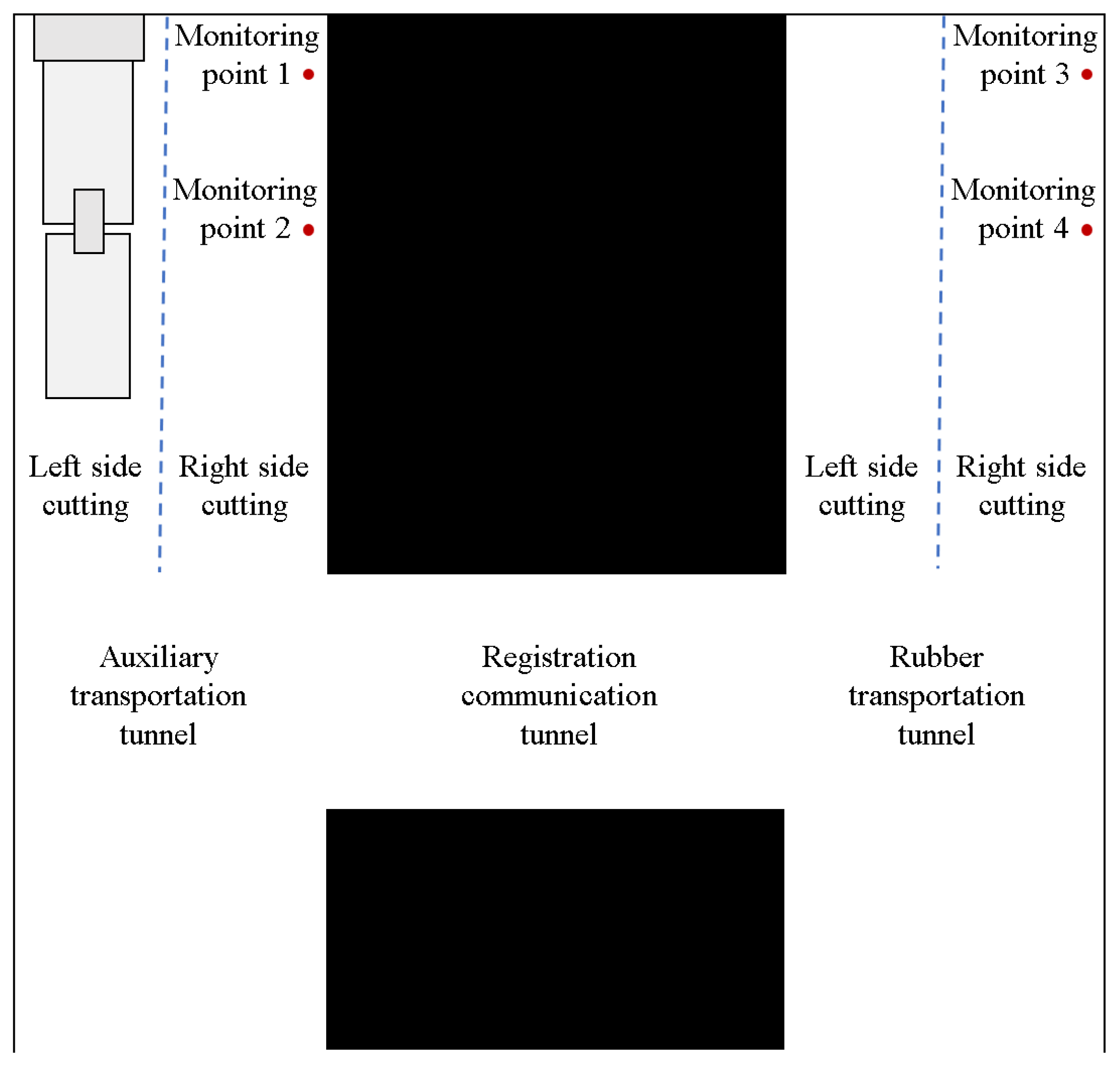
To quantitatively assess dust concentration at the heading face under different cutting conditions prior to implementation of comprehensive dust control measures, dust sampling was conducted in accordance with the Technical Specification for Comprehensive Dust Prevention of Continuous Coal Mining Face (MT/T 1189-2020) [19]. Measurement points were arranged in the 3305 belt roadway and the 3305 auxiliary transportation roadway, 5–10 m from the operator on the right side. To reduce random error during dust sampling, two independent measurement campaigns were carried out. The same personnel, equipment (AKFC-92A mine dust sampler, Zhengzhou Huazhi Technology Co., Ltd., Xi’an, Shaanxi, China), locations, and procedures were used for both campaigns. The two measurements were taken during different shifts, separated by two days. For each location, the final dust concentration value was calculated as the average of the two measurements. All sampling was performed during normal cutting operation of the continuous miner. The locations of the sampling points are shown in Figure 4.
In both the 3305 belt roadway and the 3305 auxiliary transportation roadway, dust concentrations were measured at two sampling points: one at the continuous miner operator’s position and the other 5–10 m away along the right sidewall. At each sampling point, total dust and respirable dust concentrations were measured separately during cutting operations, with each measurement lasting 1 min. Because the roadway cross-sectional width is approximately twice the length of the cutting head, the tunneling face is excavated in two sequential cutting steps. First, the left side of the face is advanced by 5 m, after which the machine retracts; then, the right side of the face is advanced by another 5 m. Accordingly, dust concentration measurements were performed separately during left-side advancement and right-side advancement of the continuous miner.

2.5. Methods for Measuring the Physicochemical Properties of Dust

2.5.1. Dust Sample Collection

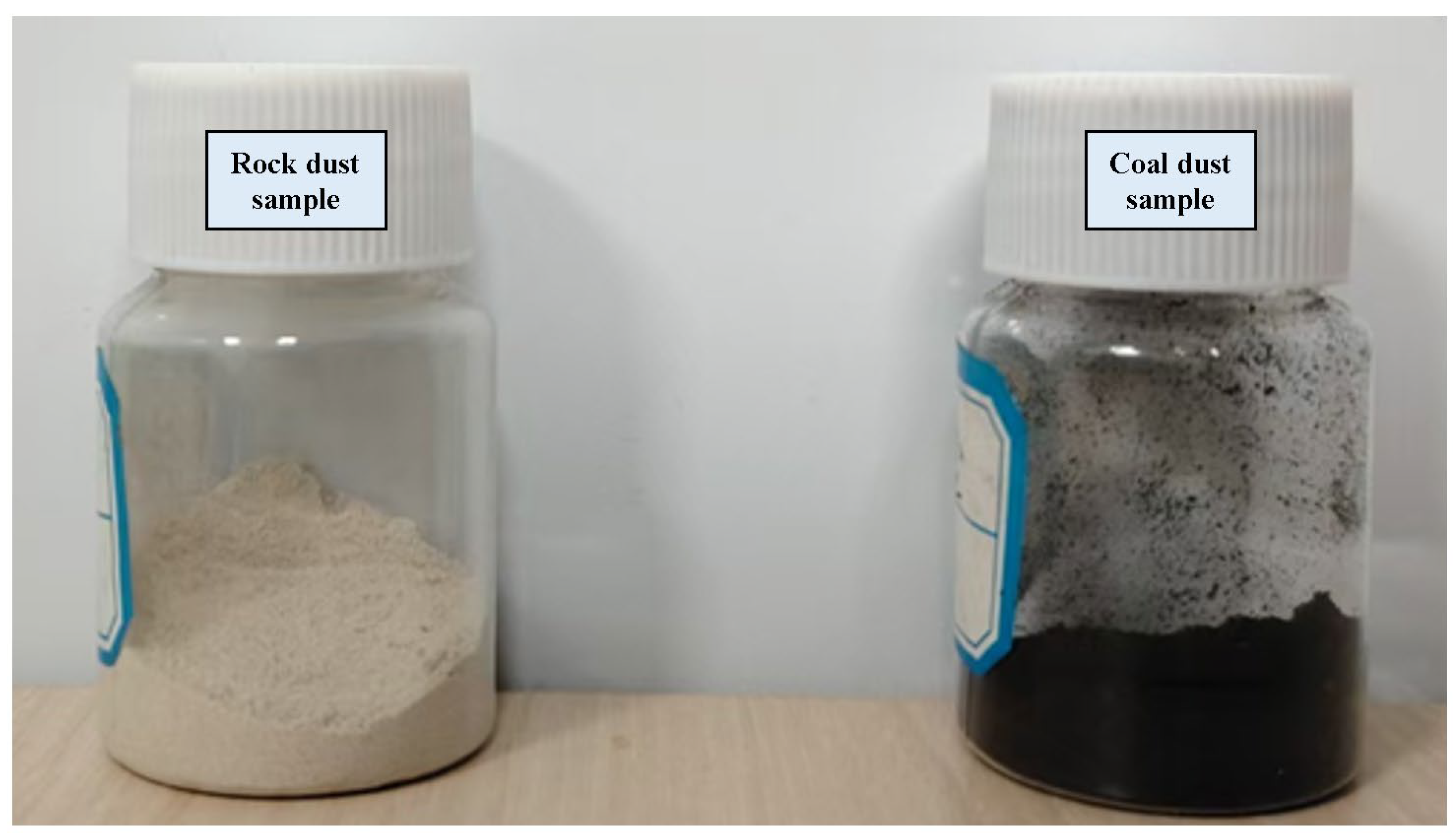
To investigate the physicochemical properties of dust in this coal mine, coal dust and rock dust samples were collected from the 3305 heading face of the Weiqiang Coal Mine in Hengshan District, Yulin City, Shaanxi Province. Approximately 30 g of coal dust were obtained using a membrane filtration and scraping method, with samples taken from the coal-cutting process of the continuous miner. Similarly, approximately 30 g of rock dust were collected using the same method, with samples taken from the roof rock cutting process of the continuous miner, as shown in Figure 5 and Table 1.

2.5.2. Particle Size Distribution Measurement

The particle size distribution of dust is critical for assessing dust-related hazards and for selecting appropriate prevention and control strategies. Previous studies indicate that dust reduction efficiency is strongly influenced by the absolute difference between droplet size and coal dust particle size [12]. As coal dust particle size increases, dust suppression efficiency initially increases and then decreases. Particle size analysis was conducted using a Malvern Mastersizer 3000 laser particle size analyzer (Malvern Panalytical Ltd., Malvern, Worcestershire, UK), with a SCIENTZ-1500F ultrasonic disperser (Jiayuanda Technology Co., Ltd., Shenzhen, China) and deionized water as the dispersing medium. Tests were performed in accordance with the national standard GB/T 19077-2016, Particle Size Analysis—Laser Diffraction Method [20,21]. The instrumental measurement error was 3%. To ensure reliability, each sample was tested three times, and the mean value was used for data analysis.

2.5.3. Measurement Method of Free Silica Content

To minimize potential experimental errors associated with a single analytical method, the free silica (SiO2) content in the dust samples was determined using both infrared (IR) spectroscopy and X-ray diffraction (XRD). The analyses were carried out in accordance with GBZ/T 192.4-2007 [22], Determination of Free Silica in Workplace Air—Infrared Spectrophotometry, and GBZ/T 192.5-2007, Determination of Free Silica in Workplace Air—X-ray Diffraction Method [23]. The instrumental measurement error was 5%. To ensure reliability, each sample was measured three times, and the mean value of the three measurements was used for data analysis.

2.5.4. Hydrophobicity and Hydrophilicity Test

The wettability of the dust samples was evaluated using a KRUSS DSA30 contact angle analyzer (Krüss GmbH, Hamburg, Germany), following the procedure specified in GB/T 30693-2014 [24], Measurement of Surface Contact Angle—Sessile Drop Method. The instrumental measurement error was 5%. To ensure reliability, each sample was measured three times, and the mean value of the three measurements was used for data analysis.

2.6. Numerical Simulation Setup for Dust Migration Characteristics

Identifying dust dispersion pathways is essential for optimizing the configuration of wall-mounted ventilation ducts and the placement of the dust extraction fan. Because it is difficult to directly observe dust migration patterns using experimental methods alone, numerical simulation was used to analyze the diffusion process of dust at the heading face.

2.6.1. Geometric Model Construction

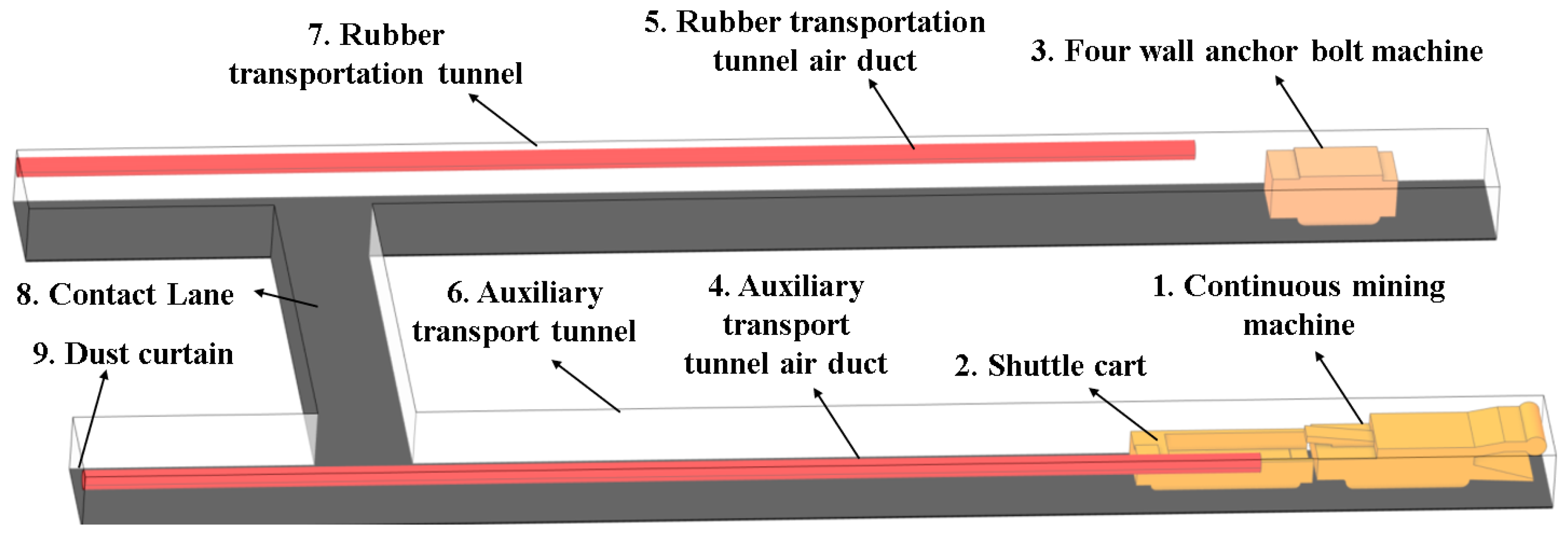
The dimensions of the roadway and machinery in the geometric model were determined from the actual size of the heading face. During model construction, the detailed structures of the continuous miner were appropriately simplified. The geometric model and associated parameters are shown in Figure 6 and Table 2.
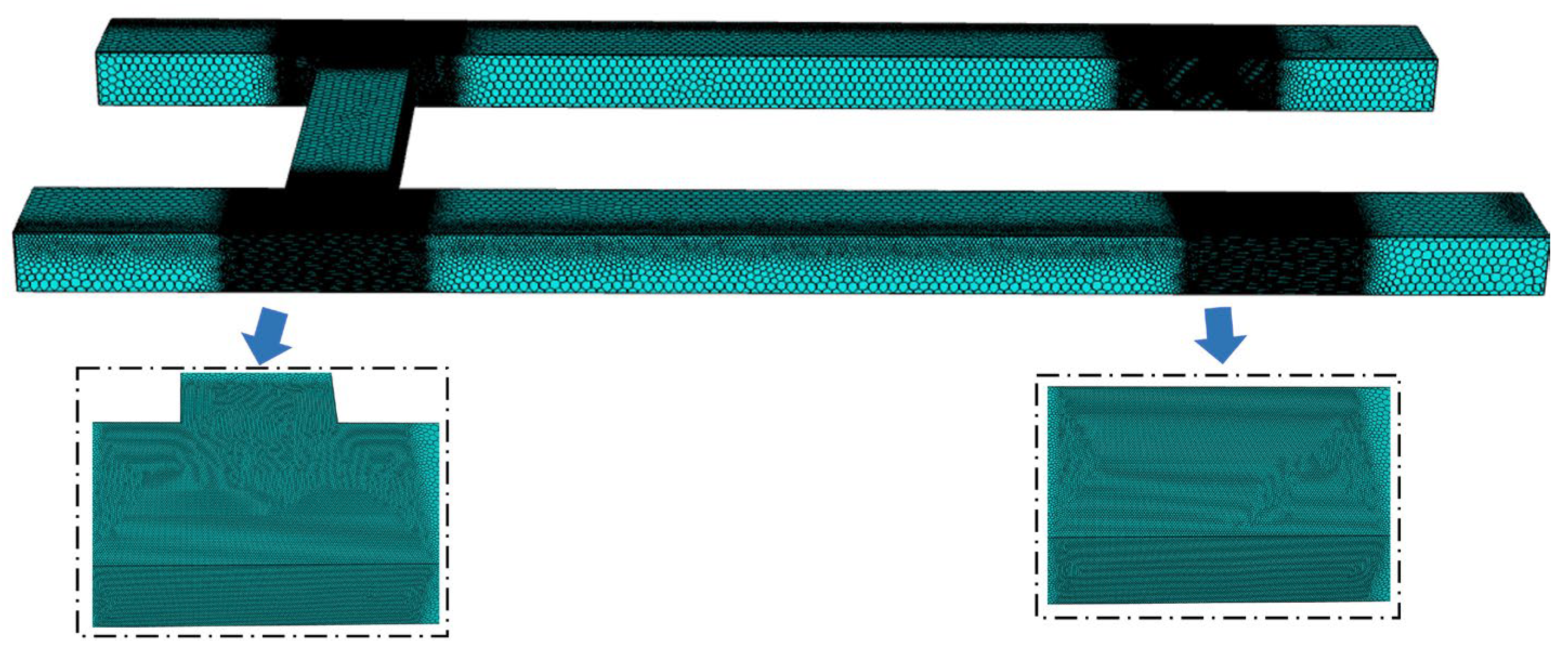
Because the wind velocity is significantly lower than the speed of sound, the airflow was treated as an incompressible fluid and solved using a pressure-based solver in the CFD model. The inlet boundary condition at the duct was defined based on the measured airflow velocity. The simplified geometric model included both the auxiliary and transportation ducts, with a perimeter of 3.14 m and a cross-sectional area of 0.785 m2. Considering ventilation requirements and dust suppression effectiveness, the distance between the duct outlet and the working face was set to 20 m. Based on the actual airflow conditions in the roadway, the inlet velocity at the simulation boundary was set to 12 m/s. The mesh generation and computational parameters are shown in Figure 7 and Table 3.

2.6.2. Physical Model Setup

Dust particles exhibit distinct size-segregation behavior during motion. Heavier particles are strongly influenced by gravitational acceleration and undergo continuous settling during transport, leading to progressive enrichment of fine particles in downstream sections of the tunnel. To simplify the analysis, the following assumptions were adopted:
(1)
Gas is incompressible.
(2)
No heat conduction or energy transfer occurs.
(3)
Collisions between dust particles are not considered.
(4)
Irregularly shaped dust particles are treated as ideal spheres with the same mass.
(5)
Particles are simultaneously subjected to gravity and buoyancy, which act in opposite directions in the fluid.
These assumptions reduce the applicability of the numerical model under conditions of high turbulence, strong non-uniformity, thermal disturbance, or high dust concentration. They also do not account for the effects of true particle morphology, surface roughness, or internal porosity on aerodynamic behavior, nor do they capture the influence of particle orientation and rotation on predictive accuracy. However, these assumptions ensure that the model remains computationally efficient and numerically tractable.
The buoyancy acting on a dust particle can be expressed mathematically as [25,26]:
F G = 1 6 π d ρ 3 ( ρ ρ ρ g ) g
where dρ represents the dust particle diameter (mm); ρρ denotes the particle density (kg/m3); and ρg indicates the air density (kg/m3).
During fluid motion, non-uniformity in the velocity field alters the forces acting on particles. When particles are located in regions with a velocity gradient, they are subjected to a transverse force that acts from the low-velocity region toward the high-velocity region. In fluid mechanics, this force is defined as the Saffman lift force, Fs. Its expression is given by:
F S = 2 K v 1 2 ρ d i j ρ ρ d ρ ( d l k d k l ) 1 4 ( u u ρ )
where K = 2.594; dij is the fluid deformation rate tensor.
Dust particles experience fluid drag force in the airflow. Assuming steady-state flow conditions, the expression is given by:
F D = C D ρ g 8 ( u g u ρ ) 2 π d p 2
where CD is the gas drag coefficient; ug is the gas velocity (m/s); uρ is the dust particle velocity (m/s).
The random force induced by Brownian motion cannot be neglected in the dynamics of micron-sized particles. When the particle diameter is less than 10 μm, this force, which arises from molecular collisions, becomes particularly significant. To accurately capture Brownian effects in numerical simulations, the energy conservation equation must be enabled. This force term is applicable only under laminar flow conditions. Its expression is:
F B r = ζ π S 0 Δ t
where Δt is the particle time step; S0 is the spectral intensity function; ζ is a Gaussian random function, expressed as:
F ( x ) = 1 2 π x e t 2 2 d t
Subsequently, to simulate the actual dust concentration distribution in underground mines, the mass flow rate (Qm) of the injection source is calculated by:
Q m = k q ρ ρ u g A
where kq is the coefficient representing the ratio of measured concentration to simulated concentration at the same location; A is the cross-sectional area of the tunnel (m2).
This improved formula offers both operational simplicity and high computational accuracy and was therefore used in this study to calculate the Qm parameter. To reduce measurement error and account for dust dispersion along the airflow path, spatial data from five monitoring points were averaged, yielding kq = 1.2.
Given the stable thermodynamic conditions in the return airway (temperature fluctuations within ±0.5 °C) and the negligible effects of resistance loss and heat transfer, the energy equation was deactivated in the computational model. Multiple monitoring points were used to collect real-time flow field data, and material properties, boundary conditions, and other key parameters were configured according to the settings summarized in Table 4.

2.6.3. Grid Convergence and Model Validation

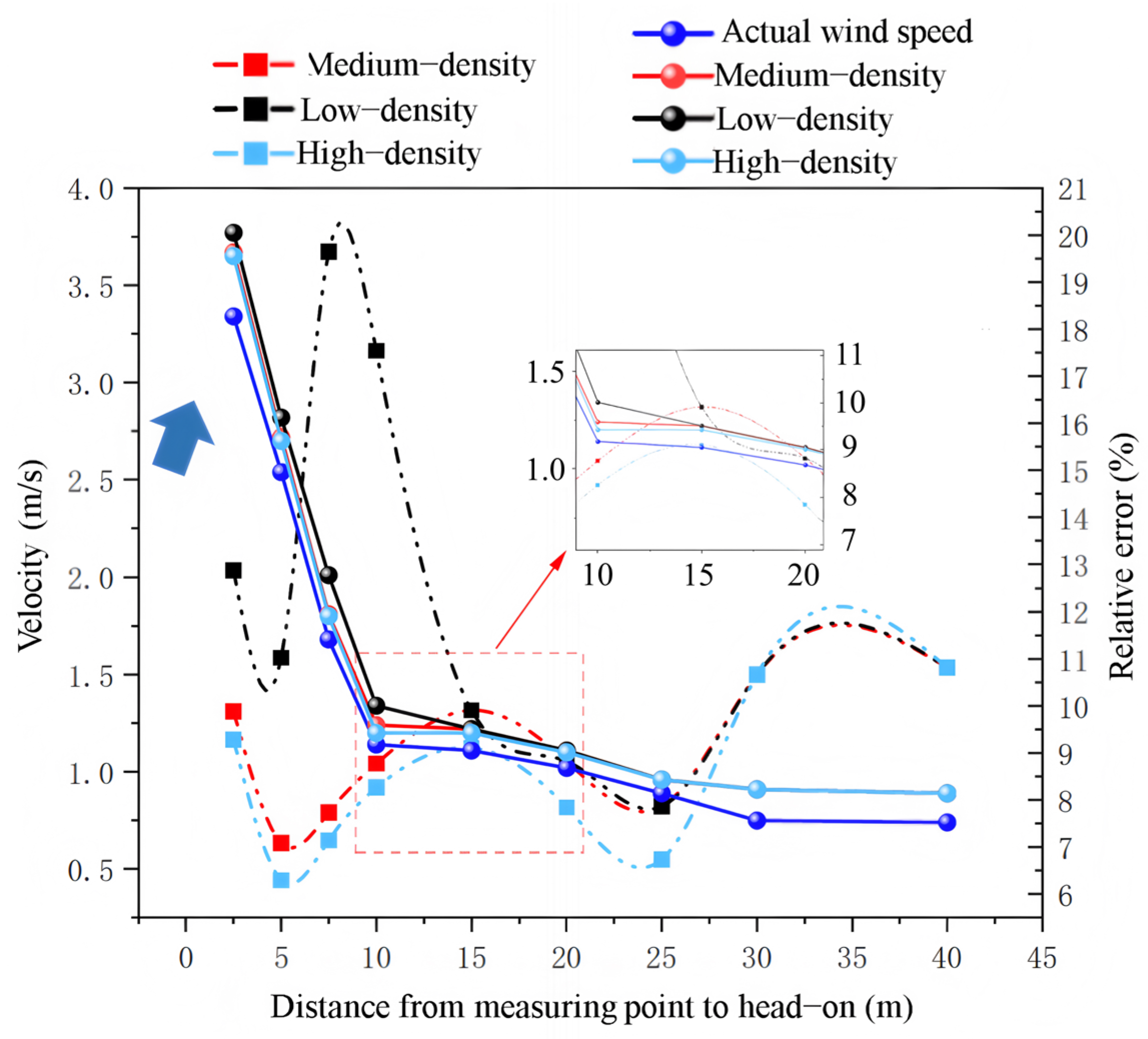
In order to evaluate the validity and reliability of the model, a comparative analysis was conducted between the measured wind speed data and the velocity vectors at the corresponding points in the model’s continuous phase. Three grids with different resolutions were selected for the grid independence analysis (low density: 524,300; medium density: 1,513,800; high density: 3,295,600). Using the actual air duct wind speed as the inlet condition, the wind speeds at the measurement points were recorded for each grid. The simulated wind speeds at the measured wind speed positions a, b, c, d, e, f, g, h, and i were also obtained. A comparison of the simulated wind speeds for the three grid densities with the actual wind speed is presented in Figure 8.
The velocity distributions obtained from the three grids exhibit trends consistent with the measured values, indicating that the model reliably reproduces the attenuation characteristics of airflow in the roadway. However, the low-density grid shows a pronounced deviation in the 0–15 m region, where the local flow field is characterized by strong turbulence and eddy structures. This discrepancy is primarily attributed to insufficient mesh resolution, which limits the model’s ability to capture the complex flow transitions near the surface. In contrast, the medium-density and high-density grids (red and blue curves) yield nearly identical velocity distributions beyond 15 m, and the relative error at all monitoring points remains below 11%. This suggests that refinement beyond the medium-density grid provides only marginal accuracy gains while substantially increasing computational cost. Therefore, considering both accuracy and efficiency, the medium-density grid was selected. In this configuration, a total of 1,513,800 grid elements were generated in the computational fluid domain.
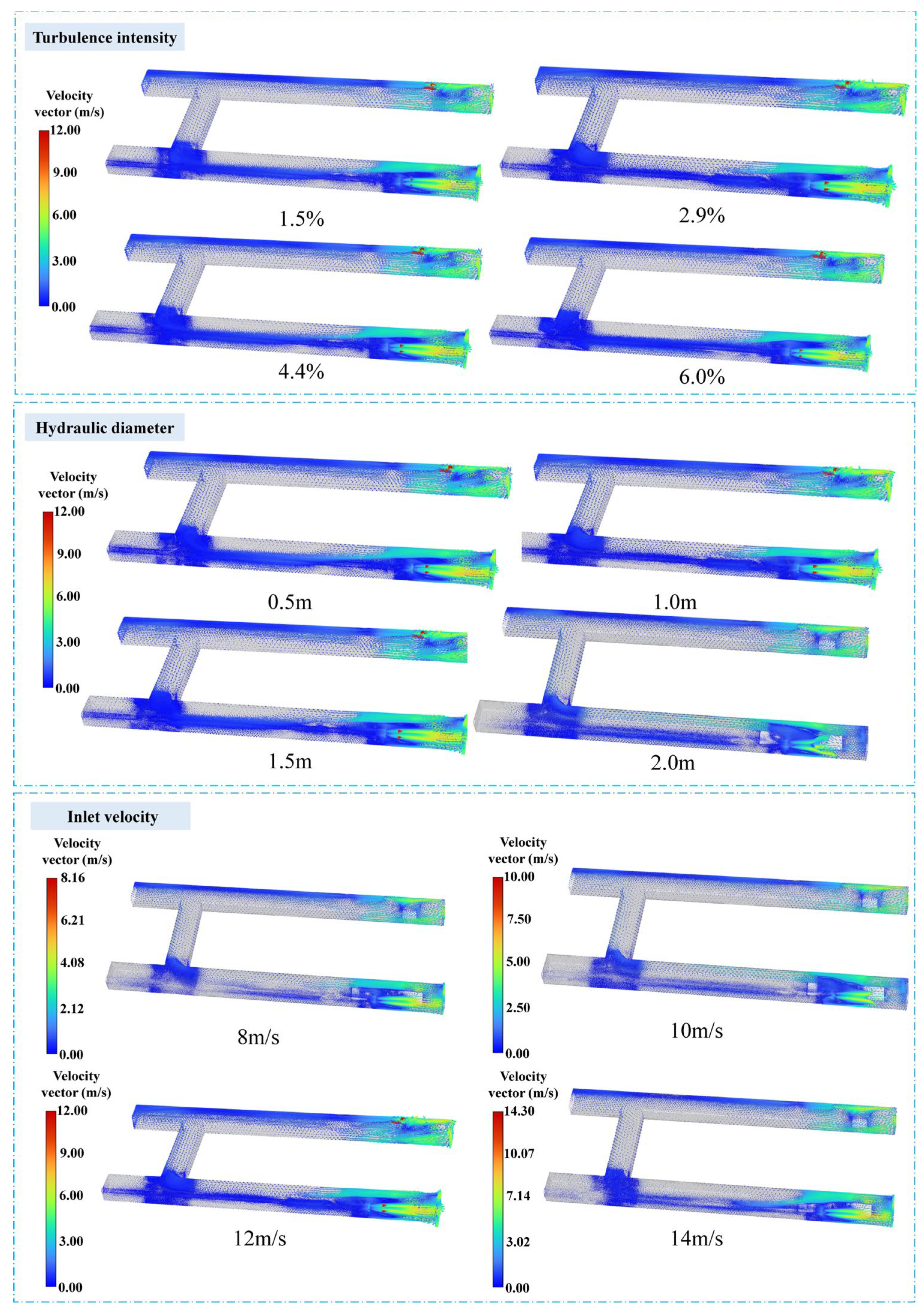
Subsequently, a sensitivity analysis was performed on three key boundary conditions—turbulence intensity, hydraulic diameter, and inlet wind speed—to assess the model’s response to variations in boundary settings and to determine the optimal parameter combination for subsequent simulations, as shown in the figure below (Figure 9).
Comparison of turbulence intensities of 4%, 6%, 8%, and 10% shows that increasing turbulence intensity slightly enlarges the local eddy region in front of the heading face and at roadway intersections and enhances airflow mixing. However, the overall wind speed distribution beyond 15 m changes very little, with a maximum wind speed difference of less than 5%. This indicates that turbulence intensity primarily influences local flow stability and the recirculation zone near the outlet, while having a limited effect on the global wind field. Considering both accuracy and stability, a turbulence intensity of 2.9% was adopted for subsequent simulations. When the hydraulic diameter increases from 0.5 m to 2.0 m, the jet kinetic energy and diffusion characteristics change significantly. At smaller diameters, the outlet wind speed is higher, the jet impact is stronger, and pronounced wall-attached vortices are observed. At larger diameters, the jet kinetic energy decreases and backflow weakens. The differences above 1.0 m become less pronounced, indicating that the model is not highly sensitive to this parameter within the range of actual ventilation pipe sizes. Therefore, 1.0 m was selected to match the measured diameter. When the inlet wind speed increases from 9 m/s to 12 m/s, the jet penetration depth and airflow uniformity are significantly improved, and the stagnation zone is reduced. At inlet wind speeds below 9 m/s, airflow decays too rapidly, making it difficult to form a stable mainstream. The simulation result at 12 m/s shows the highest agreement with the measured wind speed field and is therefore used as the final boundary condition.

3. Original Airflow and Dust Characteristics at the Heading Face of a Continuous Miner

3.1. Wind Velocity Distribution Along the Roadway

As shown in Table 5, the airflow velocity in the auxiliary transportation roadway decreases rapidly within 2.5–7.5 m of the excavation face. Beyond 10 m, the rate of decrease becomes significantly slower: for every additional 5 m, the velocity drops by no more than 0.3 m/s, with an average reduction of less than 0.15 m/s. In some locations, a slight local increase in velocity is even observed. Beyond 30 m, the airflow velocity approaches a stable state, with the average velocity difference between the 30 m and 40 m measurement points being only 0.01 m/s. These measurements provide reliable input data for both numerical calculation and model validation.

3.2. Original Dust Concentration at the Continuous Miner Heading Face

The dust concentration measurements are summarized in Table 6 and Table 7. The average total dust concentration for rock dust was 1044 mg/m3, compared with 861 mg/m3 for coal dust, representing a 21% increase for rock dust. The respirable dust concentration for rock dust was 27% higher than that for coal dust. This indicates that, under the same conditions (i.e., using only the original spray dust suppression system), rock cutting produces substantially more total dust and fine particulate matter than coal cutting, thereby posing a greater health risk.
We also observed that dust concentrations were generally higher when the continuous miner was cutting on the left side of the roadway than on the right side. During left-side advancement, the cutting zone is confined within the groove, where airflow influence is limited and dust disperses more slowly. In contrast, during right-side advancement, the cutting area is exposed directly to the airflow field, allowing dust to disperse more readily toward the operator position.
In the auxiliary transportation roadway, the increase in dust concentration during right-side advancement was more pronounced than in the belt roadway. In addition, dust concentrations at Sampling Points 3 and 4 in the belt roadway were significantly higher than those at Sampling Points 1 and 2 in the auxiliary transportation roadway—by 40% for rock dust and 26% for coal dust. This difference is primarily attributed to the layout of the ventilation ducts: in the auxiliary transportation roadway, the intake duct is located on the left side of the roadway, whereas in the belt roadway it is located on the right side. Consequently, in the auxiliary transportation roadway, high-concentration dust generated during right-side advancement is more readily transported by the left-sided airflow toward Sampling Points 1 and 2. In contrast, in the belt roadway, the right-sided airflow partially dilutes the dust-laden air.

3.3. Physicochemical Properties of Dust

3.3.1. Particle Size Distribution Characteristics of Dust in the Roadway Heading Face

The particle size distribution test results are summarized in Table 8. For the coal dust sample (M-01), the median particle size D50 is 44.60 μm, with D10 of 11.15 μm, D90 of 112.30 μm, and an average particle size D[4,3] of 35.98 μm. These values indicate that most particles fall within the coarse respiratory-dust range (10–75 μm), which settle relatively quickly but may remain airborne long enough to impair visibility and local air quality. A smaller fraction of <10 μm dust still exists, posing inhalation hazards to the upper respiratory tract [27,28,29].
In contrast, the rock dust sample (R-01) is much finer, with D50 of 7.75 μm, D10 of 1.95 μm, D90 of 18.50 μm, and an average particle size D[4,3] of only 6.83 μm. Such fine particle size leads to a high lung deposition rate and facilitates penetration beyond the protective barriers of the human respiratory system, posing substantial health risks [29,30]. In addition, particles in the range of 10–75 μm are also considered to be the most explosive part in the restricted mine environment, and the 50 μm particle size dust explosion is the most severe, which highlights the dual hazards of fine mineral dust in underground operations [31,32,33,34].
Although large-particle coal dust settles rapidly, it can remain suspended in the work environment for a certain period, impairing air quality and visibility. By comparison, the finer particle size of rock dust makes it more easily inhaled and more likely to deposit in deep regions of the respiratory tract, such as the alveoli. Long-term accumulation can induce severe pathological changes, including pulmonary fibrosis, thereby threatening the health of operators.
Regarding dust mitigation, conventional water-spray and foam systems perform effectively on coarse particles (>20 μm) due to efficient collision and agglomeration. However, their efficiency decreases markedly for ultrafine respirable dust (<10 μm), comprehensive dust control technology integrating dust reduction, dust suppression and dust removal is required.

3.3.2. Free Silica Content in Dust from the Roadway Heading Face

The test results for free silica content are summarized in Table 9. For the coal dust sample (M-01), the free silica content determined by the infrared method and the XRD method is 6.2% and 5.8%, respectively, which falls within the low-content range. Nevertheless, prolonged exposure to a coal dust environment containing even low concentrations of free silica can still lead to occupational diseases such as coal worker’s pneumoconiosis and therefore cannot be overlooked. In contrast, the free SiO2 content in the rock dust sample (R-01) is substantially higher. The values measured by the infrared method and the XRD method are 32.7% and 33.1%, respectively, indicating a high level of occupational health risk. Long-term exposure to such dust may result in severe health outcomes, including silicosis [35,36].

3.3.3. Hydrophobicity and Hydrophilicity Analysis of Dust in the Roadway Heading Face

The surface wettability of dust is a key factor determining foam film stability and dust capture efficiency during foam dust suppression. In general, the more hydrophobic the coal dust is, the lower the efficiency of foam dust suppression. The contact angle test results are summarized in Table 10. The coal dust sample (M-01) exhibits a contact angle of 108.7°, indicating strong hydrophobicity. Such dust is not easily wetted by water mist, tends to remain airborne, and readily disperses throughout the roadway, thereby increasing the difficulty of dust control. In wet dust removal processes such as spray dust suppression, ordinary water mist is ineffective at capturing highly hydrophobic coal dust. As a result, dust removal efficiency is low and repeated treatment is required, increasing labor and resource cost. In contrast, the rock dust sample (R-01) has a contact angle of 68.4°, indicating hydrophilicity. This type of dust can be more effectively captured by wet dust removal measures, which helps reduce airborne dust concentrations in the working environment [37,38].
The comparative analysis of physicochemical properties reveals distinct challenges in controlling coal dust and rock dust at the roadway heading face. Coal dust particles are relatively coarse, with moderate free silica content but strong hydrophobicity. As a result, coal dust remains airborne for a limited period but is difficult to wet using conventional water mist, which reduces the effectiveness of wet suppression techniques. Therefore, coal dust control should focus on improving wetting performance—for example, through surfactant-assisted spraying or foam dust suppression—to overcome hydrophobicity and enhance dust capture efficiency.
In contrast, rock dust is characterized by ultrafine particle sizes, very high free silica content, and hydrophilic behavior. Its fine particle size increases the likelihood of deep pulmonary deposition and raises the risk of severe occupational diseases such as silicosis. Although its hydrophilicity enables effective suppression using conventional wet methods, the high toxicity and persistence of respirable rock dust require more stringent protective measures. Engineering controls such as enhanced ventilation, localized dust extraction, and real-time monitoring of silica concentrations should be implemented in combination with wet suppression to reduce health risks.

3.4. Wind Flow Distribution Under Different Working Conditions

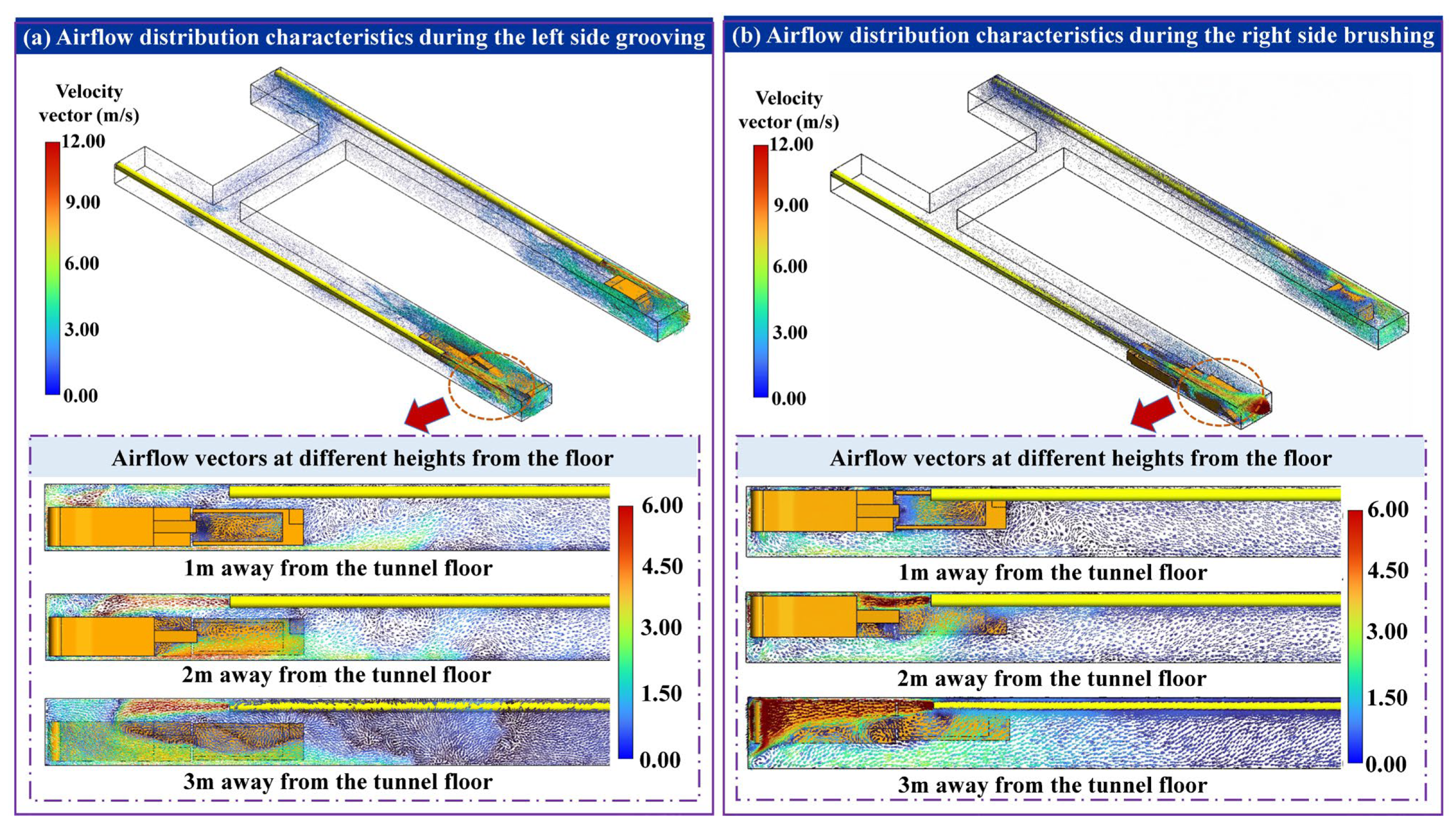
Figure 10a,b shows the overall airflow vector fields for left-side advancement and right-side advancement, respectively. For left-side advancement, when the high-velocity jet from the duct outlet (peak velocity 12 m/s) impinges on the roadway face, intense shear flow is generated. Under the combined influence of the confined roadway geometry and local pressure gradients, the jet undergoes pronounced lateral deflection, gradually attaches to the roadway wall, and rotates. At 3 m above the floor, where the influence of the continuous miner and shuttle car is relatively limited, the airflow from the duct can propagate toward both the return and intake sides with a velocity of approximately 6 m/s. In this region, partial merging with the incoming jet produces vortical structures. At 2 m and 1 m above the floor, the airflow is directed mainly toward the return side. A portion of the stream bypasses the continuous miner through the gap between the machine and the wall, adheres to the return sidewall, and then converges with the return airflow impinging on the face near the shuttle car. This interaction generates several small-scale vortices, which subsequently develop into a larger vortex in front of the shuttle car before gradually diffusing toward the intake side.
For right-side advancement, when the continuous miner shifts from the left side to the right side of the roadway, it obstructs the airflow discharged from the duct. As a result, the high-velocity jet becomes confined within the roadway space at 3 m above the floor. After impinging on and reflecting from the roadway face, the airflow undergoes kinetic energy dissipation and then disperses more uniformly in the space behind the shuttle car. At 2 m and 1 m above the floor, the airflow emerging from the duct interacts with the flow leaking through gaps in the miner and with the recirculating flow in front of the machine. The collision of these streams generates vortices near the shuttle car on the intake side. On the return side, after bypassing the continuous miner, the airflow rapidly diffuses toward the intake side.
After passing through the equipment area, the airflow experiences a sudden expansion of the roadway cross-section. This expansion causes part of the flow to deflect toward the intake side, while most of the airflow remains concentrated near the floor. Beyond 30 m from the working face, the airflow gradually diffuses and becomes relatively uniform across the roadway.

3.5. Dust Migration and Dispersion Patterns Under Different Operating Conditions

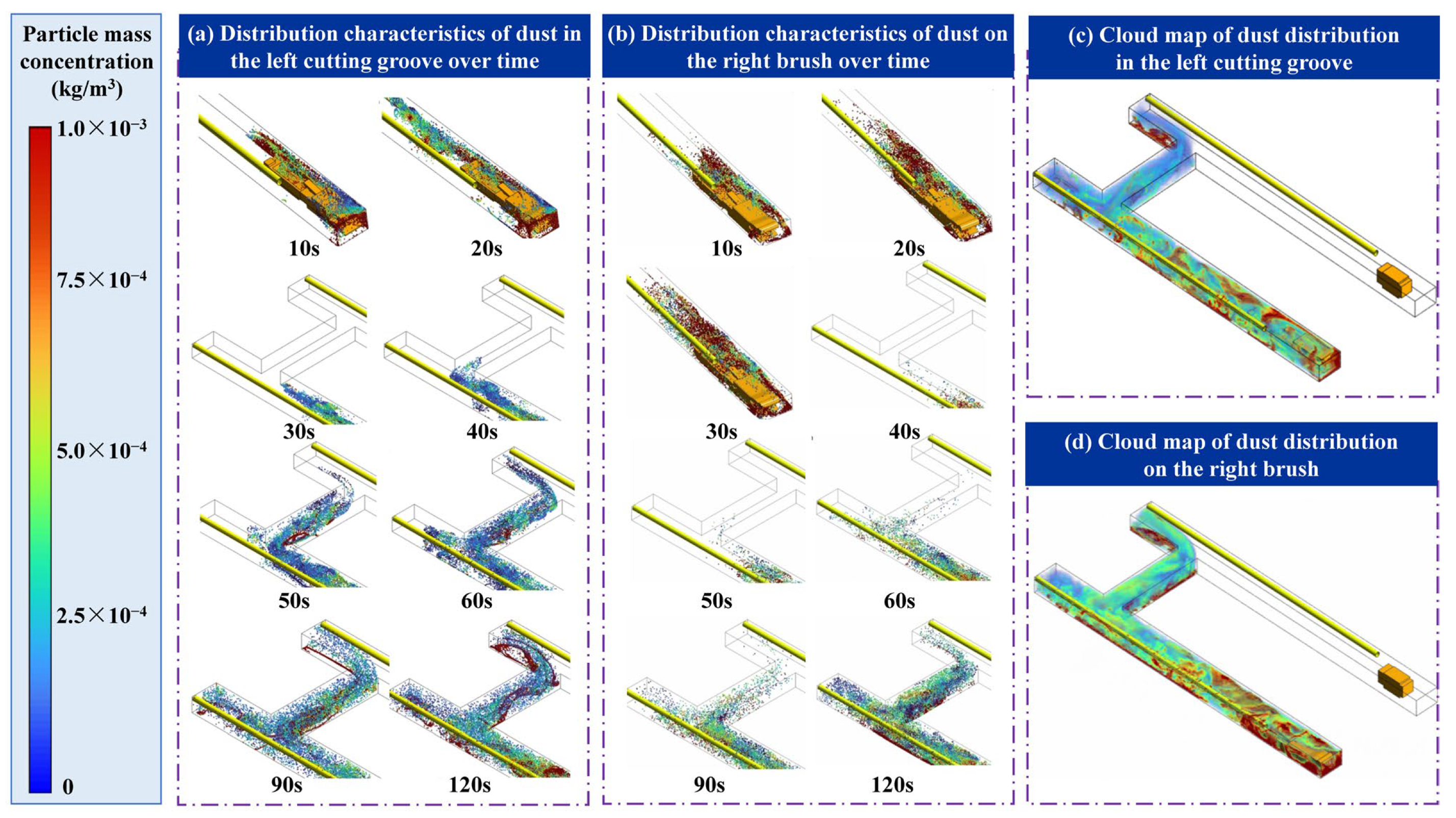
Dust particles generated at the excavation face exhibit characteristic migration patterns driven by the airflow field. Initially, fine particles produced by coal and rock breakage are entrained and transported downstream by the primary airflow. Owing to roadway geometry and the presence of mining equipment, local vortex structures form in the flow field. These vortices partially confine and recirculate dust, while the remaining particles continue to disperse along the main airflow direction. The dust migration and dispersion patterns at the working face during left-side advancement and right-side advancement are shown in Figure 11a,b.
From 10 s to 20 s, dust particles are primarily concentrated around the continuous miner and the shuttle car, with relatively high concentrations near the return sidewall. After passing the shuttle car, most of the dust gradually shifts from the roadway walls toward the roadway center. Notably, during right-side advancement, dust migration in the auxiliary transportation roadway occurs more slowly than during left-side advancement, and dust generated under right-side advancement tends to accumulate above the shuttle car.
From 30 s to 40 s, during left-side advancement, dust is entrained by airflow from the duct into the connecting roadway and is mainly distributed near the roadway center in an approximately conical pattern. In contrast, during right-side advancement, most dust remains near the continuous miner and the shuttle car, with only a small fraction reaching the intersection of the auxiliary transportation roadway and the connecting roadway.
From 50 s to 60 s, under left-side advancement, dust is diverted within the connecting roadway. Due to the presence of the dust curtain at the outlet of the auxiliary transportation roadway, airflow in the rear section of the auxiliary transportation roadway is impeded. As a result, substantially more dust exits through the connecting roadway and the belt roadway than directly through the auxiliary transportation roadway. Under right-side advancement, only a small portion of dust is transported into the connecting roadway and into the rear section of the auxiliary transportation roadway.
From 90 s to 120 s, most dust reaches the roadway intersection. Under right-side advancement, the amount of dust present in the connecting roadway is higher than under left-side advancement. The spatial distribution is similar to that observed at 60 s in the left-side advancement condition, but with fewer particles near the outlet boundary.
The overall dust distribution in the roadway under the two operating conditions is shown in Figure 11c,d. In both cases, most dust is concentrated in the front section of the auxiliary transportation roadway, with pronounced accumulation along the auxiliary transportation roadway walls and around the shuttle car and the continuous miner. In addition, elevated dust concentrations are observed near the floor in the rear section of the belt roadway near the outlet. Compared with left-side advancement, right-side advancement results in greater dust accumulation at the bottom of the connecting roadway and around the shuttle car and continuous miner.

4. Construction and Effectiveness Verification of the Foam-Dust Extraction Fan Collaborative Dust Reduction System

4.1. Layout Strategy and Airflow Control for Dust Extraction Fans

The key factors governing the dust suppression efficiency of a dust extraction fan are primarily the fan airflow volume and its installation position. Based on the results presented in Section 3.4 and Section 3.5, optimal dust reduction is achieved when fans are installed near the continuous miner and positioned radially at either the midpoint or the return-air side of the auxiliary transportation roadway. In addition to the onboard fans mounted on the continuous miner, the placement and airflow capacity of fans in the auxiliary transportation roadway must therefore be determined with precision. To this end, different airflow volumes were evaluated at two installation positions (midpoint and return-air side of the auxiliary transportation roadway) to identify the optimal combination for maximizing dust suppression.
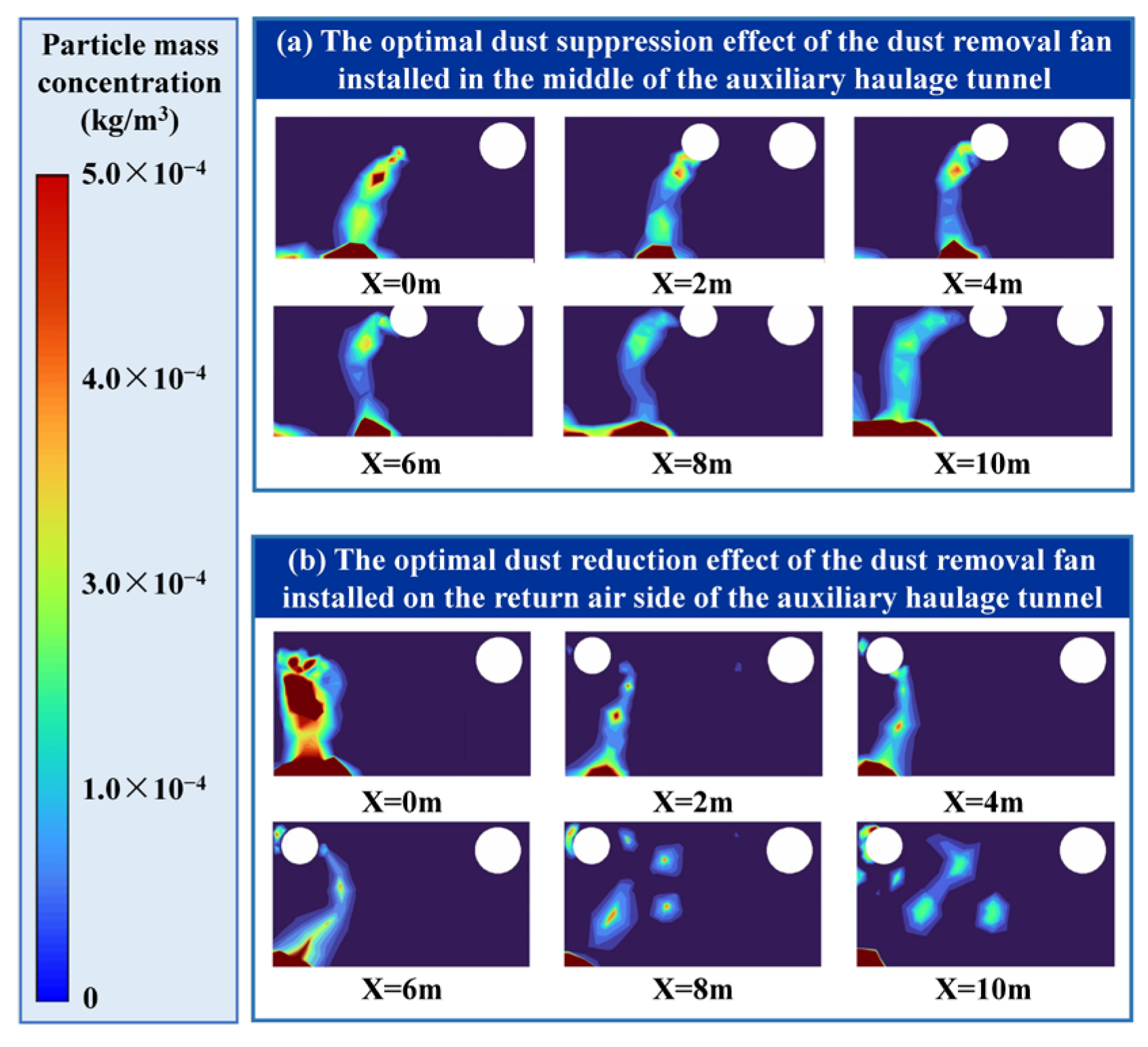
Five airflow volumes were tested: 100 m3/min, 200 m3/min, 300 m3/min, 400 m3/min, and 500 m3/min. For intuitive comparison of cross-sectional dust concentration distributions, the fan duct position was defined as X = 0 m, and sampling cross-sections were established every 2 m in the direction extending downstream from the fan. Each sampling plane collected 40,000 data points to obtain the average dust concentration, as summarized in Table 11. The dust extraction fan achieved the highest dust suppression efficiency at an airflow rate of 500 m3/min, regardless of whether it was positioned at the midpoint of the roadway or on the return-air side, yielding efficiencies of 70.3% and 69.2%, respectively. When the airflow rate was below 500 m3/min, the suction capacity was insufficient to effectively capture dust particles. When the airflow rate exceeded 500 m3/min, the fan size became impractical for deployment at the tunneling face.
At the optimal airflow rate of 500 m3/min, the spatial distribution of dust concentration across the tunnel cross-section is shown in Figure 12. When the dust extraction fan is installed in the middle of the tunnel, dust particles are drawn toward the fan duct under negative pressure, forming localized high-concentration dust clouds. Both the spatial distribution patterns and the average concentration measurements indicate that this configuration provides moderate effectiveness in controlling dust in the rear section of the auxiliary transportation roadway. However, apart from coarse particles that have already settled on the floor, areas of elevated dust concentration persist near the tunnel center, indicating that dust capture efficiency is not yet fully optimized. In contrast, when the fan is positioned on the return air side, the relatively higher airflow velocity near the tunnel center promotes dust dispersion after partial extraction by the fan duct. Spatial and statistical analyses show that this arrangement achieves dust suppression performance comparable to that of the central installation, with no significant difference in overall effectiveness.

4.2. Optimization of Dust Extraction Fan Selection and Positioning at the Tunneling Face

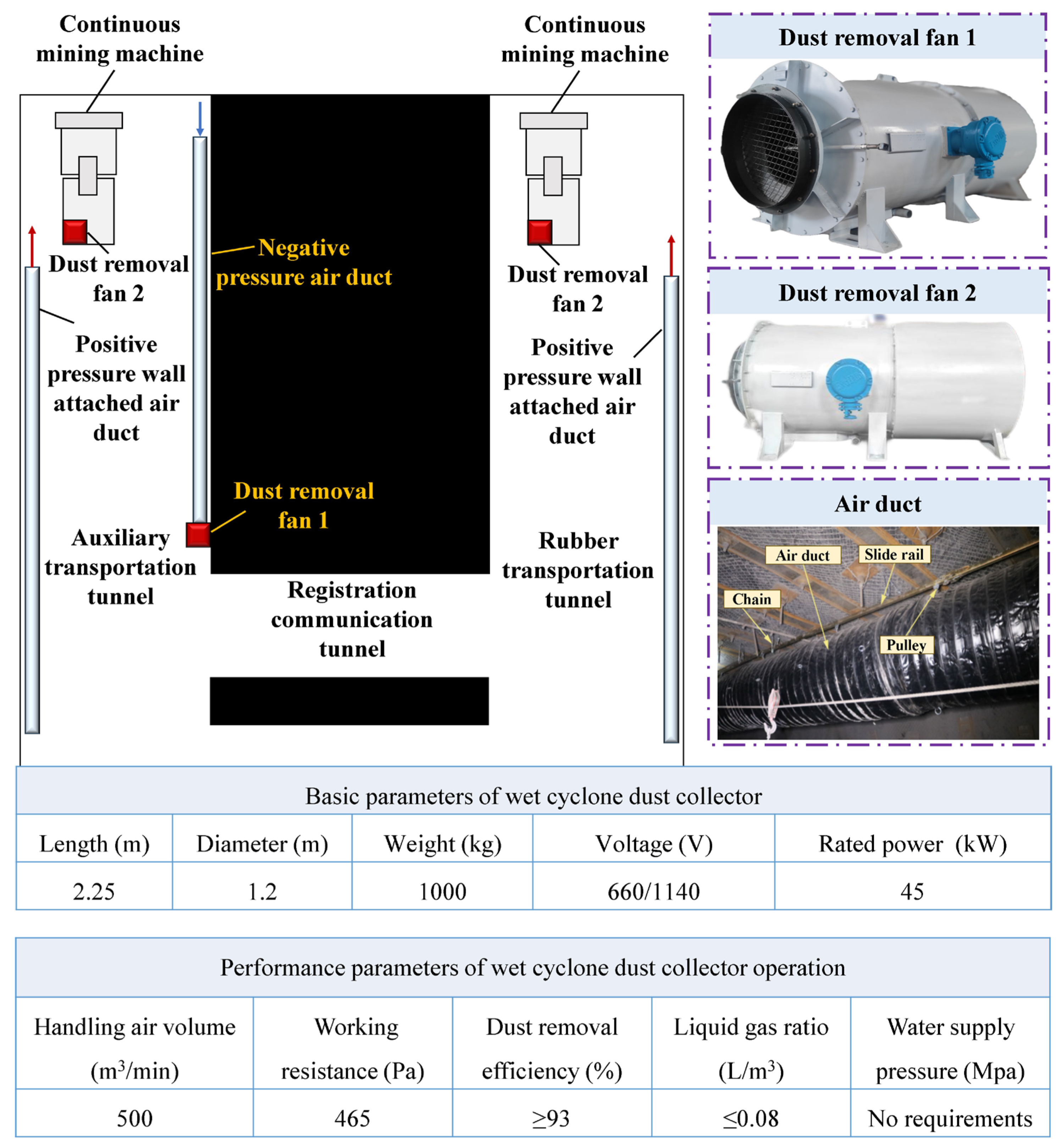
The configuration and overall layout of the underground dust removal systems are shown in Figure 13. In the auxiliary transportation roadway, dust control is implemented through an integrated approach that combines on-board foam dust suppression technology with two strategically positioned fans: Fan 1, a ground-installed central extraction unit, and Fan 2, a machine-mounted auxiliary unit. In the belt roadway, dust mitigation is achieved through a coordinated system that couples on-board foam dust suppression technology with the localized extraction capability of Fan 2.
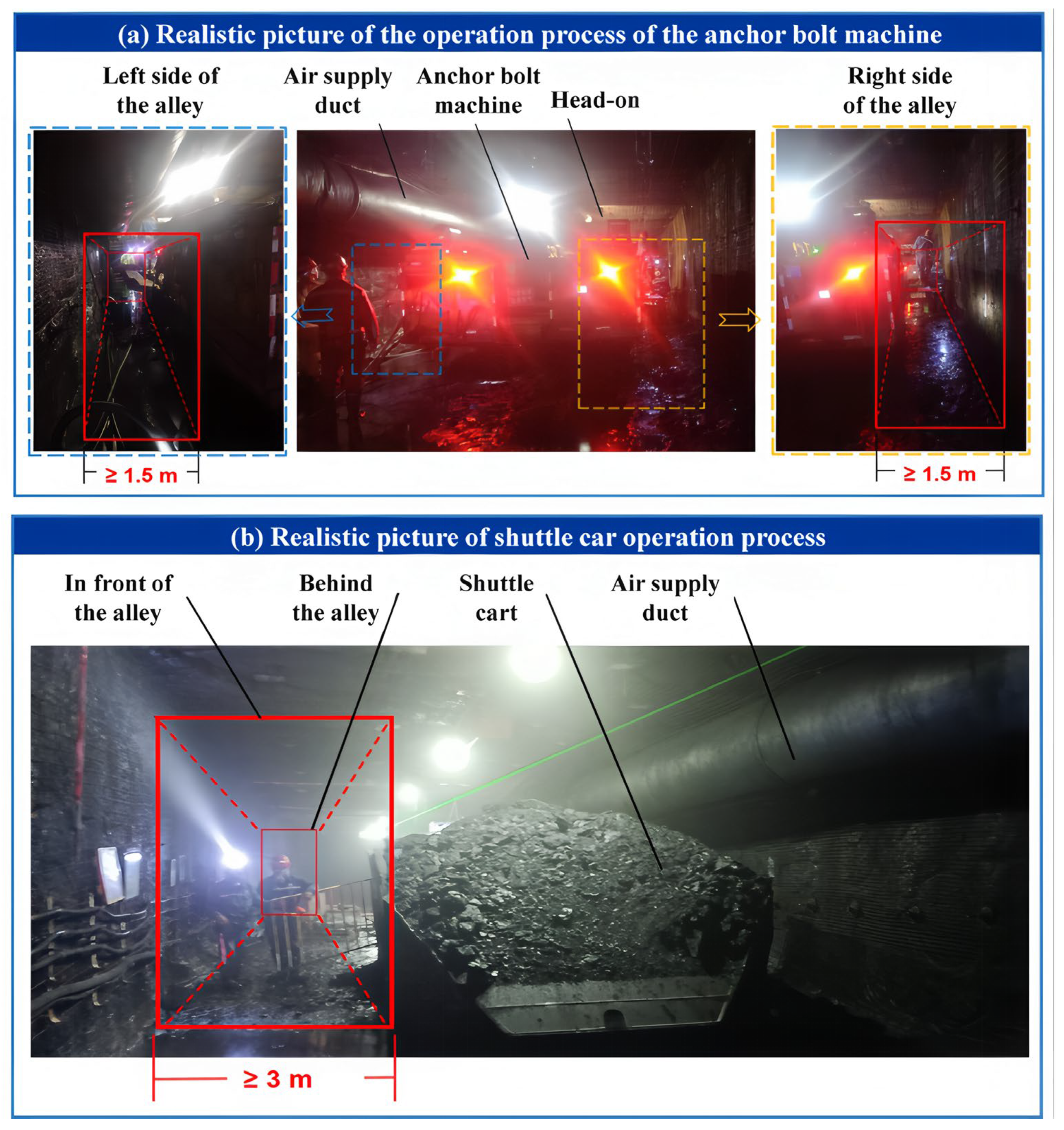
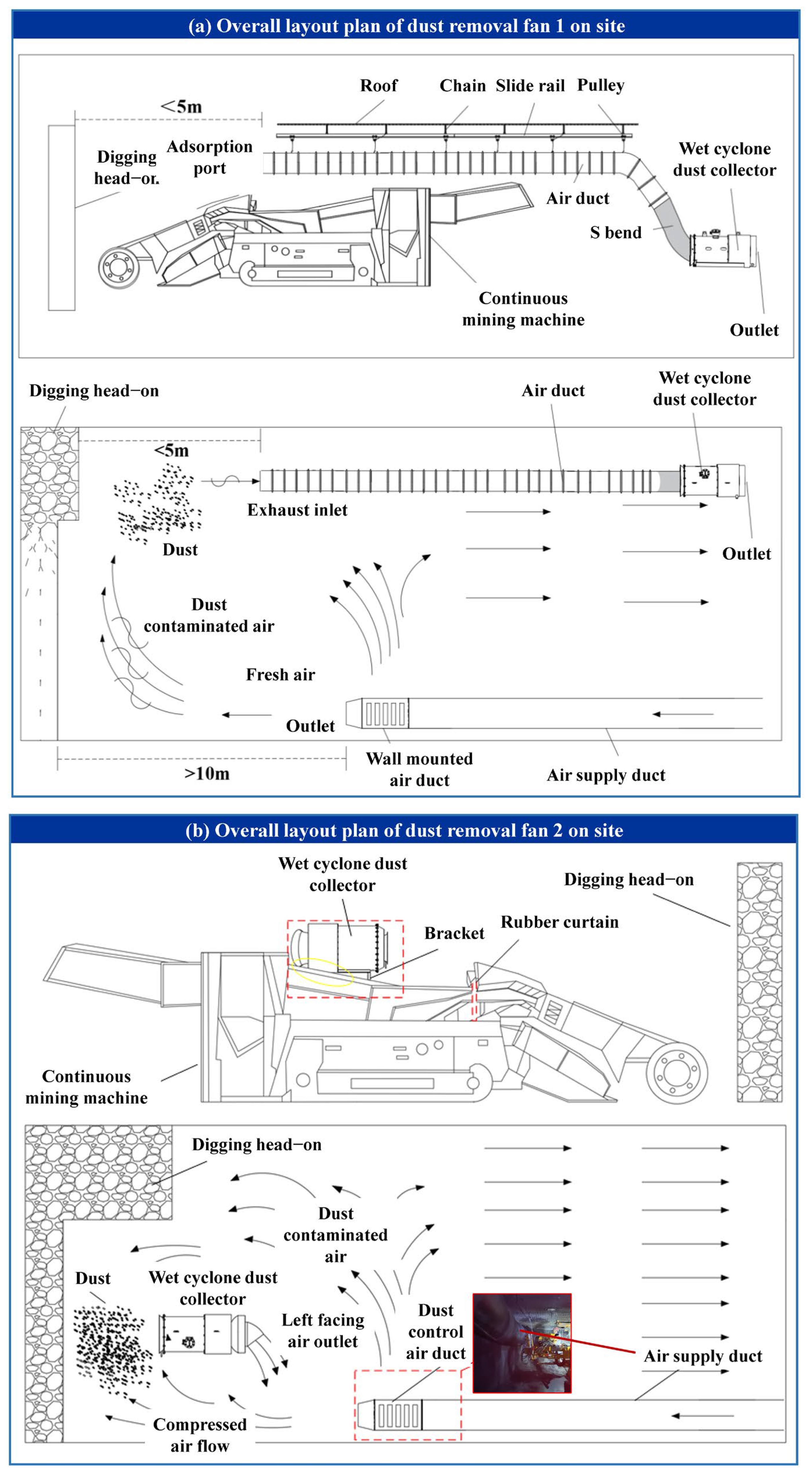
Field measurements indicate that during bolter operation, a 1.5 m lateral clearance is maintained on both sides of the roadway, while the shuttle car requires a 3 m lateral clearance on one side. The dust extraction fan is installed on the floor on the side opposite the supply air duct, adjacent to the rib, thereby ensuring adequate operational safety margins. In the optimized configuration, the dust extraction fan is positioned on the floor opposite the supply duct (near the rib), with its inlet connected to an S-shaped elbow and then to a negative-pressure duct (diameter: 0.8 m; segment length: 5 m) that extends to within 5 m of the tunnel face (Figure 14).
The installation of the floor-mounted dust extraction fan (Fan 1) is carried out by anchoring 3 m rail segments to the roof mesh using adjustable chains along the rib. Consecutive rail segments are extended toward the excavation face, maintaining a uniform elevation, until they reach within 5 m of the face. Pulleys are engaged with the rail grooves to suspend the negative-pressure ducts (∅0.8 m) using tensioned steel wires, which are then advanced forward so that the duct inlet can be positioned at the face and secured with wire fasteners. To enhance dust capture, a 5 m attached wall duct (∅1 m) is installed at the terminus of the supply duct. In field application, wet cyclonic dust extraction fans are arranged at distances of 5 m, 32 m, and 59 m from the connecting roadway, and are advanced in 27 m increments in coordination with tunneling progress (Figure 15).
As shown in Figure 15b, the onboard dust extraction fan (Fan 2) was originally mounted above the conveyor chute of the continuous miner. However, this configuration frequently resulted in impacts from falling rock and vibration-induced structural damage to the chute. To resolve these issues, the collector was relocated to the upper left side of the miner frame, where welded support brackets and protective guardrails were added to improve impact resistance and structural stability. In addition, the control switches and water valves were repositioned near the operator’s cab using custom-mounted brackets, which significantly improved operational accessibility. To enhance dust control performance, a left-oriented elbow was installed at the exhaust outlet to prevent the exhaust jet from re-entraining dust on the conveyor chute. At the air intake, an attached wall duct was added to convert the axial flow into a radial discharge pattern, thereby improving dust capture efficiency near the cutting face. These modifications ensured reliable dust extraction without interfering with normal mining operations while preserving sufficient operating space.

4.3. Layout and Optimization of Foam Dust Suppression System

The foam dust suppression system uses the working face water supply (3 MPa) and compressed air (0.6 MPa) as media sources. The host unit automatically mixes water, foaming agent, and air at predetermined ratios to generate high-performance dust-suppressing foam. The foam is then delivered through high-pressure hoses to foam injection valve blocks and finally sprayed via specialized nozzles onto the continuous miner’s cutting drum, achieving full coverage of the dust source.
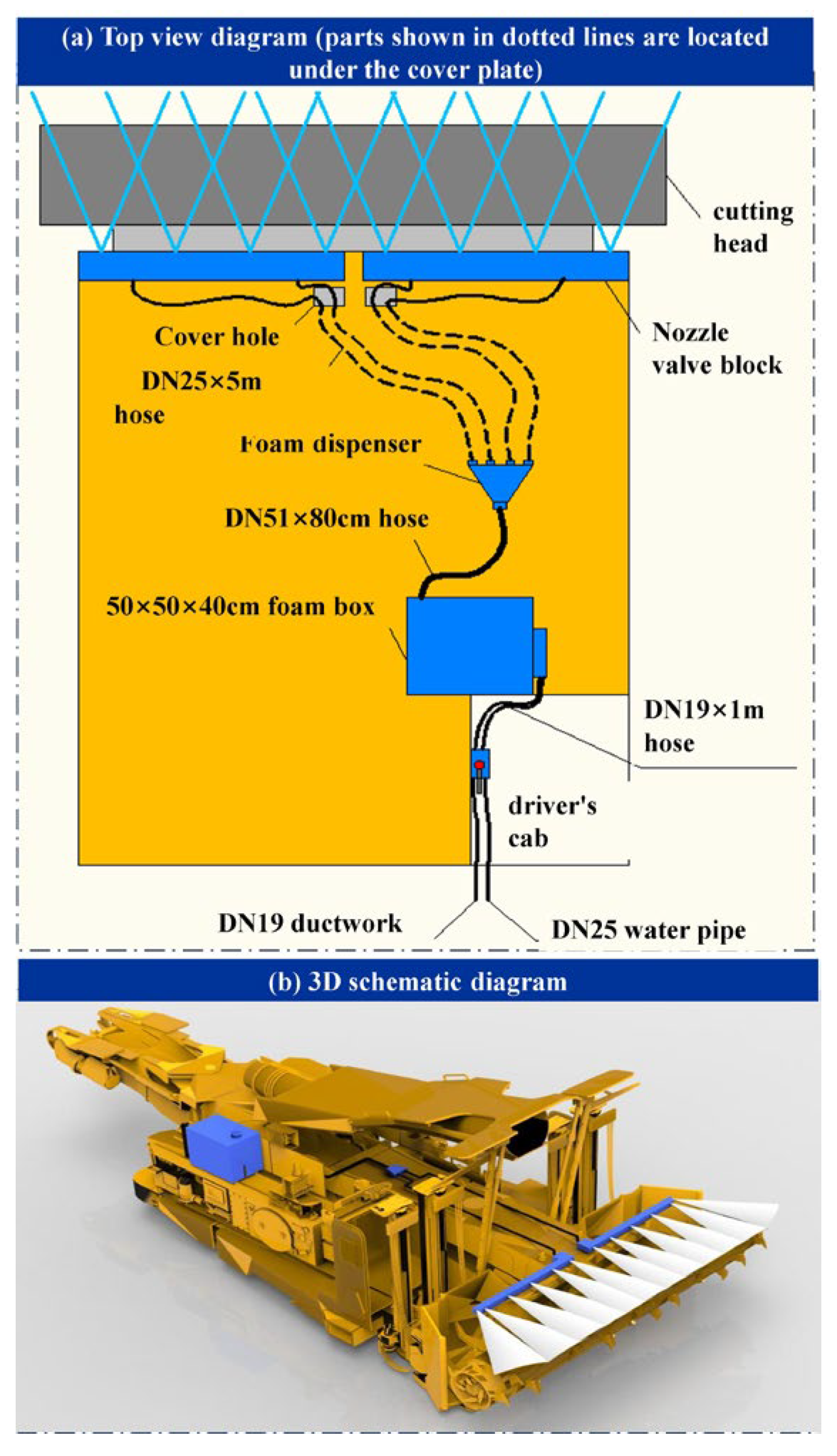
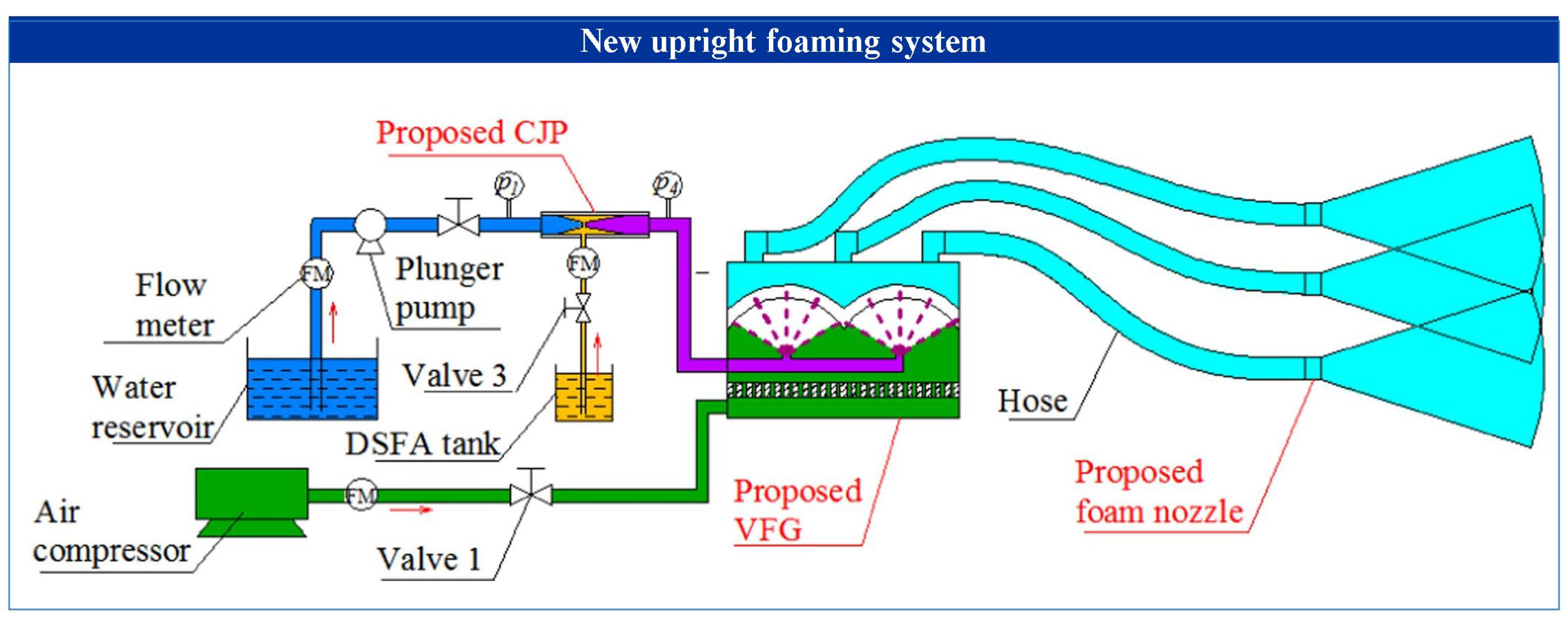
To address spatial constraints at the tunneling face and reduce pressure loss, a shock-resistant integrated foaming system was developed (Figure 16). A new vertical foam generator (VFG) is integrated into the foam generation chamber, as shown in Figure 17. Key components of the conventional system—including the traditional jet pump, horizontal foam generator (HFG), and foam nozzle—were replaced with a cavitating jet pump (CJP), the VFG, and a 3D-printed nozzle, respectively. Because the cross-sectional area of the VFG is four times that of the HFG, the pressure loss across the VFG is 22% lower than that across the HFG, as determined from pressure measurements at the inlets and outlets of the foam generators. High-pressure water and compressed air provide the driving energy for the system. As high-pressure water flows through the CJP, a negative pressure is created at the inlet of the DSFA line, which entrains the DSFA into the system. Valve 3 regulates the DSFA flow rate. The DSFA solution mixes with compressed air and is conveyed through a hose to the foam nozzle, where foam is generated and subsequently applied directly to the dust source for suppression. When the supplied water and/or air pressure exceeds the required operating pressure, it can be reduced by partially closing Valves 1 and 2, respectively. Critical dimensional parameters are summarized in Table 12. The outer shell of the foam generation chamber is constructed from 06Cr19Ni10 stainless steel with an 8 mm wall thickness. The integrated unit has compact overall dimensions of 840 × 540 × 700 mm and delivers a foam output of 85 ± 5 m3/h at 1.5 MPa water pressure and 0.6 MPa air pressure. The generated foam exhibits an expansion ratio of 35 × (ASTM D1881) [39] and a half-life greater than 22 min, exceeding the MT/T 240 standard [40] (Table 13). The integrated 75° dispersion-angle flat-fan nozzles provide an effective coverage area of 5.2 m2 at a range of 3 m, ensuring full coverage of the cutting heads.
The foam tank is mounted on the left side of the operator’s platform (500 × 500 × 400 mm) to avoid obstructing the operator’s view and to prevent collision with falling rock debris. An on-off valve is installed in the cab and connected to the tank via a DN19 high-pressure rubber hose. The tank outlet is connected to the foam distributor through a DN51 elbow and rubber hose, and the distributor outlet is connected to four DN25 × 5 m delivery pipes. These pipelines are routed along the lower part of the continuous miner’s cover plate to the nozzle valve block, which is welded to the front edge of the cover plate to minimize impact from rock debris.
During field verification of the foam dust suppression system, it was observed that broken coal slag and dust readily accumulated on the continuous miner’s cover plate in front of the nozzle valve block, preventing foam from adequately covering the cutting drum. Operational issues included insufficient foam suction flow and discontinuous foam coverage on the drum surface. To address these problems, system performance was improved through structural modifications and parameter adjustments. The specific optimization measures are as follows:
(1)
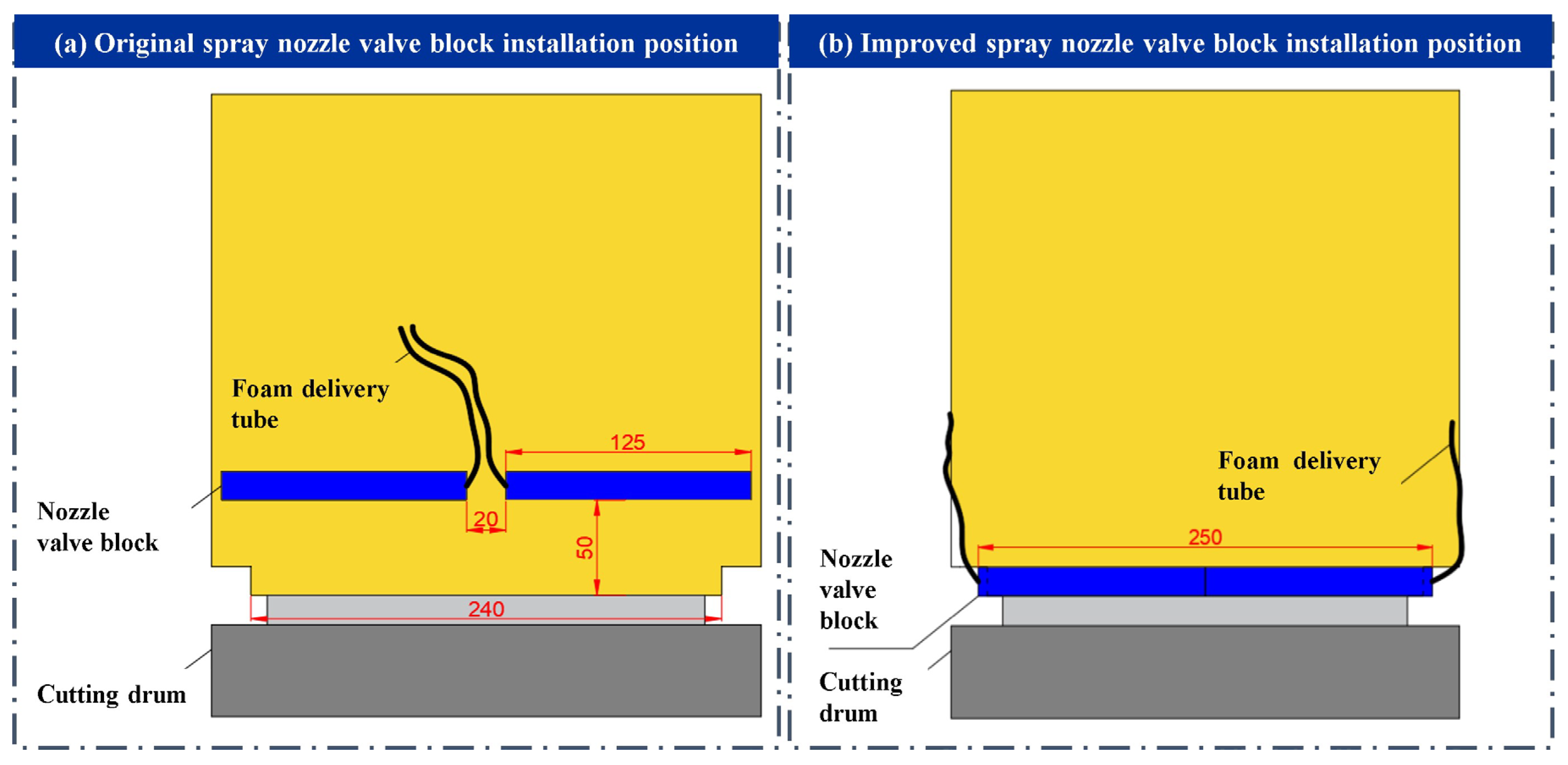
Nozzle valve block clogging: The position of the nozzle valve block was adjusted to the front edge of the continuous miner’s cover plate (Figure 18) to prevent coal slag accumulation from blocking the spray. To quantitatively evaluate the likelihood of nozzle blockage before and after optimization, the foam system was activated at the end of each cutting cycle, and the number of blocked nozzles was recorded. A total of 60 cutting cycles were examined for both the pre-optimization and post-optimization configurations. The blockage rate was calculated as the total number of blocked nozzles divided by the total number of nozzles over 60 cutting cycles (60 × 8 = 480). Before optimization, the nozzle blockage rate was 8.96%. After relocating the nozzle valve block, the blockage rate decreased to 2.92%, representing a 67% reduction. Following optimization, the effective coverage area within a 3 m range remained 5.2 m2, satisfying the requirement for complete coverage of the cutting head.
(2)
Insufficient foam continuity: The foam liquid suction flow in the foam tank was adjusted to produce a continuous foam layer on the cutting drum surface, thereby resolving the problem of intermittent spraying.
(3)
Pipeline connection and protection: Identification markings were added at the valve block connections to prevent misconnection of the air and water lines. High-pressure rubber hoses were standardized to DN specifications to ensure compatibility with the existing piping system in Weiqiang Mine. The tank wall thickness was increased to 8 mm (overall size: 50 cm × 50 cm × 40 cm), and a protective cover was installed over the control valve to reduce the risk of impact damage from falling rock.
(4)
Component durability improvement: The hex socket screws on the tank cover were replaced with hex bolts to prevent thread stripping. A filter screen was installed at the inlet of the liquid suction pipe, and the foaming agent formulation was modified to reduce sediment-induced clogging.
(5)
Spray parameter optimization: The nozzles were upgraded to conical diffusion nozzles (dispersion angle 60–90°) with integrated self-cleaning filters (≥200 mesh). The nozzle array was repositioned outward to the front section of the cutting arm (≤0.5 m from the cutting head), and adjustable pressure plates were added to the bracket to enable fine adjustment of the spray direction (angle tolerance ≤±3°).
After optimization, system performance improved significantly: the total dust suppression rate increased from 68% to 78%; cutting tool wetting coverage increased from 70% to 95%; nozzle clogging was eliminated; and the liquid film remaining after foam rupture continuously coated the surface for ≥10 s, achieving both pre-wetting of the cutting tools and sealing of newly generated dust.

4.4. Verification of Cumulative Dust Suppression Effects Between Foam and Dust Extraction Fans

To systematically evaluate the dust suppression performance of different equipment configurations, comparative experiments were conducted under four conditions: (1) baseline dust concentration measurement prior to any treatment; (2) combined application of the foam system and the floor-mounted dust extraction fan; (3) comprehensive deployment of foam, floor-mounted dust extraction fan, and onboard dust extraction fan; and (4) a control condition simulating improper installation of the foam + floor-mounted dust extraction fan combination. The quantified results of these tests are presented in Table 14, demonstrating the operational advantages of the optimized equipment synergy in underground mining environments.
The data in Table 15 show that, in the auxiliary transportation roadway, the original system alone achieved dust removal efficiencies of 30% for both total dust and respirable dust. The foam + floor-mounted dust extraction fan configuration increased the removal efficiencies to 90% for total dust and 84% for respirable dust, while the foam + onboard dust extraction fan + floor-mounted dust extraction fan configuration further improved these values to 93% and 86%, respectively. In the belt roadway, the original system achieved removal efficiencies of 34% for total dust and 31% for respirable dust. The foam + floor-mounted dust extraction fan configuration resulted in efficiencies of 84% for total dust and 51% for respirable dust, whereas the foam + onboard + floor-mounted dust extraction fan combination achieved 95% and 87%, respectively. These results demonstrate that the cumulative dust suppression system substantially improves dust reduction performance. However, improper installation of the floor-mounted dust extraction fan can significantly reduce effectiveness: field data indicate that total dust removal efficiency dropped from 90% to approximately 72%, and respirable dust removal from 84% to about 62%. This underscores the critical importance of proper installation (Table 15).
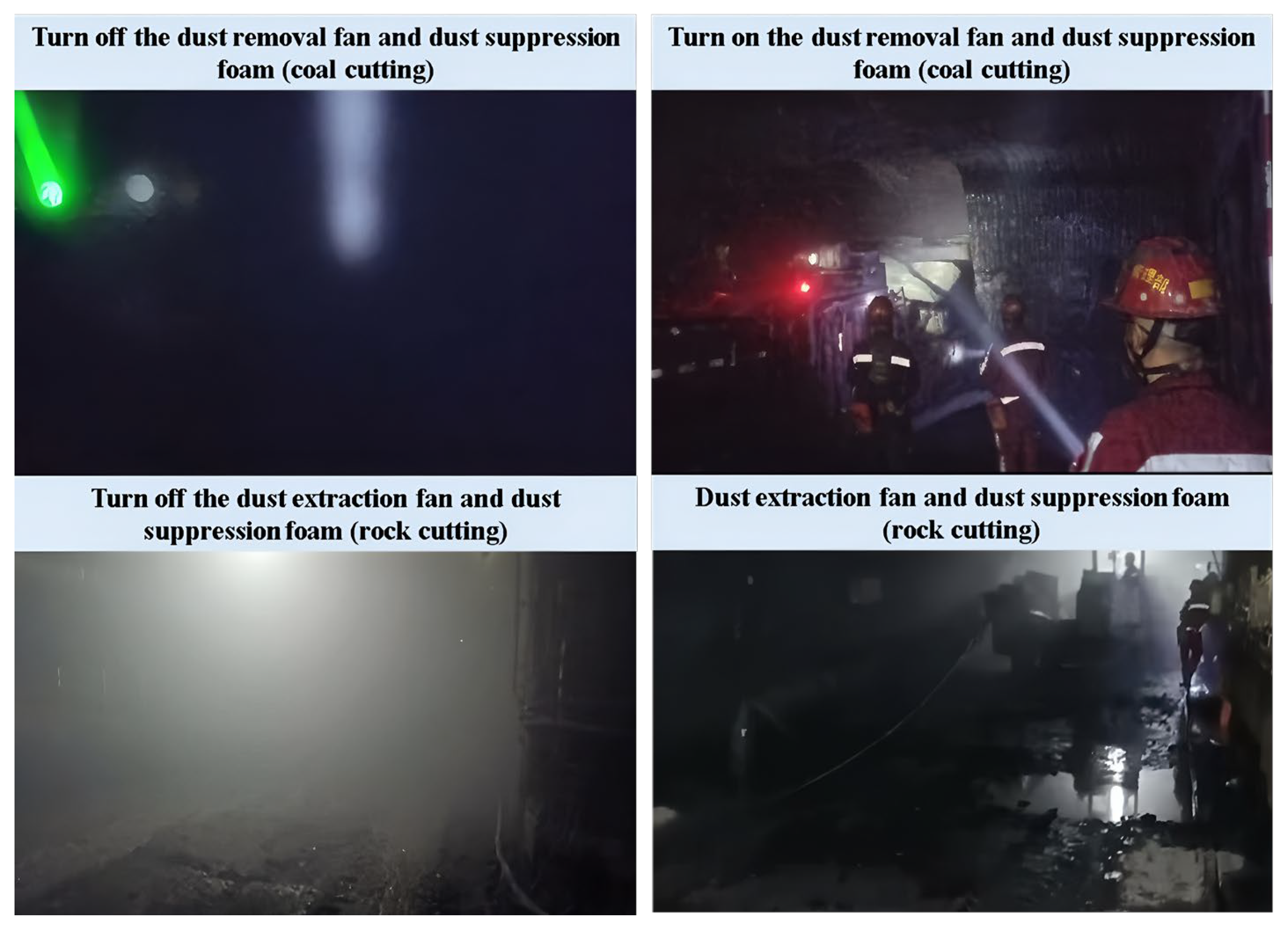
To further evaluate the technological advancement of the proposed system, its performance was compared with both conventional dust control methods—including spray dust reduction, foam dust removal, and wet dust removal technologies [41,42,43,44,45,46]—and recently developed technologies such as cloud dust removal technology and self-powered induction spray dust removal systems, as summarized in the table. The results show that the dust extraction fan + foam dust suppression combination achieves substantially higher dust removal efficiency than either traditional or emerging technologies. In addition, a comparison of visibility at the heading face before and after applying the dust extraction fan and foam dust suppression, as shown in Figure 19, demonstrates a marked improvement in visual clarity around the continuous miner when the proposed system is in use.
All dust concentration data reported in this study represent instantaneous concentrations generated during coal and rock cutting by the continuous miner. In contrast, both domestic and international Occupational Exposure Limits (OELs) for respirable dust are defined in terms of time-weighted average (TWA) concentrations, as summarized in Table 16.
At the Weiqiang Coal Mine, each 24-h period consists of one maintenance shift (8 h) and two production shifts (8 h each). During each production shift, the continuous miner completes three tunneling cycles, alternating between the belt roadway and the auxiliary transportation roadway, with each cycle lasting approximately 40 min. Because little dust is generated when the miner is idle or not cutting, the time-weighted average (TWA) dust concentration during production shifts was estimated proportionally based on the active cutting duration, as shown in the second column from the right in Table 16.
When the foam dust suppression system, onboard dust extraction fan, and floor-mounted dust extraction fan operated simultaneously, the respirable dust TWA concentration in the belt roadway and the auxiliary transportation roadway ranged from 2.81 to 3.94 mg/m3. Considering that the rock layer thickness to be cut at the Weiqiang 3305 heading face is less than 1 m, whereas the coal seam thickness ranges from 2.2 to 2.4 m, more than two-thirds of the suspended dust in the roadway is coal dust.
Given that the measured free SiO2 content in coal dust was 5.8–6.2% and that in rock dust was 32.7–33.1% (Table 4), the post-treatment dust concentrations comply with the requirements of China (AQ 4203-2008) [51]. However, they still exceed the permissible exposure limits specified in China (GBZ 2.1-2019) [47], as well as U.S. NIOSH [48] and U.S. OSHA standards [49,50]. This indicates that further optimization of dust control technologies is required to meet international occupational health benchmarks.

4.5. Limitations of the Proposed Dust Suppression System

Although the combined use of the onboard dust extraction fan, floor-mounted dust extraction fan, foam dust suppression system, and attached air duct significantly reduces dust concentration at the continuous miner working face, the integrated dust suppression system still requires optimization and adaptation under different roadway advancement conditions due to the following limitations:
(1) Mobility of the floor-mounted dust extraction fan
The floor-mounted dust extraction fan must be continuously advanced as the roadway progresses. At present, it is mainly dragged forward by the continuous miner, which is time-consuming and labor-intensive. The development of a self-propelled floor-mounted dust extraction fan would greatly improve operational efficiency and convenience.
(2) Spatial constraints for equipment arrangement
When arranging the floor-mounted dust extraction fan, sufficient space must be reserved for the operation of the continuous miner, shuttle car, and bolter. If the roadway width is insufficient, the fan cannot be properly installed. In such cases, the air-handling capacity of the onboard dust extraction fan should be enhanced to compensate.
(3) Protection under unstable roof conditions
During excavation, large rock fragments may fall from unstable roofs and strike the onboard dust extraction fan, potentially causing structural damage. Therefore, the external dimensions and protective housing of the onboard dust extraction fan should be designed with full consideration of the continuous miner’s geometry and the impact characteristics of falling rock.
(4) Variation in water quality for dust suppression
The concentration and composition of electrolytes in dust suppression water vary among mines. To prevent degradation of foam performance due to dissolved salts, the selected foam suppressant should be evaluated for foaming ability, foam stability, and wettability when mixed with the site-specific dust suppression water.
(5) Limited coverage of foam spraying
Because of space constraints on nozzle placement, the current foam spray system can only cover the upper cutting area of the continuous miner’s cutting head. Close coordination between the foam dust suppression system and the dust extraction fans is therefore essential to achieve effective overall dust control.


5. Conclusions

(1)
This study demonstrates that dust diffusion and migration at the excavation face are jointly governed by structural alterations caused by cutting and the resulting airflow dynamics. Flow disturbances generate vortex accumulation zones. During left-side advancement, dust is more readily dispersed toward the connecting tunnels, whereas during right-side advancement, dust tends to remain near the equipment, forming localized high-deposition regions. These observations provide a theoretical basis for optimizing the spatial layout and configuration of dust control equipment.
(2)
By replacing the conventional jet pump, horizontal foam generator, and standard foam nozzle in the existing foam system with a cavitating jet pump, a vertical foam generator, and a 3D-printed nozzle, the flow resistance of the foam generation unit was reduced by 22%. This modification significantly increased foam delivery rate and effectively prevented nozzle clogging. Consequently, the wetting coverage of the cutting picks increased from 70% to 85%, and the overall dust suppression efficiency improved from 68% to 78%.
(3)
Based on the coupled influence of the air-supply duct and the dust extraction fans on the migration of dust-laden airflow at the excavation face, the optimal types and spatial arrangement of the onboard and floor-mounted dust extraction fans were determined. The integrated “foam + onboard dust extraction fan + floor-mounted dust extraction fan” strategy achieved a total dust reduction efficiency exceeding 93% (peaking at 95.2%), demonstrating superior synergistic performance.
These outcomes markedly enhance dust control effectiveness, thereby improving mine safety and safeguarding workers’ health. The resulting reduction in dust concentration also improves visibility for underground intelligent equipment and provides practical guidance for large-scale industrial application.

Author Contributions

Conceptualization, K.J. and W.Z.; Methodology, W.Z.; Software, J.D. and T.Y.; Validation, K.Z.; Formal analysis, X.Z.; Investigation, X.Z., H.W. and K.Z.; Resources, K.J.; Data curation, K.J.; Writing—original draft, J.D. and T.Y.; Writing—review & editing, J.W.; Supervision, J.W., X.Z., H.W. and K.Z.; Project administration, H.W.; Funding acquisition, H.W. All authors have read and agreed to the published version of the manuscript.

Funding

The Natural National Science Foundation of China (52404260, 52504233), and the Fundamental Research Funds for the Central Universities (2025QN1034).

Institutional Review Board Statement

Not applicable.

Informed Consent Statement

Not applicable.

Data Availability Statement

The original contributions presented in this study are included in the article. Further inquiries can be directed to the corresponding author.

Acknowledgments

The authors would like to acknowledge the support provided by Shaanxi Yanchang Petroleum Group Hengshan Weiqiang Coal Industry Co., Ltd., for offering the field experimental conditions and labor resources essential to this study.

Conflicts of Interest

Author Jiangnag Wang was employed by the company Shaanxi Yanchang Petroleum Group Hengshan Weiqiang Coal Industry Co., Ltd. The remaining authors declare that the research was conducted in the absence of any commercial or financial relationships that could be construed as a potential conflict of interest.

References

  1. Zhu, X.; Xia, P.; Pan, C.; Wang, W.; Tao, R.; Zhang, J.; Han, F.; Xu, C.; Long, B.; Yang, H.; et al. Dynamics of rebound in head-on collisions between suspended micrometer-sized droplets and particles. Phys. Fluids 2025, 37, 043339. [Google Scholar] [CrossRef]
  2. Fabiano, B.; Currò, F.; Reverberi, A.; Palazzi, E. Coal dust emissions: From environmental control to risk minimization by underground transport. An applicative case-study. Process. Saf. Environ. Prot. 2014, 92, 150–159. [Google Scholar] [CrossRef]
  3. Jin, L. Analysis of the current situation of occupational hazards of dust in workplaces in China and countermeasures. Safety 2020, 41, 1–6. [Google Scholar]
  4. Xiaoli, Z.; Jingzhi, L.; Xinxiang, Q.; Meichang, W. Current status and influencing factors of disease perception among occupational pneumoconiosis patients. Occup. Health Emerg. Rescue 2025, 43, 19–26. [Google Scholar] [CrossRef]
  5. Zheng, H.; Jiang, B.; Zheng, Y.; Zhao, Y.; Wang, H. Experimental study on forced ventilation and dust-control in a heading face based on re-sponse surface method. Process Saf. Environ. Prot. 2023, 175, 753–763. [Google Scholar] [CrossRef]
  6. Cao, Y.; Xiao, Y.; Wang, Z.; Li, Q.; Shu, C.; Jiang, X.; Wu, S. Recent progress and perspectives on coal dust sources, transport, hazards, and controls in underground mines. Process Saf. Environ. Prot. 2024, 187, 159–194. [Google Scholar] [CrossRef]
  7. Tao, R.; Zhu, X.; Zhang, K.; Wang, W.; Wang, H.; Xu, C.; Xia, P.; Long, B. Study on the adhesion characteristics of liquids after collision between droplets and dust particles at the micron scale. J. Coal Soc. 2025, 50, 372–383. [Google Scholar] [CrossRef]
  8. Cheng, W.; Hu, X.; Xie, J.; Zhao, Y. An intelligent gel designed to control the spontaneous combustion of coal: Fire prevention and extinguishing properties. Fuel 2017, 210, 826–835. [Google Scholar] [CrossRef]
  9. Chang, J. Experimental Study on Coal Dust Explosion Characteristics and Analysis of Influencing Factors in Coal Mines. Shanxi Chem. Ind. 2024, 44, 152–154. [Google Scholar] [CrossRef]
  10. Wang, Q. Research on Foam-Water Mist Integrated Dust Reduction Technology and Application in Coal Mine Comprehensive Excavation Face. Ph.D. Thesis, China University of Mining and Technology, Xuzhou, China, 2018. [Google Scholar]
  11. Li, S.; Zhao, B.; Lin, H.; Shuang, H.; Kong, X.; Yang, E. Review and prospects of surfactant-enhanced spray dust suppression: Mechanisms and effectiveness. Process Saf. Environ. Prot. 2021, 154, 410–424. [Google Scholar] [CrossRef]
  12. Wang, P.; Tan, X.; Zhang, L.; Li, Y.; Liu, R. Influence of particle diameter on the wettability of coal dust and the dust suppression efficiency via spraying. Process Saf. Environ. Prot. 2019, 132, 189–199. [Google Scholar] [CrossRef]
  13. Yang, H.; Zhu, X.; Hu, R.; Zhang, K.; Xu, C.; Wang, Q.; Wang, H. Characteristics of a Cavitating Spoiler Mixing Device and Its Performance in a Foam Dust Suppression System. ACS Omega 2022, 7, 29886–29900. [Google Scholar] [CrossRef] [PubMed]
  14. Cao, S.; Yang, Z.; He, Y.; Zhai, M. Preparation and Performance Study of Foam Dust Suppressant for Underground Coal Mines. Coal Eng. 2017, 49, 87–90. [Google Scholar]
  15. Wang, H.; Wei, X.; Du, Y.; Wang, D. Effect of water-soluble polymers on the performance of dust-suppression foams: Wettability, surface viscosity and stability. Colloids Surf. A Physicochem. Eng. Asp. 2019, 568, 92–98. [Google Scholar] [CrossRef]
  16. Zhao, J.; Gao, G.; Gao, X. Study on the Influence of Dust Removal Fan Structure Parameters on Dust Removal Performance. Appl. Sci. 2024, 14, 3405. [Google Scholar] [CrossRef]
  17. Xie, Z.; Zhao, Z.; Li, D.; Li, F.; Zhang, C.; Huang, C.; Xiao, Y. Experimental study on the atomization characteristics and dust removal efficiency of a fan-shaped nozzle for purifying working environment. Sci. Total Environ. 2023, 894, 164994. [Google Scholar] [CrossRef]
  18. Zhou, G.; Feng, B.; Yin, W.; Wang, J. Numerical simulations on airflow-dust diffusion rules with the use of coal cutter dust removal fans and related engineering applications in a fully-mechanized coal mining face. Powder Technol. 2018, 339, 354–367. [Google Scholar] [CrossRef]
  19. MT/T 1189-2020; Comprehensive Dust Prevention Technical Specifications for the Comprehensive Excavation Face. State Administration of Coal Mine Safety: Beijing, China, 2020.
  20. GB/T 19077-2016; Laser Diffraction Method for Determination of Particle Size for Particle Size Analysis. General Administration of Quality Supervision, Inspection and Quarantine of the P.R. China: Beijing, China, 2016.
  21. Miroshnichenko, D.V.; Desna, N.A.; Koval, V.V.; Fatenko, S.V. Hardgrove Grindability of Coal. Part 1. Correlations with Composition, Structure, and Properties. Coke Chem. 2019, 62, 1–4. [Google Scholar] [CrossRef]
  22. GBZ/T 192.4-2007; Infrared Spectroscopy for the Determination of Free Silica in the Air in the Workplace. Ministry of Health P.R. China: Beijing, China, 2020.
  23. GBZ/T 192.5-2007; Infrared Spectroscopy for the Determination of Free Silica in the Air in the Workplace. Ministry of Health P.R. China: Beijing, China, 2020.
  24. GB/T 30693-2014; Measurement of Water-Contact Angle of Plastic Films. General Administration of Quality Supervision, Inspection and Quarantine of the P.R. China: Beijing, China, 2014.
  25. Nie, W.; Yang, B.; Du, T.; Peng, H.; Zhang, X.; Zhang, Y. Dynamic dispersion and high-rise release of coal dust in the working surface of a large-scale mine and application of a new wet dust reduction technology. J. Clean. Prod. 2022, 351, 131356. [Google Scholar] [CrossRef]
  26. Chen, L.; Ma, Y.; Ghaleb, M.; Liu, G. Study on dust pollution law and ventilation optimization of roadway excavation and shotcrete simultaneous operation. J. Clean. Prod. 2022, 379, 134744. [Google Scholar] [CrossRef]
  27. Zhang, R.; Liu, S.; Zheng, S. Characterization of nano-to-micron sized respirable coal dust: Particle surface alteration and the health impact. J. Hazard. Mater. 2021, 413, 125447. [Google Scholar] [CrossRef] [PubMed]
  28. Cheng, Y.; Yu, H.; Xie, S.; Zhao, J.; Ye, Y. Study on the coal dust deposition fraction and site in the upper respiratory tract under different particle sizes and labor intensities. Sci. Total Environ. 2023, 868, 161617. [Google Scholar] [CrossRef] [PubMed]
  29. Peng, H.; Zhang, J.; Nie, W.; Guo, L.; Tang, A.; Liu, H.; Lu, M. Multiscale dynamics of respirable coal dust deposition in Miners’ Airways: Effects of respiratory intensity, particle size, and density on pulmonary retention. Powder Technol. 2025, 468, 121569. [Google Scholar] [CrossRef]
  30. Sun, B.; Jia, J.; Zhou, G.; Tang, F.; Liu, Y.; Wang, Y.; Zhang, H.; Li, L. Impact of inhalable dust with different material properties and particle morphologies on respiratory deposition in occupational exposure. Process. Saf. Environ. Prot. 2025, 199, 107220. [Google Scholar] [CrossRef]
  31. Chen, H.; Turkevich, L.A.; Jog, M.A.; Ghia, U. Numerical investigation of powder aerosolization in a mining rock dust dispersion chamber. J. Loss Prev. Process Ind. 2023, 83, 105050. [Google Scholar] [CrossRef]
  32. Wang, H.; Zhang, Y.; Xu, J.; Li, J.; Fan, C.; Hu, Y. Experimental study on effect of dilute coal dust on gas explosion pressure/flame evolution process. Powder Technol. 2022, 404, 117450. [Google Scholar] [CrossRef]
  33. Ren, X.; Li, H.; Xuan, W.; Li, Y.; Teng, C.; Liu, C. Influence of particle size distribution on coal dust explosion sensitivity. Powder Technol. 2025, 457, 120894. [Google Scholar] [CrossRef]
  34. Li, Q.; Wang, K.; Zheng, Y.; Ruan, M.; Mei, X.; Lin, B. Experimental research of particle size and size dispersity on the explosibility characteristics of coal dust. Powder Technol. 2016, 292, 290–297. [Google Scholar] [CrossRef]
  35. Kouam, J.; Songmene, V.; Bahloul, A.; Samuel, A.M. Characterization of Si and SiO2 in Dust Emitted during Granite Polishing as a Function of Cutting Conditions. Materials 2022, 15, 3965. [Google Scholar] [CrossRef]
  36. Pan, J.; Liu, G.; Chen, L.; Xu, Q. Coal dust exposure hazards and prevention technology: A review. Process. Saf. Environ. Prot. 2025, 202, 107756. [Google Scholar] [CrossRef]
  37. Yu, R.; Huang, Z.; Fu, M.; Wang, G.; Wang, H.; Ren, J.; Liu, Q.; Ding, H.; Meng, K.; Wang, R.; et al. Study on the effects of a multi-surfactant composite solution on coal dust wettability. Energy 2025, 335, 138015. [Google Scholar] [CrossRef]
  38. Wang, H.; Zhang, L.; Wang, D.; He, X. Experimental investigation on the wettability of respirable coal dust based on infrared spectroscopy and contact angle analysis. Adv. Powder Technol. 2017, 28, 3130–3139. [Google Scholar] [CrossRef]
  39. ASTM D1881; Standard Test Method for Foaming Tendencies of Engine Coolants in Glassware. American Society for Testing and Materials: West Conshohocken, PA, USA, 2017.
  40. MT/T 240; General Specification for the Water Nozzle to Control Dusts in Coal Min. Ministry of Coal Industry of P.R. China: Beijing, China, 1997.
  41. Ji, M.; Sun, Z.; Guo, H. The Application of the Foam Technology to the Dust Control for Reducing the Dust Injury of Coal Mines. Appl. Sci. 2022, 12, 10878. [Google Scholar] [CrossRef]
  42. Xie, Y.; Cheng, W.; Yu, H.; Wang, Y. Study on spray dust removal law for cleaner production at fully mechanized mining face with large mining height. Powder Technol. 2021, 389, 48–62. [Google Scholar] [CrossRef]
  43. Zhou, G.; Jing, B.; Meng, Q.; Liu, Y.; Yang, W.; Sun, B. Study on coupling diffusion of composite dust and cloud-mist dedust technology in fully mechanized driving face of mixed coal-rock roadway. Adv. Powder Technol. 2022, 34, 103911. [Google Scholar] [CrossRef]
  44. Peng, H.; Nie, W.; Zhang, X.; Xu, C.; Meng, X.; Cheng, W.; Liu, Q.; Hua, Y. Research on the blowing-spraying synergistic dust removal technology for clean environment in largescale mechanization coal mine. Fuel 2022, 324, 124508. [Google Scholar] [CrossRef]
  45. Hou, J.; Li, S.; Hu, S.; Cheng, H.; Han, M.; Gui, C.; Guo, Q.; Yuan, L.; Zhou, F. Research and application of self-powered induction spray dust removal system for long-distance belt conveying in underground coal mines. Process. Saf. Environ. Prot. 2023, 176, 131–139. [Google Scholar] [CrossRef]
  46. Qin, B.T.; Zhou, G.; Zhou, Q.; Tonggong, Z.; Guangtao, L.; Jin, H.; Biao, S. Technology system and application of activated magnetized water spray dust reduction in fully mechanized coal mining face. J. China Coal Soc. 2021, 46, 3891–3901. [Google Scholar] [CrossRef]
  47. GBZ/T 2.1-2019; Occupational Exposure Limits for Hazardous Agents in the Workplace. Ministry of Health P.R. China: Beijing, China, 2019.
  48. NIOSH. Occupational Exposure to Respirable Crystalline Silica; National Institute for Occupational Safety and Health: Cincinnati, OH, USA, 2016. [Google Scholar]
  49. 29 CFR§1926.1153; Respirable Crystalline Silica. Department of Labor, Occupational Safety and Health Administration: Washington, DC, USA, 2016.
  50. 29 CFR § 1910.1000; Air Contaminants. Department of Labor, Occupational Safety and Health Administration: Washington, DC, USA, 1971.
  51. AQ 4203-2008; Administrative Standards for Personal Exposure Concentration of Respirable Rock Dust in the Air of Workplace. State Administration of Work Safety: Beijing, China, 2009.
Figure 1. Research process and framework.
Atmosphere 16 01290 g001
Figure 2. Weiqiang Coal Mine, Yulin City, Shaanxi Province, China.
Atmosphere 16 01290 g002
Figure 3. Wind velocity measurement setup.
Atmosphere 16 01290 g003
Figure 4. Layout of dust concentration measurement points on site.
Atmosphere 16 01290 g004
Figure 5. Dust sample pictures and sampling information.
Atmosphere 16 01290 g005
Figure 6. Geometric models.
Atmosphere 16 01290 g006
Figure 7. Numerical Model Grid and Computational Parameters.
Atmosphere 16 01290 g007
Figure 8. Comparison between wind speed calculated using grids of three different densities and actual wind speed.
Atmosphere 16 01290 g008
Figure 9. Sensitivity analysis of key boundary parameters of numerical model.
Atmosphere 16 01290 g009
Figure 10. Airflow vector fields during left- and right-side advancements.
Atmosphere 16 01290 g010
Figure 11. Time-Dependent Dust Distribution during Left- and Right-Side Advancements.
Atmosphere 16 01290 g011
Figure 12. The optimal dust reduction effect of installing a dust extraction fan in the middle of the auxiliary transportation roadway or on the return air side.
Atmosphere 16 01290 g012
Figure 13. The availability and overall layout of underground dust removal devices.
Atmosphere 16 01290 g013
Figure 14. On-site investigation of tunnel space during excavation process.
Atmosphere 16 01290 g014
Figure 15. General layout plan of dust extraction fans No. 1 and No. 2 on site.
Atmosphere 16 01290 g015
Figure 16. Schematic diagram of foam dust suppression system layout on continuous mining machine.
Atmosphere 16 01290 g016
Figure 17. Structure of upright foaming system.
Atmosphere 16 01290 g017
Figure 18. Schematic diagram of improved nozzle valve block position (scale unit in the figure: centimeters).
Atmosphere 16 01290 g018
Figure 19. Comparison of visibility at the cutting face before and after turning on the dust extraction fan and foam.
Atmosphere 16 01290 g019
Table 1. Dust sample information.
Sample NumberTypeSampling MethodMassNotes
M-01Coal dustFilter membrane collection & scraping30 gContinuous mining machine cuts coal seams
R-01Rock dust30 gContinuous mining machine cuts the roof rock
Table 2. Parameters of each geometric model.
NumberModel NameSize (m × m × m)
1Continuous mining machine11.05 × 3.3 × 2.1
2Shuttle cart8.99 × 3.05 × 1.31
3Four wall anchor bolt machine6.4 × 2.7 × 2.5
4Auxiliary transport tunnel air duct60 × 0.5 × 0.5
5Rubber transportation tunnel air duct60 × 0.5 × 0.5
6Auxiliary transport tunnel75 × 5.6 × 3.1
7Rubber transportation tunnel75 × 5.5 × 3.1
8Contact Lane19.5 × 5.0 × 3.1
9Dust curtain5.5 × 3.1
Table 3. Continuous phase parameter setting.
TypeParameter
SolverTransient
GravityY = −9.81 m/s2
Turbulence modelRealizable k-epsilon
EnergyOff
Dynamic viscosity1.7894 × 10−5 kg/m·s
Density1.225 kg/m3
Temperature24.8 °C
Inflow velocity12 m/s
Export boundary typePresser-outlet
Turbulence intensity2.9%
Hydraulic diameter1 m
Wall shear conditionsNo slip
Table 4. Discrete phase parameter setting.
Solution Method SettingParameter
Pressure-velocity couplingSIMPLEC
Gradient discretization formatLeast Square Cell Based
Momentum discretization formatSecond Order Upwind
Convergence criterion0.001
Time step0.1 s
Particle processingTransient particle trajectory
Turbulence modelFollow the fluid time step
Maximum number of calculation steps5000
Spray typeFace spray
Spray start time10 s
Spray stop time150 s
Mass flow (kg/s)0.008
Size distributionRosin-Rammler
Minimum particle size (m)5 × 10⁻⁶
Maximum particle size (m)1.5 × 10⁻⁴
Median particle size (m)4.6 × 10⁻⁵
Distribution index1.59
Number of particle sizes20
Table 5. Actual measured wind speed values.
Monitoring PointWind Speed Values Obtained from Each Sampling (m/s)Mean (m/s)SDCI
a3.23.63.53.23.33.43.73.23.43.13.340.193.22–3.46
b2.52.22.82.62.62.32.92.52.72.32.540.262.38–2.70
c2.01.91.51.71.61.81.51.61.81.41.680.201.56–1.80
d0.91.21.31.21.11.11.31.11.21.01.140.121.06–1.22
e1.01.00.91.11.51.21.11.31.10.91.110.180.99–1.23
f0.70.91.21.11.00.91.21.01.10.91.020.150.92–1.12
g0.80.90.80.70.91.01.10.80.91.00.890.120.81–0.97
h0.60.70.90.50.60.80.90.90.70.90.750.130.65–0.85
i0.70.50.60.80.90.60.70.90.80.90.740.140.64–0.84
Inlet11.912.212.111.812.111.91212.11211.9120.1411.89–12.11
Table 6. Measurement results of dust concentration at monitoring points 1–4 during roof rock cutting.
Dust Measurement Results at Monitoring Point 1
Test conditionsTotal dust concentration (mg/m3)Respiratory dust concentration (mg/m3)
Left-side advancementRight-side advancementLeft-side advancementRight-side advancement
First measurement785.3911.4116.2141.2
Second measurement900.11223.4131.1170.4
Average concentration842.71067.4123.65155.8
Dust measurement results at monitoring point 2
Test conditionsTotal dust concentration (mg/m3)Respiratory dust concentration (mg/m3)
Left-side advancementRight-side advancementLeft-side advancementRight-side advancement
First measurement631.9791.6188.4194.1
Second measurement801.51103.8201.5189.2
Average concentration716.7947.7194.95191.65
Dust measurement results at monitoring point 3
Test conditionsTotal dust concentration (mg/m3)Respiratory dust concentration (mg/m3)
Left-side advancementRight-side advancementLeft-side advancementRight-side advancement
First measurement11351145285310
Second measurement899.71217.4132.3162.1
Average concentration1017.351181.2208.65236.05
Dust measurement results at monitoring point 4
Test conditionsTotal dust concentration (mg/m3)Respiratory dust concentration (mg/m3)
Left-side advancementRight-side advancementLeft-side advancementRight-side advancement
First measurement12551380310.2295.3
Second measurement869.01421.8119.5163.6
Average concentration10621400.9214.85229.45
Table 7. Measurement results of dust concentration at monitoring points 1–4 during coal cutting.
Dust Measurement Results at Monitoring Point 1
Test conditionsTotal dust concentration (mg/m3)Respiratory dust concentration (mg/m3)
Left-side advancementRight-side advancementLeft-side advancementRight-side advancement
First measurement648.5717.5160.1175.0
Second measurement859.31097.2152.3176.5
Average concentration753.9907.35156.2175.75
Dust measurement results at monitoring point 2
Test conditionsTotal dust concentration (mg/m3)Respiratory dust concentration (mg/m3)
Left-side advancementRight-side advancementLeft-side advancementRight-side advancement
First measurement510.0855.1105.1200.1
Second measurement721.3965.499.8113.4
Average concentration615.65910.2102.4156.7
Dust measurement results at monitoring point 3
Test conditionsTotal dust concentration (mg/m3)Respiratory dust concentration (mg/m3)
Left-side advancementRight-side advancementLeft-side advancementRight-side advancement
First measurement597.4899.7139.8158.9
Second measurement652.41053.6151.4177.1
Average concentration624.9976.65145.6168
Dust measurement results at monitoring point 4
Test conditionsTotal dust concentration (mg/m3)Respiratory dust concentration (mg/m3)
Left-side advancementRight-side advancementLeft-side advancementRight-side advancement
First measurement820.0995.3230.2265.1
Second measurement911.41296.2102.6158.7
Average concentration865.71145.75166.4211.9
Table 8. Sample particle size distribution.
Sample NumberD10 (μm)D50 (μm)D90 (μm)D[4,3] (μm)
M-0111.1544.60112.3035.98
R-011.957.7518.506.83
Table 9. Free silica content in the sample.
Sample NumberTest MethodFree SiO2 (%)
M-01Infrared spectrum6.2
M-01XRD5.8
R-01Infrared spectrum32.7
R-01XRD33.1
Table 10. Analysis of sample hydrophilicity and hydrophobicity.
Sample NumberContact Angle (°)Determination of Hydrophilicity and Hydrophobicity
M-01108.7hydrophobicity
R-0168.4hydrophilicity
Table 11. Dust removal effect of dust extraction fans at different installation locations under varying air volumes.
(a) The Dust Reduction Effect of Different Air Volumes When the Dust Extraction Fan Is Installed in the Middle of the Tunnel
Air Volume
m3/min
Dust Concentration (mg/m3)Dust Reduction Efficiency
X = 2 mX = 4 mX = 6 mX = 8 mX = 10 mAverage Value
100215222232229226225.725.9%
200200199189203201198.335.2%
300153141145155148149.550.2%
400105101103100104103.766.4%
500155148147139146146.452.3%
(b) The Dust Removal Effect of a Dust Extraction Fan Installed on the Return Air Side at Different Air Volumes
Air volume
m3/min
Dust concentration (mg/m3)Dust reduction efficiency
X = 2 mX = 4 mX = 6 mX = 8 mX = 10 mAverage value
100229220232223227228.725.4%
200195192197195196195.236.1%
300159151149156158155.549.9%
400108112109112104109.864.3%
500158146151149145149.551.2%
Table 12. Operating condition parameters of foam dust suppression system.
Main Tank DimensionsWater ConsumptionAir ConsumptionFoam Expansion RatioFoam ProductionFoam Agent Consumption
840 × 540 × 700 mm2–3 m3/h80–120 m3/h>30 times60–100 m3/h10 kg/h
Table 13. Foaming device geometric parameters and specific dimensions.
Foaming Device Geometric ParametersGeometric Parameter Dimensions
Jet nozzle inlet diameter d020 mm
Jet nozzle contraction angle αn13°
Air intake chamber diameter d240 mm
Air intake chamber contraction half-angle20°
Air intake hole diameter dair15 mm
Liquid intake chamber inlet diameter32 mm
Liquid intake chamber contraction half-angle10°
Liquid intake hole diameter dw10 mm
Throat length L110 mm
Diffusion chamber diffusion angle
Diffusion chamber outlet diameter d454 mm
Swirl bubble generation chamber inner diameter54 mm
Swirl bubble generation chamber length186.44 mm
Helix angle γ126.8°
Helix number of turns3
Table 14. Comparison of dust reduction effects of different dust removal equipment combinations.
LocationDust TypeDistance from the Face (m)Average Value (mg/m3)Time Average Value (mg/m3)Dust Removal Efficiency
Belt roadway (Pre-dust removal)Total dust5 m945118.13
Total dust15 m987.5123.44
Respirable dust5 m21026.25
Respirable dust15 m217.527.19
Auxiliary transportation roadway (Pre-dust removal)Total dust5 m820102.50
Total dust15 m805100.63
Respirable dust5 m19023.75
Respirable dust15 m192.524.06
Auxiliary transportation roadway (original system enabled)Total dust5 m523.7365.4730.53%
Total dust15 m402.5150.3134.62%
Respirable dust5 m108.4313.5530.58%
Respirable dust15 m68.088.5133.52%
Belt roadway (original system enabled)Total dust5 m415.1851.9033.56%
Total dust15 m570.3271.2934.12%
Respirable dust5 m100.2212.5331.17%
Respirable dust15 m120.2715.0327.72%
Auxiliary transportation roadway (foam + floor-mounted dust extraction fan)Total dust5 m708.7591.5%
Total dust15 m57.57.1992.9%
Respirable dust5 m303.7584.2%
Respirable dust15 m253.1387.0%
Belt roadway (foam + floor-mounted dust extraction fan)Total dust5 m109.313.6683.56%
Total dust15 m159.619.9584.12%
Respirable dust5 m69.88.7351.17%
Respirable dust15 m70.88.8557.72%
Auxiliary transportation roadway (foam + on-board + floor-mounted dust extraction fan)Total dust5 m47.55.9494.2%
Total dust15 m506.2593.8%
Respirable dust5 m253.1386.8%
Respirable dust15 m22.52.8188.3%
Belt roadway (foam + on-board + floor-mounted dust extraction fan)Total dust5 m45.365.6795.2%
Total dust15 m71.18.8992.8%
Respirable dust5 m27.093.3987.1%
Respirable dust15 m31.543.9485.5%
Auxiliary transportation roadway (foam + floor-mounted dust extraction fan) (incorrect installation)Total dust5 m227.528.4472.3%
Total dust15 m192.524.0676.1%
Respirable dust5 m708.7563.2%
Respirable dust15 m72.59.0662.3%
Table 15. Comparison of the effect of the innovative dust removal technology in this paper with other technologies.
MeasureTotal Dust Reduction EfficiencyRespirable Dust Reduction Efficiency
Foam dust removal technology72%67%
Wet dust removal technology82%
Nozzles atomization dust removal technology87.5%84.2%
The cloud-mist dedust technology75%~85%
A blowing–spraying synergistic dust collector90.3%
A self-powered induction spray dust removal system67.0%60.8%
A dust reduction technology system based on the surfactant-magnetized water with strong wettability and new spray equipment90.8%85.3%
Dust suppression scheme in this paper95%87%
Table 16. Occupational Exposure Limits (Respirable Dust) for Coal and Rock Dust in China and the U.S.
Dust TypeCountry/OrganizationTime-Weighted Average Limit (TWA, mg/m3)Remarks and Conditions
Coal dust (respirable)China (GBZ 2.1-2019) [47]2.5Applicable when free SiO2 content < 10%.
Coal dust (respirable)U.S.–NIOSH [48]1.0Recommended exposure limit (measured by MSHA method).
Coal dust (respirable)U.S.–OSHA [49,50]2.4Permissible exposure limit (when coal dust contains <5% SiO2).
Rock dust (respirable)China (AQ 4203-2008) [51]5.0/2.5/1.0/0.5/0.2Corresponding to free SiO2 contents of approx. 5%, 10%, 30%, 50%, and >50%, respectively.
Disclaimer/Publisher’s Note: The statements, opinions and data contained in all publications are solely those of the individual author(s) and contributor(s) and not of MDPI and/or the editor(s). MDPI and/or the editor(s) disclaim responsibility for any injury to people or property resulting from any ideas, methods, instructions or products referred to in the content.