Genome-Wide Identification and Expression Profiling of the Di19 Gene Family in Sweet Potato and Its Two Diploid Relatives


Abstract
1. Introduction
2. Materials and Methods
2.1. Identification of Di19 Gene Family Members in Sweet Potato and Its Two Diploid Relatives
- (1)
- Genome Data Download
- (2)
- Acquisition of Query Sequences for Homology Search
- (3)
- Screening via BLASTP Homology Search
- (4)
- Screening by HMMER Domain Search
- (5)
- Filtration of Redundant Sequences and Alternative Splicing Isoforms
- (6)
- Domain Verification and Final Member Determination
2.2. Analysis of Protein Physicochemical Properties
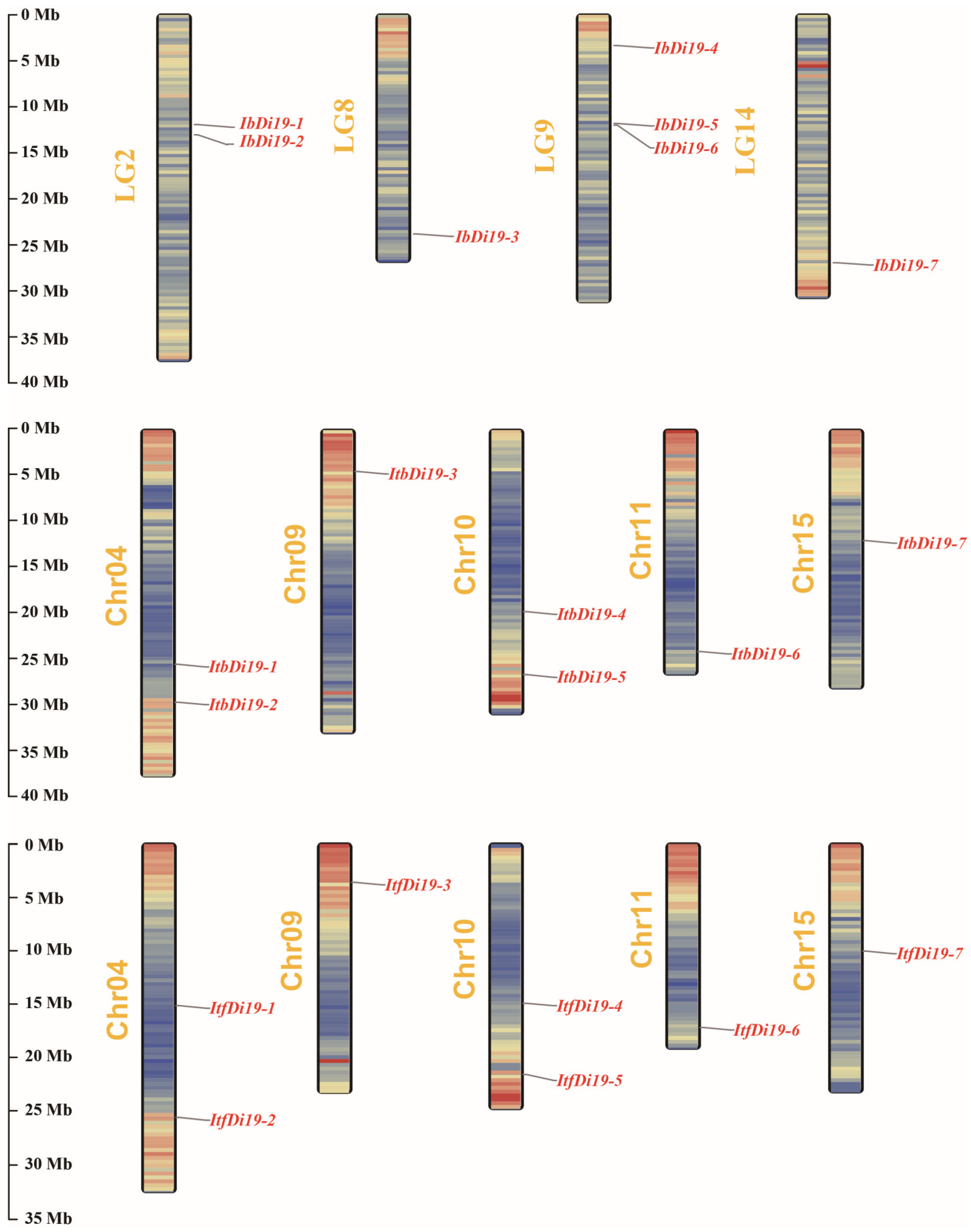
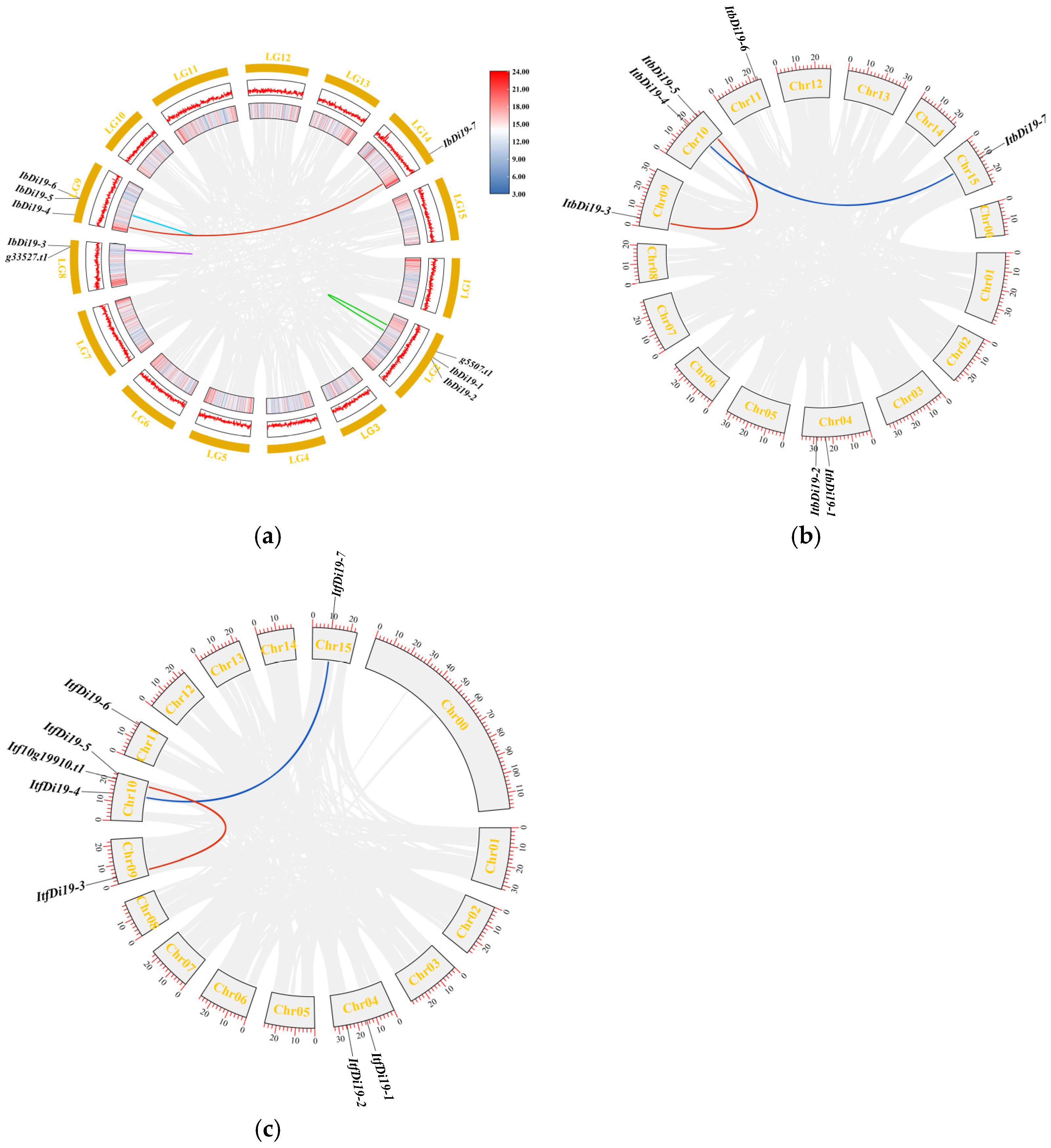
2.3. Chromosome Localization
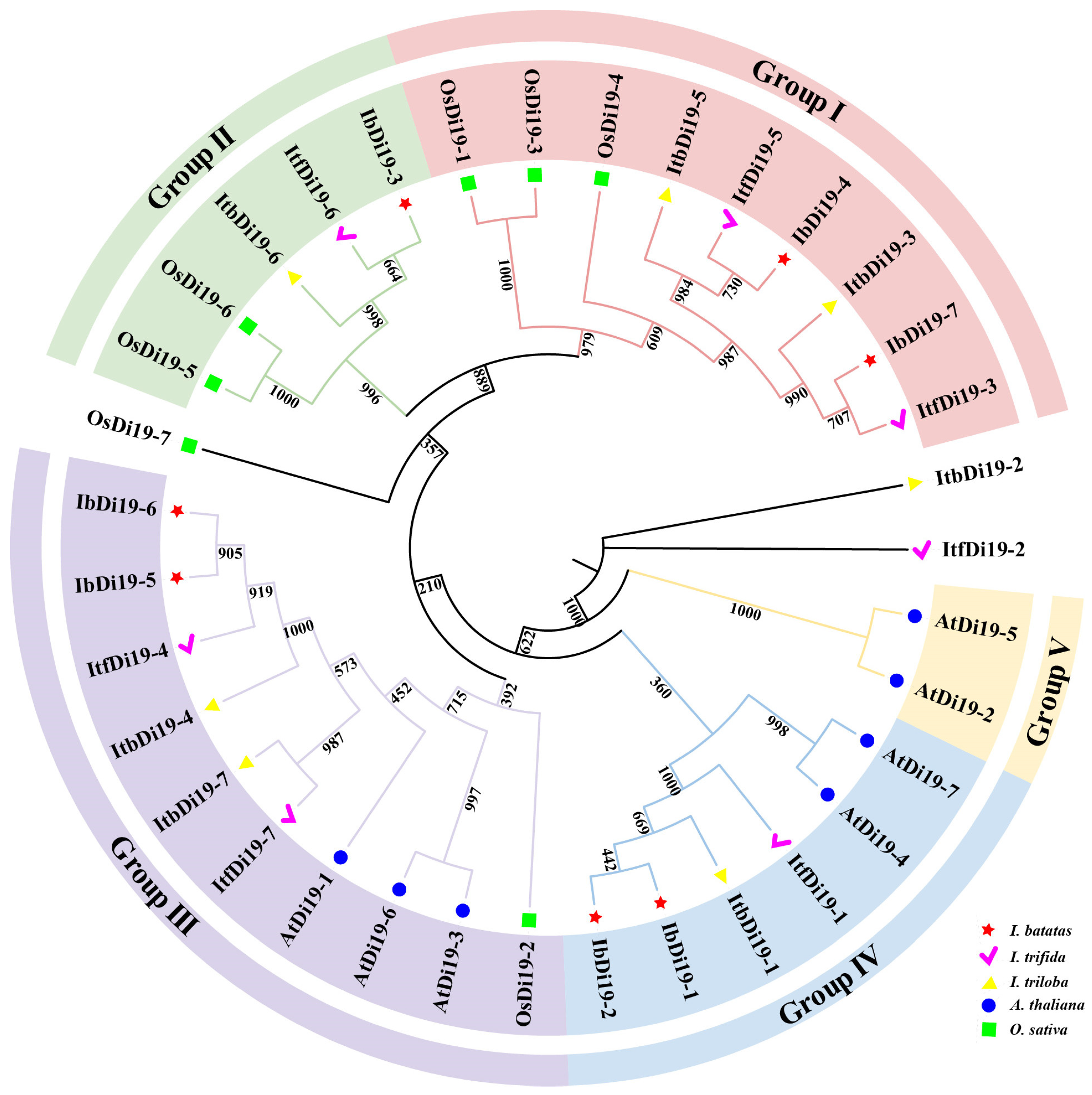
2.4. Phylogenetic Analysis
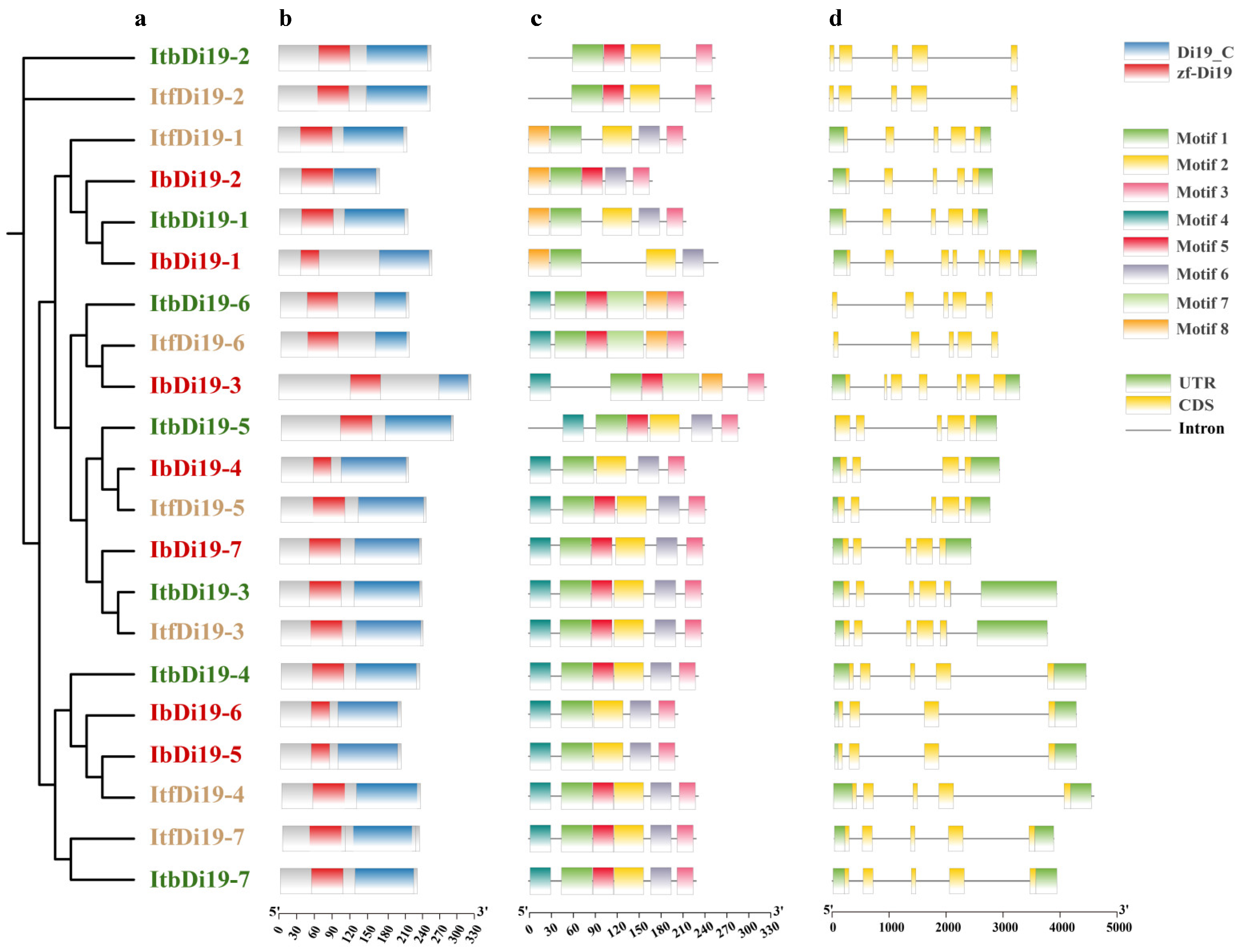
2.5. Gene Structure Analysis
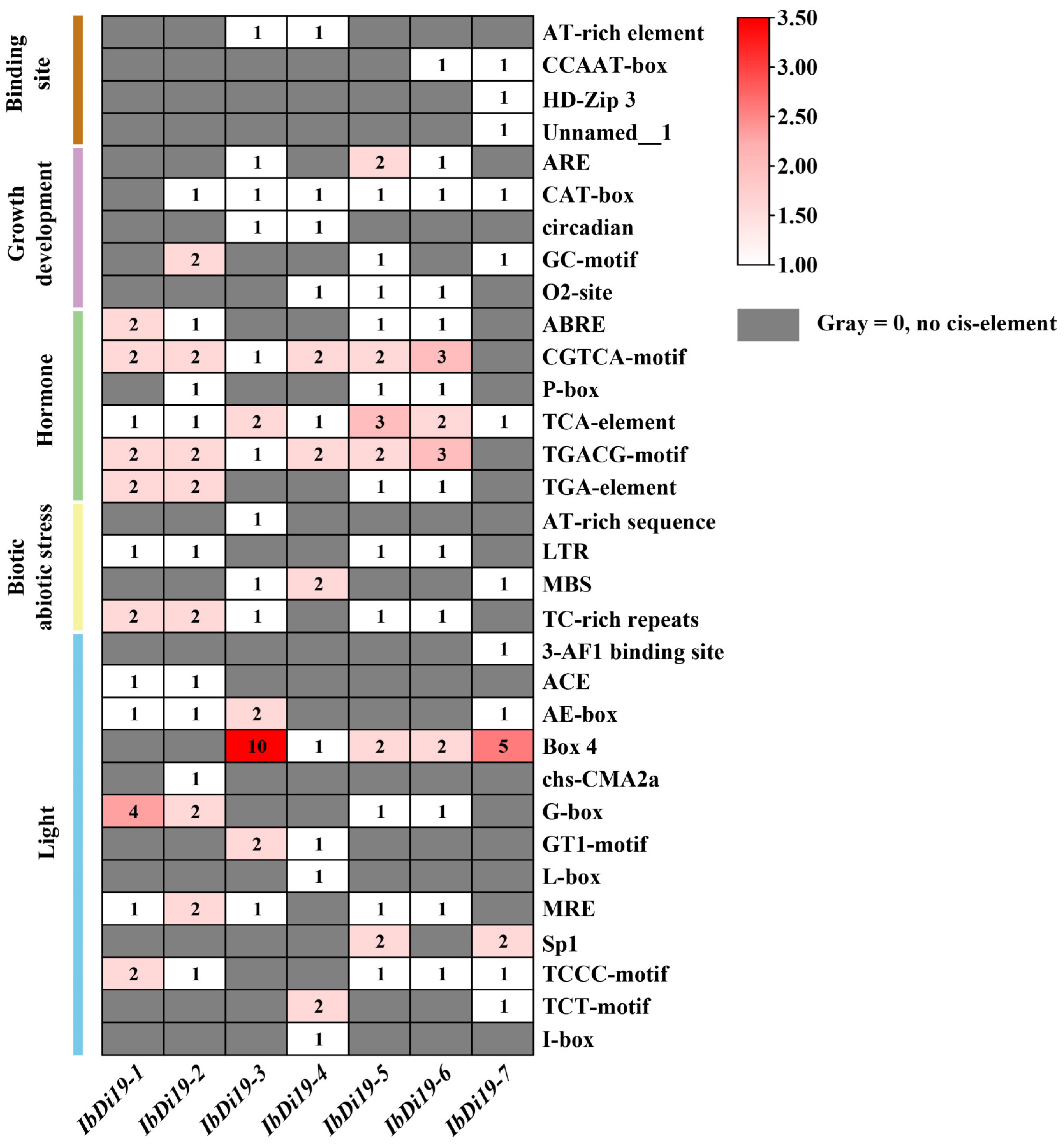
2.6. Promoter Cis-Acting Element Analysis
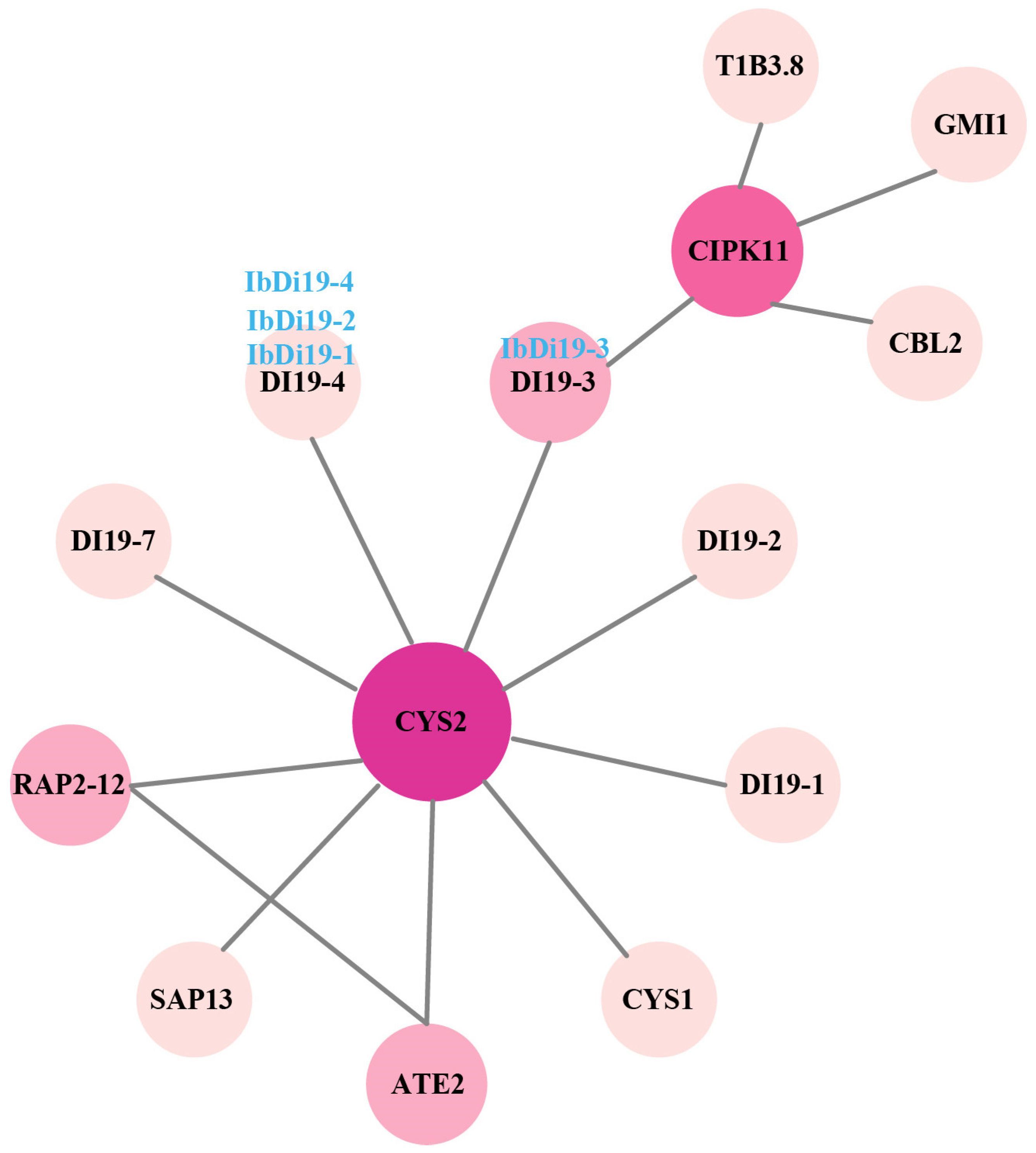
2.7. Protein–Protein Interaction Analysis
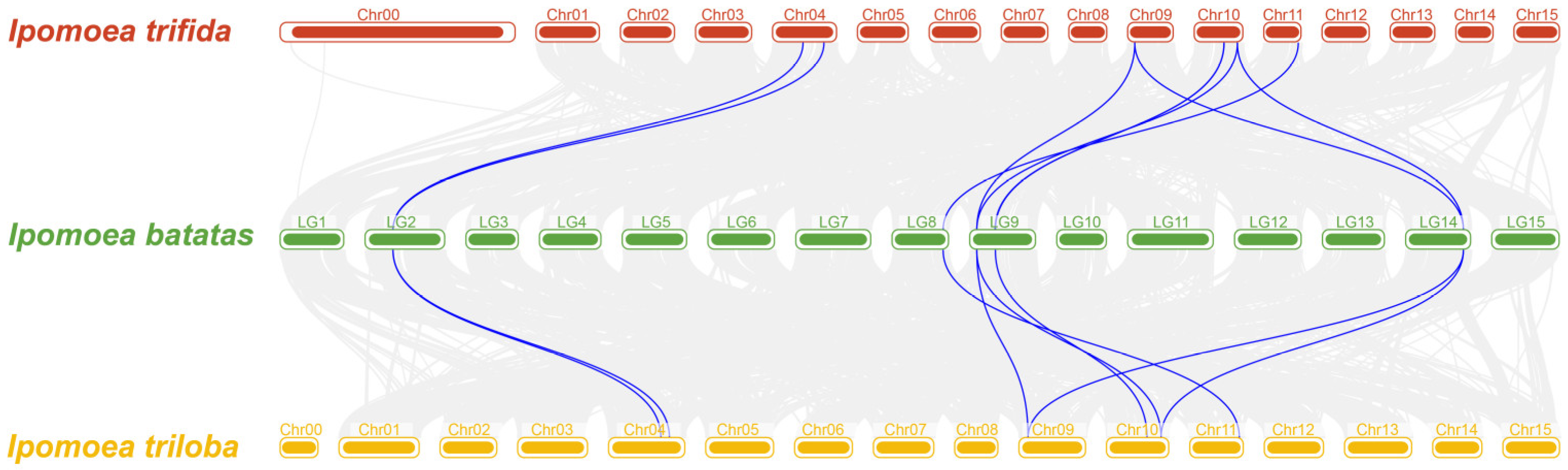
2.8. Collinearity Analysis
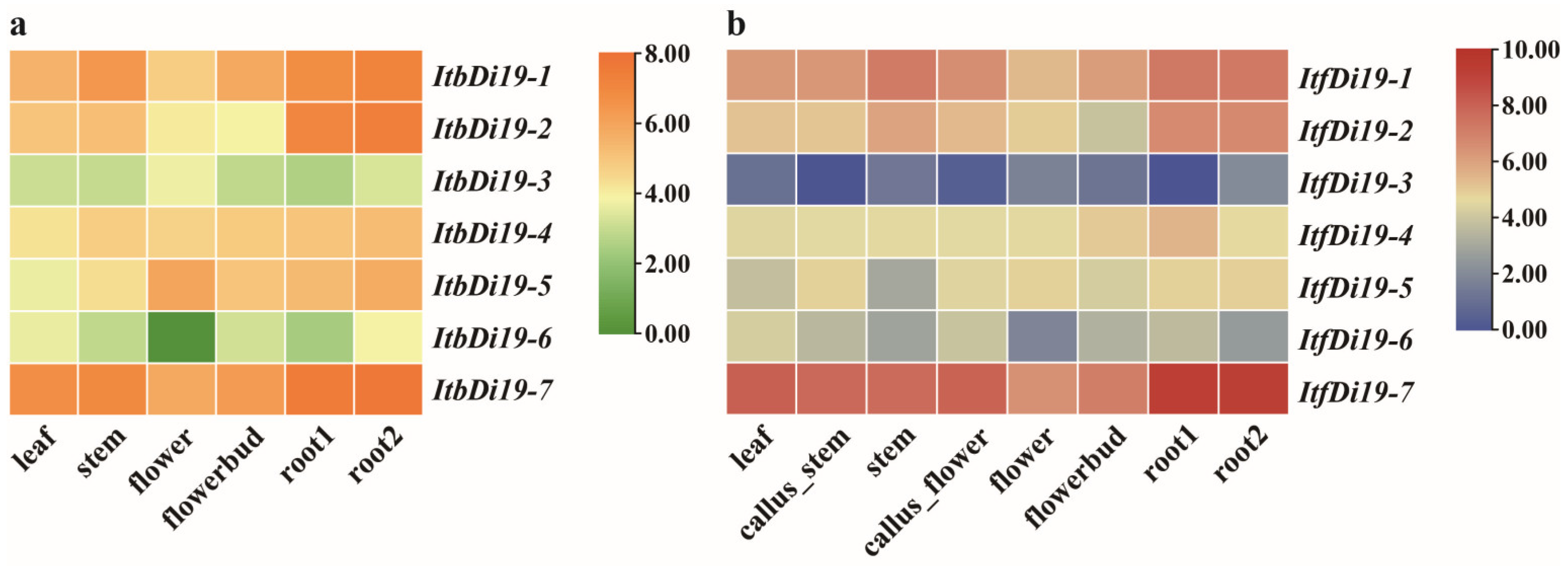
2.9. Expression Analysis
2.9.1. Quantitative Expression Analysis of Sweet Potato via RT-qPCR
- (1)
- Experimental Materials and Sampling Design
- (2)
- RT-qPCR Reaction System and Primers
- (3)
- Calculation Method of Relative Expression Level
- (4)
- Statistical Analysis and Graphing
2.9.2. RNA-Seq Expression Analysis of Diploid Relatives
3. Results
3.1. Identification and Characteristic Analysis of Di19 Gene Family Members in Sweet Potato and Its Two Diploid Relatives
3.2. Phylogenetic Analysis of Di19 Proteins
3.3. Gene Structure Analysis of Di19s in Sweet Potato and Its Two Diploid Relatives
3.4. Analysis of Cis-Acting Elements in the Promoters of IbDi19s
3.5. Analysis of Protein–Protein Interaction Network of IbDi19s
3.6. Collinearity Analysis of Di19s in Sweet Potato and Its Two Diploid Relatives
3.7. Expression Analysis of Di19s in Sweet Potato and Its Two Diploid Relatives
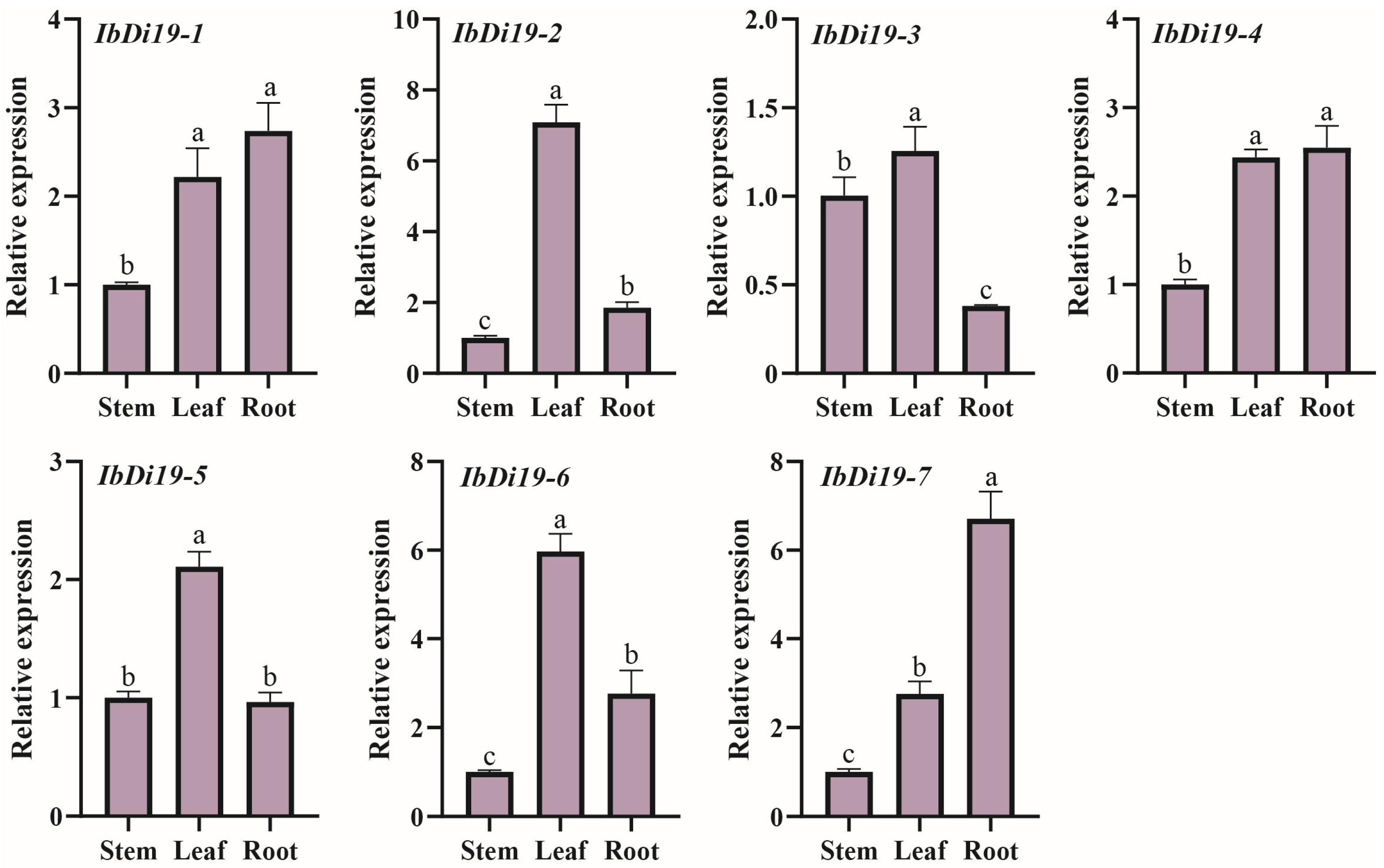
3.7.1. Expression Analysis in Different Tissues
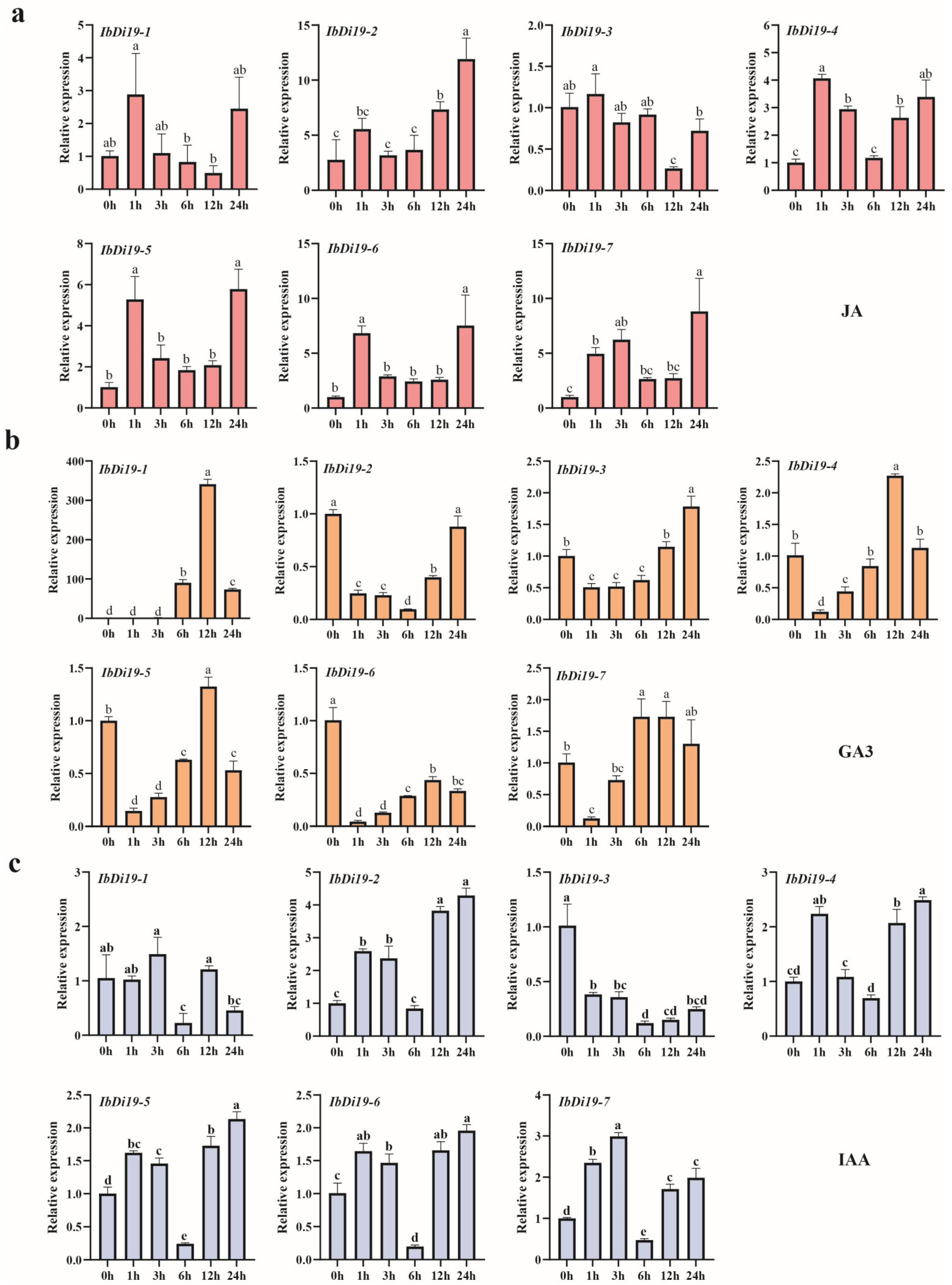
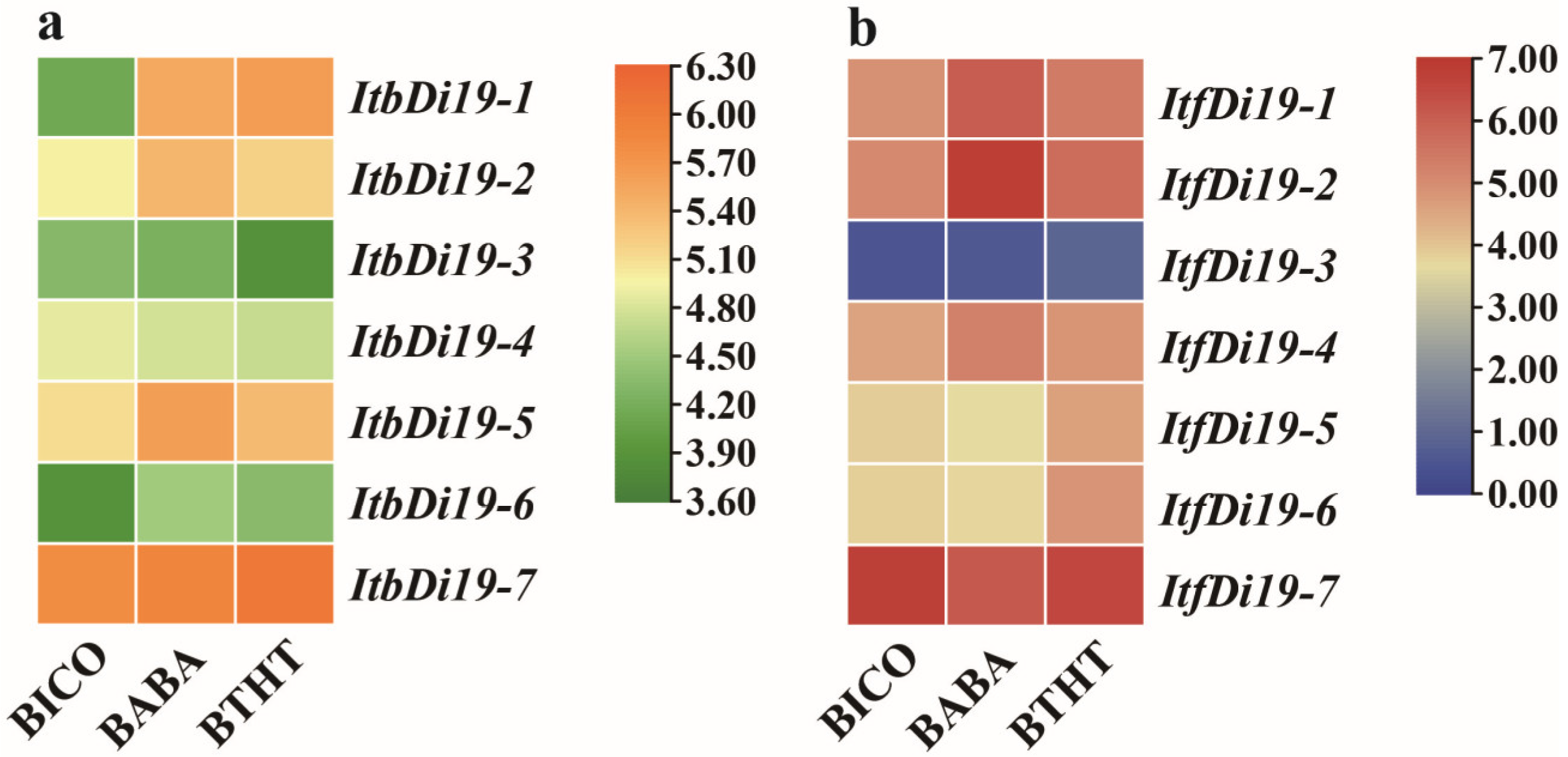
3.7.2. Expression Analysis in Response to Different Hormones
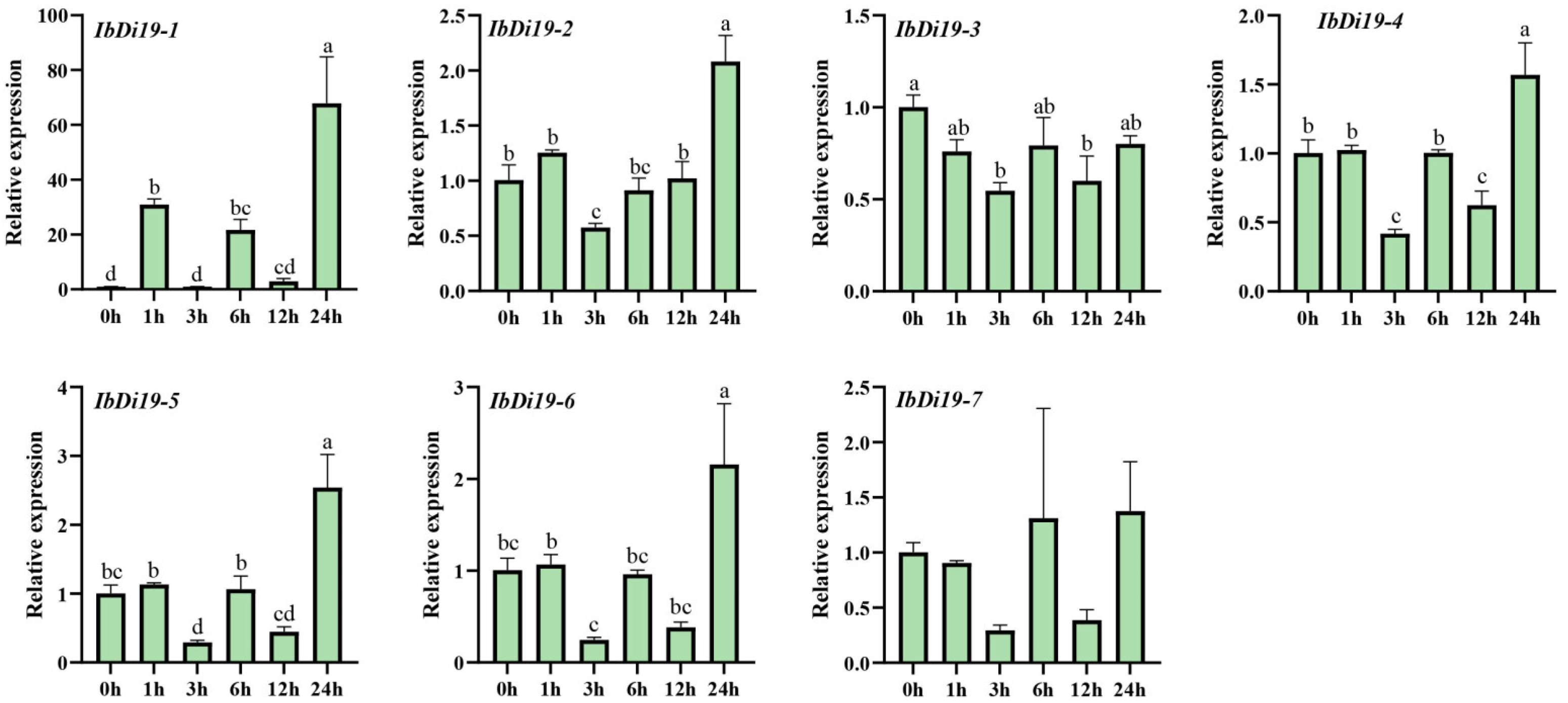
3.7.3. Expression Analysis Under Different Temperatures
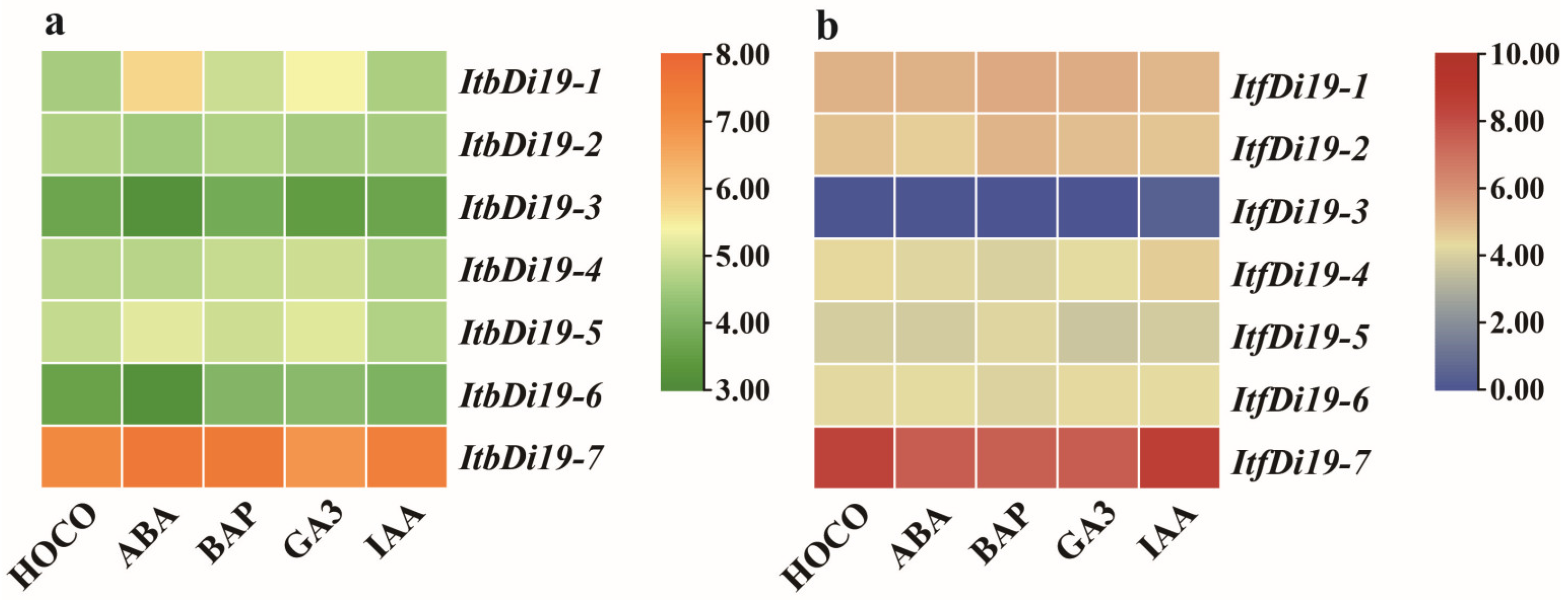
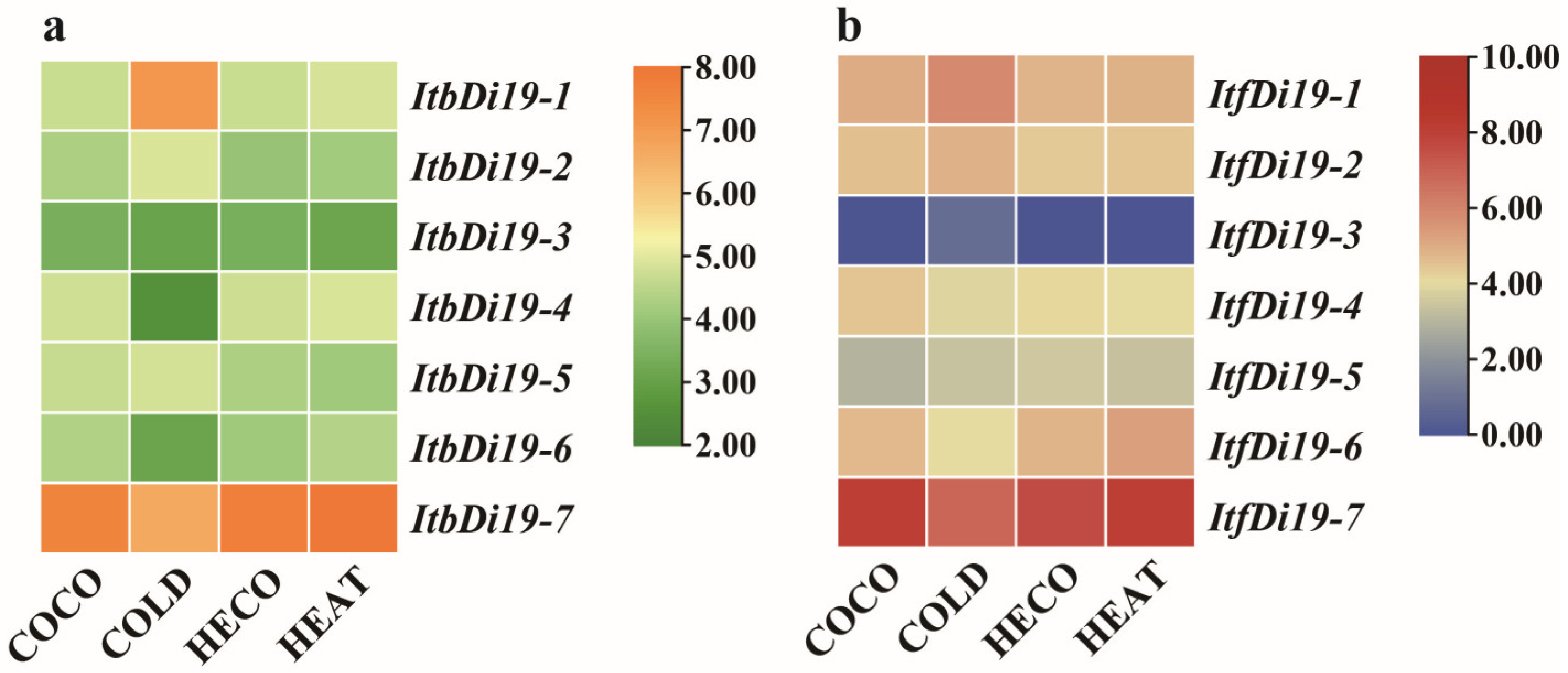
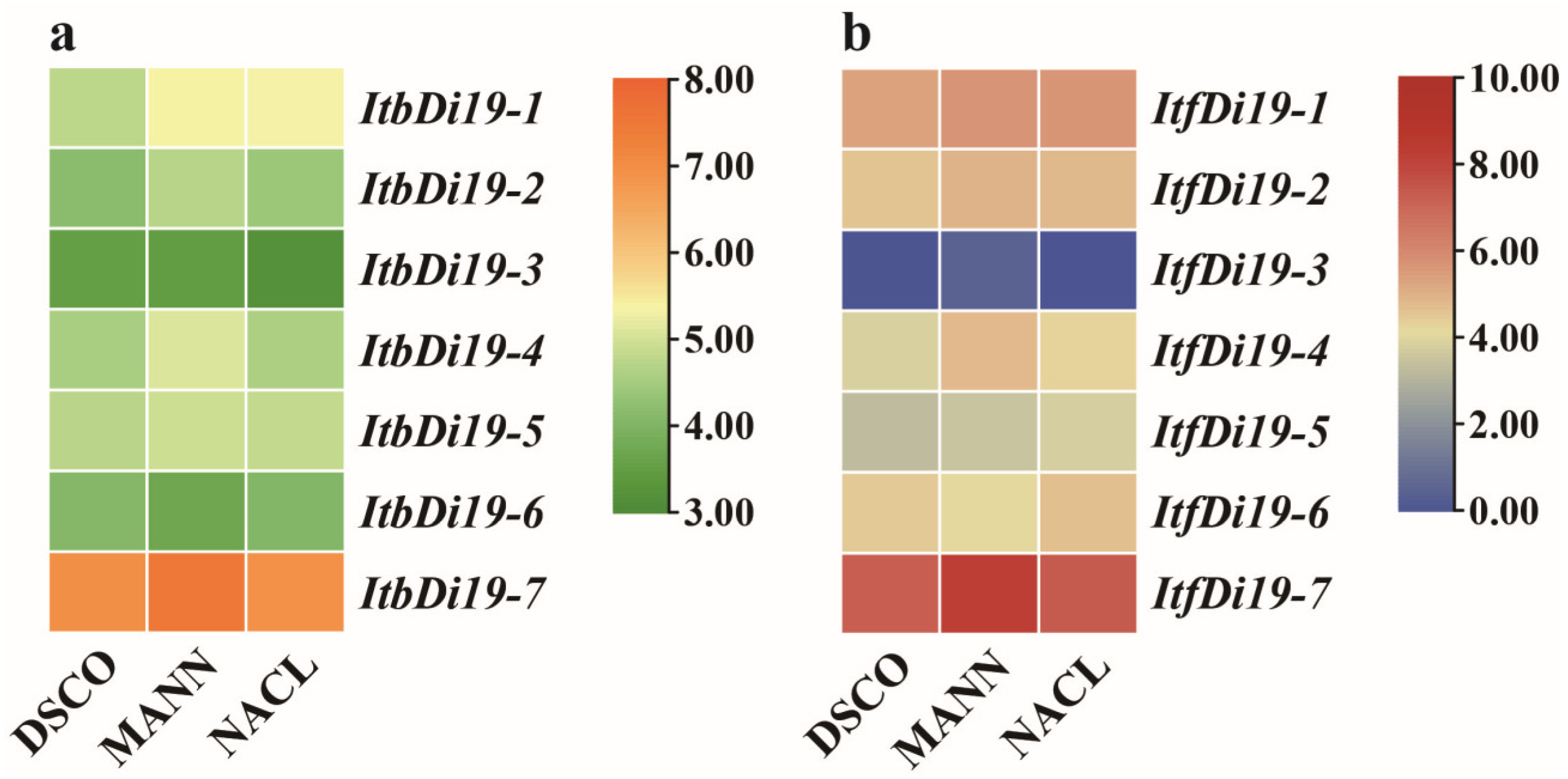
3.7.4. Expression Analysis of Diploid Relatives Under Biotic and Abiotic Stresses
4. Discussion
4.1. Evolution of Di19s in Sweet Potato and Its Two Diploid Relatives
4.2. Role of IbDi19s in Abiotic Stress Responses in Sweet Potato
4.3. Roles of Di19s in Growth, Development, Biotic and Abiotic Stresses in Two Diploid Relatives
5. Conclusions
Supplementary Materials
Author Contributions
Funding
Institutional Review Board Statement
Informed Consent Statement
Data Availability Statement
Conflicts of Interest
References
- Yang, Y.H.; Chen, Y.Q.; Bo, Y.X.; Liu, Q.C.; Zhai, H. Research progress in the mechanisms of resistance to biotic stress in sweet potato. Genes 2023, 14, 2106. [Google Scholar] [CrossRef] [PubMed]
- Mounika, V.; Gowd, T.Y.M.; Lakshminarayana, D.; Krishna, G.V.; Yogesh, M.; Reddy, I.V.S.; Soumya, B.K.; Chamuah, S.; Singh, Y.D.; Reddy, P.M. Sweet potato (Ipomoea batatas (L.) Lam): A comprehensive review of its botany, nutritional composition, phytochemical profile, health benefits, and future prospects. Eur. Food Res. Technol. 2025, 251, 3225–3239. [Google Scholar] [CrossRef]
- El Sheikha, A.F.; Ray, R.C. Potential impacts of bioprocessing of sweet potato: Review. Crit. Rev. Food Sci. Nutr. 2017, 57, 455–471. [Google Scholar] [CrossRef] [PubMed]
- Zhao, S.; Zhong, L.; Li, X.; Qin, L.; Zhou, Y.; Lei, X.; Zheng, X.; Jin, K.; Pu, Z.; Hou, X.; et al. Comparative analysis of nutrients, phytochemicals, and minerals in colored sweet potato (Ipomoea batatas L.) Roots. Foods 2024, 13, 3636. [Google Scholar] [CrossRef] [PubMed]
- Laveriano-Santos, E.P.; López-Yerena, A.; Jaime-Rodríguez, C.; González-Coria, J.; Lamuela-Raventós, R.M.; Vallverdú-Queralt, A.; Romanyà, J.; Pérez, M. Sweet potato is not simply an abundant food crop: A comprehensive review of its phytochemical constituents, biological activities, and the effects of processing. Antioxidants 2022, 11, 1648. [Google Scholar] [CrossRef] [PubMed]
- Nguyen, H.C.; Chen, C.-C.; Lin, K.-H.; Chao, P.-Y.; Lin, H.-H.; Huang, M.-Y. Bioactive compounds, antioxidants, and health benefits of sweet potato leaves. Molecules 2021, 26, 1820. [Google Scholar] [CrossRef] [PubMed]
- Li, Q.; Zhao, H.; Jin, Y.L.; Zhu, J.C.; Ma, D.F. Analysis and perspectives of sweetpotato industry contributing to national food security in China. Jiangsu J. Agric. Sci. 2022, 38, 1484–1491. [Google Scholar] [CrossRef]
- Yang, J.; Moeinzadeh, M.H.; Kuhl, H.; Helmuth, J.; Xiao, P.; Haas, S.; Liu, G.; Zheng, J.; Sun, Z.; Fan, W.; et al. Haplotype-resolved sweet potato genome traces back its hexaploidization history. Nat. Plants 2017, 3, 696–703. [Google Scholar] [CrossRef] [PubMed]
- Wu, S.; Lau, K.H.; Cao, Q.; Hamilton, J.P.; Sun, H.; Zhou, C.; Eserman, L.; Gemenet, D.C.; Olukolu, B.A.; Wang, H.; et al. Genome sequences of two diploid wild relatives of cultivated sweetpotato reveal targets for genetic improvement. Nat. Commun. 2018, 9, 4580. [Google Scholar] [CrossRef] [PubMed]
- Wang, W.X.; Vinocur, B.; Altman, A. Plant responses to drought, salinity and extreme temperatures: Towards genetic engineering for stress tolerance. Planta 2003, 218, 1–14. [Google Scholar] [CrossRef] [PubMed]
- Li, J.L.; Han, G.L.; Sun, C.F.; Sui, N. Research advances of MYB transcription factors in plant stress resistance and breeding. Plant Signal. Behav. 2019, 14, e1613131. [Google Scholar] [CrossRef] [PubMed]
- Ciftci-Yilmaz, S.; Mittler, R. The zinc finger network of plants. Cell. Mol. Life Sci. 2008, 65, 1150–1160. [Google Scholar] [CrossRef] [PubMed]
- Han, G.L.; Qiao, Z.Q.; Li, Y.X.; Wang, C.F.; Wang, B.S. The roles of CCCH zinc-finger proteins in plant abiotic stress tolerance. Int. J. Mol. Sci. 2021, 22, 8327. [Google Scholar] [CrossRef] [PubMed]
- Milla, M.A.; Townsend, J.; Chang, I.F.; Cushman, J.C. The arabidopsis AtDi19 gene family encodes a novel type of Cys2/His2 zinc-finger protein implicated in ABA-independent dehydration, high-salinity stress and light signaling pathways. Plant Mol. Biol. 2006, 61, 13–30. [Google Scholar] [CrossRef] [PubMed]
- Cai, H.L. Identification and Functional Analysis of Maize Resistance-Related Gene ZmDi19-9 (Zea mays L.). Master’s Thesis, Anhui Agricultural University, Anhui, China, 2017. [Google Scholar]
- Wang, L.L.; Yu, C.C.; Chen, C.; He, C.L.; Zhu, Y.G.; Huang, W.C. Identification of rice Di19 family reveals OsDi19-4 involved in drought resistance. Plant Cell Rep. 2014, 33, 2047–2062. [Google Scholar] [CrossRef] [PubMed]
- Du, L.Y.; Ding, L.; Tang, D.L.; Zhao, H.X.; Mao, H.D. Genome-wide analysis of wheat Di19 gene family and functional analysis of TaDi19-7 in transgenic Arabidopsis. Environ. Exp. Bot. 2023, 206, 105192. [Google Scholar] [CrossRef]
- Zhao, Y.; Xu, L.J.; Huang, Y.X.; Wu, H.Y.; Zhang, X.G.; Hu, X.L.; Ma, Q. Identification and characterization of the core region of ZmDi19-5 promoter activity and its upstream regulatory proteins. Int. J. Mol. Sci. 2022, 23, 7390. [Google Scholar] [CrossRef] [PubMed]
- Zhao, L.J.; Li, Y.Z.; Li, Y.; Chen, W.; Yao, J.B.; Fang, S.T.; Lv, Y.J.; Zhang, Y.S.; Zhu, S.H. Systematical characterization of the cotton Di19 gene family and the role of GhDi19-3 and GhDi19-4 as two negative regulators in response to salt stress. Antioxidants 2022, 11, 2225. [Google Scholar] [CrossRef] [PubMed]
- Jiang, L.; Gao, X.W.; Yang, X.F.; Huang, S.; Tang, W.J.; Li, X.H.; Ma, S.M.; Xiao, M. A novel root-specific Di19 transcription factor from Glycine max compromises drought tolerance in Arabidopsis thaliana through suppression of auxin-related pathway. Environ. Exp. Bot. 2022, 201, 104951. [Google Scholar] [CrossRef]
- Chen, Y.T.; Zhonghou, G.; You, Z.L.; Liu, J.Y.; Jin, M.R.; Shang, L.L.; Chen, L.; Gao, M.J.; Wu, L.Y.; Zhan, T.; et al. AhDi19-3B confers drought tolerance in peanut: Functional characterization of a candidate gene from the genome-wide identified Di19 family. Plant Stress 2026, 20, 101262. [Google Scholar] [CrossRef]
- Chai, W.B.; Yuan, C.; Li, S.F.; Xu, H.Y.; Zhu, Q.; Li, H.T.; Ji, W.; Wang, J. Genome-wide identification and cold stress response mechanism of barley Di19 gene family. Biology 2025, 14, 508. [Google Scholar] [CrossRef] [PubMed]
- Wu, M. Identification of drought-induced Di19 transcription factors in moso bamboo and function analysis of PeDi19-4. Ph.D. Thesis, Anhui Agricultural University, Hefei, China, 2018. [Google Scholar]
- Zhang, X.Y. Identification of Di19 gene family in grape and creation of Di19-3 gene editing grapevine. Master’s Thesis, Northwest A&F University, Xianyang, China, 2021. [Google Scholar]
- Wu, C.J.; Lin, M.; Chen, F.; Chen, J.; Liu, S.F.; Yan, H.W.; Xiang, Y. Homologous drought-induced 19 proteins, PtDi19-2 and PtDi19-7, enhance drought tolerance in transgenic plants. Int. J. Mol. Sci. 2022, 23, 16023. [Google Scholar] [CrossRef] [PubMed]
- Liu, N.; Hu, Z.Y.; Zhang, L.; Yang, Q.; Deng, L.B.; Terzaghi, W.; Hua, W.; Yan, M.L.; Liu, J.; Zheng, M. BAPID suppresses the inhibition of BRM on Di19-PR module in response to drought. Plant J. 2024, 120, 253–271. [Google Scholar] [CrossRef] [PubMed]
- Liu, W.X.; Zhang, F.C.; Zhang, W.Z.; Song, L.F.; Wu, W.H.; Chen, Y.F. Arabidopsis Di19 functions as a transcription factor and modulates PR1, PR2, and PR5 expression in response to drought stress. Mol. Plant 2013, 6, 1487–1502. [Google Scholar] [CrossRef] [PubMed]
- Majee, S.M.; Sharma, E.; Singh, B.; Khurana, J.P. Drought-induced protein (Di19-3) plays a role in auxin signaling by interacting with IAA14 in Arabidopsis. Plant Direct 2020, 4, e00234. [Google Scholar] [CrossRef] [PubMed]
- Qin, L.X.; Li, Y.; Li, D.D.; Xu, W.L.; Zheng, Y.; Li, X.B. Arabidopsis drought-induced protein Di19-3 participates in plant response to drought and high salinity stresses. Plant Mol. Biol. 2014, 86, 609–625. [Google Scholar] [CrossRef] [PubMed]
- Guo, W.; Li, X.; Yang, T.; Huang, C.; Zhao, B.; Wang, P. Identification and expression of the Di19 gene family in response to abiotic stress in common bean (Phaseolus vulgaris L.). Front. Genet. 2024, 15, 1401011. [Google Scholar] [CrossRef] [PubMed]
- Feng, Z.J.; Cui, X.Y.; Cui, X.Y.; Chen, M.; Yang, G.X.; Ma, Y.Z.; He, G.Y.; Xu, Z.S. The soybean GmDi19-5 interacts with GmLEA3.1 and increases sensitivity of transgenic plants to abiotic stresses. Front. Plant Sci. 2015, 6, 179. [Google Scholar] [CrossRef] [PubMed]
- Yang, Y.H.; Ren, R.; Karthikeyan, A.; Yin, J.L.; Jin, T.T.; Fang, F.; Cai, H.; Liu, M.Z.; Wang, D.G.; Zhi, H.J.; et al. The soybean GmPUB21-interacting protein GmDi19-5 responds to drought and salinity stresses via an ABA-dependent pathway. Crop J. 2023, 11, 1152–1162. [Google Scholar] [CrossRef]
- Zhao, J.Y.; Liu, J.M.; Feng, Z.J.; Chen, M.; Zhou, Y.B.; Chen, J.; Xu, Z.S.; Guo, C.H. The response to heat and screening of the interacting proteins of zinc finger protein GmDi19-5 in soybean. Sci. Agric. Sin. 2017, 50, 2389–2398. [Google Scholar] [CrossRef]
- Feng, Z.J.; Liu, N.; Zhang, G.W.; Bu, Y.P.; Wang, B.; Gong, Y.M. Promoter of Vegetable Soybean GmDi19-3 Responds to Salt Stress and Exogenous ABA and MeJA. Acta Hortic. Sin. 2024, 51, 2791–2799. [Google Scholar] [CrossRef]
- Ru, J.N.; Yu, T.F.; Chen, J.; Chen, M.; Zhou, Y.b.; Ma, Y.Z.; Xu, Z.S.; Min, D.H. Response of wheat zinc-finger transcription factor TaDi19A to cold and its screening of interacting proteins. Sci. Agric. Sin. 2017, 50, 2411–2422. [Google Scholar] [CrossRef]
- Li, S.O.; Xu, C.H.; Yang, Y.A.; Xia, G.M. Functional analysis of TaDi19A, a salt-responsive gene in wheat. Plant Cell Environ. 2010, 33, 117–129. [Google Scholar] [CrossRef] [PubMed]
- Wang, L.L.; Yu, C.C.; Xu, S.L.; Zhu, Y.G.; Huang, W.C. OsDi19-4 acts downstream of OsCDPK14 to positively regulate ABA response in rice. Plant Cell Environ. 2016, 39, 2740–2753. [Google Scholar] [CrossRef] [PubMed]
- Li, Y.J.; Mu, T.J.; Ren, T.Y.; Li, P. Drought-induced zinc finger transcription factor OsDi19-3 positively regulates drought stress acclimatization in rice (Oryza sativa L.). Plants 2025, 14, 1560. [Google Scholar] [CrossRef] [PubMed]
- Zeng, H.X.; Dou, D.D.; Yang, Y.; Yan, Y.; Sun, Y.W.; Yang, S.H.; Yao, W.; Zhao, S.F.; Wang, M.L.; Liu, Z.X.; et al. The ZmFKF1b-ZmDi19-5 regulatory module coordinates drought tolerance and flowering time in maize. Plant Biotechnol. J. 2025, 24, 1044–1060. [Google Scholar] [CrossRef] [PubMed]
- Zhang, X.G.; Cai, H.L.; Lu, M.; Wei, Q.Y.; Xu, L.J.; Bo, C.; Ma, Q.; Zhao, Y.; Cheng, B.J. A maize stress-responsive Di19 transcription factor, ZmDi19-1, confers enhanced tolerance to salt in transgenic Arabidopsis. Plant Cell Rep. 2019, 38, 1563–1578. [Google Scholar] [CrossRef] [PubMed]
- Dong, J.L.; Wang, Z.M.; Si, W.N.; Xu, H.; Zhang, Z.; Cao, Q.Y.; Zhang, X.Y.; Peng, H.; Mao, R.W.; Jiang, H.Y.; et al. The C2H2-type zinc finger transcription factor ZmDi19-7 regulates plant height and organ size by promoting cell size in maize. Plant J. 2024, 120, 2700–2722. [Google Scholar] [CrossRef] [PubMed]
- Qin, L.X.; Nie, X.Y.; Hu, R.; Li, G.; Xu, W.L.; Li, X.B. Phosphorylation of serine residue modulates cotton Di19-1 and Di19-2 activities for responding to high salinity stress and abscisic acid signaling. Sci. Rep. 2016, 6, 20371. [Google Scholar] [CrossRef] [PubMed]
- Li, G.; Tai, F.J.; Zheng, Y.; Luo, J.A.; Gong, S.Y.; Zhang, Z.T.; Li, X.B. Two cotton Cys2/His2-type zinc-finger proteins, GhDi19-1 and GhDi19-2, are involved in plant response to salt/drought stress and abscisic acid signaling. Plant Mol. Biol. 2010, 74, 437–452. [Google Scholar] [CrossRef] [PubMed]
- Dai, J.; Yan, Y.; Yang, H.; Hu, W. Cloning and expression analysis of zinc-finger transcription factor MeDi19-1 gene in cassava. J. South. Agric. 2022, 53, 115–124. [Google Scholar] [CrossRef]
- Chen, C.; Wu, Y.; Li, J.; Wang, X.; Zeng, Z.; Xu, J.; Liu, Y.; Feng, J.; Chen, H.; He, Y.; et al. TBtools-II: A “one for all, all for one” bioinformatics platform for biological big-data mining. Mol. Plant 2023, 16, 1733–1742. [Google Scholar] [CrossRef] [PubMed]
- Wu, S.; Lau, K.H.; Cao, Q.; Hamilton, J.P.; Sun, H.; Zhou, C.; Eserman, L.; Gemenet, D.C.; Olukolu, B.A.; Wang, H.; et al. Genome sequences of two diploid wild relatives of cultivated sweetpotato reveal targets for genetic improvement [Dataset]. Dryad 2018. [Google Scholar] [CrossRef] [PubMed]
- Bae, Y.; Lim, C.W.; Lee, S.C. Differential functions of pepper stress-associated proteins in response to abiotic stresses. Front. Plant Sci. 2021, 12, 756068. [Google Scholar] [CrossRef] [PubMed]
- Dixit, A.; Tomar, P.; Vaine, E.; Abdullah, H.; Hazen, S.; Dhankher, O.A.-O. A stress-associated protein, AtSAP13, from Arabidopsis thaliana provides tolerance to multiple abiotic stresses. Plant Cell Environ. 2018, 41, 1171–1185. [Google Scholar] [CrossRef] [PubMed]
- Hwang, J.E.; Hong, J.K.; Lim, C.J.; Chen, H.; Je, J.; Yang, K.A.; Kim, D.Y.; Choi, Y.J.; Lee, S.Y.; Lim, C.O. Distinct expression patterns of two Arabidopsis phytocystatin genes, AtCYS1 and AtCYS2, during development and abiotic stresses. Plant Cell Rep. 2010, 29, 905–915. [Google Scholar] [CrossRef] [PubMed]
- Lai, W.; Zhou, Y.A.-O.; Pan, R.; Liao, L.; He, J.; Liu, H.; Yang, Y.; Liu, S.A.-O. Identification and expression analysis of stress-associated proteins (SAPs) containing A20/AN1 zinc finger in cucumber. Plants 2020, 9, 400. [Google Scholar] [CrossRef] [PubMed]
- Das, R.; Pandey, G.K. Expressional analysis and role of calcium regulated kinases in abiotic stress signaling. Curr. Genom. 2010, 11, 2–13. [Google Scholar] [CrossRef] [PubMed]
- Lu, L.; Chen, X.; Wang, P.; Lu, Y.; Zhang, J.; Yang, X.; Cheng, T.; Shi, J.; Chen, J.A.-O. CIPK11: A calcineurin B-like protein-interacting protein kinase from Nitraria tangutorum, confers tolerance to salt and drought in Arabidopsis. BMC Plant Biol. 2021, 21, 123. [Google Scholar] [CrossRef] [PubMed]
- Yang, C.; Yi-Feng, J.; Yushu, W.; Yansong, G.; Qi, W.; Xue, Y. Diverse roles of the CIPK gene family in transcription regulation and various biotic and abiotic stresses: A literature review and bibliometric study. Front. Genet. 2022, 13, 1041078. [Google Scholar] [CrossRef] [PubMed]
- Ma, Y.; Cao, J.; Chen, Q.; He, J.; Liu, Z.; Wang, J.; Li, X.; Yang, Y. The kinase CIPK11 functions as a negative regulator in drought stress response in Arabidopsis. Int. J. Mol. Sci. 2019, 20, 2422. [Google Scholar] [CrossRef] [PubMed]
- Shakhnovich, B.E.; Koonin, E.V. Origins and impact of constraints in evolution of gene families. Genome Res. 2006, 16, 1529–1536. [Google Scholar] [CrossRef] [PubMed]
- Jaillon, O.; Aury, J.-M.; Noel, B.; Policriti, A.; Clepet, C.; Casagrande, A.; Choisne, N.; Aubourg, S.; Vitulo, N.; Jubin, C.; et al. The grapevine genome sequence suggests ancestral hexaploidization in major angiosperm phyla. Nature 2007, 449, 463–467. [Google Scholar] [CrossRef] [PubMed]
- Long, Q.A.-O.; Cao, S.A.-O.; Huang, G.A.-O.; Wang, X.A.-O.; Liu, Z.A.-O.; Liu, W.A.-O.; Wang, Y.A.-O.; Xiao, H.A.-O.; Peng, Y.A.-O.; Zhou, Y.A.-O. Population comparative genomics discovers gene gain and loss during grapevine domestication. Plant Physiol. 2024, 195, 1401–1413. [Google Scholar] [CrossRef] [PubMed]
- Huang, F.; Wang, J.; Tang, C. Genome-wide identification and analysis of ZF-HD gene family in Moso Bamboo (Phyllostachys edulis). Plants 2023, 12, 4064. [Google Scholar] [CrossRef] [PubMed]
- Peng, Z.; Lu, Y.; Li, L.; Zhao, Q.; Feng, Q.I.; Gao, Z.; Lu, H.; Hu, T.; Yao, N.; Liu, K.; et al. The draft genome of the fast-growing non-timber forest species moso bamboo (Phyllostachys heterocycla). Nat. Genet. 2013, 45, 456–461. [Google Scholar] [CrossRef] [PubMed]
- International Wheat Genome Sequencing Consortium; Borrill, P. Shifting the limits in wheat research and breeding using a fully annotated reference genome. Science 2018, 361, eaar7191. [Google Scholar] [CrossRef] [PubMed]
- Hu, G.; Grover, C.E.; Jareczek, J.; Yuan, D.; Dong, Y.; Miller, E.; Conover, J.L.; Wendel, J.F. Evolution and diversity of the cotton genome. In Cotton Precision Breeding, 2nd ed.; Rahman, M.-U., Zafar, Y., Zhang, T., Eds.; Springer International Publishing: Cham, Switzerland, 2021; pp. 25–78. [Google Scholar]
- Schmutz, J.; Cannon, S.B.; Schlueter, J.; Ma, J.; Mitros, T.; Nelson, W.; Hyten, D.L.; Song, Q.; Thelen, J.J.; Cheng, J.; et al. Genome sequence of the palaeopolyploid soybean. Nature 2010, 463, 178–183. [Google Scholar] [CrossRef] [PubMed]
- Zhuang, W.; Chen, H.; Yang, M.; Wang, J.; Pandey, M.K.; Zhang, C.; Chang, W.-C.; Zhang, L.; Zhang, X.; Tang, R.; et al. The genome of cultivated peanut provides insight into legume karyotypes, polyploid evolution and crop domestication. Nat. Genet. 2019, 51, 865–876. [Google Scholar] [CrossRef] [PubMed]
- Yan, M.; Li, M.; Wang, Y.; Wang, X.; Moeinzadeh, M.H.; Quispe-Huamanquispe, D.G.; Fan, W.; Fang, Y.; Wang, Y.; Nie, H.; et al. Haplotype-based phylogenetic analysis and population genomics uncover the origin and domestication of sweetpotato. Mol. Plant 2024, 17, 277–296. [Google Scholar] [CrossRef] [PubMed]
- Mao, Y.; Yuan, Y.; Gao, Y.; Zeng, L.; Fan, S.; Luo, J.; Sun, D. A tree peony RING-H2 finger protein, PsATL33, plays an essential role in cold-induced bud dormancy release by regulating gibberellin content. Front. Plant Sci. 2024, 15, 1395530. [Google Scholar] [CrossRef] [PubMed]
- Song, S.-W.; Lei, Y.-L.; Huang, X.-M.; Su, W.; Chen, R.-Y.; Hao, Y.-W. Crosstalk of cold and gibberellin effects on bolting and flowering in flowering Chinese cabbage. J. Integr. Agric. 2019, 18, 992–1000. [Google Scholar] [CrossRef]
- Song, Z.F.; Zhang, Z.M.; Ding, H.; Li, M.J.; Zhao, Y.; Shi, P.X.; Sun, R.D.; Chen, X.S.; Lv, Y.C.; Ning, Q.; et al. Transcriptional regulation mechanism of gibberellin promoting peanut seed germination under low temperature stress. J. Northeast Agric. Sci. 2025, 50, 53–61. [Google Scholar] [CrossRef]





| Primer | Primer Sequence |
|---|---|
| IbActin_F | AGCAGCATGAAGATTAAGGTTGTAGCACT |
| IbActin_R | GGAAAATTAGAAGCACTTCCTGTGAAC |
| IbDi19-1_F | CTTGCGACTGCAAACCTCTCAT |
| IbDi19-1_R | CCAACACTCCCAGCTTTCCTCT |
| IbDi19-2_F | CTGATCCATGGATTCGTTTCCCG |
| IbDi19-2_R | GGGCACATGAACTCTGGCCTAG |
| IbDi19-3_F | CTGGAACAATGCCACAGCAGC |
| IbDi19-3_R | TTCAGAATCCGAAGGGGGCAC |
| IbDi19-4_F | TTCTGGACCTCTCGTCTCGCC |
| IbDi19-4_R | CGGGCAAGGGAAATCAGGTCG |
| IbDi19-5_F | TGGATGCTGATCCTTGGTCGG |
| IbDi19-5_R | CGTCGACCATGTCAATTTCCTCG |
| IbDi19-6_F | TGGATGCTGATCCTTGGTCGG |
| IbDi19-6_R | CGTCGACCATGTCAATTTCCTCG |
| IbDi19-7_F | CTGATTTCTGGACCTCTCGCCT |
| IbDi19-7_R | GAAATCGGGTCGGGCCTCTT |
| Gene Name | Gene ID | Genomic Length (bp) | CDS * Length (bp) | Protein Size (aa) | MW * (kDa) | pI * | Instability Index | Gravy | Subcellular Locations |
|---|---|---|---|---|---|---|---|---|---|
| IbDi19-1 | g5948 | 3558 | 777 | 258 | 29.03 | 4.81 | 79.97 | −0.536 | Nucleus |
| IbDi19-2 | g6090 | 2801 | 507 | 168 | 19.06 | 4.45 | 75.62 | −0.636 | Nucleus |
| IbDi19-3 | g33568 | 3292 | 975 | 324 | 36.06 | 6.53 | 56.66 | −0.525 | Nucleus |
| IbDi19-4 | g34544 | 2922 | 645 | 214 | 23.97 | 5.79 | 61.29 | −0.598 | Nucleus |
| IbDi19-5 | g35681 | 4243 | 612 | 203 | 22.63 | 5.31 | 54.61 | −0.552 | Nucleus |
| IbDi19-6 | g35703 | 4241 | 612 | 203 | 22.63 | 5.31 | 54.61 | −0.552 | Nucleus |
| IbDi19-7 | g59145 | 2425 | 720 | 239 | 26.99 | 5.53 | 62.12 | −0.438 | Nucleus |
| Species | Segmental Duplication | |
|---|---|---|
| I. batatas | IbDi19-2 | g5507.t1 |
| IbDi19-3 | g33527.t1 | |
| IbDi19-5 | IbDi19-6 | |
| IbDi19-4 | IbDi19-7 | |
| I. triloba | ItbDi19-3 | ItbDi19-5 |
| ItbDi19-4 | ItbDi19-7 | |
| I. trifida | ItfDi19-4 | ItfDi19-7 |
| ItfDi19-3 | itf10g19910.t1 | |
| I. trifida-I. batatas | I. batatas-I. triloba | ||
|---|---|---|---|
| Gene1 | Gene2 | Gene1 | Gene2 |
| ItfDi19-1 | IbDi19-2 | IbDi19-2 | ItbDi19-1 |
| ItfDi19-2 | IbDi19-2 | IbDi19-2 | ItbDi19-2 |
| ItfDi19-6 | IbDi19-3 | IbDi19-3 | ItbDi19-6 |
| ItfDi19-3 | IbDi19-4 | IbDi19-4 | ItbDi19-3 |
| itf10g19910.t1 | IbDi19-4 | IbDi19-4 | ItbDi19-5 |
| ItfDi19-4 | IbDi19-6 | IbDi19-6 | ItbDi19-4 |
| ItfDi19-3 | IbDi19-7 | IbDi19-7 | ItbDi19-3 |
| itf10g19910.t1 | IbDi19-7 | IbDi19-7 | ItbDi19-5 |
| Gene 1 | Gene 2 | Non-Synonymous Rate (Ka) | Synonymous Rate (Ks) | Substitution Rate Ratio (Ka/Ks) |
|---|---|---|---|---|
| IbDi19-2 | g5507.t1 | 0.744 | Na | Na |
| IbDi19-3 | g33527.t1 | 0.016 | 0.044 | 0.370 |
| IbDi19-5 | IbDi19-6 | 0.000 | 0.000 | NaN |
| IbDi19-4 | IbDi19-7 | 0.108 | 0.696 | 0.155 |
| ItbDi19-3 | ItbDi19-5 | 0.096 | 0.679 | 0.141 |
| ItbDi19-4 | ItbDi19-7 | 0.104 | 0.592 | 0.175 |
| ItfDi19-4 | ItfDi19-7 | 0.104 | 0.548 | 0.190 |
| ItfDi19-3 | itf10g19910.t1 | 0.211 | 0.747 | 0.283 |
| ItfDi19-1 | IbDi19-2 | 0.005 | 0.009 | 0.559 |
| ItfDi19-2 | IbDi19-2 | 0.531 | Na | Na |
| ItfDi19-6 | IbDi19-3 | 0.018 | 0.044 | 0.414 |
| ItfDi19-3 | IbDi19-4 | 0.108 | 0.731 | 0.147 |
| itf10g19910.t1 | IbDi19-4 | 0.104 | 0.221 | 0.468 |
| ItfDi19-4 | IbDi19-6 | 0.000 | 0.007 | 0.000 |
| ItfDi19-3 | IbDi19-7 | 0.008 | 0.015 | 0.543 |
| itf10g19910.t1 | IbDi19-7 | 0.238 | 0.646 | 0.369 |
| IbDi19-2 | ItbDi19-1 | 0.005 | 0.000 | Na |
| IbDi19-2 | ItbDi19-2 | 0.582 | Na | Na |
| IbDi19-3 | ItbDi19-6 | 0.016 | 0.067 | 0.242 |
| IbDi19-4 | ItbDi19-3 | 0.108 | 0.698 | 0.154 |
| IbDi19-4 | ItbDi19-5 | 0.004 | 0.069 | 0.059 |
| IbDi19-6 | ItbDi19-4 | 0.004 | 0.022 | 0.190 |
| IbDi19-7 | ItbDi19-3 | 0.010 | 0.022 | 0.472 |
| IbDi19-7 | ItbDi19-5 | 0.103 | 0.685 | 0.151 |
Disclaimer/Publisher’s Note: The statements, opinions and data contained in all publications are solely those of the individual author(s) and contributor(s) and not of MDPI and/or the editor(s). MDPI and/or the editor(s) disclaim responsibility for any injury to people or property resulting from any ideas, methods, instructions or products referred to in the content. |
© 2026 by the authors. Licensee MDPI, Basel, Switzerland. This article is an open access article distributed under the terms and conditions of the Creative Commons Attribution (CC BY) license.
Share and Cite
Yang, Z.; Pan, J.; Liu, S.; Yu, T. Genome-Wide Identification and Expression Profiling of the Di19 Gene Family in Sweet Potato and Its Two Diploid Relatives. Genes 2026, 17, 712. https://doi.org/10.3390/genes17060712
Yang Z, Pan J, Liu S, Yu T. Genome-Wide Identification and Expression Profiling of the Di19 Gene Family in Sweet Potato and Its Two Diploid Relatives. Genes. 2026; 17(6):712. https://doi.org/10.3390/genes17060712
Chicago/Turabian StyleYang, Zitong, Jiaquan Pan, Sitong Liu, and Tao Yu. 2026. "Genome-Wide Identification and Expression Profiling of the Di19 Gene Family in Sweet Potato and Its Two Diploid Relatives" Genes 17, no. 6: 712. https://doi.org/10.3390/genes17060712
APA StyleYang, Z., Pan, J., Liu, S., & Yu, T. (2026). Genome-Wide Identification and Expression Profiling of the Di19 Gene Family in Sweet Potato and Its Two Diploid Relatives. Genes, 17(6), 712. https://doi.org/10.3390/genes17060712