Article

Genome-Wide Identification and Expression Profiling of the Di19 Gene Family in Sweet Potato and Its Two Diploid Relatives


Crop Research Institute, Liaoning Academy of Agricultural Sciences, Shenyang 110161, China
*
Author to whom correspondence should be addressed.
Genes 2026, 17(6), 712; https://doi.org/10.3390/genes17060712 (registering DOI)
Submission received: 17 May 2026 / Revised: 18 June 2026 / Accepted: 19 June 2026 / Published: 21 June 2026

Abstract

Background: Di19 (drought-induced 19)proteins belong to the C2H2-type zinc-finger family and play a crucial role in regulating plant growth, developmental processes, hormone signal transduction, and abiotic stress adaptation. However, research on the Di19 gene family in sweet potato and its diploid relatives remains relatively limited. Methods: At the whole-genome level, members of the Di19 gene family in sweet potato (Ipomoea batatas, 2n = 6x = 90) and its two diploid relatives, Ipomoea trifida (2n = 2x = 30) and Ipomoea triloba (2n = 2x = 30) were systematically identified, and multi-dimensional bioinformatics analyses were carried out. Results: Seven Di19 genes were identified per species, with the family’s overall evolutionary characteristics conserved. Some IbDi19s showed species-specific structural variations, mainly manifested as an increase in the number of exons, loss or substitution of conserved motifs. The expression patterns of Di19s of two diploid relatives are highly conserved. IbDi19s are mainly expressed in leaves and roots. Most members respond significantly to JA treatment, but hardly respond to IAA. The expression of IbDi19-1 was significantly up-regulated by 336-fold and 68-fold under GA3 and cold treatments, respectively. Based on bioinformatics and expression data, a hypothesis was proposed that IbDi19-1 may be involved in the regulation of low-temperature response and gibberellin signaling pathways. Conclusions: This study provides candidate genes and a theoretical basis for evolutionary analysis, stress-resistant molecular breeding of the Di19 gene family in sweet potato and its two diploid relatives.

1. Introduction

Sweet potato (I. batatas (L.) Lam.) is a hexaploid tuberous-rooted crop belonging to the genus Ipomoea in the Convolvulaceae family. It serves multiple purposes, functioning as food, feed, industrial raw material, and having health-care benefits [1]. It holds a significant position in global food security, nutrition improvement, and sustainable agriculture [2]. Sweet potato is widely cultivated in tropical and subtropical regions [3]. Its tuberous roots are rich in carbohydrates, protein, vitamins, minerals, and antioxidant components, and thus it is regarded as a superfood [4,5,6]. Sweet potato is characterized by high and stable yields. Naturally, it has multiple excellent stress-resistant properties, such as tolerance to poor soil, salinity, drought, heavy-metal enrichment, and pesticide residues, highlighting its significant value in breeding [7]. Systematic identification of key functional genes related to stress tolerance can provide a core genetic resource foundation for sweet potato genetic improvement, including transgenic germplasm creation and marker-assisted breeding. With the rapid development of sequencing technology, the complete genomes of sweet potato and its diploid relatives have been successfully assembled, which provides an accurate genomics reference for deciphering the genetic basis of key agronomic traits, mapping candidate genes, and elucidating molecular regulatory pathways [8,9].
Throughout the entire growth cycle of plants, they are confronted with a multitude of extreme and recurrent internal and external survival stresses. For instance, cold, drought, salinity–alkalinity, high temperature, waterlogging, pest infestations, viral infections, chemical residues, oxidative stress, etc., constantly pose threats to the normal growth and development of plants, restrict agricultural production, and in severe cases, may even cause plant death [10]. To adapt to diverse environmental stresses, plants modulate functional gene transcription via complex signaling cascades, triggering a set of physiological and biochemical responses that assemble a coordinated signal transduction network for mitigating stress-triggered plant injury [11]. Among these, transcriptional regulation plays a dominant role in the process of plant stress responses [11].
Zinc-finger proteins are one of the major transcription factor families in eukaryotes. The classical zinc-finger domain enables it to interact with or bind to DNA, RNA, or other proteins, participating in plant growth and development as well as the regulation of responses to abiotic stresses such as salinity, drought, flooding, low temperature, and oxidative stress [12,13]. The Di19 (drought-induced protein 19) family belongs to a class of atypical Cys2/His2 (C2H2)-type zinc-finger proteins, which contain two C2H2 zinc-finger domains [14]. The Di19 transcription factor family has typical conserved structural features: its N-terminus contains a highly conserved domain of approximately 50 amino acids, zf-Di19, which is composed of two tandem C2H2 zinc-finger motifs, zinc-finger 1 and zinc-finger 2, while the C-terminus has a highly conserved domain of about 110 amino acids, Di19_C, and there is usually also a nuclear localization signal NLS between the two domains [15]. The Di19 gene family has been identified in many species. Specifically, 7, 7, 18, 7, 16, 15, 16, 7, 10, 6, and 7 family members have been identified in Arabidopsis thaliana, Oryza sativa, wheat, maize, cotton, soybean, peanut, barley, moso bamboo, grapevine and poplar, respectively [14,16,17,18,19,20,21,22,23,24,25].
In A. thaliana, BAPID interacts with both BRM and Di19 simultaneously under drought stress and binds to the promoter regions of PR1/2/5 genes, relieving the inhibitory effect of BRM on Di19 [26]. This enhances the nucleosome accessibility of PR gene loci by Di19, and Di19 promotes the expression of PR genes, positively regulating the plant’s drought response [26]. Moreover, this expression-enhancing effect can be strengthened by CPK11, which interacts with Di19 in the cell nucleus [27]. AtDi19-3 interacts with IAA14, accelerating the degradation rate of the IAA14 protein, which positively activates the auxin signaling pathway, effectively promoting the normal initiation and development of lateral roots in A. thaliana [28]. Additionally, AtDi19-3 can also mediate the auxin-ethylene cross-regulation, jointly controlling lateral root development [28]. Meanwhile, AtDi19-3 serves as a negative regulator of genes related to auxin synthesis, preventing excessive accumulation of IAA and maintaining a stable balance of auxin content in plants [28]. AtDi19-3 and IAA14 jointly participate in the response to abiotic stresses, and the T-DNA insertion mutant of AtDi19-3 exhibits higher drought and salt tolerance as well as lower ABA sensitivity compared to the wild-type [28]. Another study indicates that AtDi19-3 is induced for expression by NACl, mannitol, and ABA, and the T-DNA insertion mutation of AtDi19-3 leads to an increase in the plant’s tolerance to drought, high salinity stress, and ABA, while over-expression of AtDi19-3 presents an opposite phenotype [29].
In common beans, RT-qPCR analysis shows that different members of the PvDi19 gene family are induced for expression to varying degrees under PEG treatment, salt stress, cold stress, and cadmium treatment [30]. In soybean, GmDi19-5 interacts with GmLEA3.1 [31]. Over-expression of the negative regulator GmDi19-5 enhances the sensitivity of transgenic A. thaliana to salinity, drought, oxidative stress, and ABA stress, and it participates in the ABA and SOS signaling pathways by altering the transcription of stress-related genes [31]. GmPUB21 and GmDi19-5 interact to coordinately regulate the drought and salt tolerance of soybean through the ABA-dependent pathway [32]. Over-expression of GmDi19-5 leads to hypersensitivity to drought and high salinity in transgenic plants, while silencing of GmDi19-5 enhances drought and salt tolerance [32]. GmDi19-5 is induced for expression by high temperature and may interact with GmDnaJ to perform related functions [33]. The GmDi19-15 gene is specifically expressed in roots, and over-expressing GmDi19-15 in A. thaliana reduces its drought tolerance [20]. In the transcriptome analysis of GmDi19-15 over-expressing transgenic plants and wild-type plants, multiple differentially expressed genes are annotated to the auxin signaling pathway [20]. The promoter of GmDi19-3 plays a crucial role in the responses of vegetable soybean to salt stress and exogenous ABA and MeJA signals [34].
In wheat, upon over-expressing TaDi19-7 in A. thaliana, the transgenic plants display higher sensitivity to salt and drought stresses than the wild-type plants [17]. Moreover, the over-expression of TaDi19-7 also facilitates the flowering and branching of the transgenic A. thaliana [17]. TaDi19A was identified from wheat transcriptomic data under cold stress, and its transcription is strongly activated upon cold exposure [35]. When subjected to cold treatment, A. thaliana lines overexpressing TaDi19A exhibit longer roots and enhanced cold tolerance relative to wild-type controls [35]. Moreover, this gene may enhance the cold tolerance of transgenic plants by regulating the expression of downstream genes related to cold-stress response [35]. Heterologous over-expression of TaDi19A in A. thaliana increases the plant’s sensitivity to salinity, ABA, and mannitol at the germination stage [36].
In O. sativa, OsDi19s are differentially expressed in vegetative tissues and are insensitive to ABA [16]. OsDi19-3 and OsDi19-4 are up-regulated after high-salt and drought stresses, and overexpression of OsDi19-4 may enhance its tolerance to drought stress by strengthening the ROS-scavenging capacity [16]. Downstream of OsCDPK14, OsDi19-4 positively regulates the ABA response by modulating the expression of O. sativa ABA-responsive genes OsASPG1 and OsNAC18 [37]. In the water-deficiency experiment, transgenic O. sativa overexpressing OsDi19-3 exhibited higher drought tolerance and more significant stomatal closure compared to the wild-type [38].
In maize, the promoter of ZmDi19-5 can be significantly induced by drought stress, and multiple drought-responsive genes show strong binding activity to the core region of its promoter [18]. Over-expression of ZmDi19-5 can enhance the drought tolerance of maize and delay the flowering time, while its interaction with ZmFKF1b weakens the expression of downstream related target genes [39]. Overexpressing ZmDi19-1 in A. thaliana enhances the salt tolerance of the transgenic A. thaliana plants [40]. ZmDi19-7 regulates the height of maize plants and the size of their organs by modulating the cell size in maize [41].
In cotton, GhDi19-1 and GhDi19-2 are likely downstream targets of CDPK kinase in the ABA signaling pathway, and they regulate their activities through the phosphorylation of serine residues in response to high-salinity stress and ABA signals [42]. The promoters of GhDi19-1 and GhDi19-2 are induced by NaCl and mannitol, and the transgenic A. thaliana seedlings overexpressing GhDi19-1 and GhDi19-2 exhibit hypersensitivity to high salinity and ABA [43]. GhDi19-3 and GhDi19-4 may negatively regulate salt stress through the calcium signaling and ABA signaling pathways [19].
In poplar, overexpressing PtDi19-2 and PtDi19-7 in A. thaliana can enhance the ABA sensitivity and drought tolerance of the transgenic A. thaliana; they may play a role in improving the drought tolerance of transgenic plants through the ABA-dependent signaling pathway [25]. In cassava, MeDi19-1 exhibits tissue-specific expression, mainly exerting regulatory functions in leaves, leaf mid-veins, and storage roots [44]. In peanut, overexpressing AhDi19-3B in A. thaliana can enhance its drought tolerance by improving water retention and reducing oxidative damage [21].
The functions of Di19 genes in model plants and major crops such as A. thaliana, soybean, O. sativa, wheat, maize, and cotton have been reviewed previously. Numerous studies have confirmed that Di19 is a highly conserved stress-tolerant transcription factor, playing an important regulatory role in responses to drought, low temperature, and salt stress, as well as in growth and development. It possesses high application value in gene transformation and molecular breeding. Currently, there are no reports at home and abroad on the systematic identification of the Di19 gene family and research on gene functions in sweet potato and its related species. Considering the special polyploid evolution of sweet potato, the specialized properties of its tuberous root development, and the practical need for stress-resistance improvement in the industry, there is an urgent need to conduct a systematic exploration and analysis of the Di19 gene family in the genus Ipomoea. This will help improve the stress-resistance regulation theory of tuberous root crops and, simultaneously, reserve key gene resources for the stress-resistance genetic improvement of sweet potato.
In summary, this study will, for the first time, systematically identify members of the Di19 gene family in sweet potato and its two diploid relatives. A comprehensive analysis will be carried out on their chromosomal localization, protein physicochemical characteristics, phylogeny, gene structure, promoter cis-elements, protein–protein interaction networks, and intra- and inter-species collinearity. Additionally, expression pattern analysis will be performed on tissues, exogenous hormones, biotic and abiotic stress treatments.

2. Materials and Methods

2.1. Identification of Di19 Gene Family Members in Sweet Potato and Its Two Diploid Relatives

To ensure the accuracy of the results, this study employed two methods to identify members of the Di19 gene family in sweet potato. The complete identification process and screening criteria are detailed as follows.
(1)
Genome Data Download
Download the genome sequence file of the pasi3 version of sweet potato (Ipomoea_batatas_pasi3.fa), the entire protein sequence file (Ipomoea_batatas_pasi3.pep.fa), and the gene structure annotation file (Ipomoea_batatas_pasi3.gff3) from the Ipomoea Genome Hub (https://sweetpotao.com, accessed on 5 December 2025).
(2)
Acquisition of Query Sequences for Homology Search
Collect the gene IDs of the Di19 family (AtDi19s, OsDi19s) from published literature in model plants A. thaliana and O. sativa [14,16]. Download the corresponding complete protein sequences (Arabidopsis_thaliana.TAIR10.pep.all.fa; osa1_r7.all_models.pep.fa) from the TAIR10 database and the Rice Genome Annotation Project database, respectively. Extract the above-mentioned reference protein sequences to serve as the homology search set.
(3)
Screening via BLASTP Homology Search
Using the Di19 protein sequences of A. thaliana and O. sativa as queries, BLASTP alignment was performed against all the protein sequences of sweet potato via TBtools (v2.305) [45]. The screening thresholds were set as follows: E-value ≤ 1 × 10⁻⁵, sequence identity ≥ 30%, and Subject coverage ≥ 50%. Consequently, a preliminary set of homologous candidate proteins was obtained.
(4)
Screening by HMMER Domain Search
Download the HMM model files corresponding to the characteristic domains of the Di19 family, zf-Di19 (PF05605) and Di19_C (PF14571), from the Pfam database (http://pfam.xfam.org/, accessed on 5 December 2025). Use the HMMER within TBtools (v2.305) to batch-search the sweet potato protein sequences [45]. The screening criterion is an E-value ≤ 1 × 10⁻⁵, and only candidate proteins with domain-matching signals are retained.
(5)
Filtration of Redundant Sequences and Alternative Splicing Isoforms
Merge the candidate protein lists obtained from the above two methods. Locate the gene locus corresponding to each protein according to the sweet potato annotation file. When multiple alternative splicing transcripts of the same gene encode multiple protein isoforms, retain only the protein sequence of the main transcript with the longest coding sequence. For multiple entries of the same gene repeatedly hit by the two methods, merge and remove redundancy, keeping only one representative protein sequence for each gene.
(6)
Domain Verification and Final Member Determination
Submit the redundancy-removed candidate proteins in batches to the CD-search online tool (https://www.ncbi.nlm.nih.gov/Structure/wrpsb-out/wrpsb.cgi, accessed on 10 December 2025) for conservative domain verification. A protein must contain both the zf-Di19 and Di19_C conserved domains intact. If either domain is absent or the domain-alignment coverage is less than 70%, the protein is considered to have a defective domain and is directly eliminated.
After a step-by-step screening and verification process, the members of the Di19 gene family in sweet potato were finally determined.
The identification of Di19 gene family members in the two diploid relatives follows an analysis procedure completely identical to that of sweet potato. Full-set omics data of I. triloba and I. trifida were obtained from the Sweetpotato Genomics Resource (https://sweetpotato.uga.edu/gt4sp_download.shtml, accessed on 10 December 2025). The data included genome sequence files (Ipomoea trifida (NSP306) Hard Masked Genome Assembly (v3).fa; Ipomoea triloba (NSP323) Hard Masked Genome Assembly (v3)).fa, entire protein sequence files (NSP323_triloba_v3.hc.gene_models.pep.fa; NSP306_trifida_v3.hc.gene_models.pep.fa), and gene structure annotation files (NSP323_triloba_v3.hc.gene_models.gff3; NSP306_trifida_v3.hc.gene_models.gff3).

2.2. Analysis of Protein Physicochemical Properties

The genomic length, CDS length, and number of amino acids of each IbDi19 were summarized through genomic files. The molecular weight, theoretical pI, instability index, and hydrophilicity of IbDi19 proteins were calculated on ExPASy (https://www.expasy.org/, accessed on 28 February 2026). The subcellular localization of IbDi19s proteins was predicted on Plant-mPLoc (http://www.csbio.sjtu.edu.cn/bioinf/plant-multi/, accessed on 28 February 2026).

2.3. Chromosome Localization

The chromosomal location information of IbDi19s was retrieved from the sweet potato genome annotation file (Ipomoea_batatas_pasi3.gff3). Visualize the chromosomal localization of the genes using the software TBtools (v2.305) [45].

2.4. Phylogenetic Analysis

First, the protein sequences of A. thaliana, O. sativa, sweet potato, and its two relatives were aligned using MAFFT version 7 (https://mafft.cbrc.jp/alignment/server/, accessed on 8 March 2026). The maximum-likelihood (ML) phylogenetic tree was constructed using PhyML 3.0 (http://www.atgc-montpellier.fr/phyml/, accessed on 13 June 2026). The LG amino acid substitution model was selected. The evolutionary rate heterogeneity among sites was corrected using a Gamma distribution with four rate categories, and the proportion of invariable sites was estimated automatically by the software. The initial phylogenetic tree was generated using the BioNJ algorithm. Subsequently, both the tree topology and branch lengths were fully optimized. A standard bootstrap test with 1000 replicates was set up to assess the confidence of each branch. A bootstrap support value of ≥700 was used as the threshold for determining the reliability of the branch topology. The phylogenetic tree of IbDi19s, ItbDi19s and ItfDi19s was constructed in the same way. Finally, the phylogenetic tree was beautified on iTOL (https://itol.embl.de/, accessed on 13 June 2026).

2.5. Gene Structure Analysis

Obtain the domain information of IbDi19s, ItbDi19s and ItfDi19s on NCBI-CDD (https://www.ncbi.nlm.nih.gov/Structure/cdd/wrpsb.cgi, accessed on 8 March 2026). Conserved Motif prediction analysis was carried out using the MEME tool in TBtools (v2.305). The maximum number of Motifs to be retrieved was set to 8, and the remaining parameters were kept as the default. Combine the phylogenetic tree file and the genomic file, and use TBtools (v2.305) to visualize and analyze the results [45].

2.6. Promoter Cis-Acting Element Analysis

Extract approximately 2000 bp of the promoter sequence upstream of the IbDi19s genes using TBtools (v2.305) [45]. The cis-acting elements within the sequences were predicted using PlantCARE (https://bioinformatics.psb.ugent.be/webtools/plantcare/html/, accessed on 11 May 2026), and the original copy numbers of each cis-element in every promoter were counted. The original copy numbers of the elements were log2-transformed and then Min–Max normalized to the range of 1.00–3.50. A heatmap was plotted based on these normalized values.

2.7. Protein–Protein Interaction Analysis

Based on the Di19 homologous proteins in A. thaliana, the protein–protein interaction network of Di19 in sweet potato was predicted using String (https://cn.string-db.org/, accessed on 11 May 2026). The confidence level was set to 0.700. Network visualization was accomplished using Cytoscape software (v3.10.3), with isolated nodes removed during the visualization process. This interaction relationship is merely a predictive result deduced from homologous sequences and has not been verified by in vivo or in vitro experiments.

2.8. Collinearity Analysis

For intragenomic collinearity analysis, the Multiple Collinearity Scan toolkit (MCScanX) in TBtools (v2.305) was used to perform collinearity analysis of the genomes of sweet potato and its two diploid relatives against themselves (E-value ≤ 1 × 10⁻³), and then a circos plot was drawn for each species [45]. For interspecies collinearity analysis, the Multiple Collinearity Scan toolkit (MCScanX) was also utilized. Collinearity analyses between I. trifida and I. batatas, as well as between I. batatas and I. triloba, were carried out separately. Subsequently, the collinearity information of the three species was merged and visualized. The CDS sequences and protein sequences corresponding to the collinear gene pairs obtained from intra-and inter-species collinearity analyses were extracted. Selection pressure evolutionary analysis was carried out to calculate the Ka/Ks values by using TBtools (v2.305) software [45].

2.9. Expression Analysis

2.9.1. Quantitative Expression Analysis of Sweet Potato via RT-qPCR

(1)
Experimental Materials and Sampling Design
Samples were taken from the roots, stems, and leaves of test-tube seedlings of Liaoshu 40 that had grown for 30 days. After transplanting the test-tube seedlings of Liaoshu 40 into nutrient soil and culturing for 4 days, four treatments were set up: cold treatment at 4 °C, 100 μM GA3, 100 μM IAA, and 100 μM JA. Samples were taken at 0 h, 1 h, 3 h, 6 h, 12 h, and 24 h, respectively. Each sampling group was set up with three independent biological replicates. For the cDNA sample of each biological replicate, three technical replicates of qPCR were performed.
(2)
RT-qPCR Reaction System and Primers
The primer sequences for RT-qPCR analysis are listed in Table 1.
(3)
Calculation Method of Relative Expression Level
IbActin was selected as the reference gene, and the relative expression levels of the target genes were calculated using the classic 2−ΔΔCt method. The data of individual samples were calibrated using the reference gene. With the expression level of the control group set as 1, inter-group normalization was performed. All treatment and tissue samples were converted into expression multiples relative to the control group.
(4)
Statistical Analysis and Graphing
Both statistical analysis and graphing were accomplished using GraphPad Prism (v10.1.2) software. For comparisons among multiple groups, One-way ANOVA and Tukey’s multiple-comparison test were employed, with a significance threshold of p < 0.05. In the bar chart, different lowercase letters denote statistically significant differences between groups.

2.9.2. RNA-Seq Expression Analysis of Diploid Relatives

In this study, the expression levels of ItbDi19s and ItfDi19s were investigated in different tissues, under different hormone treatments, treatments with Beta-Aminobutyric Acid and benzothiadiazole S-methylester, as well as treatments with mannitol and NaCl. The treatment concentrations of ABA, BAP, GA3, and IAA were 50 μM, 10 μM, 50 μM and 10 μM, respectively. For the low-temperature stress, the control group was cultured at a daytime temperature of 28 °C and a nighttime temperature of 22 °C. The treatment group was exposed to a daytime temperature of 10 °C and a nighttime temperature of 4 °C. Regarding the high-temperature stress, the control group was cultivated under the condition of 28 °C during the day and 22 °C at night. The treatment group was subjected to a constant high-temperature treatment of 35 °C day and night. The gene expression levels were represented by Fragments Per Kilobase of exon model per Million mapped reads (FPKM). The FPKM values were transformed using log2(FPKM), and a heatmap was drawn with the TBtools (v2.305) software.
The RNA-seq expression data of the two diploid relatives were both sourced from the public data platform of the GT4SP (Genomic Tools for Sweetpotato Improvement) project, specifically the Sweetpotato Genomics Resource (https://sweetpotato.uga.edu/gt4sp_download.shtml, accessed on 7 May 2026). The expression matrix files used were: I_triloba_NSP323_FPKM_expression_matrix_v3_anno.xlsx; I_triloba_NSP323_stress_FPKM_expression_matrix_v3_anno.xlsx; I_trifida_NSP306_FPKM_expression_matrix_v3_anno.xlsx; I_trifida_NSP306_stress_FPKM_expression_matrix_v3_anno.xlsx.
The expression matrix is generated from the original RNA seq sequencing reads in NCBI BioProject corresponding to I. trifida and I. triloba, using both double-ended and single-stranded library modes. Tophat (v2.1.0) was used to align them to the respective v3 version reference genome assembly sequences, and then the FPKM expression levels were calculated using Cufflinks (v2.2.1) to generate the dataset for the v3 high-confidence gene model. The public identifiers of their upstream raw data are: I. triloba: PRJNA428241, SRP162110; I. trifida: PRJNA428214, SRP162021. Meanwhile, the complete data of the GT4SP project have been archived in the Dryad database [46]. The relevant data can be publicly accessed through the above-mentioned identifiers and the official website of the project.

3. Results

3.1. Identification and Characteristic Analysis of Di19 Gene Family Members in Sweet Potato and Its Two Diploid Relatives

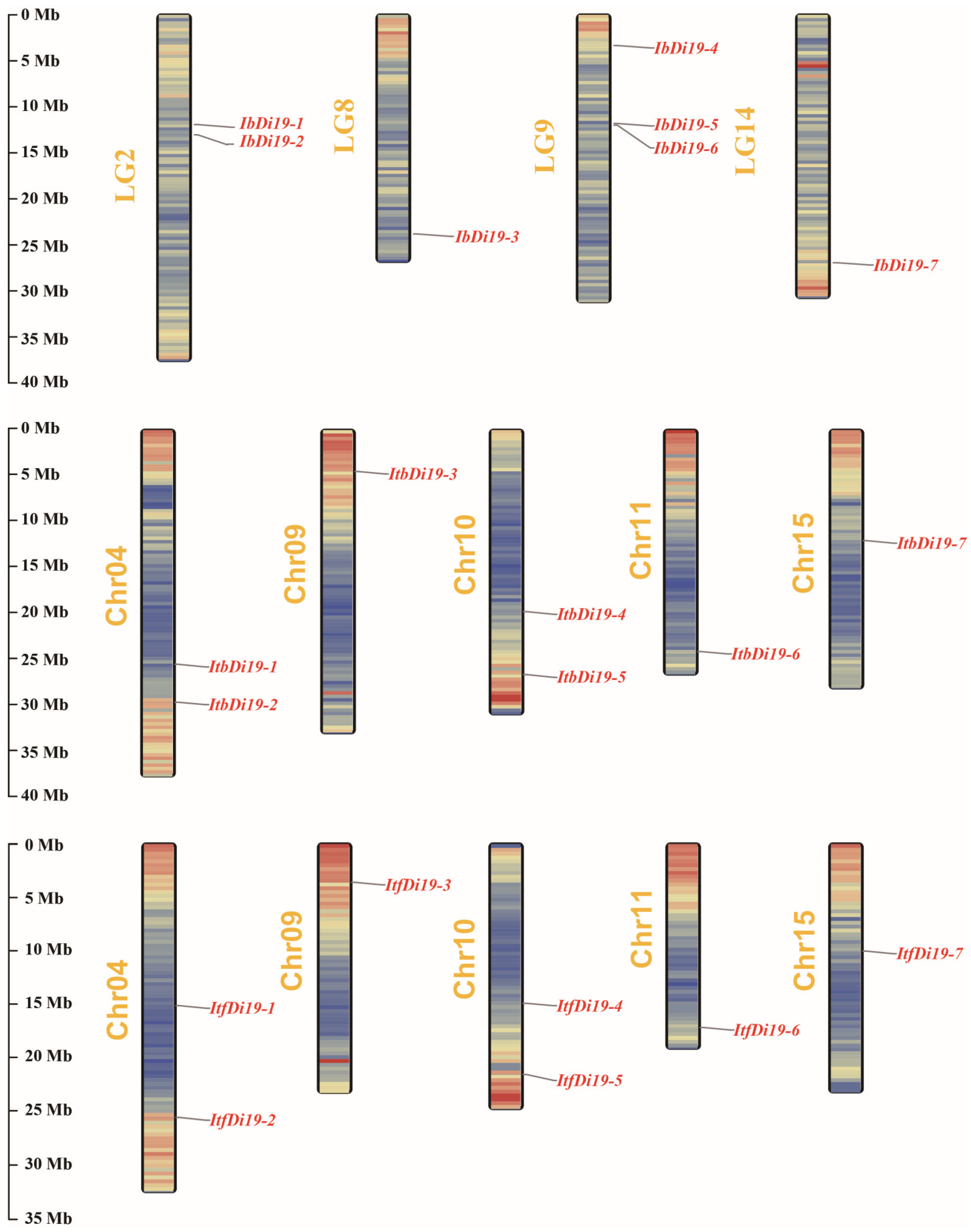
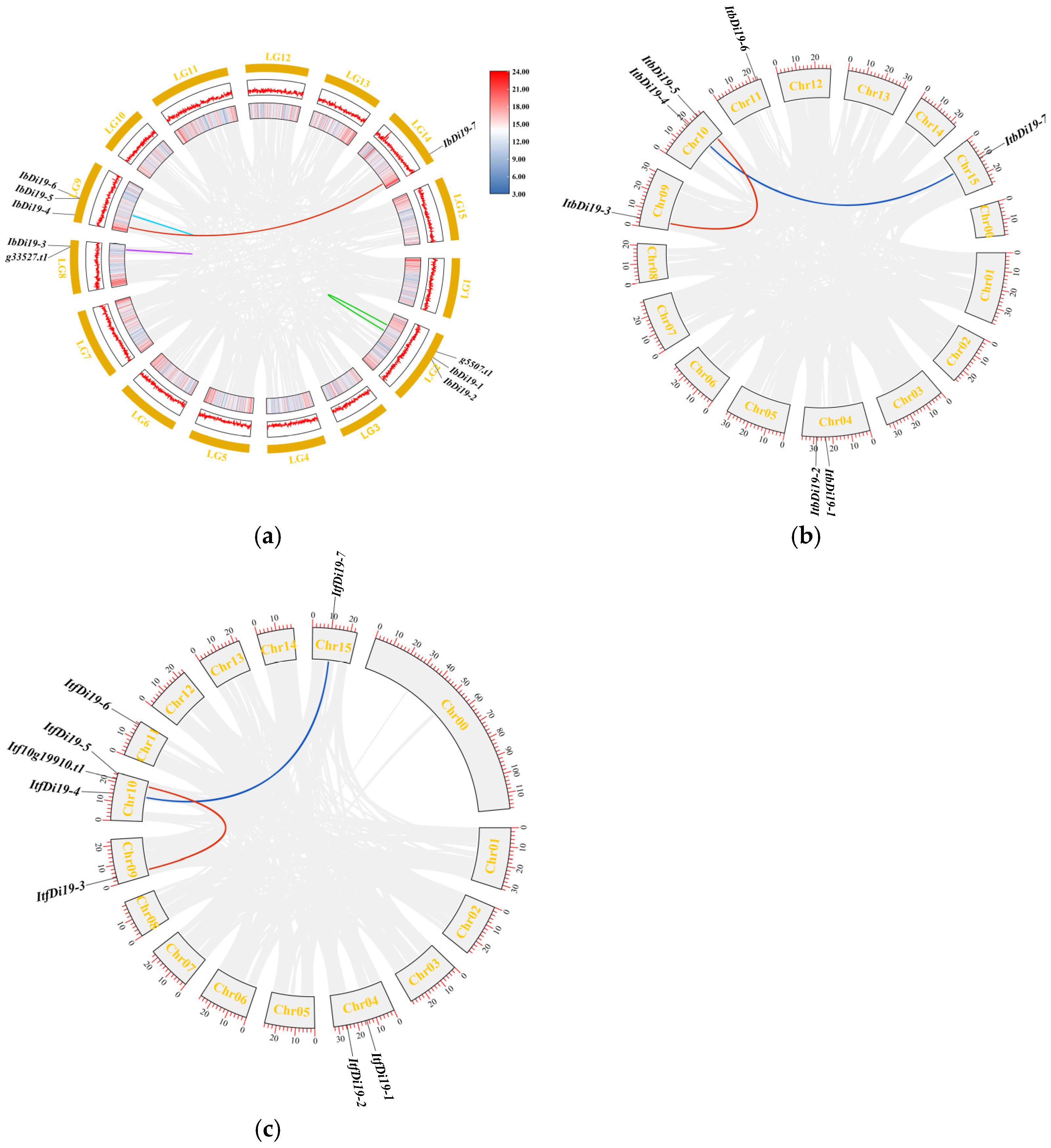
In this study, methods such as Blastp, hmmersearch, and CD-search were comprehensively employed, and seven members were identified in sweet potato and its two diploid relatives (Figure 1). They were named IbDi19-1 to IbDi19-7, ItbDi19-1 to ItbDi19-7, and ItfDi19-1 to ItfDi19-7 in sequence according to their positions on the chromosomes. The chromosomal localization numbers and physical segment distributions of Di19s in the two diploid relatives are highly conserved. In contrast, the chromosomal distribution pattern of IbDi19s shows significant divergence. In sweet potato, IbDi19s are distributed on 4 chromosomes. Two are located on LG2, one on LG8, three on LG9, and one on LG14. Di19s in both diploid relatives are distributed across five chromosomes. Two are on Chr04, one on Chr09, two on Chr10, one on Chr11, and one on Chr15.
The sequence characteristics and the physicochemical properties of IbDi19s were analyzed (Table 2). The genomic length of IbDi19s ranged from 2425 bp (IbDi19-7) to 4243 bp (IbDi19-5), and the CDS length ranged from 507 bp (IbDi19-2) to 975 bp (IbDi19-3). The amino acid length of IbDi19s was from 168 aa (IbDi19-2) to 324 aa (IbDi19-3), and their molecular weight ranged from 19.06 kDa (IbDi19-2) to 36.06 kDa (IbDi19-3). The isoelectric point of IbDi19s ranged from 4.45 (IbDi19-2) to 6.53 (IbDi19-3), all of which were less than 7, indicating that they were acidic proteins. The instability index of all IbDi19s proteins was greater than 40, suggesting that these proteins were unstable in vitro. The GRAVY scores of all IbDi19s were less than 0, indicating that they were all hydrophilic proteins. Among them, IbDi19-2 had the strongest hydrophilicity, and IbDi19-7 had the weakest hydrophilicity. The results of subcellular localization prediction showed that IbDi19s were all distributed in the nucleus.

3.2. Phylogenetic Analysis of Di19 Proteins

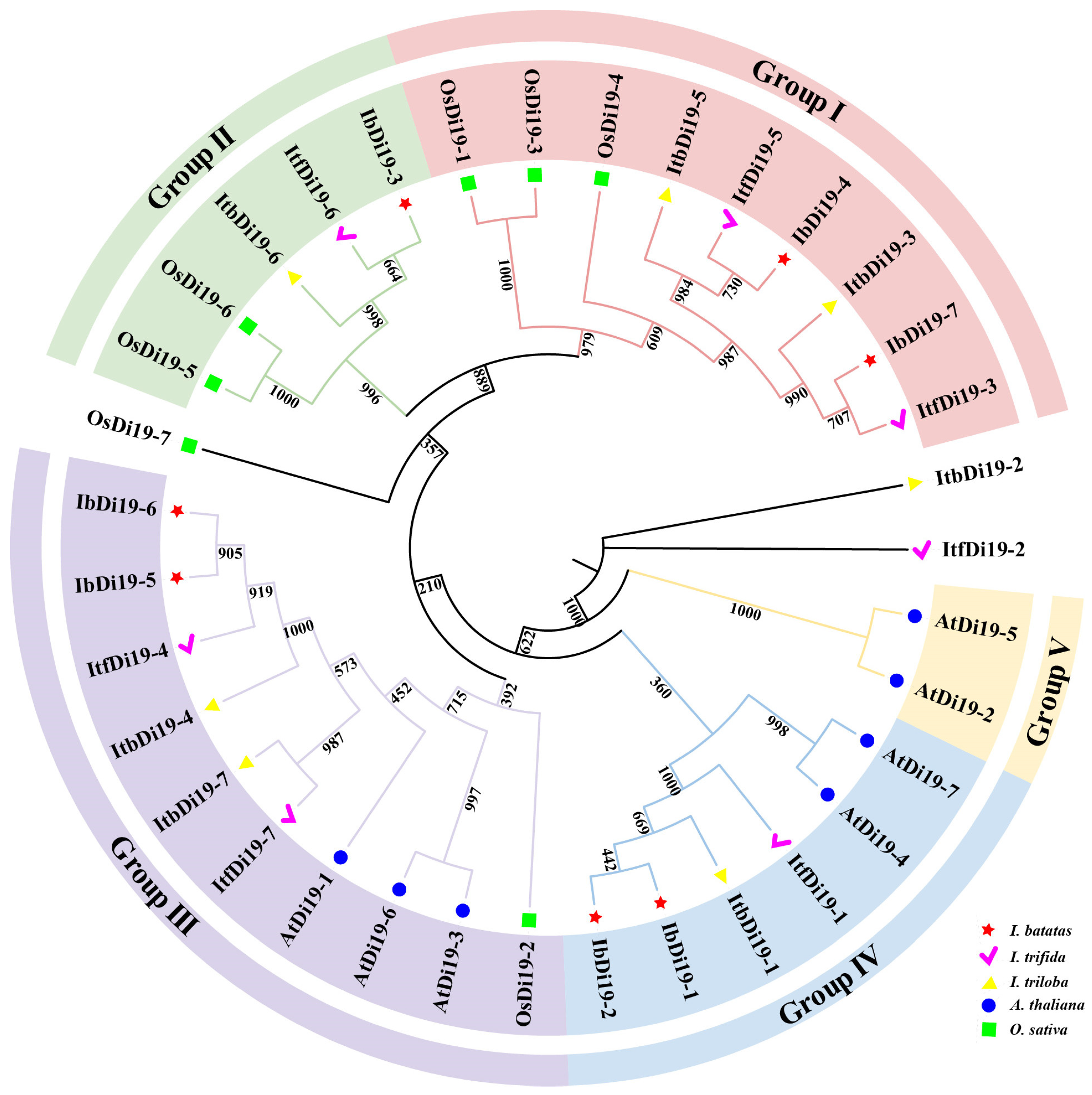
A phylogenetic tree of 35 Di19 proteins from five species, namely A. thaliana, O. sativa, I. batatas, I. triloba, and I. trifida, was constructed based on the maximum-likelihood method (Figure 2). The tree was divided into five major evolutionary branches (Group I~Group V), containing 9, 5, 10, 6, and 2 members, respectively. OsDi19-7, ItbDi19-2, and ItfDi19-2 were not classified into the above-mentioned five branches. In terms of species composition, Group V was a branch specific to A. thaliana, containing only two members, AtDi19-2 and AtDi19-5. The remaining four branches (Group I~Group IV) all showed cross-species distribution characteristics, but did not cover all five studied species.
The Di19 protein sequences of sweet potato and its two diploid relatives are highly conserved, showing distinct clustering characteristics in each evolutionary branch. In Group I, IbDi19-4, ItfDi19-5, and ItbDi19-5 cluster closely together. In Group III, IbDi19-5, IbDi19-6, ItfDi19-4, and ItbDi19-4 are tightly clustered. Some AtDi19s are located outside the clustering lineages of sweet potato and its two diploid relatives. For instance, in Group III, AtDi19-1, AtDi19-3, and AtDi19-6, and in Group IV, AtDi19-4 and AtDi19-7. Most OsDi19s either cluster outside the dicot species or form a monocot-specific sub-cluster alone. For example, in Group I, OsDi19-1, OsDi19-3, and OsDi19-4. In Group II, OsDi19-5 and OsDi19-6. In Group III, OsDi19-2. Bootstrap support values for most nodes of closely related sequences are greater than 700. Only some nodes of distantly related branches have relatively low support.

3.3. Gene Structure Analysis of Di19s in Sweet Potato and Its Two Diploid Relatives

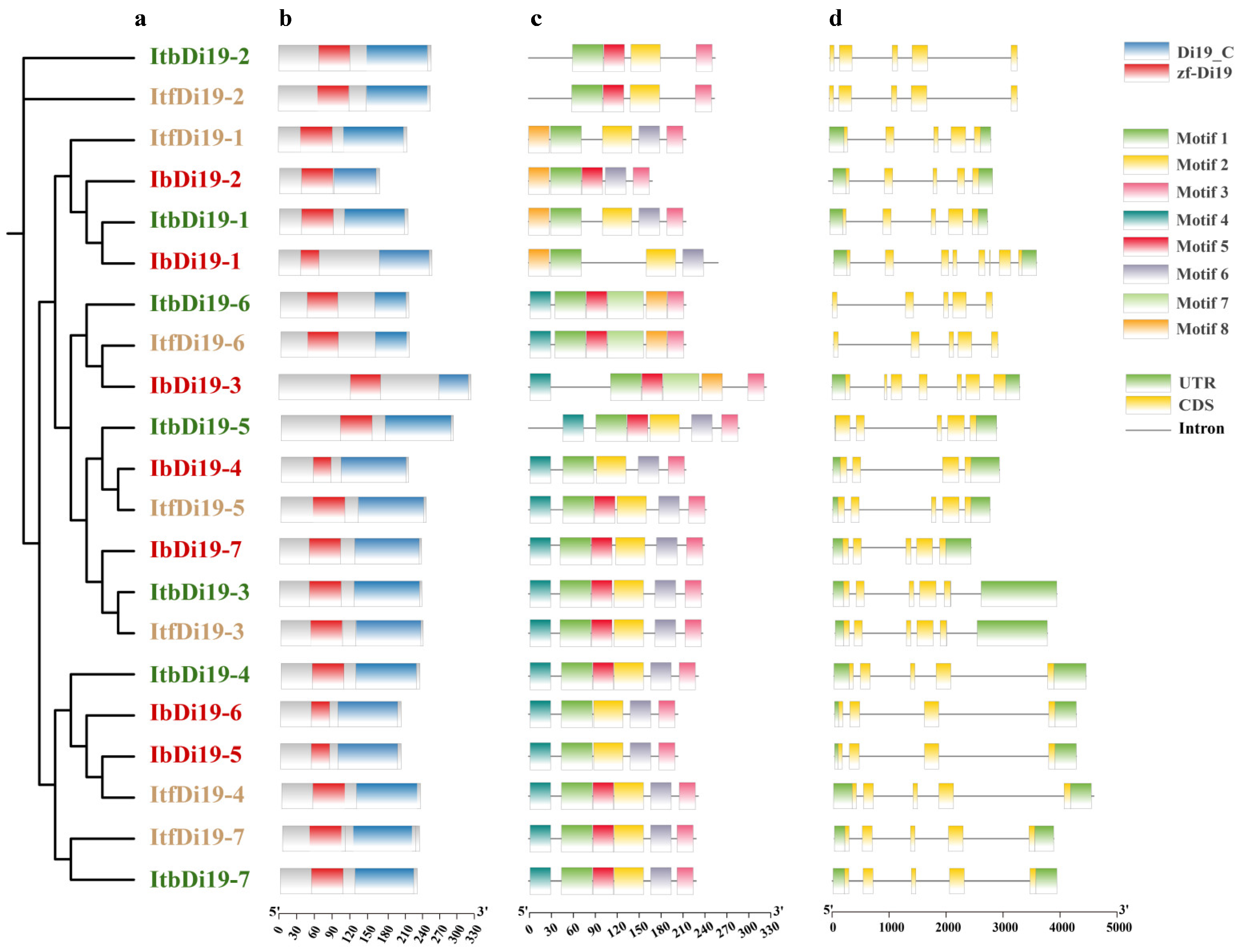
The phylogenetic tree of sweet potato and its two diploid relatives reveals that the Di19 protein sequences of the three species are highly conserved. Different gene members have diverged into multiple well-defined evolutionary branches. For example, IbDi19-7, ItbDi19-3, and ItfDi19-3 cluster closely together. IbDi19-4, ItbDi19-5, and ItfDi19-5 form another clustering branch (Figure 3a).
The analysis of the protein domains of Di19s reveals that all Di19s proteins possess Di19_C and zf-Di19 domains (Figure 3b). The zf-Di19 domain is adjacent to the N-terminus, and the Di19_C domain is near the C-terminus.
In the motif prediction analysis, the number of motifs in Di19 proteins of sweet potato and its two diploid relatives ranges from four to six (Figure 3c). IbDi19-7, ItbDi19-3, and ItfDi19-3 cluster in one branch of the phylogenetic tree, and the motifs of these three proteins are highly conserved in both number and structure. In addition, for some Di19 proteins clustered in the same branch, although they are highly conserved between the two diploid relatives, the number and structure of motifs in sweet potato have undergone specific variations. For example, the motifs are conserved between ItfDi19-1 and ItbDi19-1, whereas within the same clade, motif 3 is absent in IbDi19-1, and motif 2 in IbDi19-2 is replaced by motif 5. IbDi19-4 has one less motif 5 compared to ItbDi19-5 and ItfDi19-5 in the same branch. When compared with ItfDi19-4 and ItbDi19-4, both IbDi19-5 and IbDi19-6 lack motif 5.
Analysis of the intron-exon structure reveals that IbDi19s contain four to eight exons, while both ItbDi19s and ItfDi19s contain only five exons (Figure 3d). Some IbDi19s show certain differences in exon–intron structure compared to ItbDi19s and ItfDi19s in the same branches. For example, both IbDi19-5 and IbDi19-6 contain only four exons, while ItbDi19-4, ItbDi19-7, ItfDi19-4, and ItfDi19-7 all contain five exons. IbDi19-2, ItbDi19-1 and ItfDi19-1 all contain five exons, while IbDi19-1 contains eight exons. IbDi19-3 contains seven exons, while ItbDi19-6 and ItfDi19-6 contain only five exons. IbDi19-4 contains four exons, while ItbDi19-5 and ItfDi19-5 contain only five exons.

3.4. Analysis of Cis-Acting Elements in the Promoters of IbDi19s

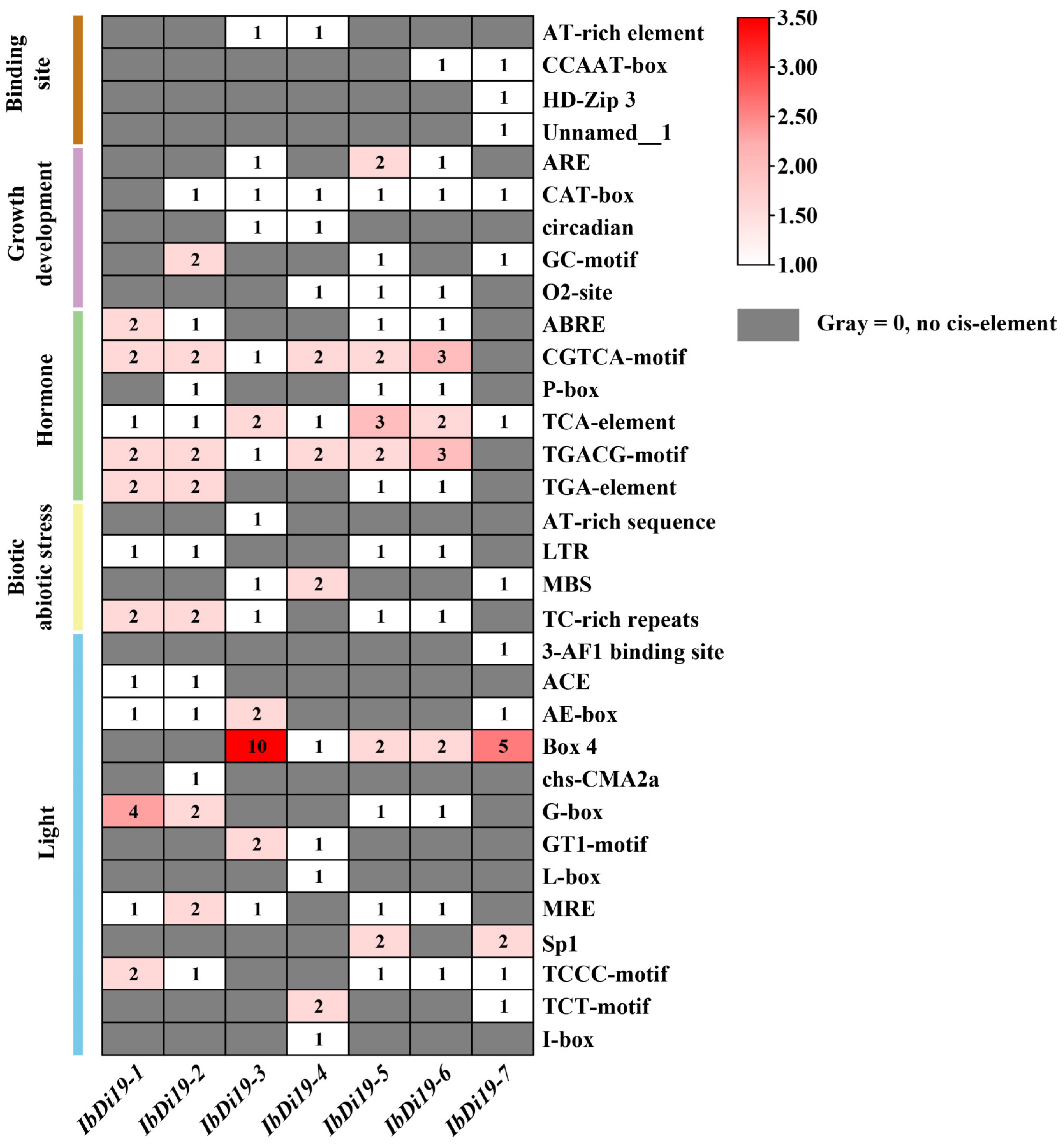
We extracted the 2000 bp promoter sequences upstream of IbDi19s and conducted an analysis of their cis-acting elements. According to the functional prediction, there are five types of cis-elements within the 2000 bp promoter region upstream of IbDi19s, namely binding sites, growth and development elements, hormone-related elements, biotic and abiotic stress-related elements, and light-related elements (Figure 4).
The results showed that all seven IbDi19s contain a large number of core promoter elements, common cis-acting elements, and some protein-binding sites. In terms of growth and development, IbDi19-3, -5, and -6 contain one, two, and one ARE cis-element(s), respectively, which are essential for anaerobic induction. All except IbDi19-1 contain one CAT-box cis-element related to meristem expression. IbDi19-3 and IbDi19-4 each contain one cis-element involved in circadian rhythm regulation. IbDi19-2, -5, and -7 contain two, one, and one enhancer element(s) GC-motif-involved in hypoxia-specific induction, respectively. IbDi19-4, -5, and -6 each contain one O2-site cis-element involved in zein metabolism regulation.
In terms of hormones, IbDi19-1, -2, -5, and -6 contain two, one, one, and one ABRE cis-element(s) involved in abscisic acid response, respectively. All except IbDi19-7 contain 2~6 cis-elements involved in methyl jasmonate response, such as CGTCA-motif and TGACG-motif. IbDi19-2, -5, and -6 each contain one gibberellin-responsive element P-box. All IbDi19s contain 1~3 TCA-elements involved in salicylic acid response. IbDi19-1, -2, -5, and -6 contain two, two, one, and one auxin-responsive element(s), the TGA element, respectively. In terms of biotic and abiotic stress, IbDi19-3 contains one cis-element AT-rich sequence related to plant disease resistance. IbDi19-1, -2, -5 and -6 each carry one LTR cis-element associated with cold responsiveness. IbDi19-3, -4, and -7 contain one, two, and one MYB-binding site(s) involved in drought inducibility, respectively. All except IbDi19-4 and IbDi19-7 contain 1~2 TC-rich repeating cis-elements involved in defense and stress responses. Each IbDi19s contains a variety of light-responsive elements, such as Box 4, G-box, TCCC-motif, etc.

3.5. Analysis of Protein–Protein Interaction Network of IbDi19s

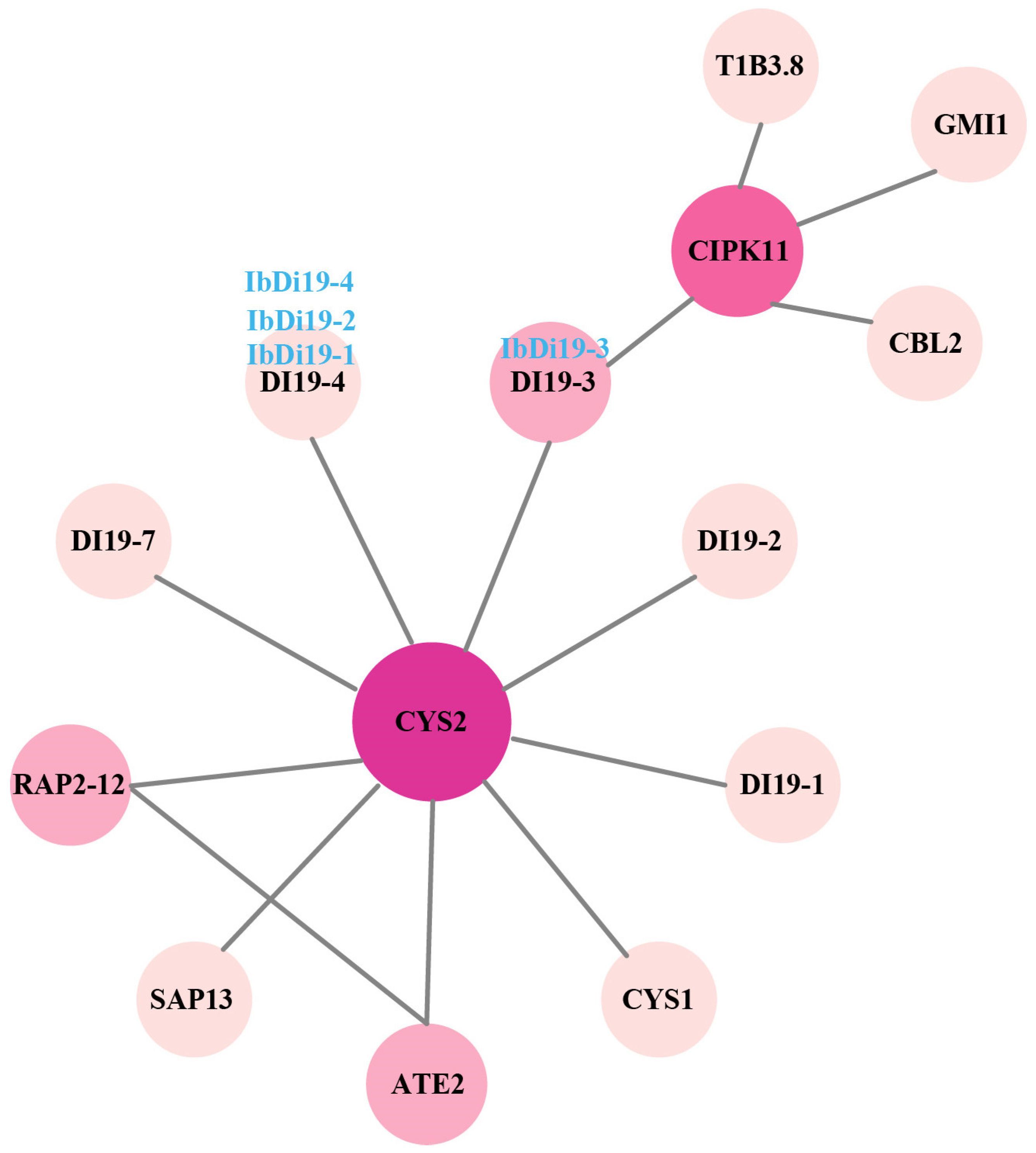
To explore the potential regulatory network of IbDi19s, we constructed an interaction network predicted based on the Di19 homologous proteins in A. thaliana (Figure 5). The results showed that the A. thaliana proteins DI19-1, DI19-2, DI19-3, DI19-4, and DI19-7 interact with four other proteins, RAP2-12, SAP13, ATE2, and CYS1, and all of them interact with CYS2. CYS1 and CYS2 are members of the cystatin gene family, and SAP13 is a member of the stress-associated protein gene family [47,48,49,50]. These proteins are involved in the response and regulation processes of various abiotic stresses such as low temperature, drought, and high salt [47,48,49,50]. The A. thaliana proteins DI19-3, T1B3.8, GMI1, and CBL2 may interact with CIPK11. As an important protein kinase in the calcium-regulated pathway, CIPK is also involved in the response processes of various abiotic stresses such as low temperature, drought, and salt stress [51,52,53]. Multiple studies have demonstrated that CIPK11 acts as a partial upstream modulator of the drought response in A. thaliana via targeting the transcription factor Di19-3 [54]. Based on the homologous mapping files, IbDi19 -1, -2, and -4 were determined to be homologous to DI19-4, and IbDi19-3 was homologous to DI19-3 in A. thaliana. Given these conservation characteristics, it is speculated that homologous proteins in sweet potato may exhibit similar protein–protein interaction patterns. The interaction relationships in this section are all predicted results inferred from homology. They are only used to propose research hypotheses and do not represent the real protein–protein interactions in sweet potato.

3.6. Collinearity Analysis of Di19s in Sweet Potato and Its Two Diploid Relatives

Intraspecific collinearity analysis of Di19s genes in sweet potato and its two diploid relatives was carried out. The results showed that I. batatas, I. triloba, and I. trifida contained four, two, and two segmental duplication gene pairs, respectively, with no tandem duplication gene pairs (Table 3 and Figure 6). Among them, IbDi19-2 and IbDi19-3 formed segmental duplication gene pairs with g5507.t1 and g33527.t1 respectively (Table 3, Figure 6a). These two genes do not belong to the Di19 gene family, because they both contain only a zf-Di19 domain. Although itf10g19910.t1 shows collinearity with ItfDi19-3, it only harbors a partial Di19_C domain and is not classified as a canonical ItfDi19 family member.
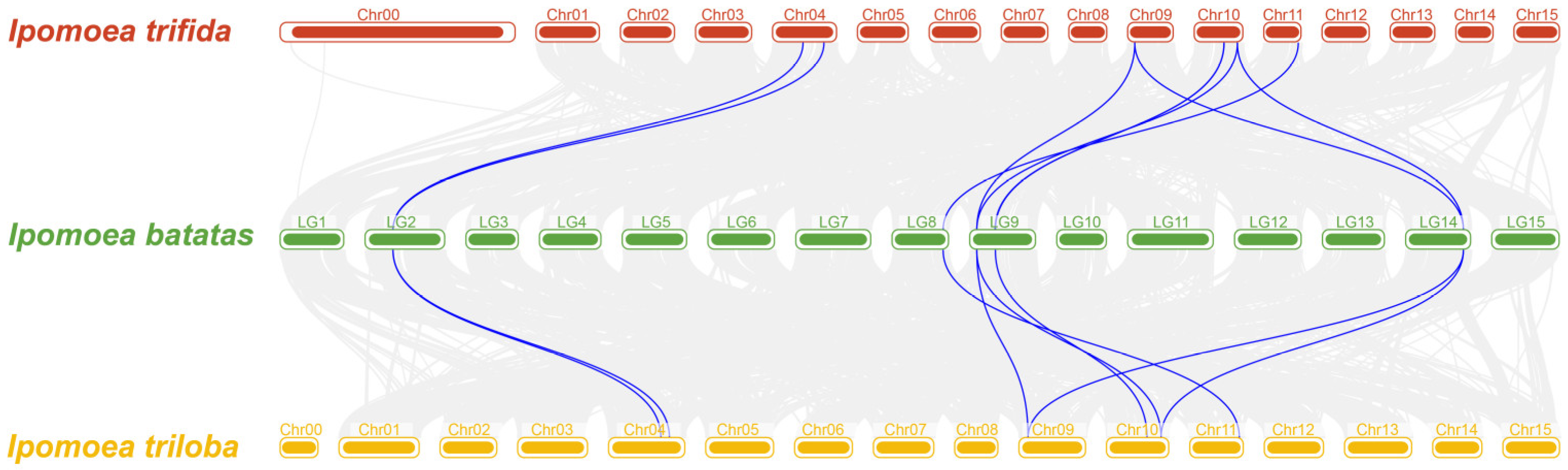
We conducted interspecific collinearity analysis on A. thaliana, sweet potato, and its two diploid relatives. We found that there were no collinear genes of Di19s between A. thaliana and sweet potato. Therefore, we carried out collinearity gene analysis between the genomes of I. trifida and I. batatas, and between I. batatas and I. triloba (Table 4, Figure 7). The results showed that there were eight pairs of gene pairs in each of the two groups of genomes (Table 4 and Figure 7). The collinear genes of I. batatas in the two diploid relatives showed a symmetric distribution (Figure 7). IbDi19-4 and IbDi19-7 had a collinear relationship with the same gene, itf10g19910.t1 (Table 4, Figure 7).
Evolutionary selection pressure analyses were performed on the intraspecific and interspecific collinear gene pairs of sweet potato and its two diploid relatives, using the Ka/Ks ratio (Table 5). For some gene pairs, factors such as sequence divergence saturation, absence of substitution sites, and a Ks value of 0 prevent the calculation of reliable Ka/Ks ratios. Results of this kind are uniformly labeled as “Na” and are not included in subsequent comparative analyses. The Ka/Ks values of the remaining collinear genes that could be calculated normally were all less than 0.6, indicating that they are all under the constraint of purifying selection.

3.7. Expression Analysis of Di19s in Sweet Potato and Its Two Diploid Relatives

3.7.1. Expression Analysis in Different Tissues

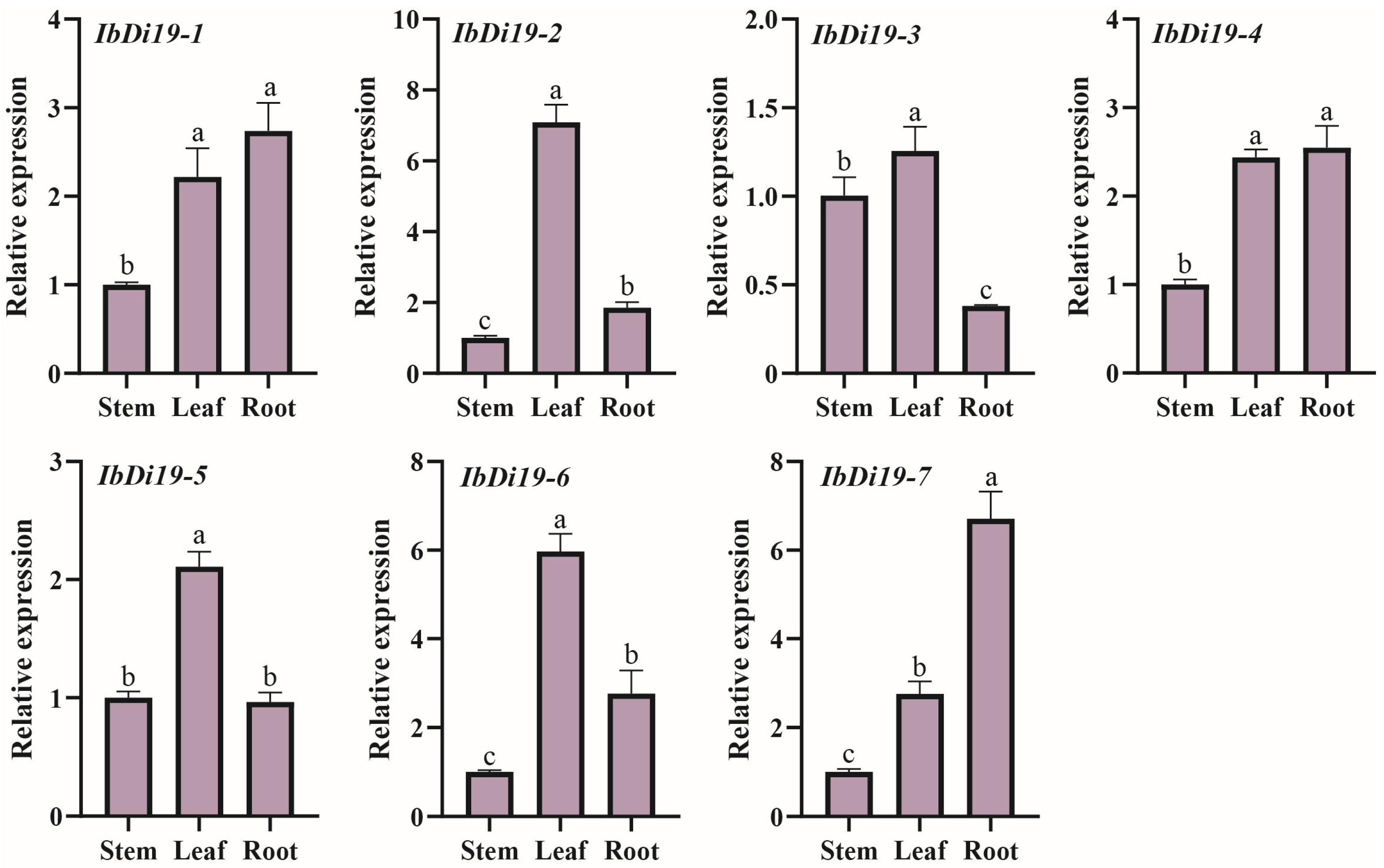
The expression patterns of IbDi19s in the roots, stems, and leaves of in vitro plantlets were analyzed by RT-qPCR (Figure 8). The results showed that IbDi19-1, IbDi19-4, and IbDi19-7 had the highest expression levels in the roots. IbDi19-2, IbDi19-3, IbDi19-5, and IbDi19-6 had the highest expression levels in the leaves. Except for IbDi19-3, the expression levels of IbDi19s in the stem were relatively low.
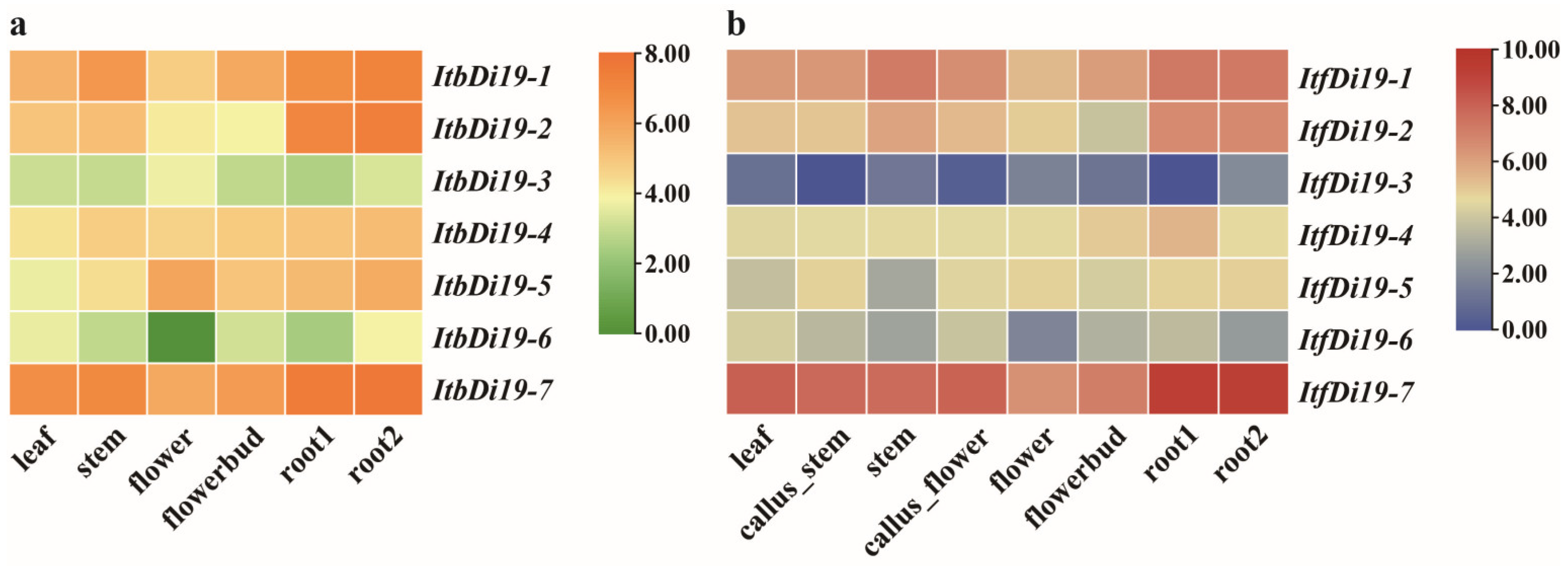
An analysis was conducted on the expression patterns of Di19s in different tissues of I. triloba and I. trifida (Figure 9). The results showed that the expression patterns of Di19s in the two diploid relatives were similar. Di19-7 had relatively high expression levels in various tissues, followed by Di19-1. The expression levels of Di19-7, -1, and -2 in root1 and root2 were much higher than those of other Di19 members in root1 and root2, and also much higher than their expression levels in most tissues. ItbDi19-5 had relatively high expression levels in root2 and flower, and ItbDi19-1 was highly expressed in flower bud and stem. ItfDi19-2 was highly expressed in the stem.

3.7.2. Expression Analysis in Response to Different Hormones

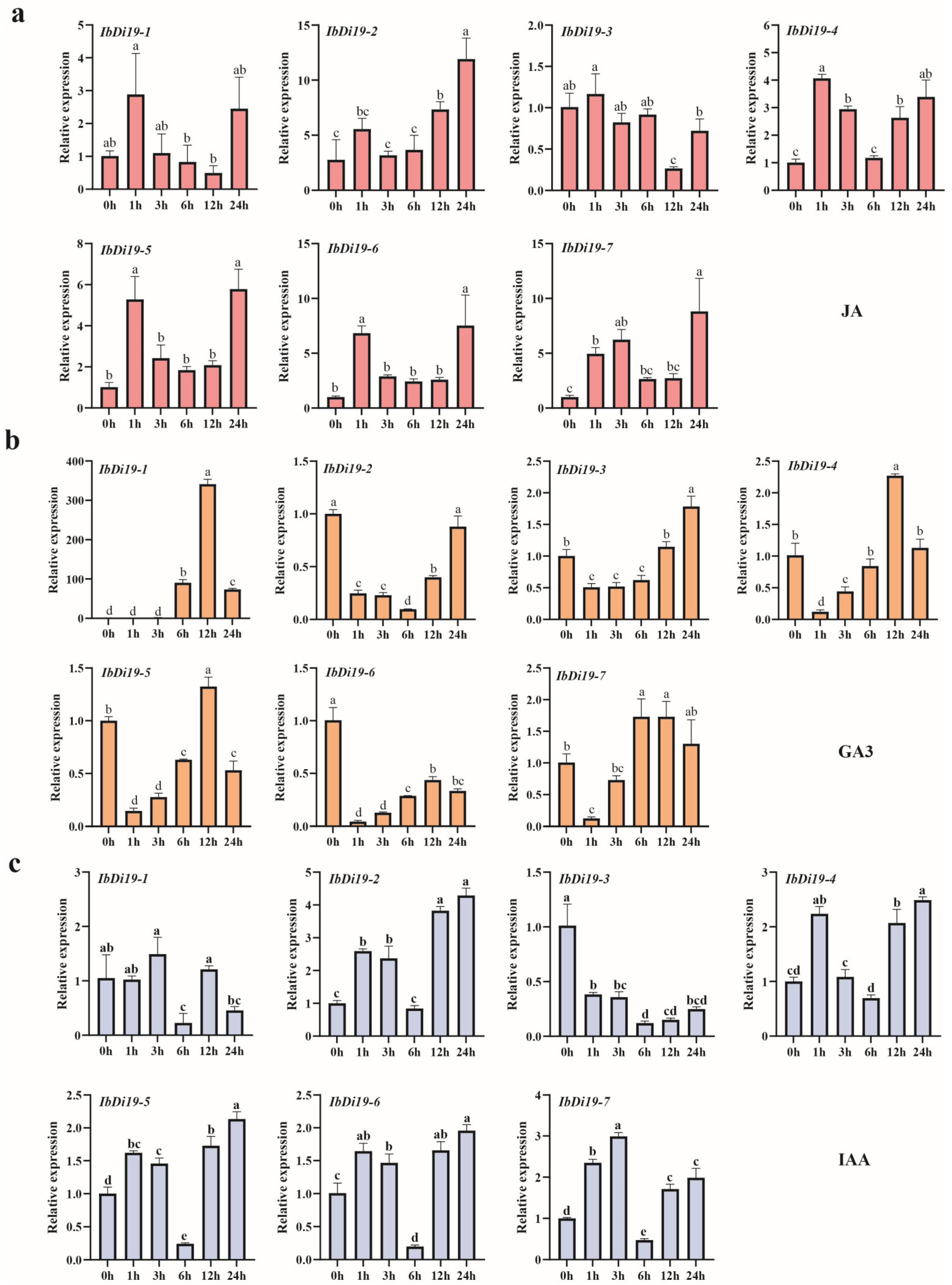
To explore the expression patterns of IbDi19s under different hormone responses, we performed RT-qPCR analysis of IbDi19s treated with JA, GA3, and IAA (Figure 10).
JA treatment induced distinct transcriptional responses of varying magnitudes among IbDi19 members. (Figure 10a). The expression patterns of IbDi19-1, -4, -5, -6, and -7 were similar. Their expression levels increased to reach the first peak at 1 h or 3 h after JA treatment, then decreased, and finally increased again to reach the peak at 24 h after treatment. IbDi19-2 reached the peak at 24 h after JA treatment, with the expression level approximately 4 folds that at 0 h. The expression level of IbDi19-3 significantly decreased at 12 h and 24 h after JA treatment, but the overall change in expression level was very small.
There was no significant change in the expression level of IbDi19-1 after 1 h and 3 h of GA3 treatment. (Figure 10b). It was significantly up-regulated at 6 h of GA3 treatment, with the expression level 89 folds that at 0 h. It showed the strongest response after 12 h of GA3 treatment, with the expression level 336 folds that at 0 h, reaching the peak. Finally, it was significantly down-regulated at 24 h of treatment, with the expression level 73 folds that at 0 h. IbDi19-2~IbDi19-7 showed a trend of first significantly decreasing and then significantly increasing under GA3 treatment, but the overall fluctuation in expression level was very small compared with IbDi19-1.
The expression patterns of IbDi19-2 and IbDi19-7 were similar under IAA treatment (Figure 10c). Their expression levels first increased significantly, then decreased significantly, reaching the lowest level at 6 h of treatment, and finally increased significantly again. Although the remaining IbDi19s had significant expression in response to IAA treatment, the overall change in expression level was very small.
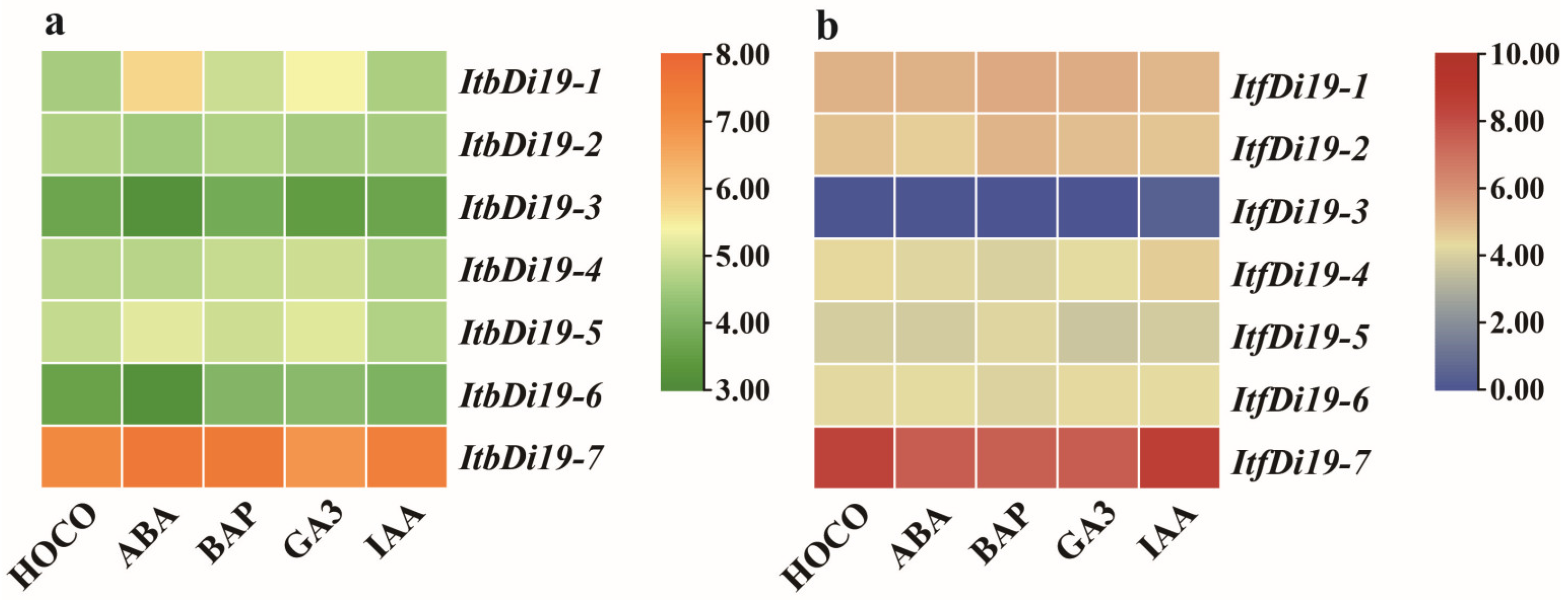
Through the RNA-seq data of I. triloba and I. trifida under treatments of ABA, BAP, GA3 and IAA, the expression patterns of the two diploid relatives in response to different hormones were analyzed (Figure 11). In I. triloba, compared with the control group, ItbDi19-7 was induced by ABA, BAP, and IAA, and inhibited by GA3 (Figure 11a). ItbDi19-1 was induced by ABA and GA3, while other ItbDi19s were insensitive to hormone treatment. In I. trifida, compared with the control group, ItfDi19-7 was induced by IAA, and inhibited by ABA, BAP, and GA3, while other ItfDi19s were insensitive to hormone treatment (Figure 11b).

3.7.3. Expression Analysis Under Different Temperatures

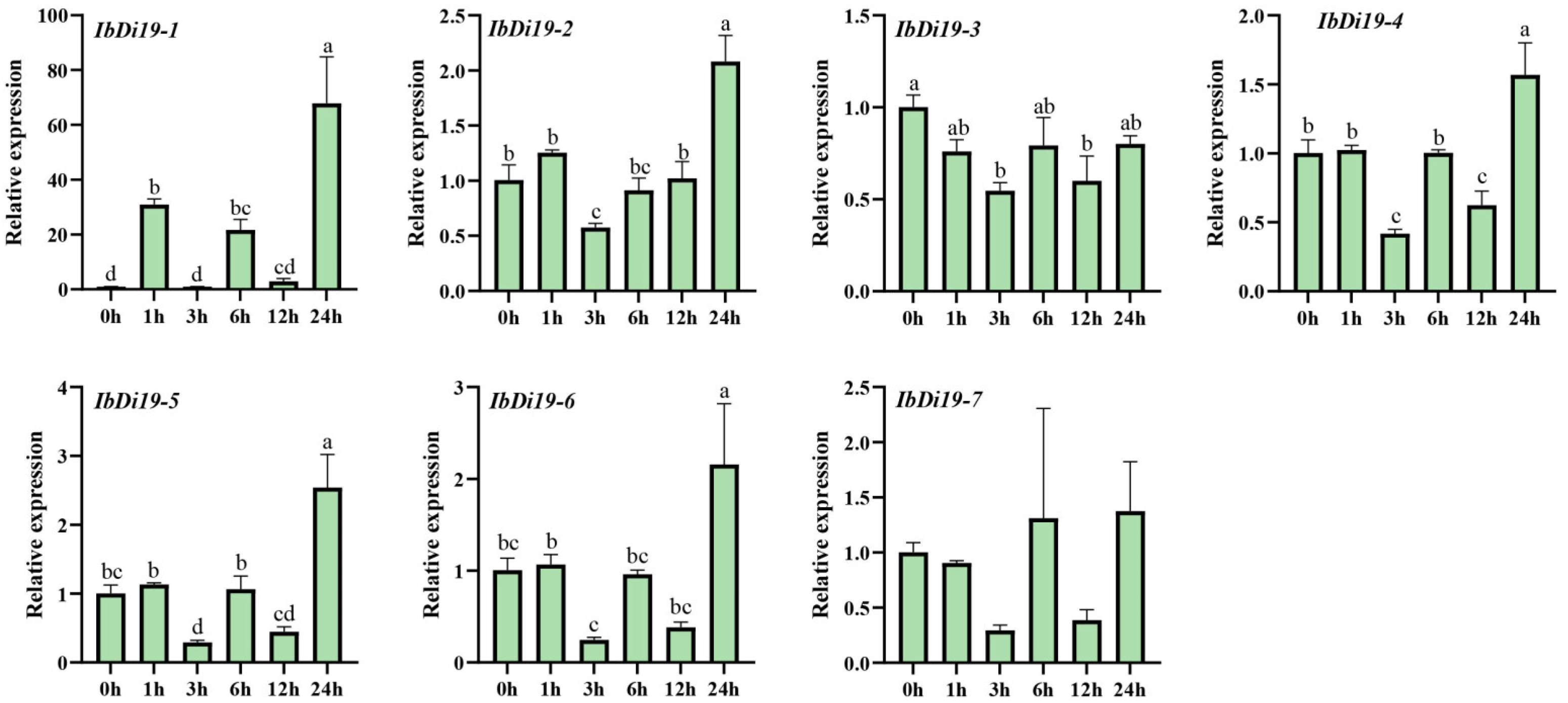
We analyzed the expression patterns of IbDi19s at 0 h, 1 h, 3 h, 6 h, 12 h, and 24 h under cold treatment at 4 °C (Figure 12). The expression of IbDi19-1 was significantly up-regulated at 1 h and 6 h of treatment, with the expression levels being 31-fold and 22-fold that at 0 h, respectively. It was significantly down-regulated at 3 h and 12 h of treatment. At 24 h, it was strongly induced at 24 h under cold stress, reaching a 68-fold that of 0 h. The expression patterns of IbDi19-2, -4, -5, and -6 were similar. Their expression levels significantly decreased at 3 h and significantly increased at 24 h. IbDi19-7 did not show significant expression under cold treatment, and IbDi19-3 was continuously down-regulated after cold treatment.
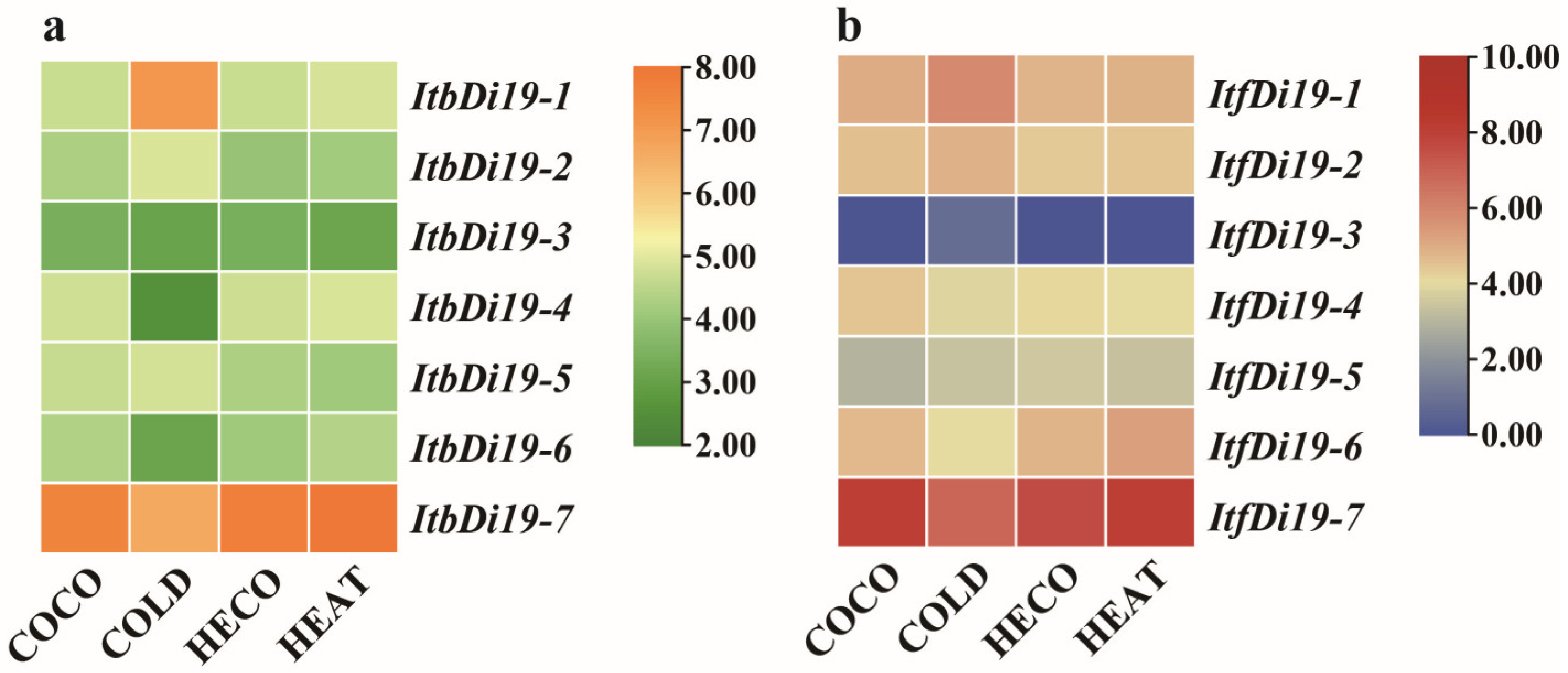
The RNA-seq data of the two diploid relatives under COLD and HEAT stresses were analyzed (Figure 13). Overall, the Di19 gene family exhibited similar expression patterns in I. triloba and I. trifida. Compared with the COCO, Di19-1 was induced under COLD, whereas Di19-7 was severely inhibited under COLD. Notably, ItbDi19-1 was strongly induced with a five-fold up-regulation (Figure 13a). Compared with the HECO, Di19-7 was up-regulated under HEAT, while the expression levels of most Di19s changed little. In addition, ItfDi19-6 displayed moderate up-regulation under HEAT (Figure 13b).

3.7.4. Expression Analysis of Diploid Relatives Under Biotic and Abiotic Stresses

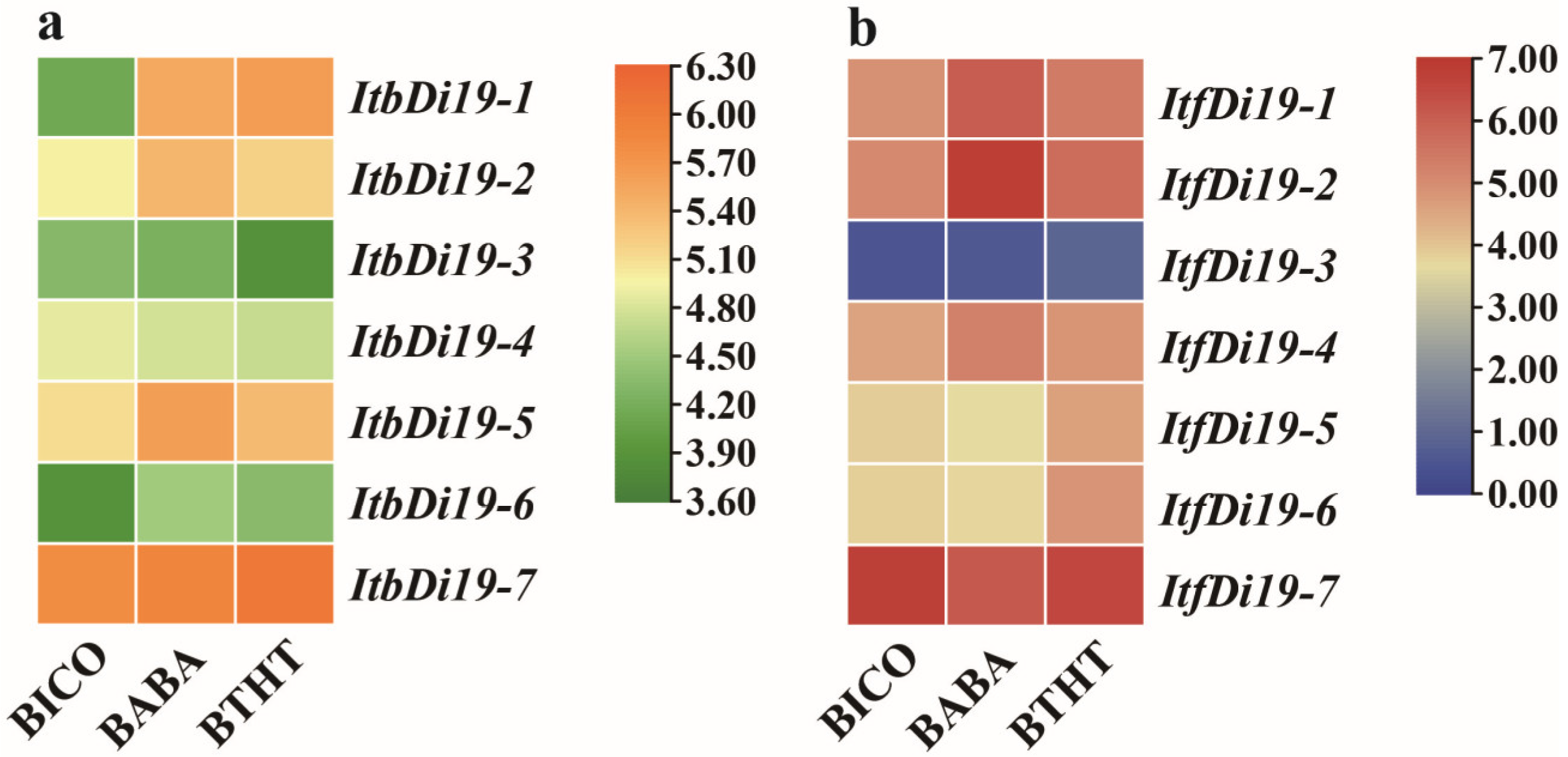
To explore the responses of the two diploid relatives to biotic stress, we analyzed the RNA-seq data of I. triloba and I. trifida treated with two biotic stress elicitors: Beta-Aminobutyric Acid and benzothiadiazole S-methylester (Figure 14). In I. triloba, compared with the control group, ItbDi19-1, -2, -5, and -6 were induced by BABA and BTHT, and ItbDi19-7 was induced by BTHT (Figure 14a). Among them, ItbDi19-1 showed the strongest response to the two plant disease-resistant inducers, with approximately three-fold up-regulation compared to the control. In I. trifida, compared with the control group, ItfDi19-1, -2, and -4 were induced by BABA (Figure 14b). ItfDi19-1 and ItfDi19-2 were up-regulated approximately two-fold and three-fold, respectively, compared to the control. ItfDi19-7 was inhibited by BABA and BTHT, and the remaining ItfDi19s were up-regulated to some extent under BTHT treatment.
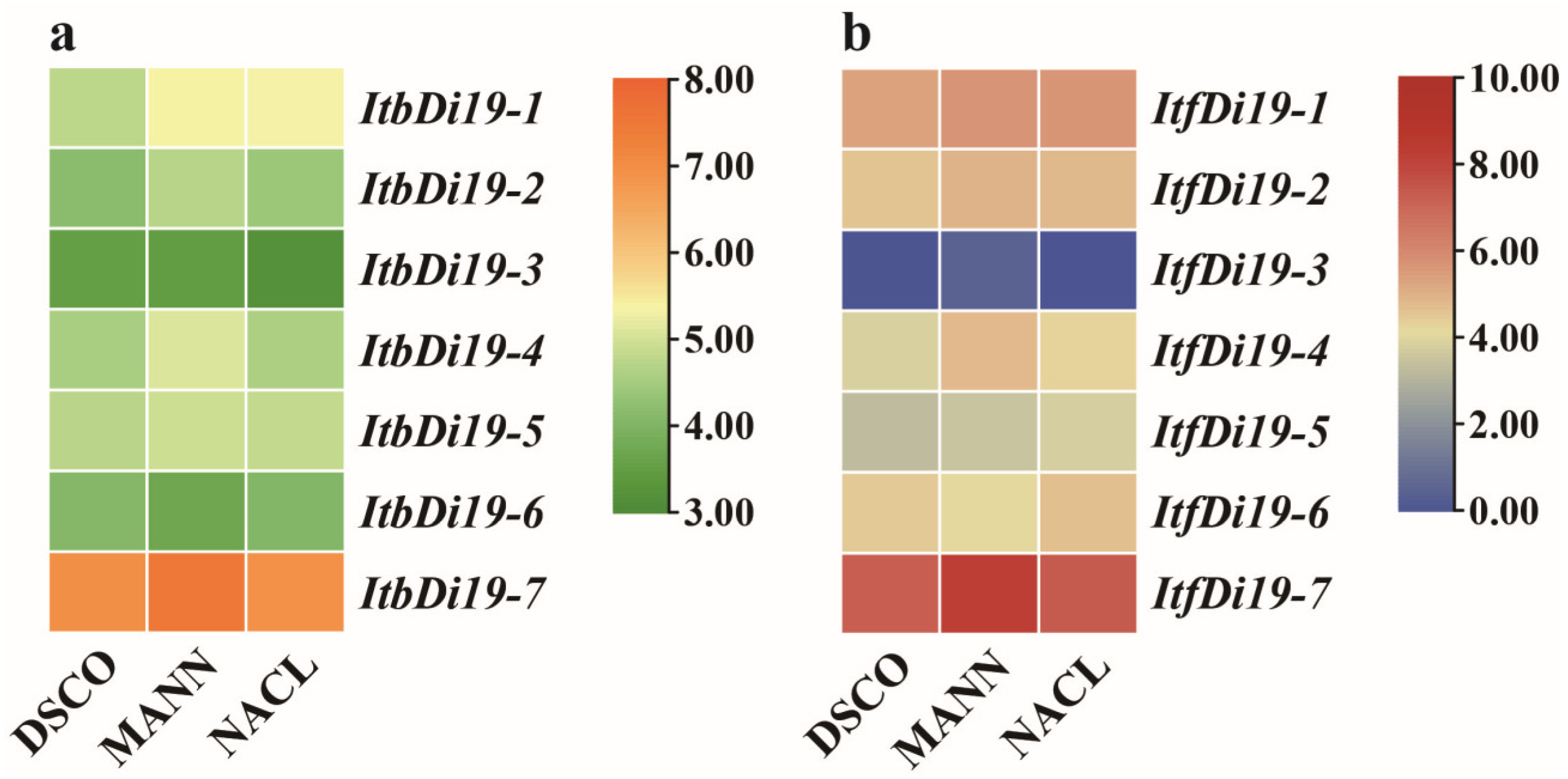
To explore the expression patterns of the two diploid relatives under drought and salt stresses, we analyzed their RNA-seq data from the MANN and the NACL experiment (Figure 15). Di19 genes exhibited similar expression patterns in I. triloba and I. trifida under the mannitol drought stress experiment and the NaCl salt stress experiment. Di19-7 showed the most intense response to the MANN experiment, while Di19-6 was slightly inhibited. Di19-1 was induced by the NACL experiment, while the expression levels of most Di19s changed only slightly under NACL treatment. ItfDi19-3 was inhibited by the NaCl experiment.

4. Discussion

4.1. Evolution of Di19s in Sweet Potato and Its Two Diploid Relatives

In this study, seven members of the Di19 gene family were identified in sweet potato and its two diploid relatives (Figure 1). This number is exactly the same as that of the Di19 gene family members in several representative plants, such as A. thaliana, O. sativa, maize, barley, and poplar [14,16,18,22,25]. This indicates that the seven Di19 members might be a highly conserved set of essential genes, representing the ancestral state of this family, and have been maintained stably by purifying selection during long-term evolution [55]. However, there are only six Di19 members in grape, suggesting that a minor lineage-specific gene loss might have occurred [56,57]. In moso bamboo, there are ten Di19 members, which may be related to its genome duplication and specific growth and development requirements [58,59]. In wheat, cotton, soybean, and peanut, the number has expanded to 15~18 [17,19,20,21]. This may be attributed to multiple whole-genome duplication or allopolyploidization events, and the duplicated genes were selectively retained or lost during domestication and adaptive evolution [60,61,62,63].
Di19 proteins exhibit numerous conserved features during the evolutionary process of sweet potato and its two diploid relatives. The Di19 genes share identical distribution patterns in terms of chromosomal number and physical intervals in the two diploid relatives, indicating highly conserved chromosomal localization of Di19s between these two species (Figure 1). Comprehensive analysis of the intra-Ipomoea phylogenetic tree and the phylogenetic tree constructed with A. thaliana and O. sativa revealed that Di19 proteins from sweet potato and its two diploid relatives consistently clustered together, suggesting high sequence conservation of Di19 proteins among the three species (Figure 2 and Figure 3). All Di19s contain two characteristic domains. The number and type of predicted motifs in diploid-related species are consistent, indicating that the protein structure of Di19 is conserved (Figure 3b). In the collinearity and selection pressure analyses, multiple collinear gene pairs were identified both within and between the three species (Table 3 and Table 4, as well as Figure 6 and Figure 7). Moreover, the Ka/Ks ratios of these collinear gene pairs were all less than 0.6, suggesting that they were all under purifying selection constraints (Table 5).
Despite a high degree of conservation, significant lineage divergence has occurred in the Di19 genes between sweet potato and its diploid relatives. In chromosomal localization, the Di19-1, -2, -3, and -7 of the two diploids could all find corresponding copies on the related chromosomes of the sweet potato (Figure 1). However, Di19-4, -5, and -6 located on adjacent chromosomes Chr10 and Chr11, respectively, in diploid, correspond to a single linkage group LG9 in sweet potato (Figure 1). This indicates that during the evolution of sweet potato from diploid ancestors to hexaploid, chromosomal rearrangement events might have occurred in the ancestral genome. As a result, the Di19 gene clusters originally distributed on two chromosomes converged onto the same chromosome. Existing research has shown that hexaploid sweet potato is composed of two major subgenomes, B1 and B2 [64]. This species originated from triploids produced by crossing diploid B1 parents with tetraploid B2 parents, and then forming a hexaploid through whole genome duplication [64]. After the polyploidization event, extensive chromosomal rearrangements and fragment exchanges occurred between subgenomes, driving the reshaping of the sweet potato genome structure [64].
There is a significant divergence in the number of exons among the Di19 family in sweet potato (Figure 3d). IbDi19-2 and IbDi19-7 maintain the conserved structure of five exons with their diploid relatives (Figure 3d). IbDi19-4, -5, and -6 have been streamlined to four exons through exon loss, and the exons of IbDi19-1 and -3 have expanded to eight and seven, respectively (Figure 3d). In motif prediction, compared with diploid relatives, most Di19 proteins in sweet potato have experienced motif loss and substitution (Figure 3c). IbDi19-1 has lost motif 3, IbDi19-4, -5, and -6 have all lost motif 5, and motif 2 of IbDi19-2 has been replaced by motif 5 (Figure 3c). These differentiation characteristics might endow sweet potato with specific gene regulatory patterns and functions.

4.2. Role of IbDi19s in Abiotic Stress Responses in Sweet Potato

In RT-qPCR analysis, IbDi19-1 showed a significant up-regulation in both cold treatment and GA3 treatment (Figure 10b and Figure 12). Its expression reached peak values at 24 h under cold treatment and 12 h under GA3 treatment (Figure 10b and Figure 12). Compared with the control, its expression was up-regulated by 68-fold and 336-fold, respectively, approximately 39-fold and 280-fold the expression levels of other IbDi19s during the same period (Figure 10b and Figure 12). IbDi19-1 was particularly prominent among all the hormone treatments and members of the Di19 family in this study. Since the maximum duration of cold treatment designed in this study was 24 h, and the expression level of IbDi19-1 peaked at 24 h, it is possible that the expression of IbDi19-1 would continue to increase with the extension of cold treatment time (Figure 12). IbDi19-1 has the potential to continuously respond to cold treatment, which requires further experimental verification. In the COLD treatment, the expression of ItbDi19-1 and ItfDi19-1 was up-regulated approximately five-fold and two-fold, respectively, compared to the control (Figure 13). This was consistent with the expression trend of IbDi19-1 in the RT-qPCR analysis under cold treatment (Figure 12). The three genes are clustered in the same branch on the phylogenetic tree (Figure 2 and Figure 3).
In the analysis of promoter cis-acting elements, no classical gibberellin-responsive elements were predicted in IbDi19-1 (Figure 4). Instead, multiple hormone-responsive elements for ABA, MeJA, SA, and IAA were present (Figure 4). It is speculated that its gibberellin response may not be achieved by directly binding to gibberellin pathway transcription factors through its own promoter. Instead, it might be regulated indirectly through cross-interactions of hormone pathways or upstream cascade indirect regulation. IbDi19-1 was predicted to carry the low-temperature responsive element LTR (Figure 4). This element can mediate the transcriptional activation of genes by low-temperature signals, which explains the molecular reason for the strongly induced expression of this gene under cold stress at the cis-regulation level. The results of promoter prediction and RT-qPCR under low temperatures corroborated each other.
Both ItbDi19s and ItfDi19s have only five exons (Figure 3). However, the number of exons of IbDi19-1 has reached eight during the evolutionary process, making it the member with the largest number of exons among all IbDi19s (Figure 3). In the Motif analysis, compared with the Di19 proteins of diploid relatives that clustered in the same branch, motif three of IbDi19-1 was lost (Figure 3). This increase in the number of exons and change in gene structure may enhance the gene’s stress response ability.
Research reports that gibberellin can promote processes such as seed germination, plant flowering, and release of bud dormancy in plants under low-temperature stress [65,66,67]. In common beans, RT-qPCR analysis revealed that different members of the PvDi19 gene family exhibited varying degrees of induced expression under cold stress treatment [30]. The TaDi19A gene was identified from the transcriptome of wheat under low-temperature stress. Heterologous over-expression experiments confirmed that this gene can enhance the cold tolerance of A. thaliana [35]. The functional characteristics of IbDi19-1 observed in this study are consistent with the trends of the above-mentioned previous research. In summary, IbDi19-1 may play roles in the response to low-temperature stress and gibberellin signal transduction. However, this inference requires more experimental verification.
In the RT-qPCR analysis, most IbDi19s showed a significant up-regulation to a certain extent in response to JA treatment, while that of only IbDi19-3 was significantly down-regulated. (Figure 10a). During the analysis of promoter cis-acting elements, 2~6 methyl jasmonate-responsive elements were predicted in the promoters of IbDi19-1 to IbDi19-6 (Figure 4). However, no such elements were detected in the promoter of IbDi19-7 (Figure 4). IbDi19-1 to IbDi19-6, which contain MeJA-responsive elements, may directly sense JA signals and activate transcription through promoter cis-elements. However, IbDi19-7, which lacks this element, can still respond to JA. This suggests that its response process may be independent of cis-elements and is achieved through indirect pathways.

4.3. Roles of Di19s in Growth, Development, Biotic and Abiotic Stresses in Two Diploid Relatives

In this study, the expression patterns of ItbDi19s and ItfDi19s in different tissues and under treatments of BABA, BTHT, ABA, BAP, GA3, IAA, COLD, HEAT, MANN, and NACL were analyzed (Figure 9 and Figure 11, as well as Figure 13, Figure 14 and Figure 15).
In the analysis of expression patterns in different tissues, it was found that the expression levels of ItbDi19-7 and ItfDi19-7 in various tissues were much higher than those of other Di19 members (Figure 9). They might be housekeeping genes. The expression levels of ItbDi19-7, -1, -2 and ItfDi19-7, -1, -2 in root1 and root2 were much higher than those of other Di19 members in root1 and root2, and also considerably higher than their own expression levels in other tissues (Figure 9). Additionally, ItbDi19-5 had a relatively high expression level in root2 (Figure 9a). The swollen tuberous roots are the main products of sweet potato, which are rich in carbohydrates, vitamins, antioxidants, etc [4,5,6]. The homologous genes of these genes in sweet potato can serve as candidate genes for tuberous root development. ItfDi19-1 is expressed at a consistently high level across multiple tissues, indicating that it plays a crucial role in the growth and development of I. trifida (Figure 9b). In addition, ItfDi19-2 and ItbDi19-1 are highly expressed in the stem, ItbDi19-5 is highly expressed in the flower, and ItbDi19-1 is highly expressed in the flower bud (Figure 9). This indicates that these genes may play important roles in the growth and development of the stem, as well as in the formation of floral organs and the process of reproductive development, respectively.
In response to biotic stress, compared with the control, the expression of ItfDi19-1 and ItfDi19-2 was up-regulated approximately two-fold and three-fold, respectively, under BABA treatment, and they were also induced under BTHT treatment (Figure 14). ItbDi19-1 was induced under both BABA and BTHT treatments, with its expression up-regulated approximately three-fold compared to the control (Figure 14a). These three genes may be involved in the plant’s defense response to biotic stress mediated by BABA and BTHT.
In the response to abiotic stress, ItbDi19-7 and ItfDi19-7 may be house-keeping genes with high expression levels, and their basal expression levels are much higher than those of other family members (Figure 11, Figure 13 and Figure 15). This is consistent with the conclusion drawn from the previous study on the expression patterns in different tissues. Under hormone treatments, both ItbDi19-7 and ItfDi19-7 were inhibited by GA3 and induced by IAA (Figure 11). However, ItbDi19-7 was induced by ABA and BAP, while ItfDi19-7 was inhibited (Figure 11). This indicates that the two genes may be involved in different hormone-response pathways. The expression of both ItbDi19-7 and ItfDi19-7 was inhibited under COLD treatment, while it was induced under HEAT and MANN treatments (Figure 13 and Figure 15). The difference is that the magnitude of change in the expression level of ItfDi19-7 was greater, suggesting that both genes are involved in the regulation of extreme high temperature and drought stress (Figure 13 and Figure 15). The expression level of ItbDi19-1 was up-regulated to a certain extent when induced by ABA and GA3 (Figure 11b). In contrast, ItfDi19-1 was insensitive to hormone treatments, with a relatively small change in expression level (Figure 11a). This indicates that the two genes participate in different hormone-response pathways, and ItbDi19-1 may be associated with the responses to ABA and GA3.

5. Conclusions

In this study, seven members of the Di19 gene family were identified in sweet potato and its two diploid relatives. The overall evolutionary pattern of this gene family is relatively conserved among the three species. Structural variations such as an increase in the number of exons, deletion, or substitution of conserved motifs occurred in IbDi19s in sweet potato. The expression patterns of Di19s in diploid relatives are highly conserved. IbDi19s are predominantly expressed in leaves and roots and respond significantly to exogenous jasmonic acid treatment. The expression level of the IbDi19-1 was significantly up-regulated by 336-fold and 68-fold upon induction by gibberellin and low-temperature stress, respectively. It is speculated that IbDi19-1 may be involved in the plant’s response to low-temperature stress and the regulation of the gibberellin signaling pathway. This study provides data support and candidate gene resources for deciphering the evolutionary patterns of the Di19 gene family in sweet potato and investigating the molecular mechanisms of stress resistance of Di19 genes.

Supplementary Materials

The following supporting information can be downloaded at: https://www.mdpi.com/article/10.3390/genes17060712/s1. Table S1: Expression profiles of sweet potato and its two diploid relatives under different conditions.

Author Contributions

Conceptualization, T.Y., Z.Y. and J.P.; methodology, T.Y., Z.Y. and J.P.; software, Z.Y.; validation, Z.Y., J.P. and S.L.; formal analysis, Z.Y.; investigation, Z.Y., J.P. and S.L.; resources, Z.Y., J.P. and S.L.; data curation, Z.Y.; writing—original draft preparation, Z.Y.; writing—review and editing, Z.Y. and T.Y.; visualization, Z.Y.; supervision, T.Y.; project administration, T.Y.; funding acquisition, T.Y. All authors have read and agreed to the published version of the manuscript.

Funding

This research was funded by Introduction of Excellent Cold Resistant Germplasm Resources and Cultivation of New Varieties of Sweet Potato (019250347) from Ministry of Agriculture and Rural Affairs, International Joint Laboratory for Potato Products (2026LHSYS05) from Liaoning Academy of Agricultural Science, Cloning and Molecular Mechanism Study of Cold Resistant Genes IbNAC90 and IbbHLH129 in Sweet Potato in 2026 (2026JC4004) from Liaoning Academy of Agricultural Science, Research and Development of Efficient Biological Breeding Technology for Sweet Potato from 2025 to 2027 (2025JH1/11700019-01-01) from Department of Science and Technology of Liaoning Province.

Institutional Review Board Statement

Not applicable.

Informed Consent Statement

Not applicable.

Data Availability Statement

Data are contained within the article and Supplementary Materials.

Conflicts of Interest

The authors declare no conflicts of interest.

References

  1. Yang, Y.H.; Chen, Y.Q.; Bo, Y.X.; Liu, Q.C.; Zhai, H. Research progress in the mechanisms of resistance to biotic stress in sweet potato. Genes 2023, 14, 2106. [Google Scholar] [CrossRef] [PubMed]
  2. Mounika, V.; Gowd, T.Y.M.; Lakshminarayana, D.; Krishna, G.V.; Yogesh, M.; Reddy, I.V.S.; Soumya, B.K.; Chamuah, S.; Singh, Y.D.; Reddy, P.M. Sweet potato (Ipomoea batatas (L.) Lam): A comprehensive review of its botany, nutritional composition, phytochemical profile, health benefits, and future prospects. Eur. Food Res. Technol. 2025, 251, 3225–3239. [Google Scholar] [CrossRef]
  3. El Sheikha, A.F.; Ray, R.C. Potential impacts of bioprocessing of sweet potato: Review. Crit. Rev. Food Sci. Nutr. 2017, 57, 455–471. [Google Scholar] [CrossRef] [PubMed]
  4. Zhao, S.; Zhong, L.; Li, X.; Qin, L.; Zhou, Y.; Lei, X.; Zheng, X.; Jin, K.; Pu, Z.; Hou, X.; et al. Comparative analysis of nutrients, phytochemicals, and minerals in colored sweet potato (Ipomoea batatas L.) Roots. Foods 2024, 13, 3636. [Google Scholar] [CrossRef] [PubMed]
  5. Laveriano-Santos, E.P.; López-Yerena, A.; Jaime-Rodríguez, C.; González-Coria, J.; Lamuela-Raventós, R.M.; Vallverdú-Queralt, A.; Romanyà, J.; Pérez, M. Sweet potato is not simply an abundant food crop: A comprehensive review of its phytochemical constituents, biological activities, and the effects of processing. Antioxidants 2022, 11, 1648. [Google Scholar] [CrossRef] [PubMed]
  6. Nguyen, H.C.; Chen, C.-C.; Lin, K.-H.; Chao, P.-Y.; Lin, H.-H.; Huang, M.-Y. Bioactive compounds, antioxidants, and health benefits of sweet potato leaves. Molecules 2021, 26, 1820. [Google Scholar] [CrossRef] [PubMed]
  7. Li, Q.; Zhao, H.; Jin, Y.L.; Zhu, J.C.; Ma, D.F. Analysis and perspectives of sweetpotato industry contributing to national food security in China. Jiangsu J. Agric. Sci. 2022, 38, 1484–1491. [Google Scholar] [CrossRef]
  8. Yang, J.; Moeinzadeh, M.H.; Kuhl, H.; Helmuth, J.; Xiao, P.; Haas, S.; Liu, G.; Zheng, J.; Sun, Z.; Fan, W.; et al. Haplotype-resolved sweet potato genome traces back its hexaploidization history. Nat. Plants 2017, 3, 696–703. [Google Scholar] [CrossRef] [PubMed]
  9. Wu, S.; Lau, K.H.; Cao, Q.; Hamilton, J.P.; Sun, H.; Zhou, C.; Eserman, L.; Gemenet, D.C.; Olukolu, B.A.; Wang, H.; et al. Genome sequences of two diploid wild relatives of cultivated sweetpotato reveal targets for genetic improvement. Nat. Commun. 2018, 9, 4580. [Google Scholar] [CrossRef] [PubMed]
  10. Wang, W.X.; Vinocur, B.; Altman, A. Plant responses to drought, salinity and extreme temperatures: Towards genetic engineering for stress tolerance. Planta 2003, 218, 1–14. [Google Scholar] [CrossRef] [PubMed]
  11. Li, J.L.; Han, G.L.; Sun, C.F.; Sui, N. Research advances of MYB transcription factors in plant stress resistance and breeding. Plant Signal. Behav. 2019, 14, e1613131. [Google Scholar] [CrossRef] [PubMed]
  12. Ciftci-Yilmaz, S.; Mittler, R. The zinc finger network of plants. Cell. Mol. Life Sci. 2008, 65, 1150–1160. [Google Scholar] [CrossRef] [PubMed]
  13. Han, G.L.; Qiao, Z.Q.; Li, Y.X.; Wang, C.F.; Wang, B.S. The roles of CCCH zinc-finger proteins in plant abiotic stress tolerance. Int. J. Mol. Sci. 2021, 22, 8327. [Google Scholar] [CrossRef] [PubMed]
  14. Milla, M.A.; Townsend, J.; Chang, I.F.; Cushman, J.C. The arabidopsis AtDi19 gene family encodes a novel type of Cys2/His2 zinc-finger protein implicated in ABA-independent dehydration, high-salinity stress and light signaling pathways. Plant Mol. Biol. 2006, 61, 13–30. [Google Scholar] [CrossRef] [PubMed]
  15. Cai, H.L. Identification and Functional Analysis of Maize Resistance-Related Gene ZmDi19-9 (Zea mays L.). Master’s Thesis, Anhui Agricultural University, Anhui, China, 2017. [Google Scholar]
  16. Wang, L.L.; Yu, C.C.; Chen, C.; He, C.L.; Zhu, Y.G.; Huang, W.C. Identification of rice Di19 family reveals OsDi19-4 involved in drought resistance. Plant Cell Rep. 2014, 33, 2047–2062. [Google Scholar] [CrossRef] [PubMed]
  17. Du, L.Y.; Ding, L.; Tang, D.L.; Zhao, H.X.; Mao, H.D. Genome-wide analysis of wheat Di19 gene family and functional analysis of TaDi19-7 in transgenic Arabidopsis. Environ. Exp. Bot. 2023, 206, 105192. [Google Scholar] [CrossRef]
  18. Zhao, Y.; Xu, L.J.; Huang, Y.X.; Wu, H.Y.; Zhang, X.G.; Hu, X.L.; Ma, Q. Identification and characterization of the core region of ZmDi19-5 promoter activity and its upstream regulatory proteins. Int. J. Mol. Sci. 2022, 23, 7390. [Google Scholar] [CrossRef] [PubMed]
  19. Zhao, L.J.; Li, Y.Z.; Li, Y.; Chen, W.; Yao, J.B.; Fang, S.T.; Lv, Y.J.; Zhang, Y.S.; Zhu, S.H. Systematical characterization of the cotton Di19 gene family and the role of GhDi19-3 and GhDi19-4 as two negative regulators in response to salt stress. Antioxidants 2022, 11, 2225. [Google Scholar] [CrossRef] [PubMed]
  20. Jiang, L.; Gao, X.W.; Yang, X.F.; Huang, S.; Tang, W.J.; Li, X.H.; Ma, S.M.; Xiao, M. A novel root-specific Di19 transcription factor from Glycine max compromises drought tolerance in Arabidopsis thaliana through suppression of auxin-related pathway. Environ. Exp. Bot. 2022, 201, 104951. [Google Scholar] [CrossRef]
  21. Chen, Y.T.; Zhonghou, G.; You, Z.L.; Liu, J.Y.; Jin, M.R.; Shang, L.L.; Chen, L.; Gao, M.J.; Wu, L.Y.; Zhan, T.; et al. AhDi19-3B confers drought tolerance in peanut: Functional characterization of a candidate gene from the genome-wide identified Di19 family. Plant Stress 2026, 20, 101262. [Google Scholar] [CrossRef]
  22. Chai, W.B.; Yuan, C.; Li, S.F.; Xu, H.Y.; Zhu, Q.; Li, H.T.; Ji, W.; Wang, J. Genome-wide identification and cold stress response mechanism of barley Di19 gene family. Biology 2025, 14, 508. [Google Scholar] [CrossRef] [PubMed]
  23. Wu, M. Identification of drought-induced Di19 transcription factors in moso bamboo and function analysis of PeDi19-4. Ph.D. Thesis, Anhui Agricultural University, Hefei, China, 2018. [Google Scholar]
  24. Zhang, X.Y. Identification of Di19 gene family in grape and creation of Di19-3 gene editing grapevine. Master’s Thesis, Northwest A&F University, Xianyang, China, 2021. [Google Scholar]
  25. Wu, C.J.; Lin, M.; Chen, F.; Chen, J.; Liu, S.F.; Yan, H.W.; Xiang, Y. Homologous drought-induced 19 proteins, PtDi19-2 and PtDi19-7, enhance drought tolerance in transgenic plants. Int. J. Mol. Sci. 2022, 23, 16023. [Google Scholar] [CrossRef] [PubMed]
  26. Liu, N.; Hu, Z.Y.; Zhang, L.; Yang, Q.; Deng, L.B.; Terzaghi, W.; Hua, W.; Yan, M.L.; Liu, J.; Zheng, M. BAPID suppresses the inhibition of BRM on Di19-PR module in response to drought. Plant J. 2024, 120, 253–271. [Google Scholar] [CrossRef] [PubMed]
  27. Liu, W.X.; Zhang, F.C.; Zhang, W.Z.; Song, L.F.; Wu, W.H.; Chen, Y.F. Arabidopsis Di19 functions as a transcription factor and modulates PR1, PR2, and PR5 expression in response to drought stress. Mol. Plant 2013, 6, 1487–1502. [Google Scholar] [CrossRef] [PubMed]
  28. Majee, S.M.; Sharma, E.; Singh, B.; Khurana, J.P. Drought-induced protein (Di19-3) plays a role in auxin signaling by interacting with IAA14 in Arabidopsis. Plant Direct 2020, 4, e00234. [Google Scholar] [CrossRef] [PubMed]
  29. Qin, L.X.; Li, Y.; Li, D.D.; Xu, W.L.; Zheng, Y.; Li, X.B. Arabidopsis drought-induced protein Di19-3 participates in plant response to drought and high salinity stresses. Plant Mol. Biol. 2014, 86, 609–625. [Google Scholar] [CrossRef] [PubMed]
  30. Guo, W.; Li, X.; Yang, T.; Huang, C.; Zhao, B.; Wang, P. Identification and expression of the Di19 gene family in response to abiotic stress in common bean (Phaseolus vulgaris L.). Front. Genet. 2024, 15, 1401011. [Google Scholar] [CrossRef] [PubMed]
  31. Feng, Z.J.; Cui, X.Y.; Cui, X.Y.; Chen, M.; Yang, G.X.; Ma, Y.Z.; He, G.Y.; Xu, Z.S. The soybean GmDi19-5 interacts with GmLEA3.1 and increases sensitivity of transgenic plants to abiotic stresses. Front. Plant Sci. 2015, 6, 179. [Google Scholar] [CrossRef] [PubMed]
  32. Yang, Y.H.; Ren, R.; Karthikeyan, A.; Yin, J.L.; Jin, T.T.; Fang, F.; Cai, H.; Liu, M.Z.; Wang, D.G.; Zhi, H.J.; et al. The soybean GmPUB21-interacting protein GmDi19-5 responds to drought and salinity stresses via an ABA-dependent pathway. Crop J. 2023, 11, 1152–1162. [Google Scholar] [CrossRef]
  33. Zhao, J.Y.; Liu, J.M.; Feng, Z.J.; Chen, M.; Zhou, Y.B.; Chen, J.; Xu, Z.S.; Guo, C.H. The response to heat and screening of the interacting proteins of zinc finger protein GmDi19-5 in soybean. Sci. Agric. Sin. 2017, 50, 2389–2398. [Google Scholar] [CrossRef]
  34. Feng, Z.J.; Liu, N.; Zhang, G.W.; Bu, Y.P.; Wang, B.; Gong, Y.M. Promoter of Vegetable Soybean GmDi19-3 Responds to Salt Stress and Exogenous ABA and MeJA. Acta Hortic. Sin. 2024, 51, 2791–2799. [Google Scholar] [CrossRef]
  35. Ru, J.N.; Yu, T.F.; Chen, J.; Chen, M.; Zhou, Y.b.; Ma, Y.Z.; Xu, Z.S.; Min, D.H. Response of wheat zinc-finger transcription factor TaDi19A to cold and its screening of interacting proteins. Sci. Agric. Sin. 2017, 50, 2411–2422. [Google Scholar] [CrossRef]
  36. Li, S.O.; Xu, C.H.; Yang, Y.A.; Xia, G.M. Functional analysis of TaDi19A, a salt-responsive gene in wheat. Plant Cell Environ. 2010, 33, 117–129. [Google Scholar] [CrossRef] [PubMed]
  37. Wang, L.L.; Yu, C.C.; Xu, S.L.; Zhu, Y.G.; Huang, W.C. OsDi19-4 acts downstream of OsCDPK14 to positively regulate ABA response in rice. Plant Cell Environ. 2016, 39, 2740–2753. [Google Scholar] [CrossRef] [PubMed]
  38. Li, Y.J.; Mu, T.J.; Ren, T.Y.; Li, P. Drought-induced zinc finger transcription factor OsDi19-3 positively regulates drought stress acclimatization in rice (Oryza sativa L.). Plants 2025, 14, 1560. [Google Scholar] [CrossRef] [PubMed]
  39. Zeng, H.X.; Dou, D.D.; Yang, Y.; Yan, Y.; Sun, Y.W.; Yang, S.H.; Yao, W.; Zhao, S.F.; Wang, M.L.; Liu, Z.X.; et al. The ZmFKF1b-ZmDi19-5 regulatory module coordinates drought tolerance and flowering time in maize. Plant Biotechnol. J. 2025, 24, 1044–1060. [Google Scholar] [CrossRef] [PubMed]
  40. Zhang, X.G.; Cai, H.L.; Lu, M.; Wei, Q.Y.; Xu, L.J.; Bo, C.; Ma, Q.; Zhao, Y.; Cheng, B.J. A maize stress-responsive Di19 transcription factor, ZmDi19-1, confers enhanced tolerance to salt in transgenic Arabidopsis. Plant Cell Rep. 2019, 38, 1563–1578. [Google Scholar] [CrossRef] [PubMed]
  41. Dong, J.L.; Wang, Z.M.; Si, W.N.; Xu, H.; Zhang, Z.; Cao, Q.Y.; Zhang, X.Y.; Peng, H.; Mao, R.W.; Jiang, H.Y.; et al. The C2H2-type zinc finger transcription factor ZmDi19-7 regulates plant height and organ size by promoting cell size in maize. Plant J. 2024, 120, 2700–2722. [Google Scholar] [CrossRef] [PubMed]
  42. Qin, L.X.; Nie, X.Y.; Hu, R.; Li, G.; Xu, W.L.; Li, X.B. Phosphorylation of serine residue modulates cotton Di19-1 and Di19-2 activities for responding to high salinity stress and abscisic acid signaling. Sci. Rep. 2016, 6, 20371. [Google Scholar] [CrossRef] [PubMed]
  43. Li, G.; Tai, F.J.; Zheng, Y.; Luo, J.A.; Gong, S.Y.; Zhang, Z.T.; Li, X.B. Two cotton Cys2/His2-type zinc-finger proteins, GhDi19-1 and GhDi19-2, are involved in plant response to salt/drought stress and abscisic acid signaling. Plant Mol. Biol. 2010, 74, 437–452. [Google Scholar] [CrossRef] [PubMed]
  44. Dai, J.; Yan, Y.; Yang, H.; Hu, W. Cloning and expression analysis of zinc-finger transcription factor MeDi19-1 gene in cassava. J. South. Agric. 2022, 53, 115–124. [Google Scholar] [CrossRef]
  45. Chen, C.; Wu, Y.; Li, J.; Wang, X.; Zeng, Z.; Xu, J.; Liu, Y.; Feng, J.; Chen, H.; He, Y.; et al. TBtools-II: A “one for all, all for one” bioinformatics platform for biological big-data mining. Mol. Plant 2023, 16, 1733–1742. [Google Scholar] [CrossRef] [PubMed]
  46. Wu, S.; Lau, K.H.; Cao, Q.; Hamilton, J.P.; Sun, H.; Zhou, C.; Eserman, L.; Gemenet, D.C.; Olukolu, B.A.; Wang, H.; et al. Genome sequences of two diploid wild relatives of cultivated sweetpotato reveal targets for genetic improvement [Dataset]. Dryad 2018. [Google Scholar] [CrossRef] [PubMed]
  47. Bae, Y.; Lim, C.W.; Lee, S.C. Differential functions of pepper stress-associated proteins in response to abiotic stresses. Front. Plant Sci. 2021, 12, 756068. [Google Scholar] [CrossRef] [PubMed]
  48. Dixit, A.; Tomar, P.; Vaine, E.; Abdullah, H.; Hazen, S.; Dhankher, O.A.-O. A stress-associated protein, AtSAP13, from Arabidopsis thaliana provides tolerance to multiple abiotic stresses. Plant Cell Environ. 2018, 41, 1171–1185. [Google Scholar] [CrossRef] [PubMed]
  49. Hwang, J.E.; Hong, J.K.; Lim, C.J.; Chen, H.; Je, J.; Yang, K.A.; Kim, D.Y.; Choi, Y.J.; Lee, S.Y.; Lim, C.O. Distinct expression patterns of two Arabidopsis phytocystatin genes, AtCYS1 and AtCYS2, during development and abiotic stresses. Plant Cell Rep. 2010, 29, 905–915. [Google Scholar] [CrossRef] [PubMed]
  50. Lai, W.; Zhou, Y.A.-O.; Pan, R.; Liao, L.; He, J.; Liu, H.; Yang, Y.; Liu, S.A.-O. Identification and expression analysis of stress-associated proteins (SAPs) containing A20/AN1 zinc finger in cucumber. Plants 2020, 9, 400. [Google Scholar] [CrossRef] [PubMed]
  51. Das, R.; Pandey, G.K. Expressional analysis and role of calcium regulated kinases in abiotic stress signaling. Curr. Genom. 2010, 11, 2–13. [Google Scholar] [CrossRef] [PubMed]
  52. Lu, L.; Chen, X.; Wang, P.; Lu, Y.; Zhang, J.; Yang, X.; Cheng, T.; Shi, J.; Chen, J.A.-O. CIPK11: A calcineurin B-like protein-interacting protein kinase from Nitraria tangutorum, confers tolerance to salt and drought in Arabidopsis. BMC Plant Biol. 2021, 21, 123. [Google Scholar] [CrossRef] [PubMed]
  53. Yang, C.; Yi-Feng, J.; Yushu, W.; Yansong, G.; Qi, W.; Xue, Y. Diverse roles of the CIPK gene family in transcription regulation and various biotic and abiotic stresses: A literature review and bibliometric study. Front. Genet. 2022, 13, 1041078. [Google Scholar] [CrossRef] [PubMed]
  54. Ma, Y.; Cao, J.; Chen, Q.; He, J.; Liu, Z.; Wang, J.; Li, X.; Yang, Y. The kinase CIPK11 functions as a negative regulator in drought stress response in Arabidopsis. Int. J. Mol. Sci. 2019, 20, 2422. [Google Scholar] [CrossRef] [PubMed]
  55. Shakhnovich, B.E.; Koonin, E.V. Origins and impact of constraints in evolution of gene families. Genome Res. 2006, 16, 1529–1536. [Google Scholar] [CrossRef] [PubMed]
  56. Jaillon, O.; Aury, J.-M.; Noel, B.; Policriti, A.; Clepet, C.; Casagrande, A.; Choisne, N.; Aubourg, S.; Vitulo, N.; Jubin, C.; et al. The grapevine genome sequence suggests ancestral hexaploidization in major angiosperm phyla. Nature 2007, 449, 463–467. [Google Scholar] [CrossRef] [PubMed]
  57. Long, Q.A.-O.; Cao, S.A.-O.; Huang, G.A.-O.; Wang, X.A.-O.; Liu, Z.A.-O.; Liu, W.A.-O.; Wang, Y.A.-O.; Xiao, H.A.-O.; Peng, Y.A.-O.; Zhou, Y.A.-O. Population comparative genomics discovers gene gain and loss during grapevine domestication. Plant Physiol. 2024, 195, 1401–1413. [Google Scholar] [CrossRef] [PubMed]
  58. Huang, F.; Wang, J.; Tang, C. Genome-wide identification and analysis of ZF-HD gene family in Moso Bamboo (Phyllostachys edulis). Plants 2023, 12, 4064. [Google Scholar] [CrossRef] [PubMed]
  59. Peng, Z.; Lu, Y.; Li, L.; Zhao, Q.; Feng, Q.I.; Gao, Z.; Lu, H.; Hu, T.; Yao, N.; Liu, K.; et al. The draft genome of the fast-growing non-timber forest species moso bamboo (Phyllostachys heterocycla). Nat. Genet. 2013, 45, 456–461. [Google Scholar] [CrossRef] [PubMed]
  60. International Wheat Genome Sequencing Consortium; Borrill, P. Shifting the limits in wheat research and breeding using a fully annotated reference genome. Science 2018, 361, eaar7191. [Google Scholar] [CrossRef] [PubMed]
  61. Hu, G.; Grover, C.E.; Jareczek, J.; Yuan, D.; Dong, Y.; Miller, E.; Conover, J.L.; Wendel, J.F. Evolution and diversity of the cotton genome. In Cotton Precision Breeding, 2nd ed.; Rahman, M.-U., Zafar, Y., Zhang, T., Eds.; Springer International Publishing: Cham, Switzerland, 2021; pp. 25–78. [Google Scholar]
  62. Schmutz, J.; Cannon, S.B.; Schlueter, J.; Ma, J.; Mitros, T.; Nelson, W.; Hyten, D.L.; Song, Q.; Thelen, J.J.; Cheng, J.; et al. Genome sequence of the palaeopolyploid soybean. Nature 2010, 463, 178–183. [Google Scholar] [CrossRef] [PubMed]
  63. Zhuang, W.; Chen, H.; Yang, M.; Wang, J.; Pandey, M.K.; Zhang, C.; Chang, W.-C.; Zhang, L.; Zhang, X.; Tang, R.; et al. The genome of cultivated peanut provides insight into legume karyotypes, polyploid evolution and crop domestication. Nat. Genet. 2019, 51, 865–876. [Google Scholar] [CrossRef] [PubMed]
  64. Yan, M.; Li, M.; Wang, Y.; Wang, X.; Moeinzadeh, M.H.; Quispe-Huamanquispe, D.G.; Fan, W.; Fang, Y.; Wang, Y.; Nie, H.; et al. Haplotype-based phylogenetic analysis and population genomics uncover the origin and domestication of sweetpotato. Mol. Plant 2024, 17, 277–296. [Google Scholar] [CrossRef] [PubMed]
  65. Mao, Y.; Yuan, Y.; Gao, Y.; Zeng, L.; Fan, S.; Luo, J.; Sun, D. A tree peony RING-H2 finger protein, PsATL33, plays an essential role in cold-induced bud dormancy release by regulating gibberellin content. Front. Plant Sci. 2024, 15, 1395530. [Google Scholar] [CrossRef] [PubMed]
  66. Song, S.-W.; Lei, Y.-L.; Huang, X.-M.; Su, W.; Chen, R.-Y.; Hao, Y.-W. Crosstalk of cold and gibberellin effects on bolting and flowering in flowering Chinese cabbage. J. Integr. Agric. 2019, 18, 992–1000. [Google Scholar] [CrossRef]
  67. Song, Z.F.; Zhang, Z.M.; Ding, H.; Li, M.J.; Zhao, Y.; Shi, P.X.; Sun, R.D.; Chen, X.S.; Lv, Y.C.; Ning, Q.; et al. Transcriptional regulation mechanism of gibberellin promoting peanut seed germination under low temperature stress. J. Northeast Agric. Sci. 2025, 50, 53–61. [Google Scholar] [CrossRef]
Figure 1. Localization of Di19s on the chromosomes of sweet potato and its two diploid relatives. The chromosomal color gradient from blue to red represents ascending gene density.
Genes 17 00712 g001
Figure 2. Phylogenetic tree of Di19 proteins. The pink band represents Group I, the green band represents Group II, the purple band represents Group III, the blue band represents Group IV, and the yellow band represents Group V. Different shapes represent different species. The blue circle represents A. thaliana, the green square represents O. sativa, the red five-pointed star represents I. batatas, the yellow triangle represents I. triloba, and the purple check mark represents I. trifida. The numbers on the branches of the phylogenetic tree are bootstrap values.
Genes 17 00712 g002
Figure 3. Conserved domains and intron-exon structures of sweet potato and its two diploid relatives. (a) Phylogenetic tree of Di19s proteins. (b) Analysis of Di19s protein domains. (c) Motif analysis of Di19s proteins. (d) Analysis of Di19s intron-exon structure. Red word font represents IbDi19s, green word font represents ItbDi19s, and brown word font represents ItfDi19s in (a). The red block represents the zf-Di19 domain, and the blue block represents the Di19_C domain in (b). The green and yellow blocks represent the untranslated regions and exons, respectively, and the gray lines represent introns in (d).
Genes 17 00712 g003
Figure 4. Analysis of cis-acting elements in the promoters of IbDi19s in sweet potato. The values within the squares represent the original copy numbers of cis-acting elements. The squares’ colors were assigned according to the log2-transformed and normalized values of element counts, with higher values corresponding to darker red. Gray cells represent a value of 0, indicating no corresponding cis-element exists.
Genes 17 00712 g004
Figure 5. Analysis of the protein–protein interaction network of IbDi19s. The color gradient (from light to dark) and circle size (from small to large) of nodes both correspond to node degree. Darker and larger circles indicate higher node degree, representing more directly interacting proteins. Labels in blue font denote IbDi19 proteins homologous to Di19 proteins of A. thaliana.
Genes 17 00712 g005
Figure 6. Intraspecific collinearity analysis of sweet potato and its two diploid relatives. (a) Intraspecific collinearity analysis of sweet potato. (b) Intraspecific collinearity analysis of I. triloba. (c) Intraspecific collinearity analysis of I. trifida. The outermost yellow or gray blocks represent chromosomes, and the scales on the blocks show the length of the chromosomes and the distribution of genes on the chromosomes. Both the red lines in the middle circle and the heatmap in the inner circle in (a) represent gene density. The greater the fluctuation of the lines, the higher the gene density. In the heatmap, the color from red to white and then to blue indicates a gradual decrease in gene density. Gray lines show all intra-species collinear genes, and colored lines link Di19 genes to their collinear genes.
Genes 17 00712 g006
Figure 7. Interspecific collinearity analysis of sweet potato and its two diploid relatives. Blue lines represent collinear links of Di19 genes between each of the two diploid relatives and sweet potato.
Genes 17 00712 g007
Figure 8. Expression analysis of IbDi19s in different tissues. Different lowercase letters denote statistically significant differences between groups.
Genes 17 00712 g008
Figure 9. Expression analysis of ItbDi19s and ItfDi19s in different tissues. (a) Expression analysis of ItbDi19s in different tissues. (b) Expression analysis of ItfDi19s in different tissues.
Genes 17 00712 g009
Figure 10. Expression analysis of IbDi19s under treatments of JA, GA3 and IAA. (a) Expression analysis of IbDi19s under treatments of JA. (b) Expression analysis of IbDi19s under treatments of GA3. (c) Expression analysis of IbDi19s under treatments of IAA. Different lowercase letters denote statistically significant differences between groups.
Genes 17 00712 g010
Figure 11. Expression analysis of ItbDi19s and ItfDi19s in response to different hormones. (a) Expression analysis of ItbDi19s in response to different hormones. (b) Expression analysis of ItfDi19s in response to different hormones. HOCO: hormone control experiment. The treatment concentrations of ABA, BAP, GA3, and IAA are 50 μM, 10 μM, 50 μM, and 10 μM, respectively.
Genes 17 00712 g011
Figure 12. Expression analysis of IbDi19s under cold treatment. Different lowercase letters denote statistically significant differences between groups.
Genes 17 00712 g012
Figure 13. Expression analysis of ItbDi19s and ItfDi19s under low-temperature and high-temperature stresses. (a) Expression analysis of ItbDi19s under low-temperature and high-temperature stresses. (b) Expression analysis of ItfDi19s under low-temperature and high-temperature stresses. COLD: low-temperature stress experiment; HEAT: high-temperature stress experiment; COCO: cold control; HECO: heat control.
Genes 17 00712 g013
Figure 14. Expression analysis of ItbDi19s and ItfDi19s under biotic stress. (a) Expression analysis of ItbDi19s under biotic stress. (b) Expression analysis of ItfDi19s under biotic stress. BICO: biotic stress control; BABA: Beta-Aminobutyric Acid; BTHT: benzothiadiazole S-methylester.
Genes 17 00712 g014
Figure 15. Expression analysis of ItbDi19s and ItfDi19s under drought and salt stresses. (a) Expression analysis of ItbDi19s under drought and salt stresses. (b) Expression analysis of ItfDi19s under drought and salt stresses. DSCO: drought and salt control experiment; MANN: mannitol drought stress experiment; NACL: NaCl salt stress experiment.
Genes 17 00712 g015
Table 1. Primer sequences for RT-qPCR analysis.
PrimerPrimer Sequence
IbActin_FAGCAGCATGAAGATTAAGGTTGTAGCACT
IbActin_RGGAAAATTAGAAGCACTTCCTGTGAAC
IbDi19-1_FCTTGCGACTGCAAACCTCTCAT
IbDi19-1_RCCAACACTCCCAGCTTTCCTCT
IbDi19-2_FCTGATCCATGGATTCGTTTCCCG
IbDi19-2_RGGGCACATGAACTCTGGCCTAG
IbDi19-3_FCTGGAACAATGCCACAGCAGC
IbDi19-3_RTTCAGAATCCGAAGGGGGCAC
IbDi19-4_FTTCTGGACCTCTCGTCTCGCC
IbDi19-4_RCGGGCAAGGGAAATCAGGTCG
IbDi19-5_FTGGATGCTGATCCTTGGTCGG
IbDi19-5_RCGTCGACCATGTCAATTTCCTCG
IbDi19-6_FTGGATGCTGATCCTTGGTCGG
IbDi19-6_RCGTCGACCATGTCAATTTCCTCG
IbDi19-7_FCTGATTTCTGGACCTCTCGCCT
IbDi19-7_RGAAATCGGGTCGGGCCTCTT
Note: The CDS sequences of IbDi19-5 and IbDi19-6 are completely identical, and they share a pair of RT-qPCR primers. In the experiment, the amplification reaction systems of the two genes are independent of each other. Their expression levels are statistically analyzed separately, without any co-amplification interference.
Table 2. Sequence characteristics and physicochemical properties of IbDi19s.
Gene NameGene IDGenomic Length (bp)CDS * Length (bp)Protein Size (aa)MW * (kDa)pI *Instability IndexGravySubcellular Locations
IbDi19-1g5948355877725829.034.8179.97−0.536Nucleus
IbDi19-2g6090280150716819.064.4575.62−0.636Nucleus
IbDi19-3g33568329297532436.066.5356.66−0.525Nucleus
IbDi19-4g34544292264521423.975.7961.29−0.598Nucleus
IbDi19-5g35681424361220322.635.3154.61−0.552Nucleus
IbDi19-6g35703424161220322.635.3154.61−0.552Nucleus
IbDi19-7g59145242572023926.995.5362.12−0.438Nucleus
* CDS: coding sequence; MW: molecular weight; pI: isoelectric point.
Table 3. Intraspecific collinear genes of Di19s in sweet potato and its two diploid relatives.
SpeciesSegmental Duplication
I. batatasIbDi19-2g5507.t1
IbDi19-3g33527.t1
IbDi19-5IbDi19-6
IbDi19-4IbDi19-7
I. trilobaItbDi19-3ItbDi19-5
ItbDi19-4ItbDi19-7
I. trifidaItfDi19-4ItfDi19-7
ItfDi19-3itf10g19910.t1
Table 4. Interspecific collinear genes of Di19s in sweet potato and its two diploid relatives.
I. trifida-I. batatasI. batatas-I. triloba
Gene1Gene2Gene1Gene2
ItfDi19-1IbDi19-2IbDi19-2ItbDi19-1
ItfDi19-2IbDi19-2IbDi19-2ItbDi19-2
ItfDi19-6IbDi19-3IbDi19-3ItbDi19-6
ItfDi19-3IbDi19-4IbDi19-4ItbDi19-3
itf10g19910.t1IbDi19-4IbDi19-4ItbDi19-5
ItfDi19-4IbDi19-6IbDi19-6ItbDi19-4
ItfDi19-3IbDi19-7IbDi19-7ItbDi19-3
itf10g19910.t1IbDi19-7IbDi19-7ItbDi19-5
Table 5. Ka/Ks analysis of intraspecific and interspecific collinear gene pairs in sweet potato and its two diploid relatives.
Gene 1Gene 2Non-Synonymous Rate (Ka)Synonymous Rate (Ks)Substitution Rate Ratio (Ka/Ks)
IbDi19-2g5507.t10.744NaNa
IbDi19-3g33527.t10.0160.0440.370
IbDi19-5IbDi19-60.0000.000NaN
IbDi19-4IbDi19-70.1080.6960.155
ItbDi19-3ItbDi19-50.0960.6790.141
ItbDi19-4ItbDi19-70.1040.5920.175
ItfDi19-4ItfDi19-70.1040.5480.190
ItfDi19-3itf10g19910.t10.2110.7470.283
ItfDi19-1IbDi19-20.0050.0090.559
ItfDi19-2IbDi19-20.531NaNa
ItfDi19-6IbDi19-30.0180.0440.414
ItfDi19-3IbDi19-40.1080.7310.147
itf10g19910.t1IbDi19-40.1040.2210.468
ItfDi19-4IbDi19-60.0000.0070.000
ItfDi19-3IbDi19-70.0080.0150.543
itf10g19910.t1IbDi19-70.2380.6460.369
IbDi19-2ItbDi19-10.0050.000Na
IbDi19-2ItbDi19-20.582NaNa
IbDi19-3ItbDi19-60.0160.0670.242
IbDi19-4ItbDi19-30.1080.6980.154
IbDi19-4ItbDi19-50.0040.0690.059
IbDi19-6ItbDi19-40.0040.0220.190
IbDi19-7ItbDi19-30.0100.0220.472
IbDi19-7ItbDi19-50.1030.6850.151
Disclaimer/Publisher’s Note: The statements, opinions and data contained in all publications are solely those of the individual author(s) and contributor(s) and not of MDPI and/or the editor(s). MDPI and/or the editor(s) disclaim responsibility for any injury to people or property resulting from any ideas, methods, instructions or products referred to in the content.