1. Introduction
Wilson–Turner syndrome (WTS; OMIM #309585) is an ultra-rare X-linked recessive disorder, characterized by variable combinations of developmental delay or intellectual disability, speech impairment, hypotonia, distinctive craniofacial features, obesity, gynecomastia, and hypogonadism [
1,
2,
3,
4]. It was first described in 1991 in a family with 14 affected males across three successive generations, who presented with X-linked intellectual disability, obesity, gynecomastia, speech difficulties, emotional lability, tapering fingers, and small feet [
4]. To date, only two molecularly confirmed families with classic WTS linked to
LAS1L have been reported. Including these cohorts, a total of five distinct
LAS1L-associated case groups have been documented prior to the present study [
2,
3,
5,
6]. Clinical manifestations vary across individuals and age groups; features such as obesity, gynecomastia, and hypogonadism often do not fully manifest until late childhood or adolescence. Accordingly, the full clinical and molecular spectrum of this disorder remains incompletely defined.
LAS1L is located at Xq12 and encodes a nucleolar protein essential for ribosome biogenesis. It functions alongside PELP1, TEX10, and WDR18 to facilitate internal transcribed spacer 2 (ITS2) processing during assembly of the 60S ribosomal subunit, as well as interacting with NOL9 to regulate pre-rRNA cleavage. Disruption of LAS1L-mediated ribosome biogenesis has been shown to induce p53-dependent cellular responses in model systems [
7,
8,
9,
10].
The five previously reported LAS1L-related case groups include two classic WTS families carrying the variants p.Ala269Gly and p.Arg415Trp, two patients with severe infantile neuromuscular disease harboring c.1430G>A (p.Ser477Asn) and c.846G>C (p.Thr282=), and one individual with an Angelman-like neurodevelopmental phenotype carrying c.1237G>A (p.Gly413Arg) [
2,
6,
11,
12]. Reports of the
LAS1L variants c.1430G>A and c.846G>C describe clinical phenotypes distinct from classical WTS, including severe infantile motor neuron disease, profound hypotonia, progressive motor neuropathy, feeding difficulties, and respiratory compromise [
11,
12].
These findings highlight the broad phenotypic diversity resulting from
LAS1L mutations and underscore the need for further investigation into its role in ribosome biogenesis and human developmental disorders. Collectively, prior studies demonstrate that LAS1L-related disorders exhibit a wider phenotypic spectrum than classic WTS alone, although the small number of published cases precludes definitive genotype–phenotype correlations [
1,
13].
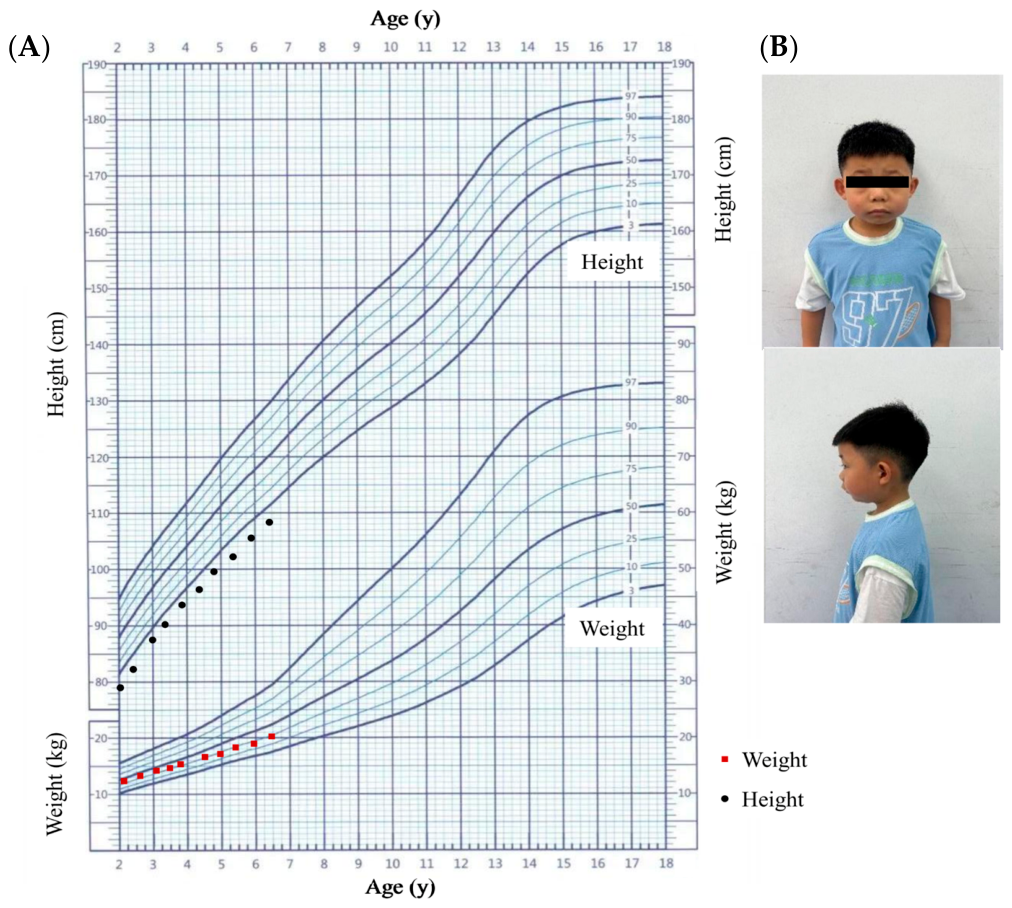
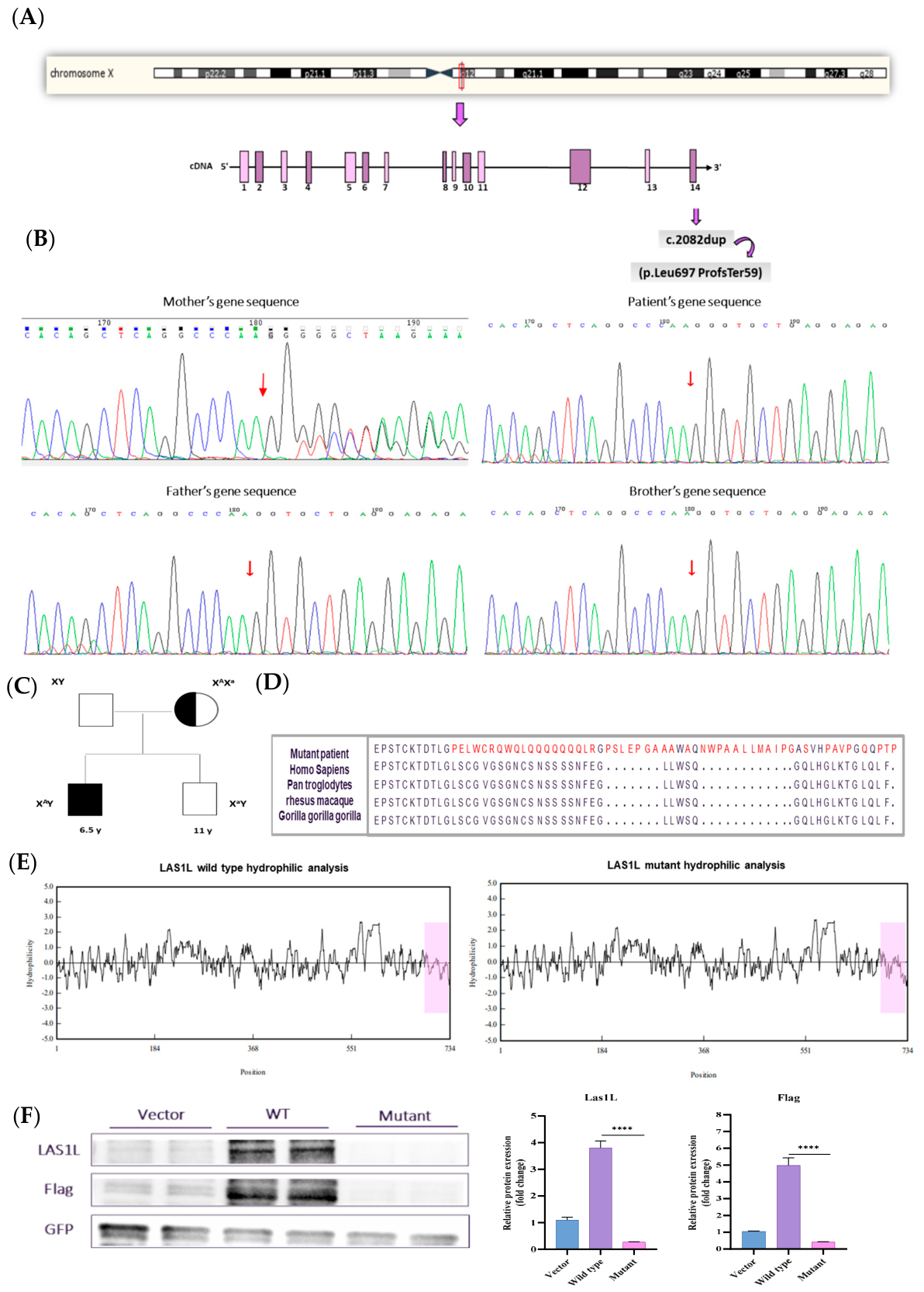
Here, we report a 6-year-and-5-month-old boy presenting with growth retardation, mild developmental delay, and early scoliosis, who carries a novel hemizygous LAS1L frameshift variant: c.2082dup, p.Leu697ProfsTer59. We describe the patient’s clinical and genetic features alongside a concise summary of all previously reported LAS1L variants, further expanding the recognized phenotypic spectrum of LAS1L-associated disease. This patient represents the sixth documented LAS1L-associated case group and presents a mild–intermediate phenotype within the broad spectrum of LAS1L-related developmental disorders.
2. Materials and Methods
2.1. Patient Enrollment and Clinical Investigations
A 6-year-and-5-month-old boy was enrolled in this study after obtaining written informed consent from his parents. Comprehensive clinical and laboratory evaluations were conducted, including assessments of growth parameters, skeletal development, and metabolic indicators. Physical examinations and medical history were reviewed to identify possible dysmorphic features, behavioral characteristics, and endocrine abnormalities. All procedures were conducted in accordance with institutional ethical guidelines.
2.2. Ethics Statement
This study was reviewed and approved by the Ethics Committee of Tongji Hospital, Tongji Medical College, Huazhong University of Science and Technology (TJ-IRB20201016). All procedures were performed in accordance with the Declaration of Helsinki. Written informed consent was obtained from the parents prior to participation.
2.3. Exome Sequencing
Genomic DNA was extracted from peripheral blood samples of the patient and his family using the QIAamp DNA Blood Mini Kit (Qiagen GmbH, Hilden, Germany). DNA libraries were prepared by fragmentation, followed by library construction according to MyGenostics protocols (MyGenostics, Beijing, China). Target enrichment for whole-exome sequencing was performed using the GenCap WES capture kit (MyGenostics, Beijing, China). Sequencing was carried out on an MGI DNBSEQ-T7 platform, with an average sequencing depth of approximately 204.8× and 98.73% of target regions covered at ≥20×. Sequence reads were processed and analyzed using the BWA-GATK pipeline and aligned to the human reference genome (UCSC hg19) (bio-bwa.sourceforge.net;
software.broadinstitute.org/gatk/) (accessed on 17 June 2026).
Variant annotation was performed using ANNOVAR (
http://annovar.openbioinformatics.org/en/latest/) (accessed on 17 June 2026) and cross-referenced against multiple databases, including the 1000 Genomes Project, dbSNP, Human Gene Mutation Database (HGMD), and MyGenostics local database. Variants were filtered based on allele frequency (excluding variants with a minor allele frequency > 1%), predicted functional impact (including nonsynonymous, frameshift and splice site variants), and consistency with the inheritance pattern. Synonymous variants without predicted functional significance were excluded. Candidate variants were prioritized based on relevance to the patient’s phenotype and the X-linked inheritance model. No alternative candidate variants with a stronger genotype–phenotype correlation were identified.
To validate the LAS1L variant identified by next-generation sequencing, the relevant exons and exon–intron boundaries were amplified, purified, and sequenced using an ABI 3730XL sequencer (Applied Biosystems; Thermo Fisher Scientific, Inc., Waltham, MA, USA). Sequence data were analyzed using Mutation Surveyor software (version 4.0.4; SoftGenetics, LLC).
2.4. Functional Bioinformatics Assessment of the Identified Variants
Protein multiple sequence alignment, amino acid hydrophobicity, and conservation analyses were performed using DNAMAN version 6.0.3.99 (Lynnon Biosoft, San Ramon, CA, USA). Evolutionary conservation at the affected amino acid position was assessed to determine whether the substitution occurs within a conserved domain of LAS1L. Hydrophobicity profiling was used to evaluate potential changes in local physicochemical properties that may affect protein folding and stability, though functional consequences cannot be inferred directly from these analyses.
2.5. Plasmid Construction
The wild-type
LAS1L cDNA was cloned into the pcDNA3.1-Flag-C eukaryotic expression vector. Mutant constructs were generated using the QuikChange site directed mutagenesis kit (Stratagene, La Jolla, CA, USA) with the wild-type plasmid as a template. All plasmids were verified by Sanger sequencing using the primers listed in
Supplementary Table S1.
2.6. Cell Culture and Transfection
HEK-293T cells were cultured in Dulbecco’s Modified Eagle Medium (DMEM) supplemented with 10% fetal bovine serum and 1% penicillin–streptomycin at 37 °C in a 5% CO2 incubator. Cells were plated in 12-well dishes and transfected at 70–80% confluence, with 2 µg of LAS1L plasmid DNA and 4 µL of Lipofectamine 3000 (Invitrogen, Carlsbad, CA, USA) per well following the manufacturer’s instructions. A GFP control vector was included in parallel transfections. After 48 h, cells were collected and processed for downstream analyses.
2.7. Western Blot
Proteins were collected from transfected HEK-293T cells using RIPA buffer (BOSTER, Wuhan, China). Samples were separated on 10% SDS PAGE and transferred to nitrocellulose membranes. Membranes were blocked for 2 h with 5% skim milk at room temperature and incubated overnight at 4 °C using the primary antibodies mentioned in
Supplementary Table S2. Following washes, membranes were incubated with secondary antibodies and signal detection was performed using a ChemiDoc XRS+ system (Bio-Rad Laboratories, Hercules, CA, USA). Band intensity was examined with Image Lab software (version 6.0; Bio-Rad Laboratories, Hercules, CA, USA). Full-length, original, and unprocessed blot images are provided in
Supplementary Figure S1.
2.8. Literature Search Strategy and Data Analysis
Reports and case series describing LAS1L variants were searched in PubMed and HGMD using the terms “LAS1L”, “Wilson–Turner syndrome”, and “X-linked intellectual disability”. The search deadline was August 2025. Only studies with molecular confirmation were considered. From eligible publications, patient details, clinical features, and LAS1L variants were extracted. These data were used to summarize reported phenotypes and variant characteristics associated with LAS1L without implying causality.
4. Literature Review
To summarize the clinical manifestations reported in patients with
LAS1L variants, available data were reviewed from HGMD and PubMed. Given the limited number of reported cases, current evidence is insufficient to establish a definitive relationship between
LAS1L variants and a consistent WTS phenotype. Reported cases show heterogeneity in both genotype and clinical presentations, thus the following summary serves for descriptive comparison rather than causal inference. Variants in
LAS1L have been linked to a wide spectrum of clinical phenotypes. Early studies described individuals with X-linked intellectual disability accompanied by truncal obesity and gynecomastia [
4]. In contrast, multiple subsequent reports documented phenotypes distinct from classical WTS. For instance, a male neonate carrying the missense variant p.Ser477Asn presented with severe infantile motor neuron disease, hypotonia, respiratory failure, and impaired ribosome biogenesis [
11]. Likewise, the splice-altering variant c.846G>C was identified in an 18-month-old boy with axonal neuropathy, hypotonia, feeding difficulties, and progressive respiratory compromise [
12]. A 7-year-old male patient carrying the
LAS1L missense variant c.1237G>A (p.Gly413Arg), with an Angelman-like neurodevelopmental phenotype including severe intellectual disability, absent speech, a happy demeanor, hyperactivity, stereotyped behaviors, ataxia, seizures, and hypotonia, was also reported, further expanding the diverse clinical spectrum of LAS1L-related disorders [
6]. These observations highlight substantial phenotypic variability among individuals carrying
LAS1L variants.
The splice site variant c.846G>C resides near an exon–intron boundary and could theoretically interfere with normal splicing, such as intron retention. However, in silico analyses from the published literature do not predict a major impact on splicing activity.
LAS1L encodes a conserved nucleolar factor within the Rixosome complex, acting alongside PELP1, TEX10, WDR18, and NOL9 to regulate internal transcribed spacer 2 (ITS2) processing during 60S ribosomal subunit assembly [
8,
9,
14]. Functional studies have confirmed that
LAS1L interacts with NOL9; disruption of this interaction in model systems leads to ribosomal stress and p53 activation [
7,
15]. Recent work also indicates that post-translational modification of
LAS1L, including USP36-mediated SUMOylation, modulates its function in rRNA maturation [
16].
Across the five reported cases, detailed clinical phenotypes were available for only two individuals, both of whom presented with severe early-onset neuromuscular disorders. The missense variant p.Ser477Asn, reported by Butterfield et al., was found in a patient with lethal congenital motor neuron disease, characterized by profound neonatal hypotonia, ventilator-dependent respiratory failure, feeding difficulties, and death at approximately two months of age. Similarly, the splice-affecting variant c.846G>C (p.Thr282=) is associated with a SMARD-like phenotype, including early infantile hypotonia, respiratory distress, recurrent pulmonary infections, and feeding impairment [
12]. While
LAS1L variants are clearly associated with severe neuromuscular disease in these patients, the small case number prevents definitive conclusions. Two additional missense variants, p.Ala269Gly and p.Arg415Trp, were reported in classic WTS cases but lack detailed individual clinical information, which hinders robust genotype–phenotype correlation [
2]. Overall, many reported cases present with neuromuscular involvement, yet interpretation remains constrained by the small sample size and incomplete phenotypic documentation.
Classic WTS features, including obesity and gynecomastia, were absent in patients with
LAS1L variants causing infantile motor neuron disease. Different
LAS1L variant types appear to correlate with distinct clinical presentations, though this association has not been fully validated. It has been hypothesized that variants causing severe protein dysfunction tend to result in early-onset motor neuron disease, while other variants may lead to milder or unrelated clinical manifestations [
11,
12]. Still, all such interpretations require caution due to the limited number of published cases. These findings align with broader research showing that impaired ribosome biogenesis can affect multiple organ systems, with clinical outcomes determined by the severity of functional disruption [
17]. Cumulatively, existing data support the existence of a continuous phenotypic spectrum across LAS1L-related disorders, but this hypothesis requires validation in larger patient cohorts. An overview of variant type, predicted protein alteration, and variant location for each reported case is presented in
Table 3.
5. Discussion
Here, we report a novel hemizygous LAS1L frameshift variant (c.2082dup; p.Leu697ProfsTer59) identified in a 6-year-and-5-month-old boy presenting with growth retardation, early developmental delay, and mild scoliosis. This case expands the spectrum of pathogenic LAS1L variants and highlights the gene’s broad phenotypic heterogeneity. The patient lacks craniofacial dysmorphism and behavioral anomalies typical of classic WTS. The identified C-terminal frameshift variant is biologically consistent with the patient’s growth and developmental and skeletal phenotypes. Its absence from general population databases, compatibility with X-linked inheritance, and evidence of reduced mutant protein expression support classification of c.2082dup as likely pathogenic, though further functional validation is warranted.
Accumulating evidence indicates that LAS1L-related phenotypes extend beyond classic WTS, encompassing mild–intermediate presentations with minimal endocrine or metabolic involvement. The identified single nucleotide duplication induces a frameshift that disrupts the protein’s C-terminal domain. As the frameshift variant is located in the final exon, the mutant transcript is predicted to escape NMD. Therefore, this variant may result in the production of a LAS1L protein with an altered C-terminal sequence instead of causing complete loss of LAS1L function [
18]. In silico hydrophobicity analysis suggested altered local protein physicochemical properties, and the variant is extremely rare in public population databases.
In accordance with ACMG/AMP 2015 guidelines, the variant was classified as likely pathogenic, supported by PVS1_Moderate evidence for disruptive frameshift alteration of a conserved domain, PS3_Supporting evidence for impaired protein expression in vitro, and PM2_Supporting evidence for population rarity [
19]. Familial testing confirmed consistent X-linked inheritance, as the variant was present in the proband but absent in his unaffected sibling. In vitro assays in HEK-293T cells verified the reduced expression of mutant LAS1L protein.
Two well-defined severe phenotypic patterns characterize LAS1L-related disease: classic WTS, which presents with X-linked intellectual disability, truncal obesity, hypogonadism, gynecomastia, and speech delay [
2]; and a lethal infantile neuromuscular disorder, marked by severe hypotonia, respiratory failure, joint contractures, and early mortality, as well as phenotypic overlap with SMARD [
11,
12]. The present patient’s clinical profile does not match either severe subtype, with no history of neonatal decompensation, severe hypotonia, or motor neuron disease.
As a prepubertal child, the patient exhibits no classic WTS endocrine or dysmorphic features. He demonstrates mild metabolic dysregulation, with overweight BMI, elevated HbA1c, and increased 1 h postprandial glucose, suggestive of early glucose intolerance. Consistent with the expanding LAS1L disease spectrum, his combination of growth impairment, early developmental delay, and mild scoliosis represents a mild–intermediate phenotype. Since hallmark WTS metabolic and pubertal features typically emerge in late childhood and adolescence, the patient’s clinical presentation may evolve over time. The retention of partial protein function due to escape from nonsense-mediated decay likely contributes to his attenuated disease severity.
The wide phenotypic variability associated with LAS1L variants challenges traditional WTS diagnostic criteria. Identification of a pathogenic or likely pathogenic LAS1L variant alone is not sufficient for a definitive WTS diagnosis, given this patient’s unique non-classic presentation. Longitudinal pubertal follow-up and additional case reports will clarify whether such mild presentations represent age-dependent WTS or distinct non-classic LAS1L phenotypes.
This phenotypic heterogeneity raises important questions regarding WTS diagnostic boundaries. Including the present case, six LAS1L-related molecular observations have been reported to date, strongly supporting a spectrum-based classification model for LAS1L-related disorders.
This study can provide practical implications for clinical diagnosis and management. LAS1L-related disorders could be included in the differential diagnosis of children with unexplained growth failure, developmental delay, and early scoliosis, even in the absence of typical WTS features. Clinical exome sequencing facilitates molecular diagnosis in such undiagnosed syndromic cases, and functional protein assays support variant interpretation. Due to the variable endocrine and metabolic expressivity of LAS1L variants, affected individuals require baseline and longitudinal endocrinological surveillance covering growth, glucose homeostasis, thyroid function, gonadal function, and adrenal function. Pituitary imaging may be implemented clinically to evaluate potential hypothalamic-pituitary dysfunction.
Structured long-term monitoring is essential for this prepubertal patient to track potential disease progression. Regular serial assessment of body composition and glycemic metabolism is recommended alongside annual endocrine surveillance, with focused hypothalamic–pituitary–gonadal axis evaluation starting in pre-adolescence to screen for pubertal-onset WTS features. Orthopedic follow-up is required to monitor scoliosis progression, while annual developmental and behavioral assessments track long-term functional outcomes.
This single case study has inherent limitations. It cannot fully define the phenotypic spectrum of LAS1L-related disease or establish definitive genotype–phenotype correlations. Furthermore, in vitro functional assays do not completely recapitulate human in vivo pathophysiology. Larger cohort studies are necessary to refine genotype–phenotype relationships and characterize the natural history of LAS1L-associated disorders.
Overall, this partial loss of function LAS1L variant illustrates possible residual ribosomal protein function drives intermediate, mild phenotypes within the ribosomopathy spectrum and emphasize the necessity of individualized clinical assessment and long-term multidisciplinary monitoring for all patients with LAS1L-related disorders, including non-classic presentations of LAS1L-related WTS.




 ,
,