Arthrogryposis Multiplex Congenita: Comprehensive Review from a Neuromuscular Standpoint

 , ,
, , 
 ,
,  and
and 
Abstract
1. Introduction
2. Central Nervous System Impairment
2.1. Central Nervous System Malformations
2.2. Non-Malformative Central Nervous System Disorders
3. Motor Neuronopathies
4. Neuropathies
5. Disorders of the Neuromuscular Junction
6. Myopathies
6.1. Amyoplasia
6.2. Congenital Myopathies
6.3. Congenital Muscular Dystrophies
7. Hereditary Metabolic Diseases
8. Hereditary Connective Tissue Disorders
9. Conclusions
Author Contributions
Funding
Institutional Review Board Statement
Informed Consent Statement
Data Availability Statement
Acknowledgments
Conflicts of Interest
Abbreviations
| AMC | Arthrogryposis Multiplex Congenita |
| ARC | Arthrogryposis–Renal Dysfunction–Cholestasis Syndrome |
| CMD | Congenital Muscular Dystrophy |
| CNS | Central Nervous System |
| EDS | Ehlers–Danlos Syndrome |
| FADS | Fetal Akinesia Deformation Sequence |
| FCMD | Fukuyama Congenital Muscular Dystrophy |
| HSP | Hereditary Spastic Paraplegia |
| LCCS | Lethal Congenital Contracture Syndrome |
| PCWH | Peripheral Demyelinating Neuropathy, Central Dysmyelinating Leukodystrophy, Waardenburg Syndrome, and Hirschsprung Disease |
| SMA | Spinal Muscular Atrophy |
| SMARD1 | Spinal Muscular Atrophy with Respiratory Distress Type 1 |
| SMALED | Lower-Extremity–Predominant Spinal Muscular Atrophy |
| TNMG | Transient Neonatal Myasthenia Gravis |
| VWMD | Vanishing White Matter Disease |
| WWS | Walker–Warburg Syndrome |
References
- Dahan-Oliel, N.; Cachecho, S.; Barnes, D.; Bedard, T.; Davison, A.M.; Dieterich, K.; Donohoe, M.; Fąfara, A.; Hamdy, R.; Hjartarson, H.T.; et al. International multidisciplinary collaboration toward an annotated definition of arthrogryposis multiplex congenita. Am. J. Med. Genet. Part C Semin. Med. Genet. 2019, 181, 288–299. [Google Scholar] [CrossRef]
- Darin, N.; Kimber, E.; Kroksmark, A.K.; Tulinius, M. Multiple congenital contractures: Birth prevalence, etiology, and outcome. J. Pediatr. 2002, 140, 61–67. [Google Scholar] [CrossRef]
- Lowry, R.B.; Sibbald, B.; Bedard, T.; Hall, J.G. Prevalence of multiple congenital contractures including arthrogryposis multiplex congenita in Alberta, Canada, and a strategy for classification and coding. Birth Defects Res. Part A Clin. Mol. Teratol. 2010, 88, 1057–1061. [Google Scholar] [CrossRef] [PubMed]
- Hall, J.G. Pena-Shokeir phenotype (fetal akinesia deformation sequence) revisited. Birth Defects Res. Part A Clin. Mol. Teratol. 2009, 85, 677–694. [Google Scholar] [CrossRef] [PubMed]
- Niles, K.M.; Blaser, S.; Shannon, P.; Chitayat, D. Fetal arthrogryposis multiplex congenita/fetal akinesia deformation sequence (FADS)-Aetiology, diagnosis, and management. Prenat. Diagn. 2019, 39, 720–731. [Google Scholar] [CrossRef] [PubMed]
- Pena, S.D.; Shokeir, M.H. Syndrome of camptodactyly, multiple ankyloses, facial anomalies, and pulmonary hypoplasia: A lethal condition. J. Pediatr. 1974, 85, 373–375. [Google Scholar] [CrossRef]
- Moessinger, A.C. Fetal akinesia deformation sequence: An animal model. Pediatrics 1983, 72, 857–863. [Google Scholar] [CrossRef]
- Hall, J.G. Deformations associated with arthrogryposis. Am. J. Med. Genet. Part A 2021, 185, 2676–2682. [Google Scholar] [CrossRef]
- Hall, J.G. Arthrogryposis (multiple congenital contractures): Diagnostic approach to etiology, classification, genetics, and general principles. Eur. J. Med. Genet. 2014, 57, 464–472. [Google Scholar] [CrossRef]
- Pehlivan, D.; Bayram, Y.; Gunes, N.; Coban Akdemir, Z.; Shukla, A.; Bierhals, T.; Tabakci, B.; Sahin, Y.; Gezdirici, A.; Fatih, J.M.; et al. The Genomics of Arthrogryposis, a Complex Trait: Candidate Genes and Further Evidence for Oligogenic Inheritance. Am. J. Hum. Genet. 2019, 105, 132–150. [Google Scholar] [CrossRef] [PubMed]
- Todd, E.J.; Yau, K.S.; Ong, R.; Slee, J.; McGillivray, G.; Barnett, C.P.; Haliloglu, G.; Talim, B.; Akcoren, Z.; Kariminejad, A.; et al. Next Generation Sequencing in a Large Cohort of Patients Presenting with Neuromuscular Disease before or at Birth. Orphanet J. Rare Dis. 2015, 10, 148. [Google Scholar] [CrossRef]
- Laquerriere, A.; Jaber, D.; Abiusi, E.; Maluenda, J.; Mejlachowicz, D.; Vivanti, A.; Dieterich, K.; Stoeva, R.; Quevarec, L.; Nolent, F.; et al. Phenotypic Spectrum and Genomics of Undiagnosed Arthrogryposis Multiplex Congenita. J. Med. Genet. 2022, 59, 559–567. [Google Scholar] [CrossRef] [PubMed]
- Bamshad, M.; Van Heest, A.E.; Pleasure, D. Arthrogryposis: A review and update. J. Bone Jt. Surg. Am. 2009, 91, 40–46. [Google Scholar] [CrossRef]
- Dieterich, K.; Kimber, E.; Hall, J.G. Central nervous system involvement in arthrogryposis multiplex congenita: Overview of causes, diagnosis, and care. Am. J. Med. Genet. Part C Semin. Med. Genet. 2019, 181, 345–353. [Google Scholar] [CrossRef]
- Schinzel, A.; Kaufmann, U. The acrocallosal syndrome in sisters. Clin. Genet. 1986, 30, 399–405. [Google Scholar] [CrossRef]
- Putoux, A.; Thomas, S.; Coene, K.L.; E Davis, E.; Alanay, Y.; Ogur, G.; Uz, E.; Buzas, D.; Gomes, C.; Patrier, S.; et al. KIF7 mutations cause fetal hydrolethalus and acrocallosal syndromes. Nat. Genet. 2011, 43, 601–606. [Google Scholar] [CrossRef]
- Brandão Cardoso Paz, I.; De Oliveira Souza, W.P.; Saraiva Brito Vitorino De Oliveira, A.; Rezende Soares Da Paz Oliveira, N.L.; De Melo Aragão, M.; Da Paz Oliveira, G. Congenital Malformations of the Posterior Fossa: A Review of Clinical and Radiological Features Through an Illustrated Guide. Rev. Bras. Neurol. 2024, 60, 13–20. [Google Scholar] [CrossRef]
- van Dijk, T.; Baas, F.; Barth, P.G.; Poll-The, B.T. What’s new in pontocerebellar hypoplasia? An update on genes and subtypes. Orphanet J. Rare Dis. 2018, 13, 92. [Google Scholar] [CrossRef] [PubMed]
- Budde, B.S.; Namavar, Y.; Barth, P.G.; Poll-The, B.T.; Nürnberg, G.; Becker, C.; van Ruissen, F.; Weterman, M.A.J.; Fluiter, K.; Beek, E.T.T.; et al. tRNA splicing endonuclease mutations cause pontocerebellar hypoplasia. Nat. Genet. 2008, 40, 1113–1118. [Google Scholar] [CrossRef]
- Edvardson, S.; Shaag, A.; Kolesnikova, O.; Gomori, J.M.; Tarassov, I.; Einbinder, T.; Saada, A.; Elpeleg, O. Deleterious mutation in the mitochondrial arginyl-transfer RNA synthetase gene is associated with pontocerebellar hypoplasia. Am. J. Hum. Genet. 2007, 81, 857–862. [Google Scholar] [CrossRef] [PubMed]
- Kortüm, F.; Jamra, R.A.; Alawi, M.; Berry, S.A.; Borck, G.; Helbig, K.L.; Tang, S.; Huhle, D.; Korenke, G.C.; Hebbar, M.; et al. Clinical and genetic spectrum of AMPD2-related pontocerebellar hypoplasia type 9. Eur. J. Hum. Genet. 2018, 26, 695–708. [Google Scholar] [CrossRef]
- van Dijk, T.; Ferdinandusse, S.; Ruiter, J.P.N.; Alders, M.; Mathijssen, I.B.; Parboosingh, J.S.; Innes, A.M.; Meijers-Heijboer, H.; Poll-The, B.T.; Bernier, F.P.; et al. Biallelic loss of function variants in COASY cause prenatal onset pontocerebellar hypoplasia, microcephaly, and arthrogryposis. Eur. J. Hum. Genet. 2018, 26, 1752–1758. [Google Scholar] [CrossRef]
- Ocampo-Navia, M.I.; Perez-Mendez, W.; Rodriguez-Alvarez, M.P.; Chadid-Contreras, J.; Vergara, M.F. Dandy-Walker syndrome: An updated literature review. Childs Nerv. Syst. 2025, 41, 194. [Google Scholar] [CrossRef] [PubMed]
- Patton, M.A.; Sharma, A.; Winter, R.M. The Aase-Smith syndrome. Clin. Genet. 1985, 28, 521–525. [Google Scholar] [CrossRef]
- Becker, K.; Splitt, M. A family with distal arthrogryposis and cleft palate: Possible overlap between Gordon syndrome and Aase-Smith syndrome. Clin. Dysmorphol. 2001, 10, 41–45. [Google Scholar] [CrossRef] [PubMed]
- Cacciagli, P.; Desvignes, J.-P.; Girard, N.; Delepine, M.; Zelenika, D.; Lathrop, M.; Lévy, N.; Ledbetter, D.H.; Dobyns, W.B.; Villard, L. AP1S2 is mutated in X-linked Dandy-Walker malformation with intellectual disability, basal ganglia disease and seizures (Pettigrew syndrome). Eur. J. Hum. Genet. 2014, 22, 363–368. [Google Scholar] [CrossRef]
- Pettigrew, A.L.; Jackson, L.G.; Ledbetter, D.H. New X-linked mental retardation disorder with Dandy-Walker malformation, basal ganglia disease, and seizures. Am. J. Med. Genet. 1991, 38, 200–207. [Google Scholar] [CrossRef]
- Ramineni, A.; Coman, D. De Novo 3q22.3q24 Microdeletion in a Patient With Blepharophimosis-Ptosis-Epicanthus Inversus Syndrome, Dandy-Walker Malformation, and Wisconsin Syndrome. Child Neurol. Open 2016, 3, 2329048X16666362. [Google Scholar] [CrossRef]
- Hunter, J.M.; Kiefer, J.; Balak, C.D.; Jooma, S.; Ahearn, M.E.; Hall, J.G.; Baumbach-Reardon, L. Review of X-linked syndromes with arthrogryposis or early contractures-aid to diagnosis and pathway identification. Am. J. Med. Genet. Part A 2015, 167, 931–973. [Google Scholar] [CrossRef]
- Ross, M.E.; Allen, K.M.; Srivastava, A.K.; Featherstone, T.; Gleeson, J.G.; Hirsch, B.; Harding, B.N.; Andermann, E.; Abdullah, R.; Berg, M.; et al. Linkage and physical mapping of X-linked lissencephaly/SBH (XLIS): A gene causing neuronal migration defects in human brain. Hum. Mol. Genet. 1997, 6, 555–562. [Google Scholar] [CrossRef] [PubMed]
- Miller, J.Q. Lissencephaly in 2 siblings. Neurology 1963, 13, 841–850. [Google Scholar] [CrossRef]
- Cardoso, C.; Leventer, R.J.; Ward, H.L.; Toyo-Oka, K.; Chung, J.; Gross, A.; Martin, C.L.; Allanson, J.; Pilz, D.T.; Olney, A.H.; et al. Refinement of a 400-kb critical region allows genotypic differentiation between isolated lissencephaly, Miller-Dieker syndrome, and other phenotypes secondary to deletions of 17p13.3. Am. J. Hum. Genet. 2003, 72, 918–930. [Google Scholar] [CrossRef]
- Laquerriere, A.; Gonzales, M.; Saillour, Y.; Cavallin, M.; Joyē, N.; Quēlin, C.; Bidat, L.; Dommergues, M.; Plessis, G.; Encha-Razavi, F.; et al. De novo TUBB2B mutation causes fetal akinesia deformation sequence with microlissencephaly: An unusual presentation of tubulinopathy. Eur. J. Med. Genet. 2016, 59, 249–256. [Google Scholar] [CrossRef]
- Weber, M.; Jaber, D.; Encha-Razavi, F.; Julien, E.; Grevoul-Fesquet, J.; Steffann, J.; Melki, J.; Martinovic, J. Broadening the phenotypic spectrum of TUBA1A tubulinopathy to syndromic arthrogryposis multiplex congenita. Am. J. Med. Genet. Part A 2022, 188, 2331–2338. [Google Scholar] [CrossRef]
- Cabet, S.; Putoux, A.; Buenerd, A.; Gueneau, L.; Reymond, A.; Thia, E.W.; Lai, A.H.; Schindewolf, E.M.; Sanlaville, D.; Lesca, G.; et al. Prenatal cerebral imaging features of a new syndromic entity related to KIAA1109 pathogenic variants mimicking tubulinopathy. Prenat. Diagn. 2020, 40, 276–281. [Google Scholar] [CrossRef]
- Dobyns, W.B. Developmental aspects of lissencephaly and the lissencephaly syndromes. Birth Defects Orig. Artic. Ser. 1987, 23, 225–241. [Google Scholar]
- Nissenkorn, A.; Weintraub, S.; Sadeh, M.; Lerman-Sagie, T. Lissencephaly associated with congenital hypomyelinating and axonal neuropathy. Pediatr. Neurol. 1998, 19, 313–316. [Google Scholar] [CrossRef] [PubMed]
- Massa, G.; Casaer, P.; Ceulemans, B.; Van Eldere, S. Arthrogryposis multiplex congenita associated with lissencephaly: A case report. Neuropediatrics 1988, 19, 24–26. [Google Scholar] [CrossRef]
- Attia-Sobol, J.; Hermier, M.; Vitrey, D.; Verloes, A.; Plauchu, H.; Encha-Razavi, F. Lissencephaly type III, stippled epiphyses and loose, thick skin: A new recessively inherited syndrome. Am. J. Med. Genet. 2001, 99, 14–20. [Google Scholar] [CrossRef]
- de Souza, P.V.S.; de Rezende Pinto, W.B.V.; de Rezende Batistella, G.N.; Bortholin, T.; Oliveira, A.S.B. Hereditary Spastic Paraplegia: Clinical and Genetic Hallmarks. Cerebellum 2017, 16, 525–551. [Google Scholar] [CrossRef] [PubMed]
- Christian, J.C.; A Andrews, P.; Conneally, P.M.; Muller, J. The adducted thumbs syndrome. An autosomal recessive disease with arthrogryposis, dysmyelination, craniostenosis, and cleft palate. Clin. Genet. 1971, 2, 95–103. [Google Scholar] [CrossRef]
- Tuysuz, B.; Sencicek, A.G.E.; Ozer, E.; Goc, N.; Yalcinkaya, C.; Bilguvar, K. Severe Phenotype in Patients with X-linked Hydrocephalus Caused by a Missense Mutation in L1CAM. Turk. Arch. Pediatr. 2022, 57, 521–525. [Google Scholar] [CrossRef]
- van der Knaap, M.S.; van Berkel, C.G.; Herms, J.; van Coster, R.; Baethmann, M.; Naidu, S.; Boltshauser, E.; Willemsen, M.A.; Plecko, B.; Hoffmann, G.F.; et al. eIF2B-related disorders: Antenatal onset and involvement of multiple organs. Am. J. Hum. Genet. 2003, 73, 1199–1207. [Google Scholar] [CrossRef] [PubMed]
- Ng, B.W.; Lee, J.S.; Toh, T.H.; Ngu, L.H. Neurological Waardenburg-Shah syndrome: A diagnostic challenge in a child with skin hypopigmentation and neurological manifestation. BMJ Case Rep. 2022, 15, e250360. [Google Scholar] [CrossRef]
- Stevenson, R.E.; Vincent, V.; Spellicy, C.J.; Friez, M.J.; Chaubey, A. Biallelic deletions of the Waardenburg II syndrome gene, SOX10, cause a recognizable arthrogryposis syndrome. Am. J. Med. Genet. Part A 2018, 176, 1968–1971. [Google Scholar] [CrossRef] [PubMed]
- Paznekas, W.A.; Karczeski, B.; Vermeer, S.; Lowry, R.B.; Delatycki, M.; Laurence, F.; Koivisto, P.A.; Van Maldergem, L.; Boyadjiev, S.A.; Bodurtha, J.N.; et al. GJA1 mutations, variants, and connexin 43 dysfunction as it relates to the oculodentodigital dysplasia phenotype. Hum. Mutat. 2009, 30, 724–733. [Google Scholar] [CrossRef]
- Bayram, Y.; Karaca, E.; Coban Akdemir, Z.; Yilmaz, E.O.; Tayfun, G.A.; Aydin, H.; Torun, D.; Bozdogan, S.T.; Gezdirici, A.; Isikay, S.; et al. Molecular etiology of arthrogryposis in multiple families of mostly Turkish origin. J. Clin. Investig. 2016, 126, 762–778. [Google Scholar] [CrossRef]
- Ngo, J.; Prokop, J.W.; Umfleet, J.; Seaver, L.H. Perinatal Manifestations of DARS2-Associated Leukoencephalopathy With Brainstem and Spinal Cord Involvement and Lactate Elevation (LBSL). Child Neurol. Open 2021, 8, 2329048X211019173. [Google Scholar] [CrossRef] [PubMed]
- Dubowitz, V. Very severe spinal muscular atrophy (SMA type 0): An expanding clinical phenotype. Eur. J. Paediatr. Neurol. 1999, 3, 49–51. [Google Scholar] [CrossRef]
- Grotto, S.; Cuisset, J.-M.; Marret, S.; Drunat, S.; Faure, P.; Audebert-Bellanger, S.; Desguerre, I.; Flurin, V.; Grebille, A.-G.; Guerrot, A.-M.; et al. Type 0 Spinal Muscular Atrophy: Further Delineation of Prenatal and Postnatal Features in 16 Patients. J. Neuromuscul. Dis. 2016, 3, 487–495. [Google Scholar] [CrossRef]
- Pinto, W.B.V.R.; de Souza, P.V.S.; Badia, B.M.L.; Farias, I.B.; Albuquerque Filho, J.M.V.; Gonçalves, E.A.; Machado, R.I.L.; Oliveira, A.S.B. Adult-onset non-5q proximal spinal muscular atrophy: A comprehensive review. Arq. Neuropsiquiatr. 2021, 79, 912–923. [Google Scholar] [CrossRef] [PubMed]
- Jędrzejowska, M.; Madej-Pilarczyk, A.; Fidziańska, A.; Mierzewska, H.; Pronicka, E.; Obersztyn, E.; Gos, M.; Pronicki, M.; Kmieć, T.; Migdał, M.; et al. Severe phenotypes of SMARD1 associated with novel mutations of the IGHMBP2 gene and nuclear degeneration of muscle and Schwann cells. Eur. J. Paediatr. Neurol. 2014, 18, 183–192. [Google Scholar] [CrossRef]
- Peeters, K.; Chamova, T.; Jordanova, A. Clinical and genetic diversity of SMN1-negative proximal spinal muscular atrophies. Brain 2014, 137, 2879–2896. [Google Scholar] [CrossRef]
- Eckart, M.; Guenther, U.-P.; Idkowiak, J.; Varon, R.; Grolle, B.; Boffi, P.; Van Maldergem, L.; Hübner, C.; Schuelke, M.; von Au, K. The natural course of infantile spinal muscular atrophy with respiratory distress type 1 (SMARD1). Pediatrics 2012, 129, e148–e156. [Google Scholar] [CrossRef]
- Rossor, A.M.; Reilly, M.M. Neurogenic arthrogryposis and the power of phenotyping. Neuromuscul. Disord. 2021, 31, 1062–1069. [Google Scholar] [CrossRef]
- A Zambon, A.; Pini, V.; Bosco, L.; Falzone, Y.M.; Munot, P.; Muntoni, F.; Previtali, S.C. Early onset hereditary neuronopathies: An update on non-5q motor neuron diseases. Brain 2023, 146, 806–822. [Google Scholar] [CrossRef]
- Amabile, S.; Jeffries, L.; McGrath, J.M.; Ji, W.; Spencer-Manzon, M.; Zhang, H.; Lakhani, S.A. DYNC1H1-related disorders: A description of four new unrelated patients and a comprehensive review of previously reported variants. Am. J. Med. Genet. Part A 2020, 182, 2049–2057. [Google Scholar] [CrossRef] [PubMed]
- Masuda, L.; Hasegawa, A.; Kamura, H.; Hasegawa, F.; Yamamura, M.; Taniguchi, K.; Ito, Y.; Hata, K.; Samura, O.; Okamoto, A. Missense BICD2 variants in fetuses with congenital arthrogryposis and pterygia. Hum. Genome Var. 2024, 11, 32. [Google Scholar] [CrossRef]
- Storbeck, M.; Horsberg Eriksen, B.; Unger, A.; Hölker, I.; Aukrust, I.; A Martínez-Carrera, L.; A Linke, W.; Ferbert, A.; Heller, R.; Vorgerd, M.; et al. Phenotypic extremes of BICD2-opathies: From lethal, congenital muscular atrophy with arthrogryposis to asymptomatic with subclinical features. Eur. J. Hum. Genet. 2017, 25, 1040–1048. [Google Scholar] [CrossRef]
- Paakkola, T.; Vuopala, K.; Kokkonen, H.; Ignatius, J.; Valkama, M.; Moilanen, J.; Fahiminiya, S.; Majewski, J.; Hinttala, R.; Uusimaa, J. A homozygous I684T in GLE1 as a novel cause of arthrogryposis and motor neuron loss. Clin. Genet. 2018, 93, 173–177. [Google Scholar] [CrossRef] [PubMed]
- Smith, C.; Parboosingh, J.; Boycott, K.; Bönnemann, C.; Mah, J.; Lamont, R.; Innes, A.M.; Bernier, F.; Care4Rare Canada Consortium. Expansion of the GLE1-associated arthrogryposis multiplex congenita clinical spectrum. Clin. Genet. 2017, 91, 426–430. [Google Scholar] [CrossRef]
- Narkis, G.; Ofir, R.; Manor, E.; Landau, D.; Elbedour, K.; Birk, O.S. Lethal congenital contractural syndrome type 2 (LCCS2) is caused by a mutation in ERBB3 (Her3), a modulator of the phosphatidylinositol-3-kinase/Akt pathway. Am. J. Hum. Genet. 2007, 81, 589–595. [Google Scholar] [CrossRef] [PubMed]
- Dlamini, N.; Josifova, D.J.; Paine, S.M.; Wraige, E.; Pitt, M.; Murphy, A.J.; King, A.; Buk, S.; Smith, F.; Abbs, S.; et al. Clinical and neuropathological features of X-linked spinal muscular atrophy (SMAX2) associated with a novel mutation in the UBA1 gene. Neuromuscul. Disord. 2013, 23, 391–398. [Google Scholar] [CrossRef]
- Knierim, E.; Hirata, H.; Wolf, N.I.; Morales-Gonzalez, S.; Schottmann, G.; Tanaka, Y.; Rudnik-Schöneborn, S.; Orgeur, M.; Zerres, K.; Vogt, S.; et al. Mutations in Subunits of the Activating Signal Cointegrator 1 Complex Are Associated with Prenatal Spinal Muscular Atrophy and Congenital Bone Fractures. Am. J. Hum. Genet. 2016, 98, 473–489. [Google Scholar] [CrossRef]
- Lugo, E.; Graulau, E.; Ramos Cortes, E.; Ramírez, N.; Carlo, S.; Ramírez-Lluch, N. Homozygous TRPV4 Mutation Broadens the Phenotypic Spectrum of Congenital Spinal Muscular Atrophy and Arthrogryposis: A Case Report. Cureus 2023, 15, e43413. [Google Scholar] [CrossRef]
- Velilla, J.; Marchetti, M.M.; Toth-Petroczy, A.; Grosgogeat, C.; Bennett, A.H.; Carmichael, N.; Estrella, E.; Darras, B.T.; Frank, N.Y.; Krier, J.; et al. Homozygous TRPV4 mutation causes congenital distal spinal muscular atrophy and arthrogryposis. Neurol. Genet. 2019, 5, e312. [Google Scholar] [CrossRef]
- Funalot, B.; Topilko, P.; Arroyo, M.A.R.; Sefiani, A.; Hedley-Whyte, E.T.; Yoldi, M.E.; Richard, L.; Touraille, E.; Laurichesse, M.; Khalifa, E.; et al. Homozygous deletion of an EGR2 enhancer in congenital amyelinating neuropathy. Ann. Neurol. 2012, 71, 719–723. [Google Scholar] [CrossRef]
- Warner, L.E.; Mancias, P.; Butler, I.J.; McDonald, C.M.; Keppen, L.; Koob, K.G.; Lupski, J.R. Mutations in the early growth response 2 (EGR2) gene are associated with hereditary myelinopathies. Nat. Genet. 1998, 18, 382–384. [Google Scholar] [CrossRef] [PubMed]
- Kochanski, A.; Drac, H.; Kabzińska, D.; Ryniewicz, B.; Rowińska-Marcińska, K.; Nowakowski, A.; Hausmanowa-Petrusewicz, I. A novel MPZ gene mutation in congenital neuropathy with hypomyelination. Neurology 2004, 62, 2122–2123. [Google Scholar] [CrossRef]
- Mandich, P.; Mancardi, G.L.; Varese, A.; Soriani, S.; Di Maria, E.; Bellone, E.; Bado, M.; Gross, L.; Windebank, A.J.; Ajmar, F.; et al. Congenital hypomyelination due to myelin protein zero Q215X mutation. Ann. Neurol. 1999, 45, 676–678. [Google Scholar] [CrossRef] [PubMed]
- Fabrizi, G.M.; Simonati, A.; Taioli, F.; Cavallaro, T.; Ferrarini, M.; Rigatelli, F.; Pini, A.; Mostacciuolo, M.L.; Rizzuto, N. PMP22 related congenital hypomyelination neuropathy. J. Neurol. Neurosurg. Psychiatry 2001, 70, 123–126. [Google Scholar] [CrossRef]
- Simonati, A.; Fabrizi, G.; Pasquinelli, A.; Taioli, F.; Cavallaro, T.; Morbin, M.; Marcon, G.; Papini, M.; Rizzuto, N. Congenital hypomyelination neuropathy with Ser72Leu substitution in PMP22. Neuromuscul. Disord. 1999, 9, 257–261. [Google Scholar] [CrossRef] [PubMed]
- Bolino, A.; Lonie, L.J.; Zimmer, M.; Boerkoel, C.F.; Takashima, H.; Monaco, A.P.; Lupski, J.R. Denaturing high-performance liquid chromatography of the myotubularin-related 2 gene (MTMR2) in unrelated patients with Charcot-Marie-Tooth disease suggests a low frequency of mutation in inherited neuropathy. Neurogenetics 2001, 3, 107–109. [Google Scholar] [CrossRef]
- Phillips, J.P.; E Warner, L.; Lupski, J.R.; Garg, B.P. Congenital hypomyelinating neuropathy: Two patients with long-term follow-up. Pediatr. Neurol. 1999, 20, 226–232. [Google Scholar] [CrossRef]
- Smit, L.S.; Roofthooft, D.; van Ruissen, F.; Baas, F.; van Doorn, P.A. Congenital hypomyelinating neuropathy, a long term follow-up study in an affected family. Neuromuscul. Disord. 2008, 18, 59–62. [Google Scholar] [CrossRef]
- Maluenda, J.; Manso, C.; Quevarec, L.; Vivanti, A.; Marguet, F.; Gonzales, M.; Guimiot, F.; Petit, F.; Toutain, A.; Whalen, S.; et al. Mutations in GLDN, Encoding Gliomedin, a Critical Component of the Nodes of Ranvier, Are Responsible for Lethal Arthrogryposis. Am. J. Hum. Genet. 2016, 99, 928–933. [Google Scholar] [CrossRef] [PubMed]
- Ravenscroft, G.; Nolent, F.; Rajagopalan, S.; Meireles, A.M.; Paavola, K.J.; Gaillard, D.; Alanio, E.; Buckland, M.; Arbuckle, S.; Krivanek, M.; et al. Mutations of GPR126 are responsible for severe arthrogryposis multiplex congenita. Am. J. Hum. Genet. 2015, 96, 955–961. [Google Scholar] [CrossRef] [PubMed]
- Perrain, V.; Record, C.J.; Skorupinska, M.; Blake, J.; Campbell, J.; Poh, R.; Polke, J.; Sarkozy, A.; Muntoni, F.; Reilly, M.M. ADGRG6-related disorder: A novel mutation resulting in distal arthrogryposis and a patchy neuropathy. Neuromuscul. Disord. 2025, 53, 105449. [Google Scholar] [CrossRef]
- Xue, S.; Maluenda, J.; Marguet, F.; Shboul, M.; Quevarec, L.; Bonnard, C.; Ng, A.Y.J.; Tohari, S.; Tan, T.T.; Kong, M.K.; et al. Loss-of-Function Mutations in LGI4, a Secreted Ligand Involved in Schwann Cell Myelination, Are Responsible for Arthrogryposis Multiplex Congenita. Am. J. Hum. Genet. 2017, 100, 659–665. [Google Scholar] [CrossRef]
- Reinstein, E.; Drasinover, V.; Lotan, R.; Gal-Tanamy, M.; Bolocan Nachman, I.; Eyal, E.; Jaber, L.; Magal, N.; Shohat, M. Mutations in ERGIC1 cause Arthrogryposis multiplex congenita, neuropathic type. Clin. Genet. 2018, 93, 160–163. [Google Scholar] [CrossRef]
- Marconi, C.; Lemmens, L.; Masclaux, F.; Mattioli, F.; Fluss, J.; Extermann, P.; Mendez, P.; Leuchter, R.H.; Stathaki, E.; Laurent, S.; et al. Bi-allelic loss of ERGIC1 causes relatively mild arthrogryposis. Clin. Genet. 2021, 100, 329–333. [Google Scholar] [CrossRef]
- Woo, S.-H.; Lukacs, V.; de Nooij, J.C.; Zaytseva, D.; Criddle, C.R.; Francisco, A.; Jessell, T.M.; A Wilkinson, K.; Patapoutian, A. Piezo2 is the principal mechanotransduction channel for proprioception. Nat. Neurosci. 2015, 18, 1756–1762. [Google Scholar] [CrossRef] [PubMed]
- Seidahmed, M.Z.; Maddirevula, S.; Miqdad, A.M.; Al Faifi, A.; Al Samadi, A.; Alkuraya, F.S. Confirming the involvement of PIEZO2 in the etiology of Marden-Walker syndrome. Am. J. Med. Genet. Part A 2021, 185, 945–948. [Google Scholar] [CrossRef] [PubMed]
- Alisch, F.; Weichert, A.; Kalache, K.; Paradiso, V.; Longardt, A.C.; Dame, C.; Hoffmann, K.; Horn, D. Familial Gordon syndrome associated with a PIEZO2 mutation. Am. J. Med. Genet. Part A 2017, 173, 254–259. [Google Scholar] [CrossRef]
- Coste, B.; Houge, G.; Murray, M.F.; Stitziel, N.; Bandell, M.; Giovanni, M.A.; Philippakis, A.; Hoischen, A.; Riemer, G.; Steen, U.; et al. Gain-of-function mutations in the mechanically activated ion channel PIEZO2 cause a subtype of Distal Arthrogryposis. Proc. Natl. Acad. Sci. USA 2013, 110, 4667–4672. [Google Scholar] [CrossRef] [PubMed]
- Dieterich, K.; Quijano-Roy, S.; Monnier, N.; Zhou, J.; Fauré, J.; Smirnow, D.A.; Carlier, R.; Laroche, C.; Marcorelles, P.; Mercier, S.; et al. The neuronal endopeptidase ECEL1 is associated with a distinct form of recessive distal arthrogryposis. Hum. Mol. Genet. 2013, 22, 1483–1492. [Google Scholar] [CrossRef]
- Patil, S.J.; Rai, G.K.; Bhat, V.; Ramesh, V.A.; Nagarajaram, H.; Matalia, J.; Phadke, S.R. Distal arthrogryposis type 5D with a novel ECEL1 gene mutation. Am. J. Med. Genet. Part A 2014, 164, 2857–2862. [Google Scholar] [CrossRef] [PubMed]
- Chesler, A.T.; Szczot, M.; Bharucha-Goebel, D.; Čeko, M.; Donkervoort, S.; Laubacher, C.; Hayes, L.H.; Alter, K.; Zampieri, C.; Stanley, C.; et al. The Role of PIEZO2 in Human Mechanosensation. N. Engl. J. Med. 2016, 375, 1355–1364. [Google Scholar] [CrossRef]
- Delle Vedove, A.; Storbeck, M.; Heller, R.; Hölker, I.; Hebbar, M.; Shukla, A.; Magnusson, O.; Cirak, S.; Girisha, K.M.; O’dRiscoll, M.; et al. Biallelic Loss of Proprioception-Related PIEZO2 Causes Muscular Atrophy with Perinatal Respiratory Distress, Arthrogryposis, and Scoliosis. Am. J. Hum. Genet. 2016, 99, 1206–1216. [Google Scholar] [CrossRef]
- Haliloglu, G.; Becker, K.; Temucin, C.; Talim, B.; Küçükşahin, N.; Pergande, M.; Motameny, S.; Nürnberg, P.; Aydingoz, U.; Topaloglu, H.; et al. Recessive PIEZO2 stop mutation causes distal arthrogryposis with distal muscle weakness, scoliosis and proprioception defects. J. Hum. Genet. 2017, 62, 497–501. [Google Scholar] [CrossRef]
- Mahmud, A.; Nahid, N.; Nassif, C.; Sayeed, M.; Ahmed, M.; Parveen, M.; Khalil, M.; Islam, M.; Nahar, Z.; Rypens, F.; et al. Loss of the proprioception and touch sensation channel PIEZO2 in siblings with a progressive form of contractures. Clin. Genet. 2017, 91, 470–475. [Google Scholar] [CrossRef]
- Behunova, J.; Gerykova Bujalkova, M.; Gras, G.; Taylor, T.; Ihm, U.; Kircher, S.; Rehder, H.; Laccone, F. Distal Arthrogryposis with Impaired Proprioception and Touch: Description of an Early Phenotype in a Boy with Compound Heterozygosity of PIEZO2 Mutations and Review of the Literature. Mol. Syndromol. 2019, 9, 287–294. [Google Scholar] [CrossRef] [PubMed]
- Michalk, A.; Stricker, S.; Becker, J.; Rupps, R.; Pantzar, T.; Miertus, J.; Botta, G.; Naretto, V.G.; Janetzki, C.; Yaqoob, N.; et al. Acetylcholine receptor pathway mutations explain various fetal akinesia deformation sequence disorders. Am. J. Hum. Genet. 2008, 82, 464–476. [Google Scholar] [CrossRef]
- de Souza, P.V.S.; Batistella, G.N.d.R.; Lino, V.C.; Pinto, W.B.V.d.R.; Annes, M.; Oliveira, A.S.B. Clinical and genetic basis of congenital myasthenic syndromes. Arq. Neuropsiquiatr. 2016, 74, 750–760. [Google Scholar] [CrossRef] [PubMed]
- Norum, R.A.; James, V.L.; Mabry, C.C. Pterygium syndrome in three children in a recessive pedigree pattern. Birth Defects Orig. Art. Ser. 1969, 5, 233–235. [Google Scholar]
- Morgan, N.V.; Brueton, L.A.; Cox, P.; Greally, M.T.; Tolmie, J.; Pasha, S.; Aligianis, I.A.; van Bokhoven, H.; Marton, T.; Al-Gazali, L.; et al. Mutations in the embryonal subunit of the acetylcholine receptor (CHRNG) cause lethal and Escobar variants of multiple pterygium syndrome. Am. J. Hum. Genet. 2006, 79, 390–395. [Google Scholar] [CrossRef]
- Seo, J.; Choi, I.-H.; Lee, J.S.; Yoo, Y.; Kim, N.K.; Choi, M.; Ko, J.M.; Shin, Y.B. Rare cases of congenital arthrogryposis multiplex caused by novel recurrent CHRNG mutations. J. Hum. Genet. 2015, 60, 213–215. [Google Scholar] [CrossRef]
- Hoffmann, K.; Müller, J.S.; Stricker, S.; Megarbane, A.; Rajab, A.; Lindner, T.H.; Cohen, M.; Chouery, E.; Adaimy, L.; Ghanem, I.; et al. Escobar syndrome is a prenatal myasthenia caused by disruption of the acetylcholine receptor fetal gamma subunit. Am. J. Hum. Genet. 2006, 79, 303–312. [Google Scholar] [CrossRef]
- Chen, C.P. Prenatal diagnosis and genetic analysis of fetal akinesia deformation sequence and multiple pterygium syndrome associated with neuromuscular junction disorders: A review. Taiwan J. Obstet. Gynecol. 2012, 51, 12–17. [Google Scholar] [CrossRef]
- Wilbe, M.; Ekvall, S.; Eurenius, K.; Ericson, K.; Casar-Borota, O.; Klar, J.; Dahl, N.; Ameur, A.; Annerén, G.; Bondeson, M.-L. MuSK: A new target for lethal fetal akinesia deformation sequence (FADS). J. Med. Genet. 2015, 52, 195–202. [Google Scholar] [CrossRef] [PubMed]
- Ghasemi, A.; Hadei, S.J.; KamaliZonouzi, S.; Shahrokhi, A.; Najmabadi, H.; Nafissi, S. Clinical and genetic diversity in Iranian individuals with RAPSN-related congenital myasthenic syndrome. Neurogenetics 2024, 26, 9. [Google Scholar] [CrossRef]
- Natera-de Benito, D.; Bestué, M.; Vilchez, J.; Evangelista, T.; Töpf, A.; García-Ribes, A.; Trujillo-Tiebas, M.; García-Hoyos, M.; Ortez, C.; Camacho, A.; et al. Long-term follow-up in patients with congenital myasthenic syndrome due to RAPSN mutations. Neuromuscul. Disord. 2016, 26, 153–159. [Google Scholar] [CrossRef]
- Bonnin, E.; Cabochette, P.; Filosa, A.; Jühlen, R.; Komatsuzaki, S.; Hezwani, M.; Dickmanns, A.; Martinelli, V.; Vermeersch, M.; Supply, L.; et al. Biallelic mutations in nucleoporin NUP88 cause lethal fetal akinesia deformation sequence. PLoS Genet. 2018, 14, e1007845. [Google Scholar] [CrossRef]
- Komachali, S.R.; Keikhaie, K.R.; Siahpoosh, Z.; Salehi, M.; Tamandani, D.M.K. DOK7 Gene Novel Homozygous Mutation is Related to Fetal Akinesia Deformation Sequence 3. J. Obstet. Gynecol. India 2025, 75, 592–598. [Google Scholar] [CrossRef]
- Radhakrishnan, P.; Shukla, A.; Girisha, K.M.; Nayak, S.S. Biallelic c.1263dupC in DOK7 results in fetal akinesia deformation sequence. Am. J. Med. Genet. Part A 2020, 182, 804–807. [Google Scholar] [CrossRef]
- Tiwari, A.K.; Srinivasan, V.M.; Phadke, S.R.; Saxena, D. Variants in DOK7 results in fetal akinesia deformation sequence: A case report and review of literature. Clin. Genet. 2024, 105, 226–227. [Google Scholar] [CrossRef]
- Vogt, J.; Morgan, N.V.; Marton, T.; Maxwell, S.; Harrison, B.J.; Beeson, D.; Maher, E.R. Germline mutation in DOK7 associated with fetal akinesia deformation sequence. J. Med. Genet. 2009, 46, 338–340. [Google Scholar] [CrossRef]
- Kraner, S.; Laufenberg, I.; Straßburg, H.M.; Sieb, J.P.; Steinlein, O.K. Congenital myasthenic syndrome with episodic apnea in patients homozygous for a CHAT missense mutation. Arch. Neurol. 2003, 60, 761–763. [Google Scholar] [CrossRef] [PubMed]
- McMacken, G.; Whittaker, R.G.; Evangelista, T.; Abicht, A.; Dusl, M.; Lochmüller, H. Congenital myasthenic syndrome with episodic apnoea: Clinical, neurophysiological and genetic features in the long-term follow-up of 19 patients. J. Neurol. 2018, 265, 194–203. [Google Scholar] [CrossRef] [PubMed]
- Reynolds, H.M.; Wen, T.; Farrell, A.; Mao, R.; Moore, B.; Boyden, S.E.; Bayrak-Toydemir, P.; Nicholas, T.J.; Rynearson, S.; Holt, C.; et al. Rapid genome sequencing identifies a novel de novo SNAP25 variant for neonatal congenital myasthenic syndrome. Mol. Case Stud. 2022, 8, a006242. [Google Scholar] [CrossRef]
- Shen, X.-M.; Selcen, D.; Brengman, J.; Engel, A.G. Mutant SNAP25B causes myasthenia, cortical hyperexcitability, ataxia, and intellectual disability. Neurology 2014, 83, 2247–2255. [Google Scholar] [CrossRef]
- O’Grady, G.L.; Verschuuren, C.; Yuen, M.; Webster, R.; Menezes, M.; Fock, J.M.; Pride, N.; Best, H.A.; Damm, T.B.; Turner, C.; et al. Variants in SLC18A3, vesicular acetylcholine transporter, cause congenital myasthenic syndrome. Neurology 2016, 87, 1442–1448. [Google Scholar] [CrossRef]
- Cetin, H.; Beeson, D.; Vincent, A.; Webster, R. The Structure, Function, and Physiology of the Fetal and Adult Acetylcholine Receptor in Muscle. Front. Mol. Neurosci. 2020, 13, 581097. [Google Scholar] [CrossRef]
- Vernet-der Garabedian, B.; Lacokova, M.; Eymard, B.; Morel, E.; Faltin, M.; Zajac, J.; Sadovsky, O.; Dommergues, M.; Tripon, P.; Bach, J.F. Association of neonatal myasthenia gravis with antibodies against the fetal acetylcholine receptor. J. Clin. Investig. 1994, 94, 555–559. [Google Scholar] [CrossRef]
- Lindroos, J.L.V.; Bjørk, M.-H.; Gilhus, N.E. Transient Neonatal Myasthenia Gravis as a Common Complication of a Rare Disease: A Systematic Review. J. Clin. Med. 2024, 13, 1136. [Google Scholar] [CrossRef]
- Midelfart Hoff, J.; Midelfart, A. Maternal myasthenia gravis: A cause for arthrogryposis multiplex congenita. J. Child. Orthop. 2015, 9, 433–435. [Google Scholar] [CrossRef] [PubMed]
- Polizzi, A.; Huson, S.M.; Vincent, A. Teratogen update: Maternal myasthenia gravis as a cause of congenital arthrogryposis. Teratology 2000, 62, 332–341. [Google Scholar] [CrossRef]
- Lecky, B.R. Transient neonatal Lambert-Eaton syndrome. J. Neurol. Neurosurg. Psychiatry 2006, 77, 1094. [Google Scholar] [CrossRef] [PubMed][Green Version]
- Bernstein, R.M. Arthrogryposis and amyoplasia. J. Am. Acad. Orthop. Surg. 2002, 10, 417–424. [Google Scholar] [CrossRef] [PubMed]
- Hall, J.G.; Aldinger, K.A.; Tanaka, K.I. Amyoplasia revisited. Am. J. Med. Genet. Part A 2014, 164, 700–730. [Google Scholar] [CrossRef]
- Kimber, E. AMC: Amyoplasia and distal arthrogryposis. J. Child. Orthop. 2015, 9, 427–432. [Google Scholar] [CrossRef] [PubMed]
- Ahmed, A.A.; Skaria, P.; Safina, N.P.; Thiffault, I.; Kats, A.; Taboada, E.; Habeebu, S.; Saunders, C. Arthrogryposis and pterygia as lethal end manifestations of genetically defined congenital myopathies. Am. J. Med. Genet. Part A 2018, 176, 359–367. [Google Scholar] [CrossRef] [PubMed]
- O’Grady, G.L.; A Best, H.; Oates, E.C.; Kaur, S.; Charlton, A.; Brammah, S.; Punetha, J.; Kesari, A.; North, K.N.; Ilkovski, B.; et al. Recessive ACTA1 variant causes congenital muscular dystrophy with rigid spine. Eur. J. Hum. Genet. 2015, 23, 883–886. [Google Scholar] [CrossRef] [PubMed]
- Buchignani, B.; Marinella, G.; Pasquariello, R.; Sgherri, G.; Frosini, S.; Santorelli, F.M.; Orsini, A.; Battini, R.; Astrea, G. KLHL40-Related Myopathy: A Systematic Review and Insight into a Follow-up Biomarker via a New Case Report. Genes 2024, 15, 208. [Google Scholar] [CrossRef]
- Kawase, K.; Nishino, I.; Sugimoto, M.; Togawa, T.; Sugiura, T.; Kouwaki, M.; Kibe, T.; Koyama, N.; Yokochi, K. Nemaline myopathy with KLHL40 mutation presenting as congenital totally locked-in state. Brain Dev. 2015, 37, 887–890. [Google Scholar] [CrossRef]
- Michael, E.; Hedberg-Oldfors, C.; Wilmar, P.; Visuttijai, K.; Oldfors, A.; Darin, N. Long-term follow-up and characteristic pathological findings in severe nemaline myopathy due to LMOD3 mutations. Neuromuscul. Disord. 2019, 29, 108–113. [Google Scholar] [CrossRef]
- Yuen, M.; Sandaradura, S.A.; Dowling, J.J.; Kostyukova, A.S.; Moroz, N.; Quinlan, K.G.; Lehtokari, V.-L.; Ravenscroft, G.; Todd, E.J.; Ceyhan-Birsoy, O.; et al. Leiomodin-3 dysfunction results in thin filament disorganization and nemaline myopathy. J. Clin. Investig. 2014, 124, 4693–4708. [Google Scholar] [CrossRef]
- Oldfors, A. Hereditary myosin myopathies. Neuromuscul. Disord. 2007, 17, 355–367. [Google Scholar] [CrossRef]
- D’Amico, A.; Fattori, F.; Bellacchio, E.; Catteruccia, M.; Servidei, S.; Bertini, E. A new de novo missense mutation in MYH2 expands clinical and genetic findings in hereditary myosin myopathies. Neuromuscul. Disord. 2013, 23, 437–440. [Google Scholar] [CrossRef]
- Martinsson, T.; Oldfors, A.; Darin, N.; Berg, K.; Tajsharghi, H.; Kyllerman, M.; Wahlström, J. Autosomal dominant myopathy: Missense mutation (Glu-706 → Lys) in the myosin heavy chain IIa gene. Proc. Natl. Acad. Sci. USA 2000, 97, 14614–14619. [Google Scholar] [CrossRef]
- Morali, B.; Miranda, V.; Raelson, J.; Grimard, G.; Glavas, P.; Audibert, F.; Dumont, N.A.; Barone, J.; Bamshad, M.; Lemyre, E.; et al. Bi-allelic variants in MYH3 cause recessively-inherited arthrogryposis. Clin. Genet. 2024, 106, 483–487. [Google Scholar] [CrossRef] [PubMed]
- Toydemir, R.M.; Rutherford, A.; Whitby, F.G.; Jorde, L.B.; Carey, J.C.; Bamshad, M.J. Mutations in embryonic myosin heavy chain (MYH3) cause Freeman-Sheldon syndrome and Sheldon-Hall syndrome. Nat. Genet. 2006, 38, 561–565. [Google Scholar] [CrossRef]
- Kamien, B.; Clayton, J.S.; Lee, H.-S.; Abeysuriya, D.; McNamara, E.; Martinovic, J.; Gonzales, M.; Melki, J.; Ravenscroft, G. Bi-allelic MYH3 loss-of-function variants cause a lethal form of contractures, pterygia, and spondylocarpotarsal fusion syndrome 1B. Neuromuscul. Disord. 2022, 32, 445–449. [Google Scholar] [CrossRef] [PubMed]
- Zhao, S.; Zhang, Y.; Hallgrimsdottir, S.; Zuo, Y.; Li, X.; Batkovskyte, D.; Liu, S.; Lindelöf, H.; Wang, S.; Hammarsjö, A.; et al. Expanding the mutation and phenotype spectrum of MYH3-associated skeletal disorders. npj Genom. Med. 2022, 7, 11. [Google Scholar] [CrossRef]
- Bonapace, G.; Ceravolo, F.; Piccirillo, A.; Duro, G.; Strisciuglio, P.; Concolino, D. Germline mosaicism for the c.2021G>A (p.Arg674Gln) mutation in siblings with trismus pseudocamptodactyly. Am. J. Med. Genet. Part A 2010, 152, 2898–2900. [Google Scholar] [CrossRef] [PubMed]
- Carlos, R.; Contreras, E.; Cabrera, J. Trismus-pseudocamptodactyly syndrome (Hecht-Beals’ syndrome): Case report and literature review. Oral. Dis. 2005, 11, 186–189. [Google Scholar] [CrossRef]
- Gurnett, C.A.; Desruisseau, D.M.; McCall, K.; Choi, R.; Meyer, Z.I.; Talerico, M.; Miller, S.E.; Ju, J.-S.; Pestronk, A.; Connolly, A.M.; et al. Myosin binding protein C1: A novel gene for autosomal dominant distal arthrogryposis type 1. Hum. Mol. Genet. 2010, 19, 1165–1173. [Google Scholar] [CrossRef]
- Sung, S.S.; Brassington, A.-M.E.; Grannatt, K.; Rutherford, A.; Whitby, F.G.; Krakowiak, P.A.; Jorde, L.B.; Carey, J.C.; Bamshad, M. Mutations in genes encoding fast-twitch contractile proteins cause distal arthrogryposis syndromes. Am. J. Hum. Genet. 2003, 72, 681–690. [Google Scholar] [CrossRef]
- Tskhovrebova, L.; Trinick, J. Titin and Nebulin in Thick and Thin Filament Length Regulation. In Fibrous Proteins: Structures and Mechanisms; Parry, D.A.D., Squire, J.M., Eds.; Springer International Publishing: Cham, Switzerland, 2017; Volume 82, pp. 285–318. [Google Scholar] [CrossRef]
- Averdunk, L.; Donkervoort, S.; Horn, D.; Waldmüller, S.; Syeda, S.; Neuhaus, S.B.; Chao, K.R.; van Riesen, A.; Gauck, D.; Haack, T.; et al. Recognizable Pattern of Arthrogryposis and Congenital Myopathy Caused by the Recurrent TTN Metatranscript-only c.39974-11T>G Splice Variant. Neuropediatrics 2022, 53, 309–320. [Google Scholar] [CrossRef]
- Oates, E.C.; Jones, K.J.; Donkervoort, S.; Charlton, A.; Brammah, S.; Smith, J.E., 3rd; Ware, J.S.; Yau, K.S.; Swanson, L.C.; Whiffin, N.; et al. Congenital Titinopathy: Comprehensive characterization and pathogenic insights. Ann. Neurol. 2018, 83, 1105–1124. [Google Scholar] [CrossRef] [PubMed]
- Liu, Y.; Xu, J.; Lv, Q.; Liang, Z.; Li, L.; Pan, Q. Case report: Identification of one frameshift variant and two in cis non-canonical splice variants of NEB gene in prenatal arthrogyposis. Front. Genet. 2023, 14, 1220170. [Google Scholar] [CrossRef]
- Feingold-Zadok, M.; Chitayat, D.; Chong, K.; Injeyan, M.; Shannon, P.; Chapmann, D.; Maymon, R.; Pillar, N.; Reish, O. Mutations in the NEB gene cause fetal akinesia/arthrogryposis multiplex congenita. Prenat. Diagn. 2017, 37, 144–150. [Google Scholar] [CrossRef]
- Rocha, M.L.; Dittmayer, C.; Uruha, A.; Korinth, D.; Chaoui, R.; Schlembach, D.; Rossi, R.; Pelin, K.; Suk, E.K.; Schmid, S.; et al. A novel mutation in NEB causing foetal nemaline myopathy with arthrogryposis during early gestation. Neuromuscul. Disord. 2021, 31, 239–245. [Google Scholar] [CrossRef] [PubMed]
- Bharucha-Goebel, D.X.; Santi, M.; Medne, L.; Zukosky, K.; Dastgir, J.; Shieh, P.B.; Winder, T.; Tennekoon, G.; Finkel, R.S.; Dowling, J.J.; et al. Severe congenital RYR1-associated myopathy: The expanding clinicopathologic and genetic spectrum. Neurology 2013, 80, 1584–1589. [Google Scholar] [CrossRef]
- Sarkozy, A.; Sa, M.; Ridout, D.; Fernandez-Garcia, M.A.; Distefano, M.G.; Main, M.; Sheehan, J.; Manzur, A.Y.; Munot, P.; Robb, S.; et al. Long-term Natural History of Pediatric Dominant and Recessive RYR1-Related Myopathy. Neurology 2023, 101, e1495–e1508. [Google Scholar] [CrossRef]
- Ravenscroft, G.; Clayton, J.S.; Faiz, F.; Sivadorai, P.; Milnes, D.; Cincotta, R.; Moon, P.; Kamien, B.; Edwards, M.; Delatycki, M.; et al. Neurogenetic fetal akinesia and arthrogryposis: Genetics, expanding genotype-phenotypes and functional genomics. J. Med. Genet. 2021, 58, 609–618. [Google Scholar] [CrossRef] [PubMed]
- Yiş, U.; Hiz, S.; Güneş, S.; Diniz, G.; Baydan, F.; Töpf, A.; Sonmezler, E.; Lochmüller, H.; Horvath, R.; Oktay, Y. Dihydropyridine Receptor Congenital Myopathy In A Consangineous Turkish Family. J. Neuromuscul. Dis. 2019, 6, 377–384. [Google Scholar] [CrossRef] [PubMed]
- Essop, F.; Dillon, B.; Mhlongo, F.; Bhengu, L.; Naicker, T.; Lambie, L.; Smit, L.; Fieggen, K.; Lochan, A.; Dawson, J.; et al. Correction: STAC3 disorder: A common cause of congenital hypotonia in Southern African patients. Eur. J. Hum. Genet. 2024, 33, 14–23. [Google Scholar] [CrossRef]
- Capri, Y.; Bourmance, L.; Dupont, C.; Saint-Frison, M.; Guimiot, F.; Grotto, S.; Chitrit, Y.; Laquerrière, A.; Melki, J. DST variants are responsible for neurogenic arthrogryposis multiplex congenita enlarging the spectrum of type VI hereditary sensory autonomic neuropathy. Clin. Genet. 2023, 104, 587–592. [Google Scholar] [CrossRef]
- Schnabel, F.; Schuler, E.; Al-Maawali, A.; Chaurasia, A.; Syrbe, S.; Al-Kindi, A.; Bhavani, G.S.; Shukla, A.; Altmüller, J.; Nürnberg, P.; et al. Homozygous loss-of-function variants in FILIP1 cause autosomal recessive arthrogryposis multiplex congenita with microcephaly. Hum. Genet. 2023, 142, 543–552. [Google Scholar] [CrossRef]
- Geranmayeh, F.; Clement, E.; Feng, L.H.; Sewry, C.; Pagan, J.; Mein, R.; Abbs, S.; Brueton, L.; Childs, A.-M.; Jungbluth, H.; et al. Genotype-phenotype correlation in a large population of muscular dystrophy patients with LAMA2 mutations. Neuromuscul. Disord. 2010, 20, 241–250. [Google Scholar] [CrossRef]
- Picker, S.M.; Parker, G.; Gissen, P. Features of Congenital Arthrogryposis Due to Abnormalities in Collagen Homeostasis, a Scoping Review. Int. J. Mol. Sci. 2023, 24, 13545. [Google Scholar] [CrossRef]
- Geis, T.; Rödl, T.; Topaloğlu, H.; Balci-Hayta, B.; Hinreiner, S.; Müller-Felber, W.; Schoser, B.; Mehraein, Y.; Hübner, A.; Zirn, B.; et al. Clinical long-time course, novel mutations and genotype-phenotype correlation in a cohort of 27 families with POMT1-related disorders. Orphanet J. Rare Dis. 2019, 14, 179. [Google Scholar] [CrossRef] [PubMed]
- Vasconcelos, M.M.; Guedes, C.R.; Domingues, R.C.; Vianna, R.N.G.; Sotero, M.; Vieira, M.M. Walker-Warburg syndrome: Report of two cases. Arq. Neuropsiquiatr. 1999, 57, 672–677. [Google Scholar] [CrossRef][Green Version]
- Toda, T.; Kobayashi, K.; Takeda, S.; Sasaki, J.; Kurahashi, H.; Kano, H.; Tachikawa, M.; Wang, F.; Nagai, Y.; Taniguchi, K.; et al. Fukuyama-type congenital muscular dystrophy (FCMD) and alpha-dystroglycanopathy. Congenit. Anom. 2003, 43, 97–104. [Google Scholar] [CrossRef]
- Baumann, M.; Steichen-Gersdorf, E.; Krabichler, B.; Petersen, B.-S.; Weber, U.; Schmidt, W.M.; Zschocke, J.; Müller, T.; Bittner, R.E.; Janecke, A.R. Homozygous SYNE1 mutation causes congenital onset of muscular weakness with distal arthrogryposis: A genotype-phenotype correlation. Eur. J. Hum. Genet. 2017, 25, 262–266. [Google Scholar] [CrossRef]
- Bonne, G.; Mercuri, E.; Muchir, A.; Urtizberea, A.; Becane, H.M.; Recan, D.; Merlini, L.; Wehnert, M.; Boor, R.; Reuner, U.; et al. Clinical and molecular genetic spectrum of autosomal dominant Emery-Dreifuss muscular dystrophy due to mutations of the lamin A/C gene. Ann. Neurol. 2000, 48, 170–180. [Google Scholar] [CrossRef]
- Ho, G.; Cardamone, M.; Farrar, M. Congenital and childhood myotonic dystrophy: Current aspects of disease and future directions. World J. Clin. Pediatr. 2015, 4, 66–80. [Google Scholar] [CrossRef] [PubMed]
- Haller, C.N.; Paladichuk, H.; Ziats, C.A.; Buchanan, C.A.; Diaz, L.Z. Ichthyosis, petechiae, and arthrogryposis in a neonate. Pediatr. Dermatol. 2023, 40, 352–354. [Google Scholar] [CrossRef] [PubMed]
- Sherer, D.M.; Metlay, L.A.; Sinkin, R.A.; Mongeon, C.; Lee, R.E.; Woods, J.R., Jr. Congenital ichthyosis with restrictive dermopathy and Gaucher disease: A new syndrome with associated prenatal diagnostic and pathology findings. Obstet. Gynecol. 1993, 81, 842–844. [Google Scholar]
- Busche, A.; Hennermann, J.B.; Bürger, F.; Proquitté, H.; Dierks, T.; von Arnim-Baas, A.; Horn, D. Neonatal manifestation of multiple sulfatase deficiency. Eur. J. Pediatr. 2009, 168, 969–973. [Google Scholar] [CrossRef] [PubMed]
- Garavelli, L.; Santoro, L.; Iori, A.; Gargano, G.; Braibanti, S.; Pedori, S.; Melli, N.; Frattini, D.; Zampini, L.; Galeazzi, T.; et al. Multiple sulfatase deficiency with neonatal manifestation. Ital. J. Pediatr. 2014, 40, 86. [Google Scholar] [CrossRef]
- Vamos, E.; Liebaers, I.; Bousard, N.; Libert, J.; Perlmutter, N. Multiple sulphatase deficiency with early onset. J. Inherit. Metab. Dis. 1981, 4, 103–104. [Google Scholar] [CrossRef]
- Bowen, P.; Lee, C.S.; Zellweger, H.; Lindenberg, R. A familial syndrome of multiple congenital defects. Bull. Johns Hopkins Hosp. 1964, 114, 402–414. [Google Scholar] [PubMed]
- Landino, J.; Jnah, A.J.; Newberry, D.M.; Iben, S.C. Neonatal Rhizomelic Chondrodysplasia Punctata Type 1: Weaving Evidence Into Clinical Practice. J. Perinat. Neonatal. Nurs. 2017, 31, 350–357. [Google Scholar] [CrossRef]
- White, A.L.; Modaff, P.; Holland-Morris, F.; Pauli, R.M. Natural history of rhizomelic chondrodysplasia punctata. Am. J. Med. Genet. Part A 2003, 118, 332–342. [Google Scholar] [CrossRef]
- Bruno, C.; Cassandrini, D.; Assereto, S.; Akman, H.O.; Minetti, C.; Di Mauro, S. Neuromuscular forms of glycogen branching enzyme deficiency. Acta Myol. 2007, 26, 75–78. [Google Scholar]
- Souza, P.V.S.; Badia, B.M.L.; Farias, I.B.; Pinto, W.B.V.R.; Oliveira, A.S.B.; Akman, H.O.; DiMauro, S. GBE1-related disorders: Adult polyglucosan body disease and its neuromuscular phenotypes. J. Inherit. Metab. Dis. 2021, 44, 534–543. [Google Scholar] [CrossRef] [PubMed]
- Bruno, C.; van Diggelen, O.P.; Cassandrini, D.; Gimpelev, M.; Giuffrè, B.; Donati, M.A.; Introvini, P.; Alegria, A.; Assereto, S.; Morandi, L.; et al. Clinical and genetic heterogeneity of branching enzyme deficiency (glycogenosis type IV). Neurology 2004, 63, 1053–1058. [Google Scholar] [CrossRef]
- Fernandez, C.; Halbert, C.; De Paula, A.M.; Lacroze, V.; Froissart, R.; Figarella-Branger, D.; Chabrol, B.; Pellissier, J. Non-lethal neonatal neuromuscular variant of glycogenosis type IV with novel GBE1 mutations. Muscle Nerve 2010, 41, 269–271. [Google Scholar] [CrossRef] [PubMed]
- Jurecka, A.; Zikanova, M.; Kmoch, S.; Tylki-Szymańska, A. Adenylosuccinate lyase deficiency. J. Inherit. Metab. Dis. 2015, 38, 231–242. [Google Scholar] [CrossRef] [PubMed]
- Mouchegh, K.; Zikánová, M.; Hoffmann, G.F.; Kretzschmar, B.; Kühn, T.; Mildenberger, E.; Stoltenburg-Didinger, G.; Krijt, J.; DvořáKová, L.; Honzík, T.; et al. Lethal fetal and early neonatal presentation of adenylosuccinate lyase deficiency: Observation of 6 patients in 4 families. J. Pediatr. 2007, 150, 57–61.e2. [Google Scholar] [CrossRef] [PubMed]
- Khan, A.O.; Al-Mesfer, S. Recessive COL25A1 mutations cause isolated congenital ptosis or exotropic Duane syndrome with synergistic divergence. J. Am. Assoc. Pediatr. Ophthalmol. Strabismus 2015, 19, 463–465. [Google Scholar] [CrossRef]
- Natera-de Benito, D.; Jurgens, J.A.; Yeung, A.; Zaharieva, I.T.; Manzur, A.; DiTroia, S.P.; Di Gioia, S.A.; Pais, L.; Pini, V.; Barry, B.J.; et al. Recessive variants in COL25A1 gene as novel cause of arthrogryposis multiplex congenita with ocular congenital cranial dysinnervation disorder. Hum. Mutat. 2022, 43, 487–498. [Google Scholar] [CrossRef]
- Malfait, F.; Francomano, C.; Byers, P.; Belmont, J.; Berglund, B.; Black, J.; Bloom, L.; Bowen, J.M.; Brady, A.F.; Burrows, N.P.; et al. The 2017 international classification of the Ehlers-Danlos syndromes. Am. J. Med. Genet. Part C Semin. Med. Genet. 2017, 175, 8–26. [Google Scholar] [CrossRef]
- Otaify, G.A.; Abdel-Hamid, M.S.; Hassib, N.F.; Elhossini, R.M.; Abdel-Ghafar, S.F.; Aglan, M.S. Bruck syndrome in 13 new patients: Identification of five novel FKBP10 and PLOD2 variants and further expansion of the phenotypic spectrum. Am. J. Med. Genet. Part A 2022, 188, 1815–1825. [Google Scholar] [CrossRef]
- Ewans, L.J.; Colley, A.; Gaston-Massuet, C.; Gualtieri, A.; Cowley, M.J.; McCabe, M.J.; Anand, D.; Lachke, S.A.; Scietti, L.; Forneris, F.; et al. Pathogenic variants in PLOD3 result in a Stickler syndrome-like connective tissue disorder with vascular complications. J. Med. Genet. 2019, 56, 629–638. [Google Scholar] [CrossRef] [PubMed]
- Johnson, N.; Chaudhary, H.; Kumrah, R.; Pilania, R.K.; Sharma, Y.; Sharma, A.; Kaur, A.; Mukherjee, S.; Kakkar, N.; Vignesh, P. Syndrome of progressive deforming non-inflammatory arthritis of childhood: Two patients of camptodactyly-arthropathy-coxa vara-pericarditis syndrome. Rheumatol. Int. 2021, 41, 1875–1882. [Google Scholar] [CrossRef]
- Padmanabha, H.; Suthar, R.; Sankhyan, N.; Singhi, P. Stiffness, Facial Dysmorphism, and Skeletal Abnormalities: Schwartz-Jampel Syndrome 1A. J. Pediatr. 2018, 200, 286–286.e1. [Google Scholar] [CrossRef]
- Girisha, K.M.; Bidchol, A.M.; Graul-Neumann, L.; Gupta, A.; Hehr, U.; Lessel, D.; Nader, S.; Shah, H.; Wickert, J.; Kutsche, K. Phenotype and genotype in patients with Larsen syndrome: Clinical homogeneity and allelic heterogeneity in seven patients. BMC Med. Genet. 2016, 17, 27. [Google Scholar] [CrossRef]
- Romeo Bertola, D.; Honjo, R.S.; Baratela, W.A. Stüve-Wiedemann Syndrome: Update on Clinical and Genetic Aspects. Mol. Syndr. 2016, 7, 12–18. [Google Scholar] [CrossRef]



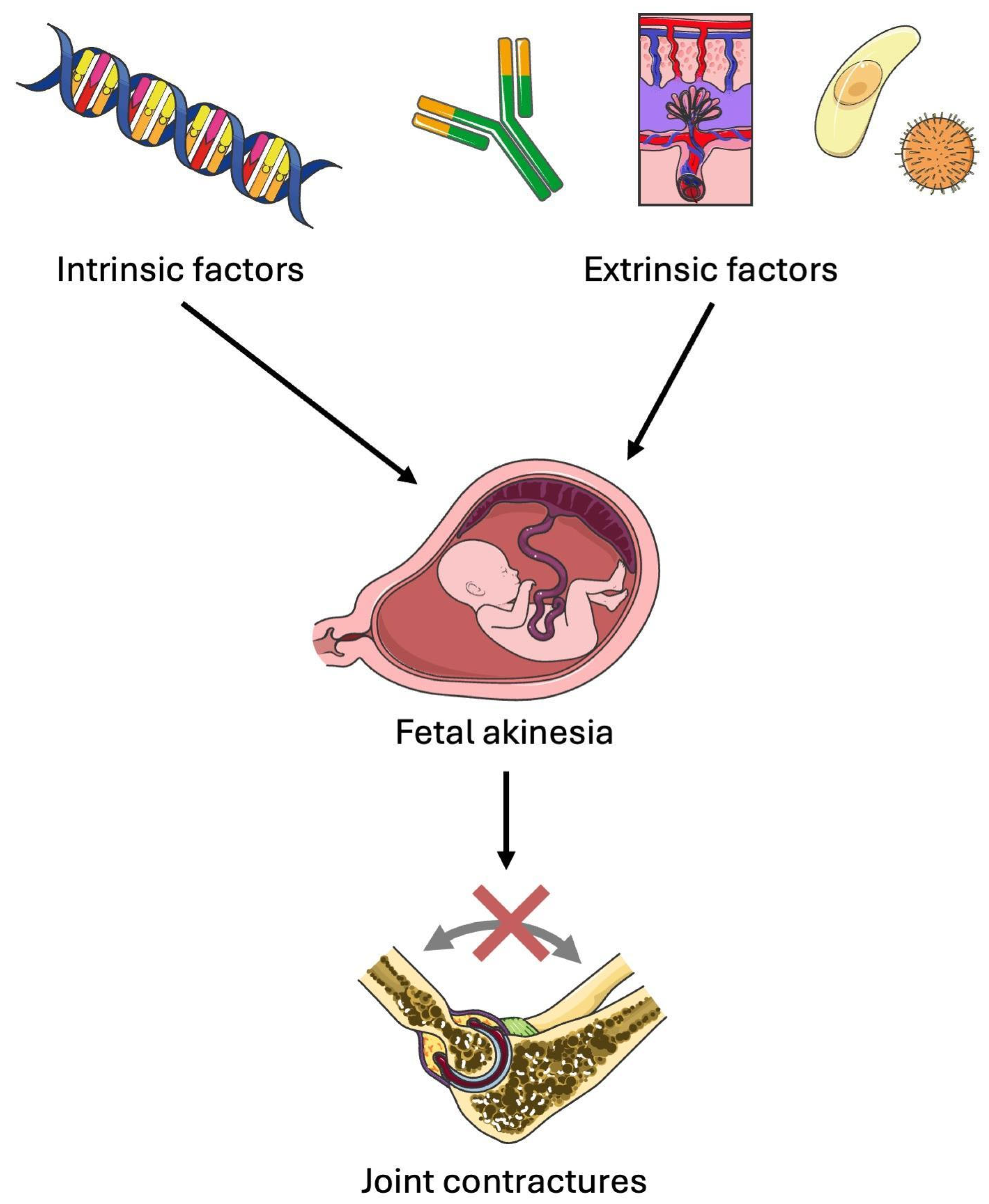
| Category | Causes |
|---|---|
| Mechanical factors | Multiple pregnancy Uterine malformations (e.g., bicornuate or septate uterus) Uterine fibroids |
| Maternal illnesses | Maternal infections (e.g., Zika virus, Coxsackie, CMV) Autoimmune diseases (e.g., myasthenia gravis, lupus) Poorly controlled maternal diabetes |
| Congenital infections | Zika virus, CMV, toxoplasmosis, rubella |
| Placental and vascular factors | Placental infarction Uteroplacental insufficiency Fetal vascular abnormalities |
| Environmental factors | Exposure to toxins or pesticides Drugs (e.g., neuromuscular blockers, misoprostol, alcohol, cocaine) |
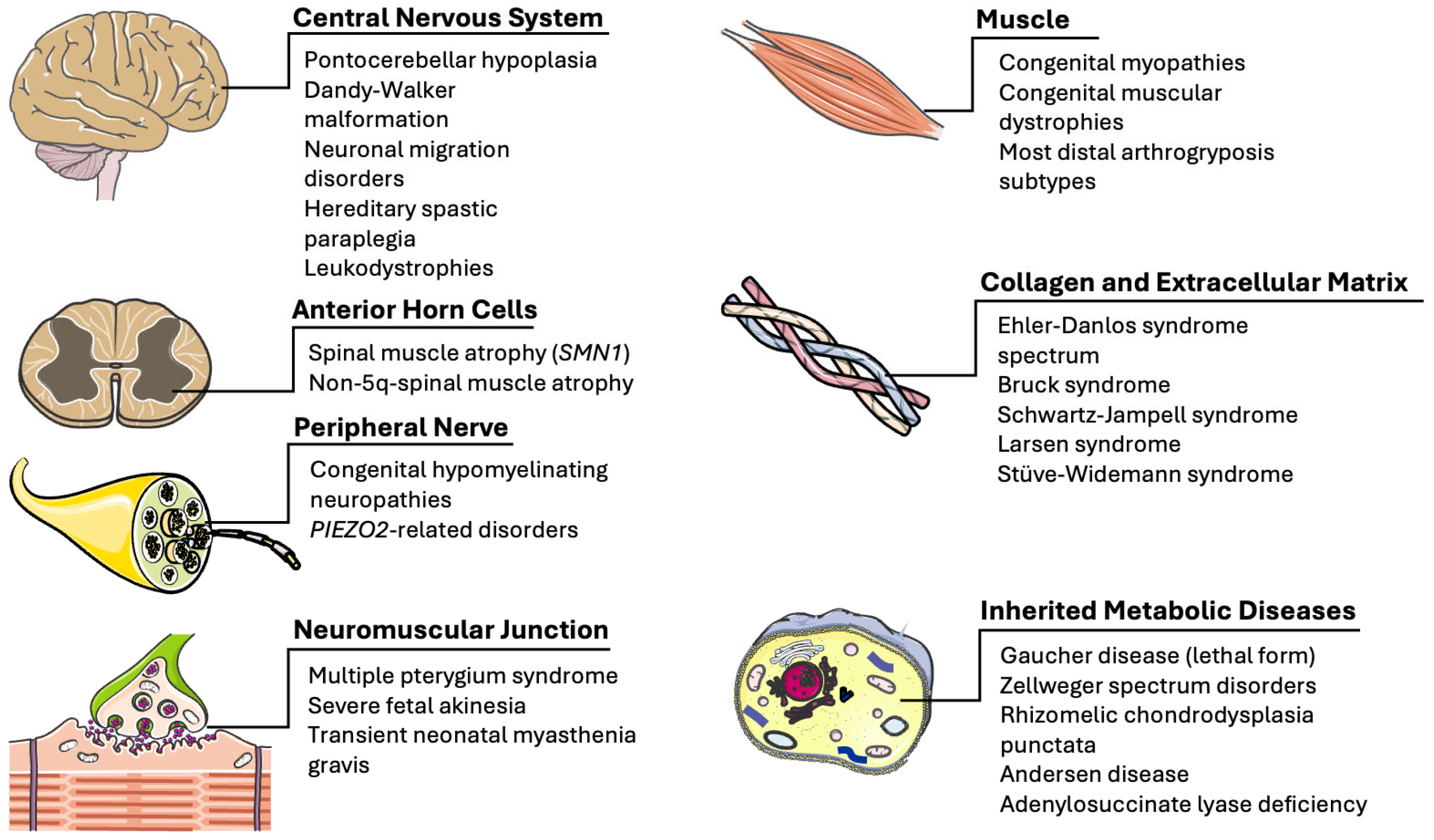
| Category | Condition/Syndrome | Gene(s) | Remarkable Features |
|---|---|---|---|
| CNS malformations | Pontocerebellar hypoplasias | PCH1 (EXOSC3, EXOSC8, EXOSC9, VRK1) PCH4 (TSEN54) PCH6 (RARS2) PCH9 (AMPD2) PCH12 (COASY) | Reduced pons size and cerebellar hypoplasia. |
| Dandy-Walker malformation | Unknown–genetic and environmental | Vermis hypoplasia and cystic enlargement of the fourth ventricle | |
| Lissencephaly | ARX; DCX, PAFAH1B1; RELN; PAFAH1B1; YWHAE; TUBA1A; TUBB2B; BLTP1 | Progressive demyelination; ataxia, weakness | |
| Non-malformative CNS disorders | HSP1 | L1CAM | Adducted thumbs |
| Vanishing white matter disease | EIF2B1-5 | Microcephaly, multiple organ involvement | |
| PCWH | SOX10 | Pigmentary abnormalities, hearing loss, Hirschprung disease | |
| Oculodentodigital dysplasia | GJA1 | Dental and ocular abnormalities | |
| Motor neuronopathies Motor neuronopathies (anterior horn cell disease) | Spinal muscular atrophy (congenital) | SMN1 | Severe hypotonia, respiratory failure |
| Non-5q-SMA | IGHMBP2; DYNC1H; BICD2; GLE1; ERBB3; UBA1; TRIP4; ASCC1; TRPV4 | Variable | |
| Neuropathies | Congenital hypomyelinating neuropathies | EGR2; MPZ; PMP22; MTMR2; GLDN; ADGRG6; LGI4; ERGIC1 | Fetal akinesia, nerve hypomyelination |
| Distal arthrogryposis with impaired proprioception and touch | PIEZO2 | Severely impaired proprioception, scoliosis | |
| Gordon syndrome (DA type 3) | PIEZO2 | Cleft palate, broad joint involvement | |
| Neuromuscular junction abnormalities | Multiple pterygium syndrome (Escobar type) | CHRNG | Multiple pterygia, distinctive facial features |
| Severe FADS | CHRNA1; CHRNG; RAPSN; MUSK; DOK7; NUP88; CHAT; SNAP25B; SCL18A3 | ||
| Transient neonatal myasthenia gravis | Sporadic–mothers with myasthenia gravis | Hypotonia, weak sucking, respiratory distress | |
| Myopathies | Congenital myopathies | RYR1; CACNA1S, STAC3, MTM1; DNM2; SPN1; ACTA1; ACTC1; TPM2; KLHL40; LMOD3; TNNT1; MYH2; TTN; NEB | Generalized muscle weakness, hypotonia, axial involvement. Cardiomyopathy (ACTC1) |
| Congenital muscular dystrophies | LAMA2; LMNA; COL6A1-3 | Hypotonia, axial contractures (LMNA, EDM), CNS involvement (LAMA2), hyperextensibility (COL6A1, 2, 3) | |
| Congenital myotonic dystrophy | DMPK | Myotonia | |
| Distal arthrogryposis 1A | TNNI2; TPM2; MYBPC1; MYBPC2; MYLPF | Pure distal AMC | |
| Freeman–Sheldon syndrome (DA 2A) | MYH3 | ‘Whistling face’ with ulnar deviation of hands | |
| Sheldon–Hall syndrome (DA 2B) | MYH3; TNNI2; TNNT3; TPM2 | Camptodactyly, triangular facies | |
| Trismus-camptodactyly | MYH8 | Jaw contracture | |
| Hereditary connective tissue disorders | Ehlers–Danlos syndrome spectrum | PLOD1; FKBP14; CHST14; DSE; B4GALT7; B3GALT6; SLC39A13; TNXB | Fragile skin, scoliosis, short stature |
| Bruck syndrome | FKBP10; PLOD2 | Brittle bones, blue sclera | |
| CACP syndrome | PRG4 | Noninflammatory arthropathy, pericarditis | |
| PLOD3-related disorder | PLOD3 | Skin laxity, vascular fragility, | |
| Schwartz–Jampel syndrome | HSPG2 | Myotonia, short stature, blepharophimosis | |
| Larsen syndrome | FLNB | Osteochondrodysplasia, joint dislocations, hearing loss, cleft palate | |
| Stüve–Wiedemann syndrome | LIFR | Skeletal dysplasia, hyperthermia, respiratory instability | |
| Hereditary Metabolic Diseases | Gaucher disease (perinatal lethal) | GBA | Hydrops, unusual fat, hepatosplenomegaly |
| Zellweger spectrum disorders | PEX1; PEX6; PEX10 | Peroxisome biogenesis defect; neuronal migration abnormalities | |
| Rhizomelic chondrodysplasia punctata | PEX7, GNPAT, AGPS | Rhizomelic shortening, congenital cataracts | |
| Andersen disease | GBE1 | Hypotonia, cardiomyopathy, respiratory failure | |
| Adenylosuccinate lyase deficiency | ADSL | Hypotonia, respiratory failure, CNS involvement |
Disclaimer/Publisher’s Note: The statements, opinions and data contained in all publications are solely those of the individual author(s) and contributor(s) and not of MDPI and/or the editor(s). MDPI and/or the editor(s) disclaim responsibility for any injury to people or property resulting from any ideas, methods, instructions or products referred to in the content. |
© 2026 by the authors. Licensee MDPI, Basel, Switzerland. This article is an open access article distributed under the terms and conditions of the Creative Commons Attribution (CC BY) license.
Share and Cite
Seneor, D.D.; Barile, J.P.; Mendes, P.M.; Orsini, M.; Silva, E.M.W.d.; Farias, I.B.; Serrano, P.d.L.; Pinto, W.B.V.d.R.; Oliveira, A.S.B.; Souza, P.V.S.d. Arthrogryposis Multiplex Congenita: Comprehensive Review from a Neuromuscular Standpoint. Genes 2026, 17, 675. https://doi.org/10.3390/genes17060675
Seneor DD, Barile JP, Mendes PM, Orsini M, Silva EMWd, Farias IB, Serrano PdL, Pinto WBVdR, Oliveira ASB, Souza PVSd. Arthrogryposis Multiplex Congenita: Comprehensive Review from a Neuromuscular Standpoint. Genes. 2026; 17(6):675. https://doi.org/10.3390/genes17060675
Chicago/Turabian StyleSeneor, Daniel Delgado, João Paulo Barile, Patrícia Marques Mendes, Marco Orsini, Eduardo Mendonça Werneck da Silva, Igor Braga Farias, Paulo de Lima Serrano, Wladimir Bocca Vieira de Rezende Pinto, Acary Souza Bulle Oliveira, and Paulo Victor Sgobbi de Souza. 2026. "Arthrogryposis Multiplex Congenita: Comprehensive Review from a Neuromuscular Standpoint" Genes 17, no. 6: 675. https://doi.org/10.3390/genes17060675
APA StyleSeneor, D. D., Barile, J. P., Mendes, P. M., Orsini, M., Silva, E. M. W. d., Farias, I. B., Serrano, P. d. L., Pinto, W. B. V. d. R., Oliveira, A. S. B., & Souza, P. V. S. d. (2026). Arthrogryposis Multiplex Congenita: Comprehensive Review from a Neuromuscular Standpoint. Genes, 17(6), 675. https://doi.org/10.3390/genes17060675