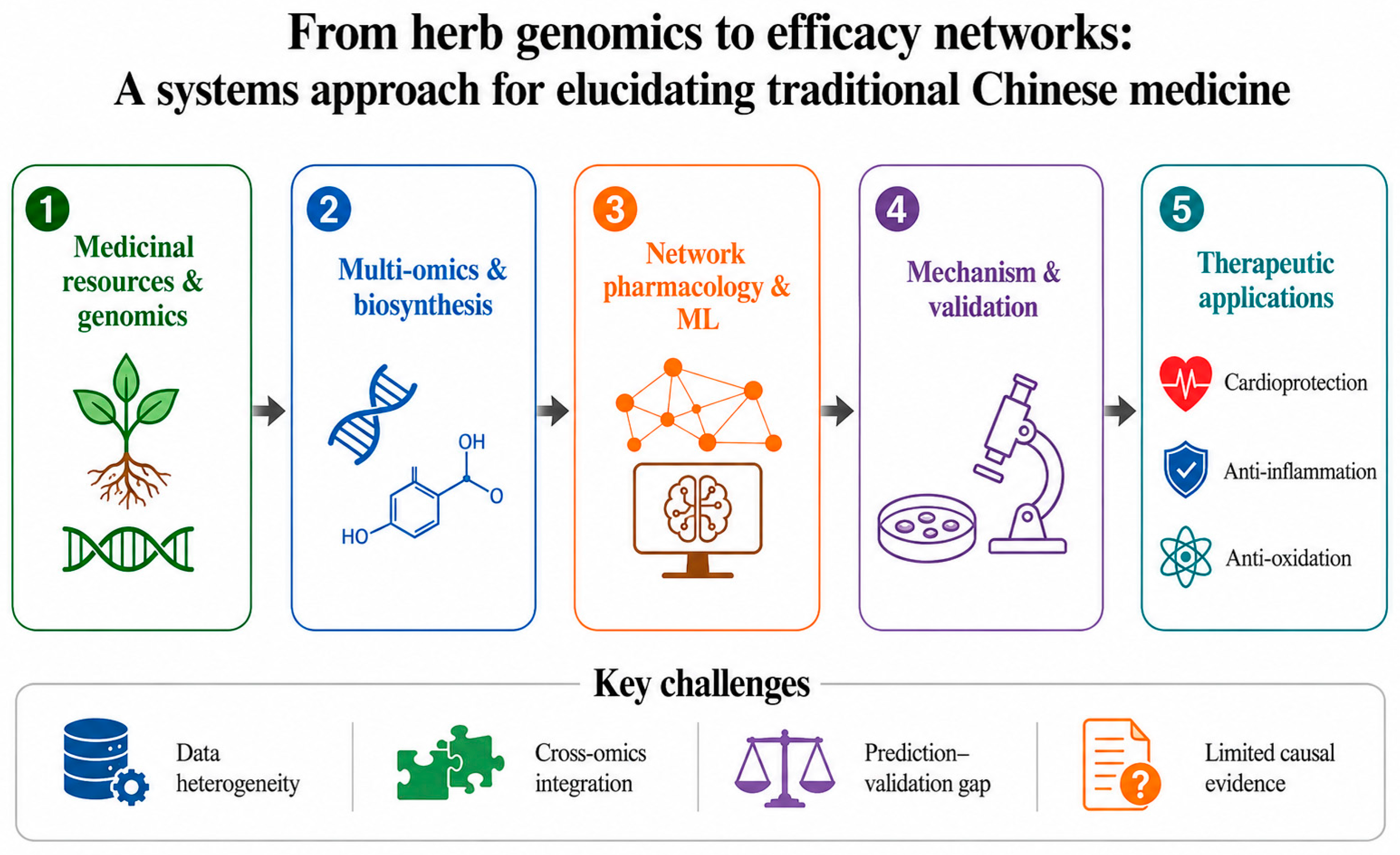
From Genome to Pharmacome: Current Status and Future Perspectives of Multi-Omics Integration in Traditional Chinese Medicine Research

Abstract
1. Introduction
2. Unraveling Geo-Authenticity: Environmental Factors and Genomic Underpinnings
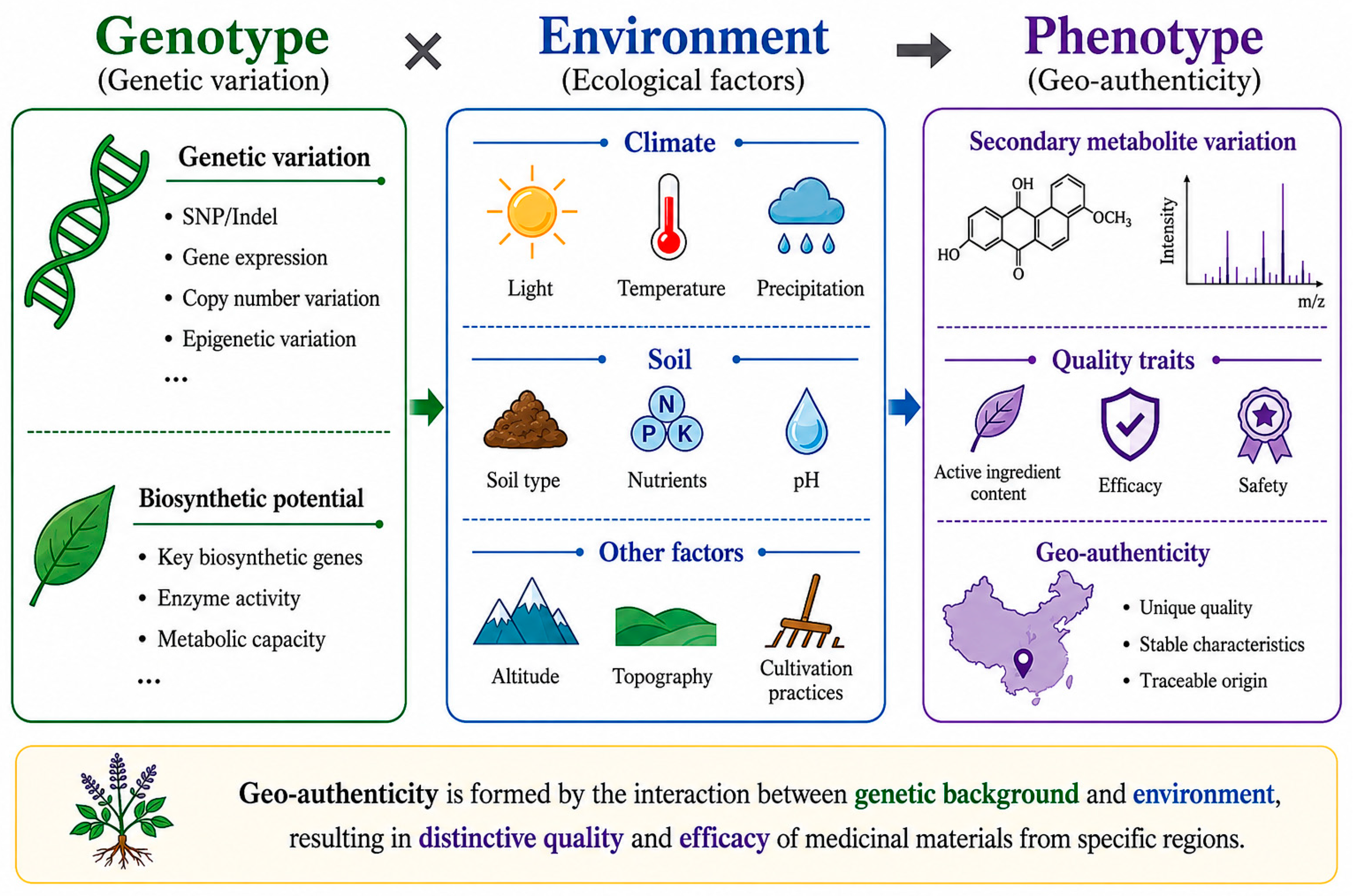
2.1. Genotype × Environment: Genetic Architecture Underlying Daodi Quality
2.2. From Field to Sequence: Molecular Authentication and Origin Traceability
2.3. Epigenetics and Metabolic Feedback: Closing the Regulatory Loop
3. From Gene to Metabolite: Biosynthetic Logic of TCM Bioactive Compounds
3.1. Genome-First Pathway Discovery: Strategies and Tools
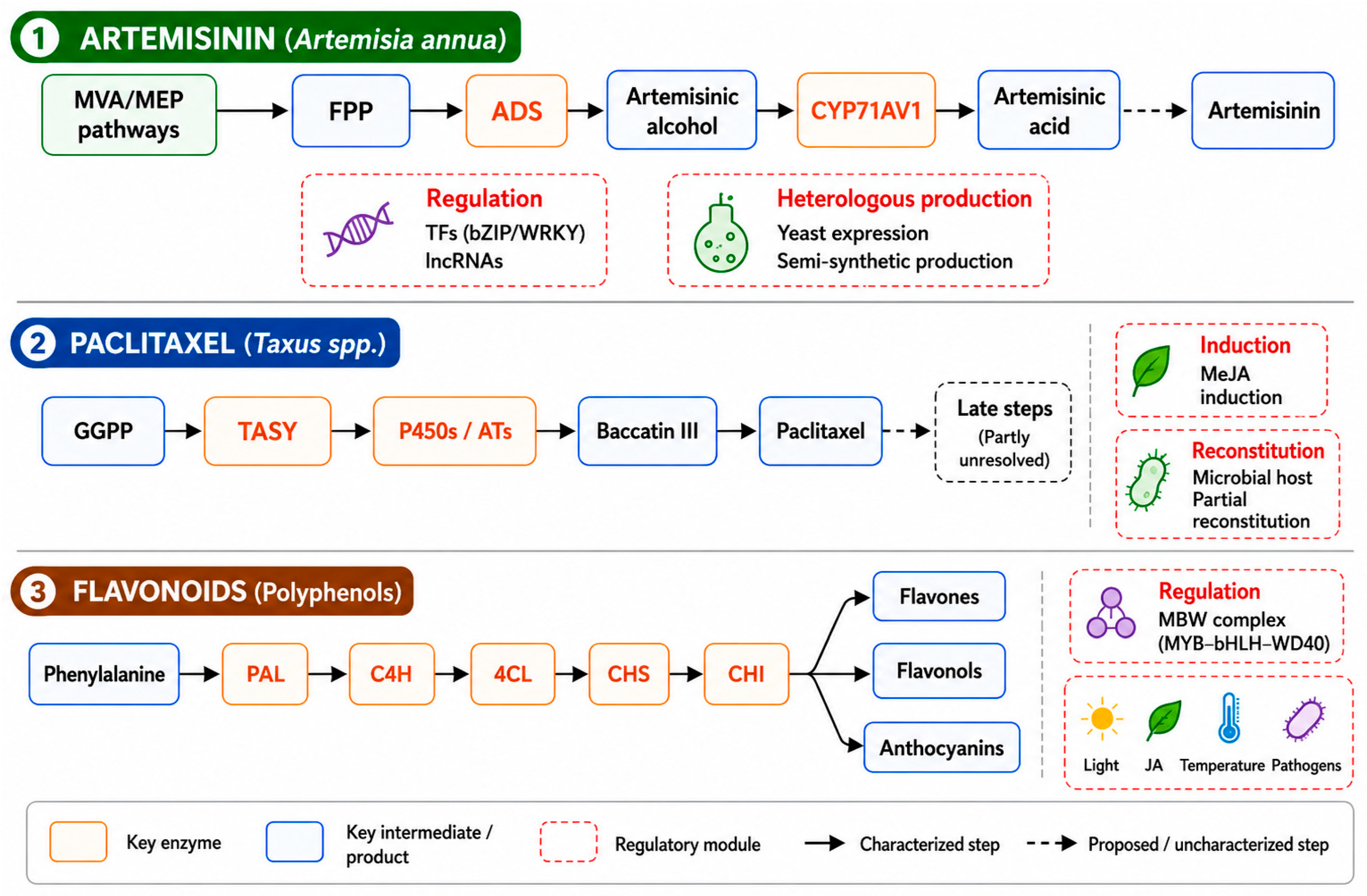
3.2. Three Case Studies in Pathway Elucidation
3.2.1. Artemisinin—A Linear Pathway Resolved
3.2.2. Paclitaxel—A Branched Pathway with Missing Steps
3.2.3. Flavonoids—A Network of Branching Decisions
3.3. Transcriptional Control to Chromatin: The Regulatory Hierarchy
4. Engineering Production: Synthetic Biology for TCM Natural Products
4.1. Building the Chassis: Heterologous Expression Systems

| Pathway Feature | Recommended Chassis | Rationale |
|---|---|---|
| Plant terpenoids (C15, C20) [40,65,66] | S. cerevisiae | Native MVA pathway; ER for P450 expression |
| Bacterial polyketides [67] | Streptomyces spp. | Native precursor pools; established genetic tools |
| Simple plant phenolics [49] | E. coli | Rapid growth; well-characterized metabolism |
| Complex alkaloids [50,71] | S. cerevisiae or co-culture | Compartmentalization; pH control |
| Membrane-bound P450 enzymes [65] | S. cerevisiae | Endomembrane system; closer to plant context |
| Industrial-scale [67,68] | E. coli or Corynebacterium glutamicum | High-density fermentation; GRAS status |
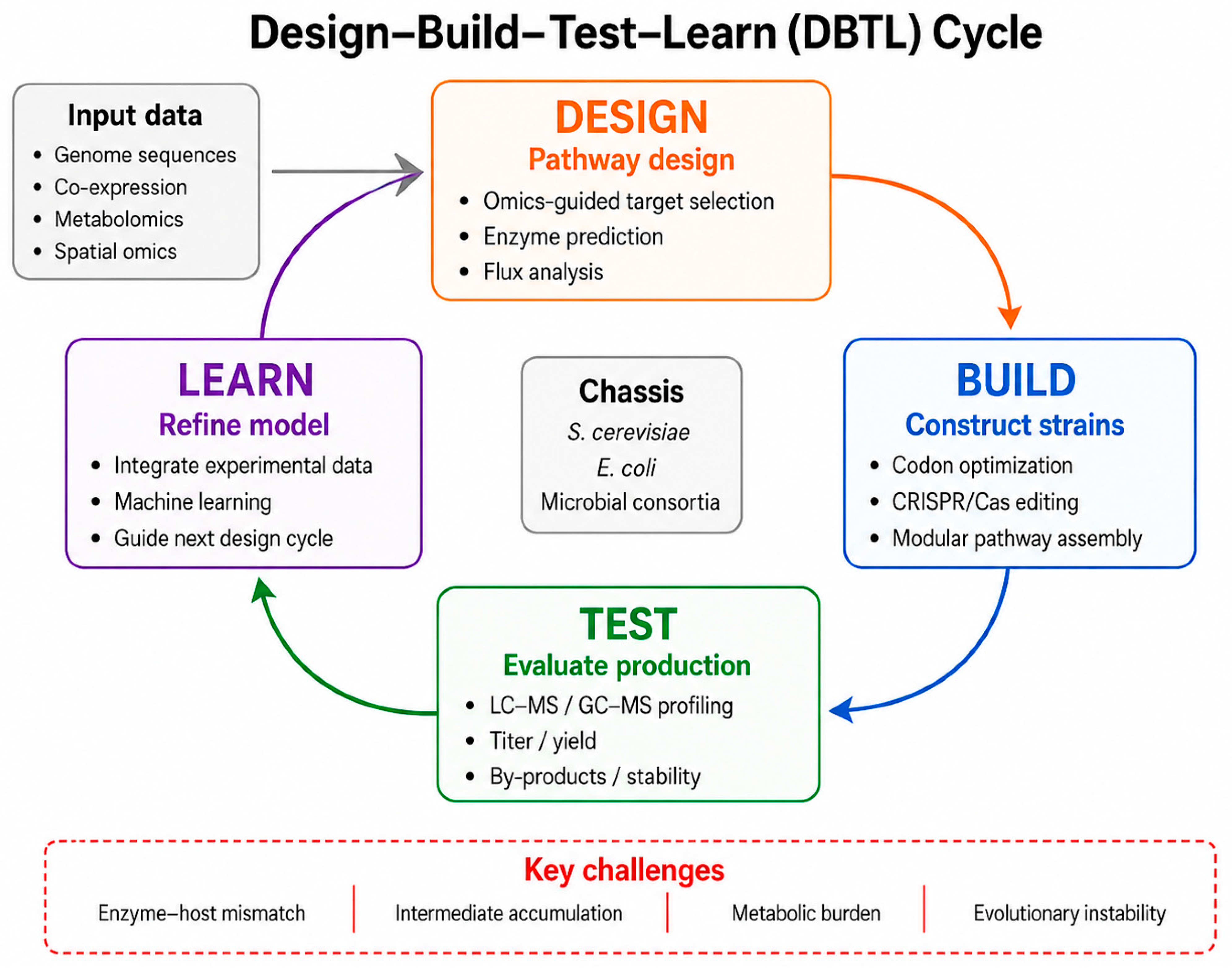
4.2. The DBTL Cycle: Iterative Pathway Optimization
4.3. From Lab to Bioreactor: Scaling Challenges and Economic Reality
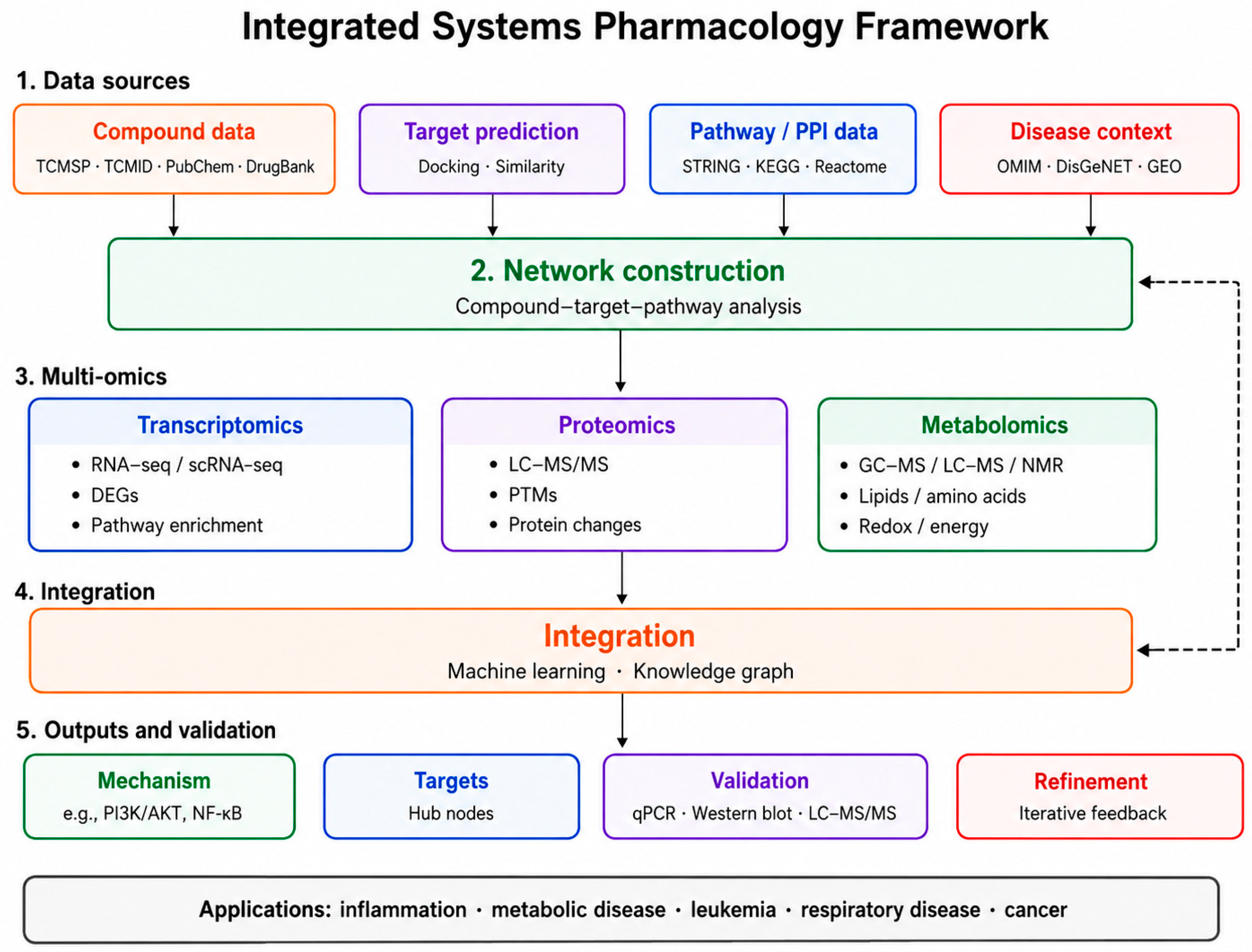
5. Systems Pharmacology of Traditional Chinese Medicine
5.1. Network Pharmacology: From Single Target to System-Level Logic
5.2. Multi-Omics Dissection of TCM Mechanisms
5.2.1. Transcriptomic Signatures
5.2.2. Proteomic and Metabolomic Readouts
5.3. Case Study: Multi-Omics Dissection of TCM Pharmacological Mechanisms
5.4. From Correlation to Causation: Experimental Validation Strategies
5.4.1. Tiered Validation Framework
- (1)
- Target prioritization. Computational predictions must first be triaged to focus experimental resources on the most tractable and biologically plausible targets. Prioritization criteria include (i) network topology metrics (degree centrality, betweenness centrality) to identify hub nodes; (ii) druggability assessment using structural databases (e.g., DrugBank, ChEMBL); (iii) availability of validated reagents (antibodies, siRNA, sgRNA design sites); and (iv) prior functional annotation linking the target to the disease phenotype of interest.
- (2)
- Biochemical target engagement. The highest-priority targets should undergo direct binding confirmation. Thermal shift assays (also termed cellular thermal shift assays, CETSA) measure ligand-induced protein thermal stabilization in intact cells. Surface plasmon resonance (SPR) and microscale thermophoresis (MST) provide quantitative binding affinities (Kd) in cell-free systems. Chemoproteomics approaches—including thermal proteome profiling (TPP) and activity-based protein profiling (ABPP)—enable proteome-wide assessment of compound–protein interactions without prior target specification, thereby identifying both on-target and off-target binding events.
- (3)
- Genetic perturbation. Arrayed or pooled CRISPR/Cas9 knockout or CRISPR interference/activation (CRISPRi/a) screens test whether modulating a predicted target alters the pharmacological response. Pooled screens with deep sequencing readouts (e.g., MAGeCK analysis) are suitable for genome-wide target discovery, while arrayed screens allow more detailed phenotypic characterization of prioritized candidates. To resolve cellular heterogeneity, single-cell perturbation sequencing (Perturb-seq) combines CRISPR perturbations with scRNA-seq readout, simultaneously measuring the transcriptional consequences of target modulation in thousands of individual cells.
- (4)
- In vivo functional validation. Target engagement and genetic perturbation evidence from cellular systems must ultimately be tested in disease-relevant animal models. Pathway-specific pharmacological inhibitors, inducible transgenic models, and xenograft assays can determine whether a specific compound–target interaction is necessary and sufficient for the therapeutic effect in vivo.
5.4.2. Bridging Computation and Experiment: An Iterative Loop
5.5. Standardization, Reproducibility, and FAIR Data Principles
6. Conclusions and Perspectives
6.1. Key Advances
6.2. The Road Ahead: A Prioritized Action Plan
- Establish community standards and data infrastructure. (i) Adopt minimum metadata standards for TCM multi-omics studies (herbal material authentication, preparation methods, omics platform specifications, statistical parameters). (ii) Deposit raw multi-omics data in public repositories (GEO, ProteomeXchange, MetaboLights) with complete sample metadata as a condition of publication. (iii) Develop curated, species-specific reference databases for medicinal plant genomes, transcriptomes, and metabolomes.
- Close the causal validation gap. (i) Implement the tiered validation framework outlined in Section 5.4, prioritizing at least one orthogonal validation method (biochemical binding assay, genetic perturbation, or in vivo pathway inhibition) for each computationally predicted mechanism. (ii) Fund collaborative programs linking computational prediction groups with experimental validation laboratories. (iii) Establish shared perturbation screening resources (arrayed CRISPR libraries, chemoproteomics facilities) accessible to TCM research consortia.
- Bridge biosynthesis and production. (i) Fund coordinated DBTL pilot projects targeting 3–5 high-value TCM natural products, with pre-specified titer, yield, and productivity benchmarks and public reporting of both successes and failures. (ii) Develop standardized techno-economic models that co-optimize strain design, fermentation, and downstream processing. (iii) Address regulatory pathways for fermentation-derived TCM compounds through early engagement with agencies (FDA, EMA, NMPA).
6.3. A Closing Note
Author Contributions
Funding
Institutional Review Board Statement
Informed Consent Statement
Data Availability Statement
Conflicts of Interest
References
- Hopkins, A.L. Network pharmacology: The next paradigm in drug discovery. Nat. Chem. Biol. 2008, 4, 682–690. [Google Scholar] [CrossRef]
- Song, Z.; Lin, C.; Xing, P.; Fen, Y.; Jin, H.; Zhou, C.; Gu, Y.Q.; Wang, J.; Li, X. A high-quality reference genome sequence of Salvia miltiorrhiza provides insights into tanshinone synthesis in its red rhizomes. Plant Genome 2020, 13, e20041. [Google Scholar] [CrossRef] [PubMed]
- Xu, H.; Song, J.; Luo, H.; Zhang, Y.; Li, Q.; Zhu, Y.; Xu, J.; Li, Y.; Song, C.; Wang, B.; et al. Analysis of the genome sequence of the medicinal plant Salvia miltiorrhiza. Mol. Plant 2016, 9, 949–952. [Google Scholar] [CrossRef]
- Chen, W.; Kui, L.; Zhang, G.; Zhu, S.; Zhang, J.; Wang, X.; Yang, M.; Huang, H.; Liu, Y.; Wang, Y.; et al. Whole-genome sequencing and analysis of the Chinese herbal plant Panax notoginseng. Mol. Plant 2017, 10, 899–902. [Google Scholar] [CrossRef]
- Zhang, D.; Li, W.; Xia, E.-H.; Zhang, Q.-J.; Liu, Y.; Zhang, Y.; Tong, Y.; Zhao, Y.; Niu, Y.-C.; Xu, J.-H.; et al. The medicinal herb Panax notoginseng genome provides insights into ginsenoside biosynthesis and genome evolution. Mol. Plant 2017, 10, 903–907. [Google Scholar] [CrossRef]
- Hasin, Y.; Seldin, M.; Lusis, A. Multi-omics approaches to disease. Genome Biol. 2017, 18, 83. [Google Scholar] [CrossRef]
- Sun, Y.; Sun, J.; Lin, C.; Zhang, J.; Yan, H.; Guan, Z.; Zhang, C. Single-cell transcriptomics applied in plants. Cells 2024, 13, 1561. [Google Scholar] [CrossRef]
- Li, S.; Zhang, B. Traditional Chinese medicine network pharmacology: Theory, methodology and application. Chin. J. Nat. Med. 2013, 11, 110–120. [Google Scholar] [CrossRef] [PubMed]
- Vamathevan, J.; Clark, D.; Czodrowski, P.; Dunham, I.; Ferran, E.; Lee, G.; Li, B.; Madabhushi, A.; Shah, P.; Spitzer, M.; et al. Applications of machine learning in drug discovery and development. Nat. Rev. Drug Discov. 2019, 18, 463–477. [Google Scholar] [CrossRef]
- Siadjeu, C.; Pucker, B. Medicinal plant genomics. BMC Genom. 2023, 24, 429. [Google Scholar] [CrossRef] [PubMed]
- Liu, S.; Jiang, Y.; Wang, Y.; Huo, H.; Cilkiz, M.; Chen, P.; Han, Y.; Li, L.; Wang, K.; Zhao, M.; et al. Genetic and molecular dissection of ginseng (Panax ginseng Mey.) germplasm using high-density genic SNP markers, secondary metabolites, and gene expressions. Front. Plant Sci. 2023, 14, 1165349. [Google Scholar] [CrossRef]
- Zhang, F.; Fu, X.; Lv, Z.; Lu, X.; Shen, Q.; Zhang, L.; Zhu, M.; Wang, G.; Sun, X.; Liao, Z.; et al. A basic leucine zipper transcription factor, AabZIP1, connects abscisic acid signaling with artemisinin biosynthesis in Artemisia annua. Mol. Plant 2015, 8, 163–175. [Google Scholar] [CrossRef] [PubMed]
- Jia, J.-S.; Ge, N.; Wang, Q.-Y.; Zhao, L.-T.; Chen, C.; Chen, J.-W. Genome-wide identification and characterization of members of the LEA gene family in Panax notoginseng and their transcriptional responses to dehydration of recalcitrant seeds. BMC Genom. 2023, 24, 126. [Google Scholar] [CrossRef]
- Cun, Z.; Li, X.; Zhang, J.-Y.; Hong, J.; Gao, L.-L.; Yang, J.; Ma, S.-Y.; Chen, J.-W. Identification of candidate genes and residues for improving nitrogen use efficiency in the N-sensitive medicinal plant Panax notoginseng. BMC Plant Biol. 2024, 24, 105. [Google Scholar] [CrossRef]
- Weng, J.-K.; Lynch, J.H.; Matos, J.O.; Dudareva, N. Adaptive mechanisms of plant specialized metabolism connecting chemistry to function. Nat. Chem. Biol. 2021, 17, 1037–1045. [Google Scholar] [CrossRef] [PubMed]
- Marais, D.L.D.; Hernandez, K.M.; Juenger, T.E. Genotype-by-environment interaction and plasticity: Exploring genomic responses of plants to the abiotic environment. Annu. Rev. Ecol. Evol. Syst. 2013, 44, 5–29. [Google Scholar] [CrossRef]
- Li, L.-F.; Cushman, S.A.; He, Y.-X.; Li, Y. Genome sequencing and population genomics modeling provide insights into the local adaptation of weeping forsythia. Hortic. Res. 2020, 7, 130. [Google Scholar] [CrossRef]
- Siol, M.; Wright, S.I.; Barrett, S.C.H. The population genomics of plant adaptation. New Phytol. 2010, 188, 313–332. [Google Scholar] [CrossRef]
- Berg, J.J.; Coop, G. A population genetic signal of polygenic adaptation. PLoS Genet. 2014, 10, e1004412. [Google Scholar] [CrossRef]
- Chen, S.L.; Yao, H.; Han, J.P.; Liu, C.; Song, J.Y.; Shi, L.C.; Zhu, Y.J.; Ma, X.Y.; Gao, T.; Pang, X.H.; et al. Validation of the ITS2 region as a novel DNA barcode for identifying medicinal plant species. PLoS ONE 2010, 5, e8613. [Google Scholar] [CrossRef]
- Techen, N.; Parveen, I.; Pan, Z.; Khan, I.A. DNA barcoding of medicinal plant material for identification. Curr. Opin. Biotechnol. 2014, 25, 103–110. [Google Scholar] [CrossRef] [PubMed]
- Mishra, P.; Kumar, A.; Nagireddy, A.; Mani, D.N.; Shukla, A.K.; Tiwari, R.; Sundaresan, V. DNA barcoding: An efficient tool to overcome authentication challenges in the herbal market. Plant Biotechnol. J. 2016, 14, 8–21. [Google Scholar] [CrossRef]
- Chen, S.; Yin, X.; Han, J.; Sun, W.; Yao, H.; Song, J.; Li, X. DNA barcoding in herbal medicine: Retrospective and prospective. J. Pharm. Anal. 2023, 13, 431–441. [Google Scholar] [CrossRef]
- Gu, W.; Song, J.; Cao, Y.; Sun, Q.; Yao, H.; Wu, Q.; Chao, J.; Zhou, J.; Xue, W.; Duan, J. Application of the ITS2 region for barcoding medicinal plants of Selaginellaceae in Pteridophyta. PLoS ONE 2013, 8, e67818. [Google Scholar] [CrossRef] [PubMed]
- Langfelder, P.; Horvath, S. WGCNA: An R package for weighted correlation network analysis. BMC Bioinform. 2008, 9, 559. [Google Scholar] [CrossRef] [PubMed]
- Rai, A.; Saito, K.; Yamazaki, M. Integrated omics analysis of specialized metabolism in medicinal plants. Plant J. 2017, 90, 764–787. [Google Scholar] [CrossRef]
- Korte, A.; Farlow, A. The advantages and limitations of trait analysis with GWAS: A review. Plant Methods 2013, 9, 29. [Google Scholar] [CrossRef]
- Zhang, F.; Xiang, L.; Yu, Q.; Zhang, H.; Zhang, T.; Zeng, J.; Geng, C.; Li, L.; Fu, X.; Shen, Q.; et al. ARTEMISININ BIOSYNTHESIS PROMOTING KINASE 1 positively regulates artemisinin biosynthesis through phosphorylating AabZIP1. J. Exp. Bot. 2018, 69, 1109–1123. [Google Scholar] [CrossRef]
- Li, X.; Egervari, G.; Wang, Y.; Berger, S.L.; Lu, Z. Regulation of chromatin and gene expression by metabolic enzymes and metabolites. Nat. Rev. Mol. Cell Biol. 2018, 19, 563–578. [Google Scholar] [CrossRef]
- Zhang, F.; Zhang, G.; Wang, C.; Xu, H.; Che, K.; Sun, T.; Yao, Q.; Xiong, Y.; Zhou, N.; Chen, M.; et al. Geographical variation in metabolite profiles and bioactivity of Thesium chinense Turcz. revealed by UPLC-Q-TOF-MS-based metabolomics. Front. Plant Sci. 2025, 15, 1471729. [Google Scholar] [CrossRef]
- Zhang, H.; Zhu, J.-K. Epigenetic gene regulation in plants and its potential applications in crop improvement. Nat. Rev. Mol. Cell Biol. 2025, 26, 51–67. [Google Scholar] [CrossRef] [PubMed]
- Huang, X.-Q.; Dudareva, N. Plant specialized metabolism. Curr. Biol. 2023, 33, R473–R478. [Google Scholar] [CrossRef]
- Wong, D.C.J. Harnessing integrated omics approaches for plant specialized metabolism research: New insights into shikonin biosynthesis. Plant Cell Physiol. 2019, 60, 4–6. [Google Scholar] [CrossRef]
- Smit, S.J.; Lichman, B.R. Plant biosynthetic gene clusters in the context of metabolic evolution. Nat. Prod. Rep. 2022, 39, 1465–1482. [Google Scholar] [CrossRef]
- Arya, S.S.; Rookes, J.E.; Cahill, D.M.; Lenka, S.K. Next-generation metabolic engineering approaches towards development of plant cell suspension cultures as specialized metabolite producing biofactories. Biotechnol. Adv. 2020, 45, 107635. [Google Scholar] [CrossRef]
- Bai, Y.; Liu, X.; Baldwin, I.T. Using synthetic biology to understand the function of plant specialized metabolites. Annu. Rev. Plant Biol. 2024, 75, 629–653. [Google Scholar] [CrossRef] [PubMed]
- Pichersky, E.; Raguso, R.A. Why do plants produce so many terpenoid compounds? New Phytol. 2018, 220, 692–702. [Google Scholar] [CrossRef] [PubMed]
- Chen, S.; Song, J.; Sun, C.; Xu, J.; Zhu, Y.; Verpoorte, R.; Fan, T.P. Herbal genomics: Examining the biology of traditional medicines. Science 2015, 347, S27–S29. [Google Scholar]
- Wu, Y.; Gong, F.L.; Li, S. Leveraging yeast to characterize plant biosynthetic gene clusters. Curr. Opin. Plant Biol. 2023, 71, 102314. [Google Scholar] [CrossRef]
- Paddon, C.J.; Westfall, P.J.; Pitera, D.J.; Benjamin, K.; Fisher, K.; McPhee, D.J.; Leavell, M.D.; Tai, A.; Main, A.; Eng, D.; et al. High-level semi-synthetic production of the potent antimalarial artemisinin. Nature 2013, 496, 528–532. [Google Scholar] [CrossRef]
- Lin, X.; Hezari, M.; Koepp, A.E.; Floss, H.G.; Croteau, R. Mechanism of taxadiene synthase, a diterpene cyclase that catalyzes the first step of taxol biosynthesis in Pacific yew. Biochemistry 1996, 35, 2968–2977. [Google Scholar] [CrossRef]
- Gonzalez, A.; Zhao, M.; Leavitt, J.M.; Lloyd, A.M. Regulation of the anthocyanin biosynthetic pathway by the TTG1/bHLH/Myb transcriptional complex in Arabidopsis seedlings. Plant J. 2008, 53, 814–827. [Google Scholar] [CrossRef]
- Shen, Q.; Zhang, L.; Liao, Z.; Wang, S.; Yan, T.; Shi, P.; Liu, M.; Fu, X.; Pan, Q.; Wang, Y.; et al. The genome of Artemisia annua provides insight into the evolution of Asteraceae family and artemisinin biosynthesis. Mol. Plant 2018, 11, 776–788. [Google Scholar] [CrossRef]
- Croteau, R.; Ketchum, R.E.B.; Long, R.M.; Kaspera, R.; Wildung, M.R. Taxol biosynthesis and molecular genetics. Phytochem. Rev. 2006, 5, 75–97. [Google Scholar] [CrossRef]
- Lu, C.; Yan, X.; Zhang, H.; Zhong, T.; Gui, A.; Liu, Y.; Pan, L.; Shao, Q. Integrated metabolomic and transcriptomic analysis reveals biosynthesis mechanism of flavone and caffeoylquinic acid in chrysanthemum. BMC Genom. 2024, 25, 759. [Google Scholar] [CrossRef]
- Martinelli, L.; Papon, N.; Courdavault, V. The Paclitaxel Biosynthesis Pathway Unlocked. Research 2025, 8, 965. [Google Scholar] [CrossRef]
- Shen, Q.; Yan, T.; Fu, X.; Tang, K. Transcriptional regulation of artemisinin biosynthesis in Artemisia annua L. Sci. Bull. 2016, 61, 18–25. [Google Scholar] [CrossRef]
- Xu, W.; Dubos, C.; Lepiniec, L. Transcriptional control of flavonoid biosynthesis by MYB–bHLH–WDR complexes. Trends Plant Sci. 2015, 20, 176–185. [Google Scholar] [CrossRef]
- Ajikumar, P.K.; Xiao, W.-H.; Tyo, K.E.J.; Wang, Y.; Simeon, F.; Leonard, E.; Mucha, O.; Phon, T.H.; Pfeifer, B.; Stephanopoulos, G. Isoprenoid pathway optimization for Taxol precursor overproduction in Escherichia coli. Science 2010, 330, 70–74. [Google Scholar] [CrossRef] [PubMed]
- Galanie, S.; Thodey, K.; Trenchard, I.J.; Interrante, M.F.; Smolke, C.D. Complete biosynthesis of opioids in yeast. Science 2015, 349, 1095–1100. [Google Scholar] [CrossRef] [PubMed]
- Lam, P.Y.; Wang, L.; Lui, A.C.W.; Liu, H.; Takeda-Kimura, Y.; Chen, M.-X.; Zhu, F.-Y.; Zhang, J.; Umezawa, T.; Tobimatsu, Y.; et al. Deficiency in flavonoid biosynthesis genes CHS, CHI, and CHIL alters rice flavonoid and lignin profiles. Plant Physiol. 2022, 188, 1993–2011. [Google Scholar] [CrossRef] [PubMed]
- Paddon, C.J.; Keasling, J.D. Semi-synthetic artemisinin: A model for the use of synthetic biology in pharmaceutical development. Nat. Rev. Microbiol. 2014, 12, 355–367. [Google Scholar] [CrossRef]
- Ma, T.; Zhang, T.; Song, J.; Shen, X.; Xiang, L.; Shi, Y. Novel Differentially Expressed LncRNAs Regulate Artemisinin Biosynthesis in Artemisia annua. Life 2024, 14, 1462. [Google Scholar] [CrossRef]
- Howat, S.; Park, B.; Oh, I.S.; Jin, Y.-W.; Lee, E.-K.; Loake, G.J. Paclitaxel: Biosynthesis, production and future prospects. New Biotechnol. 2014, 31, 242–245. [Google Scholar] [CrossRef]
- Guerra-Bubb, J.; Croteau, R.; Williams, R.M. The early stages of taxol biosynthesis: An interim report on the synthesis and identification of early pathway metabolites. Nat. Prod. Rep. 2012, 29, 683–696. [Google Scholar] [CrossRef]
- Walker, K.; Croteau, R. Taxol biosynthetic genes. Phytochemistry 2001, 58, 1–7. [Google Scholar] [CrossRef]
- Wang, W.-L.; Wang, Y.-X.; Li, H.; Liu, Z.-W.; Cui, X.; Zhuang, J. Two MYB transcription factors (CsMYB2 and CsMYB26) are involved in flavonoid biosynthesis in tea plant [Camellia sinensis (L.) O. Kuntze]. BMC Plant Biol. 2018, 18, 288. [Google Scholar] [CrossRef]
- Wang, H.; Wang, X.; Yu, C.; Wang, C.; Jin, Y.; Zhang, H. MYB transcription factor PdMYB118 directly interacts with bHLH transcription factor PdTT8 to regulate wound-induced anthocyanin biosynthesis in poplar. BMC Plant Biol. 2020, 20, 173. [Google Scholar] [CrossRef]
- van der Fits, L.; Memelink, J. ORCA3, a jasmonate-responsive transcriptional regulator of plant primary and secondary metabolism. Science 2000, 289, 295–297. [Google Scholar] [CrossRef] [PubMed]
- Chen, Q.; Sun, J.; Zhai, Q.; Zhou, W.; Qi, L.; Xu, L.; Wang, B.; Chen, R.; Jiang, H.; Qi, J.; et al. The basic helix-loop-helix transcription factor MYC2 directly represses PLETHORA expression during jasmonate-mediated modulation of the root stem cell niche in Arabidopsis. Plant Cell 2011, 23, 3335–3352. [Google Scholar] [CrossRef] [PubMed]
- Shoji, T.; Ogawa, T.; Hashimoto, T. Jasmonate-induced nicotine formation in tobacco is mediated by tobacco COI1 and JAZ genes. Plant Cell Physiol. 2008, 49, 1003–1012. [Google Scholar] [CrossRef] [PubMed]
- De Geyter, N.; Gholami, A.; Goormachtig, S.; Goossens, A. Transcriptional machineries in jasmonate-elicited plant secondary metabolism. Trends Plant Sci. 2012, 17, 349–359. [Google Scholar] [CrossRef] [PubMed]
- Dowen, R.H.; Pelizzola, M.; Schmitz, R.J.; Lister, R.; Dowen, J.M.; Nery, J.R.; Dixon, J.E.; Ecker, J.R. Widespread dynamic DNA methylation in response to biotic stress. Proc. Natl. Acad. Sci. USA 2012, 109, 2183–2191. [Google Scholar] [CrossRef]
- Li, S.; Lin, Y.-C.J.; Wang, P.; Zhang, B.; Li, M.; Chen, S.; Shi, R.; Tunlaya-Anukit, S.; Liu, X.; Wang, Z.; et al. The AREB1 transcription factor influences histone acetylation to regulate drought responses and tolerance in Populus trichocarpa. Plant Cell 2019, 31, 663–686. [Google Scholar] [CrossRef]
- Ro, D.-K.; Paradise, E.M.; Ouellet, M.; Fisher, K.J.; Newman, K.L.; Ndungu, J.M.; Ho, K.A.; Eachus, R.A.; Ham, T.S.; Kirby, J.; et al. Production of the antimalarial drug precursor artemisinic acid in engineered yeast. Nature 2006, 440, 940–943. [Google Scholar] [CrossRef]
- Xie, L.; Gao, J.; Zhou, Y.J. Synthetic biology for Taxol biosynthesis and sustainable production. Trends Biotechnol. 2024, 42, 674–676. [Google Scholar] [CrossRef]
- Keasling, J.D. Manufacturing molecules through metabolic engineering. Science 2010, 330, 1355–1358. [Google Scholar] [CrossRef]
- Nielsen, J.; Keasling, J.D. Engineering cellular metabolism. Cell 2016, 164, 1185–1197. [Google Scholar] [CrossRef]
- Gupta, A.; Reizman, I.M.B.; Reisch, C.R.; Prather, K.L.J. Dynamic regulation of metabolic flux in engineered bacteria using a pathway-independent quorum-sensing circuit. Nat. Biotechnol. 2017, 35, 273–279. [Google Scholar] [CrossRef]
- Jinek, M.; Chylinski, K.; Fonfara, I.; Hauer, M.; Doudna, J.A.; Charpentier, E. A Programmable dual-RNA-guided DNA endonuclease in adaptive bacterial immunity. Science 2012, 337, 816–821. [Google Scholar] [CrossRef] [PubMed]
- Zhou, K.; Qiao, K.; Edgar, S.M.; Stephanopoulos, G. Distributing a metabolic pathway among a microbial consortium enhances production of natural products. Nat. Biotechnol. 2015, 33, 377–383. [Google Scholar] [CrossRef]
- Radivojević, T.; Costello, Z.; Workman, K.; Martin, H.G. A machine learning Automated Recommendation Tool for synthetic biology. Nat. Commun. 2020, 11, 4879. [Google Scholar] [CrossRef]
- Martin, V.J.J.; Pitera, D.J.; Withers, S.T.; Newman, J.D.; Keasling, J.D. Engineering a mevalonate pathway in Escherichia coli for production of terpenoids. Nat. Biotechnol. 2003, 21, 796–802. [Google Scholar] [CrossRef]
- Xu, P.; Gu, Q.; Wang, W.; Wong, L.; Bower, A.G.; Collins, C.H.; Koffas, M.A. Modular optimization of multi-gene pathways for fatty acids production in E. coli. Nat. Commun. 2013, 4, 1409. [Google Scholar] [CrossRef] [PubMed]
- Pfleger, B.F.; Pitera, D.J.; Smolke, C.D.; Keasling, J.D. Combinatorial engineering of intergenic regions in operons tunes expression of multiple genes. Nat. Biotechnol. 2006, 24, 1027–1032. [Google Scholar] [CrossRef]
- Dahl, R.H.; Zhang, F.; Alonso-Gutierrez, J.; Baidoo, E.; Batth, T.S.; Redding-Johanson, A.M.; Petzold, C.J.; Mukhopadhyay, A.; Lee, T.S.; Adams, P.D.; et al. Engineering dynamic pathway regulation using stress-response promoters. Nat. Biotechnol. 2013, 31, 1039–1046. [Google Scholar] [CrossRef]
- Jakočiūnas, T.; Jensen, M.K.; Keasling, J.D. CRISPR/Cas9 advances engineering of microbial cell factories. Metab. Eng. 2016, 34, 44–59. [Google Scholar] [CrossRef]
- Li, M.; Schneider, K.; Kristensen, M.; Borodina, I.; Nielsen, J. Engineering yeast for high-level production of stilbenoid antioxidants. Sci. Rep. 2016, 6, 36827. [Google Scholar] [CrossRef] [PubMed]
- Zhang, H.; Pereira, B.; Li, Z.; Stephanopoulos, G. Engineering Escherichia coli coculture systems for the production of biochemical products. Proc. Natl. Acad. Sci. USA 2015, 112, 8266–8271. [Google Scholar] [CrossRef]
- Tyo, K.E.; Alper, H.S.; Stephanopoulos, G.N. Expanding the metabolic engineering toolbox: More options to engineer cells. Trends Biotechnol. 2007, 25, 132–137. [Google Scholar] [CrossRef] [PubMed]
- Yadav, V.G.; De Mey, M.; Lim, C.G.; Ajikumar, P.K.; Stephanopoulos, G. The future of metabolic engineering and synthetic biology: Towards a systematic practice. Metab. Eng. 2012, 14, 233–241. [Google Scholar] [CrossRef]
- Lau, W.; Sattely, E.S. Six enzymes from mayapple that complete the biosynthetic pathway to the etoposide aglycone. Science 2015, 349, 1224–1228. [Google Scholar] [CrossRef]
- Xu, P.; Li, L.; Zhang, F.; Stephanopoulos, G.; Koffas, M. Improving fatty acids production by engineering dynamic pathway regulation and metabolic control. Proc. Natl. Acad. Sci. USA 2014, 111, 11299–11304. [Google Scholar] [CrossRef] [PubMed]
- Xing, X.; Lv, D.; Chai, Y.; Zhu, Z. Advances in the mechanism of traditional Chinese medicine by network pharma-cology method. J. Pharm. Pract. 2018, 36, 97–102. [Google Scholar] [CrossRef]
- Verma, N.; Khare, D.; Poe, A.J.; Amador, C.; Ghiam, S.; Fealy, A.; Ebrahimi, S.; Shadrokh, O.; Song, X.-Y.; Santiskulvong, C.; et al. MicroRNA and Protein Cargos of Human Limbal Epithelial Cell-Derived Exosomes and Their Regulatory Roles in Limbal Stromal Cells of Diabetic and Non-Diabetic Corneas. Cells 2023, 12, 2524. [Google Scholar] [CrossRef] [PubMed]
- Cai, F.-F.; Zhou, W.-J.; Wu, R.; Su, S.-B. Systems biology approaches in the study of Chinese herbal formulae. Chin. Med. 2018, 13, 65. [Google Scholar] [CrossRef]
- Yildirim, M.A.; Goh, K.I.; Cusick, M.E.; Barabási, A.L.; Vidal, M. Drug—Target network. Nat. Biotechnol. 2007, 25, 1119–1126. [Google Scholar] [CrossRef]
- Keiser, M.J.; Roth, B.L.; Armbruster, B.N.; Ernsberger, P.; Irwin, J.J.; Shoichet, B.K. Relating protein pharmacology by ligand chemistry. Nat. Biotechnol. 2007, 25, 197–206. [Google Scholar] [CrossRef]
- Li, X.; Liu, Z.; Liao, J.; Chen, Q.; Lu, X.; Fan, X. Network pharmacology approaches for research of Traditional Chinese Medicines. Chin. J. Nat. Med. 2023, 21, 323–332. [Google Scholar] [CrossRef]
- Li, X.; Wu, L.; Liu, W.; Jin, Y.; Chen, Q.; Wang, L.; Fan, X.; Li, Z.; Cheng, Y. A network pharmacology study of Chinese medicine QiShenYiQi to reveal its underlying multi-compound, multi-target, multi-pathway mode of action. PLoS ONE 2014, 9, e95004. [Google Scholar] [CrossRef]
- Barabási, A.-L.; Oltvai, Z.N. Network biology: Understanding the cell’s functional organization. Nat. Rev. Genet. 2004, 5, 101–113. [Google Scholar] [CrossRef]
- Lamb, J.; Crawford, E.D.; Peck, D.; Modell, J.W.; Blat, I.C.; Wrobel, M.J.; Lerner, J.; Brunet, J.-P.; Subramanian, A.; Ross, K.N.; et al. The Connectivity Map: Using gene-expression signatures to connect small molecules, genes, and disease. Science 2006, 313, 1929–1935. [Google Scholar] [CrossRef]
- Bessell, B.; Loecker, J.; Zhao, Z.; Aghamiri, S.S.; Mohanty, S.; Amin, R.; Helikar, T.; Puniya, B.L. COMO: A pipeline for multi-omics data integration in metabolic modeling and drug discovery. Brief. Bioinform. 2023, 24, bbad387. [Google Scholar] [CrossRef]
- Yang, Y.-Y.; Yang, F.-Q.; Gao, J.-L. Differential proteomics for studying action mechanisms of traditional Chinese medicines. Chin. Med. 2019, 14, 1. [Google Scholar] [CrossRef]
- Su, M.; Zhang, J.; Wang, S.; Chen, W.; Lai, M.; Peng, L.; Liang, Y.; Feng, Y.; Zhou, H.; Qiao, W.; et al. Multi-omics and network pharmacology approaches reveal the mechanism of action of KeKe tablet against post-infectious cough. Chin. Med. 2025, 20, 160. [Google Scholar] [CrossRef]
- Zhu, X.; Yao, Q.; Yang, P.; Zhao, D.; Yang, R.; Bai, H.; Ning, K. Multi-omics approaches for in-depth understanding of therapeutic mechanism for Traditional Chinese Medicine. Front. Pharmacol. 2022, 13, 1031051. [Google Scholar] [CrossRef]
- Koh, H.W.L.; Fermin, D.; Vogel, C.; Choi, K.P.; Ewing, R.M.; Choi, H. iOmicsPASS: Network-based integration of multiomics data for predictive subnetwork discovery. npj Syst. Biol. Appl. 2019, 5, 22. [Google Scholar] [CrossRef]
- Zhao, J.; Zhou, Y.; Bao, H.; Zhao, X.; Wang, X.; Zhao, C.; Qin, W.; Lu, X.; Xu, G. MODA: A graph convolutional network-based multi-omics integration framework for unraveling hub molecules and disease mechanisms. Brief. Bioinform. 2025, 26, bbaf532. [Google Scholar] [CrossRef]
- Zha, D.; Gamez, J.; Ebrahimi, S.M.; Wang, Y.; Verma, N.; Poe, A.J.; White, S.; Shah, R.; Kramerov, A.A.; Sawant, O.B.; et al. Oxidative stress-regulatory role of miR-10b-5p in the diabetic human cornea revealed through integrated multi-omics analysis. Diabetologia 2026, 69, 198–213. [Google Scholar] [CrossRef]
- Shalek, A.K.; Satija, R.; Shuga, J.; Trombetta, J.J.; Gennert, D.; Lu, D.; Chen, P.; Gertner, R.S.; Gaublomme, J.T.; Yosef, N.; et al. Single-cell RNA-seq reveals dynamic paracrine control of cellular variation. Nature 2014, 510, 363–369. [Google Scholar] [CrossRef]
- Trapnell, C.; Cacchiarelli, D.; Grimsby, J.; Pokharel, P.; Li, S.; Morse, M.; Lennon, N.J.; Livak, K.J.; Mikkelsen, T.S.; Rinn, J.L. The dynamics and regulators of cell fate decisions are revealed by pseudotemporal ordering of single cells. Nat. Biotechnol. 2014, 32, 381–386. [Google Scholar] [CrossRef]
- Ramirez-Carrozzi, V.R.; Braas, D.; Bhatt, D.M.; Cheng, C.S.; Hong, C.; Doty, K.R.; Black, J.C.; Hoffmann, A.; Carey, M.; Smale, S.T. A unifying model for the selective regulation of inducible tran-scription by CpG islands and nucleosome remodeling. Cell 2009, 138, 114–128. [Google Scholar]
- Hargreaves, D.C.; Horng, T.; Medzhitov, R. Control of inducible gene expression by signal-dependent transcriptional elongation. Cell 2009, 138, 129–145. [Google Scholar] [CrossRef][Green Version]
- Glass, C.K.; Natoli, G. Molecular control of activation and priming in macrophages. Nat. Immunol. 2016, 17, 26–33. [Google Scholar] [CrossRef]
- Kensler, T.W.; Wakabayashi, N.; Biswal, S. Cell survival responses to environmental stresses via the Keap1-Nrf2-ARE pathway. Annu. Rev. Pharmacol. Toxicol. 2007, 47, 89–116. [Google Scholar] [CrossRef]
- Rhee, S.G.; Woo, H.A.; Kil, I.S.; Bae, S.H. Peroxiredoxin functions as a peroxidase and a regulator and sensor of local peroxides. J. Biol. Chem. 2012, 287, 4403–4410. [Google Scholar] [CrossRef]
- Jang, H.H.; Lee, K.O.; Chi, Y.H.; Jung, B.G.; Park, S.K.; Park, J.H.; Lee, J.R.; Lee, S.S.; Moon, J.C.; Yun, J.W.; et al. Two enzymes in one: Two yeast peroxiredoxins display oxidative stress-dependent switching from a peroxidase to a molecular chaperone function. Cell 2004, 117, 625–635. [Google Scholar]
- Aebersold, R.; Mann, M. Mass-spectrometric exploration of proteome structure and function. Nature 2016, 537, 347–355. [Google Scholar] [CrossRef]
- Johnson, C.H.; Ivanisevic, J.; Siuzdak, G. Metabolomics: Beyond biomarkers and towards mechanisms. Nat. Rev. Mol. Cell Biol. 2016, 17, 451–459. [Google Scholar] [CrossRef]
- Wishart, D.S. Metabolomics for investigating physiological and pathophysiological processes. Physiol. Rev. 2019, 99, 1819–1875. [Google Scholar] [CrossRef]
- Maan, K.; Baghel, R.; Dhariwal, S.; Sharma, A.; Bakhshi, R.; Rana, P. Metabolomics and transcriptomics based multi-omics integration reveals radiation-induced altered pathway networking and underlying mechanism. npj Syst. Biol. Appl. 2023, 9, 42. [Google Scholar] [CrossRef]
- Wang, Z.; Gerstein, M.; Snyder, M. RNA-Seq: A revolutionary tool for transcriptomics. Nat. Rev. Genet. 2009, 10, 57–63. [Google Scholar] [CrossRef]
- Zhao, P.; Li, J.; Yang, L.; Li, Y.; Tian, Y.; Li, S. Integration of transcriptomics, proteomics, metabolomics and systems pharmacology data to reveal the therapeutic mechanism underlying Chinese herbal Bufei Yishen formula for the treatment of chronic obstructive pulmonary disease. Mol. Med. Rep. 2018, 17, 5247–5257. [Google Scholar] [CrossRef]
- Papaemmanuil, E.; Gerstung, M.; Bullinger, L.; Gaidzik, V.I.; Paschka, P.; Roberts, N.D.; Potter, N.E.; Heuser, M.; Thol, F.; Bolli, N.; et al. Genomic classification and prognosis in acute myeloid leukemia. N. Engl. J. Med. 2016, 374, 2209–2221. [Google Scholar] [CrossRef]


| Marker | Target Genome | Resolution | Limitations |
|---|---|---|---|
| matK [20,21] | Plastid | Family–genus level | Low amplification success in some lineages |
| rbcL [20,21] | Plastid | Family–genus level | Low interspecific variation |
| ITS2 [20,21,24] | Nuclear rDNA | Species level | Primer bias; amplification failure in degraded DNA |
| psbA-trnH [21] | Plastid | Species level | Length variation complicates alignment |
| SNP/InDel panels [22] | Nuclear | Population level | Requires prior population genomic data |
| DNA metabarcoding [23,24] | Multi-locus | Multi-species mixtures | Contamination risk; uneven amplification efficiency |
| Feature | Artemisinin | Paclitaxel (Taxol) | Flavonoids |
|---|---|---|---|
| Compound class [40,41,42] | Sesquiterpene lactone | Diterpenoid | Polyphenols |
| Source plant [42,43,44] | Artemisia annua | Taxus spp. | Ubiquitous |
| Key committed step [40,41,45] | Amorpha-4,11-diene synthase (ADS) | Taxadiene synthase (TS) | Chalcone synthase (CHS) |
| Known enzymes [40,42,44] | ~10 | ~19 identified; several mid-pathway steps unresolved | >20 (core pathway well characterized) |
| Unresolved steps [43,45,46] | Trichome-specific transport | C9 oxidation; C1/C2 hydroxylation; oxetane ring formation | Species-specific tailoring modifications |
| Key regulators [44,47,48] | AabZIP1, AaGSW1, AaMYC2 | JA-responsive TFs (under investigation) | MYB–bHLH–WDR ternary complex |
| Heterologous production [40,49,50] | Achieved in yeast (artemisinic acid, 25 g/L) | Partial; taxadiene > 1 g/L in Escherichia coli | Achieved for many subclasses |
| Validation strategy [40,44,51] | Enzyme assay + NMR; heterologous reconstitution | Isotopic labeling; heterologous step reconstitution | In vitro enzyme assay; mutant complementation |
| Most tractable next experiment [45,46,52] | Field-scale semi-synthesis cost reduction | Cryo-EM of multi-enzyme complexes | Engineering tissue-specific glycosylation patterns |
| Evidence Type | Intervention | Model | Omics | Samples | Findings | Limitations |
|---|---|---|---|---|---|---|
| Network pharmacology-based studies [1,89] | Various herbal formulas or compounds | AML, CML, and ALL-related models | Network pharmacology, transcriptomic database mining | Variable across studies; sample information is often not consistently reported | Predicted regulation of PI3K/Akt, MAPK, NF-κB, apoptosis, and inflammatory pathways | High dependence on database-based target prediction; high false-positive risk; limited direct target validation |
| Proteomics-based studies [94] | Single-herb extracts or formula-derived compounds | Leukemia cell-line models | Proteomics, including 2D-DIGE and LC-MS/MS | Mainly cell-line studies; biological replication varies across studies | Differentially abundant proteins are enriched in apoptosis, oxidative stress, redox regulation, and metabolic pathways | Usually lack matched transcriptomic and metabolomic data; limited validation in patient-derived or in vivo models |
| Transcriptomic studies [112] | TCM-treated hematopoietic or leukemia-related models | Hematopoietic or leukemia-related cells | Bulk RNA-seq | Sample size should be specified according to the original source | Transcriptional reprogramming of apoptosis, immune response, and differentiation-related gene sets | Single-omics evidence; lack of proteomic, metabolomic, biochemical, and functional perturbation validation |
Disclaimer/Publisher’s Note: The statements, opinions and data contained in all publications are solely those of the individual author(s) and contributor(s) and not of MDPI and/or the editor(s). MDPI and/or the editor(s) disclaim responsibility for any injury to people or property resulting from any ideas, methods, instructions or products referred to in the content. |
© 2026 by the authors. Licensee MDPI, Basel, Switzerland. This article is an open access article distributed under the terms and conditions of the Creative Commons Attribution (CC BY) license.
Share and Cite
Yu, T.; Chen, C.; Hu, P.; Zou, Y.; Zhang, J.; Zhu, Q.; Yang, T. From Genome to Pharmacome: Current Status and Future Perspectives of Multi-Omics Integration in Traditional Chinese Medicine Research. Genes 2026, 17, 634. https://doi.org/10.3390/genes17060634
Yu T, Chen C, Hu P, Zou Y, Zhang J, Zhu Q, Yang T. From Genome to Pharmacome: Current Status and Future Perspectives of Multi-Omics Integration in Traditional Chinese Medicine Research. Genes. 2026; 17(6):634. https://doi.org/10.3390/genes17060634
Chicago/Turabian StyleYu, Tengfei, Changting Chen, Peng Hu, Yunlian Zou, Jinping Zhang, Qianze Zhu, and Tonghua Yang. 2026. "From Genome to Pharmacome: Current Status and Future Perspectives of Multi-Omics Integration in Traditional Chinese Medicine Research" Genes 17, no. 6: 634. https://doi.org/10.3390/genes17060634
APA StyleYu, T., Chen, C., Hu, P., Zou, Y., Zhang, J., Zhu, Q., & Yang, T. (2026). From Genome to Pharmacome: Current Status and Future Perspectives of Multi-Omics Integration in Traditional Chinese Medicine Research. Genes, 17(6), 634. https://doi.org/10.3390/genes17060634