1. Introduction
Bardet–Biedl syndrome (BBS) is an autosomal recessive ciliopathy resulting from genetic defects in proteins essential for the structural and functional integrity of primary cilia [
1]. The clinical phenotype of BBS is characterized by marked variability and includes early-onset retinal dystrophy, early-onset obesity, postaxial polydactyly, cognitive impairment, hypogonadism, and renal anomalies [
2]. The prevalence of BBS shows marked geographic variability, ranging from approximately 1:100,000 to 1:160,000 live births, while in certain isolated communities it may increase to 1:13,500–1:18,000 [
3]. The pathogenic mechanism of BBS is driven by primary ciliary dysfunction resulting from defects in genes encoding proteins involved in intraflagellar transport (IFT), a form of intracellular transport responsible for the biogenesis and maintenance of primary cilia [
4,
5]. The molecular organization of IFT is mediated by specialized protein complexes within cilia, in particular the BBSome complex and the BBS chaperone complex [
6].
To date, at least 28 genes have been identified as causally associated with BBS or involved in its pathogenesis [
3,
5]. The mutational burden is highest in the
BBS1,
BBS2,
BBS4,
BBS5,
BBS7,
BBS9,
BBS10, and
BBS12 genes, which together account for approximately 70–80% of all molecularly confirmed cases. Among Russian patients with BBS, a distinct feature has been observed: pathogenic and likely pathogenic variants in the
BBS7 gene account for up to 24% of cases, substantially exceeding the corresponding global estimate (approximately 1.5–2%) [
7,
8,
9]. A recurrent variant, NM_176824.3(
BBS7):c.1967_1968delinsC, p.(Leu656ProfsTer18), has been identified in this gene in multiple unrelated patients, suggesting a founder effect in the Russian Federation [
10].
The
BBS7 gene is mapped to locus 4q27; its product, the BBS7 protein, is a key component of the BBSome complex required for both anterograde and retrograde transport of molecular cargo [
11]. The presence of a mutant BBS7 subunit within the BBSome leads to dysfunction of the entire complex. In
Bbs7 knockout mouse models, the structure of primary cilia and the IFT complex is preserved; however, similarly to
Bbs2−/− and
Bbs4−/− models, abnormal accumulation of the dopamine receptor D1 is observed in the ciliary membrane, indicating a role for BBS7 in the specific localization of membrane proteins to primary cilia [
12]. Moreover, the absence of functional BBS7 leads to the accumulation of Smoothened (Smo) in primary cilia, resulting in aberrant activation of the Hedgehog (Hh) signaling pathway and contributing to the associated phenotypic manifestations, including dental anomalies [
13,
14].
According to the HGMD Professional database (version 2025.1), the variant spectrum of the
BBS7 gene is dominated by missense variants and frameshift mutations; however, the application of modern approaches, particularly whole-genome sequencing, may reveal an additional contribution of deep intronic and structural variants. In addition to the classical features of BBS, specific phenotypic traits have been described for
BBS7 mutations, such as bilateral accessory auricles. Furthermore, more severe renal involvement has been reported in association with mutations in the
BBS7 gene compared with other genetic forms of BBS [
15,
16].
Differential diagnosis of BBS includes a range of hereditary disorders characterized by the combination of obesity and retinal dystrophy, including Alström and Cohen syndromes, as well as isolated forms of retinal degeneration and postaxial polydactyly [
17]. Molecular genetic verification of the diagnosis is critically important for genetic counseling, prognostic assessment, and identification of asymptomatic carriers of pathogenic variants. At the same time, the interpretation of previously undescribed or rare variants in BBS-associated genes (particularly
BBS7) remains a major diagnostic challenge due to pronounced locus heterogeneity and the lack of functional data for a substantial proportion of missense variants. As a result, a considerable fraction of identified nucleotide variants is classified as variants of uncertain significance (VUS), complicating definitive clinical diagnosis and necessitating additional studies and segregation analysis [
18]. According to current recommendations of the American College of Medical Genetics and Genomics (ACMG), an integrative approach combining allele frequency data, in silico predictive analyses, segregation data, and functional studies enables more accurate classification of variant pathogenicity [
19].
In this report, we present a familial case involving affected siblings referred for genetic counseling due to progressive visual impairment, early-onset obesity, and postaxial polydactyly of both upper and lower limbs. This case contributes to expanding the mutational spectrum of the BBS7 gene and provides additional evidence supporting the reclassification of the c.454T>C p.(Cys152Arg) variant, which is reported here for the first time. Application of ACMG variant interpretation criteria—considering its occurrence in compound heterozygosity with a known pathogenic variant, localization within an evolutionarily conserved protein domain, and consistent results from in silico prediction tools (SIFT, PolyPhen-2, and MutationTaster)—supports upgrading its pathogenicity to the likely pathogenic category. This report highlights the importance of detailed clinical-genetic correlation and the accumulation of data on rare variants in BBS-associated genes as essential for improving diagnostic accuracy and optimizing genetic counseling.
2. Case Presentation
An 11-year-old and 8-year-old, siblings, were referred to the Research Centre for Medical Genetics under a program for the diagnosis of early-onset severe obesity. Both were born via spontaneous vaginal delivery, with birth weights of 3.646 kg and 3.560 kg, respectively. The 11-year-old patient had a history of a congenital heart defect (moderate stenosis of the peripheral branches of the pulmonary artery) diagnosed shortly after birth. At the age of 1.5 years, he developed esotropia. In addition, he presented with postaxial polydactyly of the fifth digits of both hands and feet, pes planovalgus deformity of the right foot, congenital left-sided clubfoot, cystic renal dysplasia, grade II cerebral ischemia, and hypogonadism. The mother also reported rapid weight gain, delayed speech development, and poor academic performance. The family history was notable for the 8-year-old sibling, who had a clinical presentation consistent with BBS and similar to that of the proband.
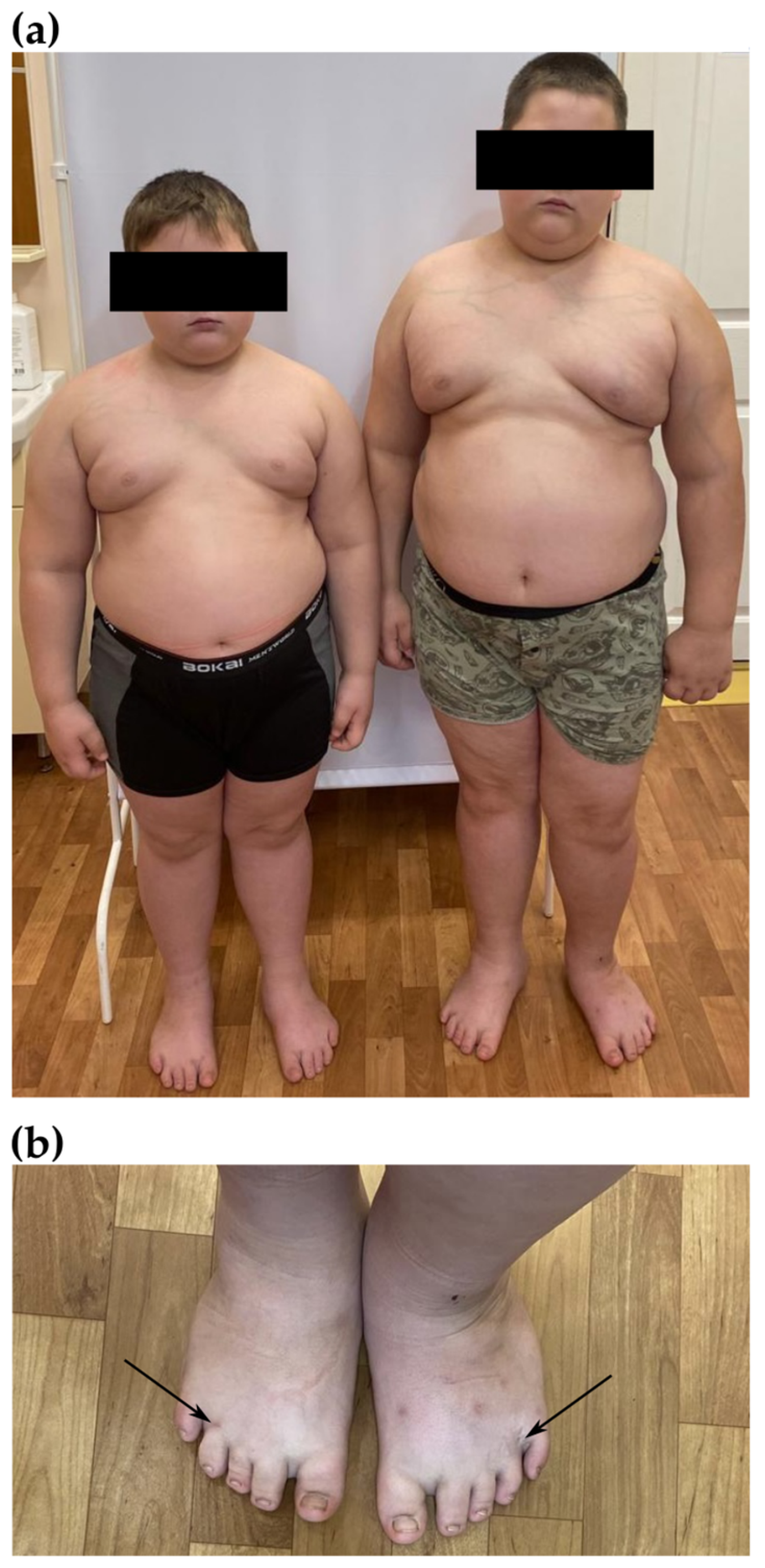
Clinical examination by a geneticist revealed characteristic phenotypic features, including obesity (BMI SDS +3.5 and +4.0, respectively), with the older sibling measuring 144 cm, 74 kg (BMI 36 kg/m
2) and the younger sibling 136 cm, 61 kg (BMI 33 kg/m
2), as well as a high forehead and a broad nasal tip. Both siblings had previously undergone surgical correction of postaxial polydactyly with removal of supernumerary digits of the hands and feet (
Figure 1).
Laboratory investigations, including a complete blood count, fasting glucose measurement, and serum inorganic phosphorus levels, revealed no abnormalities. All parameters were within reference ranges.
In both cases, a reduction in visual function of 60–80% from age-normal values was recorded. The older sibling exhibited low-amplitude nystagmus. Color vision testing revealed a deuteranomaly-type deficiency in both affected individuals. Nyctalopia was diagnosed only in the younger sibling.
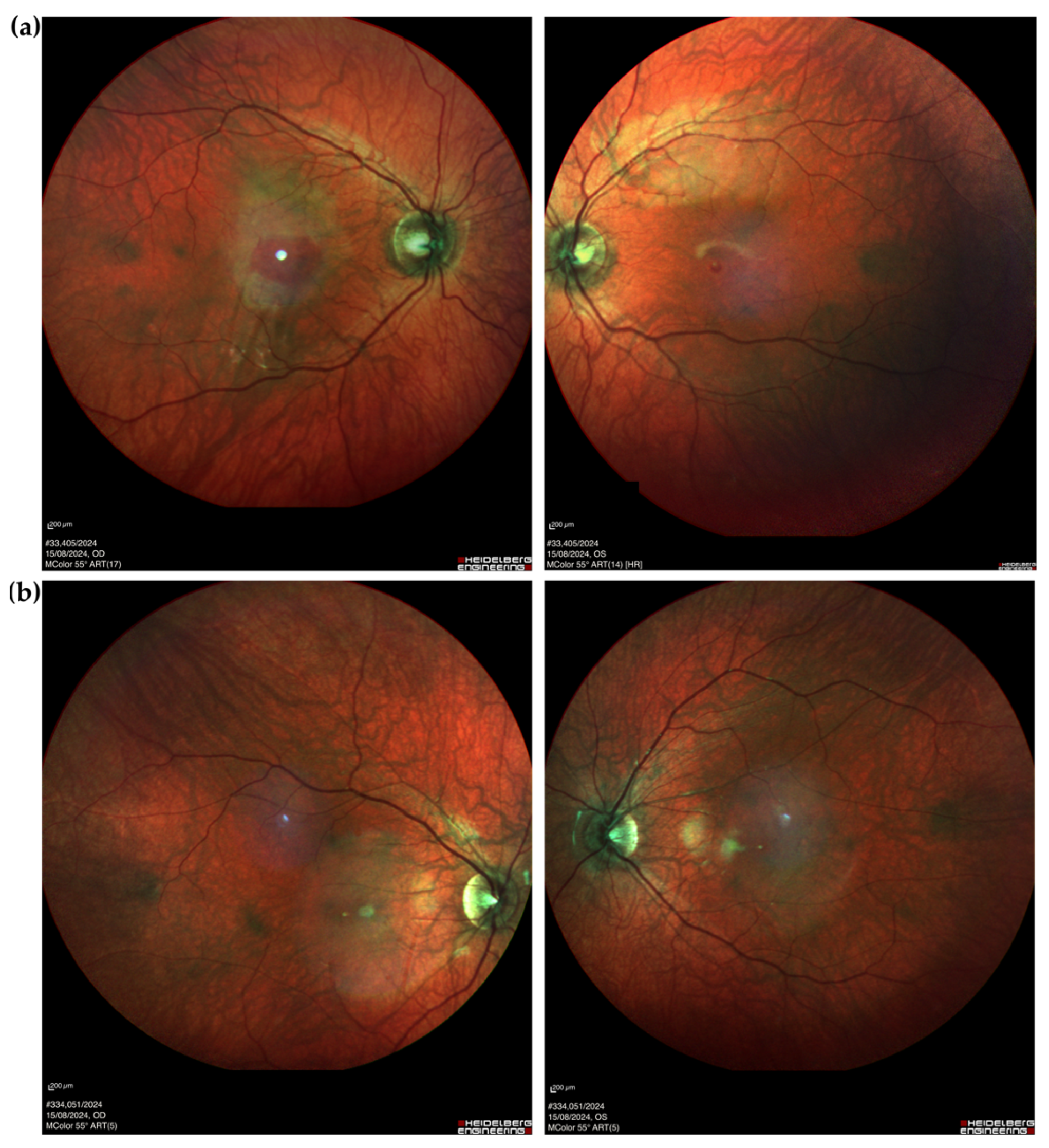
Biomicroscopy of the anterior segment structures revealed no pathological changes. Best-corrected visual acuity (BCVA) in the older affected sibling was 0.3 in the right eye and 0.4 in the left eye; in the younger affected sibling, BCVA was 0.2 in both eyes. Ophthalmoscopy was performed under pharmacologically induced mydriasis. The funduscopic findings were identical in the two patients: the optic disk was waxy and atrophic, of normal diameter, with well-defined margins; the capillary network and perineural ring on the disk were preserved and symmetrical. The arterial vessels were narrowed. The macular area was well differentiated, with a distinct foveal depression and a clear foveolar reflex; pigmentation was present in the fovea. In the mid- and far periphery of the fundus, choroidal vessels were visible, and pigment redistribution was observed. No bone-spicule pigmentation was detected (
Figure 2).
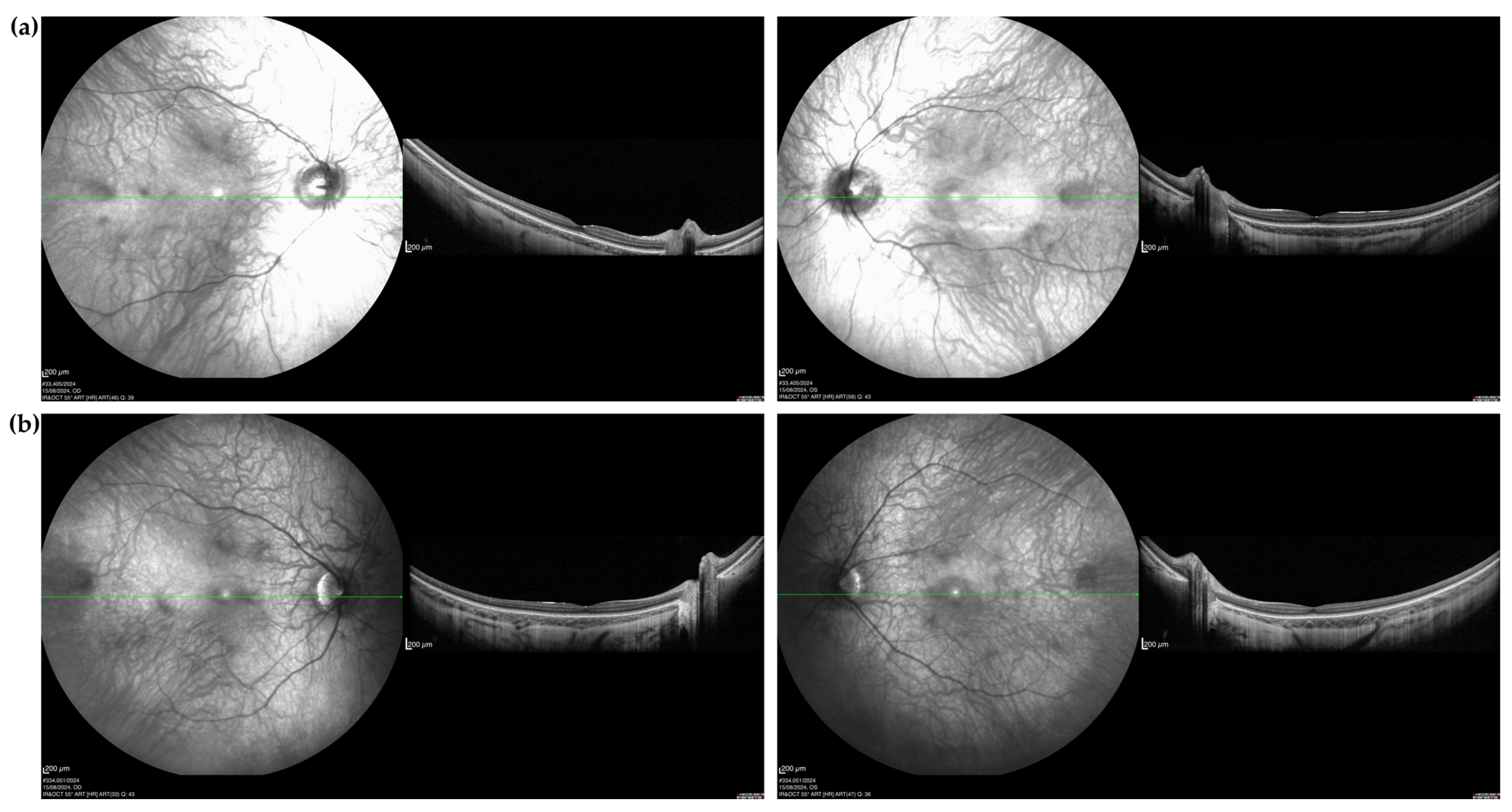
Spectral-domain optical coherence tomography (SD-OCT) of the fundus structures was performed in both siblings. In both cases, identical changes were recorded: a well-expressed foveal pit; the external limiting membrane was distinguishable; the IS/OS junction (the boundary between the inner and outer segments of the photoreceptors) was well visualized; cellular rarefaction was observed in the fovea; bilaminarity at the level of the retinal pigment epithelium (RPE)–Bruch’s membrane complex was poorly expressed (
Figure 3).
Full-field electroretinography in both affected siblings revealed severely attenuated scotopic and photopic responses. Rod, maximal combined rod-cone, cone, and 30-Hz flicker responses were either non-recordable or reduced to low microvolt/submicrovolt amplitudes bilaterally. These findings indicate a severe disturbance of bioelectrical activity of the retina in the periphery and in the center, involving both rod- and cone-mediated pathways, consistent with inherited retinal dystrophy associated with Bardet–Biedl syndrome (
Table 1).
Thus, based on the ophthalmological examination findings, a clinical condition consistent with cone-rod retinal degeneration was established.
The clinical diagnosis of BBS was established in both siblings by a clinical geneticist based on established diagnostic criteria [
2]. Both patients exhibited four primary features: early-onset obesity, polydactyly, early retinal dystrophy, and cystic renal dysplasia detected by ultrasound. In addition, two secondary features were noted: hypogonadism and neurodevelopmental disability.
3. Genetic Results
To confirm the clinical diagnosis and establish the molecular genetic etiology of BBS, whole-exome sequencing was performed in the 11-year-old proband.
Whole-exome sequencing (WES) was performed on DNA from the proband. Libraries were prepared from fragmented genomic DNA using the KAPA Hyper Prep Kit, followed by target enrichment with KAPA HyperExome probes (Roche, Basel, Switzerland). Paired-end sequencing (2 × 150 bp) was carried out on an Illumina NextSeq 500 platform (Illumina Inc., San Diego, CA, USA). Raw reads were aligned to the human reference genome GRCh38/hg38 using NGSData v.1.0.
In total, 22,893,631 reads were obtained, with a mean coverage of 53×; 97% of target regions were covered at ≥10×. The BBS7-containing region chr4:121,825,839–121,868,073 had an average coverage of 30×. Variant calling and annotation were performed according to HGVS nomenclature v.21.1.3. The identified variant was visualized in Integrative Genomics Viewer v.2.17.4 (IGV), and its pathogenicity was assessed following ACMG guidelines [
19]. Additionally, CNV analysis was performed, and other known BBS/ciliopathy genes were systematically evaluated. Given the genetic heterogeneity of BBS, we also assessed whether any other potentially relevant variants were identified or excluded.
Analysis identified two heterozygous variants in the
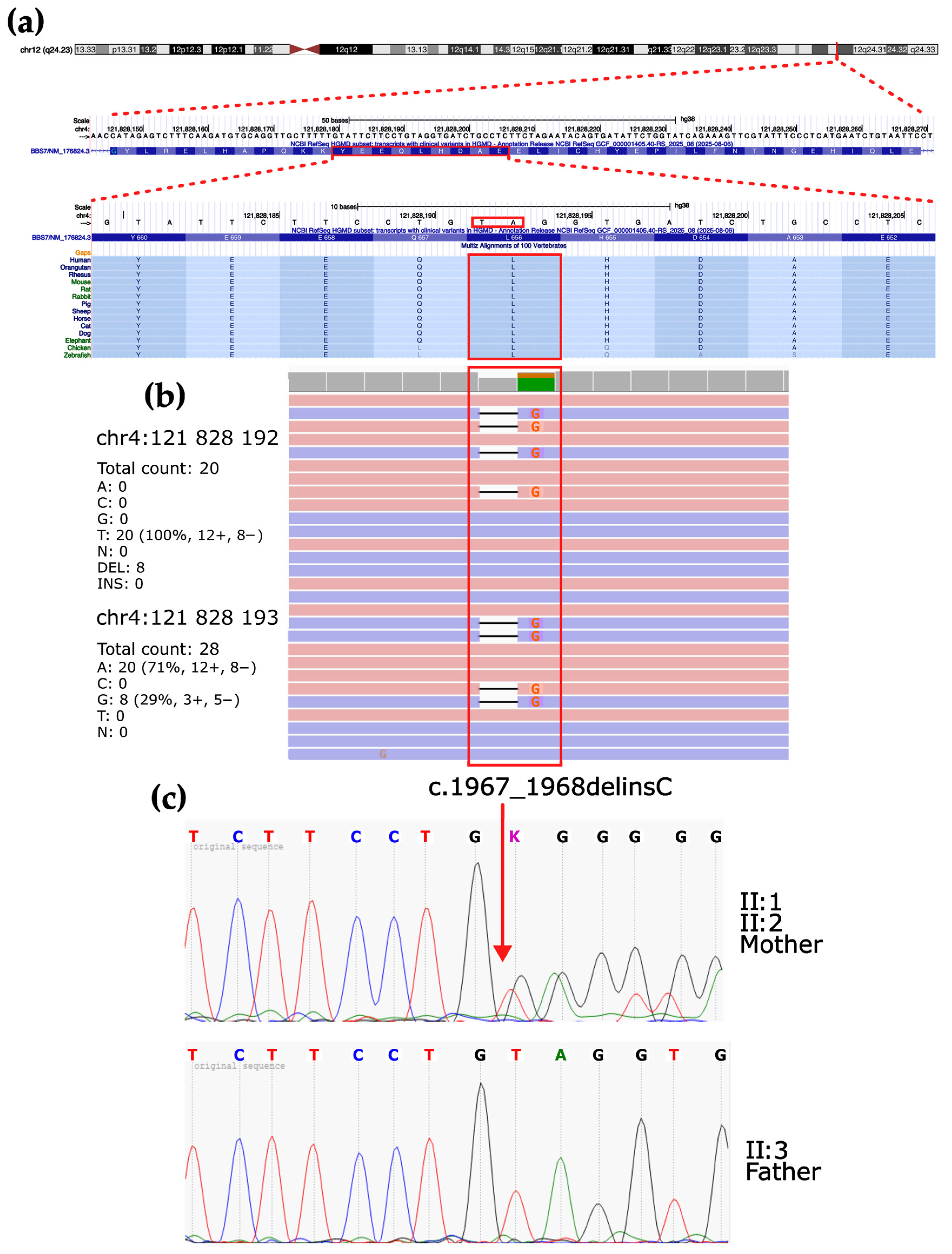
BBS7 gene (NM_176824.3): c.1967_1968delinsC, a frameshift variant resulting in a premature stop codon p.(Leu656ProfsTer18) (
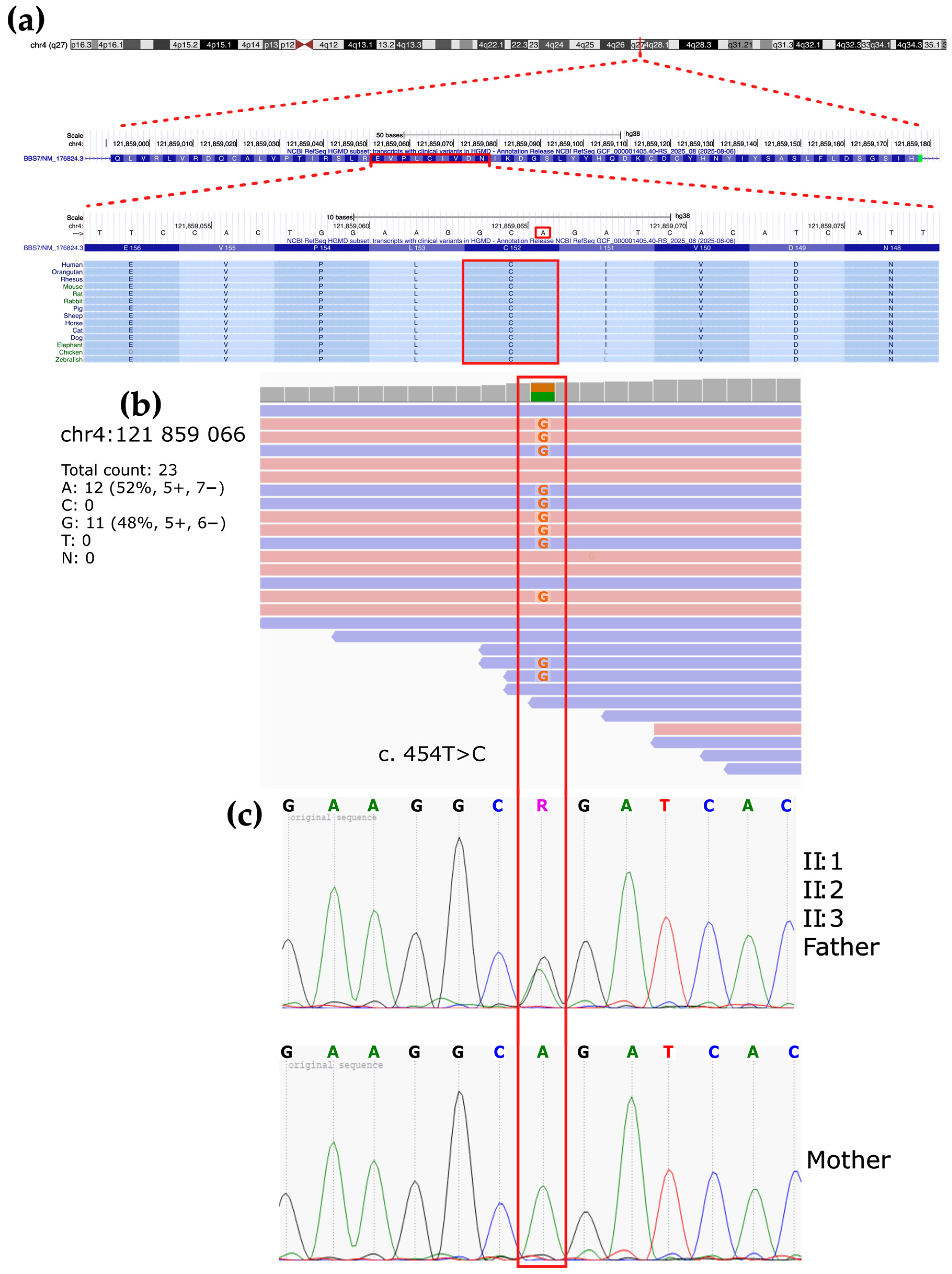
Figure 4), and c.454T>C, a missense variant leading to the amino acid substitution p.(Cys152Arg) (
Figure 5). The c.1967_1968delinsC variant has previously been reported as pathogenic in Russian patients with BBS [
20], whereas the c.454T>C variant has not been described in the literature to date.
To validate the variants identified by WES, the c.1967_1968delinsC variant was validated using PCR with the following primers, synthesized by Evrogen (Moscow, Russia): forward 5′-GATCCTTGGGAAATAGCCAGT, reverse 5′-TTTTGAATATTAAGGTGCTTCTGT; and the c.454T>C variant was validated using primers forward 5′-AGGCAGGTAAAGGTTCTCTG, reverse 5′-ACTAGGAATTAACTAGGAGAAAGTT.
PCR was performed in 25 µL reactions containing 1× PCR buffer, 2 mM MgCl2, 0.2 mM each dNTP, 0.5 mM each primer, 0.3 U Taq DNA polymerase (Syntol, Moscow, Russia), and 1 µL genomic DNA. Amplification was carried out on a GeneAmp PCR System 9700 Thermal Cycler (Applied Biosystems Inc., Foster City, CA, USA) under the following conditions: 95 °C for 2 min; 35 cycles of 95 °C for 30 s, 64 °C for 30 s, and 72 °C for 30 s; and a final extension at 72 °C for 5 min.
PCR products were checked on 2% agarose gels stained with ethidium bromide and visualized under UV light. Amplicons were purified using Exonuclease I/FastAP Thermosensitive Alkaline Phosphatase (Thermo Fisher Scientific, Waltham, MA, USA), then sequenced with the BigDye Terminator v3.1 kit on an Applied Biosystems 3500 DNA Analyzer according to the manufacturer’s protocol. Sequencing chromatograms were analyzed using Chromas v.2.6.6 (Technelysium, South Brisbane, QLD, Australia).
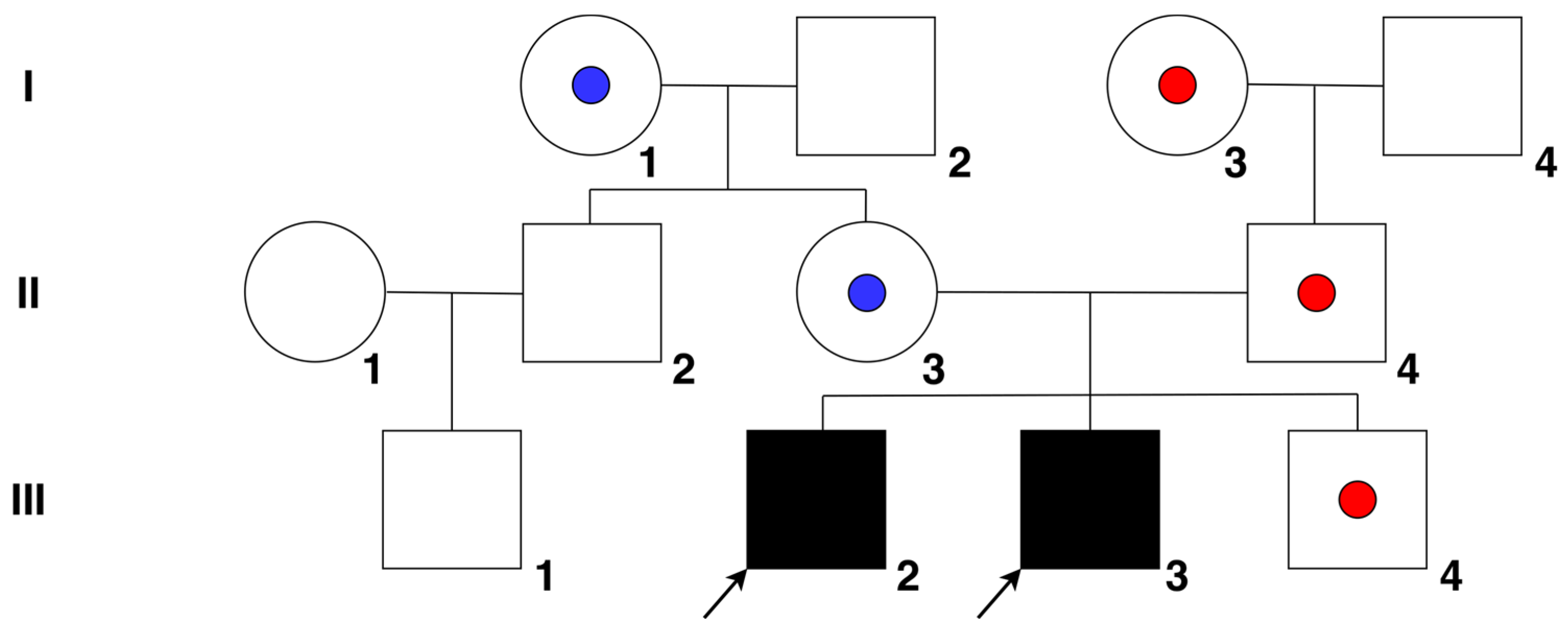
Segregation analysis was performed to confirm inheritance, demonstrating that the c.1967_1968delinsC variant was inherited from the mother, whereas the c.454T>C variant was inherited from the father. Accordingly, the variants are in trans. Both variants were also identified in the 8-year-old sibling with a similar clinical presentation. In addition, a 6-year-old male sibling with normal body weight and without clinical features of BBS was found to be a heterozygous carrier of the c.454T>C variant but did not carry the c.1967_1968delinsC variant (
Figure 6).
4. Results and Discussion
Bardet–Biedl syndrome is a rare autosomal recessive ciliopathy characterized by obesity, postaxial polydactyly, retinal dystrophy, intellectual disability, and renal abnormalities [
20]. Pathogenic
BBS7 variants are identified in approximately 1.5–2% of all patients with Bardet–Biedl syndrome; however, in a Russian cohort, they account for up to 24% of cases [
10]. In this case report, we describe two siblings aged 11 and 8 years with Bardet–Biedl syndrome who presented with a typical clinical picture of the BBS (
Table 2), harboring two heterozygous variants in trans in the
BBS7 gene. The c.1967_1968delinsC variant is not represented as a single variant in the gnomAD v.4.1.1 database; instead, it is recorded as a combination of two adjacent variants, c.1968del, p.(Gln657ArgfsTer17), and c.1967T>C, p.(Leu656Pro), each observed at a low allele frequency (0.005%). In contrast, the allele frequency in a Russian reference database (Federal Medical-Biological Agency) reaches 0.1% [
21]. Moreover, it has previously been reported as pathogenic and is frequently observed in Russian patients with BBS, consistent with a possible founder effect and explaining its recurrent detection among affected individuals in Russia. [
20].
The c.454T>C variant has not been described in the literature to date. The variant is present in gnomAD v4.1.1 at a very low frequency (0.0003%), with a total allele count of 5 out of 1,613,994 alleles (including 4 alleles in the European non-Finnish cohorts and 1 allele of other ancestry) and no homozygous individuals. In a Russian reference database (Federal Medical-Biological Agency), the variant was observed at a frequency of 0.004% (10 out of 241,524 alleles), also with no homozygotes [
21].
These findings confirm the previously established clinical diagnosis of Bardet–Biedl syndrome. The c.1967_1968delinsC variant in the
BBS7 gene (NM_176824.3), resulting in the p.(Leu656ProfsTer18) change, has previously been reported as pathogenic in both homozygous and compound heterozygous states in patients with Bardet–Biedl syndrome [
8,
10,
20,
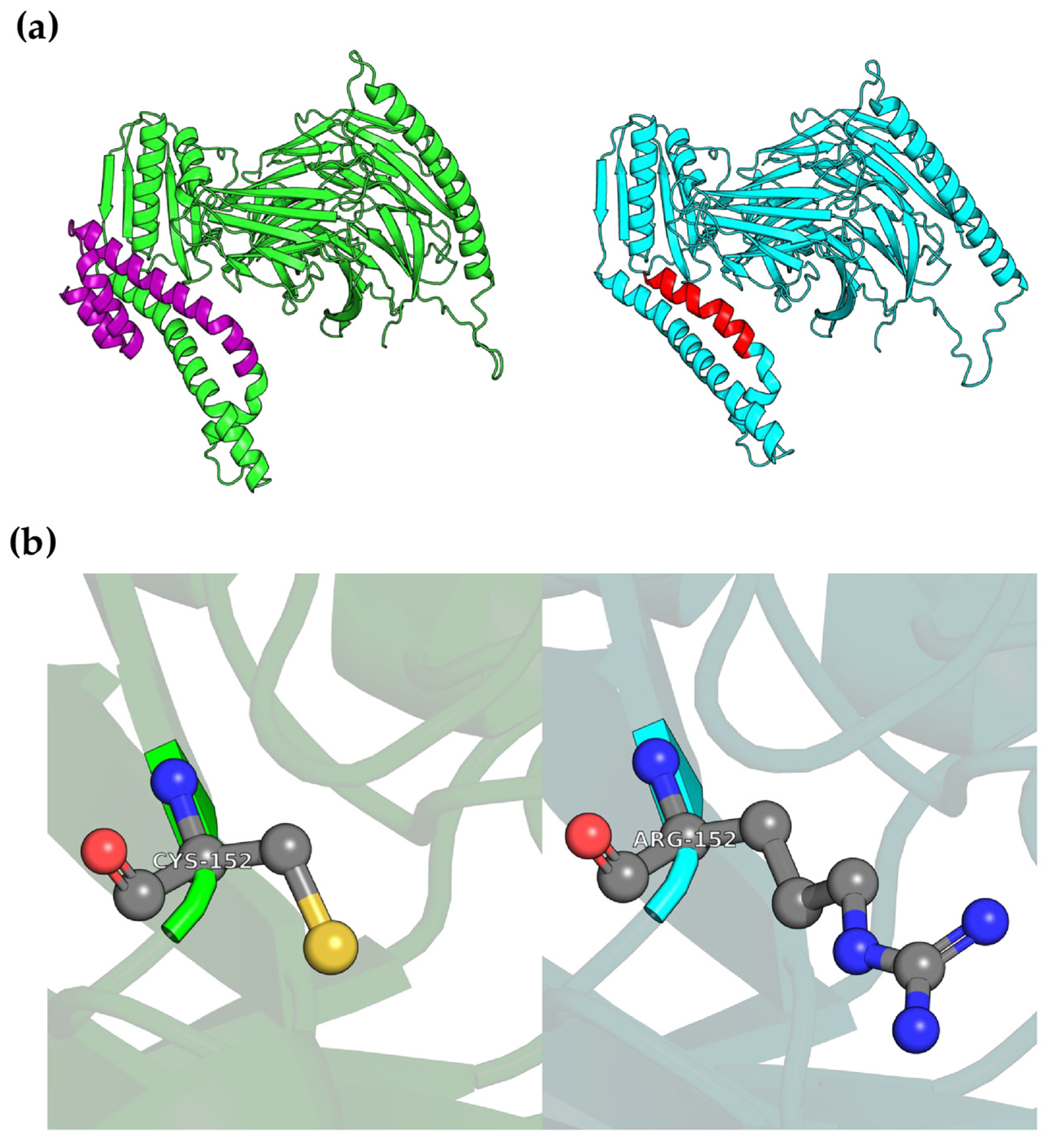
26]. This variant induces a frameshift starting at codon 656 and introduces a premature stop codon (Ter) 18 residues downstream of leucine (Leu). Such truncation of the polypeptide chain is predicted to result in the loss of key protein domains, thereby impairing BBSome assembly and function (
Figure 7a). The c.454T>C variant is predicted to be likely pathogenic by multiple in silico tools for missense variant interpretation (SIFT, SIFT4G, MetaLR, MetaSVM, DEOGEN2, M-CAP, PROVEAN, LRT, PolyPhen-2 HDIV, PrimateAI, and fathmm-MKL coding), which provide supportive, but not conclusive, evidence for pathogenicity. It can be assumed that the p.(Cys152Arg) substitution in the BBS7 protein leads to significant steric constraints due to the substantial difference in the side-chain volumes of cysteine and arginine: the bulkier arginine residue is likely unable to be accommodated within the protein’s tertiary structure without introducing unfavorable torsional angles and steric clashes. In addition, the substitution eliminates a cysteine residue and may affect local structural stability; however, this prediction requires experimental validation (
Figure 7b).
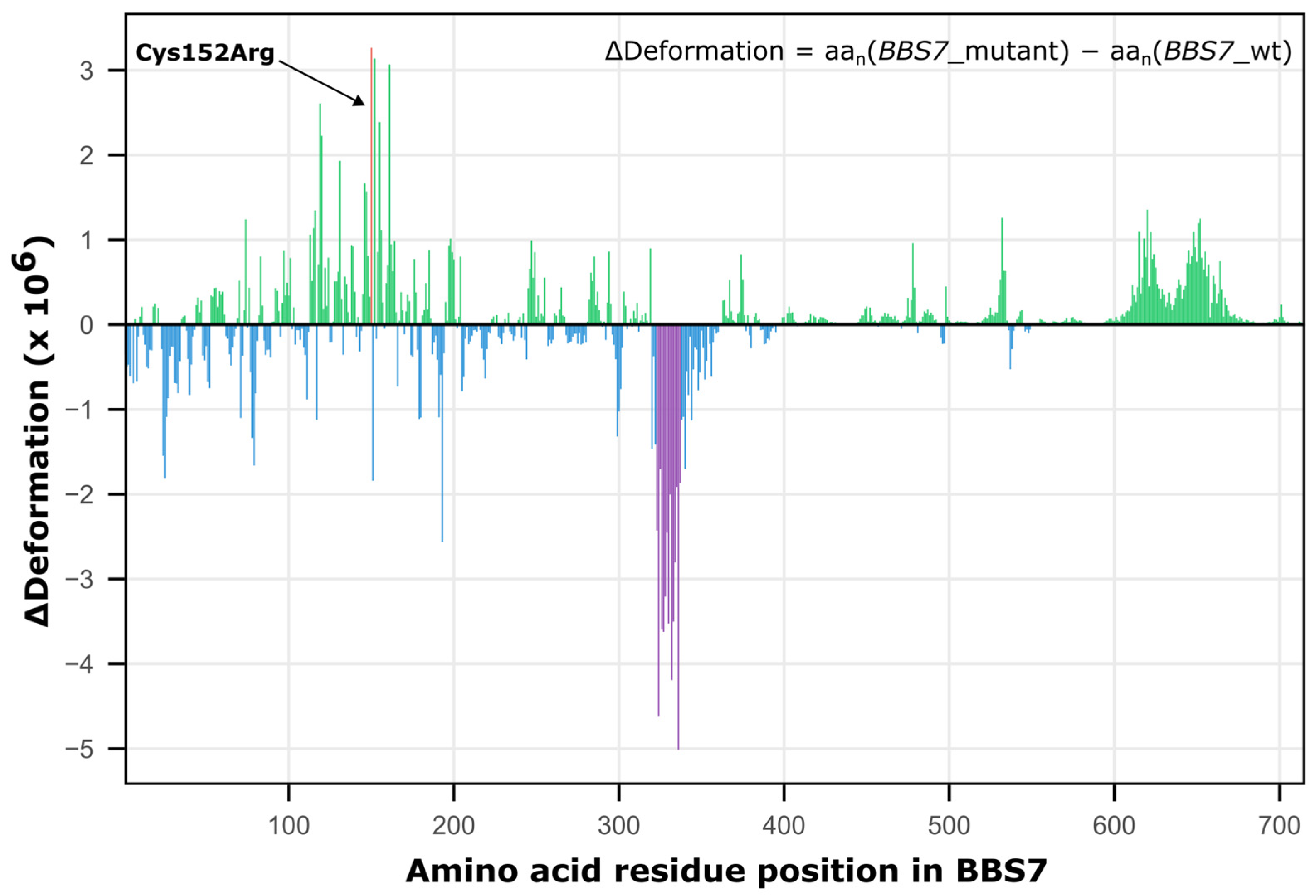
The Cys152Arg substitution in the BBS7 protein induces local structural perturbations that are not confined to the mutation site. As demonstrated by Normal Mode Analysis (NMA), the mutation exerts a significant long-range allosteric effect (
Figure 8). The differential structural deformation profile reveals that this instability manifests as a prominent structural relaxation cluster in the 323–337 residue range, indicating a global reorganization of the protein’s dynamical network. This disruption of the native structural dynamics may impair the functional integrity of the BBS7 protein and its interaction with the BBSome complex, although these potential functional consequences require further experimental validation.
In conclusion, according to ACMG/AMP guidelines, the
BBS7 variant (NM_176824.3):c.454T>C, p.(Cys152Arg) is classified as likely pathogenic [
19] (
Table 3).
According to the literature, analysis of the BBS7 protein sequence does not allow definitive conclusions regarding its cellular function, as the protein shows no homology to functionally characterized proteins or known functional domains. Nevertheless, comparative analysis of BBS7 with other members of the BBS protein family suggests a possible structural relationship with BBS1 and BBS2. In particular, the BBS7 region spanning amino acids 129–196 shows similarity to the region of BBS2 between residues 147–210 and to the region of BBS1 between residues 314 and 377 [
27]. The variant identified in this study is located at position 152 of the amino acid sequence. Its localization within an evolutionarily conserved region that is homologous to BBS2 and BBS1 supports its classification as likely pathogenic, as it is expected to disrupt the structure and function of BBS7. Together with segregation data and allele frequency evidence, this supports its contribution to the development of Bardet–Biedl syndrome. Notably, missense variants affecting the BBS7 region spanning amino acids 129–196 have been reported in the ClinVar database (Variation IDs: 1487264, 216828, 3346200), and additional pathogenic/likely pathogenic variants near residue 152, including loss-of-function and missense variants, are also listed (Variation IDs: 2794762, 982871, 1069619).
In previous studies using a
Danio rerio model, BBS-associated variants in a region of the BBS1 protein homologous to BBS7 were shown to reduce both the length of primary cilia (to approximately 70% of control values) and their number (to approximately 42% of control values), and to induce phenotypic abnormalities in
Danio rerio, including reduced eye size, shortening of the body axis, and other defects in gastrulation [
28,
29]. Thus, localization of the
BBS7 variant (NM_176824.3):c.454T>C, p.(Cys152Arg) within an evolutionarily conserved region homologous to domains of BBS1 and BBS2 provides additional structural and functional support for its pathogenicity.
Thus, the previously unreported missense variant p.(Cys152Arg) in compound heterozygosity with a known pathogenic frameshift variant in the BBS7 gene provides novel information regarding the genotype–phenotype correlation. This observation expands the known mutational spectrum of BBS7 and demonstrates for the first time that a missense variant at position 152, when combined with a frameshift allele, results in a phenotype consistent with Bardet–Biedl syndrome. These findings suggest that even moderately conserved amino acid substitutions in functionally important domains of the BBS7 protein may potentially impair its function in the absence of a normal allele.
Ultimately, the main limitations of our work are: the absence of functional verification of the novel missense variant; segregation analysis confined to a single family (three generations); technical constraints of whole-exome sequencing (incomplete coverage of non-coding regions and failure to detect large structural rearrangements); inadequate assessment of the population frequency of the identified variant; and a single case (one proband). Therefore, the present conclusions warrant validation in independent cohorts and via experimental models.
5. Conclusions
We present a case of two siblings (11 and 8 years of age) with Bardet–Biedl syndrome associated with compound heterozygosity for two BBS7 variants in trans. One of these, c.1967_1968delinsC, has been previously reported as pathogenic, whereas the other, c.454T>C, represents a previously undescribed variant that we provisionally classify as likely pathogenic. Nevertheless, we caution that this classification is not definitive and will require functional validation. Because molecular confirmation may affect eligibility for approved or emerging therapies targeting specific manifestations of BBS, such as hyperphagia-associated obesity, genetic diagnosis has direct clinical relevance.
Author Contributions
Conceptualization, A.F.N. and V.O.S.; methodology, A.F.N., T.V.B. and E.G.P.; software, O.P.R.; formal analysis, A.F.N. and T.V.B.; investigation, A.F.N., T.V.B. and A.N.T.; resources, O.P.R., T.O.A. and T.R.H.; data curation, A.N.T., E.A.S., V.V.K. and S.V.K.; writing—original draft preparation, A.F.N., T.V.B., V.V.K., A.N.T. and E.G.P.; writing—review and editing, V.O.S.; visualization, A.F.N. and T.V.B.; supervision, V.O.S.; funding acquisition, S.I.K. All authors have read and agreed to the published version of the manuscript.
Funding
This research was supported by the state assignment of the Ministry of Science and Higher Education of the Russian Federation to the Research Centre for Medical Genetics number 125040704897-7 in 2026.
Institutional Review Board Statement
The study was conducted in accordance with the Declaration of Helsinki and was approved by the Institutional Ethics Committee of the Research Centre for Medical Genetics (protocol No. 4, 1 July 2024).
Informed Consent Statement
Informed consent was obtained from all subjects involved in the study. Written informed consent has been obtained from the patients to publish this paper.
Data Availability Statement
All original data supporting the findings of this study are included in the article. Additional information is available from the corresponding author upon reasonable request.
Conflicts of Interest
The authors declare no conflicts of interest.
Abbreviations
The following abbreviations are used in this manuscript:
| ACMG/AMP | American College of Medical Genetics and Genomics/Association for Molecular Pathology |
| BBS | Bardet–Biedl syndrome |
| BMI SDS | Body Mass Index Standard Deviation Score |
| BCVA | Best-corrected visual acuity |
| CDS | Coding DNA sequence |
| ENM | Elastic Network Model |
| ERG | Electroretinography |
| Hh | Hedgehog signaling pathway |
| HGMD | Human Gene Mutation Database |
| IFT | Intraflagellar transport |
| NMA | Normal Mode Analysis |
| PM | Pathogenic Moderate |
| PP | Pathogenic Supporting |
| RPE | Retinal Pigment Epithelium |
| SD-OCT | Spectral-Domain Optical Coherence Tomography |
| Smo | Smoothened; transmembrane receptor component of the Hedgehog signaling pathway localized in primary cilia. |
| VUS | Variants of Uncertain Significance |
References
- Melluso, A.; Secondulfo, F.; Capolongo, G.; Capasso, G.; Zacchia, M. Bardet-Biedl Syndrome: Current Perspectives and Clinical Outlook. Ther. Clin. Risk Manag. 2023, 19, 115–132. [Google Scholar] [CrossRef]
- Dollfus, H.; Lilien, M.R.; Maffei, P.; Verloes, A.; Muller, J.; Bacci, G.M.; Cetiner, M.; van den Akker, E.L.T.; Grudzinska Pechhacker, M.; Testa, F.; et al. Bardet-Biedl Syndrome Improved Diagnosis Criteria and Management: Inter European Reference Networks Consensus Statement and Recommendations. Eur. J. Hum. Genet. 2024, 32, 1347–1360. [Google Scholar] [CrossRef]
- Beales, P.L.; Cetiner, M.; Haqq, A.M.; Miller, J.; Shoemaker, A.H.; Valverde, D.; Zacchia, M.; Dollfus, H. Hyperphagia in Bardet–Biedl Syndrome: Pathophysiology, Burden, and Management. Obes. Rev. 2025, 26, e13915. [Google Scholar] [CrossRef]
- Mitra, A.; Gioukakis, E.; Mul, W.; Peterman, E.J.G. Delivery of Intraflagellar Transport Proteins to the Ciliary Base and Assembly into Trains. Sci. Adv. 2025, 11, eadr1716. [Google Scholar] [CrossRef]
- Tomlinson, J.W. Bardet-Biedl Syndrome: A Focus on Genetics, Mechanisms and Metabolic Dysfunction. Diabetes Obes. Metab. 2024, 26, 13–24. [Google Scholar] [CrossRef]
- Priya, S.; Nampoothiri, S.; Sen, P.; Sripriya, S. Bardet–Biedl Syndrome: Genetics, Molecular Pathophysiology, and Disease Management. Indian J. Ophthalmol. 2016, 64, 620. [Google Scholar] [CrossRef]
- Deveault, C.; Billingsley, G.; Duncan, J.L.; Bin, J.; Theal, R.; Vincent, A.; Fieggen, K.J.; Gerth, C.; Noordeh, N.; Traboulsi, E.I.; et al. BBS Genotype-Phenotype Assessment of a Multiethnic Patient Cohort Calls for a Revision of the Disease Definition. Hum. Mutat. 2011, 32, 610–619. [Google Scholar] [CrossRef]
- Muller, J.; Stoetzel, C.; Vincent, M.C.; Leitch, C.C.; Laurier, V.; Danse, J.M.; Hellé, S.; Marion, V.; Bennouna-Greene, V.; Vicaire, S.; et al. Identification of 28 Novel Mutations in the Bardet–Biedl Syndrome Genes: The Burden of Private Mutations in an Extensively Heterogeneous Disease. Hum. Genet. 2010, 127, 583–593. [Google Scholar] [CrossRef]
- Katsanis, N. The Oligogenic Properties of Bardet-Biedl Syndrome. Hum. Mol. Genet. 2004, 13, R65–R71. [Google Scholar] [CrossRef]
- Orlova, M.; Gundorova, P.; Kadnikova, V.; Polyakov, A. Spectrum of Pathogenic Variants and High Prevalence of Pathogenic BBS7 Variants in Russian Patients with Bardet–Biedl Syndrome. Front. Genet. 2024, 15, 1419025. [Google Scholar] [CrossRef]
- Jin, H.; White, S.R.; Shida, T.; Schulz, S.; Aguiar, M.; Gygi, S.P.; Bazan, J.F.; Nachury, M.V. The Conserved Bardet-Biedl Syndrome Proteins Assemble a Coat That Traffics Membrane Proteins to Cilia. Cell 2010, 141, 1208–1219. [Google Scholar] [CrossRef]
- Zhang, Q.; Nishimura, D.; Vogel, T.; Shao, J.; Swiderski, R.; Yin, T.; Searby, C.; Carter, C.C.; Kim, G.; Bugge, K.; et al. BBS7 Is Required for BBSome Formation and Its Absence in Mice Results in Bardet-Biedl Syndrome Phenotypes and Selective Abnormalities in Membrane Protein Trafficking. J. Cell Sci. 2013, 126, 2372–2380. [Google Scholar] [CrossRef]
- Blacque, O.E.; Reardon, M.J.; Li, C.; McCarthy, J.; Mahjoub, M.R.; Ansley, S.J.; Badano, J.L.; Mah, A.K.; Beales, P.L.; Davidson, W.S.; et al. Loss of C. Elegans BBS-7 and BBS-8 Protein Function Results in Cilia Defects and Compromised Intraflagellar Transport. Genes Dev. 2004, 18, 1630–1642. [Google Scholar] [CrossRef]
- Kantaputra, P.; Dejkhamron, P.; Sittiwangkul, R.; Katanyuwong, K.; Ngamphiw, C.; Sonsuwan, N.; Intachai, W.; Tongsima, S.; Beales, P.L.; Buranaphatthana, W. Dental Anomalies in Ciliopathies: Lessons from Patients with BBS2, BBS7, and EVC2 Mutations. Genes 2022, 14, 84. [Google Scholar] [CrossRef]
- Min, J.; Xiao, R.; Fu, Q.; Huang, Y.; Wang, H. Compound Heterozygous Mutations in BBS7 Cause Kidney Abnormalities in Bardet-Biedl Syndrome. Genes Dis. 2026, 13, 101792. [Google Scholar] [CrossRef]
- Yang, X.; Zhou, X.; Zhou, C.; Li, C.; Wu, S.; Zhou, Y.; Du, J.; Guo, X.; Huang, X. A Rare Case of Bardet-Biedl Syndrome Caused by a Heterozygous Point Variant in BBS7 and a CNV Involved BBS7. Mol. Syndromol. 2025, 17, 179–185. [Google Scholar] [CrossRef]
- Forsyth, R.; Gunay-Aygun, M. Bardet-Biedl Syndrome Overview. In Genetics and Genomics of Eye Disease: Advancing to Precision Medicine; University of Washington: Seattle, WA, USA, 2023; pp. 117–136. [Google Scholar]
- Yan, K.; Sun, Y.; Yang, Y.; Liu, B.; Dong, M. Case Report: Identification Pathogenic Abnormal Splicing of BBS1 Causing Bardet–Biedl Syndrome Type I (BBS1) Due to Missense Mutation. Front. Genet. 2022, 13, 849562. [Google Scholar] [CrossRef]
- Richards, S.; Aziz, N.; Bale, S.; Bick, D.; Das, S.; Gastier-Foster, J.; Grody, W.W.; Hegde, M.; Lyon, E.; Spector, E.; et al. Standards and Guidelines for the Interpretation of Sequence Variants: A Joint Consensus Recommendation of the American College of Medical Genetics and Genomics and the Association for Molecular Pathology. Genet. Med. 2015, 17, 405–424. [Google Scholar] [CrossRef]
- Suspitsin, E.N.; Sokolenko, A.P.; Lyazina, L.V.; Preobrazhenskaya, E.V.; Lepenchuk, A.Y.; Imyanitov, E.N. Exome Sequencing of a Family with Bardet-Biedl Syndrome Identifies the Common Russian Mutation c.1967_1968delTAinsC in BBS7. Mol. Syndromol. 2015, 6, 96–98. [Google Scholar] [CrossRef]
- Population Allele Frequency Database of Genetic Variants in the Russian Federation. Federal Medical-Biological Agency of Russia. Application Version 1.3.4 (11.12.2025). Available online: https://gdbpop.nir.cspfmba.ru/ (accessed on 22 April 2026).
- Yang, Z.; Yang, Y.; Zhao, P.; Chen, K.; Chen, B.; Lin, Y.; Guo, F.; Chen, Y.; Liu, X.; Lu, F.; et al. A Novel Mutation in BBS7 Gene Causes Bardet-Biedl Syndrome in a Chinese Family. Mol. Vis. 2008, 14, 2304–2308. [Google Scholar]
- Shin, S.J.; Kim, M.; Chae, H.; Kwon, A.; Kim, Y.; Kim, S.J.; Yoon, H.E.; Jekarl, D.W.; Lee, S. Identification of Compound Heterozygous Mutations in the BBS7 Gene in a Korean Family with Bardet-Biedl Syndrome. Ann. Lab. Med. 2015, 35, 181–184. [Google Scholar] [CrossRef]
- Shen, T.; Gao, J.-M.; Shou, T.; Li, L.; Zhang, J.-P.; Zhao, Q.; Yan, X.-M. Identification of a Homozygous BBS7 Frameshift Mutation in Two (Related) Chinese Miao Families with Bardet-Biedl Syndrome. J. Chin. Med. Assoc. 2019, 82, 110–114. [Google Scholar] [CrossRef]
- Hayat, A.; Khan, A.A.; Rauf, A.; Khan, S.U.; Hussain, S.; Ullah, A.; Ahmad, W.; Shams, S.; Khan, B. A Novel Missense Variant in the BBS7 Gene Underlying Bardet-Biedl Syndrome in a Consanguineous Pakistani Family. Clin. Dysmorphol. 2020, 29, 17–23. [Google Scholar] [CrossRef]
- Jeziorny, K.; Antosik, K.; Jakiel, P.; Młynarski, W.; Borowiec, M.; Zmysłowska, A. Next-Generation Sequencing in the Diagnosis of Patients with Bardet–Biedl Syndrome—New Variants and Relationship with Hyperglycemia and Insulin Resistance. Genes 2020, 11, 1283. [Google Scholar] [CrossRef]
- Badano, J.L.; Ansley, S.J.; Leitch, C.C.; Lewis, R.A.; Lupski, J.R.; Katsanis, N. Identification of a Novel Bardet-Biedl Syndrome Protein, BBS7, That Shares Structural Features with BBS1 and BBS2. Am. J. Hum. Genet. 2003, 72, 650–658. [Google Scholar] [CrossRef]
- Castro-Sánchez, S.; Suarez-Bregua, P.; Novas, R.; Álvarez-Satta, M.; Badano, J.L.; Rotllant, J.; Valverde, D. Functional Analysis of New Human Bardet-Biedl Syndrome Loci Specific Variants in the Zebrafish Model. Sci. Rep. 2019, 9, 12936, Correction in Sci. Rep. 2020, 10, 2876. https://doi.org/10.1038/s41598-020-60006-5. [Google Scholar] [CrossRef]
- Álvarez-Satta, M.; Castro-Sánchez, S.; Pereiro, I.; Piñeiro-Gallego, T.; Baiget, M.; Ayuso, C.; Valverde, D. Overview of Bardet–Biedl Syndrome in Spain: Identification of Novel Mutations in BBS1, BBS10 and BBS12 Genes. Clin. Genet. 2014, 86, 601–602. [Google Scholar] [CrossRef]
Figure 1.
(a) Photographs of the siblings aged 11 (right) and 8 (left), demonstrating obesity. (b) Postoperative scars following correction of bilateral postaxial polydactyly of the lower limbs (indicated by arrows).
Figure 1.
(a) Photographs of the siblings aged 11 (right) and 8 (left), demonstrating obesity. (b) Postoperative scars following correction of bilateral postaxial polydactyly of the lower limbs (indicated by arrows).
Figure 2.
Fundus photographs of the younger affected sibling (a) and older affected sibling (b).
Figure 2.
Fundus photographs of the younger affected sibling (a) and older affected sibling (b).
Figure 3.
Optical coherence tomography images of the fundus structures of the younger affected sibling (a) and older affected sibling (b). The green arrow indicates the OCT scan direction on the fundus image. The corresponding B-scan represents a cross-sectional tomographic image of the retina acquired along this trajectory.
Figure 3.
Optical coherence tomography images of the fundus structures of the younger affected sibling (a) and older affected sibling (b). The green arrow indicates the OCT scan direction on the fundus image. The corresponding B-scan represents a cross-sectional tomographic image of the retina acquired along this trajectory.
Figure 4.
Identification and validation of a previously described BBS7 (NM_176824.3) c.1967_1968delinsC variant. (a) Schematic representation of the BBS7 gene and evolutionary conservation analysis. The identified c.1967_1968delinsC, p.(Leu656ProfsTer18) frameshift variant is indicated at genomic coordinates chr4:121828192_121828193. Multiple sequence alignment across diverse species demonstrates that the leucine residue at position 656 is highly conserved (indicated by a red frame), highlighting its putative structural and functional importance. (b) Visualization of the heterozygous chr4:121828192_121828193delinsC variant in the BBS7 gene using Integrative Genomics Viewer (IGV v.2.17.4). (c) Sanger sequencing of the proband and family members. Sanger sequencing confirmed the c.1967_1968delinsC, p.(Leu656ProfsTer18) variant in a heterozygous state in the affected siblings and in the maternal carrier. The variant is indicated by a red arrow.
Figure 4.
Identification and validation of a previously described BBS7 (NM_176824.3) c.1967_1968delinsC variant. (a) Schematic representation of the BBS7 gene and evolutionary conservation analysis. The identified c.1967_1968delinsC, p.(Leu656ProfsTer18) frameshift variant is indicated at genomic coordinates chr4:121828192_121828193. Multiple sequence alignment across diverse species demonstrates that the leucine residue at position 656 is highly conserved (indicated by a red frame), highlighting its putative structural and functional importance. (b) Visualization of the heterozygous chr4:121828192_121828193delinsC variant in the BBS7 gene using Integrative Genomics Viewer (IGV v.2.17.4). (c) Sanger sequencing of the proband and family members. Sanger sequencing confirmed the c.1967_1968delinsC, p.(Leu656ProfsTer18) variant in a heterozygous state in the affected siblings and in the maternal carrier. The variant is indicated by a red arrow.
Figure 5.
Identification and validation of a BBS7 (NM_176824.3) c.454T>C variant. (a) Schematic representation of the BBS7 gene and evolutionary conservation analysis. The identified c.454T>C, p.(Cys152Arg) missense variant is indicated at genomic coordinate chr4:121859066. Multiple sequence alignment across diverse species demonstrates that the cysteine residue at position 152 is highly conserved (indicated by a red frame), highlighting its putative structural and functional importance. (b) Visualization of the heterozygous chr4:121859066A>G variant in the BBS7 gene using Integrative Genomics Viewer (IGV v.2.17.4). (c) Sanger sequencing of the proband and family members. Sanger sequencing confirmed the c.454T>C, p.(Cys152Arg) variant in a heterozygous state in the affected siblings and in the paternal carrier. The variant is indicated by a red frame.
Figure 5.
Identification and validation of a BBS7 (NM_176824.3) c.454T>C variant. (a) Schematic representation of the BBS7 gene and evolutionary conservation analysis. The identified c.454T>C, p.(Cys152Arg) missense variant is indicated at genomic coordinate chr4:121859066. Multiple sequence alignment across diverse species demonstrates that the cysteine residue at position 152 is highly conserved (indicated by a red frame), highlighting its putative structural and functional importance. (b) Visualization of the heterozygous chr4:121859066A>G variant in the BBS7 gene using Integrative Genomics Viewer (IGV v.2.17.4). (c) Sanger sequencing of the proband and family members. Sanger sequencing confirmed the c.454T>C, p.(Cys152Arg) variant in a heterozygous state in the affected siblings and in the paternal carrier. The variant is indicated by a red frame.
Figure 6.
Pedigree of a family with BBS. The older and younger affected siblings are indicated by an arrow. Circles represent females, and squares represent males. Solid black symbols indicate affected individuals. Open symbols denote clinically healthy individuals who are not carriers of either variant. Family members carrying the NM_176824.3(BBS7):c.454T>C, p.(Cys152Arg) and NM_176824.3(BBS7):c.1967_1968delinsC, p.(Leu656ProfsTer18) variants are indicated in red and blue, respectively. Roman numerals (I–III) denote generations, and Arabic numerals (1–4) indicate individuals within each generation.
Figure 6.
Pedigree of a family with BBS. The older and younger affected siblings are indicated by an arrow. Circles represent females, and squares represent males. Solid black symbols indicate affected individuals. Open symbols denote clinically healthy individuals who are not carriers of either variant. Family members carrying the NM_176824.3(BBS7):c.454T>C, p.(Cys152Arg) and NM_176824.3(BBS7):c.1967_1968delinsC, p.(Leu656ProfsTer18) variants are indicated in red and blue, respectively. Roman numerals (I–III) denote generations, and Arabic numerals (1–4) indicate individuals within each generation.
Figure 7.
Structural modeling of the predicted effects of the missense variant in the BBS7 gene on the tertiary structure of the protein. The PDB file of the normal (wild-type) BBS7 protein was downloaded from the UniProt database (UniProt ID: Q8IWZ6). To model the mutant protein, the coding DNA sequence (CDS) was extracted from the MANE Select Plus Clinical transcript of the BBS7 gene (NM_176824.3). The obtained sequence was translated in silico using the ExPASy Translate service (verison) and compared with the canonical amino acid sequence of BBS7. Nucleotide substitutions (c.454T>C and c.1967_1968delinsC) were introduced into the original CDS by directly editing the sequence in a text editor, after which the translation result was verified again in silico. The amino acid sequence of the mutant protein was uploaded to ColabFold v1.6.1 (AlphaFold2 using MMseqs2), yielding an archive of predicted tertiary models with confidence scores. From this archive, the file with the highest prediction confidence was selected. The tertiary structures of both proteins (wild-type and mutant) were visualized in PyMOL v.3.1. (a) Left: wild-type BBS7 protein; right: BBS7 protein with the truncating variant p.(Leu656ProfsTer18). (b) Left: Cys152 residue in the wild-type BBS7 protein; right: Arg152 residue in the mutant BBS7 protein.
Figure 7.
Structural modeling of the predicted effects of the missense variant in the BBS7 gene on the tertiary structure of the protein. The PDB file of the normal (wild-type) BBS7 protein was downloaded from the UniProt database (UniProt ID: Q8IWZ6). To model the mutant protein, the coding DNA sequence (CDS) was extracted from the MANE Select Plus Clinical transcript of the BBS7 gene (NM_176824.3). The obtained sequence was translated in silico using the ExPASy Translate service (verison) and compared with the canonical amino acid sequence of BBS7. Nucleotide substitutions (c.454T>C and c.1967_1968delinsC) were introduced into the original CDS by directly editing the sequence in a text editor, after which the translation result was verified again in silico. The amino acid sequence of the mutant protein was uploaded to ColabFold v1.6.1 (AlphaFold2 using MMseqs2), yielding an archive of predicted tertiary models with confidence scores. From this archive, the file with the highest prediction confidence was selected. The tertiary structures of both proteins (wild-type and mutant) were visualized in PyMOL v.3.1. (a) Left: wild-type BBS7 protein; right: BBS7 protein with the truncating variant p.(Leu656ProfsTer18). (b) Left: Cys152 residue in the wild-type BBS7 protein; right: Arg152 residue in the mutant BBS7 protein.

Figure 8.
Amino acid residue-based differential structural deformation profile between the Cys152Arg mutant BBS7 and the wild-type BBS7. The X-axis displays the amino acid residue index of the BBS7 protein sequence. The Y-axis displays the ΔDeformation values (×10−6) between the Cys152Arg mutant BBS7 protein and the wild-type BBS7 protein. Positive values (green bars) indicate regions of increased structural deformation (higher flexibility) in the mutant protein, whereas negative values (blue bars) represent regions of structural relaxation (higher rigidity) compared to the wild-type. The site of the amino acid substitution (C152R) is marked in red, while the violet bars highlight the region (323–37) of the mutant BBS7 exhibiting the most prominent structural relaxation. Structural dynamics were analyzed using NMA based on an Elastic Network Model (ENM). Calculations were performed using the Bio3D package v.2.4-5 in R. The structural deformation profile for each residue was calculated by summing the atomic fluctuations derived from the first three non-trivial normal modes for both the wild-type and the C152R mutant BBS7 structures. aa—amino acid residue, wt—wild-type.
Figure 8.
Amino acid residue-based differential structural deformation profile between the Cys152Arg mutant BBS7 and the wild-type BBS7. The X-axis displays the amino acid residue index of the BBS7 protein sequence. The Y-axis displays the ΔDeformation values (×10−6) between the Cys152Arg mutant BBS7 protein and the wild-type BBS7 protein. Positive values (green bars) indicate regions of increased structural deformation (higher flexibility) in the mutant protein, whereas negative values (blue bars) represent regions of structural relaxation (higher rigidity) compared to the wild-type. The site of the amino acid substitution (C152R) is marked in red, while the violet bars highlight the region (323–37) of the mutant BBS7 exhibiting the most prominent structural relaxation. Structural dynamics were analyzed using NMA based on an Elastic Network Model (ENM). Calculations were performed using the Bio3D package v.2.4-5 in R. The structural deformation profile for each residue was calculated by summing the atomic fluctuations derived from the first three non-trivial normal modes for both the wild-type and the C152R mutant BBS7 structures. aa—amino acid residue, wt—wild-type.

Table 1.
Full-field ERG findings in the older and younger affected siblings.
Table 1.
Full-field ERG findings in the older and younger affected siblings.
| ERG Test | Predominant Retinal
Pathway | Parameter
Reported | Younger
Sibling, Right Eye | Younger
Sibling, Left Eye | Older
Sibling,
Right Eye | Older Sibling,
Left Eye |
|---|
Rod
response | Scotopic rod-mediated response | a-marker, µV/ms | 6.1/47.3 | 2.8/46.2 | 3.3/46.7 | 2.2/35.4 |
| b-marker, µV/ms | 3.4/75.7 | 0.4/68.5 | 2.2/81.0 | 4.6/75.7 |
| Maximal combined response | Mixed rod-cone response | a-marker, µV/ms | 4.8/17.5 | 12.1/10.9 | 0.2/11.8 | 4.2/29.5 |
| b-marker, µV/ms | 5.6/36.5 | 10.1/37.3 | 4.3/39.4 | 0.5/38.5 |
Cone
response | Photopic cone-mediated response | a-marker, µV/ms | 1.3/15.0 | 3.6/18.0 | 2.7/20.8 | 8.2/18.5 |
| b-marker, µV/ms | 0.5/26.8 | 1.4/29.5 | 2.2/36.3 | 0.8/30.0 |
| 30-Hz flicker | Cone-mediated temporal response | Fundamental
amplitude, µV | 1.300 | 0.897 | 0.591 | 0.777 |
Table 2.
BBS7-associated Bardet–Biedl syndrome: extracted clinical comparison table.
Table 2.
BBS7-associated Bardet–Biedl syndrome: extracted clinical comparison table.
| Study | Variant(s) | Population | Renal | Retinal | Obesity | Polydactyly | ND | Hypogonadism |
|---|
| [22] | c.1666A>C | Chinese | + | + | + | + | + | + |
| [20] | c.1967_1968delinsC | Russian | NR | + | + | + | + | + |
| [23] | c.728G>A/c.103-1G>A | Korean | + | + | + | − | + | − |
| [24] | c.389_390del | Chinese | + | + | + | + | + | + |
| [25] | c.719G>T | Pakistani | − | + | + | + | + | + |
| [16] | c.1002del / 4q26q27del | Chinese | + | NR | NR | + | NR | NR |
| Present study | c.1967_1968dlinsC/c.454T>C | Russian | + | + | + | + | + | + |
Table 3.
ACMG/AMP classification evidence for the BBS7 (NM_176824.3):c.454T>C, p.(Cys152Arg) variant, based on the 2015 ACMG/AMP guidelines and integrating clinical, genetic, and in silico data to determine its pathogenicity.
Table 3.
ACMG/AMP classification evidence for the BBS7 (NM_176824.3):c.454T>C, p.(Cys152Arg) variant, based on the 2015 ACMG/AMP guidelines and integrating clinical, genetic, and in silico data to determine its pathogenicity.
| Criteria | Strength | Evidence | Limitations |
|---|
| PM2 | Moderate | Population frequency: 0.0003% in gnomAD v4.1.1, 0.004% in a Russian cohort. | Very low frequency, but not absent. |
| PM3 | Moderate | The variant is detected in trans with a pathogenic variant c.1967_1968delinsC; phase confirmed by parental testing. | Single family observation; possible linkage disequilibrium with another causal variant in the same gene (full gene sequencing not performed); moderate strength (not strong) according to ACMG/AMP guidelines. |
| PP1 | Supporting | Segregation with disease in the family: two affected siblings carry both variants; parents are carriers of each variant separately. Variants segregates with 4 meiosis. | No distant relatives; possible linkage disequilibrium with true pathogenic variant; full gene sequencing (introns, UTR) not performed. |
| PP3 | Supporting | Bioinformatic tools predict a damaging effect | In silico tools are not independent; predictions require experimental validation. |
| PP4 | Supporting | Phenotype consistent with BBS diagnostic criteria; other BBS/ciliopathy genes excluded by WES. | Phenotype is not entirely specific to BBS7; clinical variability possible. |
| Disclaimer/Publisher’s Note: The statements, opinions and data contained in all publications are solely those of the individual author(s) and contributor(s) and not of MDPI and/or the editor(s). MDPI and/or the editor(s) disclaim responsibility for any injury to people or property resulting from any ideas, methods, instructions or products referred to in the content. |




 ,
,