1. Introduction
Accurate prognostic assessment is an important component of precision oncology, as it supports risk stratification, outcome prediction, and the identification of molecular features associated with disease progression [
1]. With the development of high-throughput sequencing technologies, multiple layers of molecular data, including gene expression, DNA methylation, and copy number variation, can now be profiled at the genome-wide scale, providing complementary views of tumor heterogeneity and disease biology [
2,
3,
4]. These advances have created new opportunities for cancer prognosis research, but they have also introduced substantial analytical challenges because multi-omics data are high-dimensional, heterogeneous, and often difficult to integrate effectively [
5,
6,
7]. In addition, preprocessing choices, including normalization, filtering of lowly expressed genes, batch-effect correction, and differential expression analysis, can substantially influence downstream biomarker interpretation and the reproducibility of transcriptome-based prognostic studies [
8].
Pathway databases provide biologically meaningful prior knowledge for organizing gene-level molecular information. Among them, the Kyoto Encyclopedia of Genes and Genomes (KEGG) is a widely used pathway database that manually curates functional relationships among genes, gene products, biochemical reactions, and signaling processes in the form of pathway maps [
9,
10,
11]. These pathway maps can be further represented as structured gene graphs, in which genes are treated as nodes and pathway-derived functional associations are treated as edges. By mapping multi-omics measurements onto pathway-derived graphs, it becomes possible to integrate molecular profiles with structured biological knowledge, thereby improving both model interpretability and biological relevance in prognostic analysis [
12,
13,
14]. This pathway-guided strategy is particularly attractive for cancer bioinformatics because it allows survival models to move beyond isolated molecular features and to incorporate functional associations among genes.
Graph neural networks (GNNs) provide a natural framework for learning from such structured data and have shown promise in multi-omics integration tasks, including cancer survival prediction and subtype analysis [
15,
16,
17]. Existing graph-based survival models typically rely on a predefined adjacency matrix derived from pathway databases or similarity networks [
12,
13]. However, pathway-derived graphs are often incomplete and locally sparse, and their node connectivity can vary substantially across genes. Genes with few neighbors may lack sufficient local context, whereas highly connected genes may accumulate redundant or noisy information during message passing [
14]. These limitations can reduce the ability of graph-based models to learn stable and informative representations for downstream prognostic prediction.
To improve graph representation learning under imperfect graph structures, previous studies have explored feature augmentation and topology refinement strategies [
16,
17]. For example, conditional variational autoencoders have been used to enhance node features [
18], while data-driven graph construction approaches such as k-nearest neighbor (kNN) graphs have been introduced to complement incomplete biological networks [
19]. Although these strategies may improve representation quality, they can also weaken biological interpretability when the augmented structure deviates substantially from known pathway organization [
20]. In pathway-guided multi-omics survival analysis, it is therefore desirable to enhance local representations while preserving biologically meaningful neighborhood relationships [
21].
A recent study, LAGProg [
12], moved in this direction by combining local augmentation with KEGG-guided graph modeling for multi-omics cancer prognosis. However, its neighborhood aggregation scheme assigns equal importance to all selected neighbors, which may introduce irrelevant signals in dense local regions and fail to highlight informative neighbors in sparse ones. In addition, its reliance on fixed local structure may limit its ability to adapt to heterogeneous pathway neighborhoods. These issues suggest that pathway-guided survival models may benefit from a more flexible mechanism for reconstructing and weighting local neighborhood information.
In this study, we propose PANA-Surv, a pathway-guided adaptive neighborhood augmentation framework for multi-omics cancer survival analysis. PANA-Surv uses KEGG pathways to define graph structure and encodes gene-level multi-omics profiles as node features. A conditional variational autoencoder module is introduced to reconstruct local neighborhoods and adaptively weight neighboring nodes, generating denoised augmented representations for downstream survival modeling. These features are then incorporated into a graph convolutional survival model optimized with the Cox partial likelihood. Using 10 cancer cohorts from The Cancer Genome Atlas (TCGA), we show that PANA-Surv improves prognostic performance relative to several representative survival models and supports the identification of biologically relevant prognostic genes in breast cancer.
2. Materials and Methods
This section describes the overview of the method, data and preprocessing, baseline methods, cross-validation setup, performance evaluation, experiment designs, and downstream analyses.
2.1. Overview of the Method
In this section we introduce the PANA-Surv (see
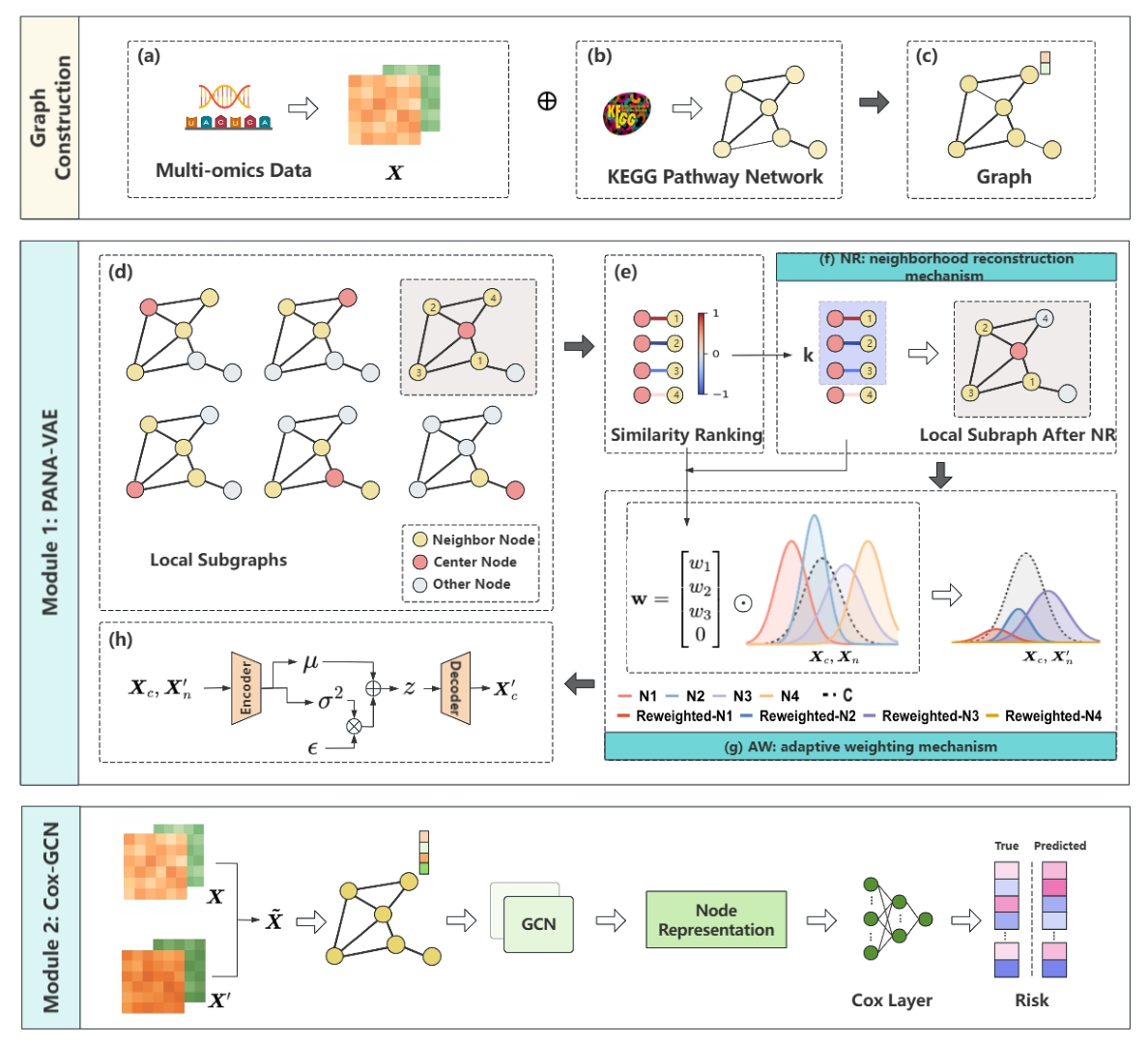
Figure 1), which includes graph construction component and two modules: the PANA-VAE module, which enhances node representations through neighborhood reconstruction (NR) and adaptive weighting (AW) mechanisms, and the Cox-GCN module, which fuses the augmented features and original features to predict the survival risk.
2.1.1. Graph Construction
In the graph construction stage, the pathway-guided graph (as shown in
Figure 1c) can be represented as
, where
denotes the set of genes (nodes) and
represents the pathway connections derived from the KEGG network (
Figure 1b). The node feature matrix
(
Figure 1a) contains the multi-omics features of all genes, with
being the number of genes and
the number of omics modalities. This graph provides both the biological topology and node-level omics attributes, which serve as inputs for the subsequent PANA-VAE module.
2.1.2. Module 1: PANA-VAE
Local Subgraphs
For each node , we define its local neighborhood as , where is the number of neighbors of node . The corresponding multi-omics features are represented as for the central node and for its neighboring nodes.
Each node serves as a center to construct its local subgraph based on its directed connected neighbors (
Figure 1d). In these subgraphs, the red node denotes the central node
, the yellow nodes represent its neighbors
, and the gray nodes indicate other genes not directly connected to
.
Similarity Ranking
For the central node
and each neighbor
, the cosine similarity is computed as
, where
The absolute similarity values
are then ranked in descending order (
Figure 1e).
Neighborhood Reconstruction Mechanism
We adopt a top-
selection strategy. For each central node
, we retain the
most similar neighbors from its original
connected neighbors, where
is a predefined hyperparameter. The reconstructed neighborhood is denoted as
. This mechanism refines the local structure of each node, pruning weak or noisy connections and focusing on biologically coherent relationships (
Figure 1f).
Adaptive Weighting Mechanism
This mechanism assigns a normalized contribution weight to each neighbor in the reconstructed set
(
Figure 1g). For each selected neighbor, the weight is defined as
, where
, and
. For each central node
, the weights of all its neighbors are collected as
. The weighted neighborhood features are then computed as
. These two mechanisms allow each central node to adaptively form a unique local neighborhood, with neighbor weights determined by their similarities.
Generate the Augmented Features
As shown in
Figure 1h, the central node features
and the weighted neighborhood features
are concatenated and fed into the encoder, which incorporates a latent variable
to model the conditional posterior:
.
The encoder captures the latent dependency between each central node and its reconstructed local neighborhood through
. During training, PANA-VAE learns the joint distribution between each central node and its neighbors; the decoder then reconstructs the neighborhood features by maximizing the evidence lower bound (ELBO):
where
denotes the standard Gaussian prior.
In the generation stage, the latent variable and the central-node feature are fed into the decoder to generate the augmented node representation: Collecting all from all central nodes yields the global feature matrix , which is subsequently used in the GCN-Cox module for survival prediction.
2.1.3. Module 2: GCN-Cox
The concatenated feature matrix
serves as the input to the graph convolutional network (GCN). Feature aggregation is defined as:
where
is the normalized adjacency matrix, and
,
are learnable weights. The output
represents the final node embeddings.
The Cox proportional hazards model uses these embeddings to predict survival risk, and the network is optimized by minimizing the negative partial log-likelihood:
where
is the event indicator,
denotes the observed survival time,
is the number of uncensored samples,
and
is the regression coefficient learned jointly with the GCN parameters.
2.2. Data and Preprocessing
We analyzed 10 TCGA cancer cohorts with matched DNA methylation, mRNA expression, and clinical survival data. The omics data were obtained as processed tabulated files rather than being generated directly from raw sequencing or array intensity files. DNA methylation data were measured using the Illumina Infinium HumanMethylation450 BeadChip platform (Illumina, Inc., San Diego, CA, USA). For each gene, the beta values ranging from 0 to 1 were averaged across its annotated CpG sites to obtain gene-level methylation features. mRNA expression data were obtained from the UNC Illumina HiSeq platform (Illumina, Inc., San Diego, CA, USA); the normalized expression values were log-transformed before model input.
To further evaluate the generalizability of the proposed model, we additionally performed external validation on an independent BRCA cohort, GSE20713_BRCA. This external cohort was used only for independent model evaluation and was not involved in feature selection, hyperparameter tuning, risk-group cutoff determination, or model training.
For missing data handling, samples without valid overall survival time or vital status were removed. Samples with more than 20% missing values in any omics modality were also excluded. For the remaining samples, missing omics values were imputed as 0 after normalization to ensure a consistent input matrix across patients and omics modalities. Only patients with matched DNA methylation, mRNA expression, and clinical survival information were retained for downstream analysis.
KEGG pathway information was obtained from KGML files downloaded from the KEGG database. For each selected KEGG pathway, the corresponding KGML file was downloaded and parsed using a custom Python (version 3.13.2) script based on the xml.etree. ElementTree module. Specifically, gene entries in the KGML files were extracted and used as graph nodes, while pathway relationships, including gene–gene or gene product–gene product interactions, were extracted and used as graph edges. In this way, each KEGG pathway was converted into a structured pathway-derived gene graph. These pathway-derived graphs were then used as prior biological structures to guide the construction of the pathway-guided gene graph in our model.
2.3. Baseline Methods
To evaluate the predictive performance of the proposed method, we compared it with four representative baseline methods, including traditional statistical, deep learning, and graph neural network-based survival models. All baseline methods were implemented and evaluated under the same preprocessing procedure, input features, and data partitioning strategy as the proposed model. For each TCGA cohort, the models were trained on the training/validation set, and the hyperparameters were selected according to the validation C-index during 10-fold cross-validation. The selected model was then evaluated on the independent test set.
Cox-EN: It introduces a pathwise algorithm for the Cox proportional hazards model, regularized by convex combinations of
and
penalties (elastic net) [
22].
DeepSurv: It combines a Cox proportional hazards deep neural network with a state-of-the-art survival model to capture the interactions between a patient’s covariates and treatment effectiveness [
23].
GraphSurv: It integrates a GCN with a deep Cox proportional hazards network for survival prediction [
24].
LAGProg: It is a local augmented graph convolutional network that augments multi-omics data using a conditional variational autoencoder and combines it with a two-layer GCN and a Cox proportional hazard network for cancer prognosis [
12].
Although both PANA-Surv and LAGProg use local neighborhood information for multi-omics survival prediction, the two methods differ in how the local neighborhood is constructed and used. LAGProg mainly performs local data augmentation based on the original neighborhood structure and then combines the augmented features with a GCN-based Cox model. In contrast, PANA-Surv explicitly reconstructs the local neighborhood of each central gene node using a top-K similarity-based selection strategy. After neighborhood reconstruction, PANA-Surv further assigns adaptive weights to selected neighboring nodes according to their similarity with the central node, so that more informative neighbors contribute more strongly to the augmented representation. Therefore, compared with LAGProg, PANA-Surv introduces a more flexible and biologically guided neighborhood reconstruction and weighting mechanism before graph convolution and survival risk prediction.
2.4. Cross-Validation Setup
To ensure a fair comparison and avoid information leakage, the same data partitioning strategy was applied to all methods. Each TCGA cohort was first split into an 80% training/validation set and a 20% independent test set using stratified sampling, preserving the proportion of events (status = 1) and censored observations (status = 0). All feature selection procedures, model tuning, and risk-group cutoff determination were performed only within the training/validation set. We then performed 10-fold cross-validation on the training/validation set to select the optimal model and hyperparameters according to the validation Concordance Index (C-index). The independent test set was not used during feature selection, model tuning, or cutoff determination, and was used only for final performance evaluation.
2.5. Performance Evaluation
The C-index evaluates the discriminative ability of survival prediction models. It measures whether patients with higher predicted risk scores tend to experience events earlier. The C-index is calculated as:
where
and
denote the observed survival times of patients
and
, respectively;
is the event indicator, with
indicating that the event was observed and
indicating censoring; and
and
are the predicted risk scores. A patient with a higher risk score is expected to have a shorter survival time. The denominator represents the number of comparable patient pairs. The C-index ranges from 0 to 1, with a higher value indicating better predictive performance [
25].
2.6. Experiment Designs
Selection of the Neighborhood Size
In each dataset, we examined the degree distribution of gene nodes in the KEGG pathway network to determine the appropriate range of values. FGF20 exhibited the highest degree with 45 connections, while EGLN2 had the lowest degree with only one connection. Notably, no gene nodes had degrees between 27 and 45, and degrees of 45 or 1 were considered outliers. Based on this distribution, we evaluated model performance under six different values (5, 10, 15, 20, 25, and 30) across 10 TCGA datasets.
2.7. Design of Ablation Variants Within PANA-VAE
We designed two ablated variants to evaluate the contribution of each mechanism within PANA-VAE.
No-NR (no neighborhood reconstruction mechanism): The similarity-based neighborhood reconstruction (NR) mechanism (corresponding to
Figure 1f) was removed, and all neighbors defined by KEGG were used for feature augmentation. The adaptive weighting (AW) mechanism remained, and weights were computed for all neighbors.
No-AW (no adaptive weighting mechanism): We retained NR but removed the AW mechanism (corresponding to
Figure 1g), assigning equal weights to all selected neighbors.
2.8. Comparison of Graph Construction Strategies
The impact of graph topology was further examined by replacing the pathway-guided graph in PANA-Surv with two alternatives: a data-driven kNN graph and a directed graph, while keeping all other components unchanged.
KNN-based graph construction: For each central node, the top- most similar nodes in the feature space were selected as neighbors, and PANA-VAE performed feature augmentation on the resulting completed graph.
Directed graph construction: We also constructed a directed graph based on the information flow during feature augmentation. In the NR mechanism, when node B is selected as a neighbor of node A and assigned a non-zero weight by AW, a directed edge from B to A is introduced; otherwise, the edge between B and A has no direction.
For all graph construction strategies, we evaluated neighborhood sizes to examine the robustness of our method under different neighborhood sizes and to compare model performance across these settings.
2.9. Downstream Analyses
2.9.1. Kaplan–Meier Curves
Kaplan–Meier survival curves are used to estimate the survival probabilities of different groups. The survival function is defined as
, where
denotes the probability of surviving beyond time
,
represents the number of events (e.g., deaths) occurring at time
, and
is the number of individuals at risk at time
. The product is taken over all time points
such that
, where
are ordered in increasing time [
26].
2.9.2. Differential Gene Expression Analysis
We applied differential gene expression analysis to identify candidate prognostic biomarkers associated with the risk stratification produced by PANA-Surv. Specifically, PANA-Surv first generated a survival risk score for each BRCA patient. Patients were then divided into high-risk and low-risk groups according to the median predicted risk score. Differential expression analysis was performed between the high-risk and low-risk groups to identify genes with significant expression changes. The fold change (FC) represents the ratio of gene expression levels between the high-risk and low-risk groups, and the log2 fold change (log2FC) was calculated as follows: where and denote the normalized expression levels of a given gene under two different conditions. A higher absolute value indicates a more substantial differential expression.
R package
DESeq2 (version 1.46.0) [
27] was used to compute the
(FC) and
p-values, considering both biological and technical variability. The selection criteria for differentially expressed genes (DEGs) were adjusted
p-values
, and
.
2.9.3. Enrichment Analysis
We utilized the R package
clusterProfiler (version 4.14.6) [
28] to conduct functional enrichment analysis of genes, including Gene Ontology (GO) and KEGG pathway analysis. Gene ID conversion from the HUGO Gene Nomenclature Committee (HGNC) to Ensembl and Entrez IDs was carried out using the R package
biomaRt (version 2.62.1) [
29]. Finally, we applied the Benjamini–Hochberg (BH) [
30] method for multiple testing correction, considering GO terms and KEGG pathways with a
-value less than 0.05 as statistically significant.
3. Results
In this section, we evaluate PANA-Surv from multiple perspectives to verify its predictive performance, model design, and biological interpretability.
3.1. Overall Survival Prediction Performance
We compared PANA-Surv with representative survival models from three methodological categories, including the traditional statistical model Cox-EN, the deep learning model DeepSurv, and two GNN-based models, GraphSurv and LAGProg. For a fair comparison, all models used the same patient-level multi-omics features, including DNA methylation and mRNA expression profiles, together with the corresponding overall survival time and survival status for model training and evaluation. For graph-based methods, including PANA-Surv, pathway-derived graph structures were further used to model gene-level relationships. It should be noted that the output of each survival prediction model is a patient-specific risk score, which is used to evaluate patient prognosis and calculate the C-index, rather than directly predicting the exact survival time.
Table 1 summarizes the C-index values across 10 TCGA cohorts and reports the corresponding mean C-index values. PANA-Surv reached the highest mean C-index (0.6763) among all models, outperforming Cox-EN (0.5870), DeepSurv (0.5579), GraphSurv (0.5938), and LAGProg (0.6035). Compared with LAGProg, which also employs local neighborhood augmentation, PANA-Surv yielded a 12.06% improvement in mean C-index (0.6763 vs. 0.6035). Pairwise Wilcoxon signed-rank tests between PANA-Surv and the other models resulted in
-values below 0.01, indicating statistically significant differences across the 10 TCGA cohorts.
To further assess external generalizability, we evaluated the trained model on the independent GSE20713_BRCA cohort. As shown in
Table 2, PANA-Surv achieved a C-index of 0.6240, which was slightly higher than GraphSurv (0.6181) and higher than CoxNN (0.5808), DeepSurv (0.5723), and LAGProg (0.4375). These results suggest that PANA-Surv maintains competitive predictive performance on an independent BRCA validation cohort.
3.2. Ablation Experiments Within PANA-VAE
After validating the overall performance of PANA-Surv, we conducted ablation experiments to evaluate the contribution of each mechanism within PANA-VAE.
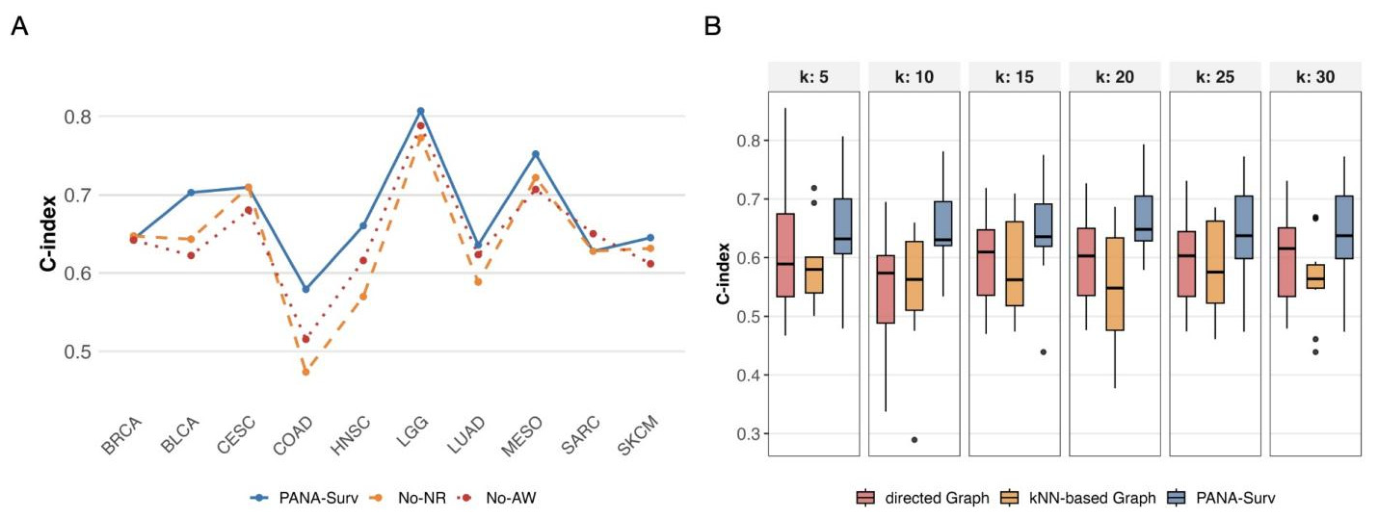
The results are shown in
Figure 2A. Both variants produced lower predictive performance than the full model. Removing neighborhood reconstruction reduced the mean C-index from 0.6763 to 0.6386, while replacing adaptive weighting decreased it to 0.6467. These results demonstrate that both mechanisms contribute to improving model performance.
3.3. Effectiveness of Pathway-Guided Graph Construction
We next examined how different graph construction strategies affect survival prediction performance. Based on all 10 TCGA cohorts and 6 neighborhood sizes, PANA-Surv reached the highest overall mean C-index (
), followed by the kNN-based (
) and directed graphs (
). As illustrated in
Figure 2B, PANA-Surv maintained higher C-index values across different neighborhood sizes (
), while the two alternative graphs showed larger variation and lower stability. The kNN-based and directed graphs were more sensitive to the choice of
, suggesting that they may introduce noisy or unreliable connections.
3.4. Clinical Validation Through Risk Stratification and Survival Analysis
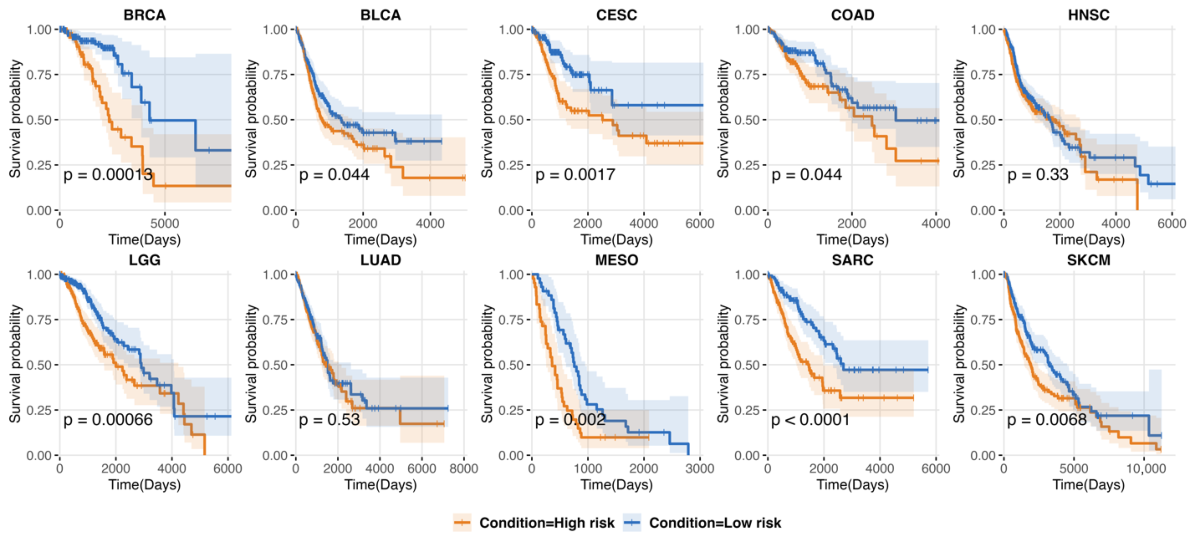
We assessed the prognostic performance of PANA-Surv through risk stratification and Kaplan–Meier survival analysis. In each cohort, patients were divided into high-risk and low-risk groups according to the median predicted risk score. Survival differences between the two groups were evaluated using the log-rank test.
As shown in
Figure 3, PANA-Surv successfully separated patients into groups with distinct survival outcomes in most cohorts. Significant differences were observed in BLCA (
= 0.044), BRCA (
= 0.00013), CESC (
= 0.0017), COAD (
= 0.044), LGG (
= 0.00068), MESO (
= 0.0091), SARC (
0.0001), and SKCM (
= 0.00068), where high-risk groups consistently exhibited shorter survival times. Although HNSC and LUAD did not reach statistical significance, their curves still demonstrated clear downward trends for high-risk patients, indicating consistent risk separation patterns.
Overall, PANA-Surv achieved consistent and reliable risk stratification across multiple cancer types, demonstrating robust performance in distinguishing patients with different survival outcomes.
3.5. Biological Interpretability and Downstream Analyses in BRCA
To investigate the biological interpretability of PANA-Surv, we conducted downstream analyses on the BRCA cohort.
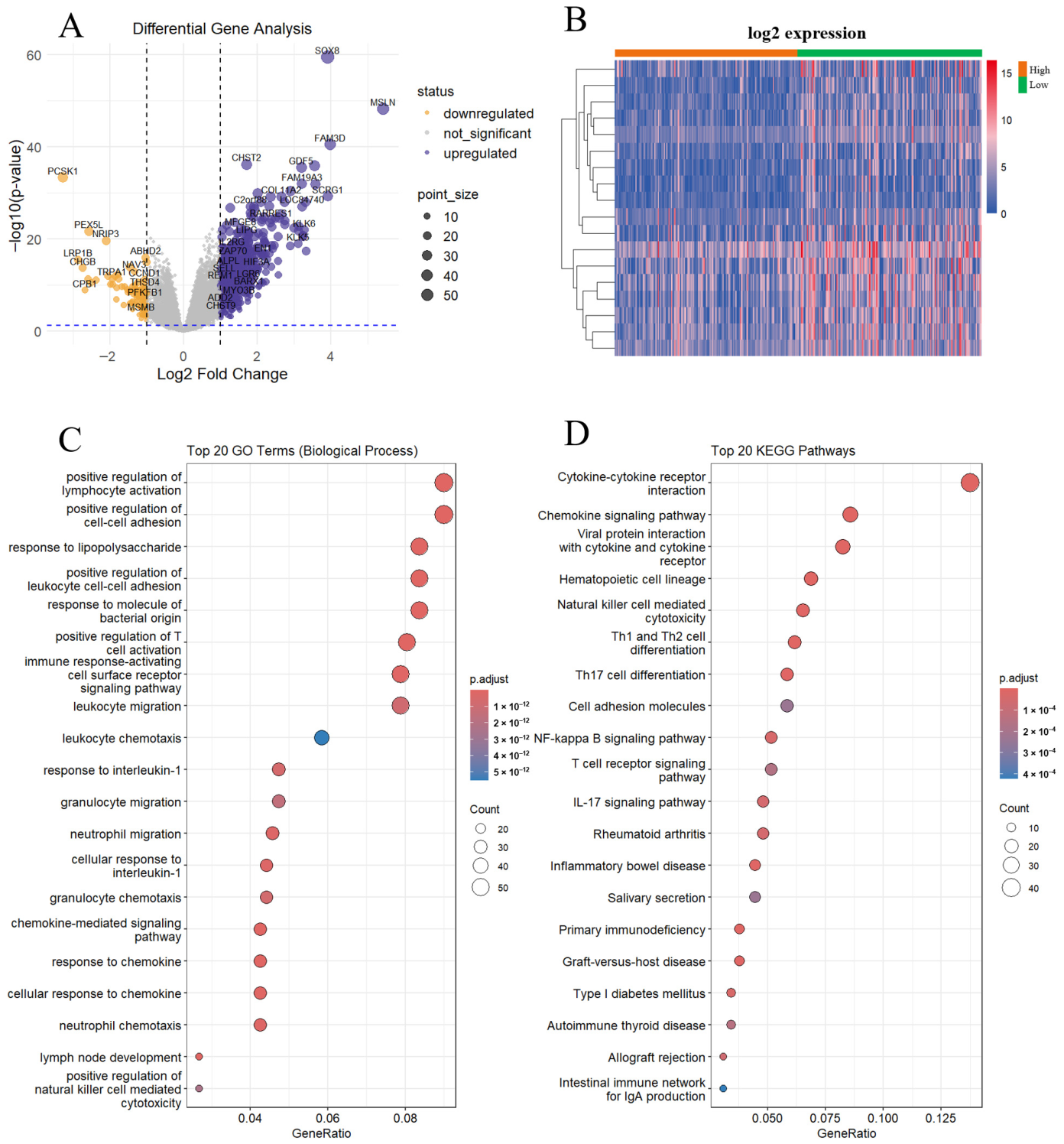
As shown in
Figure 4A, differential gene expression analysis identified 723 genes (
, adjusted
), including 626 upregulated and 97 downregulated genes. The corresponding heatmap (
Figure 4B) illustrates a clear separation between the two risk groups, reflecting distinct transcriptomic profiles captured by the model.
Among the 18 prognostic candidate biomarkers identified in the BRCA cohort (
Table 3), 12 (66.7%) have been previously reported to be associated with breast cancer, including
MSLN,
FAM3D,
SOX8,
A2ML1,
GFRA3,
KLK6,
AQP5,
FBN3,
SLC6A14,
KLK5,
LRP1B and
PCDH10. For instance,
KLK6 has been characterized as a tumor suppressor in breast cancer [
31], and elevated
SLC6A14 expression has been linked to advanced clinical stages [
32]. It should be noted that
Table 3 is not intended to represent a list of frequently mutated or canonical driver genes in breast cancer. Instead, the genes listed in
Table 3 were selected as expression-level prognostic biomarkers based on the model-defined risk groups, differential expression analysis, statistical significance, and model ranking results. Therefore, the absence of well-known breast cancer-related genes, such as
TP53 (p53),
BRCA1/2,
PTEN,
ATM, and
CHEK family genes, does not indicate that these genes are unrelated to BRCA or deny their established roles in breast cancer. Rather, it suggests that the biomarkers identified by PANA-Surv mainly reflect risk-associated expression changes, pathway perturbations, and model-driven prognostic signals under the current multi-omics intersected gene set and KEGG pathway constraints. These findings may provide complementary information to traditional mutation-driven biomarkers.
To further evaluate the applicability of PANA-Surv to another cancer type, we performed additional biomarker analysis in the LGG cohort (
Table 4). A total of 20 prognostic candidate biomarkers were identified in the LGG cohort using the same screening criteria. Among them, 15 genes, including
NECAB1,
RASGRF2,
CDKL2,
RGS4,
PAK1,
SERPINI1,
CAMK2A,
SLC12A5,
ITPR1,
POSTN,
H19,
HOXC13,
HOXA9,
HOXC10, and
MMP7, have been previously implicated in glioma- or LGG-related biological processes or prognosis. The remaining five genes,
KCNJ3,
NAPB,
PAX3,
TRPM8, and
MAGEA6, also satisfied the same screening criteria but currently lack direct glioma- or LGG-related literature support in our literature check; therefore, they are reported as potential candidate biomarkers requiring further validation. Compared with the BRCA results, the identified LGG biomarkers showed a distinct cancer-type-specific pattern, suggesting that PANA-Surv can identify biologically meaningful prognostic candidate biomarkers across different cancer contexts.
Gene Ontology (GO) enrichment analysis (
Figure 4C) showed that the top biological processes were primarily related to immune activation, chemotaxis, and cell adhesion [
56], such as “positive regulation of T cell activation”, “immune response-activating cell surface receptor signaling pathway” and “positive regulation of cell–cell adhesion”. Consistently, KEGG pathway enrichment (
Figure 4D) revealed significant involvement of immune and inflammation-related pathways, including “T cell receptor signaling”, “Cytokine-cytokine receptor interaction”, “Natural killer cell-mediated cytotoxicity”, “NF-kappa B signaling”, and “IL-17 signaling”. These pathways highlight the roles of immune regulation and inflammatory activity in breast cancer progression [
57,
58,
59].
These analyses demonstrate that PANA-Surv captures biologically meaningful molecular patterns underlying survival differences and highlights potential biomarkers and pathways relevant to breast cancer progression.
4. Discussion
This study demonstrates that integrating pathway prior knowledge with adaptive local representation learning can improve multi-omics survival prediction. PANA-Surv consistently outperformed traditional and deep learning models such as Cox-EN and DeepSurv, suggesting that pathway-guided graph modeling provides a more effective way to capture gene-level molecular dependencies associated with patient survival. Compared with existing GNN-based survival models, including GraphSurv and LAGProg, PANA-Surv further improved prognostic performance across multiple TCGA cohorts.
A key distinction between PANA-Surv and previous local augmentation methods is that many existing approaches implicitly assume that neighboring nodes contribute equally during feature generation. In contrast, PANA-Surv incorporates both neighborhood reconstruction (NR) and adaptive weighting (AW), allowing the model to retain informative neighbors while reducing the influence of weakly related or noisy local signals. The ablation experiments further support the value of this design, as removing NR or replacing AW with uniform weighting led to consistent reductions in predictive performance.
Our comparison of graph construction strategies also showed that KEGG pathway-guided graphs were more effective than both data-driven kNN graphs and directed graph variants. This result suggests that biologically curated pathway structure provides a more reliable prior for multi-omics prognostic modeling and helps reduce spurious associations that may arise in high-dimensional molecular data. In addition, PANA-Surv maintained relatively stable performance across different neighborhood sizes, indicating that the framework is reasonably robust to parameter selection.
The downstream analyses in the BRCA cohort further indicate that PANA-Surv captures biologically relevant molecular patterns associated with survival differences. The identified prognostic genes included both previously reported biomarkers and several potentially novel candidates, while the enrichment results highlighted immune- and inflammation-related pathways that are consistent with the current understanding of breast cancer progression. These findings suggest that adaptive local representation enhancement may improve not only predictive accuracy but also the biological interpretability of pathway-guided survival models.
Several limitations should also be noted. First, although KEGG pathways provide biologically meaningful prior knowledge, they do not fully capture the complexity of gene regulation and molecular interactions in cancer. Integrating additional resources, such as protein–protein interaction networks or gene regulatory networks, may further improve graph representation quality. Second, the current framework focuses on overall survival and does not explicitly model competing risks, treatment heterogeneity, or temporal disease dynamics. Extending the method to more complex clinical outcome settings may improve its applicability in future studies.
5. Conclusions
In summary, PANA-Surv provides a pathway-guided framework for multi-omics cancer survival analysis by integrating KEGG pathway knowledge with adaptive local feature enhancement. Through neighborhood reconstruction and adaptive weighting, the proposed method reduces noisy local propagation and improves the representation of biologically relevant neighborhood information, leading to more reliable prognostic prediction. Across 10 TCGA cancer cohorts, PANA-Surv achieved superior overall performance compared with representative traditional, deep learning, and graph-based survival models. In addition, the downstream analysis in BRCA showed that the framework can help identify prognostic genes and pathway-level biological signals associated with cancer outcomes. These results suggest that PANA-Surv offers an effective bioinformatics strategy for pathway-guided multi-omics prognostic modeling.
Author Contributions
Conceptualization, H.H. and J.G.; Methodology, X.C.; Data Curation, X.C. and Y.Z.; Formal Analysis, X.C. and Y.Z.; Visualization, X.C., J.-p.M. and Y.Z.; Writing—Original Draft Preparation, X.C. and Y.Z.; Writing—Review and Editing, Y.Z., Y.D., J.L., X.Z., Y.W., J.Z., H.H. and J.G.; Supervision, H.H. and J.G.; Resources, H.H. and J.G.; Funding Acquisition, H.H. and J.G. All authors have read and agreed to the published version of the manuscript.
Funding
This research was funded by the National Key R&D Program of China, grant number 2023YFB4503000; the National Natural Science Foundation of China (NSFC), grant number 62473129; and the Natural Science Foundation of Tianjin, grant number 23JCYBJC00790.
Institutional Review Board Statement
Not applicable. This study was based exclusively on publicly available, de-identified data from TCGA and publicly accessible pathway resources and did not involve direct contact with human participants or the collection of identifiable personal information.
Informed Consent Statement
Not applicable. This study used publicly available de-identified data for secondary analysis.
Data Availability Statement
The data presented in this study were derived from public domain resources. TCGA multi-omics and clinical data are available from the Genomic Data Commons (GDC) portal, and KEGG pathway data were obtained from the KEGG database. The code used in this study is publicly available at
https://github.com/hebut-xiaowencao/PANA-Surv_cancer_prognosis, accessed on 16 April 2026.
Conflicts of Interest
The authors declare no conflicts of interest.
Abbreviations
| AW | Adaptive weighting |
| BH | Benjamini–Hochberg |
| BLCA | Bladder urothelial carcinoma |
| BP | Biological process |
| BRCA | Breast invasive carcinoma |
| CESC | Cervical squamous cell carcinoma and endocervical adenocarcinoma |
| C-index | Concordance index |
| COAD | Colon adenocarcinoma |
| DEG | Differentially expressed gene(s) |
| ELBO | Evidence lower bound |
| EN | Elastic net |
| FC | Fold change |
| GNN | Graph neural network |
| GO | Gene ontology |
| HGNC | HUGO Gene Nomenclature Committee |
| HNSC | Head and neck squamous cell carcinoma |
| KEGG | Kyoto Encyclopedia of Genes and Genomes |
| KGML | KEGG markup language |
| KNN | k-nearest neighbors |
| LAGProg | Local augmented graph for cancer prognosis |
| LGG | Brain lower grade glioma |
| LUAD | Lung adenocarcinoma |
| MESO | Mesothelioma |
| NR | Neighborhood reconstruction |
| PANA | Pathway-guided adaptive neighborhood augmentation |
| PPI | Protein–protein interaction |
| SARC | Sarcoma |
| SKCM | Skin cutaneous melanoma |
| TCGA | The Cancer Genome Atlas |
| UNC | University of North Carolina |
| VAE | Variational auto-encoder |
| MSLN | Mesothelin |
| FAM3D | Family with sequence similarity 3 member D |
| SOX8 | SRY-box transcription factor 8 |
| A2ML1 | Alpha-2-macroglobulin like 1 |
| SLC30A8 | Solute carrier family 30 member 8 |
| PCSK1 | Proprotein convertase subtilisin/kexin type 1 |
| CPB1 | Carboxypeptidase B1 |
| CPA6 | Carboxypeptidase A6 |
| NECAB1 | N-terminal EF-hand calcium binding protein 1 |
| RASGRF2 | Ras protein specific guanine nucleotide releasing factor 2 |
| CDKL2 | Cyclin dependent kinase like 2 |
| RGS4 | Regulator of G protein signaling 4 |
| PAK1 | p21 (RAC1) activated kinase 1 |
| SERPINI1 | Serpin family I member 1 |
| CAMK2A | Calcium/calmodulin dependent protein kinase II alpha |
| SLC12A5 | Solute carrier family 12 member 5 |
| ITPR1 | Inositol 1,4,5-trisphosphate receptor type 1 |
| POSTN | Periostin |
| H19 | H19 imprinted maternally expressed transcript |
| HOXC13 | Homeobox C13 |
| HOXA9 | Homeobox A9 |
| HOXC10 | Homeobox C10 |
| MMP7 | Matrix metallopeptidase 7 |
| KCNJ3 | Potassium inwardly rectifying channel subfamily J member 3 |
| NAPB | NSF attachment protein beta |
| TRPM8 | Transient receptor potential cation channel subfamily M member 8 |
References
- Zabihi, A. The role of biological macromolecules in the regulation of angiogenesis in glioblastoma: Focus on vascular growth factors, integrins, and extracellular matrix proteins. Int. J. Biol. Macromol. 2025, 311, 143838. [Google Scholar] [CrossRef] [PubMed]
- Marguerat, S.; Bähler, J. RNA-seq: From technology to biology. Cell. Mol. Life Sci. 2010, 67, 569–579. [Google Scholar] [CrossRef]
- Hao, X.; Luo, H.; Krawczyk, M.; Wei, W.; Wang, W.; Wang, J.; Flagg, K.; Hou, J.; Zhang, H.; Yi, S.; et al. DNA methylation markers for diagnosis and prognosis of common cancers. Proc. Natl. Acad. Sci. USA 2017, 114, 7414–7419. [Google Scholar] [CrossRef]
- Heo, Y.J.; Hwa, C.; Lee, G.-H.; Park, J.-M.; An, J.-Y. Integrative multi-omics approaches in cancer research: From biological networks to clinical subtypes. Mol. Cells 2021, 44, 433–443. [Google Scholar] [CrossRef] [PubMed]
- Valous, N.A.; Popp, F.; Zörnig, I.; Jäger, D.; Charoentong, P. Graph machine learning for integrated multi-omics analysis. Br. J. Cancer 2024, 131, 205–211. [Google Scholar] [CrossRef]
- Ren, S.; Lu, Y.; Zhang, G.; Xie, K.; Chen, D.; Cai, X.; Ye, M. Integration of Graph Neural Networks and multi-omics analysis identify the predictive factor and key gene for immunotherapy response and prognosis of bladder cancer. J. Transl. Med. 2024, 22, 1141. [Google Scholar] [CrossRef]
- Wen, G.; Li, L. FGCNSurv: Dually fused graph convolutional network for multi-omics survival prediction. Bioinformatics 2023, 39, btad472. [Google Scholar] [CrossRef]
- Lin, Y.; Golovnina, K.; Chen, Z.-X.; Lee, H.N.; Negron, Y.L.S.; Sultana, H.; Oliver, B.; Harbison, S.T. Comparison of normalization and differential expression analyses using RNA-Seq data from 726 individual Drosophila melanogaster. BMC Genom. 2016, 17, 28. [Google Scholar] [CrossRef]
- Kanehisa, M.; Goto, S. KEGG: Kyoto Encyclopedia of Genes and Genomes. Nucleic Acids Res. 2000, 28, 27–30. [Google Scholar] [CrossRef] [PubMed]
- Chanumolu, S.K.; Albahrani, M.; Can, H.; Otu, H.H. KEGG2Net: Deducing gene interaction networks and acyclic graphs from KEGG pathways. EMBnet J. 2021, 26, e949. [Google Scholar] [CrossRef]
- Kanehisa, M.; Goto, S.; Kawashima, S.; Okuno, Y.; Hattori, M. The KEGG resource for deciphering the genome. Nucleic Acids Res. 2004, 32, D277–D280. [Google Scholar] [CrossRef]
- Zhang, Y.; Xiong, S.; Wang, Z.; Liu, Y.; Luo, H.; Li, B.; Zou, Q. Local augmented graph neural network for multi-omics cancer prognosis prediction and analysis. Methods 2023, 213, 1–9. [Google Scholar] [CrossRef]
- Zhang, S.; Tong, H.; Xu, J.; Maciejewski, R. Graph convolutional networks: A comprehensive review. Comput. Soc. Netw. 2019, 6, 11. [Google Scholar] [CrossRef] [PubMed]
- Cappelletti, L.; Rekerle, L.; Fontana, T.; Hansen, P.; Casiraghi, E.; Ravanmehr, V.; Mungall, C.J.; Yang, J.J.; Spranger, L.; Karlebach, G.; et al. Node-degree aware edge sampling mitigates inflated classification performance in biomedical random walk-based graph representation learning. Bioinform. Adv. 2024, 4, vbae036. [Google Scholar] [CrossRef]
- Wu, Z.; Pan, S.; Chen, F.; Long, G.; Zhang, C.; Yu, P.S. A comprehensive survey on graph neural networks. IEEE Trans. Neural Netw. Learn. Syst. 2021, 32, 4–24. [Google Scholar] [CrossRef]
- Ding, K.; Xu, Z.; Tong, H.; Liu, H. Data augmentation for deep graph learning: A survey. ACM SIGKDD Explor. Newsl. 2022, 24, 61–77. [Google Scholar] [CrossRef]
- Adjeisah, M.; Zhu, X.; Xu, H.; Ayall, T.A. Towards data augmentation in graph neural network: An overview and evaluation. Comput. Sci. Rev. 2023, 47, 100527. [Google Scholar] [CrossRef]
- Liu, S.; Ying, R.; Dong, H.; Li, L.; Xu, T.; Rong, Y.; Zhao, P.; Huang, J.; Wu, D. Local Augmentation for Graph Neural Networks. In Proceedings of the 39th International Conference on Machine Learning, PMLR, Baltimore, MD, USA, 17–23 July 2022; pp. 14054–14072. [Google Scholar]
- Huang, X.; Ma, Z.; Meng, D.; Liu, Y.; Ruan, S.; Sun, Q.; Zheng, X.; Qiao, Z. PRAGA: Prototype-Aware Graph Adaptive Aggregation for Spatial Multi-Modal Omics Analysis. In Proceedings of the AAAI Conference on Artificial Intelligence, Philadelphia, PA, USA, 25 February–4 March 2025; Volume 39, pp. 326–333. [Google Scholar]
- Dai, E.; Jin, W.; Liu, H.; Wang, S. Towards Robust Graph Neural Networks for Noisy Graphs with Sparse Labels. In Proceedings of the Fifteenth ACM International Conference on Web Search and Data Mining, Virtual Event, AZ, USA, 21–25 February 2022; pp. 181–191. [Google Scholar] [CrossRef]
- Burkhart, J.G.; Wu, G.; Song, X.; Raimondi, F.; McWeeney, S.; Wong, M.H.; Deng, Y. Biology-inspired graph neural network encodes reactome and reveals biochemical reactions of disease. Patterns 2023, 4, 100758. [Google Scholar] [CrossRef] [PubMed]
- Simon, N.; Friedman, J.H.; Hastie, T.; Tibshirani, R. Regularization paths for Cox’s proportional hazards model via coordinate descent. J. Stat. Softw. 2011, 39, 1–13. [Google Scholar] [CrossRef]
- Katzman, J.L.; Shaham, U.; Cloninger, A.; Bates, J.; Jiang, T.; Kluger, Y. DeepSurv: Personalized treatment recommender system using a Cox proportional hazards deep neural network. BMC Med. Res. Methodol. 2018, 18, 24. [Google Scholar] [CrossRef]
- Wang, Y.; Zhang, Z.; Chai, H.; Yang, Y. Multi-Omics Cancer Prognosis Analysis Based on Graph Convolution Network. In Proceedings of the 2021 IEEE International Conference on Bioinformatics and Biomedicine (BIBM), Virtual Conference, 9–12 December 2021; pp. 1564–1568. [Google Scholar] [CrossRef]
- Brentnall, A.R.; Cuzick, J. Use of the concordance index for predictors of censored survival data. Stat. Methods Med. Res. 2018, 27, 2359–2373. [Google Scholar] [CrossRef]
- Clark, T.G.; Bradburn, M.J.; Love, S.B.; Altman, D.G. Survival analysis part I: Basic concepts and first analyses. Br. J. Cancer 2003, 89, 232–238. [Google Scholar] [CrossRef] [PubMed]
- Love, M.I.; Huber, W.; Anders, S. Moderated estimation of fold change and dispersion for RNA-seq data with DESeq2. Genome Biol. 2014, 15, 550. [Google Scholar] [CrossRef] [PubMed]
- Yu, G.; Wang, L.-G.; Han, Y.; He, Q.-Y. clusterProfiler: An R package for comparing biological themes among gene clusters. Omics 2012, 16, 284–287. [Google Scholar] [CrossRef]
- Durinck, S.; Spellman, P.T.; Birney, E.; Huber, W. Mapping identifiers for the integration of genomic datasets with the R/Bioconductor package biomaRt. Nat. Protoc. 2009, 4, 1184–1191. [Google Scholar] [CrossRef]
- Benjamini, Y.; Hochberg, Y. Controlling the false discovery rate: A practical and powerful approach to multiple testing. J. R. Stat. Soc. Ser. B Stat. Methodol. 1995, 57, 289–300. [Google Scholar] [CrossRef]
- Sidiropoulos, K.G.; Ding, Q.; Pampalakis, G.; White, N.M.; Boulos, P.; Sotiropoulou, G.; Yousef, G.M. KLK6-regulated miRNA networks activate oncogenic pathways in breast cancer subtypes. Mol. Oncol. 2016, 10, 993–1007. [Google Scholar] [CrossRef] [PubMed]
- Zhao, X.; Jin, L.; Liu, Y.; Liu, Z.; Liu, Q. Bioinformatic analysis of the role of solute carrier-glutamine transporters in breast cancer. Ann. Transl. Med. 2022, 10, 777. [Google Scholar] [CrossRef]
- Wang, X.; O’Regan, R.M. Breast cancer therapy in China: Introducing the special collection. Cancer 2024, 130, 1368–1370. [Google Scholar] [CrossRef]
- Chen, Z.; Jiao, S.; Zhao, D.; Zou, Q.; Xu, L.; Zhang, L.; Su, X. The characterization of structure and prediction for aquaporin in tumour progression by machine learning. Front. Cell Dev. Biol. 2022, 10, 845622. [Google Scholar] [CrossRef]
- Dong, Q.-T.; Ma, D.-D.; Gong, Q.; Lin, Z.-Y.; Li, Z.-H.; Ye, J.-X.; Qin, C.-H.; Jin, W.-D.; Zhang, J.-X.; Zhang, Z.-Y. FAM3 family genes are associated with prognostic value of human cancer: A pan-cancer analysis. Sci. Rep. 2023, 13, 15144. [Google Scholar] [CrossRef]
- Liu, S.; Song, A.; Zhou, X.; Huo, Z.; Yao, S.; Yang, B.; Liu, Y.; Wang, Y. ceRNA network development and tumour-infiltrating immune cell analysis of metastatic breast cancer to bone. J. Bone Oncol. 2020, 24, 100304. [Google Scholar] [CrossRef]
- Liu, Y.; Ji, Y.; Qiu, P. Identification of thresholds for dichotomizing DNA methylation data. EURASIP J. Bioinform. Syst. Biol. 2013, 2013, 8. [Google Scholar] [CrossRef]
- Li, Y.; Zhou, X.; Liu, J.; Yin, Y.; Yuan, X.; Yang, R.; Wang, Q.; Ji, J.; He, Q. Differentially expressed genes and key molecules of BRCA1/2-mutant breast cancer: Evidence from bioinformatics analyses. PeerJ 2020, 8, e8403. [Google Scholar] [CrossRef] [PubMed]
- Sidiropoulos, K.G.; White, N.M.; Bui, A.; Ding, Q.; Boulos, P.; Pampalakis, G.; Khella, H.; Samuel, J.N.; Sotiropoulou, G.; Yousef, G.M. Kallikrein-related peptidase 5 induces miRNA-mediated anti-oncogenic pathways in breast cancer. Oncoscience 2014, 1, 709–724. [Google Scholar] [CrossRef] [PubMed]
- Liu, J.; Ge, S.; Cheng, Y.; Wang, X. Multi-view spectral clustering based on multi-smooth representation fusion for cancer subtype prediction. Front. Genet. 2021, 12, 718915. [Google Scholar] [CrossRef]
- Huang, Y.; Qiu, Y.; Ding, L.; Ren, S.; Jiang, Y.; Luo, J.; Huang, J.; Yin, X.; Fu, S.; Zhao, J.; et al. Somatic mutations in four novel genes contribute to homologous recombination deficiency in breast cancer: A real-world clinical tumor sequencing study. J. Pathol. Clin. Res. 2024, 10, e12367. [Google Scholar] [CrossRef]
- de Ruijter, T.C.; van der Heide, F.; Smits, K.M.; Aarts, M.J.; van Engeland, M.; Heijnen, V.C.G. Prognostic DNA methylation markers for hormone receptor breast cancer: A systematic review. Breast Cancer Res. 2020, 22, 13. [Google Scholar] [CrossRef]
- Gulaia, V.; Shmelev, M.; Romanishin, A.; Shved, N.; Farniev, V.; Goncharov, N.; Biktimirov, A.; Vargas, I.L.; Khodosevich, K.; Kagansky, A.; et al. Single-nucleus transcriptomics of IDH1-and TP53-mutant glioma stem cells displays diversified commitment on invasive cancer progenitors. Sci. Rep. 2022, 12, 18975. [Google Scholar] [CrossRef] [PubMed]
- Shan, L.; Zhu, X.; Qiu, H.-Z.; Zuo, E.-D.; Cheng, X. Prognostic significance of TMEM131L in glioma and establishment of oxidative stress prognostic model. Front. Neurol. 2023, 14, 1162394. [Google Scholar] [CrossRef]
- Mikheev, A.M.; Mikheeva, S.A.; Trister, A.D.; Tokita, M.J.; Emerson, S.N.; Parada, C.A.; Born, D.E.; Carnemolla, B.; Frankel, S.; Kim, D.-H.; et al. Periostin is a novel therapeutic target that predicts and regulates glioma malignancy. Neuro-Oncol. 2015, 17, 372–382. [Google Scholar] [CrossRef]
- Yi, R.; Yang, S.; Liao, Y.; Hu, Z.; Long, H.; Zeng, Y.; Wang, X.; Qiu, C.; Xu, A.; Lin, J.; et al. Decreased CDKL2 expression is correlated with the progression and poor prognosis of glioma. Pathol.-Res. Pract. 2020, 216, 152920. [Google Scholar] [CrossRef] [PubMed]
- Xiao, Y.; Zhu, Z.; Li, J.; Yao, J.; Jiang, H.; Ran, R.; Li, X.; Li, Z. Expression and prognostic value of long non-coding RNA H19 in glioma via integrated bioinformatics analyses. Aging 2020, 12, 3407. [Google Scholar] [CrossRef]
- Cai, J.; Zeng, C.; Hua, W.; Qi, Z.; Song, Y.; Lu, X.; Li, D.; Zhang, Z.; Cui, X.; Zhang, X.; et al. An integrative analysis of genome-wide 5-hydroxymethylcytosines in circulating cell-free DNA detects noninvasive diagnostic markers for gliomas. Neuro-Oncol. Adv. 2021, 3, vdab049. [Google Scholar] [CrossRef]
- Yu, M.; Yu, S.; Zhou, W.; Yi, B.; Liu, Y. HOXC6/8/10/13 predict poor prognosis and associate with immune infiltrations in glioblastoma. Int. Immunopharmacol. 2021, 101, 108293. [Google Scholar] [CrossRef]
- Chu, Y.; Elrod, N.; Wang, C.; Li, L.; Chen, T.; Routh, A.; Xia, Z.; Li, W.; Wagner, E.J.; Ji, P. Nudt21 regulates the alternative polyadenylation of Pak1 and is predictive in the prognosis of glioblastoma patients. Oncogene 2019, 38, 4154–4168. [Google Scholar] [CrossRef]
- Pojo, M.; Gonçalves, C.S.; Xavier-Magalhães, A.; Oliveira, A.I.; Gonçalves, T.; Correia, S.; Rodrigues, A.J.; Costa, S.; Pinto, L.; Pinto, A.A.; et al. A transcriptomic signature mediated by HOXA9 promotes human glioblastoma initiation, aggressiveness and resistance to temozolomide. Oncotarget 2015, 6, 7657. [Google Scholar] [CrossRef] [PubMed]
- Cen, S.; Yang, G.; Bao, H.; Yu, Z.; Liang, L. Impact of propofol versus sevoflurane anesthesia on molecular subtypes and immune checkpoints of glioma during surgery. Health Sci. Rep. 2023, 6, e1366. [Google Scholar] [CrossRef]
- Tan, Z.; Chen, K.; Wu, W.; Zhou, Y.; Zhu, J.; Wu, G.; Cao, L.; Zhang, X.; Guan, H.; Yang, Y.; et al. Overexpression of HOXC10 promotes angiogenesis in human glioma via interaction with PRMT5 and upregulation of VEGFA expression. Theranostics 2018, 8, 5143. [Google Scholar] [CrossRef]
- Xie, H.; Xue, Y.-X.; Liu, L.-B.; Wang, P.; Liu, Y.-H.; Ying, H.-Q. Expressions of matrix metalloproteinase-7 and matrix metalloproteinase-14 associated with the activation of extracellular signal-regulated kinase1/2 in human brain gliomas of different pathological grades. Med. Oncol. 2011, 28, 433–438. [Google Scholar] [CrossRef] [PubMed]
- Liu, H.; Pan, Z.; Lin, X.; Chen, L.; Yang, Q.; Zhang, W.; Dai, L.; Zhang, Y.; Li, W.; Chen, Y.; et al. A potassium-chloride co-transporter with altered genome architecture functions as a suppressor in glioma. J. Cell. Mol. Med. 2024, 28, e18352. [Google Scholar] [CrossRef]
- Fridman, W.H.; Pagès, F.; Sautès-Fridman, C.; Galon, J. The immune contexture in human tumours: Impact on clinical outcome. Nat. Rev. Cancer 2012, 12, 298–306. [Google Scholar] [CrossRef]
- Zhao, J.; Chen, X.; Herjan, T.; Li, X. The role of interleukin-17 in tumor development and progression. J. Exp. Med. 2019, 217, e20190297. [Google Scholar] [CrossRef]
- Waes, C.V. Nuclear factor-kappaB in development, prevention, and therapy of cancer. Clin. Cancer Res. 2007, 13, 1076–1082. [Google Scholar] [CrossRef]
- Huang, B.; Zhang, X.; Cao, Q.; Chen, J.; Lin, C.; Xiang, T.; Zeng, P. Construction and validation of a prognostic risk model for breast cancer based on protein expression. BMC Med. Genom. 2022, 15, 148. [Google Scholar] [CrossRef]
Figure 1.
Workflow of PANA-Surv. Graph construction builds a pathway-guided graph by integrating multi-omics features with the KEGG pathway network (a–c). Module 1 (PANA-VAE) includes two mechanisms: a neighborhood reconstruction (NR) mechanism that selects the top- most similar neighbors (d–f), and an adaptive weighting (AW) mechanism that reweights the neighborhood feature () based on computed similarities (g). The reweighted neighborhood features together with the central node features are then fed into an encoder to generate the augmented central representation (h). Module 2 (Cox-GCN) takes the concatenated feature matrix as input to a two-layer graph convolutional network with a Cox proportional hazards layer for patient risk prediction.
Figure 1.
Workflow of PANA-Surv. Graph construction builds a pathway-guided graph by integrating multi-omics features with the KEGG pathway network (a–c). Module 1 (PANA-VAE) includes two mechanisms: a neighborhood reconstruction (NR) mechanism that selects the top- most similar neighbors (d–f), and an adaptive weighting (AW) mechanism that reweights the neighborhood feature () based on computed similarities (g). The reweighted neighborhood features together with the central node features are then fed into an encoder to generate the augmented central representation (h). Module 2 (Cox-GCN) takes the concatenated feature matrix as input to a two-layer graph convolutional network with a Cox proportional hazards layer for patient risk prediction.
Figure 2.
Evaluation of PANA-Surv through ablation and graph topology analyses. (A) C-index comparison of the full model and its two ablated variants, No-NR (without neighborhood reconstruction mechanism) and No-AW (without adaptive weighting mechanism), across 10 TCGA cancer cohorts. (B) Comparison of directed graph construction, kNN-based graph construction, and PANA-Surv (pathway-guided construction) under different neighborhood sizes ().
Figure 2.
Evaluation of PANA-Surv through ablation and graph topology analyses. (A) C-index comparison of the full model and its two ablated variants, No-NR (without neighborhood reconstruction mechanism) and No-AW (without adaptive weighting mechanism), across 10 TCGA cancer cohorts. (B) Comparison of directed graph construction, kNN-based graph construction, and PANA-Surv (pathway-guided construction) under different neighborhood sizes ().
Figure 3.
Kaplan–Meier survival curves predicted by PANA-Surv across 10 TCGA cancer cohorts. Patients were divided into high-risk (orange) and low-risk (blue) groups according to the median predicted risk score. Shaded regions represent 95% confidence intervals, and p-values were calculated using the log-rank test.
Figure 3.
Kaplan–Meier survival curves predicted by PANA-Surv across 10 TCGA cancer cohorts. Patients were divided into high-risk (orange) and low-risk (blue) groups according to the median predicted risk score. Shaded regions represent 95% confidence intervals, and p-values were calculated using the log-rank test.
Figure 4.
Downstream biomarker analysis and functional enrichment in BRCA. (A) Differentially expressed genes, where the blue dashed horizontal line represents -value = 0.05, and the black dashed vertical lines indicate |logFC| = 2. The yellow and purple dots correspond to the significantly down-regulated and up-regulated genes, respectively. (B) Heatmap of identified biological features based on up-regulated and down-regulated genes filtered by PANA-Surv. (C) GO enrichment analysis showing the top 20 biological processes. (D) KEGG enrichment analysis showing the top 20 enriched pathways.
Figure 4.
Downstream biomarker analysis and functional enrichment in BRCA. (A) Differentially expressed genes, where the blue dashed horizontal line represents -value = 0.05, and the black dashed vertical lines indicate |logFC| = 2. The yellow and purple dots correspond to the significantly down-regulated and up-regulated genes, respectively. (B) Heatmap of identified biological features based on up-regulated and down-regulated genes filtered by PANA-Surv. (C) GO enrichment analysis showing the top 20 biological processes. (D) KEGG enrichment analysis showing the top 20 enriched pathways.
Table 1.
Summary of model performance across 10 TCGA cancer cohorts. The table reports the C-index values of PANA-Surv and four baseline methods, including Cox-EN, DeepSurv, GraphSurv, and LAGProg, grouped by model category. Bold values indicate the highest C-index among the compared methods for each cancer cohort and the highest mean C-index across all cohorts. The penultimate row reports the mean C-index across the 10 cohorts, and the last row presents the paired Wilcoxon test p-values comparing PANA-Surv with each baseline method; “-“ indicates that the comparison is not applicable.
Table 1.
Summary of model performance across 10 TCGA cancer cohorts. The table reports the C-index values of PANA-Surv and four baseline methods, including Cox-EN, DeepSurv, GraphSurv, and LAGProg, grouped by model category. Bold values indicate the highest C-index among the compared methods for each cancer cohort and the highest mean C-index across all cohorts. The penultimate row reports the mean C-index across the 10 cohorts, and the last row presents the paired Wilcoxon test p-values comparing PANA-Surv with each baseline method; “-“ indicates that the comparison is not applicable.
| | Traditional | Deep Learning | Graph Neural Networks |
|---|
| Cancer Type | Cox-EN | DeepSurv | GraphSurv | LAGProg | PANA-Surv |
|---|
| BRCA | 0.5145 | 0.6506 | 0.5956 | 0.5699 | 0.6433 |
| BLCA | 0.5191 | 0.5258 | 0.5630 | 0.5802 | 0.7028 |
| CESC | 0.5560 | 0.5192 | 0.5670 | 0.7199 | 0.7096 |
| COAD | 0.4780 | 0.5519 | 0.4973 | 0.5590 | 0.5792 |
| HNSC | 0.5742 | 0.5637 | 0.5620 | 0.6135 | 0.6603 |
| LGG | 0.7843 | 0.5885 | 0.7425 | 0.7795 | 0.8071 |
| LUAD | 0.5939 | 0.4915 | 0.5767 | 0.5581 | 0.6359 |
| MESO | 0.6388 | 0.6692 | 0.5940 | 0.5564 | 0.7519 |
| SARC | 0.6190 | 0.4888 | 0.6310 | 0.5176 | 0.6278 |
| SKCM | 0.5917 | 0.5297 | 0.6093 | 0.5805 | 0.6452 |
| Mean | 0.5870 | 0.5579 | 0.5938 | 0.6035 | 0.6763 |
| p-value | 8.30 × 10⁻⁴ | 5.21 × 10⁻⁴ | 7.32 × 10⁻⁴ | 3.62 × 10⁻³ | - |
Table 2.
External validation performance on the independent GSE20713_BRCA cohort. The table reports the C-index values of PANA-Surv and four baseline methods grouped by model category. Bold values indicate the highest C-index among the compared methods in the external validation cohort.
Table 2.
External validation performance on the independent GSE20713_BRCA cohort. The table reports the C-index values of PANA-Surv and four baseline methods grouped by model category. Bold values indicate the highest C-index among the compared methods in the external validation cohort.
| | Traditional | Deep Learning | Graph Neural Networks |
|---|
|
Cancer Type
|
Cox-EN
|
DeepSurv
|
GraphSurv
|
LAGProg
|
PANA-Surv
|
|---|
| BRCA | 0.5808 | 0.5723 | 0.6181 | 0.4375 | 0.6240 |
Table 3.
Prognostic candidate biomarkers identified by PANA-Surv in the BRCA cohort. Eighteen prognostic candidate biomarkers were identified in the BRCA cohort based on an absolute log-fold change (|logFC|) greater than 2 and an adjusted p-value below 0.05. The “Reference” column indicates whether direct literature support for the association of each gene with breast cancer or BRCA-related prognosis was identified. A dash indicates that no direct BRCA-related literature support was identified in our literature check; these genes are reported as potential candidate biomarkers requiring further validation.
Table 3.
Prognostic candidate biomarkers identified by PANA-Surv in the BRCA cohort. Eighteen prognostic candidate biomarkers were identified in the BRCA cohort based on an absolute log-fold change (|logFC|) greater than 2 and an adjusted p-value below 0.05. The “Reference” column indicates whether direct literature support for the association of each gene with breast cancer or BRCA-related prognosis was identified. A dash indicates that no direct BRCA-related literature support was identified in our literature check; these genes are reported as potential candidate biomarkers requiring further validation.
| Gene | logFC | Adjusted p | Reference | Gene | logFC | Adjusted p | Reference |
|---|
| MSLN | 5.416 | 5.81 × 10−49 | [33] | AQP5 | 3.252 | 3.04 × 10⁻²¹ | [34] |
| FAM3D | 3.981 | 3.63 × 10−41 | [35] | FBN3 | 3.135 | 2.12 × 10⁻²³ | [36] |
| SOX8 | 3.904 | 3.66 × 10−60 | [37] | SLC6A14 | 3.116 | 1.87 × 10⁻²² | [32] |
| A2ML1 | 3.317 | 3.56 × 10⁻¹⁸ | [38] | KLK5 | 3.111 | 1.04 × 10⁻¹⁹ | [39] |
| GFRA3 | 3.313 | 9.29 × 10⁻²⁹ | [40] | LRP1B | −2.872 | 3.54 × 10⁻¹⁶ | [41] |
| KLK6 | 3.274 | 1.19 × 10⁻²² | [31] | PCDH10 | −2.072 | 1.13 × 10⁻¹² | [42] |
| SCRG1 | 3.930 | 6.13 × 10⁻³⁰ | - | PCSK1 | −3.280 | 4.96 × 10⁻³⁴ | - |
| CHGB | −2.739 | 1.96 × 10⁻¹⁴ | - | CPB1 | −2.679 | 1.31 × 10⁻⁹ | - |
| SLC30A8 | −2.524 | 3.34 × 10⁻¹¹ | - | CPA6 | −2.393 | 7.74 × 10⁻¹² | - |
Table 4.
Prognostic candidate biomarkers identified by PANA-Surv in the LGG cohort. Twenty prognostic candidate biomarkers were identified in the LGG cohort based on an absolute log-fold change (|logFC|) greater than 2 and an adjusted p-value below 0.05. The “Reference” column indicates whether direct literature support for the association of each gene with glioma or LGG-related prognosis was identified. A dash indicates that no direct glioma- or LGG-related literature support was identified in our literature check; these genes are reported as potential candidate biomarkers requiring further validation.
Table 4.
Prognostic candidate biomarkers identified by PANA-Surv in the LGG cohort. Twenty prognostic candidate biomarkers were identified in the LGG cohort based on an absolute log-fold change (|logFC|) greater than 2 and an adjusted p-value below 0.05. The “Reference” column indicates whether direct literature support for the association of each gene with glioma or LGG-related prognosis was identified. A dash indicates that no direct glioma- or LGG-related literature support was identified in our literature check; these genes are reported as potential candidate biomarkers requiring further validation.
| Gene | logFC | Adjusted p | Reference | Gene | logFC | Adjusted p | Reference |
|---|
| NECAB1 | 4.238 | 1.95 × 10−41 | [43] | ITPR1 | 2.504 | 3.02 × 10−38 | [44] |
| RASGRF2 | 3.269 | 4.64 × 10−41 | [44] | POSTN | −4.015 | 1.48 × 10−45 | [45] |
| CDKL2 | 2.937 | 8.96 × 10⁻³² | [46] | H19 | −3.856 | 6.32 × 10−74 | [47] |
| RGS4 | 2.103 | 3.56 × 10⁻¹⁸ | [48] | HOXC13 | −3.812 | 5.18 × 10⁻¹² | [49] |
| PAK1 | 2.480 | 6.32 × 10−36 | [50] | HOXA9 | −2.368 | 2.87 × 10⁻¹¹ | [51] |
| SERPINI1 | 2.497 | 2.16 × 10−37 | [52] | HOXC10 | −2.296 | 7.41 × 10⁻⁸ | [53] |
| CAMK2A | 2.303 | 2.02 × 10⁻³⁴ | [52] | MMP7 | −2.291 | 3.67 × 10⁻²⁰ | [54] |
| SLC12A5 | 2.158 | 9.40 × 10⁻³³ | [55] | PAX3 | −3.801 | 2.20 × 10⁻¹⁴ | - |
| KCNJ3 | 3.222 | 7.59 × 10−41 | - | TRPM8 | −2.381 | 5.79 × 10⁻²³ | - |
| NAPB | 2.393 | 1.37 × 10⁻³⁵ | - | MAGEA6 | −2.251 | 1.92 × 10⁻¹⁰ | - |
| Disclaimer/Publisher’s Note: The statements, opinions and data contained in all publications are solely those of the individual author(s) and contributor(s) and not of MDPI and/or the editor(s). MDPI and/or the editor(s) disclaim responsibility for any injury to people or property resulting from any ideas, methods, instructions or products referred to in the content. |






 ,
,