A Chromosome-Level Genome Assembly and Annotation of the Chinese Porcupine (Hystrix hodgsoni) Reveals the Expansion of Olfactory-Related Gene Families
 and
and
Abstract
1. Introduction
2. Materials and Methods
2.1. Sample Selection and Sequencing
2.2. Genome Size Estimation and Assembly
2.3. Genome Quality Evaluation
2.4. Gene Prediction and Functional Annotation
2.4.1. Identification of Non-Coding RNAs
2.4.2. Protein-Coding Gene Prediction
2.4.3. Functional Annotation
2.5. Comparative Genomics Analysis
2.5.1. Orthogroup Inference and Phylogenetic Framework Construction
2.5.2. Gene Family Expansion and Contraction Analysis
2.5.3. Functional Enrichment Analysis of Expanded Gene Families
3. Results
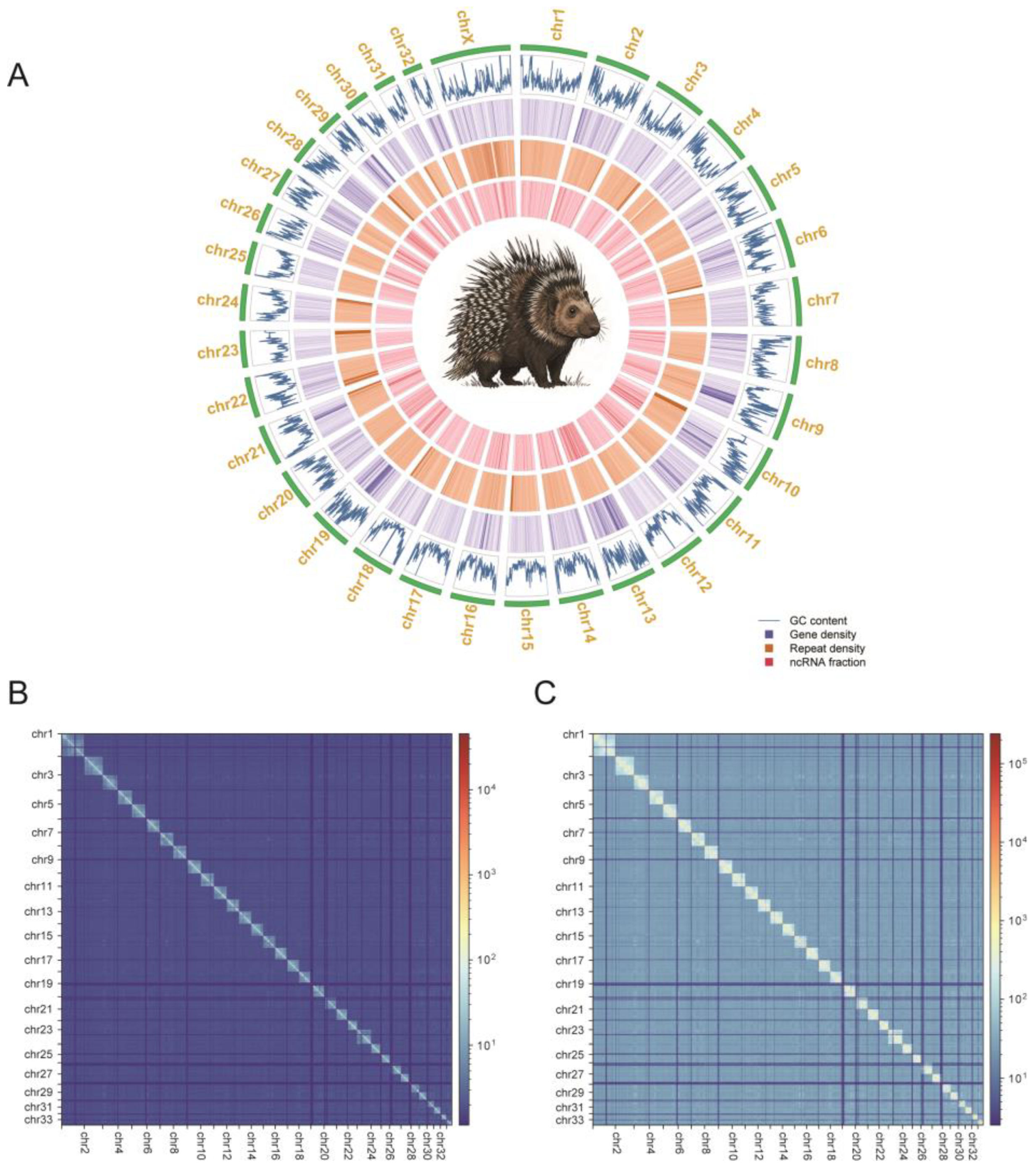
3.1. Genome Assembly and Evaluation
3.2. Genome Annotation and Gene Content
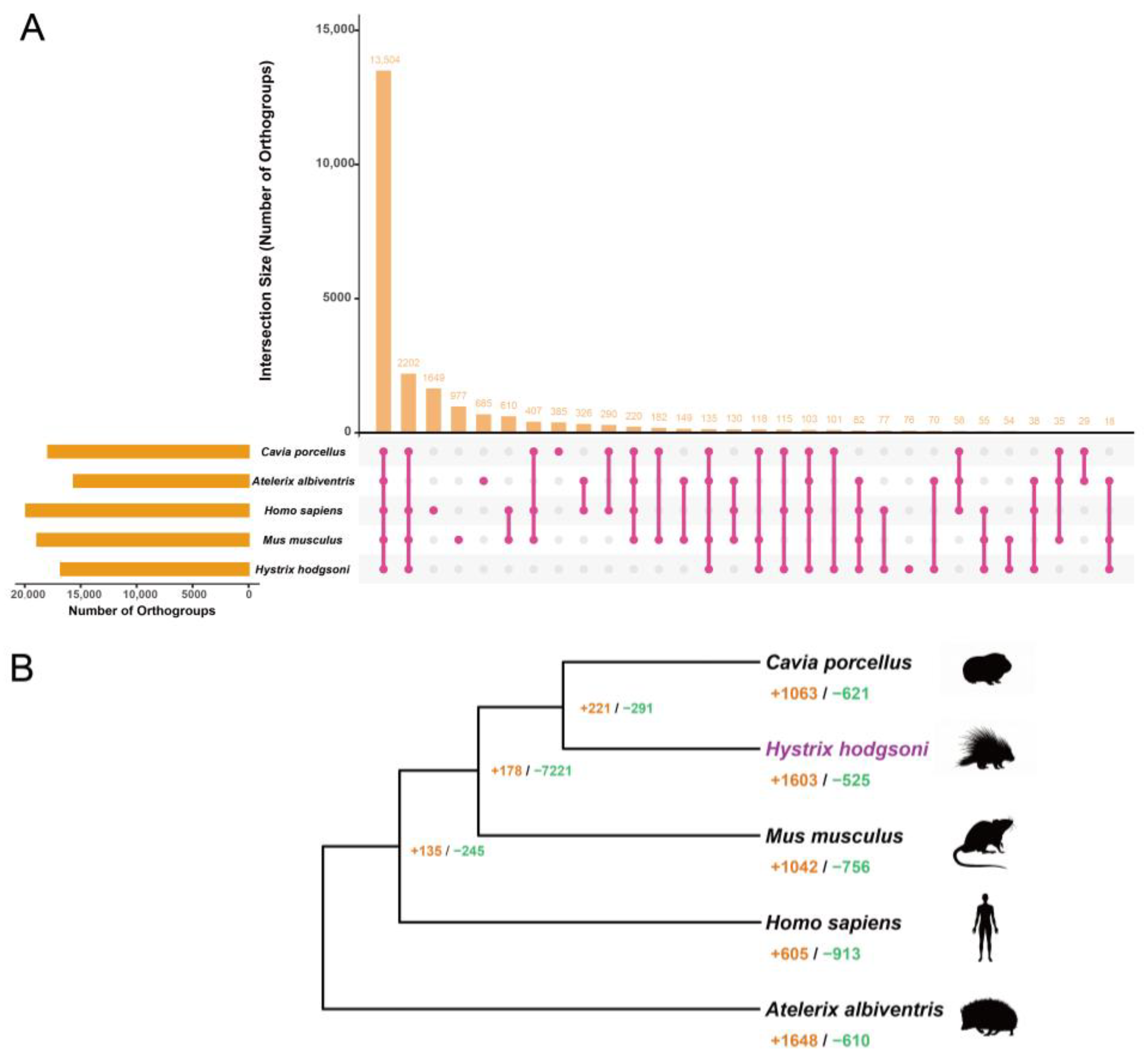
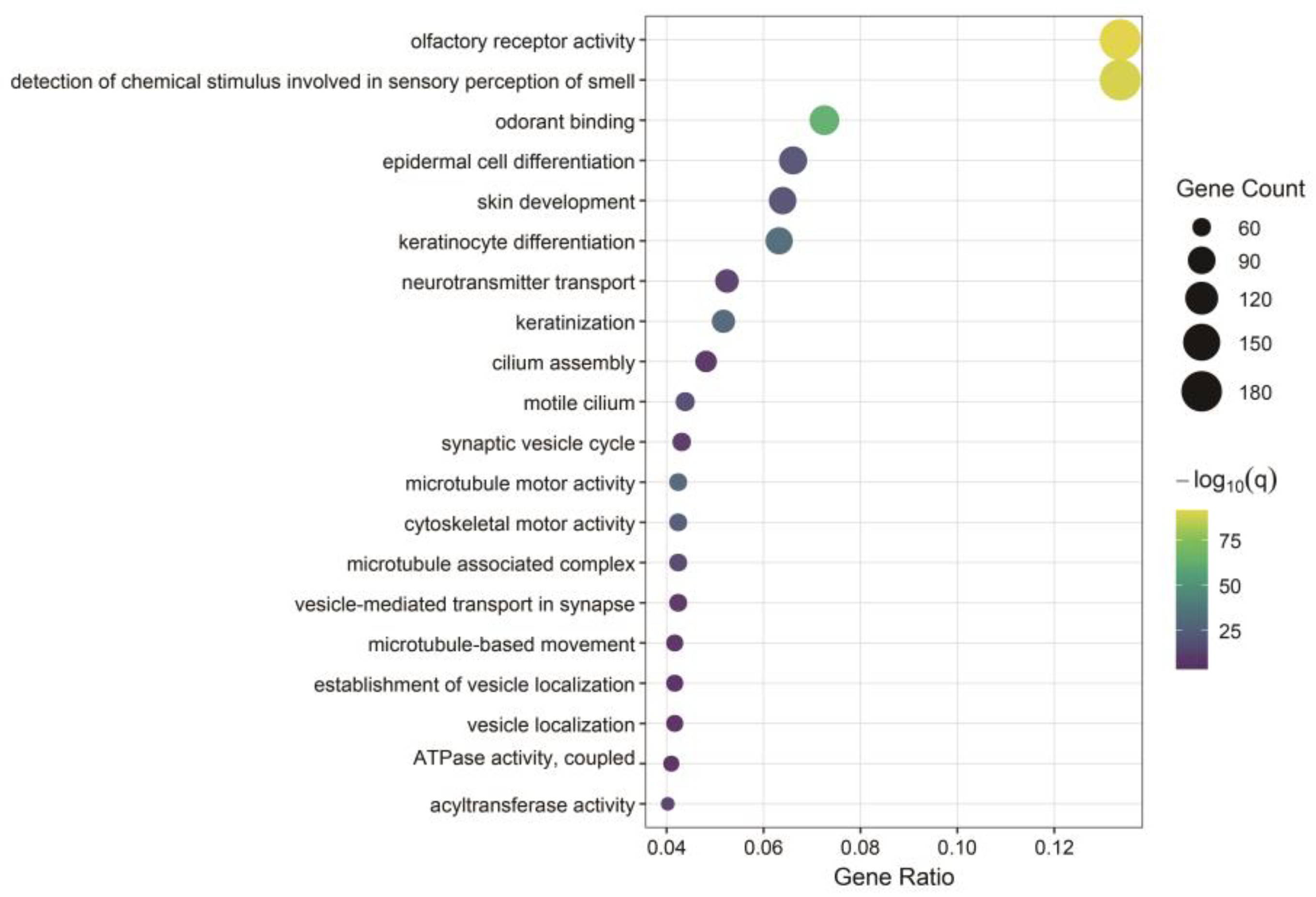
3.3. Comparative Genomics and Gene Family Evolution
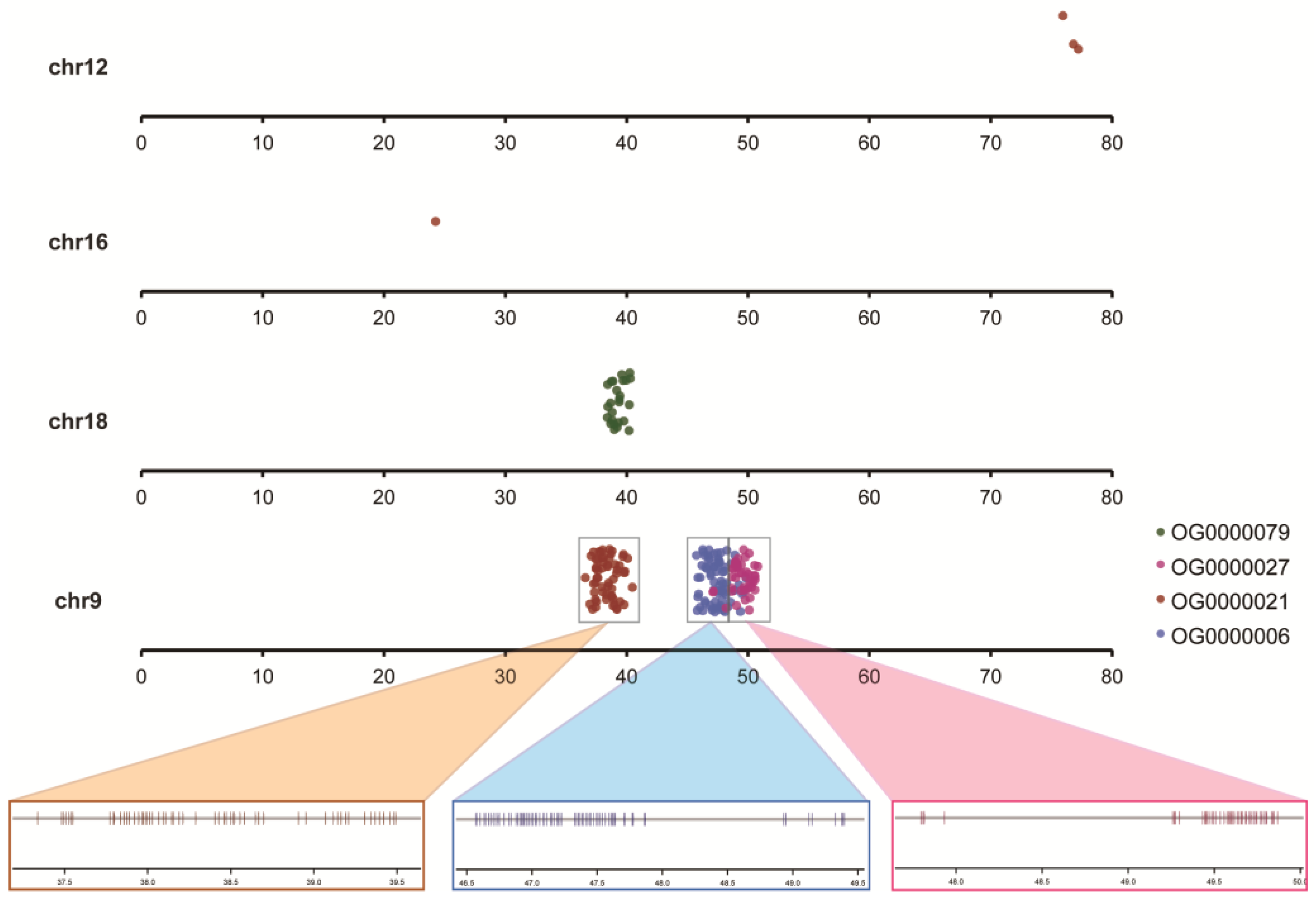
3.4. Chromosomal Distribution and Expansion Patterns of OR Genes
4. Discussion
5. Conclusions
Supplementary Materials
Author Contributions
Funding
Institutional Review Board Statement
Informed Consent Statement
Data Availability Statement
Acknowledgments
Conflicts of Interest
References
- Srinivasulu, C.; Jordan, M.J. Checklist of dipodids, myoxids and hystricids (Mammalia: Rodentia: Dipodidae, Myoxidae and Hystricidae) of South Asia. Zoos’ Print J. 2004, 19, 1346–1350. [Google Scholar] [CrossRef]
- Harris, R.B. A Guide to the Mammals of China. J. Mammal. 2009, 90, 520–521. [Google Scholar] [CrossRef]
- Wang, B.-Y.; Qiu, Z.-X. New Hystrix (Hystricidae, Rodentia) from the Neogene of Linxia Basin, Gansu, China. Vertebr. Palasiat. 2020, 58, 204. [Google Scholar]
- Tong, H. Hystrix subcristata (Mammalia, Rodentia) from Tianyuan Cave, a human fossil site newly discovered near Zhoukoudian (Choukoutien). Vertebr. Palasiat. 2005, 43, 135. [Google Scholar]
- Mudge, J.F. The Roles of Porcupine (Erethizon dorsatum) Populations Within a Human Dominated Landscape. Master’s Thesis, Acadia University, Wolfville, NS, Canada, 2005. [Google Scholar]
- Wang, B.-Y.; Qi, G.-Q. A porcupine (Rodentia, Mammalia) from Lufengpithecus site, Lufeng, Yunnan. Vertebr. Palasiat. 2005, 43, 11. [Google Scholar]
- Trucchi, E.; Facon, B.; Gratton, P.; Mori, E.; Stenseth, N.C.; Jentoft, S. Long live the alien: Is high genetic diversity a pivotal aspect of crested porcupine (Hystrix cristata) long-lasting and successful invasion? Mol. Ecol. 2016, 25, 3527–3539. [Google Scholar] [CrossRef] [PubMed]
- Santini, L. The habits and influence on the environment of the Old World porcupine Hystrix cristata L. in the northernmost part of its range. Proc. Vertebr. Pest Conf. 1980, 9, 149–153. [Google Scholar]
- Lorenzo, C.; Sántiz, E.C.; Navarrete, D.A.; Bolaños, J. Causes and consequences of change rates in the habitat of the threatened tropical porcupine, Sphiggurus mexicanus (Rodentia: Erethizontidae) in Oaxaca, Mexico: Implications for its conservation. Rev. Biol. Trop. 2014, 62, 1481–1494. [Google Scholar] [CrossRef][Green Version]
- Tu, F.; Huang, X.; Zhang, Y.; Feng, Y. Complete mitochondrial genome of captive Chinese porcupine Hystrix hodgsoni (Rodentia: Hystricidae). Mitochondrial DNA Part B 2020, 5, 1945–1946. [Google Scholar] [CrossRef]
- Wang, B.-Y.; Qiu, Z.-X. A porcupine from late Miocene of Linxia Basin, Gansu, China. Vertebr. Palasiat. 2002, 40, 23–33. [Google Scholar]
- Mori, E.; Mazza, G.; Galimberti, A.; Angiolini, C.; Bonari, G. The porcupine as “Little Thumbling”: The role of Hystrix cristata in the spread of Helianthus tuberosus. Biologia 2017, 72, 1211–1216. [Google Scholar] [CrossRef]
- Sulimski, A. Hystrix primigenia (Wagner) in the Pliocene fauna from Weze. Acta Palaeontol. Pol. 1960, 5, 316–334. [Google Scholar]
- Coppola, F.; Grignolio, S.; Brivio, F.; Giunchi, D.; Felicioli, A. Spatio-temporal inhabitation of settlements by Hystrix cristata L., 1758. Sci. Rep. 2022, 12, 5426. [Google Scholar] [CrossRef] [PubMed]
- Martinez, Q.; Courcelle, M.; Douzery, E.; Fabre, P.-H. When morphology does not fit the genomes: The case of rodent olfaction. Biol. Lett. 2023, 19, 20230080. [Google Scholar] [CrossRef]
- Felicioli, A.; Ganni, M.; Garibotti, M.; Pelosi, P. Multiple types and forms of odorant-binding proteins in the Old-World porcupine Hystrix cristata. Comp. Biochem. Physiol. B 1993, 105, 775–784. [Google Scholar] [CrossRef]
- Ganni, M.; Garibotti, M.; Scaloni, A.; Pucci, P.; Pelosi, P. Microheterogeneity of odorant-binding proteins in the porcupine revealed by N-terminal sequencing and mass spectrometry. Comp. Biochem. Physiol. Biochem. Mol. Biol. 1997, 117, 287–291. [Google Scholar] [CrossRef] [PubMed]
- Pugalenthi, G.; Tang, K.; Suganthan, P.N.; Archunan, G.; Sowdhamini, R. A machine learning approach for the identification of odorant binding proteins from sequence-derived properties. BMC Bioinform. 2007, 8, 351. [Google Scholar] [CrossRef]
- Granjon, L.; Duplantier, J.-M. Les Rongeurs de l’Afrique Sahélo-Soudanienne; IRD: Marseille, France, 2009.
- George, W. A study in hystricomorph rodent relationships: The karyotypes of Thryonomys gregorianus, Pedetes capensis and Hystrix cristata. Zool. J. Linn. Soc. 1980, 68, 361–372. [Google Scholar] [CrossRef]
- Capanna, E.; Merani, M.S. Karyotypes of Somalian rodent populations. Monit. Zool. Italiano. Suppl. 1981, 14, 227–240. [Google Scholar] [CrossRef]
- Tanomtong, A.; Supanuam, P.; Sangpakdee, W.; Siripiyasing, P.; Boonhan, P.; Kaewsri, S. The first cytogenetic study of the Malayan porcupine, Hystrix brachyura (Rodentia, Hystricidae) by conventional staining and G-banding technique. Cytologia 2008, 73, 221–228. [Google Scholar] [CrossRef][Green Version]
- Rovie-Ryan, J.J.; Khan, F.A.A.; Zahari, Z.; Zainuddin, A.H.A.; Gani, M.; Julaihi, A.M.; Saaban, S. Molecular phylogeny of the old world porcupines (family Hystricidae) using mitochondrial cytochrome b gene. J. Sustain. Sci. Manag. 2017, 12, 1–11. [Google Scholar]
- Voss, R.S.; Hubbard, C.; Jansa, S.A. Phylogenetic relationships of New World porcupines (Rodentia, Erethizontidae): Implications for taxonomy, morphological evolution, and biogeography. Am. Mus. Novit. 2013, 2013, 1–36. [Google Scholar] [CrossRef]
- Huchon, D.; Douzery, E.J. From the Old World to the New World: A molecular chronicle of the phylogeny and biogeography of hystricognath rodents. Mol. Phylogenet. Evol. 2001, 20, 238–251. [Google Scholar] [CrossRef]
- Upham, N.S.; Esselstyn, J.A.; Jetz, W. Inferring the mammal tree: Species-level sets of phylogenies for questions in ecology, evolution, and conservation. PLoS Biol. 2019, 17, e3000494. [Google Scholar] [CrossRef]
- Burgos-Paz, W.; Cerón-Muñoz, M.; Solarte-Portilla, C. Genetic diversity and population structure of the Guinea pig (Cavia porcellus, Rodentia, Caviidae) in Colombia. Genet. Mol. Biol. 2011, 34, 711–718. [Google Scholar] [CrossRef]
- Conrad, D.F.; Pinto, D.; Redon, R.; Feuk, L.; Gokcumen, O.; Zhang, Y.; Aerts, J.; Andrews, T.D.; Barnes, C.; Campbell, P. Origins and functional impact of copy number variation in the human genome. Nature 2010, 464, 704–712. [Google Scholar]
- Hotaling, S.; Kelley, J.L. The rising tide of high-quality genomic resources. Mol. Ecol. Resour. 2019, 19, 567–569. [Google Scholar]
- Guiglielmoni, N.; Villegas, L.I.; Kirangwa, J.; Schiffer, P.H. Revisiting genomes of non-model species with long reads yields new insights into their biology and evolution. Front. Genet. 2024, 15, 1308527. [Google Scholar] [CrossRef]
- Etherington, G.J.; Heavens, D.; Baker, D.; Lister, A.; McNelly, R.; Garcia, G.; Clavijo, B.; Macaulay, I.; Haerty, W.; Di Palma, F. Sequencing smart: De novo sequencing and assembly approaches for a non-model mammal. GigaScience 2020, 9, giaa045. [Google Scholar] [CrossRef] [PubMed]
- Wenger, A.M.; Peluso, P.; Rowell, W.J.; Chang, P.-C.; Hall, R.J.; Concepcion, G.T.; Ebler, J.; Fungtammasan, A.; Kolesnikov, A.; Olson, N.D. Accurate circular consensus long-read sequencing improves variant detection and assembly of a human genome. Nat. Biotechnol. 2019, 37, 1155–1162. [Google Scholar] [CrossRef] [PubMed]
- Lieberman-Aiden, E.; Van Berkum, N.L.; Williams, L.; Imakaev, M.; Ragoczy, T.; Telling, A.; Amit, I.; Lajoie, B.R.; Sabo, P.J.; Dorschner, M.O. Comprehensive mapping of long-range interactions reveals folding principles of the human genome. Science 2009, 326, 289–293. [Google Scholar] [CrossRef] [PubMed]
- Martin, M. Cutadapt removes adapter sequences from high-throughput sequencing reads. EMBnet. J. 2011, 17, 10–12. [Google Scholar] [CrossRef]
- Chen, S.; Zhou, Y.; Chen, Y.; Gu, J. fastp: An ultra-fast all-in-one FASTQ preprocessor. Bioinformatics 2018, 34, i884–i890. [Google Scholar] [CrossRef] [PubMed]
- Marçais, G.; Kingsford, C. A fast, lock-free approach for efficient parallel counting of occurrences of k-mers. Bioinformatics 2011, 27, 764–770. [Google Scholar] [CrossRef]
- Ranallo-Benavidez, T.R.; Jaron, K.S.; Schatz, M.C. GenomeScope 2.0 and Smudgeplot for reference-free profiling of polyploid genomes. Nat. Commun. 2020, 11, 1432. [Google Scholar] [CrossRef]
- Sun, H.; Ding, J.; Piednoël, M.; Schneeberger, K. findGSE: Estimating genome size variation within human and Arabidopsis using k-mer frequencies. Bioinformatics 2018, 34, 550–557. [Google Scholar] [CrossRef]
- Li, X.; Waterman, M.S. Estimating the repeat structure and length of DNA sequences using ℓ-tuples. Genome Res. 2003, 13, 1916–1922. [Google Scholar] [CrossRef]
- Cheng, H.; Asri, M.; Lucas, J.; Koren, S.; Li, H. Scalable telomere-to-telomere assembly for diploid and polyploid genomes with double graph. Nat. Methods 2024, 21, 967–970. [Google Scholar] [CrossRef] [PubMed]
- Guan, D.; McCarthy, S.A.; Wood, J.; Howe, K.; Wang, Y.; Durbin, R. Identifying and removing haplotypic duplication in primary genome assemblies. Bioinformatics 2020, 36, 2896–2898. [Google Scholar] [CrossRef]
- Li, H. Aligning sequence reads, clone sequences and assembly contigs with BWA-MEM. arXiv 2013, arXiv:1303.3997. [Google Scholar] [CrossRef]
- Open2C; Abdennur, N.; Fudenberg, G.; Flyamer, I.M.; Galitsyna, A.A.; Goloborodko, A.; Imakaev, M.; Venev, S.V. Pairtools: From sequencing data to chromosome contacts. PLoS Comput. Biol. 2024, 20, e1012164. [Google Scholar]
- Zhou, C.; McCarthy, S.A.; Durbin, R. YaHS: Yet another Hi-C scaffolding tool. Bioinformatics 2023, 39, btac808. [Google Scholar] [CrossRef]
- Durand, N.C.; Shamim, M.S.; Machol, I.; Rao, S.S.; Huntley, M.H.; Lander, E.S.; Aiden, E.L. Juicer provides a one-click system for analyzing loop-resolution Hi-C experiments. Cell Syst. 2016, 3, 95–98. [Google Scholar] [CrossRef] [PubMed]
- Ramírez, F.; Bhardwaj, V.; Arrigoni, L.; Lam, K.C.; Grüning, B.A.; Villaveces, J.; Habermann, B.; Akhtar, A.; Manke, T. High-resolution TADs reveal DNA sequences underlying genome organization in flies. Nat. Commun. 2018, 9, 189. [Google Scholar] [CrossRef]
- Xu, M.; Guo, L.; Gu, S.; Wang, O.; Zhang, R.; Peters, B.A.; Fan, G.; Liu, X.; Xu, X.; Deng, L. TGS-GapCloser: A fast and accurate gap closer for large genomes with low coverage of error-prone long reads. GigaScience 2020, 9, giaa094. [Google Scholar] [CrossRef]
- Li, H. Minimap2: Pairwise alignment for nucleotide sequences. Bioinformatics 2018, 34, 3094–3100. [Google Scholar] [CrossRef]
- Danecek, P.; Bonfield, J.K.; Liddle, J.; Marshall, J.; Ohan, V.; Pollard, M.O.; Whitwham, A.; Keane, T.; McCarthy, S.A.; Davies, R.M. Twelve years of SAMtools and BCFtools. Gigascience 2021, 10, giab008. [Google Scholar] [CrossRef]
- Rhie, A.; Walenz, B.P.; Koren, S.; Phillippy, A.M. Merqury: Reference-free quality, completeness, and phasing assessment for genome assemblies. Genome Biol. 2020, 21, 245. [Google Scholar] [CrossRef]
- Manni, M.; Seppey, M.; Simão, F.; Zdobnov, E. BUSCO update: Novel and streamlined workflows along with broader and deeper phylogenetic coverage for scoring of eukaryotic, prokaryotic, and viral genomes. Mol. Biol. Evol. 2021, 38. [Google Scholar] [CrossRef]
- Guo, J.; Wang, J.; Fan, H. Chromosome study in Chinese porcupine, Hystrix hodgsoni (Rodentia, Hystricidae). Acta Theriol. Sin. 2006, 9, 285. [Google Scholar]
- Schneider, V.A.; Graves-Lindsay, T.; Howe, K.; Bouk, N.; Chen, H.-C.; Kitts, P.A.; Murphy, T.D.; Pruitt, K.D.; Thibaud-Nissen, F.; Albracht, D. Evaluation of GRCh38 and de novo haploid genome assemblies demonstrates the enduring quality of the reference assembly. Genome Res. 2017, 27, 849–864. [Google Scholar] [CrossRef]
- Marçais, G.; Delcher, A.L.; Phillippy, A.M.; Coston, R.; Salzberg, S.L.; Zimin, A. MUMmer4: A fast and versatile genome alignment system. PLoS Comput. Biol. 2018, 14, e1005944. [Google Scholar] [CrossRef]
- Chan, P.P.; Lin, B.Y.; Mak, A.J.; Lowe, T.M. tRNAscan-SE 2.0: Improved detection and functional classification of transfer RNA genes. Nucleic Acids Res. 2021, 49, 9077–9096. [Google Scholar] [CrossRef]
- Quast, C.; Pruesse, E.; Yilmaz, P.; Gerken, J.; Schweer, T.; Yarza, P.; Peplies, J.; Glöckner, F.O. The SILVA ribosomal RNA gene database project: Improved data processing and web-based tools. Nucleic Acids Res. 2012, 41, D590–D596. [Google Scholar] [CrossRef]
- Nawrocki, E.P.; Eddy, S.R. Infernal 1.1: 100-fold faster RNA homology searches. Bioinformatics 2013, 29, 2933–2935. [Google Scholar] [CrossRef]
- Kalvari, I.; Nawrocki, E.P.; Ontiveros-Palacios, N.; Argasinska, J.; Lamkiewicz, K.; Marz, M.; Griffiths-Jones, S.; Toffano-Nioche, C.; Gautheret, D.; Weinberg, Z. Rfam 14: Expanded coverage of metagenomic, viral and microRNA families. Nucleic Acids Res. 2021, 49, D192–D200. [Google Scholar] [CrossRef]
- Flynn, J.M.; Hubley, R.; Goubert, C.; Rosen, J.; Clark, A.G.; Feschotte, C.; Smit, A.F. RepeatModeler2 for automated genomic discovery of transposable element families. Proc. Natl. Acad. Sci. USA 2020, 117, 9451–9457. [Google Scholar] [CrossRef] [PubMed]
- Jurka, J.; Kapitonov, V.; Pavlicek, A.; Klonowski, P.; Kohany, O.; Walichiewicz, J. Repbase Update, a database of eukaryotic repetitive elements. Cytogenet. Genome Res. 2005, 110, 462–467. [Google Scholar] [CrossRef] [PubMed]
- Hoede, C.; Arnoux, S.; Moisset, M.; Chaumier, T.; Inizan, O.; Jamilloux, V.; Quesneville, H. PASTEC: An automatic transposable element classification tool. PLoS ONE 2014, 9, e91929. [Google Scholar] [CrossRef]
- Chen, N. Using Repeat Masker to identify repetitive elements in genomic sequences. Curr. Protoc. Bioinform. 2004, 5, 4–10. [Google Scholar] [CrossRef] [PubMed]
- Zhang, P.; Xu, T.; Wang, S.; Yang, X.; Sun, P.; Jia, P.; Lin, J.; Wang, B.; Zhang, Y.; Meng, D.; et al. Highly accurate ab initio gene annotation with ANNEVO. Nat. Methods 2026, 23, 740–748. [Google Scholar] [CrossRef]
- Dainat, J.; Hereñú, D.; Murray, K.; Davis, E.; Crouch, K.; Lucile, S.; Agostinho, N.; Zollman, Z. AGAT: Another Gff Analysis Toolkit; version v1.2.0; Zenodo: Geneva, Switzerland, 2023. [Google Scholar] [CrossRef]
- Camacho, C.; Coulouris, G.; Avagyan, V.; Ma, N.; Papadopoulos, J.; Bealer, K.; Madden, T.L. BLAST+: Architecture and applications. BMC Bioinform. 2009, 10, 421. [Google Scholar] [CrossRef]
- Buchfink, B.; Xie, C.; Huson, D.H. Fast and sensitive protein alignment using DIAMOND. Nat. Methods 2015, 12, 59–60. [Google Scholar] [CrossRef]
- Jones, P.; Binns, D.; Chang, H.-Y.; Fraser, M.; Li, W.; McAnulla, C.; McWilliam, H.; Maslen, J.; Mitchell, A.; Nuka, G. InterProScan 5: Genome-scale protein function classification. Bioinformatics 2014, 30, 1236–1240. [Google Scholar] [CrossRef]
- Cantalapiedra, C.P.; Hernández-Plaza, A.; Letunic, I.; Bork, P.; Huerta-Cepas, J. eggNOG-mapper v2: Functional annotation, orthology assignments, and domain prediction at the metagenomic scale. Mol. Biol. Evol. 2021, 38, 5825–5829. [Google Scholar] [CrossRef]
- Emms, D.M.; Kelly, S. OrthoFinder: Phylogenetic orthology inference for comparative genomics. Genome Biol. 2019, 20, 238. [Google Scholar] [CrossRef] [PubMed]
- Emms, D.M.; Kelly, S. OrthoFinder: Solving fundamental biases in whole genome comparisons dramatically improves orthogroup inference accuracy. Genome Biol. 2015, 16, 157. [Google Scholar] [CrossRef] [PubMed]
- Mendes, F.K.; Vanderpool, D.; Fulton, B.; Hahn, M.W. CAFE 5 models variation in evolutionary rates among gene families. Bioinformatics 2020, 36, 5516–5518. [Google Scholar] [CrossRef] [PubMed]
- Ashburner, M.; Ball, C.A.; Blake, J.A.; Botstein, D.; Butler, H.; Cherry, J.M.; Davis, A.P.; Dolinski, K.; Dwight, S.S.; Eppig, J.T. Gene Ontology: Tool for the unification of biology. Nat. Genet. 2000, 25, 25–29. [Google Scholar] [CrossRef]
- Gene Ontology Consortium. The Gene Ontology knowledgebase in 2023. Genetics 2023, 224, iyad031. [Google Scholar] [CrossRef]
- Kanehisa, M.; Goto, S. KEGG: Kyoto Encyclopedia of Genes and Genomes. Nucleic Acids Res. 2000, 28, 27–30. [Google Scholar] [CrossRef]
- Wu, T.; Hu, E.; Xu, S.; Chen, M.; Guo, P.; Dai, Z.; Feng, T.; Zhou, L.; Tang, W.; Zhan, L. clusterProfiler 4.0: A universal enrichment tool for interpreting omics data. Innovation 2021, 2, 100141. [Google Scholar] [CrossRef]
- Jiang, L.; Xu, J.; Zhu, M.; Lv, Z.; Ning, Z.; Yang, F. A haplotype-resolved genome reveals the genetic basis of spine formation in Atelerix albiventris. J. Genet. Genom. 2024, 51, 1529–1532. [Google Scholar] [CrossRef]
- Zhang, X.; Firestein, S. The olfactory receptor gene superfamily of the mouse. Nat. Neurosci. 2002, 5, 124–133. [Google Scholar] [CrossRef]
- Niimura, Y. Olfactory receptor genes: Evolution. eLS 2014. [Google Scholar] [CrossRef]
- Akash, M.; Gazzard, A.; Nanziba, R.; Ahmed, S.; Debbarma, H.; Zakir, T. Malayan porcupines in moonlight: Assessing nocturnal activity patterns, with a review of porcupine distributions in Bangladesh. Glob. Ecol. Conserv. 2025, 58, e03486. [Google Scholar] [CrossRef]
- Mori, E.; Menchetti, M.; Lucherini, M.; Sforzi, A.; Lovari, S. Timing of reproduction and paternal cares in the crested porcupine. Mamm. Biol. 2016, 81, 345–349. [Google Scholar] [CrossRef]
- Courcelle, M.; Fabre, P.-H.; Douzery, E.J. Phylogeny, ecology, and gene families covariation shaped the olfactory subgenome of rodents. Genome Biol. Evol. 2023, 15, evad197. [Google Scholar] [CrossRef]
- Niimura, Y.; Matsui, A.; Touhara, K. Extreme expansion of the olfactory receptor gene repertoire in African elephants and evolutionary dynamics of orthologous gene groups in 13 placental mammals. Genome Res. 2014, 24, 1485–1496. [Google Scholar] [CrossRef]
- Hayden, S.; Bekaert, M.; Crider, T.A.; Mariani, S.; Murphy, W.J.; Teeling, E.C. Ecological adaptation determines functional mammalian olfactory subgenomes. Genome Res. 2010, 20, 1–9. [Google Scholar] [CrossRef]
- Niimura, Y.; Nei, M. Extensive gains and losses of olfactory receptor genes in mammalian evolution. PLoS ONE 2007, 2, e708. [Google Scholar] [CrossRef]
- Innan, H.; Kondrashov, F. The evolution of gene duplications: Classifying and distinguishing between models. Nat. Rev. Genet. 2010, 11, 97–108. [Google Scholar] [CrossRef]
- Ohno, S. Evolution by Gene Duplication; Springer Science & Business Media: Berlin/Heidelberg, Germany, 1970. [Google Scholar]
- Aloni, R.; Olender, T.; Lancet, D. Ancient genomic architecture for mammalian olfactory receptor clusters. Genome Biol. 2006, 7, R88. [Google Scholar] [CrossRef]




| Sequencing | Hystrix hodgsoni |
|---|---|
| PacBio Sequel II sequencing | |
| Raw data (Gb) | ~158 |
| Sequencing depth (×) | 27 |
| Number of reads | 4,573,090 |
| Mean read length (bp) | 18,588 |
| Hi-C sequencing | |
| Clean data (Gb) | ~158 |
| Sequencing depth (×) | 100 |
| Genome assembly | |
| Estimated genome size (Gb) | 2.25 |
| Assembly size (Gb) | 2.36 |
| Number of gaps | 284 |
| Contig N50 (Mb) | 39.73 |
| Scaffold N50 (Mb) | 74.88 |
| GC content (%) | 41.70 |
| Number of protein-coding genes | 23,424 |
| BUSCO completeness (%) | 95.80 |
| Average gene length (bp) | 32,672 |
| Average exons per gene | 9.50 |
Disclaimer/Publisher’s Note: The statements, opinions and data contained in all publications are solely those of the individual author(s) and contributor(s) and not of MDPI and/or the editor(s). MDPI and/or the editor(s) disclaim responsibility for any injury to people or property resulting from any ideas, methods, instructions or products referred to in the content. |
© 2026 by the authors. Licensee MDPI, Basel, Switzerland. This article is an open access article distributed under the terms and conditions of the Creative Commons Attribution (CC BY) license.
Share and Cite
Chen, N.; Zhou, J.; Liu, X.; Jing, M.; Jiang, L.; Yang, F. A Chromosome-Level Genome Assembly and Annotation of the Chinese Porcupine (Hystrix hodgsoni) Reveals the Expansion of Olfactory-Related Gene Families. Genes 2026, 17, 596. https://doi.org/10.3390/genes17060596
Chen N, Zhou J, Liu X, Jing M, Jiang L, Yang F. A Chromosome-Level Genome Assembly and Annotation of the Chinese Porcupine (Hystrix hodgsoni) Reveals the Expansion of Olfactory-Related Gene Families. Genes. 2026; 17(6):596. https://doi.org/10.3390/genes17060596
Chicago/Turabian StyleChen, Nannan, Jianxuan Zhou, Xinjie Liu, Meidong Jing, Libo Jiang, and Fengtang Yang. 2026. "A Chromosome-Level Genome Assembly and Annotation of the Chinese Porcupine (Hystrix hodgsoni) Reveals the Expansion of Olfactory-Related Gene Families" Genes 17, no. 6: 596. https://doi.org/10.3390/genes17060596
APA StyleChen, N., Zhou, J., Liu, X., Jing, M., Jiang, L., & Yang, F. (2026). A Chromosome-Level Genome Assembly and Annotation of the Chinese Porcupine (Hystrix hodgsoni) Reveals the Expansion of Olfactory-Related Gene Families. Genes, 17(6), 596. https://doi.org/10.3390/genes17060596