The First Case of Kleefstra Syndrome in a Rwandan Patient with Global Developmental Delay

 , , ,
, , ,  ,
,
Abstract
1. Introduction
2. Materials and Methods
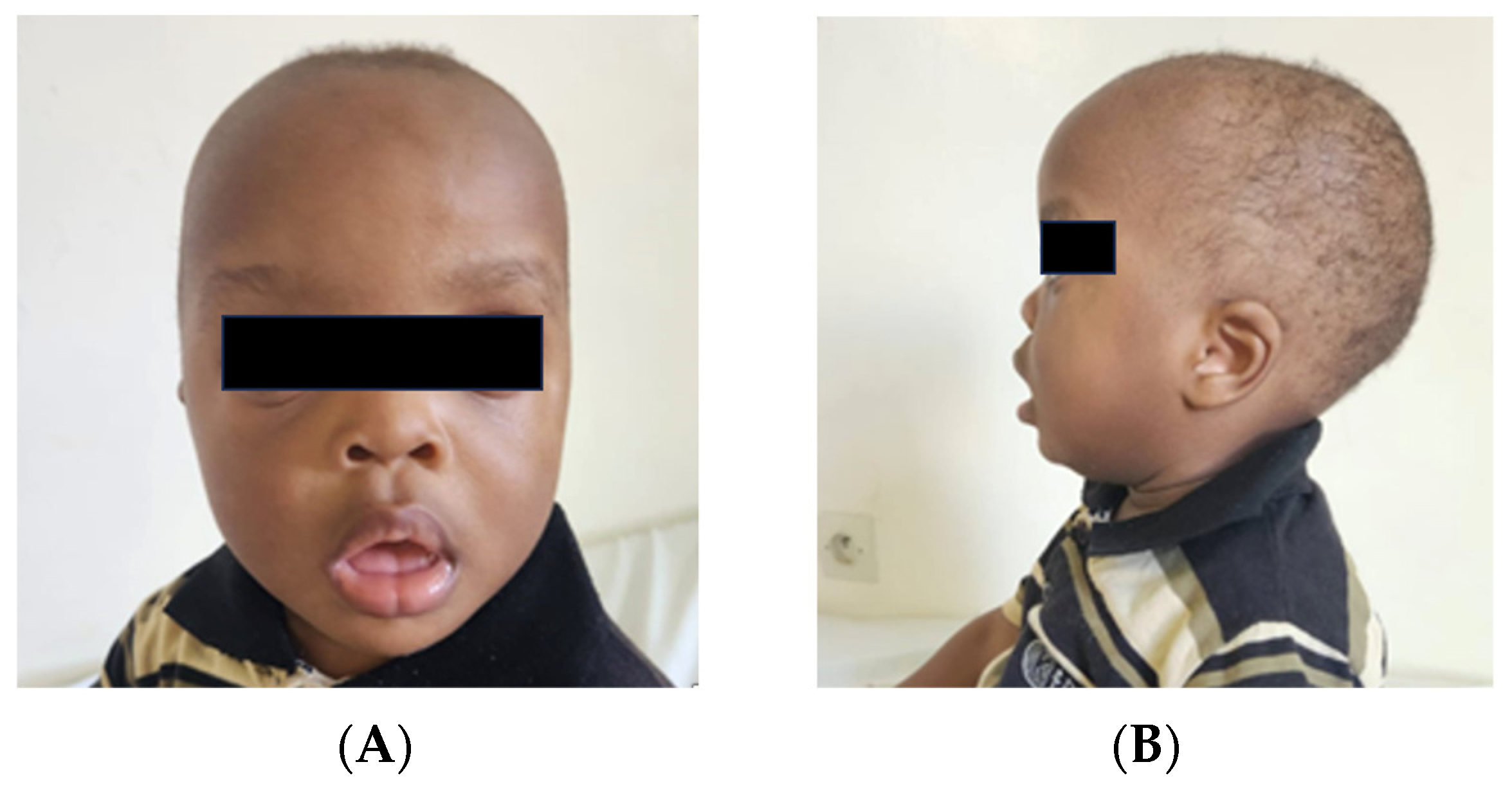
2.1. Case Presentation
2.2. Trio Whole Exome Sequencing
3. Results
3.1. Whole Exome Sequencing Results
3.2. Imaging Analysis
4. Discussion
5. Conclusions
Supplementary Materials
Author Contributions
Funding
Institutional Review Board Statement
Informed Consent Statement
Data Availability Statement
Conflicts of Interest
Abbreviations
| WES | Whole Exome Sequencing |
| ACMG | American College of Medical Genetics |
| KS | Kleefstra Syndrome |
| CHUK | Kigali University Teaching Hospital |
| CNV | Copy Number Variant |
| SNV | Single-Nucleotide Variant |
| IRB | Institute Review Board |
| LMIC | Low- and Middle-Income Country |
| IGV | Integrative Genomics Viewer |
| DNA | Deoxyribose Nucleic Acid |
Appendix A

References
- Kleefstra, T.; Smidt, M.; Banning, M.J.G.; Oudakker, A.R.; Van Esch, H.; de Brouwer, A.P.M.; Nillesen, W.; A Sistermans, E.; Hamel, B.C.J.; de Bruijn, D.; et al. Disruption of the gene Euchromatin Histone Methyl Transferase1 (Eu-HMTase1) is associated with the 9q34 subtelomeric deletion syndrome. J. Med. Genet. 2005, 42, 299–306. [Google Scholar] [CrossRef]
- Koemans, T.S.; Kleefstra, T.; Chubak, M.C.; Stone, M.H.; Reijnders, M.R.F.; de Munnik, S.; Willemsen, M.H.; Fenckova, M.; Stumpel, C.T.R.M.; Bok, L.A.; et al. Functional convergence of histone methyltransferases EHMT1 and KMT2C involved in intellectual disability and autism spectrum disorder. PLoS Genet. 2017, 13, e1006864. [Google Scholar] [CrossRef]
- Kleefstra, T.; Brunner, H.G.; Amiel, J.; Oudakker, A.R.; Nillesen, W.M.; Magee, A.; Geneviève, D.; Cormier-Daire, V.; van Esch, H.; Fryns, J.-P.; et al. Loss-of-Function Mutations in Euchromatin Histone Methyl Transferase 1 (EHMT1) Cause the 9q34 Subtelomeric Deletion Syndrome. Am. J. Hum. Genet. 2006, 79, 370–377. [Google Scholar] [CrossRef]
- Connors, K.L.; Carmichael, N.E.; Bichell, T.J.; Dies, K.A.; Frazier, Z.J. Development of a Patient and Caregiver-Centered Pediatric Disease Concept Model for Kleefstra Syndrome. Sage Open Pediatr. 2025, 12, 30502225251336880. [Google Scholar] [CrossRef]
- Draksler, T.Z.; Bouman, A.; Guček, A.; Novak, E.; Burger, P.; Colin, F.; Kleefstra, T. Exploring Kleefstra syndrome cohort phenotype characteristics: Prevalence insights from caregiver-reported outcomes. Eur. J. Med. Genet. 2024, 72, 104974. [Google Scholar] [CrossRef]
- Bouman, A.; Geelen, J.M.; Kummeling, J.; Schenck, A.; van der Zwan, Y.G.; Klein, W.M.; Kleefstra, T. Growth, body composition, and endocrine-metabolic profiles of individuals with Kleefstra syndrome provide directions for clinical management and translational studies. Am. J. Med. Genet. Part A 2024, 194, e63472. [Google Scholar] [CrossRef] [PubMed]
- Kleefstra, T.; Koolen, D.A.; Nillesen, W.M.; de Leeuw, N.; Hamel, B.C.; Veltman, J.A.; Sistermans, E.A.; van Bokhoven, H.; van Ravenswaay, C.; de Vries, B.B. Interstitial 2.2 Mb deletion at 9q34 in a patient with mental retardation but without classical features of the 9q subtelomeric deletion syndrome. Am. J. Med. Genet. Part A 2006, 140A, 618–623. [Google Scholar] [CrossRef]
- Kleefstra, T.; Kramer, J.M.; Neveling, K.; Willemsen, M.H.; Koemans, T.S.; Vissers, L.E.; Wissink-Lindhout, W.; Fenckova, M.; Van Den Akker, W.M.; Kasri, N.N.; et al. Disruption of an EHMT1-Associated Chromatin-Modification Module Causes Intellectual Disability. Am. J. Hum. Genet. 2012, 91, 73–82. [Google Scholar] [CrossRef] [PubMed]
- Oegema, R.; Barakat, T.S.; Wilke, M.; Stouffs, K.; Amrom, D.; Aronica, E.; Bahi-Buisson, N.; Conti, V.; Fry, A.E.; Geis, T.; et al. International consensus recommendations on the diagnostic work-up for malformations of cortical development. Nat. Rev. Neurol. 2020, 16, 618–635. [Google Scholar] [CrossRef]
- Wu, D.; Li, R. Case Report: Long-Term Treatment and Follow-Up of Kleefstra Syndrome-2. Front. Pediatr. 2022, 10, 881838. [Google Scholar] [CrossRef] [PubMed]
- Frazier, Z.J.; Kilic, S.; Osika, H.; Mo, A.; Quinn, M.; Ballal, S.; Katz, T.; Shearer, A.E.; Horlbeck, M.A.; Pais, L.S.; et al. Novel Phenotypes and Genotype–Phenotype Correlations in a Large Clinical Cohort of Patients with Kleefstra Syndrome. Clin. Genet. 2025, 107, 636–645. [Google Scholar] [CrossRef] [PubMed]
- Rots, D.; Bouman, A.; Yamada, A.; Levy, M.; Dingemans, A.J.M.; A de Vries, B.B.; Ruiterkamp-Versteeg, M.; de Leeuw, N.; Ockeloen, C.W.; Pfundt, R.; et al. Comprehensive EHMT1 variants analysis broadens genotype-phenotype associations and molecular mechanisms in Kleefstra syndrome. Am. J. Hum. Genet. 2024, 111, 1605–1625. [Google Scholar] [CrossRef] [PubMed]
- Sium, A.F.; Shimels, T.; Abdosh, A.A.; Diress, T.; Tsegaye, T.; Yifrashewa, T.; Terefework, Z.; Gudu, W. Indications, types, and diagnostic implications of prenatal genetic testing in Sub-Saharan Africa: A descriptive study. PLoS ONE 2023, 18, e0294409. [Google Scholar] [CrossRef]
- Li, C.; Wang, Y.; Zeng, C.; Huang, B.; Chen, Y.; Xue, C.; Liu, L.; Rong, S.; Lin, Y. Trio-whole exome sequencing reveals the importance of de novo variants in children with intellectual disability and developmental delay. Sci. Rep. 2024, 14, 27590. [Google Scholar] [CrossRef] [PubMed]
- Harvengt, J.; Lumaka, A.; Fasquelle, C.; Caberg, J.H.; Mastouri, M.; Janssen, A.; Palmeira, L.; Bours, V. HIDEA syndrome: A new case report highlighting similarities with ROHHAD syndrome. Front. Genet. 2023, 14, 1137767. [Google Scholar] [CrossRef]
- Richards, S.; Aziz, N.; Bale, S.; Bick, D.; Das, S.; Gastier-Foster, J.; Grody, W.W.; Hegde, M.; Lyon, E.; Spector, E.; et al. Standards and guidelines for the interpretation of sequence variants: A joint consensus recommendation of the American College of Medical Genetics and Genomics and the Association for Molecular Pathology. Genet. Med. 2015, 17, 405–424. [Google Scholar] [CrossRef]
- Ren, R.; Liu, Y.; Liu, P.; Zhao, J.; Hou, M.; Li, S.; Chen, Z.; Yuan, A. Clinical characteristics and genetic analysis of four pediatric patients with Kleefstra syndrome. BMC Med. Genom. 2024, 17, 290. [Google Scholar] [CrossRef]
- Morison, L.D.; Kennis, M.G.; Rots, D.; Bouman, A.; Kummeling, J.; Palmer, E.; Vogel, A.P.; Liegeois, F.; Brignell, A.; Srivastava, S.; et al. Expanding the phenotype of Kleefstra syndrome: Speech, language and cognition in 103 individuals. J. Med. Genet. 2024, 61, 578–585. [Google Scholar] [CrossRef]
- Truter, B.; Slogrove, A.L.; Ilhan, E.; Conradie, P.; Thompson, L.; Gillberg, C.; Billstedt, E. Screening young children for neurodevelopmental differences in sub-Saharan Africa: A scoping review. BMC Psychiatry 2025, 25, 857. [Google Scholar] [CrossRef]
- Savatt, J.M.; Myers, S.M. Genetic Testing in Neurodevelopmental Disorders. Front. Pediatr. 2021, 9, 526779. [Google Scholar] [CrossRef]
- Cheema, H.A.; Waheed, N.; Saeed, A. Kleefstra Syndrome with Severe Sensory Neural Deafness and De Novo Novel Mutation. J. Coll. Physicians Surg. Pak. 2022, 32, 236–238. [Google Scholar] [CrossRef] [PubMed]
- Liu, C.; Lee, M.K.; Naqvi, S.; Hoskens, H.; Liu, D.; White, J.D.; Indencleef, K.; Matthews, H.; Eller, R.J.; Li, J.; et al. Genome scans of facial features in East Africans and cross-population comparisons reveal novel associations. PLoS Genet. 2021, 17, e1009695. [Google Scholar] [CrossRef] [PubMed]
- Uwineza, A.; Mutesa, L. Medical genetics and genomic medicine in Rwanda. Mol. Genet. Genom. Med. 2015, 3, 486–489. [Google Scholar] [CrossRef] [PubMed]


| Comparison of Reported Kleefstra Syndrome Clinical Features vs. Rwandan Patient with Kleefstra Syndrome | |||
|---|---|---|---|
| System/Feature | Typical Kleefstra Syndrome Symptoms | Rwandan Patient Symptoms | Novel/Not Commonly Emphasized |
| Variant | EHMT1 haploinsufficiency (deletions or loss of function variants) | EHMT1: c.2871dup; p. Phe958Leufs*219 (de novo frameshift) | Novel variant (previously unreported) |
| Inheritance | Autosomal dominant (mostly de novo) | De novo confirmed by trio-WES | — |
| Growth | Obesity (later childhood), variable growth | Short stature (<3rd percentile), normal weight percentile | Early short stature without obesity |
| Head size | Microcephaly | Normal OFC (50th percentile) | Normal head circumference despite GDD |
| Hypotonia | Common (early infancy) | Neonatal hypotonia, persistent axial hypotonia | — |
| Global developmental delay | Severe | Severe GDD, delayed motor milestones | — |
| Speech | Severe speech delay or absent speech | No expressive speech at 24 months | — |
| Face (general) | Coarse facies, flat face | Flat face | Absence of coarse facies |
| Forehead | Not consistently described | Wide forehead | Possibly underreported feature |
| Eyes | Hypertelorism, up-slanting palpebral fissures | Hypertelorism | — |
| Ears | Malformed ears and hearing loss | Low-set ears | — |
| Nose | Anteverted nares | Anteverted nares + depressed nasal bridge | Depressed nasal bridge emphasized |
| Midface | Midface hypoplasia | Midface hypoplasia and short neck | — |
| Mouth | Everted lower lip | Tented upper lip + everted lower lip | Tented upper lip (less commonly highlighted) |
| Dentition | Not consistently reported | Small teeth | Rarely reported feature |
| Extremities (hands/feet) | Brachydactyly, single palmar crease | Bilateral 5th toe clinodactyly | Toe clinodactyly (less typical than hand anomalies) |
| Cardiac defects | Cono-truncal defects | Normal echocardiogram | Absence of CHD |
| Neurologic (seizures) | Seizures | No seizures reported | Absence at early age |
| Behavioral/psychiatric | Autism, aggression, OCD, sleep disorders | Not observed at 15–24 months | — |
| Brain imaging | May show abnormalities | Normal brain MRI | Normal imaging |
| Other anomalies | Urogenital, renal anomalies possible | None reported | Absence of systemic anomalies |
Disclaimer/Publisher’s Note: The statements, opinions and data contained in all publications are solely those of the individual author(s) and contributor(s) and not of MDPI and/or the editor(s). MDPI and/or the editor(s) disclaim responsibility for any injury to people or property resulting from any ideas, methods, instructions or products referred to in the content. |
© 2026 by the authors. Licensee MDPI, Basel, Switzerland. This article is an open access article distributed under the terms and conditions of the Creative Commons Attribution (CC BY) license.
Share and Cite
Dukuze, N.; Hitayezu, J.; Uyisenga, J.P.; Uwibambe, E.; Caberg, J.H.; Dideberg, V.; Bours, V.; Alagbonsi, A.I.; Mutesa, L.; Uwineza, A. The First Case of Kleefstra Syndrome in a Rwandan Patient with Global Developmental Delay. Genes 2026, 17, 429. https://doi.org/10.3390/genes17040429
Dukuze N, Hitayezu J, Uyisenga JP, Uwibambe E, Caberg JH, Dideberg V, Bours V, Alagbonsi AI, Mutesa L, Uwineza A. The First Case of Kleefstra Syndrome in a Rwandan Patient with Global Developmental Delay. Genes. 2026; 17(4):429. https://doi.org/10.3390/genes17040429
Chicago/Turabian StyleDukuze, Norbert, Janvier Hitayezu, Jeanne Primitive Uyisenga, Esther Uwibambe, Jean Hubert Caberg, Vinciane Dideberg, Vincent Bours, Abdullateef Isiaka Alagbonsi, Leon Mutesa, and Annette Uwineza. 2026. "The First Case of Kleefstra Syndrome in a Rwandan Patient with Global Developmental Delay" Genes 17, no. 4: 429. https://doi.org/10.3390/genes17040429
APA StyleDukuze, N., Hitayezu, J., Uyisenga, J. P., Uwibambe, E., Caberg, J. H., Dideberg, V., Bours, V., Alagbonsi, A. I., Mutesa, L., & Uwineza, A. (2026). The First Case of Kleefstra Syndrome in a Rwandan Patient with Global Developmental Delay. Genes, 17(4), 429. https://doi.org/10.3390/genes17040429