Case Report

The First Case of Kleefstra Syndrome in a Rwandan Patient with Global Developmental Delay

by
Norbert Dukuze
1,2,3,
Janvier Hitayezu
4,
Jeanne Primitive Uyisenga
5,
Esther Uwibambe
1,
Jean Hubert Caberg
3,
Vinciane Dideberg
3,
Vincent Bours
3,
Abdullateef Isiaka Alagbonsi
6,
Leon Mutesa
1,2,* and
Annette Uwineza
1,2
1
Center for Human Genetics, School of Medicine and Pharmacy, College of Medicine and Health Sciences, University of Rwanda, KG 11 Ave Gasabo, Kigali P.O. Box 3286, Rwanda
2
Department of Biochemistry, Molecular Biology and Genetics, School of Medicine and Pharmacy, College of Medicine and Health Sciences, University of Rwanda, Kigali P.O. Box 4285, Rwanda
3
Center for Human Genetics, Centre Hospitalier Universitaire Sart-Tilman, University of Liege, Sart Tilman, 4000 Liège, Belgium
4
Department of Pediatrics, University Teaching Hospital of Kigali (CHUK), Kigali P.O. Box 655, Rwanda
5
Department of Biology, College of Science and Technology, University of Rwanda, Kigali P.O. Box 3900, Rwanda
6
Department of Physiology, School of Medicine and Pharmacy, College of Medicine and Health Sciences, University of Rwanda, Kigali P.O. Box 3286, Rwanda
*
Author to whom correspondence should be addressed.
Genes 2026, 17(4), 429; https://doi.org/10.3390/genes17040429
Submission received: 22 February 2026 / Revised: 29 March 2026 / Accepted: 30 March 2026 / Published: 7 April 2026
(This article belongs to the Special Issue Genes and Pediatrics)

Abstract

Background: Kleefstra syndrome (KS) is a rare neurodevelopmental disorder caused by haploinsufficiency of EHMT1; it is characterized by global developmental delay, intellectual disability, hypotonia, distinctive facial features, and variable congenital anomalies. Autistic features, behavioral abnormalities and severe speech impairment are frequently reported. However, molecularly confirmed cases of KS from Africa remain extremely limited, largely due to restricted access to genomic diagnostic infrastructures. Methods: We describe a 15-month-old patient from Rwanda presenting with neonatal hypotonia, global developmental delay, short stature, and characteristic dysmorphic facial features. Comprehensive clinical evaluation was performed, followed by trio-based exome sequencing to identify the underlying genetic cause of this neurodevelopmental disorder. Results: Exome sequencing identified a de novo heterozygous frameshift variant in EHMT1 (NM_024757.5: c.2871dup; p. Phe958Leufs*219), confirming the diagnosis of KS. Conclusions: This report presents the first molecularly confirmed case of KS in Rwanda. It highlights additional clinical features like bilateral 5th toe clinodactyly, short stature and absence of obesity in KS. There is a need to further delineate the study of EHMT1 and investigate the natural history of KS across different populations for optimal patient management and to reduce diagnostic odyssey. The diagnostic utility of exome sequencing for neurodevelopmental disorders needs to be strengthened, with strong emphasis on expanding genomic medicine to help diagnose rare diseases in resource-limited settings.

1. Introduction

KS (OMIM 610253) is a rare neurodevelopmental disorder (NDD) caused by the deletion of the chromosome 9q34.3 genomic sequence or loss of function of euchromatin histone methyltransferase 1 (EHMT1) with OMIM number 607001 [1]. EHMT1 encodes a histone methyltransferase that modulates gene expression by altering chromatin architecture and by interacting with additional transcriptional regulators [2]. KS is a multisystem disorder involving abnormalities of the neurological, cardiovascular, musculoskeletal, gastrointestinal, renal, and genitourinary systems, with key clinical features including developmental delay or intellectual disability, autism-like characteristics, childhood hypotonia, and distinct facial features [3]. To date, KS is estimated to affect between 1:25,000 and 1:35,000 individuals globally [4]. Currently, cases of KS have only been reported in South Africa, Egypt and Morocco among the African population, while most other reports are from non-African populations [5]. Bouman et al. (2024) used the Genetics of Intellectual Disability and Autism Spectrum Disorders data to identify cases from South Africa and Egypt, whereas the Moroccan cases were reported from data of the Radboud University Medical Center biobank for Genetics and Rare Diseases, Netherlands [6]. To the best of our knowledge, no case of KS has been reported in the East African region or Rwanda in particular, likely due to limited availability of molecular diagnostic testing infrastructure. In this study, we report the clinical phenotype of the first molecularly confirmed case of KS. The condition presents with a clinically recognizable phenotype including developmental milestone delay and behavioral features. Males and females are equally affected [7]. There is mounting evidence that the etiology of global developmental delay and cognitive dysfunction is significantly influenced by the epigenetic change in the chromatin structure in neurons, which controls EHMT1 transcription [8]. A cost-effective approach to improve the quality of genetic diagnosis of neurodevelopmental disorders like Kleefstra syndrome is the examination of structural variants, such as copy number variations or single-nucleotide variants, by using exome sequencing technologies [9]. The EHMT1 expression pattern indicates how it plays a role in central nervous system development and function. This aligns with the severe intellectual disability and behavioral issues observed in patients with a deletion of one copy of the gene [10]. EHMT1 is also a gene implicated in brain development, and it is increasingly recognized for its role in chromatin remodeling. The full profile of clinical presentations and genotype–phenotype correlations of KS is not fully understood [11]. Given the widespread interest in the role of EHMT1 in cell biology and cancers, the increase in EHMT1 variants found in people with KS enables more precise characterization of both molecular and phenotypic aspects as well as a more comprehensive understanding of EHMT1 functions [12]. Genetic testing in sub-Saharan countries remains limited, with only three geneticists serving a population of 14 million in Rwanda. Clinical diagnostics rely mainly on karyotyping, restricting detection of conditions like KS and other rare genetic conditions [13]. This case report highlights a novel clinical presentation and expands the spectrum of EHM1 variants responsible for KS.

2. Materials and Methods

The study was approved by the Institutional Review Board of the College of Medicine and Health Sciences at the University of Rwanda (500/CMHS IRB/2024) and Kigali University Teaching Hospital. The patient was evaluated by a trained medical geneticist in a genetic clinic. The diagnosis of global developmental delay was based on evaluating the patient’s development quotient (DQ) by using the Gesell Development Diagnosis Scale (for children under five years old). A thorough physical exam and laboratory investigation was also performed by a trained geneticist.

2.1. Case Presentation

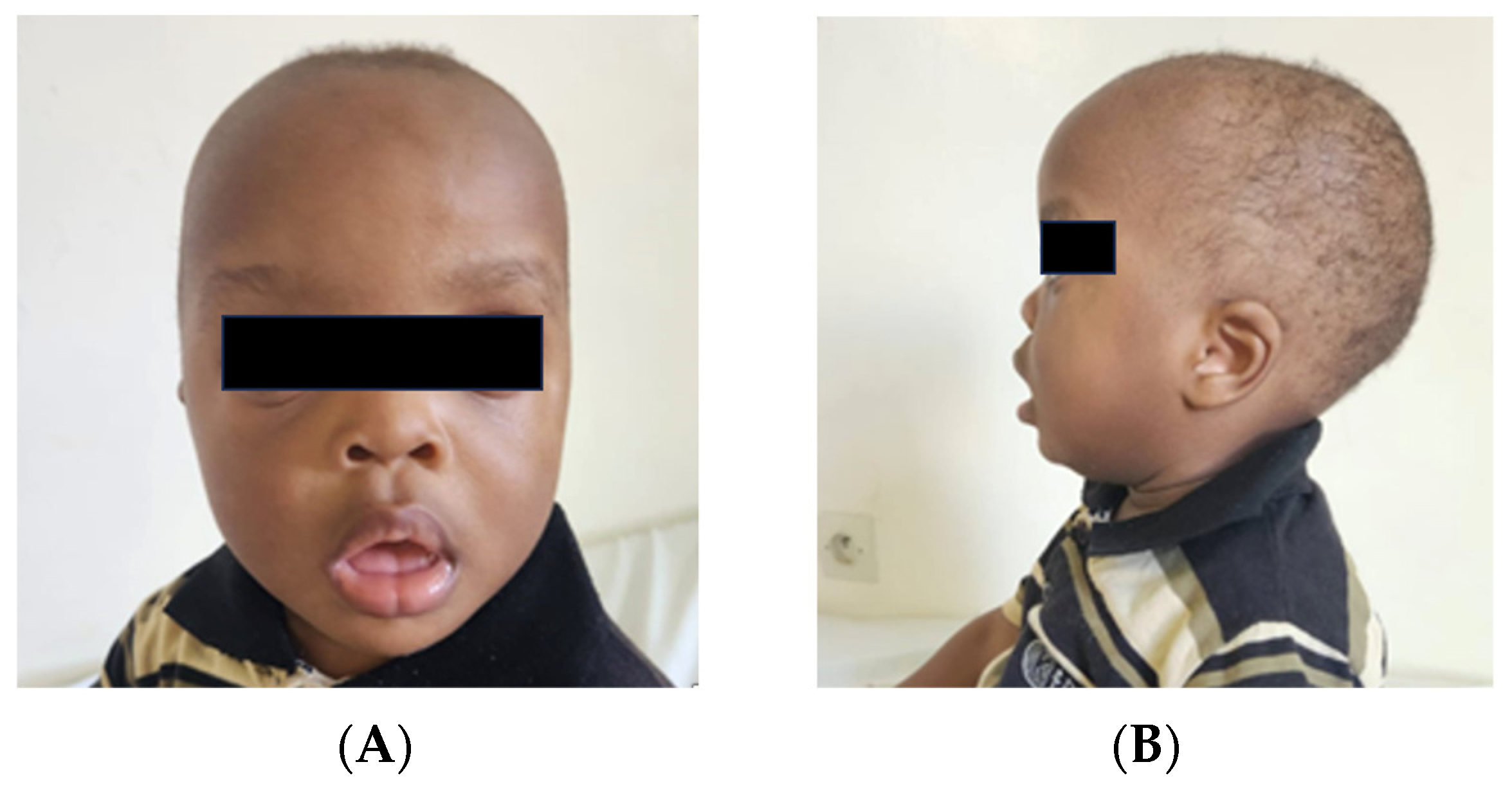
The patient is a 15-month-old male, who was referred to the genetic clinic of the University Teaching Hospital of Kigali for global developmental delay and dysmorphic facial features. The patient is the third child of healthy nonconsanguineous parents and there is no family history of intellectual disability or congenital malformations. He was born to a 39-year-old gravida 6 para 6 mother, by cesarian section at term with a birth weight of 2.785 kg. The patient presented hypotonia during the neonatal period. He underwent cardiac evaluation and the echocardiogram was normal. On physical examination (at 15 months), his weight was (9.8 kg = 25th percentile) and occipitofrontal circumference (OFC) was (46 cm = 50th percentile), with a short stature observed (height 69 cm below 3rd percentile), using the WHO growth charts. Dysmorphic facial features consisted of low-set ears, a wide forehead, hypertelorism, a depressed nasal bridge, anteverted nares, a tented upper lip and everted lower lip, midface hypoplasia (Figure 1), small teeth and bilateral 5th toe clinodactyly. He had axial hypotonia. At the age of 24 months, developmental reassessment confirmed persistent global developmental delay, with attainment of crawling only with the aid of physiotherapy and continued absence of independent walking and expressive speech. His weight was 11.74 kg (=50th percentile), with an OFC of (48 cm = 50th percentile). In contrast, his short stature remained markedly clear, with a height 74 cm below the 3rd percentile. The karyotype was normal (46, XY).

2.2. Trio Whole Exome Sequencing

Trio exome sequencing is a genomic test in which the protein-coding region of the proband and both biological parents are sequenced and analyzed; up to 30–40% of severe neurodevelopmental disorders result from de novo mutations, and trio-WES is the most effective method to capture them accurately [14]. Peripheral blood was collected from both the patient and the parents. The WES was performed at the University of Liège Centre for Human Genetics. Extraction of DNA from blood samples was performed manually using a QIA amp DNA mini kit (Qiagen) in accordance with the manufacturer’s protocol. The purity and concentration of extracted DNA was assessed using the Nanodrop 1000 UV-spectrophotometer. Subsequently, 30 µL of the normalized lysis product was utilized for library preparation with the Illumina DNA PCR-Free Prep, Tagmentation library preparation kit and IDT® for Illumina® DNA/RNA Unique Dual Indexes Set A, Tagmentation (96 Indexes). The preparation of the exome library was carried out using “Comprehensive Exome” solution from the firm Twist Bioscience; this modified exome targets more than 99% of protein-coding genes (+/−36.8 Mb of regions covered). The process consists of the enzymatic fragmentation of genomic DNA followed by the preparation of this fragmented gDNA before capturing the regions of interest; then, there is the enrichment of the captured regions and high-throughput sequencing of the libraries created on an Illumina NovaSeq 6000 sequencing Technologies with a Flow Cell in 2 × 100 Paired-End sequencing. Sequencing data generated from the patient by NovaSeq were presented in the form of standard fastq.gz files, including a list of inferred variants compared to the reference genome, and a bam file including the mapped reads. All data were processed by bioinformaticians and processed using the Humanomics pipeline. The vcf.gz files including inferred variants from exome sequencing were analyzed via the CE-IVD Agilent Alissa Interpret platform, as well as bam files including mapped reads which allow for visualization of aligned sequences in the IGV genomic data visualization software [15]. Sanger confirmation was not performed for this variant due to the fact that the sequencing was performed in a certified diagnostic genetic laboratory (BELAC certification, ISO 15189) [1]. We validated our bioinformatic WES pipeline using reference genomes from the Ga4GH consortium (GIAB HG001 and HG002 DNA). This consortium defined regions of high confidence for these reference genomes. We certified our workflow by using these regions of high confidence with excellent performance metrics, and every variant that fell out of these high-confidence regions was verified by Sanger. The EHMT1 heterozygous reported variant was located in a high-confidence region, supported by 251 reads, and it had an allelic fraction of 50.2%. The proband was analyzed alongside both parents, and the coverage of the parents for this region was also higher than 250×, with a relatedness calculated by Somalier, which confirmed the relation to both the mother and father (relatedness of 0.5).

3. Results

3.1. Whole Exome Sequencing Results

The proband trio-WES identified a variant—NM_024757.5: c.2871dup, p. (Phe958Leufs*219)—in a heterozygous state in EHMT1. The variant was absent from control population databases, including the Exome Sequencing Project, 1000 Genomes Project, ExAC, and gnomAD. The duplication results in a frameshift and introduces a premature stop codon 219 amino acids downstream, in a gene for which loss of function is an established pathogenic mechanism (gnomAD pLI = 1). Trio analysis confirmed the variant as de novo. Given the phenotypic consistency with the associated gene, a ClinGen score of 0.5 was used to weight the PS2 score applied to de novo variants. This was based on two main aspects: the phenotype of the patient was consistent with the gene being non-highly specific, of high genetic heterogeneity, and a de novo variant after confirming the parental relationships; the variant occurred in exon 20 of 27 and was therefore subject to nonsense-mediated decay (NMD) and loss of function, and so it was classified as PVS1 [16]. The results were analyzed via intellectual disability and an epilepsy gene panel, the variant was classified as PM2-supporting, and it was absent in the controlled population, including in the Exome Sequencing Project, 1000 Genomes Project, and Exome Aggregation Consortium, GnomAD. It was a PS2-supporting de novo phenotype consistent with the gene but not highly specific and there was high genetic heterogeneity. Given the fact that the variant was found by using a gene panel, robust internal validation studies were conducted at the University of Liege’s Center for Human Genetics’ laboratories. With a high read depth (>100×) and strong bioinformatics pipelines, together with a good variant allele fraction, no other validation process was needed like Sanger sequencing, as the laboratory is a certified diagnostic genetic facility (BELAC certification, ISO 15189). We validated our bioinformatic WES pipeline using reference genomes from the Ga4GH consortium (GIAB HG001 and HG002 DNA) [15]. The ClinGen sequence variant interpretation framework assigns points to de novo variants based on phenotype specificity and gene–disease relationship strength. The reported case’s phenotype fitted KS but was not specific to the EHMT1 variant. There were no other contiguous genes affected in the 9q34.3 region as reported by exome sequencing results, and no copy number variants were detected. The identified variant was NM_024757.5: c.2871dup, p. (Phe958Leufs*219), a heterozygous state of EHMT1 (OMIM*607001; OMIM#610253 Kleefstra syndrome 1). The heterozygous frameshift variant in EHMT1 fitted ACMG criteria (PVS1, PM2-supporting, and PS2-supporting), and it was categorized as pathogenic since it introduces an early stop codon that causes loss of function. It was absent from population databases and occurred de novo in a compatible phenotype [16]. The clinical presentations and identified genetic marker of the patient are shown in Table 1 and The read alignment and variant visualization supporting the detected variant are provided in the Supplementary Materials (Supplementary Figure S1), generated using Integrative Genomics Viewer (IGV).

3.2. Imaging Analysis

Brain and spine MRI of the patient did not reveal any abnormalities.

4. Discussion

The identification of pathogenic variants in EHMT1 in our patient highlights the expanding genetic and phenotypic spectrum of KS in African populations where genomic data remain significantly under-represented [17]. Specifically, the identified variant—NM_024757.5: c.2871dup, p. (Phe958Leufs*219)—has not been previously reported and further supports loss of function as the primary pathogenic mechanism underlying KS. Our patient’s phenotype aligns with the characteristic clinical spectrum documented in published KS cohorts [3]. The patient presented early with neonatal hypotonia, severe global developmental delay, and absent expressive speech by the age of 3 years, findings consistently reported as cardinal features in major case series and review [11]. However, additional clinical features frequently reported in other KS patients, such as behavioral abnormalities, autism spectrum disorder, sleep disturbances, epilepsy, congenital heart defect and urogenital malformations [18], were absent in our patient at the time of evaluation. This observation is consistent with prior reports demonstrating that the KS phenotype is age-dependent and may evolve over time, highlighting the importance of prospective clinical follow-up in affected individuals. The patient’s short stature (height < 3rd percentile on WHO charts) with relatively preserved weight and head circumference at 15 months aligns with prior observations that growth can be variably affected across individuals with KS [6]. Identification of KS in African patients remains particularly challenging because diagnosis based solely on clinical features is difficult, as the characteristic facial gestalt may be subtle, age-dependent, or underrecognized in individuals of African ancestry due to limited normative phenotypic references and the marked under-representation of African patients in published KS cohorts. This case highlights how reliance on clinical features alone can result in delayed or missed diagnoses, reinforcing the critical importance of genomic testing for achieving diagnostic equity in low- and middle-income countries (LMICs). Studies indicate that neurodevelopmental disorders including KS affect up to 10–17% of children, yet most patients in sub-Saharan Africa, including Rwanda, do not undergo advanced genetic testing, with <25% of studies using next-generation sequencing [19]. Policy efforts should therefore emphasize equitable access, local capacity building, and incorporation of genomics into routine patient clinical care [20]. The reported case reinforces the core KS phenotype, namely, hypotonia, severe global developmental delay, and absent speech, consistent with large cohorts [21]. However, the absence of obesity and seizures and the presence of short stature together with bilateral 5th toe clinodactyly highlight phenotypic variability, as also observed in recent genotype–phenotype studies [12]. This case highlights underappreciated facial gestalt distinctions in African ancestry as compared to European cohorts [22]. Due to restricted genetic access in sub-Saharan countries, Rwanda in particular continues to face significant diagnostic challenges that frequently results in delayed or missed diagnosis of neurodevelopmental disorders. This study shows how important trio-WES is for resolving clinical uncertainty and lowering diagnostic disparities in resource-limited settings [23]. Appendix A is first referenced here and summarizes the key findings of this study; it illustrates the clinical presentation alongside the identification of EHMT1 variant through trio-whole exome sequencing in KS.

5. Conclusions

KS shares clinical presentations with other neurodevelopmental disorders and it is challenging diagnosis. In the case of clinical suspicion in a patient with psychomotor developmental delay, EHM1 should be systematically evaluated. In the future, better delineation of the natural history of KS is required to allow for adequate phenotype recognition. The investigation of EHMT1, a key regulator in the epigenetic process, could provide new insight into disease mechanisms and therapeutic options. Therefore, it is paramount to emphasize the critical importance of integrating trio exome sequencing into the diagnostic evaluation of neurodevelopmental disorders even in under-represented populations.

Supplementary Materials

The following supporting information can be downloaded at: https://www.mdpi.com/article/10.3390/genes17040429/s1, Figure S1. IGV for Patient. NM_024757.5: c.2871dup, p. (Phe958Leufs*219) in heterozygote status of EHMT1 (OMIM*607001; OMIM#610253 Kleefstra syndrome 1).

Author Contributions

Conceptualization, L.M. and A.U.; data collection and methodology, N.D. and E.U.; examination of patients and investigation, N.D., L.M. and A.U.; formal analysis, N.D., L.M., A.U., J.H., A.I.A., J.H.C., V.D. and V.B.; writing—draft preparation, N.D., L.M. and A.U.; writing—review and editing, N.D., E.U., J.P.U. and L.M.; supervision, V.B. and L.M.; funding acquisition, L.M. and A.U. All authors have read and agreed to the published version of the manuscript.

Funding

This work was funded by the European Union (EU)/University of Rwanda Enabel-Kwigira Project, grant number RWA210001-10016. The study was also sponsored by the African Academy of Sciences under its African Research Initiative for Scientific Excellence (ARISE) pilot project 262 program, grant number (DCI-PAN AF/2020/420-028). The funder had no role in the study design, data collection and analysis, decision to publish, or preparation of the manuscript.

Institutional Review Board Statement

The study was approved by the Institutional Review Board of the College of Medicine and Health Sciences at the University of Rwanda (500/CMHS IRB/2024 on 27 June 2024) and Kigali University Teaching Hospital.

Informed Consent Statement

Informed consent was obtained from legal guardians of the subjects involved in the study.

Data Availability Statement

The original contributions presented in this study are included in the article/Supplementary Materials. Further inquiries can be directed to the corresponding author.

Conflicts of Interest

The authors declare no conflict of interest.

Abbreviations

The following abbreviations are used in this manuscript:
WESWhole Exome Sequencing
ACMGAmerican College of Medical Genetics
KSKleefstra Syndrome
CHUKKigali University Teaching Hospital
CNVCopy Number Variant
SNVSingle-Nucleotide Variant
IRBInstitute Review Board
LMICLow- and Middle-Income Country
IGVIntegrative Genomics Viewer
DNADeoxyribose Nucleic Acid

Appendix A

The graphical figure below illustrates the clinical to molecular diagnostic pathway of the first case of KS in Rwanda and, to the best of our knowledge, in East Africa. It starts with neonatal presentation that includes dysmorphic features including a depressed nasal bridge, a wide forehead, low-set ears, midface hypoplasia and marked hypotonia, along with global developmental delay. It emphasizes how trio whole exome sequencing was used as a decisive diagnostic technique that revealed a pathogenic frameshift variant in EHMT1 (c.2871dup; p. Phe958Leufs*219) in the proband, while the parents’ results were normal. The variant was classified as Class V according to the American College of Medical Genetics criteria. The final segment of the figure highlights the strong need for a multidisciplinary team approach in the management of global developmental delay and the role of expanding access to advanced genomic testing to improve early diagnosis and provide individualized care to patients with neurodevelopmental disorders.
Genes 17 00429 i001

References

  1. Kleefstra, T.; Smidt, M.; Banning, M.J.G.; Oudakker, A.R.; Van Esch, H.; de Brouwer, A.P.M.; Nillesen, W.; A Sistermans, E.; Hamel, B.C.J.; de Bruijn, D.; et al. Disruption of the gene Euchromatin Histone Methyl Transferase1 (Eu-HMTase1) is associated with the 9q34 subtelomeric deletion syndrome. J. Med. Genet. 2005, 42, 299–306. [Google Scholar] [CrossRef]
  2. Koemans, T.S.; Kleefstra, T.; Chubak, M.C.; Stone, M.H.; Reijnders, M.R.F.; de Munnik, S.; Willemsen, M.H.; Fenckova, M.; Stumpel, C.T.R.M.; Bok, L.A.; et al. Functional convergence of histone methyltransferases EHMT1 and KMT2C involved in intellectual disability and autism spectrum disorder. PLoS Genet. 2017, 13, e1006864. [Google Scholar] [CrossRef]
  3. Kleefstra, T.; Brunner, H.G.; Amiel, J.; Oudakker, A.R.; Nillesen, W.M.; Magee, A.; Geneviève, D.; Cormier-Daire, V.; van Esch, H.; Fryns, J.-P.; et al. Loss-of-Function Mutations in Euchromatin Histone Methyl Transferase 1 (EHMT1) Cause the 9q34 Subtelomeric Deletion Syndrome. Am. J. Hum. Genet. 2006, 79, 370–377. [Google Scholar] [CrossRef]
  4. Connors, K.L.; Carmichael, N.E.; Bichell, T.J.; Dies, K.A.; Frazier, Z.J. Development of a Patient and Caregiver-Centered Pediatric Disease Concept Model for Kleefstra Syndrome. Sage Open Pediatr. 2025, 12, 30502225251336880. [Google Scholar] [CrossRef]
  5. Draksler, T.Z.; Bouman, A.; Guček, A.; Novak, E.; Burger, P.; Colin, F.; Kleefstra, T. Exploring Kleefstra syndrome cohort phenotype characteristics: Prevalence insights from caregiver-reported outcomes. Eur. J. Med. Genet. 2024, 72, 104974. [Google Scholar] [CrossRef]
  6. Bouman, A.; Geelen, J.M.; Kummeling, J.; Schenck, A.; van der Zwan, Y.G.; Klein, W.M.; Kleefstra, T. Growth, body composition, and endocrine-metabolic profiles of individuals with Kleefstra syndrome provide directions for clinical management and translational studies. Am. J. Med. Genet. Part A 2024, 194, e63472. [Google Scholar] [CrossRef] [PubMed]
  7. Kleefstra, T.; Koolen, D.A.; Nillesen, W.M.; de Leeuw, N.; Hamel, B.C.; Veltman, J.A.; Sistermans, E.A.; van Bokhoven, H.; van Ravenswaay, C.; de Vries, B.B. Interstitial 2.2 Mb deletion at 9q34 in a patient with mental retardation but without classical features of the 9q subtelomeric deletion syndrome. Am. J. Med. Genet. Part A 2006, 140A, 618–623. [Google Scholar] [CrossRef]
  8. Kleefstra, T.; Kramer, J.M.; Neveling, K.; Willemsen, M.H.; Koemans, T.S.; Vissers, L.E.; Wissink-Lindhout, W.; Fenckova, M.; Van Den Akker, W.M.; Kasri, N.N.; et al. Disruption of an EHMT1-Associated Chromatin-Modification Module Causes Intellectual Disability. Am. J. Hum. Genet. 2012, 91, 73–82. [Google Scholar] [CrossRef] [PubMed]
  9. Oegema, R.; Barakat, T.S.; Wilke, M.; Stouffs, K.; Amrom, D.; Aronica, E.; Bahi-Buisson, N.; Conti, V.; Fry, A.E.; Geis, T.; et al. International consensus recommendations on the diagnostic work-up for malformations of cortical development. Nat. Rev. Neurol. 2020, 16, 618–635. [Google Scholar] [CrossRef]
  10. Wu, D.; Li, R. Case Report: Long-Term Treatment and Follow-Up of Kleefstra Syndrome-2. Front. Pediatr. 2022, 10, 881838. [Google Scholar] [CrossRef] [PubMed]
  11. Frazier, Z.J.; Kilic, S.; Osika, H.; Mo, A.; Quinn, M.; Ballal, S.; Katz, T.; Shearer, A.E.; Horlbeck, M.A.; Pais, L.S.; et al. Novel Phenotypes and Genotype–Phenotype Correlations in a Large Clinical Cohort of Patients with Kleefstra Syndrome. Clin. Genet. 2025, 107, 636–645. [Google Scholar] [CrossRef] [PubMed]
  12. Rots, D.; Bouman, A.; Yamada, A.; Levy, M.; Dingemans, A.J.M.; A de Vries, B.B.; Ruiterkamp-Versteeg, M.; de Leeuw, N.; Ockeloen, C.W.; Pfundt, R.; et al. Comprehensive EHMT1 variants analysis broadens genotype-phenotype associations and molecular mechanisms in Kleefstra syndrome. Am. J. Hum. Genet. 2024, 111, 1605–1625. [Google Scholar] [CrossRef] [PubMed]
  13. Sium, A.F.; Shimels, T.; Abdosh, A.A.; Diress, T.; Tsegaye, T.; Yifrashewa, T.; Terefework, Z.; Gudu, W. Indications, types, and diagnostic implications of prenatal genetic testing in Sub-Saharan Africa: A descriptive study. PLoS ONE 2023, 18, e0294409. [Google Scholar] [CrossRef]
  14. Li, C.; Wang, Y.; Zeng, C.; Huang, B.; Chen, Y.; Xue, C.; Liu, L.; Rong, S.; Lin, Y. Trio-whole exome sequencing reveals the importance of de novo variants in children with intellectual disability and developmental delay. Sci. Rep. 2024, 14, 27590. [Google Scholar] [CrossRef] [PubMed]
  15. Harvengt, J.; Lumaka, A.; Fasquelle, C.; Caberg, J.H.; Mastouri, M.; Janssen, A.; Palmeira, L.; Bours, V. HIDEA syndrome: A new case report highlighting similarities with ROHHAD syndrome. Front. Genet. 2023, 14, 1137767. [Google Scholar] [CrossRef]
  16. Richards, S.; Aziz, N.; Bale, S.; Bick, D.; Das, S.; Gastier-Foster, J.; Grody, W.W.; Hegde, M.; Lyon, E.; Spector, E.; et al. Standards and guidelines for the interpretation of sequence variants: A joint consensus recommendation of the American College of Medical Genetics and Genomics and the Association for Molecular Pathology. Genet. Med. 2015, 17, 405–424. [Google Scholar] [CrossRef]
  17. Ren, R.; Liu, Y.; Liu, P.; Zhao, J.; Hou, M.; Li, S.; Chen, Z.; Yuan, A. Clinical characteristics and genetic analysis of four pediatric patients with Kleefstra syndrome. BMC Med. Genom. 2024, 17, 290. [Google Scholar] [CrossRef]
  18. Morison, L.D.; Kennis, M.G.; Rots, D.; Bouman, A.; Kummeling, J.; Palmer, E.; Vogel, A.P.; Liegeois, F.; Brignell, A.; Srivastava, S.; et al. Expanding the phenotype of Kleefstra syndrome: Speech, language and cognition in 103 individuals. J. Med. Genet. 2024, 61, 578–585. [Google Scholar] [CrossRef]
  19. Truter, B.; Slogrove, A.L.; Ilhan, E.; Conradie, P.; Thompson, L.; Gillberg, C.; Billstedt, E. Screening young children for neurodevelopmental differences in sub-Saharan Africa: A scoping review. BMC Psychiatry 2025, 25, 857. [Google Scholar] [CrossRef]
  20. Savatt, J.M.; Myers, S.M. Genetic Testing in Neurodevelopmental Disorders. Front. Pediatr. 2021, 9, 526779. [Google Scholar] [CrossRef]
  21. Cheema, H.A.; Waheed, N.; Saeed, A. Kleefstra Syndrome with Severe Sensory Neural Deafness and De Novo Novel Mutation. J. Coll. Physicians Surg. Pak. 2022, 32, 236–238. [Google Scholar] [CrossRef] [PubMed]
  22. Liu, C.; Lee, M.K.; Naqvi, S.; Hoskens, H.; Liu, D.; White, J.D.; Indencleef, K.; Matthews, H.; Eller, R.J.; Li, J.; et al. Genome scans of facial features in East Africans and cross-population comparisons reveal novel associations. PLoS Genet. 2021, 17, e1009695. [Google Scholar] [CrossRef] [PubMed]
  23. Uwineza, A.; Mutesa, L. Medical genetics and genomic medicine in Rwanda. Mol. Genet. Genom. Med. 2015, 3, 486–489. [Google Scholar] [CrossRef] [PubMed]
Figure 1. (A) Frontal facial view showing a wide forehead, hypertelorism, a depressed nasal bridge, anteverted nares, a tented upper lip, an everted lower lip, and midface hypoplasia. (B) Profile view highlighting midface hypoplasia and facial gestalt consistent with KS.
Genes 17 00429 g001
Table 1. Clinical presentations of KS in Rwandan patient compared to other patients.
Comparison of Reported Kleefstra Syndrome Clinical Features vs. Rwandan Patient with Kleefstra Syndrome
System/FeatureTypical Kleefstra Syndrome SymptomsRwandan Patient SymptomsNovel/Not Commonly Emphasized
VariantEHMT1 haploinsufficiency (deletions or loss of function variants)EHMT1: c.2871dup; p. Phe958Leufs*219 (de novo frameshift)Novel variant (previously unreported)
InheritanceAutosomal dominant (mostly de novo)De novo confirmed by trio-WES
GrowthObesity (later childhood), variable growthShort stature (<3rd percentile), normal weight percentileEarly short stature without obesity
Head sizeMicrocephalyNormal OFC (50th percentile)Normal head circumference despite GDD
HypotoniaCommon (early infancy)Neonatal hypotonia, persistent axial hypotonia
Global developmental delaySevereSevere GDD, delayed motor milestones
SpeechSevere speech delay or absent speechNo expressive speech at 24 months
Face (general)Coarse facies, flat faceFlat faceAbsence of coarse facies
ForeheadNot consistently describedWide foreheadPossibly underreported feature
EyesHypertelorism, up-slanting palpebral fissuresHypertelorism
EarsMalformed ears and hearing lossLow-set ears
NoseAnteverted naresAnteverted nares + depressed nasal bridgeDepressed nasal bridge emphasized
MidfaceMidface hypoplasiaMidface hypoplasia and short neck
MouthEverted lower lipTented upper lip + everted lower lipTented upper lip (less commonly highlighted)
DentitionNot consistently reportedSmall teethRarely reported feature
Extremities (hands/feet)Brachydactyly, single palmar creaseBilateral 5th toe clinodactylyToe clinodactyly (less typical than hand anomalies)
Cardiac defectsCono-truncal defectsNormal echocardiogramAbsence of CHD
Neurologic (seizures)Seizures No seizures reportedAbsence at early age
Behavioral/psychiatricAutism, aggression, OCD, sleep disordersNot observed at 15–24 months
Brain imagingMay show abnormalitiesNormal brain MRINormal imaging
Other anomaliesUrogenital, renal anomalies possibleNone reportedAbsence of systemic anomalies
Disclaimer/Publisher’s Note: The statements, opinions and data contained in all publications are solely those of the individual author(s) and contributor(s) and not of MDPI and/or the editor(s). MDPI and/or the editor(s) disclaim responsibility for any injury to people or property resulting from any ideas, methods, instructions or products referred to in the content.