Article

The copB Is a Key Copper Resistance Gene in Xanthomonas citri pv. mangiferaeindicae GXBS06

1
State Key Laboratory for Conservation and Utilization of Subtropical Agro-Bioresource, College of Life Science and Technology, Guangxi University, Nanning 530004, China
2
College of Agriculture, Guangxi University, Nanning 530004, China
*
Author to whom correspondence should be addressed.
These authors contributed equally to this work.
Genes 2026, 17(4), 408; https://doi.org/10.3390/genes17040408
Submission received: 17 March 2026 / Revised: 26 March 2026 / Accepted: 29 March 2026 / Published: 31 March 2026
(This article belongs to the Section Genes & Environments)

Abstract

Background/Objectives: Mango bacterial angular leaf spot, caused by Xanthomonas citri pv. mangiferaeindicae (Xcm), is one of the most destructive bacterial diseases of mango, resulting in significant economic losses to the mango industry. Copper-based bactericides have been widely used for decades to control this disease, leading to increased copper resistance in the pathogen and heightened environmental risks. However, the copper resistance mechanisms of Xcm remain incompletely understood. Methods: In this study, we used Xcm GXBS06 isolated from major mango cultivars in Guangxi, China. We analyzed the homologs of known copper resistance-related genes in Xcm and found that these genes are relatively conserved across different strains. The functions of six important known copper resistance gene homologs in Xcm were investigated. Among them, five were functionally characterized by gene deletion, while the remaining one was characterized by overexpression because deletion was unsuccessful. Results: The result showed that copB is a critical copper resistance-related gene in Xcm. However, its deletion neither affects H2O2 tolerance nor virulence determinants such as extracellular polysaccharide production, biofilm formation, or cell motility. Additionally, it did not impact pathogenicity or bacterial growth within the host. The expression of copB was significantly induced at copper sulfate concentrations of 0.2 mM and 0.6 mM. Conclusions: These findings contribute to a better understanding of the copper resistance mechanisms in Xcm and provide a foundation for further studies on the biological control of this pathogen.

1. Introduction

Mango bacterial angular leaf spot, also known as mango bacterial canker, is a prevalent bacterial disease in mango production. It is distributed across many mango-growing regions and difficult to control, making it one of the most significant mango diseases [1]. The causal agent, Xcm, is a Gram-negative bacterium that primarily enters leaves through stomata and wounds, causing damage to mango leaves and fruits [2]. It can lead to severe infections in various mango cultivars, inducing characteristic angular, black lesions on leaves and water-soaked spots on fruits, ultimately resulting in defoliation and fruit drop [3], posing significant harm. During infection, Xcm produces substances such as cell wall-degrading enzymes, toxins, and extracellular polysaccharides that facilitate invasion of the plant [4].
Guangxi is one of China’s major mango-producing regions, and the mango industry makes a significant contribution to the local economy. In recent years, mango bacterial angular leaf spot has become increasingly frequent in most mango orchards in Guangxi, causing substantial economic losses to mango cultivation and processing [5]. For biological control of bacterial angular leaf spot disease in mangoes, we have systematically isolated prevalent strains from key cultivated mango varieties in Guangxi, China. All of the strains we isolated exhibited high copper tolerance, including Xcm GXBS06 [5] and Xcm GX07 [6], which have been previously reported, as well as Xcm B3 [7], another highly copper-tolerant strain isolated from Guangxi.
Since the accidental discovery in the late 19th century that the “Bordeaux mixture” (a blend of copper sulfate and lime) effectively controlled downy mildew in the vineyards of the Bordeaux region of France, copper-based compounds have been used as plant protectants for over a century. Copper ions (Cu2+) can non-specifically bind to various proteins and enzymes, particularly those containing sulfhydryl groups, within the cells of pathogenic microorganisms. This binding leads to their denaturation and inactivation, disrupts the integrity of cell membranes, and catalyzes the production of damaging reactive oxygen species (ROS), thereby achieving a broad-spectrum lethal effect against various pathogens, including fungi, bacteria, and oomycetes [8,9]. This “multi-targeted” mode of action [9,10] was once considered an inherent advantage that made it difficult for pathogens to develop resistance. Owing to their high efficacy, broad spectrum, long duration, and relatively low cost, copper-based fungicides/bactericides have been extensively utilized in various agricultural production systems worldwide, including orchards, vegetable farms, and cash crop plantations [10].
In living organisms, copper serves as an essential cofactor for numerous proteins; however, excess copper is toxic to organisms. Therefore, maintaining copper homeostasis is crucial for all life forms [11]. Bacteria primarily rely on efflux systems to prevent the intracellular accumulation of copper ions, thereby mitigating their toxic effects. Copper-based bactericides are the most important chemicals for controlling diseases caused by Xanthomonas species. Historically, to effectively manage these diseases, frequent and high-volume applications of copper-based bactericides were required. The extensive use of these bactericides has, in turn, driven the evolution of copper resistance in pathogens. For instance, copper-tolerant strains of Xanthomonas citri pv. citri, the causal agent of citrus canker, were first detected in Argentina in 1994 and subsequently found in Réunion and Martinique, France [11]. Furthermore, a survey in Florida revealed that nearly all (99.8%) tested strains of Xanthomonas perforans, a key pathogen responsible for bacterial spot of tomato, were tolerant to copper sulfate [12]. Consequently, investigating targets related to bacterial copper resistance and developing novel chemical agents for disease management is a promising approach.
The primary copper efflux proteins in bacteria are P1B-type ATPases. Two subfamilies of these ATPases, P1B-1 (CopA) and P1B-3 (CopB), are key proteins responsible for the export of intracellular copper ions [13]. In Escherichia coli, cellular copper homeostasis is primarily regulated by the Cue and Cus systems [11]. However, some copper-tolerant E. coli strains harbor the pcoABCDRSE gene cluster on plasmids. This cluster, functionally similar to the copABCDRS cluster in Pseudomonas syringae, enables adaptation to high copper concentrations. A central component of this system is PcoA. The level of copper resistance conferred by pcoA alone is much lower than that conferred by pcoA and pcoB together, suggesting a potential interaction between them [14,15]. In Pseudomonas aeruginosa, copper homeostasis is achieved through the CueR system, which regulates cytoplasmic copper levels, and the two-component CopR/S system, which controls periplasmic genes influencing copper distribution [15]. Within the CopR/S two-component system, several genes—including pcoA, pcoB, czcCBA, czcR, czcS, ptrA, oprD, PA2806, and PA2807—are regulated by copRS. Both PcoA and PcoB are outer transmembrane proteins that reduce copper levels in the periplasm, primarily through efflux and oxidation mechanisms, respectively [16].
In the genus Xanthomonas, the copper resistance phenotype is often attributed to plasmid-borne cop operons. These plasmids facilitate the horizontal transfer of resistance genes among different strains through conjugation [17]. The expression of copA and copB is primarily induced by the upstream gene copL in the presence of copper ions [18]. In Xanthomonas. citri subsp. citri (Xac) A44, copL, copA, and copB were identified as the most important copper resistance genes. Mutations in copL and copA reduced copper resistance to levels comparable to copper-sensitive strains, while mutation of copB only resulted in a partial reduction in copper resistance [19]. A study comparing Xac 306 under copper-treated and untreated conditions, analyzing the expression of 32 genes, revealed significant upregulation of genes related to pathogenicity and detoxification. This indicated that copA and copB are involved in the copper detoxification process in Xac 306 [20]. In Xanthomonas fastidiosa, copA and copB mutants were found to be more sensitive to copper than the wild-type strain. Gene expression of copA and copB was induced by low concentrations of copper ions (0 to 250 mM) but suppressed at high concentrations. Plant experiments showed that both genes influence copper homeostasis in the strain, which in turn affects its virulence and is modulated by environmental copper levels [17]. Current research has revealed that the copper resistance gene clusters found in different Xanthomonas species share high similarity with those in several other bacterial genera. Furthermore, the genetic basis for copper resistance often resides on plasmids [21,22], although chromosomal localization has also been reported in some instances [23].
In this study, using Xcm GXBS06 as the reference strain, we analyzed the homologous genes of known copper resistance genes in Xcm and functionally characterized six of these genes associated with copper resistance. The results indicated that only deletion of copB resulted in a highly significant reduction in copper resistance in Xcm.

2. Materials and Methods

2.1. Plasmids and Bacterial Cultures

The primers, plasmids, and bacterial strains used in this study are listed in Table 1. Xanthomonas strains were cultivated in NYG medium (liquid or solidified with 1% (w/v) agar) containing 3 g/L polypeptone (Cat# P8970, Solarbio, Beijing, China), 5 g/L beef extract (01-009, AOBOX, Hangzhou, China), 1 g/L yeast extract (Cat# LP0021B, Oxoid, Hampshire, UK), pH 7.0. The medium was supplemented with 50 μg/mL rifampicin (Rif), 25 μg/mL kanamycin (Kan), or 5 μg/mL tetracycline (Tc) as appropriate. E. coli strains were grown in LB medium (liquid or solidified with 1% (w/v) agar) containing 10 g/L tryptone (Cat# T8940, Solarbio, Beijing, China), 10 g/L NaCl, 5 g/L yeast extract, pH 7.0. When indicated, kanamycin (25 μg/mL) was added, and cultures were incubated at 37 °C.

2.2. DNA and RNA Manipulations

DNA manipulations were performed following the procedures described by Sambrook et al. [31]. Conjugation between E. coli and Xanthomonas strains was carried out as described by Turner et al. [32] Restriction endonucleases, T4 DNA ligase, and Pfu polymerase were sourced from Promega (Shanghai, China). Total RNA was extracted from Xcm strain cultures using the TransZol Up Plus RNA Kit (TransGen Biotech, Beijing, China) according to the manufacturer’s instructions. Reverse transcription of RNA was performed using the HiScript® III RT SuperMix for qPCR (+gDNA wiper) kit (VazymeTM, Nanjing, China) following the manufacturer’s protocol. Relative quantification of gene expression was conducted using the 23S rRNA gene as an internal control. The transcriptional levels of copB were analyzed by qRT-PCR using total RNA extracted from Xcm strains grown in NB medium for 24 h. SYBR green-labeled PCR fragments were amplified using primer set 3670f/r (Table 2). Three independent biological replicates were performed, and each biological replicate contained three technical replicates. The expression level of the 23S rRNA gene was used as an internal standard.

2.3. Construction of Deletion Mutants

In-frame deletion mutants were constructed using the homologous recombination vector pK18mobsacB. As an example, the ΔcopB mutant was generated as follows. A DNA fragment containing the copB gene with its flanking regions was amplified from Xcm GXBS06 genomic DNA using primer pairs 3670LF/3670LR and 3670RF/3670RR (Table 2). The two fragments were ligated into the EcoRI/XbaI and XbaI/HindIII sites of pK18mobsacB, respectively, resulting in the deletion construct, in which an internal portion of the copB coding region was replaced by the XbaI site. The construct was verified by PCR and sequencing. The recombinant plasmid was introduced into Xcm GXBS06 by conjugation with E. coli DH5α (pRK2013). Transconjugants were selected on NYG medium containing kanamycin (25 μg/mL). Single-crossover integrants were identified by PCR, and double-crossover mutants were selected on NYG medium containing 10% sucrose. Gene deletion was confirmed by PCR using primers flanking the target locus (3670F and 3670R) and by Sanger sequencing. The same strategy was applied to generate the ΔXCM1423 and ΔXCM3130-33 mutants using the respective primer pairs listed in Table 2. All deletion mutants were confirmed by PCR and sequencing.

2.4. Construction of Complemented Strain

The complemented strain CΔcopB was constructed using the broad-host-range vector pLAFR6. A 2268-bp DNA fragment containing the full-length copB gene with its native promoter region was amplified by PCR using primer pairs 3670F and 3670R (Table 2) and cloned into pLAFR6, giving a recombinant plasmid. The construct was verified by PCR and Sanger sequencing. The verified plasmid was introduced into the ΔcopB mutant by conjugation with E. coli DH5α (pRK2013). Transconjugants were selected on NYG medium containing tetracycline (5 μg/mL). Successful complementation was confirmed by PCR amplification of the copB gene using primers 3670F and 3670R, and by sequencing of the plasmid isolated from the complemented strain. The resulting strain was designated CΔcopB.

2.5. PCR Confirmation and Sequencing

Deletion mutants and the complemented strain were verified by PCR and Sanger sequencing. PCR was performed using primer pairs listed in Table 2. For deletion mutants, primers flanking the target locus were used; the resulting PCR products from the wild-type and mutant strains showed the expected size difference, confirming the deletion. For the complemented strain, the presence of the copB gene was confirmed using primers 3670F/3670R, which amplified the full-length copB fragment in the wild-type and complemented strains but not in the ΔcopB mutant. PCR was carried out with initial denaturation at 95 °C for 5 min; 30 cycles of 95 °C for 30 s, Tm °C for 30 s, and 72 °C for 1 min/kb; and a final extension at 72 °C for 5 min. PCR products were purified and sequenced by Sanger sequencing (Sangon Biotech, Shanghai, China) to verify the precise deletion junction (for mutants) and the correct sequence of the copB insert (for the complemented strain). All sequencing results were compared with the reference genome sequence.

2.6. Copper Resistance Assay

In this study, both qualitative plate assays and quantitative liquid culture assays were employed to evaluate the tolerance of the test strains to the heavy metal stressor CuSO4, thereby determining their copper resistance.
For the qualitative plate assay, test strains were cultured overnight to the mid-to-late logarithmic growth phase. The bacterial suspension was adjusted to an OD600 of 0.2, and 2 μL of the suspension was spotted onto NYG plates containing various concentrations of CuSO4. The plates were then incubated inverted at 28 °C for 3 days, after which the growth of each sample was observed.
For the quantitative liquid culture assay, test strains were cultured overnight to the mid-to-late logarithmic growth phase. The bacterial concentration was adjusted to an OD600 of 1.0. Then, 10 μL of this suspension was pipetted into 90 μL of liquid medium containing different concentrations of CuSO4 in a 96-well plate. The plate was incubated with shaking at 600 rpm for 24 h, and subsequently, measurements were taken using a microplate reader.

2.7. Observation of Cell Morphology by Scanning Electron Microscopy (SEM)

Test strains were cultured overnight to the mid-to-late logarithmic growth phase. Bacterial cells were harvested by centrifugation, and the pellets were washed three times with phosphate-buffered saline (PBS). The washed bacterial suspensions were then inoculated into NYG medium containing copper ions at concentrations of 0 mM, 0.5 mM, and 0.6 mM, and cultured in a shaker at 28 °C with agitation at 200 rpm until an OD600 of approximately 0.8 was reached. Samples were collected by centrifugation at 8000 rpm for 5 min. The supernatant was discarded, and the pellets were resuspended in PBS and washed three times by repeated centrifugation (8000 rpm, 5 min). The washed bacterial cells were fixed overnight in a 2.5% glutaraldehyde solution. After fixation, the cells were washed three times with PBS. Subsequently, small paper packets were prepared for dehydration: filter paper was cut into 4 cm × 4 cm squares. A piece of aluminum foil (approximately 2 cm2) was spread at one end of the filter paper square, folded evenly three times along the edge of the aluminum foil, and stapled securely to form a small packet. The concentrated bacterial suspension obtained after centrifugation was added into the small paper packet, and the open end was immediately sealed with a stapler. Gradient ethanol dehydration was then performed by sequentially immersing the paper packets containing the bacterial samples in 50%, 70%, 85%, and 95% ethanol for 15 min each, followed by two changes of 100% ethanol for 20 min each. Throughout this process, care was taken to ensure the packets were completely submerged in the ethanol solution. The packets were then dried overnight in an oven at 40 °C. Cell morphology was observed using a high-resolution field emission scanning electron microscope.

2.8. Identification and Evolutionary Analysis of Copper Resistance Genes in Xcm GXBS06

Based on the sequences of genes known to be associated with copper homeostasis in Xac, E. coli, and P. aeruginosa, a BLASTp 2.12.0 search was performed to identify their homologous genes in Xcm GXBS06 (GCA_045799005.1), Xac 306 (GCA_000007165.1), Xanthomonas oryzae pv. oryzae (Xoo) PXO99A (GCA_000019585.2), Xanthomonas campestris pv. campestris (Xcc) 8004 (GCA_045712965.1), and Xanthomonas oryzae pv. oryzicola (Xoc) GX01 (GCA_008370835.2). The criteria for homology were set as identity > 20%, query coverage > 50%, and an e-value < 1 × 10⁻⁵. The protein structural conformations were concurrently predicted using AlphaFold (https://alphafoldserver.com/) [33] and subsequently validated against a comprehensive collection of experimentally determined and AlphaFold-predicted protein structure models available through the FoldSeek server (https://search.foldseek.com/search (24 March 2026)) using FoldSeek [34] under default settings. Sequence alignment of the copA and copB genes predicted in this study was performed using MUSCLE (v 5.2) [35]. ModelTest-NG (v0.1.7) [36] was then employed to determine the best-fit models, followed by maximum likelihood phylogenetic tree inference using RAxML-NG (v1.2.2) [37] with 1000 bootstrap replicates (—seed 2 —bs-trees 1000). The models applied for copA and copB were VT+G4+F and WAG+I, respectively. All phylogenetic trees were visualized using iTOL (https://itol.embl.de) [38].

2.9. Statistical Analysis

All experiments were performed with three independent biological replicates. Data are presented as mean ± standard deviation (SD). Statistical analysis was performed using GraphPad Prism 9.0. Two-way analysis of variance (ANOVA) followed by Tukey’s multiple comparisons test was used to evaluate the effects of strain type and copper concentration on bacterial growth. Differences were considered statistically significant at p < 0.05 (*), p < 0.01 (**), p < 0.001 (***), and p < 0.0001 (****). For qRT-PCR analysis, relative expression levels were calculated using the 2−ΔΔCt method, and comparisons between groups were performed using Student’s t-test.

3. Results

3.1. Xcm GXBS06 Exhibits Strong Copper Tolerance

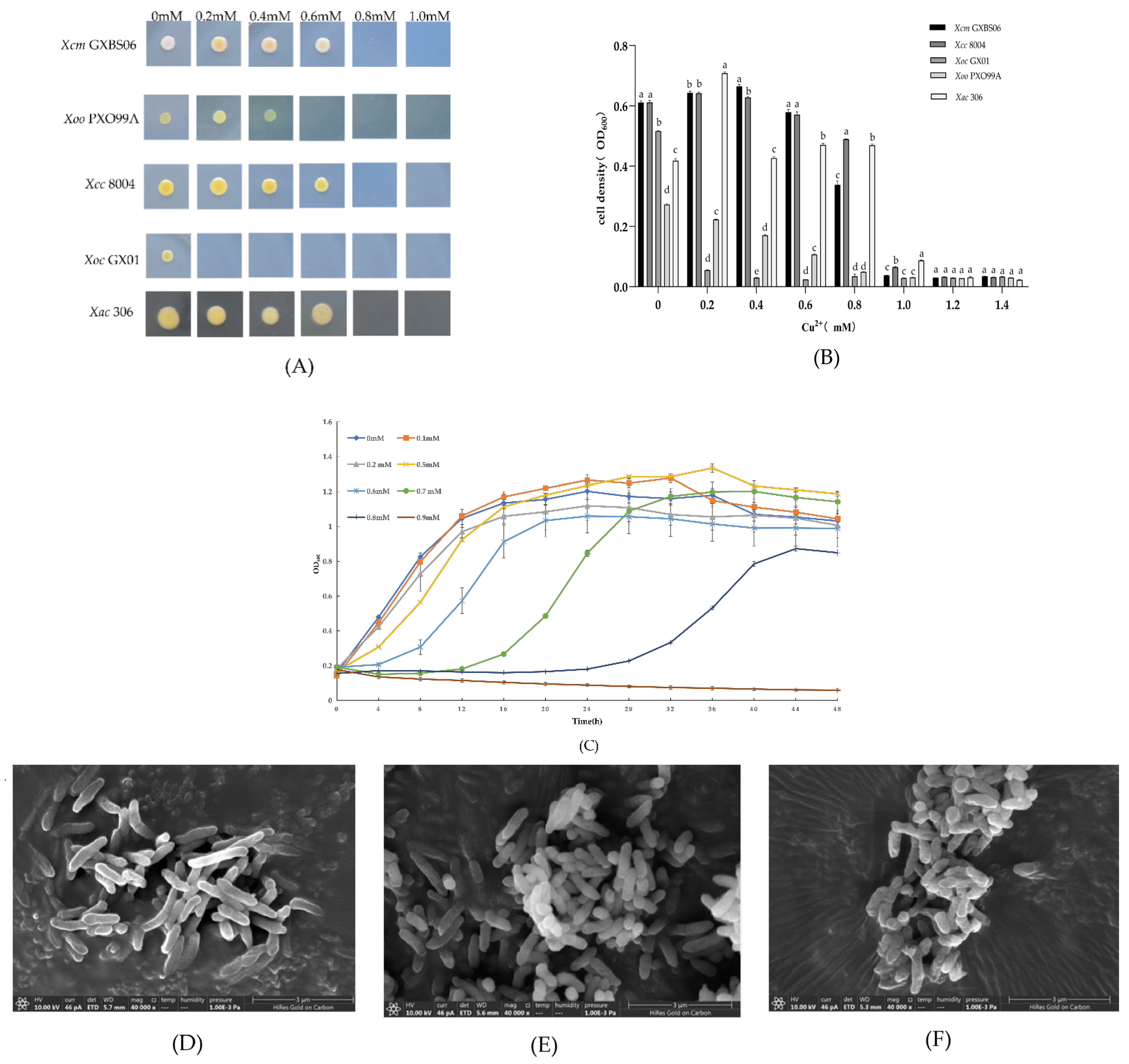
In this study, we evaluated the copper tolerance of Xcm GXBS06 and several Xanthomonas strains preserved in our laboratory (e.g., Xoo PXO99A, Xoc GX01, Xcc 8004). The results showed that Xcm GXBS06 could tolerate up to 0.8 mM Cu2+ (Figure 1A,B), a tolerance level comparable to that of Xcc 8004 and significantly higher than that of Xoo and Xoc, indicating that Xcm GXBS06 possesses a notable copper-resistant phenotype.
Growth curve analysis under different copper concentrations revealed that Xcm GXBS06 reached its peak growth after approximately 20 h of culture in NYG medium without copper ions. Low concentrations of copper ions (0.1–0.2 mM) did not inhibit growth and even slightly promoted it. When the copper concentration was increased to 0.5–0.7 mM, early-stage growth was inhibited, but growth levels largely recovered to those of the control group in the later stage. Under 0.8 mM Cu2+, although growth was severely inhibited, limited proliferation could still be sustained in the later stage. At copper concentrations ≥ 0.9 mM, the strain failed to grow entirely (Figure 1C).
Scanning electron microscopy (SEM) observation revealed no significant differences in the cells of Xcm GXBS06 between the control group (0 mM) and the stress groups (0.2 mM, 0.6 mM) (Figure 1D–F), indicating that the cell surface structure of the strain remained relatively stable within these copper concentration ranges.

3.2. Evolutionary Relationship Analysis of Copper Resistance Genes in Xcm GXBS06

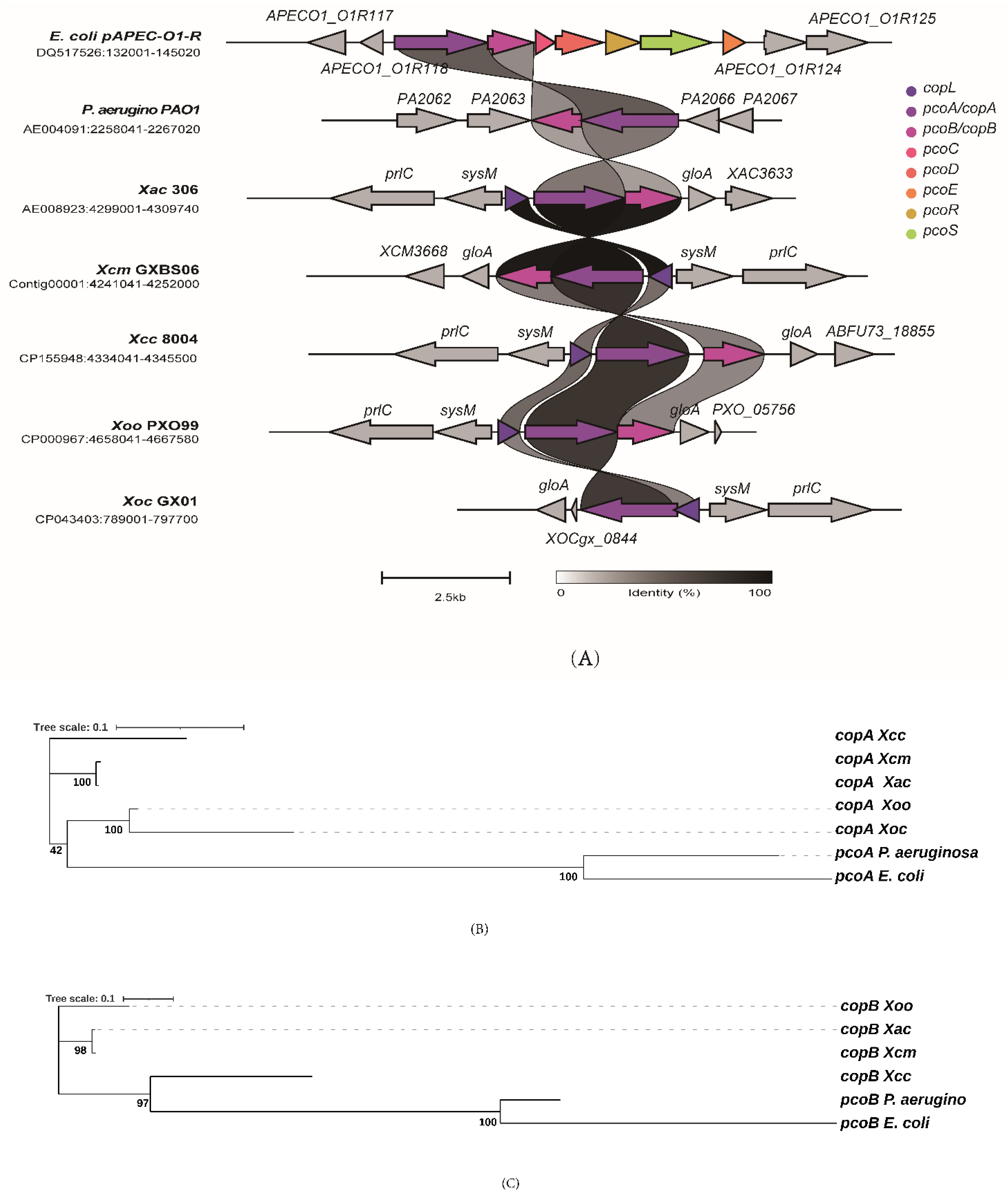
To comprehensively analyze the distribution of copper resistance-related genes in Xcm, sequences of genes known to be associated with copper homeostasis in E. coli, P. aeruginosa, and Xac were retrieved and used to identify their homologous genes in different pathogenic microorganisms (Table 3, Figure 2A).
The results indicated that the analyzed strains share a similar set of genes related to copper homeostasis. All of them contained the resistance nodulation division (RND)-type transmembrane efflux pump system czcCBA, the periplasmic copper chaperone ptrA, the multicopper oxidase pcoA, and the siderophore receptors fpvA/B (Table 3). This suggests that bacterial systems for copper homeostasis are broadly conserved, implying that these organisms may employ similar mechanisms to cope with external copper stress. Compared to P. aeruginosa, all the other tested strains lacked homologs of the important copper chaperone genes copZ1/Z2. Additionally, E. coli lacked fpvA/B. The plasmid of E. coli contains the pcopABCDERS gene cluster; P. aeruginosa contains copAB and lacks copL. Among several strains of the genus Xanthomonas, except for Xoc, all others contain the complete copLAB gene cluster, and Xoc was missing copB, which is involved in copper efflux and oxidation to reduce Cu2+ levels in the periplasm (Table 3, Figure 2A). Owing to the relatively low sequence identity (≥20%) between copper-related genes in the genus Xanthomonas and the known copper resistance genes in E. coli, the results of structural similarity comparison fail to support the presence of homologous genes for cueR, pcoRS, and copA in the genus Xanthomonas, but other homologous genes have similar structures (Table 3). Owing to the relatively low sequence identity (≥20%) between copper-related genes in the genus Xanthomonas and the known copper resistance genes in E. coli, the results of structural similarity comparison fail to support the presence of homologous genes for cueR, pcoRS, and copA in the genus Xanthomonas, but other homologous genes have similar structures (Table 3). Analysis of the flanking sequences of copAB revealed that, within the genus Xanthomonas, the downstream region of copAB is transcribed in the same direction as gloA, while its upstream region is transcribed in the opposite direction to sysM and prlC. No analogous structure exists in E. coli and P. aeruginosa as observed in the genus Xanthomonas (Figure 2A).
To investigate the evolutionary relationships of copper resistance genes, we constructed phylogenetic trees for copA and copB. The copAB phylogenetic tree (Figure 2) showed that all copAB sequences from Xanthomonas were clearly separated from the outgroup sequences from E. coli and P. aeruginosa. Among these, copA of Xcm formed a clade with that of its close relative Xac, with extremely short branch lengths, indicating high sequence similarity between them. This clade further formed a sister group to that of Xcc. Notably, copA from Xoo and Xoc also clustered together, but the branch length of Xoc was considerably longer than that of Xoo, suggesting that copA in Xoc might have evolved at a faster rate (Figure 2B). In contrast to copA, the copB phylogenetic tree (Figure 2C) exhibited a distinct topology. The copB sequences of Xcm and Xac still clustered together with extremely short branch lengths. However, this clade did not directly cluster with the copB of Xcc; instead, it formed a sister group to a larger clade comprising the outgroup sequences (pcoB from E. coli and P. aeruginosa) and the copB of Xcc. Additionally, the copB from Xoo was positioned at the base of the phylogenetic tree, distant from all other Xanthomonas and outgroup sequences, with a long branch length.

3.3. copB Is a Critical Copper Resistance Gene in Xcm GXBS06

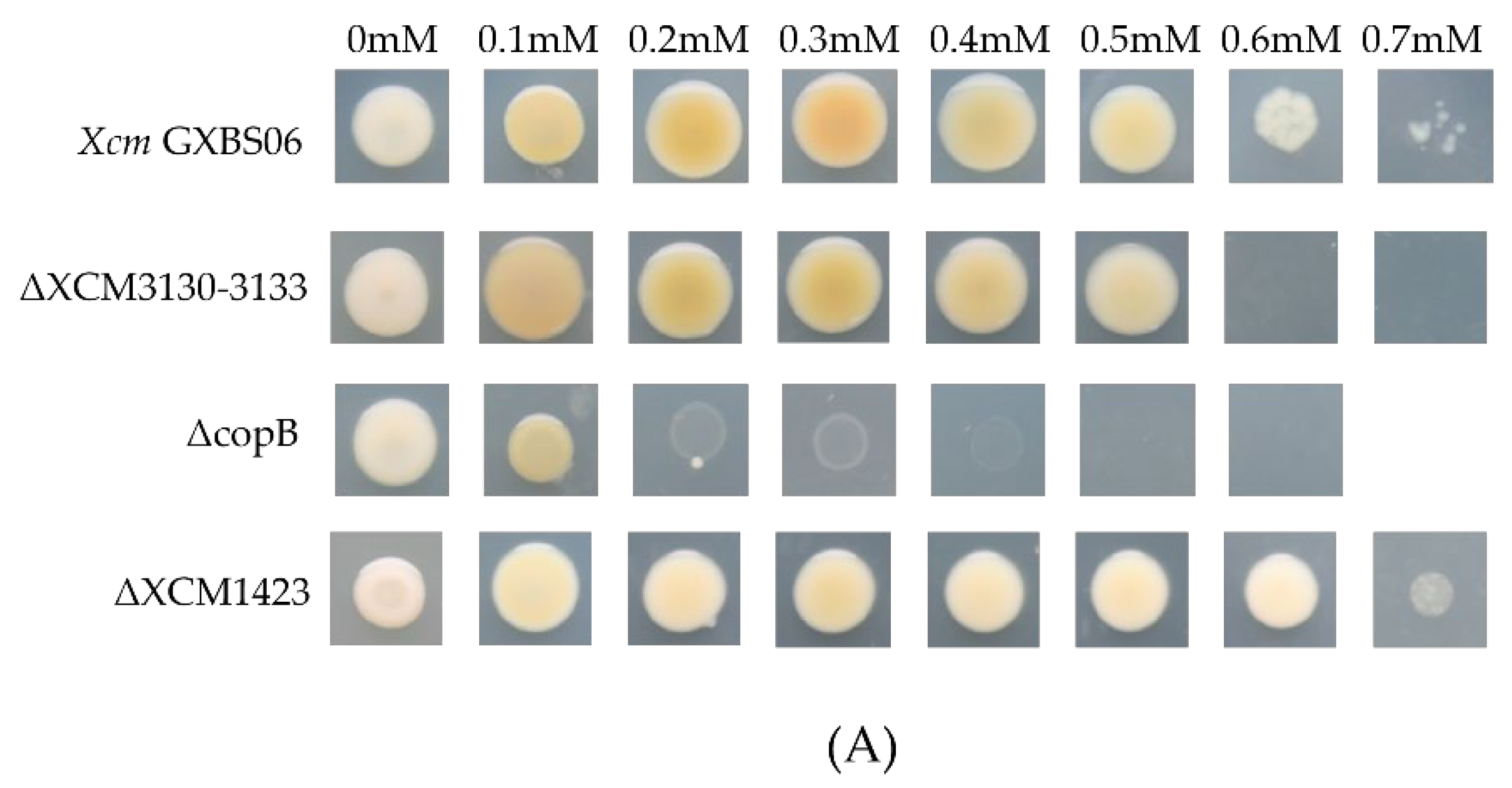
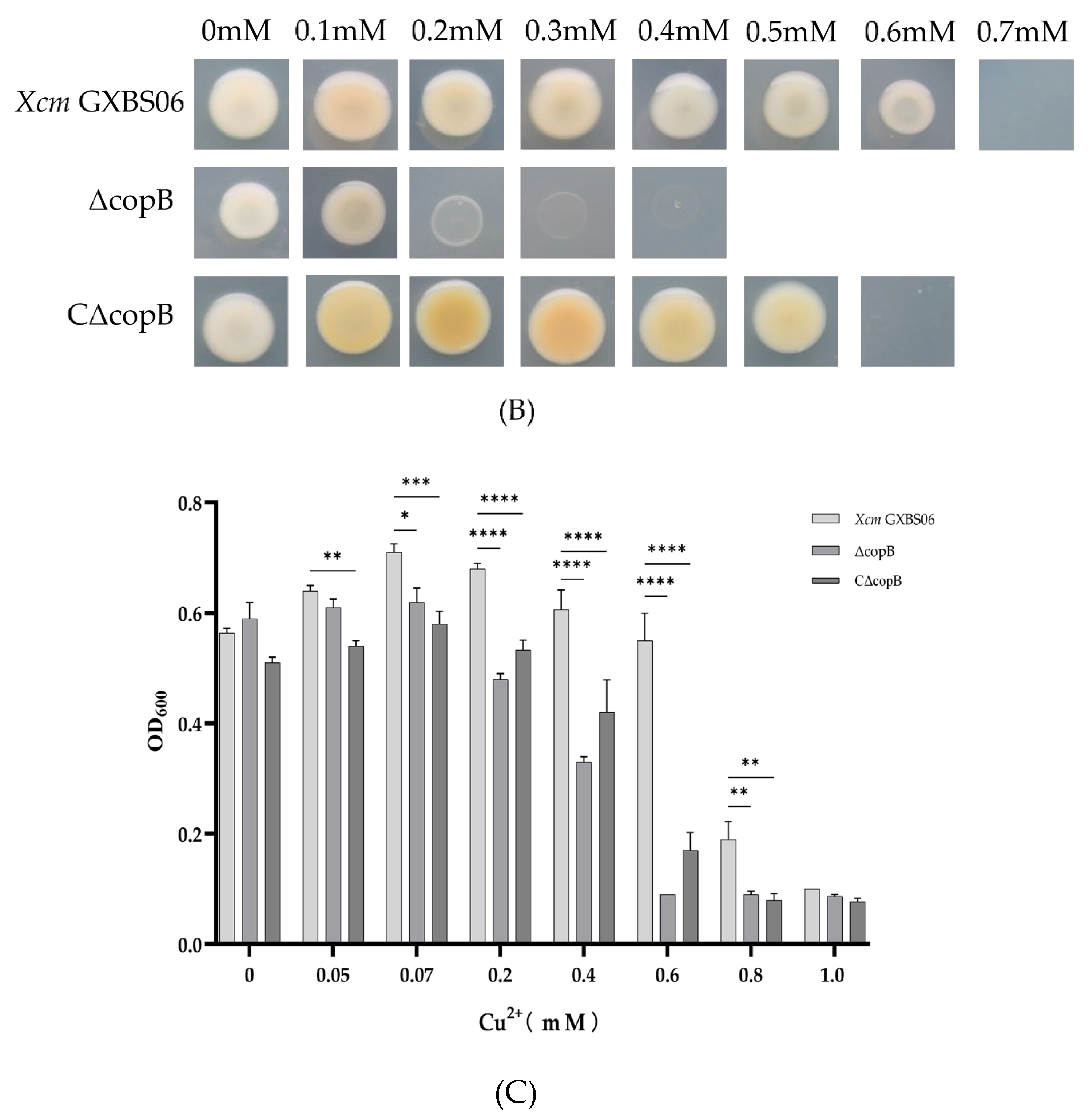
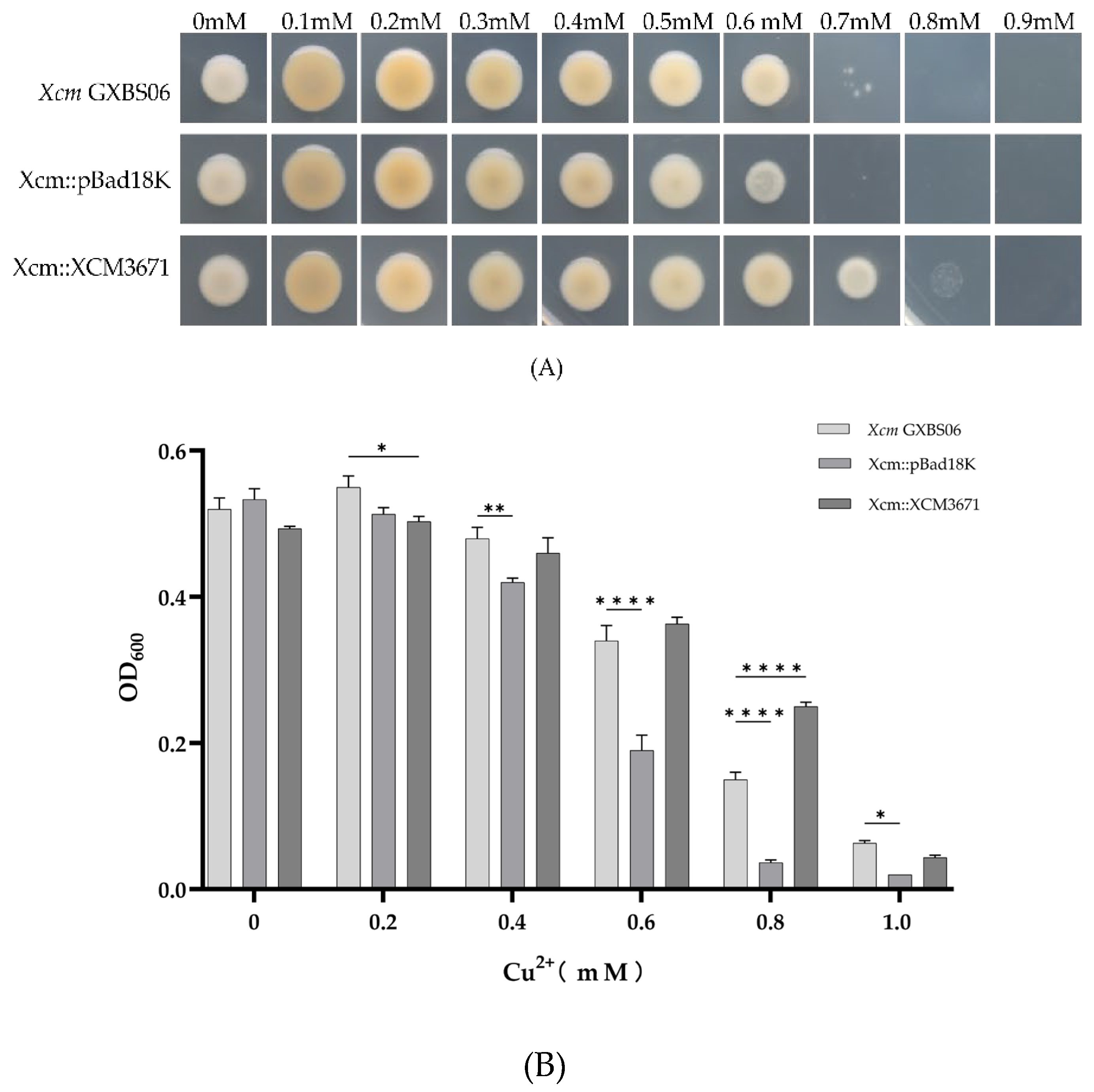
Among the candidate copper resistance-related genes identified through homology analysis (Table 3), six were selected for functional characterization. Deletion mutants were successfully constructed for five of these genes (copB, XCM1423, and XCM3130-33), while attempts to delete XCM3671 were unsuccessful. Therefore, XCM3671 was characterized via overexpression analysis. Subsequently, systematic resistance assays were conducted on these mutants under varying copper ion concentrations. The results showed that on solid medium, the wild-type strain could still form sparse colonies in the presence of 0.7 mM copper ions. However, among all mutants tested, ΔcopB exhibited the most significant reduction in copper resistance, failing to grow on plates containing 0.3 mM copper ions. In contrast, mutants of the other four genes showed no obvious changes in copper resistance (Figure 3A). In liquid medium supplemented with 0.2 mM copper ions, the copB mutant ΔcopB displayed significant growth inhibition (Figure 3B). To validate its function, a complemented strain, CΔcopB, was constructed. Copper resistance assays revealed that the copper tolerance of the ΔcopB mutant was significantly decreased compared to the wild-type strain, while the resistance level of the complemented strain CΔcopB was substantially restored to wild-type levels (Figure 3C). These results strongly suggested that copB is a key copper resistance gene in Xcm GXBS06. At copper concentrations exceeding 0.6 mM, the complemented strain did not fully recover to wild-type levels (Figure 3C).

3.4. copB Expression Is Significantly Upregulated Under Both Low (0.2 mM) and High (0.6 mM) Copper Ion Concentrations

To verify whether copB expression is induced by copper ions, the expression levels of copB were examined under stress conditions of 0.2 mM and 0.6 mM copper ions. qRT-PCR results showed that under low-concentration (0.2 mM) copper stress, the expression level of copB was significantly upregulated 90.73-fold (log2 fold change = 6.50) compared to the control group; under high-concentration (0.6 mM) stress, its expression level reached 40.45-fold (log2 fold change = 5.34) compared to that of the control group (Table 4). These results indicate that copB expression is strongly induced by different concentrations of copper ions.

3.5. Overexpression of XCM3671 Significantly Enhances Copper Tolerance in Xcm and Xoc

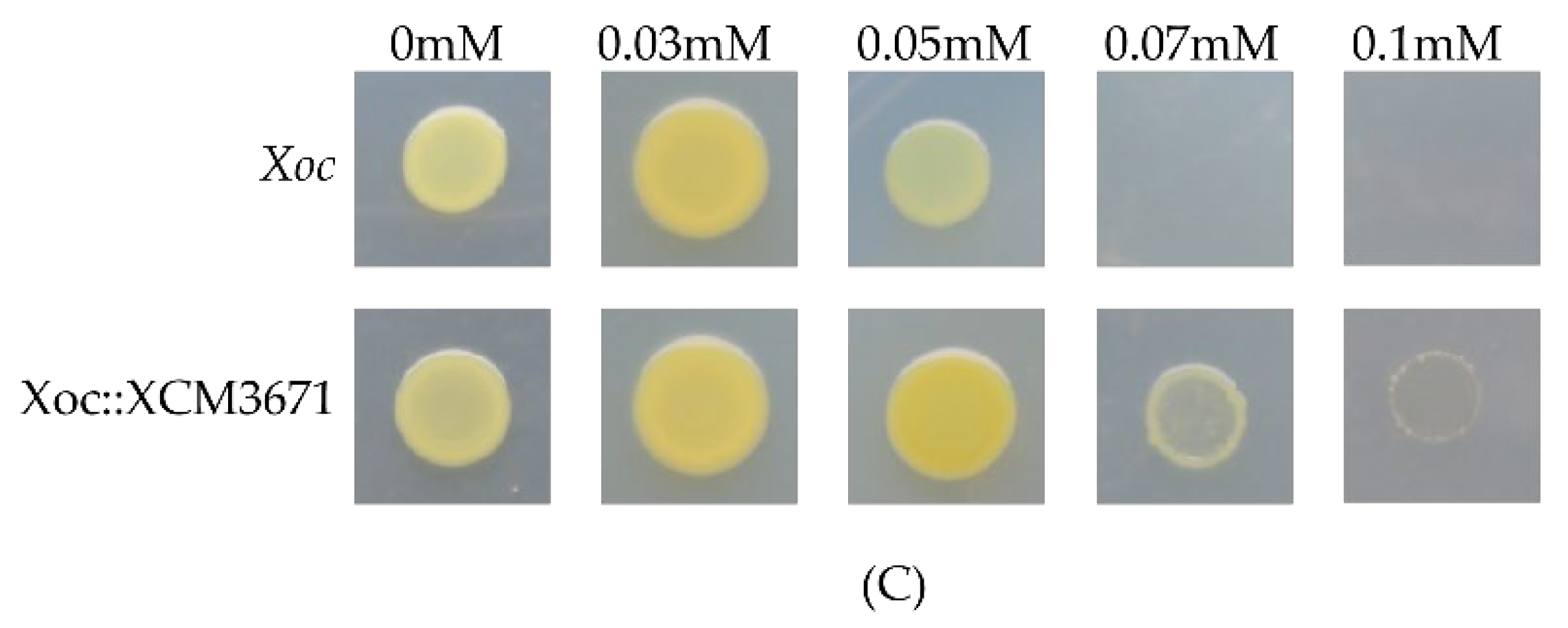
In Xanthomonas species, the function of copB is often associated with copA, which is annotated as a multicopper oxidase gene closely related to copper homeostasis. Homology analysis revealed that copA corresponds to locus tag XCM3671 in Xcm GXBS06. Although there is currently no evidence indicating that this gene is a housekeeping gene, we attempted various mutagenesis methods, including integrative mutagenesis, insertional mutagenesis, and simultaneous deletion of both XCM3671(copA) and copB. However, we were consistently unable to obtain a mutant of its homologous gene, XCM3671. To investigate the role of XCM3671 in copper resistance, an arabinose-inducible plasmid carrying this gene was introduced into Xcm and Xoc for overexpression. The Xcm::XCM3671 strain was able to grow on plates and in liquid medium containing 0.8 mM copper ions, exhibiting significantly enhanced copper resistance compared to the wild-type strain (Figure 4A,B). This indicates that XCM3671 is indeed involved in copper resistance. Xoc possesses a homolog of XCM3671 but lacks a homolog of copB (Table 3, Figure 2A), and its maximum tolerated copper concentration is only 0.05 mM, making it the most copper-sensitive strain among the Xanthomonas species tested to date. Compared to the Xoc wild-type strain, the Xoc::XCM3671 strain showed significantly enhanced copper resistance, with its maximum tolerated copper concentration increasing from 0.05 mM to 0.1 mM (Figure 4C). These results collectively demonstrate that XCM3671 significantly enhances copper resistance in both Xcm and Xoc.

4. Discussion

Guangxi, China, is one of the most important mango-producing regions in the country, consistently ranking among the top three provinces for mango yield. Since none of the main cultivated mango varieties possess immunity to Xcm, copper-based compounds have been the primary bactericides used to limit the occurrence, development, and spread of this pathogen. Currently, all three Xcm (GXG07, B3, and GXBS06) strains isolated from Guangxi exhibit high copper resistance, with no copper-sensitive strains having been identified to date [5,6,7]. In-depth research on copper resistance genes is therefore crucial for the prevention and control of this disease.
Copper is an essential trace element for all life forms, participating as a cofactor in the active centers of various key enzymes, such as cytochrome c oxidase and superoxide dismutase [39,40]. However, “the dose makes the poison”, and excess copper becomes lethal. Consequently, throughout their long evolutionary history, microorganisms have necessarily developed sophisticated copper homeostasis regulatory networks to maintain a delicate balance between essentiality and toxicity.
Research indicates that the copper resistance mechanism in pathogenic bacteria is a complex, multi-gene cooperative system. It primarily includes: (1) Active Efflux Systems: Represented by the RND family efflux pump encoded by the cusABC gene cluster, these systems actively pump excess copper ions from the cytoplasm or periplasm out of the cell using cellular energy (e.g., proton motive force), constituting a core resistance mechanism [41]. (2) Sequestration/Storage Systems: Exemplified by the copABCD gene cluster, which encodes a series of proteins localized in the periplasm, inner membrane, and outer membrane [18,42,43]. For instance, CopA (a P-type ATPase) pumps excess cytoplasmic copper into the periplasm; CopC is a periplasmic copper chaperone involved in copper capture and transport; CopB is a putative outer membrane protein potentially involved in final copper efflux or sequestration [44]; and the function of CopD is not fully understood. In P. syringae, copA and copB contribute partially to copper resistance [45]. This system functions like a “temporary warehouse,” safely sequestering toxic copper ions in compartments less disruptive to cellular metabolism. (3) Oxidative Detoxification Systems: Multicopper oxidases (e.g., CueO) can oxidize the more toxic cuprous ions (Cu+) to the less toxic cupric ions (Cu2+), thereby reducing cellular damage [18]. (4) Regulatory Systems: Centered on two-component systems like CopR/S or CusR/S, these act as “radars” and “switches.” The sensor protein (CopS/CusS) perceives changes in environmental copper concentrations. Upon exceeding a threshold, it is activated and phosphorylates its cognate response regulator (CopR/CusR) [40,46]. The phosphorylated regulator then binds to promoter regions of resistance genes (e.g., copABCD, cusABC), initiating their transcription and thus building the “defensive fortifications.” Bioinformatic analysis reveals that Xcm lacks plasmid-borne cop gene clusters. Instead, it retains only an incomplete pcop gene cluster on its chromosome, homologous to the plasmid-borne pcop cluster found in E. coli. In most Xanthomonas species, copper resistance is conferred by the plasmid-borne copLAB gene cluster [47]. The pcop gene cluster does not play a primary role in E. coli copper resistance, where cueR is critical [48]. Within the genus Xanthomonas, the system governed by the cop gene cluster is a significant mechanism for maintaining copper homeostasis. Comparative analysis of cop operons across various Xanthomonas and Pseudomonas species revealed that the Xanthomonas cop operon is among the smallest, relying solely on CopA and CopB to confer substantial copper resistance, highlighting the crucial role of copAB in the copper resistance mechanisms of this genus [49]. Within copLAB, copL plays a minor role in copper resistance, whereas copA is critical [50]. In this study, we systematically mutated homologs of several important known copper resistance genes in Xcm GXBS06 and assessed the copper tolerance of the resulting mutants. We identified copB as an important copper resistance gene in Xcm. However, copB deletion did not affect extracellular amylase activity, extracellular polysaccharide production, extracellular cellulase activity, extracellular protease activity, swarming motility, swimming motility, or antioxidant capacity. It also did not impact pathogenicity or bacterial growth within the host, suggesting that its function is specifically related to copper resistance. Unfortunately, we were unable to obtain a copA mutant, precluding direct assessment of its role in copper tolerance. Nevertheless, overexpression of copA significantly enhanced copper resistance in both Xcm and Xoc, indicating that copA is also a copper resistance-related gene. XCM3130/3131/3133 is predicted to constitute the czcABC efflux system, which could theoretically transport excess copper ions from the periplasm out of the cell. However, this system appeared non-functional for copper efflux in Xcm under the conditions tested, although it might play a role in the efflux of other metal ions. Additionally, this loss of function was also observed for the cueR homolog XCM1423. These findings suggest that Xanthomonas and Escherichia employ fundamentally different primary systems to cope with elevated environmental copper concentrations. According to phylogenetic analysis, the topology of copAB from Xanthomonas was clearly separated from the outgroup sequences from E. coli and P. aeruginosa. The distinct evolutionary histories of the copper resistance genes copA and copB in Xanthomonas are largely consistent with the species classification of the host bacteria, wherein the X. citri clade is separated from the X. campestris clade, while the X. oryzae clade forms an independent lineage. This pattern suggests that copA has primarily been transmitted vertically within the genus Xanthomonas, functioning as a core gene involved in basal copper homeostasis. This phylogenetic topology strongly suggests that copB may have undergone horizontal gene transfer (HGT). This finding is consistent with reports that copper resistance genes are often located on plasmids or mobile genetic elements, and provides a potential explanation for the substantial variability in copper resistance capacity among different species within the same genus, or even among different strains of the same species.
Due to the overall low similarity between the copper resistance-related genes of Xanthomonas, E. coli and P. aeruginosa, we conducted auxiliary analysis on these genes using structural similarity. Through Alphafold’s structural simulation and Foldseek’s search, XCM1423, XCM2092, XCM2014/2013, and XCM2541/2542 have shown no structural similarity with CueR, CopA, and CopRS, respectively. This indicates that these genes may have different functions in Xcm from those in E. coli and P. aeruginosa.
For many copper-tolerant pathogenic bacteria, high concentrations of copper can lead to cell wall thickening or the formation of abnormal surface structures (such as protrusions or exudates), which represent a defensive response by the bacteria attempting to prevent copper ions from entering the cell [51]. Studies on Xanthomonas have shown that under copper stress, Xac can enter a viable but non-culturable (VBNC) state [52]. Concurrently, to counteract copper stress, bacteria may increase the synthesis of the protective layer EPS to sequester free copper ions, resulting in morphological changes such as a smoother or altered surface glossiness [53]. However, morphological changes induced by copper stress have not been observed in other studies on copper resistance within the genus Xanthomonas. In the present study, SEM analysis revealed no changes in the surface morphology or motility of Xcm under different copper ion concentrations.
In Xac, gene expression analysis of the cop operon revealed that copAB transcripts were detectable only when copper was added to the culture medium. The accumulation of copAB transcripts subsequently induced CopA and CopB, confirming the coupling of copper-induced transcription and translation [49]. In the present study, copB expression levels were significantly upregulated under both 0.2 mM and 0.6 mM copper ion concentrations, suggesting that copB expression in Xcm is also copper-inducible.
In some Xanthomonas species, copAB are typically located within a cop gene cluster. In Xanthomonas. axonopodis pv. vesicatoria, copper resistance genes are plasmid-borne, and their expression is regulated by copL, an open reading frame (ORF) located directly upstream of copAB. Notably, their expression does not depend on the two-component systems (copRS or pcoRS) [54]. In Xanthomonas. axonopodis pv. manihotis, highly conserved copLAB or copABCD gene clusters are widely distributed [55].
In the homology analysis of copper resistance genes conducted in this study, we evaluated copper tolerance in Xcm alongside Xoo, Xoc, Xac, and Xcc. We observed that copper tolerance among Xanthomonas species was generally consistent. However, as shown in Figure 1A,B, Xoc exhibited the weakest copper tolerance among the five strains tested, tolerating only 0.05 mM copper ions. Comparative analysis revealed that Xoc possesses copA and copL homologs but lacks copB. This observation suggests a correlation between the presence of copB and higher copper tolerance among Xanthomonas species. However, whether the absence of copB is the direct cause of the low copper tolerance in Xoc requires further experimental validation, as other genetic differences among these strains may also contribute to the observed phenotype. Nonetheless, these findings support that copB plays an important role in copper resistance within the genus Xanthomonas. Furthermore, the function of copA in Xoc may be comparatively weaker than that of its homolog in Xac, which could also explain why overexpression of copA in Xcm only increased its copper tolerance to 0.1 mM. This highlights that substantial functional differences exist among homologous genes across different bacterial strains.

5. Conclusions

In this study, using the copper-tolerant strain Xcm GXBS06, we identified five potential copper resistance-related (plus one analyzed by overexpression) genes through homology analysis. Ultimately, the crucial copper resistance gene copB was confirmed. copB encodes the copper efflux protein CopB, and mutation of copB led to a significant decrease in the copper resistance of this strain, demonstrating that copB is an important copper resistance gene in Xcm GXBS06. These findings provide a foundation for further studies on copper resistance mechanisms and the management of Xcm.

Author Contributions

M.T.: Writing—original draft, Methodology, Investigation, Formal analysis, Data curation. M.Q.: Writing—original draft, Methodology, Investigation, Formal analysis, Data curation. Y.M.: Writing—review and editing, Validation, Formal analysis. F.B.: Writing—review and editing, Formal analysis. S.Z.: Writing—review and editing, Formal analysis. Y.H.: Writing—review and editing, Formal analysis. W.J.: Writing—review and editing, Supervision, Project administration, Methodology, Funding acquisition, Formal analysis, Conceptualization. All authors have read and agreed to the published version of the manuscript.

Funding

This research was supported by the National Natural Science Foundation of China (32460044), the Key Research and Development Program of Guangxi (AB241484043), and the Guangxi Key Laboratory of Biology for Mango (GKLBMO25).

Institutional Review Board Statement

Not applicable.

Informed Consent Statement

Not applicable.

Data Availability Statement

The original contributions presented in this study are included in the article. Further inquiries can be directed to the corresponding author.

Conflicts of Interest

The authors declare no conflicts of interest.

References

  1. Gagnevin, L.; Pruvost, O. Epidemiology and Control of Mango Bacterial Black Spot. Plant Dis. 2001, 85, 928–935. [Google Scholar] [CrossRef] [PubMed]
  2. Rudolph, K. Infection of the plant by Xanthomonas. In Xanthomonas; Swings, J.G., Civerolo, E.L., Eds.; Springer: Dordrecht, The Netherlands, 1993; pp. 193–264. [Google Scholar]
  3. Pruvost, O.; Savelon, C.; Boyer, C.; Chiroleu, F.; Gagnevin, L.; Jacques, M.A. Populations of Xanthomonas citri pv. mangiferaeindicae from asymptomatic mango leaves are primarily endophytic. Microb. Ecol. 2009, 58, 170–178. [Google Scholar] [CrossRef] [PubMed]
  4. Sossah, F.L.; Aidoo, O.F.; Dofuor, A.K.; Osabutey, A.F.; Obeng, J.; Abormeti, F.K.; Duker, R.Q.; Antwi-Agyakwa, A.K.; Osei-Owusu, J.; Loh, S.K.; et al. A critical review on bacterial black spot of mango caused by Xanthomonas citri pv. mangiferaeindicae: Current status and direction for future research. For. Pathol. 2024, 54, e12860. [Google Scholar] [CrossRef]
  5. Bie, F.; Li, Y.; Liu, Z.; Qin, M.; Li, S.; Dan, X.; Huang, S.; He, Y.Q.; Jiang, W. High-Quality Genome Resource of Mango Bacterial Black Spot Pathogen Xanthomonas citri pv. mangiferaeindicae GXG07 Isolated from Guangxi, China. Plant Dis. 2022, 106, 1027–1030. [Google Scholar] [CrossRef]
  6. Ouyang, Q.; Yang, C.; Lv, L.; Huang, J.; Li, X.; Zhu, Z. The complete genome of Xanthomonas citri pv. mangiferaeindicae strain B3, isolated from diseased mango leaves in Guangxi, China. Microbiol. Resour. Announc. 2025, 14, e0029925. [Google Scholar] [CrossRef]
  7. Li, Y.M.; Peng, J.; Miao, Y.; Qin, M.; Liao, L.; Tian, Y.; Wang, S.; He, Y.Q.; Jiang, W. Complete genome sequence of Xanthomonas citri pv. mangiferaeindicae GXBS06 isolated from the mango fruit in Guangxi, China. Microbiol. Resour. Announc. 2026, 15, e0113525. [Google Scholar] [CrossRef]

  8. Banik, S.; Pérez-de-Luque, A. In vitro effects of copper nanoparticles on plant pathogens, beneficial microbes and crop plants. Span. J. Agric. Res. 2017, 15, e1005. [Google Scholar] [CrossRef]
  9. Kamel, S.M.; Elgobashy, S.F.; Omara, R.I.; Derbalah, A.S.; Abdelfatah, M.; El-Shaer, A.; Al-Askar, A.A.; Abdelkhalek, A.; Abd-Elsalam, K.A.; Essa, T.; et al. Antifungal Activity of Copper Oxide Nanoparticles against Root Rot Disease in Cucumber. J. Fungi 2022, 8, 911. [Google Scholar] [CrossRef]
  10. Tamm, L.; Thuerig, B.; Apostolov, S.; Blogg, H.; Borgo, E.; Corneo, P.E.; Fittje, S.; de Palma, M.; Donko, A.; Experton, C.; et al. Use of Copper-Based Fungicides in Organic Agriculture in Twelve European Countries. Agronomy 2022, 12, 673. [Google Scholar] [CrossRef]
  11. Richard, D.; Boyer, C.; Vernière, C.; Canteros, B.I.; Lefeuvre, P.; Pruvost, O. Complete Genome Sequences of Six Copper-Resistant Xanthomonas citri pv. citri Strains Causing Asiatic Citrus Canker, Obtained Using Long-Read Technology. For. Pathol. 2009, 5, e00010-17. [Google Scholar] [CrossRef]
  12. Klein-Gordon, J.M.; Xing, Y.; Garrett, K.A.; Abrahamian, P.; Paret, M.L.; Minsavage, G.V.; Strayer-Scherer, A.L.; Fulton, J.C.; Timilsina, S.; Jones, J.B.; et al. Assessing Changes and Associations in the Xanthomonas perforans Population Across Florida Commercial Tomato Fields Via a Statewide Survey. Phytopathology 2021, 111, 1029–1041. [Google Scholar] [CrossRef]
  13. Busenlehner, L.S.; Pennella, M.A.; Giedroc, D.P. The SmtB/ArsR family of metalloregulatory transcriptional repressors: Structural insights into prokaryotic metal resistance. FEMS Microbiol. Rev. 2003, 27, 131–143. [Google Scholar] [CrossRef] [PubMed]
  14. Rensing, C.; Grass, G. Escherichia coli mechanisms of copper homeostasis in a changing environment. FEMS Microbiol. Rev. 2003, 27, 197–213. [Google Scholar] [CrossRef] [PubMed]
  15. Mills, S.D.; Jasalavich, C.A.; Cooksey, D.A. A two-component regulatory system required for copper-inducible expression of the copper resistance operon of Pseudomonas syringae. J. Bacteriol. 1993, 175, 1656–1664. [Google Scholar] [CrossRef] [PubMed]
  16. Grünberger, F.; Reichelt, R.; Waege, I.; Ned, V.; Bronner, K.; Kaljanac, M.; Weber, N.; El Ahmad, Z.; Knauss, L.; Madej, M.G.; et al. CopR, a Global Regulator of Transcription to Maintain Copper Homeostasis in Pyrococcus furiosus. Front. Microbiol. 2020, 11, 613532. [Google Scholar] [CrossRef]
  17. Marin, T.G.S.; Galvanin, A.L.; Lanza, F.E.; Behlau, F. Description of copper tolerant Xanthomonas citri subsp. citri and genotypic comparison with sensitive and resistant strains. Plant Pathol. 2019, 68, 1088–1098. [Google Scholar] [CrossRef]
  18. Behlau, F.; Canteros, B.I.; Minsavage, G.V.; Jones, J.B.; Graham, J.H. Molecular characterization of copper resistance genes from Xanthomonas citri subsp. citri and Xanthomonas alfalfae subsp. citrumelonis. Appl. Environ. Microbiol. 2011, 77, 4089–4096. [Google Scholar] [CrossRef]
  19. Lee, S.M.; Grass, G.; Rensing, C.; Barrett, S.R.; Yates, C.J.; Stoyanov, J.V.; Brown, N.L. The Pco proteins are involved in periplasmic copper handling in Escherichia coli. Biochem. Biophys. Res. Commun. 2002, 295, 616–620. [Google Scholar] [CrossRef]
  20. Palmieri, A.C.; do Amaral, A.M.; Homem, R.A.; Machado, M.A. Differential expression of pathogenicity- and virulence-related genes of Xanthomonas axonopodis pv. citri under copper stress. Genet. Mol. Biol. 2010, 33, 348–353. [Google Scholar] [CrossRef]
  21. Outten, F.W.; Outten, C.E.; Hale, J.; O’Halloran, T.V. Transcriptional activation of an Escherichia coli copper efflux regulon by the chromosomal MerR homologue, cueR. J. Biol. Chem. 2000, 275, 31024–31029. [Google Scholar] [CrossRef]
  22. Andoy, N.M.; Sarkar, S.K.; Wang, Q.; Panda, D.; Benítez, J.J.; Kalininskiy, A.; Chen, P. Single-molecule study of metalloregulator CueR-DNA interactions using engineered Holliday junctions. Biophys. J. 2009, 97, 844–852. [Google Scholar] [CrossRef]
  23. Brown, N.L.; Stoyanov, J.V.; Kidd, S.P.; Hobman, J.L. The MerR family of transcriptional regulators. FEMS Microbiol. Rev. 2003, 27, 145–163. [Google Scholar] [CrossRef] [PubMed]
  24. Niu, X.N.; Li, Y.; Carpenter, S.C.D.; Dan, X.; Li, T.; Wu, Q.; Wang, L.; Jiang, W.; Huang, S.; Tang, J.L.; et al. Complete Genome Resource of Xanthomonas oryzae pv. oryzicola GX01 Isolated in South China. Mol. Plant Microbe Interact. 2022, 35, 357–359. [Google Scholar] [CrossRef] [PubMed]
  25. Lei, Y.; Kang, S.K.; Gao, J.; Jia, X.S.; Chen, L.L. Improved annotation of a plant pathogen genome Xanthomonas oryzae pv. oryzae PXO99A. J. Biomol. Struct. Dyn. 2013, 31, 342–350. [Google Scholar] [CrossRef] [PubMed]
  26. Wang, H.; Shi, C.; Xie, Q.; Wang, Y.; Liu, S.; Li, C.; He, C.; Tao, J. Genome-Wide Analysis of β-Galactosidases in Xanthomonas campestris pv. campestris 8004. Front. Microbiol. 2018, 9, 957. [Google Scholar] [CrossRef]
  27. Hanahan, D. Studies on transformation of Escherichia coli with plasmids. J. Mol. Biol. 1983, 166, 557–580. [Google Scholar] [CrossRef]
  28. Schäfer, A.; Tauch, A.; Jäger, W.; Kalinowski, J.; Thierbach, G.; Pühler, A. Small mobilizable multi-purpose cloning vectors derived from the Escherichia coli plasmids pK18 and pK19: Selection of defined deletions in the chromosome of Corynebacterium glutamicum. Gene 1994, 145, 69–73. [Google Scholar] [CrossRef]
  29. Huynh, T.V.; Dahlbeck, D.; Staskawicz, B.J. Bacterial blight of soybean: Regulation of a pathogen gene determining host cultivar specificity. Science 1989, 245, 1374–1377. [Google Scholar] [CrossRef]
  30. Guzman, L.M.; Belin, D.; Carson, M.J.; Beckwith, J. Tight regulation, modulation, and high-level expression by vectors containing the arabinose PBAD promoter. J. Bacteriol. 1995, 177, 4121–4130. [Google Scholar] [CrossRef]
  31. Sambrook, J.; Fritsch, E.F.; Maniatis, T. Molecular Cloning: A Laboratory Manual, 2nd ed.; Cold Spring Harbor Laboratory Press: Cold Spring Harbor, NY, USA, 1989. [Google Scholar]
  32. Turner, P.; Barber, C.; Daniels, M. Evidence for clustered pathogenicity genes in Xanthomonas campestris pv. campestris. Mol. Gen. Genet. 1985, 199, 338–343. [Google Scholar] [CrossRef]
  33. Abramson, J.; Adler, J.; Dunger, J.; Evans, R.; Green, T.; Pritzel, A.; Ronneberger, O.; Willmore, L.; Ballard, A.J.; Bambrick, J.; et al. Accurate structure prediction of biomolecular interactions with AlphaFold 3. Nature 2024, 630, 493–500. [Google Scholar] [CrossRef] [PubMed]
  34. van Kempen, M.; Kim, S.S.; Tumescheit, C.; Mirdita, M.; Lee, J.; Gilchrist, C.L.M.; Söding, J.; Steinegger, M. Fast and accurate protein structure search with Foldseek. Nat. Biotechnol. 2024, 42, 243–246. [Google Scholar] [CrossRef] [PubMed]
  35. Edgar, R.C. MUSCLE: A multiple sequence alignment method with reduced time and space complexity. BMC Bioinform. 2004, 5, 113. [Google Scholar] [CrossRef] [PubMed]
  36. Darriba, D.; Posada, D.; Kozlov, A.M.; Stamatakis, A.; Morel, B.; Flouri, T. ModelTest-NG: A New and Scalable Tool for the Selection of DNA and Protein Evolutionary Models. Mol. Biol. Evol. 2020, 37, 291–294. [Google Scholar] [CrossRef]
  37. Kozlov, A.M.; Darriba, D.; Flouri, T.; Morel, B.; Stamatakis, A. RAxML-NG: A fast, scalable and user-friendly tool for maximum likelihood phylogenetic inference. Bioinformatics 2019, 35, 4453–4455. [Google Scholar] [CrossRef]
  38. Letunic, I.; Bork, P. Interactive Tree of Life (iTOL) v5: An online tool for phylogenetic tree display and annotation. Nucleic Acids Res. 2021, 49, W293–W296. [Google Scholar] [CrossRef]
  39. Burandt, Q.C.; Deising, H.B.; von Tiedemann, A. Further Limitations of Synthetic Fungicide Use and Expansion of Organic Agriculture in Europe Will Increase the Environmental and Health Risks of Chemical Crop Protection Caused by Copper-Containing Fungicides. Environ. Toxicol. Chem. 2024, 43, 19–30. [Google Scholar] [CrossRef]
  40. Tripathi, R.; Tewari, R.; Singh, K.P.; Keswani, C.; Minkina, T.; Srivastava, A.K.; De Corato, U.; Sansinenea, E. Plant mineral nutrition and disease resistance: A significant linkage for sustainable crop protection. Front. Plant Sci. 2022, 13, 883970. [Google Scholar] [CrossRef]
  41. Colombi, E.; Straub, C.; Künzel, S.; Templeton, M.D.; McCann, H.C.; Rainey, P.B. Evolution of copper resistance in the kiwifruit pathogen Pseudomonas syringae pv. actinidiae through acquisition of integrative conjugative elements and plasmids. Environ. Microbiol. 2017, 19, 819–832. [Google Scholar] [CrossRef]
  42. Li, Z.; Ma, Z.; Hao, X.; Rensing, C.; Wei, G. Genes conferring copper resistance in Sinorhizobium meliloti CCNWSX0020 also promote the growth of Medicago lupulina in copper-contaminated soil. Appl. Environ. Microbiol. 2014, 80, 1961–1971. [Google Scholar] [CrossRef]
  43. Yu, Y.; Liu, H.; Xia, H.; Chu, Z. Double- or Triple-Tiered Protection: Prospects for the Sustainable Application of Copper-Based Antimicrobial Compounds for Another Fourteen Decades. Int. J. Mol. Sci. 2023, 24, 10893. [Google Scholar] [CrossRef]
  44. Odermatt, A.; Suter, H.; Krapf, R.; Solioz, M. Primary structure of two P-type ATPases involved in copper homeostasis in Enterococcus hirae. J. Biol. Chem. 1993, 268, 12775–12779. [Google Scholar] [CrossRef] [PubMed]
  45. Hu, Y.H.; Wang, H.L.; Zhang, M.; Sun, L. Molecular analysis of the copper-responsive CopRSCD of a pathogenic Pseudomonas fluorescens strain. J. Microbiol. 2009, 47, 277–286. [Google Scholar] [CrossRef] [PubMed]
  46. Bender, C.L.; Cooksey, D.A. Molecular cloning of copper resistance genes from Pseudomonas syringae pv. tomato. J. Bacteriol. 1987, 169, 470–474. [Google Scholar] [CrossRef] [PubMed]
  47. Basim, H.; Minsavage, G.V.; Stall, R.E.; Wang, J.F.; Shanker, S.; Jones, J.B. Characterization of a unique chromosomal copper resistance gene cluster from Xanthomonas campestris pv. vesicatoria. Appl. Environ. Microbiol. 2005, 71, 8284–8291. [Google Scholar] [CrossRef]
  48. Moreira Martins, P.M.; Gong, T.; de Souza, A.A.; Wood, T.K. Copper Kills Escherichia coli Persister Cells. Antibiotics 2020, 9, 506. [Google Scholar] [CrossRef]
  49. Teixeira, E.C.; Franco de Oliveira, J.C.; Marques Novo, M.T.; Bertolini, M.C. The copper resistance operon copAB from Xanthomonas axonopodis pathovar citri: Gene inactivation results in copper sensitivity. Microbiology 2008, 154, 402–412. [Google Scholar] [CrossRef]
  50. Hsiao, Y.M.; Liu, Y.F.; Lee, P.Y.; Hsu, P.C.; Tseng, S.Y.; Pan, Y.C. Functional characterization of copA gene encoding multicopper oxidase in Xanthomonas campestris pv. campestris. J. Agric. Food Chem. 2011, 59, 9290–9302. [Google Scholar] [CrossRef]
  51. Luong, H.T.; Nguyen, C.X.; Lam, T.T.; Nguyen, T.H.; Dang, Q.L.; Lee, J.H.; Hur, H.G.; Nguyen, H.T.; Ho, C.T. Antibacterial effect of copper nanoparticles produced in a Shewanella-supported non-external circuit bioelectrical system on bacterial plant pathogens. RSC Adv. 2022, 12, 4428–4436. [Google Scholar] [CrossRef]
  52. del Campo, R.; Russi, P.; Mara, P.; Mara, H.; Peyrou, M.; de León, I.P.; Gaggero, C. Xanthomonas axonopodis pv. citri enters the VBNC state after copper treatment and retains its virulence. FEMS Microbiol. Lett. 2009, 298, 143–148. [Google Scholar] [CrossRef]
  53. Osiro, D.; Franco, R.W.A.; Colnago, L.A. Spectroscopic characterization of the exopolysaccharide of Xanthomonas axonopodis pv. citri in Cu2+ resistance mechanism. J. Braz. Chem. Soc. 2011, 22, 1339–1345. [Google Scholar] [CrossRef]
  54. Voloudakis, A.E.; Reignier, T.M.; Cooksey, D.A. Regulation of resistance to copper in Xanthomonas axonopodis pv. vesicatoria. Appl. Environ. Microbiol. 2005, 71, 782–789. [Google Scholar] [CrossRef]
  55. Shi, T.; Li, C.; Wang, G.; Huang, G. Multilocus Sequence Analysis and Detection of Copper Ion Resistance of Xanthomonas phaseoli pv. manihotis Causing Bacterial Blight in Cassava. Curr. Issues Mol. Biol. 2023, 45, 5389–5402. [Google Scholar] [CrossRef]
Figure 1. Copper resistance assay of strain Xcm GXBS06. (A) Qualitative plate assay for copper ion resistance of strains Xcm GXBS06, Xcc 8004, Xoc GX01, and Xoo PXO99A; (B) quantitative liquid assay for copper ion resistance of strains Xcm GXBS06, Xcc 8004, Xoc GX01, and Xoo PXO99A(different lowercase letters above the bars indicate statistically significant differences among groups at the same copper concentration (p < 0.05). Bars sharing the same letter are not significantly different.); (C) effect of different copper ion concentrations on the growth of strain Xcm GXBS06; (D) Xcm GXBS06 at a copper ion concentration of 0 mM (magnification, 40,000×); (E) Xcm GXBS06 at a copper ion concentration of 0.2 mM (magnification, 40,000×); (F) Xcm GXBS06 at a copper ion concentration of 0.6 mM (magnification, 40,000×).
Genes 17 00408 g001
Figure 2. Evolutionary relationship analysis of known copper resistance genes. (A) Major copper resistance gene clusters in seven strains. (B) Phylogenetic tree of copA homologs. (C) Phylogenetic tree of copB homologs.
Genes 17 00408 g002
Figure 3. Results of copper resistance assays. (A) Growth of five deletion mutants on solid medium with different copper ion concentrations; (B) growth of copB on solid medium with different copper ion concentrations; (C) growth of copB in liquid medium with different copper ion concentrations. Data represent the mean ± SD of three independent biological replicates. Statistical significance was determined by two-way ANOVA with Tukey’s multiple comparisons test. * p < 0.05, ** p < 0.01, *** p < 0.001, **** p < 0.0001, compared to the wild-type strain at the corresponding copper concentration.
Genes 17 00408 g003aGenes 17 00408 g003b
Figure 4. Functional characterization of XCM3671. (A) Growth of the arabinose-inducible overexpression strain of XCM3671 on solid medium with different copper ion concentrations; (B) growth of the arabinose-inducible overexpression strain of XCM3671 in liquid medium with different copper ion concentrations; (C) growth of the heterologous expression strain of XCM3671 on solid medium with different copper ion concentrations. Data represent the mean ± SD of three independent biological replicates. Statistical significance was determined by two-way ANOVA with Tukey’s multiple comparisons test. * p < 0.05, ** p < 0.01, **** p < 0.0001, compared to the wild-type strain at the corresponding copper concentration; ns, not significant.
Genes 17 00408 g004aGenes 17 00408 g004b
Table 1. Bacterial strains and plasmids used in this study.
Strains or PlasmidsRelevant CharacteristicsReference or Source
Xcm
Xcm GXBS06Xcm wild-type strain, Rif r[5]
ΔcopBAs Xcm GXBS06, but copB (XCM3670) gene deleted, non-polar effect, Rif rThis study
CΔcopBΔcopB harboring a recombinant plasmid derived from the full length of copB cloned into the promoterless plasmid pLAFR6., Rif r, Tc rThis study
ΔXCM3130-33As Xcm GXBS06, but XCM3130-33 gene deleted, non-polar effect, Rif rThis study
ΔXCM1423As Xcm GXBS06, but XCM1423 gene deleted, non-polar effect, Rif rThis study
Xcm::XCM3671Xcm GXBS06 harboring a recombinant plasmid derived from the full length of XCM3671 cloned into the promoterless plasmid pLAFR6., Rif r, Tc rThis study
Xcm::pBad18KXcm wild-type strain transformed with the empty vector pBad18K, Rif r, Kan rThis study
Xanthomonas oryzae pv. oryzicola (Xoc) GX01Xoc GX01 wild-type strain, Rif r[24]
Xoc::XCM3671Xoc GX01 harboring a recombinant plasmid derived from the full length of XCM3671 cloned into the promoterless plasmid pLAFR6., Rif r, Tc rThis study
Xanthomonas oryzae pv. oryzae (Xoo) PXO99AXoo PXO99A wild-type strain, Rif r[25]
Xanthomonas campestris pv. campestris (Xcc) 8004Xcc 8004 wild-type strain, Rif r[26]
E. coli
DH5αΦ80△lacZM15 recA1 endA1 deoR, Kan r[27]
2013Helper strain, Kan rThis study
plasmids
pK18mobsacBpUC18 derivative, lacZ, sacB, Kan r, mob site. Allelic exchange vector (Suicidal vector carrying sacB gene for mutagenesis) r[28]
pLARFJ6A promoterless derivative of pLAFR3, Shuttle plasmid, Tc r[29]
pBad18KL-arabinose-inducible expression plasmid, Kan r[30]
r: resistant
Table 2. PCR Primers Used in This Study.
PrimerSequence a (5′-3′)Direction and Use b
3130-33LFGAATTCTGCTGCGCGCCAGACCGTGCF, mutant construction and confirmation
3130-33LRTCTAGAGAGGGTGTCTCCGGAATCGGR, mutant construction
3130-33RFTCTAGAGCGGATGCACGGCGTGGTTGF, mutant construction
3130-33RRAAGCTTCGCGGAAACACGGAGCTTCAR, mutant construction and confirmation
3130-33FGTTCCGCGACTGGGATGTGGTGTTF, mutant confirmation
3130-33RTCGGATTCCAGCGGCGAATAR, mutant confirmation
3670LFGAATTCCTGATCGACATGCGCAGCAATF, mutant construction and confirmation
3670LRTCTAGAGCGAAAGCGGCTCATGCTTCR, mutant construction
3670RFTCTAGAGGTACCGCGGTTGGCCCTCTCCF, mutant construction
3670RRAAGCTTCGAAACGTGCGCAGGCGGCAR, mutant construction and confirmation
3670FGAATTCATGAGCCGCTTTCGCATGCAF, mutant confirmation and complemented strain construction
3670RTCTAGATCAAAACCAAACGCGCACTCR, mutant confirmation and complemented strain construction
3671LFGAATTCTTCGTGTTGGAAGCCTCCF, mutant construction and confirmation
3671LRTCTAGATGGAAGCATGAGCCGCTTTR, mutant construction
3671RFTCTAGAATCGAAAGACATGACATCTF, mutant construction
3671RRAAGCTTCCTGCTGCTGTGCCTGTGCCTR, mutant construction and confirmation
3671FGAATTCATGTCTTTCGATCCCCCGTTF, mutant confirmation and overexpression Strain construction
3671RAAGCTTTCATGCTTCCACCCGCACTTR, mutant confirmation and overexpression Strain construction
3670fAGCCAAGTTCGACCCGTTF, CopB RT-qPCR primer
3670rACTGGCGCCCTACAAGTTR, CopB RT-qPCR primer
a Added restriction enzyme sites are underlined. b F, forward direction; R, reverse direction.
Table 3. Comparative analysis of the copper resistance genes in phytopathogenic bacteria.
StrainsTF aCYTO-C a2CS aP-Type aRND bPeri-C bMCO bSidero bOther b
P. aeruginosacueRcopZ1
copZ2
copRScopA1,
copA2
czcCBAptrA
azu
pcoAfpvA
fpvB
pcoB
E. colicueRN/ApcoRS
cusRS
copAcusCFBApcoE
pcoC
cusF
pcoA
cueO
N/ApcoB
pcoD
XacXAC3000N/AXAC0325/0326
XAC0834/0835
XAC0757XAC4162
XAC4161
XAC4160
XAC4322XAC3630XAC3498XAC3631
copL
XcmXCM1423N/AXCM2542/2541 XCM2014/2013XCM2092XCM3130
XCM3131
XCM3133
XCM3906XCM3671XCM3812XCM3670
XCM3672
XooPXO_02196N/APXO_04836/04835
PXO_02836/02837
PXO_04386PXO_00707
PXO_00705
PXO_00706
PXO_02282PXO_03132PXO_01148PXO_03131
PXO_03133
XocXOCgx_3530N/AXOCgx_3291/3292
XOCgx_4037/4036
XOC4118XOCgx_2403
XOCgx_2401
XOCgx_2402
XOCgx_1068XOCgx_0845XOCgx_4723N/A
XOCgx_0846
XcABFU73_06540N/AABFU73_20535/20540
ABFU73_17805/17800
ABFU73_18215ABFU73_21305
ABFU73_21300
ABFU73_21295
ABFU73_04520ABFU73_18840ABFU73_03305ABFU73_18845
ABFU73_18835
Comparative analysis of the organization of copper resistance genes in P. aerugino PAO1 (GCA_000006765.1), E. coli APEC 01 (GCA_000014845.1), Xac 306(GCA_000007165.1), Xcm GXBS06(GCA_045799005.1), Xoo PXO99A(GCA_000019585.2), and Xoc GX01 (GCA_008370835.2). TF: transcription factor; CYTO-C: cytoplasmic copper chaperone; 2CS: copper sensing two-component systems; P-type: P-type copper ATPase; RND: resistance nodulation division-type transmembrane efflux pump; Peri C: periplasmic copper chaperone; MCO: multicopper oxidase; Sidero: siderophores; N/A: not applicable. a, while the genes exhibit similarity at the sequence level, their protein structures show low similarity. b, both comparison of sequence and protein structure all support that they are homologous genes.
Table 4. Gene expression levels of copB under different copper ion concentrations.
Gene NamePredicted ProductFold Change
(0.2 mM/0 mM)
log2 Fold Change (0.2 mM/0 mM)Fold Change (0.6 mM/0 mM)log2 Fold Change
(0.6 mM/0 mM)
copBCopper resistance protein B precursor (copB)90.736.5040.455.34
Disclaimer/Publisher’s Note: The statements, opinions and data contained in all publications are solely those of the individual author(s) and contributor(s) and not of MDPI and/or the editor(s). MDPI and/or the editor(s) disclaim responsibility for any injury to people or property resulting from any ideas, methods, instructions or products referred to in the content.