
Identification of Candidate Causal Polymorphisms in GGT1 and SLC5A1 Associated with Fat Area Ratio on BTA17 in Japanese Black Cattle
 , and
, and
Abstract
1. Introduction
2. Materials and Methods
2.1. Animals
2.2. GWAS
2.3. Detection of Polymorphisms Within the Candidate Region
2.4. Linkage Disequilibrium Analysis
2.5. Verifying the Effects of Candidate Polymorphisms on FAR
2.6. Gene Function Research
3. Results and Discussion
4. Conclusions
Supplementary Materials
Author Contributions
Funding
Institutional Review Board Statement
Informed Consent Statement
Data Availability Statement
Acknowledgments
Conflicts of Interest
References
- Gotoh, T.; Nishimura, T.; Kuchida, K.; Mannen, H. The Japanese Wagyu beef industry: Current situation and future prospects—A review. Asian-Australas. J. Anim. Sci. 2018, 31, 933–950. [Google Scholar] [CrossRef] [PubMed]
- Wheeler, T.L.; Cundiff, L.V.; Shackelford, S.D.; Koohmaraie, M. Characterization of biological types of cattle (Cycle VI): Carcass, yield, and longissimus palatability traits. J. Anim. Sci. 2004, 82, 1177–1189. [Google Scholar] [CrossRef]
- Ueda, S.; Hosoda, M.; Yoshino, K.; Shirai, Y. Gene expression analysis provides new insights into the mechanism of intramuscular fat formation in Japanese Black cattle. Genes 2021, 12, 1107. [Google Scholar] [CrossRef]
- Honda, T.; Nomura, T.; Fukushima, M.; Mukai, F. Genetic diversity of a closed population of Japanese Black cattle in Hyogo Prefecture. Anim. Sci. J. 2001, 72, 378–385. [Google Scholar] [CrossRef]
- Nishimaki, T.; Ibi, T.; Tanabe, Y.; Miyazaki, Y.; Kobayashi, N.; Matsuhashi, T.; Akiyama, T.; Yoshida, E.; Imai, K.; Matsui, M.; et al. The assessment of genetic diversity within and among the eight subpopulations of Japanese Black cattle using 52 microsatellite markers. Anim. Sci. J. 2013, 84, 585–591. [Google Scholar] [CrossRef]
- Kuchida, K.; Konishi, K.; Suzuki, M.; Miyoshi, S. Effect of Breeds on the Relationship between Beef Marbling Standard and Fat Percentage in Ribeye of Beef. Nihon Chikusan Gakkaiho 1999, 70, 495–500. [Google Scholar] [CrossRef]
- Nakajima, A.; Kawaguchi, F.; Uemoto, Y.; Fukushima, M.; Yoshida, E.; Iwamoto, E.; Akiyama, T.; Kohama, N.; Kobayashi, E.; Honda, T.; et al. A genome-wide association study for fat-related traits computed by image analysis in Japanese Black cattle. Anim. Sci. J. 2018, 89, 743–751. [Google Scholar] [CrossRef]
- Londoño-Gil, M.; Cardona-Cifuentes, D.; Rodríguez, J.D.; Brunes, L.C.; Magnabosco, C.U.; Pereira, A.S.C.; Peripolli, E.; Lôbo, R.B.; Baldi, F. Heritability and genetic correlations between marbling in longissimus dorsi muscle and conventional economic traits in Nellore beef cattle. Trop. Anim. Health Prod. 2022, 54, 274. [Google Scholar] [CrossRef] [PubMed]
- Jeyaruban, M.G.; Johnston, D.J.; Walmsley, B.J. Genetic and phenotypic characterization of MSA index and its association with carcase and meat quality traits in Angus and Brahman cattle. Proc. Assoc. Advmt. Anim. Breed. Genet. 2017, 22, 313–316. [Google Scholar]
- Inoue, K.; Shoji, N.; Honda, T.; Oyama, K. Genetic relationships between meat quality traits and fatty acid composition in Japanese Black cattle. Anim. Sci. J. 2017, 88, 11–18. [Google Scholar] [CrossRef]
- Kuchida, K.; Hamasaki, Y.; Hagiya, K.; Kato, K.; Suzuki, M.; Miyoshi, S. Estimates of genetic parameters for carcass and image analysis traits on ribeye area in Japanese Black cattle. Hokuchiku Kaiho 2001, 43, 69–73. [Google Scholar]
- Yamada, T.; Sasaki, S.; Sukegawa, S.; Miyake, T.; Fujita, T.; Kose, H.; Morita, M.; Takahagi, Y.; Murakami, H.; Morimatsu, F.; et al. Novel SNP in 5′ flanking region of EDG1 associated with marbling in Japanese Black beef cattle. Anim. Sci. J. 2009, 80, 486–489. [Google Scholar] [CrossRef]
- Yamada, T.; Sasaki, S.; Sukegawa, S.; Miyake, T.; Fujita, T.; Kose, H.; Morita, M.; Takahagi, Y.; Murakami, H.; Morimatsu, F.; et al. Association of a single nucleotide polymorphism in ribosomal protein L27a gene with marbling in Japanese Black beef cattle. Anim. Sci. J. 2009, 80, 631–635. [Google Scholar] [CrossRef] [PubMed]
- Hirano, T.; Watanabe, T.; Inoue, K.; Sugimoto, Y. Fine-mapping of a marbling trait to a 2.9-cM region on bovine chromosome 7 in Japanese Black cattle. Anim. Genet. 2008, 39, 79–83. [Google Scholar]
- Imai, K.; Matsughige, T.; Watanabe, T.; Sugimoto, Y.; Ihara, N. Mapping of a quantitative trait locus for beef marbling on bovine chromosome 9 in purebred Japanese Black cattle. Anim. Biotechnol. 2007, 18, 75–80. [Google Scholar] [CrossRef] [PubMed]
- Takasuga, A.; Watanabe, T.; Mizoguchi, Y.; Hirano, T.; Ihara, N.; Takano, A.; Yokouchi, K.; Fujikawa, A.; Chiba, K.; Kobayashi, N.; et al. Identification of bovine QTL for growth and carcass traits in Japanese Black cattle by replication and identical-by-descent mapping. Mamm. Genome 2007, 18, 125–136. [Google Scholar] [CrossRef]
- Sasazaki, S.; Kawaguchi, F.; Nakajima, A.; Yamamoto, R.; Akiyama, T.; Kohama, N.; Yoshida, E.; Kobayashi, E.; Honda, T.; Oyama, K.; et al. Detection of candidate polymorphisms around the QTL for fat area ratio to rib eye area on BTA7 using whole-genome resequencing in Japanese Black cattle. Anim. Sci. J. 2020, 91, e13335. [Google Scholar] [PubMed]
- Terzyan, S.S.; Burgett, A.W.G.; Heroux, A.; Smith, C.A.; Mooers, B.H.M.; Hanigan, M.H. Human γ-glutamyl transpeptidase 1: Structures of the free enzyme, inhibitor-bound tetrahedral transition states, and glutamate-bound enzyme reveal novel movement within the active site during catalysis. J. Biol. Chem. 2015, 290, 17576–17586. [Google Scholar]
- Lonardo, A.; Ndrepepa, G. Concise review: Gamma-glutamyl transferase-evolution from an indiscriminate liver test to a biomarker of cardiometabolic risk. Metab. Target Organ Damage 2022, 2, 17. [Google Scholar]
- Parker, H.E.; Habib, A.M.; Rogers, G.J.; Gribble, F.M.; Reimann, F. Nutrient-dependent secretion of glucose-dependent insulinotropic polypeptide from primary murine K cells. Diabetologia 2009, 52, 289–298. [Google Scholar]
- Seino, Y.; Maekawa, R.; Ogata, H.; Hayashi, Y. Carbohydrate-induced secretion of glucose-dependent insulinotropic polypeptide and glucagon-like peptide-1. J. Diabetes Investig. 2016, 7, 27–32. [Google Scholar] [CrossRef]
- Sharma, A.; Park, J.-E.; Chai, H.-H.; Jang, G.-W.; Lee, S.-H.; Lim, D. Next generation sequencing in livestock species—A review. J. Anim. Breed. Genom. 2017, 1, 23–30. [Google Scholar]
- Kawaguchi, F.; Maeda, N.; Ito, R.; Iwamoto, E.; Yoshida, E.; Oyama, K.; Mannen, H.; Sasazaki, S. Detection of QTLs and candidate polymorphisms for percentage of oleic acid through GWAS and post-GWAS analysis in Japanese Black beef. Anim. Sci. J. 2025, 96, e70083. [Google Scholar] [CrossRef]
- Sasazaki, S.; Yamamoto, R.; Toyomoto, S.; Kondo, H.; Akiyama, T.; Kohama, N.; Yoshida, E.; Kawaguchi, F.; Oyama, K.; Mannen, H. Verification of candidate SNP effects reveals two QTLs on BTA7 for beef marbling in two Japanese Black cattle populations. Genes 2022, 13, 1190. [Google Scholar] [CrossRef]
- Sasazaki, S.; Kondo, H.; Moriishi, Y.; Kawaguchi, F.; Oyama, K.; Mannen, H. Comprehensive genotyping analysis of single nucleotide polymorphisms responsible for beef marbling in Japanese Black cattle. BMC Genom. Data 2024, 25, 17. [Google Scholar] [CrossRef]
- Purcell, S.; Neale, B.; Todd-Brown, K.; Thomas, L.; Ferreira, M.A.R.; Bender, D.; Maller, J.; Sklar, P.; de Bakker, P.I.W.; Daly, M.J.; et al. PLINK: A tool set for whole-genome association and population-based linkage analyses. Am. J. Hum. Genet. 2007, 81, 559–575. [Google Scholar]
- Bedhane, M.; van der Werf, J.; Gondro, C.; Duijvesteijn, N.; Lim, D.; Park, B.; Park, M.N.; Hee, R.S.; Clark, S. Genome-wide association study of meat quality traits in Hanwoo beef cattle using imputed whole-genome sequence data. Front. Genet. 2019, 10, 1235. [Google Scholar]
- Kolpakov, V.; Bukareva, E.; Kosyan, D.; Ruchay, A.; Ryazanov, V. Identification of candidate genes associated with meat production of Aberdeen Angus cattle. Animals 2025, 15, 155. [Google Scholar] [CrossRef]
- Leal-Gutiérrez, J.D.; Elzo, M.A.; Johnson, D.D.; Hamblen, H.; Mateescu, R.G. Genome wide association and gene enrichment analysis reveal membrane anchoring and structural proteins associated with meat quality in beef. BMC Genom. 2019, 20, 151. [Google Scholar] [CrossRef] [PubMed]
- Kawaguchi, F.; Kakiuchi, F.; Oyama, K.; Mannen, H.; Sasazaki, S. Effect of Five Polymorphisms on Percentage of Oleic Acid in Beef and Investigation of Linkage Disequilibrium to Confirm the Locations of Quantitative Trait Loci on BTA19 in Japanese Black Cattle. Life 2021, 11, 597. [Google Scholar] [CrossRef] [PubMed]
- Kass, I.; Knaupp, A.S.; Bottomley, S.P.; Buckle, A.M. Conformational properties of the disease-causing Z variant of α1-antitrypsin revealed by theory and experiment. Biophys. J. 2012, 102, 2856–2865. [Google Scholar] [CrossRef] [PubMed]
- Monsonego-Ornan, E.; Adar, R.; Feferman, T.; Segev, O.; Yayon, A. The transmembrane mutation G380R in fibroblast growth factor receptor 3 uncouples ligand-mediated receptor activation from down-regulation. Mol. Cell. Biol. 2000, 20, 516–522. [Google Scholar] [CrossRef]
- Robinson, P.C.; Lau, E.; Keith, P.; Lau, M.C.; Thomas, G.P.; Bradbury, L.A.; Brown, M.A.; Kenna, T.J. ERAP2 functional knockout in humans does not alter surface heavy chains or HLA-B27, inflammatory cytokines or endoplasmic reticulum stress markers. Ann. Rheum. Dis. 2015, 74, 2092–2095. [Google Scholar] [CrossRef] [PubMed]
- Li, W.; Wang, X.; Wu, P.; Xu, X.; Liu, W.; Zhang, G.; Zhang, L.; Fu, T.; Gao, T. Polymorphism of the CSN3 3′UTR in dairy cows causes changes in bta-miR-708 binding ability and κ-casein expression. Animals 2024, 14, 3462. [Google Scholar] [CrossRef]
- Mishra, C.; Kumar, S.; Panigrahi, M.; Yathish, H.M.; Chaudhary, R.; Chauhan, A.; Kumar, A.; Sonawane, A.A. Single nucleotide polymorphisms in 5′ upstream region of bovine TLR4 gene affecting expression profile and transcription factor binding sites. Anim. Biotechnol. 2018, 29, 119–128. [Google Scholar] [CrossRef] [PubMed]
- Musunuru, K.; Strong, A.; Frank-Kamenetsky, M.; Lee, N.E.; Ahfeldt, T.; Sachs, K.V.; Li, X.; Li, H.; Kuperwasser, N.; Ruda, V.M.; et al. From noncoding variant to phenotype via SORT1 at the 1p13 cholesterol locus. Nature 2010, 466, 714–719. [Google Scholar] [CrossRef]
- Rains, J.L.; Jain, S.K. Oxidative stress, insulin signaling and diabetes. Free Radic. Biol. Med. 2011, 50, 567–575. [Google Scholar] [CrossRef]
- Tirosh, A.; Potashnik, R.; Bashan, N.; Rudich, A. Oxidative stress disrupts insulin-induced cellular redistribution of insulin receptor substrate-1 and phosphatidylinositol 3-kinase in 3T3-L1 adipocytes. J. Biol. Chem. 1999, 274, 10595–10602. [Google Scholar] [CrossRef]
- Carpentier, A.C. 100th anniversary of the discovery of insulin perspective: Insulin and adipose tissue fatty acid metabolism. Am. J. Physiol. Endocrinol. Metab. 2021, 320, E653–E670. [Google Scholar] [CrossRef]
- Jocken, J.W.E.; Goossens, G.H.; Boon, H.; Mason, R.R.; Essers, Y.; Havekes, B.; Watt, M.J.; van Loon, L.J.C.; Blaak, E.E. Insulin-mediated suppression of lipolysis in adipose tissue and skeletal muscle of obese type 2 diabetic men and men with normal glucose tolerance. Diabetologia 2013, 56, 2255–2265. [Google Scholar] [CrossRef]
- Takahashi, Y.; Fujita, J.; Maeda, T.; Kimura, H.; Suzuki, Y.; Hayashi, T.; Akazawa, H.; Ishii, N.; Shimizu, Y.; Sakuma, K.; et al. Gastric inhibitory polypeptide receptor antagonism suppresses intramuscular adipose tissue accumulation and ameliorates sarcopenia. J. Cachexia Sarcopenia Muscle 2023, 14, 2703–2718. [Google Scholar] [CrossRef] [PubMed]
- Chen, L.; Li, L.; Cui, D.; Huang, Y.; Tong, H.; Zabihi, H.; Wang, S.; Qi, Y.; Lakowski, T.; Leng, L.; et al. Extracellular macrophage migration inhibitory factor (MIF) downregulates adipose hormone-sensitive lipase (HSL) and contributes to obesity. Mol. Metab. 2024, 79, 101834. [Google Scholar] [CrossRef] [PubMed]
- Cao, Y. Adipose tissue angiogenesis as a therapeutic target for obesity and metabolic diseases. Nat. Rev. Drug Discov. 2010, 9, 107–115. [Google Scholar] [CrossRef] [PubMed]



| Position 1 | SNP ID | SNP Name | p-Value |
|---|---|---|---|
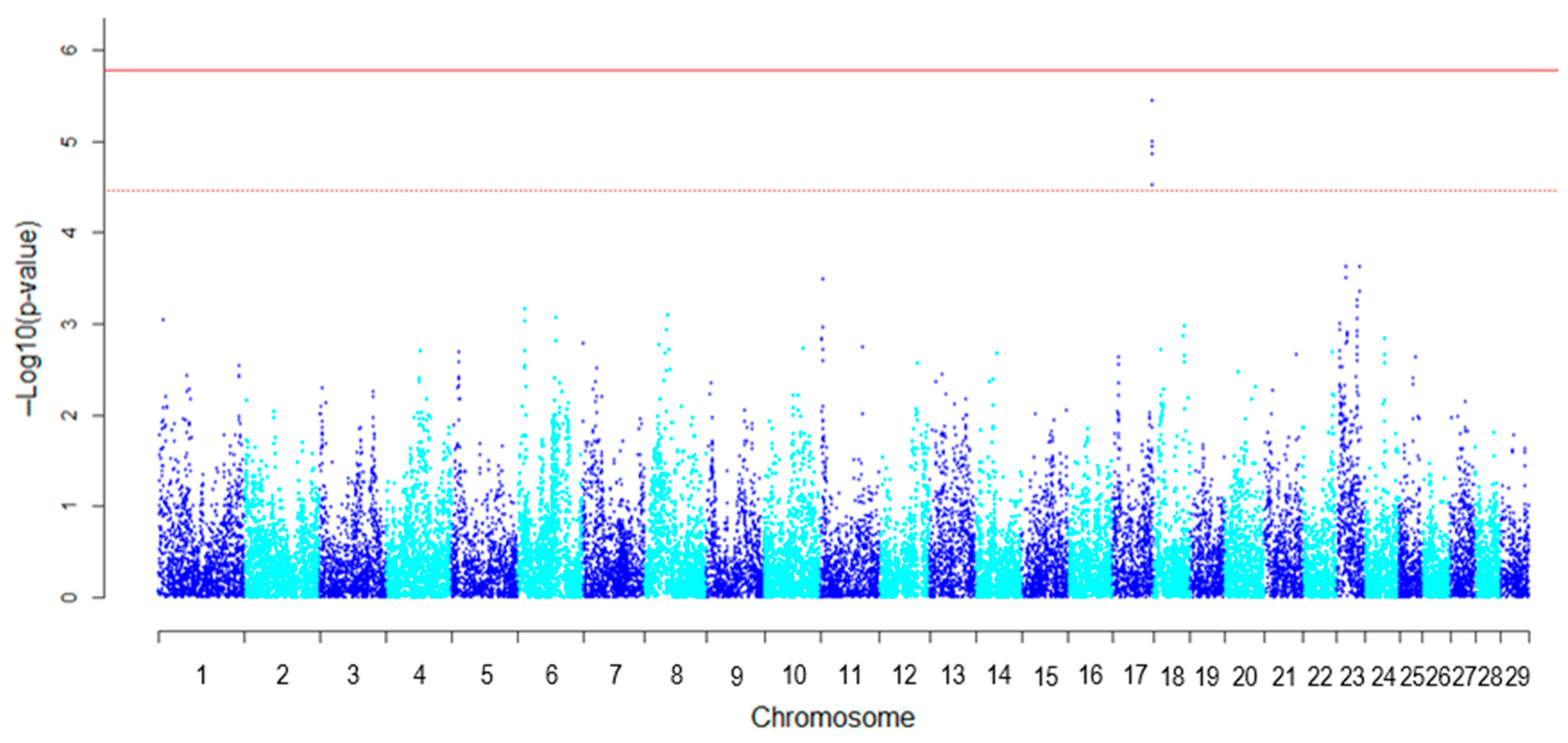
| 72,329,662 | rs110240047 | ARS-BFGL-NGS-28077 | 3.60 × 10⁻⁶ |
| 72,579,763 | rs108976372 | ARS-BFGL-NGS-17791 | 1.01 × 10⁻⁵ |
| 72,554,429 | rs109808146 | ARS-BFGL-NGS-62627 | 1.16 × 10⁻⁵ |
| 73,315,120 | rs41856310 | ARS-BFGL-NGS-117653 | 1.39 × 10⁻⁵ |
| 72,790,867 | rs110840574 | ARS-BFGL-NGS-105537 | 3.01 × 10⁻⁵ |
| Annotation | LD with Top SNP (r2) | Total Number of Polymorphisms | Total Number of Genes 1 | ||||||||
|---|---|---|---|---|---|---|---|---|---|---|---|
| 0.9–1.0 | 0.8–0.9 | 0.7–0.8 | 0.6–0.7 | 0.5–0.6 | 0.4–0.5 | 0.3–0.4 | 0.2–0.3 | 0.1–0.2 | |||
| stop_gained | 1 | 1 | 1 | ||||||||
| missense_variant | 1 | 3 | 3 | 4 | 4 | 5 | 20 | 14 | |||
| 5_prime_UTR_variant | 3 | 2 | 1 | 1 | 6 | 3 | |||||
| 3_prime_UTR_variant | 2 | 1 | 2 | 2 | 1 | 1 | 9 | 7 | |||
| upstream_gene_variant | 2 | 3 | 5 | 6 | 8 | 2 | 3 | 29 | 17 | ||
| downstream_gene_variant | 2 | 1 | 6 | 2 | 5 | 1 | 3 | 20 | 15 | ||
| splice_region_variant | 1 | 2 | 2 | 5 | 4 | ||||||
| synonymous_variant | 2 | 1 | 2 | 1 | 1 | 7 | 5 | ||||
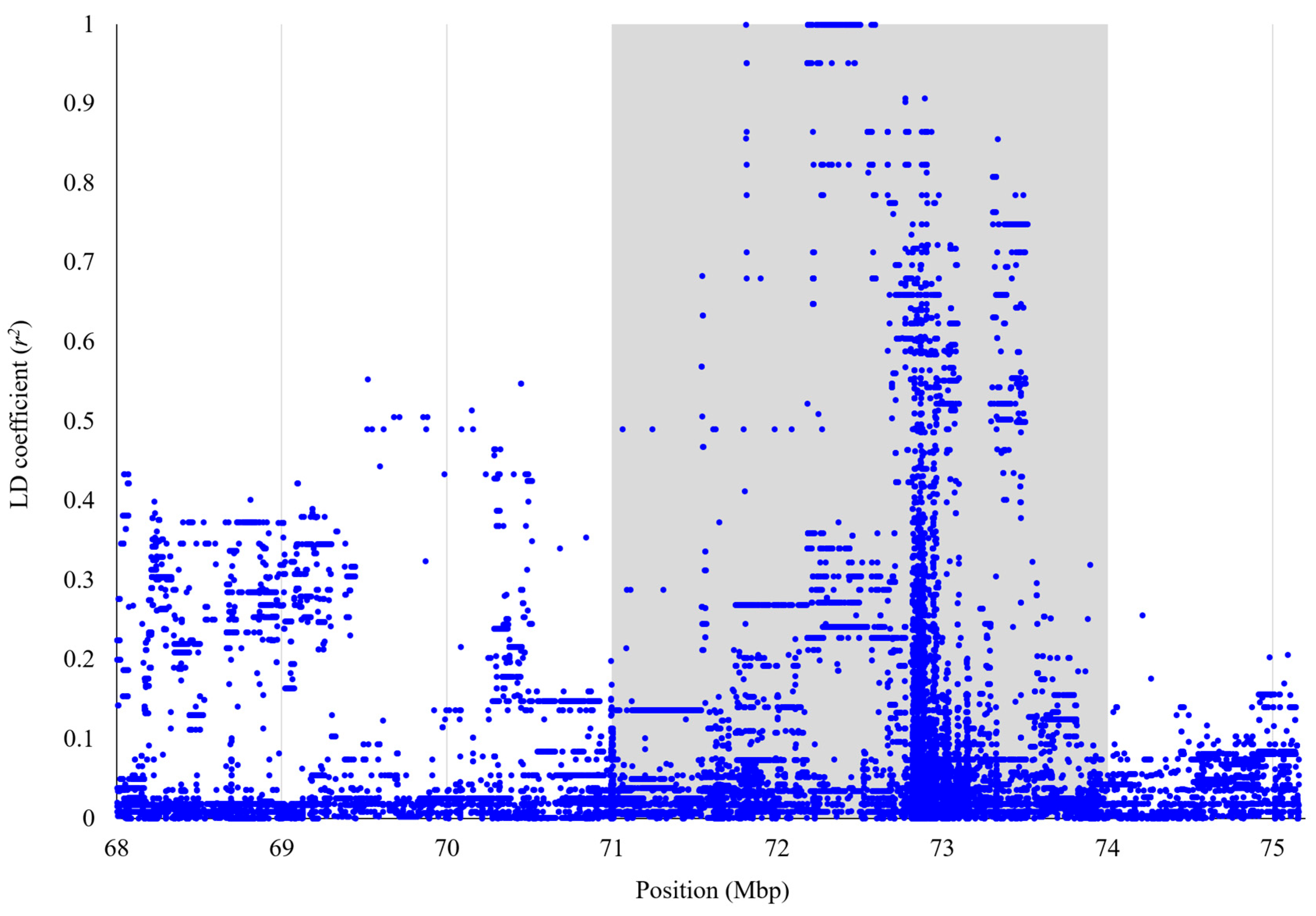
| Total | 9 | 6 | 20 | 13 | 21 | 6 | 10 | 5 | 6 | 96 | 30 |
| Polymorphism | Genotype Frequency | Allele Frequency | LD | p-Value | FAR (%) 1 | |||||
|---|---|---|---|---|---|---|---|---|---|---|
| GGT1 c.589G>A | AA | AG | GG | A | G | AA | AG | GG | ||
| 97 | 223 | 104 | 0.49 | 0.51 | 0.748 | 2.86 × 10⁻⁶ | 39.0 a ± 0.275 | 37.9 b ± 0.181 | 37.0 c ± 0.265 | |
| GGT1 c. −256G>T | GG | GT | TT | G | T | GG | GT | TT | ||
| 92 | 228 | 104 | 0.49 | 0.51 | 0.748 | 3.04 × 10⁻⁶ | 39.1 a ± 0.279 | 37.8 b ± 0.180 | 37.1 b ± 0.264 | |
| SLC5A1 c.32C>T | CC | CT | TT | C | T | CC | CT | TT | ||
| 145 | 215 | 64 | 0.60 | 0.40 | 0.775 | 1.67 × 10⁻⁵ | 38.8 a ± 0.225 | 37.5 b ± 0.186 | 37.2 b ± 0.334 | |
Disclaimer/Publisher’s Note: The statements, opinions and data contained in all publications are solely those of the individual author(s) and contributor(s) and not of MDPI and/or the editor(s). MDPI and/or the editor(s) disclaim responsibility for any injury to people or property resulting from any ideas, methods, instructions or products referred to in the content. |
© 2026 by the authors. Licensee MDPI, Basel, Switzerland. This article is an open access article distributed under the terms and conditions of the Creative Commons Attribution (CC BY) license.
Share and Cite
Sasazaki, S.; Ito, H.; Adachi, R.; Iwamoto, E.; Yoshida, E.; Kawaguchi, F.; Oyama, K.; Mannen, H. Identification of Candidate Causal Polymorphisms in GGT1 and SLC5A1 Associated with Fat Area Ratio on BTA17 in Japanese Black Cattle. Genes 2026, 17, 363. https://doi.org/10.3390/genes17040363
Sasazaki S, Ito H, Adachi R, Iwamoto E, Yoshida E, Kawaguchi F, Oyama K, Mannen H. Identification of Candidate Causal Polymorphisms in GGT1 and SLC5A1 Associated with Fat Area Ratio on BTA17 in Japanese Black Cattle. Genes. 2026; 17(4):363. https://doi.org/10.3390/genes17040363
Chicago/Turabian StyleSasazaki, Shinji, Hikari Ito, Ryoto Adachi, Eiji Iwamoto, Emi Yoshida, Fuki Kawaguchi, Kenji Oyama, and Hideyuki Mannen. 2026. "Identification of Candidate Causal Polymorphisms in GGT1 and SLC5A1 Associated with Fat Area Ratio on BTA17 in Japanese Black Cattle" Genes 17, no. 4: 363. https://doi.org/10.3390/genes17040363
APA StyleSasazaki, S., Ito, H., Adachi, R., Iwamoto, E., Yoshida, E., Kawaguchi, F., Oyama, K., & Mannen, H. (2026). Identification of Candidate Causal Polymorphisms in GGT1 and SLC5A1 Associated with Fat Area Ratio on BTA17 in Japanese Black Cattle. Genes, 17(4), 363. https://doi.org/10.3390/genes17040363