
Article

The Complete Mitochondrial Genomes of Two Octopi of the Western Pacific Ocean, Japetella diaphana and Amphitretus pelagicus (Cephalopoda: Amphitretidae), and Their Phylogenetic Position Within Amphitretidae


1
College of Marine Living Resource Sciences and Management, Shanghai Ocean University, Shanghai 201306, China
2
National Engineering Research Center of Marine Facilities Aquaculture, Zhejiang Ocean University, Zhoushan 316022, China
3
Department of Sciences, Kibogora Polytechnic, Nyamasheke P.O. Box 50, Rwanda
*
Authors to whom correspondence should be addressed.
Genes 2026, 17(3), 312; https://doi.org/10.3390/genes17030312
Submission received: 21 February 2026 / Revised: 3 March 2026 / Accepted: 6 March 2026 / Published: 10 March 2026

Abstract

Background/Objectives: A comprehensive analysis of the mitochondrial genomes of Japetella diaphana and Amphitretus pelagicus was conducted to investigate their genomic composition, gene size, sequence characteristics, and phylogenetic positioning within the Amphitretidae family. Methods: A rigorous phylogenetic analysis was performed utilizing a dataset comprising 13 protein-coding genes, two ribosomal RNAs, and 22 transfer RNAs derived from 26 cephalopod mitochondrial genomes, representing 25 species across seven families, Vampyroteuthidae, Tremoctopodidae, Octopodidae, Enteroctopodidae, Bolitaenidae, Argonautidae, and Amphitretidae, along with outgroup Nautilus macromphalus. Results: Notably, both focal species demonstrated a pronounced adenine–thymine bias in their mitochondrial genomes, with A. pelagicus exhibiting gene rearrangements and two extensive non-coding regions. The analysis, employing both the maximum likelihood and Bayesian inference methodologies, revealed a monophyletic relationship between Bolitaenidae and Vitreledonellidae, as well as a sister taxon relationship between Amphitretidae and Tremoctopodidae. The majority of species were classified into the Amphitretidae and Bolitaenidae clades, with numerous species exhibiting close phylogenetic relationships. Conclusions: This study provides novel insights into the evolutionary relationships within Octopodiformes, underscoring the significance of mitochondrial genome data in resolving phylogenetic relationships among cephalopods. The findings contribute to our understanding of the evolutionary history of octopi and pose implications for their classification and conservation. Furthermore, the results underscore the necessity for continued research into the evolutionary relationships among cephalopod taxa.

1. Introduction

The octopi are classified within the Phylum Mollusca, Class Cephalopoda, Subclass Coleoidea, and order Octopoda, which encompasses two suborders: Cirrata (deep-sea finned octopods) and Incirrata (benthic and pelagic finless octopods). A well-established sister taxon relationship exists between these suborders [1,2,3,4,5], with over 200 species documented globally. The suborder Incirrata is further subdivided into several higher taxonomic groupings, including the superfamily Argonautoidea, which comprises four distinct families of pelagic octopods: Argonautidae, Tremoctopodidae, and Alloposidae, with gelatinous bodies and females that can attain a total length of up to 4 m [6], as well as Ocythoidae now characterized by a unique reproductive strategy involving a hectocotylus, which exhibit biserial arm suckers and pronounced sexual dimorphism, with mature males being significantly smaller than females. In addition to Argonautoidea, Incirrata includes three other pelagic families, Vitreledonellidae, Bolitaenidae, and Amphitretidae, whose members are gelatinous and transparent, and possess uniserial suckers. The radula of Bolitaenidae and Amphitretidae exhibits a distinctive ctenoglossan morphology with multiple cusps per tooth, leading to their historical classification into the separate taxonomic group Ctenoglossa, subordinate to Incirrata [2,7].
In the current taxonomic framework, all remaining incirrate octopods are classified within the diverse family Octopodidae, comprising over 300 predominantly benthic species. Molecular phylogenetic analyses indicate that Octopodidae may be polyphyletic [3,8,9,10,11], although this hypothesis requires further substantiation. Contemporary classification [12,13] divided Octopodidae into four subfamilies (Octopodinae, Bathypolypodinae, Eledoninae, and Graneledoninae) based on ink sac presence and sucker arrangement [14,15]. However, cladistic analyses [16], examining 15 morphological traits across 14 genera, rejected these subfamily classifications due to paraphyletic groupings [13]. Ref. [4] expanded this work to 29 taxa and 66 characters, concluding that subfamily Ctenoglossa is polyphyletic, identifying Bolitaenidae as basal within Incirrata, and dividing the remaining incirrates into two sister clades, one containing Argonautoidea with Vitreledonellidae and Amphitretidae and the other containing Octopodidae, though the internal Octopodidae structure remained unresolved. Ref. [5] similarly provided evidence for monophyletic Octopoda and sister relationships between Cirrata and Incirrata and between Octopoda and Vampyromorpha, corroborating earlier hypotheses [17,18].
The taxonomic classification of Amphitretidae has undergone significant revision, now encompassing three previously recognized families: Bolitaenidae, Amphitretidae, and Vitreledonelidae [14]. The shared ctenoglossan radula provides morphological evidence for their close relationship, while molecular analyses robustly support a monophyletic clade comprising Bolitaeninae and Vitreledonellidae [14]. Family Amphitretidae is represented by a single genus containing Amphitretus pelagicus and Amphitretus thielei [19], characterized by vesicular, transparent, gelatinous bodies and prominent tubular eyes. They inhabit tropical and subtropical marine environments at depths of approximately 1000 to 2000 m or greater, typically near the benthic zone, with a maximum mantle length of 100 mm and a body length up to 300 mm [20]. The Bolitaenidae family encompasses two genera and two recognized species, Bolitaenus pygmaea and Japetella diaphana [21]. Members exhibit heavily pigmented integument, laterally compressed ocular structures, and front arms with single-row wrist suckers. Within Monodiscus, the male’s left third arm is cauline with a swollen lingual lobe. Adult females of Anispecia possess a distinctive ring of oral photophores enabling bioluminescence at depths exceeding 1000 m to attract conspecific males. The maximum recorded mantle length is 200 mm. These organisms are widely distributed across tropical to temperate marine environments, with adults typically inhabiting continental slopes at 1000 to 2500 m, occasionally extending to abyssal plains at 6000 m. Eggs are oviposited at depths of 750–2500 m and primarily develop on the continental shelf [20]. Molecular markers are increasingly recognized as reliable for precise species identification and correct taxonomic placement within genera [22,23,24,25].
The genus Octopus, named after its type species Octopus vulgaris Cuvier, 1797, has recently been redefined as the “Octopus vulgaris species complex” due to molecular phylogenetic studies indicating that this species encompasses multiple distinct species [26,27,28]. According to the World Register of Marine Species (WORMS), the genus Octopus currently includes 73 recognized species [WORMS. http://www.marinespecies.org (accessed online 24 may 2018)]. This elevated species count results from the provisional classification of numerous “octopus-like” taxa with ambiguous taxonomic status [29]. Consequently, Octopus functions as a “catch-all” taxon, creating considerable taxonomic ambiguity and instability, with frequent instances of synonymy and misallocation to incorrect genera [24,30,31]. These ongoing taxonomic revisions highlight the necessity for continued research into phylogenetic relationships among these species. Previous molecular investigations into cephalopod phylogeny have predominantly utilized two mitochondrial genes, cytochrome c oxidase subunit I (COI) and 16S rRNA genes, though these studies yielded limited phylogenetic resolution. Most molecular phylogenetic research within order Octopodiformes has concentrated on narrow ranges of closely related taxa [24,31,32,33,34,35,36,37]. A seminal study by [8] employed partial COI sequences from 28 octopodiform species, providing the first molecular phylogenetic analysis of relationships among and within octopod families, indicating that family Octopodidae is polyphyletic and suggesting that other incirrate families may have diverged from it. Subsequent research by [3,10,11], utilized expanded datasets of three to four mitochondrial genes, parallel to three nuclear genes, reinforcing the polyphyly of family Octopodidae. These studies further posited that families Vitreledonellidae and Bolitaenidae (identified as sister taxa) may have evolved from within Octopodidae via neoteny, whereby pelagic planktonic paralarvae developed into holopelagic taxa. These studies also provided robust support for a sister relationship between Argonautoidea and the remaining incirrate taxa and strong phylogenetic support for a clade of Southern Ocean endemics and deep-sea octopods characterized by uniserial suckers [9,37], utilizing four mitochondrial genes and six nuclear genes of varying coverage, corroborated each of these proposed relationships. In contrast, complete mitochondrial genomes (mitogenomes) have gained prominence as a valuable resource for elucidating the evolutionary history and conducting phylogenetic reconstructions of species, owing to the conservation of the type and number of genes encoded by metazoan mitogenomes [38].
In the present study, we sequenced and analyzed the complete mitochondrial genome (mitogenome) of Japetella diaphana and Amphitretus pelagicus. We examined the genome composition, the evolutionary rates of protein-coding genes (PCGs), the secondary structure of transfer RNA (tRNA), and the relative synonymous codon usage (RSCU). Furthermore, a phylogenetic analysis was conducted utilizing the complete mitochondrial sequences of other octopus species available in GenBank to ascertain their phylogenetic position within the family Amphitretidae.

2. Materials and Methods

2.1. Sample Collection and Genomic DNA Extraction

The specimens of J. diaphana and A. pelagicus were procured via trawling operations in the western Pacific Ocean (coordinates: 36°41′ N, 157°39′ W) in October 2021. All specimens utilized in this study were collected and handled in a manner consistent with ethical guidelines, and this research adheres to the principles outlined in the ARRIVE guidelines. Fresh muscle tissues from these specimens were meticulously dissected and subsequently preserved in 95% ethanol prior to the extraction of genomic DNA. DNA extraction was conducted utilizing the rapid salting-out method [39]. The integrity and quality of the extracted DNA were evaluated by employing 1% agarose gel electrophoresis, and the DNA was then stored at −20 °C for future analyses.

2.2. Library Construction, Mitogenome Assembly, and Annotation

The complete mitogenomes of J. diaphana and A. pelagicus were sequenced utilizing Illumina HiSeq and PacBio sequencing technologies, conducted by Origin Gene Bio-pharm Technology Co., Ltd. (Shanghai, China). DNA libraries were prepared and sequenced using the TruSeq™ Nano DNA Sample Prep Kit (San Diego, CA, USA). Following library preparation, enrichment was performed via a polymerase chain reaction (PCR) using the cBot TruSeq PE Cluster Kit v3-cBot-HS platform (San Diego, CA, USA), after which paired-end sequencing was executed utilizing the TruSeq SBS array (300 cycles). A total of 1421.7 Mb of raw sequencing data was generated. The raw data were subsequently processed using Trimmomatic-0.39 [40] to yield 1329 Mb of clean data. The Q20 quality score of the clean data was determined to be 96.91%. Additionally, the genomic DNA was fragmented into 10 kb segments using the G-tube method [41]. A single-stranded circular library was annealed and ligated with polymerase at the base of a fixed zero-mode waveguide (ZMW) aperture. Sequencing was conducted subsequent to the completion of the assembly process utilizing the PacBio Sequel platform. The N50 value of the filtered PacBio sub-sequences was determined to be 3870 bp. The splice clean data were processed using SPAdes v3.10.1 [42]. Sequences exhibiting adequate coverage and extended assembly length were designated as candidate sequences and compared against entries in the National Center for Biotechnology Information database (http://www.ncbi.nlm.nih.gov/ (accessed on 24 March 2022)) to validate mitochondrial reference sequences. GapCloser v1.12 [43] was employed to align clean reads with the assembled frames, thereby facilitating the filling of local gaps and optimizing the assembly results for paired-end reads and overlaps. The complete mitochondrial genome of Illex argentinus [44] served as a reference genome to correct the starting point and orientation of the mitochondrial assembly sequence, leading to the finalization of the mitochondrial genome sequence.

2.3. Sequence Alignments

Mitos software 2.1.7 (http://mitos.bioinf.uni-leipzig.de/index.py (accessed on 6 March 2024)) was employed to predict protein-coding genes (PCGs), transfer RNA (tRNA), and ribosomal RNA (rRNA) genes within the mitochondrial genome [45]. Redundant gene sequences were eliminated, and the positions of start and stop codons were manually adjusted to ensure a set of conserved genes with enhanced accuracy. The verification of start and stop codons was conducted by referencing the previously published mitochondrial genome of octopods [43,44]. The circular features of the mitochondrial genomes of J. diaphana and A. pelagicus were visualized utilizing the online software CGView version 2 (http://stothard.afns.ualberta.ca/cgview_server/ (accessed on 26 July 2023)) [46]. Relative synonymous codon usage (RSCU) analysis was performed using MEGA X software [47]. Component slope values were calculated using the formulas established by [48]: AT slope = (A − T)/(A + T); GC slope = (G − C)/(G + C). Phylogenetic relationships were reconstructed based on 13 PCGs, 2 rRNAs, and 22 tRNAs derived from 26 cephalopod mitochondrial genomes, including the newly sequenced J. diaphana and A. pelagicus, with Nautilus macromphalus [49] serving as an outgroup (Table 1). Subsequent to manual corrections, the sequenced mitochondrial genomes were submitted to the GenBank database at the National Center for Biotechnology Information (NCBI) to secure GenBank accession numbers (http://www.ncbi.nlm.nih.gov/GenBank/ (accessed on 24 March 2022)).

2.4. Phylogenetic Analysis

The substitution saturation of 13 protein-coding genes (PCGs) within the mitochondrial genome of 26 octopus species was quantified utilizing DAMBE7 software [73]. Based on these findings, we aligned the nucleotide sequences of the 13 PCGs according to default parameters in MEGA X [46] to construct maximum likelihood (ML) and Bayesian inference (BI) phylogenetic trees. The complete mitochondrial genomes of the 26 cephalopod species (Table 1) provided the sequence data for the phylogenetic analysis. The phylogenetic relationships were assessed using the ML method, with trees constructed in IQ-TREE [74] employing the optimal “GTR + F + R7” model, supported by 1000 nonparametric bootstrapping replicates. The most suitable ML model was determined using the ModelFinder software version 1.4.2 results [74,75]. The optimal model (GTR + I + G) for each segment was identified through the Akaike Information Criterion (AIC) in MrModeltest 2.3 [76], although this approach raises questions regarding the rationale behind incorporating invariant positions in conjunction with the gamma distribution, particularly given the potential interdependence of parameter estimations [77]. Subsequently, BI analysis was conducted using MrBayes 3.2, in conjunction with PAUP 4.0 [78] and Modeltest 3.7 software within the MrMTgui interface [79]. The BI analyses employed Markov Chain Monte Carlo (MCMC) methods with default settings across three independent runs for 2,000,000 generations, with sampling occurring every 1000 steps. The average standard deviation of split frequencies was maintained at <0.01, and the initial 25% of samples were discarded as burn-in. The resulting phylogenetic tree was visualized using FigTree v1.4.3 (https://github.com/rambaut/figtree/) (accessed on 26 July 2023) [80].

3. Results

3.1. The General Characteristics of the Mitochondrial Genome

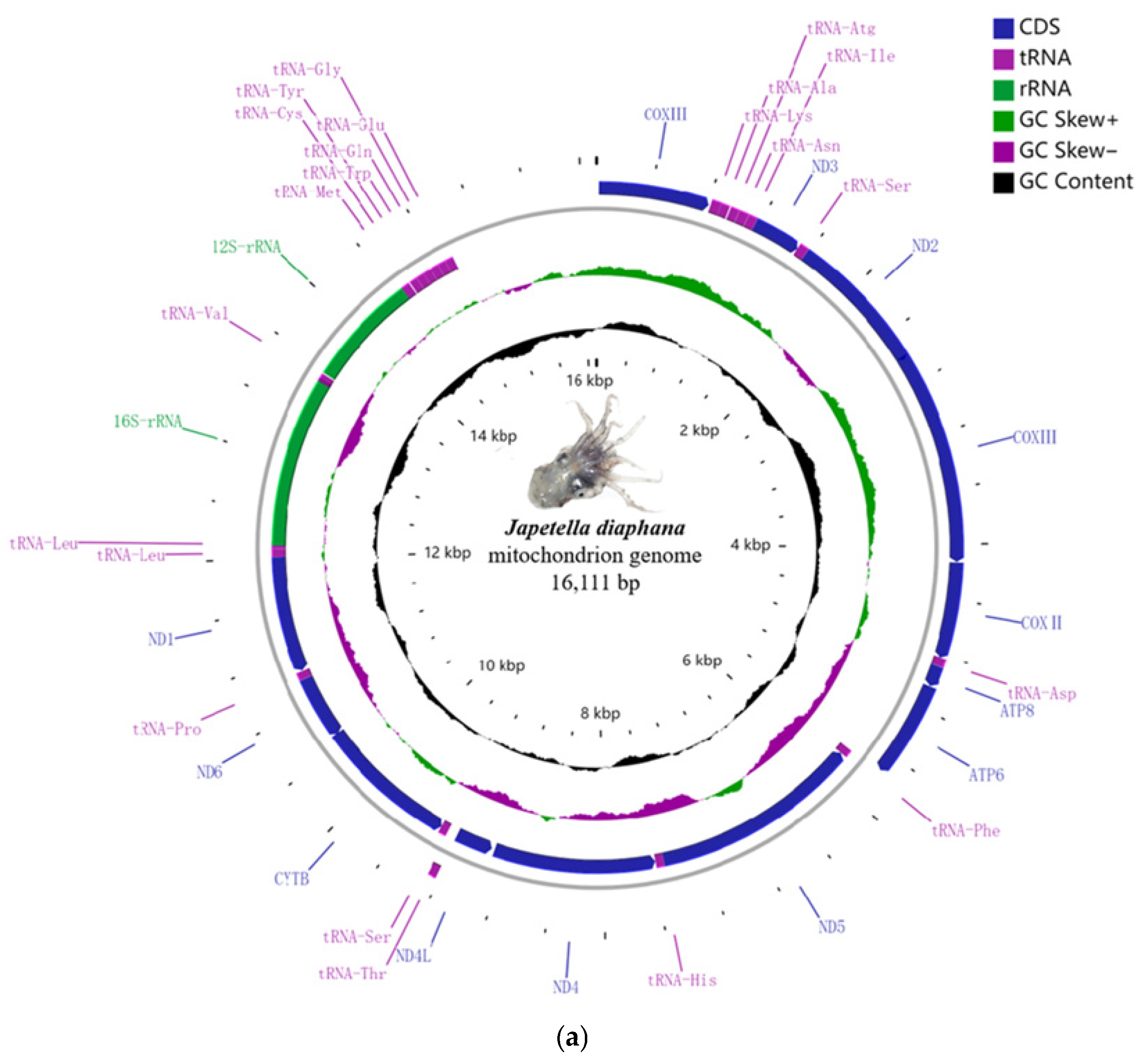
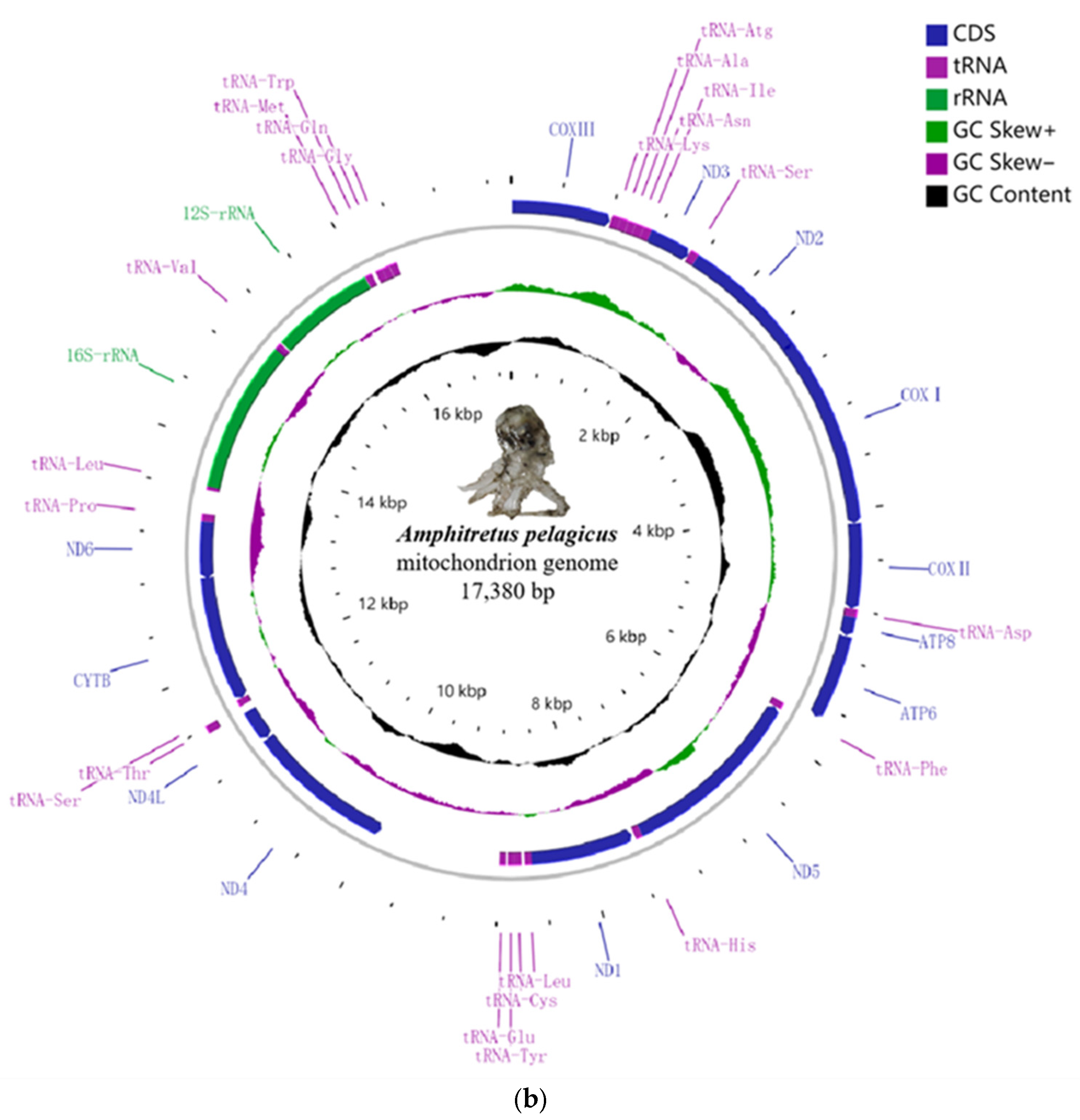
We accomplished the complete sequencing of the mitochondrial genome of Japetella diaphana and Amphitretus pelagicus for the first time, with accession numbers ON060363 and ON060364, respectively. The lengths of the mitochondrial genomes were 16,111 base pairs (bp) on GenBank for J. diaphana and 17,380 bp for A. pelagicus (see Figure 1a,b). Both mitochondrial genomes exhibited the canonical repertoire of 13 protein-coding genes (PCGs), which include cytochrome c oxidase subunits COI-COIII, ATP synthase subunits ATP6 and ATP8, and NADH dehydrogenase subunits ND1-ND6, as well as ND4L. Additionally, each genome contained 22 tRNA genes and 2 rRNA genes (12S and 16S rRNA) (Figure 1a,b). A notable difference between the two species was the presence of a single long non-coding region (LNCR) in J. diaphana, while A. pelagicus had two such regions (Table 2 and Table 3). The LNCR in J. diaphana was located between the trnE and COIII genes, whereas in A. pelagicus, the LNCRs were positioned between trnE and ND4 and between trnG and COIII.
The overall base composition of J. diaphana was 40.6% adenine (A), 36.3% thymine (T), 15.4% cytosine (C), and 7.7% guanine (G), resulting in an A + T content of 76.9% and a C + G content of 23.1%. This mitochondrial genome exhibited a pronounced AT bias, consistent with the patterns observed in most Cephalopoda species (see Table 2). Furthermore, the entire mitogenome manifested a negative GC skew of −0.333 and a positive AT skew of 0.056. In contrast, the base composition of A. pelagicus differed with 40.6% A, 35.1% T, 16.8% C, and 7.5% G, leading to an A + T content of 75.7% and a C + G content of 24.3%. This mitochondrial genome similarly exhibited a significant AT bias, aligning with the trends identified in the majority of Cephalopoda species (refer to Table 2). The overall mitochondrial genome manifested a negative GC skew of −0.383 and a positive AT skew of 0.073.
Both mitochondrial genomes exhibited a composition of 13 protein-coding genes (PCGs), 22 transfer RNA genes (tRNA), 2 ribosomal RNA genes (rRNA), and a single control region (CR). The arrangement of these genes within the mitochondrial genome is consistent with that observed in other previously documented octopus species (Figure 1a,b; Table 2 and Table 3). Specifically, seven PCGs and eight tRNA genes are situated on the light strand (L), whereas the remaining PCGs, the majority of tRNA genes (excluding tRNA-T), and the two ribosomal RNAs are localized on the heavy strand (H) (Table 2 and Table 3). The positioning of these genes on each strand was ascertained based on the guanine and cytosine content, with the L-strand exhibiting a higher cytosine content than the guanine-rich H-strand.

3.2. Protein-Coding Genes

The length of the protein-coding genes (PCGs) in J. diaphana ranged from 351 bp to 1693 bp. The codon usage for the 13 protein-coding genes is presented in Table 2. The findings revealed that COIII initiates with the codon ATT, while NADH dehydrogenase subunit 4 (ND4) commences with ATA; the remaining PCGs all initiate with ATG. The stop codons employed include TAA for the gene pairs COI-COIII, ATP8, ND1-ND4, and Cytb and TAG for ATP6, ND4L, and ND6, while ND5 exhibits an incomplete stop codon of T.
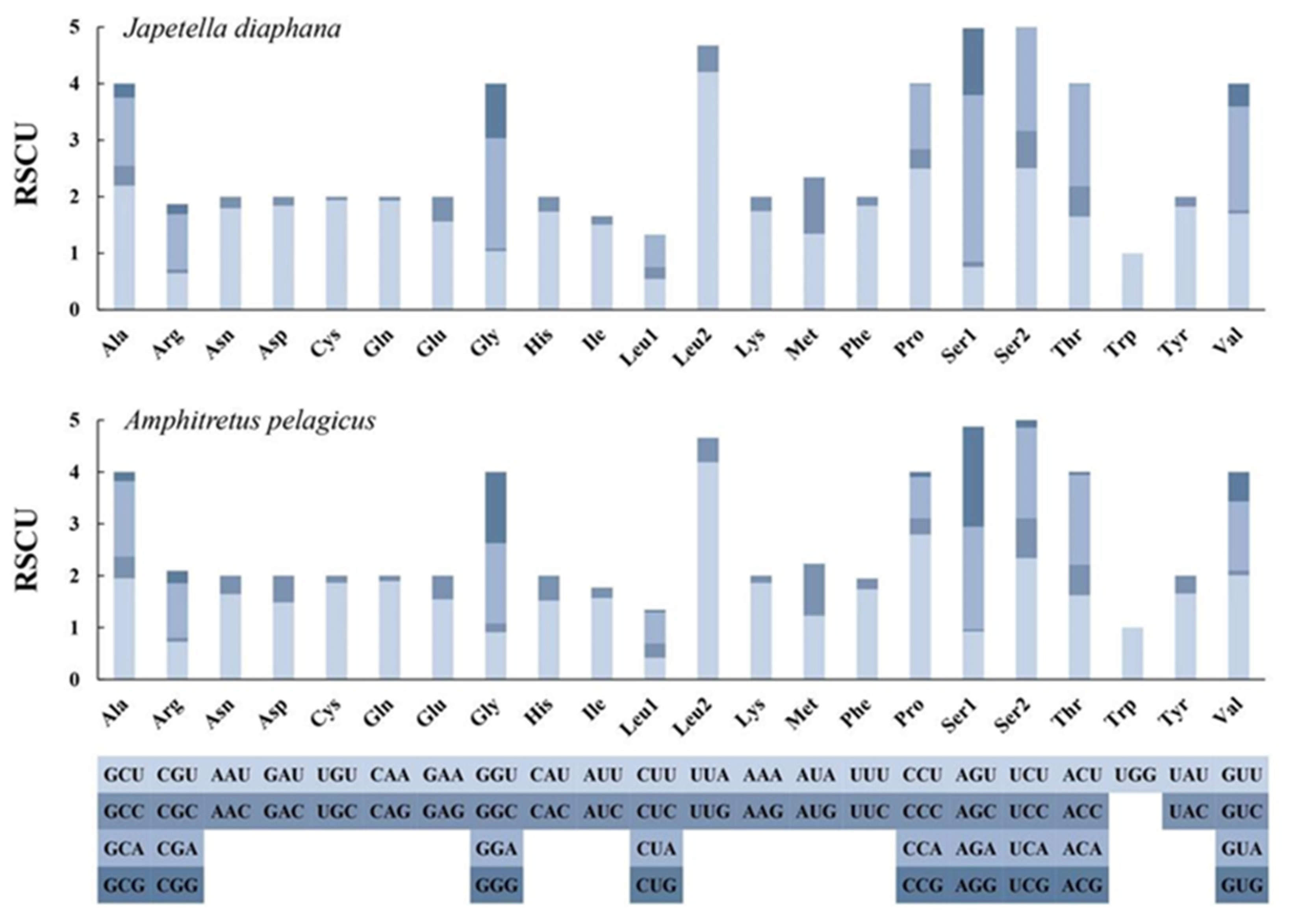
In A. pelagicus, the lengths of protein-coding genes (PCGs) varied from 351 bp to 1693 bp, with the codon usage of the 13 protein-coding genes detailed in Table 3. Notably, with the exceptions of COIII, ATP6, ND1, and ND4, which utilize ATA and ATT as start codons, respectively, all other PCGs initiate with the codon ATG. Additionally, the stop codons employed include TAA for the gene clusters COI-III, ATP8, ND2, ND3, and Cytb, while TAG is utilized by ATP6, ND1, ND4, ND4L, and ND6; ND5 exhibits an incomplete stop codon of T. The relative synonymous codon usage (RSCU) analysis for the 13 PCGs across these two species suggests a conserved preference for synonymous codons (Figure 2). The most frequently utilized codon in both species is TTA, coding for leucine (Leu2).
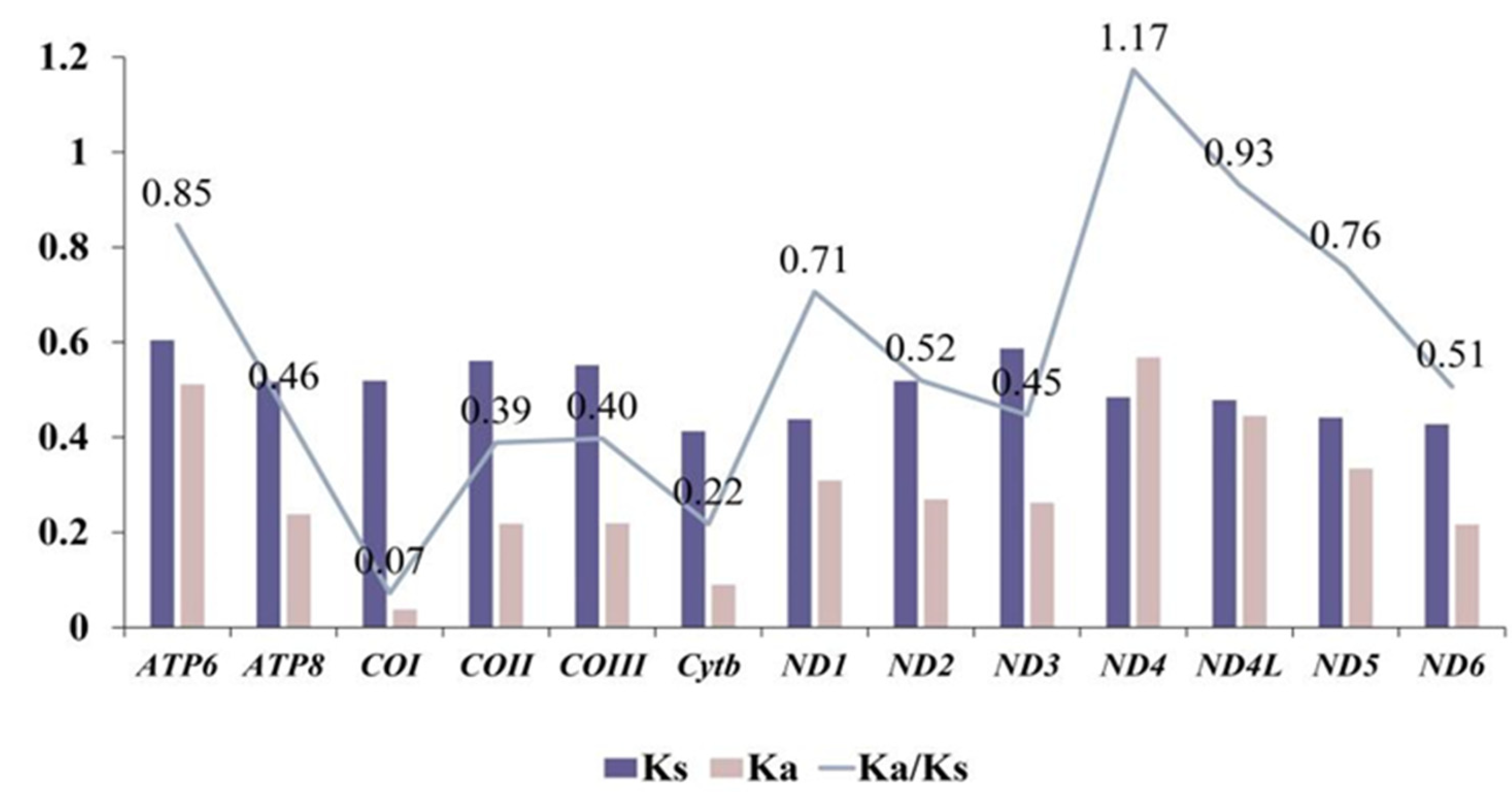
The ratios of nonsynonymous to synonymous substitution rates (Ka/Ks) for the 13 PCGs were calculated using data from 25 Octopodiform species (Figure 3). The Ka/Ks analysis revealed values ranging from 0.07 for cytochrome c oxidase subunit I (COI) to 1.17 for NADH dehydrogenase subunit 4 (ND4). The majority of genes exhibited Ka/Ks values of less than 1, indicative of purifying selection. In contrast, ND4 demonstrated a Ka/Ks value of 1.17, suggesting that it is subject to positive selection. Among the 13 protein-coding genes (PCGs), COI displayed the lowest and most conserved Ka/Ks value, supporting its applicability as a widely utilized DNA barcode for cephalopod identification [81,82].

3.3. Transfer and Ribosomal RNAs

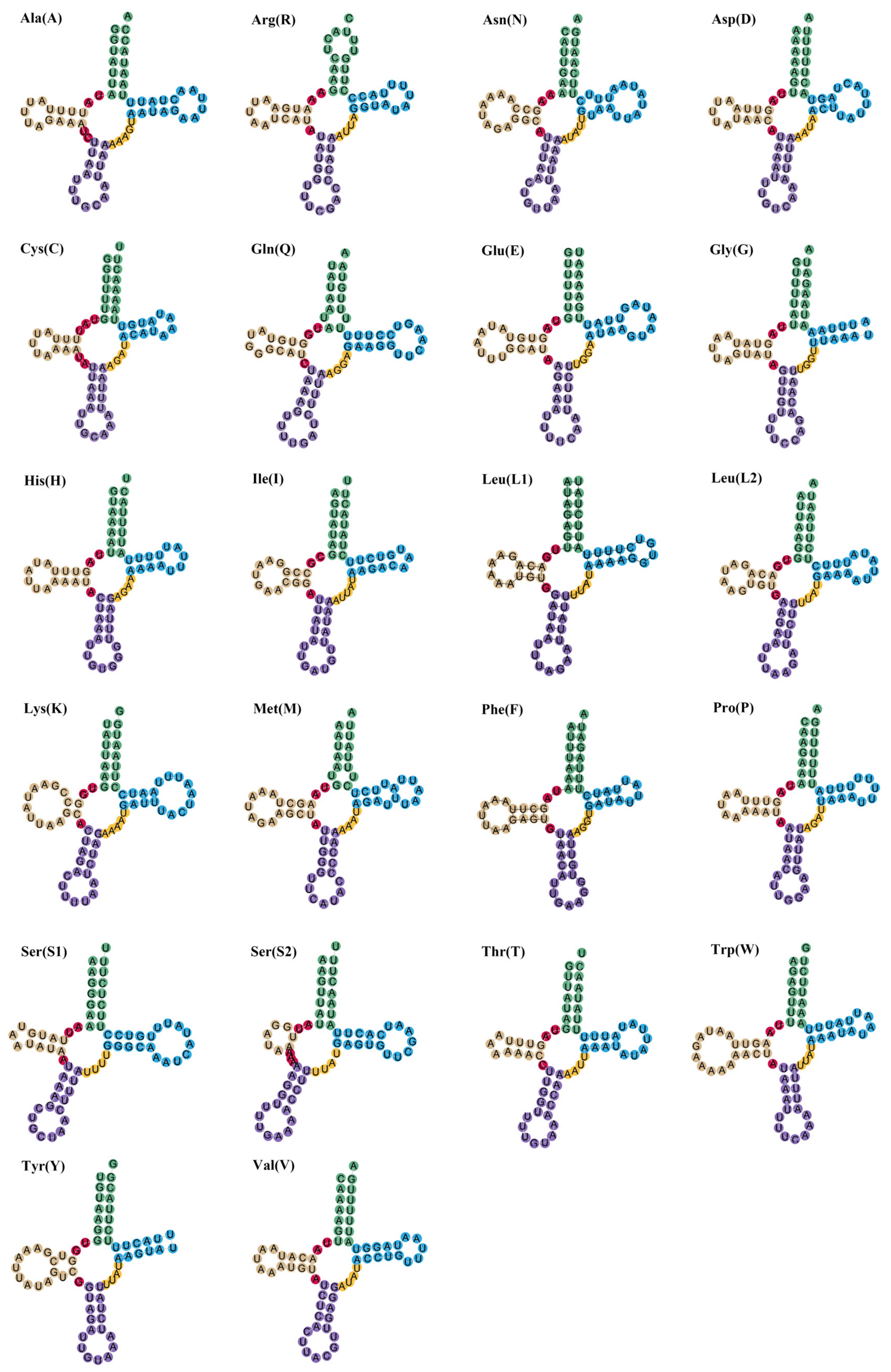
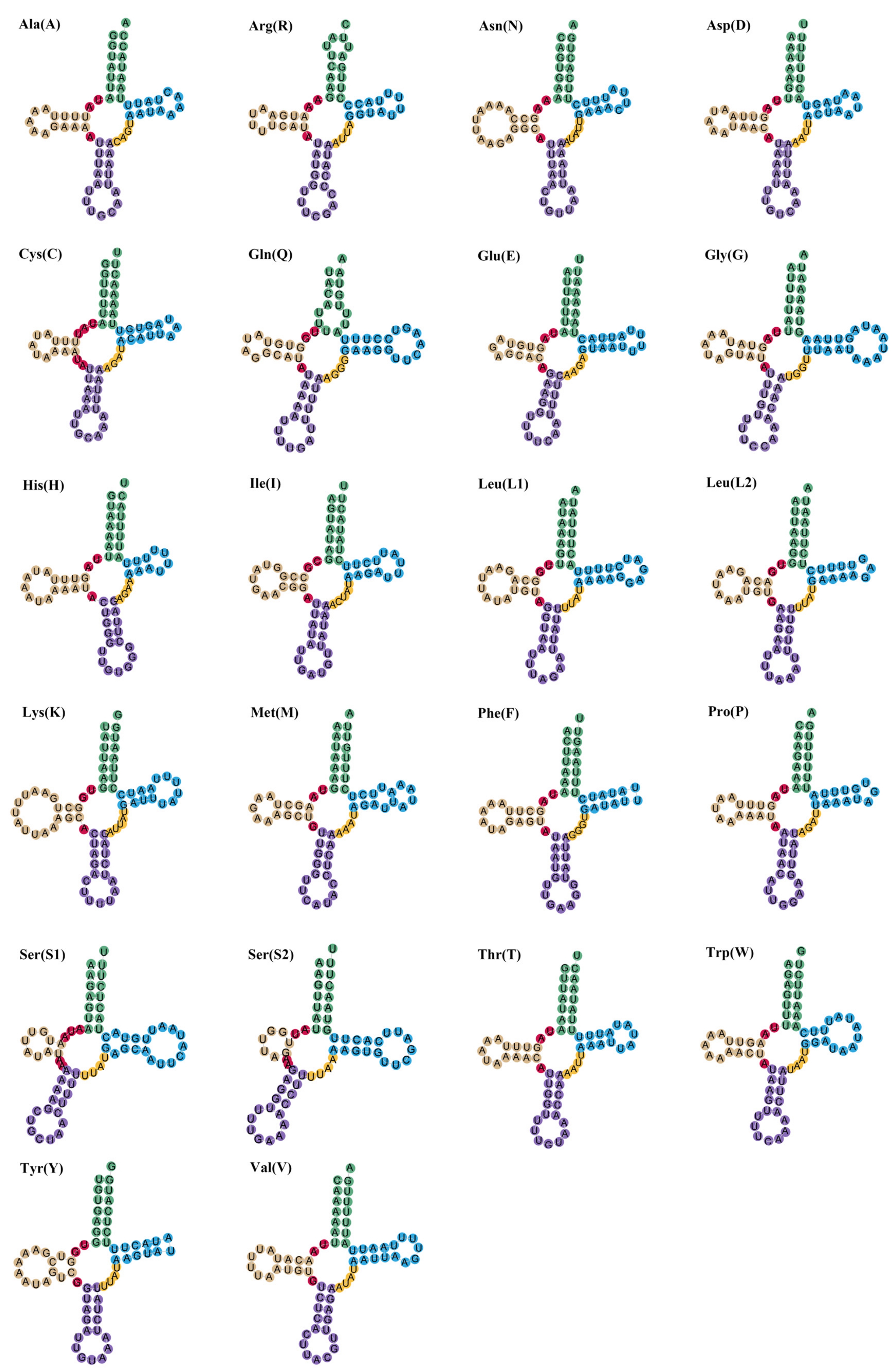
The mitochondrial genomes of the two investigated species encompass a total of 22 transfer RNA (tRNA) genes. In J. diaphana, the tRNA genes measure 1462 bp in length, with individual tRNA lengths varying from 63 to 71 bp. Collectively, in A. pelagicus, the total length of the tRNA genes is 1448 bp, with lengths ranging from 62 to 70 bp (Table 2 and Table 3). Both species exhibited a negative adenine–thymine (A-T) skew alongside a positive guanine–cytosine (G-C) skew (Table 4). The predicted secondary structures of the tRNA cloverleaf configurations for both species are illustrated in Figure 4 and Figure 5. In J. diaphana, the majority of tRNAs exhibited a canonical cloverleaf structure; however, the tRNA for serine (trnSer2) is notable for the absence of the dihydrouridine (DHU) arm, while the TΨC loop is lacking in both trnY and trnG. In the case of A. pelagicus, the absence of the DHU arm was observed in both trnS2 and trnS1, a phenomenon frequently documented in metazoans [83,84]. Furthermore, the transfer RNAs for phenylalanine (trnF) and tyrosine (trnY) also lack the TΨC loop.
In the mitochondrial genome of J. diaphana, the lengths of the 12S and 16S ribosomal RNA (rRNA) genes were 915 bp and 1397 bp, respectively. In contrast, A. pelagicus exhibited lengths of 946 bp for the 12S rRNA and 1398 bp for the 16S rRNA. Notably, in both species, the 12S and 16S rRNA genes were interspersed by the transfer RNA gene (trnV). Furthermore, the ribosomal RNA sequences in these species displayed a negative adenine–thymine (A-T) skew and a positive guanine–cytosine (G-C) skew (Table 4).

3.4. Gene Rearrangements

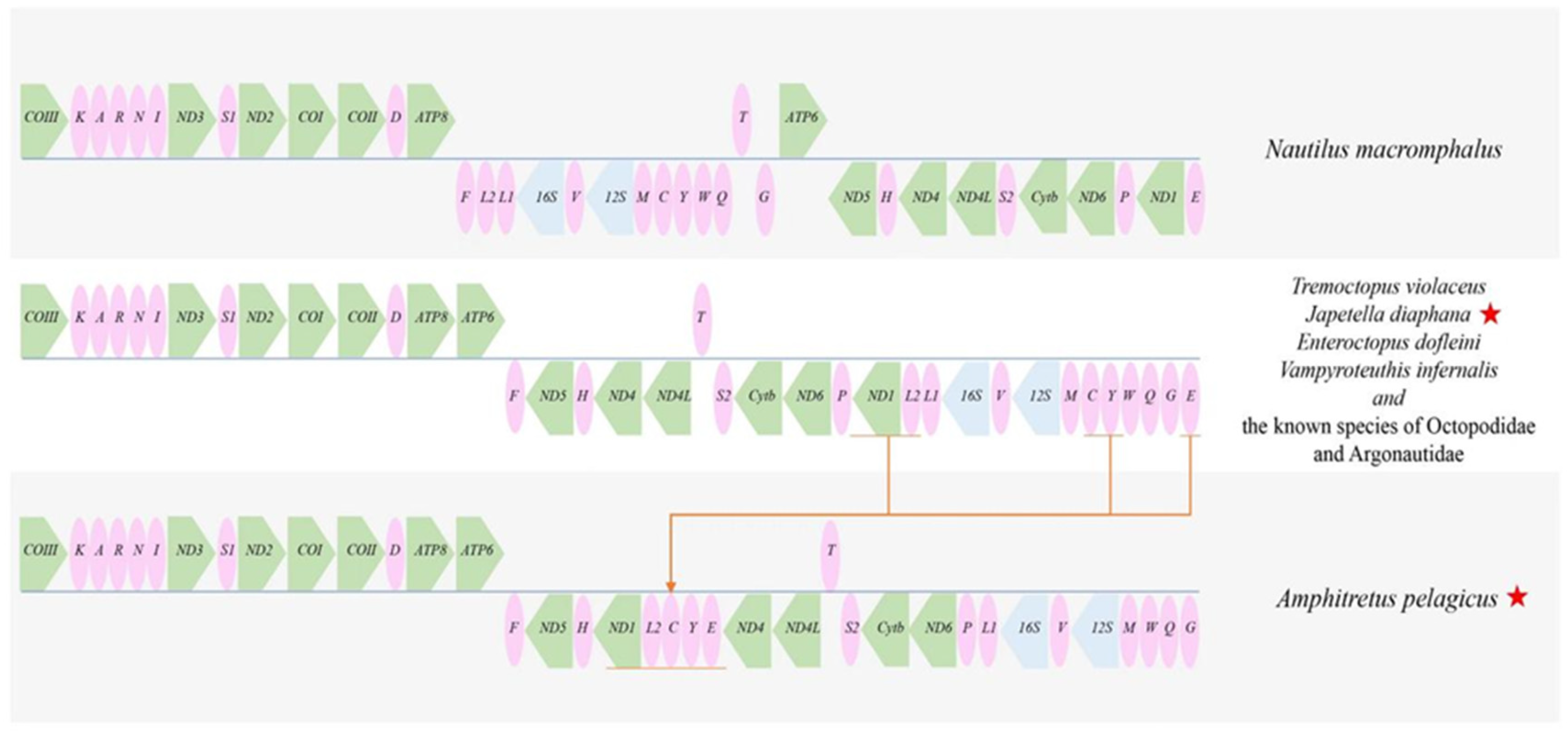
To visualize genomic rearrangements, mitochondrial genes were linearized. Figure 6 depicts the linearization of the protein-coding genes (PCGs), along with the 12S and 16S ribosomal RNA (rRNA) genes across seven families. Despite considerable sequence variation, a conserved gene block was identified. Specifically, three genes (ND3, COI, and COIII), in addition to the ND4-ND4L gene block, were conserved across both focal species. Further, two transfer RNA (tRNA) blocks, designated KARNI and MCYWQG, are illustrated in Figure 6. The KARNI block is located between COIII and ND3, whereas the MCYWQG blocks are situated adjacent to the 12S rRNA gene. Notably, both tRNA blocks underwent rearrangement within family Amphithretidae. The tRNA arrangement observed in Vampyroteuthis infernalis is consistent with that of the majority of octopods. All species examined, with the exception of A. pelagicus, displayed the L1-L2 gene block positioned adjacent to NADH dehydrogenase subunit 1 (ND1).
For all cephalopods species with known mitochondrial genomes, genomic rearrangements are predominantly observed within the order Decapodiformes. While the gene segments encompassing COIII-trnK-trnA-trnR-trnN-trnI-ND3-trnS1-ND2-COI-COII-trnD-ATP8-trnF-ND5-trnH remain conserved across other Octopodiform species, A. pelagicus displays the insertion of ND1-trnL2 and trnC-trnY-trnE between trnH and ND4. Furthermore, A. pelagicus contains two long non-coding regions (LNCRs): one located between COIII and trnG and another situated between trnE and ND4. This observed rearrangement may be attributed to random duplication and subsequent loss, as suggested by [85], which could explain the gene rearrangement within this lineage.

3.5. Phylogenetic Analysis

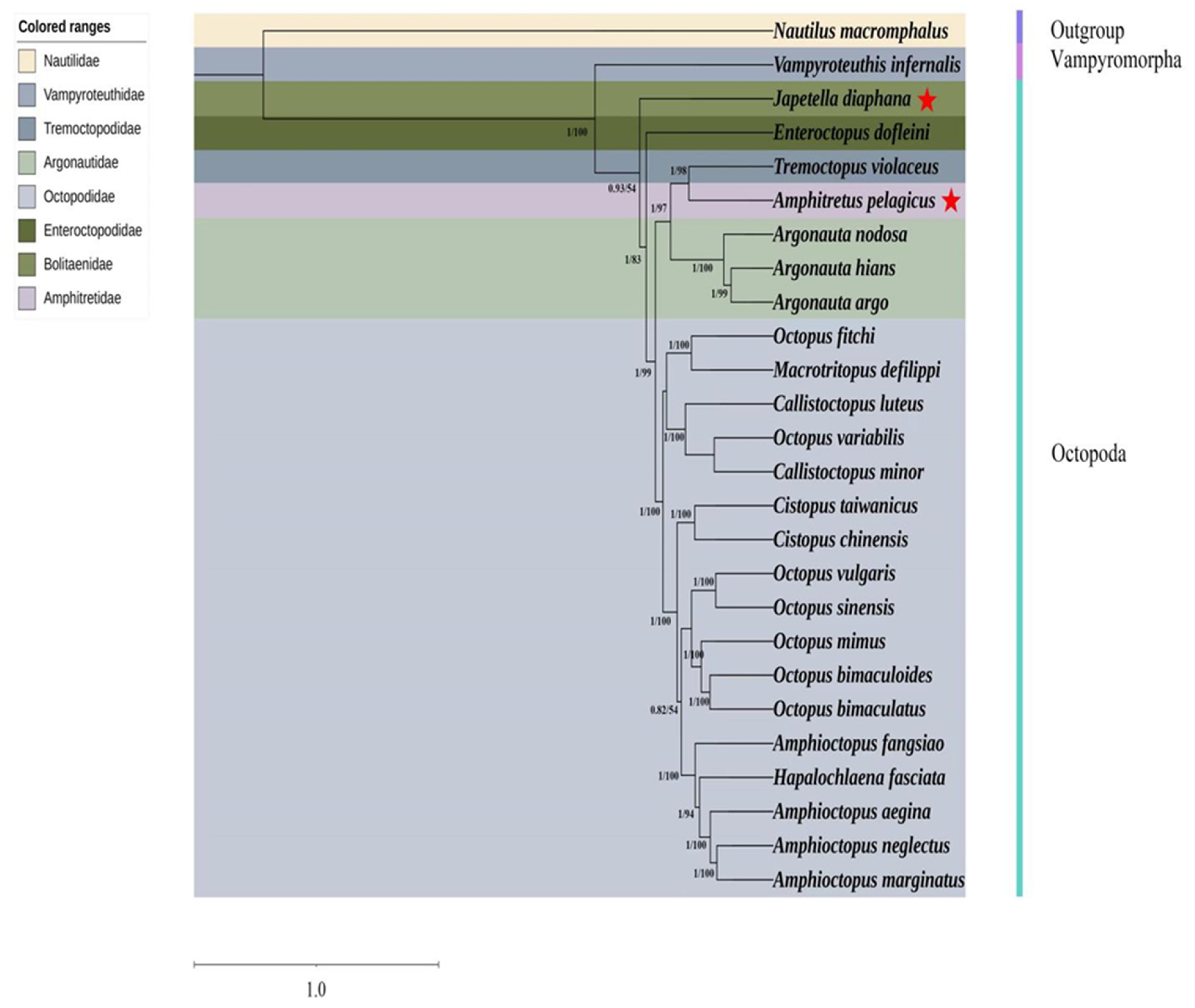
The mitochondrial genomes of 25 species representing seven families (Vampyroteuthidae, Tremoctopodidae, Argonautidae, Octopodidae, Enteroctopodidae, Bolitaenidae, and Amphitretidae), which are really Octopodiformes but, as Vampyromorpha, distinct from the order Octopoda, thus may serve as an outgroup, especially Nautilus macromphalus, which was utilized to construct a phylogenetic tree (Table 1, Figure 7). Both the maximum likelihood (ML) and Bayesian inference (BI) methodologies yielded identical topological structures, exhibiting high support for the majority of branches and categorizing the 26 species into eight primary clades. N. macromphalus emerged as a distinct branch. The inferred phylogenetic relationships among the families within Octopodiformes are as follows: ((((((Octopodidae, Argonautidae), Amphitretidae), Tremoctopodidae), Enteroctopodidae), Bolitaenidae), Vampyroteuthidae). Among the sequenced species, E. dofleini and J. diaphana were found to be closely related. Additionally, T. violaceus was identified as a sister group to A. pelagicus. Notably, family Octopodidae encompasses the majority of species within order Octopoda; thus the nominal genera are totally mixed within Octopodidae, which strongly supports the revision of the genus-level taxonomy of Octopodidae.

4. Discussion

The scarcity of data presents considerable challenges for the investigation of J. diaphana and A. pelagicus. These species have garnered less research attention compared to other cephalopods, despite their ecological significance and unique morphological characteristics. Their primary habitats, predominantly located in the deep seas of the western Pacific Ocean, remain under-sampled, hindering a comprehensive understanding of their biology, behavior, and ecological roles. Moreover, the reconstruction of their evolutionary histories and phylogenetic relationships within family Amphitretidae is impeded by the absence of sufficient genetic and genomic data. Mitochondrial gene sequences in invertebrates exhibit gene rearrangements on varying scales. In our study, we compared the mitochondrial genomes of currently sequenced species within the order Octopodiformes to the ancestral lineages represented by N. macromphalus (Figure 6). Our analysis revealed that the mitochondrial gene order of most species was conserved; however, A. pelagicus demonstrated significant translocation and random duplication–loss events. Notably, the genetic sequences of A. pelagicus were markedly altered to those of N. macromphalus.
The Ka/Ks ratio is an essential metric for evaluating the direction and intensity of natural selection exerted on protein-coding genes. A ratio exceeding 1 indicates the presence of positive or Darwinian selection, which facilitates evolutionary change [86]. In contrast, a ratio below 1 suggests the action of purifying or stabilizing selection, which counteracts evolutionary alterations, while a ratio equal to 1 denotes neutrality, indicating the absence of selective pressure. However, the simultaneous influence of both positive and purifying selection at various loci within a gene or across different temporal stages of its evolution may obscure the detection of one type of selection or affect the apparent strength of another. In our study, the majority of examined genes exhibited Ka/Ks ratios below 1, indicating their susceptibility to purifying selection. However, the ND4 gene displayed a ratio of 1.17, surpassing the threshold of 1, attributable to instances of positive selection during evolutionary history [87]. The conserved usage of synonymous codons, alongside the observed patterns of purifying and positive selection within protein-coding genes, provides a nuanced understanding of the evolutionary pressures influencing these genomes. Among the 13 PCGs, COI is recognized as the most conserved and smallest, frequently employed as a DNA barcode for the identification of cephalopods. The taxonomic classification of octopi has been contentious, with phylogenetic analyses yielding divergent results depending on the mitochondrial genes utilized [81]. Mitochondrial DNA sequences have offered compelling insights into the phylogenetic relationships among octopus species; phylogenetic analysis has corroborated the monophyletic relationship between families Bolitaenidae and Vitreledonellidae [13]. This result underscores the pivotal role of mitochondrial genome data in elucidating the evolutionary relationships among cephalopod species.
This study provides and analyzes the first complete mitochondrial genome sequences for J. diaphana and A. pelagicus, contributing novel insights into the mitochondrial genomic characteristics, gene arrangement, and phylogenetic relationships within the Octopodiformes clade. Bayesian probabilities and bootstrap supports are provided for each clade, enhancing the robustness of the phylogenetic interpretations. The pronounced AT bias identified in both species corroborates the findings from prior research on cephalopod mitochondrial genomes, underscoring a prevalent trend within this taxonomic group. Notably, A. pelagicus harbors two long non-coding regions (LNCRs), and the observed gene rearrangements exhibit significant deviations from the canonical mitochondrial genome organization documented in cephalopods. These results imply that the mechanisms of gene duplication and random loss may be pivotal in shaping the evolutionary trajectory of the mitochondrial genome in this particular species.

5. Conclusions

The complete mitochondrial genomes of two octopus species, J. diaphana and A. pelagicus, were sequenced and analyzed to ascertain their phylogenetic positioning within family Amphitretidae. The results indicated a significant AT bias in the mitochondrial genomes of both species, with A. pelagicus exhibiting a notable gene rearrangement and two long non-coding regions (LNCRs). Phylogenetic analysis, employing concatenated sequences from 13 protein-coding genes and two rRNA genes, revealed a monophyletic relationship between families Bolitaenidae and Vitreledonellidae, as well as a sister taxon relationship between Tremoctopus violaceus and Amphitretus pelagicus. This study provided novel insights into the evolutionary relationships within order Octopodiformes and underscored the utility of mitochondrial genomic data in elucidating phylogenetic relationships among cephalopods. The findings contribute to a deeper understanding of the evolutionary history of octopi and pose significant implications for the conservation of these species.

Author Contributions

L.J. collected samples and conceived this study. M.M. authored drafts in this article and conducted writing—review and editing. B.L. acquired funding. L.P. helped analyze data. All authors have read and agreed to the published version of the manuscript.

Funding

This study was supported by the Program on the Survey, Monitoring, and Assessment of Global Fishery Resources (a comprehensive scientific survey of fisheries resources in the high seas) sponsored by the Ministry of Agriculture and Rural Affairs and the Follow-up Program for Professor of Special Appointment (Eastern Scholar) at Shanghai Institutions of Higher Learning (GZ2022011).

Institutional Review Board Statement

This study was performed in line with the animal experimental ethical inspection and the institutional animal care and use committee of Zhejiang Ocean University guidelines “2025130”, approval date: 19 November 2025.

Informed Consent Statement

Not applicable.

Data Availability Statement

The annotated mitogenomes of Japetella diaphana and Amphitretus pelagicus were submitted and are available in the NCBI nucleotide database under accession numbers ON060363 and ON060364, respectively.

Acknowledgments

Our gratitude goes to the crew of the research vessel “Ocean Explorer” for their assistance in sample collection and to the technical staff for their meticulous efforts in ensuring the accuracy of our data.

Conflicts of Interest

The authors declare no conflicts of interest.

References

  1. Grimpe, G. Teuthologische Mitteilungen. VII: Systematiche Ubersicht der Nordsee-cephalopoden. Zool. Anz 1921, 52, 297–305. [Google Scholar]
  2. Naef, A.; Theodor, O.; von Boletzky, S.; Roper, C.F.E.; Institution, S.; di Napoli, S.Z. Cephalopoda; Part 1; Biodiversity Heritage Library: Washington, DC, USA, 1972; Jerusalem, Israel, 1921/1923. [Google Scholar]
  3. Strugnell, J.; Norman, M.; Jackson, J.; Drummond, A.J.; Cooper, A. Molecular phylogeny of coleoid cephalopods (Mollusca: Cephalopoda) using a multigene approach; the effect of data partitioning on resolving phylogenies in a Bayesian framework. Mol. Phylogenet. Evol. 2005, 37, 426–441. [Google Scholar] [CrossRef] [PubMed]
  4. Voight, J.R. Cladistic analysis of the Octopods based on anatomical characters. J. Mollusan Stud. 1997, 63, 311–325. [Google Scholar] [CrossRef]
  5. Young, R.E.M.V. Analysis of morphology to determine primary sister taxon relationships within coleoid cephalopods. Am. Malacol. Bull. 1996, 12, 91–112. [Google Scholar]
  6. O’Shea, S. The giant octopus Haliphron atlanticus (Mollusca: Octopoda) in New Zealand waters. New Zealand J. Zool. 2004, 31, 7–13. [Google Scholar] [CrossRef]
  7. Robson, G.C. A Monograph of the Recent Cephalopoda based on the Collections in the British Museum (Natural History). Nature 1932, 129, 636. [Google Scholar] [CrossRef]
  8. Carlini, D.B.; Young, R.E.; Vecchione, M. A molecular phylogeny of the Octopoda (Mollusca: Cephalopoda) evaluated in light of morphological evidence. Mol. Phylogenet. Evol. 2001, 21, 388–397. [Google Scholar] [CrossRef]
  9. Lindgren, A.R.; Pankey, M.S.; Hochberg, F.G.; Oakley, T.H. A multi-gene phylogeny of Cephalopoda supports convergent morphological evolution in association with multiple habitat shifts in the marine environment. BMC Evol. Biol. 2012, 12, 129. [Google Scholar] [CrossRef]
  10. Strugnell, J.; Norman, M.; Drummond, A.J.; Cooper, A. Neotenous origins for pelagic octopuses. Curr. Biol. 2004, 14, R300–R301. [Google Scholar] [CrossRef]
  11. Strugnell, J.M.; Collins, M.; Allcock, A. Molecular evolutionary relationships of the octopodid genus Thaumeledone (Cephalopoda: Octopodidae) from the Southern Ocean. Antarct. Sci. 2008, 20, 245–251. [Google Scholar] [CrossRef]
  12. Sweeney, M.J.C.F.E.R. Classification, type localities, and type repositories of recent cephalopoda. Smithsonian Contributions to Zoology. Zool. Anz. 1998, 586, 561–599. [Google Scholar]
  13. Voss, G.L. Evolution and phylogenetic relationships of deep-sea octopods (Cirrata and Incirrata). In The Mollusca. Pale Ontology and Neontology of Cephalopods; Clarke, M.R., Trueman, E.R., Eds.; Academic Press: London, UK, 1988; Volume 12, pp. 253–276. [Google Scholar]
  14. Strugnell, J.M.; Norman, M.; Vecchione, M.; Guzik, M.; Allcock, A. The ink sac clouds octopod evolutionary history. Hydrobiologia 2014, 725, 215–235. [Google Scholar] [CrossRef]
  15. Taite, M.; Dillon, L.; Strugnell, J.M.; Drewery, J.; Allcock, A. DNA Barcoding Reveals Unexpected Diversity of Deep-Sea Octopuses in the North-East Atlantic. Biol. Environ. Proc. R. Ir. Acad. 2023, 123B, 1–12. [Google Scholar] [CrossRef]
  16. Voight, J.R. A cladistic reassessment of Octopodid classification. Malacologia 1993, 35, 343–349. [Google Scholar]
  17. Boletzky, S.V. Evolutionary aspects of development, life style, and reproductive mode in incirrate octopods (Mollusca, Cephalopoda). Rev. Suisse De Zool 1992, 99, 755–770. [Google Scholar] [CrossRef]
  18. Engeser, T.K.B. Phylogenetic classification of coleoid cephalopods. In Cephalopods—Present and Past; Wiedman, J., Kullmann, J., Eds.; Schweizerbart. E. sche-Verlagsbuchhandlung: Stuttgart, Germany, 1988; pp. 105–116. [Google Scholar]
  19. Brands, S.J.E. Classification of Family Amphitretidae (molluscs) down to Species (Hoyle, 1885). In Systema Naturae 2000; The Taxonomicon; Universal Taxonomic Services: Zwaag, The Netherlands, 2021; Available online: http://taxonomicon.taxonomy.nl/TaxonTree.aspx?src=0&id=40327 (accessed on 19 December 2021).
  20. O’Shea, S. The Marine Fauna of New Zealand: Octopoda (Mollusca: Cephalopoda). NIWA Biodivers. Mem. 1999, 112, 280. [Google Scholar]
  21. Bouchet, P. Bolitaeninae Chun, 1911. In World Register of Marine Species; Flanders Marine Institute: Ostend, Belgium, 2013. [Google Scholar]
  22. Guzik, M.T.; Norman, M.D.; Crozier, R.H. Molecular phylogeny of the benthic shallow-water octopuses (Cephalopoda: Octopodinae). Mol. Phylogenet. Evol. 2005, 37, 235–248. [Google Scholar] [CrossRef]
  23. Kaneko, N.; Kubodera, T.; Iguchis, A. Taxonomic Study of Shallow-Water Octopuses (Cephalopoda: Octopodidae) in Japan and Adjacent Waters using Mitochondrial Genes with Perspectives on Octopus DNA Barcoding. Malacologia 2011, 54, 97–108. [Google Scholar] [CrossRef]
  24. Soeller, R.; Warnke, K.; Saint-Paul, U.; Blohm, D. Sequence divergence of mitochondrial DNA indicates cryptic biodiversity in Octopus vulgaris and supports the taxonomic distinctiveness of Octopus mimus (Cephalopoda: Octopodidae). Mar. Biol. 2000, 136, 29–35. [Google Scholar] [CrossRef]
  25. Toussaint, R.K.; Scheel, D.; Sage, G.K.; Talbot, S.L. Nuclear and mitochondrial markers reveal evidence for genetically segregated cryptic speciation in giant Pacific octopuses from Prince William Sound, Alaska. Conserv. Genet. 2012, 13, 1483–1497. [Google Scholar] [CrossRef]
  26. Amor, M.; Norman, M.; Roura, A.; Leite, T.; Gleadall, I.; Reid, A.; Perales-Raya, C.; Lu, C.; Silvey, C.; Vidal, E.; et al. Morphological assessment of the Octopus vulgaris species complex evaluated in light of molecular-based phylogenetic inferences. Zool. Scr. 2016, 46, 275–288. [Google Scholar] [CrossRef]
  27. Amor, M.D.; Doyle, S.R.; Norman, M.D.; Roura, Á.; Hall, N.E.; Robinson, A.J.; Leite, T.S.; Strugnell, J.M. Genome-wide sequencing uncovers cryptic diversity and mito-nuclear discordance in the Octopus vulgaris species complex. bioRxiv 2019. [Google Scholar] [CrossRef]
  28. Gleadall, I.G. Octopus sinensis d’Orbigny, 1841 (Cephalopoda: Octopodidae): Valid Species Name for the Commercially Valuable East Asian Common Octopus. Species Divers. 2016, 21, 31–42. [Google Scholar] [CrossRef]
  29. Norman, M.D.; Finn, J.K.; Hochberg, F.G. Family Octopodidae. In Cephalopods of the World; Jereb, P., Roper, C.F.E., Norman, M.D., Finn, J.K., Eds.; An Annotated and Illustrated Catalogue of Cephalopod Species Known to Date; Species Catalogue for Fishery Purposes; FAO: Rome, Italy, 2014; Volume 3. [Google Scholar]
  30. Pliego-Cárdenas, R.; Hochberg, F.G.; León, F.J.G.-D.; Barriga-Sosa, I.D.L.A. Close Genetic Relationships between Two American Octopuses: Octopus hubbsorum Berry, 1953, and Octopus mimus Gould, 1852. J. Shellfish Res. 2014, 33, 293–303. [Google Scholar] [CrossRef]
  31. Warnke, K. Diversität des Artenkomplexes Octopus cf. Vulgaris CUVIER, 1797 in Beziehung zu Seiner Verbreitung an der Ost-und Westküste Lateinamerikas; Shaker Verlag: Düren, Germany, 1999. [Google Scholar]
  32. Allcock, A.; Piertney, S. Evolutionary relationships of Southern Ocean Octopodidae (Cephalopoda: Octopoda) and a new diagnosis of Pareledone. Mar. Biol. 2002, 140, 129–135. [Google Scholar] [CrossRef]
  33. Allcock, A.L.; Strugnell, J.M.; Johnson, M.P. How useful are the recommended counts and indices in the systematics of the Octopodidae (Mollusca: Cephalopoda). Biol. J. Linn. Soc. 2008, 95, 205–218. [Google Scholar] [CrossRef]
  34. Allcock, A.L.; Strugnell, J.M.; Prodöhl, P.; Piatkowski, U.; Vecchione, M. A new species of Pareledone (Cephalopoda: Octopodidae) from Antarctic Peninsula Waters. Polar Biol. 2007, 30, 883–893. [Google Scholar] [CrossRef]
  35. Allcock, A.L.; Strugnell, J.M.; Ruggiero, H.; Collins, M.A. Redescription of the deep-sea octopod Benthoctopus normani (Massy 1907) and a description of a new species from the Northeast Atlantic. Mar. Biol. Res. 2006, 2, 372–387. [Google Scholar] [CrossRef]
  36. Sosa, I.D.B.; Beckenbach, K.; Hartwick, B.; Smith, M.J. The Molecular Phylogeny of Five Eastern North Pacific Octopus Species. Mol. Phylogenet. Evol. 1995, 4, 163–174. [Google Scholar] [CrossRef]
  37. Strugnell, J.M.; Rogers, A.; Prodöhl, P.A.; Collins, M.A.; Allcock, A.L. The thermohaline expressway: The Southern Ocean as a centre of origin for deep-sea octopuses. Cladistics 2008b, 24, 853–860. [Google Scholar] [CrossRef]
  38. Boore, J.L. Animal mitochondrial genomes. Nucleic Acids Res. 1999, 27, 1767–1780. [Google Scholar] [CrossRef]
  39. Aljanabi, S.M.; Martinez, I. Universal and rapid salt-extraction of high quality genomic DNA for PCR-based techniques. Nucleic Acids Res. 1997, 25, 4692–4693. [Google Scholar] [CrossRef] [PubMed]
  40. Bolger, A.M.; Lohse, M.; Usadel, B. Trimmomatic: A flexible trimmer for Illumina sequence data. Bioinformatics 2014, 30, 2114–2120. [Google Scholar] [CrossRef] [PubMed]
  41. Crang, N.; Contreras-López, O. Fragmentation of genomic DNA using Covaris g-Tubes prior to library preparation for sequencing. bioRxiv 2024. preprint. [Google Scholar] [CrossRef]
  42. Bankevich, A.; Nurk, S.; Antipov, D.; Gurevich, A.A.; Dvorkin, M.; Kulikov, A.S.; Lesin, V.M.; Nikolenko, S.I.; Pham, S.; Prjibelski, A.D.; et al. SPAdes: A new genome assembly algorithm and its applications to single-cell sequencing. J. Comput. Biol. 2012, 19, 455–477. [Google Scholar] [CrossRef]
  43. Xu, M.; Guo, L.; Gu, S.; Wang, O.; Zhang, R.; Peters, B.; Fan, G.; Liu, X.; Xu, X.; Deng, L.; et al. TGS-GapCloser: A fast and accurate gap closer for large genomes with low coverage of error-prone long reads. GigaScience 2020, 9, giaa094. [Google Scholar] [CrossRef]
  44. Jiang, L.; Liu, W.; Zhang, J.; Zhu, A.; Wu, C. Complete mitochondrial genome of Argentine shortfin squid (Illex argentines). Mitochondrial DNA A DNA Mapp. Seq. Anal. 2016, 27, 3335–3336. [Google Scholar] [CrossRef]
  45. Bernt, M.; Donath, A.; Jühling, F.; Externbrink, F.; Florentz, C.; Fritzsch, G.; Pütz, J.; Middendorf, M.; Stadler, P.F. MITOS: Improved de novo metazoan mitochondrial genome annotation. Mol. Phylogenet. Evol. 2013, 69, 313–319. [Google Scholar] [CrossRef]
  46. Grant, J.R.; Stothard, P. The CGView Server: A comparative genomics tool for circular genomes. Nucleic Acids Res. 2008, 36, W181–W184. [Google Scholar] [CrossRef]
  47. Kumar, S.; Stecher, G.; Li, M.; Knyaz, C.; Tamura, K. MEGA X: Molecular Evolutionary Genetics Analysis across Computing Platforms. Mol. Biol. Evol. 2018, 35, 1547–1549. [Google Scholar] [CrossRef]
  48. Perna, N.T.; Kocher, T.D. Patterns of nucleotide composition at fourfold degenerate sites of animal mitochondrial genomes. J. Mol. Evol. 1995, 41, 353–358. [Google Scholar] [CrossRef] [PubMed]
  49. Sowerby, I.G.B.T. Monograph of the genus Nautilus. In Hesaurus conchyliorum, or Monographs of Genera of Shells; Sowerby, G.B., II, Ed.; Global Biodiversity Information Facility: Copenhagen, Denmark, 1849; Volume 2, pp. 463–465. [Google Scholar]
  50. Pei, L.; Jiang, L.; Chen, C.; Fan, F.; Zhao, Q. Amphitretus pelagicus Mitochondrion, Complete Genome. 2022. Available online: https://www.ncbi.nlm.nih.gov/nuccore/ON060364 (accessed on 21 November 2022).
  51. Hirota, K.; Yoshida, M.A.; Itoh, T.; Toyoda, A.; Setiamarga, D.H.E. The full mitochondrial genome sequence of the greater argonaut Argonauta argo (Cephalopoda, Argonautoidea) and its phylogenetic position in Octopodiformes. Mitochondrial DNA B Resour. 2021, 6, 1451–1453. [Google Scholar] [CrossRef] [PubMed]
  52. Chiu, Y.-W.; Chang, C.-W.; Lin, H.-D.; Shen, K.-N. The complete mitogenome of the winged argonaut Argonauta hians and its phylogenetic relationships in Octopoda. Conserv. Genet. Resour. 2018, 10, 359–362. [Google Scholar] [CrossRef]
  53. Zhang, J. Argonauta nodosa Mitochondrion, Complete Genome. 2023. Available online: https://www.ncbi.nlm.nih.gov/nuccore/NC_048475 (accessed on 3 April 2023).
  54. Kim, K.-R.; Kim, Y.H.; Park, J.Y.; Bang, I.-C. Enteroctopus dofleini Mitochondrion, Complete Genome. 2021. Available online: https://www.ncbi.nlm.nih.gov/nuccore/NC_056385 (accessed on 19 June 2021).
  55. Zhang, X.; Zheng, X.; Ma, Y.; Li, Q. Complete mitochondrial genome and phylogenetic relationship analyses of Amphioctopus aegina (Gray, 1849) (Cephalopoda: Octopodidae). Mitochondrial DNA A DNA Mapp. Seq. Anal. 2017, 28, 17–18. [Google Scholar] [CrossRef]
  56. Akasaki, T.; Nikaido, M.; Tsuchiya, K.; Segawa, S.; Hasegawa, M.; Okada, N. Extensive mitochondrial gene arrangements in coleoid Cephalopoda and their phylogenetic implications. Mol. Phylogenet. Evol. 2006, 38, 648–658. [Google Scholar] [CrossRef] [PubMed]
  57. Tang, Y.; Zheng, X.D.; Ma, Y.; Cheng, R. The complete mitochondrial genome of Amphioctopus marginatus (Cephalopoda: Octopodidae) and the exploration for the optimal DNA barcoding in Octopodidae. Conserv. Genet. Resour. 2017, 10, 115–118. [Google Scholar] [CrossRef]
  58. Tang, Y.; Zheng, X.D.; Zhong, H. Phylogenetics and comparative analysis of the mitochondrial genomes of three violet-ringed octopuses. Zool. Scr. 2019, 48, 482–493. [Google Scholar] [CrossRef]
  59. Cheng, R.; Zheng, X.; Ma, Y.; Li, Q. The complete mitochondrial genomes of two octopods Cistopus chinensis and Cistopus taiwanicus: Revealing the phylogenetic position of the genus Cistopus within the order Octopoda. PLoS ONE 2013, 8, e84216. [Google Scholar] [CrossRef]
  60. Ma, Y.; Zhang, X.; Zheng, X.; Cheng, R.; Li, Q. Callistoctopus luteus Mitochondrion, Complete Genome. 2018. Available online: https://www.ncbi.nlm.nih.gov/nuccore/NC_039848 (accessed on 9 November 2018).
  61. Cheng, R.; Zheng, X.; Lin, X.; Yang, J.; Li, Q. Determination of the complete mitochondrial DNA sequence of Octopus minor. Mol. Biol. Rep. 2012, 39, 3461–3470. [Google Scholar] [CrossRef]
  62. Kim, H.S.; Kim, K.Y.; Kim, I.H.; Yang, D.; Kim, H. The complete mitochondrial genome of blue-lined octopus Hapalochlaena fasciata (Hoyle, 1886) (Octopodiformes; Octopoda; Octopodidae). Mitochondrial DNA B Resour. 2020, 5, 3322–3323. [Google Scholar] [CrossRef]
  63. Magallon-Gayon, E.; del Rio-Portilla, M.; Barriga-Sosa, I. Macrotritopus defilippi Mitochondrion, Partial Genome. 2021. Available online: https://www.ncbi.nlm.nih.gov/nuccore/MZ264859 (accessed on 18 May 2021).
  64. Domínguez-Contreras, J.F.; Munguia-Vega, A.; Ceballos-Vázquez, B.P.; García-Rodriguez, F.J.; Arellano-Martinez, M. The complete mitochondrial genome of Octopus bimaculatus Verrill, 1883 from the Gulf of California. Mitochondrial DNA A DNA Mapp. Seq. Anal. 2016, 27, 4584–4585. [Google Scholar] [CrossRef] [PubMed]
  65. Farfan, C.; Vargas-Peralta, C.E.; Lafarga-De La Cruz, F. Octopus bimaculoides Mitochondrion, Complete Genome. 2016. Available online: https://www.ncbi.nlm.nih.gov/nuccore/NC_029723 (accessed on 24 March 2016).
  66. Magallón-Gayón, E.; del Río-Portilla, M.Á.; de los Angeles Barriga-Sosa, I. The complete mitochondrial genomes of two octopods of the eastern Pacific Ocean: Octopus mimus and ‘Octopus’ fitchi (Cephalopoda: Octopodidae) and their phylogenetic position within Octopoda. Mol. Biol. Rep. 2020, 47, 943–952. [Google Scholar] [CrossRef] [PubMed]
  67. Du, X. Octopus variabilis Mitochondrion, Complete Genom. 2018. Available online: https://www.ncbi.nlm.nih.gov/nuccore/MF029677 (accessed on 7 July 2018).
  68. Yokobori, S.-I.; Fukuda, N.; Nakamura, M.; Aoyama, T.; Oshima, T. Long-Term Conservation of Six Duplicated Structural Genes in Cephalopod Mitochondrial Genomes. Mol. Biol. Evol. 2004, 21, 2034–2046. [Google Scholar] [CrossRef] [PubMed]
  69. Li, F.; Liu, Y.; Qin, B.; Bian, L.; Ge, J.; Chang, Q.; Hui, L.; Chen, S. Sequence and phylogenetic analysis of the mitochondrial genome for the East Asian common octopus, Octopus sinensis (Octopodidae: Octopoda). Mitochondrial DNA Part B 2021, 6, 2120–2122. [Google Scholar] [CrossRef]
  70. Chiu, Y.-W.; Chang, C.-W.; Shen, K.-N.; Ju, Y.-M.; Lin, H.-D. Complete mitochondrial genome and the phylogenetic position of the pelagic octopus Tremoctopus violaceus (Mollusca: Tremoctopodidae). Mitochondrial DNA Part B 2018, 3, 1248–1249. [Google Scholar] [CrossRef]
  71. Yokobori, S.-I.; Lindsay, D.J.; Yoshida, M.; Tsuchiya, K.; Yamagishi, A.; Maruyama, T.; Oshima, T. Mitochondrial genome structure and evolution in the living fossil vampire squid, Vampyroteuthis infernalis, and extant cephalopods. Mol. Phylogenet. Evol. 2007, 44, 898–910. [Google Scholar] [CrossRef]
  72. Boore, J.L. The complete sequence of the mitochondrial genome of Nautilus macromphalus (Mollusca: Cephalopoda). BMC Genom. 2006, 7, 182. [Google Scholar] [CrossRef]
  73. Xia, X. DAMBE7: New and Improved Tools for Data Analysis in Molecular Biology and Evolution. Mol. Biol. Evol. 2018, 35, 1550–1552. [Google Scholar] [CrossRef]
  74. Trifinopoulos, J.; Nguyen, L.-T.; von Haeseler, A.; Minh, B.Q. W-IQ-TREE: A fast online phylogenetic tool for maximum likelihood analysis. Nucleic Acids Res. 2016, 44, W232–W235. [Google Scholar] [CrossRef]
  75. Kalyaanamoorthy, S.; Minh, B.Q.; Wong, T.K.F.; von Haeseler, A.; Jermiin, L.S. ModelFinder: Fast model selection for accurate phylogenetic estimates. Nat. Methods 2017, 14, 587–589. [Google Scholar] [CrossRef]
  76. Ronquist, F.; Teslenko, M.; van der Mark, P.; Ayres, D.L.; Darling, A.; Höhna, S.; Larget, B.; Liu, L.; Suchard, M.A.; Huelsenbeck, J.P. MrBayes 3.2: Efficient Bayesian phylogenetic inference and model choice across a large model space. Syst. Biol. 2012, 61, 539–542. [Google Scholar] [CrossRef]
  77. Stamatakis, A.; Ott, M.; Ludwig, T. RAxML-OMP: An Efficient Program for Phylogenetic Inference on SMPs. In Parallel Computing Technologies; Springer: Berlin/Heidelberg, Germany, 2005. [Google Scholar]
  78. Cummings, M.P. PAUP (Phylogenetic Analysis Using Parsimony (and Other Methods)). In Dictionary of Bioinformatics and Computational Biology; John Wiley & Sons: Hoboken, NJ, USA, 2014. [Google Scholar]
  79. Swofford, D. PAUP*. Phylogenetic Analysis Using Parsimony (*and Other Methods), Version 4.0b10; Sinauer Associates: Sunderland, MA, USA, 2002. [CrossRef]
  80. Rambaut, A. FigTreev1.4.2. A Graphical Viewer of Phylogenetic Trees. 2014. Available online: http://tree.bio.ed.ac.uk/software/figtree/ (accessed on 4 April 2014).
  81. Dai, L.; Zheng, X.; Kong, L.; Li, Q. DNA barcoding a graphical viewer of phylogenetic trees analysis of Coleoidea (Mollusca: Cephalopoda) from Chinese waters. Mol. Ecol. Resour. 2012, 12, 437–447. [Google Scholar] [CrossRef] [PubMed]
  82. Katugin, O.; Chichvarkhina, O.; Zolotova, A.; Chichvarkhin, A. DNA barcoding for squids of the family Gonatidae (Cephalopoda: Teuthida) from the boreal North Pacific. Mitochondrial DNA 2015, 28, 41–49. [Google Scholar] [CrossRef] [PubMed]
  83. Wang, X.; Huang, Y.; Liu, N.; Yang, J.; Lei, F. Seven complete mitochondrial genome sequences of Bushtits (Passeriformes, Aegithalidae, Aegithalos): The evolution pattern in duplicated control regions. Mitochondrial DNA 2015, 26, 350–356. [Google Scholar] [CrossRef] [PubMed]
  84. Yamauchi, M.M.; Miya, M.U.; Nishida, M. Complete mitochondrial DNA sequence of the swimming crab, Portunus trituberculatus (Crustacea: Decapoda: Brachyura). Gene 2003, 311, 129–135. [Google Scholar] [CrossRef]
  85. Moritz, C.; Brown, W.M. Tandem duplications in animal mitochondrial DNAs: Variation in incidence and gene content among lizards. Proc. Natl. Acad. Sci. USA 1987, 84, 7183–7187. [Google Scholar] [CrossRef]
  86. Yang, Z.; Bielawski, J.P. Statistical methods for detecting molecular adaptation. Trends Ecol. Evol. 2000, 15, 496–503. [Google Scholar] [CrossRef]
  87. Feng, J.-T.; Guo, Y.-H.; Yan, C.-R.; Ye, Y.-Y.; Li, J.-J.; Guo, B.-Y.; Lü, Z.-M. Comparative analysis of the complete mitochondrial genomes in two limpets from Lottiidae (Gastropoda: Patellogastropoda): Rare irregular gene rearrangement within Gastropoda. Sci. Rep. 2020, 10, 19277. [Google Scholar] [CrossRef]
Figure 1. (a) Mitochondrial genome map of J. diaphana: The two inner circles illustrate the total GC content (in black) and the GC skew (green indicating positive and purple indicating negative) of the mitochondrial genome. The next circles represent the nucleotide identity between J. diaphana and other species within the genus Japetella. The outermost sections represent the various elements: protein-coding genes (in blue), tRNAs (in purple), rRNAs (in green), and the control region (represented by empty space). Genes with a clockwise arrow are encoded on the “L” strand, while those with a counterclockwise arrow are encoded on the “H” strand. (b) Mitochondrial genome map of A. pelagicus: The two inner circles illustrate the total GC content (in black) and the GC skew (green indicating positive and purple indicating negative) of the mitochondrial genome. The next circles represent the nucleotide similarity between A. pelagicus and other species within the genus Amphitretus. The outermost sections represent the various gene types: protein-coding genes (in blue), tRNAs (in purple), rRNAs (in green), and the control region (represented by empty space). Genes with a clockwise arrow are encoded on the “L” strand, while those with a counterclockwise arrow are encoded on the “H” strand.
Genes 17 00312 g001aGenes 17 00312 g001b
Figure 2. The relative synonymous codon usage of 13 protein-coding genes in the mitogenome for J. diaphana and A. pelagicus.
Genes 17 00312 g002
Figure 3. An analysis of protein-coding genes based on the Ka/Ks ratio.
Genes 17 00312 g003
Figure 4. Transfer RNA structure of J. diaphana.
Genes 17 00312 g004
Figure 5. Transfer RNA structure of A. pelagicus.
Genes 17 00312 g005
Figure 6. A linearized representation of the mitochondrial gene arrangement. The two species whose sequences are newly reported here are indicated with a red star.
Genes 17 00312 g006
Figure 7. A phylogenetic tree of 26 cephalopod species constructed by the Bayesian inference and maximum likelihood methods based on the concatenated sequences of 13 PCGs and two rRNAs. The two species whose sequences are newly reported here are indicated with a red star.
Genes 17 00312 g007
Table 1. List of mitogenomes analyzed in this study. The two species whose sequences are newly reported here are indicated with a star.
FamilySpeciesSize (bp)Accession No.Reference
AmphitretidaeAmphitretus pelagicus *17,380ON060364[50] Unpublished
ArgonautidaeArgonauta argo15,741LC596061[51]
Argonauta hians16,130NC036354[52]
Argonauta nodosa15,201NC048475[53] Unpublished
BolitaenidaeJapetella diaphana *16,111ON060363[50] Unpublished
EnteroctopodidaeEnteroctopus dofleini16,026NC056385[54] Unpublished
OctopodidaeAmphioctopus aegina15,545NC029702[55]
Amphioctopus fangsiao15,979AB240156[56]
Amphioctopus marginatus15,719NC036351[57]
Amphioctopus neglectus15,814MH899749[58]
Cistopus taiwanicus15,793NC023257[59]
Callistoctopus luteus15,961NC039848[60] Unpublished
Cistopus chinensis15,706KF017606[59]
Callistoctopus minor15,974NC015896[61]
Hapalochlaena fasciata15,479NC051545[62] Unpublished
Macrotritopus defilippi15,501MZ264859[63]
Octopus bimaculatus16,084NC028547[64]
Octopus bimaculoides15,733NC029723[65] Unpublished
Octopus fitchi15,780MK450541[66]
Octopus mimus15,696NC044093[66]
Octopus variabilis15,992MF029677[67] Unpublished
Octopus vulgaris15,744AB158363[68]
Octopus sinensis15,737MT712046[69]
TremoctopodidaeTremoctopus violaceus16,015KY649286[70]
VampyroteuthidaeVampyroteuthis infernalis15,617NC009689[71]
NautilidaeNautilus macromphalus16,258DQ472026[72]
Table 2. Gene annotations for the complete mitogenomes of J. diaphana.
GenePositionSize (bp)CodonIntergenic NucleotidesStrand
FromToNucleotideAmino AcidInitiationStop
COIII17808792263ATTTAA0L
trnK82088869 0L
trnA88995668 0L
trnR965102763 0L
trnN1029109870 23L
trnI1100116566 4L
ND311661516351116ATGTAA11L
trnS11515158369 9L
ND2158426211038345ATGTAA0L
COI259341251533510ATGTAA8L
COII41294818690229ATGTAA1L
trnD4817488266 −2L
ATP84884503615351ATGTAA1L
ATP650395731693230ATGTAG0L
trnF5755582066 −8H
ND5582175131693563ATGT--−2H
trnH7514757966 1H
ND4758088961317438ATATAA0H
ND4L8920921629798ATGTAG−29H
trnT9221928565 4L
trnS29295935965 0H
Cytb935810,4971140379ATGTAA3H
ND610,49011,002513170ATGTAG−2H
trnP11,00411,06865 0H
ND111,07312,014942313ATGTAA1H
trnL212,01512,07965 −40H
trnL112,08012,14364 −31H
16S12,10413,5001397 2H
trnV13,47013,53667 9H
12S13,54614,460915 23H
trnM14,45914,52769 −2H
trnC14,53614,59964 8H
trnY14,60014,66364 0H
trnW14,66414,73471 0H
trnQ14,73514,80268 0H
trnG14,80314,86664 0H
trnE14,86714,93468 0H
Table 3. The gene annotations of the complete mitogenomes of A. pelagicus.
GenePositionSize (bp)CodonIntergenic NucleotidesStrand
FromToNucleotideAmino AcidInitiationStop
COIII10807798266ATATAA0L
trnK81388169 5L
trnA88294564 0L
trnR947100862 1L
trnN1009107668 0L
trnI1077114266 0L
ND311431439351117ATGTAA0L
TrnS11492156069 −2L
ND2156126011041347ATGTAA0L
COI257341051533511ATGTAA−29L
COII41074793687229ATGTAA1L
trnD4792485564 −2L
ATP84856501115652ATGTAA0L
ATP650165705690230ATATAG4L
trnF5731579565 25H
ND5579674821687562ATGT--0H
trnH7483754664 0H
ND175648508945315ATATAG17H
trnL28506857065 −3H
trnC8597866165 26H
trnY8662872463 0H
trnE8734879764 9H
ND4990711,2411335445ATTTAG0H
ND4L11,24711,54329799ATGTAG5H
trnT11,54811,61265 4L
trnS211,61311,67664 0H
Cytb11,67512,8141140380ATGTAA−2H
ND612,80713,319513171ATGTAG−8H
trnP13,32113,38565 1H
trnL113,59813,66568 0H
16S13,63115,0281398 −35H
trnV15,00015,06768 −29H
12S15,08016,025946 12H
trnM16,02916,09466 3H
trnW16,13116,19666 36H
trnQ16,19716,26468 0H
trnG16,26716,33670 2H
Table 4. The nucleotide composition in the mitochondrial genome.
Species Size (bp)A%T%C%G%A + T%C + G%A-T SkewG-C Skew
J. diaphanaWhole genome16,11140.6%36.3%15.4%7.7%76.9%23.1%0.056−0.333
13 PCGs11,15231.9%43.5%11.0%13.5%75.4%24.5%−0.1540.102
rRNA231237.1%42.5%6.0%14.4%79.6%20.4%−0.0680.412
tRNA146237.9%40.6%8.1%13.4%78.5%21.5%−0.0340.247
A. pelagicusWhole genome17,38040.6%35.1%16.8%7.5%75.7%24.3%0.073−0.383
13 PCGs11,17330.7%42.7%12.2%14.4%73.4%26.6%−0.1630.083
rRNA234436.9%41.6%6.1%15.4%78.5%21.5%−0.0600.433
tRNA144838.4%40.1%8.0%13.5%78.5%21.5%−0.0220.256
Disclaimer/Publisher’s Note: The statements, opinions and data contained in all publications are solely those of the individual author(s) and contributor(s) and not of MDPI and/or the editor(s). MDPI and/or the editor(s) disclaim responsibility for any injury to people or property resulting from any ideas, methods, instructions or products referred to in the content.