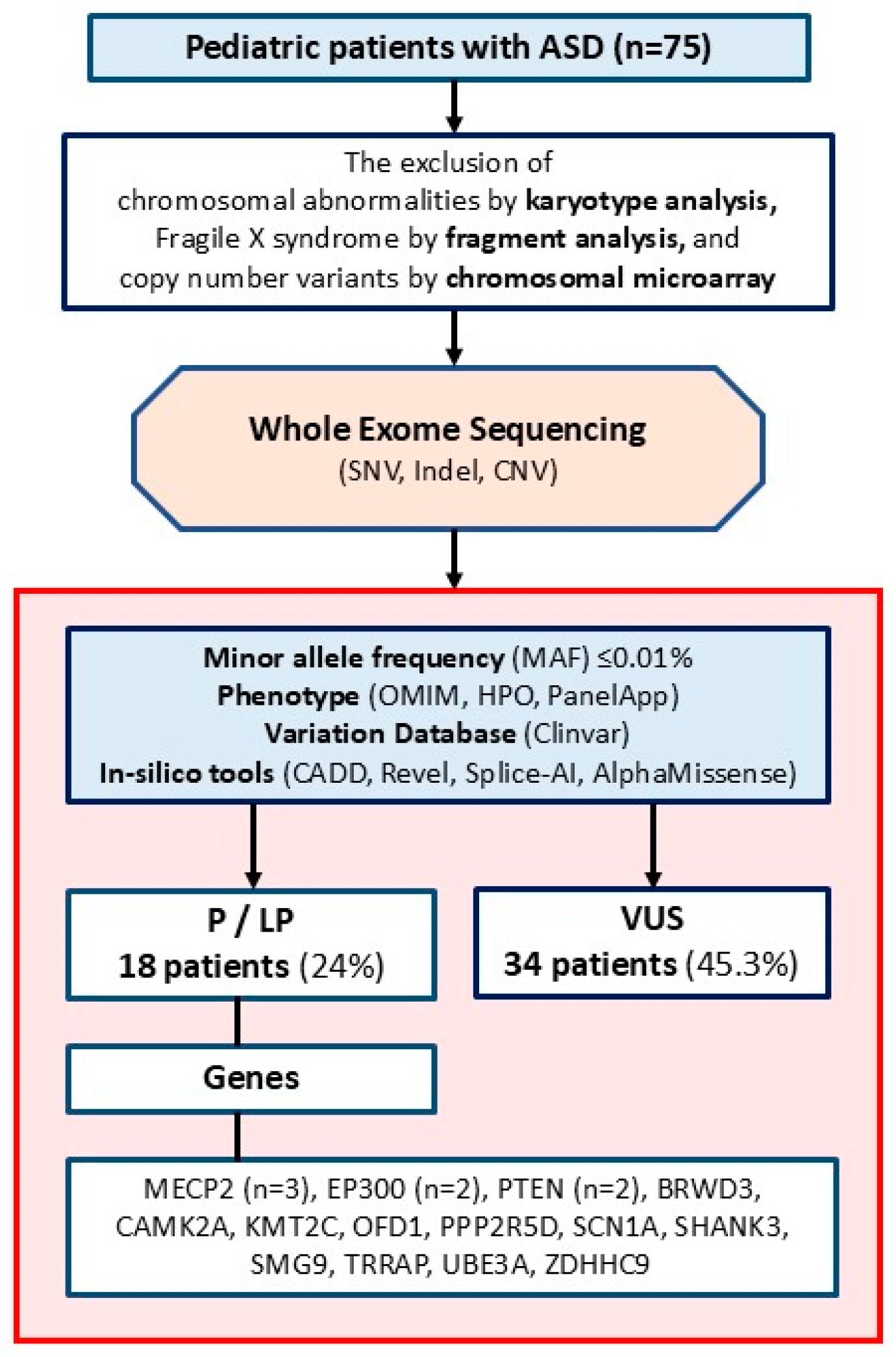
Genetic Traces in Autism Spectrum Disorders: A Whole Exome Sequencing Study from Türkiye

 , , and
Abstract
1. Introduction
2. Materials and Methods
2.1. Ethics
2.2. Participants
2.3. Whole Exome Sequencing and Analysis
3. Results
3.1. Clinical Findings
3.2. Molecular Findings
4. Discussion
5. Conclusions
Author Contributions
Funding
Institutional Review Board Statement
Informed Consent Statement
Data Availability Statement
Acknowledgments
Conflicts of Interest
References
- First, M.B. Diagnostic and statistical manual of mental disorders, and clinical utility. J. Nerv. Ment. Dis. 2013, 201, 727–729. [Google Scholar] [CrossRef] [PubMed]
- Bicks, L.K.; Geschwind, D.H. Functional neurogenomics in autism spectrum disorders: A decade of progress. Curr. Opin. Neurobiol. 2024, 86, 102858. [Google Scholar] [CrossRef] [PubMed]
- Diagnostic, A.P. Statistical Manual of Mental Disorders: DSM-5, 5th ed.; American Psychiatric Association: Washington, DC, USA, 2013. [Google Scholar]
- Smalley, S.L. Genetic influences in childhood-onset psychiatric disorders: Autism and attention-deficit/hyperactivity disorder. Am. J. Hum. Genet. 1997, 60, 1276–1282. [Google Scholar] [CrossRef]
- Cohen, D.; Pichard, N.; Tordjman, S.; Baumann, C.; Burglen, L.; Excoffier, E.; Lazar, G.; Mazet, P.; Pinquier, C.; Verloes, A.; et al. Specific genetic disorders and autism: Clinical contribution towards their identification. J. Autism Dev. Disord. 2005, 35, 103–116. [Google Scholar] [CrossRef] [PubMed]
- Matson, J.L. Current status of differential diagnosis for children with autism spectrum disorders. Res. Dev. Disabil. 2007, 28, 109–118. [Google Scholar] [CrossRef]
- Matson, J.L.; Beighley, J.; Turygin, N. Autism diagnosis and screening: Factors to consider in differential diagnosis. Res. Autism Spectr. Disord. 2012, 6, 19–24. [Google Scholar] [CrossRef]
- Kreiman, B.L.; Boles, R.G. State of the art of genetic testing for patients with autism: A practical guide for clinicians. Semin. Pediatr. Neurol. 2020, 34, 100804. [Google Scholar] [CrossRef]
- Hallmayer, J.; Cleveland, S.; Torres, A.; Phillips, J.; Cohen, B.; Torigoe, T.; Miller, J.; Fedele, A.; Collins, J.; Smith, K.; et al. Genetic heritability and shared environmental factors among twin pairs with autism. Arch. Gen. Psychiatry 2011, 68, 1095–1102. [Google Scholar] [CrossRef]
- Bourgeron, T. Current knowledge on the genetics of autism and propositions for future research. C. R. Biol. 2016, 339, 300–307. [Google Scholar] [CrossRef]
- Genovese, A.; Butler, M.G. Clinical assessment, genetics, and treatment approaches in autism spectrum disorder (ASD). Int. J. Mol. Sci. 2020, 21, 4726. [Google Scholar] [CrossRef]
- Ritvo, E.R.; Spence, M.A.; Freeman, B.J.; Mason-Brothers, A.; Mo, A.; Marazita, M.L. Evidence for autosomal recessive inheritance in 46 families with multiple incidences of autism. Am. J. Psychiatry 1985, 142, 187–192. [Google Scholar]
- Doan, R.N.; Lim, E.T.; De Rubeis, S.; Betancur, C.; Cutler, D.J.; Chiocchetti, A.G.; Overman, L.M.; Soucy, A.; Goetze, S.; Autism Sequencing Consortium; et al. Recessive gene disruptions in autism spectrum disorder. Nat. Genet. 2019, 51, 1092–1098. [Google Scholar] [CrossRef]
- Shen, L.; Li, P.; Zheng, T.; Luo, M.; Zhang, S.; Huang, Y.; Hu, Y.; Li, H. Comparative analysis of the autism-related variants between different autistic children in a family pedigree. Mol. Med. Rep. 2021, 24, 697. [Google Scholar] [CrossRef] [PubMed]
- Sener, E.F.; Canatan, H.; Ozkul, Y. Recent advances in autism spectrum disorders: Applications of whole exome sequencing technology. Psychiatry Investig. 2016, 13, 255. [Google Scholar] [CrossRef]
- de Koning, M.A.; Srebniak, M.I.; Oldekamp, E.J.; Hahn, D.; Diderich, K.E.; Bruggenwirth, H.T.; Santen, G.W.; Hoffer, M.J.; Suerink, M. Prenatal Variants of Uncertain Significance (VUS): To report or not to report? Eur. J. Hum. Genet. 2025, 33, 1300–1308. [Google Scholar] [CrossRef] [PubMed]
- Sanders, S.J.; Murtha, M.T.; Gupta, A.R.; Murdoch, J.D.; Raubeson, M.J.; Willsey, A.J.; Ercan-Sencicek, A.G.; DiLullo, N.M.; Parikshak, N.N.; Stein, J.L.; et al. De novo mutations revealed by whole-exome sequencing are strongly associated with autism. Nature 2012, 485, 237–241. [Google Scholar] [CrossRef]
- Hashimoto, R.; Nakazawa, T.; Tsurusaki, Y.; Yasuda, Y.; Nagayasu, K.; Matsumura, K.; Kawashima, H.; Yamamori, H.; Fujimoto, M.; Ohi, K.; et al. Whole-exome sequencing and neurite outgrowth analysis in autism spectrum disorder. J. Hum. Genet. 2016, 61, 199–206. [Google Scholar] [CrossRef] [PubMed]
- Timothy, W.Y.; Chahrour, M.H.; Coulter, M.E.; Jiralerspong, S.; Okamura-Ikeda, K.; Ataman, B.; Schmitz-Abe, K.; Harmin, D.A.; Adli, M.; Malik, A.N.; et al. Using whole-exome sequencing to identify inherited causes of autism. Neuron 2013, 77, 259–273. [Google Scholar] [CrossRef]
- Chapman, N.H.; Nato, A.Q.; Bernier, R.; Ankenman, K.; Sohi, H.; Munson, J.; Patowary, A.; Archer, M.; Blue, E.M.; Webb, S.J.; et al. Whole exome sequencing in extended families with autism spectrum disorder implicates four candidate genes. Hum. Genet. 2015, 134, 1055–1068. [Google Scholar] [CrossRef]
- C Yuen, R.K.; Merico, D.; Bookman, M.; L Howe, J.; Thiruvahindrapuram, B.; Patel, R.V.; Whitney, J.; Deflaux, N.; Bingham, J.; Wang, Z.; et al. Whole genome sequencing resource identifies 18 new candidate genes for autism spectrum disorder. Nat. Neurosci. 2017, 20, 602–611. [Google Scholar] [CrossRef]
- Richards, S.; Aziz, N.; Bale, S.; Bick, D.; Das, S.; Gastier-Foster, J.; Grody, W.W.; Hegde, M.; Lyon, E.; Spector, E.; et al. Standards and guidelines for the interpretation of sequence variants: A joint consensus recommendation of the American College of Medical Genetics and Genomics and the Association for Molecular Pathology. Genet. Med. 2015, 17, 405–423. [Google Scholar] [CrossRef]
- Zeidan, J.; Fombonne, E.; Scorah, J.; Ibrahim, A.; Durkin, M.S.; Saxena, S.; Yusuf, A.; Shih, A.; Elsabbagh, M. Global prevalence of autism: A systematic review update. Autism Res. 2022, 15, 778–790. [Google Scholar] [CrossRef] [PubMed]
- McCarty, P.; Frye, R.E. Early detection and diagnosis of autism spectrum disorder: Why is it so difficult? Semin. Pediatr. Neurol. 2020, 35, 100831. [Google Scholar] [CrossRef]
- Okoye, C.; Obialo-Ibeawuchi, C.M.; Obajeun, O.A.; Sarwar, S.; Tawfik, C.; Waleed, M.S.; Wasim, A.U.; Mohamoud, I.; Afolayan, A.Y.; Mbaezue, R.N. Early diagnosis of autism spectrum disorder: A review and analysis of the risks and benefits. Cureus 2023, 15, e43226. [Google Scholar] [CrossRef] [PubMed]
- Nisar, S.; Haris, M. Neuroimaging genetics approaches to identify new biomarkers for the early diagnosis of autism spectrum disorder. Mol. Psychiatry 2023, 28, 4995–5008. [Google Scholar] [CrossRef]
- Niu, M.; Han, Y.; Dy, A.B.; Du, J.; Jin, H.; Qin, J.; Zhang, J.; Li, Q.; Hagerman, R.J. Autism symptoms in fragile X syndrome. J. Child Neurol. 2017, 32, 903–909. [Google Scholar] [CrossRef]
- Kalsner, L.; Twachtman-Bassett, J.; Tokarski, K.; Stanley, C.; Dumont-Mathieu, T.; Cotney, J.; Chamberlain, S. Genetic testing including targeted gene panel in a diverse clinical population of children with autism spectrum disorder: Findings and implications. Mol. Genet. Genom. Med. 2018, 6, 171–185. [Google Scholar] [CrossRef]
- Özaslan, A.; Kayhan, G.; İşeri, E.; Ergün, M.A.; Güney, E.; Perçin, F.E. Identification of copy number variants in children and adolescents with autism spectrum disorder: A study from Turkey. Mol. Biol. Rep. 2021, 48, 7371–7378. [Google Scholar] [CrossRef]
- Ni Ghralaigh, F.; McCarthy, E.; Murphy, D.N.; Gallagher, L.; Lopez, L.M. Brief report: Evaluating the diagnostic yield of commercial gene panels in autism. J. Autism Dev. Disord. 2023, 53, 484–488. [Google Scholar] [CrossRef]
- Havdahl, A.; Niarchou, M.; Starnawska, A.; Uddin, M.; van der Merwe, C.; Warrier, V. Genetic contributions to autism spectrum disorder. Psychol. Med. 2021, 51, 2260–2273. [Google Scholar] [CrossRef] [PubMed]
- Bruno, L.P.; Doddato, G.; Valentino, F.; Baldassarri, M.; Tita, R.; Fallerini, C.; Bruttini, M.; Lo Rizzo, C.; Mencarelli, M.A.; Mari, F.; et al. New candidates for autism/intellectual disability identified by whole-exome sequencing. Int. J. Mol. Sci. 2021, 22, 13439. [Google Scholar] [CrossRef] [PubMed]
- Van’T Hof, M.; Tisseur, C.; van Berckelear-Onnes, I.; Van Nieuwenhuyzen, A.; Daniels, A.M.; Deen, M.; Hoek, H.W.; Ester, W.A. Age at autism spectrum disorder diagnosis: A systematic review and meta-analysis from 2012 to 2019. Autism 2021, 25, 862–873. [Google Scholar] [CrossRef] [PubMed]
- Ferri, S.L.; Abel, T.; Brodkin, E.S. Sex differences in autism spectrum disorder: A review. Curr. Psychiatry Rep. 2018, 20, 9. [Google Scholar] [CrossRef] [PubMed]
- Tammimies, K.; Marshall, C.R.; Walker, S.; Kaur, G.; Thiruvahindrapuram, B.; Lionel, A.C.; Yuen, R.K.; Uddin, M.; Roberts, W.; Weksberg, R.; et al. Molecular diagnostic yield of chromosomal microarray analysis and whole-exome sequencing in children with autism spectrum disorder. JAMA 2015, 314, 895–903. [Google Scholar] [CrossRef]
- Feliciano, P.; Zhou, X.; Astrovskaya, I.; Turner, T.N.; Wang, T.; Brueggeman, L.; Barnard, R.; Hsieh, A.; Snyder, L.G.; Muzny, D.M.; et al. Exome sequencing of 457 autism families recruited online provides evidence for autism risk genes. NPJ Genom. Med. 2019, 4, 19. [Google Scholar] [CrossRef]
- Sheth, F.; Shah, J.; Jain, D.; Shah, S.; Patel, H.; Patel, K.; Solanki, D.I.; Iyer, A.S.; Menghani, B.; Mhatre, P.; et al. Comparative yield of molecular diagnostic algorithms for autism spectrum disorder diagnosis in India: Evidence supporting whole exome sequencing as first tier test. BMC Neurol. 2023, 23, 292. [Google Scholar] [CrossRef]
- Cokyaman, T.; Özcan, E.G.; Akbaş, N.E. High Genetic Diagnostic Yield of Whole Exome Sequencing in Children with Epilepsy and Neurodevelopmental Disorders. Fetal Pediatr. Pathol. 2025, 44, 25–39. [Google Scholar] [CrossRef]
- Operto, F.F.; Mazza, R.; Pastorino, G.M.; Verrotti, A.; Coppola, G. Epilepsy and genetic in Rett syndrome: A review. Brain Behav. 2019, 9, e01250. [Google Scholar] [CrossRef]
- Ghosh, R.P.; Horowitz-Scherer, R.A.; Nikitina, T.; Gierasch, L.M.; Woodcock, C.L. Rett syndrome-causing mutations in human MeCP2 result in diverse structural changes that impact folding and DNA interactions. J. Biol. Chem. 2008, 283, 20523–20534. [Google Scholar] [CrossRef]
- Bunyan, D.J.; Robinson, D.O. Multiple de novo mutations in the MECP2 gene. Genet. Test. 2008, 12, 373–375. [Google Scholar] [CrossRef]
- Buxbaum, J.D.; Cai, G.; Chaste, P.; Nygren, G.; Goldsmith, J.; Reichert, J.; Anckarsäter, H.; Rastam, M.; Smith, C.J.; Silverman, J.M.; et al. Mutation screening of the PTEN gene in patients with autism spectrum disorders and macrocephaly. Am. J. Med. Genet. B Neuropsychiatr. Genet. 2007, 144, 484–491. [Google Scholar] [CrossRef] [PubMed]
- Marsh, D.J.; Coulon, V.; Lunetta, K.L.; Rocca-Serra, P.; Dahia, P.L.; Zheng, Z.; Liaw, D.; Caron, S.; Duboué, B.; Lin, A.Y.; et al. Mutation spectrum and genotype-phenotype analyses in Cowden disease and Bannayan-Zonana syndrome, two hamartoma syndromes with germline PTEN mutation. Hum. Mol. Genet. 1998, 7, 507–515. [Google Scholar] [CrossRef]
- Tsou, H.C.; Ping, X.L.; Xie, X.X.; Gruener, A.C.; Zhang, H.; Nini, R.; Swisshelm, K.; Sybert, V.; Diamond, T.M.; Sutphen, R.; et al. The genetic basis of Cowden’s syndrome: Three novel mutations in PTEN/MMAC1/TEP1. Hum. Genet. 1998, 102, 467–473. [Google Scholar] [CrossRef] [PubMed]
- Lobo, G.P.; Waite, K.A.; Planchon, S.M.; Romigh, T.; Nassif, N.T.; Eng, C. Germline and somatic cancer-associated mutations in the ATP-binding motifs of PTEN influence its subcellular localization and tumor suppressive function. Hum. Mol. Genet. 2009, 18, 2851–2862. [Google Scholar] [CrossRef]
- Frazier, T.W.; Embacher, R.; Tilot, A.K.; Koenig, K.; Mester, J.; Eng, C. Molecular and phenotypic abnormalities in individuals with germline heterozygous PTEN mutations and autism. Mol. Psychiatry 2015, 20, 1132–1138. [Google Scholar] [CrossRef] [PubMed]
- Vega, A.; Torres, J.; Torres, M.; Cameselle-Teijeiro, J.; Macia, M.; Carracedo, Á.; Pulido, R. A novel loss-of-function mutation (N48K) in the PTEN gene in a Spanish patient with Cowden disease. J. Invest. Dermatol. 2003, 121, 1356–1359. [Google Scholar] [CrossRef][Green Version]
- Rodriguez-Escudero, I.; Oliver, M.D.; Andres-Pons, A.; Molina, M.; Cid, V.J.; Pulido, R. A comprehensive functional analysis of PTEN mutations: Implications in tumor-and autism-related syndromes. Hum. Mol. Genet. 2011, 20, 4132–4142. [Google Scholar] [CrossRef]
- Pradella, L.M.; Evangelisti, C.; Ligorio, C.; Ceccarelli, C.; Neri, I.; Zuntini, R.; Amato, L.B.; Ferrari, S.; Martelli, A.M.; Gasparre, G.; et al. A novel deleterious PTEN mutation in a patient with early-onset bilateral breast cancer. BMC Cancer 2014, 14, 70. [Google Scholar] [CrossRef]
- Nishi, E.; Takenouchi, T.; Miya, F.; Uehara, T.; Yanagi, K.; Hasegawa, Y.; Ueda, K.; Mizuno, S.; Kaname, T.; Kosaki, K.; et al. The novel and recurrent variants in exon 31 of CREBBP in Japanese patients with Menke–Hennekam syndrome. Am. J. Med. Genet. A 2022, 188, 446–453. [Google Scholar] [CrossRef]
- Firth, H.V. 22q11.2 Duplication—Retired chapter, for historical reference only. In GeneReviews®; University of Washington: Seattle, WA, USA, 1993. [Google Scholar]
- Koemans, T.S.; Kleefstra, T.; Chubak, M.C.; Stone, M.H.; Reijnders, M.R.; de Munnik, S.; Willemsen, M.H.; Fenckova, M.; Stumpel, C.T.; Bok, L.A.; et al. Functional convergence of histone methyltransferases EHMT1 and KMT2C involved in intellectual disability and autism spectrum disorder. PLoS Genet. 2017, 13, e1006864. [Google Scholar] [CrossRef]
- Küry, S.; van Woerden, G.M.; Besnard, T.; Onori, M.P.; Latypova, X.; Towne, M.C.; Cho, M.T.; Prescott, T.E.; Ploeg, M.A.; Sanders, S.; et al. De novo mutations in protein kinase genes CAMK2A and CAMK2B cause intellectual disability. Am. J. Hum. Genet. 2017, 101, 768–788. [Google Scholar] [CrossRef]
- Ferrante, M.I.; Feather, S.A.; Bulfone, A.; Wright, V.; Ghiani, M.; Selicorni, A.; Gammaro, L.; Scolari, F.; Woolf, A.S.; Sylvie, O.; et al. Identification of the gene for oral-facial-digital type I syndrome. Am. J. Hum. Genet. 2001, 68, 569–576. [Google Scholar] [CrossRef] [PubMed]
- Coene, K.L.; Roepman, R.; Doherty, D.; Afroze, B.; Kroes, H.Y.; Letteboer, S.J.; Ngu, L.H.; Budny, B.; van Wijk, E.; Gorden, N.T.; et al. OFD1 is mutated in X-linked Joubert syndrome and interacts with LCA5-encoded lebercilin. Am. J. Hum. Genet. 2009, 85, 465–481. [Google Scholar] [CrossRef] [PubMed]
- Horowitz, K.; Fotopoulos, N.H.; Mistry, A.J.; Simo, J.; Medeiros, M.; Bucco, I.D.; Ginsberg, M.; Dwosh, E.; La Piana, R.; Rouleau, G.A.; et al. Enhancing variant of uncertain significance (VUS) interpretation in neurogenetics: Collaborative experiences from a tertiary care centre. J. Med. Genet. 2025, 62, 37–45. [Google Scholar] [CrossRef] [PubMed]
- Satterstrom, F.K.; Kosmicki, J.A.; Wang, J.; Breen, M.S.; De Rubeis, S.; An, J.Y.; Peng, M.; Collins, R.; Grove, J.; Klei, L.; et al. Large-scale exome sequencing study implicates both developmental and functional changes in the neurobiology of autism. Cell 2020, 180, 568–584. [Google Scholar] [CrossRef]


| Patient No. | Age (y/o) | Gender | Genetic Variants | Rs/Allele Frequency in GnomAD Global | P or LP (ACMG) | Zygosity | Inheritance | Disease with Diagnosis (#OMIM), Inheritance | Phenotype |
|---|---|---|---|---|---|---|---|---|---|
| P2 | 3.5 | Male | BRWD3 (NM_153252.5):c.2800C>T:p.Arg934Ter | -/Not reported | LP (PVS1, PM2) | Hem | Maternal | Intellectual developmental disorder, X-linked 93 (300659), XLR | ASD, DD, relatively macrocephaly |
| P3 | 10 | Female | CAMK2A (NM_015981.4):c.310C>T:p.Arg104Trp | -/Not reported | LP (PM2, PS2, PP2, PP3, PP5) | Het | De novo | Intellectual developmental disorder, autosomal dominant 53 (617798), AD | ASD, congenital bilateral hearing loss |
| P4 | 3 | Male | EP300 (NM_001429.4):c.6568C>T:p.Gln2190Ter | -/Not reported | LP (PVS1, PM2) | Het | ND | Menke-Hennekam syndrome 2 (6183339), AD | ASD |
| P5 | 6 | Male | EP300 (NM_001429.4):c.256C>T:p.Arg86Ter | rs1601598122/ Not reported | LP (PVS1, PS4, PM2, PP4) | Het | ND | Rubinstein–Taybi syndrome 2 (613684), AD | ASD, DD, microcephaly (−5 SD), short stature (−2.75 SD), beaked nose, broad thumbs and toes * |
| P6 | 4 | Male | KMT2C (NM_170606.3):c.6650C>T:p.Pro2217Leu | -/Not reported | LP (PS2, PM2) | Het | De novo | Kleefstra syndrome 2 (617768), AD | ASD |
| P8 | 10 | Female | PTEN (NM_000314.8):c.202T>C:p.Tyr68His | rs398123317/ Not reported | P (PS4, PS3, PM2, PM5_P, PP2, PP3) | Het | Paternal | Macrocephaly-autism syndrome (605309), AD | ASD, ID |
| P9 | 9 | Male | PTEN (NM_000314.8):c.142A>G:p.Asn48Asp | -/Not reported | LP (PS2, PM2, PM5, PP2, PP3) | Het | De novo | Macrocephaly-autism syndrome (605309), AD | ASD, macrocephaly (4.6 SD) |
| P10 | 4 | Male | SMG9 (NM_019108.4):c.897del:p.Tyr299Ter | rs765635618/ 3.9 × 10⁻⁶ | LP (PVS1, PM2) | Het | Paternal | Neurodevelopmental disorder with intention tremor, pyramidal signs, dyspraxia, and ocular anomalies (619995), AR | ASD, intermittent exotropia |
| SMG9 (NM_019108.4):c.898G>A:p.Val300Ile | rs768806823/ 2.4 × 10⁻⁵ | LP (PM2, PM3, PP3, PP4) | Het | Maternal | |||||
| P52 | 16 | Male | SHANK3 (NM_001372044.2):c.3286_3287delinsT:p.Ala1096SerfsTer44 | -/Not reported | LP (PVS1, PM2) | Het | ND | Phelan–McDermid syndrome (606232), AD | ASD |
| P53 | 10 | Male | MECP2 (NM_001110792.2):c.1174_1192del: p.Val392CysfsTer23 | -/Not reported | LP (PVS1_M, PM2, PP5_M) | Hem | ND | Intellectual developmental disorder, X-linked, syndromic 13 (300055), XLR | ASD, drug resistant epilepsy |
| P54 | 19 | Male | MECP2 (NM_001110792.2):c.524G>A:p.Gly175Glu | -/Not reported | LP (PS2, PM2, PM5_P, PP3) | Hem | De novo | Intellectual developmental disorder, X-linked, syndromic 13 (300055), XLR | ASD, DD, epilepsy, microcephaly (−3.8 SD) |
| P55 | 8 | Female | MECP2 (NM_001110792.2):c.916C>T:p.Arg306Ter | rs61751362/ Not reported | P (PVS1, PS2, PS3, PM2) | Het | De novo | Rett syndrome (312750), XLD Rett syndrome, atypical (312750), XLD | ASD, developmental regression, epilepsy |
| P58 | 14 | Female | PPP2R5D (NM_006245.4):c.598G>A:p.Glu200Lys | rs863225079/ Not reported | P (PS3, PS4, PM2, PP2, PP3) | Het | ND | Houge-Janssens syndrome 1 (616355), AD | ASD, ID, epilepsy, absence of speech |
| P59 | 18 | Male | SCN1A (NM_001165963.4):c.3733C>T:p.Arg1245Ter | rs727504136/ Not reported | P (PVS1, PS4, PM2) | Het | De novo | Dravet syndrome (607208), AD | ASD, epilepsy |
| P60 | 10 | Male | ZDHHC9 (NM_016032.4):c.777+1G>A | -/Not reported | P (PVS1, PM2, PP5) | Hem | Maternal | Intellectual developmental disorder, X-linked syndromic, Raymond type (300799), XL | ASD, DD, dysmorphic appearance |
| P61 | 13 | Male | TRRAP (NM_001375524.1):c.2879G>A:p.Arg960Gln | -/Not reported | LP (PS2, PM2, PP2) | Het | De novo | Developmental delay with or without dysmorphic facies and autism (618454), AD | ASD, ID, microcephaly (−2.7 SD) |
| P62 | 9 | Male | UBE3A (NM_130839.5):c.1021C>T:p.Gln341Ter | rs587781191/ Not reported | P (PVS1, PS4, PM2) | Het | De novo | Angelman syndrome (105830), AD | ASD, ID, atrial septal defect |
| P71 | 7 | Male | OFD1 (NM_003611.3):c.2883C>A:p.Tyr961Ter | -/Not reported | LP (PM1, PM2, PM4, PP3, PP4) | Hem | ND | OFD1-related ciliopathy, XLR | ASD, speech delay, postaxial polydactyly. There was no MRI scan. |
| Patient No. | Age (y/o) | Gender | Genetic Variants | Rs/Allele frequency in gnomAD global | Zygosity | Inheritance | Gene-related diseases (#OMIM), Inheritance | Phenotype |
|---|---|---|---|---|---|---|---|---|
| P7 | 4 | Male | GRIN2B (NM_000834.5):c.3619G>A:p.Glu1207Lys | -/Not reported | Het | ND | Intellectual developmental disorder, autosomal dominant 6, with or without seizures (613970), AD | ASD, speech delay |
| P11 | 16 | Male | SYN1 (NM_006950.3):c.2055C>G:p.Asp685Glu | -/Not reported | Hem | ND | Epilepsy, X-linked 1, with variable learning disabilities and behavior disorders (300491), XLR | ASD, macrocephaly (+2 SD) |
| P12 | 8 | Male | MED13L (NM_015335.5):c.2423A>G:p.His808Arg | -/Not reported | Het | ND | Impaired intellectual development and distinctive facial features with or without cardiac defects (616789), AD | ASD |
| P13 | 18 | Male | DIP2B (NM_173602.3):c.2620A>G:p.Ser874Gly | -/Not reported | Het | ND | Intellectual developmental disorder, autosomal dominant, FRA12A type (136630), AD | ASD |
| PPP2R1A (NM_014225.6):c.740C>G:p.Thr247Ser | -/Not reported | Het | ND | Houge-Janssens syndrome 2 (616362), AD | ||||
| P17 | 10 | Male | RALGAPA1 (NM_001346249.2):c.1097C>G:p.Ser366Cys | rs921047919/ Not reported | Hom | Paternal or maternal | Neurodevelopmental disorder with hypotonia, neonatal respiratory insufficiency, and thermodysregulation (618797), AR | ASD, DD |
| P19 | 6 | Male | BRWD3 (NM_153252.5):c.3326-4C>G | -/Not reported | Hem | ND | Intellectual developmental disorder, X-linked 93 (300659), XLR | ASD, DD |
| P22 | 6 | Male | CNOT1 (NM_016284.5):c.3068_3079del:p.Gln1023_Val1026del | -/Not reported | Het | ND | Vissers-Bodmer syndrome (619033), AD | ASD, speech delay |
| FBXO11 (NM_001190274.2):c.935-7T>A | -/Not reported | Het | ND | Intellectual developmental disorder with dysmorphic facies and behavioral abnormalities (618089), AD | ||||
| ZBTB7A (NM_015898.4):c.839C>G:p.Ala280Gly | -/Not reported | Het | ND | Macrocephaly, neurodevelopmental delay, lymphoid hyperplasia, and persistent fetal hemoglobin (619769), AD | ||||
| P24 | 2 | Male | DEAF1 (NM_021008.4):c.62C>G:p.Ala21Gly | -/Not reported | Het | ND | Vulto-van Silfout-de Vries syndrome (615828), AD | ASD |
| P25 | 7 | Male | SMARCA1 (NM_001282874.2):c.837G>A:p.Met279Ile | -/Not reported | Hem | ND | X-linked neurodevelopmental disorders, XL | ASD, DD |
| KDM6B (NM_001348716.2):c.3302A>G:p.Lys1101Arg | -/Not reported | Het | ND | Stolerman neurodevelopmental syndrome (618505), AD | ||||
| P26 | 3 | Male | MED13L (NM_015335.5):c.5365C>A:p.Arg1789Arg 1 | -/Not reported | Het | ND | Impaired intellectual development and distinctive facial features with or without cardiac defects (616789), AD | ASD |
| P30 | 6 | Male | KIF1A (NM_001244008.2):c.1564G>A:p.Asp522Asn | -/Not reported | Het | ND | NESCAV syndrome (614255), AD | ASD, speech delay |
| P31 | 4 | Female | CDH15 (NM_004933.3):c.795C>T:p.Phe265Phe 2 | rs1220962174/ Not reported | Het | ND | Intellectual developmental disorder, autosomal dominant 3 (612580), AD | ASD, delayed myelination |
| P32 | 6 | Female | ANKRD17 (NM_032217.5):c.6343G>T:p.Val2115Phe | -/Not reported | Het | ND | Chopra–Amiel–Gordon syndrome (619504), AD | ASD |
| P33 | 5 | Male | PRORP (NM_014672.4):c.1202G>A:p.Arg401His | rs547075844/ 1.1 × 10⁻⁵ | Hom | ND | Combined oxidative phosphorylation deficiency 54 (619737), AR | ASD |
| P34 | 3 | Female | GRIK2 (NM_021956.5):c.1117G>A:p.Gly373Ser | rs914040945/ Not reported | Het | ND | Neurodevelopmental disorder with impaired language and ataxia and with or without seizures (619580), AD | ASD |
| SRCAP (NM_006662.3):c.3751A>T:p.Ile1251Phe | -/Not reported | Het | ND | Developmental delay, hypotonia, musculoskeletal defects, and behavioral abnormalities (619595), AD | ||||
| P35 | 3 | Female | SHANK1 (NM_016148.5):c.3625C>T:p.Pro1209Ser | -/Not reported | Het | ND | Neurodevelopmental disorder, AD | ASD |
| P36 | 3 | Female | GRIN2A (NM_001134407.3)c.676G>C:p.Val226Leu | -/Not reported | Het | ND | Epilepsy, focal, with speech disorder and with or without impaired intellectual development (245570), AD | ASD |
| P37 | 10 | Male | TAF4 (NM_003185.4):c.2563A>G:p.Thr855Ala | -/Not reported | Het | ND | Intellectual developmental disorder, autosomal dominant 73 (620450), AD | ASD |
| P38 | 13 | Male | BPTF (NM_182641.4):c.4588C>G:p.Gln1530Glu | -/Not reported | Het | ND | Neurodevelopmental disorder with dysmorphic facies and distal limb anomalies (617755), AD | ASD, ADHD |
| TCF20 (NM_001378418.1):c.3782T>G:p.Ile1261Ser | -/Not reported | Het | ND | Developmental delay with variable intellectual impairment and behavioral abnormalities (618430), AD | ||||
| P39 | 4 | Male | GRIN2B (NM_000834.5):c.1262G>A:p.Ser421Asn | -/Not reported | Het | ND | Developmental and epileptic encephalopathy 27 (616139), AD Intellectual developmental disorder, autosomal dominant 6, with or without seizures (613970), AD | ASD |
| P40 | 5 | Female | EHMT1 (NM_024757.5):c.974G>T:p.Gly325Val | -/Not reported | Het | ND | Kleefstra syndrome 1 (610253), AD | ASD, speech delay |
| DIP2B (NM_173602.3):c.904G>A:p.Glu302Lys | -/Not reported | Het | ND | Intellectual developmental disorder, autosomal dominant, FRA12A type (136630), AD | ||||
| P45 | 6 | Female | JMJD1C (NM_032776.3):c.1640C>A:p.Ser547Tyr | -/Not reported | Het | Maternal | Intellectual disability (PMID: 26181491) | ASD |
| P56 | 16 | Male | PHIP (NM_017934.7):c.4801T>C:p.Ser1601Pro | -/Not reported | Het | ND | Chung–Jansen syndrome (617991), AD | ASD, resistant epilepsy |
| P57 | 7 | Female | PPP2CA (NM_002715.4):c.879_880del:p.Arg294Ter | -/Not reported | Het | ND | Houge-Janssens syndrome 3 (618354), AD | ASD, ID, DD, epilepsy |
| COL4A3BP (NM_001379029.1):c.852_854delinsGAA:p.Arg285Lys | -/Not reported | Het | ND | Neurodevelopmental disorder with hypotonia, speech delay, and dysmorphic facies (616351), AD | ||||
| P63 | 12 | Male | POGZ (NM_015100.4):c.-1-3T>G | -/Not reported | Het | ND | White–Sutton syndrome (616364), AD | ASD, epilepsy |
| P64 | 15 | Female | SETD2 (NM_014159.7):c.6997G>A:p.Gly2333Arg | rs1559661037/ Not reported | Het | ND | Intellectual developmental disorder, autosomal dominant 70 (620157), AD Luscan–Lumish syndrome (616831), AD Rabin-Pappas syndrome (620155), AD | ASD, epilepsy, dysmorphic findings |
| P66 | 8 | Male | HERC2 (NM_004667.6):c.11669G>T:p.Arg3890Ile | -/Not reported | Het | Paternal | Intellectual developmental disorder, autosomal recessive 38 (615516), AR | ASD, epilepsy, learning difficulties |
| HERC2 (NM_004667.6):c.1150G>A:p.Glu384Lys | rs772532798/ 8.8 × 10⁻⁵ | Het | ND | |||||
| P67 | 4.5 | Female | KMT2B (NM_014727.3):c.2318A>G:p.Glu773Gly | -/Not reported | Het | Maternal (affected) | Intellectual developmental disorder, autosomal dominant 68 (619934), AD | ASD, DD |
| CDK8 (NM_001260.3):c.402G>T:p.Gln134His | -/Not reported | Het | Maternal (affected) | Intellectual developmental disorder with hypotonia and behavioral abnormalities (618748), AD | ||||
| SRCAP (NM_006662.3):c.5144C>G:p.Thr1715Arg | -/Not reported | Het | ND | Developmental delay, hypotonia, musculoskeletal defects, and behavioral abnormalities (619595), AD | ||||
| P69 | 4 | Male | TCF20 (NM_001378418.1):c.2513A>C:p.Asp838Ala | -/Not reported | Het | ND | Developmental delay with variable intellectual impairment and behavioral abnormalities (618430), AD | ASD, DD |
| P70 | 3 | Female | TNRC6B (NM_001162501.2):c.1553A>G:p.Asp518Gly | -/Not reported | Het | ND | Global developmental delay with speech and behavioral abnormalities (619243), AD | ASD, bicuspid aortic valve, aortic dilatation |
| P72 | 14 | Female | CEP41 (NM_018718.3):c.1079G>C:p.Arg360Pro | rs781878740/ 3.9 × 10⁻⁶ | Hom | ND | Joubert syndrome 15 (614464), AR | ASD, DD, microcephaly (−5.8 SD), spasticity, visual impairment, bilateral frontotemporal atrophy on MRI (3.5-year-old) |
| P73 | 9 | Male | GRIN1 (NM_007327.4):c.1668G>C:p.Gln556His | -/Not reported | Het | ND | Neurodevelopmental disorder with or without hyperkinetic movements and seizures (614254), AD | ASD, epilepsy, DD, hippocampal atrophy, micropenis, puberty tarda |
| P74 | 11 | Male | KMT2B (NM_014727.3):c.7160-4C>T | -/Not reported | Het | ND | Intellectual developmental disorder, autosomal dominant 68 (619934), AD | ASD, obesity (+4 SD), tall stature (+3.92 SD), precocious puberty, hypothyroidism |
| P75 | 7 | Male | C12ORF57 (NM_138425.4):c.35G>T:p.Ser12Ile | rs148483779/ 8.8 × 10⁻⁴ | Hom | Paternal or maternal | Temtamy syndrome (218340), AR | ASD, DD, EEG abnormalities, congenital glaucoma * |
Disclaimer/Publisher’s Note: The statements, opinions and data contained in all publications are solely those of the individual author(s) and contributor(s) and not of MDPI and/or the editor(s). MDPI and/or the editor(s) disclaim responsibility for any injury to people or property resulting from any ideas, methods, instructions or products referred to in the content. |
© 2026 by the authors. Licensee MDPI, Basel, Switzerland. This article is an open access article distributed under the terms and conditions of the Creative Commons Attribution (CC BY) license.
Share and Cite
Kayhan, G.; Ozaslan, A.; Işeri, E.; Guney, E.; Kazan, H.H.; Buyuktaskin, D.; Mulayim, M.F.; Ergun, M.A.; Percin, F.E. Genetic Traces in Autism Spectrum Disorders: A Whole Exome Sequencing Study from Türkiye. Genes 2026, 17, 249. https://doi.org/10.3390/genes17020249
Kayhan G, Ozaslan A, Işeri E, Guney E, Kazan HH, Buyuktaskin D, Mulayim MF, Ergun MA, Percin FE. Genetic Traces in Autism Spectrum Disorders: A Whole Exome Sequencing Study from Türkiye. Genes. 2026; 17(2):249. https://doi.org/10.3390/genes17020249
Chicago/Turabian StyleKayhan, Gülsüm, Ahmet Ozaslan, Elvan Işeri, Esra Guney, Hasan Huseyin Kazan, Dicle Buyuktaskin, Muhammed Fatih Mulayim, Mehmet Ali Ergun, and Ferda Emriye Percin. 2026. "Genetic Traces in Autism Spectrum Disorders: A Whole Exome Sequencing Study from Türkiye" Genes 17, no. 2: 249. https://doi.org/10.3390/genes17020249
APA StyleKayhan, G., Ozaslan, A., Işeri, E., Guney, E., Kazan, H. H., Buyuktaskin, D., Mulayim, M. F., Ergun, M. A., & Percin, F. E. (2026). Genetic Traces in Autism Spectrum Disorders: A Whole Exome Sequencing Study from Türkiye. Genes, 17(2), 249. https://doi.org/10.3390/genes17020249