Tetralogy of Fallot: Genetic, Epigenetic and Clinical Insights into a Multifactorial Congenital Heart Disease

 ,
,  , ,
, ,
Abstract
1. Introduction
2. Genetic Architecture and Pathophysiology of Tetralogy of Fallot
2.1. Mutations and Associated Genes
2.2. Inheritance Patterns
2.3. Pathophysiological Pathways
2.4. Neuro–Cardiac Interactions and Emerging Genetic Determinants of Neurological Risk in TOF
3. Epigenetic Regulation in Tetralogy of Fallot
3.1. DNA Methylation
3.2. Histone Modifications
3.3. Non-Coding RNAs
3.4. Cell-Type-Specific Epigenetic Alterations: Epithelial vs. Endothelial Contributions
- Epithelial and Neural Crest Epigenetic Alterations: Bioinformatic and integrative analyses of TOF heart tissues identified hypermethylation and expression changes in epithelial- and neural crest-related genes, including GJA1, SFRP1, PRICKLE1, and PTK7. These genes regulate epithelial polarity, PCP signaling, SHF patterning, and neural crest migration, suggesting that impaired epithelial organization and SHF–neural crest interaction contribute to conotruncal misalignment [23].
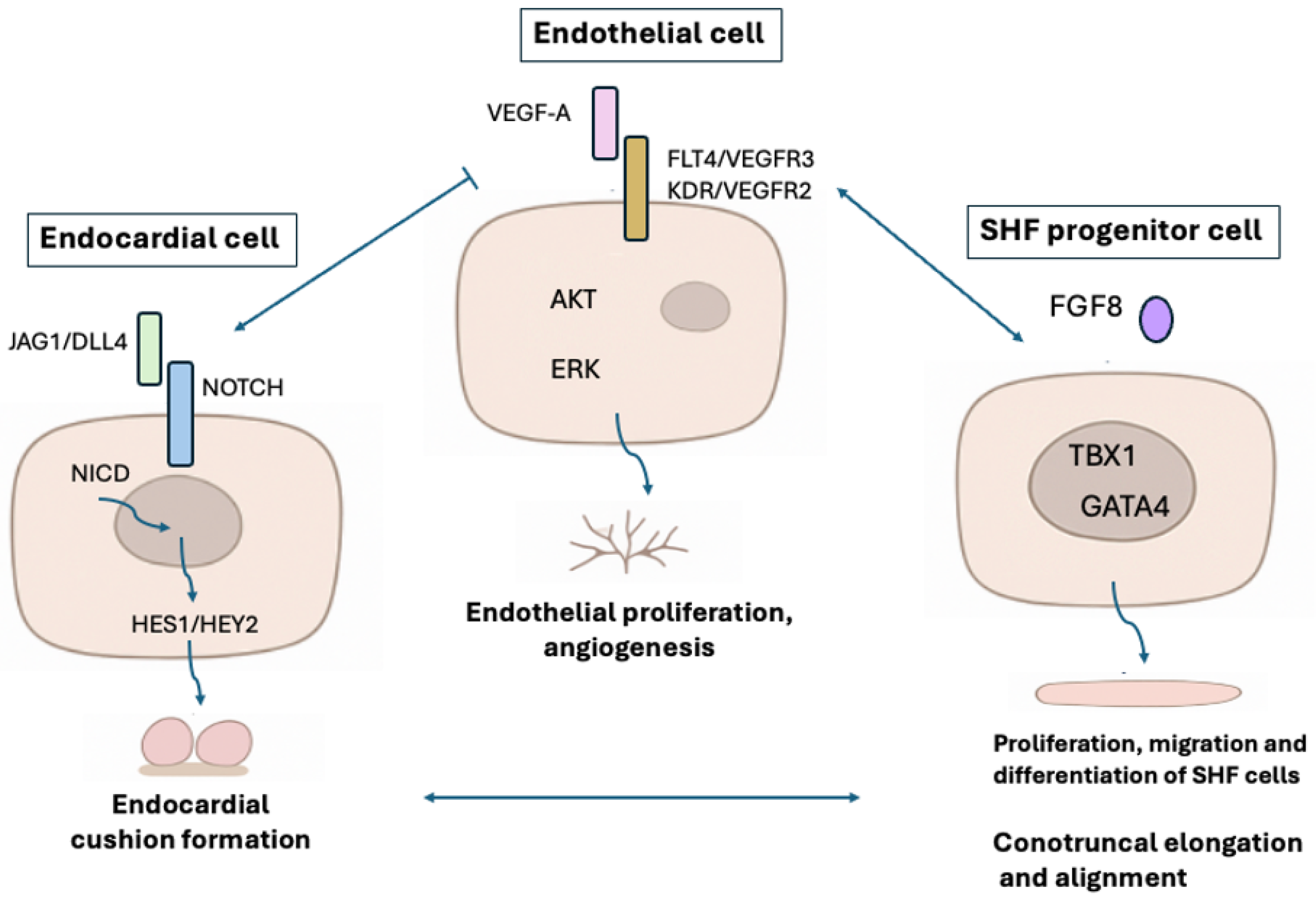
- Endothelial Epigenetic Alterations: A methylome-wide study of newborn blood identified significant differential methylation in endothelial genes involved in VEGF, NOTCH, and PI3K–Akt signaling. These pathways regulate endocardial cushion formation, angiogenesis, and outflow tract vascularization, indicating that endothelial epigenetic perturbations are an early and distinct contributor to TOF [24].
3.5. Rare Association of the Fallot Spectrum with Systemic Epigenetic Disorders
4. Mitochondrial Dysfunction and Redox Imbalance in Tetralogy of Fallot
5. Genotype–Phenotype Correlations
5.1. Genotype–Phenotype Correlations in Tetralogy of Fallot
5.2. Syndromic Versus Non-Syndromic Forms
5.3. Gene-Specific Anatomical Associations
6. Clinical Implications
6.1. Integrating Genetics into Clinical Follow-Up
6.2. Genetic Testing Strategy
6.3. Family Counseling and Genetic Risk in TOF
6.4. Psychosocial and Ethical Considerations
7. Future Directions
8. Conclusions
Author Contributions
Funding
Institutional Review Board Statement
Informed Consent Statement
Data Availability Statement
Acknowledgments
Conflicts of Interest
References
- Horenstein, M.S.; Diaz-Frias, J.; Guillaume, M. Tetralogy of Fallot. In StatPearls [Internet]; StatPearls Publishing: Treasure Island, FL, USA, 2025. [Google Scholar] [PubMed]
- Van der Linde, D.; Konings, E.E.M.; Slager, M.A.; Witsenburg, M.; Helbing, W.A.; Takkenberg, J.J.M.; Roos-Hesselink, J.W. Birth prevalence of congenital heart disease worldwide: A systematic review and meta-analysis. J. Am. Coll. Cardiol. 2011, 58, 2241–2247. [Google Scholar] [CrossRef]
- Moreno-Castellanos, C.A.; Lazalde, B. Genetic insights into the Tetralogy of Fallot. GSC Adv. Res. Rev. 2023, 16, 168–175. [Google Scholar] [CrossRef]
- Page, D.J.; Miossec, M.J.; Williams, S.G.; Monaghan, R.M.; Fotiou, E.; Cordell, H.J.; Sutcliffe, L.; Topf, A.; Bourgey, M.; Bourque, G.; et al. Whole Exome Sequencing Reveals the Major Genetic Contributors to Nonsyndromic Tetralogy of Fallot. Circ. Res. 2019, 124, 553–563. [Google Scholar] [CrossRef] [PubMed]
- Reuter, M.S.; Jobling, R.; Chaturvedi, R.R.; Manshaei, R.; Costain, G.; Heung, T.; Curtis, M.; Hosseini, S.M.; Liston, E.; Lowther, C.; et al. Haploinsufficiency of Vascular Endothelial Growth Factor-Related Signaling Genes Is Associated with Tetralogy of Fallot. Genet. Med. 2019, 21, 1001–1007. [Google Scholar] [CrossRef] [PubMed]
- Manshaei, R.; Merico, D.; Reuter, M.S.; Engchuan, W.; Mojarad, B.A.; Chaturvedi, R.; Heung, T.; Pellecchia, G.; Zarrei, M.; Nalpathamkalam, T.; et al. Genes and Pathways Implicated in Tetralogy of Fallot Revealed by Ultra-Rare Variant Burden Analysis in 231 Genome Sequences. Front. Genet. 2020, 11, 957. [Google Scholar] [CrossRef]
- Greenway, S.C.; Pereira, A.C.; Lin, J.C.; DePalma, S.R.; Israel, S.J.; Mesquita, S.M.; Luo, Y.; de Wit, G.M.; Ziebarth, T.D.; Pereira, L.; et al. De novo copy number variants identify new genes and loci in isolated sporadic Tetralogy of Fallot. Nat. Genet. 2009, 41, 931–935. [Google Scholar] [CrossRef]
- Grunert, M.; Dorn, C.; Schueler, M.; Dunkel, I.; Schlesinger, J.; Mebus, S.; Alexi-Meskishvili, V.; Perrot, A.; Wassilew, K.; Timmermann, B.; et al. Rare and private variations in neural crest, apoptosis and sarcomere genes define the polygenic background of isolated Tetralogy of Fallot. Hum. Mol. Genet. 2014, 23, 3115–3128. [Google Scholar] [CrossRef]
- Reuter, M.S.; Chaturvedi, R.R.; Jobling, R.K.; Pellecchia, G.; Hamdan, O.; Sung, W.W.L.; Nalpathamkalam, T.; Attaluri, P.; Silversides, C.K.; Wald, R.M.; et al. Clinical genetic risk variants inform a functional protein interaction network for Tetralogy of Fallot. Circ. Genom. Precis. Med. 2021, 14, e003410. [Google Scholar] [CrossRef]
- Bassett, A.S.; Reuter, M.S.; Malecki, S.; Silversides, C.; Oechslin, E. Clinically relevant genetic considerations for patients with tetralogy of Fallot. CJC Pediatr. Congenit. Heart Dis. 2023, 2, 426–439. [Google Scholar] [CrossRef]
- Zhou, Y.; Jiang, T.; Gao, J.; Zang, J.; Mo, X.; Yue, S.; Cui, Y.; Wang, Q.; Da, M.; Xu, J.; et al. Loss-of-function variants in ciliary genes confer high risk for tetralogy of Fallot. Sci. Adv. 2025, 11, eadt0836. [Google Scholar] [CrossRef]
- Wang, Q.L.; Fang, C.L.; Xue, L.L.; Wang, X.C.; Zhai, C.Y.; Zhao, Y.Y.; Xiao, Q.X.; Wang, T.H.; Xiong, L.L. Molecular insights into neurodevelopmental abnormalities and rescue mechanisms in the fetal prefrontal cortex with tetralogy of Fallot. Discov. Neurosci. 2025, 20, 16. [Google Scholar] [CrossRef]
- Feng, Z.; Huang, X.; Gao, Y.; Gao, H.; Na, W.; Tan, C.; Min, S.; Lu, Y.; Zhuang, Q.; Lin, S.; et al. MST1R Gene Variants Predispose Individuals to Tetralogy of Fallot. Phenomics 2025, 4, 548–561. [Google Scholar] [CrossRef] [PubMed]
- Pan, Y.; Liu, M.; Zhang, S.; Mei, H.; Wu, J. Whole-exome sequencing revealed novel genetic alterations in patients with Tetralogy of Fallot. Transl. Pediatr. 2023, 12, 1835–1841. [Google Scholar] [CrossRef] [PubMed]
- Online Mendelian Inheritance in Man (OMIM). PUF60, Poly-U-Binding Splicing Factor, 60 kDa; OMIM #604819; Johns Hopkins University: Baltimore, MD, USA, 2000; Available online: https://omim.org/entry/604819 (accessed on 28 December 2025).
- Online Mendelian Inheritance in Man (OMIM). DVL3, Dishevelled 3; OMIM #601368; Johns Hopkins University: Baltimore, MD, USA, 1996; Available online: https://omim.org/entry/601368 (accessed on 28 December 2025).
- Volpi, J.; Zhao, X.; Owen, N.; Evans, T.; Holder-Espinasse, M.; Lahiri, N.; Sherlock, E.; Poke, G.; Breckpot, J.; Devriendt, K.; et al. Non-isolated tetralogy of fallot (TOF+): Exome sequencing efficacy and phenotypic expansions. Eur. J. Hum. Genet. 2025. [Google Scholar] [CrossRef] [PubMed]
- Kalayinia, S.; Maleki, M.; Mahdavi, M.; Mahdieh, N. Whole-exome sequencing reveals a novel mutation of FLNA gene in an Iranian family with nonsyndromic Tetralogy of Fallot. Case Rep. Lab. Med. 2021, 52, 614–618. [Google Scholar] [CrossRef]
- Song, P.; Xu, J.; Zhuoga, D.; Wu, K.; Patel, N.; Jia, A.; Jirong, Q.; Mo, X. Bioinformatic analysis identifies GPR91 as a potential key gene in brain injury after deep hypothermic low flow. Heliyon 2023, 9, e15286. [Google Scholar] [CrossRef]
- Wang, G.; Wang, B.; Yang, P. Epigenetics in Congenital Heart Disease. J. Am. Heart Assoc. 2022, 11, e025163. [Google Scholar] [CrossRef]
- Zhu, Y.; Ye, M.; Xu, H.; Gu, R.; Ma, X.; Chen, M.; Li, X.; Sheng, W.; Huang, G. Methylation status of CpG sites in the NOTCH4 promoter region regulates NOTCH4 expression in patients with Tetralogy of Fallot. Mol. Med. Rep. 2020, 22, 4412–4422. [Google Scholar] [CrossRef]
- Motahari, Z.; Moody, S.A.; Maynard, T.M.; LaMantia, A.S. In the line-up: Deleted genes associated with DiGeorge/22q11.2 deletion syndrome: Are they all suspects? J. Neurodev. Disord. 2019, 11, 7. [Google Scholar] [CrossRef]
- Shi, J.; Wang, Z.; Bai, Y.; Li, S.; Zhang, X.; Liu, T.; Hong, L.; Cui, L.; Zhang, Y.; Ma, J.; et al. Bioinformatics and in silico findings reveal candidate genes for Tetralogy of Fallot via integrative multi-omics data. Congenit. Heart Dis. 2025, 20, 213–229. [Google Scholar] [CrossRef]
- Radhakrishna, U.; Vishweswaraiah, S.; Veerappa, A.M.; Zafra, R.; Albayrak, S.; Sitharam, P.H.; Saiyed, N.M.; Mishra, N.K.; Guda, C.; Bahado-Singh, R. Newborn blood DNA epigenetic variations and signaling pathway genes associated with Tetralogy of Fallot (TOF). PLoS ONE 2018, 13, e0203893. [Google Scholar] [CrossRef]
- Mital, R.; Lozier, J.S.; Mead, T.J. Genetic insights into Tetralogy of Fallot: Oh MYH(6). Pediatr. Res. 2024, 96, 297–298. [Google Scholar] [CrossRef]
- Pane, L.S.; Fulcoli, F.G.; Cirino, A.; Altomonte, A.; Ferrentino, R.; Bilio, M.; Baldini, A. Tbx1 represses Mef2c gene expression and is correlated with histone 3 deacetylation of the anterior heart field enhancer. Dis. Model. Mech. 2018, 11, dmm029967. [Google Scholar] [CrossRef]
- Onyekwelu, E. Beckwith-Wiedemann syndrome associated with haemodynamically significant Tetralogy of Fallot. Pediatr. Endocrinol. Rev. 2009, 7, 60–62. [Google Scholar] [PubMed]
- Shinde, S.B.; Save, V.C.; Patil, N.D.; Mishra, K.P.; Tendolkar, A.G. Impairment of mitochondrial respiratory chain enzyme activities in tetralogy of Fallot. Clin. Chim. Acta 2007, 377, 138–143. [Google Scholar] [CrossRef] [PubMed]
- Pires Da Silva, J.; Casa de Vito, M.; Miyano, C.; Sucharov, C.C. Mitochondrial Dysfunction in Congenital Heart Disease. J. Cardiovasc. Dev. Dis. 2025, 12, 42. [Google Scholar] [CrossRef] [PubMed]
- Ren, C.; Xi, L.; Li, H.; Pan, Z.; Li, Y.; Wang, G.; Dai, J.; He, D.; Fan, S.; Wang, Q. Inhibition of the FOXO1-ROCK1 axis mitigates cardiomyocyte injury under chronic hypoxia in Tetralogy of Fallot by maintaining mitochondrial quality control. Life Sci. 2024, 357, 123084. [Google Scholar] [CrossRef]
- Wang, J.; Zhao, R.; Xu, S.; Zhou, X.-Y.; Cai, K.; Chen, Y.-L.; Zhou, Z.-Y.; Sun, X.; Shi, Y.; Wang, F.; et al. NOTCH1 Mitochondria Localization during Heart Development Promotes Mitochondrial Metabolism and the Endothelial-to-Mesenchymal Transition in Mice. Nat. Commun. 2024, 15, 9945. [Google Scholar] [CrossRef]
- Griffin, H.R.; Töpf, A.; Glen, E.; Zweier, C.; Stuart, A.G.; Parsons, J.; Peart, I.; Deanfield, J.; O’Sullivan, J.; Rauch, A.; et al. Systematic survey of variants in TBX1 in non-syndromic tetralogy of Fallot identifies a novel 57 base pair deletion that reduces transcriptional activity but finds no evidence for association with common variants. Heart 2010, 96, 1651–1655. [Google Scholar] [CrossRef]
- Lindsay, E.A.; Vitelli, F.; Su, H.; Morishima, M.; Huynh, T.; Pramparo, T.; Jurecic, V.; Ogunrinu, G.; Sutherland, H.F.; Scambler, P.J.; et al. Tbx1 haploinsufficiency in the DiGeorge syndrome region causes aortic arch defects in mice. Nature 2001, 410, 97–101. [Google Scholar] [CrossRef]
- Calcagni, G.; Calvieri, C.; Baban, A.; Bianco, F.; Barracano, R.; Caputo, M.; Madrigali, A.; Silva Kikina, S.; Perrone, M.A.; Digilio, M.C.; et al. Syndromic and Non-Syndromic Patients with Repaired Tetralogy of Fallot: Does It Affect the Long-Term Outcome? J. Clin. Med. 2022, 11, 850. [Google Scholar] [CrossRef] [PubMed]
- Piran, S.; Bassett, A.S.; Grewal, J.; Swaby, J.A.; Morel, C.; Oechslin, E.N.; Redington, A.N.; Liu, P.P.; Silversides, C.K. Patterns of cardiac and extracardiac anomalies in adults with tetralogy of Fallot. Am. Heart J. 2011, 161, 131–137. [Google Scholar] [CrossRef] [PubMed]
- Boyarchuk, O.; Volyanska, L.; Dmytrash, L. Clinical variability of chromosome 22q11.2 deletion syndrome. Cent. Eur. J. Immunol. 2017, 42, 412–417. [Google Scholar] [CrossRef] [PubMed]
- Monaghan, R.M.; Naylor, R.W.; Flatman, D.; Kasher, P.R.; Williams, S.G.; Keavney, B.D. FLT4 causes developmental disorders of the cardiovascular and lymphovascular systems via pleiotropic molecular mechanisms. Cardiovasc. Res. 2024, 120, 1164–1176. [Google Scholar] [CrossRef]
- Koenig, S.N.; LaHaye, S.; Feller, J.D.; Rowland, P.; Hor, K.N.; Trask, A.J.; Janssen, P.M.; Radtke, F.; Lilly, B.; Garg, V. Notch1 haploinsufficiency causes ascending aortic aneurysms in mice. JCI Insight 2017, 2, e91353. [Google Scholar] [CrossRef]
- Althali, N.J.; Hentges, K.E. Genetic insights into non-syndromic Tetralogy of Fallot. Front. Physiol. 2022, 13, 1012665. [Google Scholar] [CrossRef]
- Zeljkovic, I.; Gauthey, A.; Manninger, M.; Malaczynska-Rajpold, K.; Tfelt-Hansen, J.; Crotti, L.; Behr, E.R.; Migliore, F.; Wilde, A.; Chun, J.; et al. Genetic testing for inherited arrhythmia syndromes and cardiomyopathies: Results of the European Heart Rhythm Association survey. Europace 2024, 26, euae216. [Google Scholar] [CrossRef]
- Baumgartner, H.; De Backer, J.; Babu-Narayan, S.V.; Budts, W.; Chessa, M.; Diller, G.P.; Lung, B.; Kluin, J.; Lang, I.M.; Meijboom, F.; et al. Task Force for the Management of Adult Congenital Heart Disease of the European Society of Cardiology (ESC). 2020 ESC Guidelines for the management of adult congenital heart disease. Eur. Heart J. 2021, 42, 563–645. [Google Scholar] [CrossRef]
- Stout, K.K.; Daniels, C.J.; Aboulhosn, J.A.; Bozkurt, B.; Broberg, C.S.; Colman, J.M.; Crumb, S.R.; Dearani, J.A.; Fuller, S.; Gurvitz, M.; et al. 2018 AHA/ACC Guideline for the management of adults with congenital heart disease: A report of the american college of cardiology/american heart association task force on clinical practice guidelines. Circulation 2018, 138, e609–e700. [Google Scholar] [CrossRef]
- Japanese Circulation Society (JCS); Japanese Cardiovascular Society (JCC); Japanese Society of Paediatric Cardiology and Cardiac Surgery (JSPCCS). JCS/JCC/JSPCCS 2024 Guideline on Genetic Testing and Counseling in Cardiovascular Disease. Circ. J. 2024, 88, 2022–2099. [Google Scholar] [CrossRef]
- Wilde, A.A.M.; Semsarian, C.; Márquez, M.F.; Sepehri Shamloo, A.; Ackerman, M.J.; Ashley, E.A.; Sternick, E.B.; Barajas-Martinez, H.; Behr, E.R.; Bezzina, C.R.; et al. European Heart Rhythm Association (EHRA)/Heart Rhythm Society (HRS)/Asia Pacific Heart Rhythm Society (APHRS)/Latin American Heart Rhythm Society (LAHRS) Expert Consensus Statement on the state of genetic testing for cardiac diseases. Europace 2022, 24, 1307–1367. [Google Scholar] [CrossRef]


Disclaimer/Publisher’s Note: The statements, opinions and data contained in all publications are solely those of the individual author(s) and contributor(s) and not of MDPI and/or the editor(s). MDPI and/or the editor(s) disclaim responsibility for any injury to people or property resulting from any ideas, methods, instructions or products referred to in the content. |
© 2026 by the authors. Licensee MDPI, Basel, Switzerland. This article is an open access article distributed under the terms and conditions of the Creative Commons Attribution (CC BY) license.
Share and Cite
Gagliardi, M.F.; Micaglio, E.; Micheletti, A.; Benedetti, S.; Negura, D.G.; Bevilacqua, F.; Guglielmi, G.; Pasqualin, G.; Giamberti, A.; Chessa, M. Tetralogy of Fallot: Genetic, Epigenetic and Clinical Insights into a Multifactorial Congenital Heart Disease. Genes 2026, 17, 181. https://doi.org/10.3390/genes17020181
Gagliardi MF, Micaglio E, Micheletti A, Benedetti S, Negura DG, Bevilacqua F, Guglielmi G, Pasqualin G, Giamberti A, Chessa M. Tetralogy of Fallot: Genetic, Epigenetic and Clinical Insights into a Multifactorial Congenital Heart Disease. Genes. 2026; 17(2):181. https://doi.org/10.3390/genes17020181
Chicago/Turabian StyleGagliardi, Maria Felicia, Emanuele Micaglio, Angelo Micheletti, Sara Benedetti, Diana Gabriela Negura, Francesca Bevilacqua, Giulia Guglielmi, Giulia Pasqualin, Alessandro Giamberti, and Massimo Chessa. 2026. "Tetralogy of Fallot: Genetic, Epigenetic and Clinical Insights into a Multifactorial Congenital Heart Disease" Genes 17, no. 2: 181. https://doi.org/10.3390/genes17020181
APA StyleGagliardi, M. F., Micaglio, E., Micheletti, A., Benedetti, S., Negura, D. G., Bevilacqua, F., Guglielmi, G., Pasqualin, G., Giamberti, A., & Chessa, M. (2026). Tetralogy of Fallot: Genetic, Epigenetic and Clinical Insights into a Multifactorial Congenital Heart Disease. Genes, 17(2), 181. https://doi.org/10.3390/genes17020181