Article

Pan-Genome Analysis and Expression Profiling of HIPP Gene Family in Cassava

1
Department of Biotechnology, School of Life and Health Sciences, Hainan University, Haikou 570228, China
2
Laboratory of Biopharmaceuticals and Molecular Pharmacology, School of Pharmaceutical Sciences, Hainan University, Haikou 570228, China
3
One Health Cooperative Innovation Center, Hainan University, Haikou 570228, China
4
Key Laboratory of Tropical Biological Resources, Hainan University, Haikou 570228, China
5
School of Breeding and Multiplication (Sanya Institute of Breeding and Multiplication), School of Tropical Agriculture and Forestry, Hainan University, Sanya 572025, China
6
National Key Laboratory of Tropical Crop Biobreeding, Sanya 572025, China
*
Authors to whom correspondence should be addressed.
Genes 2026, 17(2), 136; https://doi.org/10.3390/genes17020136
Submission received: 31 December 2025 / Revised: 18 January 2026 / Accepted: 22 January 2026 / Published: 27 January 2026
(This article belongs to the Section Plant Genetics and Genomics)

Abstract

Background: Cassava (Manihot esculenta Crantz) ranks as the sixth largest food crop worldwide and serves as an important cash and energy crop. Heavy-metal-associated isoprenylated plant proteins (HIPPs) are metallochaperones involved in metal homeostasis and stress adaptation in vascular plants. However, research on the identification and function of HIPPs in cassava has been poorly explored. Methods: This study conducted a pan-genome-wide investigation to identify and characterize MeHIPPs in 31 cassava accessions. Subsequent analyses examined their physicochemical properties, subcellular localization, phylogeny, Ka/Ks, chromosomal localization, synteny, gene structure, and cis-acting elements. Additionally, the expression profiles of MeHIPPs in different tissues and cell subsets and under different stress conditions were analyzed using transcriptome data and quantitative real-time polymerase chain reaction (qRT-PCR). Results: A total of 59 MeHIPP pan-genes were identified, including five core genes, 22 softcore genes, 17 dispensable genes, and 15 private genes, which were unevenly distributed on chromosomes. Based on phylogenetic analysis, these genes were classified into five major subgroups. Evolutionary analyses indicated that segmental duplication predominated in family expansion and that most members may be subjected to purifying selection. Cis-element analysis highlighted the importance of MeHIPPs in plant adaptation to environmental stress. The expression profiles suggested widespread involvement of MeHIPP genes in response to Xanthomonas phaseoli pv. manihotis (Xpm) infection and drought stress. Different MeHIPP genes exhibited varying transcript levels in different tissues and cell subsets. qRT-PCR analysis revealed that the selected MeHIPP genes had distinct expression patterns under Cd stress. Conclusions: This study provides valuable insights into the functional characteristics of MeHIPP genes and their evolutionary relationships, laying a theoretical foundation for further functional research on stress resistance.

1. Introduction

Cassava (M. esculenta) is a significant tuberous root crop in the genus Manihot of the Euphorbiaceae family [1]. As a major tropical crop and the world’s sixth-largest food source, cassava is a critical staple crop, often referred to as the “king of starch” and “energy crop” [2]. In addition to food, it serves as an industrial feedstock for starch-based products, feed, pharmaceuticals, cosmetics, biopolymers, and biofuels [3,4]. Cassava is notable for its tolerance to diverse biotic and abiotic stresses, as well as its capacity for post-stress recovery, enabling its growth on infertile, drought-prone, and acidic soils [1,4]. Nevertheless, like many tropical crops, cassava routinely encounters multiple stresses during growth and development, which compromise plant vigor and ultimately reduce quality and yield [5,6]. In recent decades, rapid industrialization and unsustainable human activities have exacerbated metal contamination in soil and water [7]. Elevated concentrations of metal pollutants, especially heavy metals such as cadmium, arsenic, lead, and copper, suppress crop growth and diminish yield and quality, causing severe phytotoxicity manifested as reduced biomass, impaired photosynthesis, chlorosis, altered nutrient assimilation, disrupted water balance, and even plant death [8,9,10,11].
To mitigate heavy metal toxicity, plants have evolved a suite of complementary strategies, including immobilization of metals in the cell wall, chelation into metal-ligand complexes, vacuolar sequestration, regulation of membrane permeability and transport, and maintenance of cellular redox homeostasis [12,13]. These processes are mediated by multiple protein families or chelators that mediate metal ion chelation, transport, and subcellular partitioning to achieve detoxification and isolation. Representative examples include mitogen-activated protein kinases (MAPKs), ATP-binding cassette (ABC) transporters, cation diffusion facilitators (CDFs), phytochelatins (PCs), and metallochaperones [14,15,16,17,18].
Metallochaperones are a class of proteins with specific functions involved in plant growth, development, and stress responses, playing significant roles in metal homeostasis and heavy metal detoxification [19]. A defining structural feature is the highly conserved heavy-metal-associated (HMA) domain. Based on structural differences, metallochaperones are broadly classified into two subfamilies: heavy-metal-associated plant proteins (HPPs) and heavy-metal-associated isoprenylated plant proteins (HIPPs) [20]. HIPPs are specific to vascular plants. They contain one or two HMA domains and a conserved C-terminal isoprenylation motif, CaaX (where “C” denotes cysteine, “a” an aliphatic amino acid, and “X” any amino acid) [21]. The HMA domain binds metal ions to maintain intracellular metal homeostasis, and the isoprenylation motif serves as a key post-translational modification that mediates protein–membrane and protein–protein interactions in plants [20,22].
The physiological functions of HIPPs have been investigated across multiple species, including Arabidopsis thaliana, maize (Zea mays), wheat (Triticum aestivum), rice (Oryza sativa), and tomato (Solanum lycopersicum), revealing broad roles in plant responses to biotic and abiotic stresses, particularly heavy metal stress, and underscoring their importance for growth, development, and environmental adaptation [23,24,25,26,27]. In Arabidopsis, AtHIPP26 interacts with ATHB29 to mediate drought responses, and the expression of AtHIPP20, AtHIPP22, AtHIPP26, and AtHIPP27 in the cadmium-sensitive yeast mutant Δycf1 enhances tolerance to Cd [20,28]. AtHIPP33 functions as a selective autophagy cargo receptor by binding cadmium and interacting with ATG8e through an AIM (ATG8-interacting motif), thereby promoting autophagy-mediated vacuolar sequestration and enhancing cadmium detoxification [29]. In addition, AtHIPPs modulate cytokinin oxidase/dehydrogenase (CKX) degradation and respond to cytokinin negative-feedback signals to maintain cellular homeostasis [23]. In rice, knockout of OsHIPP17 increases Cd accumulation in roots, and OsHIPP41 is strongly induced by cold and drought stress [21,26]. Heterologous expression of OsHIPP24 in the wild-type yeast (Saccharomyces cerevisiae) strain BY4741 elevates copper and cadmium accumulation, while both overexpression and knockout of OsHIPP24 impair rice growth [30]. In wheat, transient silencing of TaHIPP1 enhances resistance to stripe rust, suggesting that TaHIPP1 acts as a negative regulator of disease response [25]. In grapevine, VvHIPP21 interacts with VvHOS1 and negatively regulates cold and drought responses [31]. In quinoa, CqHIPP34 interacts with CqNAC79 to enhance drought tolerance, promote chlorophyll accumulation, and strengthen antioxidant capacity [32].
Research on HIPPs has primarily focused on Arabidopsis and several major crops. To date, 45, 59, 66, and 34 HIPP genes have been identified in Arabidopsis, rice, maize, and tomato, respectively [21,27,33]. However, HIPP genes in cassava have not yet been fully characterized. Traditional gene family identification typically relies on a single reference genome, whereas pan-genomic analyses can reveal family members present within a species’ gene pool but absent from the reference. In cassava, comprehensive genome-wide identification and functional characterization of the HIPP gene family are still lacking. To address this gap, we performed a genome-wide identification of cassava HIPP genes using the pan-genome of 31 cassava accessions. We further analyzed their molecular characteristics, evolutionary relationships, chromosomal distribution, gene duplication events, promoter cis-elements and expression patterns. This work lays a foundation for understanding the HIPP gene family in cassava and provides candidate genes for future genetic improvement and stress-resilience breeding.

2. Materials and Methods

2.1. Identification and Physicochemical Properties of HIPP Genes in Cassava

The genome sequences, protein sequences, and genome annotation files (general feature format version [GFF], gene transfer format) for 31 different cassava accessions were downloaded from the cassava comprehensive multi-omics database CassavaDB (https://nature.hainanu.edu.cn/CassavaDB/) (accessed on 15 September 2025). Arabidopsis HIPP sequences were obtained from The Arabidopsis Information Resource (TAIR, http://www.arabidopsis.org/) (accessed on 18 September 2025). The hidden Markov model (HMM) files for the heavy-metal-associated (HMA) domain (PF00403) were downloaded from the Pfam database (http://pfam.xfam.org/) (accessed on 27 August 2025) [34]. Using the HMMER 3.0 software suite subroutine HMMsearch, HIPP candidate proteins were identified by searching full-length protein sequences against the HMA domain model. Additionally, homologous genes in cassava were obtained through BLAST searches using the amino acid sequences of the Arabidopsis HIPP family as a reference in TBtools v2.376 [35]. The results from both methods were merged, and duplicate entries were removed. Candidate sequences were subsequently submitted to the InterPro database [36], retaining only those containing the HMA domain. To further refine the selection, MeHIPP candidate proteins were screened using the C-terminal isoprenylation motif CaaX as a criterion, utilizing the PrePS tool [37].
The physicochemical properties and subcellular localization of MeHIPPs were predicted using ExPasy [38] and DeepLoc 2.1 [39].

2.2. Phylogenetic Analysis of the HIPP Gene Family

HIPP family members in the yam (Dioscorea rotundata) and rubber tree (Hevea brasiliensis) genomes were also identified using HMMER and BLASTp (https://www.ncbi.nlm.nih.gov/assembly/) (accessed on 21 September 2025). A total of 59 HIPP sequences from rice were obtained from the Rice Genome Annotation Project (RGAP, https://rice.uga.edu/) (accessed on 18 September 2025), while HIPPs from poplar (Populus trichocarpa) were obtained from previously published studies [21]. Based on the HMMsearch output, amino acid sequences corresponding to the HMA domains were extracted from HIPPs of cassava, Arabidopsis, rice, poplar, yam, and rubber tree. Multiple sequence alignments of all HMA domain sequences were performed using the MUSCLE algorithm integrated in MEGA 7.0 [40]. Phylogenetic analysis was subsequently conducted using the maximum likelihood (ML) method in IQ-TREE v3.0.1 [41], with the best-fit substitution model (Dayhoff) automatically selected. The robustness of the phylogenetic relationships was evaluated using 1000 bootstrap replicates. The resulting phylogenetic tree was visualized and annotated using iTOL [42].

2.3. Homology and Presence/Absence Variation Analysis of the HIPP Gene Family in Cassava

Orthologous gene groups (OGGs) of HIPP genes among 31 cassava accessions were identified using OrthoFinder v2.5.5 under the following settings: MSA infers gene trees, DIAMOND aligns sequences, and FastTree builds trees [43]. Following a systematic pan-genome naming convention, the HIPP OGGs across the 31 cassava genomes were uniformly renamed as MeHIPP. To determine syntenic relationships of HIPP genes within and between species, the cassava reference genome AM560 was aligned with the genomes of 11 other plant species using the Diamond tool. Synteny relationships were analyzed using the One Step MCScanX—SuperFast module in TBtools (using an e-value threshold of 1 × 10⁻¹⁰. and visualized using the Dual Synteny Plot and Advanced Circos tools [35,44]. The presence/absence variation (PAV) heatmap of the MeHIPP family members across the 31 cassava genomes was generated using the pheatmap package in R.

2.4. Ka/Ks Calculation

The coding sequences (CDS) and protein sequences of MeHIPP family members from the 31 cassava genomes were compared, and the nonsynonymous (Ka) and synonymous (Ks) substitution rates between gene pairs were calculated using KAKS_Calculator 3.0 [45]. To ensure robustness and reliability, paired data with Ks < 0.005 and Ka/Ks ratio < 0.01 were excluded. The resulting data were visualized using the R packages ggplot2 (v4.0.1), pheatmap (v1.0.13), and ggridges (v0.5.7) [46].

2.5. Chromosomal Localization, Cis-Element Prediction, and Conserved Motif Analysis

Chromosomal lengths and MeHIPP genomic coordinates were extracted from the cassava GFF files using TBtools, and the chromosomal distribution of MeHIPP genes was visualized accordingly [35]. For promoter analysis, 2000 bp upstream sequences of each MeHIPP coding sequence (CDS) were retrieved from the cassava genome. Cis-acting regulatory elements were predicted using the PlantCARE database (http://bioinformatics.psb.ugent.be/webtools/plantcare/html/) (accessed on 4 November 2025) [47]. Conserved protein motifs were identified using the Multiple Em for Motif Elicitation website (https://meme-suite.org/meme/) (accessed on 6 November 2025) under the following settings: classic mode, any number of repetitions, and number of motifs set to 10 [48].

2.6. RNA-Seq Data Analysis of HIPP Genes

RNA-seq datasets from 11 cassava tissues (PRJNA324539) were obtained from the European Nucleotide Archive (ENA, https://www.ebi.ac.uk/ena/) (accessed on 11 November 2025), and datasets generated under drought stress and infection with Xanthomonas phaseoli pv. manihotis (PRJNA385393, PRJNA231851) were downloaded from the National Center of Biotechnology Information (NCBI, https://www.ncbi.nlm.nih.gov/bioproject/) (accessed on 13 November 2025) [49,50]. RNA-seq data were analyzed using the Trimmomatic, Hisat2, and featureCounts packages on the Galaxy database (https://galaxyproject.org/) (accessed on 15 November 2025) [51]. The raw counts were divided by gene length (kb) to calculate the reads per kilobase (RPK). Each gene’s RPK was divided by the sum of RPK values across all genes and multiplied by 106 to yield transcripts per million (TPM). TPM values were manually calculated and log2 transformed.

2.7. Analysis of the Single-Cell Transcriptome of Cassava Root and Leaf

Using our single-cell sequencing maps of cassava tubers (PRJNA895163) and leaves (PRJCA019992), we examined the expression patterns of the MeHIPP genes at the single-cell level [52,53]. Data were analyzed on the OmicSmart platform (https://www.omicsmart.com) (accessed on 28 November 2025), and Uniform Manifold Approximation and Projection (UMAP) embeddings together with gene expression bubble plots were generated.

2.8. Plant Materials and Treatments

Cassava (M. esculenta Crantz cv. SC8) plants, a typical cassava cultivar, were transplanted from the Tropical Crops Genetic Resources Institute (TCGRI, Danzhou, China). All plants were grown on Murashige and Skoog (MS) medium for 2 to 3 months. Seedlings with comparable vigor were selected for subsequent experiments. For metal stress treatment, seedlings were exposed to 40 μM Cd2+. Leaves were collected at 0, 2, 4, 8, 12, 24, and 48 h, immediately snap-frozen in liquid nitrogen, and stored at −80 °C until further use.

2.9. RNA Extraction and Quantitative Real-Time PCR (qRT-PCR) Analysis

Total RNA was extracted from plant tissues using the RNAprep Pure Plant Kit (TIANGEN, Beijing, China), and first-strand cDNA was synthesized using the All-in-One First-Strand Synthesis Master Mix (Share-bio, Shanghai, China) according to the manufacturer’s instructions. Each 10 μL qRT-PCR reaction contained 5 μL premix (Share-bio, Shanghai, China), 0.4 μL each of forward and reverse primers, 1.2 μL cDNA, and 3 μL ddH2O. Gene-specific primers targeting MeHIPP genes were designed using NCBI Primer-BLAST (https://www.ncbi.nlm.nih.gov/tools/primer-blast/, accessed on 28 November 2025). qRT-PCR was performed on a Light Cycler 96 (Roche, Switzerland). β-tubulin (TUB) and elongation factor 1α (EF1α) served as internal reference genes [54,55]. Thermal cycling conditions were: 95 °C for 30 s; followed by 40 cycles of 95 °C for 10 s, 59 °C for 10 s, and 72 °C for 30 s; and a final extension at 72 °C for 15 s. Three biological replicates were performed, each with three technical replicates. Relative expression levels were calculated using the 2−ΔΔCt method, and statistical differences were assessed with Tukey’s test [56].

3. Results

3.1. Identification of HIPP Genes in Cassava

To characterize the composition and features of the HIPP gene family in cassava, we performed genome-wide identification at both the reference genome and pan-genome levels. Based on the heavy-metal-associated (HMA, PF00403) domain profile characteristic of HIPPs in the Pfam database and HIPP gene sequences in Arabidopsis, we conducted the hidden Markov model searches using HMMER and obtained homologous genes in cassava using BLASTP. All candidate sequences were subsequently confirmed using InterPro to ensure the presence of the intact HMA domain. In the reference genome AM560, we identified 51 HIPP genes. Across the pan-genome, which includes 31 cassava accessions, we detected 59 HIPP pan-genes, representing a total of 1209 HIPP genes across different cassava accessions. The number of HIPP genes per accession varied from 26 to 61, reflecting considerable variation in gene presence or absence and lineage-specific gene gain or loss within this family (Figure S1).
Physicochemical analysis revealed that the HIPPs ranged from 95 to 839 amino acids in length, with molecular masses ranging from 10.36 to 90.93 kDa. The theoretical isoelectric points (pI) varied between 4.97 and 9.68. The aliphatic index ranged from 32.05 to 109.14, and the instability index ranged from 18.54 to 72.50. Only two proteins exhibited positive GRAVY values, suggesting that, overall, HIPPs are hydrophilic. Subcellular localization predictions indicated that most HIPPs are localized in the cytoplasm or at the cell membrane, with a minority targeted to the peroxisomes or the nucleus (Table S1).

3.2. Presence/Absence Variation and Phylogenetic Analysis of HIPP Gene Family

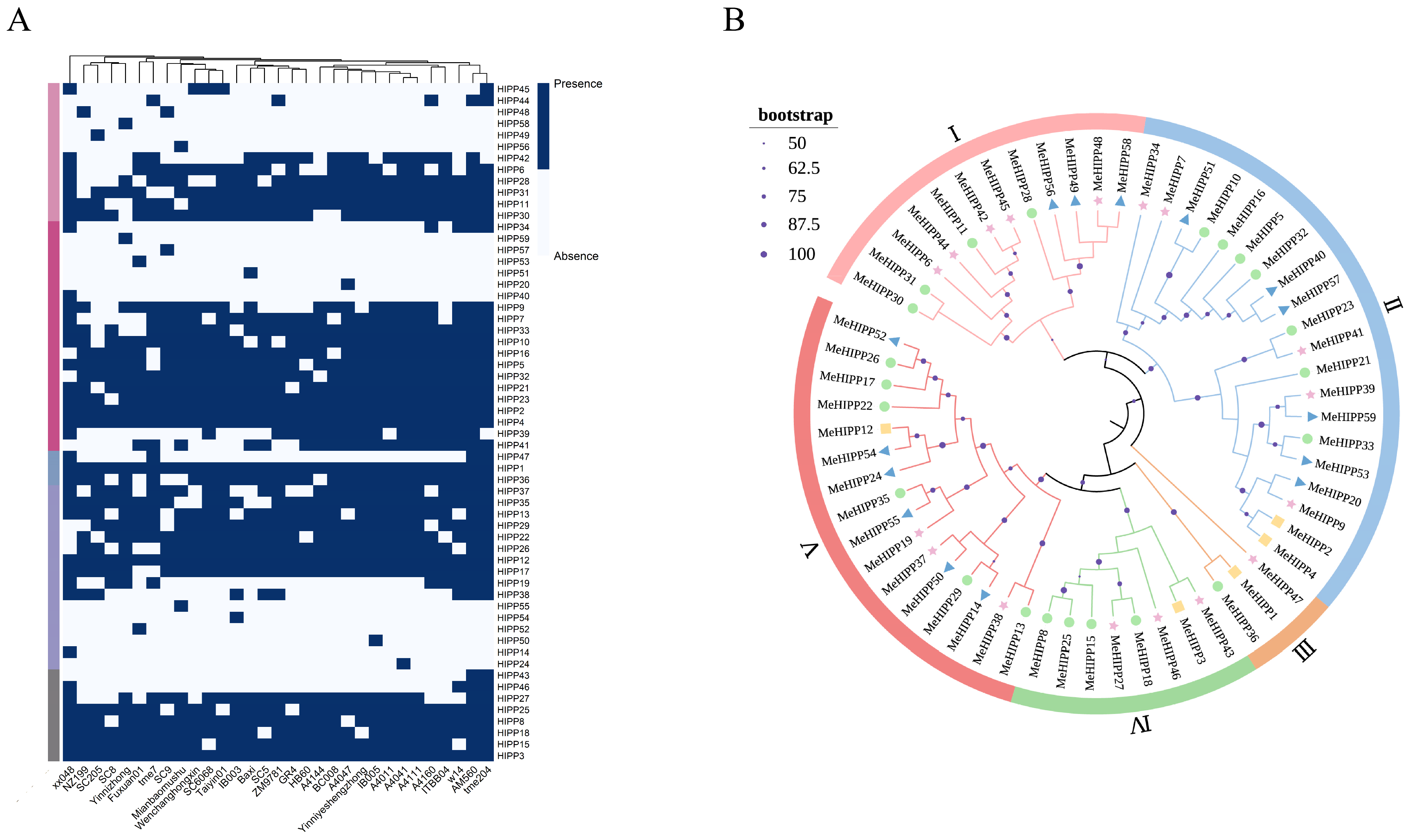
Presence/absence analysis of the identified MeHIPP family members indicated that the cassava HIPP family comprises five core genes, 22 softcore genes, 17 dispensable genes, and 15 private genes. Across the 31 cassava accessions, the relative proportions of core, softcore, and dispensable genes were comparable, whereas private genes were rare or absent in many accessions. Notably, MeHIPP1, MeHIPP2, MeHIPP3, MeHIPP4, and MeHIPP5 were present as multiple copies in most accessions, and some genes also showed more than one copy in specific accessions. MeHIPP1, MeHIPP2, MeHIPP3, MeHIPP4, and MeHIPP12 were present in all the cassava accessions. In contrast, certain genes exhibited accession-specific presence. For instance, MeHIPP14 was found only in the xx048 accession, while MeHIPP52 and MeHIPP53 were exclusive to the Fuxuan01 accession. This suggests that these genes may be linked to cultivar-specific traits. In the AM560 reference genome, MeHIPP14, MeHIPP20, MeHIPP24, MeHIPP40, MeHIPP45, and MeHIPP48MeHIPP59 were not identified. Among these genes, all except MeHIPP45 were classified as private genes, occurring only in a specific accession. MeHIPP45 was detected in only a limited number of accessions (Figure 1A).
To elucidate the evolutionary relationships and genomic variation in the HIPP gene family in cassava, we performed phylogenetic analyses based on the HMA conserved domain sequences derived from the MeHIPPs. To gain broader evolutionary insights, HIPP family members from Arabidopsis, O. sativa, P. trichocarpa, D. rotundata, and H. brasiliensis were also incorporated to construct the cross-species phylogenetic tree (Figure S2). Notably, five genes, MeHIPP28, MeHIPP48, MeHIPP49, MeHIPP56, and MeHIPP58, exhibited significant species-specific clustering.
The maximum likelihood (ML) phylogenetic tree classified the MeHIPP gene family into five major clades (Figure 1B). Group II represented the largest cluster, containing 20 MeHIPP genes. Group V and Group I included 16 and 12 MeHIPP genes, respectively, while Group IV comprised eight genes, and Group III formed the smallest clade with only three MeHIPP members.

3.3. Differential Selection Pressures Acting on MeHIPP Genes in Cassava

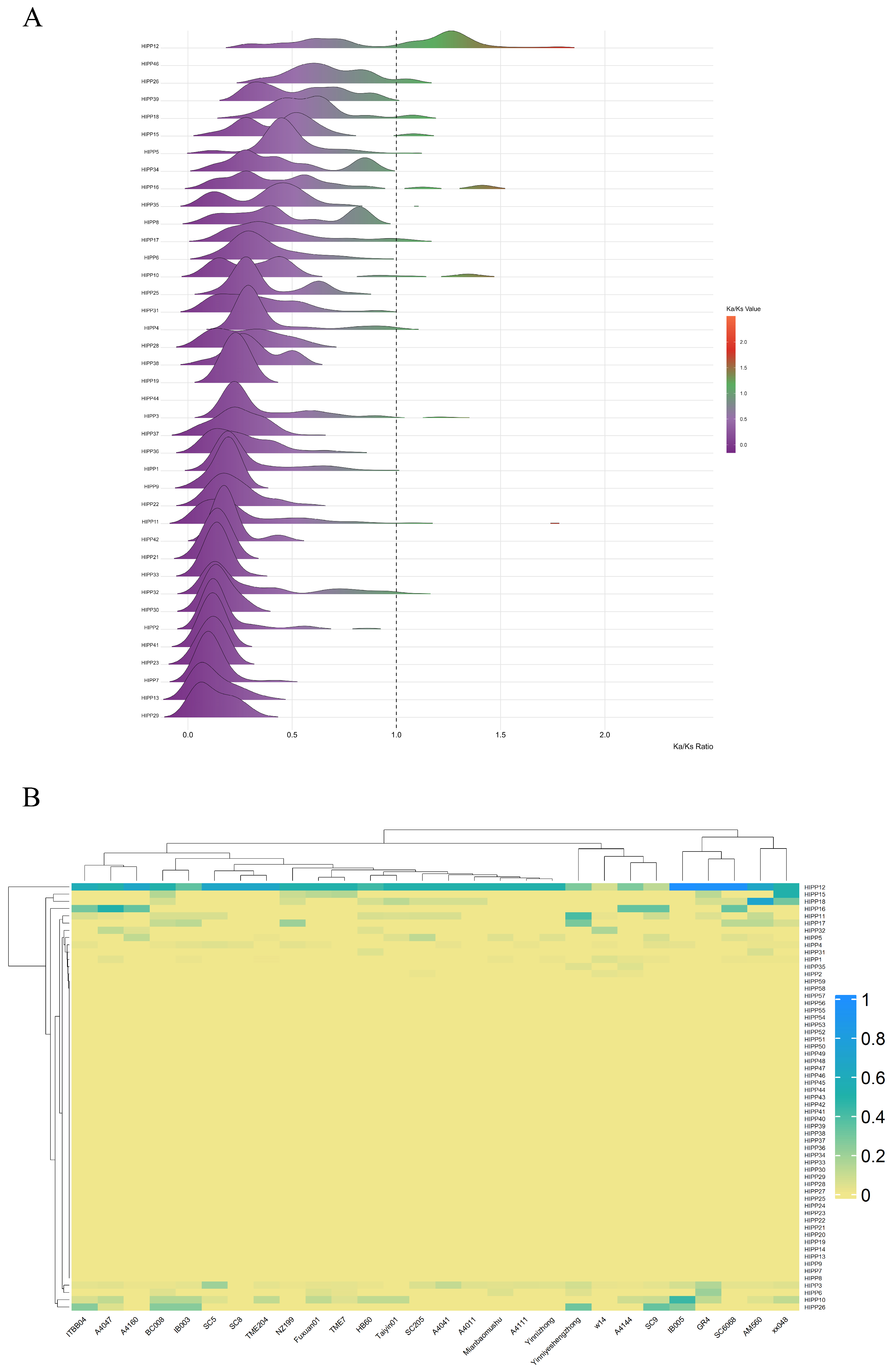
The ratio of nonsynonymous (Ka) to synonymous (Ks) substitution rates (Ka/Ks) is widely used to assess the selection pressure on gene family members across species. To explore the evolutionary constraints on the MeHIPP gene family, we assessed the selection of MeHIPP family members using the ratio of nonsynonymous (Ka) to synonymous (Ks) substitution rates. Ka and Ks were calculated for each MeHIPP gene pair, and Ka/Ks ratios were used to infer selection. Most MeHIPP genes displayed Ka/Ks values between 0 and 1, indicating that the MeHIPP gene family in cassava is under potential signatures of strong purifying selection. This indicates that these genes may have been subject to evolutionary constraints to preserve their functional integrity and structural conservation. However, several genes displayed evidence of potential positive selection in certain cassava accessions (Figure 2A). Further heatmap analysis of genes with Ka/Ks ratios greater than 1 revealed that MeHIPP12 exhibited consistently high Ka/Ks values across most accessions, implying that this gene has undergone potential signatures of positive selection during cassava evolution. In contrast, MeHIPP10, MeHIPP11, MeHIPP15, MeHIPP16, MeHIPP17, MeHIPP18, MeHIPP26, and MeHIPP32 showed Ka/Ks > 1 more frequently in specific accessions, suggesting that these genes may be subject to potential impact of lineage-specific positive selection (Figure 2B).

3.4. Chromosomal Localization

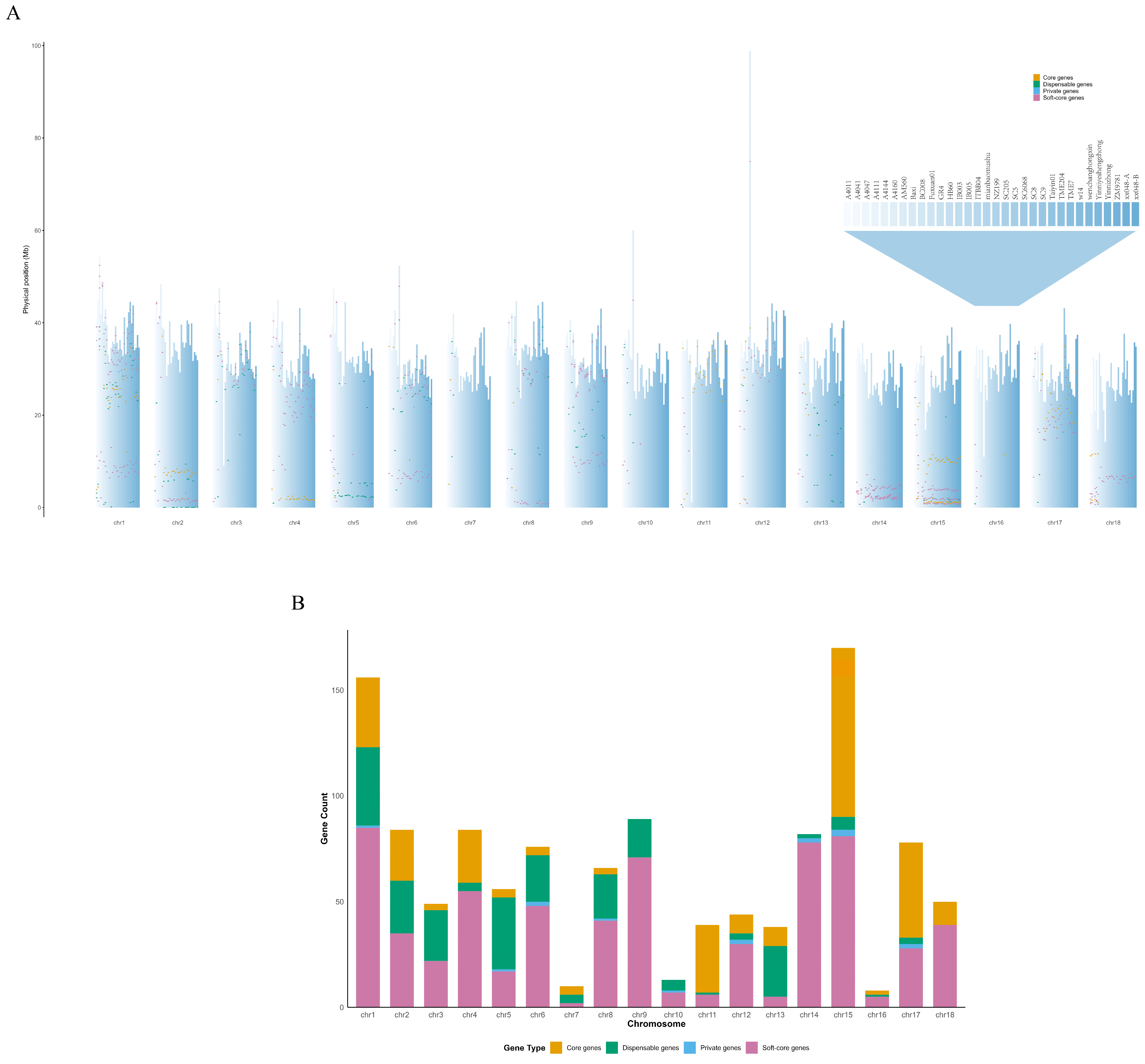
To examine the chromosomal distribution of MeHIPP genes in cassava, we mapped their genomic positions across 31 cassava accessions. All MeHIPP genes were unevenly distributed across the 18 cassava chromosomes, with those on chromosomes 2, 14, and 15 primarily concentrated at the chromosomal ends. Chromosome 15 contained the largest number of MeHIPP genes (170), followed by chromosome 1 (156). Furthermore, chromosomes 9, 2, 4, 14, 17, and 6 contained similar numbers of MeHIPP genes, with counts of 89, 84, 84, 82, 78, and 76, respectively. In contrast, chromosomes 10, 7, and 16 harbored comparatively fewer genes, with 13, 10, and 8 genes, respectively (Figure 3A).
Softcore MeHIPP genes predominated across most chromosomes, particularly on chromosomes 14 (95.12%), 9 (79.78%), and 18 (78.00%). On chromosome 11, MeHIPP genes were mainly core genes (82.1%), revealing that these MeHIPP genes on this chromosome are highly conserved. In contrast, chromosomes 5 and 13 were enriched in dispensable genes (60.7% and 63.2%, respectively). Private MeHIPP genes accounted for a relatively small proportion of the total and exhibited an uneven chromosomal distribution (Figure 3B).

3.5. Synteny Analysis of MeHIPP Genes Within Cassava and Interspecific Synteny Analysis

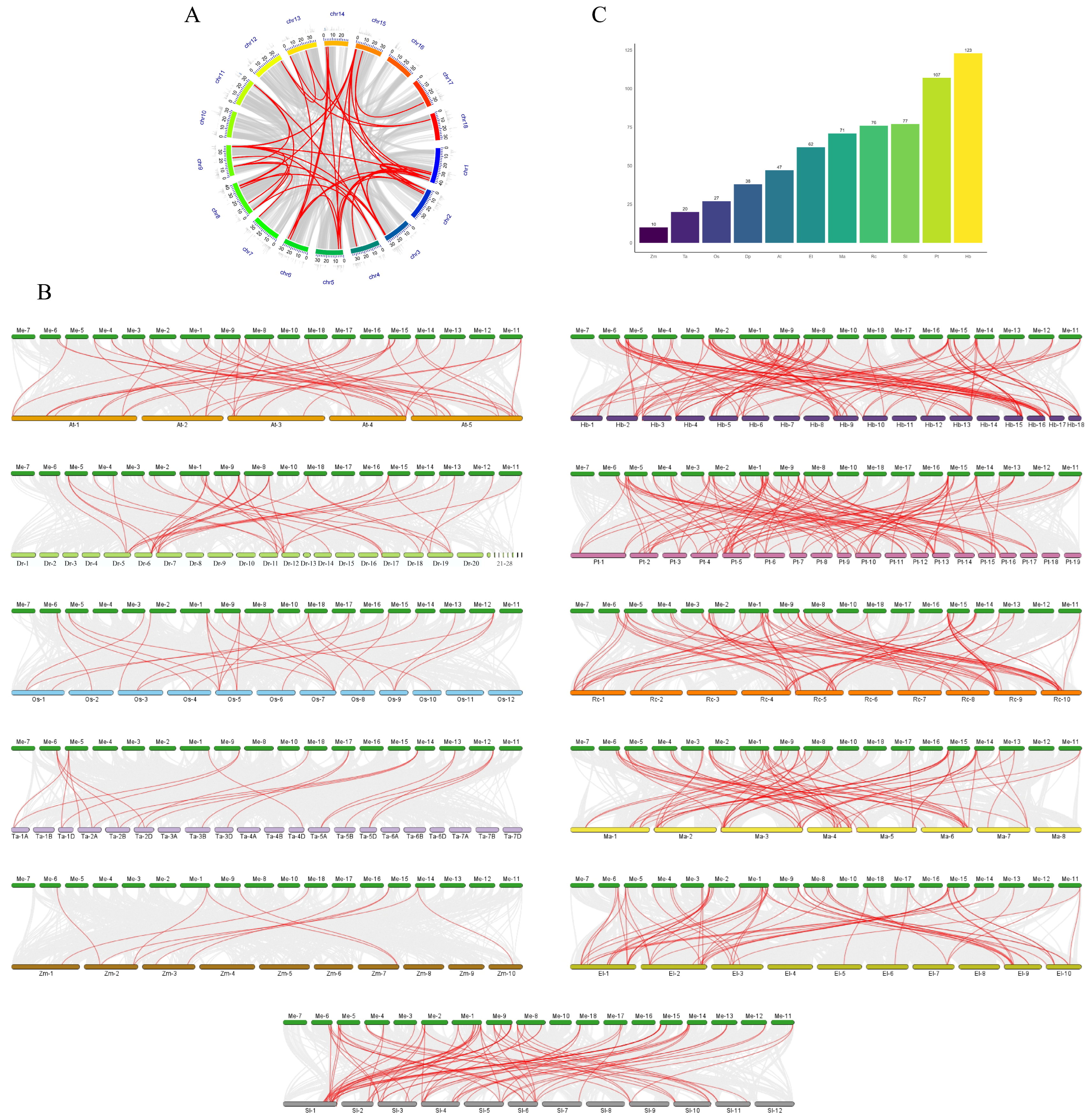
Within a species, many genes do not exist as a single copy. Instead, they come in multiple homologous copies. These copies can perform the same or overlapping functions, even though their DNA sequences are not identical. Synteny analysis of MeHIPP genes in the reference genome AM560 identified at least 47 pairs of segmentally duplicated genes and two pairs of tandemly duplicated genes among the 51 MeHIPP members, indicating that segmental duplication was the predominant contributor to the expansion of the MeHIPP family (Figure 4A).
To explore evolutionary and functional relationships across species, we performed comparative synteny analyses between cassava and eleven other plants, including Arabidopsis, tomato, rice, wheat, maize, yam, castor bean (Ricinus communis), poplar, rubber tree, caper spurge (Euphorbia lathyris), and annual mercury (Mercurialis annua) (Figure 4B). The number of syntenic MeHIPP gene pairs varied among species, with cassava and rubber tree showing the highest number (123 pairs), followed by poplar (107 pairs). Substantial synteny pairs were also observed with castor bean (76 pairs), annual mercury (71 pairs), and caper spurge (62 pairs), reflecting the strong conservation of HIPP genes within Euphorbiaceae. Additionally, a considerable number of syntenic pairs (77 pairs) were identified between cassava and tomato, a dicotyledonous plant. Cassava and Arabidopsis shared 47 collinear pairs, fewer than those observed for the other dicotyledonous plants examined. In contrast, fewer syntenic relationships were found with monocots: 27 pairs with rice, 20 with wheat, and 10 with maize. Similarly, cassava and the tuberous monocot yam exhibited a limited number of syntenic pairs (38) (Figure 4C).

3.6. Conserved Motif, Gene Structure, and Cis-Acting Regulatory Elements

To further elucidate the evolutionary relationships among the MeHIPP genes, we analyzed their gene structures and conserved protein motifs. The number of exons per MeHIPP ranged from 1 to 10, with most genes containing 2 to 5 exons, suggesting that the MeHIPP family has undergone exon gain and loss during evolution. The majority of MeHIPP genes possessed 0–2 untranslated regions (UTRs) (Table S2).
To better understand the conservation and diversity of MeHIPP genes, ten conserved motifs (motifs 1–10) were identified in all MeHIPPs using MEME. Members belonging to the same pan-gene exhibited highly similar gene exon–intron architectures and protein motif compositions. However, there were significant differences in the number of exons among different MeHIPP1 copies (Table S2). Representative members from different pan-genes were selected for further motif analysis, revealing comparable exon–intron structures and motif arrangements within different clades, with one or two copies of the core motif 1 retained in all MeHIPPs (Figure S3).
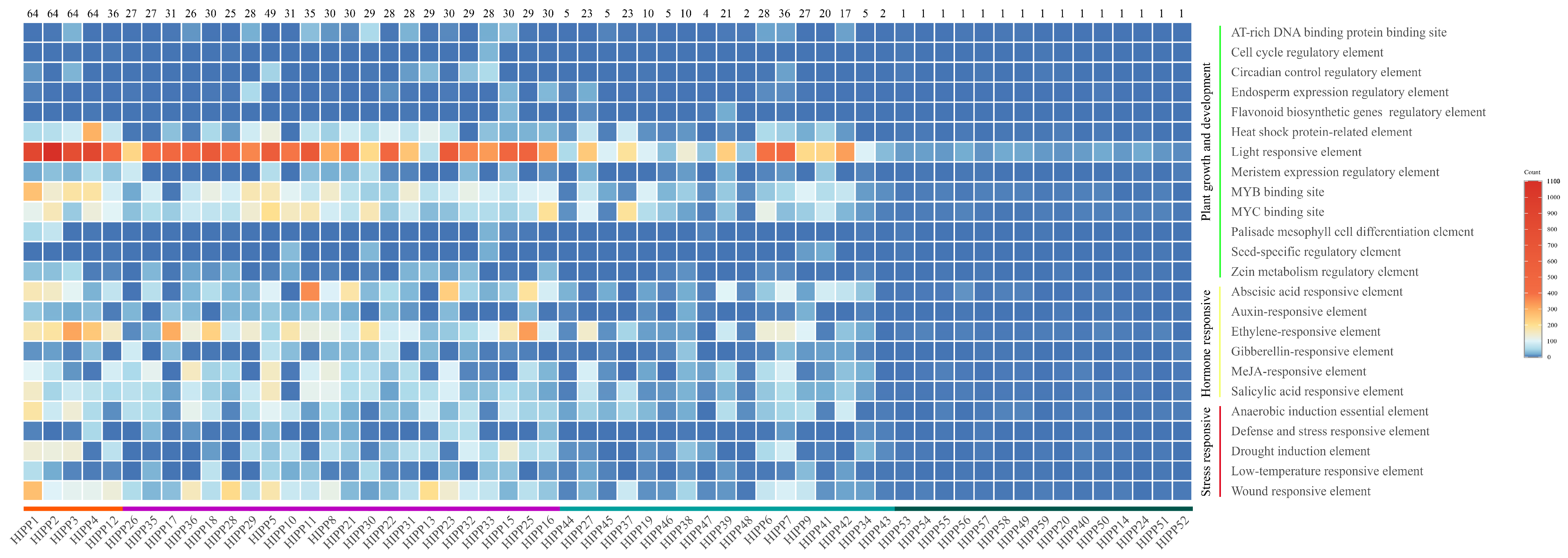
To explore the potential transcriptional regulatory mechanisms of the HIPP gene family in cassava, the promoter regions of MeHIPP genes were analyzed using the PlantCARE database. A total of 24 distinct cis-acting regulatory elements were identified, including 13 plant growth- and development-related cis-elements, 6 hormone-related cis-elements, and 5 stress-related cis-elements. Light-responsive elements were the most abundant and widespread, detected in all MeHIPP promoters, with particularly high frequencies in MeHIPP2. This suggests that light signaling plays a fundamental role in the regulation of MeHIPP transcription. The binding sites for MYB and MYC transcription factors were frequently observed. In addition, numerous hormone-related cis-elements were identified in this study. Abscisic acid (ABA) responsive elements and ethylene-responsive elements were widely distributed, while responsive elements of methyl jasmonate (MeJA) and salicylic acid (SA) were also prevalent. Additionally, several stress-related cis-elements associated with anaerobic induction, drought, low temperatures, and wounding were identified. Collectively, these findings reveal that MeHIPP promoters contain diverse cis-elements potentially involved in growth, hormonal, and stress-related regulatory pathways, which may respond rapidly to endogenous and exogenous stimuli and contribute to the regulation of plant development (Figure 5, Table S3).

3.7. Expression Patterns of MeHIPP Genes in Different Tissues and Under Different Stress Conditions

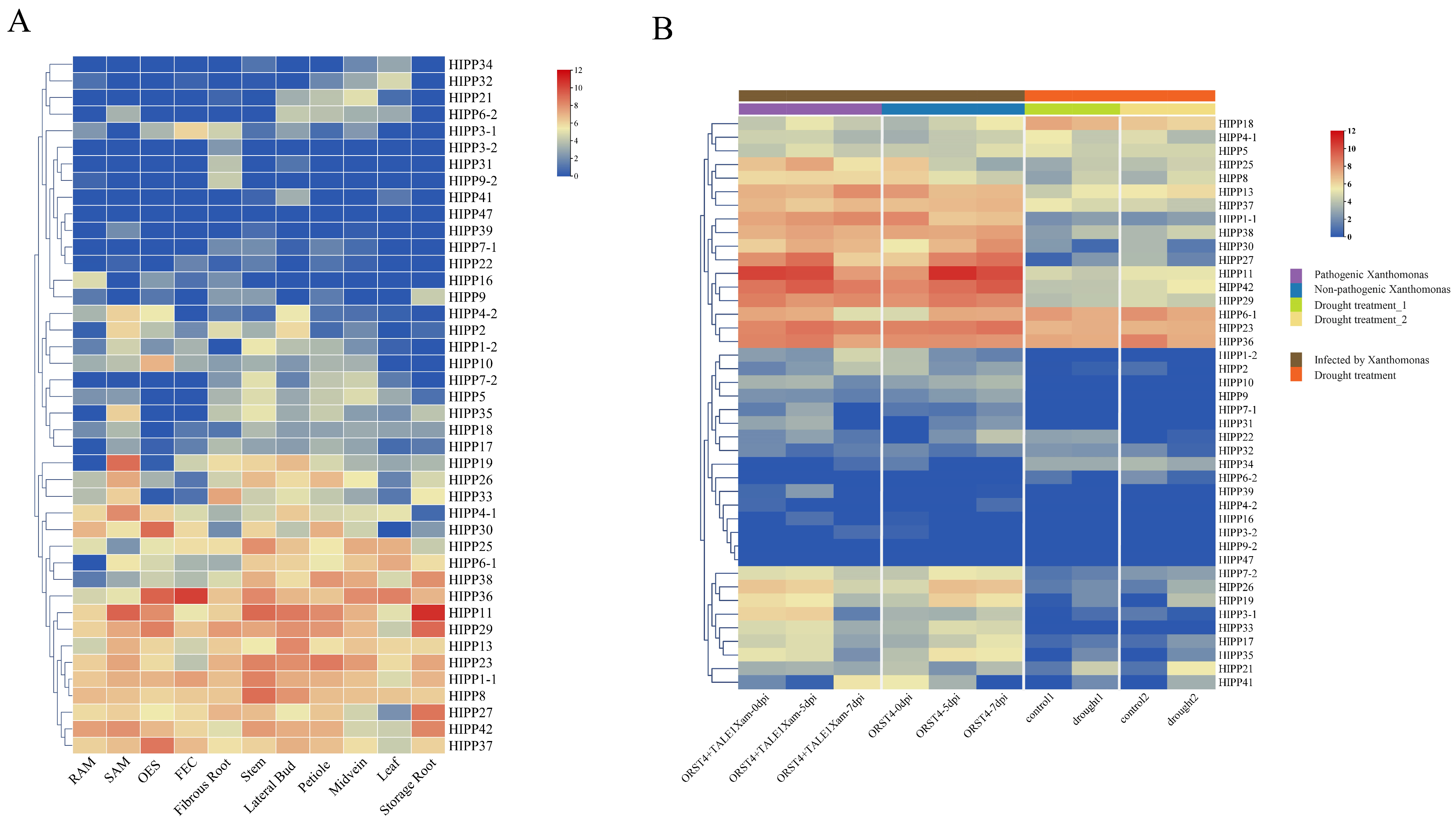
We analyzed bulk RNA-seq data obtained from the ENA database to profile MeHIPP gene expression in different tissues. The expression of different MeHIPP genes exhibited distinct patterns across distinct tissues. MeHIPP1-1, MeHIPP8, MeHIPP13, MeHIPP23, MeHIPP29, MeHIPP37, and MeHIPP42 exhibited broad and relatively high expression across 11 plant tissues. MeHIPP11 and MeHIPP36 were not only broadly expressed but also showed notable enrichment in storage roots and friable embryogenic callus (FEC), respectively. Similarly, MeHIPP6-1, MeHIPP25, MeHIPP27, and MeHIPP38 were highly expressed in the majority of tissues. Several genes displayed pronounced tissue specificity. Expression of MeHIPP21 was strongly biased toward midvein. MeHIPP10 was highly specifically expressed in organized embryogenic structures (OES). MeHIPP19 was highly specifically expressed in the shoot apical meristem (SAM). In contrast, MeHIPP7-1, MeHIPP22, MeHIPP39, and MeHIPP47 were generally expressed at low levels. These genes, with their varied expression profiles, may play crucial roles in plant development (Figure 6A).
To investigate the impact of various stress conditions on gene expression, we examined MeHIPP transcript levels under drought and pathogen stress treatments. Most MeHIPP genes showed expression changes in response to X. phaseoli pv. manihotis (Xpm) infection and drought stress conditions. During Xpm strain infection, MeHIPP1-1, MeHIPP13, MeHIPP23, MeHIPP29, MeHIPP30, MeHIPP36, MeHIPP37, MeHIPP38, and MeHIPP42 maintained relatively high expression across time points, with minimal differences between pathogenic and non-pathogenic strains. In contrast, MeHIPP6-1, MeHIPP11, and MeHIPP27 were downregulated under pathogenic infection but showed an upward trend under non-pathogenic infection. Furthermore, MeHIPP3-1, MeHIPP7-2, MeHIPP17, MeHIPP19, MeHIPP26, MeHIPP33, and MeHIPP35 were downregulated at 7 days post-infection with the pathogenic strain but were upregulated in response to non-pathogenic strains. Notably, MeHIPP41 showed an initial decrease, followed by an increase under pathogenic infection, but its expression gradually decreased under non-pathogenic treatment. Under drought conditions, MeHIPP6-1, MeHIPP18, MeHIPP23, and MeHIPP36 maintained high and stable expression. MeHIPP8, MeHIPP19, MeHIPP21, MeHIPP26, MeHIPP35, MeHIPP38, and MeHIPP41 were induced, with MeHIPP21 showing the greatest induction. In contrast, MeHIPP4-1, MeHIPP6-2, and MeHIPP30 were markedly suppressed. These results suggest that MeHIPP genes exhibit complex and diverse transcriptional responses under various stress conditions (Figure 6B).

3.8. Expression Patterns of MeHIPP Genes in Single-Cell Transcriptomes

To investigate the expression patterns of MeHIPP genes at the single-cell level, we analyzed single-cell RNA-seq data from cassava tuberous roots and leaves. MeHIPP expression varied markedly among different organs and cell types. In leaves, most MeHIPP genes were predominantly expressed in epidermis, companion cells, and vascular bundles. In storage roots, the spatial expression was highly heterogeneous. High expression was primarily observed in internal phloem-associated parenchyma (IPAP), vascular bundles, and endodermis clusters of the tuberous roots (Figure S4).
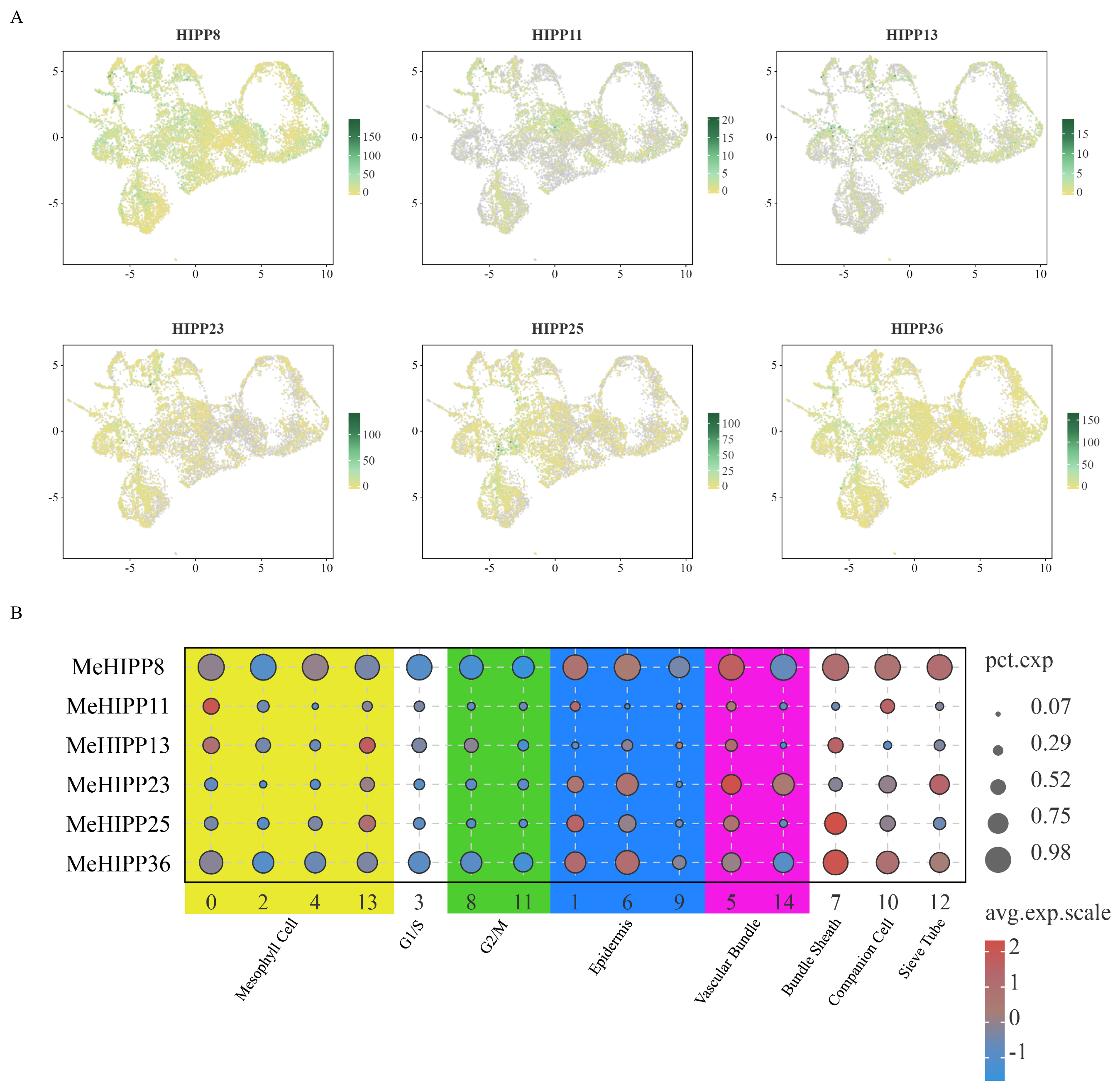
Based on the systematic evolutionary analyses, we selected representative genes from each subgroup that showed consistently broad and relatively high expression levels across diverse tissues. These genes were selected for detailed single-cell analysis. In leaves, MeHIPP8, MeHIPP25, and MeHIPP36 were mainly enriched in epidermis and bundle sheath and were expressed across a large proportion of cells. In addition, MeHIPP8 and MeHIPP36 displayed broad expression across other cell clusters. MeHIPP23 was highly expressed in epidermis, sieve tubes and vascular bundles, with expression of MeHIPP23 detected in a larger number of cells. In contrast, MeHIPP11 and MeHIPP13 were primarily expressed in epidermis and mesophyll cells, with high expression in companion cells and bundle sheath, respectively. However, they were detected in only a small proportion of cells compared with other selected genes (Figure 7, Table S4).
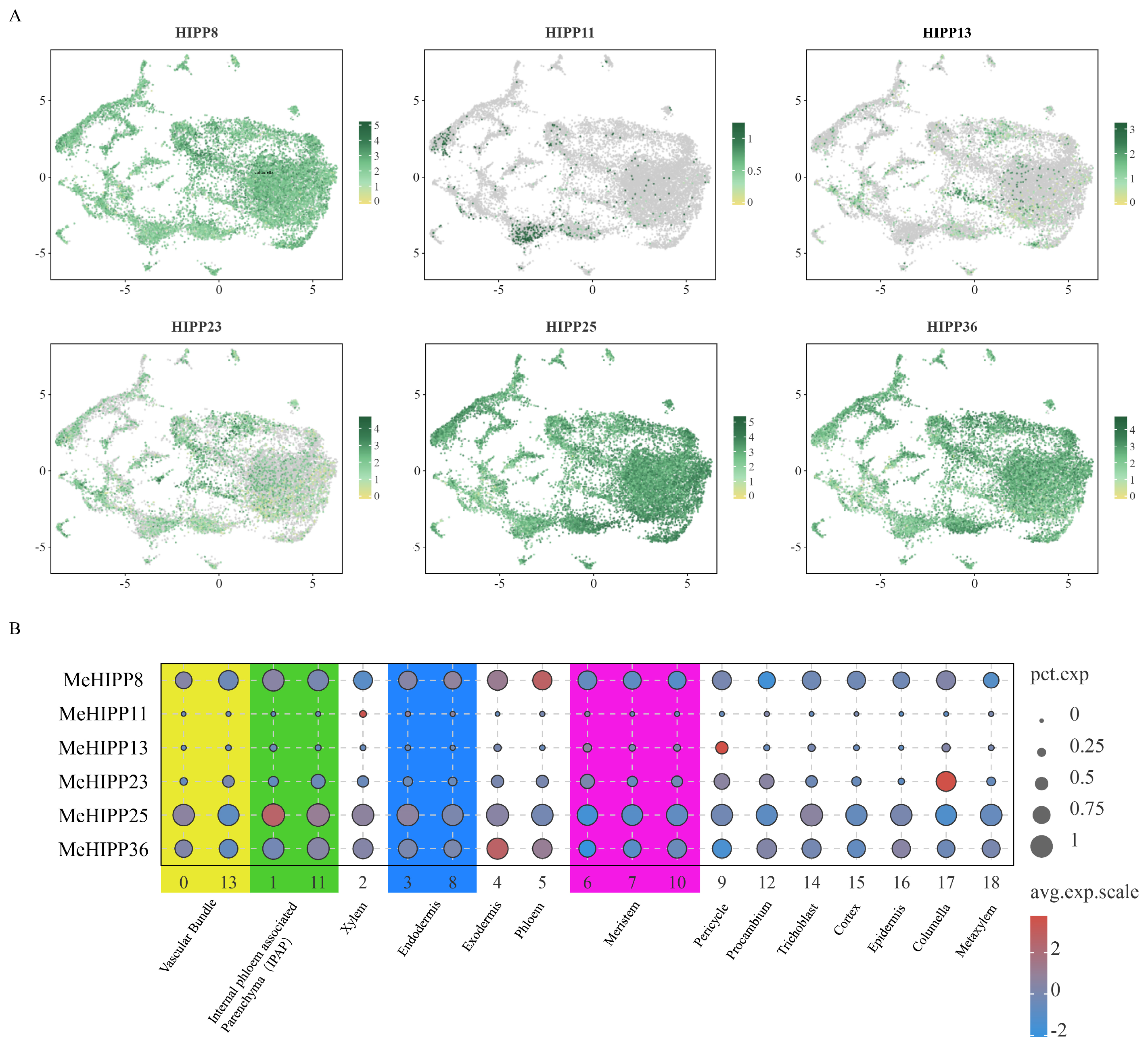
In tuberous roots, MeHIPP8, MeHIPP25, and MeHIPP36 were broadly expressed in multiple cell clusters. MeHIPP8 showed high expression in phloem, MeHIPP25 in IPAP, and MeHIPP36 in exodermis. Additionally, MeHIPP23 was specifically and highly expressed in columella, while MeHIPP11 and MeHIPP13 were specifically and highly expressed in xylem and pericycle, respectively (Figure 8, Table S4).

3.9. Expression Profiles of Selected MeHIPP Genes Under Cd Stress

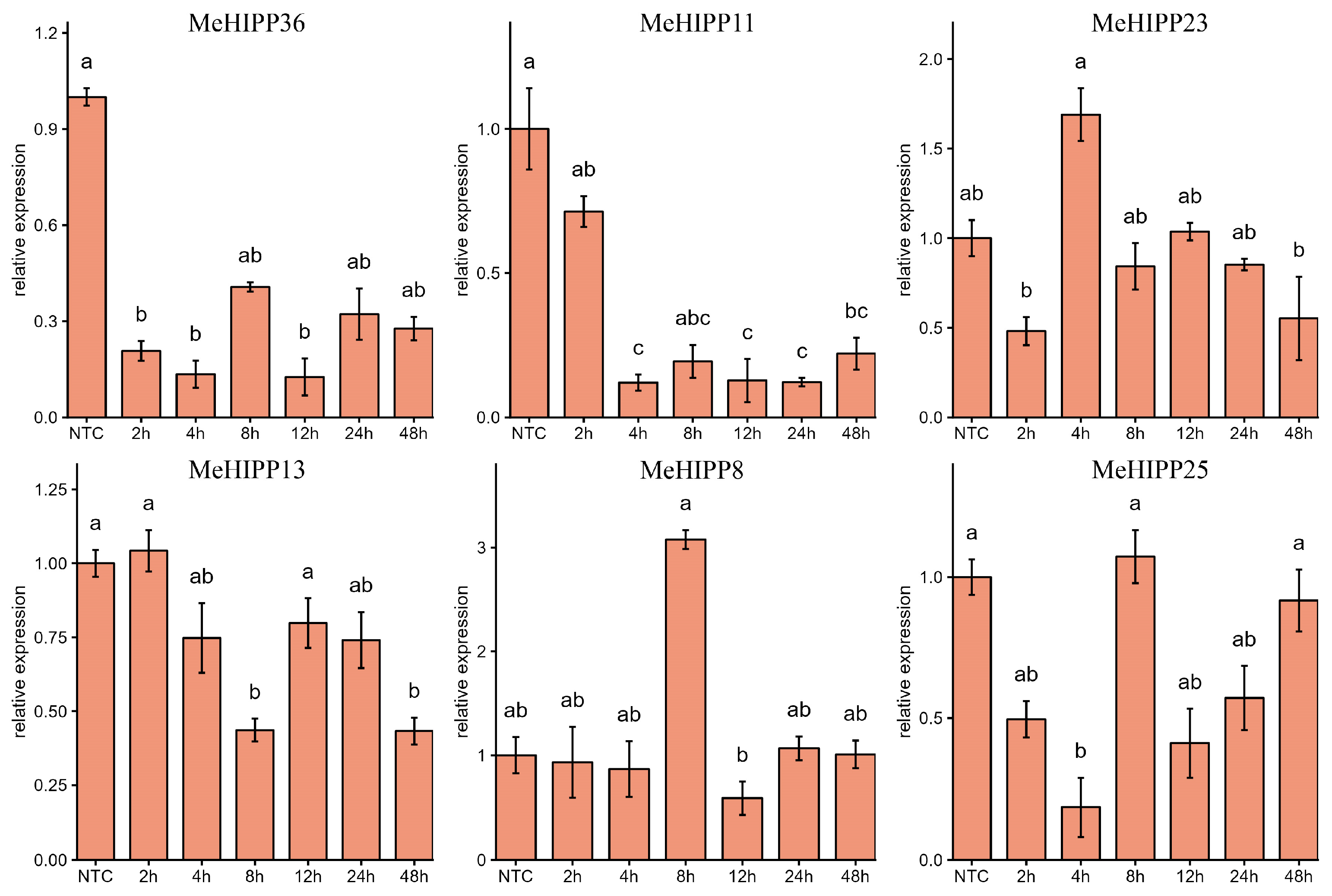
To assess the responses of the six MeHIPP genes to heavy metal stress, we quantified their transcript levels using qRT-PCR. Under cadmium (Cd) stress, MeHIPP36 was significantly downregulated. MeHIPP11 decreased sharply at 4 h and then remained stable. MeHIPP8 was strongly upregulated at 8 h but returned to baseline levels shortly thereafter. A biphasic pattern was observed for MeHIPP23, with significant downregulation at 2 h and subsequent upregulation at 4 h. MeHIPP13 exhibited a progressive decline over time. Notably, MeHIPP25 displayed two distinct episodes of significant downregulation and two significant rebounds (Figure 9).

4. Discussion

Conventional gene family analyses are confined to a single reference genome, limiting their ability to capture the full spectrum of genetic diversity within a species. The recent pan-genomic investigation of the bHLH gene family in barley demonstrated the value of expanding beyond single-genome approaches and set a precedent for similar analyses in other plant species [57]. With the release of comprehensive pan-genome resources for cassava, it is now both timely and essential to conduct a pan-genomic exploration of the HIPP gene family, which can provide a more complete understanding of its evolutionary dynamics and functional diversity and lay the foundation for subsequent research [58]. In this study, we performed the first pan-genome-wide identification and characterization of HIPP genes across 31 diverse cassava accessions, revealing their genetic variation and providing preliminary insights into their potential biological functions.
The HIPP gene family exhibits distinct numerical diversity within the cassava pan-genome. Through domain-based HMM searches combined with BLAST-based filtering, we identified 59 HIPP pan-genes corresponding to 1209 distinct gene copies across the 31 accessions. Variable numbers of MeHIPP genes were detected across cassava accessions, ranging from 26 to 61 per accession, with the majority harboring 31 to 45 functional members per accession. Such variation may reflect genuine biological differences among accessions, while also being influenced by the accuracy and completeness of distinct genome assemblies and annotations. Notably, the genome data of the “xx048” accession is a complete telomere-to-telomere (T2T) reference genome, within which a comprehensive and complete set of HIPP gene members has been identified [59]. Collectively, this suggests that HIPP gene expansions and losses have occurred frequently within the cassava genome. The observed variation in gene number likely reflects divergent evolutionary trajectories among cassava lineages, with certain lineages undergoing multiple rounds of gene duplication, thereby contributing to the overall expansion of the HIPP family [58].
All the MeHIPP genes identified across the 31 cassava accessions were systematically grouped into 59 OGGs, which were further classified into four categories: five core genes (present in all accessions), 22 softcore genes (frequency ≥ 90%), 17 dispensable genes (present in at least two accessions but at ≤90% frequency), and 15 private genes (accession-specific), thereby establishing a comprehensive evolutionary classification for the 59 HIPP OGGs. MeHIPPs were classified into five subgroups, with cluster II containing the largest number of members and cluster III containing the fewest. Notably, the phylogenetic analysis across multiple species revealed that MeHIPP28, MeHIPP48, MeHIPP49, MeHIPP56, and MeHIPP58 formed distinct species-specific clusters, with MeHIPP49, MeHIPP56, and MeHIPP58 identified as private genes. This suggests that this lineage may have undergone cassava-specific expansion or acquired new genes. Within the MeHIPP gene family, 47 segmentally duplicated and 2 tandemly duplicated gene pairs were identified, exhibiting duplication patterns similar to those reported in maize and tea plant [33,60]. Such gene duplication events may enhance adaptability to environmental stress and promote evolutionary flexibility. Cross-species synteny analysis revealed that cassava shares a higher number of syntenic HIPP gene pairs with rubber tree, poplar, castor bean, annual mercury, caper spurge, tomato, and Arabidopsis, all of which are dicot species. Notably, more orthologous gene pairs were identified between cassava and other members of the Euphorbiaceae family. Although cassava shares fewer syntenic pairs with Arabidopsis than with other dicot species, this may be limited by the smaller genome of Arabidopsis. In contrast, relatively few syntenic pairs were detected between cassava and monocots, such as maize, wheat, rice, and yams. These findings suggest that HIPP genes may have evolved distinct and important functions in the environmental adaptation of dicots. The monocot maize HIPP syntenic pairs reported in a previous study appear to be specific to monocots and are absent in dicots [33]. Consistent with this observation, as a dicot species, lotus shows substantially higher conservation of collinear HIPP gene pairs with other dicots than with monocots [61]. Similarly, cassava exhibited markedly stronger HIPP synteny with dicots than with monocots, indicating that MeHIPPs share closer evolutionary relationships within dicots. Together, these patterns are consistent with the notion that this lineage diversified after the monocot–dicot split during HIPP family evolution, with MeHIPPs evolving predominantly within the dicot lineage and potentially acquiring functions relevant to environmental adaptation. Ka/Ks analyses showed that most MeHIPP genes exhibited ratios below 1, consistent with predominant purifying selection and suggesting the potential presence of strong functional constraints over evolutionary timescales. In contrast, a smaller subset displayed Ka/Ks ratios greater than 1, indicating possible positive selection and potential functional diversification during recent cassava evolution.
Promoter cis-regulatory element analysis of MeHIPP genes revealed numerous stress-responsive and hormone-related motifs, indicating that these genes may play a role in stress tolerance and growth regulation. Light-responsive elements were detected in all MeHIPP promoter regions, indicating a fundamental role of light signaling in the regulation of this gene family. Additionally, cis-acting elements putatively recognized by the transcription factors MYB and MYC were identified. MYB factors are known to regulate gene expression in response to heavy metal stress [62]. Accordingly, further investigation of the transcriptional regulation of MeHIPP genes is warranted, with MYB- and MYC-binding sites serving as primary targets for defining the core promoter motifs of these genes.
Expression profiling across organs provides a basis for elucidating the roles of MeHIPP genes in metal homeostasis in cassava. To date, expression patterns of the HIPP gene family in different tissues have been reported in wheat, tea plant, and tobacco [60,63,64]. The expression profiles of MeHIPP genes across different tissues revealed both constitutive and tissue-specific expression patterns, suggesting that these genes may perform diverse functions in plant development and organ-specific responses. Single-cell RNA sequencing enables the analysis of gene expression patterns at the single-cell level, providing a powerful approach for exploring plant cell growth, development, and stress responses in greater depth [65]. MeHIPP genes are widely expressed at relatively high levels in the leaf vascular bundles and epidermis, suggesting they may play potential roles in nutrient transport and storage, defense, and plant growth [66,67]. In storage roots, MeHIPP gene expression across distinct cell subsets displayed pronounced cell-type specificity, suggesting that the MeHIPP family may undergo expression specialization during root development and cellular differentiation. The internal phloem is embedded within the xylem of vascular bundles, and its parenchyma cells are generally considered components of the phloem system [68]. High expression of MeHIPP genes was observed in the internal phloem-associated parenchyma (IPAP) and vascular bundles of storage roots. HIPP genes have been reported to modulate the expression of genes associated with metal transport and may contribute to metal uptake and translocation [69]. We hypothesize that MeHIPP genes could participate in metal handling by coordinating metal ions via their HMA domains, thereby supporting metal homeostasis and transport-related functions. Moreover, MeHIPP genes showed broader expression across diverse leaf cell subsets than in storage roots. The preferential expression of MeHIPP genes within specific cell subsets implies that these genes may have shared regulatory mechanisms, related functional roles, or common evolutionary origins, providing further support for their classification as members of a single gene family. MeHIPP8, MeHIPP25, and MeHIPP36 exhibited broad and relatively high expression across multiple tissues, with extensive expression across diverse cell subsets in both leaves and storage roots. This pattern suggests that these genes may represent core, broadly acting members of the MeHIPP family and may contribute to a wider range of biological processes. In contrast, MeHIPP11, MeHIPP13, and MeHIPP23 displayed more restricted, cell-type-enriched expression, being detected primarily in specific tuberous root subsets, which may be related to more specialized or context-dependent functions.
In various plant species, HIPP genes are involved in a wide range of responses to abiotic and biotic stresses [23,24,25,26,27]. Homologous genes in Arabidopsis have been shown to play key roles in regulating plant organ development and mediating responses to both biotic and abiotic stresses [23,28,70]. In cassava, RNA-seq data from leaves under drought conditions and Xpm infection revealed that most MeHIPP genes are differentially expressed, suggesting their broad involvement in both drought and bacterial stress responses. In addition to their well-established role in heavy metal stress response, HIPP genes can also be targeted by pathogen effector proteins, acting as susceptibility genes in response to pathogen attack [71,72]. Under biotic stress, distinct expression patterns are observed among different HIPP gene members [71]. For instance, following infection with Xpm, MeHIPP7-2, MeHIPP26, MeHIPP19, MeHIPP3-1, MeHIPP33, MeHIPP17, and MeHIPP35 genes were downregulated after 7 days of pathogen infection. In contrast, their expression showed an upregulation trend during infection with non-pathogenic bacteria. MeHIPP41 displayed an initial downregulation followed by upregulation during pathogenic infection. Non-pathogenic bacterial infection resulted in its sustained downregulation.
HIPP genes are known to interact with drought-regulating factors, such as cyclic E3 ubiquitin ligase HOS1 and zinc finger homeodomain transcription factor ATHB29, to modulate plant responses to drought stress [28,31,73]. In cassava, genes such as MeHIPP19, MeHIPP38, MeHIPP26, MeHIPP35, MeHIPP21, MeHIPP41, and MeHIPP8 were significantly upregulated under drought stress, with MeHIPP21 showing the most pronounced induction. These patterns suggest that MeHIPP21 may act as a key regulator of the drought-stress response in cassava. In contrast, MeHIPP4-1, MeHIPP30, and MeHIPP6-2 were significantly suppressed. These findings underscore the complex and diverse expression patterns of MeHIPP genes in response to drought and biotic stresses in cassava. Numerous studies have demonstrated that HIPP genes are widely responsive to cadmium (Cd) stress, interacting specifically with Cd to play a critical role in its detoxification [21,27,61]. Our qPCR analysis revealed differential expression patterns of the six selected MeHIPP genes under Cd stress. Specifically, MeHIPP8 and MeHIPP23 were significantly upregulated, while MeHIPP11, MeHIPP13, and MeHIPP36 were markedly downregulated. These results suggest that members of the HIPP gene family exhibit diverse expression patterns in response to Cd stress, likely owing to specific structural features. Overall, the expression of MeHIPP genes is inducible by various abiotic and biotic stresses, highlighting their potential involvement in multiple stress response functions.

5. Conclusions

This study presents the first pan-genome-scale analysis of the HIPP gene family in cassava, revealing substantial cultivar-to-cultivar variations in gene content and composition. We identified 59 MeHIPP pan-genes, comprising 1209 gene copies across 31 accessions. Integrative analyses of phylogeny, structural variation, selective pressure, and transcriptomic profiles elucidated the complex evolutionary history of MeHIPPs and their functional diversification. Bulk RNA-seq and single-cell transcriptome data demonstrated pronounced heterogeneity in MeHIPP expression across tissues and cell subsets, supporting potential distinct regulatory programs and divergent biological roles among family members. Moreover, transcriptomic analyses under multiple stress conditions showed that MeHIPPs exhibit stress-responsive expression in response to drought, Xpm, and Cd stress, underscoring their potential involvement in the adaptation of cassava to stress. Collectively, these findings expand our understanding of the cassava HIPP gene family.

Supplementary Materials

The following supporting information can be downloaded at https://www.mdpi.com/article/10.3390/genes17020136/s1. Figure S1: Pan-genome distribution of cassava HIPP genes; Figure S2: Cross-species phylogenetic tree of HIPP family; Figure S3: Phylogeny and conserved motif architecture of cassava HIPPs; Figure S4: Single-Cell Transcriptome analysis of MeHIPPs in cassava tuberous root and leaves. Table S1: List of the 1209 MeHIPP genes identified in this study; Table S2: The conserved motifs and gene structures of MeHIPP; Table S3: Distribution of cis-acting regulatory elements of MeHIPP genes; Table S4: Single Cell RNA-seq data of six selected genes that were used in this study; Table S5: Primers for qRT-PCR.

Author Contributions

Z.X.: Formal analysis; investigation; visualization; writing—original draft. J.Z.: Formal analysis; visualization. C.W.: Data curation; formal analysis. S.W.: Resources; software. Y.Z.: Data curation; resources. D.W.: Writing—review and editing. S.Z.: Writing—review and editing. Y.M.: Conceptualization; writing—review and editing. All authors have read and agreed to the published version of the manuscript.

Funding

This research was funded by the Project of Sanya Yazhou Bay Science and Technology City (Grant No. SKJC-JYRC-2025-22), the Natural Science Foundation of Hainan Province (Grant No. 822RC651), and National Natural Science Foundation of China (Grant No. 31960039).

Institutional Review Board Statement

Not applicable.

Informed Consent Statement

Not applicable.

Data Availability Statement

The data presented in this study are available in the article and the Supplementary Materials.

Conflicts of Interest

The authors declare no conflicts of interest.

Abbreviations

The following abbreviations are used in this manuscript:
Cdcadmium
ENAEuropean Nucleotide Archive
GFFgeneral feature format version
GRAVYgrand average of hydropathy
HIPPheavy-metal-associated isoprenylated plant protein
HMAheavy-metal-associated
Ka/Ksratio of the nonsynonymous substitution rate to the synonymous substitution rate
NCBINational Center for Biotechnology Information
OGGorthologous gene group
qRT-PCRquantitative real-time polymerase chain reaction
UMAPuniform manifold approximation and projection

References

  1. Amelework, A.B.; Bairu, M.W. Advances in Genetic Analysis and Breeding of Cassava (Manihot esculenta Crantz): A Review. Plants 2022, 11, 1617. [Google Scholar] [CrossRef]
  2. Cai, Z.; Ruan, L.; Wei, W.; He, W.; Yang, H.; Chen, H.; Liang, Z.; Huang, Z.; Lan, X.; Zhang, X.; et al. Morphological, Anatomical, and Transcriptomics Analysis Reveals the Regulatory Mechanisms of Cassava Plant Height Development. BMC Genom. 2024, 25, 699. [Google Scholar] [CrossRef]
  3. Fathima, A.A.; Sanitha, M.; Tripathi, L.; Muiruri, S. Cassava (Manihot esculenta) Dual Use for Food and Bioenergy: A Review. Food Energy Secur. 2023, 12, e380. [Google Scholar] [CrossRef]
  4. Okogbenin, E.; Setter, T.L.; Ferguson, M.; Mutegi, R.; Ceballos, H.; Olasanmi, B.; Fregene, M. Phenotypic Approaches to Drought in Cassava: Review. Front. Physiol. 2013, 4, 93. [Google Scholar] [CrossRef] [PubMed]
  5. More, S.J.; Bardhan, K.; Ravi, V.; Pasala, R.; Chaturvedi, A.K.; Lal, M.K.; Siddique, K.H.M. Morphophysiological Responses and Tolerance Mechanisms in Cassava (Manihot esculenta Crantz) Under Drought Stress. J. Soil Sci. Plant Nutr. 2023, 23, 71–91. [Google Scholar] [CrossRef]
  6. Devi, B.; Kumar, M.N.; Chutia, M.; Bhattacharyya, N. Abiotic and Biotic Stress Challenges of Cassava in Changing Climate and Strategies to Overcome: A Review. Sci. Hortic. 2022, 305, 111432. [Google Scholar] [CrossRef]
  7. Zaynab, M.; Al-Yahyai, R.; Ameen, A.; Sharif, Y.; Ali, L.; Fatima, M.; Khan, K.A.; Li, S. Health and Environmental Effects of Heavy Metals. J. King Saud. Univ. Sci. 2022, 34, 101653. [Google Scholar] [CrossRef]
  8. Shahid, M.; Khalid, S.; Abbas, G.; Shahid, N.; Nadeem, M.; Sabir, M.; Aslam, M.; Dumat, C. Heavy Metal Stress and Crop Productivity. In Crop Production and Global Environmental Issues; Hakeem, K.R., Ed.; Springer International Publishing: Cham, Switzerland, 2015; pp. 1–25. ISBN 978-3-319-23161-7. [Google Scholar]
  9. Li, L.; Fan, Z.; Gan, Q.; Xiao, G.; Luan, M.; Zhu, R.; Zhang, Z. Conservative Mechanism through Various Rapeseed (Brassica napus L.) Varieties Respond to Heavy Metal (Cadmium, Lead, Arsenic) Stress. Front. Plant Sci. 2025, 15, 1521075. [Google Scholar] [CrossRef] [PubMed]
  10. Kısa, D.; Öztürk, L.; Doker, S.; Gökçe, İ. Expression Analysis of Metallothioneins and Mineral Contents in Tomato (Lycopersicon Esculentum) under Heavy Metal Stress. J. Sci. Food Agric. 2017, 97, 1916–1923. [Google Scholar] [CrossRef] [PubMed]
  11. Singh, S.; Parihar, P.; Singh, R.; Singh, V.P.; Prasad, S.M. Heavy Metal Tolerance in Plants: Role of Transcriptomics, Proteomics, Metabolomics, and Ionomics. Front. Plant Sci. 2016, 6, 1143. [Google Scholar] [CrossRef]
  12. Thakur, M.; Praveen, S.; Divte, P.R.; Mitra, R.; Kumar, M.; Gupta, C.K.; Kalidindi, U.; Bansal, R.; Roy, S.; Anand, A.; et al. Metal Tolerance in Plants: Molecular and Physicochemical Interface Determines the “Not so Heavy Effect” of Heavy Metals. Chemosphere 2022, 287, 131957. [Google Scholar] [CrossRef] [PubMed]
  13. Hasan, M.K.; Cheng, Y.; Kanwar, M.K.; Chu, X.-Y.; Ahammed, G.J.; Qi, Z.-Y. Responses of Plant Proteins to Heavy Metal Stress—A Review. Front. Plant Sci. 2017, 8, 1492. [Google Scholar] [CrossRef] [PubMed]
  14. Niekerk, L.; Gokul, A.; Basson, G.; Badiwe, M.; Nkomo, M.; Klein, A.; Keyster, M. Heavy Metal Stress and Mitogen Activated Kinase Transcription Factors in Plants: Exploring Heavy metal-ROS Influences on Plant Signalling Pathways. Plant Cell Environ. 2024, 47, 2793–2810. [Google Scholar] [CrossRef]
  15. Jalmi, S.K. The Role of ABC Transporters in Metal Transport in Plants. In Plant Metal and Metalloid Transporters; Kumar, K., Srivastava, S., Eds.; Springer Nature: Singapore, 2022; pp. 55–71. ISBN 978-981-19-6102-1. [Google Scholar]
  16. Alejandro, S.; Meier, B.; Hoang, M.T.T.; Peiter, E. Cation Diffusion Facilitator Proteins of Beta vulgaris Reveal Diversity of Metal Handling in Dicotyledons. Plant Cell Environ. 2023, 46, 1629–1652. [Google Scholar] [CrossRef]
  17. Xing, Q.; Hasan, M.K.; Li, Z.; Yang, T.; Jin, W.; Qi, Z.; Yang, P.; Wang, G.; Ahammed, G.J.; Zhou, J. Melatonin-Induced Plant Adaptation to Cadmium Stress Involves Enhanced Phytochelatin Synthesis and Nutrient Homeostasis in Solanum lycopersicum L. J. Hazard. Mater. 2023, 456, 131670. [Google Scholar] [CrossRef]
  18. Cao, H.W.; Zhao, Y.N.; Liu, X.S.; Rono, J.K.; Yang, Z.M. A Metal Chaperone OsHIPP16 Detoxifies Cadmium by Repressing Its Accumulation in Rice Crops. Environ. Pollut. 2022, 311, 120058. [Google Scholar] [CrossRef]
  19. Rono, J.K.; Sun, D.; Yang, Z.M. Metallochaperones: A Critical Regulator of Metal Homeostasis and Beyond. Gene 2022, 822, 146352. [Google Scholar] [CrossRef] [PubMed]
  20. Tehseen, M.; Cairns, N.; Sherson, S.; Cobbett, C.S. Metallochaperone-like Genes in Arabidopsis thaliana. Metallomics 2010, 2, 556. [Google Scholar] [CrossRef]
  21. De Abreu-Neto, J.B.; Turchetto-Zolet, A.C.; De Oliveira, L.F.V.; Bodanese Zanettini, M.H.; Margis-Pinheiro, M. Heavy Metal-associated Isoprenylated Plant Protein (HIPP): Characterization of a Family of Proteins Exclusive to Plants. FEBS J. 2013, 280, 1604–1616. [Google Scholar] [CrossRef]
  22. Chevalier, Q.; Debié, P.; Huchelmann, A.; Hemmerlin, A. Protein Prenylation Makeovers in Plants: Insights into Substrate Diversification. Int. J. Mol. Sci. 2025, 26, 10638. [Google Scholar] [CrossRef]
  23. Guo, T.; Weber, H.; Niemann, M.C.E.; Theisl, L.; Leonte, G.; Novák, O.; Werner, T. Arabidopsis HIPP Proteins Regulate Endoplasmic Reticulum-Associated Degradation of CKX Proteins and Cytokinin Responses. Mol. Plant 2021, 14, 1918–1934. [Google Scholar] [CrossRef] [PubMed]
  24. Ma, L.; An, R.; Jiang, L.; Zhang, C.; Li, Z.; Zou, C.; Yang, C.; Pan, G.; Lübberstedt, T.; Shen, Y. Effects of ZmHIPP on Lead Tolerance in Maize Seedlings: Novel Ideas for Soil Bioremediation. J. Hazard. Mater. 2022, 430, 128457. [Google Scholar] [CrossRef] [PubMed]
  25. Zhang, X.; Feng, H.; Feng, C.; Xu, H.; Huang, X.; Wang, Q.; Duan, X.; Wang, X.; Wei, G.; Huang, L.; et al. Isolation and Characterisation of c DNA Encoding a Wheat Heavy Metal-associated Isoprenylated Protein Involved in Stress Responses. Plant Biol. J. 2015, 17, 1176–1186. [Google Scholar] [CrossRef]
  26. Shi, Y.; Jiang, W.; Li, M.; Jiang, N.; Huang, Y.; Wang, M.; Du, Z.; Chen, J.; Li, J.; Wu, L.; et al. Metallochaperone Protein OsHIPP17 Regulates the Absorption and Translocation of Cadmium in Rice (Oryza sativa L.). Int. J. Biol. Macromol. 2023, 245, 125607. [Google Scholar] [CrossRef]
  27. Xu, J.; Cui, J.; He, Q.; Liu, Y.; Lu, X.; Qi, J.; Xiong, J.; Yu, W.; Li, C. Genome-Wide Identification of HIPP and Mechanism of SlHIPP4/7/9/21/26/32 Mediated Phytohormones Response to Cd, Osmotic, and Salt Stresses in Tomato. Plant Physiol. Bioch 2024, 217, 109220. [Google Scholar] [CrossRef]
  28. Barth, O.; Vogt, S.; Uhlemann, R.; Zschiesche, W.; Humbeck, K. Stress Induced and Nuclear Localized HIPP26 from Arabidopsis thaliana Interacts via Its Heavy Metal Associated Domain with the Drought Stress Related Zinc Finger Transcription Factor ATHB29. Plant Mol. Biol. 2009, 69, 213–226. [Google Scholar] [CrossRef]
  29. Wu, W.; Zhao, T.; Zheng, Y.; Liu, T.; Zhou, S.; Chen, W.; Xie, L.; Lin, Q.; Chen, L.; Xiao, S.; et al. HIPP33 Contributes to Selective Autophagy-Mediated Vacuolar Sequestration of Cadmium in Arabidopsis. Plant Cell Environ. 2025, 48, 7072–7088. [Google Scholar] [CrossRef]
  30. Chen, G.; Xiong, S. OsHIPP24 Is a Copper Metallochaperone Which Affects Rice Growth. J. Plant Biol. 2021, 64, 145–153. [Google Scholar] [CrossRef]
  31. Zheng, Q.; Yu, Q.; Wu, N.; Yao, W.; Li, J.; Lv, K.; Xu, W. A Grape VvHOS1-Interacting HIPP Protein (VvHIPP21) Negatively Regulates Cold and Drought Stress. Environ. Exp. Bot. 2023, 207, 105203. [Google Scholar] [CrossRef]
  32. Sun, W.; Wei, J.; Wu, G.; Xu, H.; Chen, Y.; Yao, M.; Zhan, J.; Yan, J.; Wu, N.; Chen, H.; et al. CqZF-HD14 Enhances Drought Tolerance in Quinoa Seedlings through Interaction with CqHIPP34 and CqNAC79. Plant Sci. 2022, 323, 111406. [Google Scholar] [CrossRef] [PubMed]
  33. Gao, C.; Zhang, Z.; Zhu, Y.; Tian, J.; Yu, K.; Hou, J.; Luo, D.; Cai, J.; Zhu, Y. Genome-Wide Analysis of HIPP Gene Family in Maize Reveals Its Role in the Cadmium Stress Response. Genes 2025, 16, 770. [Google Scholar] [CrossRef]
  34. Finn, R.D. Pfam: Clans, Web Tools and Services. Nucleic Acids Res. 2006, 34, D247–D251. [Google Scholar] [CrossRef] [PubMed]
  35. Chen, C.; Wu, Y.; Li, J.; Wang, X.; Zeng, Z.; Xu, J.; Liu, Y.; Feng, J.; Chen, H.; He, Y.; et al. TBtools-II: A “One for All, All for One” Bioinformatics Platform for Biological Big-Data Mining. Mol. Plant 2023, 16, 1733–1742. [Google Scholar] [CrossRef] [PubMed]
  36. Blum, M.; Andreeva, A.; Florentino, L.C.; Chuguransky, S.R.; Grego, T.; Hobbs, E.; Pinto, B.L.; Orr, A.; Paysan-Lafosse, T.; Ponamareva, I.; et al. InterPro: The Protein Sequence Classification Resource in 2025. Nucleic Acids Res 2025, 53, D444–D456. [Google Scholar] [CrossRef] [PubMed]
  37. Maurer-Stroh, S.; Eisenhaber, F. Refinement and Prediction of Protein Prenylation Motifs. Genome Biol. 2005, 6, R55. [Google Scholar] [CrossRef]
  38. Gasteiger, E.; Hoogland, C.; Gattiker, A.; Duvaud, S.; Wilkins, M.R.; Appel, R.D.; Bairoch, A. Protein Identification and Analysis Tools on the ExPASy Server. In The Proteomics Protocols Handbook; Walker, J.M., Ed.; Humana Press: Totowa, NJ, USA, 2005; pp. 571–607. ISBN 978-1-58829-343-5. [Google Scholar]
  39. Ødum, M.T.; Teufel, F.; Thumuluri, V.; Almagro Armenteros, J.J.; Johansen, A.R.; Winther, O.; Nielsen, H. DeepLoc 2.1: Multi-Label Membrane Protein Type Prediction Using Protein Language Models. Nucleic Acids Res. 2024, 52, W215–W220. [Google Scholar] [CrossRef]
  40. Kumar, S.; Stecher, G.; Tamura, K. MEGA7: Molecular Evolutionary Genetics Analysis Version 7.0 for Bigger Datasets. Mol. Biol. Evol. 2016, 33, 1870–1874. [Google Scholar] [CrossRef]
  41. Nguyen, L.-T.; Schmidt, H.A.; Von Haeseler, A.; Minh, B.Q. IQ-TREE: A Fast and Effective Stochastic Algorithm for Estimating Maximum-Likelihood Phylogenies. Mol. Biol. Evol. 2015, 32, 268–274. [Google Scholar] [CrossRef]
  42. Letunic, I.; Bork, P. Interactive Tree of Life (iTOL) v6: Recent Updates to the Phylogenetic Tree Display and Annotation Tool. Nucleic Acids Res. 2024, 52, W78–W82. [Google Scholar] [CrossRef]
  43. Emms, D.M.; Kelly, S. OrthoFinder: Phylogenetic Orthology Inference for Comparative Genomics. Genome Biol. 2019, 20, 238. [Google Scholar] [CrossRef]
  44. Wang, Y.; Tang, H.; De Barry, J.D.; Tan, X.; Li, J.; Wang, X.; Lee, T.-H.; Jin, H.; Marler, B.; Guo, H.; et al. MCScanX: A Toolkit for Detection and Evolutionary Analysis of Gene Synteny and Collinearity. Nucleic Acids Res. 2012, 40, e49. [Google Scholar] [CrossRef] [PubMed]
  45. Zhang, Z. KaKs_Calculator 3.0: Calculating Selective Pressure on Coding and Non-Coding Sequences. Genom. Proteom. Bioinf. 2022, 20, 536–540. [Google Scholar] [CrossRef] [PubMed]
  46. Wickham, H. Ggplot2: Elegant Graphics for Data Analysis. In Use R! 2nd ed.; Springer International Publishing: Cham, Switzerland, 2016; ISBN 978-3-319-24277-4. [Google Scholar]
  47. Lescot, M. PlantCARE, a Database of Plant Cis-Acting Regulatory Elements and a Portal to Tools for in Silico Analysis of Promoter Sequences. Nucleic Acids Res. 2002, 30, 325–327. [Google Scholar] [CrossRef]
  48. Bailey, T.L.; Johnson, J.; Grant, C.E.; Noble, W.S. The MEME Suite. Nucleic Acids Res. 2015, 43, W39–W49. [Google Scholar] [CrossRef]
  49. Wilson, M.C.; Mutka, A.M.; Hummel, A.W.; Berry, J.; Chauhan, R.D.; Vijayaraghavan, A.; Taylor, N.J.; Voytas, D.F.; Chitwood, D.H.; Bart, R.S. Gene Expression Atlas for the Food Security Crop Cassava. New Phytol. 2017, 213, 1632–1641. [Google Scholar] [CrossRef] [PubMed]
  50. Muñoz-Bodnar, A.; Perez-Quintero, A.L.; Gomez-Cano, F.; Gil, J.; Michelmore, R.; Bernal, A.; Szurek, B.; Lopez, C. RNAseq Analysis of Cassava Reveals Similar Plant Responses upon Infection with Pathogenic and Non-Pathogenic Strains of Xanthomonas Axonopodis Pv. Manihotis. Plant Cell Rep. 2014, 33, 1901–1912. [Google Scholar] [CrossRef]
  51. Grüning, B.A.; Fallmann, J.; Yusuf, D.; Will, S.; Erxleben, A.; Eggenhofer, F.; Houwaart, T.; Batut, B.; Videm, P.; Bagnacani, A.; et al. The RNA Workbench: Best Practices for RNA and High-Throughput Sequencing Bioinformatics in Galaxy. Nucleic Acids Res. 2017, 45, W560–W566. [Google Scholar] [CrossRef]
  52. Song, J.; Fan, B.; Shao, X.; Zang, Y.; Wang, D.; Min, Y. Single-Cell Transcriptome Sequencing Atlas of Cassava Tuberous Root. Front. Plant Sci. 2023, 13, 1053669. [Google Scholar] [CrossRef]
  53. Zang, Y.; Pei, Y.; Cong, X.; Ran, F.; Liu, L.; Wang, C.; Wang, D.; Min, Y. Single-Cell RNA-Sequencing Profiles Reveal the Developmental Landscape of the Manihot esculenta Crantz Leaves. Plant Physiol. 2023, 194, 456–474. [Google Scholar] [CrossRef]
  54. Salcedo, A.; Zambrana, C.; Siritunga, D. Comparative Expression Analysis of Reference Genes in Field-Grown Cassava. Trop. Plant Biol. 2014, 7, 53–64. [Google Scholar] [CrossRef]
  55. Ye, J.; Yang, H.; Shi, H.; Wei, Y.; Tie, W.; Ding, Z.; Yan, Y.; Luo, Y.; Xia, Z.; Wang, W.; et al. The MAPKKK Gene Family in Cassava: Genome-Wide Identification and Expression Analysis against Drought Stress. Sci. Rep. 2017, 7, 14939. [Google Scholar] [CrossRef]
  56. Schmittgen, T.D.; Livak, K.J. Analyzing Real-Time PCR Data by the Comparative CT Method. Nat. Protoc. 2008, 3, 1101–1108. [Google Scholar] [CrossRef]
  57. Tong, C.; Jia, Y.; Hu, H.; Zeng, Z.; Chapman, B.; Li, C. Pangenome and Pantranscriptome as the New Reference for Gene-Family Characterization: A Case Study of Basic Helix-Loop-Helix (bHLH) Genes in Barley. Plant Commun. 2025, 6, 101190. [Google Scholar] [CrossRef]
  58. Xia, Z.; Du, Z.; Zhou, X.; Jiang, S.; Zhu, T.; Wang, L.; Chen, F.; Carvalho, L.; Zou, M.; Becerra Lopez-Lavalle, L.A.; et al. Pan-Genome and Haplotype Map of Cassava Cultivars and Wild Ancestors Provide Insights into Its Adaptive Evolution and Domestication. Mol. Plant 2025, 18, 1047–1071. [Google Scholar] [CrossRef] [PubMed]
  59. Xu, X.-D.; Zhao, R.-P.; Xiao, L.; Lu, L.; Gao, M.; Luo, Y.-H.; Zhou, Z.-W.; Ye, S.-Y.; Qian, Y.-Q.; Fan, B.-L.; et al. Telomere-to-Telomere Assembly of Cassava Genome Reveals the Evolution of Cassava and Divergence of Allelic Expression. Hortic. Res. 2023, 10, uhad200. [Google Scholar] [CrossRef]
  60. Wei, Y.; Peng, X.; Wang, X.; Wang, C. The Heavy Metal-Associated Isoprenylated Plant Protein (HIPP) Gene Family Plays a Crucial Role in Cadmium Resistance and Accumulation in the Tea Plant (Camellia sinensis L.). Ecotoxicol. Environ. Saf. 2023, 260, 115077. [Google Scholar] [CrossRef]
  61. Gao, C.; Zhu, Y.; Xu, H.; Peng, X.; Yu, K.; Gu, X.; Xiao, Y.; Cai, J.; Wang, Y. The Heavy Metal-Associated Isoprenylated Plant Protein (HIPP) Gene Family Plays a Crucial Role in Cadmium Resistance in Lotus (Nelumbo nucifera G.). Horticulturae 2025, 11, 1136. [Google Scholar] [CrossRef]
  62. Yan, X.; Huang, Y.; Song, H.; Chen, F.; Geng, Q.; Hu, M.; Zhang, C.; Wu, X.; Fan, T.; Cao, S. A MYB4-MAN3-Mannose-MNB1 Signaling Cascade Regulates Cadmium Tolerance in Arabidopsis. PLoS Genet. 2021, 17, e1009636. [Google Scholar] [CrossRef] [PubMed]
  63. Zhang, H.; Zhang, X.; Liu, J.; Niu, Y.; Chen, Y.; Hao, Y.; Zhao, J.; Sun, L.; Wang, H.; Xiao, J.; et al. Characterization of the Heavy-Metal-Associated Isoprenylated Plant Protein (HIPP) Gene Family from Triticeae Species. Int. J. Mol. Sci. 2020, 21, 6191. [Google Scholar] [CrossRef] [PubMed]
  64. Wang, H.; Du, J.; Niu, C.; Yang, X.; Wu, D.; Sun, H.; Zhang, X.; Shao, H.; Zhang, S. Genome-Wide Identification and Stress Response Expression Analysis of the Heavy Metal-Associated Isoprenylated Plant Protein Gene Family in Tobacco (Nicotiana tabacum L.). BMC Plant Biol. 2025, 25, 1506. [Google Scholar] [CrossRef]
  65. Wang, Y.; Huan, Q.; Li, K.; Qian, W. Single-Cell Transcriptome Atlas of the Leaf and Root of Rice Seedlings. J. Genet. Genom. 2021, 48, 881–898. [Google Scholar] [CrossRef]
  66. Javelle, M.; Vernoud, V.; Rogowsky, P.M.; Ingram, G.C. Epidermis: The Formation and Functions of a Fundamental Plant Tissue. New Phytol. 2011, 189, 17–39. [Google Scholar] [CrossRef]
  67. Chang, W.; Chen, H.; Jiao, G.; Dou, Y.; Liu, L.; Qu, C.; Li, J.; Lu, K. Biomolecular Strategies for Vascular Bundle Development to Improve Crop Yield. Biomolecules 2022, 12, 1772. [Google Scholar] [CrossRef] [PubMed]
  68. Rajput, K.S.; Kapadane, K.K.; Ramoliya, D.G.; Thacker, K.D.; Gondaliya, A.D. Inter- and Intraxylary Phloem in Vascular Plants: A Review of Subtypes, Occurrences, and Development. Forests 2022, 13, 2174. [Google Scholar] [CrossRef]
  69. Xia, H.; Jing, X.; He, H.; Peng, J.; Liu, Y.; Sun, W.; Wang, X.; Yuan, Z.; Wu, J.; Zhang, M.; et al. Genome-Wide Identification of the HIPPs Gene Family and Functional Validation of MsHIPP12 in Enhancing Cadmium Tolerance in Medicago sativa. J. Hazard. Mater. 2025, 491, 137894. [Google Scholar] [CrossRef]
  70. Zschiesche, W.; Barth, O.; Daniel, K.; Böhme, S.; Rausche, J.; Humbeck, K. The Zinc-binding Nuclear Protein HIPP 3 Acts as an Upstream Regulator of the Salicylate-dependent Plant Immunity Pathway and of Flowering Time in Arabidopsis thaliana. New Phytol. 2015, 207, 1084–1096. [Google Scholar] [CrossRef] [PubMed]
  71. Huang, G.; Hu, Y.; Li, F.; Zuo, X.; Wang, X.; Li, F.; Li, R. Genome-Wide Characterization of Heavy Metal-Associated Isoprenylated Plant Protein Gene Family from Citrus Sinensis in Response to Huanglongbing. Front. Plant Sci. 2024, 15, 1369883. [Google Scholar] [CrossRef]
  72. Radakovic, Z.S.; Anjam, M.S.; Escobar, E.; Chopra, D.; Cabrera, J.; Silva, A.C.; Escobar, C.; Sobczak, M.; Grundler, F.M.W.; Siddique, S. Arabidopsis HIPP27 Is a Host Susceptibility Gene for the Beet Cyst Nematode Heterodera schachtii. Mol. Plant Pathol. 2018, 19, 1917–1928. [Google Scholar] [CrossRef]
  73. Li, J.; Wang, N.; Wang, L.; Xin, H.; Li, S. Molecular Cloning and Characterization of the HOS1 Gene from ‘Muscat Hamburg’ Grapevine. J. Am. Soc. Hortic. Sci. 2014, 139, 54–62. [Google Scholar] [CrossRef]
Figure 1. Phylogenetic and presence/absence analyses of the MeHIPP gene family. (A) Heatmap showing the presence/absence variation in HIPP genes across 31 cassava genomes. Dark blue indicates the presence of genes, whereas ghost white denotes the absence of genes. (B) Phylogenetic tree of the HIPP gene family in cassava. The phylogenetic tree is divided into five major clades, designated I–V. Different colors represent the various subgroups. Squares represent core genes, circles represent softcore genes, asterisks represent dispensable genes, and triangles represent private genes.
Genes 17 00136 g001
Figure 2. Analysis of Ka/Ks ratios of HIPP genes in cassava. (A) Ka/Ks values of HIPP genes across cassava genomes. (B) Heatmap of frequency of Ka/Ks ratios greater than 1 for each HIPP gene across different accessions.
Genes 17 00136 g002
Figure 3. Genomic distribution of MeHIPP genes across 31 cassava genomes. (A) Genomic positions of MeHIPP genes on 18 chromosomes. (B) Per chromosome counts and proportions of the four gene categories. Orange represents core genes, pink represents softcore genes, green represents dispensable genes, and blue represents private genes.
Genes 17 00136 g003
Figure 4. Synteny analysis of MeHIPP genes. (A) Duplicated gene pairs within MeHIPP. Segmentally duplicated gene pairs are connected by lines, with red lines indicating MeHIPP segmental duplications. Vertical lines on individual chromosomes represent tandem duplication events, and dark vertical lines denote MeHIPP tandem duplications. (B) Syntenic relationships between cassava and Arabidopsis (At), tomato (Sl), rice (Os), wheat (Ta), maize (Zm), yam (Dr), castor bean (Rc), poplar (Pt), rubber tree (Hb), caper spurge (El), and annual mercury (Ma). Gray lines represent all syntenic relationships, while red lines indicate those involving HIPP genes. (C) Number of syntenic HIPP gene pairs between cassava and other species. The abscissa represents the other species, and the ordinate represents the number of syntenic pairs.
Genes 17 00136 g004
Figure 5. Distribution of cis-regulatory element counts across MeHIPP genes. The numbers inside the boxes indicate the number of cis-acting regulatory elements present in each gene. The numbers above the figure represent the total gene count per MeHIPP across various cassava accessions.
Genes 17 00136 g005
Figure 6. Expression profile of MeHIPP genes. (A) Eleven different tissues. (B) Drought stress and Xanthomonas phaseoli pv. manihotis (Xpm) infection. Drought treatment_1 and drought treatment_2 were applied to leaf material from the cassava varieties xx048 and KU50.
Genes 17 00136 g006
Figure 7. Single-cell transcriptome analysis of selected MeHIPPs in cassava leaves. (A) Uniform Manifold Approximation and Projection (UMAP) of the six MeHIPPs. (B) Bubble diagram of the six MeHIPPs.
Genes 17 00136 g007
Figure 8. Single-cell transcriptome analysis of selected MeHIPPs in cassava tuberous root. (A) Uniform Manifold Approximation and Projection (UMAP) of the six MeHIPPs. (B) Bubble diagram of the six MeHIPPs.
Genes 17 00136 g008
Figure 9. Expression of the selected MeHIPPs in response to cadmium (Cd) stress. The values represent the mean ± SE from three independent experiments. The horizontal axis represents the time after treatment, while the vertical axis represents the relative expression levels. Means not sharing a letter are significantly different (p < 0.05), for example, “a” and “b,” “ab” and “bc”.
Genes 17 00136 g009
Disclaimer/Publisher’s Note: The statements, opinions and data contained in all publications are solely those of the individual author(s) and contributor(s) and not of MDPI and/or the editor(s). MDPI and/or the editor(s) disclaim responsibility for any injury to people or property resulting from any ideas, methods, instructions or products referred to in the content.