TMPRSS6 Non-Coding Variants in the Expression of Iron Refractory Iron Deficiency Anemia in Monoallelic Subjects

 , and
, and
Abstract
1. Introduction
2. Materials and Methods
2.1. Study Population
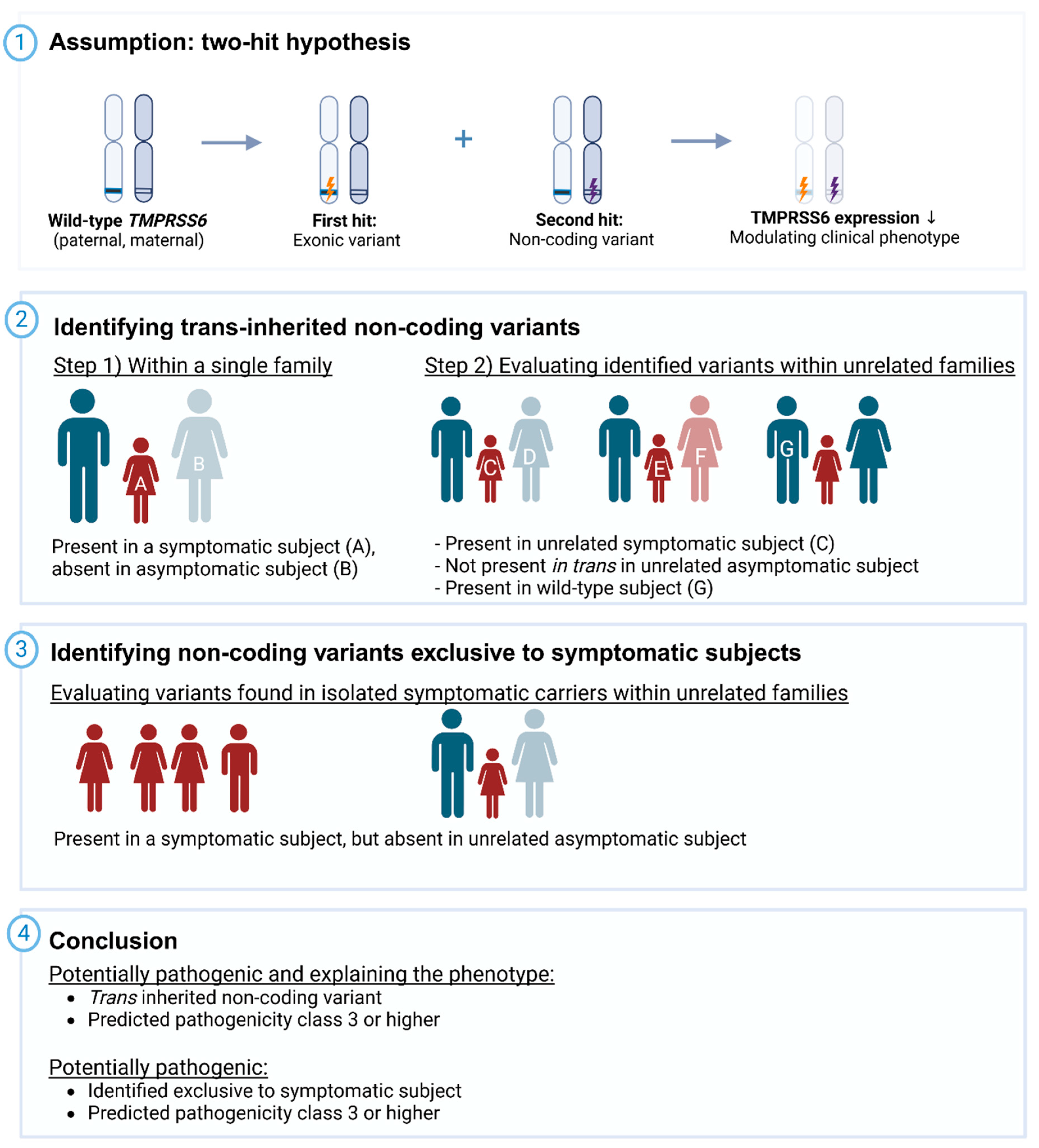
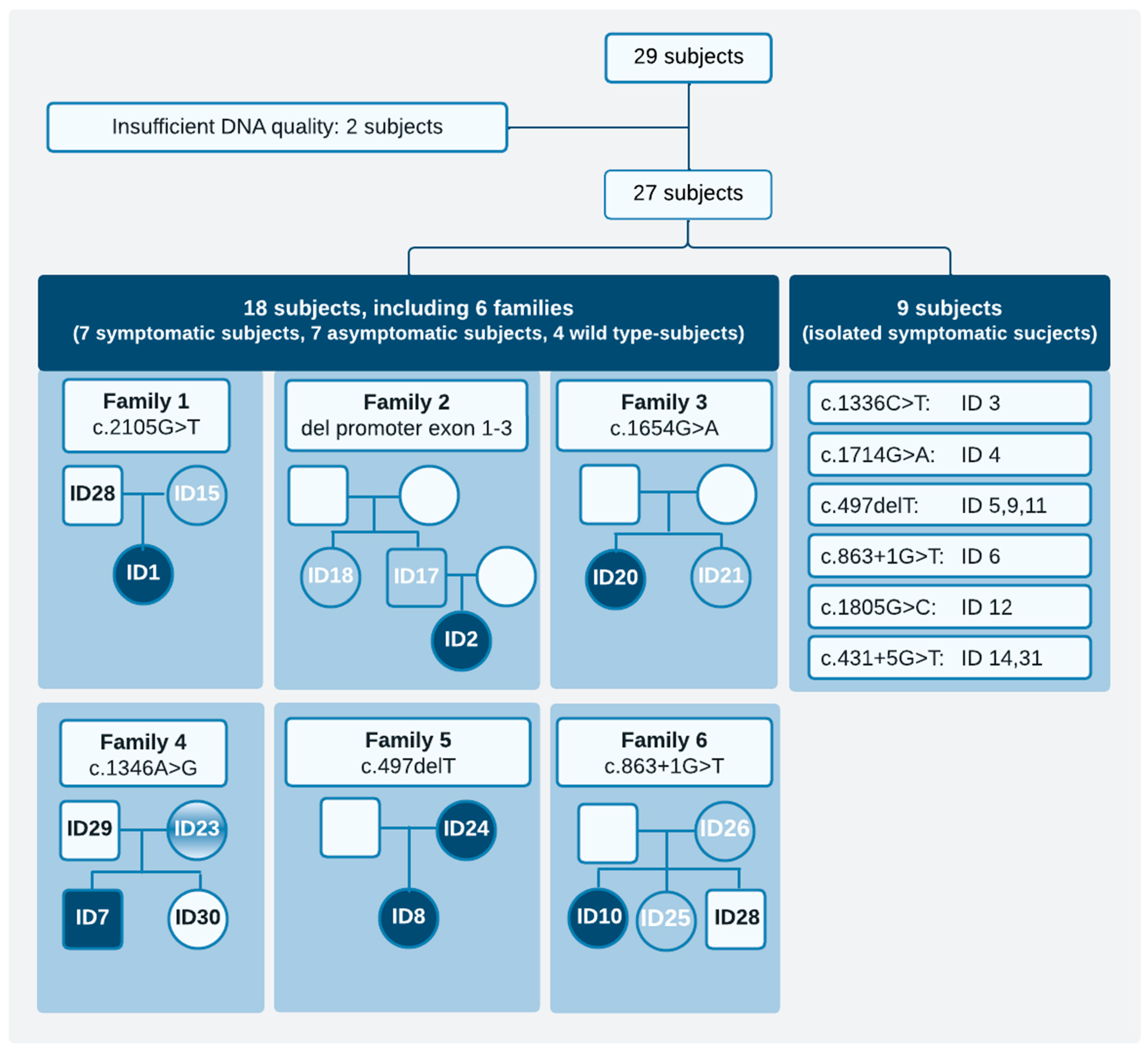
- Symptomatic monoallelic IRIDA subjects
- Individuals carrying a single exonic TMPRSS6 variant (pathogenicity class ≥ 3) who express the IRIDA phenotype [1].
- Asymptomatic monoallelic IRIDA subjects
- Relatives who share the same exonic TMPRSS6 variant as their symptomatic family member but do not express the IRIDA phenotype.
- Wild-type TMPRSS6 subjects
- Relatives of symptomatic monoallelic subjects who lack an exonic TMPRSS6 variant and do not express the IRIDA phenotype.
2.2. Amplification and Sequencing of TMPRSS6
2.3. Data Analysis and Variant Classification
2.4. Identifying Candidate Non-Coding Variants
2.5. Whole-Exome Sequencing
3. Results
3.1. Identification of Non-Coding Variants Potentially Modulating IRIDA Phenotype
3.2. Classification of Non-Coding Variants Potentially Linked to Phenotype Expression
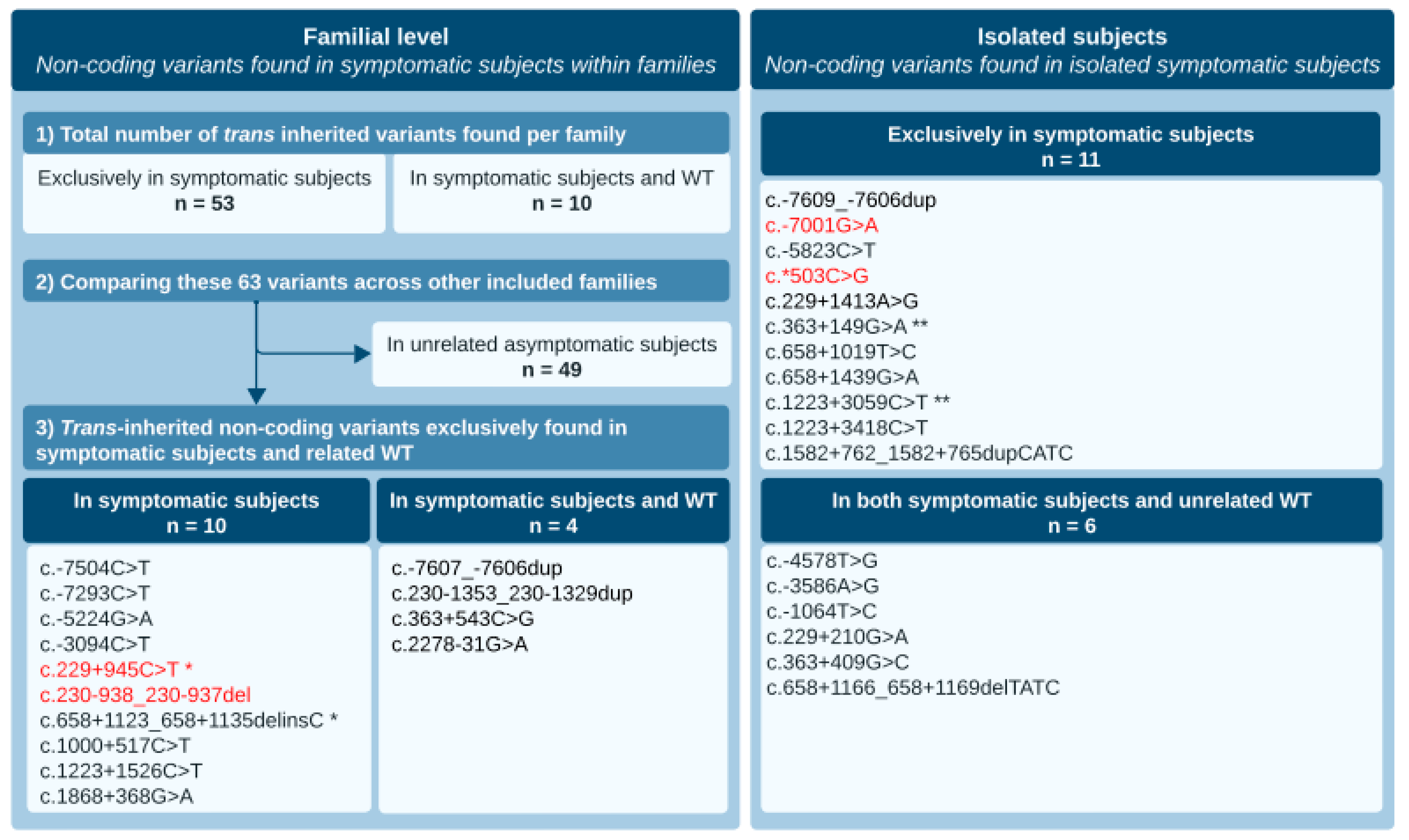
- rs80140288 (c.229+945C>T): Identified exclusively in two unrelated symptomatic subjects (ID 9, ID 24) carrying the exonic c.497delT variant. This variant has a low minor allele frequency (MAF, 0.53%). Its absence in ID 8 from Family 5 (which includes ID 8 and ID 24) suggests trans-inheritance within this family. If proven pathogenic, this variant could indicate different underlying causes for the phenotype in the two symptomatic subjects.
- rs146953827 (c.230-938_230-937del): Found exclusively in ID 2, with a MAF of 0.92%.
- rs78987624 (c.-7001G>A): Found in ID 12, with a MAF of 0.22%, predicted to be in the promoter region (Eukaryotic Promoter Database (EPD)). Given its predicted location, this variant may impact TMPRSS6 expression.
- rs117575523 (c.*503C>G): Found in ID 3, located in the 3′UTR, with predicted effects on splicing.
3.3. Non-Coding Variants Not Linked to Phenotype Expression
3.4. Cis-Inherited Non-Coding Variants
3.5. Prevalent Trans-Inherited Non-Coding Variants
3.6. Whole-Exome Sequencing
3.7. Potential Modifier: CDAN1 Variant in an Asymptomatic Subject
3.8. HFE and TFR2 Variants Unlikely to Explain Phenotypic Differences
4. Discussion
5. Conclusions
Supplementary Materials
Author Contributions
Funding
Institutional Review Board Statement
Informed Consent Statement
Data Availability Statement
Acknowledgments
Conflicts of Interest
References
- Finberg, K.E. Iron-Refractory Iron Deficiency Anemia. Semin. Hematol. 2009, 46, 378–386. [Google Scholar] [CrossRef] [Scilit]
- Silvestri, L.; Nai, A.; Dulja, A.; Pagani, A. Hepcidin and the BMP-SMAD pathway: An unexpected liaison. Vitam. Horm. 2019, 110, 71–99. [Google Scholar] [CrossRef] [Scilit] [PubMed]
- Donker, A.E.; Schaap, C.C.; Novotny, V.M.; Smeets, R.; Peters, T.M.; van den Heuvel, B.L.; Raphael, M.F.; Rijneveld, A.W.; Appel, I.M.; Vlot, A.J.; et al. Iron refractory iron deficiency anemia: A heterogeneous disease that is not always iron refractory. Am. J. Hematol. 2016, 91, E482–E490. [Google Scholar] [CrossRef] [Scilit]
- Nemeth, E.; Ganz, T. Hepcidin and Iron in Health and Disease. Annu. Rev. Med. 2023, 74, 261–277. [Google Scholar] [CrossRef] [Scilit]
- van der Staaij, H.; Donker, A.E.; Bakkeren, D.L.; Salemans, J.; Mignot-Evers, L.A.A.; Bongers, M.Y.; Dieleman, J.P.; Galesloot, T.E.; Laarakkers, C.M.; Klaver, S.M.; et al. Transferrin Saturation/Hepcidin Ratio Discriminates TMPRSS6-Related Iron Refractory Iron Deficiency Anemia from Patients with Multi-Causal Iron Deficiency Anemia. Int. J. Mol. Sci. 2022, 23, 1917. [Google Scholar] [CrossRef] [Scilit]
- Hoving, V.; Korman, S.E.; Antonopoulos, P.; Donker, A.E.; Schols, S.E.M.; Swinkels, D.W. IRIDA Phenotype in TMPRSS6 Monoallelic-Affected Patients: Toward a Better Understanding of the Pathophysiology. Genes 2022, 13, 1309. [Google Scholar] [CrossRef] [Scilit]
- Finberg, K.E.; Heeney, M.M.; Campagna, D.R.; Aydınok, Y.; Pearson, H.A.; Hartman, K.R.; Mayo, M.M.; Samuel, S.M.; Strouse, J.J.; Markianos, K. Mutations in TMPRSS6 cause iron-refractory iron deficiency anemia (IRIDA). Nat. Genet. 2008, 40, 569–571. [Google Scholar] [CrossRef] [Scilit]
- Jaspers, A.; Caers, J.; Le Gac, G.; Ferec, C.; Beguin, Y.; Fillet, G. A novel mutation in the CUB sequence of matriptase-2 (TMPRSS6) is implicated in iron-resistant iron deficiency anaemia (IRIDA). Br. J. Haematol. 2012, 160, 564–565. [Google Scholar] [CrossRef] [Scilit] [PubMed]
- Pellegrino, R.M.; Coutinho, M.; D’Ascola, D.; Lopes, A.M.; Palmieri, A.; Carnuccio, F.; Costa, M.; Zecchina, G.; Saglio, G.; Costa, E.; et al. Two novel mutations in the tmprss6 gene associated with iron-refractory iron-deficiency anaemia (irida) and partial expression in the heterozygous form. Br. J. Haematol. 2012, 158, 668–672. [Google Scholar] [CrossRef] [Scilit] [PubMed]
- Radboudumc. Reference Values WCX-TOF MS for Serum Hepcidin-25. Available online: https://www.hepcidinanalysis.com/provided-service/reference-values/ (accessed on 22 August 2025).
- Wallis, Y.L.; Payne, S.J.; Mcanulty, C.; Bodmer, D.; Sister-mans, E.; Robertson, K.; Moore, D.; Abbs, S.J.; Deans, Z.C.; Devereau, A. Practice Guidelines for the Evaluation of Pathogenicity and the Reporting of Sequence Variants in Clinical Molecular Genetics; The Association for Clinical Genomic Science: Birmingham, UK, 2013. [Google Scholar]
- Richards, S.; Aziz, N.; Bale, S.; Bick, D.; Das, S.; Gastier-Foster, J.; Grody, W.W.; Hegde, M.; Lyon, E.; Spector, E.; et al. Standards and guidelines for the interpretation of sequence variants: A joint consensus recommendation of the American College of Medical Genetics and Genomics and the Association for Molecular Pathology. Genet. Med. 2015, 17, 405–423. [Google Scholar] [CrossRef] [Scilit]
- Ellingford, J.M.; Ahn, J.W.; Bagnall, R.D.; Baralle, D.; Barton, S.; Campbell, C.; Downes, K.; Ellard, S.; Duff-Farrier, C.; FitzPatrick, D.R.; et al. Recommendations for clinical interpretation of variants found in non-coding regions of the genome. Genome Med. 2022, 14, 73. [Google Scholar] [CrossRef] [Scilit]
- Girelli, D.; Busti, F.; Brissot, P.; Cabantchik, I.; Muckenthaler, M.U.; Porto, G. Hemochromatosis classification: Update and recommendations by the BIOIRON Society. Blood 2022, 139, 3018–3029. [Google Scholar] [CrossRef] [Scilit]
- Donker, A.E.; Raymakers, R.A.; Vlasveld, L.T.; van Barneveld, T.; Terink, R.; Dors, N.; Brons, P.P.; Knoers, N.V.; Swinkels, D.W. Practice guidelines for the diagnosis and management of microcytic anemias due to genetic disorders of iron metabolism or heme synthesis. Blood 2014, 123, 3873–3886; quiz 4005. [Google Scholar] [CrossRef] [Scilit] [PubMed]
- Heimpel, H.; Schwarz, K.; Ebnöther, M.; Goede, J.S.; Heydrich, D.; Kamp, T.; Plaumann, L.; Rath, B.; Roessler, J.; Schildknecht, O.; et al. Congenital dyserythropoietic anemia type I (CDA I): Molecular genetics, clinical appearance, and prognosis based on long-term observation. Blood 2006, 107, 334–340. [Google Scholar] [CrossRef] [Scilit] [PubMed]
- Tamary, H.; Dgany, O. Congenital Dyserythropoietic Anemia Type I. In GeneReviews®; Adam, M.P., Feldman, J., Mirzaa, G.M., Pagon, R.A., Wallace, S.E., Bean, L.J.H., Gripp, K.W., Amemiya, A., Eds.; University of Washington: Seattle, WA, USA. Available online: https://www.ncbi.nlm.nih.gov/books/NBK5313/ (accessed on 22 August 2025).
- Powell, L.W.; Seckington, R.C.; Deugnier, Y. Haemochromatosis. Lancet 2016, 388, 706–716. [Google Scholar] [CrossRef] [Scilit] [PubMed]
- Benyamin, B.; Ferreira, M.A.; Willemsen, G.; Gordon, S.; Middelberg, R.P.; McEvoy, B.P.; Hottenga, J.J.; Henders, A.K.; Campbell, M.J.; Wallace, L.; et al. Common variants in TMPRSS6 are associated with iron status and erythrocyte volume. Nat. Genet. 2009, 41, 1173–1175. [Google Scholar] [CrossRef] [Scilit]
- Beutler, E.; Van Geet, C.; te Loo, D.M.W.M.; Gelbart, T.; Crain, K.; Truksa, J.; Lee, P.L. Polymorphisms and mutations of human TMPRSS6 in iron deficiency anemia. Blood Cells Mol. Dis. 2010, 44, 16–21. [Google Scholar] [CrossRef] [Scilit]
- Serre, D.; Gurd, S.; Ge, B.; Sladek, R.; Sinnett, D.; Harmsen, E.; Bibikova, M.; Chudin, E.; Barker, D.L.; Dickinson, T.; et al. Differential Allelic Expression in the Human Genome: A Robust Approach To Identify Genetic and Epigenetic Cis-Acting Mechanisms Regulating Gene Expression. PLoS Genet. 2008, 4, e1000006. [Google Scholar] [CrossRef] [Scilit]
- Veitia, R.A.; Caburet, S.; Birchler, J.A. Mechanisms of Mendelian dominance. Clin. Genet. 2018, 93, 419–428. [Google Scholar] [CrossRef] [Scilit]
- Gerasimavicius, L.; Livesey, B.J.; Marsh, J.A. Loss-of-function, gain-of-function and dominant-negative mutations have profoundly different effects on protein structure. Nat. Commun. 2022, 13, 3895. [Google Scholar] [CrossRef] [Scilit]
- De Falco, L.; Totaro, F.; Nai, A.; Pagani, A.; Girelli, D.; Silvestri, L.; Piscopo, C.; Campostrini, N.; Dufour, C.; Manjomi, F.A.; et al. Novel TMPRSS6 mutations associated with iron-refractory iron deficiency anemia (IRIDA). Hum. Mutat. 2010, 31, E1390–E1405. [Google Scholar] [CrossRef] [Scilit] [PubMed]
- Pagani, A.; Colucci, S.; Bocciardi, R.; Bertamino, M.; Dufour, C.; Ravazzolo, R.; Silvestri, L.; Camaschella, C. A new form of IRIDA due to combined heterozygous mutations of TMPRSS6 and ACVR1A encoding the BMP receptor ALK2. Blood 2017, 129, 3392–3395. [Google Scholar] [CrossRef] [Scilit] [PubMed]
- Diepeveen, L.E.; Laarakkers, C.M.M.; Martos, G.; Pawlak, M.E.; Uğuz, F.F.; Verberne, K.; van Swelm, R.P.L.; Klaver, S.; de Haan, A.F.J.; Pitts, K.R.; et al. Provisional standardization of hepcidin assays: Creating a traceability chain with a primary reference material, candidate reference method and a commutable secondary reference material. Clin. Chem. Lab. Med. 2019, 57, 864–872. [Google Scholar] [CrossRef] [Scilit] [PubMed]
- Qian, X.; Wang, J.; Wang, M.; Igelman, A.D.; Jones, K.D.; Li, Y.; Wang, K.; Goetz, K.E.; Birch, D.G.; Yang, P.; et al. Identification of Deep-Intronic Splice Mutations in a Large Cohort of Patients With Inherited Retinal Diseases. Front. Genet. 2021, 12, 647400. [Google Scholar] [CrossRef] [Scilit]
- Rodenburg, R.J. The functional genomics laboratory: Functional validation of genetic variants. J. Inherit. Metab. Dis. 2018, 41, 297–307. [Google Scholar] [CrossRef] [Scilit]
- De Falco, L.; Silvestri, L.; Kannengiesser, C.; Morán, E.; Oudin, C.; Rausa, M.; Bruno, M.; Aranda, J.; Argiles, B.; Yenicesu, I.; et al. Functional and Clinical Impact of Novel Tmprss6 Variants in Iron-Refractory Iron-Deficiency Anemia Patients and Genotype–Phenotype Studies. Hum. Mutat. 2014, 35, 1321–1329. [Google Scholar] [CrossRef] [Scilit]



| Variants Found Exclusively in Symptomatic Subjects | ||||
|---|---|---|---|---|
| Non-Coding Variant | rsID | MAF (%) | Exonic Variant | Subject |
| 5′UTR/PR | ||||
| c.-7504C>T | rs115067778 | 3.45 | c.1654G>A | 20 |
| c.-7293C>T | rs74839029 | 3.62 | c.1654G>A | 20 |
| c.-5224G>A | rs59744498 | 3.37 | c.1654G>A | 20 |
| c.-3094C>T | rs77087103 | 2.25 | c.1654G>A | 20 |
| Intron 2 | ||||
| c.230-938_230-937del | rs146953827 | 0.92 | del prom exon 1–3 | 2 |
| c.229+945C>T * | rs80140288 | 0.53 | c.497delT | 9, 24 |
| Intron 6 | ||||
| c.658+1123_658+1135delinsC ** | - | - | c.1714G>A | 3 |
| c.497delT | 24 | |||
| Intron 8 | ||||
| c.1000+517C>T | rs57746379 | 2.09 | c.1654G>A | 20 |
| Intron 10 | ||||
| c.1223+1526C>T | rs539552983 | 0.016 | c.497delT | 8 |
| Intron 15 | ||||
| c.1868+368G>A | rs148550682 | 1.46 | c.863+1G>T | 10 |
| Variants Found in Both Symptomatic Subjects and Related WT | ||||
| Non-Coding Variant | rsID | MAF (%) | Exonic Variant | Subject |
| 5′UTR/PR | ||||
| c.-7607_-7606dup | rs71324841 | 39.86 | c.1336C>T | 3 |
| c.1346G>A | 7, 29 (WT) | |||
| c.497delT | 8 | |||
| c.1654G>A | 20 | |||
| Intron 2 | ||||
| c.230-1353_230-1329dup | rs140612996 | 18.15 | c.1346G>A | 7, 29 (WT) |
| Intron 3 | ||||
| c.363+543C>G | rs13058647 | 0.0067 | c.1346G>A | 7, 29 (WT) |
| Intron 17 | ||||
| c.2278-31G>A | rs41283231 | 0.16 | c.2105G>A | 1, 28 (WT) |
| Variants Exclusively Found in Symptomatic Subjects | ||||
|---|---|---|---|---|
| Non-Coding Variant | rsID | MAF (%) | Exonic Variant | Subject |
| UTR/PR | ||||
| c.-7609_-7606dup | rs71324841 | 13.82 | c.431+5G>T | 14 |
| c.-7001G>A | rs78987624 | 0.15 | c.1805G>C | 12 |
| c.-5823C>T | rs190894261 | 0.16 | c.431+5G>T | 14, 31 |
| c.*503C>G | rs117575523 | 0.057 | c.1336C>T | 3 |
| Intron 2 | ||||
| c.229+1413A>G | rs228908 | 7.95 | c.1805G>C | 12 |
| Intron 3 | ||||
| c.363+149G>A | rs572610055 | 0.10 | c.497delT | 5, 8, 9, 11, 24 |
| Intron 6 | ||||
| c.658+1019T>C | rs73160067 | 1.08 | c.1714G>A | 4 |
| c.658+1439G>A | - | - | c.1336C>T | 3 |
| Intron 10 | ||||
| c.1223+3059C>T | rs147597581 | 0.089 | c.497delT | 5, 8, 9, 11, 24 |
| c.431+5G>T | 31 | |||
| c.1223+3418C>T | rs566491190 | 0.0032 | c.431+5G>T | 14 |
| Intron 13 | ||||
| c.1582+762_1582+765dupCATC | rs558830761 | 1.05 | c.497delT | 11 |
| Variants Found in Symptomatic Subjects and Unrelated WT | ||||
| Non-Coding Variant | rsID | MAF (%) | Exonic Variant | Subject |
| 5′UTR/PR | ||||
| c.-4578T>G | rs228913 | 19.11 | c.1805G>C | 12 |
| c.431+5G>T | 14, 31 | |||
| WT | 29 (family c.1346G>A) | |||
| c.-3586A>G | rs1883276 | 19.30 | c.1805G>C | 12 |
| c.431+5G>T | 14, 31 | |||
| WT | 29 (family c.1346G>A) | |||
| c.-1064T>C | rs228909 | 21.68 | c.1805G>C | 12 |
| c.431+5G>T | 14, 31 | |||
| WT | 29 (family c.1346G>A) | |||
| Intron 2 | ||||
| c.229+210G>A | rs5995380 | 20.62 | c.1805G>C | 12 |
| c.431+5G>T | 14, 31 | |||
| WT | 29 (family c.1346G>A) | |||
| Intron 3 | ||||
| c.363+409G>C | rs867039861 | 0.25 | c.1714G>A | 4 |
| WT | 29 (family c.1346G>A) | |||
| Intron 6 | ||||
| c.658+1166_658+1169delTATC | rs746732095 | 7.72 | c.1714G>A | 4 |
| WT | 28 (family c.2105G>T) | |||
| Variant | rsID | MAF (%) | Genomic Location | Evidence |
|---|---|---|---|---|
| c.229+945C>T | rs80140288 | 0.53 | Intron 2 | Family segregation |
| c.230-938_230-937del | rs146953827 | 0.92 | Intron 2 | Family segregation |
| c.-7001G>A | rs78987624 | 0.15 | Promoter region | Isolated subject |
| c.*503C>G | rs117575523 | 0.057 | 3’UTR | Isolated subject |
| Non-Coding Variant | rsID | MAF (%) | Exonic Variant | Subject |
|---|---|---|---|---|
| Intron 2 | ||||
| c.230-1580C>T | rs543987633 | 0.064 | c.1346A>G | 23, 30 (WT) |
| Intron 3 | ||||
| c.363+750C>T | 12.32 | c.1654G>A | 21 | |
| Intron 4 | ||||
| c.431+238G>A | rs75746329 | 1.12 | c.1654G>A | 21 |
| Intron 6 | ||||
| c.658+1123A>C | - | - | c.1654G>A | 21 |
| Intron 8 | ||||
| c.864-342T>A | - | - | c.1654G>A | 21 |
| Intron 10 | ||||
| c.1000+633C>A | - | - | c.1654G>A | 21 |
| c.1224-18G>T | rs9610642 | 0.067 | c.2105G>T | 15 |
Disclaimer/Publisher’s Note: The statements, opinions and data contained in all publications are solely those of the individual author(s) and contributor(s) and not of MDPI and/or the editor(s). MDPI and/or the editor(s) disclaim responsibility for any injury to people or property resulting from any ideas, methods, instructions or products referred to in the content. |
© 2026 by the authors. Licensee MDPI, Basel, Switzerland. This article is an open access article distributed under the terms and conditions of the Creative Commons Attribution (CC BY) license.
Share and Cite
Hoving, V.; Donker, A.E.; Smeets, R.J.P.; van den Heuvel, B.P.W.J.; Schols, S.E.M.; Swinkels, D.W. TMPRSS6 Non-Coding Variants in the Expression of Iron Refractory Iron Deficiency Anemia in Monoallelic Subjects. Genes 2026, 17, 74. https://doi.org/10.3390/genes17010074
Hoving V, Donker AE, Smeets RJP, van den Heuvel BPWJ, Schols SEM, Swinkels DW. TMPRSS6 Non-Coding Variants in the Expression of Iron Refractory Iron Deficiency Anemia in Monoallelic Subjects. Genes. 2026; 17(1):74. https://doi.org/10.3390/genes17010074
Chicago/Turabian StyleHoving, Vera, Albertine E. Donker, Roel J. P. Smeets, Bert P. W. J. van den Heuvel, Saskia E. M. Schols, and Dorine W. Swinkels. 2026. "TMPRSS6 Non-Coding Variants in the Expression of Iron Refractory Iron Deficiency Anemia in Monoallelic Subjects" Genes 17, no. 1: 74. https://doi.org/10.3390/genes17010074
APA StyleHoving, V., Donker, A. E., Smeets, R. J. P., van den Heuvel, B. P. W. J., Schols, S. E. M., & Swinkels, D. W. (2026). TMPRSS6 Non-Coding Variants in the Expression of Iron Refractory Iron Deficiency Anemia in Monoallelic Subjects. Genes, 17(1), 74. https://doi.org/10.3390/genes17010074