New Candidate Genes for a Chicken Pectoralis Muscle Weight QTL Identified by a Hypothesis-Free Integrative Genetic Approach

Abstract
1. Introduction
2. Materials and Methods
2.1. Animals and Traits
2.2. Principal Component Analysis
2.3. QTL Remapping
2.4. RNA-Seq Analysis
2.5. Functional Gene Enrichment and Pathway Analyses
2.6. RT-qPCR Analysis
2.7. Haplotype Frequency Analysis
2.8. Correlation Analyses
3. Results
3.1. Principal Component Analysis
3.2. QTL Remapping
3.3. RNA-Seq Analysis
3.4. Functional Gene Enrichment and Pathway Analyses
3.5. RT-qPCR Analysis
3.6. Haplotype Frequency Analysis
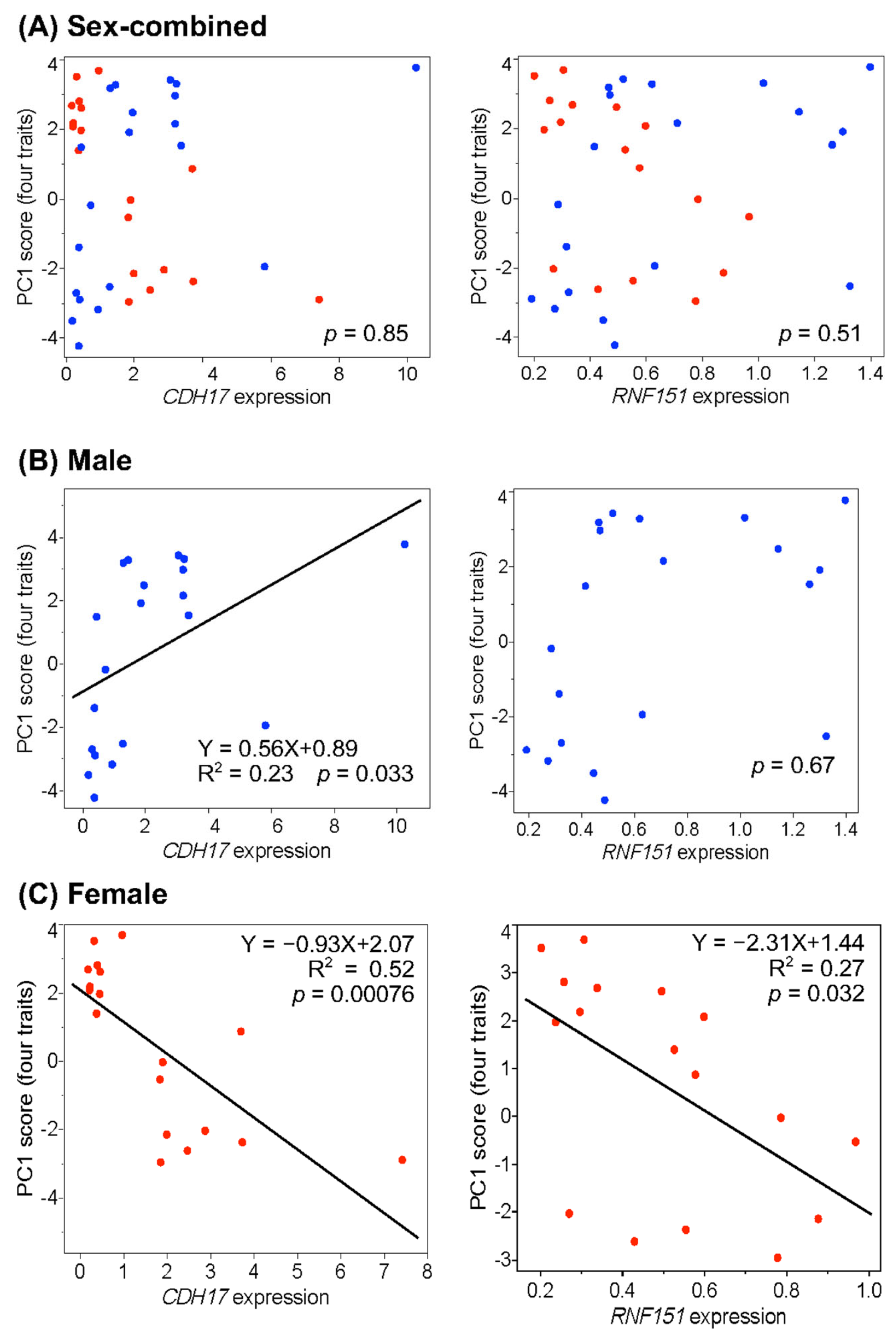
3.7. Association Analyses
4. Discussion
5. Conclusions
Supplementary Materials
Author Contributions
Funding
Institutional Review Board Statement
Informed Consent Statement
Data Availability Statement
Acknowledgments
Conflicts of Interest
Abbreviations
| QTL | quantitative trait loci |
| GWASs | genome-wide association studies |
| RNA-seq | RNA-sequencing |
| RT-qPCR | reverse transcription quantitative PCR |
| NAG | Nagoya |
| JAS | Japanese Agricultural Standards |
| WPR | White Plymouth Rock |
| LOD | logarithms of the odds |
| PCA | principal component analysis |
| PC1 | first principal component |
| SNP | single nucleotide polymorphism |
| RAD-seq | restriction site-associated DNA sequencing |
| DEGs | differentially expressed gene |
| GO | Gene Ontology |
| KEGG | Kyoto Encyclopedia of Genes and Genomes |
| YWHAZ | tyrosine 3-monooxygenase/tryptophan 5-monooxygenase activation protein zeta |
| TBP | TATA-box binding protein |
| ACTB | actin, beta |
| RPL32 | ribosomal protein L32 |
| GAPDH | glyceraldehyde-3-phosphate dehydrogenase |
| ANOVA | analysis of variance |
| HSD | Tukey’s honest significant difference |
| IMPACT | impact RWD domain protein |
| GATA6 | GATA binding protein 6 |
| CDH17 | cadherin-17 |
| RNF151 | ring finger protein 151 |
| IGF-1 | insulin-like growth factor 1 |
| Mstn | myostatin |
| FSH | follicle-stimulating hormone |
| Fshb | FSHβ subunit |
References
- Mackay, T. The genetic architecture of quantitative traits. Annu. Rev. Genet. 2001, 35, 303–339. [Google Scholar] [CrossRef]
- Keane, T.M.; Goodstadt, L.; Danecek, P.; White, M.A.; Wong, K.; Yalcin, B.; Heger, A.; Agam, A.; Slater, G.; Goodson, M.; et al. Mouse genomic variation and its effect on phenotypes and gene regulation. Nature 2011, 477, 289–294. [Google Scholar] [CrossRef]
- Albert, F.W.; Kruglya, L. The role of regulatory variation in complex traits and disease. Nat. Rev. Genet. 2015, 16, 197–212. [Google Scholar] [CrossRef] [PubMed]
- Ishikawa, A. A strategy for identifying quantitative trait genes using gene expression analysis and causal analysis. Genes 2017, 8, 347. [Google Scholar] [CrossRef] [PubMed]
- Visscher, P.M.; Wray, N.R.; Zhang, Q.; Sklar, P.; McCarthy, M.I.; Brown, M.A.; Yang, J. 10 Years of GWAS discovery: Biology, function, and translation. Am. J. Hum. Genet. 2017, 101, 5–22. [Google Scholar] [CrossRef] [PubMed]
- Al-Barghouthi, B.M.; Rosenow, W.T.; Du, K.-P.; Heo, J.; Maynard, R.; Mesner, L.; Calabrese, G.; Nakasone, A.; Senwar, B.; Gerstenfeld, L.; et al. Transcriptome-wide association study and eQTL colocalization identify potentially causal genes responsible for human bone mineral density GWAS associations. eLife 2022, 11, e77285. [Google Scholar] [CrossRef]
- Ghoreishifar, M.; Macleod, I.M.; Chamberlain, A.J.; Liu, Z.; Lopdell, T.J.; Littlejohn, M.D.; Xiang, R.; Pryce, J.E.; Goddard, M.E. An integrative approach to prioritize candidate causal genes for complex traits in cattle. PLoS Genet. 2025, 21, e1011492. [Google Scholar] [CrossRef]
- Ochiai, T.; Sakaguchi, M.; Kawakami, S.I.; Ishikawa, A. Identification of candidate genes responsible for innate fear behavior in the chicken. G3 2023, 13, jkac316. [Google Scholar] [CrossRef]
- Imamura, Y.; Tsudzuki, M.; Roszkowski, S. Japanese Chickens: The Living Art of the World; Taurus Printing, Ltd.: Kazimierów, Poland, 2021. [Google Scholar]
- Tsudzuki, M.; Onitsuka, S.; Akiyama, R.; Iwamizu, M.; Goto, N.; Nishibori, M.; Takahashi, H.; Ishikawa, A. Identification of quantitative trait loci affecting shank length, body weight and carcass weight from the Japanese cockfighting chicken breed, Oh-Shamo (Japanese Large Game). Cytogenet. Genome Res. 2007, 117, 288–295. [Google Scholar] [CrossRef]
- Goto, T.; Ishikawa, A.; Nishibori, M.; Tsudzuki, M. A longitudinal quantitative trait locus mapping of chicken growth traits. Mol. Genet. Genom. 2019, 294, 243–252. [Google Scholar] [CrossRef]
- Essa, B.H.; Suzuki, S.; Nagano, A.J.; Elkholya, S.Z.; Ishikawa, A. QTL analysis for early growth in an intercross between native Japanese Nagoya and White Plymouth Rock chicken breeds using RAD sequencing-based SNP markers. Anim. Genet. 2021, 52, 232–236. [Google Scholar] [CrossRef]
- Yoshida, M.; Ishikawa, A.; Goto, T.; Goto, N.; Nishibori, M.; Tsudzuki, M. QTL mapping for meat color traits using the F2 intercross between the Oh-Shamo (Japanese Large Game) and White Leghorn chickens. J. Poult. Sci. 2013, 50, 198–205. [Google Scholar] [CrossRef]
- Ishikawa, A.; Essa, B.H.; Nasr, S.M.; Suzuki, S. Mapping QTLs for breast muscle weight in an F2 intercross between native Japanese Nagoya and White Plymouth Rock chicken breeds. Life 2021, 11, 754. [Google Scholar] [CrossRef]
- Goto, T.; Ishikawa, A.; Onitsuka, S.; Goto, N.; Fujikawa, Y.; Umino, T.; Nishibori, M.; Tsudzuki, M. Mapping quantitative trait loci for egg production traits in an F2 intercross of Oh-Shamo and White Leghorn chickens. Anim. Genet. 2011, 42, 634–641. [Google Scholar] [CrossRef]
- Goto, T.; Ishikawa, A.; Yoshida, M.; Goto, N.; Umino, T.; Nishibori, M.; Tsudzuki, M. Quantitative trait loci mapping for egg external traits in F2 chickens. J. Poult. Sci. 2014, 51, 118–129. [Google Scholar] [CrossRef]
- Goto, T.; Ishikawa, A.; Goto, N.; Nishibori, M.; Umino, T.; Tsudzuki, M. Mapping of main-effect and epistatic quantitative trait loci for internal egg traits in an F2 resource population of chickens. J. Poult. Sci. 2014, 51, 375–386. [Google Scholar] [CrossRef]
- Ishikawa, A.; Sakaguchi, M.; Nagano, A.J.; Suzuki, S. Genetic architecture of innate fear behavior in chickens. Behav. Genet. 2020, 50, 411–422. [Google Scholar] [CrossRef] [PubMed]
- Velasco, V.V.; Ochiai, T.; Tsudzuki, M.; Goto, N.; Ishikawa, A. Quantitative trait loci mapping of innate fear behavior in day-old F2 chickens of Japanese Oh-Shamo and White Leghorn breeds using restriction site-associated DNA sequencing. Poult. Sci. 2024, 103, 103228. [Google Scholar] [CrossRef]
- Ishikawa, A.; Eledel, M.; Essa, B.H. Differences in growth and fat deposition between White Plymouth Rock and Nagoya breeds as a tool for QTL analysis. Damanhour J. Vet. Sci. 2019, 1, 21–26. [Google Scholar]
- Broman, K.W.; Sen, S. A Guide to QTL Mapping with R/qtl; Springer: New York, NY, USA, 2009. [Google Scholar]
- Bolger, A.M.; Lohse, M.; Usadel, B. Trimmomatic: A flexible trimmer for Illumina sequence data. Bioinformatics 2014, 30, 2114–2120. [Google Scholar] [CrossRef]
- Kim, D.; Paggi, J.M.; Park, C.; Bennett, C.; Salzberg, S.L. Graph-based genome alignment and genotyping with HISAT2 and HISAT-genotype. Nat. Biotechnol. 2019, 37, 907–915. [Google Scholar] [CrossRef] [PubMed]
- Love, M.I.; Huber, W.; Anders, S. Moderated estimation of fold change and dispersion for RNA-seq data with DESeq2. Genome Biol. 2014, 15, 550. [Google Scholar] [CrossRef]
- Zhou, Y.; Zhou, B.; Pache, L.; Chang, M.; Khodabakhshi, A.H.; Tanaseichuk, O.; Benner, C.; Chanda, S.K. Metascape provides a biologist-oriented resource for the analysis of systems-level datasets. Nat. Commun. 2019, 10, 1523. [Google Scholar] [CrossRef] [PubMed]
- Bélteky, J.; Agnvall, B.; Johnsson, M.; Wright, D.; Jensen, P. Domestication and tameness: Brain gene expression in red junglefowl selected for less fear of humans suggests effects on reproduction and immunology. R. Soc. Open Sci. 2016, 3, 160033. [Google Scholar] [CrossRef]
- Borowska, D.; Rothwell, L.; Bailey, R.A.; Watson, K.; Kaiser, P. Identification of stable reference genes for quantitative PCR in cells derived from chicken lymphoid organs. Vet. Immunol. Immunopathol. 2016, 170, 20–24. [Google Scholar] [CrossRef]
- Bagés, S.; Estany, J.; Tor, M.; Pena, R.N. Investigating reference genes for quantitative real-time PCR analysis across four chicken tissues. Gene 2015, 561, 82–87. [Google Scholar] [CrossRef]
- Huppert, S.S.; Schwartz, R.E. Multiple facets of cellular homeostasis and regeneration of the mammalian liver. Annu. Rev. Physiol. 2023, 85, 469–493. [Google Scholar] [CrossRef] [PubMed]
- Wang, H.; Xu, Y.; Yu, D.; Li, D.; Liu, X.; Du, W. Insulin-like growth factor-1 (IGF-1) promotes myoblast proliferation and skeletal muscle growth of embryonic chickens via the PI3K/Akt signaling pathway. Cell Biol. Int. 2015, 39, 910–922. [Google Scholar]
- Zhang, D.; Xu, F.; Liu, Y. Research progress on regulating factors of muscle fiber heterogeneity in poultry: A review. Poult. Sci. 2024, 103, 104031. [Google Scholar] [CrossRef]
- Wang, Z.; Tian, W.; Wang, D.; Guo, Y.; Cheng, Z.; Zhang, Y.; Li, X.; Zhi, Y.; Li, D.; Li, Z.; et al. Comparative analyses of dynamic transcriptome profiles highlight key response genes and dominant isoforms for muscle development and growth in chicken. Genet. Sel. Evol. 2023, 55, 73. [Google Scholar] [CrossRef]
- Khullar, S.; Wang, D. Predicting brain-regional gene regulatory networks from multi-omics for Alzheimer’s disease phenotypes and Covid-19 severity. Hum. Mol. Genet. 2023, 32, 1797–1813. [Google Scholar] [CrossRef] [PubMed]
- Tegally, H.; Kensler, K.H.; Dilmohamud, A.; Ghoorah, A.W.; Rebbeck, T.R.; Baichoo, S. Discovering novel driver mutations from pan-cancer analysis of mutational and gene expression profiles. PLoS ONE 2020, 15, e0242780. [Google Scholar] [CrossRef] [PubMed]
- Hwang, S.; Rhee, S.Y.; Marcotte, E.M.; Lee, I. Systematic prediction of gene function in Arabidopsis thaliana using a probabilistic functional gene network. Nat. Protoc. 2011, 6, 1429–1442. [Google Scholar] [CrossRef]
- Lin, Z.; Zhang, C.; Zhang, M.; Xu, D.; Fang, Y.; Zhou, Z.; Chen, X.; Qin, N.; Zhang, X. Targeting Cadherin-17 inactivates Ras/Raf/MEK/ERK signaling and inhibits cell proliferation in gastric cancer. PLoS ONE 2014, 9, e85296. [Google Scholar] [CrossRef]
- Long, Z.W.; Zhou, M.L.; Fu, J.W.; Chu, X.O.; Wang, Y.N. Association between cadherin-17 expression and pathological characteristics of gastric cancer: A meta-analysis. World J. Gastroenterol. 2015, 21, 3694–3705. [Google Scholar] [CrossRef]
- Qiu, H.; Zhang, L.; Ren, C.; Zheng, Z.; Wu, W.; Luo, H.; Zhou, Z.; Xu, R. Targeting CDH17 suppresses tumor progression in gastric cancer by downregulating Wnt/β-catenin signaling. PLoS ONE 2013, 8, e56959. [Google Scholar] [CrossRef]
- Buqué, X.; Martínez, M.J.; Cano, A.; Miquilena-Colina, M.E.; García-Monzón, C.; Aspichueta, P.; Ochoa, B. A subset of dysregulated metabolic and survival genes is associated with severity of hepatic steatosis in obese Zucker rats. J. Lipid Res. 2010, 51, 500–513. [Google Scholar] [CrossRef]
- Ou, X.; Yang, J.; Zeng, H.; Shao, L. Histone acetylation regulated by histone deacetylases during spermatogenesis. Andrology 2025, 13, 706–717. [Google Scholar] [CrossRef]
- Hou, C.; Yang, W. New insights to the ubiquitin–proteasome pathway (UPP) mechanism during spermatogenesis. Mol. Biol. Rep. 2013, 40, 3213–3230. [Google Scholar] [CrossRef] [PubMed]
- Pirbaluty, A.M.; Mehrban, H.; Kadkhodaei, S.; Ravash, R.; Oryan, A.; Ghaderi, Z.M.; Smith, J. Network meta-analysis of chicken microarray data following avian influenza challenge–a comparison of highly and lowly pathogenic strains. Genes 2022, 13, 435. [Google Scholar] [CrossRef]
- Ongaro, L.; Zhou, X.; Wang, Y.; Schultz, H.; Zhou, Z.; Buddle, E.R.S.; Brûlé, E.; Lin, Y.-F.; Schang, G.; Hagg, A.; et al. Muscle-derived myostatin is a major endocrine driver of follicle-stimulating hormone synthesis. Science 2025, 387, 329–336. [Google Scholar] [CrossRef] [PubMed]
- Makino, K.; Ishikawa, A. Genetic identification of Ly75 as a novel quantitative trait gene for resistance to obesity in mice. Sci. Rep. 2018, 8, 17658. [Google Scholar] [CrossRef] [PubMed]
- Chen, P.B.; Chen, R.; LaPierre, N.; Chen, Z.; Mefford, J.; Marcus, E.; Heffel, M.G.; Soto, D.C.; Ernst, J.; Luo, C.; et al. Complementation testing identifies genes mediating effects at quantitative trait loci underlying fear-related behavior. Cell Genom. 2024, 4, 100545. [Google Scholar] [CrossRef] [PubMed]


| Gene 1 | Forward Primer (5′-3′) | Reverse Primer (5′-3′) | Reference or Accesion No. 2 |
|---|---|---|---|
| TBP | TAGCCCGATGATGCCGTAT | GTTCCCTGTGTCGCTTGC | [26] |
| ACTB | CCAGACATCAGGGTGTGATGG | CTCCATATCATCCCAGTTGGTGA | [27] |
| GAPDH | GAAGGCTGGGGCTCATCTG | CAGTTGGTGGTGCACGATG | [27] |
| YWHAZ | TTGCTGCTGGAGATGACAAG | CTTCTTGATACGCCTGTTG | [28] |
| RPL32 | ATGGGAGCAACAAGAAGACG | TTGGAAGACACGTTGTGAGC | [28] |
| APCDD1 | AAGTGATGGGCGGAACAGAG | AAGACGTTGAGCAGAGAGGC | NM_001012941.2 |
| ENSGALG00000051993 | GGCTTGTTGTTTGCGTTCC | TTGTGATGTGTGTCCTCCTTTGT | ENSGALT00000093901.1 |
| ENSGALG00000054223 | CAGTTCCTTTGACCCAGAAAT | ATTGATTTGTGATCGGAGGTC | ENSGALT00000097868.2 |
| ENSGALG00000053416 | CGTGGGAGGGCTGTGATTAG | CCAGTGTCTAGCAGCTTGGA | ENSGALT00000099366.1 |
| TGIF1 | TTTCCTCATCTGCTGGCTCG | GGCGTGCGTTGATAAACCAG | NM_205379.2 |
| NDC80 | TCTTATGAACTGCCTGACTCAA | CCAAATCAAAGCTGCCACAATC | NM_204477.3 |
| GATA6 | TGTTTTCACTCTCTCATCGCCTTC | GTACACGCTACCAACACTTGAGAA | NM_001398234.1 |
| LOC100857837 | GTCTACGCAGCCATCTCAGG | TGTTGAAGTGTTCGCTCAGC | XM_015282646.4 |
| C2H8ORF22 | CAGCGTTTCTTCCAGCACCT | GCCAACAGTCGGTGGAGATG | NM_001302199.2 |
| SOX17 | TGTCATTCATGGTCGAGATCCTTG | AAAAACCCGAAGTCTGTACAACGT | NM_001039326.1 |
| LY96 | TTTCCCCAAAATGAAGCATCC | TGCAGGGTGTCATATTAAGCT | XM_040696637.2 |
| CA2 | CTGGCTCCCTGACTACTCCA | AGCTCTGACTTCCCTGCTCT | NM_205317.2 |
| ATP6V0D2 | AGGGTTCAAAGCTGGGATCTT | GCCATAGTCTGTCGTCTGTAGA | NM_001008455.2 |
| MMP16 | AATGGCAAGAGAGACGTGGA | AGTGTCTCCCCCAATTCCTG | NM_205197.3 |
| NBN | AAGCTGTTCAGTCCAGGCAA | ACCAATGGCAGGCTCATCAA | NM_204337.2 |
| CDH17 | GGGGATGCTGTACGATATTCCTT | GTTCTTGTTCACGATCCAAAGCA | NM_001199495.2 |
| RNF151 | GCAGAGAGACAGCATCGACA | CCCCTCAGCAGCTCCATTAG | XM_015282944.4 |
| PTDSS1 | TCCTGGTGTTCGTGCTCTTC | CCCCAGAAATGCCCAAAAGC | NM_001031505.2 |
| LAPTM4B | TGCTACCAGATCTTTGACTTTGC | CCAGACACGTAGGGTTCACA | XM_001233338.7 |
| Trait | All Four Traits | Three Muscle Weights | ||
|---|---|---|---|---|
| PC1 | PC2 | PC1 | PC2 | |
| Body weight | 0.79 | 0.61 | NA | NA |
| Pectoralis minor muscle weight | 0.97 | −0.16 | 0.99 | 0.17 |
| Pectoralis major muscle weight | 0.97 | −0.17 | 0.99 | −0.15 |
| Total pectoralis muscle weight | 0.98 | −0.16 | 0.99 | −0.02 |
| Eigenvalue | 3.48 | 0.46 | 2.93 | 0.05 |
| % Variance | 86.9 | 11.4 | 97.8 | 1.8 |
| Trait | Pos. 1 | Nearest Marker | CI 2 | LOD | % Variance | Additive Effect 3 | Dominant Effect 3 |
|---|---|---|---|---|---|---|---|
| Body weight | 86 (104.7) | SNP79 | 45–107 (98.0–127.4) | 4.63 ** | 8.53 | 0.48 ± 0.10 | −0.15 ± 0.18 |
| Pectoralis minor muscle weight | 83 (114.8) | SNP101 | 69–99 (101.7–117.0) | 6.08 ** | 11.18 | 0.54 ± 0.10 | −0.26 ± 0.18 |
| Pectoralis major muscle weight | 82 (111.4) | SNP101 | 50–101 (100.8–125.3) | 3.66 * | 6.89 | 0.41 ± 0.10 | −0.26 ± 0.18 |
| Total pectoralis muscle weight | 83 (114.8) | SNP101 | 56–100 (101.3–122.7) | 4.26 * | 7.97 | 0.45 ± 0.10 | −0.26 ± 0.18 |
| PC1 score (all four traits) | 83 (114.8) | SNP101 | 62–100 (101.3–120.3) | 5.22 ** | 9.68 | 0.92 ± 0.19 | −0.50 ± 0.33 |
| PC1 score (three muscle traits) | 83 (114.8) | SNP101 | 60–100 (101.3–121.0) | 4.70 ** | 8.76 | 0.81 ± 0.16 | −0.45 ± 0.31 |
| Gene 1 | Physical Position (bp) 2 | Log2FC 3 | ||
|---|---|---|---|---|
| Start | End | Male | Female | |
| APCDD1 | 98,307,894 | 98,337,161 | 2.97 | 1.08 |
| ENSGALG00000051993 | 98,582,916 | 98,594,266 | −0.84 | −0.03 |
| ENSGALG00000054223 | 98,750,108 | 98,758,304 | 1.01 | −0.03 |
| ENSGALG00000053416 | 99,746,306 | 99,754,086 | 4.08 | −1.47 |
| TGIF1 | 100,818,249 | 100,826,684 | 1.19 | 0.42 |
| NDC80 | 101,172,292 | 101,191,007 | 1.28 | 0.56 |
| GATA6 | 102,638,198 | 102,654,114 | −0.08 | −0.70 |
| LOC100857837 | 107,656,418 | 107,705,493 | 1.62 | 0.41 |
| ENSGALG00000053658 4 | 108,475,567 | 108,484,328 | 1.60 | −0.25 |
| C2H8ORF22 | 108,494,837 | 108,497,336 | 1.72 | −0.56 |
| SOX17 | 110,517,253 | 110,518,918 | 2.11 | 0.20 |
| LY96 | 118,035,819 | 118,043,555 | −0.18 | 0.90 |
| CA2 | 122,766,240 | 122,822,370 | −0.70 | −0.80 |
| ATP6V0D2 | 122,936,917 | 122,954,777 | −5.32 | −1.12 |
| MMP16 | 123,570,466 | 123,745,959 | 2.01 | NA |
| NBN | 124,273,535 | 124,294,981 | −0.27 | 0.64 |
| CDH17 | 125,879,843 | 125,906,330 | 1.85 | −0.11 |
| RNF151 | 126,031,779 | 126,041,077 | 0.87 | 0.06 |
| PTDSS1 | 126,738,656 | 126,768,617 | −0.73 | 0.62 |
| LAPTM4B | 127,225,486 | 127,287,310 | 1.77 | 1.36 |
| Gene | Term | Source Category 1 | −–Log10p |
|---|---|---|---|
| GATA6 | Cell lineage map for neuronal differentiation | WikiPathways | 4.13 |
| Hydronephrosis | GeDiPNet | 3.65 | |
| Regulation of growth | GO | 3.31 | |
| Chordate embryonic development | GO | 3.21 | |
| Embryo development ending in birth or egg hatching | GO | 3.15 | |
| Cell population proliferation | GO | 3.04 | |
| In utero embryonic development | GO | 2.74 | |
| Developmental growth | GO | 2.63 | |
| Growth | GO | 2.63 | |
| Cellular response to growth factor stimulus | GO | 2.48 | |
| Embryonic morphogenesis | GO | 2.25 | |
| Response to growth factor | GO | 2.40 | |
| CDH17 | Asthma | GeDiPNet | 2.34 |
| Leukocyte activation | GO | 2.22 | |
| Cell morphogenesis | GO | 2.07 | |
| RNF151 | NS 2 | NS 2 | NS 2 |
| Gene 1 | WPR | F1 | NAG | p Value 2 | |||||
|---|---|---|---|---|---|---|---|---|---|
| M | F | M | F | M | F | B | S | B × S | |
| APCDD1 | 1 ± 0.08 | 1.03 ± 0.13 | 0.78 ± 0.04 | 0.60± 0.09 | 0.78 ± 0.04 | 0.60 ± 0.09 | 0.00080 | 0.99 | 0.19 |
| ENSGALG00000051993 | 1 ± 0.04 | 1.01 ± 0.05 | 0.88 ± 0.02 | 0.77 ± 0.10 | 0.61 ± 0.03 | 0.57 ± 0.03 | 0.000013 | 0.37 | 0.64 |
| ENSGALG00000054223 | 1 ± 0.09 | 1.13 ± 0.19 | 1.10 ± 0.15 | 0.76± 0.10 | 1.11 ± 0.16 | 0.58 ± 0.06 | 0.32 | 0.049 | 0.082 |
| ENSGALG00000053416 | 1 ± 0.06 | 1.22 ± 0.07 | 0.70 ± 0.04 | 0.84± 0.08 | 0.87 ± 0.07 | 1.16 ± 0.14 | 0.0066 | 0.013 | 0.74 |
| TGIF1 | 1 ± 0.13 | 0.76 ± 0.13 | 0.78 ± 0.11 | 0.52 ± 0.08 | 0.73 ± 0.10 | 0.82 ± 0.18 | 0.32 | 0.27 | 0.40 |
| NDC80 | 1 ± 0.05 | 1.32 ± 0.25 | 0.74 ± 0.08 | 1.07 ± 0.13 | 0.72 ± 0.07 | 1.01 ± 0.04 | 0.048 | 0.0060 | 0.93 |
| GATA6 | 1 ± 0.07 | 0.79 ± 0.13 | 1.11 ± 0.17 | 1.08 ± 0.20 | 1.19 ± 0.08 | 1.18 ± 0.19 | 0.25 | 0.56 | 0.82 |
| LOC100857837 | 1 ± 0.04 | 1.05 ± 0.09 | 1.24 ± 0.10 | 1.16 ± 0.12 | 1.01 ± 0.04 | 1.17 ± 0.21 | 0.41 | 0.71 | 0.67 |
| C2H8ORF22 | 1 ± 0.13 | 1.20 ± 0.16 | 1.13 ± 0.11 | 1.12 ± 0.09 | 0.94 ± 0.08 | 0.79 ± 0.05 | 0.099 | 0.87 | 0.41 |
| SOX17 | 1 ± 0.14 | 0.74 ± 0.07 | 0.83 ± 0.10 | 0.50 ± 0.08 | 0.32 ± 0.06 | 0.48 ± 0.04 | 0.00092 | 0.10 | 0.055 |
| LY96 | 1 ± 0.12 | 0.75 ± 0.08 | 0.55 ± 0.07 | 0.42 ± 0.06 | 0.62 ± 0.12 | 0.92 ± 0.22 | 0.052 | 0.65 | 0.094 |
| CA2 | 1 ± 0.47 | 0.71 ± 0.11 | 0.76 ± 0.23 | 1.97 ± 0.23 | 0.54 ± 0.11 | 0.61 ± 0.09 | 0.53 | 0.98 | 0.66 |
| ATP6V0D2 | 1 ± 0.06 | 0.99 ± 0.12 | 1.11 ± 0.04 | 1.08 ± 0.10 | 0.98 ± 0.09 | 1.00 ± 0.09 | 0.47 | 0.94 | 0.97 |
| MMP16 | 1 ± 0.02 | 0.57 ± 0.07 | 0.55 ± 0.06 | 0.33 ± 0.04 | 0.53 ± 0.10 | 0.33 ± 0.09 | 0.59 | 0.26 | 0.012 |
| NBN | 1 ± 0.05 | 1.07 ± 0.06 | 1.19 ± 0.08 | 1.21 ± 0.17 | 1.25 ± 0.12 | 1.57 ± 0.31 | 0.16 | 0.38 | 0.69 |
| CDH17 | 1 ± 0.26 | 0.86 ± 0.17 | 0.78 ± 0.13 | 0.40 ± 0.07 | 0.38 ± 0.08 | 0.48 ± 0.09 | 0.020 | 0.31 | 0.38 |
| RNF151 | 1 ± 0.23 | 1.19 ± 0.29 | 0.65 ± 0.07 | 0.68 ± 0.11 | 0.68 ± 0.02 | 0.54 ± 0.05 | 0.036 | 0.87 | 0.69 |
| PTDSS1 | 1 ± 0.20 | 1.04 ± 0.24 | 1.44 ± 0.20 | 1.29 ± 0.16 | 0.70 ± 0.12 | 0.89 ± 0.21 | 0.060 | 0.87 | 0.75 |
| LAPTM4B | 1 ± 0.40 | 0.52 ± 0.05 | 0.48 ± 0.12 | 1.13 ± 0.31 | 0.42 ± 0.06 | 0.35 ± 0.09 | 0.20 | 0.88 | 0.10 |
| Gene 1 | Haplotype | Highest Group 2 | Lowest Group 2 | Chi-Square Value | p Value 3 |
|---|---|---|---|---|---|
| APCDD1 | NAG | 0.42 (16) | 0.38 (15) | 0.17 | 0.68 |
| WPR | 0.58 (22) | 0.63 (25) | |||
| ENSGALG00000051993 | NAG | 0.42 (16) | 0.43 (17) | 0.0010 | 0.97 |
| WPR | 0.58 (22) | 0.58 (23) | |||
| ENSGALG00000053416 | NAG | 0.42 (15) | 0.50 (18) | 0.50 | 0.48 |
| WPR | 0.58 (21) | 0.50 (18) | |||
| NDC80 | NAG | 0.42 (15) | 0.50 (18) | 0.50 | 0.48 |
| WPR | 0.58 (21) | 0.50 (18) | |||
| SOX17 | NAG | 0.44 (15) | 0.53 (18) | 0.53 | 0.47 |
| WPR | 0.56 (19) | 0.47 (16) | |||
| LY96 | NAG | 0.50 (16) | 0.53 (18) | 0.057 | 0.81 |
| WPR | 0.50 (16) | 0.47 (16) | |||
| CDH17 | NAG | 0.69 (22) | 0.50 (13) | 3.06 | 0.080 |
| WPR | 0.31 (11) | 0.50 (13) | |||
| RNF151 | NAG | 0.69 (22) | 0.50 (13) | 3.06 | 0.080 |
| WPR | 0.31 (11) | 0.50 (13) | |||
| PTDSS1 | NAG | 0.66 (21) | 0.53 (17) | 0.83 | 0.36 |
| WPR | 0.34 (17) | 0.47 (15) |
Disclaimer/Publisher’s Note: The statements, opinions and data contained in all publications are solely those of the individual author(s) and contributor(s) and not of MDPI and/or the editor(s). MDPI and/or the editor(s) disclaim responsibility for any injury to people or property resulting from any ideas, methods, instructions or products referred to in the content. |
© 2026 by the authors. Licensee MDPI, Basel, Switzerland. This article is an open access article distributed under the terms and conditions of the Creative Commons Attribution (CC BY) license.
Share and Cite
Furuta, A.; Ishikawa, A. New Candidate Genes for a Chicken Pectoralis Muscle Weight QTL Identified by a Hypothesis-Free Integrative Genetic Approach. Genes 2026, 17, 62. https://doi.org/10.3390/genes17010062
Furuta A, Ishikawa A. New Candidate Genes for a Chicken Pectoralis Muscle Weight QTL Identified by a Hypothesis-Free Integrative Genetic Approach. Genes. 2026; 17(1):62. https://doi.org/10.3390/genes17010062
Chicago/Turabian StyleFuruta, Akihiro, and Akira Ishikawa. 2026. "New Candidate Genes for a Chicken Pectoralis Muscle Weight QTL Identified by a Hypothesis-Free Integrative Genetic Approach" Genes 17, no. 1: 62. https://doi.org/10.3390/genes17010062
APA StyleFuruta, A., & Ishikawa, A. (2026). New Candidate Genes for a Chicken Pectoralis Muscle Weight QTL Identified by a Hypothesis-Free Integrative Genetic Approach. Genes, 17(1), 62. https://doi.org/10.3390/genes17010062