Molecular Tools for qPCR Identification and STR-Based Individual Identification of Panthera pardus (Linnaeus, 1758)


Abstract
1. Introduction
2. Materials and Methods
2.1. Specimens Used for the Analyses
2.2. Quantification System and Species Identification (Ppar Qplex)
2.3. Validation of the Ppar Qplex
2.4. STRplex Design and Individual Identification
3. Results
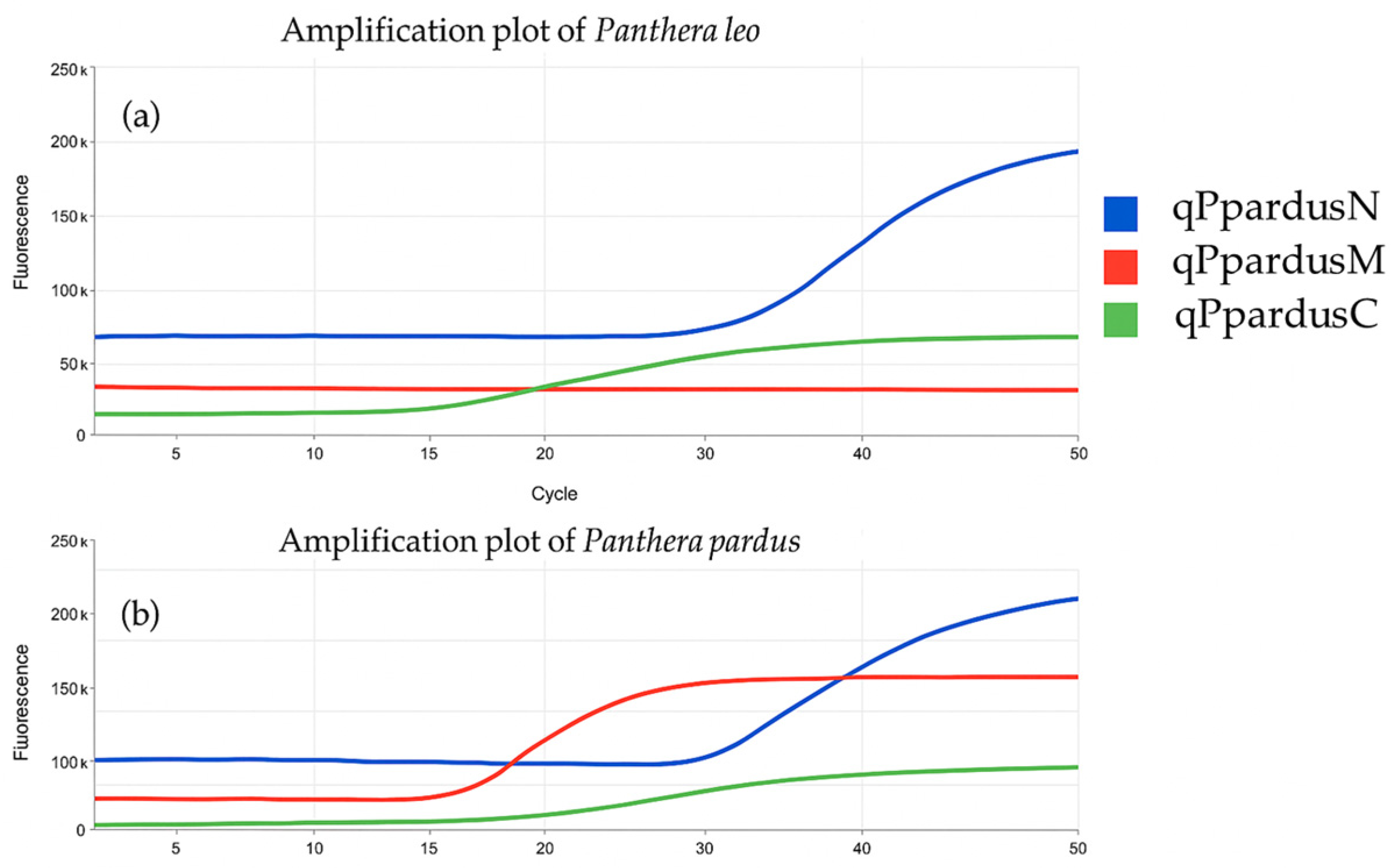
3.1. Quantification and Species Identification
3.2. Results of Validation of the Ppar Qplex
3.2.1. Robustness
3.2.2. Specificity
3.2.3. Sensitivity
3.2.4. Repeatability
3.2.5. Reproducibility
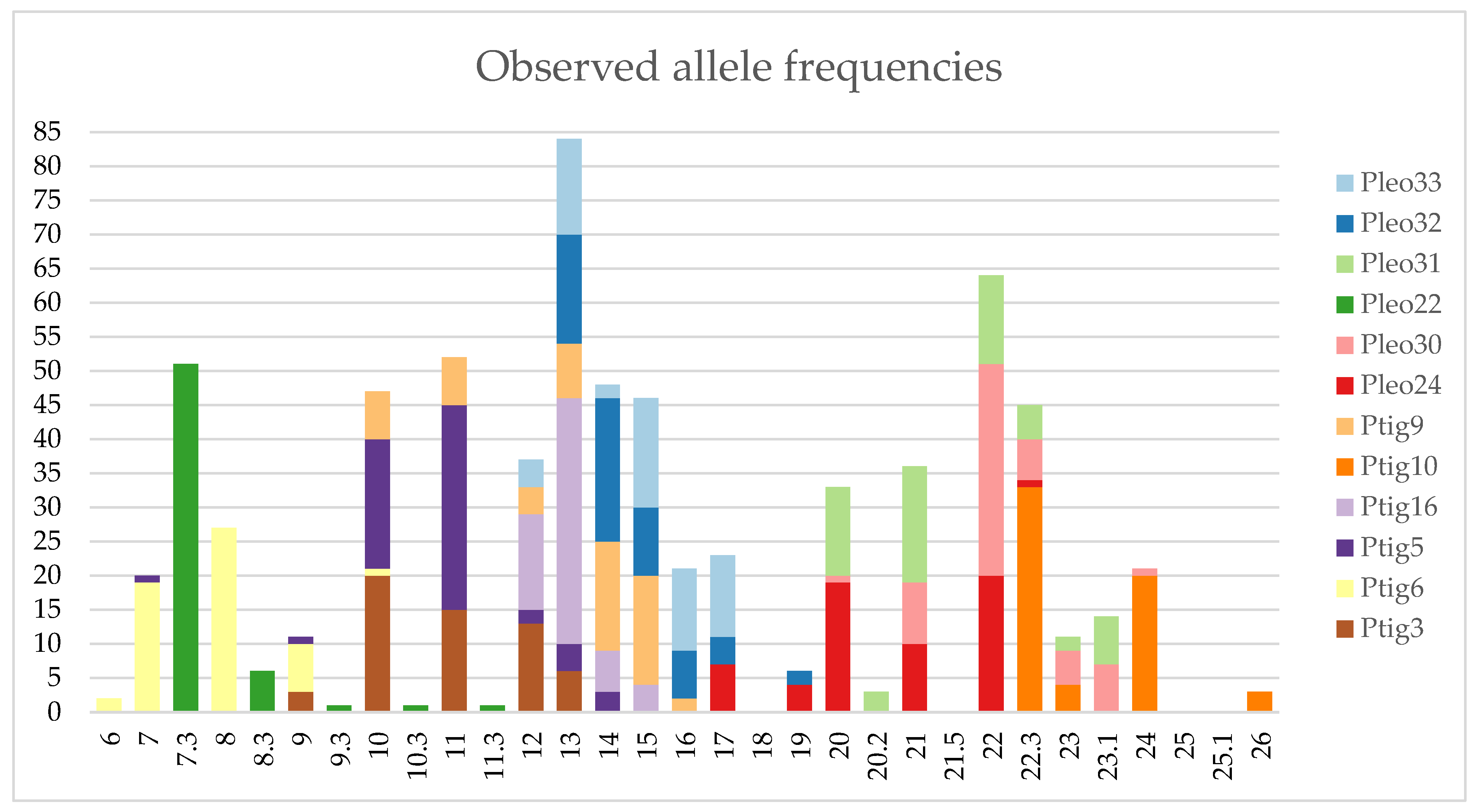
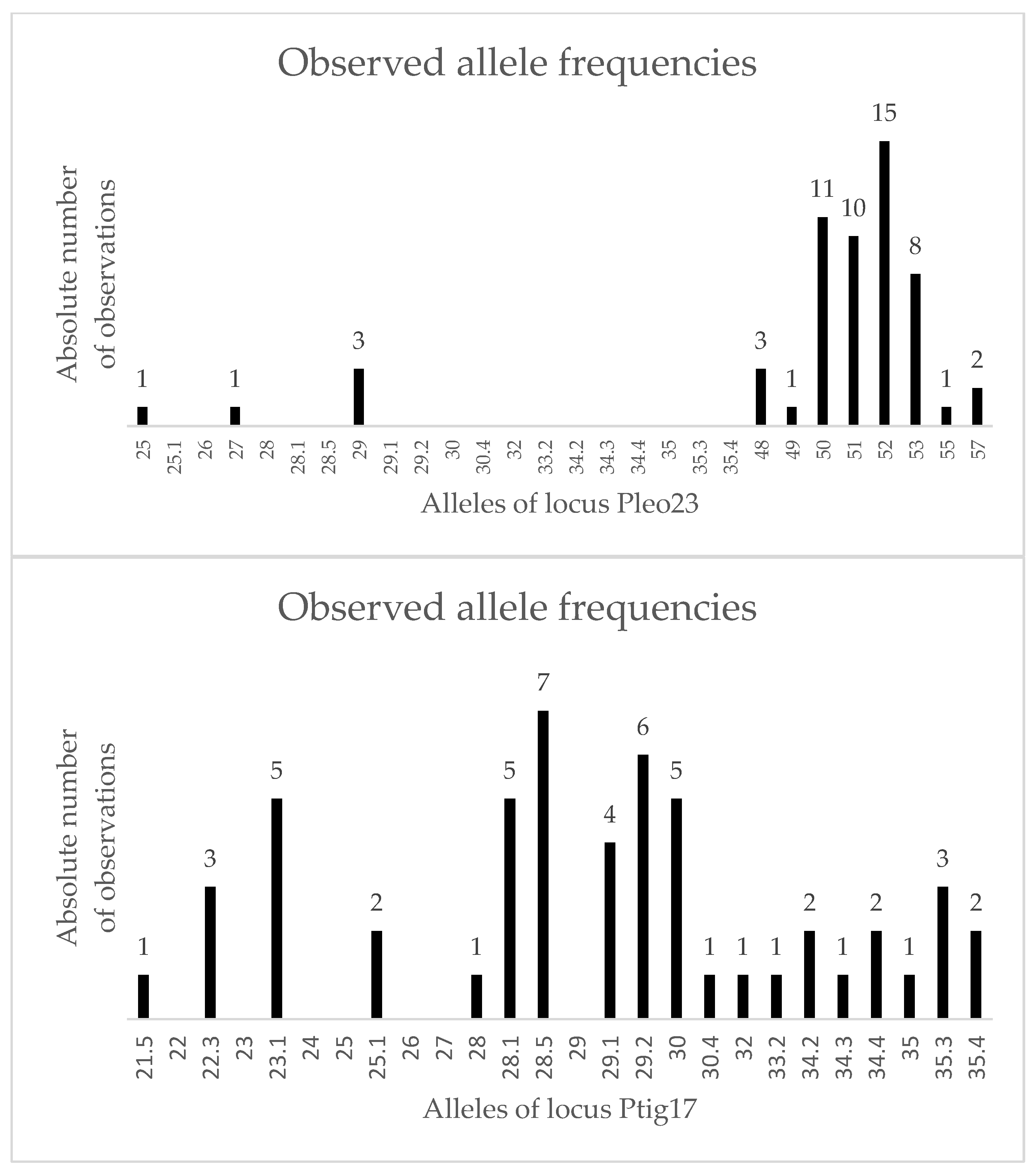
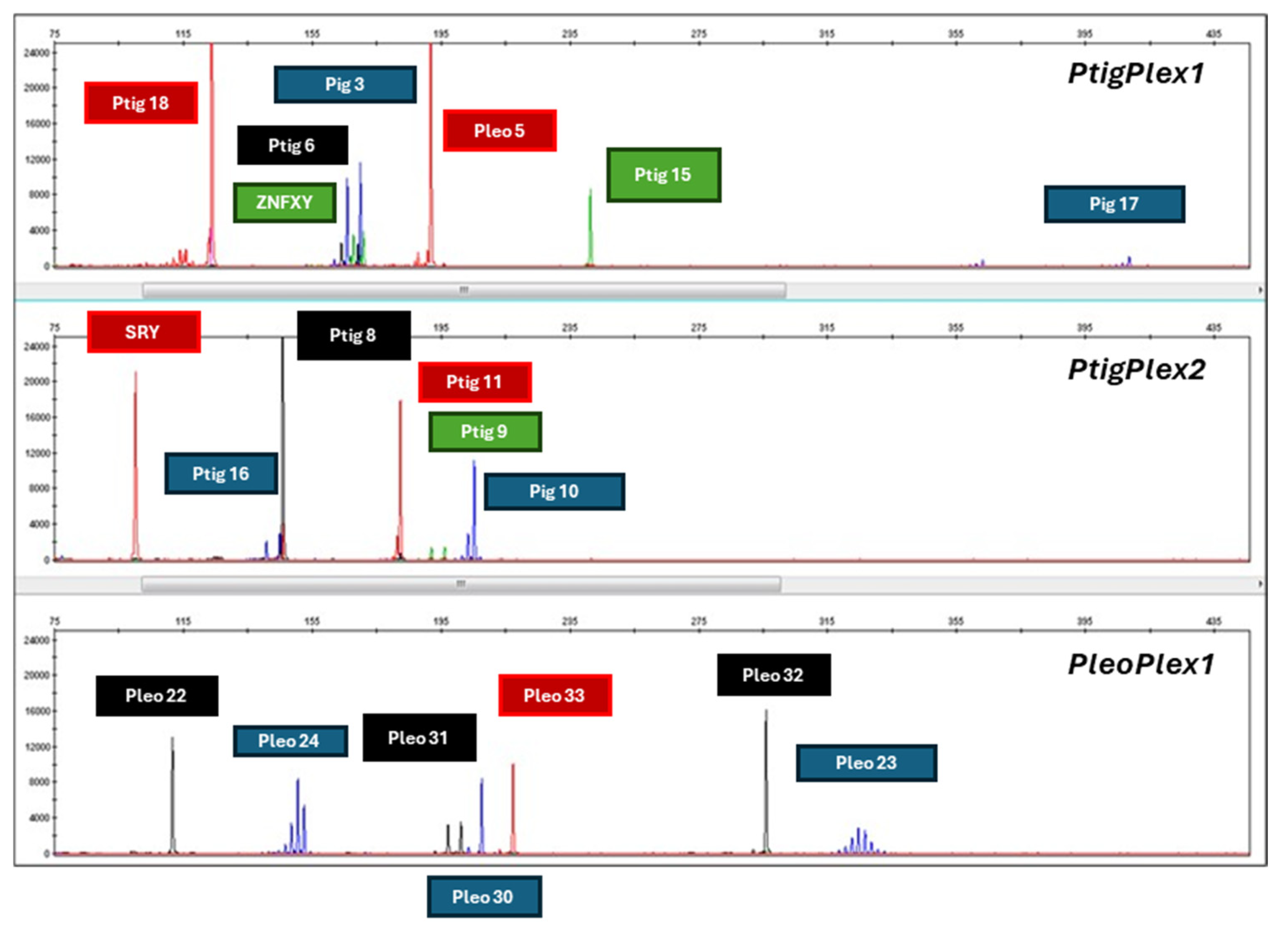
3.3. Individual Identification
4. Discussion
5. Conclusions
Supplementary Materials
Author Contributions
Funding
Institutional Review Board Statement
Informed Consent Statement
Data Availability Statement
Acknowledgments
Conflicts of Interest
References
- Stein, A.B.; Athreya, V.; Gerngross, P.; Balme, G.; Henschel, P.; Karanth, U.; Miquelle, D.; Rostro-Garcia, S.; Kamler, J.F.; Laguardia, A.; et al. The IUCN Red List of Threatened Species: Panthera pardu; The IUCN Red List of Threatened Species™. 2020, e.T15954A163991139. Available online: https://dx.doi.org/10.2305/IUCN.UK.2020-1.RLTS.T15954A163991139.en (accessed on 1 September 2025).
- CITES Appendices I, II and III. Convention on International Trade in Endangered Species of Wild Fauna and Flora. Available online: https://cites.org/eng/app/appendices.php (accessed on 1 September 2025).
- IUCN The IUCN Red List of Threatened Species, Version 2024-3. Available online: https://www.iucnredlist.org (accessed on 1 September 2025).
- Kitchener, A.; Breitenmoser, C.; Eizirik, E.; Gentry, A.; Werdelin, L.; Wilting, A.; Yamaguchi, N.; Abramov, A.; Christiansen, P.; Driscoll, C.; et al. A Revised Taxonomy of the Felidae: The Final Report of the Cat Classification Task Force of the IUCN/SSC Cat Specialist Group. Cat News 2017, 80. Available online: https://repository.si.edu/handle/10088/32616 (accessed on 1 September 2025).
- Nowell, K.; Jackson, P. Wild Cats—Status Survey and Conservation Action Plan; IUCN: Gland, Switzerland, 1996; ISBN 2-8317-0045-0. [Google Scholar]
- Ministry of Environment and Tourism (MET). Botswana National Leopard (Panthera pardus) Management and Action Plan 2024–2034; Ministry of Environment and Tourism (MET): Windhoek, Namibia, 2024; p. 65. Available online: https://cites.org/sites/default/files/documents/E-AC33-Inf-22_0.pdf (accessed on 1 September 2025).
- Jacobson, A.P.; Gerngross, P.; Lemeris, J.R., Jr.; Schoonover, R.F.; Anco, C.; Breitenmoser-Würsten, C.; Durant, S.M.; Farhadinia, M.S.; Henschel, P.; Kamler, J.F.; et al. Leopard (Panthera pardus) Status, Distribution, and the Research Efforts across Its Range. PeerJ 2016, 4, e1974. [Google Scholar] [CrossRef] [Scilit] [PubMed]
- Green, R. Wild Cat Species of the World; Basset Publications: Plymouth, UK, 1991; ISBN 0-946873-93-3. [Google Scholar]
- Selvan, K.M.; Lyngdoh, S.; Habib, B.; Gopi, G.V. Population Density and Abundance of Sympatric Large Carnivores in the Lowland Tropical Evergreen Forest of Indian Eastern Himalayas. Mamm. Biol. 2014, 79, 254–258. [Google Scholar] [CrossRef] [Scilit]
- Thorn, M.; Green, M.; Scott, D.; Marnewick, K. Characteristics and Determinants of Human-Carnivore Conflict in South African Farmland. Biodivers. Conserv. 2013, 22, 1715–1730. [Google Scholar] [CrossRef] [Scilit]
- Datta, A.; Anand, M.O.; Naniwadekar, R. Empty Forests: Large Carnivore and Prey Abundance in Namdapha National Park, North-East India. Biol. Conserv. 2008, 141, 1429–1435. [Google Scholar] [CrossRef] [Scilit]
- Hatton, J.; Couto, M.; Oglethorpe, J. Biodiversity and War: A Case Study of Mozambique; Biodiversity Support Program: Washington, DC, USA, 2017; ISBN 0099002280. [Google Scholar]
- Williams, V.L.; Loveridge, A.J.; Newton, D.J.; Macdonald, D.W. A Roaring Trade? The Legal Trade in Panthera leo Bones from Africa to East-Southeast Asia. PLoS ONE 2017, 12, e0185996. [Google Scholar] [CrossRef] [Scilit]
- Williams, V.; Newton, D.; Loveridge, A.; Macdonald, D. Bones of Conection: An Assessment of the South African Trade in African Lion Panthera leo Bones and Other Body Parts; TRAFFIC: Cambridge, UK, 2015; p. 128. [Google Scholar]
- Balme, G.; Rogan, M.; Thomas, L.; Pitman, R.; Mann, G.; Whittington-Jones, G.; Midlane, N.; Broodryk, M.; Broodryk, K.; Campbell, M.; et al. Big Cats at Large: Density, Structure, and Spatio-temporal Patterns of a Leopard Population Free of Anthropogenic Mortality. Popul. Ecol. 2019, 61, 256–267. [Google Scholar] [CrossRef] [Scilit]
- Li, J.; Lu, Z. Snow Leopard Poaching and Trade in China 2000–2013. Biol. Conserv. 2014, 176, 207–211. [Google Scholar] [CrossRef] [Scilit]
- Wong, R.; Krishnasamy, K. Skin and Bones Unresolved: An Analysis of Tiger Seizures from 2000–2018; Southeast Asia Regional Office: Petaling Jaya, Selangor, Malaysia, 2019. [Google Scholar]
- Balme, G.A.; Slotow, R.; Hunter, L.T.B. Impact of Conservation Interventions on the Dynamics and Persistence of a Persecuted Leopard (Panthera pardus) Population. Biol. Conserv. 2009, 142, 2681–2690. [Google Scholar] [CrossRef] [Scilit]
- Stein, A.B.; Athreya, V.; Society, W.C.; Gerngross, P.; Balme, G. Panthera Pardus. The IUCN Red List of Threatened Species 2016 Red List Assessment Assessment Information. 2016. Available online: https://www.iucnredlist.org/species/pdf/163991139 (accessed on 1 September 2025).
- Environmental Investigative Agency (EIA). Down to the Bone: China’s Alarming Trade in Leopard Bones; Environmental Investigative Agency (EIA): Washington, DC, USA, 2018; pp. 1–8. [Google Scholar]
- Karmacharya, D.; Sherchan, A.M.; Dulal, S.; Manandhar, P.; Manandhar, S.; Joshi, J.; Bhattarai, S.; Bhatta, T.R.; Awasthi, N.; Sharma, A.N.; et al. Species, Sex and Geo-Location Identification of Seized Tiger (Panthera tigris tigris) Parts in Nepal—A Molecular Forensic Approach. PLoS ONE 2018, 13, e0201639. [Google Scholar] [CrossRef] [Scilit]
- Alves, R.R.N.; Pinto, L.C.L.; Barboza, R.R.D.; Souto, W.M.S.; Oliveira, R.E.M.C.C.; Vieira, W.L.S. A Global Overview of Carnivores Used in Traditional Medicines. In Animals in Traditional Folk Medicine; Springer: Berlin/Heidelberg, Germany, 2013; pp. 171–206. [Google Scholar]
- Kesch, M.K.; Bauer, D.T.; Loveridge, A.J. Break on Through to the Other Side: The Effectiveness of Game Fencing to Mitigate Human—Wildlife Conflict. Afr. J. Wildl. Res. 2015, 45, 76. [Google Scholar] [CrossRef] [Scilit]
- Seoraj-Pillai, N.; Pillay, N. A Meta-Analysis of Human–Wildlife Conflict: South African and Global Perspectives. Sustainability 2016, 9, 34. [Google Scholar] [CrossRef] [Scilit]
- Woodroffe, R.; Thirgood, S.; Rabinowitz, A. The Impact of Human–Wildlife Conflict on Natural Systems. In People and Wildlife; Woodroffe, R., Thirgood, S., Rabinowitz, A., Eds.; Cambridge University Press: Cambridge, UK, 2005; pp. 1–12. [Google Scholar]
- Kissui, B.M. Livestock Predation by Lions, Leopards, Spotted Hyenas, and Their Vulnerability to Retaliatory Killing in the Maasai Steppe, Tanzania. Anim. Conserv. 2008, 11, 422–432. [Google Scholar] [CrossRef] [Scilit]
- Marker, L.L.; Dickman, A.J. Factors Affecting Leopard (Panthera pardus) Spatial Ecology, with Particular Reference to Namibian Farmlands. Afr. J. Wildl. Res. 2005, 35, 105–115. [Google Scholar]
- Tremori, T.M.; Antonio, L.U.; Godoy Cardena, M.M.S.; Gwinnett, C.; Davidson, A.; do Amaral, J.B.; Fridman, C.; Rocha, N.S. Forensic Genetics Associated with Hair Analysis as a Tool for Jaguar (Panthera onca) Identification. Glob. Ecol. Conserv. 2024, 52, e02956. [Google Scholar] [CrossRef] [Scilit]
- Pavithra, R.; Thunnisa, A.M.; Vasanthakumari, D.; Udhayan, A. Unveiling a Novel Morphometric Approach in Claws and Canines for Species Discrimination and Age Stratification in Leopard (Panthera pardus fusca). Sci. Nat. 2025, 112, 4. [Google Scholar] [CrossRef] [Scilit]
- Miththapala, S.; Seidensticker, J.; Phillips, L.G.; Fernando, S.B.U.; Smallwood, J.A. Identification of Individual Leopards (Panthera pardus kotiya) Using Spot Pattern Variation. J. Zool. 1989, 218, 527–536. [Google Scholar] [CrossRef] [Scilit]
- Wattegedera, M.; Silva, D.; Sooriyabandara, C.; Wimaladasa, P.; Siriwardena, R.; Piyasena, M.; Marasinghe, R.M.S.L.R.P.; Hathurusinghe, B.M.; Nilanthi, R.M.R.; Gunawardena, S.; et al. A Multi-Point Identification Approach for the Recognition of Individual Leopards (Panthera pardus kotiya). Animals 2022, 12, 660. [Google Scholar] [CrossRef] [Scilit]
- Margaret, E. Sims Cranial Morphology of Five Felids: Acinonyx jubatus, Panthera onca, Panthera pardus, Puma concolor, Uncia uncia. Russ. J. Theriol. 2012, 11, 157–170. [Google Scholar]
- Knecht, L. The Use of Hair Morphology in the Identification of Mammals. In Wildlife Forensics; Wiley: Hoboken, NJ, USA, 2011; pp. 129–143. [Google Scholar]
- Picek, L.; Belotti, E.; Bojda, M.; Bufka, L.; Cermak, V.; Dula, M.; Dvorak, R.; Hrdy, L.; Jirik, M.; Kocourek, V.; et al. CzechLynx: A Dataset for Individual Identification and Pose Estimation of the Eurasian Lynx. arXiv 2025, arXiv:2506.04931. [Google Scholar] [CrossRef] [Scilit]
- Sharma, S.; Jhala, Y.; Sawarkar, V.B. Identification of Individual Tigers (Panthera tigris) from Their Pugmarks. J. Zool. 2005, 267, 9–18. [Google Scholar] [CrossRef] [Scilit]
- Lang, A.J.; Engler, T.; Martin, T. Dental Topographic and Three-dimensional Geometric Morphometric Analysis of Carnassialization in Different Clades of Carnivorous Mammals (Dasyuromorphia, Carnivora, Hyaenodonta). J. Morphol. 2022, 283, 91–108. [Google Scholar] [CrossRef] [Scilit] [PubMed]
- Karanth, K.U. Estimating Tiger Panthera Tigris Populations from Camera-Trap Data Using Capture—Recapture Models. Biol. Conserv. 1995, 71, 333–338. [Google Scholar] [CrossRef] [Scilit]
- Mondol, S.; Kumar, N.S.; Gopalaswamy, A.; Sunagar, K.; Karanth, K.U.; Ramakrishnan, U. Identifying Species, Sex and Individual Tigers and Leopards in the Malenad-Mysore Tiger Landscape, Western Ghats, India. Conserv. Genet. Resour. 2015, 7, 353–361. [Google Scholar] [CrossRef] [Scilit]
- Mondol, S.; Sridhar, V.; Yadav, P.; Gubbi, S.; Ramakrishnan, U. Tracing the Geographic Origin of Traded Leopard Body Parts in the Indian Subcontinent with DNA-based Assignment Tests. Conserv. Biol. 2015, 29, 556–564. [Google Scholar] [CrossRef] [Scilit]
- Hebert, P.D.N.; Cywinska, A.; Ball, S.L.; DeWaard, J.R. Biological Identifications through DNA Barcodes. Proc. R. Soc. Lond. B Biol. Sci. 2003, 270, 313–321. [Google Scholar] [CrossRef] [Scilit]
- Dawnay, N.; Ogden, R.; McEwing, R.; Carvalho, G.R.; Thorpe, R.S. Validation of the Barcoding Gene COI for Use in Forensic Genetic Species Identification. Forensic Sci. Int. 2007, 173, 1–6. [Google Scholar] [CrossRef] [Scilit]
- Mitani, T.; Akane, A.; Tokiyasu, T.; Yoshimura, S.; Okii, Y.; Yoshida, M. Identification of Animal Species Using the Partial Sequences in the Mitochondrial 16S rRNA Gene. Leg. Med. 2009, 11, S449–S450. [Google Scholar] [CrossRef] [Scilit]
- Hsieh, H.-M.; Chiang, H.-L.; Tsai, L.-C.; Lai, S.-Y.; Huang, N.-E.; Linacre, A.; Lee, J.C.-I. Cytochrome b Gene for Species Identification of the Conservation Animals. Forensic Sci. Int. 2001, 122, 7–18. [Google Scholar] [CrossRef] [Scilit]
- Vankova, L.; Vanek, D. DNA-Based Identification of Big Cats and Traditional Chinese Medicine Artifacts in the Czech Republic. Forensic Sci. Int. Genet. Suppl. Ser. 2022, 8, 122–124. [Google Scholar] [CrossRef] [Scilit]
- Henger, C.S.; Straughan, D.J.; Xu, C.C.Y.; Nightingale, B.R.; Kretser, H.E.; Burnham-Curtis, M.K.; McAloose, D.; Seimon, T.A. A New Multiplex qPCR Assay to Detect and Differentiate Big Cat Species in the Illegal Wildlife Trade. Sci. Rep. 2023, 13, 9796. [Google Scholar] [CrossRef] [Scilit]
- Mahlerová, K.; Alaverdyan, J.; Vaňková, L.; Vaněk, D. Molecular Tools for Lynx Spp. qPCR Identification and STR-Based Individual Identification of Eurasian Lynx (Lynx lynx) in Forensic Casework. Methods Protoc. 2025, 8, 47. [Google Scholar] [CrossRef] [Scilit]
- Cao, J.; Xu, J.; Liu, R.; Yu, K.; Wang, C. Specific PCR Detection of Tiger, Leopard, and Lion Ingredients from Test Samples. J. AOAC Int. 2011, 94, 1200–1205. [Google Scholar] [CrossRef] [Scilit] [PubMed]
- Mukherjee, N.; Mondol, S.; Andheria, A.; Ramakrishnan, U. Rapid Multiplex PCR Based Species Identification of Wild Tigers Using Non-Invasive Samples. Conserv. Genet. 2007, 8, 1465–1470. [Google Scholar] [CrossRef] [Scilit]
- Maroju, P.A.; Yadav, S.; Kolipakam, V.; Singh, S.; Qureshi, Q.; Jhala, Y. Schrodinger’s Scat: A Critical Review of the Currently Available Tiger (Panthera tigris) and Leopard (Panthera pardus) Specific Primers in India, and a Novel Leopard Specific Primer. BMC Genet. 2016, 17, 37. [Google Scholar] [CrossRef] [Scilit] [PubMed]
- Hall, T.A. BioEdit: A User-Friendly Biological Sequence Alignment Editor and Analysis Program for Windows 95/98/NT. Nucleic Acids Symp. Ser. 1999, 41, 95–98. [Google Scholar]
- O’Leary, N.A.; Cox, E.; Holmes, J.B.; Anderson, W.R.; Falk, R.; Hem, V.; Tsuchiya, M.T.N.; Schuler, G.D.; Zhang, X.; Torcivia, J.; et al. Exploring and Retrieving Sequence and Metadata for Species across the Tree of Life with NCBI Datasets. Sci. Data 2024, 11, 732. [Google Scholar] [CrossRef] [Scilit]
- Sayers, E.W.; Beck, J.; Bolton, E.E.; Brister, J.R.; Chan, J.; Comeau, D.C.; Connor, R.; DiCuccio, M.; Farrell, C.M.; Feldgarden, M.; et al. Database Resources of the National Center for Biotechnology Information. Nucleic Acids Res. 2024, 52, D33–D43. [Google Scholar] [CrossRef] [Scilit]
- Altschul, S.F.; Gish, W.; Miller, W.; Myers, E.W.; Lipman, D.J. Basic Local Alignment Search Tool. J. Mol. Biol. 1990, 215, 403–410. [Google Scholar] [CrossRef]
- Tobe, S.S.; Kitchener, A.C.; Linacre, A.M.T. Reconstructing Mammalian Phylogenies: A Detailed Comparison of the Cytochrome b and Cytochrome Oxidase Subunit I Mitochondrial Genes. PLoS ONE 2010, 5, e14156. [Google Scholar] [CrossRef] [Scilit]
- Farag, M.R.; El Bohi, K.M.; Khalil, S.R.; Alagawany, M.; Arain, M.A.; Sharun, K.; Tiwari, R.; Dhama, K. Forensic Applications of Mitochondrial Cytochrome b Gene in the Identification of Domestic and Wild Animal Species. J. Exp. Biol. Agric. Sci. 2020, 8, 1–8. [Google Scholar] [CrossRef] [Scilit]
- Vaněk, D.; Ehler, E.; Vaňková, L. Technical Note: Development of DNA Quantitation and STR Typing Systems for Panthera Tigris Species Determination and Individual Identification in Forensic Casework. Eur. J. Environ. Sci. 2021, 11, 113–118. [Google Scholar] [CrossRef] [Scilit]
- Vankova, L.; Alaverdyan, J.; Vanek, D. Developmental Validation of DNA Quantitation System, Extended STR Typing Multiplex, and Database Solutions for Panthera Leo Genotyping. Life 2025, 15, 664. [Google Scholar] [CrossRef] [Scilit] [PubMed]
- Gouy, A.; Zieger, M. STRAF—A Convenient Online Tool for STR Data Evaluation in Forensic Genetics. Forensic Sci. Int. Genet. 2017, 30, 148–151. [Google Scholar] [CrossRef] [Scilit]
- Mondol, S.; R, N.; Athreya, V.; Sunagar, K.; Selvaraj, V.M.; Ramakrishnan, U. A Panel of Microsatellites to Individually Identify Leopards and Its Application to Leopard Monitoring in Human Dominated Landscapes. BMC Genet. 2009, 10, 79. [Google Scholar] [CrossRef] [Scilit]
- Sugimoto, T.; Nagata, J.; Aramilev, V.V.; Belozor, A.; Higashi, S.; McCullough, D.R. Species and Sex Identification from Faecal Samples of Sympatric Carnivores, Amur Leopard and Siberian Tiger, in the Russian Far East. Conserv. Genet. 2006, 7, 799–802. [Google Scholar] [CrossRef] [Scilit]
- Caragiulo, A.; Pickles, R.S.A.; Smith, J.A.; Smith, O.; Goodrich, J.; Amato, G. Tiger (Panthera tigris) Scent DNA: A Valuable Conservation Tool for Individual Identification and Population Monitoring. Conserv. Genet. Resour. 2015, 7, 681–683. [Google Scholar] [CrossRef] [Scilit]
- Kittle, A.M.; Watson, A.C.; Cushman, S.A.; Macdonald, D.W. Forest Cover and Level of Protection Influence the Island-Wide Distribution of an Apex Carnivore and Umbrella Species, the Sri Lankan Leopard (Panthera pardus kotiya). Biodivers. Conserv. 2018, 27, 235–263. [Google Scholar] [CrossRef] [Scilit]
- Williamson, J.E.; Huebinger, R.M.; Sommer, J.A.; Louis, E.E.; Barber, R.C. Development and Cross-species Amplification of 18 Microsatellite Markers in the Sumatran Tiger (Panthera tigris sumatrae). Mol. Ecol. Notes 2002, 2, 110–112. [Google Scholar] [CrossRef] [Scilit]
- Menotti-Raymond, M.; David, V.A.; Lyons, L.A.; Schäffer, A.A.; Tomlin, J.F.; Hutton, M.K.; O’Brien, S.J. A Genetic Linkage Map of Microsatellites in the Domestic Cat (Felis catus). Genomics 1999, 57, 9–23. [Google Scholar] [CrossRef] [Scilit]
- Gupta, S.K.; Bhagavatula, J.; Thangaraj, K.; Singh, L. Establishing the Identity of the Massacred Tigress in a Case of Wildlife Crime. Forensic Sci. Int. Genet. 2011, 5, 74–75. [Google Scholar] [CrossRef] [Scilit]
- Wultsch, C.; Caragiulo, A.; Dias-Freedman, I.; Quigley, H.; Rabinowitz, S.; Amato, G. Genetic Diversity and Population Structure of Mesoamerican Jaguars (Panthera onca): Implications for Conservation and Management. PLoS ONE 2016, 11, e0162377. [Google Scholar] [CrossRef] [Scilit]
- Webster, M.S.; Reichart, L. Use of Microsatellites for Parentage and Kinship Analyses in Animals. In Methods in Enzymology; Academic Press: New York, NY, USA, 2005; pp. 222–238. [Google Scholar]



| Primer/Probe Name | Final Concentration | Sequence (5′-3′) | PCR Product Size | Specificity | TaqMan Probe Fluorescent Label | Design |
|---|---|---|---|---|---|---|
| (mM) | (bp = Base Pairs) | |||||
| qPparM_F | 5 | AGACATGGAACATTGGAGTC | 164 bp | Cyt b (mtDNA) | --- | * |
| qPparM_R | 5 | TCAGATTCATTCTACTAGGTCAATC | --- | * | ||
| qPparM_probe | 1.7 | CAACCGTAATTACCAACCTCC | probe | VIC | * | |
| qPparC_F | 5 | CTGCTAGGTTTAGCGCGTGAC | 261 bp | IPC | --- | [46] |
| qPparC_R | 5 | GGGGACCATGCTTGCG | --- | [46] | ||
| qPparC_probe | 1.7 | TGCACGATTCAAGCACGAT | probe | NED | [46] | |
| qPparN_F | 3.3 | AGTCCACTTCTCATTGCCCCTT | 132 bp | PLP (nDNA) | --- | [46] |
| qPparN_R | 3.3 | ACCTTCCCTGAGTTCTCCATACC | --- | [46] | ||
| qPparN_probe | 1.7 | CTCACCAGACCTGTTAGGA | probe | 6-FAM | [46] |
| P. pardus | ||
|---|---|---|
| Multiplex | Locus | Alleles |
| PtigPlex1 | Ptig3 | 12, 13 |
| Ptig17 | 28.1, 35.4 | |
| Ptig15 | 11.1, 11.1 | |
| Ptig6 | 7, 8 | |
| Ptig18 | 3, 3 | |
| Ptig5 | 10, 10 | |
| ZNFXY | M | |
| PtigPlex2 | Ptig16 | 13, 14 |
| Ptig10 | 23, 23 | |
| Ptig9 | 14, 15 | |
| Ptig8 | 6.1, 6.1 | |
| Ptig11 | 15, 15 | |
| SRY | M | |
| PleoPlex1 | Pleo24 | 19, 20 |
| Pleo30 | 22, 22 | |
| Pleo23 | 56, 57 | |
| Pleo22 | 7.3, 7.3 | |
| Pleo31 | 21, 22 | |
| Pleo32 | 14, 14 | |
| Pleo33 | 15, 15 | |
| P. tigris | P. pardus | |
|---|---|---|
| Ptig 8 (ATCTAT)n (ATC)n | alelle 7 — 6 × (ATCTAT) + 2 × (ATC) | alelle 6.1 5 × (ATCTAT) + 2 × (ATC) + 1 bp insertion |
| GCTGAT ATCTAT ATCTAT ATCTAT ATCTAT ATC ATCTAT ATC ATCTAT ATTTTT CCCCC TCTC | GCTGAT ATCTAT ATCTAT ATCTAT ATC ATCTAT ATC ATCTAT ATTTTT TCCCC CTC |
Disclaimer/Publisher’s Note: The statements, opinions and data contained in all publications are solely those of the individual author(s) and contributor(s) and not of MDPI and/or the editor(s). MDPI and/or the editor(s) disclaim responsibility for any injury to people or property resulting from any ideas, methods, instructions or products referred to in the content. |
© 2025 by the authors. Licensee MDPI, Basel, Switzerland. This article is an open access article distributed under the terms and conditions of the Creative Commons Attribution (CC BY) license.
Share and Cite
Mahlerová, K.; Vaňková, L.; Vaněk, D. Molecular Tools for qPCR Identification and STR-Based Individual Identification of Panthera pardus (Linnaeus, 1758). Genes 2026, 17, 45. https://doi.org/10.3390/genes17010045
Mahlerová K, Vaňková L, Vaněk D. Molecular Tools for qPCR Identification and STR-Based Individual Identification of Panthera pardus (Linnaeus, 1758). Genes. 2026; 17(1):45. https://doi.org/10.3390/genes17010045
Chicago/Turabian StyleMahlerová, Karolina, Lenka Vaňková, and Daniel Vaněk. 2026. "Molecular Tools for qPCR Identification and STR-Based Individual Identification of Panthera pardus (Linnaeus, 1758)" Genes 17, no. 1: 45. https://doi.org/10.3390/genes17010045
APA StyleMahlerová, K., Vaňková, L., & Vaněk, D. (2026). Molecular Tools for qPCR Identification and STR-Based Individual Identification of Panthera pardus (Linnaeus, 1758). Genes, 17(1), 45. https://doi.org/10.3390/genes17010045