
Homotypic Transposable Element Pairing May Drive Coherent Chromatin Folding


Abstract
1. Introduction
2. Methods
2.1. Chromatin Conformation Datasets
- ZITI (4DNFI1O6IL1Q): H1-hESC stem cells, Caucasian male, Micro-C (MNase);
- WALNUT (4DNFI3ULPBI5): WTC-11 iPSC cells, Japanese male, Micro-C (MNase);
- ALMOND (4DNFIEVQW3GY): WTC-11 iPSC cells, Japanese male, Micro-C (MNase);
- PASTRY (4DNFICOEXGPJ): HFFc6 immortalized fibroblasts, Micro-C (MNase);
2.2. Chromatin Contact Data Processing, Selecting Hotspots and Coldfields
2.3. Hotspot Identification
2.4. Coldfield Identification
2.5. Data Sampling
2.6. Reproducibility of TE Homotypic Pairing at Contacts
2.7. TE Pairing Specificity Measurement
3. Results
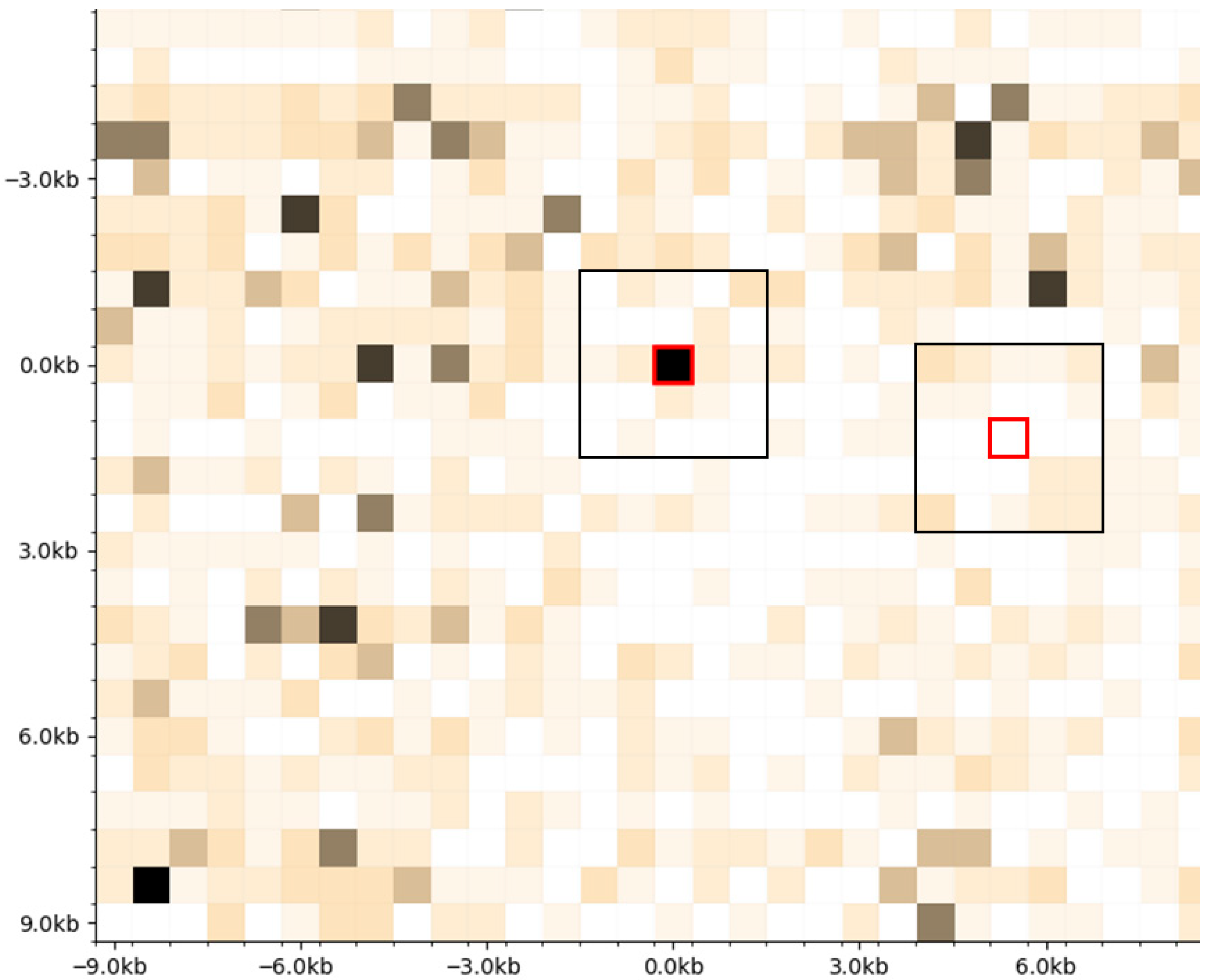
3.1. Study Design: Identifying Focal Contacts Versus Diffuse Regions
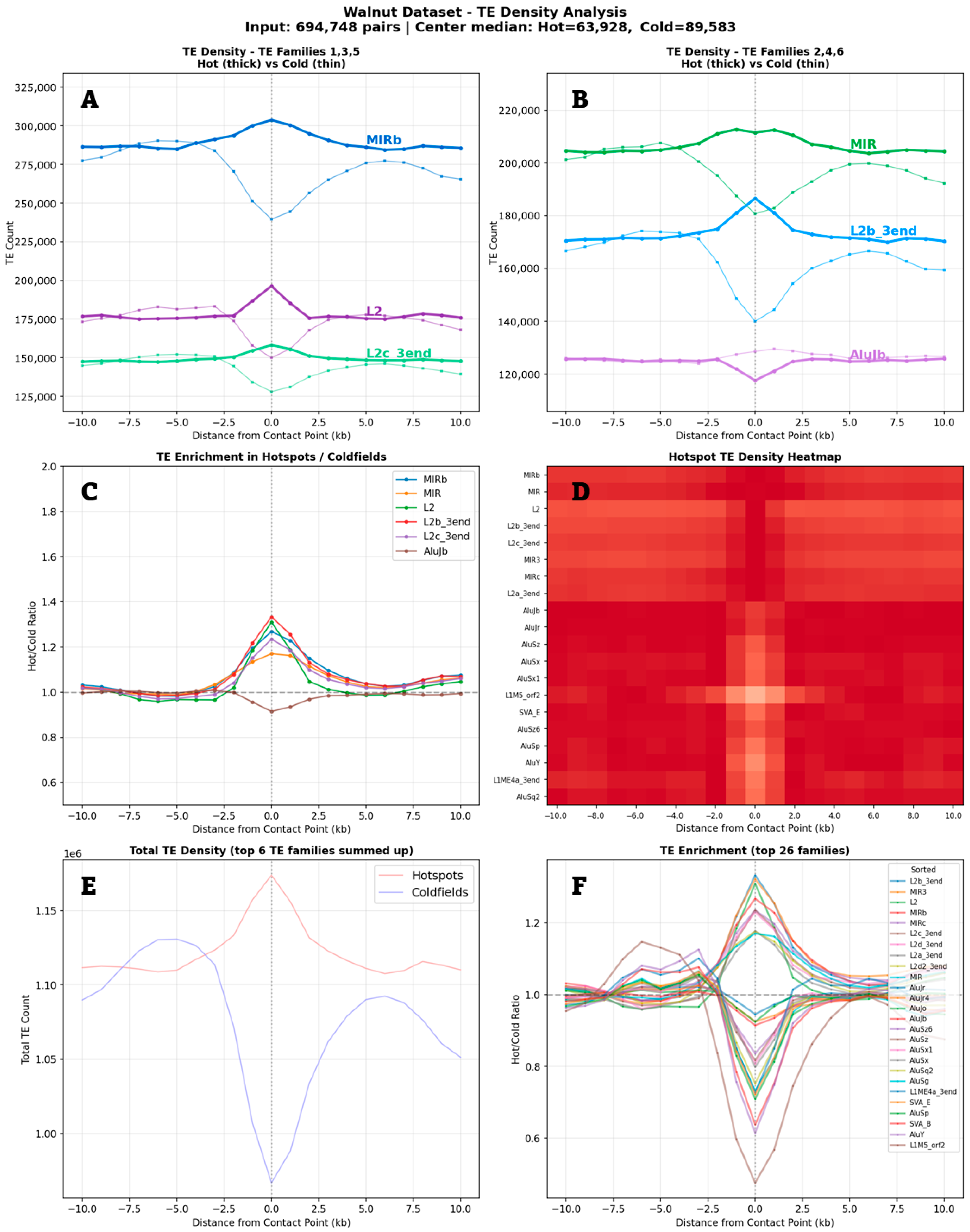
3.2. Transposable Element Distribution at Chromatin Contacts
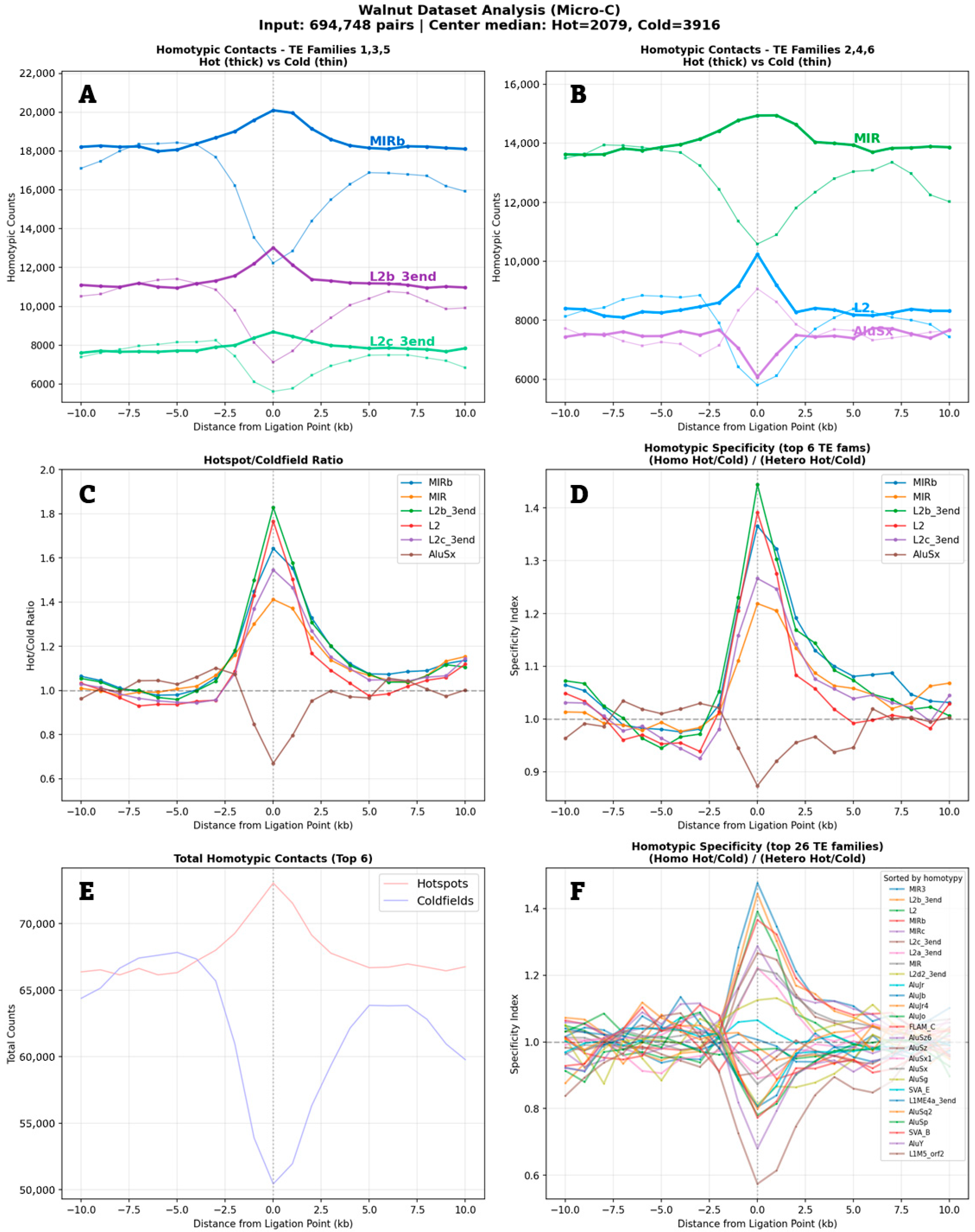
3.3. Homotypic Pairing at Chromatin Contacts
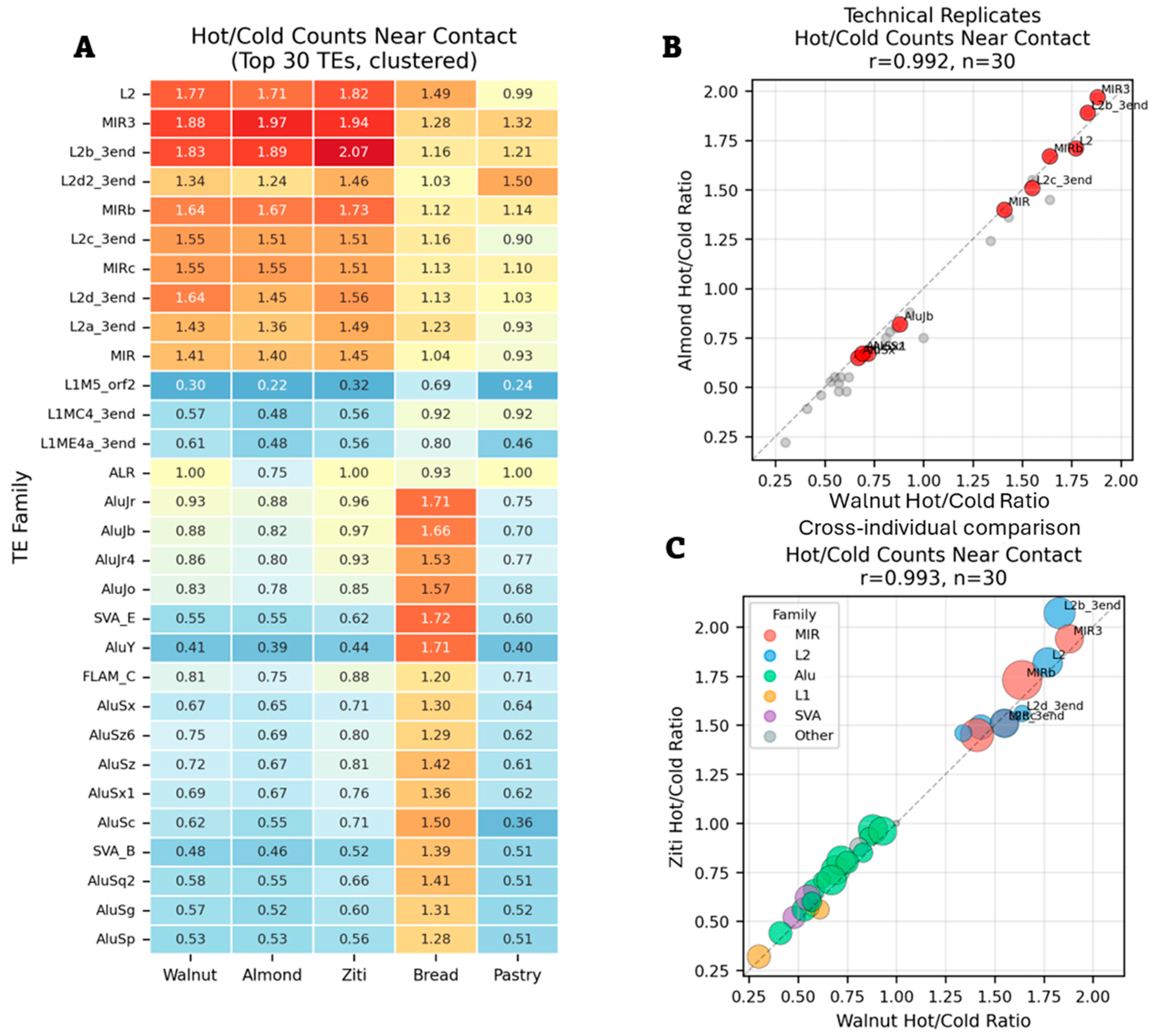
3.4. Reproducibility of Homotypic Pairing Patterns
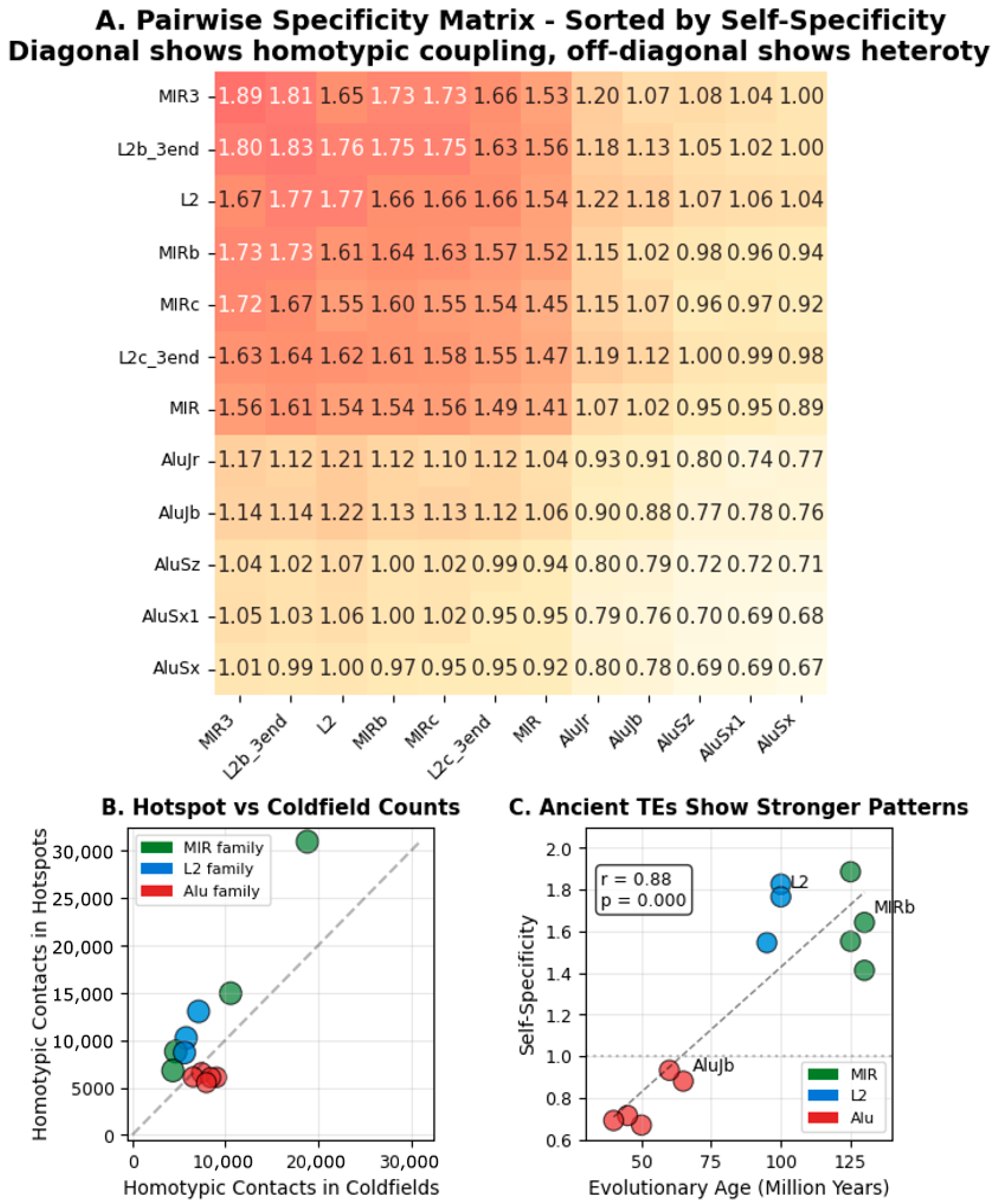
3.5. Pairwise Specificity and Evolutionary Age Correlation
4. Discussion
4.1. Interpreting the Sharp Focal Signal
4.2. Two Interpretations of the Depletion Signal
4.3. The MIR-L2 Cross-Specificity Problem
4.4. The Cause–Consequence Question
4.5. Distinguishing Markers from Drivers
Funding
Institutional Review Board Statement
Informed Consent Statement
Data Availability Statement
Acknowledgments
Conflicts of Interest
References
- Cordaux, R.; Batzer, M.A. The Impact of Retrotransposons on Human Genome Evolution. Nat. Rev. Genet. 2009, 10, 691–703. [Google Scholar] [CrossRef] [PubMed]
- Deininger, P. Human Retrotransposable Elements: An End or Just the Beginning? Nat. Rev. Genet. 2021, 22, 749–771. [Google Scholar] [CrossRef]
- Lu, J.-Y.; Chang, L.; Li, T.; Wang, Y.; Wang, X.; Gao, S.; Chao, C.-W.; Wang, Y.; Wang, D.; Yu, Y.; et al. Homotypic Clustering of L1 and B1/Alu Repeats Compartmentalizes the 3D Genome. Cell Res. 2021, 31, 613–630. [Google Scholar] [CrossRef] [PubMed]
- Polesskaya, O.; Guschin, V.; Kondratev, N.; Garanina, I.; Nazarenko, O.; Zyryanova, N.; Tovmash, A.; Mara, A.; Shapiro, T.; Erdyneeva, E.; et al. On Possible Role of DNA Electrodynamics in Chromatin Regulation. Prog. Biophys. Mol. Biol. 2018, 134, 50–54. [Google Scholar] [CrossRef] [PubMed]
- Polesskaya, O.; Kananykhina, E.; Roy-Engel, A.M.; Nazarenko, O.; Kulemzina, I.; Baranova, A.; Vassetsky, Y.; Myakishev-Rempel, M. The Role of Alu-Derived RNAs in Alzheimer’s and Other Neurodegenerative Conditions. Med. Hypotheses 2018, 115, 29–34. [Google Scholar] [CrossRef] [PubMed]
- Savelyev, I.V.; Zyryanova, N.V.; Polesskaya, O.O.; Myakishev-Rempel, M. On the Existence of the DNA Resonance Code and Its Possible Mechanistic Connection to the Neural Code. Neuroquantology 2019, 17, 56–71. [Google Scholar] [CrossRef]
- Savelev, I.; Myakishev-Rempel, M. Possible Traces of Resonance Signaling in the Genome. Prog. Biophys. Mol. Biol. 2020, 151, 23–31. [Google Scholar] [CrossRef] [PubMed]
- Savelev, I.; Myakishev-Rempel, M. Evidence for DNA Resonance Signaling via Longitudinal Hydrogen Bonds. Prog. Biophys. Mol. Biol. 2020, 156, 14–19. [Google Scholar] [CrossRef] [PubMed]
- Myakishev-Rempel, M.; Savelev, I.V. How Schrödinger’s Mice Weave Consciousness. In Rhythmic Advantages in Big Data and Machine Learning; Springer Nature Singapore: Singapore, 2022; pp. 201–224. ISBN 9789811657221. [Google Scholar]
- Savelev, I.V.; Miller, R.A.; Myakishev-Rempel, M. How the Biofield Is Created by DNA Resonance. In Rhythmic Advantages in Big Data and Machine Learning; Springer Nature Singapore: Singapore, 2022; pp. 161–199. ISBN 9789811657221. [Google Scholar]
- Vikhorev, A.V.; Savelev, I.V.; Polesskaya, O.O.; Rempel, M.M.; Miller, R.A.; Vetcher, A.A.; Myakishev-Rempel, M. The Avoidance of Purine Stretches by Cancer Mutations. Int. J. Mol. Sci. 2024, 25, 11050. [Google Scholar] [CrossRef] [PubMed]
- Reiff, S.B.; Schroeder, A.J.; Kırlı, K.; Cosolo, A.; Bakker, C.; Mercado, L.; Lee, S.; Veit, A.D.; Balashov, A.K.; Vitzthum, C.; et al. The 4D Nucleome Data Portal as a Resource for Searching and Visualizing Curated Nucleomics Data. Nat. Commun. 2022, 13, 2365. [Google Scholar] [CrossRef] [PubMed]
- Dekker, J.; Belmont, A.S.; Guttman, M.; Leshyk, V.O.; Lis, J.T.; Lomvardas, S.; Mirny, L.A.; O’Shea, C.C.; Park, P.J.; Ren, B.; et al. The 4D Nucleome Project. Nature 2017, 549, 219–226. [Google Scholar] [CrossRef] [PubMed]
- Krietenstein, N.; Abraham, S.; Venev, S.V.; Abdennur, N.; Gibcus, J.; Hsieh, T.-H.S.; Parsi, K.M.; Yang, L.; Maehr, R.; Mirny, L.A.; et al. Ultrastructural Details of Mammalian Chromosome Architecture. Mol. Cell 2020, 78, 554–565.e7. [Google Scholar] [CrossRef] [PubMed]
- Rao, S.S.P.; Huntley, M.H.; Durand, N.C.; Stamenova, E.K.; Bochkov, I.D.; Robinson, J.T.; Sanborn, A.L.; Machol, I.; Omer, A.D.; Lander, E.S.; et al. A 3D Map of the Human Genome at Kilobase Resolution Reveals Principles of Chromatin Looping. Cell 2014, 159, 1665–1680. [Google Scholar] [CrossRef] [PubMed]
- Storer, J.; Hubley, R.; Rosen, J.; Wheeler, T.J.; Smit, A.F. The Dfam Community Resource of Transposable Element Families, Sequence Models, and Genome Annotations. Mob. DNA 2021, 12, 2. [Google Scholar] [CrossRef] [PubMed]
- Smit, A.F.; Riggs, A.D. MIRs Are Classic, tRNA-Derived SINEs That Amplified before the Mammalian Radiation. Nucleic Acids Res. 1995, 23, 98–102. [Google Scholar] [CrossRef] [PubMed]
- Batzer, M.A.; Deininger, P.L. Alu Repeats and Human Genomic Diversity. Nat. Rev. Genet. 2002, 3, 370–379. [Google Scholar] [CrossRef] [PubMed]


Disclaimer/Publisher’s Note: The statements, opinions and data contained in all publications are solely those of the individual author(s) and contributor(s) and not of MDPI and/or the editor(s). MDPI and/or the editor(s) disclaim responsibility for any injury to people or property resulting from any ideas, methods, instructions or products referred to in the content. |
© 2025 by the author. Licensee MDPI, Basel, Switzerland. This article is an open access article distributed under the terms and conditions of the Creative Commons Attribution (CC BY) license.
Share and Cite
Myakishev-Rempel, M. Homotypic Transposable Element Pairing May Drive Coherent Chromatin Folding. Genes 2026, 17, 43. https://doi.org/10.3390/genes17010043
Myakishev-Rempel M. Homotypic Transposable Element Pairing May Drive Coherent Chromatin Folding. Genes. 2026; 17(1):43. https://doi.org/10.3390/genes17010043
Chicago/Turabian StyleMyakishev-Rempel, Max. 2026. "Homotypic Transposable Element Pairing May Drive Coherent Chromatin Folding" Genes 17, no. 1: 43. https://doi.org/10.3390/genes17010043
APA StyleMyakishev-Rempel, M. (2026). Homotypic Transposable Element Pairing May Drive Coherent Chromatin Folding. Genes, 17(1), 43. https://doi.org/10.3390/genes17010043