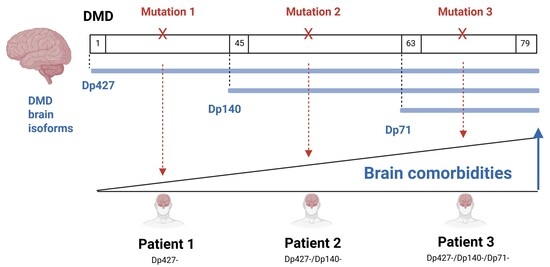

Article

Brain Matters in Duchenne Muscular Dystrophy: DMD Mutation Sites and Their Association with Neurological Comorbidities Through Isoform Impairment

by
Teodora Barbarii
1,2,
Raluca Anca Tudorache
3,4,
Dana Craiu
2,3,5,*,
Elena Neagu
6,
Lacramioara Aurelia Brinduse
7,
Carmen Magdalena Burloiu
5,
Catrinel Mihaela Iliescu
3,5,
Magdalena Budisteanu
8,9,10,
Ioana Minciu
3,5,
Diana Gabriela Barca
2,3,5,
Carmen Sandu
3,5,
Oana Tarta-Arsene
3,5,
Cristina Pomeran
5,
Cristina Motoescu
3,5,
Alice Dica
3,5,
Cristina Anghelescu
11,
Dana Surlica
5,
Adrian Ioan Toma
12 and
Niculina Butoianu
3,5
1
Department of Medical Genetics, “Carol Davila” University of Medicine and Pharmacy, 020032 Bucharest, Romania
2
Romanian Group for Undiagnosed Rare Diseases, Genomics Research and Development Institute, 020021 Bucharest, Romania
3
Pediatric Neurology Discipline, Department of Neurosciences, “Carol Davila” University of Medicine and Pharmacy, 050474 Bucharest, Romania
4
Université Paris Cité, 75015 Paris, France
5
Pediatric Neurology Clinic, “Prof. Dr. Alexandru Obregia” Clinical Hospital, Expertise Center for Rare Pediatric Neurology Disorders, EpiCARE Full Member, 041914 Bucharest, Romania
6
Dr. Nicolae Robanescu National Clinical Center for Children Neurorehabilitation, 041408 Bucharest, Romania
7
Public Health and Management Department, “Carol Davila” University of Medicine and Pharmacy, 050463 Bucharest, Romania
8
Research Department for Psychiatry, “Prof. Dr. Alexandru Obregia” Clinical Hospital, 041914 Bucharest, Romania
9
Medical Genetics Laboratory, Victor Babes National Institute of Pathology, 050096 Bucharest, Romania
10
Department of Genetics, Faculty of Medicine, “Titu Maiorescu” University, 040051 Bucharest, Romania
11
Ioana Medical Center, 011053 Bucharest, Romania
12
Faculty of Medicine, “Titu Maiorescu” University, 040051 Bucharest, Romania
*
Author to whom correspondence should be addressed.
Genes 2026, 17(1), 12; https://doi.org/10.3390/genes17010012
Submission received: 30 November 2025 / Revised: 12 December 2025 / Accepted: 16 December 2025 / Published: 24 December 2025
(This article belongs to the Special Issue Genetic Diagnosis and Treatment of Duchenne Muscular Dystrophy)

Abstract

Background: Duchenne/Becker muscular dystrophy (DMD/BMD) is associated with a wide spectrum of brain-related comorbidities. Methods: This retrospective study assesses the neuropsychiatric profile of DMD/BMD patients and the hypothesis of a functional-versus-structural approach of dystrophin gene variants/impaired isoforms in relation to brain comorbidities. Patients with documented mutation in the DMD gene and neuropsychiatric assessments were included. Seven comorbidities were analyzed based on variant location and dystrophin brain isoform disruption. The clustering of comorbidities and genotype–phenotype correlations were studied. Results: 264 DMD/BMD patients met inclusion criteria. 22 variants have never been described before. A high prevalence of neuropsychiatric comorbidities was identified in the cohort with higher values in patients with distal mutations. The number of comorbidities increased with the number of brain dystrophin isoforms predicted to be lost. Functional-versus-structural comparison revealed that Dp140 5′UTR variants might not affect protein expression. Epilepsy and intellectual disability (ID) showed significant association in this cohort. Neuropsychiatric phenotype varied greatly in patients with identical variants, even between siblings. Conclusions: This is one of the largest European cohorts for which all these comorbidities were studied in association with DMD gene mutation site and the first study of this kind performed on the Eastern European DMD/BMD population. Our group analyzed, for the first time, Dp140 5′UTR variants in relation to all neuropsychiatric phenotypes and showed that epilepsy and ID are strongly associated in DMD/DMB patients.

1. Introduction

Duchenne/Becker Muscular Dystrophy (DMD/BMD) is a progressive neuromuscular condition caused by mutations in the dystrophin gene (DMD/Xp21) resulting in the lack of functional dystrophin protein [1]. Dystrophin protein’s role is not limited to muscle function as there is increasing evidence of neurological, psychiatric, and neurodevelopmental comorbidities associated with impaired dystrophin isoforms expressed in different brain areas [2,3,4]. The French neurologist Duchenne de Boulogne, who initially described the disease, noted the presence of cognitive deficits as part of the phenotype [5] and it was reported that global developmental delay and cognitive and language impairments could be the initial symptoms of the disease [6].
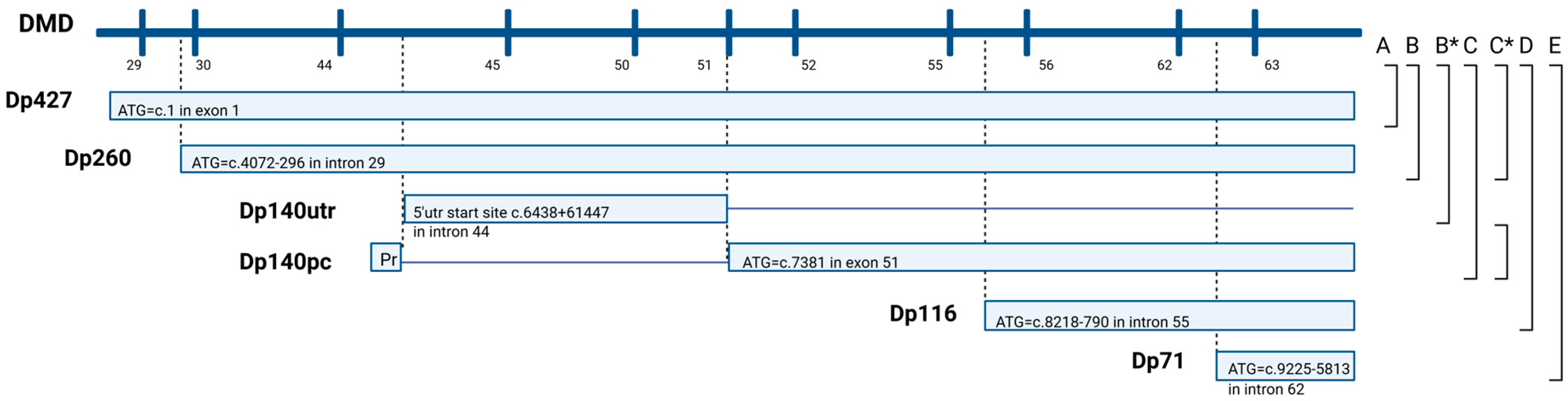
The dystrophin gene, one of the largest and complex genes in the human genome, has 79 exons and integrates 7 promoters, giving rise to 7 dystrophin protein (Dp) isoforms with diverse expression in different tissues [7,8]. Variants at the 5′ end of the gene affect the longest isoforms generated by the three promoters located upstream the first exon, named Dp427M, Dp427C, and Dp427P, according to the main sites of their expression: skeletal and cardiac muscle, neurons of the cerebral cortex, and hippocampus and cerebellar Purkinje cells, respectively [9,10,11,12]. Mutations occurring further downstream of the gene affect, besides the long isoforms, the other gene products deriving from the four internal promoters located distal to exon 30. Variants between exons 31 and 44 disrupt the isoform Dp260 (expressed predominantly in the retina [13]), those between exons 45 and 62 affect Dp140 (expressed at high levels in the brain during fetal development and adult kidneys [14,15]) and Dp116 (expressed in adult peripheral nerves [16]), and mutations occurring downstream of exon 63 affect all dystrophin gene products including isoform Dp71 (the most abundant isoform expressed in the brain, even from fetal life [17]) (Figure 1).
Many studies investigated the relationship between neuropsychiatric comorbidities and gene mutation sites in DMD patients. Ricotti and colleagues [18] were the first to observe a pattern when clustering these brain-related symptoms and proposed the term “DMD neuropsychiatric syndrome”. Several studies pointed out that mutations in the second part of the dystrophin gene are associated with cognitive impairment and neuropsychiatric comorbidities as they affect more dystrophin gene products. Therefore, patients with 3′ end variants present a more severe neurodevelopmental phenotype following the cumulative loss of brain isoforms [19,20,21,22].
Figure 1. DMD gene, dystrophin isoforms, and patients groups. Vertical lines represent the exons of the DMD gene. Dp427, Dp260, Dp140, Dp116, and Dp71 are dystrophin isoforms. Transcription of every isoform is initiated at ATG (Methionine) and the location of ATG is listed for all isoforms transcripts. The promoters of isoforms are localized prior to these transcription initiation sites. Dp140 transcript includes a long 5′utr (untranslated region)-Dp140utr consisting of exons 45–50 and a portion of exon 51 and has its promoter (Pr) within intron 44, followed by the protein coding region of the isoform (Dp140pc). From the N- to C-terminus, dystrophin contains an N-terminal actin-binding domain, a central rod domain made of spectrin-like repeats, a cysteine-rich domain, and a C-terminal domain. Dp427 (3685 aa) contains all four domains; Dp260 (2344 aa) lacks the N-terminal actin-binding domain; Dp140 (1225 aa) lacks the N-terminal domain and part of the rod domain; Dp116 (956 aa) contains only the last rod repeats plus the cysteine-rich and C-terminal domains; and Dp71 (617 aa) consists mainly of the cysteine-rich and C-terminal domains with a short unique N-terminus. Structural (A–E) and functional (B*–C*) patient groups, according to mutation position and predicted isoform disruption, are indicated on the right and described in detail in Section 2.3. This figure is adapted from Taylor et al. [21] with permission. * = functional groups. utr/UTR = untranslated region.
Genes 17 00012 g001
Compared with the general pediatric population, DMD/BMD patients have a higher prevalence of intellectual disability (ID) [23] and other neuropsychiatric comorbidities, including attention-deficit/hyperactivity disorder (ADHD) [24,25], autism spectrum disorders (ASD) [26,27], obsessive–compulsive disorder, depression, aggression, anxiety, motor and vocal tics [28], and epilepsy [29,30,31,32].

2. Materials and Methods

2.1. Patients

This is a single-center retrospective observational study on a cohort of DMD/BMD patients referred for assessment at the Pediatric Neurology Department, Prof. Dr. Alex. Obregia Clinical Hospital of Psychiatry, Bucharest, Romania, between January 2001 and July 2024.
Inclusion criteria were as follows: 1. males with DMD/BMD clinical diagnosis; 2. confirmed molecular diagnostic in the dystrophin gene; 3. age 2–20 years; 4. documented neurological, psychiatric, and psychological assessment; and 5. absence of severe hearing or visual impairment. The exclusion criteria were as follows: 1. female carriers (symptomatic females were not included since skewed X-chromosome inactivation produces tissue-specific mosaic dystrophin expression, making their brain isoform profile not directly comparable with that of hemizygous males); 2. patients missing neurological, psychiatric, and psychological assessment; and 3. other neurological disorders than DMD.
This study was approved by the Ethics Committee of Prof. Dr. Alexandru Obregia Clinical Hospital of Psychiatry according to the Declaration of Helsinki. Informed consent for molecular testing and clinical assessments, as well as for results publication, is included in the standard informed consent documents of the hospital.

2.2. Clinical Assessment

The clinical data were extracted from patients’ records. The patients’ care was routinely performed according to the international guidelines (standard of care) by a multidisciplinary team [33,34].
The following domains were evaluated:
  • The neurodevelopmental disorders (NDDs) including intellectual disability (ID), attention-deficit/hyperactivity disorder (ADHD), autism spectrum disorder (ASD), and language and/or speech disorders (LSD). Cognitive ability was measured using Wechsler Intelligence Scales for Children (WISC), Raven’s Progressive Matrices, or Mental Developmental Scales depending on the patient’s age. Patients were divided into intellectually normal or disabled, based either on the IQ or DQ at the moment of the assessment. A small number of patients had severe developmental delay and were not able to complete these scales therefore they were directly categorized into the intellectual disability group. The diagnosis of ADHD and ASD was established by pediatric psychiatrists based on criteria of the Diagnostic and Statistical Manual of Mental Disorders (DSM IV-TR and DSM V). Patients were classified as having language and/or speech disorders based on Verbal Comprehension Index scores from the Wechsler Intelligence Scales for Children (WISC) and based on the healthcare professionals’ reports at presentation.
  • The behavioral emotional (BE) group was divided in two: a. the externalizing symptoms (ES) group including oppositional/aggressive behavior, anger problems, and behavioral outbursts—analyzed by pediatric neurologists at presentation or reported by the family; and b. the internalizing symptoms (IS) group including anxiety and depression—diagnosis was established by pediatric psychiatrists based on the criteria of the DSM IV-TR/DSM V.
  • The diagnosis of epilepsy was established based on history, clinical aspects of seizures, and EEG evaluation findings. Seizure diagnosis respected the International League Against Epilepsy (ILAE) classification [35,36,37]. Patients with febrile seizures, family history of epilepsy, or other known etiology for the seizures were excluded from this category.

2.3. Genetic Analysis

Genomic DNA was extracted from peripheral blood samples. DMD exon-level deletions and duplications were first screened using SALSA MLPA probemixes P034 and P035 (MRC-Holland, Amsterdam, The Netherlands), which cover all exons of the DMD gene. In patients without a copy-number variant detectable by MLPA, the entire coding region and exon–intron boundaries of the DMD gene were analyzed either by Sanger sequencing or, in more recent years, by next-generation sequencing approaches (targeted neuromuscular panels, exome or genome sequencing) to detect indels, point mutations, and splice-site variants. Sequence variants identified by NGS were confirmed by Sanger sequencing where necessary. Variants were classified according to the ACMG/AMP classification guidelines [38,39].
Testing protocols were carried out in several laboratories. Most MLPA and Sanger sequencing analyses were performed in Romanian diagnostic laboratories starting with 2005, and expenses were supported by the Romanian Ministry of Health through different National Disease Prevention Programs. Next-generation sequencing was performed in reference laboratories abroad. The patients diagnosed clinically and by immunohistochemistry before 2005 were also diagnosed by molecular investigations.
Patients were divided into different groups according to the location of their mutation and the affected dystrophin isoforms, as presented by Taylor et al. [21] (Figure 1). A detailed distribution of neuropsychiatric comorbidities prevalence was studied using the following structural and functional classifications:

2.3.1. Structural Classification of the Identified DMD Variants

The structural classification was based only on the location of the variant (prior to or after a specific exon). Therefore, patients were divided in the following 5 groups: group A—variants located upstream of exon 30 which are considered to affect Dp427m, Dp427c, and Dp427p isoforms; group B—variants between exons 31 and 44, affecting Dp427 and Dp260; group C—variants between exons 45 and 55, affecting Dp427, Dp260, and Dp140; group D—variants between exons 56 and 62, affecting Dp427, Dp260, Dp140, and Dp116; group E—variants located downstream exon 63, affecting all dystrophin isoforms including Dp71 (Figure 1).

2.3.2. Functional Classification of the Identified DMD Variants

This classification consisted of selecting and grouping patients based on the isoforms disrupted. We consider that the disruption of an isoform is caused by a mutation either located on the protein coding region of the isoform or affecting the isoform’s promoter (deletion of the promoter).
We excluded patients carrying variants for which the functional effect cannot be predicted: large duplications containing internal promoters and large deletions and duplications with proximal breakpoints at the border of internal promoters (e.g., deletion of exon 44 or exon 45 detected by MLPA may or may not extend to the Dp140 promoter; therefore, we cannot be certain whether Dp140 expression is preserved or lost in these patients). The location of every promoter is displayed in Figure 1.
The selected patients were included in the following functional groups: group A*—variants affecting Dp427m, Dp427c, and Dp427p isoforms (located upstream of exon 29); group B*—variants affecting Dp427, Dp260 (located between exons 30 and 43) and Dp140utr (mutations between exons 46 and 50, that do not affect in theory the Dp140 isoform); group C*—variants affecting Dp427, Dp260, and Dp140 (located between exons 51 and 54 affecting Dp140pc and those affecting the Dp140 promoter, e.g., deletion of exons 44–45); group D*—variants affecting Dp427, Dp260, Dp140, and Dp116 isoforms (located between exons 56 and 61); group E*—variants affecting all dystrophin isoforms including Dp71 (located downstream exon 63) (Figure 1).
An additional group Y comprising patients with large deletion breakpoints at the border of the Dp116 promoter was created (e.g., deletion of exons 51–55). It is not certain whether mutations from this group, besides disrupting Dp427 and Dp140 isoforms, also affect Dp116. However, these patients can be included in the statistical analysis when grouping C* with D* (C* + Y + D*) since, on a functional level, patients from the Y group can belong to either C* or D*.

2.3.3. Functional Versus Structural Comparison and Study of Dp140 5′ UTR Variants

As a certain number of patients were excluded for the functional classification (see Section 2.3.2), the comparison had to be performed using a smaller cohort of patients. The patients selected for the functional classification were divided into structural groups using the same criteria as in Section 2.3.1. Thus, smaller structural groups were generated and annotated as follows: group A’, B’, C’, D’ and E’.
To study the effect of Dp140 5′ UTR variants, we compared 2 possible scenarios: 5′ UTR variants affecting Dp140 expression-patients with mutations in the 5′ UTR region are grouped distally in group C’ (structural classification) versus 5′ UTR variants that do not affect Dp140 expression–patients with mutations in the 5′ UTR region are grouped proximally in group B* (functional classification): A’ + B’/C’ + D’ + E’ versus A* + B*/C* + D* + Y + E* (Figure 2).

2.3.4. Genotype–Phenotype Correlations

Phenotypes of individuals carrying the same variant were compared. Only mutations affecting certain dystrophin isoforms (the functional approach) and those found in siblings were studied.

2.4. Statistical Analysis

Statistical analyses were performed using SPSS version 23.0 and R version 4.5.2. For each feature, Chi-square test or Fisher’s exact test were used to compare the frequencies between the groups of patients classified according to specific classifications. A Chi-square test was used to assess the clustering of symptoms based on genotype groups. The correlation between the number of affected brain isoforms and the number of neuropsychiatric comorbidities was assessed using Spearman’s rank correlation coefficient. Kendall rank correlation coefficient was used to assess the association between comorbidities. p-values less than 0.05 were considered statistically significant.

3. Results

264 boys with DMD/BMD with an age range of 2 to 20 years were enrolled for more than 23 years. 239 (90.5%) patients had DMD and 25 had the (9.4%) BMD phenotype. 11 pairs of brothers were identified. All patients were classified in different groups based on mutation location or affected dystrophin isoforms.

3.1. Genetic Results

The following variants were detected: 163 (61.7%) large deletions and 30 (11.3%) large duplications, 37 (14%) nonsense, 6 (2.2%) missense, 21 (7.9%) small insertions or deletions and 5 (1.8%) splice site mutations. 22 variants have never been reported before (absent from LOVD, ClinVar and HGMD databases). In two patients, only the exon where the premature stop codon was located was specified. All the variants and associated phenotypes described in this paper were submitted to the LOVD (https://www.LOVD.nl/DMD) and are listed in Supplementary Table S1.

3.2. Structural Classification of the Identified DMD Variants

According to the structural classification, the 264 patients were distributed as follows: group A—72 (27.2%) patients, group B—37 (14%), group C—122 (46.2%), group D—12 (4.5%) and group E—21 (7.9%).
The cohort of 264 patients presented the following neurodevelopmental features: ID—82 (31.1%) patients, ADHD—63 (23.9%), ASD—19 (7.2%), and LSD—61 (23.1%). ES were present in 16 (6.1%) males whereas IS were found in only 7 (2.7%) patients. Epilepsy was present in 14 (5.3%) patients (Supplementary Table S2).
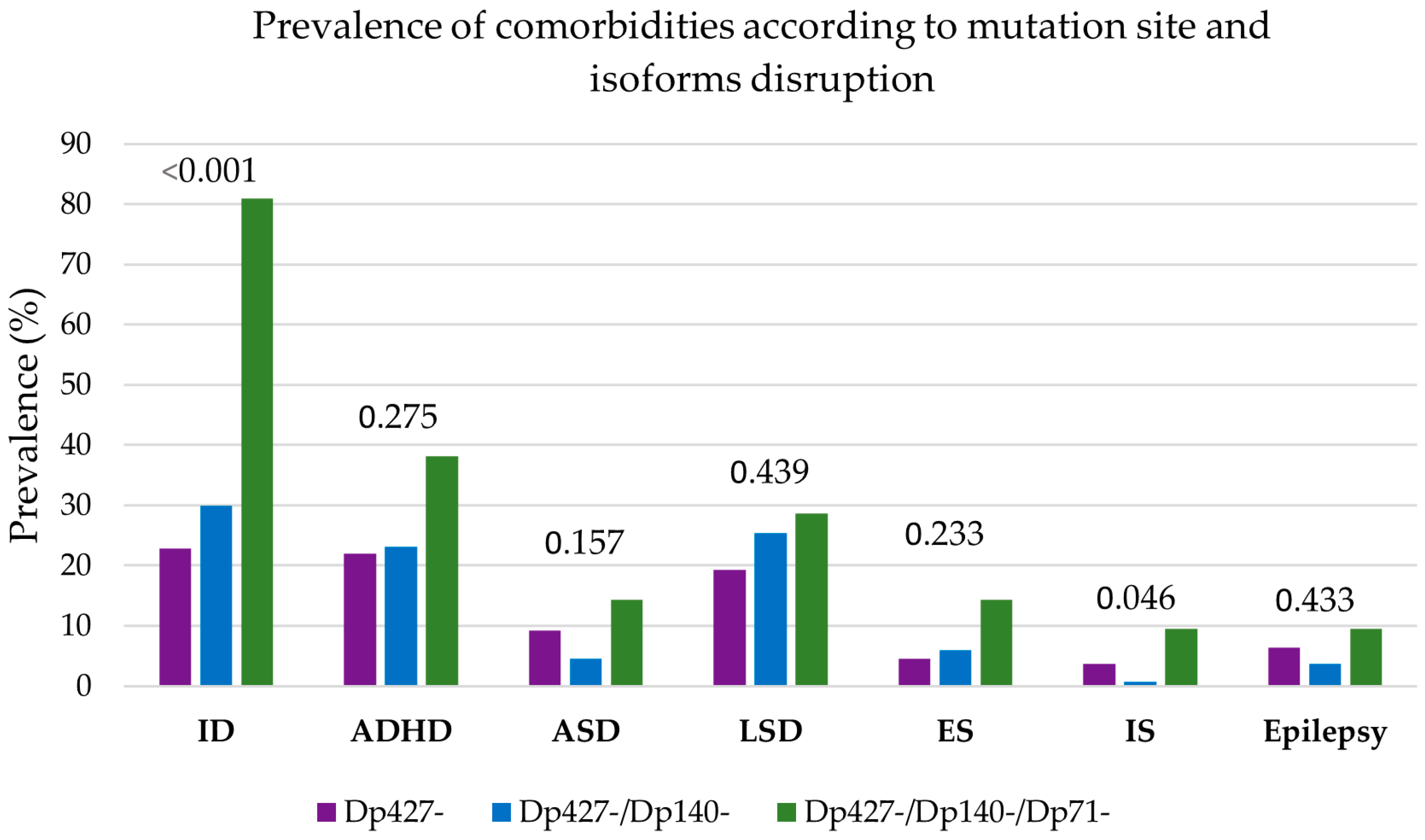
The prevalence of ID, ADHD, LSD, and ES is increasing in patients with mutations closer to the 3′ end of the gene. Nonspecific distribution pattern of prevalence was observed for ASD, IS, and epilepsy between the patients’ groups. The highest prevalence for all comorbidities was found in patients with 3′end mutations (Supplementary Table S2; Figure 3).
The analysis of prevalence distribution between the patients’ groups reached statistical significance for ID (p < 0.001) and internalizing symptoms (p = 0.046).

3.3. Functional Versus Structural Comparison and Study of Dp140 5′UTR Variants

A total of 203 patients were selected for structural versus functional analysis: 72 (35.4%) patients in groups A’ and A*, 22 (10.8%) in group B’, 53 (26.1%) in group B*, 82 (40.4%) in group C’, 43 (21.1%) in group C*, 9 (4.4%) in groups D’ and D*, 8 (3.9%) in group Y, and 18 (8.9%) in groups E’ and E*.
In this cohort of 203 patients, 66 (32.5%) presented ID, 50 (24.6%) had ADHD, 17 (8.4%) had ASD, 49 (24.1%) had language and/or speech disorders, 15 (7.4%) had externalizing and 6 (2.9%) had internalizing symptoms; 12 (5.9%) patients were diagnosed with epilepsy.
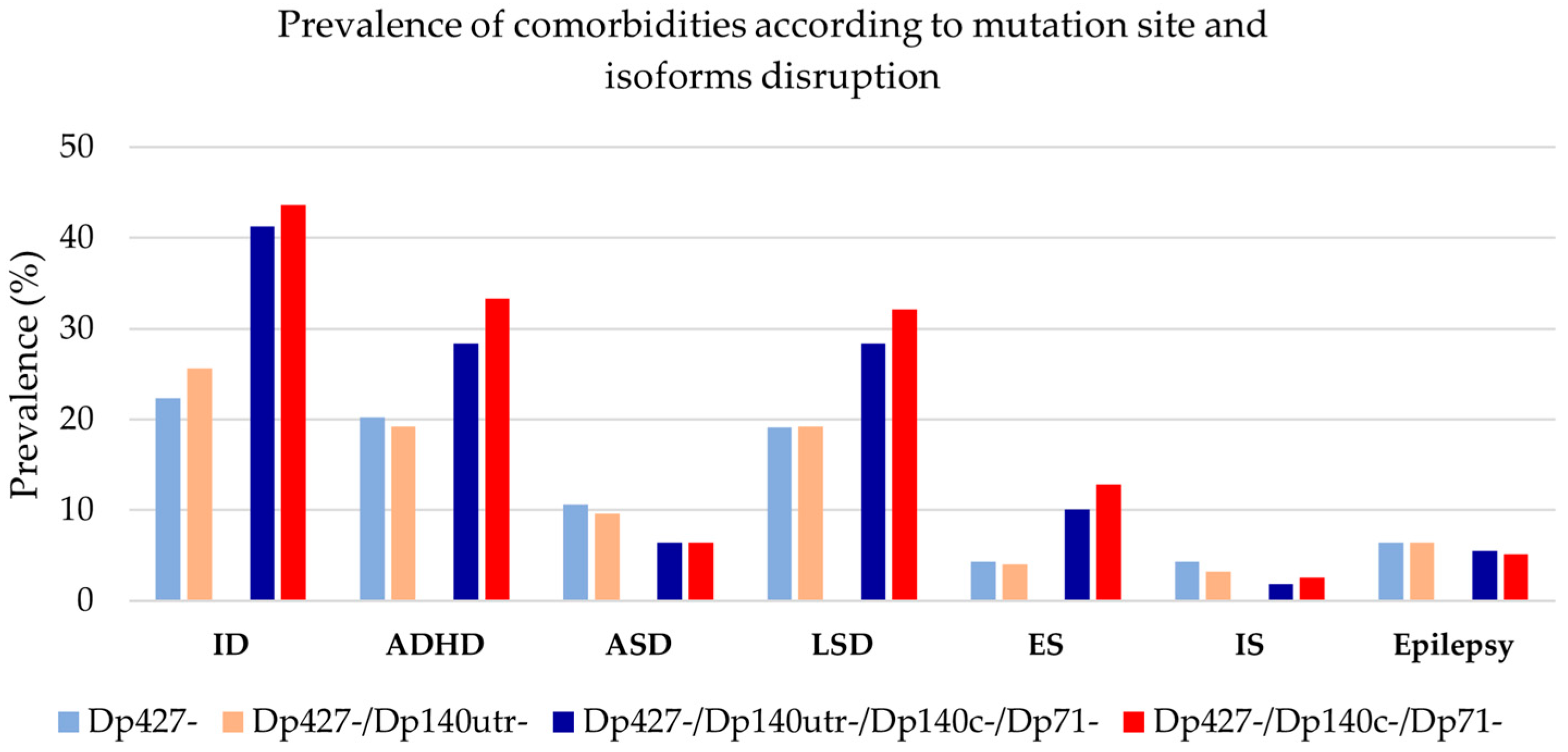
Different prevalence distribution between patients’ groups were obtained for the structural versus functional classifications (Figure 4, Supplementary Tables S3 and S4). The prevalence of ID, ADHD, LSD, ES, and IS in patients with distal mutations is higher in functional groups compared to the structural ones (Figure 4).
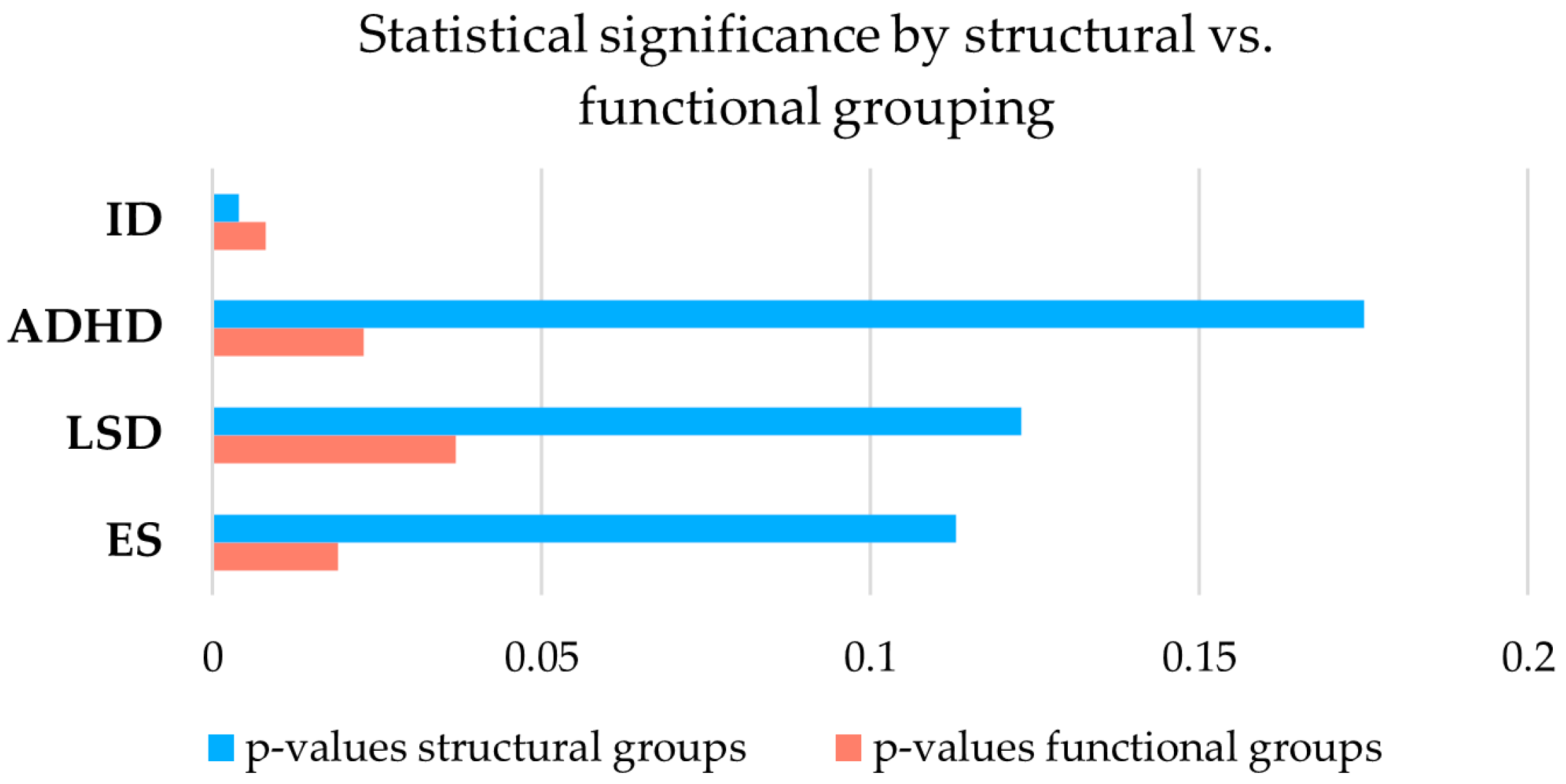
ID is the symptom that reached statistical significance for both types of classifications (structural: p = 0.004; functional: p = 0.008). The prevalence distribution of ADHD, LSD, and ES is statistically significant in the functional classification (p = 0.023, p = 0.037, p = 0.019) (Figure 5, Supplementary Tables S3 and S4).

3.4. Clustering of Neurological and Psychiatric Comorbidities

We determined the clustering of neurological and psychiatric comorbidities in our patients in relation to the site of the mutation. Most of the patients (143/264, 54.2%) presented at least one symptom and almost one third of patients (78/264, 29.5%) had at least two symptoms (Supplementary Table S5). Across the cohort, the maximum number of comorbidities per patient was five, which was observed in only one individual. The relationship between the number of symptoms and the genotype groups reached statistical significance (p = 0.027).
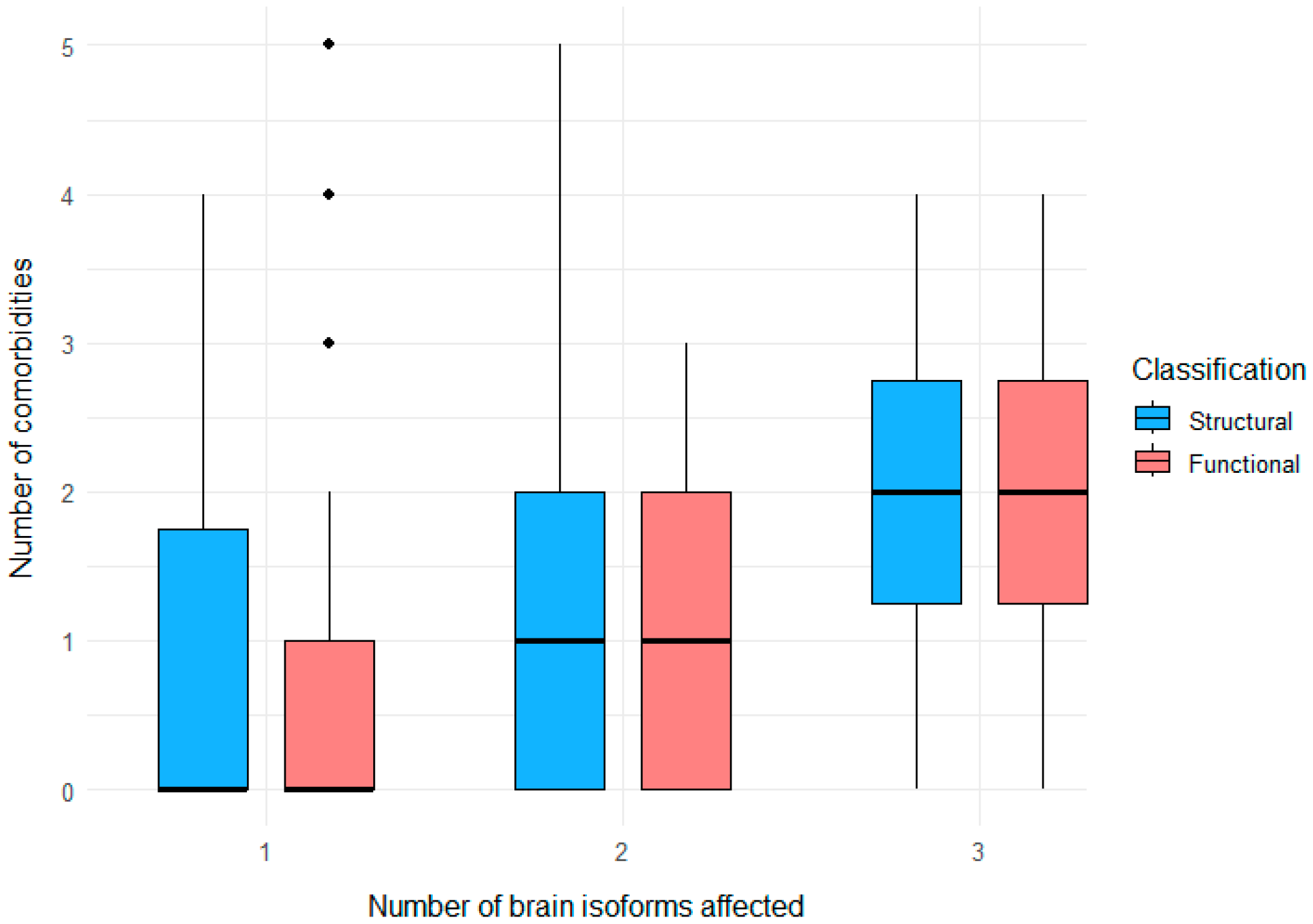
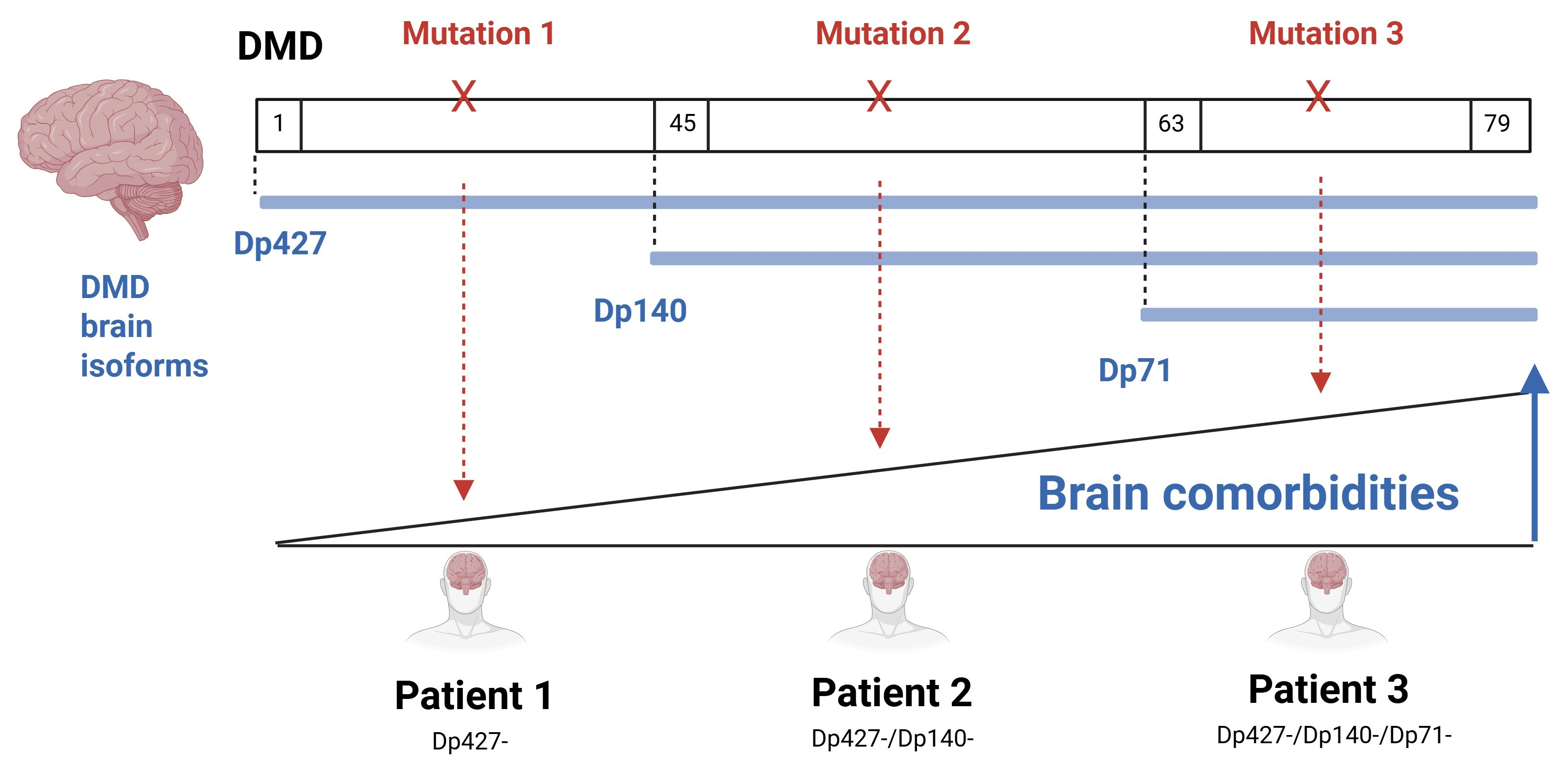
In the subset of 203 patients for whom both functional and structural classifications were available, we quantified the relationship between cumulative brain dystrophin isoform loss (1 = Dp427-; 2 = Dp427-/Dp140-; 3 = Dp427-/Dp140-/Dp71-) and the number of neuropsychiatric comorbidities per patient (range 0–5) (Figure 6). Using the functional classification, Spearman’s rank correlation showed a weak but statistically significant positive association between the number of affected brain isoforms and the number of comorbidities (ρ = 0.28, p < 0.001). The corresponding analysis based on the structural classification also revealed a significant correlation (ρ = 0.24, p < 0.001).
11 of the 14 patients with epilepsy (78.57%) presented at least one NDD symptom and 9/14 (64.2%) were diagnosed with ID. 129 from the 250 patients without epilepsy (51.6%) associated NDDs and 73/250 (29.2%) presented ID (Supplementary Table S1).
The correlation between neurological and psychiatric comorbidities was studied. A significant association was found between the following neuropsychiatric comorbidities: a. ID and ADHD (p = 0.009), ASD (p < 0.001), language and speech disorders (p < 0.001), and epilepsy (p = 0.006); b. ADHD and ASD (p < 0.001), language and speech disorders (p = 0.011), and ES (p < 0.001); c. ASD and language and speech disorders (p < 0.001); d. ES and IS (p = 0.012) (Supplementary Table S6).

3.5. Genotype–Phenotype Correlations

The phenotype in 28 groups of patients (2 to 6 patients/group) having the same variant per group was studied. The same phenotype was found in patients from 7 mutational groups. In another 7 groups, at least two patients had the same phenotype within each group. The 14 other groups included patients with either overlapping or different phenotype features (Supplementary Table S7).
Among the 11 pairs of siblings, in 7 pairs, the brothers shared the same phenotype, 2 pairs had one of the siblings presenting one more symptom, one pair had a sibling with two more symptoms and one pair of brothers presented different phenotypes (one with ID and the other presenting no symptoms) (Supplementary Table S7).

4. Discussion

It is now well recognized that DMD patients are at increased risk of developing neurological and psychiatric comorbidities. Consequently, the management of these symptoms is now integrated into the standard of care for these patients [34].
In the studied cohort of 264 patients, there is a high prevalence of intellectual disability, ADHD, language and/or speech disorders, and ASD. Similar percentages resulted from analyzing the reduced cohort of 203 patients. These results are concordant with previous studies reporting in DMD boys a prevalence ranging between 19 and 35% for ID [3,4,18,28], 24–39% for language and speech disorders [28,40], 11.7–32% for ADHD [24,25,41,42], and 3.79–21% for ASD [18,25,26,27,41,42].
A high prevalence of NDDs was found in patients from group A: 25% for ID, 18.1% for ADHD, 12.5% for ASD, and 18.1% for language and speech disorders as published in previous studies [18,28,42]. This suggests that disruption of the full-length Dp427 isoform is enough to develop neuropsychiatric comorbidities which could be explained by its high expression in in the cerebral cortex, hippocampus, amygdala, and cerebellum. Besides its structural function in central synapses, Dp427 clusters with GABAA receptors at inhibitory synapses and can intensify defensive behavior by affecting the amygdala GABAergic transmission [43,44].
Our analysis established that the prevalence of ID, ADHD, language and speech disorders increases when more dystrophin isoforms are affected, except for ASD. Similar results have been reported, supporting that additional loss of Dp140 and Dp71 isoforms in patients with variants closer to the 3′ end is associated with a higher prevalence of these comorbidities [18,19,20,28,40,45,46]. However, there is one study reporting comparable findings for ASD in patients with mutations upstream of exon 44 [41]. The involvement of Dp140 in NDDs has been linked to its high expression in glial cells during fetal life as well as in adult human brain in cerebral cortex, hippocampus, amygdala, and cerebellum [46,47]. Doorenweerd et al. reported that the cellular component associated with Dp140 is the main axon and the isoform is co-expressed with genes involved in early developmental processes such as neuron differentiation, neuron projection morphogenesis, axonal guidance, and transcription factor activity [47]. Therefore, the role of Dp140 in ND comorbidities could be explained by both the timing of its expression as well as its cellular and macroscopic localization. This role is further supported by the altered white matter microstructure [48] and the disrupted structural connectome [49] found on brain MRIs of patients lacking Dp140 isoform.
ID’s prevalence was much higher in patients from groups E (81%) and E’/E* (77.8%) compared to the other groups. This is supported by Dp71 ubiquitous expression in the fetal and adult brain [47,50], where it is involved in clustering glutamate receptors at postsynaptic densities of hippocampal neurons [51]. Additionally, it was found that Dp71 interacts with the water (AQP4) and potassium (Kir4.1) channels [43,52] in glial cells. Therefore, loss of Dp71 could lead to impaired neuronal development, due to its role in synaptic structure and function [43,51], and to altered transmembrane water permeability at the blood–brain barrier [50,51].
The prevalence of ES was 6.1% and IS—2.7%. These results are lower compared to other studies reporting 15–30% for ES [18,28] and 20–25% for IS [18,28]. The low incidence may be related to missing data from the clinic visit notes (on paper records only), even though patients received the proper care for these comorbidities.
The prevalence of epilepsy was 5.3% in the initial cohort of 264 patients and 5.9% in the reduced one. These results are in line with previous studies that reported the prevalence of epilepsy ranging between 3.1 and 12.3% [29,30,31]. A higher prevalence of NDDs was detected in patients presenting epilepsy compared to those without a diagnostic of epilepsy. These results are comparable with data reported by Hendriksen et al. [32] who proposed a triangular relationship between DMD, epilepsy, and NDDs. We are first to report a statistically significant association between epilepsy and ID (p = 0.006) in DMD patients, which was not detected in similar studies [32].
As a particular finding, two patients with epilepsy had variants downstream of exon 63; this was not reported by other studies performed on similar cohorts [31,32]. It is known that Dp427 is co-expressed with genes involved in epilepsy [47] and its expression was higher in the brain of patients with epilepsy compared to controls [53], while no difference could be observed for Dp140 and Dp71 [54]. Therefore, the association between prevalence and cumulative isoform loss observed for NDDs might not apply for epilepsy, even though the involvement of Dp71 in epileptogenesis was previously suggested [43,51,52]. It is possible that the epilepsy identified in these two patients might be due to the loss of Dp427 and not a result of Dp140 and Dp71 disruption, since all our patients presenting epilepsy had the full-length Dp427 isoform affected. Additionally, we found no significant p-value and no specific distribution of epilepsy prevalence across groups, implying that there is no correlation between mutation site and epilepsy, as suggested by a recent meta-analysis [55].
Our study analyzed brain-related comorbidities according to mutation location (structural classification) versus isoforms’ disruption (functional classification) using only variants for which the protein effect could be predicted as well as distinct grouping of Dp140 5′UTR mutations. A higher prevalence was found for ID, ADHD, LSD, and ES in patients with distal mutations included in the functional groups (5′ UTR mutations excluded) compared to the structural ones (5′UTR mutations included). Even though it is known that causative variants in 5′UTR regions can affect protein expression, our results emphasize that variants in the Dp140utr region are less likely to affect Dp140 expression and function. Although similar observations were described for ID [21,56], our study is the first to report such findings for the other comorbidities found in DMD/BMD patients. Moreover, a statistically significant difference for ADHD, LSD, and ES was obtained in the functional approach compared to the structural one. These data suggest that grouping and analyzing patients’ symptoms based on the affected isoforms, and not purely by the mutation location, is more significant and should be considered for phenotype anticipation. Additionally, we compared the cognitive phenotypes of patients carrying identical variants in Dp140 5′ UTR region, together with those already reported in the literature [21,56], but no genotype–phenotype correlation could be determined.
When analyzing the clustering of comorbidities, we found a statistically significant association between the number of isoforms affected and the number of comorbidities, which is in line with previous studies [18]. These findings indicate that patients with cumulative loss of brain dystrophin isoforms tend to present a higher neuropsychiatric burden. Additionally, this pattern was captured more strongly when patients were grouped according to the functional classification, consistent with our prevalence analyses.
The study of genotype–phenotype correlations showed that neuropsychiatric features, alone or cumulated, can vary greatly between individuals with identical variants and even between siblings. Some authors showed differences in cognitive function of unrelated males sharing the same mutation [57,58], while others observed high levels of correlation for Full-Scale Intelligence Quotient (FSIQ) in both related and unrelated subjects carrying the same DMD mutation [21]. Phenotypic variability could be explained by the co-expression networks between Dp427, Dp140, and Dp71 isoforms and genes involved in ID, NDDs, and epilepsy [47] as dystrophin isoforms might interact with these genes’ protein products. This may also explain the associations between specific comorbidities found in our study. Moreover, epigenetic factors, such as DNA methylation and histone modification, can lead to varying levels of gene expression in patients with identical variants, contributing to differences in phenotype and disease severity [59].
The limits of this study come from the retrospective design, the variable follow-up duration of patients, and the limits of the genetic investigations such as testing the integrity of promoters. For our structural versus functional approach, patients with unknown integrity of the Dp140 promoter were excluded; this introduced a bias in the statistical analysis, given that exons 45–55 represent a hotspot region for DMD deletions and duplications [60].
Despite the limitations, the strong points include the large number of participants, the advantage of a single-center study (unique practice protocol and homogeneous patients’ follow-up), and long-term monitoring.
Understanding the pathophysiology of DMD/BMD boys’ neuropsychiatric comorbidities is important not only for diagnosis, but also for the development of potential therapies. Recent studies showed that intracerebroventricular injection of the mdx mouse with exon skipping-based antisense oligonucleotides (ASOs), especially with tricycloDNA(tcDNA)-ASO, can partially restore brain dystrophin isoforms and improve some of the neuropsychiatric symptoms [61,62,63]. Moreover, tcDNA-ASO compounds were able to cross the blood–brain barrier after systemic treatment, giving the opportunity for a single drug to treat both muscle and brain phenotypes [64,65].
This is the first study that analyzes the difference between the structural-versus-functional approach on multiple neurological and psychiatric comorbidities of boys with Duchenne/Becker muscular dystrophy. To our knowledge, this is one of the largest European cohorts for which all these comorbidities were studied in association with DMD gene mutation site, and it is the first study of this kind performed on the Eastern European DMD/BMD population.

5. Conclusions

Dystrophin isoforms play a major role in brain development and function, yet a clear association between specific brain isoforms and neuropsychiatric profile remains to be established. Our study shows that patients with distal mutations, affecting additional brain isoforms, have not only higher prevalence but also a greater cumulative number of neuropsychiatric comorbidities than those with proximal variants. Conversely, we illustrate that Dp140 5′UTR variants may not affect Dp140 expression and appear to confer a lower neuropsychiatric risk than initially assumed from the classical, exon-based grouping. This emphasizes the importance of systematically documenting dystrophin isoform disruption in every patient to not only diagnose this pathology, but also to anticipate it from the perspective of quality patient care. In clinical practice, boys with distal mutations should receive structured and repeated neurological and psychiatric assessments, so that associated comorbidities can be detected early and multidisciplinary interventions can be initiated promptly, with the aim of limiting symptom progression and improving overall quality of life.

Supplementary Materials

The following supporting information can be downloaded at: https://www.mdpi.com/article/10.3390/genes17010012/s1, Table S1: Genotype and phenotype data; Table S2: Prevalence of comorbidities according to the structural classification applied for cohort of 264 patients; Table S3: Prevalence of comorbidities according to the structural classification applied for cohort of 203 patients; Table S4. Prevalence of comorbidities according to the functional classification applied for the cohort of 203 patients; Table S5: Clustering of neurological and psychiatric comorbidities in accordance with patients genotype; Table S6: Associations between NDDs, behavioural-emotional symptoms and epilepsy; Table S7: Genotype -phenotype correlations.

Author Contributions

T.B.: Conceptualization, Methodology, Investigation, Data Curation, Writing—Original Draft. R.A.T.: Investigation, Data Curation. D.C.: Supervision, Resources, Writing—Review and Editing. E.N.: Supervision, Resources, Data Curation. L.A.B.: Formal analysis. C.M.B., C.M.I., M.B., I.M., D.G.B., C.S., O.T.-A., C.P., C.M., A.D., C.A., D.S. and A.I.T.: Resources. N.B.: Supervision, Resources, Data curation. All authors have read and agreed to the published version of the manuscript.

Funding

This research received no external funding.

Institutional Review Board Statement

The study was conducted in accordance with the Declaration of Helsinki and approved by the Ethics Committee of the Prof. Dr. Alexandru Obregia Clinical Hospital of Psychiatry (Ethics approval number: #NR110; 1 February 2023) for studies involving humans.

Informed Consent Statement

Informed consent was obtained from all subjects involved in the study.

Data Availability Statement

The genetic and phenotype data presented in this study are openly available in the Leiden Open Variation Database (LOVD), DMD gene-specific database, at: https://www.LOVD.nl/DMD.

Acknowledgments

We would like to thank all the families who kindly consented to the use and publication of their data, as well as the clinicians who shared detailed phenotypic information and supported this work. Publication of this paper was supported by the University of Medicine and Pharmacy Carol Davila, through the institutional program Publish not Perish.

Conflicts of Interest

The authors declare no conflicts of interest.

References

  1. Emery, A.E. The muscular dystrophies. Lancet 2002, 359, 687–695. [Google Scholar] [CrossRef]
  2. Anderson, J.L.; Head, S.I.; Rae, C.; Morley, J.W. Brain function in Duchenne muscular dystrophy. Brain 2002, 125, 4–13. [Google Scholar] [CrossRef]
  3. Cotton, S.; Voudouris, N.J.; Greenwood, K.M. Intelligence and Duchenne muscular dystrophy: Full-scale, verbal, and performance intelligence quotients. Dev. Med. Child. Neurol. 2001, 43, 497–501. [Google Scholar] [CrossRef] [PubMed]
  4. Cotton, S.M.; Voudouris, N.J.; Greenwood, K.M. Association between intellectual functioning and age in children and young adults with Duchenne muscular dystrophy: Further results from a meta-analysis. Dev. Med. Child Neurol. 2005, 47, 257–265. [Google Scholar] [CrossRef]
  5. Duchenne de Boulogne, G.B.A. Studies on pseudohypertrophic muscular paralysis or myosclerotic paralysis. In Neurological Classics; Wilkins, R.H., Brody, I.A., Eds.; American Association of Neurological Surgeons: New York, NY, USA, 1973; pp. 60–67. [Google Scholar]
  6. Ciafaloni, E.; Fox, D.J.; Pandya, S.; Westfield, C.P.; Puzhankara, S.; Romitti, P.A.; Mathews, K.D.; Miller, T.M.; Matthews, D.J.; Miller, L.A.; et al. Delayed diagnosis in duchenne muscular dystrophy: Data from the Muscular Dystrophy Surveillance, Tracking, and Research Network (MD STARnet). J. Pediatr. 2009, 155, 380–385. [Google Scholar] [CrossRef]
  7. Koenig, M.; Hoffman, E.P.; Bertelson, C.J.; Monaco, A.P.; Feener, C.; Kunkel, L.M. Complete cloning of the Duchenne muscular dystrophy (DMD) cDNA and preliminary genomic organization of the DMD gene in normal and affected individuals. Cell 1987, 50, 509–517. [Google Scholar] [CrossRef] [PubMed]
  8. Muntoni, F.; Torelli, S.; Ferlini, A. Dystrophin and mutations: One gene, several proteins, multiple phenotypes. Lancet Neurol. 2003, 2, 731–740. [Google Scholar] [CrossRef]
  9. Lidov, H.G.; Byers, T.J.; Watkins, S.C.; Kunkel, L.M. Localization of dystrophin to postsynaptic regions of central nervous system cortical neurons. Nature 1990, 348, 725–728. [Google Scholar] [CrossRef]
  10. Lidov, H.G.; Byers, T.J.; Kunkel, L.M. The distribution of dystrophin in the murine central nervous system: An immunocytochemical study. Neuroscience 1993, 54, 167–187. [Google Scholar] [CrossRef]
  11. Chelly, J.; Hamard, G.; Koulakoff, A.; Kaplan, J.C.; Kahn, A.; Berwald-Netter, Y. Dystrophin gene transcribed from different promoters in neuronal and glial cells. Nature 1990, 344, 64–65. [Google Scholar] [CrossRef]
  12. Blake, D.J.; Weir, A.; Newey, S.E.; Davies, K.E. Function and genetics of dystrophin and dystrophin-related proteins in muscle. Physiol. Rev. 2002, 82, 291–329. [Google Scholar] [CrossRef] [PubMed]
  13. D’Souza, V.N.; Nguyen, T.M.; Morris, G.E.; Karges, W.; Pillers, D.A.; Ray, P.N. A novel dystrophin isoform is required for normal retinal electrophysiology. Hum. Mol. Genet. 1995, 4, 837–842. [Google Scholar] [CrossRef] [PubMed]
  14. Sadoulet-Puccio, H.M.; Kunkel, L.M. Dystrophin and its isoforms. Brain Pathol. 1996, 6, 25–35. [Google Scholar] [CrossRef]
  15. Bardoni, A.; Felisari, G.; Sironi, M.; Comi, G.; Lai, M.; Robotti, M.; Bresolin, N. Loss of Dp140 regulatory sequences is associated with cognitive impairment in dystrophinopathies. Neuromuscul. Disord. 2000, 10, 194–199. [Google Scholar] [CrossRef]
  16. Byers, T.J.; Lidov, H.G.; Kunkel, L.M. An alternative dystrophin transcript specific to peripheral nerve. Nat. Genet. 1993, 4, 77–81. [Google Scholar] [CrossRef]
  17. Austin, R.C.; Morris, G.E.; Howard, P.L.; Klamut, H.J.; Ray, P.N. Expression and synthesis of alternatively spliced variants of Dp71 in adult human brain. Neuromuscul. Disord. 2000, 10, 187–193. [Google Scholar] [CrossRef]
  18. Ricotti, V.; Mandy, W.P.; Scoto, M.; Pane, M.; Deconinck, N.; Messina, S.; Mercuri, E.; Skuse, D.H.; Muntoni, F. Neurodevelopmental, emotional, and behavioural problems in Duchenne muscular dystrophy in relation to underlying dystrophin gene mutations. Dev. Med. Child Neurol. 2016, 58, 77–84. [Google Scholar] [CrossRef]
  19. Moizard, M.P.; Billard, C.; Toutain, A.; Berret, F.; Marmin, N.; Moraine, C. Are Dp71 and Dp140 brain dystrophin isoforms related to cognitive impairment in Duchenne muscular dystrophy? Am. J. Med. Genet. 1998, 80, 32–41. [Google Scholar] [CrossRef]
  20. D’Angelo, M.G.; Lorusso, M.L.; Civati, F.; Comi, G.P.; Magri, F.; Del Bo, R.; Guglieri, M.; Molteni, M.; Turconi, A.C.; Bresolin, N. Neurocognitive profiles in Duchenne muscular dystrophy and gene mutation site. Pediatr. Neurol. 2011, 45, 292–299. [Google Scholar] [CrossRef]
  21. Taylor, P.J.; Betts, G.A.; Maroulis, S.; Gilissen, C.; Pedersen, R.L.; Mowat, D.R.; Johnston, H.M.; Buckley, M.F. Dystrophin gene mutation location and the risk of cognitive impairment in Duchenne muscular dystrophy. PLoS ONE 2010, 5, e8803. [Google Scholar] [CrossRef] [PubMed]
  22. Morris, G.E.; Simmons, C.; Nguyen, T.M. Apo-dystrophins (Dp140 and Dp71) and dystrophin splicing isoforms in developing brain. Biochem. Biophys. Res. Commun. 1995, 215, 361–367. [Google Scholar] [CrossRef] [PubMed]
  23. Lorusso, M.L.; Civati, F.; Molteni, M.; Turconi, A.C.; Bresolin, N.; D’Angelo, M.G. Specific profiles of neurocognitive and reading functions in a sample of 42 Italian boys with Duchenne muscular dystrophy. Child. Neuropsychol. 2013, 19, 350–369. [Google Scholar] [CrossRef]
  24. Pane, M.; Lombardo, M.E.; Alfieri, P.; D’Amico, A.; Bianco, F.; Vasco, G.; Piccini, G.; Mallardi, M.; Romeo, D.M.; Ricotti, V.; et al. Attention deficit hyperactivity disorder and cognitive function in Duchenne muscular dystrophy: Phenotype-genotype correlation. J. Pediatr. 2012, 161, 705–709.e1. [Google Scholar] [CrossRef]
  25. Hendriksen, J.G.; Vles, J.S. Neuropsychiatric disorders in males with duchenne muscular dystrophy: Frequency rate of attention-deficit hyperactivity disorder (ADHD), autism spectrum disorder, and obsessive--compulsive disorder. J. Child Neurol. 2008, 23, 477–481. [Google Scholar] [CrossRef]
  26. Hinton, V.J.; Cyrulnik, S.E.; Fee, R.J.; Batchelder, A.; Kiefel, J.M.; Goldstein, E.M.; Kaufmann, P.; De Vivo, D.C. Association of autistic spectrum disorders with dystrophinopathies. Pediatr. Neurol. 2009, 41, 339–346. [Google Scholar] [CrossRef]
  27. Wu, J.Y.; Kuban, K.C.; Allred, E.; Shapiro, F.; Darras, B.T. Association of Duchenne muscular dystrophy with autism spectrum disorder. J. Child. Neurol. 2005, 20, 790–795. [Google Scholar] [CrossRef] [PubMed]
  28. Darmahkasih, A.J.; Rybalsky, I.; Tian, C.; Shellenbarger, K.C.; Horn, P.S.; Lambert, J.T.; Wong, B.L. Neurodevelopmental, behavioral, and emotional symptoms common in Duchenne muscular dystrophy. Muscle Nerve 2020, 61, 466–474. [Google Scholar] [CrossRef]
  29. Goodwin, F.; Muntoni, F.; Dubowitz, V. Epilepsy in Duchenne and Becker muscular dystrophies. Eur. J. Paediatr. 1997, 1, 115–119. [Google Scholar] [CrossRef]
  30. Etemadifar, M.; Molaei, S. Epilepsy in boys with Duchenne Muscular Dystrophy. J. Res. Med. Sci. 2004, 3, 116–199. [Google Scholar]
  31. Pane, M.; Messina, S.; Bruno, C.; D’amico, A.; Villanova, M.; Brancalion, B.; Sivo, S.; Bianco, F.; Striano, P.; Battaglia, D.; et al. Duchenne muscular dystrophy and epilepsy. Neuromuscul. Disord. 2013, 23, 313–315. [Google Scholar] [CrossRef] [PubMed]
  32. Hendriksen, R.G.F.; Vles, J.S.H.; Aalbers, M.W.; Chin, R.F.M.; Hendriksen, J.G.M. Brain-related comorbidities in boys and men with Duchenne Muscular Dystrophy: A descriptive study. Eur. J. Paediatr. Neurol. 2018, 22, 488–497. [Google Scholar] [CrossRef]
  33. Birnkrant, D.J.; Bushby, K.; Bann, C.M.; Apkon, S.D.; Blackwell, A.; Brumbaugh, D.; Case, L.E.; Clemens, P.R.; Hadjiyannakis, S.; Pandya, S.; et al. DMD Care Considerations Working Group. Diagnosis and management of Duchenne muscular dystrophy, part 1: Diagnosis, and neuromuscular, rehabilitation, endocrine, and gastrointestinal and nutritional management. Lancet Neurol. 2018, 17, 251–267, Erratum in Lancet Neurol. 2018, 17, 495. https://doi.org/10.1016/S1474-4422(18)30125-X. [Google Scholar] [CrossRef]
  34. Birnkrant, D.J.; Bushby, K.; Bann, C.M.; Apkon, S.D.; Blackwell, A.; Colvin, M.K.; Cripe, L.; Herron, A.R.; Kennedy, A.; Kinnett, K.; et al. DMD Care Considerations Working Group. Diagnosis and management of Duchenne muscular dystrophy, part 3: Primary care, emergency management, psychosocial care, and transitions of care across the lifespan. Lancet Neurol. 2018, 17, 445–455. [Google Scholar] [CrossRef]
  35. Proposal for revised clinical and electroencephalographic classification of epileptic seizures. From the Commission on Classification and Terminology of the International League Against Epilepsy. Epilepsia 1981, 22, 489–501. [CrossRef]
  36. Fisher, R.S.; Cross, J.H.; French, J.A.; Higurashi, N.; Hirsch, E.; Jansen, F.E.; Lagae, L.; Moshé, S.L.; Peltola, J.; Roulet Perez, E.; et al. Operational classification of seizure types by the International League Against Epilepsy: Position Paper of the ILAE Commission for Classification and Terminology. Epilepsia 2017, 58, 522–530. [Google Scholar] [CrossRef] [PubMed]
  37. Scheffer, I.E.; Berkovic, S.; Capovilla, G.; Connolly, M.B.; French, J.; Guilhoto, L.; Hirsch, E.; Jain, S.; Mathern, G.W.; Moshé, S.L.; et al. ILAE classification of the epilepsies: Position paper of the ILAE Commission for Classification and Terminology. Epilepsia 2017, 58, 512–521. [Google Scholar] [CrossRef]
  38. Richards, S.; Aziz, N.; Bale, S.; Bick, D.; Das, S.; Gastier-Foster, J.; Grody, W.W.; Hegde, M.; Lyon, E.; Spector, E.; et al. Standards and guidelines for the interpretation of sequence variants: A joint consensus recommendation of the American College of Medical Genetics and Genomics and the Association for Molecular Pathology. Genet. Med. 2015, 17, 405–424. [Google Scholar] [CrossRef] [PubMed]
  39. Brandt, T.; Sack, L.M.; Arjona, D.; Tan, D.; Mei, H.; Cui, H.; Gao, H.; Bean, L.J.; Ankala, A.; Del Gaudio, D.; et al. Adapting ACMG/AMP sequence variant classification guidelines for single-gene copy number variants. Genet. Med. 2020, 22, 336–344, Erratum in Genet. Med. 2020, 22, 670–671. https://doi.org/10.1038/s41436-019-0725-5. [Google Scholar] [CrossRef]
  40. Thangarajh, M.; Hendriksen, J.; McDermott, M.P.; Martens, W.; Hart, K.A.; Griggs, R.C. Relationships between DMD mutations and neurodevelopment in dystrophinopathy. Neurology 2019, 93, e1597–e1604. [Google Scholar] [CrossRef] [PubMed]
  41. Colombo, P.; Nobile, M.; Tesei, A.; Civati, F.; Gandossini, S.; Mani, E.; Molteni, M.; Bresolin, N.; D’Angelo, G. Assessing mental health in boys with Duchenne muscular dystrophy: Emotional, behavioural and neurodevelopmental profile in an Italian clinical sample. Eur. J. Paediatr. Neurol. 2017, 21, 639–647. [Google Scholar] [CrossRef]
  42. Banihani, R.; Smile, S.; Yoon, G.; Dupuis, A.; Mosleh, M.; Snider, A.; McAdam, L. Cognitive and Neurobehavioral Profile in Boys With Duchenne Muscular Dystrophy. J. Child. Neurol. 2015, 30, 1472–1482. [Google Scholar] [CrossRef]
  43. Perronnet, C.; Vaillend, C. Dystrophins, utrophins, and associated scaffolding complexes: Role in mammalian brain and implications for therapeutic strategies. J. Biomed. Biotechnol. 2010, 2010, 849426. [Google Scholar] [CrossRef]
  44. Sekiguchi, M.; Zushida, K.; Yoshida, M.; Maekawa, M.; Kamichi, S.; Yoshida, M.; Sahara, Y.; Yuasa, S.; Takeda, S.I.; Wada, K. A deficit of brain dystrophin impairs specific amygdala GABAergic transmission and enhances defensive behaviour in mice. Brain 2009, 132, 124–135. [Google Scholar] [CrossRef]
  45. Daoud, F.; Candelario-Martinez, A.; Billard, J.M.; Avital, A.; Khelfaoui, M.; Rozenvald, Y.; Guegan, M.; Mornet, D.; Jaillard, D.; Nudel, U.; et al. Role of mental retardation-associated dystrophin-gene product Dp71 in excitatory synapse organization, synaptic plasticity and behavioral functions. PLoS ONE 2008, 4, e6574, Erratum in PLoS ONE 2010, 5. https://doi.org/10.1371/annotation/1cf456c8-c517-4f04-9e98-8f3ee3b29ce3. [Google Scholar] [CrossRef]
  46. Lidov, H.G.; Selig, S.; Kunkel, L.M. Dp140: A novel 140 kDa CNS transcript from the dystrophin locus. Hum. Mol. Genet. 1995, 4, 329–335. [Google Scholar] [CrossRef] [PubMed]
  47. Doorenweerd, N.; Mahfouz, A.; van Putten, M.; Kaliyaperumal, R.; t’Hoen, P.A.; Hendriksen, J.G.; Aartsma-Rus, A.M.; Verschuuren, J.J.; Niks, E.H.; Reinders, M.J.; et al. Timing and localization of human dystrophin isoform expression provide insights into the cognitive phenotype of Duchenne muscular dystrophy. Sci. Rep. 2017, 7, 12575. [Google Scholar] [CrossRef] [PubMed]
  48. Doorenweerd, N.; Straathof, C.S.; Dumas, E.M.; Spitali, P.; Ginjaar, I.B.; Wokke, B.H.; Schrans, D.G.; van den Bergen, J.C.; van Zwet, E.W.; Webb, A.; et al. Reduced cerebral gray matter and altered white matter in boys with Duchenne muscular dystrophy. Ann. Neurol. 2014, 76, 403–411. [Google Scholar] [CrossRef]
  49. Preethish-Kumar, V.; Shah, A.; Polavarapu, K.; Kumar, M.; Safai, A.; Vengalil, S.; Nashi, S.; Deepha, S.; Govindaraj, P.; Afsar, M.; et al. Disrupted structural connectome and neurocognitive functions in Duchenne muscular dystrophy: Classifying and subtyping based on Dp140 dystrophin isoform. J. Neurol. 2022, 269, 2113–2125. [Google Scholar] [CrossRef]
  50. Haenggi, T.; Soontornmalai, A.; Schaub, M.C.; Fritschy, J.M. The role of utrophin and Dp71 for assembly of different dystrophin-associated protein complexes (DPCs) in the choroid plexus and microvasculature of the brain. Neuroscience 2004, 129, 403–413. [Google Scholar] [CrossRef]
  51. Daoud, F.; Angeard, N.; Demerre, B.; Martie, I.; Benyaou, R.; Leturcq, F.; Cossee, M.; Deburgrave, N.; Saillour, Y.; Tuffery, S.; et al. Analysis of Dp71 contribution in the severity of mental retardation through comparison of Duchenne and Becker patients differing by mutation consequences on Dp71 expression. Hum. Mol. Genet. 2009, 18, 3779–3794. [Google Scholar] [CrossRef]
  52. Connors, N.C.; Adams, M.E.; Froehner, S.C.; Kofuji, P. The potassium channel Kir4.1 associates with the dystrophin-glycoprotein complex via alpha-syntrophin in glia. J. Biol. Chem. 2004, 279, 28387–28392. [Google Scholar] [CrossRef]
  53. Hendriksen, R.G.; Schipper, S.; Hoogland, G.; Schijns, O.E.; Dings, J.T.; Aalbers, M.W.; Vles, J.S. Dystrophin Distribution and Expression in Human and Experimental Temporal Lobe Epilepsy. Front. Cell Neurosci. 2016, 10, 174. [Google Scholar] [CrossRef]
  54. Hoogland, G.; Hendriksen, R.G.; Slegers, R.J.; Hendriks, M.P.; Schijns, O.E.; Aalbers, M.W.; Vles, J.S. The expression of the distal dystrophin isoforms Dp140 and Dp71 in the human epileptic hippocampus in relation to cognitive functioning. Hippocampus 2019, 29, 102–110. [Google Scholar] [CrossRef]
  55. Pascual-Morena, C.; Martínez-Vizcaíno, V.; Saz-Lara, A.; López-Gil, J.F.; Fernández-Bravo-Rodrigo, J.; Cavero-Redondo, I. Epileptic disorders in Becker and Duchenne muscular dystrophies: A systematic review and meta-analysis. J. Neurol. 2022, 269, 3461–3469. [Google Scholar] [CrossRef]
  56. Hoogland, G.; Hendriksen, R.G.; Slegers, R.J.; Hendriks, M.P.; Schijns, O.E.; Aalbers, M.W.; Vles, J.S. Intellectual ability in the duchenne muscular dystrophy and dystrophin gene mutation location. Balkan J. Med. Genet. 2015, 17, 25–35. [Google Scholar] [CrossRef]
  57. Bushby, K.M.; Appleton, R.; Anderson, L.V.; Welch, J.L.; Kelly, P.; Gardner-Medwin, D. Deletion status and intellectual impairment in Duchenne muscular dystrophy. Dev. Med. Child. Neurol. 1995, 37, 260–269. [Google Scholar] [CrossRef] [PubMed]
  58. Hodgson, S.V.; Abbs, S.; Clark, S.; Manzur, A.; Heckmatt, J.Z.H.; Dubowitz, V.; Bobrow, M. Correlation of clinical and deletion data in Duchenne and Becker muscular dystrophy, with special reference to mental ability. Neuromuscul. Disord. 1992, 2, 269–276. [Google Scholar] [CrossRef] [PubMed]
  59. Abdolmaleky, H.M.; Zhou, J.R.; Thiagalingam, S. Cataloging recent advances in epigenetic alterations in major mental disorders and autism. Epigenomics 2021, 13, 1231–1245. [Google Scholar] [CrossRef] [PubMed]
  60. Duan, D.; Goemans, N.; Takeda, S.; Mercuri, E.; Aartsma-Rus, A. Duchenne muscular dystrophy. Nat. Rev. Dis. Primers 2021, 7, 13. [Google Scholar] [CrossRef]
  61. Zarrouki, F.; Relizani, K.; Bizot, F.; Tensorer, T.; Garcia, L.; Vaillend, C.; Goyenvalle, A. Partial Restoration of Brain Dystrophin and Behavioral Deficits by Exon Skipping in the Muscular Dystrophy X-Linked (mdx) Mouse. Ann. Neurol. 2022, 92, 213–229. [Google Scholar] [CrossRef]
  62. Saoudi, A.; Barberat, S.; Le Coz, O.; Vacca, O.; Caquant, M.D.; Tensorer, T.; Sliwinski, E.; Garcia, L.; Muntoni, F.; Vaillend, C.; et al. Partial restoration of brain dystrophin by tricyclo-DNA antisense oligonucleotides alleviates emotional deficits in mdx52 mice. Mol. Ther. Nucleic Acids 2023, 32, 173–188. [Google Scholar] [CrossRef] [PubMed]
  63. Hashimoto, Y.; Kuniishi, H.; Sakai, K.; Fukushima, Y.; Du, X.; Yamashiro, K.; Hori, K.; Imamura, M.; Hoshino, M.; Yamada, M.; et al. Brain Dp140 alters glutamatergic transmission and social behaviour in the mdx52 mouse model of Duchenne muscular dystrophy. Prog. Neurobiol. 2022, 216, 102288. [Google Scholar] [CrossRef] [PubMed]
  64. Goyenvalle, A.; Griffith, G.; Babbs, A.; Andaloussi, S.E.; Ezzat, K.; Avril, A.; Dugovic, B.; Chaussenot, R.; Ferry, A.; Voit, T.; et al. Functional correction in mouse models of muscular dystrophy using exon-skipping tricyclo-DNA oligomers. Nat. Med. 2015, 21, 270–275. [Google Scholar] [CrossRef] [PubMed]
  65. Relizani, K.; Griffith, G.; Echevarría, L.; Zarrouki, F.; Facchinetti, P.; Vaillend, C.; Leumann, C.; Garcia, L.; Goyenvalle, A. Efficacy and Safety Profile of Tricyclo-DNA Antisense Oligonucleotides in Duchenne Muscular Dystrophy Mouse Model. Mol. Ther. Nucleic Acids 2017, 8, 144–157. [Google Scholar] [CrossRef]
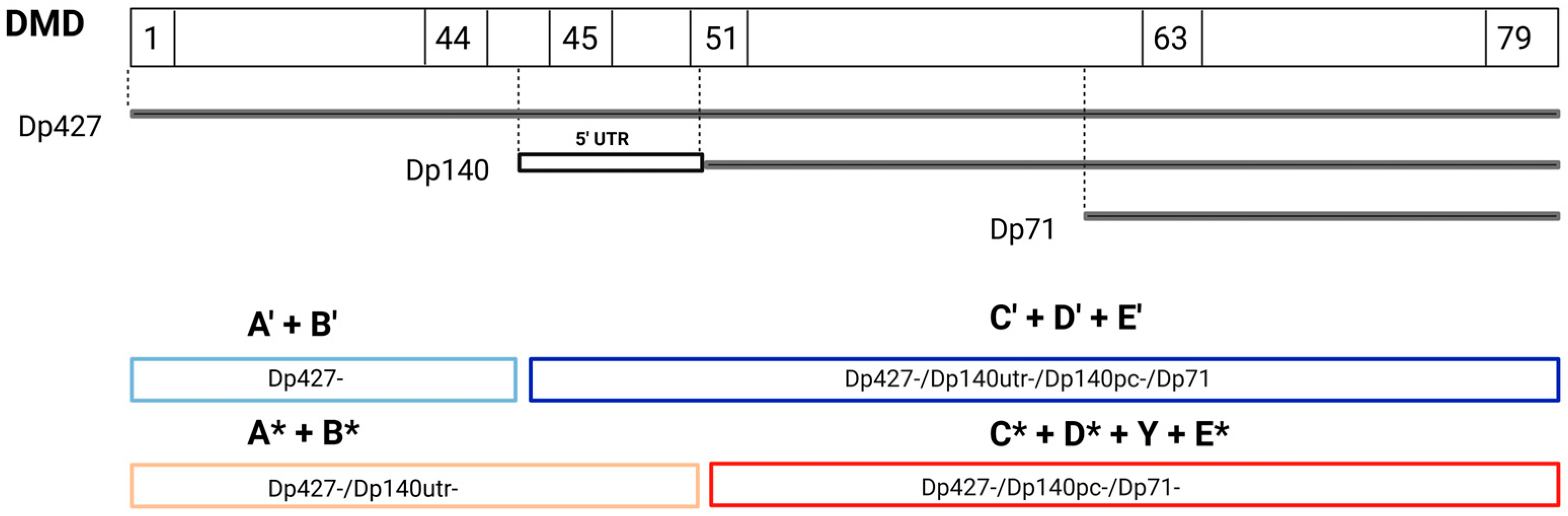
Figure 2. DMD gene, dystrophin brain isoforms, and patients groups according to structural (blue) and functional (red) classification applied for the cohort of 203 patients. Light blue: loss of Dp427 isoform (patients with variants upstream exon 44—structural groups A’ + B’), dark blue: loss of all brain isoforms (patients with variants downstream exon 45—structural groups C’ + D’ + E’), light red: loss of Dp427 (patients with variants upstream exon 44 and mutations in the Dp140 5′ UTR region—functional groups A* + B*), dark red: loss of all brain isoforms (patient with variants downstream exon 51—functional groups C* + D* + Y + E*). * = functional groups.
Genes 17 00012 g002
Figure 3. Prevalence of neuropsychiatric comorbidities for the cohort of 264 patients according to the structural classification. Purple: loss of Dp427 isoform (groups A + B), blue: loss of Dp427 and Dp140 isoforms (groups C + D), green: loss of Dp427, Dp140 and Dp71 isoforms (group E). For each comorbidity, the p-value of the global test for prevalence differences among the three isoform-loss groups (Chi-square or Fisher’s exact test) is indicated above the corresponding bars. ADHD = attention deficit hyperactive disorder, ASD = autism spectrum disorder, ES = externalizing symptoms, ID = intellectual disability, IS = internalizing symptoms, LSD = language and/or speech disorders.
Genes 17 00012 g003
Figure 4. Prevalence of neuropsychiatric comorbidities for the cohort of 203 patients according to the structural classification (blue) and functional classification (red) of mutations. In patients with distal mutations, the functional classification yields higher prevalences of ID, ADHD, LSD, ES, and IS than the structural one, supporting the relevance of brain isoform-based grouping. Light blue: loss of Dp427 isoform (structural groups A’ + B’), dark blue: loss of all brain isoforms (structural groups C’ + D’ + E’), light red: loss of Dp427 (functional groups A* + B*), dark red: loss of all brain isoforms (functional groups C* + D* + Y + E*). ADHD = attention deficit hyperactive disorder, ASD = autism spectrum disorder, ES = externalizing symptoms, ID = intellectual disability, IS = internalizing symptoms, LSD = language and/or speech disorders, utr = untranslated region (genotype groups are detailed in Figure 2).
Genes 17 00012 g004
Figure 5. p-values reflecting differences in the prevalence of four comorbidities across genotype groups according to structural (blue) and functional classification (red) in the cohort of 203 patients. The figure illustrates that except for ID, no significant prevalence differences for ADHD, LSD, and ES are observed between groups in the structural classification compared to the functional one, suggesting that the isoform-based classification is more informative for neuropsychiatric risk. ADHD = attention deficit hyperactive disorder, ES = externalizing symptoms, ID = intellectual disability, LSD = language and/or speech disorders.
Genes 17 00012 g005
Figure 6. Relationship between cumulative brain dystrophin isoform loss and neuropsychiatric comorbidity burden for the cohort of 203 patients. Boxplots show the distribution of the total number of neuropsychiatric comorbidities per patient according to the number of affected brain isoforms (1, 2, or 3). Structural groups are shown in blue and functional groups in red. Boxes indicate the median and interquartile range (IQR), whiskers extend to 1.5 × IQR, and dots represent outliers. Patients with two and three affected brain isoforms have higher median comorbidity counts than those with only one affected isoform, in line with the significant positive Spearman correlations observed.
Genes 17 00012 g006
Disclaimer/Publisher’s Note: The statements, opinions and data contained in all publications are solely those of the individual author(s) and contributor(s) and not of MDPI and/or the editor(s). MDPI and/or the editor(s) disclaim responsibility for any injury to people or property resulting from any ideas, methods, instructions or products referred to in the content.