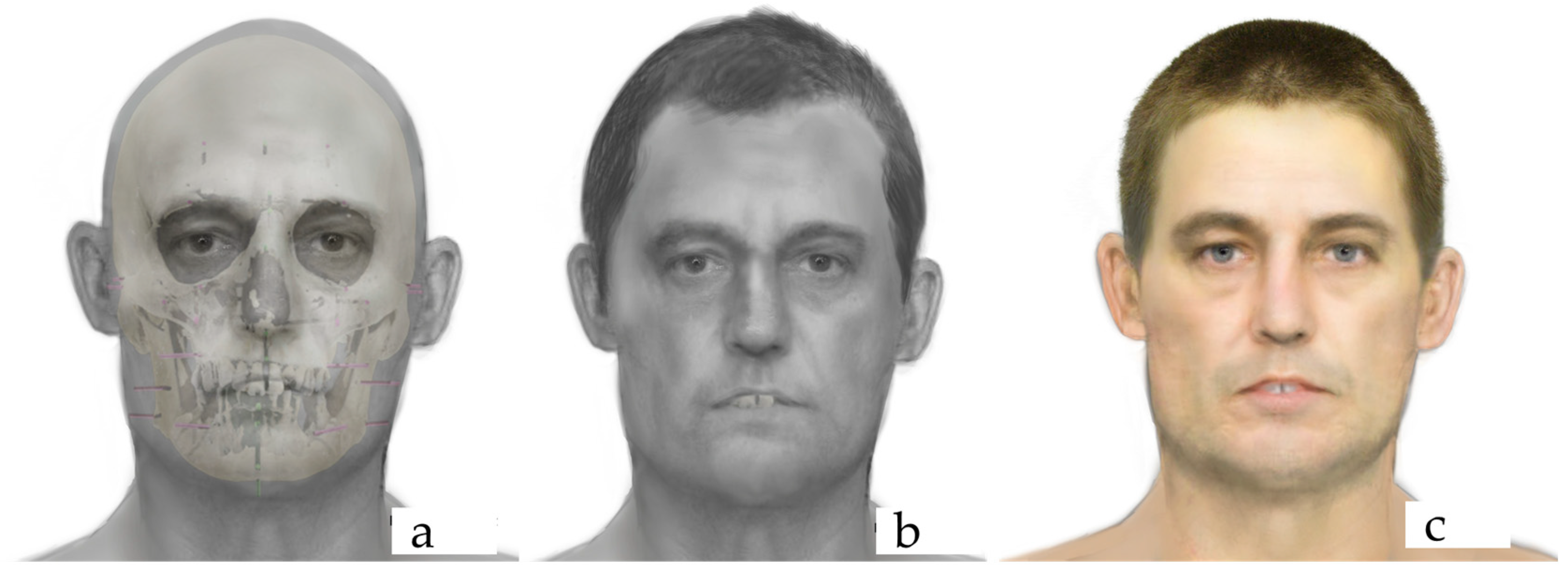

Facing the Unknown: Integration of Skeletal Traits, Genetic Information and Forensic Facial Approximation




Abstract
1. Introduction
2. Methods and Materials
2.1. Samples
2.2. Anthropological Analysis
2.3. Bone Samples for DNA Analysis
2.4. Facial Approximation
2.5. DNA Isolation from Bone Samples
2.6. DNA Quantification
2.7. Hair and Eye Color Genotyping System Protocol
2.8. Skin Color Genotyping System Protocol
2.9. Hair, Eye and Skin Color Prediction
3. Results
3.1. Biological Profile
3.2. Phenotyping Predictions
3.3. Facial Approximation Integration
4. Discussion
5. Conclusions
Author Contributions
Funding
Institutional Review Board Statement
Informed Consent Statement
Data Availability Statement
Acknowledgments
Conflicts of Interest
Ethical Statement
References
- Hefner, J.T. Cranial nonmetric variation and estimating ancestry. J. Forensic Sci. 2009, 54, 985–995. [Google Scholar] [CrossRef] [PubMed]
- Hefner, J.T.; Ousley, S.D. Statistical classification methods for estimating ancestry using morphoscopic traits. J. Forensic Sci. 2014, 59, 883–890. [Google Scholar] [CrossRef] [PubMed]
- Ousley, S.D.; Jantz, R.L. Fordisc: A Computer Program for Forensic Anthropology; University of Tennessee: Knoxville, TN, USA, 1996. [Google Scholar]
- Phenice, T.W. A newly developed visual method of sexing the os pubis. Am. J. Phys. Anthropol. 1969, 30, 297–301. [Google Scholar] [CrossRef] [PubMed]
- Klales, A.R.; Ousley, S.D.; Vollner, J.M. A revised method of sexing the human innominate using Phenice’s nonmetric traits and statistical methods. Am. J. Phys. Anthropol. 2012, 149, 104–114. [Google Scholar] [CrossRef] [PubMed]
- Walker, P.L. Sexing skulls using discriminant function analysis of visually assessed traits. Am. J. Phys. Anthropol. 2008, 136, 39–50. [Google Scholar] [CrossRef] [PubMed]
- Klales, A.R.; Cole, S.J. MorphoPASSE: Morphological Pelvis and Skull Sex Estimation. In Sex Estimation of the Human Skeleton; Academic Press: Cambridge, MA, USA, 2018. [Google Scholar]
- Brooks, S.; Suchey, J.M. Skeletal age determination based on the os pubis: A comparison of the Acsádi-Nemeskéri and Suchey-Brooks methods. Hum. Evol. 1990, 5, 227–238. [Google Scholar] [CrossRef]
- Lovejoy, C.O.; Meindl, R.S.; Pryzbeck, T.R.; Mensforth, R.P. Chronological metamorphosis of the auricular surface of the ilium: A new method for the determination of adult skeletal age at death. Am. J. Phys. Anthropol. 1985, 68, 15–28. [Google Scholar] [CrossRef] [PubMed]
- Meindl, R.S.; Lovejoy, C.O. Ectocranial suture closure: A revised method for the determination of skeletal age at death based on the lateral-anterior sutures. Am. J. Phys. Anthropol. 1985, 68, 57. [Google Scholar] [CrossRef]
- Nawrocki, S.P. Regression formulae for the estimation of age from cranial suture closure. In Forensic Osteology: Advances in the Identification of Human Remains, 2nd ed.; Reichs, K.J., Ed.; CC Thomas: Springfield, IL, USA, 1998; pp. 276–292. [Google Scholar]
- Adserias-Garriga, J.; Wilson-Taylor, R. Chapter 5: Skeletal age estimation in adults. In Age Estimation; Adserias-Garriga, J., Ed.; Academic Press: Cambridge, MA, USA, 2019; pp. 55–73. ISBN 9780128144916. [Google Scholar] [CrossRef]
- Iscan, M.Y.; Loth, S.R.; Wright, R.K. Age estimation from the rib by phase analysis: White males. J. Forensic Sci. 1984, 29, 1094–1104. [Google Scholar] [CrossRef] [PubMed]
- Iscan, M.Y.; Loth, S.R.; Wright, R.K. Age estimation from the rib by phase analysis: White females. J. Forensic Sci. 1985, 30, 853–863. [Google Scholar] [CrossRef] [PubMed]
- Hartnett, K.M. Analysis of age-at-death estimation using data from a new, modern autopsy sample—Part II: Sternal end of the fourth rib. J. Forensic Sci. 2010, 55, 1152–1156. [Google Scholar] [CrossRef] [PubMed]
- Hartnett, K.M. Analysis of age-at-death estimation using data from a new, modern autopsy sample—Part I: Pubic bone. J. Forensic Sci. 2010, 55, 1145–1151. [Google Scholar] [CrossRef] [PubMed]
- Molina, J.; Denny, T. Standardization Challenges in Forensic Art [Review of Standardization Challenges in Forensic Art]. ID News 2024, 54, 8–9. [Google Scholar]
- Hartman, D.; Drummer, O.; Eckhoff, C.; Scheffer, J.W.; Stringer, P. The contribution of DNA to the disaster victim identification (DVI) effort. Forensic. Sci. Int. 2011, 205, 52–58. [Google Scholar] [CrossRef] [PubMed]
- Hofreiter, M.; Serre, D.; Poinar, H.N.; Kuch, M.; Paabo, S. Ancient DNA. Nat. Rev. Genet. 2001, 2, 353–359. [Google Scholar] [CrossRef] [PubMed]
- Chaitanya, L.; Pajnic, I.Z.; Walsh, S.; Balazic, J.; Zupanc, T.; Kayser, M. Bringing colour back after 70 years: Predicting eye and hair colour from skeletal remains of World War II victims using the HIrisPlex system. Forensic Sci. Int. Genet. 2017, 26, 48–57. [Google Scholar] [CrossRef] [PubMed]
- Ossowski, A.; Kus, M.; Brzezinski, P.; Pruffer, J.; Piatek, J.; Zielinska, G.; Bykowska, M.; Jalowinska, K.; Torgaszev, A.; Skoryukov, A.; et al. Example of human individual identification from World War II gravesite. Forensic. Sci. Int. 2013, 233, 179–192. [Google Scholar] [CrossRef] [PubMed]
- Terrado-Ortuno, N.; May, P. Forensic DNA phenotyping: A review on SNP panels, genotyping techniques, and prediction models. Forensic. Sci. Res. 2025, 10, owae013. [Google Scholar] [CrossRef] [PubMed] [PubMed Central]
- Sobrino, B.; Brion, M.; Carracedo, A. SNPs in forensic genetics: A review on SNP typing methodologies. Forensic. Sci. Int. 2005, 154, 181–194. [Google Scholar] [CrossRef] [PubMed]
- Sobrino, B.; Carracedo, A. SNP typing in forensic genetics: A review. Methods Mol. Biol. 2005, 297, 107–126. [Google Scholar] [CrossRef] [PubMed]
- Budowle, B. SNP typing strategies. Forensic. Sci. Int. 2004, 146, S139–S142. [Google Scholar] [CrossRef] [PubMed]
- Chaitanya, L.; Breslin, K.; Zuniga, S.; Wirken, L.; Pospiech, E.; Kukla-Bartoszek, M.; Sijen, T.; Knijff, P.; Liu, F.; Branicki, W.; et al. The HIrisPlex-S system for eye, hair and skin colour prediction from DNA: Introduction and forensic developmental validation. Forensic. Sci. Int. Genet. 2018, 35, 123–135. [Google Scholar] [CrossRef] [PubMed]
- de la Puente, M.; Santos, C.; Fondevila, M.; Manzo, L.; Consortium, E.U.-N.; Carracedo, A.; Lareu, M.V.; Phillips, C. The Global AIMs Nano set: A 31-plex SNaPshot assay of ancestry-informative SNPs. Forensic Sci. Int. Genet. 2016, 22, 81–88. [Google Scholar] [CrossRef] [PubMed]
- Watherston, J.; McNevin, D.; Gahan, M.E.; Bruce, D.; Ward, J. Current and emerging tools for the recovery of genetic information from post mortem samples: New directions for disaster victim identification. Forensic Sci. Int. Genet. 2018, 37, 270–282. [Google Scholar] [CrossRef] [PubMed]
- Ousley, S.D.; Jantz, R.L. Fordisc 3 and Statistical Methods for Estimating Sex and Ancestry. In A Companion to Forensic Anthropology; Dirkmaat, D.C., Ed.; Blackwell Publishing: Hoboken, NJ, USA, 2012. [Google Scholar]
- Boldsen, J.L.; Milner, G.R.; Hylleberg, R. ADBOU Age Estimation Software. Version 2.0. 2002.
- Boldsen, J.L.; Milner, G.R.; Konigsberg, L.; Wood, J. Transition analysis: A new method for estimating age from skeleton. In Paleodemography: Age Distributions from Skeletal Samples; Hoppa, R., Vaupel, J.W., Eds.; Cambridge University Press: Cambridge, UK, 2002. [Google Scholar]
- Taylor, K. Forensic Art & Illustration; CRC Press: Boca Raton, FL, USA, 2000. [Google Scholar]
- Stephan, C.N.; Henneberg, M.; Sampson, W. Predicting nose projection and pronasale position in facial approximation: A test of published methods and proposal of new guidelines. Am. J. Phys. Anthropol. 2003, 122, 240–250. [Google Scholar] [CrossRef] [PubMed]
- Walsh, S.; Liu, F.; Wollstein, A.; Kovatsi, L.; Ralf, A.; Kosiniak-Kamysz, A.; Branicki, W.; Kayser, M. The HIrisPlex system for simultaneous prediction of hair and eye colour from DNA. Forensic. Sci. Int. Genet. 2013, 7, 98–115. [Google Scholar] [CrossRef] [PubMed]
- Walsh, S.; Liu, F.; Ballantyne, K.N.; van Oven, M.; Lao, O.; Kayser, M. IrisPlex: A sensitive DNA tool for accurate prediction of blue and brown eye colour in the absence of ancestry information. Forensic. Sci. Int. Genet. 2011, 5, 170–180. [Google Scholar] [CrossRef] [PubMed]
- Walsh, S.; Chaitanya, L.; Clarisse, L.; Wirken, L.; Draus-Barini, J.; Kovatsi, L.; Maeda, H.; Ishikawa, T.; Sijen, T.; de Knijff, P.; et al. Developmental validation of the HIrisPlex system: DNA-based eye and hair colour prediction for forensic and anthropological usage. Forensic Sci. Int. Genet. 2014, 9, 150–161. [Google Scholar] [CrossRef] [PubMed]
- Fabbri, M.; Alfieri, L.; Mazdai, L.; Frisoni, P.; Gaudio, R.M.; Neri, M. Application of Forensic DNA Phenotyping for Prediction of Eye, Hair and Skin Colour in Highly Decomposed Bodies. Healthcare 2023, 11, 647. [Google Scholar] [CrossRef] [PubMed] [PubMed Central]
- Chaitanya, L.; Walsh, S.; Andersen, J.D.; Ansell, R.; Ballantyne, K.; Ballard, D.; Banemann, R.; Bauer, C.M.; Bento, A.M.; Brisighelli, F.; et al. Collaborative EDNAP exercise on the IrisPlex system for DNA-based prediction of human eye colour. Forensic Sci. Int. Genet. 2014, 11, 241–251. [Google Scholar] [CrossRef] [PubMed]
- Walsh, S.; Wollstein, A.; Liu, F.; Chakravarthy, U.; Rahu, M.; Seland, J.H.; Soubrane, G.; Tomazzoli, L.; Topouzis, F.; Vingerling, J.R.; et al. DNA-based eye colour prediction across Europe with the IrisPlex system. Forensic Sci. Int. Genet. 2012, 6, 330–340. [Google Scholar] [CrossRef] [PubMed]
- Palmal, S.; Adhikari, K.; Mendoza-Revilla, J.; Fuentes-Guajardo, M.; Silva de Cerqueira, C.C.; Bonfante, B.; Chacon-Duque, J.C.; Sohail, A.; Hurtado, M.; Villegas, V.; et al. Prediction of eye, hair and skin colour in Latin Americans. Forensic Sci. Int. Genet. 2021, 53, 102517. [Google Scholar] [CrossRef] [PubMed]
- Melchionda, F.; Silvestrini, B.; Robino, C.; Bini, C.; Fattorini, P.; Martinez-Labarga, C.; De Angelis, F.; Tagliabracci, A.; Turchi, C. Development and Validation of MPS-Based System for Human Appearance Prediction in Challenging Forensic Samples. Genes 2022, 13, 1688. [Google Scholar] [CrossRef] [PubMed] [PubMed Central]
- Zupanic Pajnic, I.; Zupanc, T.; Leskovar, T.; Cresnar, M.; Fattorini, P. Eye and Hair Color Prediction of Ancient and Second World War Skeletal Remains Using a Forensic PCR-MPS Approach. Genes 2022, 13, 1432. [Google Scholar] [CrossRef] [PubMed] [PubMed Central]
- Breslin, K.; Wills, B.; Ralf, A.; Ventayol Garcia, M.; Kukla-Bartoszek, M.; Pospiech, E.; Freire-Aradas, A.; Xavier, C.; Ingold, S.; de La Puente, M.; et al. HIrisPlex-S system for eye, hair, and skin color prediction from DNA: Massively parallel sequencing solutions for two common forensically used platforms. Forensic Sci. Int. Genet. 2019, 43, 102152. [Google Scholar] [CrossRef] [PubMed]
- Diepenbroek, M.; Bayer, B.; Anslinger, K. Phenotype predictions of two-person mixture using single cell analysis. Forensic Sci. Int. Genet. 2023, 67, 102938. [Google Scholar] [CrossRef] [PubMed]
- Sapan, V.; Simsek, S.Z.; Filoglu, G.; Bulbul, O. Forensic DNA phenotyping using Oxford Nanopore Sequencing system. Electrophoresis 2025, 46, 198–211. [Google Scholar] [CrossRef] [PubMed] [PubMed Central]
- Ragazzo, M.; Puleri, G.; Errichiello, V.; Manzo, L.; Luzzi, L.; Potenza, S.; Strafella, C.; Peconi, C.; Nicastro, F.; Caputo, V.; et al. Evaluation of OpenArray as a Genotyping Method for Forensic DNA Phenotyping and Human Identification. Genes 2021, 12, 221. [Google Scholar] [CrossRef] [PubMed] [PubMed Central]
- Xavier, C.; de la Puente, M.; Mosquera-Miguel, A.; Freire-Aradas, A.; Kalamara, V.; Vidaki, A.; Gross, T.E.; Revoir, A.; Pospiech, E.; Kartasinska, E.; et al. Development and validation of the VISAGE AmpliSeq basic tool to predict appearance and ancestry from DNA. Forensic Sci. Int. Genet. 2020, 48, 102336. [Google Scholar] [CrossRef] [PubMed]
- Jager, A.C.; Alvarez, M.L.; Davis, C.P.; Guzman, E.; Han, Y.; Way, L.; Walichiewicz, P.; Silva, D.; Pham, N.; Caves, G.; et al. Developmental validation of the MiSeq FGx Forensic Genomics System for Targeted Next Generation Sequencing in Forensic DNA Casework and Database Laboratories. Forensic Sci. Int. Genet. 2017, 28, 52–70. [Google Scholar] [CrossRef] [PubMed]
- Draus-Barini, J.; Walsh, S.; Pospiech, E.; Kupiec, T.; Glab, H.; Branicki, W.; Kayser, M. Bona fide colour: DNA prediction of human eye and hair colour from ancient and contemporary skeletal remains. Investig. Genet. 2013, 4, 3. [Google Scholar] [CrossRef] [PubMed] [PubMed Central]
- King, T.E.; Fortes, G.G.; Balaresque, P.; Thomas, M.G.; Balding, D.; Maisano Delser, P.; Neumann, R.; Parson, W.; Knapp, M.; Walsh, S.; et al. Identification of the remains of King Richard III. Nat. Commun. 2014, 5, 5631. [Google Scholar] [CrossRef] [PubMed] [PubMed Central]


| Assay Position | PCR Primers | Sequence | Concentration | Product Size | SBE Primers | Gene | HIrisPlex Model Input | Sequence | Concentration |
|---|---|---|---|---|---|---|---|---|---|
| 1 | MC1Rset1F | GCAGGGATCCCAGAGAAGAC | 0.55 μm | 117 bp | N29insA | MC1R | C/insA | CCCCAGCTGGGGCTGGCTGCCAA | 1.3 μm |
| 2 | MC1Rset1R | TCAGAGATGGACACCTCCAG | 0.55 μm | rs11547464 | MC1R | G/A | ttttttttttttGCCATCGCCGTGGACC | 0.1 μm | |
| 3 | MC1Rset2F | CTGGTGAGCTTGGTGGAGA | 0.5 μm | 158 bp | rs885479 | MC1R | C/T | ttttttttttttttttttGATGGCCGCAACGGCT | 1.25 μm |
| 4 | MC1Rset2F | TCCAGCAGGAGGATGACG | 0.5 μm | rs1805008 | MC1R | C/T | tttttttttttttACAGCATCGTGACCCTGCCG | 0.375 μm | |
| 5 | MC1Rset3F | GTCCAGCCTCTGCTTCCTG | 0.5 μm | 147 bp | rs1805005 | MC1R | G/T | tttttttttttttttTGGTGGAGAACGCGCTGGTG | 0.75 μm |
| 6 | MC1Rset3R | AGCGTGCTGAAGACGACAC | 0.5 μm | rs1805006 | MC1R | C/A | ttttttttttttttttttttCTGCCTGGCCTTGTCGGA | 0.75 μm | |
| 7 | MC1Rset4F | CAAGAACTTCAACCTCTTTCTCG | 0.4 μm | 106 bp | rs1805007 | MC1R | C/T | tttttttttttttttttttttttttCTCCATCTTCTACGCACTG | 1 μm |
| 8 | MC1Rset4R | CACCTCCTTGAGCGTCCTG | 0.4 μm | rs1805009 | MC1R | G/C | ttttttttttttttttttttttttttttttATCTGCAATGCCATCATC | 0.4 μm | |
| 9 | 0.4 μm | Y152OCH | MC1R | C/A | ttttttttttttttttttttttttttttttCATCTTCTACGCACTGCGCTA | 0.6 μm | |||
| 10 | 0.4 μm | rs2228479 | MC1R | G/A | ttttttttttttttttttttttttttttttttttttCTGGTGAGCGGGAGCAAC | 0.375 μm | |||
| 11 | 0.4 μm | rs1110400 | MC1R | T/C | ttttttttttttttttttttttttttttttCTTCTACGCACTGCGCTACCACAGCA | ||||
| 12 | rs28777_F | TACTCGTGTGGGAGTTCCAT | 0.4 μm | 150 bp | rs28777 | SLC45A2 | A/C | tttttttttttttttttttttttttttttttttttttttCATGTGATCCTCACAGCAG | 0.3 μm |
| rs28777_R | TCTTTGATGTCCCCTTCGAT | 0.4 μm | |||||||
| 13 | Rs16891982_F | TCCAAGTTGTGCTAGACCAGA | 0.4 μm | 128 bp | rs16891982 | SLC45A2 | G/C | ttttttttttttttttttttttttttttttttttttttttttttAAACACGGAGTTGATGCA | 1.2 μm |
| Rs16891982_R | CGAAAGAGGAGTCGAGGTTG | 0.4 μm | |||||||
| 14 | rs12821256_F | ATGCCCAAAGGATAAGGAAT | 0.4 μm | 118 bp | rs12821256 | KITLG | A/G | tttttttttttttttttttttttttttttttttttttttGGAGCCAAGGGCATGTTACTACGGCAC | 1 μm |
| rs12821256_R | GGAGCCAAGGGCATGTTACT | 0.4 μm | |||||||
| 15 | Rs4959270_F | TGAGAAATCTACCCCCACGA | 0.4 μm | 140 bp | rs4959270 | EXOC2 | C/A | tttttttttttttttttttttttttttttttttttttttttGGAACACATCCAAACTATGACACTATG | 0.375 μm |
| Rs4959270_R | GTGTTCTTACCCCCTGTGGA | 0.4 μm | |||||||
| 16 | rs12203592_F | AGGGCAGCTGATCTCTTCAG | 0.4 μm | 126 bp | rs12203592 | IRF4 | C/T | tttttttttttttttttttttttttttttttttttttttttttttTCCACTTTGGTGGGTAAAAGAAGG | 0.3 μm |
| rs12203592_R | GCTTCGTCATATGGCTAAACCT | 0.4 μm | |||||||
| 17 | rs1042602_F | CAACACCCATGTTTAACGACA | 0.4 μm | 124 bp | rs1042602 | TYR | G/T | ttttttttttttttttttttttttttttttttttttttttttttttttttttTCAATGTCTCTCCAGATTTCA | 1.25 μm |
| rs1042602_R | GCTTCATGGGCAAAATCAAT | 0.4 μm | |||||||
| 18 | rs1800407_F | AAGGCTGCCTCTGTTCTACG | 0.4 μm | 124 bp | rs1800407 | OCA2 | G/A | tttttttttttttttttttttttttttttttttttttttttttttttttttttttttttttGCATACCGGCTCTCCC | 0.1 μm |
| rs1800407_R | CGATGAGACAGAGCATGATGA | 0.4 μm | |||||||
| 19 | rs2402130_F | ACCTGTCTCACAGTGCTGCT | 0.4 μm | 150 bp | rs2402130 | SLC24A4 | A/G | ttttttttttttttttttttttttttttttttttttttttttttttttttttttttttttTGAACCATACGGAGCCCGTG | 0.75 μm |
| rs2402130_R | TTCACCTCGATGACGATGAT | 0.4 μm | |||||||
| 20 | rs12913832_F | TCAACATCAGGGTAAAAATCATGT | 0.4 μm | 150 bp | rs12913832 | HERC2 | C/T | ttttttttttttttttttttttttttttttttttttttttttttttttttttttttttttttttTAGCGTGCAGAACTTGACA | 1.2 μm |
| rs12913832_R | GGCCCCTGATGATGATAGC | 0.4 μm | |||||||
| 21 | rs2378249_F | CGCATAACCCATCCCTCTAA | 0.4 μm | 136 bp | rs2378249 | ASIP/PIGU | T/C | ttttttttttttttttttttttttttttttttttttttttttttttttttttttttttttttttttCCACACCTCTCCTCAGCCCA | 0.18 μm |
| rs2378249_R | CATTGCTTTTCAGCCCACAC | 0.4 μm | |||||||
| 22 | Rs12896399_F | CTGGCGATCCAATTCTTTGT | 0.4 μm | 125 bp | rs12896399 | SLC24A4 | T/G | tttttttttttttttttttttttttttttttttttttttttttttttttttttttttttttttttTCTTTAGGTCAGTATATTTTGGG | 1.125 μm |
| Rs12896399_R | GACCCTGTGTGAGACCCAGT | 0.4 μm | |||||||
| 23 | Rs1393350_F | TTTCTTTATCCCCCTGATGC | 0.4 μm | 124 bp | rs1393350 | TYR | C/T | tttttttttttttttttttttttttttttttttttttttttttttttttttttttttttttttttttCATTTGTAAAAGACCACACAGATTT | 1.1 μm |
| Rs1393350_R | GGGAAGGTGAATGATAACACG | 0.4 μm | |||||||
| 24 | rs683_F | CACAAAACCACCTGTTGAA | 0.4 μm | 138 bp | rs683 | TYRP1 | T/G | ttttttttttttttttttttttttttttttttttttttttttttttttttttttttttttttttttGCTTTGAAAAGTATGCCTAGAACTTTAAT | 0.175 μm |
| rs683_R | TGAAAGGGTCTTCCCAGTT | 0.4 μm |
| Assay Position | PCR Primers | Sequence | Concentration | Product Size | SBE Primers | Gene | HPS Model Input | Sequence | Bases | Concentration |
|---|---|---|---|---|---|---|---|---|---|---|
| 1 | rs3114908_F | CAGAACACAGCCACACCCTA | 0.4 μm | 118 bp | rs3114908_R | ANKRD11 | C/T | TTT TTT TTT TAG AGA AGG GTC AAG CAC TT | 29 | 0.12 μm |
| rs3114908_R | CATAAAGGGGTCACCAGCAA | 0.4 μm | ||||||||
| 2 | rs1800414_F | GCTGCAGGAGTCAGAAGGTT | 0.4 μm | 145 bp | rs1800414_R | OCA2 | T/C | TTT TTT TTT TTC AGA ATC CCG TCA GAT ATC CTA | 43 | 0.2 μm |
| rs1800414_R | GGGACAAACGAATTGAGGAA | 0.4 μm | ||||||||
| 3 | rs10756819_F | AAAGCAAGCTCATGTTTCCA | 0.4 μm | 145 bp | rs10756819_F | BNC2 | A/G | TTTTTTTTTTTTGGACCAGTTATTTTGGGTTTGGA | 35 | 1.7 μm |
| rs10756819_R | CGTCATGACTAGAAAAACACCAA | 0.4 μm | ||||||||
| 4 | rs2238289_F | GGAACATGAAGATTTCCCAGT | 0.4 μm | 112 bp | rs2238289_F | HERC2 | C/T | TTT TTT TTT TTT TTT TTT TTG AGA TTG GAA GAT TGG AGC C | 53 | 0.5 μm |
| rs2238289_R | CTGATTCAGGTCTGCTGTCACT | 0.4 μm | ||||||||
| 5 | rs17128291_F | CCAGCACTGCCAAAATAACA | 0.4 μm | 129 bp | rs17128291_R | SLC24A4 | T/C | TTT TTT TTT TTT TTT TTT TTT CAA TGT GCA CTG GAT TAA AAG TC | 58 | 1 μm |
| rs17128291_R | CTCTTTGGACCCATCACCTC | 0.4 μm | ||||||||
| 6 | rs6497292_F | TCTGCTGTAGAACCAATGTCC | 0.4 μm | 150 bp | rs6497292_R | HERC2 | T/C | TTT TTT TTT TTT TTT TTT TTT TTT TTG TCT CCT GTG TCT TCA TCC T | 61 | 0.2 μm |
| rs6497292_R | GAATTGCACCTGTAGCTCCAT | 0.4 μm | ||||||||
| 7 | rs1129038_F | ATGTCGACTCCTTTGCTTCG | 0.4 μm | 137 bp | rs1129038_F | HERC2 | A/G | TTT TTT TTT TTT TTT TTT TTT TTT TTT TTT TTT TTT GAG CCA GGC AGC AGA GC | 70 | 0.4 μm |
| rs1129038_R | ACACCAGGCAGCCTACAGTC | 0.4 μm | ||||||||
| 8 | rs1667394_F | CAGCTGTAGAGAGAGACTTTGAGG | 0.4 μm | 130 bp | rs1667394_R | HERC2 | C/T | TTT TTT TTT TTT TTT TTT TTT TTT TTT TTT TTT GCA GCA ATT CAA AAC GTG CAT A | 73 | 0.2 μm |
| rs1667394_R | CACCATTAAGACGCAGCAAT | 0.4 μm | ||||||||
| 9 | rs1126809_F | TGTTTCTTAGTCTGAATAACCTTTTCC | 0.4 μm | 100 bp | rs1126809_F | TYR | A/G | TTT TTT TTT TTT TTT TTT TTT TTT TTT TTT TTT TTT TGT ATT TTT GAG CAG TGG CTC C | 77 | 0.05 μm |
| rs1126809_R | GGTGCATTGGCTTCTGGATA | 0.4 μm | ||||||||
| 10 | rs1470608_F | TTTCTTGTGTTAACTGTCCTTACAAA | 0.4 μm | 145 bp | rs1470608_F | OCA2 | A/C | TTT TTT TTT TTT TTT TTT TTT TTT TTT TTT TTC ATT CTC TCT TAA AAA TAT TAA TTT GCA CC | 62 | 4 μm |
| rs1470608_R | GGAAAATATGTTAGGGTTGATGG | 0.4 μm | ||||||||
| 11 | rs1426654_F | TTCAGCCCTTGGATTGTCTC | 0.4 μm | 123 bp | rs1426654_F | SLC24A5 | A/G | TTT TTT TTT TTT TTT TTT TTT TTT TTT TTT TTT TTT TTT TTT TTT TGT CTC AGG ATG TTG CAG GC | 86 | 0.16 μm |
| rs1426654_R | TGAGTAAGCAAGAAGTATAAGGAGCA | 0.4 μm | ||||||||
| 12 | rs6119471_F | GCAGGAGAATTGCTGGAACT | 0.4 μm | 170 bp | rs6119471_R | ASIP | G/C | TTT TTT TTT TTT TTT TTT TTT TTT TTT TTT TTT TTT TTT TTT TTT TGA AGG AAG AGT GAA AAT GCG TAA | 91 | 1 μm |
| rs6119471_R | AACCCGAAGGAAGAGTGAAAA | 0.4 μm | ||||||||
| 13 | rs1545397_F | GGTATAGGATTATTTGGGGAATGA | 0.4 μm | 144 bp | rs1545397_F | OCA2 | A/T | TTT TTT TTT TTT TTT TTT TTT TTT TTT TTT TTT TTT TTT TTT TTT GTA CAA CTT TGT GAA TAT ACT AAA ATA C | 97 | 1 μm |
| rs1545397_R | TGGAGATATAGAATTCACACAACATAAA | 0.4 μm | ||||||||
| 14 | rs6059655_F | GTGAGGAAATCGAGGCTCAG | 0.4 μm | 112 bp | rs6059655_R | RALY | A/G | TTT TTT TTT TTT TTT TTT TTT TTT TTT TTT TTT TTT TTT TTT TTT TTT TTT TTT TTT TTT GCT GAT GCC CTG AGC A | 76 | 2 μm |
| rs6059655_R | AGGAGAAAGCTGCAGATCCA | 0.4 μm | ||||||||
| 15 | rs12441727_F | GGGAAGAGACAGCTCCATGT | 0.4 μm | 137 bp | rs12441727_F | OCA2 | A/G | TTT TTT TTT TTT TTT TTT TTT TTT TTT TTT TTT TTT TTT TTT TTT TTT TTT TTT TTT TTT TTT TGG CTC AGT GTG GCC TT | 106 | 0.5 μm |
| rs12441727_R | ACAATCCTGGGAGGTACACG | 0.4 μm | ||||||||
| 16 | rs3212355_F | GAGTGAACCCAGGAAGATGC | 0.4 μm | 144 bp | rs3212355_R | MC1R | T/C | TTT TTT TTT TTT TTT TTT TTT TTT TTT TTT TTT TTT TTT TTT TTT TTT TTT TTT TTT TTT TTT TTT TTT TCC GAA GCC CAG CAG G | 113 | 1.5 μm |
| rs3212355_R | CATCAAAGGCAGACCTCTCG | 0.4 μm | ||||||||
| 17 | rs8051733_F | AGGCGGTGGTCTCTCTCTC | 0.4 μm | 124 bp | rs8051733_R | DEF8 | T/C | TTT TTT TTT TTT TTT TTT TTT TTT TTT TTT TTT TTT TTT TTT TTT TTT TTT TTT TTT TTT TTT TTT TTT TTC ACC CTG CCT GTC TCG | 115 | 1.6 μm |
| rs8051733_R | TTGCAACAGGAGGGTCTAGG | 0.4 μm |
| Individual | Population Affinity Estimation | Known Population Affinity | Sex Estimation | Known Sex | Age Interval | Age Point Estimate | Known Chronological Age |
|---|---|---|---|---|---|---|---|
| 1 | White | White | Male | Male | 35–75 | 49.8 | 60 |
| 2 | White | White | Male | Male | >50 | 79.2 | 88 |
| 3 | White | White | Male | Male | 30–75 | 48.1 | 42 |
| 4 | White | White | Female | Female | 30–65 | 41.2 | 66 |
| 5 | White | White | Male | Male | 45–85 | 63.7 | 62 |
| Phenotypic Characteristics | Individuals | ||||||
|---|---|---|---|---|---|---|---|
| 1 | 2 | 3 | 4 | 5 | |||
| Eye | Eye Color | Blue eye | 0.926 | 0.067 | 0.026 | 0.948 | 0.848 |
| Intermediate | 0.057 | 0.13 | 0.063 | 0.038 | 0.088 | ||
| Brown eye | 0.017 | 0.803 | 0.912 | 0.014 | 0.065 | ||
| Hair Color | Hair Color | Blond hair | 0 | 0 | 0 | 0 | 0 |
| Brown hair | 0 | 0.006 | 0.006 | 0.001 | 0 | ||
| Red hair | 1 | 0.994 | 0.994 | 0.999 | 1 | ||
| Black hair | 0 | 0 | 0 | 0 | 0 | ||
| Hair Shade | Light hair | 0.936 | 0.071 | 0.367 | 0.973 | 0.998 | |
| Dark hair | 0.064 | 0.929 | 0.633 | 0.027 | 0.002 | ||
| Skin | Skin Color | Very pale skin | 0.231 | 0.074 | 0.004 | 0.029 | 0.0421 |
| Pale skin | 0.711 | 0.442 | 0.079 | 0.675 | 0.51 | ||
| Intermediate skin | 0.058 | 0.479 | 0.692 | 0.293 | 0.069 | ||
| Dark skin | 0 | 0.005 | 0.2 | 0.003 | 0 | ||
| Dark to black skin | 0 | 0 | 0.025 | 0 | 0 | ||
Disclaimer/Publisher’s Note: The statements, opinions and data contained in all publications are solely those of the individual author(s) and contributor(s) and not of MDPI and/or the editor(s). MDPI and/or the editor(s) disclaim responsibility for any injury to people or property resulting from any ideas, methods, instructions or products referred to in the content. |
© 2025 by the authors. Licensee MDPI, Basel, Switzerland. This article is an open access article distributed under the terms and conditions of the Creative Commons Attribution (CC BY) license (https://creativecommons.org/licenses/by/4.0/).
Share and Cite
Adserias-Garriga, J.; Medina-Paz, F.; Molina, J.; Zapico, S.C. Facing the Unknown: Integration of Skeletal Traits, Genetic Information and Forensic Facial Approximation. Genes 2025, 16, 511. https://doi.org/10.3390/genes16050511
Adserias-Garriga J, Medina-Paz F, Molina J, Zapico SC. Facing the Unknown: Integration of Skeletal Traits, Genetic Information and Forensic Facial Approximation. Genes. 2025; 16(5):511. https://doi.org/10.3390/genes16050511
Chicago/Turabian StyleAdserias-Garriga, Joe, Francisco Medina-Paz, Jorge Molina, and Sara C. Zapico. 2025. "Facing the Unknown: Integration of Skeletal Traits, Genetic Information and Forensic Facial Approximation" Genes 16, no. 5: 511. https://doi.org/10.3390/genes16050511
APA StyleAdserias-Garriga, J., Medina-Paz, F., Molina, J., & Zapico, S. C. (2025). Facing the Unknown: Integration of Skeletal Traits, Genetic Information and Forensic Facial Approximation. Genes, 16(5), 511. https://doi.org/10.3390/genes16050511