Article

Genome-Wide Identification of the DFR Gene Family in Lonicera japonica Thunb. and Response to Drought and Salt Stress


1
Institute of Chinese Herbal Medicines, Henan Academy of Agricultural Sciences, Zhengzhou 450002, China
2
Provincial Key Laboratory of Conservation and Utilization of Traditional Chinese Medicine Resources, Zhengzhou 450002, China
*
Authors to whom correspondence should be addressed.
Genes 2025, 16(12), 1453; https://doi.org/10.3390/genes16121453
Submission received: 19 November 2025 / Revised: 29 November 2025 / Accepted: 2 December 2025 / Published: 4 December 2025
(This article belongs to the Section Plant Genetics and Genomics)

Abstract

Background: Dihydroflavonol 4-reductase (DFR) is pivotal for anthocyanin biosynthesis and plays a crucial role in plant development and stress adaptation. However, a systematic characterization of the DFR gene family is lacking in Lonicera japonica Thunb. Methods: In the present study, based on genome and transcriptome data of L. japonica, the research identified six LjDFR gene family members throughout the entire genome. Results: The LjDFR genes were located on Chr.04 and Chr.09 and the full-length coding sequences of LjDFR1-LjDFR6 were cloned. Subcellular localization analysis showed that LjDFRs are primarily found at the cell membrane and in the nucleus. Phylogenetic analysis showed closer clustering of LjDFR genes with Capsicum annuum and Camellia sinensis. Promoter analysis linked LjDFR genes to light response, hormone signaling, and stress-responses. qRT-PCR analysis demonstrated tissue-specific and stage-specific expression patterns among LjDFR members. Notably, LjDFR2 expression was significantly higher in the intensely pigmented tissues of Lonicera japonica Thunb. var. chinensis (Wats.) Bak. compared to L. japonica. Coupled with its phylogenetic proximity to the anthocyanin-related CsDFRa and CaDFR5 genes, this suggests that LjDFR2 may be positively correlated with anthocyanin accumulation. Additionally, the expression of LjDFR2 and LjDFR4 was markedly induced by both drought and salt stress, indicating their roles in abiotic stress responses. Conclusions: This research provides a foundation for further functional studies of LjDFR genes in anthocyanin biosynthesis and stress resistance and offers candidate genes for molecular breeding of L. japonica.

1. Introduction

Anthocyanins are water-soluble pigments found in plants. They belong to a group of flavonoid-derived compounds and are mainly stored in the vacuoles of flowers, fruits, seeds, and leaves [1]. In plants, anthocyanins perform several important things, including attracting pollinators, repelling herbivores, activating chemical defenses, and protecting against pathogens, UV rays, low temperatures, and drought [2]. Due to their strong antioxidants, anthocyanins also offer health benefits for animals and humans, such as controlling blood sugar, lowering blood fats, and may reduce cancer risks [3]. About 600 types of anthocyanin exist, with six main types: delphinidin, pelargonidin, petunidin, cyanidin, peonidin, and malvidin; cyanidin is the most common. In terms of color, cyanidin and pelargonidin provide red hues, while delphinidin and its derivatives like petunidin and malvidin give blue-purple shades [4]. The final color of anthocyanins is influenced by factors like co-pigmentation, vacuolar pH, structural differences, and metal ions [5].
The anthocyanin biosynthetic pathway is part of the flavonoid biosynthesis. It is the end product of the phenylpropanoid/flavonoid pathway and involves several enzymes [6]; DFR is the rate-limiting enzyme. It directs carbon flow, leading to different types of anthocyanins [7]. DFR can transform three colorless dihydroflavonols (dihydrokaempferol DHK, dihydroquercetin DHQ, dihydromyricetin DHM) into leucoanthocyanidins. Thus, DFR is a key regulator in anthocyanin production [8]. There are three types of DFRs: the first is the Asn-type DFRs, found in many plants, which can process all three dihydroflavonols; the second are the Asp-type DFRs, which are specific to DHQ and DHM, and cannot effectively catalyze DHK; the third type are called non-Asn/Asp-type DFRs, containing neither Asn nor Asp [9]. Biochemical studies show that DFR proteins have specific substrates, which affect the types and amounts of anthocyanins, leading to color variations [10]. For instance, petunia DFR cannot process DHK, so this species lacks orange flowers. However, when certain amino acids in the DFR enzyme are changed, the modified petunia DFR can process DHM, resulting in orange flowers with pelargonidin-based anthocyanins [11]. Therefore, DFR is crucial in the anthocyanin pathway, and adjusting its expression can change plant color.
L. japonica (Caprifoliaceae), commonly known as Jin-Yin-Hua or Flos Lonicerae Japonicae (FLJ), refers to the dried flower buds or nearly open flowers of the plant. It is perennial semi-evergreen climbing shrub blooms from April to June; its flowers transition in color from pure white to golden yellow, often displaying both hues simultaneously on the same vine, hence the name “Jin-Yin-Hua” (Figure 1). This plant is highly adaptable, tolerant to cold, heat, and drought, but susceptible to waterlogging. As a traditional Chinese herb, L. japonica possesses various biological activities, including antibacterial, anti-inflammatory, antiviral, antioxidant, anti-endotoxin, hypolipidemic, and antipyretic effects [12]. It is also an effective antiviral against SARS coronavirus, influenza A virus, and the novel coronavirus [13]. Lonicera japonica Thunb. var. chinensis (Wats.) Bak. (RFLJ) is a natural variant of L. japonica. Its young branches, leaves, and stems are all purplish-red, with a purplish-red corolla outside and white inside (Figure 1). Compared to L. japonica, RFLJ has more luteoloside, quercetin, chlorogenic acid, and anthocyanins, along with a wider range of volatile oils. Research by Yuan et al. shows that RFLJ can have anthocyanin levels as high as 100 mg/100 g [14]. L. japonica flowers are colorful and fragrant, passing through six stages: S1 (young alabastrum), S2 (green alabastrum), S3 (slightly white alabastrum), S4 (whole white alabastrum), S5 (silvery flower), and S6 (golden flower). The differences in anthocyanin levels and flower color at S4 separate L. japonica (GFLJ with green flowers) from RFLJ (with purple flowers) [15].
Currently, research on DFR mainly focuses on gene cloning and functional identification. The DFR gene family has been identified in only a few species, such as C. annuum [16] and C. sinensis [17], while a comprehensive identification or systematic study of the DFR gene family in L. japonica has been lacking. To address this knowledge gap and investigate the role of LjDFR in the regulation of anthocyanin biosynthesis and its function in stress response, we conduct a comprehensive analysis of the LjDFR genes, including physicochemical properties, chromosomal localization, collinearity, conserved protein domains, gene structures, and promoter cis-acting elements, subcellular localization, tissue-specific expression and expression levels under drought and salt stress. This research will lay a foundation for further exploring the function of LjDFR genes in the anthocyanin metabolic pathway and provides theoretical guidance for the breeding of new L. japonica varieties.

2. Materials and Methods

2.1. Materials and Stress Treatments

The test materials, GFLJ and RFLJ (Figure 1), were collected from Fengqiu, Henan, and maintained by the Institute of Chinese Herbal Medicines, Henan Academy of Agricultural Sciences. They were grown under natural conditions at the Modern Agricultural Research and Development Base of Henan Academy of Agricultural Sciences (34°55′~35°11′ N, 113°36′~114°15′ E). During the first flowering stage, roots, stems, leaves, and flower buds of 5–10 plants were collected from both varieties, along with flowers at various stages. Each sample had three biological replicates. After quickly freezing in liquid nitrogen, samples were stored at −80 °C for later use.
The same GFLJ seedlings, as described above, were subjected to drought and salt stress. One-year-old healthy seedlings were chosen and acclimated to hydroponic culture with a 50% Hoagland [18] nutrient solution for two weeks, then switched to 100% for another two weeks in a constant-temperature light incubator under the following conditions: temperature (23 ± 2) °C, relative humidity 40–50%, light intensity 1000 μmol·m−2·s−1, and a 14 h·d−1 photoperiod. Seedlings with uniform growth underwent drought stress (25% PEG 6000) or salt stress (300 mmol·L−1 NaCl). Leaf samples were collected at 0, 3, 12, 24, 48, and 80 h after stress induction, with the 0 h sample as the control. For each treatment, leaves from 3 to 5 seedlings were pooled into one biological replicate. The mixed samples were quickly frozen in liquid nitrogen and stored at −80 °C, with three replicates for each time point.

2.2. Identification and Chromosomal Distribution of the LjDFR Gene Family

Genome sequences, protein sequences, and genome annotation files (Project ID: PRJCA001719) for L. japonica were downloaded from the National Genomics Data Center (https://bigd.big.ac.cn/gwh, accessed on 21 October 2025) [19]. Arabidopsis thaliana DFR protein sequences were obtained from TAIR (https://www.arabidopsis.org/, accessed on 21 October 2025). DFR protein sequences from C. annuum, C. sinensis, and Brassica napus were retrieved from the literature [16]. The AtDFR protein sequences were used for a BLASTP search against the L. japonica database. Sequences were screened based on the following criteria: >50% sequence homology, an E-value < 1 × 10−50, a bit-score > 300, and duplicates were removed. Two online databases—SMART (http://smart.emblheidelberg.de/, accessed on 22 October 2025) and CD-Search Tool (https://www.ncbi.nlm.nih.gov/Structure/bwrpsb/bwrpsb.cgi, accessed on 22 October 2025) were used for verification, excluding sequences without the complete DFR conserved domain. The chromosomal location of LjDFR genes was obtained from the genome annotation file (GFF) and visualized using TBtools-II v2.371 software.

2.3. Cloning, Physicochemical Properties, and Structural Characteristic Analysis of LjDFR Genes

Specific primers were designed with Primer Premier 5 software based on the obtained gene sequences (Table S1). PCR amplification was performed using KOD enzyme (Toyobo, Osaka, Japan) with cDNA from L. japonica petals as the template. The 20 μL reaction system included 10 μL of 2× PCR buffer for KOD FX, 4 μL of 2 mM dNTPs, 2 μL of cDNA template, 0.6 μL each of forward and reverse primers, 0.4 μL of KOD FX, and 2.4 μL of sterile double-distilled water. The reaction program was as follows: pre-denaturation at 94 °C for 2 min; 35 cycles of denaturation at 98 °C for 10 s, annealing at 55 °C for 30 s, and extension at 68 °C for 2 min; and a final extension at 68 °C for 5 min. PCR products were ligated into the T-vector according to the method described previously [20] and sent to Henan Youkang Biotechnology for sequencing. The resulting nucleotide sequences were imported into DNAMAN 6.0 to derive amino acid sequences. Physicochemical properties of LjDFR proteins, like amino acid count, molecular weight, theoretical isoelectric point and hydrophilicity/hydrophobicity were predicted using the Protein Parameter Calc tool in TBtools-II v2.371. Subcellular localization was predicted via Plant-mPLoc (http://www.csbio.sjtu.edu.cn/bioinf/plant-multi/, accessed on 23 October 2025). Secondary structure predictions used Prabi (https://npsa-prabi.ibcp.fr/cgi-bin/npsa_automat.pl?page=/NPSA/npsa_sopma.html, accessed on 23 October 2025). Tertiary structure models were constructed using SWISS-MODEL (https://swissmodel.expasy.org/interactive, accessed on 24 October 2025). Transmembrane domains were analyzed with TMHMM-2.0 (https://services.healthtech.dtu.dk/services/TMHMM-2.0/, accessed on 24 October 2025).

2.4. Subcellular Localization Analysis

The full-length CDS of LjDFR3 and LjDFR6 without stop codons were amplified using primers with homologous arms and adapters. They were inserted into pCAMBIA1300-35S-GFP by homologous recombination using the ClonExpress® II One-Step Cloning Kit (Vazyme, Nanjing, China). The fusion vectors were transformed into the abaxial side of 3-week-old tobacco (Nicotiana benthamiana) leaves via Agrobacterium tumefaciens strain GV3101. The fluorescence signal with 488 excitation light was detected using a Zeiss LSM710 confocal laser scanning microscope (Zeiss, Oberkochen, Germany).

2.5. Multiple Sequence Alignment and Phylogenetic Analysis

Multiple sequence alignment of DFR proteins from L. japonica, A. thaliana, C. annuum, C. sinensis, and B. napus was performed using ClustalW in MEGA 7.0 software. A phylogenetic tree was built using the Neighbor-joining method with Bootstrap set to 1000. The tree was optimized using Evolview 3.0 online software and Adobe Illustrator 2020. Multiple sequence alignment of LjDFR proteins was conducted using DNAMAN6.0 and visualized with GeneDoc 2.7 and Adobe Illustrator 2020.

2.6. Conserved Motif and Gene Structure Analysis

Amino acid sequences of LjDFR proteins were submitted to the online tool MEME 5.5.2 (http://meme-suite.org/tools/meme, accessed on 24 October 2025) for conserved motif analysis. To prioritize the most statistically significant motifs and to facilitate a clear and interpretable downstream analysis, the maximum number of motifs was set to 10, with motif widths constrained to a range of 6–50 amino acids. The exon–intron structure of LjDFR genes was analyzed using GSDS 2.0 (http://gsds.gao-lab.org/, accessed on 24 October 2025), and results were visualized using TBtools-II v2.371 [21].

2.7. Collinearity Analysis and Identification of Cis-Acting Elements in Promoters of the LjDFR Gene Family

Collinear relationships among the LjDFR gene family in the L. japonica genome were analyzed using One Step MCScanX [22] in TBtools-II v2.371 and visualized via the Advance Circos module. The 2000 bp sequences upstream of the ATG start codon of LjDFR genes were extracted from the L. japonica database. Cis-acting elements were analyzed using PlantCARE (https://bioinformatics.psb.ugent.be/webtools/plantcare/html/, accessed on 24 October 2025), and the screened cis-acting regulatory elements were visualized using TBtools.

2.8. RNA Extraction, cDNA Synthesis, and qRT-PCR Analysis

Total RNA was extracted from roots, stems, leaves, flowers at various developmental stages of both L. japonica varieties and stress-treated samples using the FastPure® Universal Plant Total RNA Isolation Kit (Vazyme, Nanjing, China). RNA quality and integrity were assessed by 1.1% agarose gel electrophoresis, and concentration/purity were measured with a NanoDrop 2000 spectrophotometer (Thermo Fisher, Waltham, MA, USA). Total RNA (1 μg) was used for reverse transcription to synthesize cDNA with the HiScript® III 1st Strand cDNA Synthesis Kit (+gDNA wiper) (Vazyme, Nanjing, China). Fluorescent quantitative primers were designed with Primer Premier 5 based on conserved regions of the cDNA sequences (Table S1). The 10 μL qRT-PCR reaction system included 5 μL of RealStar Fast SYBR qPCR Mix (2×) (GenStar, Beijing, China), 1 μL of cDNA (10×), 0.3 μL each of forward and reverse primers (10 μmol·L−1), and 3.4 μL of RNase-free ddH2O. The reaction program was as follows: pre-denaturation at 95 °C for 2 min; 40 cycles of denaturation at 95 °C for 15 s and annealing/extension at 60 °C for 30 s. Amplification was performed on a QIAquant 96 2 plex real-time Detection System (Qiagen, Hilden, Germany), with melting curve analysis for specificity. Three biological and three technical replicates were used. Gene expression was normalized to the reference gene LjG6PD [23], which also served as a positive control. Additionally, no-template controls (NTCs) with nuclease-free water instead of cDNA were included in every run to check for contamination. The 2−ΔΔCT method was used for quantification. The experimental data are shown as mean ± SD of three biological replicates. Tukey’s test was used for significance analysis (p < 0.05; p < 0.01).

3. Results

3.1. Genome-Wide Identification, Full-Length Cloning, and Chromosomal Distribution of the LjDFR Gene Family

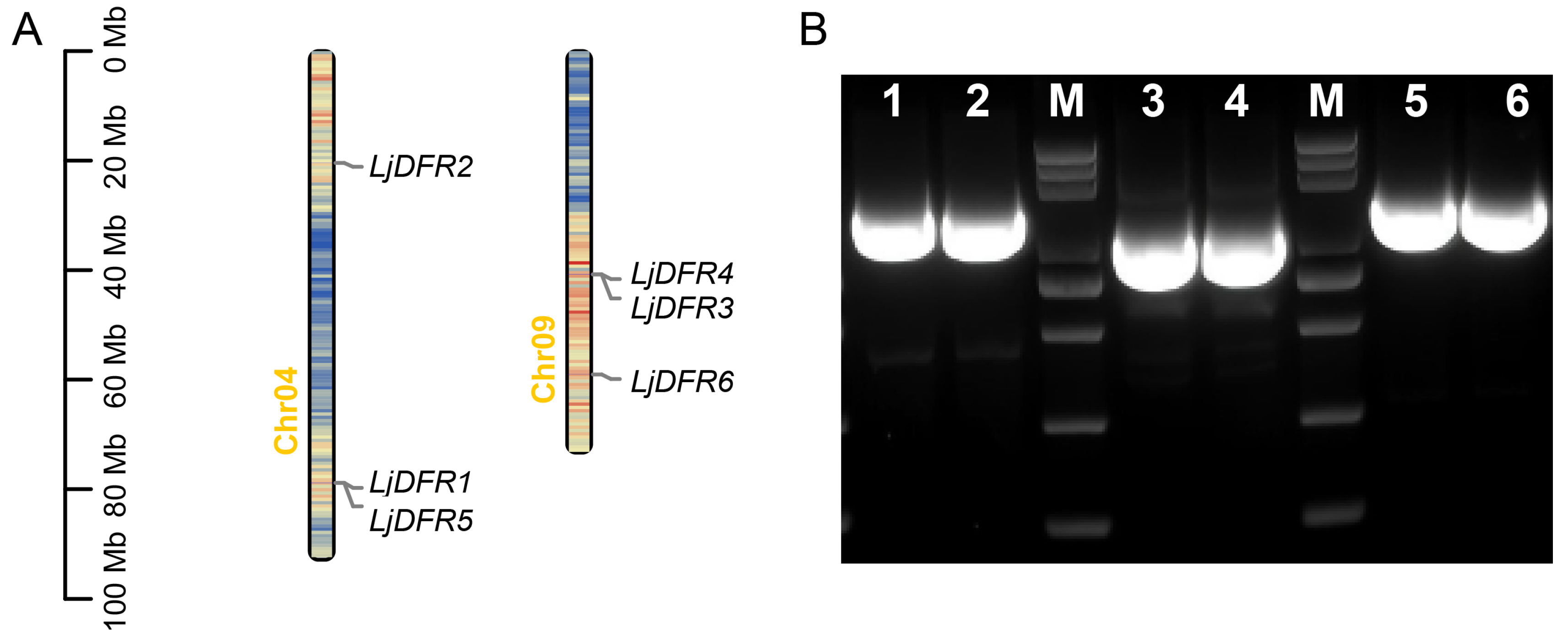
A total of six DFR genes were identified in L. japonica. Chromosomal localization analysis showed that these genes are distributed on Chr.04 and Chr.09 (Figure 2A). Specifically, LjDFR1, LjDFR2, and LjDFR5 are on Chr.04, while LjDFR3, LjDFR4, and LjDFR6 are on Chr.09.
To ensure the accuracy of later bioinformatics analysis, we cloned all six LjDFR genes (Figure 2B). The products were ligated into T-vectors for sequencing. Results showed 93.62% to 94.05% identity with the reference sequences. The 5′ and 3′ ends had high identity, but significant differences appeared in the middle sequences, including long-fragment insertions in some genes, likely due to varietal differences between the reference genome and the cloned material.

3.2. Protein Physicochemical Properties and Structural Analysis of the LjDFR Gene Family

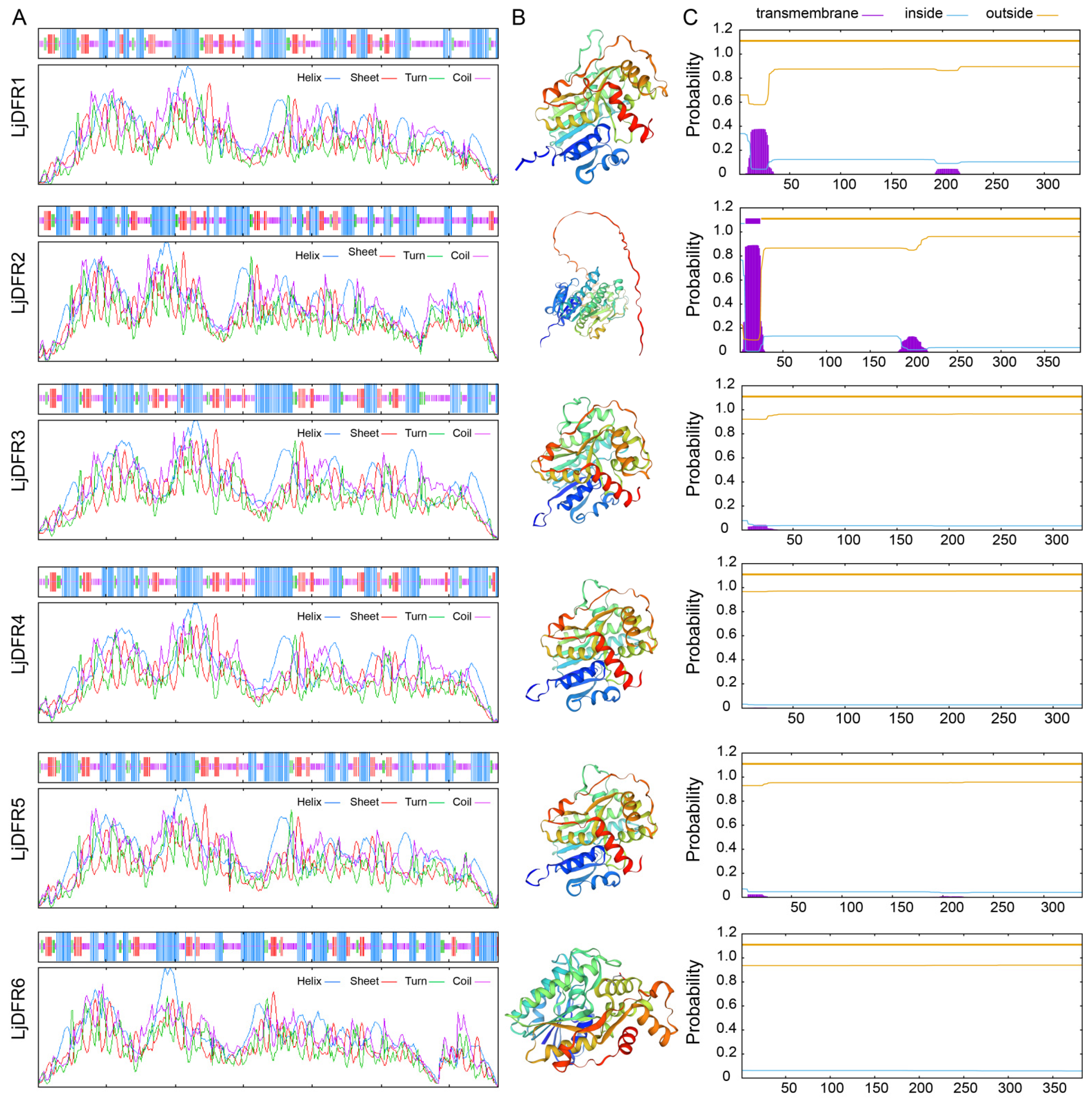
The analysis of cloned LjDFR proteins showed variations in length, ranging from 328 (LjDFR3, LjDFR4) to 391 amino acids (LjDFR2), with an average of 350.5 amino acids (Table S2). Molecular weights ranged from 36.693 kDa (LjDFR4) to 43.686 kDa (LjDFR2), and the theoretical isoelectric point (pI) ranged from 5.82 (LjDFR2) to 8.28 (LjDFR5). All LjDFR proteins were hydrophilic, as indicated by negative GRAVY values. Subcellular localization prediction suggested that LjDFR1-LjDFR5 are in the cytoplasm, while LjDFR6 is nuclear (Table S2).
Secondary structure prediction revealed that all family members contain α-helix, β-turn, random coil, and extended strand. Except for LjDFR2, which has the highest random coil at 40.15%, all other members have the most α-helix ranging from 39.35% (LjDFR5) to 42.07% (LjDFR4). Additionally, β-sheets are the lowest among all members (Figure 3A). Tertiary structure results showed a significant presence of α-helix and random coil, consistent with the secondary structure predictions. The space between inversely parallel β-sheets can bind specifically to DNA sequences (Figure 3B). Transmembrane structure prediction revealed that only LjDFR2 has one transmembrane domain (1–6 aa), with the N-terminus intracellularly (7–24 aa) and the C-terminus extracellularly. Other LjDFR members lack transmembrane domains (Figure 3C).

3.3. Subcellular Localization Analysis of LjDFR Proteins

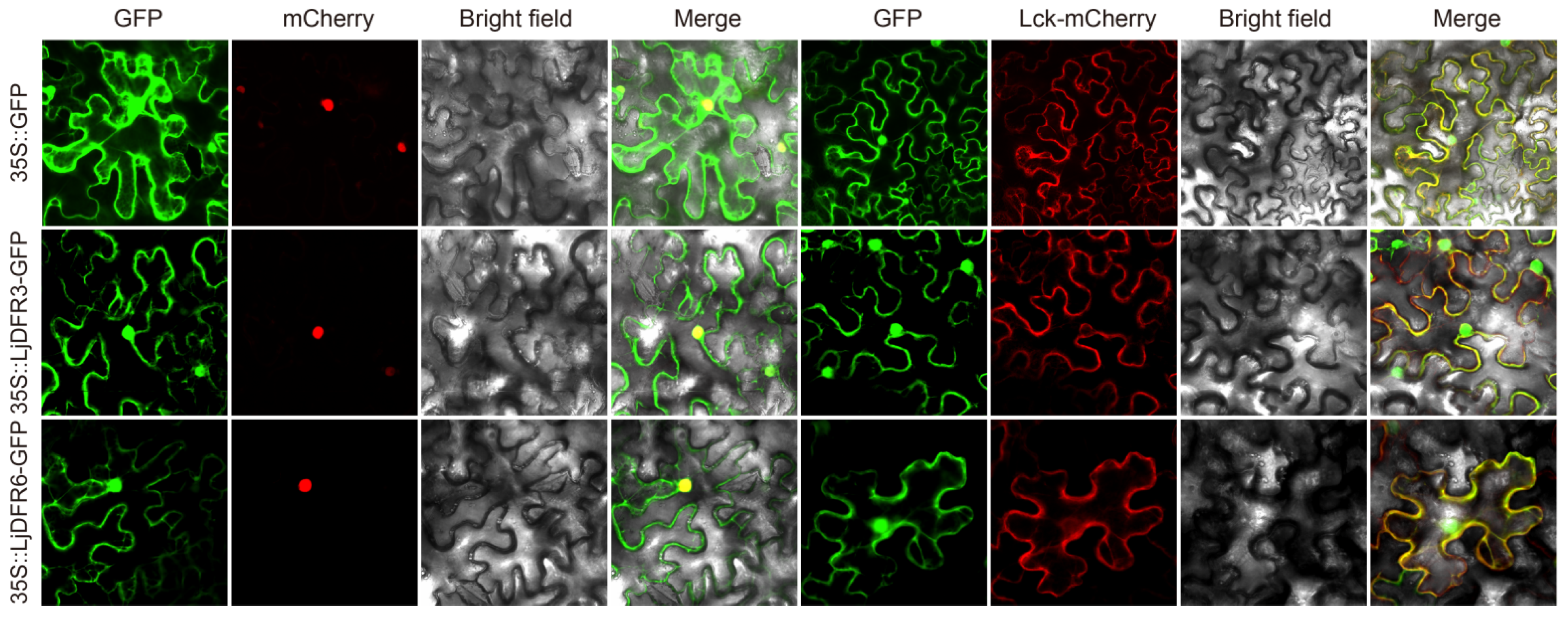
To verify subcellular localization, we constructed recombinant 35S::LjDFR3-GFP and 35S::LjDFR6-GFP plasmids for transient expression in tobacco epidermal cells. The control (35S::GFP) showed diffuse fluorescence in the nuclear, cell membrane, and cytoplasm (Figure 4). In contrast, the fluorescence signals of 35S::LjDFR3-GFP and 35S::LjDFR6-GFP colocalized with cell membrane and nuclear marker fluorescence, confirming their localization.

3.4. Phylogenetic Analysis of the LjDFR Family

Multiple sequence alignment was performed to explore the evolutionary conservation of LjDFR genes. The N-terminal region of LjDFR proteins has a conserved NADPH-binding motif, while the C-terminal regions are more variable (Figure S1). Based on the residue at position 134, LjDFR2 is Asn-type, while the other five are non-Asn/non-Asp type (Figure S1).
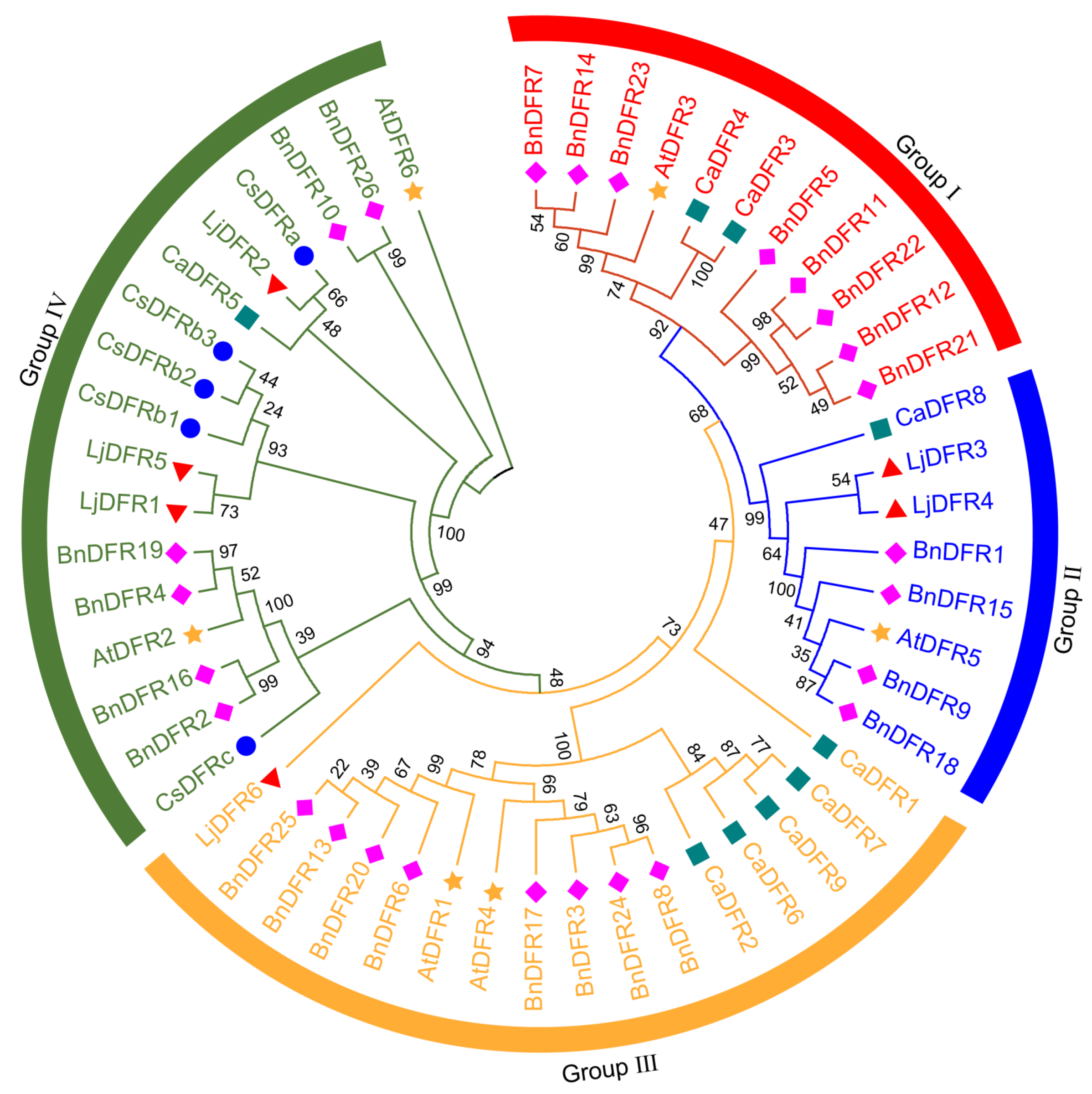
Phylogenetic analysis of DFR proteins from four species grouped LjDFR proteins into four subfamilies (Groups I–IV), showing high conservation in plant evolution. Notably, no LjDFR proteins were found in Group I; two were in Group II, one in Group III, and three in Group IV (Figure 5).

3.5. Gene Structure, Conserved Motifs, and Synteny Analysis of the LjDFR Gene Family

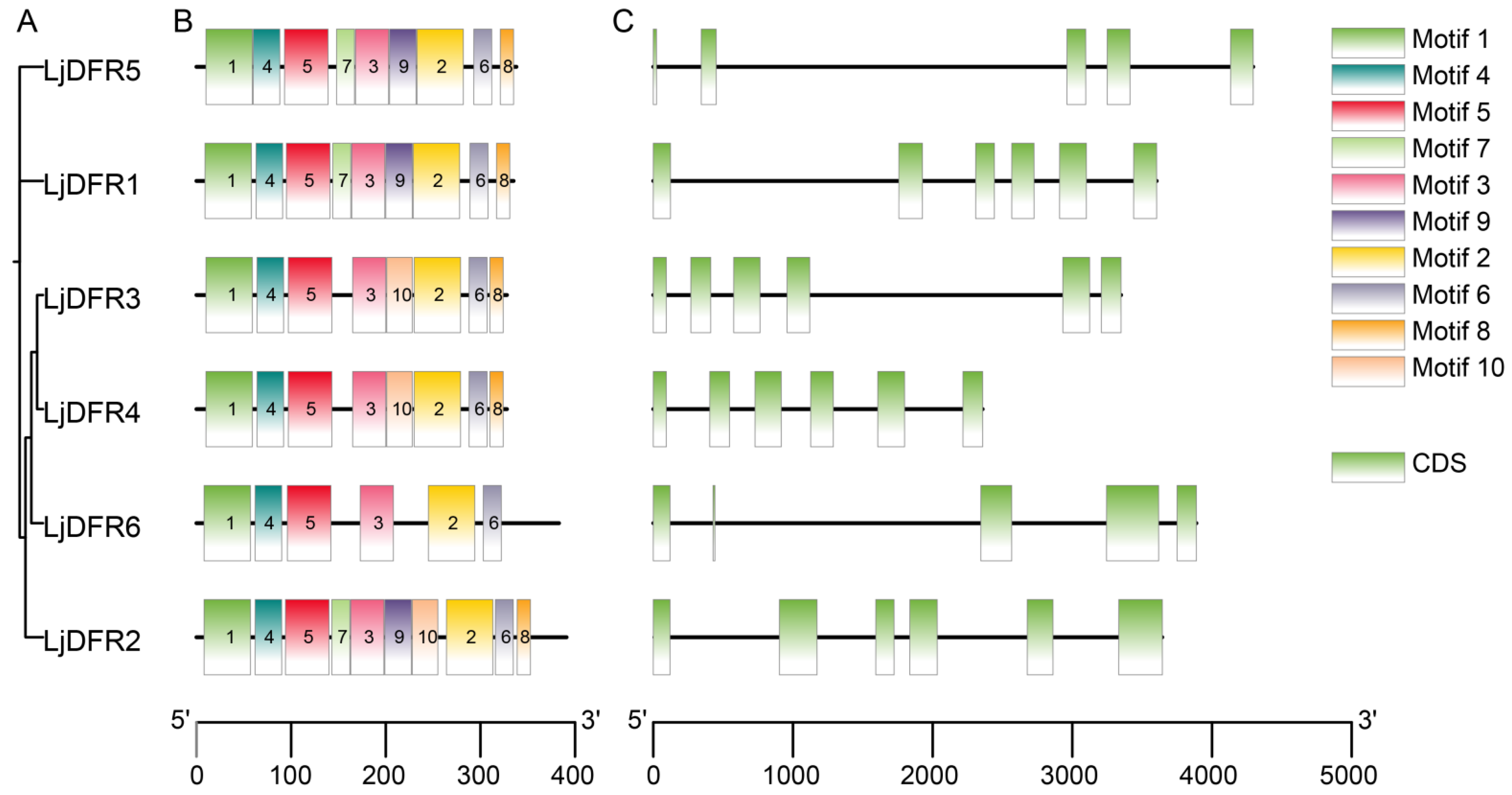
We analyzed conserved motifs and gene structures alongside the phylogenetic tree (Figure 6A). Motif types and numbers were highly similar within the same subgroup but varied between different subgroups. LjDFR1 and LjDFR5 contained motifs 1–9, missing motif 10; LjDFR2 contained all 10 motifs; LjDFR3 and LjDFR4 lacked motif 7 and 9; and LjDFR6 had motifs 1–6 (Figure 6B). Gene structure analysis showed LjDFR genes have five to six exons (Figure 6C). LjDFR5 and LjDFR6 have five exons, while others have six. The similarities in gene structure within subgroups support the reliability of the evolutionary classification.
Gene duplication events are key in evolution. New genes from duplication can provide new functions or traits, aiding species’ development. Collinearity analysis helps reveal evolutionary relationships and gene duplication events. In this study, collinearity analysis showed no collinear relationships among the LjDFR genes (Figure S2). This suggests a lack of recent gene duplication events in this family in L. japonica, indicating a flexible evolutionary strategy.

3.6. Analysis of Cis-Acting Elements in the Promoters of LjDFR Genes

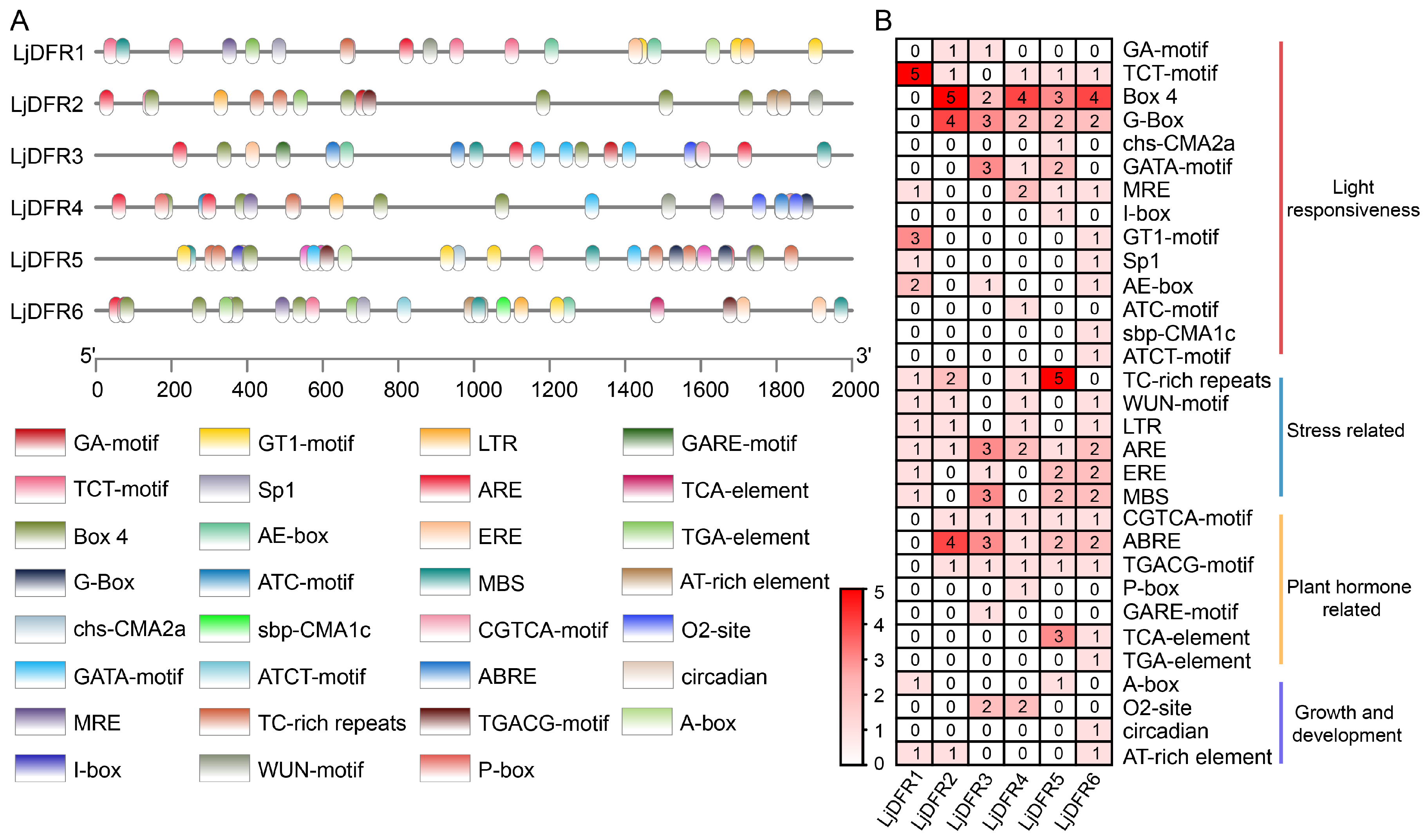
Analysis of the 2000 bp promoter regions upstream of LjDFR genes identified 148 cis-acting elements belonging to 31 types, grouped into four major categories (Figure 7). Light-responsive elements included 14 types, with Box4 being the most abundant (12.16%). Stress-responsive elements had six types, with the antioxidant response element ARE being the most numerous (6.76%). Hormone-responsive elements included seven types, with the abscisic acid-responsive element ABRE being the most abundant (8.11%). Elements related to plant growth and development included four types, with O2-site being the most numerous (2.70%). Notably, LjDFR1 lacked hormone-responsive elements, while all other LjDFR promoters contained all four types. The composition of major elements varied among genes (e.g., LjDFR1 had many TCT-motifs; LjDFR2, LjDFR4, LjDFR6 rich in Box 4; LjDFR3 rich in G-Box, GATA-motif, ABRE, ARE, MBS; LjDFR5 rich in TC-rich repeats) (Figure 7). These results suggest LjDFR genes are involved in processes like photosynthesis, growth, development and responses to hormones and abiotic stresses.

3.7. Tissue Expression Patterns of the LjDFR Gene Family

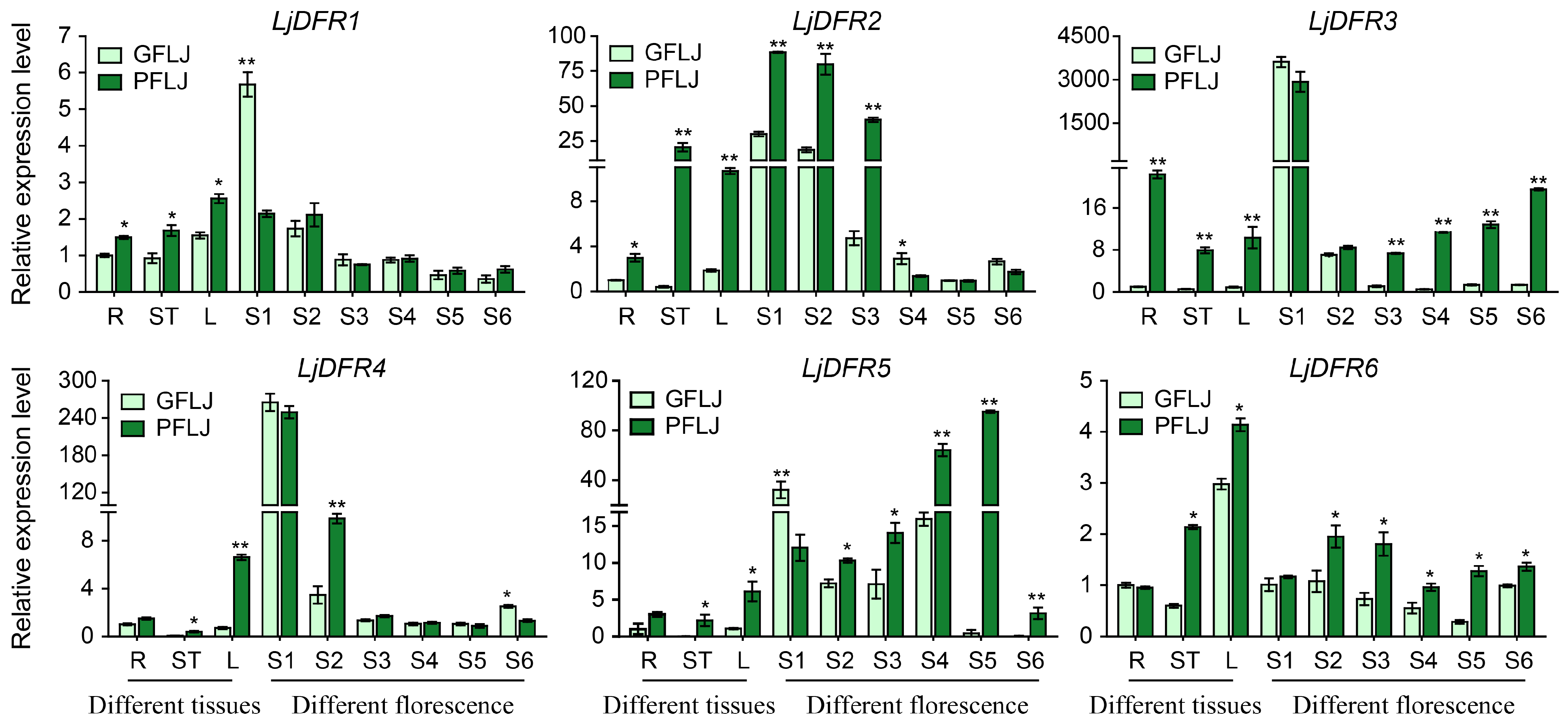
The qRT-PCR analysis revealed that LjDFR gene expression was tissue-specific in both GFLJ and RFLJ (Figure 8). Specifically, LjDFR1 had the highest expression in the flowers of GFLJ and leaves of RFLJ. LjDFR6 showed the highest expression in the leaves of both lines. LjDFR2, LjDFR3, and LjDFR4 had the highest expression in the flowers of both lines. LjDFR5 was highest in the stems of GFLJ and roots of RFLJ (Figure 8).
Furthermore, the expression trends of all LjDFR genes were consistent in a concordant manner across different flower developmental stages in both GFLJ and RFLJ. Notably, LjDFR1 expression gradually decreased from S1 in both lines. LjDFR2, LjDFR3, and LjDFR4 initially decreased, then increased, with the lowest levels at S5, S4/S3, and S5, respectively. LjDFR5 showed a decrease–increase–decrease trend, lowest at S6, whereas LjDFR6 exhibited an increase–decrease–increase pattern, with the lowest levels at S5 in GFLJ and S4 in RFLJ (Figure 8).

3.8. Expression Patterns of the LjDFR Gene Family Under Drought and Salt Stress

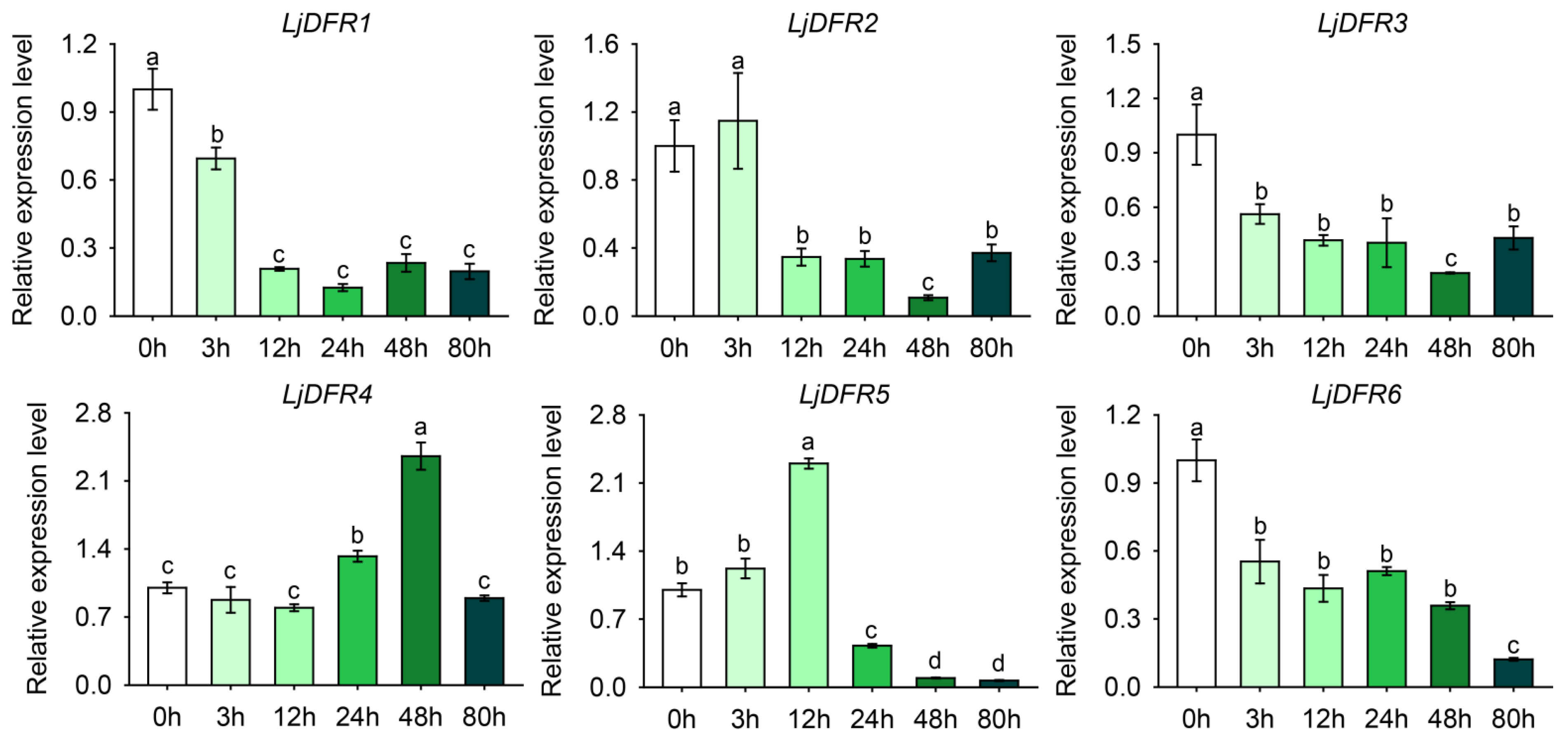
The expression patterns of LjDFR genes under drought and salt stress were analyzed to investigate the response of LjDFR genes to abiotic stress. Results showed differences in expression after stress exposure. Under drought stress, LjDFR2, LjDFR4, and LjDFR5 were upregulated during treatment (Figure 9). LjDFR2 expression showed an increase–decrease–increase trend. After 3 h of stress, expression rose sharply to 1.2 times the control, decreased thereafter and was significantly lower at 48 h. A slight upregulation occurred at 72 h. LjDFR4 expression initially decreased, peaked at 48 h (2.4-fold), and then decreased. LjDFR5 increased, peaking at 12 h (2.3-fold) before declining. In contrast, LjDFR1, LjDFR3, and LjDFR6 were downregulated throughout the treatment period, and their relative expression trends were similar.
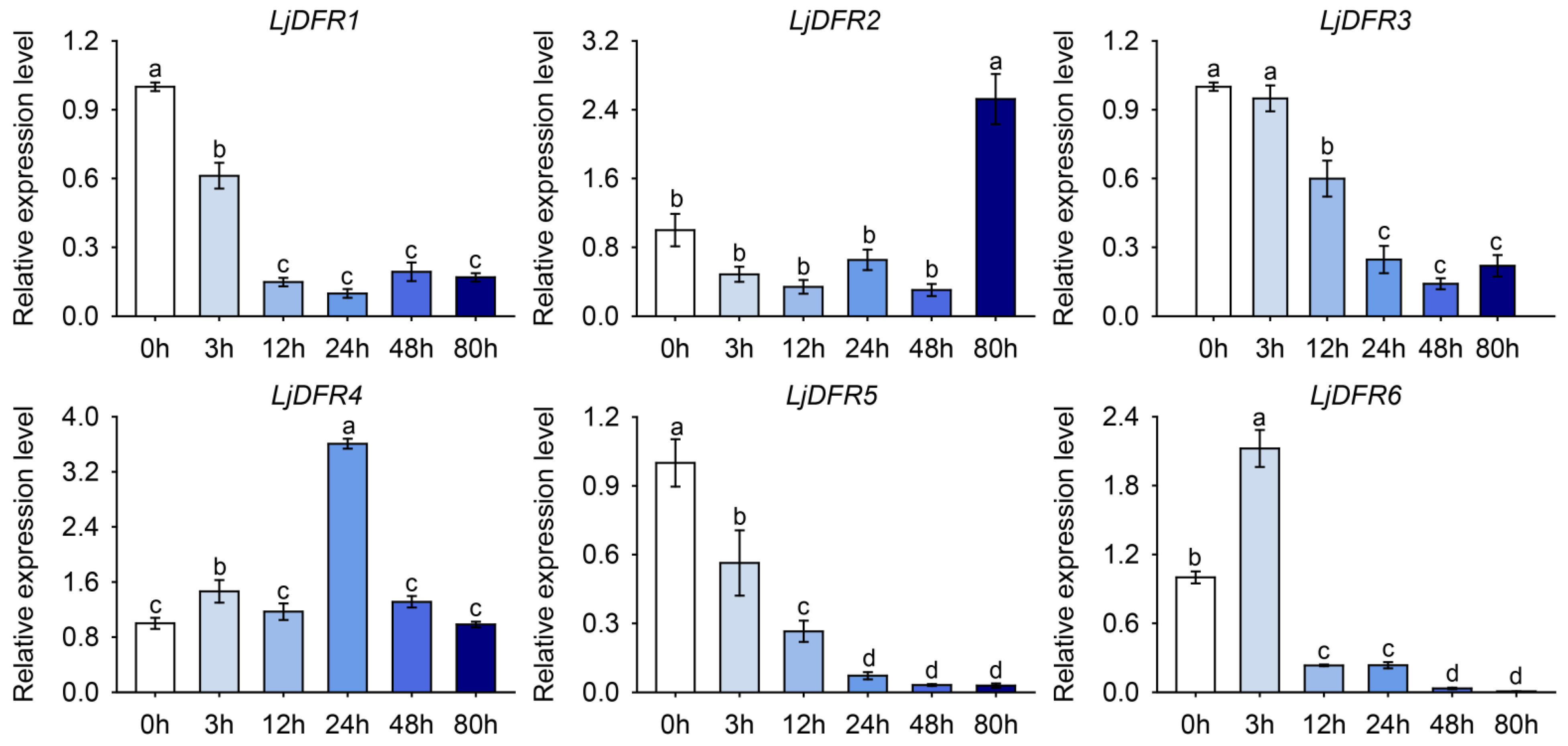
Under salt stress, LjDFR2, LjDFR4, and LjDFR6 were upregulated (Figure 10). LjDFR2 expression decreased initially and then increased, peaking at 72 h (2.5-fold). LjDFR4 rose sharply at 3 h, then decreased, reaching a maximum at 24 h (3.6-fold). LjDFR6 also increased sharply at 3 h (2.1-fold), followed by a gradual decline. Meanwhile, LjDFR1, LjDFR3, and LjDFR5 showed downregulated expression to varying degrees during treatment (Figure 10).

4. Discussion

Flower color is vital in ornamental plants and a key breeding focus. It is mainly determined by the accumulation and combination of pigments like chlorophyll, carotenoids, and anthocyanins [2]. DFR is the first enzyme in anthocyanin biosynthesis and is essential for color. If DFR fails, anthocyanin production halts, directly affecting color. The first DFR gene was identified in maize and has been used in genetic engineering to alter flower color in petunias [24]. Overexpressing HvDFR in tobacco deepened its flower color [25]. Additionally, overexpressing OjDFR1 in the AtDFR mutant tt3-1 restored anthocyanin levels and darkened flower color by upregulating NtANS and NtUFGT expression [26]. Transgenic RdDFR1 also restored anthocyanin biosynthesis defects in seed coat, hypocotyls, and cotyledons of tt3-1 and changed tobacco flower color from pale pink to deep pink [27]. This study identified six DFR genes in L. japonica, comparable to C. sinensis (five members) [17] but fewer than C. annuum (nine members) [16].
Gene structure is crucial for gene family evolution. Structural differences contribute to divergence and new gene functions. The structure of DFR genes relates to their functions [28]. The amino acid sequences of LjDFR proteins range from 328 to 391 amino acids, averaging 350.5; this is similar to DFR sequences in many other plants [29]. Neutral amino acids outnumber acidic and basic ones, which might help form α-helix structures. All six LjDFR proteins have over 39% α-helix content. Except for LjDFR2, α-helix is the most common secondary structure in the other five proteins. Protein folding affects function by shaping characteristics and structure. All LjDFR proteins are hydrophilic, likely due to their high α-helix and random coil content [30]. Similar DFR structures are found in Brassica oleracea, Glycine max, and Meconopsis [31,32,33]. Most LjDFR genes have six exons, while two (LjDFR5, LjDFR6) have five, hinting at potential functional divergence.
Moreover, DFR function relates to its action site. Subcellular localization studies showed LjDFR3 and LjDFR6 in the cell membrane and nucleus, similar to DFRs in Hosta ventricosa [25] and B. oleracea [34], but different from cytoplasmic localization in Loropetalum chinense [35,36]. This indicates various localization patterns for DFRs across species. Anthocyanins synthesize mainly in the cytoplasm and move to vacuoles for storage via transport proteins. Thus, DFR genes may function in multiple organelles.
LjDFR genes showed tissue-specific and developmentally regulated expression. Most had the highest expression in flowers, then leaves, consistent with findings in H. ventricosa [25] and Carthamus tinctorius [29]. During flower development (S1–S6), most LjDFR genes showed decreased expression from S1, lowest at S5, then a slight rise at S6, similar to the findings in Meconopsis [33] and Cineraria [37], but inconsistent with HvDFR, which rises from S1 to S3, then decreases [25]. These results highlight that DFR gene expression is regulated differently by species and stages.
Notably, LjDFR expression levels were generally higher in RFLJ than in GFLJ, especially in pigmented tissues and specific developmental stages. All LjDFR genes in RFLJ stems and leaves were significantly higher than in GFLJ. The expression levels of LjDFR2, LjDFR3, LjDFR4, LjDFR5 and LjDFR6 in RFLJ were significantly higher at various stages compared to GFLJ, for instance LjDFR2 expression in RFLJ was significantly higher at S1–S3 than in GFLJ; LjDFR3 was higher at S3–S6; LjDFR4 was higher at S2; LjDFR5 and LjDFR6 were significantly higher at S2–S6. This link between higher DFR expression and darker pigmentation aligns with observations in Rhododendron hybridum [38] and Chrysanthemum morifolium [39,40]. Phylogenetically, LjDFR2 aligns closely with functionally characterized DFRs CsDFRa [17] and CaDFR5 [16]. Previous studies confirmed that CsDFRa has DFR activity, converting dihydroflavonols into leucoanthocyanidins in vitro. Overexpressing CsDFRa in the AtDFR mutant (tt3) restored purple petiole color and improved seed coat color [17]. Additionally, CaDFR5 expression levels matched anthocyanin content changes [16]. This, along with high expression in RFLJ, suggests that LjDFR2 aids anthocyanin accumulation and flower color in L. japonica.
Promoters are DNA sequences upstream of a gene. They contain cis-acting elements that enhance or inhibit transcription and bind to transcription factors to regulate the gene expression under stress. Studying gene promoters is important for understanding plant gene functions. This study analyzed promoters and found many stress-responsive cis elements, leading to investigation under abiotic stress. Under drought stress, LjDFR2, LjDFR4, and LjDFR5 showed increased expression during treatment, reaching 1.2-fold, 2.4-fold, and 2.3-fold of the control, respectively. Under salt stress, LjDFR2, LjDFR4, and LjDFR6 also showed increased expression at 2.5-fold, 3.6-fold, and 2.1-fold of the control, respectively. Both LjDFR2 and LjDFR4 were significantly induced under both stresses, suggesting their potential roles in abiotic stress response. However, direct functional evidence is required to confirm this role. This lays the groundwork for further analyzing LjDFR gene functions.

5. Conclusions

This study identified six LjDFR genes in L. japonica through genome-wide analysis. Their full-length sequences were cloned, and analyses of chromosomal location, subcellular localization, protein structure, phylogenetic relationships, promoter cis-elements, and expression profiles were conducted. Results show that the LjDFR gene family is relatively conserved and involved in flower color formation and responses to drought and salt stress. Specifically, LjDFR2 is key for anthocyanin accumulation, while LjDFR2 and LjDFR4 respond significantly to abiotic stress. This work provides a foundation for further characterization of LjDFR genes and offers candidate genes for molecular breeding aimed at improving ornamental traits and stress resistance in L. japonica. These findings are promising for plant physiologists and breeders, offering insights for enhancing drought and salinity tolerance in various crops.

Supplementary Materials

The following supporting information can be downloaded at: https://www.mdpi.com/article/10.3390/genes16121453/s1, Figure S1: Multiple sequence alignment of LjDFR proteins. The NADPH-binding site is boxed in green; Figure S2: Collinearity analysis of the LjDFR gene family; Table S1: Primers used in this study; Table S2: Physiochemical prosperities and subcellular location analysis results of LjDFRs.

Author Contributions

Conceptualization, Z.T. and H.L.; methodology, D.L. and X.S.; software, L.L. and L.W.; validation, Y.C.; formal analysis, Y.Y. and M.Q.; investigation, Y.S.; resources, M.S.; data curation, Y.C. and C.L.; writing—original draft preparation, D.L.; writing—review and editing, Z.T. and X.S.; visualization, H.Y. and Y.C.; supervision, H.L.; project administration, Z.T. and C.L.; funding acquisition, Z.T. and H.L. All authors have read and agreed to the published version of the manuscript.

Funding

This research was supported by the Henan Provincial Department of Science and Technology-Key Research and Development Program of Henan [241111310200, 231111110800, 251111310600, 251111111800], Central Government-Guided Local Science and Technology Development Fund Project of Henan Province (2025ZYYD07), Henan Province Science and Technology Research Project [252102111079, 252102110295, 252102110255]; China’s Ministry of Agriculture and Rural Affairs-China Agriculture Research System of MOF and MARA [CARS-21], and the Henan Academy of Agricultural Sciences-Henan Agriculture Research System [HARS-22-11-G3], Independent Innovation Projects of Henan Academy of Agricultural Sciences [2025ZC45], Henan Academy of Agricultural Sciences Outstanding Youth Science and Technology Fund [2024YQ15, 2024YQ16], Henan Provincial Department of Human Resources and Social Security-Henan Center for Overseas Scientists [GZS2024025].

Institutional Review Board Statement

Not applicable.

Informed Consent Statement

Not applicable.

Data Availability Statement

All data related to this study are open-access, and the databases, websites, and software information used have been detailed in the article and are available for interested researchers.

Conflicts of Interest

The authors declare no conflicts of interest.

References

  1. Karanjalker, G.R.; Ravishankar, K.V.; Shivashankara, K.S.; Dinesh, M.R.; Roy, T.K.; Sudhakar Rao, D.V. A Study on the expression of genes involved in carotenoids and anthocyanins during ripening in fruit peel of green, yellow, and red colored mango cultivars. Appl. Biochem. Biotechnol. 2018, 184, 140–154. [Google Scholar] [CrossRef]
  2. Shang, Y.; Venail, J.; Mackay, S.; Bailey, P.C.; Schwinn, K.E.; Jameson, P.E.; Martin, C.R.; Davies, K.M. The molecular basis for venation patterning of pigmentation and its effect on pollinator attraction in flowers of Antirrhinum. New Phytol. 2011, 189, 602–615. [Google Scholar] [CrossRef] [PubMed]
  3. Zhang, Y.; Butelli, E.; Martin, C. Engineering anthocyanin biosynthesis in plants. Curr. Opin. Plant Biol. 2014, 19, 81–90. [Google Scholar] [CrossRef] [PubMed]
  4. Xie, S.; Zhao, T.; Zhang, Z.W.; Meng, J.F. Reduction of dihydrokaempferol by Vitis vinfera dihydroflavonol 4-reductase to produce orange Pelargonidin-Type anthocyanins. J. Agric. Food Chem. 2018, 66, 3524–3532. [Google Scholar] [CrossRef] [PubMed]
  5. Jaakola, L. New insights into the regulation of anthocyanin biosynthesis in fruits. Trends Plant Sci. 2013, 18, 477–483. [Google Scholar] [CrossRef]
  6. LaFountain, A.M.; Yuan, Y.W. Repressors of anthocyanin biosynthesis. New Phytol. 2021, 231, 933–949. [Google Scholar] [CrossRef]
  7. Miyagawa, N.; Miyahara, T.; Okamoto, M.; Hirose, Y.; Sakaguchi, K.; Hatano, S.; Ozeki, Y. Dihydroflavonol 4-reductase activity is associated with the intensity of flower colors in delphinium. Plant Biotechnol. 2015, 32, 249–255. [Google Scholar] [CrossRef]
  8. Ni, J.; Ruan, R.J.; Wang, L.J.; Jiang, Z.F.; Gu, X.J.; Chen, L.S.; Xu, M.J. Functional and correlation analyses of dihydroflavonol-4-reductase genes indicate their roles in regulating anthocyanin changes in Ginkgo biloba. Ind. Crops Prod. 2020, 152, 112546. [Google Scholar] [CrossRef]
  9. Johnson, E.T.; Ryu, S.; Yi, H.; Shin, B.; Cheong, H.; Choi, G. Alteration of a single amino acid changes the substrate specificity of dihydroflavonol 4-reductase. Plant J. 2001, 25, 325–333. [Google Scholar] [CrossRef]
  10. Liu, H.L.; Lou, Q.; Ma, J.R.; Su, B.B.; Gao, Z.Z.; Liu, Y.L. Cloning and functional characterization of dihydroflavonol 4-reductase gene involved in anthocyanidin biosynthesis of Grape Hyacinth. Int. J. Mol. Sci. 2019, 20, 4743. [Google Scholar] [CrossRef]
  11. Vainio, J.; Mattila1, S.; Abdou, S.M.; Sipari, N.; Teeri, T.H. Petunia dihydroflavonol 4-reductase is only a few amino acids away from producing orange pelargonidinbased anthocyanins. Front. Plant Sci. 2023, 14, 1227219. [Google Scholar] [CrossRef] [PubMed]
  12. Shang, X.F.; Pan, H.; Li, M.X.; Miao, X.L.; Ding, H. Lonicera japonica Thunb.: Ethnopharmacology, phytochemistry and pharmacology of an important traditional Chinese medicine. J. Ethnopharmacol. 2001, 138, 1–21. [Google Scholar] [CrossRef] [PubMed]
  13. Seo, O.N.; Kim, G.S.; Park, S.; Lee, J.H.; Kim, Y.H.; Lee, W.S.; Lee, S.J.; Kim, C.Y.; Jin, J.S.; Choi, S.K.; et al. Determination of polyphenol components of Lonicera japonica Thunb. using liquid chromatography—tandem mass spectrometry: Contribution to the overall antioxidant activity. Food Chem. 2012, 134, 572–577. [Google Scholar] [CrossRef]
  14. Yuan, Y.; Yang, J.; Yu, X.D.; Huang, L.Q.; Lin, S.F. Anthocyanins from buds of Lonicera japonica Thunb. var. chinensis (Wats.) Bak. Food Res. Int. 2014, 62, 812–818. [Google Scholar] [CrossRef]
  15. Li, J.; Lian, X.; Ye, C.; Wang, L. Analysis of flower color variations at different developmental stages in two L. japonica (Lonicera japonica Thunb.) cultivars. HortScience 2019, 54, 779–782. [Google Scholar] [CrossRef]
  16. An, Y.; Li, N.; Zhang, R.L.; Wang, S.; Wang, J.N. Identification and characterization of DFR gene family and cloning of candidate genes for anthocyanin biosynthesis in pepper (Capsicum annuum L.). BMC Plant Biol. 2025, 25, 830. [Google Scholar] [CrossRef]
  17. Ruan, H.X.; Shi, X.X.; Gao, L.P.; Rashid, A.; Li, Y.; Lei, T.; Dai, X.L.; Xia, T.; Wang, Y.S. Functional analysis of the dihydroflavonol 4-reductase family of Camellia sinensis: Exploiting key amino acids to reconstruct reduction activity. Hortic. Res. 2022, 9, uhac098. [Google Scholar] [CrossRef]
  18. Silva, E.C.D.; Nogueira, R.J.M.C.; Araújo, F.P.D.; Melo, N.F.D.; Neto, A.D.D.A. Physiological responses to salt stress in young umbu plants. Environ. Exp. Bot. 2008, 63, 147–157. [Google Scholar] [CrossRef]
  19. Pu, X.D.; Li, Z.; Tian, Y.; Gao, R.R.; Hao, L.J.; Hu, Y.T.; He, C.N.; Sun, W.; Xu, M.M.; Peters, R.J.; et al. The honeysuckle genome provides insight into the molecular mechanism of carotenoid metabolism underlying dynamic flower coloration. New Phytol. 2020, 227, 930–943. [Google Scholar] [CrossRef]
  20. Lu, D.D.; Tan, Z.W.; Yu, Y.L.; Li, L.; Xu, L.J.; Yang, H.Q.; Yang, Q.; Dong, W.; An, S.F.; Liang, H.Z. Cloning, structure and expression profile analysis of CtANR2 and CtANR3 genes from Carthamus tinctorius L. Acta Agric. Boreali-Sin. 2023, 38, 84–93. [Google Scholar] [CrossRef]
  21. Chen, C.J.; Chen, H.; Zhang, Y.; Thomas, H.R.; Frank, M.H.; He, Y.H.; Xia, R. TBtools: An integrative toolkit developed for interactive analyses of big biological data. Mol Plant. 2020, 13, 1194–1202. [Google Scholar] [CrossRef]
  22. Wang, Y.P.; Tang, H.B.; Debarry, J.D.; Tan, X.; Li, J.P.; Wang, X.Y.; Lee, T.H.; Jin, H.Z.; Marler, B.; Guo, H.; et al. MCScanX: A toolkit for detection and evolutionary analysis of gene synteny and collinearity. Nucleic Acids Res. 2012, 40, e49. [Google Scholar] [CrossRef] [PubMed]
  23. Liu, X.Y.; Chen, L.; Qiao, Y.G.; Rong, Y.; Wang, J.S. Selection of reference genes by qRT-PCR inflower organ of Lonicera japonica Thunb. J Shanxi Agri Sci. 2017, 45, 514–517. [Google Scholar] [CrossRef]
  24. Meyer, P.; Heidmann, I.; Forkmann, G.; Saedler, H. A new Petunia flower colour generated by transformation of a mutant with a maize gene. Nature 1987, 330, 677–678. [Google Scholar] [CrossRef] [PubMed]
  25. Qin, S.; Liu, Y.T.; Cui, B.Q.; Cheng, J.L.; Liu, S.Y.; Liu, H.Z. Isolation and functional diversification of dihydroflavonol 4-Reductase gene HvDFR from Hosta ventricosa indicate its role in driving anthocyanin accumulation. Plant Signal. Behav. 2022, 17, e2010389. [Google Scholar] [CrossRef]
  26. Sun, W.; Zhou, N.N.; Feng, C.; Sun, S.Y.; Tang, M.; Tang, X.X.; Ju, Z.G.; Yi, Y. Functional analysis of a dihydroflavonol 4-reductase gene in Ophiorrhiza japonica (OjDFR1) reveals its role in the regulation of anthocyanin. Peer J 2021, 9, e12323. [Google Scholar] [CrossRef]
  27. Sun, W.; Zhou, N.N.; Wang, Y.H.; Sun, S.Y.; Zhang, Y.; Zhigang Ju, Z.G.; Yi, Y. Characterization and functional analysis of RdDFR1 regulation on flower color formation in Rhododendron delavayi. Plant Physiol. Biochem. 2021, 169, 203–210. [Google Scholar] [CrossRef]
  28. Xu, G.X.; Guo, C.C.; Shan, H.Y.; Kong, H.Z. Divergence of duplicate genes in exon-intron structure. Proc. Natl. Acad. Sci. USA 2012, 109, 1187–1192. [Google Scholar] [CrossRef]
  29. Tan, Z.W.; Lu, D.D.; Li, L.; Yu, Y.L.; Xu, L.J.; Dong, W.; Yang, H.Q.; Yang, Q.; Li, C.M.; Liang, H.Z. Cloning and expression analysis of dihydroflavonol 4-reductase gene from Safflower (Carthamus tinctorius L.). Mol. Plant Breed. 2022, 20, 5309–5318. [Google Scholar] [CrossRef]
  30. Yang, C.L.; Li, Y.Z.; He, L.L.; Song, Y.H.; Zhang, P.; Liu, Z.X.; Li, P.H.; Liu, S.J. Genome-wide identification and analysis of TPS gene family and functional verification of VvTPS4 in the formation of monoterpenes in Grape. Sci. Agric. Sin. 2025, 58, 1397–1417. [Google Scholar] [CrossRef]
  31. Feng, X.; Zhang, Y.T.; Wang, H.; Tian, Z.D.; Siyao Xin, S.Y.; Zhu, P.F. The dihydrofavonol 4-reductase BoDFR1 drives anthocyanin accumulation in pink-leaved ornamental kale. Theor. Appl. Genet. 2021, 134, 159–169. [Google Scholar] [CrossRef] [PubMed]
  32. Shi, Z.; Li, H.; Gao, M.; Guo, C.H.; Guo, D.L.; Bi, Y.D. Cloning of GmDFR gene from Soybean (Glycine max) and identification of its function on resistance to iron deficiency. J. Agric. Biotechnol. 2023, 31, 259–272. [Google Scholar] [CrossRef]
  33. Wang, H.J.; Chen, X.J.; Li, T.J.; Luo, J.; Qu, Y. Cloning and expression analysis of DFR gene from Meconopsis with different colors. Acta Agric. Boreali Sin. 2024, 39, 88–95. [Google Scholar] [CrossRef]
  34. Zheng, H.; Zhang, F.; Jian, Y.; Huang, W.L.; Liang, S.; Jiang, M.; Yuan, Q.; Wang, Q.M.; Sun, B. Cloning and function identification of Dihydroflavonol 4-Reductase gene BoaDFR in Chinese Kale. Acta Hortic. Sin. 2021, 48, 73–82. [Google Scholar] [CrossRef]
  35. Zhang, B.Y.; Li, C.H.; Liu, X.; Liao, X.S.; Rong, D.Y. Cloning and subcellular localization analysis of LcDRF1 and LcDRF2 in Loropetalum chinense var. rubrum. J. South. Agric. 2020, 51, 2865–2874. [Google Scholar]
  36. Zhu, Y.; Peng, Q.Z.; Li, K.G.; Xie, D.Y. Molecular cloning and functional characterization of a dihydroflavonol 4-reductase from Vitis bellula. Molecules 2018, 23, 861. [Google Scholar] [CrossRef]
  37. Hu, K.; Meng, L.; Han, K.T.; Sun, Y.; Dai, S.L. Isolation and expression analysis of key genes involved in anthocyanin biosynthesis of Cineraria. Acta Hortic. Sin. 2009, 36, 1013–1022. [Google Scholar] [CrossRef]
  38. Jiang, B.X.; Wang, Q.H.; Yang, G.X.; Jia, Y.H.; Xie, X.H.; Wu, Y.Y. Cloning and analysis of RhDFR gene in Rhododendron hybridum Hort. Acta Bot. Boreat. Occident. Sin. 2023, 43, 10–20. [Google Scholar] [CrossRef]
  39. Yu, X.; Li, Y.H.; Zhang, L.Y.; Liu, H.; Luo, C.; Cheng, X.; Gao, K.; Huang, C.L.; Chen, D.L. Cloning and expression analysis of CmDFRa gene in Chrysanthemum × morifolium. Mol. Plant Breed. 2024, 4, 1–12. Available online: https://link.cnki.net/urlid/46.1068.S.20240424.0948.005 (accessed on 25 November 2025).
  40. Lim, S.H.; Park, B.; Kim, D.H.; Park, S.; Yang, J.H.; Jung, J.A.; Lee, J.M.; Lee, J.Y. Cloning and functional characterization of dihydroflavonol 4-reductase gene involved in anthocyanin biosynthesis of Chrysanthemum. Int. J. Mol. Sci. 2020, 21, 7960. [Google Scholar] [CrossRef]
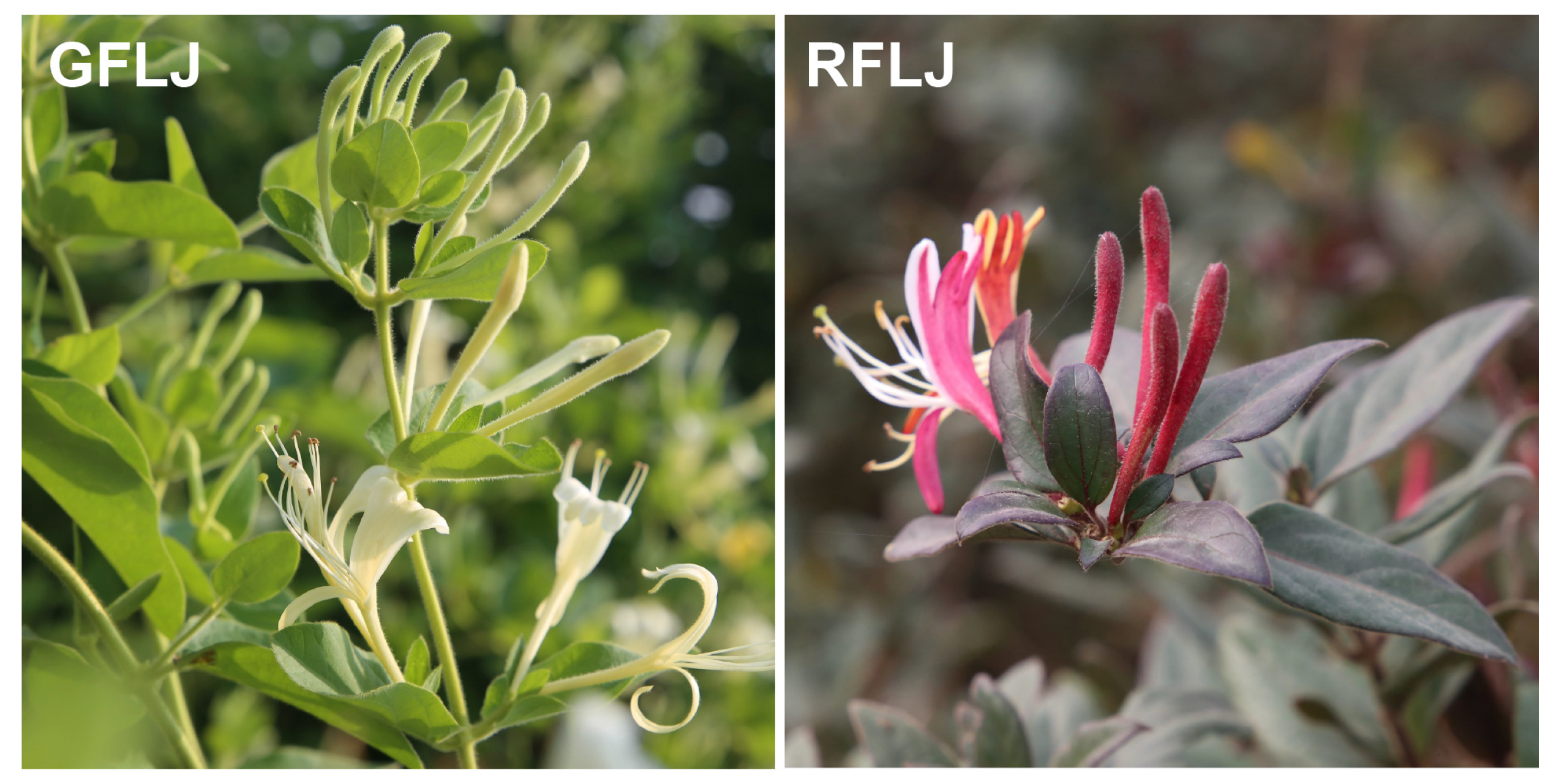
Figure 1. The two L. japonica lines.
Genes 16 01453 g001
Figure 2. Distribution of LjDFR family members on chromosome map (A) and PCR amplification of LjDFR genes (B). 1–6: LjDFR1-LjDFR6; M: DL 5000 marker (5000, 3000, 2000, 1000, 750, 500, 250, 100 bp).
Genes 16 01453 g002
Figure 3. Prediction of secondary structure (A), tertiary structure (B) and transmembrane structure (C) of LjDFR proteins.
Genes 16 01453 g003
Figure 4. Subcellular localization of LjDFR proteins. GFP indicates the green fluorescence field, mCherry stands for the nuclear marker, Lck-mCherry stands for the membrane marker, Bright field indicates the bright field images, and Merge stands for the superimposed field. Scale bar = 20 μm.
Genes 16 01453 g004
Figure 5. Phylogenetic tree of DFRs in L. japonica (Lj, ), C. sinensis (Cs, ), C. annuum (Ca, ), B. (Bn, ) and A. thaliana (At, ).
Genes 16 01453 g005
Figure 6. Phylogenetic tree (A), conserved motifs (B) and gene structure (C) analysis of the LjDFR gene family. (A) The phylogenetic tree of LjDFR proteins; (B) the conserved motifs of LjDFR proteins, Motif 1–10 in different colored blocks represent the motif composition; (C) gene structure of LjDFR genes. CDS: coding sequence.
Genes 16 01453 g006
Figure 7. Cis-elements in the LjDFR gene promoters. (A) The location of the promoter cis-acting elements. (B) Statistical analysis of the number of cis-acting elements in the promoter region of the LjDFR gene family.
Genes 16 01453 g007
Figure 8. Differential expression patterns of LjDFR genes in different tissues and different florescence petals in GFLJ and RFLJ. All the data indicate means ± SD of three replicates. * indicates p < 0.05, ** indicates p < 0.01.
Genes 16 01453 g008
Figure 9. Expression patterns of LjDFR genes in L. japonica under drought treatment. All the data indicate means ± SD of three replicates. Different letters represented significant difference in purity (p < 0.05).
Genes 16 01453 g009
Figure 10. Expression patterns of LjDFR genes in L. japonica under NaCl treatment. All the data indicate means ± SD of three replicates. Different letters represented significant difference in purity (p < 0.05).
Genes 16 01453 g010
Disclaimer/Publisher’s Note: The statements, opinions and data contained in all publications are solely those of the individual author(s) and contributor(s) and not of MDPI and/or the editor(s). MDPI and/or the editor(s) disclaim responsibility for any injury to people or property resulting from any ideas, methods, instructions or products referred to in the content.