You are currently viewing a new version of our website. To view the old version click .
Genes
  • Article
  • Open Access

3 December 2025

Bridging East and West: Real-World Clinicogenomic Landscape of Metastatic NSCLC in Türkiye

,
,
,
,
,
,
,
,
and
1
Department of Medical Oncology, Dokuz Eylul University, Izmir 35330, Türkiye
2
Department of Medical Oncology, Atatürk University, Erzurum 25240, Türkiye
3
Department of Medical Oncology, Antalya Research and Training Hospital, Antalya 07100, Türkiye
4
Department of Medical Oncology, Bilkent City Hospital, Ankara 06800, Türkiye
Genes2025, 16(12), 1446;https://doi.org/10.3390/genes16121446 
(registering DOI)
This article belongs to the Special Issue Genetics and Genomics of Lung Cancer

Abstract

Background/Objectives: Genomic profiling guides treatment in metastatic non-small-cell lung cancer (mNSCLC), yet country-level data from Türkiye remain limited. Methods: We retrospectively analyzed consecutive patients with mNSCLC diagnosed between January 2018 and March 2025 across tertiary centers in all seven regions. Variables included demographics, smoking, histology, testing modality (single-gene vs. next-generation sequencing [NGS]), targetable genomic alterations (TGAs) and co-mutations, and programmed death-ligand 1 (PD-L1) tumor proportion score. Results: Among 1023 patients (mean age 64 years; 76.4% male), tobacco exposure was frequent (mean 42.1 pack-years); 16.9% were never-smokers. NGS use increased over time, exceeding 90% by 2025. TGAs were detected in 28.3% (EGFR 16.0%, ALK 5.0%, KRAS G12C 2.6%, BRAF V600E 3.2%; ROS1, MET exon 14, HER2, NTRK ≤ 2.5%; no RET). EGFR alterations occurred in 19% of non-squamous carcinomas and 6% of squamous cell carcinomas (SCCs), suggesting an intermediate East–West pattern. Among NGS-tested samples, TP53 was the most frequent co-mutation (33.1%), followed by alterations in CDKN2A, PIK3CA, FGFR, STK11, and KEAP1. Conclusions: In this large, multicenter Turkish real-world cohort, the TGA spectrum broadly mirrors global patterns while revealing local nuances; EGFR mutations were more frequent than expected in SCC, and nationwide NGS adoption is accelerating. Limitations include retrospective design, non-centralized PD-L1 testing, and missing data. Prospective, standardized studies integrating outcomes and resistance mechanisms are warranted to refine regional precision oncology.

1. Introduction

Cancer is a genetic disease driven by oncogenic and tumor-suppressor alterations that rewire proliferation, survival, genomic stability, and immune evasion. Over the last century, treatment evolved from surgery, radiation, and cytotoxic chemotherapy to molecularly targeted agents and immunotherapies, reshaping outcomes in biomarker-defined subsets. Molecular profiling is therefore no longer optional background—it is the mechanism by which actionable drivers are found, resistance is understood, and immunotherapy biomarkers are interpreted in context [1].
Within thoracic oncology, non-small-cell lung cancer (NSCLC) constitutes the majority of lung cancer cases and is characterized by significant histological and molecular heterogeneity. Over the past two decades, the treatment paradigm has shifted from empiric platinum-based chemotherapy to increasingly precise strategies driven by tumor biology [2]. This evolution, which centers on identifying targetable genomic alterations (TGAs) (e.g., EGFR, ALK/ROS1, BRAF V600E, MET exon 14, RET, NTRK, HER2) and immune markers like programmed death-ligand 1 (PD-L1), has reshaped therapeutic decision-making globally [3]. While the rise of molecular diagnostics and targeted/immunotherapies have reshaped treatment paradigms, the available genomic data predominantly derive from Western or East Asian populations. This disparity underscores the need for real-world data from diverse populations to ensure regional applicability of precision medicine standards. In parallel, molecular testing has moved from single-gene assays to broad next-generation sequencing (NGS), reshaping diagnostic workflows and therapeutic decision-making [4].
Türkiye, with its population of approximately 85 million, located at the crossroads of Europe and Asia, represents a unique population in terms of both genetic diversity and environmental exposures [5]. In Türkiye, the life expectancy at birth for the 2022–2024 period was approximately 78.1 years, with an average of about 80.7 years for women and 75.5 years for men [6]. Türkiye currently holds the highest lung cancer incidence rate among men globally, where it remains the most frequently diagnosed malignancy and the leading cause of cancer-related death [7]. This high burden is largely attributed to the country’s elevated tobacco consumption and associated risk factors [8].
Given this context, country-level data from Türkiye remains limited. This multicenter retrospective study aimed to characterize the demographic, histological, and molecular features of patients with metastatic NSCLC (mNSCLC) in Türkiye. In particular, it aimed to assess the distribution of actionable genomic alterations and programmed death-ligand 1 (PD-L1) expression and explore their associations with smoking history.

2. Methods

This retrospective, multicenter cohort study was conducted across seven geographical regions of Türkiye, including Marmara, Aegean, Mediterranean, Central Anatolia, Black Sea, Eastern Anatolia, and Southeastern Anatolia. The highest-volume tertiary center specializing in cancer care and molecular testing contributed data from each region. A total of 1023 patients diagnosed with mNSCLC from January 2018 to March 2025 were included. Patients were eligible if they had histologically confirmed mNSCLC, stage IV at diagnosis or metastatic relapse, and available molecular profiling data, regardless of histologic subtype or line of therapy. Patients with tumors with neuroendocrine or small cell features, limited molecular data (less than three genes), and non-metastatic disease were excluded.
Demographic data (age, sex), smoking history (pack-years and smoking status), histological subtype, and clinical presentation (de novo vs. recurrent metastatic disease) were recorded. Molecular testing information included the method of testing [single-gene polymerase chain reaction (PCR)-based assays or next-generation sequencing (NGS)], identified genomic alterations (e.g., epidermal growth factor receptor (EGFR), anaplastic lymphoma kinase (ALK), Kirsten rat sarcoma viral oncogene homolog (KRAS), ROS proto-oncogene 1 (ROS1), B-Raf proto-oncogene V600E mutation (BRAF V600E), mesenchymal–epithelial transition exon 14 skipping mutation (MET exon 14 skipping), rearranged during transfection (RET), human epidermal growth factor receptor 2 (HER2), neurotrophic tyrosine receptor kinase (NTRK)), and co-mutations (e.g., tumor protein p53 (TP53), serine/threonine kinase 11 (STK11), Kelch-like ECH-associated protein 1 (KEAP1), and phosphatidylinositol-4,5-bisphosphate 3-kinase catalytic subunit alpha (PIK3CA)). Single-gene testing and NGS were performed locally at participating tertiary centers using their routine, validated assays. ALK and ROS rearrangements were identified by fluorescent in situ hybridization (FISH). Because NGS panels and vendors differed across sites, we harmonized outputs with a predefined list of targetable genomic alterations and excluded variants of uncertain significance (VUSs) from driver/co-mutation counts. For analysis, alterations were coded as present/absent per patient level using Human Genome Variation Society (HGVS) nomenclature on a common build; no attempt was made to harmonize panel size, depth, or bioinformatic pipelines. Molecular frequencies are reported as “positive/N tested”.
PD-L1 expression was evaluated by immunohistochemistry (IHC) in local pathology laboratories using guideline-concordant, vendor-approved assays and reported as tumor proportion score (TPS) in three categories, <1%, 1–49%, and ≥50%, per local protocol. PD-L1 positivity was defined as PD-L1-TPS ≥ 1%. Since assays and platforms were not centralized, PD-L1 analyses are considered exploratory. Complete site-level specifications for NGS panels (genes, variant classes, LOD, depth, and pipelines) and PD-L1 assays (clone/platform, scoring, adoption year) are provided in Supplementary Table S1.
Adenocarcinoma, adenosquamous carcinoma, and non-small-cell carcinoma not otherwise specified are reported as non-squamous carcinoma. Targetable genomic alterations (TGA) were defined as EGFR, ALK, KRAS G12C, ROS1, BRAF V600E, MET exon 14 skipping, RET, HER2, and NTRK. Treatment data included only the number of systemic therapy lines received. Overall survival (OS) was defined as the time from diagnosis of metastatic disease to death or last follow-up.
All statistical analyses were performed using IBM SPSS Statistics version 29.0 (IBM Corp., Armonk, NY, USA) and R version 4.5.2 (R Foundation for Statistical Computing, Vienna, Austria). Descriptive statistics were used to summarize demographic and clinical characteristics. When appropriate, categorical variables were presented as frequencies and percentages and compared using the Pearson chi-square test or Fisher’s exact test. Continuous variables were expressed as mean ± standard deviation or median (range), depending on the distribution assessed by the Kolmogorov–Smirnov test. Associations between genomic alterations and clinicopathologic parameters, including age group, sex, smoking status, histology, and PD-L1 expression, were evaluated using cross-tabulations. Associations between driver alterations and PD-L1 positivity were assessed using multivariable logistic regression adjusted for age, sex, smoking status, histologic subtype, and PD-L1 assay. Two-sided p-values were corrected for multiple testing using the Benjamini–Hochberg false discovery rate (FDR) procedure. OS was estimated using the Kaplan–Meier method. Median survival times were reported with corresponding 95% confidence intervals (CIs). Statistical significance was defined as a two-sided p-value of less than 0.05.

3. Results

3.1. Patient Characteristics

A total of 1023 patients with mNSCLC were included in the study. The mean age at diagnosis was 64.0 ± 9.8 years, and 49.4% of the patients were aged ≥65 years. The majority were male (76.4%) and had a history of tobacco exposure, with a mean cumulative smoking index of 42.1 ± 28.8 pack-years. Never-smokers comprised only 16.9% of the cohort. Most patients presented with de novo metastatic disease (75.2%), while the remainder had recurrent metastasis after prior curative treatment (24.8%).

3.2. Molecular Testing

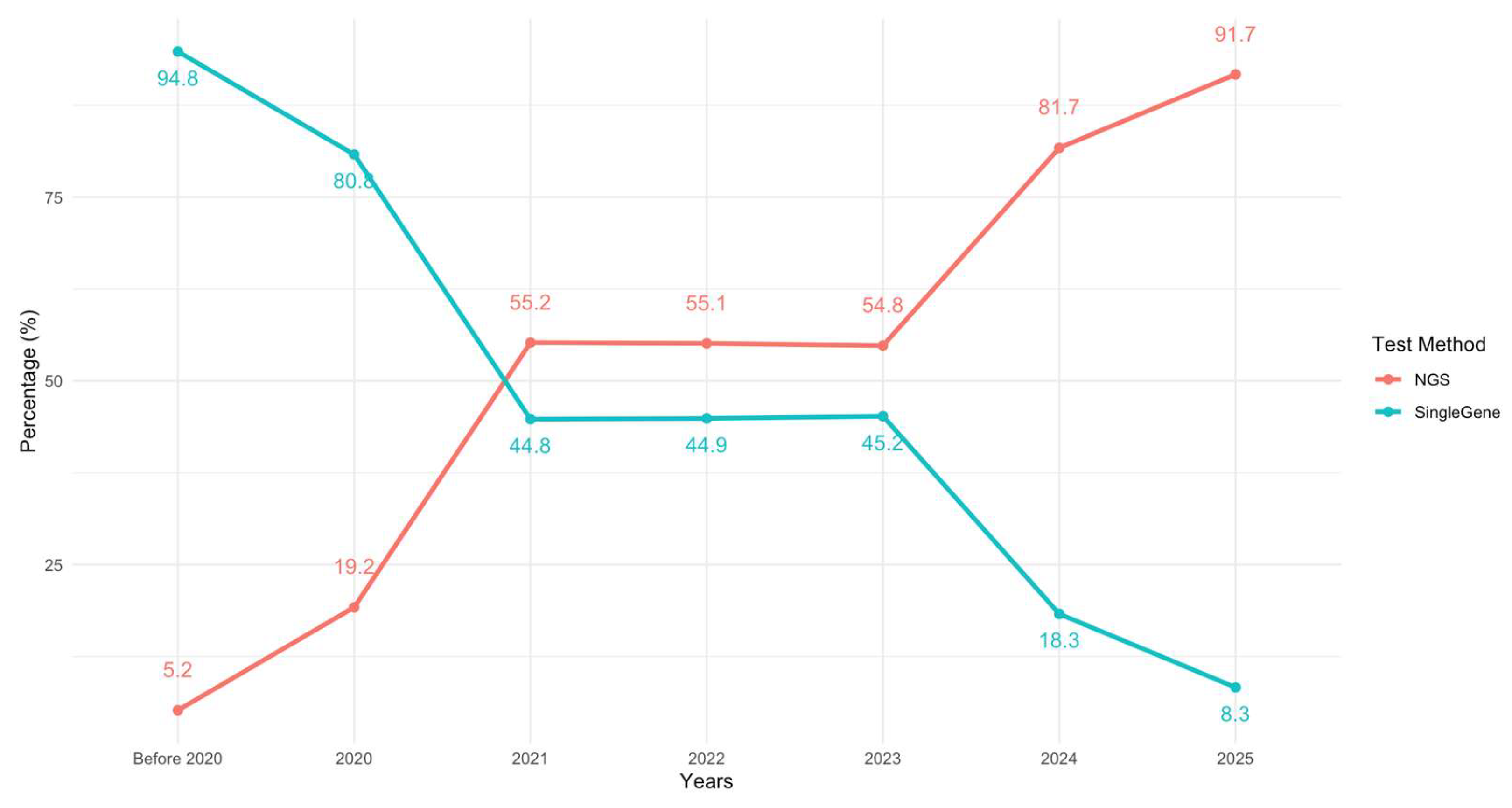
Molecular profiling was performed using NGS in 528 patients (51.6%) and single-gene assays in 495 patients (48.4%). The use of NGS increased significantly over time, rising from only 5.2% of molecular tests in 2020 and earlier to more than 90% in 2025, indicating a substantial shift toward comprehensive genomic profiling in recent years (Figure 1). The center-level year-by-year distribution is shown in Supplementary Table S2.
Figure 1. Temporal trends in molecular testing methods for NSCLC: single-gene testing vs. NGS (before 2020–2025). NGS: next-generation sequencing.

3.3. Driver Mutations

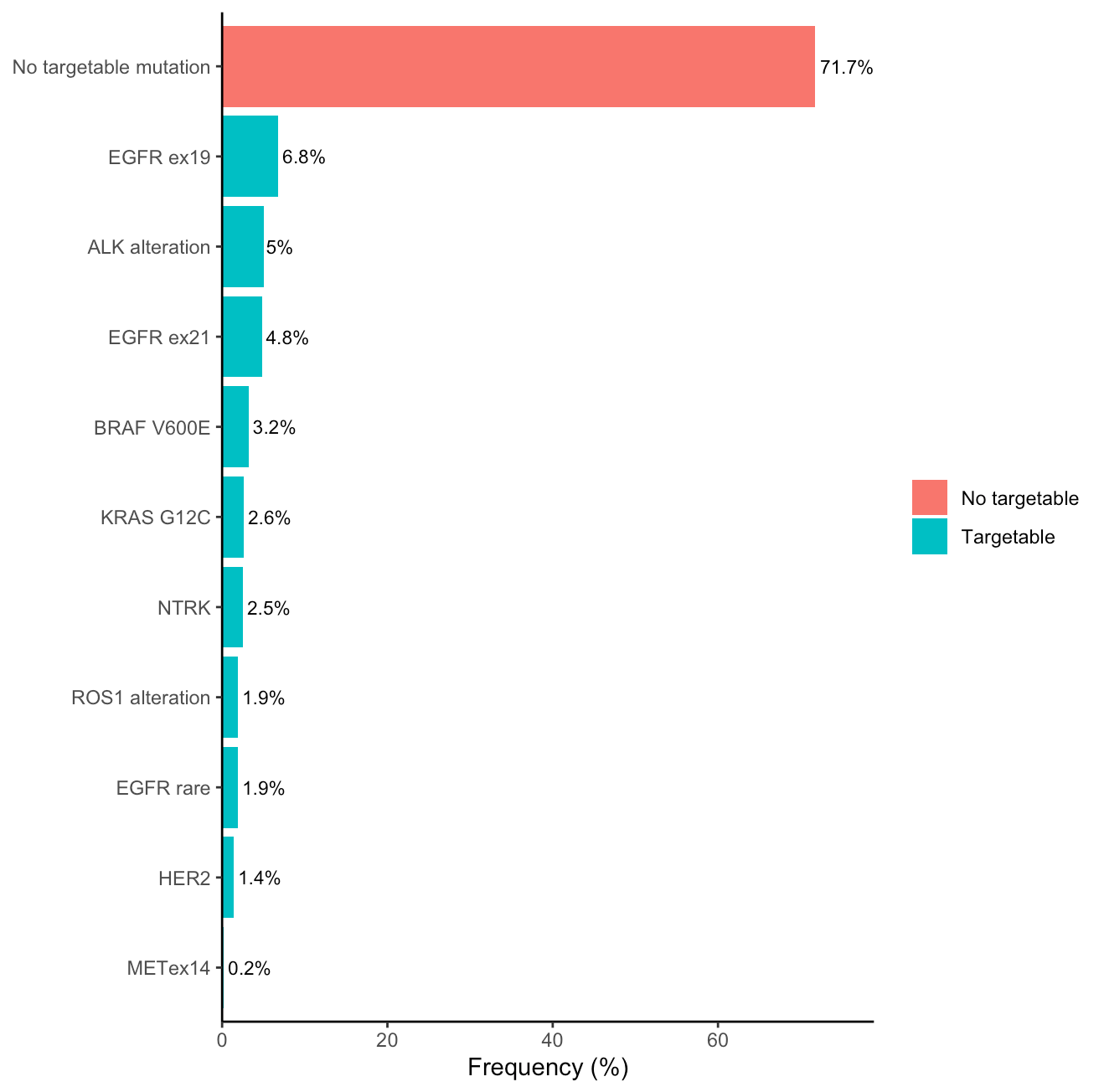
Targetable genomic alterations were identified in 289 patients (28.3%). The most frequently detected alterations included EGFR mutations in 164 patients (164/1023; 16.0%), with exon 19 deletions (6.8%) and L858R point mutations in exon 21 (4.8%) representing the most common subtypes. Rare EGFR mutations were present in 1.9%, and EGFR exon 20 insertions were observed in 0.9%. Other targetable alterations included ALK rearrangements in 5.0% (51/992), KRAS G12C mutations in 2.6% (26/990), ROS1 fusions in 1.9% (18/992), BRAF V600E in 3.2% (22/693), HER2 mutations in 1.4% (8/552), MET exon 14 skipping in 2.5% (13/527), and NTRK fusion in 0.2% (1/504). No RET rearrangements were identified in the cohort (0/525) (Figure 2). In total, 10 patients (1.0%) harbored dual actionable mutations. These included EGFR with BRAF V600E (n = 2), BRAF V600E with KRAS G12C (n = 1), ROS1 with BRAF V600E (n = 1), ROS1 with EGFR (n = 1), EGFR with MET exon 14 skipping (n = 2), KRAS G12C with MET exon 14 skipping (n = 1), KRAS G12C with NTRK fusion (n = 1), and ALK with BRAF V600E (n = 1).
Figure 2. Distribution of targetable genomic alterations in metastatic NSCLC. Because some patients harbored > 1 actionable alteration (n = 10, 1.0%), they were counted in the overall total and in each relevant gene slice (non-mutually exclusive). Consequently, slice percentages may exceed 100%. Percentages reflect gene-level frequencies. ALK: anaplastic lymphoma kinase, BRAF: B-Raf proto-oncogene, EGFR ex19: epidermal growth factor receptor exon 19 deletions, EGFR ex21: epidermal growth factor receptor exon 21 mutation, HER2: human epidermal growth factor receptor 2, KRAS: Kirsten rat sarcoma viral oncogene homolog, METex14: mesenchymal–epithelial transition exon 14 skipping mutation, NTRK: neurotrophic tyrosine receptor kinase, ROS1: ROS proto-oncogene 1.

3.4. Frequency of Targetable Mutations by Histologic Subtype

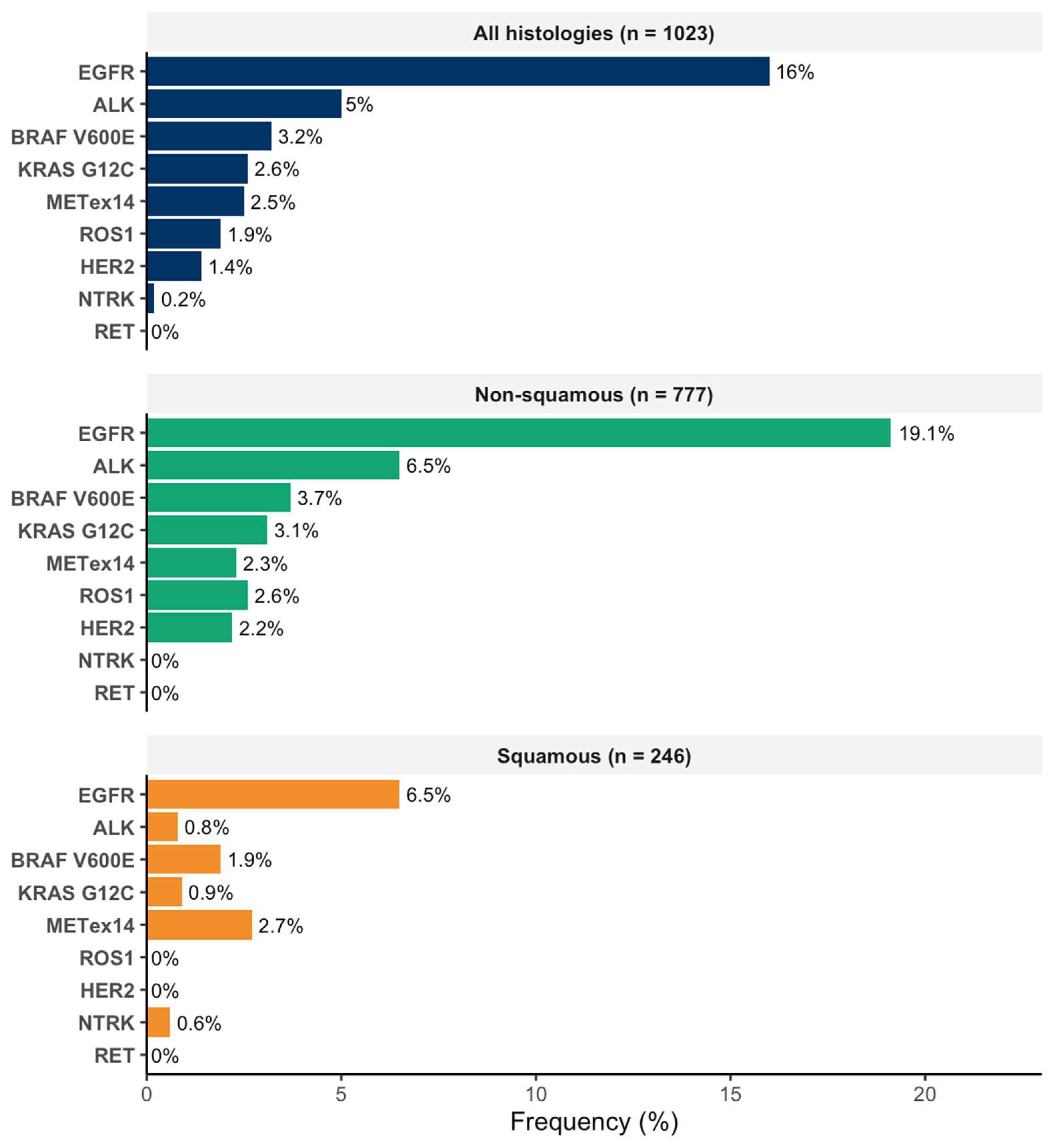
When stratified by histologic subtype, EGFR mutations were significantly more frequent in non-squamous tumors (19.1%) than in squamous cell carcinomas (6.5%). Similarly, ALK rearrangements were more common in non-squamous histology (6.5%) than in squamous tumors (0.8%). ROS1 fusions were detected in 2.6% of non-squamous and 1.9% of squamous carcinomas, while BRAF V600E mutations were found in 3.7% and 1.9%, respectively. KRAS G12C mutations occurred in 3.1% squamous and 2.6% non-squamous tumors. HER2 mutations were also slightly more common in non-squamous histology (2.2%) than in squamous histology (1.4%). MET exon 14 skipping mutations were relatively evenly distributed across both histologic subtypes (2.5% in non-squamous vs. 2.3% in squamous). NTRK fusions were rare overall (0.2%) and not observed in squamous tumors. No RET rearrangements were identified in either group (Figure 3).
Figure 3. Frequency of targetable genomic alterations by histologic subtype in metastatic NSCLC. ALK: anaplastic lymphoma kinase, BRAF: B-Raf proto-oncogene, EGFR ex19: epidermal growth factor receptor exon 19 deletions, EGFR ex21: epidermal growth factor receptor exon 21 mutation, HER2: human epidermal growth factor receptor 2, KRAS: Kirsten rat sarcoma viral oncogene homolog, METex14: mesenchymal–epithelial transition exon 14 skipping mutation, NTRK: neurotrophic tyrosine receptor kinase, ROS1: ROS proto-oncogene 1.

3.5. PD-L1 Expression and Association with Oncogenic Driver Mutations

In exploratory analyses, PD-L1-TPS was <1% in 47.8%, between 1 and 49% in 34.4%, and ≥50% in 17.8% of 601 patients with available data. EGFR-mutated tumors were more frequently associated with lower PD-L1 expression compared to EGFR wild-type tumors. A total of 42.7% (n = 38) of EGFR-mutated tumors were PD-L1-positive, whereas 54.2% (n = 276) of EGFR wild-type tumors expressed PD-L1. ROS1-rearranged tumors (n = 11) demonstrated a lower PD-L1 positivity rate (18.2%, n = 2) compared to ROS1-negative tumors (53.8%, n = 304), a statistically significant difference (p = 0.019), although the number of ROS1-positive cases was relatively small. Multivariable logistic regression (adjusted for age, sex, smoking, histology, and site) followed by Benjamini–Hochberg FDR correction across drivers showed no statistically significant associations between PD-L1 positivity (TPS ≥ 1%) and EGFR, ALK, ROS1, KRAS G12C, or BRAF V600E (all q ≥ 0.29) (Supplementary Table S3).
No meaningful associations were found between PD-L1 status and the presence of other alterations, including ALK (52.0% vs. 52.6%, p = 0.956), BRAF V600E (46.2% vs. 52.7%, p = 0.642), KRAS G12C (40.0% vs. 52.5%, p = 0.271), HER2 (66.7% vs. 52.3%, p = 0.484), MET exon 14 (0.0% vs. 51.7%, p = 0.302), and NTRK (0.0% vs. 53.1%, p = 0.288), suggesting that PD-L1 expression is largely independent of these oncogenic alterations in this cohort.

3.6. Co-Mutations in NGS-Tested Patients

Among 520 patients who underwent NGS testing with the optimal level of gene coverage, the most frequent co-mutations were TP53 (33.1%), CDKN2A (4.1%), PIK3CA (3.2%), FGFR (3.0%), STK11 (2.6%), KEAP1 (2.0%), RB1 (2.0%), NF1 (2.0%), PTEN (1.5%), ARID1 (1.9%), and ATRX (0.9%).
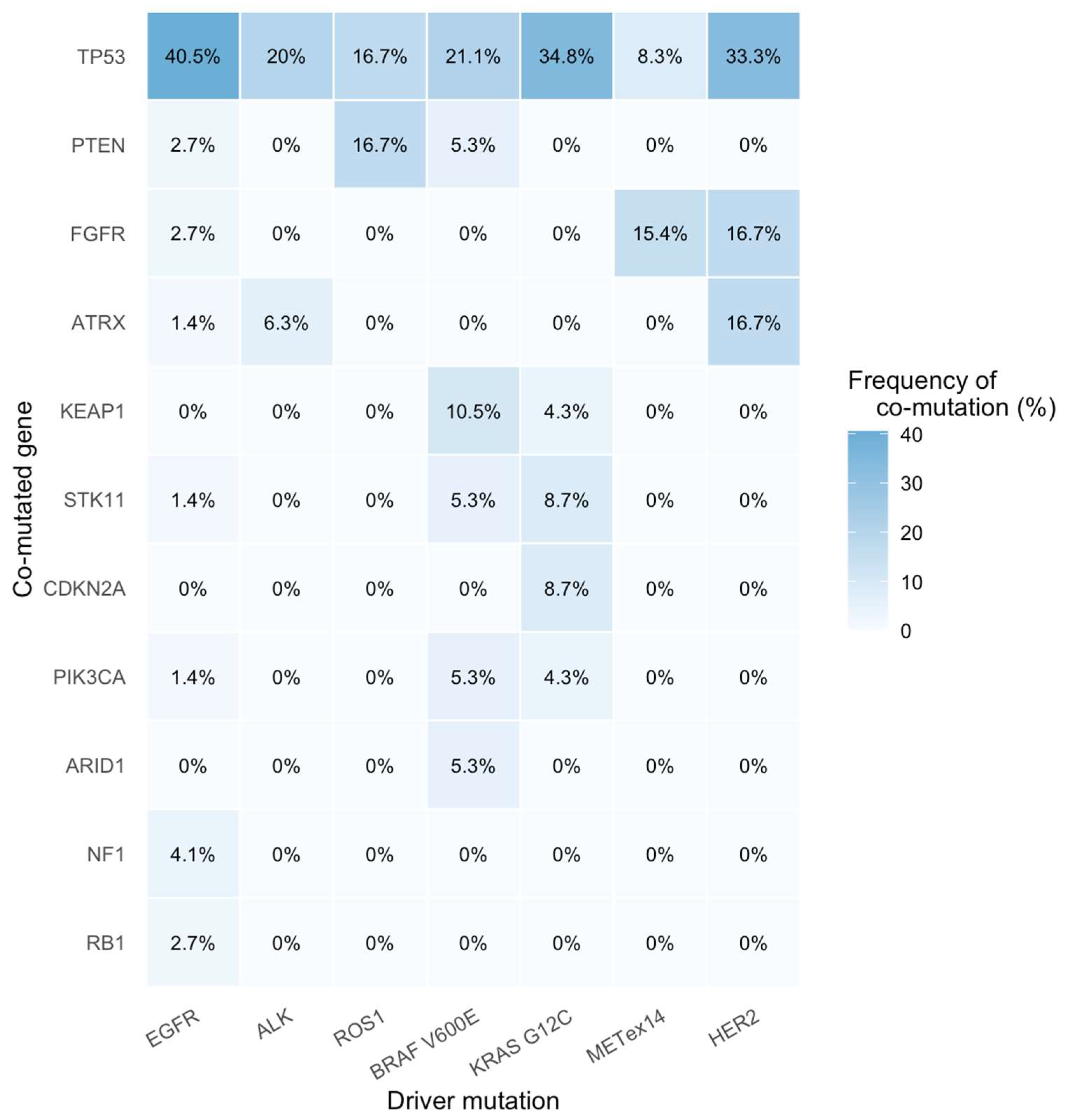
Among patients harboring targetable driver alterations, TP53 was the most frequent co-mutation across multiple subgroups, observed in 40.5% of EGFR-mutant, 20.0% of ALK-rearranged, 34.8% of KRAS G12C-mutant, 33.3% of HER2-mutant, 21.1% of BRAF V600E-mutant, 16.7% of ROS1-rearranged, and 8.3% of MET exon 14 skipping cases. Other notable co-mutations included STK11 in KRAS G12C (8.7%) and BRAF V600E (5.3%); KEAP1 in BRAF V600E (10.5%), KRAS G12C (4.3%); PTEN in ROS1 (16.7%) and EGFR (2.7%); FGFR alterations in MET exon 14 skipping (15.4%) and HER2 (16.7%). ARID1 mutations were uncommon, present only in BRAF V600E (5.3%) (Figure 4).
Figure 4. Distribution of co-mutations in patients with targetable genomic alterations. ALK: anaplastic lymphoma kinase, ARID1: AT-rich interaction domain 1A, ATRX: Alpha Thalassemia/Mental Retardation Syndrome X-linked, BRAF: B-Raf proto-oncogene, CDKN2A: cyclin-dependent kinase inhibitor 2A, EGFR: epidermal growth factor receptor, FGFR: fibroblast growth factor receptor, HER2: human epidermal growth factor receptor 2, KEAP1: Kelch-like ECH-associated protein 1, KRAS: Kirsten rat sarcoma viral oncogene homolog, METex14: mesenchymal–epithelial transition exon 14 skipping mutation, NF1: Neurofibromatosis type 1, PIK3CA: phosphatidylinositol-4,5-bisphosphate 3-kinase catalytic subunit alpha, PTEN: Phosphatase and TENsin homolog, RB1: Retinoblastoma 1, ROS1: ROS proto-oncogene 1, STK11: serine/threonine kinase 11, TP53: Tumor protein p53.

3.7. Associations Between Clinical Characteristics and Driver Mutations

EGFR-mutated patients were more often female, never-smokers, and had non-squamous histology compared to their wild-type counterparts. ALK fusion-positive tumors were also enriched in younger, female, never-smokers with non-squamous histology. ROS1 rearrangements occurred predominantly in younger, female, never-smokers with non-squamous histology, similar to the ALK pattern. BRAF V600E-mutated tumors shared the tendency toward non-squamous histology but did not differ significantly from wild-type cases in other demographic or clinical features. Comparative distributions of age, sex, smoking status, histologic subtype, and PD-L1 expression across these molecular subgroups are presented in Table 1.
Table 1. Comparison of clinical and pathological characteristics according to driver mutation status in mNSCLC.

3.8. Treatment and Follow-Up

The median follow-up duration for the study cohort was 29.1 months, and the median OS was 14.4 months. The median number of systemic therapy lines received was 2 (range, 0–8). Forty-two patients did not receive any systemic treatment due to poor performance status or treatment refusal, and two patients received only local treatment to metastatic sites. A total of 978 patients received at least one line of systemic therapy.

4. Discussion

This multicenter retrospective study provides a real-world landscape of genomic alterations and PD-L1 expression patterns among patients with mNSCLC across Türkiye. Beyond describing mutation frequencies, our data capture how molecular testing is currently implemented in routine practice, including heterogeneity in testing strategies. The diversity of genomic profiles observed in this Turkish population at the crossroads of Europe and Asia underscores the need to adapt global precision oncology standards to regional realities, with implications for test selection and for planning future access and policy discussions. Consistent with regional studies investigating genetic variants in other malignancies, such as genomic variants in bladder cancer and genomic disparity in breast cancer patients from Türkiye [9,10], our findings reinforce that regional genetic susceptibility and molecular characteristics can differ from aggregated global data and must be understood locally to optimize lung cancer care.
Across the study period, testing shifted decisively from single-gene assays to NGS, reaching >90% of tests by 2025. This transition aligns with international guidance favoring upfront broad profiling [11], and was facilitated by Türkiye’s universal, publicly funded system [12], where phased national reimbursement for NGS panels enabled routine use by 2022–2023, setting the stage for the inflection observed in 2024–2025. This surge likely reflects broader institutional access to on-site and reference NGS, the maturation of the national social security reimbursement framework. Center-specific policy data were not collected, however, so these inferences should be interpreted cautiously. The resulting expansion of NGS made comprehensive genotyping and PD-L1 assessment available to most patients with mNSCLC, providing the necessary foundation for rational selection of targeted therapies and immunotherapies. Future work should evaluate whether widespread testing translates into better outcomes and equitable delivery of targeted therapies.
Overall, our driver profile broadly mirrors global experience with local nuances. As expected, EGFR mutations (16%) clustered among never-smokers, women, and non-squamous histology; the overall prevalence, consistent with prior Turkish reports [13,14], is lower than in East Asian populations yet comparable to Western cohorts [15]. Notably, EGFR was detected in 6% of tumors diagnosed as SCC, above typical Western estimates (1.9–5%) [16,17] but remaining below East Asian estimates (14–18%) [18,19,20], suggesting an intermediate prevalence typical Western and East Asian series. Because many diagnoses relied on small biopsies without central review, underrecognition of adenosquamous components and classification challenges are credible contributors; indeed, the 2021 WHO guidance cautions against labeling NSCLC as “squamous” on small samples without adequate morphologic and immunohistochemical support [21]. Accordingly, these observations are hypothesis-generating and warrant confirmation in prospective, centrally reviewed cohorts. Importantly, they also carry a practical message: molecular testing should not be omitted in SCC. At minimum, reflex testing (or NGS when feasible) is warranted in SCCs with clinical or pathologic “red flags” (e.g., never- or light-smoking history, female sex, younger age, ambiguous morphology/limited tissue) to avoid missing actionable alterations and to ensure access to targeted therapies [4]. Other drivers in our cohort, ALK rearrangements (5.0%), KRAS G12C (2.6%), and BRAF V600E (3.2%), were observed at expected frequencies [22,23] and RET rearrangements were not detected, potentially reflecting true rarity and also limits of testing coverage.
Our co-mutation findings carry practical implications. TP53 was the most frequent concomitant alteration across drivers, present in 40.5% of EGFR-mutant tumors. Although we lacked treatment-level detail, accumulating evidence suggests that TP53 co-mutation in EGFR-mutant NSCLC portends inferior outcomes on EGFR TKIs [24,25,26]. In KRAS-mutant disease, co-alterations in STK11/LKB1 and/or KEAP1 demarcate subsets with distinct biology and attenuated benefit from PD-1/PD-L1 blockade [27,28]. Although our sample size precluded survival analysis, the ability to detect these immunotherapy-resistant profiles allows clinicians to better contextualize heterogeneous outcomes and consider prioritizing combination strategies or clinical trial referral over single-agent immunotherapy for these high-risk subgroups.
We investigated associations between PD-L1 expression and specific oncogenic drivers. Tumors with EGFR mutations and ROS1 rearrangements showed numerically lower PD-L1 positivity, consistent with prior reports of modest single-agent ICI activity in these subgroups [29,30,31], However, after multivariable adjustment and Benjamini–Hochberg FDR correction, no driver alteration reached statistical significance. Given small subgroup sizes, PD-L1 missingness, and heterogeneous IHC platforms, these signals should be considered hypothesis-generating and warrant confirmation in larger, prospectively collected, methodologically standardized cohorts. Taken together, PD-L1 expression alone remains a heterogeneous and complex biomarker that should be interpreted with caution in oncogene-addicted NSCLC.
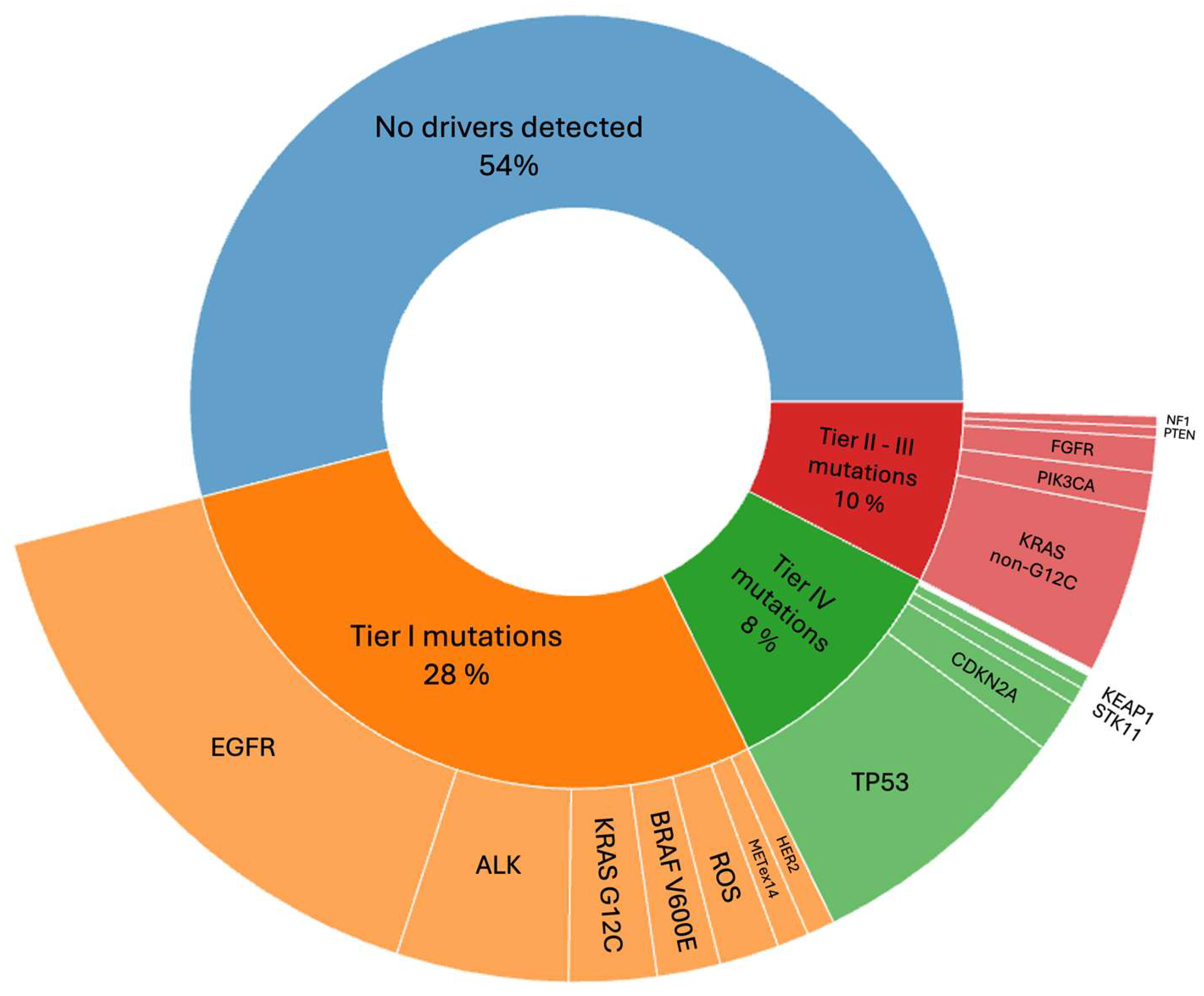
While single-gene testing historically captured EGFR and ALK, the inflection toward broad-panel NGS (reaching >90% by 2025) has revealed a more complex genomic landscape. As visualized in Figure 5, Tier I Standard Actionable drivers [32] were identified in 28.3% of patients and Tier II/III alterations in a further 7.6%, meaning that approximately one-third of patients harbor variants that either already guide therapy [11] or may become targets for emerging agents and clinical trials. These frequencies, combined with the high uptake of panel-based testing, support reflex broad-panel NGS at the time of pathological diagnosis of metastatic NSCLC rather than after empiric systemic therapy, so that eligible patients are identified early enough to receive genotype-matched treatment or trial referral.
Figure 5. Sunburst chart illustrating the genomic actionability landscape stratified by ESMO-ESCAT evidence levels. The inner ring represents the distribution of patients according to clinical actionability tiers, while the outer ring details the specific genomic alterations within each tier. Inner Ring (Clinical Actionability): Patients are classified into Standard Actionable (Tier I), Potentially Actionable (Tier II/III), Prognostic Only, and No Driver Detected groups based on the ESMO-ESCAT framework [32] and current guidelines [11]. ALK: anaplastic lymphoma kinase, BRAF: B-Raf proto-oncogene, CDKN2A: cyclin-dependent kinase inhibitor 2A, EGFR: epidermal growth factor receptor, FGFR: fibroblast growth factor receptor, HER2: human epidermal growth factor receptor 2, KEAP1: Kelch-like ECH-associated protein 1, KRAS: Kirsten rat sarcoma viral oncogene homolog, METex14: mesenchymal–epithelial transition exon 14 skipping mutation, NF1: Neurofibromatosis type 1, PIK3CA: phosphatidylinositol-4,5-bisphosphate 3-kinase catalytic subunit alpha, PTEN: Phosphatase and TENsin homolog, ROS1: ROS proto-oncogene 1, STK11: serine/threonine kinase 11, TP53: Tumor protein p53.
Within this landscape, a distinct subgroup of patients harbors Tier II/III (potentially actionable) alterations [32], such as PIK3CA, PTEN, and FGFR, alongside purely prognostic markers. Although these alterations are not currently part of the standard treatment algorithm for NSCLC [11], their identification carries significant real-world utility. Consistent with reports on the prevalence and clinical implications of PIK3CA aberrations across cancer types [33] and the emerging role of PTEN alterations in NSCLC biology [34], these variants help refine prognostic expectations and may signal mechanisms of resistance to other therapies. In practice, detecting PIK3CA or PTEN alterations may not trigger a specific approved therapy today, but it can flag patients for closer follow-up, inform discussions about likely disease course, and support consideration of clinical trial enrollment.
Ultimately, the value of molecular profiling lies in its ability to enable genotype-matched therapies. Broad overviews of cancer treatment and future directions emphasize that newer generations of targeted agents will increasingly require robust upfront genomic characterization [35]. As NGS becomes embedded in routine care in Türkiye, aligning clinical trial design and future reimbursement decisions with these real-world prevalence data may help ensure that diagnostic advances can translate into therapeutic benefit.
One area that merits deeper exploration is the influence of tobacco exposure. Türkiye has among the highest rates of tobacco consumption globally, particularly among men, with current smoking prevalence exceeding 40% and substantial rates of secondhand smoke exposure [8]. Our cohort mirrored this trend, with over 80% of patients having a smoking history. Interestingly, smoking status was strongly associated with the mutational profile—EGFR, ALK, and ROS1 alterations were more frequent in never-smokers, while KRAS G12C was more common in smokers. These findings reinforce the need to pair comprehensive molecular testing with routine, structured smoking-cessation support as a standard component of lung cancer care.
The retrospective nature of the study introduces potential biases, including missing data, and variable sample quality. Testing platforms varied across centers (panel size, nominal depth/LOD, bioinformatics pipelines) and PD-L1 assays (clone/platform), which we harmonized at the alteration-present/absent level; nevertheless, assay variability may contribute to between-group differences. Additionally, treatment response and resistance mechanisms were not captured, which limits causal inference for survival differences and the prediction of immunotherapy benefit by genotype. PD-L1 testing was not available in all cases, and co-mutation analysis was restricted to the subset of patients who underwent NGS. Finally, the lack of detailed socioeconomic, occupational, and environmental exposure data may obscure important modifiers of molecular patterns as well as potential histologic misclassification. Nevertheless, key strengths include a large sample spanning seven regions, contemporaneous practice patterns that capture the real-world rollout of NGS, and integrated reporting of drivers, PD-L1, and co-mutations. Importantly, in the absence of a Surveillance, Epidemiology, and End Results Program (SEER)-like nationwide cancer genomics registry in Türkiye, this multicenter study provides rare, system-level visibility into molecular testing patterns and genomic profiles across diverse institutions and regions, thereby helping to fill a critical evidence gap.

5. Conclusions

This study enhances our understanding of the genomic landscape of mNSCLC in a middle-income country with a high lung cancer burden. It underscores the feasibility of implementing advanced diagnostics in a publicly funded healthcare setting and highlights the heterogeneity of actionable mutations across demographic and histologic subgroups. Future prospective studies integrating treatment outcomes, resistance mechanisms, and real-world effectiveness of targeted therapies are warranted to further optimize lung cancer care in Türkiye and similar settings.

Supplementary Materials

The following supporting information can be downloaded at: https://www.mdpi.com/article/10.3390/genes16121446/s1, Table S1. Center-level NGS panel specifications and PD-L1 clones with adoption timelines. Table S2. Center-level year-by-year distribution of testing method (Single-gene vs NGS). Table S3: Association of oncogenic drivers with PD-L1 positivity (TPS ≥ 1%): multivariable logistic regression with FDR correction adjusted for age, sex, smoking status, histologic subtype, and PD-L1 assay.

Author Contributions

K.C.: Conceptualization, Methodology, Data Curation, Formal Analysis, Writing—Original Draft; E.E.: Data Curation, M.B.: Methodology, Supervision; F.M.B.: Data Curation, B.Ö.: Methodology, Supervision; M.Ç.: Data Curation; Ö.B.: Methodology, Supervision; G.T.: Data Curation; F.Ö.: Methodology, Supervision; H.A.: Data Curation; Z.U.: Methodology, Supervision; E.Ç.: Data Curation; Z.H.T.: Methodology, Supervision; A.K.: Conceptualization, Methodology, Supervision, Writing—Review and Editing. All authors have read and agreed to the published version of the manuscript.

Funding

The authors received no funding for this research.

Institutional Review Board Statement

This retrospective, multicenter study was approved by the Dokuz Eylül University Non-Interventional Research Ethics Committee (decision number 2025/29-03, 3 September 2025). Administrative permissions for data use were obtained from all participating institutions. The study was conducted in accordance with the Declaration of Helsinki and applicable national regulations.

Data Availability Statement

Data is not publicly available due to confidentiality and institutional privacy regulations. De-identified data underlying the findings are available to the corresponding author on reasonable request.

Conflicts of Interest

The authors declare no conflict of interest.

References

  1. Sonkin, D.; Thomas, A.; Teicher, B.A. Cancer treatments: Past, present, and future. Cancer Genet. 2024, 286–287, 18–24. [Google Scholar] [CrossRef] [PubMed] [PubMed Central]
  2. Li, M.S.C.; Mok, K.K.S.; Mok, T.S.K. Developments in targeted therapy & immunotherapy-how non-small cell lung cancer management will change in the next decade: A narrative review. Ann. Transl. Med. 2023, 11, 358. [Google Scholar] [CrossRef] [PubMed]
  3. Riely, G.J.; Wood, D.E.; Aisner, D.L.; Loo, B.W., Jr.; Axtell, A.L.; Bauman, J.R.; Bharat, A.; Chang, J.Y.; Desai, A.; Dilling, T.J.; et al. NCCN Guidelines® Insights: Non-Small Cell Lung Cancer, Version 7.2025. J. Natl. Compr. Cancer Netw. 2025, 23, 354–362. [Google Scholar] [CrossRef] [PubMed]
  4. Lindeman, N.I.; Cagle, P.T.; Aisner, D.L.; Arcila, M.E.; Beasley, M.B.; Bernicker, E.H.; Colasacco, C.; Dacic, S.; Hirsch, F.R.; Kerr, K.; et al. Updated Molecular Testing Guideline for the Selection of Lung Cancer Patients for Treatment With Targeted Tyrosine Kinase Inhibitors: Guideline From the College of American Pathologists, the International Association for the Study of Lung Cancer, and the Association for Molecular Pathology. Arch. Pathol. Lab. Med. 2018, 142, 321–346. [Google Scholar] [CrossRef] [PubMed]
  5. Cangır, A.K.; Yumuk, P.F.; Sak, S.D.; Akyürek, S.; Eralp, Y.; Yılmaz, Ü.; Selek, U.; Eroğlu, A.; Tatlı, A.M.; Dinçbaş, F.Ö.; et al. Lung Cancer in Turkey. J. Thorac. Oncol. 2022, 17, 1158–1170. [Google Scholar] [CrossRef]
  6. Turkish Statistical Institute. Available online: https://data.tuik.gov.tr/Kategori/GetKategori?p=Nufus-ve-Demografi-109 (accessed on 4 August 2025).
  7. Sung, H.; Ferlay, J.; Siegel, R.L.; Laversanne, M.; Soerjomataram, I.; Jemal, A.; Bray, F. Global Cancer Statistics 2020: GLOBOCAN Estimates of Incidence and Mortality Worldwide for 36 Cancers in 185 Countries. CA A Cancer J. Clin. 2021, 71, 209–249. [Google Scholar] [CrossRef]
  8. GATS (Global Adult Tobacco Survey) Fact Sheet, Turkey 2016. Available online: https://extranet.who.int/ncdsmicrodata/index.php/catalog/872 (accessed on 5 August 2025).
  9. Akkoç, Y.; Sulhan, H.; Akgöllü, E.; Çift, A. The effect of HOTAIR gene variants on the development of bladder cancer and its clinicopathological characteristics in a Caucasian population. Cancer Genet. 2025, 296–297, 145–149. [Google Scholar] [CrossRef] [PubMed]
  10. Agaoglu, N.B.; Unal, B.; Hayes, C.P.; Walker, M.; Ng, O.H.; Doganay, L.; Can, N.D.; Rana, H.Q.; Ghazani, A.A. Genomic disparity impacts variant classification of cancer susceptibility genes in Turkish breast cancer patients. Cancer Med. 2024, 13, e6852. [Google Scholar] [CrossRef] [PubMed] [PubMed Central]
  11. Hendriks, L.E.; Kerr, K.M.; Menis, J.; Mok, T.S.; Nestle, U.; Passaro, A.; Peters, S.; Planchard, D.; Smit, E.F.; Solomon, B.J.; et al. Oncogene-addicted metastatic non-small-cell lung cancer: ESMO Clinical Practice Guideline for diagnosis, treatment and follow-up. Ann. Oncol. 2023, 34, 339–357. [Google Scholar] [CrossRef]
  12. Social Security Institution. Available online: https://www.sgk.gov.tr/Istatistik/Yillik/fcd5e59b-6af9-4d90-a451-ee7500eb1cb4/ (accessed on 4 August 2025).
  13. Tezel, G.G.; Şener, E.; Aydın, Ç.; Önder, S. Prevalence of Epidermal Growth Factor Receptor Mutations in Patients with Non-Small Cell Lung Cancer in Turkish Population. Balk. Med. J. 2017, 34, 567–571. [Google Scholar] [CrossRef]
  14. Calibasi-Kocal, G.; Amirfallah, A.; Sever, T.; Umit Unal, O.; Gurel, D.; Oztop, I.; Ellidokuz, H.; Basbinar, Y. EGFR mutation status in a series of Turkish non-small cell lung cancer patients. Biomed. Rep. 2020, 13, 2. [Google Scholar] [CrossRef]
  15. Melosky, B.; Kambartel, K.; Häntschel, M.; Bennetts, M.; Nickens, D.J.; Brinkmann, J.; Kayser, A.; Moran, M.; Cappuzzo, F. Worldwide Prevalence of Epidermal Growth Factor Receptor Mutations in Non-Small Cell Lung Cancer: A Meta-Analysis. Mol. Diagn. Ther. 2022, 26, 7–18. [Google Scholar] [CrossRef] [PubMed]
  16. Skov, B.G.; Høgdall, E.; Clementsen, P.; Krasnik, M.; Larsen, K.R.; Sørensen, J.B.; Skov, T.; Mellemgaard, A. The prevalence of EGFR mutations in non-small cell lung cancer in an unselected Caucasian population. J. Pathol. Microbiol. Immunol. 2015, 123, 108–115. [Google Scholar] [CrossRef] [PubMed]
  17. Gahr, S.; Stoehr, R.; Geissinger, E.; Ficker, J.H.; Brueckl, W.M.; Gschwendtner, A.; Gattenloehner, S.; Fuchs, F.S.; Schulz, C.; Rieker, R.J.; et al. EGFR mutational status in a large series of Caucasian European NSCLC patients: Data from daily practice. Br. J. Cancer 2013, 109, 1821–1828. [Google Scholar] [CrossRef] [PubMed]
  18. Zhang, Q.; Zhu, L.; Zhang, J. Epidermal growth factor receptor gene mutation status in pure squamous-cell lung cancer in Chinese patients. BMC Cancer 2015, 15, 88. [Google Scholar] [CrossRef]
  19. Zhao, Z.; Chen, Y.; Kong, W.; Yu, Z.; He, X. 29P Genomic features of Chinese lung squamous cell carcinoma patients. Ann. Oncol. 2020, 31, S253. [Google Scholar] [CrossRef]
  20. Han, B.; Tjulandin, S.; Hagiwara, K.; Normanno, N.; Wulandari, L.; Laktionov, K.; Hudoyo, A.; He, Y.; Zhang, Y.P.; Wang, M.Z.; et al. EGFR mutation prevalence in Asia-Pacific and Russian patients with advanced NSCLC of adenocarcinoma and non-adenocarcinoma histology: The IGNITE study. Lung Cancer 2017, 113, 37–44. [Google Scholar] [CrossRef]
  21. Nicholson, A.G.; Tsao, M.S.; Beasley, M.B.; Borczuk, A.C.; Brambilla, E.; Cooper, W.A.; Dacic, S.; Jain, D.; Kerr, K.M.; Lantuejoul, S.; et al. The 2021 WHO Classification of Lung Tumors: Impact of Advances Since 2015. J. Thorac. Oncol. 2022, 17, 362–387. [Google Scholar] [CrossRef]
  22. Gün, E.; Çakır, İ.E.; Ersöz, H.; Oflazoğlu, U.; Sertoğullarından, B. The Epidermal Growth Factor, Anaplastic Lymphoma Kinase, and ROS Proto-oncogene 1 Mutation Profile of Non-Small Cell Lung Carcinomas in the Turkish Population: A Single-Center Analysis. Thorac. Res. Pract. 2024, 25, 102–109. [Google Scholar] [CrossRef]
  23. Ayten, Ö.; Çalışkan, T.; Canoğlu, K.; Kaya Terzi, N.; Emirzeoğlu, L.; Okutan, O. Oncogenic Mutation Frequencies in Lung Cancer Patients. Hamidiye Med. J. 2020, 1, 17–21. [Google Scholar] [CrossRef]
  24. Ferrara, M.G.; Belluomini, L.; Smimmo, A.; Sposito, M.; Avancini, A.; Giannarelli, D.; Milella, M.; Pilotto, S.; Bria, E. Meta-analysis of the prognostic impact of TP53 co-mutations in EGFR-mutant advanced non-small-cell lung cancer treated with tyrosine kinase inhibitors. Crit. Rev. Oncol./Hematol. 2023, 184, 103929. [Google Scholar] [CrossRef]
  25. Qin, K.; Hou, H.; Liang, Y.; Zhang, X. Prognostic value of TP53 concurrent mutations for EGFR- TKIs and ALK-TKIs based targeted therapy in advanced non-small cell lung cancer: A meta-analysis. BMC Cancer 2020, 20, 328. [Google Scholar] [CrossRef]
  26. Pezzuto, F.; Hofman, V.; Bontoux, C.; Fortarezza, F.; Lunardi, F.; Calabrese, F.; Hofman, P. The significance of co-mutations in EGFR-mutated non-small cell lung cancer: Optimizing the efficacy of targeted therapies? Lung Cancer 2023, 181, 107249. [Google Scholar] [CrossRef] [PubMed]
  27. Ricciuti, B.; Arbour, K.C.; Lin, J.J.; Vajdi, A.; Vokes, N.; Hong, L.; Zhang, J.; Tolstorukov, M.Y.; Li, Y.Y.; Spurr, L.F.; et al. Diminished Efficacy of Programmed Death-(Ligand)1 Inhibition in STK11- and KEAP1-Mutant Lung Adenocarcinoma Is Affected by KRAS Mutation Status. J. Thorac. Oncol. 2022, 17, 399–410. [Google Scholar] [CrossRef] [PubMed]
  28. Skoulidis, F.; Goldberg, M.E.; Greenawalt, D.M.; Hellmann, M.D.; Awad, M.M.; Gainor, J.F.; Schrock, A.B.; Hartmaier, R.J.; Trabucco, S.E.; Gay, L.; et al. STK11/LKB1 Mutations and PD-1 Inhibitor Resistance in KRAS-Mutant Lung Adenocarcinoma. Cancer Discov. 2018, 8, 822–835. [Google Scholar] [CrossRef] [PubMed]
  29. Takada, K.; Toyokawa, G.; Tagawa, T.; Kohashi, K.; Shimokawa, M.; Akamine, T.; Takamori, S.; Hirai, F.; Shoji, F.; Okamoto, T.; et al. PD-L1 expression according to the EGFR status in primary lung adenocarcinoma. Lung Cancer 2018, 116, 1–6. [Google Scholar] [CrossRef]
  30. Hastings, K.; Yu, H.A.; Wei, W.; Sanchez-Vega, F.; DeVeaux, M.; Choi, J.; Rizvi, H.; Lisberg, A.; Truini, A.; Lydon, C.A.; et al. EGFR mutation subtypes and response to immune checkpoint blockade treatment in non-small-cell lung cancer. Ann. Oncol. 2019, 30, 1311–1320. [Google Scholar] [CrossRef]
  31. Choudhury, N.J.; Schneider, J.L.; Patil, T.; Zhu, V.W.; Goldman, D.A.; Yang, S.R.; Falcon, C.J.; Do, A.; Nie, Y.; Plodkowski, A.J.; et al. Response to Immune Checkpoint Inhibition as Monotherapy or in Combination With Chemotherapy in Metastatic ROS1-Rearranged Lung Cancers. JTO Clin. Res. Rep. 2021, 2, 100187. [Google Scholar] [CrossRef]
  32. Mateo, J.; Chakravarty, D.; Dienstmann, R.; Jezdic, S.; Gonzalez-Perez, A.; Lopez-Bigas, N.; Ng, C.K.Y.; Bedard, P.L.; Tortora, G.; Douillard, J.Y.; et al. A framework to rank genomic alterations as targets for cancer precision medicine: The ESMO Scale for Clinical Actionability of molecular Targets (ESCAT). Ann. Oncol. 2018, 29, 1895–1902. [Google Scholar] [CrossRef] [PubMed] [PubMed Central]
  33. Kim, J.; Jang, H.L.; Hong, J.Y.; Kim, S.T.; Park, S.H.; Park, J.O.; Kim, K.M.; Geun Kim, D.; Lee, J.; Lim, S.H. Prevalence and clinical implications of PIK3CA aberrations across cancer types: A real-world next-generation sequencing approach. Cancer Genet. 2025, 296–297, 133–143. [Google Scholar] [CrossRef] [PubMed]
  34. Paredes, R.; Borea, R.; Drago, F.; Russo, A.; Nigita, G.; Rolfo, C. Genetic drivers of tumor microenvironment and immunotherapy resistance in non-small cell lung cancer: The role of KEAP1, SMARCA4, and PTEN mutations. J. Immunother. Cancer 2025, 13, e012288. [Google Scholar] [CrossRef] [PubMed] [PubMed Central]
  35. Joshi, R.M.; Telang, B.; Soni, G.; Khalife, A. Overview of perspectives on cancer, newer therapies, and future directions. Oncol. Transl. Med. 2024, 10, 105–109. [Google Scholar] [CrossRef]
Disclaimer/Publisher’s Note: The statements, opinions and data contained in all publications are solely those of the individual author(s) and contributor(s) and not of MDPI and/or the editor(s). MDPI and/or the editor(s) disclaim responsibility for any injury to people or property resulting from any ideas, methods, instructions or products referred to in the content.

Article Metrics

Citations

Article Access Statistics

Article metric data becomes available approximately 24 hours after publication online.