


Alcohol Use Intensity Decreases in Response to Successful Smoking Cessation Therapy

 ,
,  ,
,  and
and
Abstract
1. Introduction
2. Materials and Methods
3. Results
4. Discussion
Author Contributions
Funding
Institutional Review Board Statement
Informed Consent Statement
Data Availability Statement
Conflicts of Interest
References
- Bien, T.H.; Burge, R. Smoking and drinking: A review of the literature. Int. J. Addict. 1990, 25, 1429–1454. [Google Scholar] [CrossRef] [Scilit]
- Newport, F. Smoking and Drinking in America Today. Gallup, 2014. Available online: https://news.gallup.com/opinion/polling-matters/176420/smoking-drinking-america-today.aspx (accessed on 28 October 2021).
- Chou, S.P.; Goldstein, R.B.; Smith, S.M.; Huang, B.; Ruan, W.J.; Zhang, H.; Jung, J.; Saha, T.D.; Pickering, R.P.; Grant, B.F. The epidemiology of dsm-5 nicotine use disorder: Results from the national epidemiologic survey on alcohol and related conditions-iii. J. Clin. Psychiatry 2016, 77, 1404–1412. [Google Scholar] [CrossRef] [Scilit]
- Ho, R.K.S.; Fok, P.W.Y.; Chan, H.C.H. Pattern and determinants of alcohol and tobacco co-use and its relationship with smoking cessation in Hong Kong. Tob. Prev. Cessat. 2021, 7, 1–9. [Google Scholar] [CrossRef] [Scilit] [PubMed]
- Meyerhoff, D.J.; Tizabi, Y.; Staley, J.K.; Durazzo, T.C.; Glass, J.M.; Nixon, S.J. Smoking comorbidity in alcoholism: Neurobiological and neurocognitive consequences. Alcohol. Clin. Exp. Res. 2006, 30, 253–264. [Google Scholar] [CrossRef] [Scilit]
- Livingston, M.; Callinan, S. Underreporting in Alcohol Surveys: Whose Drinking Is Underestimated? J. Stud. Alcohol Drugs 2015, 76, 158–164. [Google Scholar] [CrossRef]
- Boniface, S.; Shelton, N. How is alcohol consumption affected if we account for under-reporting? A hypothetical scenario. Eur. J. Public Health 2013, 23, 1076–1081. [Google Scholar] [CrossRef] [Scilit]
- Cho, E.; Lee, J.E.; Rimm, E.B.; Fuchs, C.S.; Giovannucci, E.L. Alcohol consumption and the risk of colon cancer by family history of colorectal cancer. Am. J. Clin. Nutr. 2012, 95, 413–419. [Google Scholar] [CrossRef] [Scilit] [PubMed]
- Parajuli, R.; Bjerkaas, E.; Tverdal, A.; Selmer, R.; Le Marchand, L.; Weiderpass, E.; Gram, I.T. The increased risk of colon cancer due to cigarette smoking may be greater in women than men. Cancer Epidemiol. Biomark. Prev. 2013, 22, 862–871. [Google Scholar] [CrossRef] [Scilit] [PubMed]
- McKee, S.A.; Krishnan-Sarin, S.; Shi, J.; Mase, T.; O’Malley, S.S. Modeling the effect of alcohol on smoking lapse behavior. Psychopharmacology 2006, 189, 201–210. [Google Scholar] [CrossRef] [Scilit] [PubMed]
- Hämäläinen, M.D.; Zetterström, A.; Winkvist, M.; Söderquist, M.; Öhagen, P.; Andersson, K.; Nyberg, F. Breathalyser-Based eHealth Data Suggest That Self-Reporting of Abstinence Is a Poor Outcome Measure for Alcohol Use Disorder Clinical Trials. Alcohol Alcohol. 2020, 55, 237–245. [Google Scholar] [CrossRef] [Scilit] [PubMed]
- Searles, J.S.; Helzer, J.E.; Rose, G.; Badger, G.J. Concurrent and retrospective reports of alcohol consumption across 30, 90 and 366 days: Interactive voice response compared with the timeline follow back. J. Stud. Alcohol 2002, 63, 352–362. [Google Scholar] [CrossRef] [Scilit] [PubMed]
- Papas, R.K.; Gakinya, B.N.; Mwaniki, M.M.; Keter, A.K.; Lee, H.; Loxley, M.P.; Klein, D.A.; Sidle, J.E.; Martino, S.; Baliddawa, J.B.; et al. Associations Between the Phosphatidylethanol Alcohol Biomarker and Self-Reported Alcohol Use in a Sample of HIV -Infected Outpatient Drinkers in Western Kenya. Alcohol. Clin. Exp. Res. 2016, 40, 1779–1787. [Google Scholar] [CrossRef] [Scilit]
- Nanau, R.M.; Neuman, M.G. Biomolecules and Biomarkers Used in Diagnosis of Alcohol Drinking and in Monitoring Therapeutic Interventions. Biomolecules 2015, 5, 1339–1385. [Google Scholar] [CrossRef] [Scilit]
- Miller, S.; Mills, J.A.; Long, J.; Philibert, R. A Comparison of the Predictive Power of DNA Methylation with Carbohydrate Deficient Transferrin for Heavy Alcohol Consumption. Epigenetics 2021, 16, 696–979. [Google Scholar] [CrossRef] [Scilit] [PubMed]
- Cabarcos, P.; Álvarez, I.; Tabernero-Duque, M.; Bermejo, A.M. Determination of direct alcohol markers: A review. Anal. Bioanal. Chem. 2015, 407, 4907–4925. [Google Scholar] [CrossRef] [Scilit] [PubMed]
- Philibert, R.; Miller, S.; Noel, A.; Dawes, K.; Papworth, E.; Black, D.; Beach, S.R.H.; Long, J.; Mills, J.A.; Dogan, M. A Four Marker Digital PCR Toolkit for Detecting Heavy Alcohol Consumption and the Effectiveness of Its Treatment. J. Insur. Med. 2019, 48, 90–102. [Google Scholar] [CrossRef] [Scilit]
- Philibert, R.; Levin, M.; Privett, M. Alcohol Use, Epigenetics & life Insurance: Quantifying the Risk. On the Risk: The Journal of the Academy of Life Underwriting (June 2021). Available online: https://ontherisk.com/product/alcohol-use-epigenetics-and-life-insurance-quantifying-the-risk/ (accessed on 28 October 2021).
- Gelernter, J.; Polimanti, R. Genetics of substance use disorders in the era of big data. Nat. Rev. Genet. 2021, 22, 712–729. [Google Scholar] [CrossRef] [Scilit] [PubMed]
- Dawes, K.; Andersen, A.; Reimer, R.; Mills, J.A.; Hoffman, E.; Long, J.D.; Miller, S.; Philibert, R. The relationship of smoking to cg05575921 methylation in blood and saliva DNA samples from several studies. Sci. Rep. 2021, 11, 21627. [Google Scholar] [CrossRef] [Scilit] [PubMed]
- Dawes, K.; Sampson, L.; Reimer, R.; Miller, S.; Philibert, R.; Andersen, A. Epigenetic Analyses of Alcohol Consumption in Combustible and Non-Combustible Nicotine Product Users. Epigenomes 2021, 5, 18. [Google Scholar] [CrossRef] [Scilit]
- Liu, Y.; Comellas, A.; Kaczka, D.; Motahari, A.; Lee, C.; Gerke, A.; Wilson, J.; Salisbury, A.; O’Connel-Moore, D.; Philibert, R. An incentive-based program coupled with sildenafil provides enhanced success of smoking cessation associated with an accelerated loss of ct assessed smoking-associated lung density (inflammation) and improved dlco. In D76. Copd: Clinical Studies; American Thoracic Society: New York, NY, USA, 2020; p. A7556. [Google Scholar]
- Philibert, R.; Dogan, M.; Beach, S.R.H.; Mills, J.A.; Long, J.D. AHRR methylation predicts smoking status and smoking intensity in both saliva and blood DNA. Am. J. Med. Genet. Part B Neuropsychiatr. Genet. 2020, 183, 51–60. [Google Scholar] [CrossRef] [Scilit] [PubMed]
- Andersen, A.; Reimer, R.; Dawes, K.; Becker, A.; Hutchens, N.; Miller, S.; Dogan, M.; Hundley, B.; Mills, J.A.; Long, J.D.; et al. DNA methylation differentiates smoking from vaping and non-combustible tobacco use. Epigenetics 2021, 1–13. [Google Scholar] [CrossRef] [Scilit] [PubMed]
- Philibert, R.; Dogan, M.; Noel, A.; Miller, S.; Krukow, B.; Papworth, E.; Black, D.W. Dose response and prediction characteristics of a methylation sensitive digital PCR assay for cigarette consumption in adults. Front. Genet. 2018, 9, 137. [Google Scholar] [CrossRef] [Scilit] [PubMed]
- Mills, J.A.; Beach, S.R.H.; Dogan, M.; Simons, R.L.; Gibbons, F.X.; Long, J.D.; Philibert, R. A Direct Comparison of the Relationship of Epigenetic Aging and Epigenetic Substance Consumption Markers to Mortality in the Framingham Heart Study. Genes 2019, 10, 51. [Google Scholar] [CrossRef] [Scilit] [PubMed]
- National Institute of Alcoholism and Alcohol Abuse. Alcohol Facts and Statistics; Department of Health and Human Services: Rockville, MD, USA, 2020. Available online: https://www.niaaa.nih.gov/publications/brochures-and-fact-sheets/alcohol-facts-and-statistics (accessed on 20 October 2020).
- Notley, C.; .Notley, C.; Gentry, S.; Livingstone-Banks, J.; Bauld, L.; Perera, R.; Hartmann-Boyce, J. Incentives for smoking cessation. Cochrane Database Syst. Rev. 2019, 7, CD004307. [Google Scholar] [CrossRef] [Scilit] [PubMed]
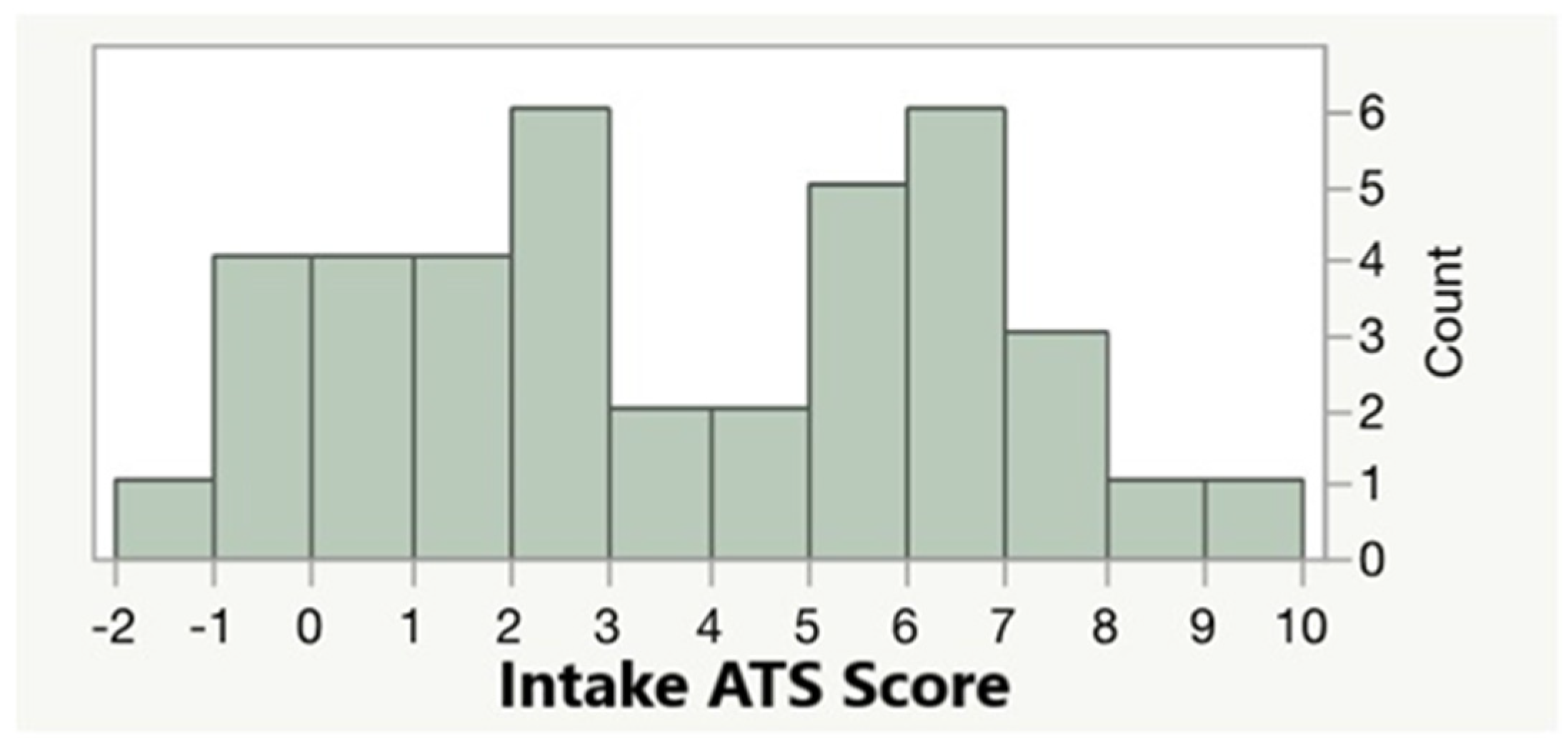
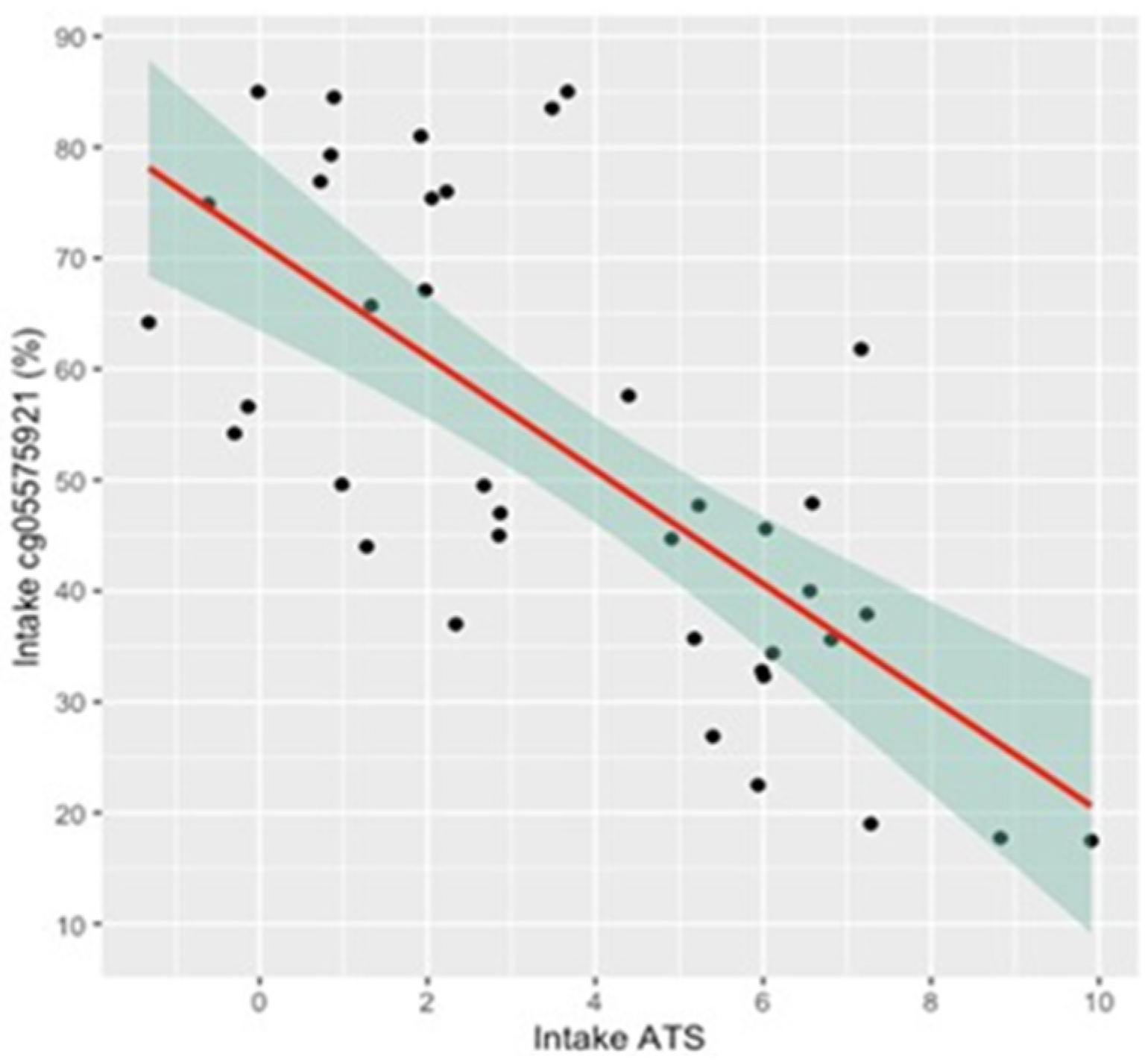
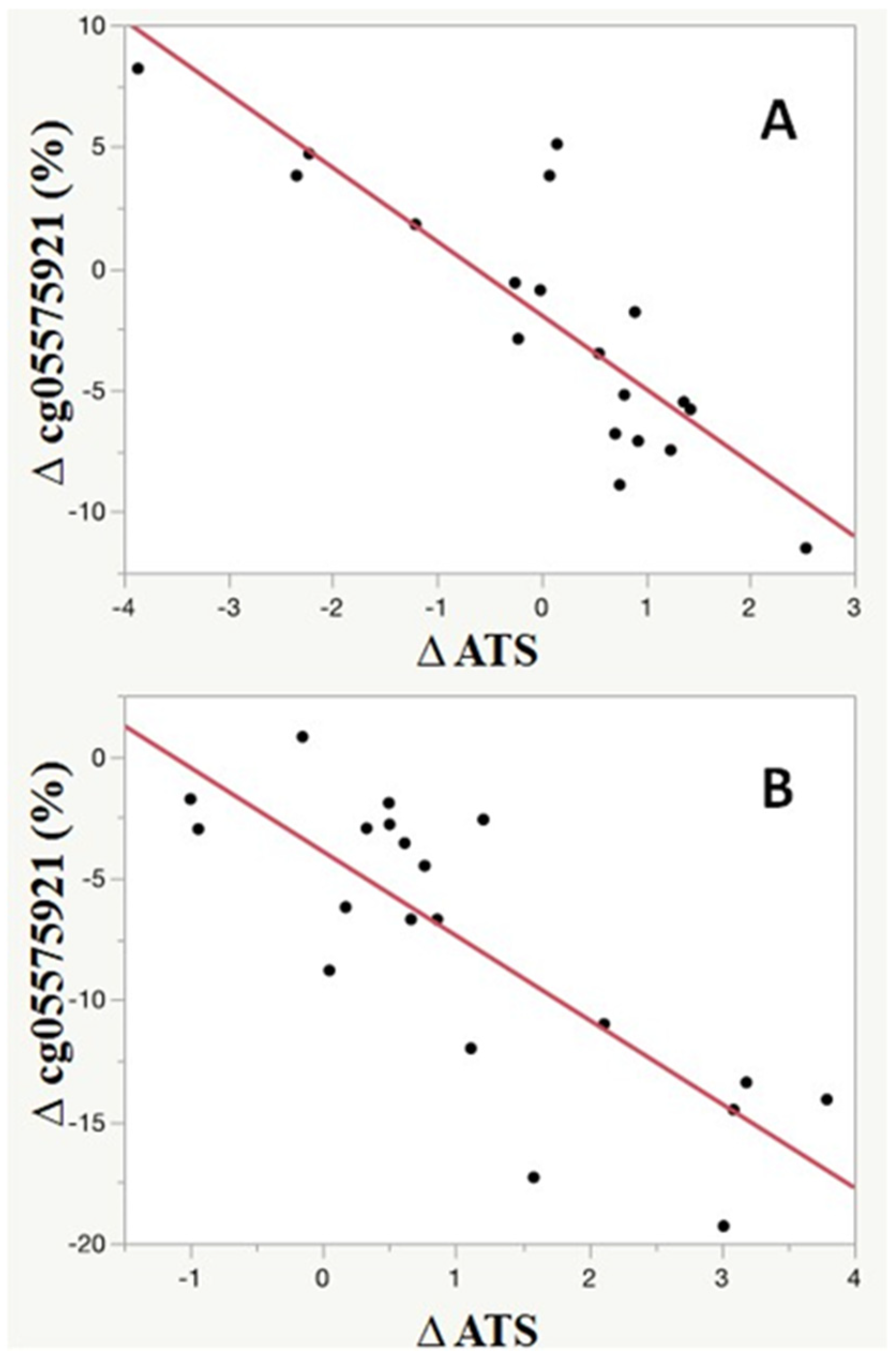

| Non-Quitters | Quitters | |
|---|---|---|
| N | 19 | 20 |
| Age (years) | 45 ± 10.2 | 39.8 ± 9.9 |
| Gender | ||
| Male | 11 | 11 |
| Female | 8 | 9 |
| Ethnicity | ||
| White | 17 | 20 |
| African American | 1 | |
| Other | 1 | |
| Smoking Variables | ||
| Pack year consumption | 34 ± 25 | 22 ± 10 |
| Cigarettes per day | 19 ± 13 | 16 ± 6 |
| cg05575921 Methylation (%) | ||
| Intake | 47.2 ± 18.3 | 57.1 ± 22.1 |
| Exit | 49.4 ± 17.7 | 64.7 ± 17.9 |
| Cotinine (ng/mL) | 278 ± 135 | 206 ± 93 |
| Alcohol T Scores (ATS) | ||
| Intake | 4.22 ± 2.95 | 3.26 ± 2.78 |
| Exit | 4.15 ± 3.03 * | 2.18 ± 2.33 |
Publisher’s Note: MDPI stays neutral with regard to jurisdictional claims in published maps and institutional affiliations. |
© 2021 by the authors. Licensee MDPI, Basel, Switzerland. This article is an open access article distributed under the terms and conditions of the Creative Commons Attribution (CC BY) license (https://creativecommons.org/licenses/by/4.0/).
Share and Cite
Philibert, R.; Dawes, K.; Philibert, W.; Andersen, A.M.; Hoffman, E.A. Alcohol Use Intensity Decreases in Response to Successful Smoking Cessation Therapy. Genes 2022, 13, 2. https://doi.org/10.3390/genes13010002
Philibert R, Dawes K, Philibert W, Andersen AM, Hoffman EA. Alcohol Use Intensity Decreases in Response to Successful Smoking Cessation Therapy. Genes. 2022; 13(1):2. https://doi.org/10.3390/genes13010002
Chicago/Turabian StylePhilibert, Robert, Kelsey Dawes, Willem Philibert, Allan M. Andersen, and Eric A. Hoffman. 2022. "Alcohol Use Intensity Decreases in Response to Successful Smoking Cessation Therapy" Genes 13, no. 1: 2. https://doi.org/10.3390/genes13010002
APA StylePhilibert, R., Dawes, K., Philibert, W., Andersen, A. M., & Hoffman, E. A. (2022). Alcohol Use Intensity Decreases in Response to Successful Smoking Cessation Therapy. Genes, 13(1), 2. https://doi.org/10.3390/genes13010002

