Article

An Improved Phenotype-Driven Tool for Rare Mendelian Variant Prioritization: Benchmarking Exomiser on Real Patient Whole-Exome Data


by
Valentina Cipriani
1,2,3,4,*,
Nikolas Pontikos
2,3,
Gavin Arno
2,3,5,
Panagiotis I. Sergouniotis
6,
Eva Lenassi
6,
Penpitcha Thawong
7,
Daniel Danis
8,
Michel Michaelides
2,3,
Andrew R. Webster
2,3,
Anthony T. Moore
2,3,9,
Peter N. Robinson
8,
Julius O.B. Jacobsen
1 and
Damian Smedley
1
1
William Harvey Research Institute, Queen Mary University of London, London EC1M 6BQ, UK
2
UCL Institute of Ophthalmology, University College London, London EC1V 9EL, UK
3
Moorfields Eye Hospital NHS Foundation Trust, London EC1V 2PD, UK
4
UCL Genetics Institute, University College London, London WC1E 6AA, UK
5
North East Thames Regional Genetics Laboratory, Great Ormond Street Hospital NHS Trust, London WC1N 3BH, UK
6
Manchester Royal Eye Hospital & University of Manchester, Manchester M13 9WL, UK
7
Department of Medical Sciences, Medical Genetics Section, National Institute of Health, Ministry of Public Health, Nonthaburi 11000, Thailand
8
The Jackson Laboratory for Genomic Medicine, Farmington, CT 06032, USA
9
Ophthalmology Department, UCSF School of Medicine, San Francisco, CA 94143-0644, USA
*
Author to whom correspondence should be addressed.
Genes 2020, 11(4), 460; https://doi.org/10.3390/genes11040460
Submission received: 11 March 2020 / Revised: 8 April 2020 / Accepted: 16 April 2020 / Published: 23 April 2020
(This article belongs to the Special Issue Bioinformatic Analysis for Rare Diseases)

Abstract

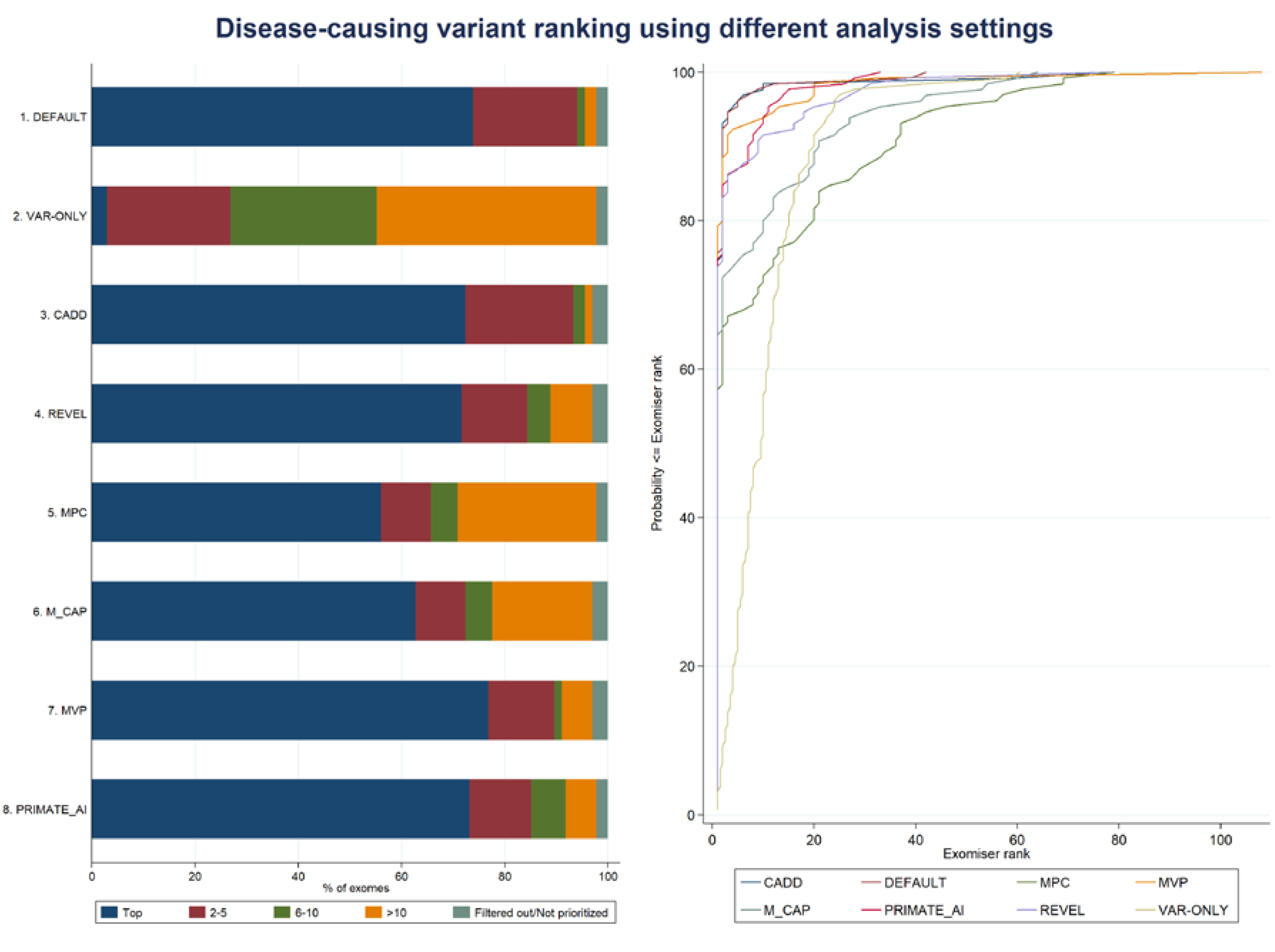
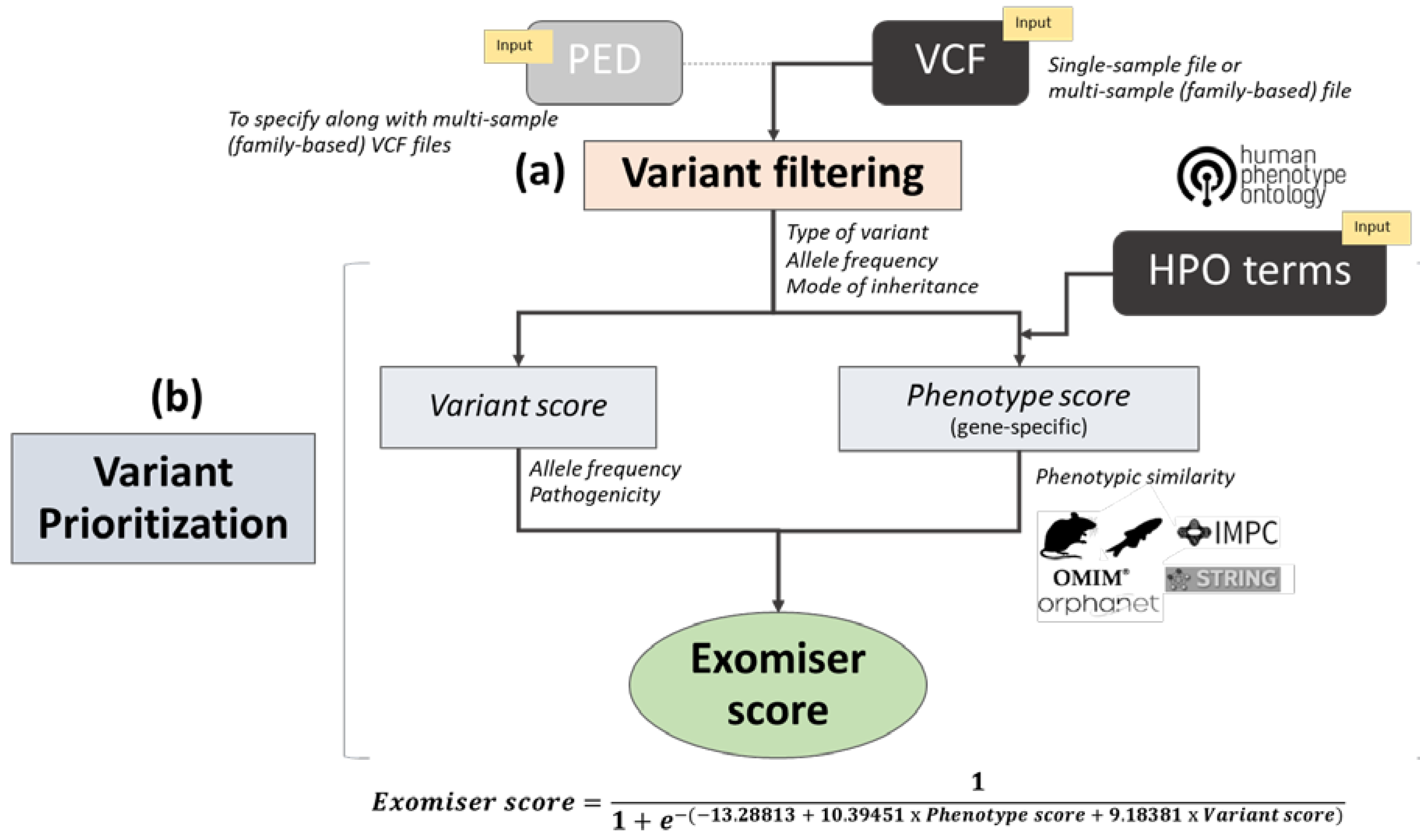
Next-generation sequencing has revolutionized rare disease diagnostics, but many patients remain without a molecular diagnosis, particularly because many candidate variants usually survive despite strict filtering. Exomiser was launched in 2014 as a Java tool that performs an integrative analysis of patients’ sequencing data and their phenotypes encoded with Human Phenotype Ontology (HPO) terms. It prioritizes variants by leveraging information on variant frequency, predicted pathogenicity, and gene-phenotype associations derived from human diseases, model organisms, and protein–protein interactions. Early published releases of Exomiser were able to prioritize disease-causative variants as top candidates in up to 97% of simulated whole-exomes. The size of the tested real patient datasets published so far are very limited. Here, we present the latest Exomiser version 12.0.1 with many new features. We assessed the performance using a set of 134 whole-exomes from patients with a range of rare retinal diseases and known molecular diagnosis. Using default settings, Exomiser ranked the correct diagnosed variants as the top candidate in 74% of the dataset and top 5 in 94%; not using the patients’ HPO profiles (i.e., variant-only analysis) decreased the performance to 3% and 27%, respectively. In conclusion, Exomiser is an effective support tool for rare Mendelian phenotype-driven variant prioritization.
Keywords: whole-exome sequencing; whole-genome sequencing; rare disease; variant prioritization; human phenotype ontology; phenotypic similarity; bioinformatics; inherited retinal disease whole-exome sequencing; whole-genome sequencing; rare disease; variant prioritization; human phenotype ontology; phenotypic similarity; bioinformatics; inherited retinal disease