Ion Channel Integration and Functional Coupling in Salivary Gland Fluid Secretion


Abstract
1. Introduction
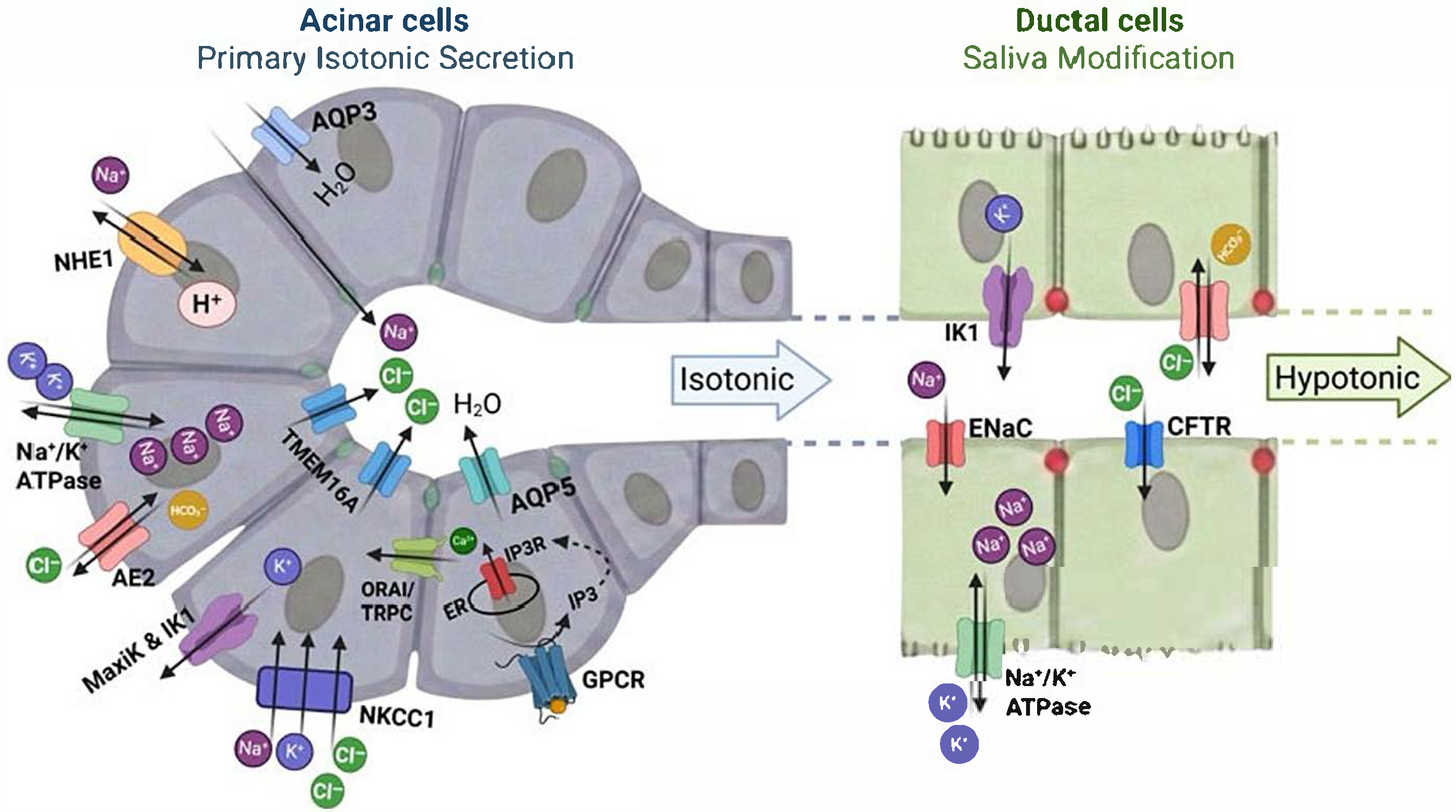
2. Acinar–Ductal Coordination of Epithelial Ion Transport in Saliva Fluid Formation
3. Calcium Channels Regulating Intracellular Signaling and Secretion
3.1. Mechanisms of Calcium Entry and Sustained Signaling in Salivary Gland Epithelium
3.2. Intracellular Calcium Channels
3.2.1. IP3R—Inositol 1,4,5-Trisphosphate Receptors
3.2.2. Ryr—Ryanodine Receptors
4. Chloride Channels as Primary Drivers of Fluid Secretion
5. Potassium and Sodium Channels in Secretory and Absorptive Functions
6. Aquaporins and the Coupling of Ion and Water Transport
7. Cotransporter and Exchanger Systems Maintaining Electrolyte Balance in Salivary Glands
8. Intracellular Signaling Pathways Regulating Ion Channel Activity
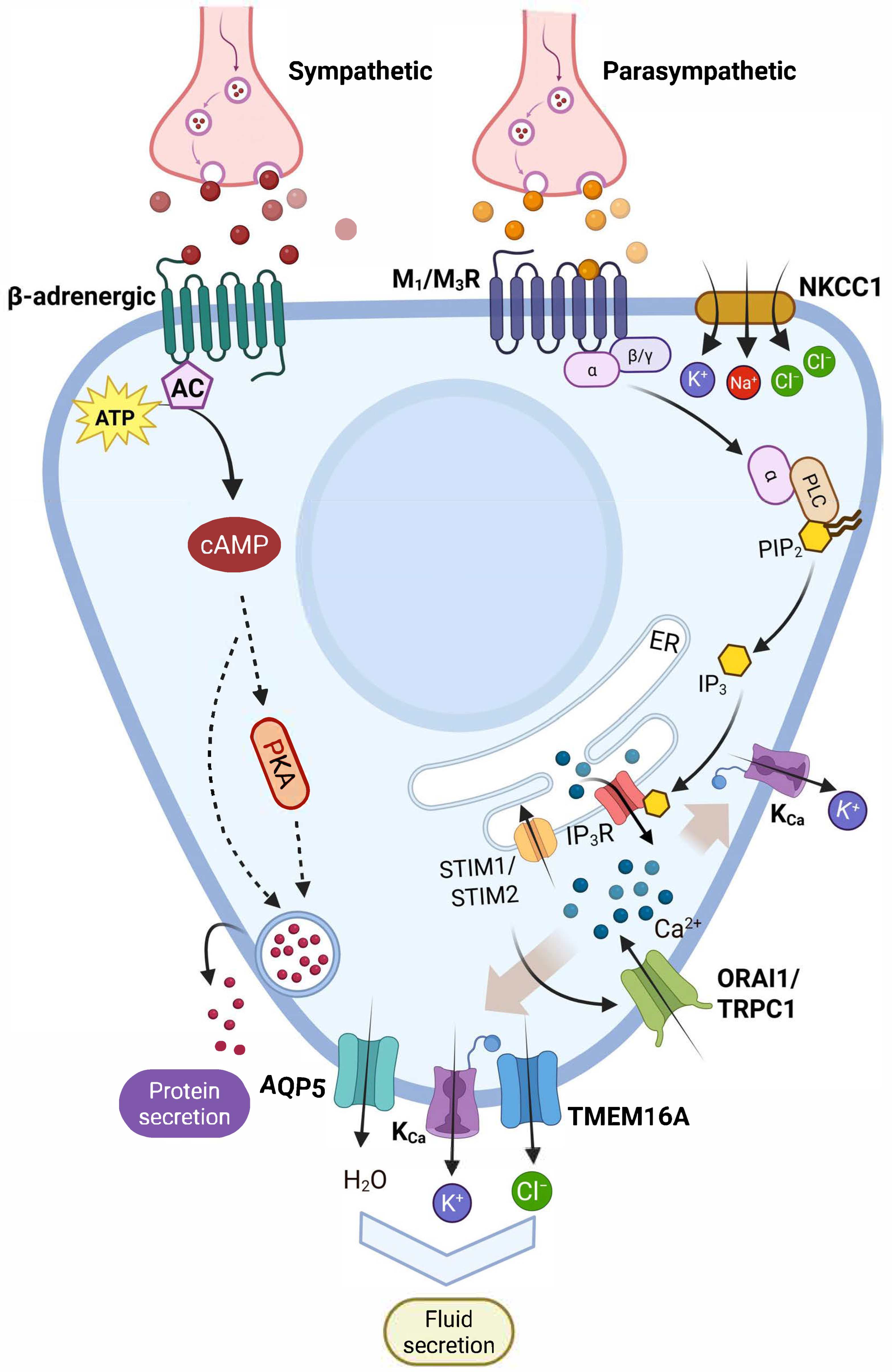
8.1. Parasympathetic Signaling Through Muscarinic Receptors
8.2. Sympathetic Signaling Through Adrenergic Receptors
8.3. Additional Regulatory Pathways
8.3.1. Purinergic Signaling
8.3.2. MAPK/ERK Signaling
8.3.3. Calcium-Calmodulin-Dependent Kinases
8.3.4. Nitric Oxide Signaling
8.3.5. IRBIT and WNK1 Regulation
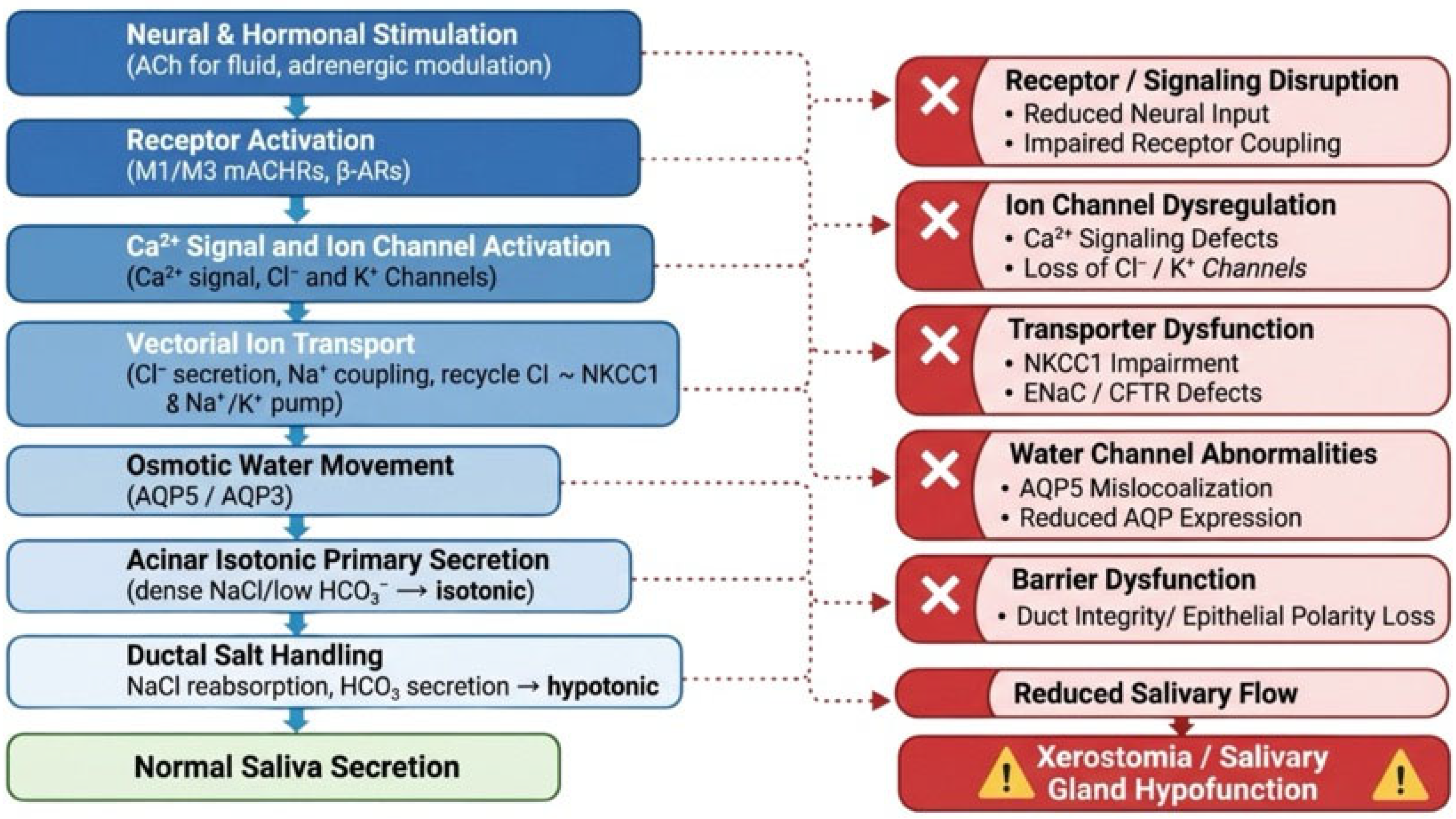
9. Translational Significance, Current Limitations, and Future Directions
10. Conclusions
Author Contributions
Funding
Institutional Review Board Statement
Informed Consent Statement
Data Availability Statement
Conflicts of Interest
Abbreviations
| Abbreviation | Definition |
| ACh | Acetylcholine |
| ADPR | ADP-ribose |
| AE | Anion exchanger |
| ANO1 | Anoctamin-1 |
| AQP | Aquaporin |
| BK | Big conductance potassium channel |
| cAMP | Cyclic adenosine monophosphate |
| CFTR | Cystic fibrosis transmembrane conductance regulator |
| DAG | Diacylglycerol |
| ENaC | Epithelial sodium channel |
| ER | Endoplasmic reticulum |
| ERK | Extracellular signal-regulated kinase |
| GPCR | G protein-coupled receptor |
| IK | Intermediate conductance potassium channel |
| IP3 | Inositol 1,4,5-trisphosphate |
| IP3R | Inositol 1,4,5-trisphosphate receptor |
| KCC | K+-Cl− cotransporter |
| LRRC8 | Leucine-rich repeat containing 8 |
| M1 | Muscarinic receptor type 1 |
| M3 | Muscarinic receptor type 3 |
| NBC | Na+-HCO3− cotransporter |
| NHE | Na+/H+ exchanger |
| NKCC1 | Na+-K+-2Cl− cotransporter |
| Orai1 | Calcium release-activated calcium channel protein 1 |
| PKA | Protein kinase A |
| PKC | Protein kinase C |
| PLCβ | Phospholipase C beta |
| RVD | Regulatory volume decrease |
| SERCA | Sarco/endoplasmic reticulum Ca2+-ATPase |
| SK | Small conductance potassium channel |
| SOCE | Store-operated calcium entry |
| STIM1 | Stromal interaction molecule 1 |
| TMEM16A | Transmembrane protein 16A |
| TRP | Transient receptor potential |
| TRPC | Transient receptor potential canonical |
| VRAC | Volume-regulated anion channel |
References
- Pedersen, A.M.L.; Sørensen, C.E.; Proctor, G.B.; Carpenter, G.H.; Ekström, J. Salivary secretion in health and disease. J. Oral Rehabil. 2018, 45, 730–746. [Google Scholar] [CrossRef] [PubMed]
- Holmberg, K.V.; Hoffman, M.P. Anatomy, biogenesis and regeneration of salivary glands. Monogr. Oral Sci. 2014, 24, 1–13. [Google Scholar] [CrossRef]
- Amano, O.; Mizobe, K.; Bando, Y.; Sakiyama, K. Anatomy and histology of rodent and human major salivary glands: Overview of the Japan salivary gland society-sponsored workshop. Acta Histochem. Cytochem. 2012, 45, 241–250. [Google Scholar] [CrossRef]
- Tucker, A.S. Salivary gland development. Semin. Cell Dev. Biol. 2007, 18, 237–244. [Google Scholar] [CrossRef]
- Humphrey, S.P.; Williamson, R.T. A review of saliva: Normal composition, flow, and function. J. Prosthet. Dent. 2001, 85, 162–169. [Google Scholar] [CrossRef]
- Mandel, I.D. The functions of saliva. J. Dent. Res. 1987, 66, 623–627. [Google Scholar] [CrossRef]
- Villa, A.; Connell, C.L.; Abati, S. Diagnosis and management of xerostomia and hyposalivation. Ther. Clin. Risk Manag. 2015, 11, 45–51. [Google Scholar] [CrossRef] [PubMed]
- Melvin, J.E.; Yule, D.; Shuttleworth, T.; Begenisich, T. Regulation of fluid and electrolyte secretion in salivary gland acinar cells. Annu. Rev. Physiol. 2005, 67, 445–469. [Google Scholar] [CrossRef]
- Turner, R.J.; Sugiya, H. Understanding salivary fluid and protein secretion. Oral Dis. 2002, 8, 3–11. [Google Scholar] [CrossRef] [PubMed]
- Bruce, J.I.; Shuttleworth, T.J.; Giovannucci, D.R.; Yule, D.I. Phosphorylation of inositol 1,4,5-trisphosphate receptors in parotid acinar cells. A mechanism for the synergistic effects of cAMP on Ca2+ signaling. J. Biol. Chem. 2002, 277, 1340–1348. [Google Scholar] [CrossRef]
- Giovannucci, D.R.; Bruce, J.I.; Straub, S.V.; Arreola, J.; Sneyd, J.; Shuttleworth, T.J.; Yule, D.I. Cytosolic Ca2+ and Ca2+-activated Cl− current dynamics: Insights from two functionally distinct mouse exocrine cells. J. Physiol. 2002, 540, 469–484. [Google Scholar] [CrossRef]
- Romanenko, V.G.; Catalán, M.A.; Brown, D.A.; Putzier, I.; Hartzell, H.C.; Marmorstein, A.D.; Gonzalez-Begne, M.; Rock, J.R.; Harfe, B.D.; Melvin, J.E. Tmem16A encodes the Ca2+-activated Cl- channel in mouse submandibular salivary gland acinar cells. J. Biol. Chem. 2010, 285, 12990–13001. [Google Scholar] [CrossRef] [PubMed]
- Catalán, M.A.; Nakamoto, T.; Melvin, J.E. The salivary gland fluid secretion mechanism. J. Med. Investig. 2009, 56, 192–196. [Google Scholar] [CrossRef] [PubMed]
- Ma, T.; Song, Y.; Gillespie, A.; Carlson, E.J.; Epstein, C.J.; Verkman, A.S. Defective secretion of saliva in transgenic mice lacking aquaporin-5 water channels. J. Biol. Chem. 1999, 274, 20071–20074. [Google Scholar] [CrossRef]
- Evans, R.L.; Park, K.; Turner, R.J.; Watson, G.E.; Nguyen, H.V.; Dennett, M.R.; Hand, A.R.; Flagella, M.; Shull, G.E.; Melvin, J.E. Severe impairment of salivation in Na+/K+/2Cl- cotransporter (NKCC1)-deficient mice. J. Biol. Chem. 2000, 275, 26720–26726. [Google Scholar] [CrossRef] [PubMed]
- Hong, J.H.; Park, S.; Shcheynikov, N.; Muallem, S. Mechanism and synergism in epithelial fluid and electrolyte secretion. Pflug. Arch. 2014, 466, 1487–1499. [Google Scholar] [CrossRef]
- Jorgensen, P.L.; Hakansson, K.O.; Karlish, S.J. Structure and mechanism of Na,K-ATPase: Functional sites and their interactions. Annu. Rev. Physiol. 2003, 65, 817–849. [Google Scholar] [CrossRef]
- Ambudkar, I.S. Ca2+ signaling and regulation of fluid secretion in salivary gland acinar cells. Cell Calcium 2014, 55, 297–305. [Google Scholar] [CrossRef]
- Park, C.Y.; Hoover, P.J.; Mullins, F.M.; Bachhawat, P.; Covington, E.D.; Raunser, S.; Walz, T.; Garcia, K.C.; Dolmetsch, R.E.; Lewis, R.S. STIM1 clusters and activates CRAC channels via direct binding of a cytosolic domain to Orai1. Cell 2009, 136, 876–890. [Google Scholar] [CrossRef]
- Proctor, G.B.; Carpenter, G.H. Regulation of salivary gland function by autonomic nerves. Auton. Neurosci. 2007, 133, 3–18. [Google Scholar] [CrossRef]
- Lee, M.G.; Ohana, E.; Park, H.W.; Yang, D.; Muallem, S. Molecular mechanism of pancreatic and salivary gland fluid and HCO3 secretion. Physiol. Rev. 2012, 92, 39–74. [Google Scholar] [CrossRef]
- Dinudom, A.; Harvey, K.F.; Komwatana, P.; Young, J.A.; Kumar, S.; Cook, D.I. Nedd4 mediates control of an epithelial Na+ channel in salivary duct cells by cytosolic Na+. Proc. Natl. Acad. Sci. USA 1998, 95, 7169–7173. [Google Scholar] [CrossRef] [PubMed]
- Reddy, M.M.; Quinton, P.M.; Haws, C.; Wine, J.J.; Grygorczyk, R.; Tabcharani, J.A.; Hanrahan, J.W.; Gunderson, K.L.; Kopito, R.R. Failure of the cystic fibrosis transmembrane conductance regulator to conduct ATP. Science 1996, 271, 1876–1879. [Google Scholar] [CrossRef]
- Catalán, M.A.; Kondo, Y.; Peña-Munzenmayer, G.; Jaramillo, Y.; Liu, F.; Choi, S.; Crandall, E.; Borok, Z.; Flodby, P.; Shull, G.E.; et al. A fluid secretion pathway unmasked by acinar-specific Tmem16A gene ablation in the adult mouse salivary gland. Proc. Natl. Acad. Sci. USA 2015, 112, 2263–2268. [Google Scholar] [CrossRef] [PubMed]
- Begenisich, T.; Nakamoto, T.; Ovitt, C.E.; Nehrke, K.; Brugnara, C.; Alper, S.L.; Melvin, J.E. Physiological roles of the intermediate conductance, Ca2+-activated potassium channel Kcnn4. J. Biol. Chem. 2004, 279, 47681–47687. [Google Scholar] [CrossRef] [PubMed]
- Shcheynikov, N.; Yang, D.; Wang, Y.; Zeng, W.; Karniski, L.P.; So, I.; Wall, S.M.; Muallem, S. The Slc26a4 transporter functions as an electroneutral Cl−/I−/HCO3− exchanger: Role of Slc26a4 and Slc26a6 in I− and HCO3− secretion and in regulation of CFTR in the parotid duct. J. Physiol. 2008, 586, 3813–3824. [Google Scholar] [CrossRef]
- Park, S.; Shcheynikov, N.; Hong, J.H.; Zheng, C.; Suh, S.H.; Kawaai, K.; Ando, H.; Mizutani, A.; Abe, T.; Kiyonari, H.; et al. Irbit mediates synergy between Ca2+ and cAMP signaling pathways during epithelial transport in mice. Gastroenterology 2013, 145, 232–241. [Google Scholar] [CrossRef]
- Bandyopadhyay, B.C.; Swaim, W.D.; Sarkar, A.; Liu, X.; Ambudkar, I.S. Extracellular Ca2+ Sensing in Salivary Ductal Cells. J. Biol. Chem. 2012, 287, 30305–30316. [Google Scholar] [CrossRef]
- Choi, B.-E.; Shin, S.; Evans, S.; Singh, B.B.; Bandyopadhyay, B.C. Ablation of TRPC3 disrupts Ca2+ signaling in salivary ductal cells and promotes sialolithiasis. Sci. Rep. 2023, 13, 5772. [Google Scholar] [CrossRef]
- Raina, S.; Preston, G.M.; Guggino, W.B.; Agre, P. Molecular cloning and characterization of an aquaporin cDNA from salivary, lacrimal, and respiratory tissues. J. Biol. Chem. 1995, 270, 1908–1912. [Google Scholar] [CrossRef]
- Gresz, V.; Kwon, T.H.; Hurley, P.T.; Varga, G.; Zelles, T.; Nielsen, S.; Case, R.M.; Steward, M.C. Identification and localization of aquaporin water channels in human salivary glands. Am. J. Physiol. Gastrointest. Liver Physiol. 2001, 281, G247–G254. [Google Scholar] [CrossRef] [PubMed]
- Günzel, D.; Yu, A.S. Claudins and the modulation of tight junction permeability. Physiol. Rev. 2013, 93, 525–569. [Google Scholar] [CrossRef]
- Feske, S.; Gwack, Y.; Prakriya, M.; Srikanth, S.; Puppel, S.-H.; Tanasa, B.; Hogan, P.G.; Lewis, R.S.; Daly, M.; Rao, A. A mutation in Orai1 causes immune deficiency by abrogating CRAC channel function. Nature 2006, 441, 179–185. [Google Scholar] [CrossRef]
- Vig, M.; Peinelt, C.; Beck, A.; Koomoa, D.L.; Rabah, D.; Koblan-Huberson, M.; Kraft, S.; Turner, H.; Fleig, A.; Penner, R.; et al. CRACM1 is a plasma membrane protein essential for store-operated Ca2+ entry. Science 2006, 312, 1220–1223. [Google Scholar] [CrossRef]
- Prakriya, M.; Feske, S.; Gwack, Y.; Srikanth, S.; Rao, A.; Hogan, P.G. Orai1 is an essential pore subunit of the CRAC channel. Nature 2006, 443, 230–233. [Google Scholar] [CrossRef] [PubMed]
- Yeromin, A.V.; Zhang, S.L.; Jiang, W.; Yu, Y.; Safrina, O.; Cahalan, M.D. Molecular identification of the CRAC channel by altered ion selectivity in a mutant of Orai. Nature 2006, 443, 226–229. [Google Scholar] [CrossRef] [PubMed]
- Muik, M.; Fahrner, M.; Derler, I.; Schindl, R.; Bergsmann, J.; Frischauf, I.; Groschner, K.; Romanin, C. A Cytosolic Homomerization and a Modulatory Domain within STIM1 C Terminus Determine Coupling to ORAI1 Channels. J. Biol. Chem. 2009, 284, 8421–8426. [Google Scholar] [CrossRef]
- Yuan, J.P.; Zeng, W.; Dorwart, M.R.; Choi, Y.-J.; Worley, P.F.; Muallem, S. SOAR and the polybasic STIM1 domains gate and regulate Orai channels. Nat. Cell Biol. 2009, 11, 337–343. [Google Scholar] [CrossRef]
- Liu, X.; Bandyopadhyay, B.C.; Singh, B.B.; Groschner, K.; Ambudkar, I.S. Molecular analysis of a store-operated and 2-acetyl-sn-glycerol-sensitive non-selective cation channel. Heteromeric assembly of TRPC1-TRPC3. J. Biol. Chem. 2005, 280, 21600–21606. [Google Scholar] [CrossRef]
- Brazer, S.C.; Singh, B.B.; Liu, X.; Swaim, W.; Ambudkar, I.S. Caveolin-1 contributes to assembly of store-operated Ca2+ influx channels by regulating plasma membrane localization of TRPC1. J. Biol. Chem. 2003, 278, 27208–27215. [Google Scholar] [CrossRef]
- Venkatachalam, K.; Montell, C. TRP channels. Annu. Rev. Biochem. 2007, 76, 387–417. [Google Scholar] [CrossRef]
- Kwan, H.Y.; Huang, Y.; Yao, X. TRP channels in endothelial function and dysfunction. Biochim. Biophys. Acta 2007, 1772, 907–914. [Google Scholar] [CrossRef] [PubMed]
- Kim, M.S.; Lee, K.P.; Yang, D.; Shin, D.M.; Abramowitz, J.; Kiyonaka, S.; Birnbaumer, L.; Mori, Y.; Muallem, S. Genetic and pharmacologic inhibition of the Ca2+ influx channel TRPC3 protects secretory epithelia from Ca2+-dependent toxicity. Gastroenterology 2011, 140, 2107–2115.e4. [Google Scholar] [CrossRef] [PubMed]
- Rizzuto, R.; Brini, M.; Murgia, M.; Pozzan, T. Microdomains with High Ca2+ Close to IP3-Sensitive Channels that Are Sensed by Neighboring Mitochondria. Science 1993, 262, 744–747. [Google Scholar] [CrossRef]
- Camello-Almaraz, C.; Salido, G.M.; Pariente, J.A.; Camello, P.J. Role of mitochondria in Ca2+ oscillations and shape of Ca2+ signals in pancreatic acinar cells. Biochem. Pharmacol. 2002, 63, 283–292. [Google Scholar] [CrossRef]
- Liu, X.; Gong, B.; de Souza, L.B.; Ong, H.L.; Subedi, K.P.; Cheng, K.T.; Swaim, W.; Zheng, C.; Mori, Y.; Ambudkar, I.S. Radiation inhibits salivary gland function by promoting STIM1 cleavage by caspase-3 and loss of SOCE through a TRPM2-dependent pathway. Sci. Signal 2017, 10, eaal4064. [Google Scholar] [CrossRef]
- Shaw, P.J.; Feske, S. Regulation of lymphocyte function by ORAI and STIM proteins in infection and autoimmunity. J. Physiol. 2012, 590, 4157–4167. [Google Scholar] [CrossRef]
- Zhou, Y.; Mancarella, S.; Wang, Y.; Yue, C.; Ritchie, M.; Gill, D.L.; Soboloff, J. The short N-terminal domains of STIM1 and STIM2 control the activation kinetics of Orai1 channels. J. Biol. Chem. 2009, 284, 19164–19168. [Google Scholar] [CrossRef] [PubMed]
- Ong, H.L.; de Souza, L.B.; Zheng, C.; Cheng, K.T.; Liu, X.; Goldsmith, C.M.; Feske, S.; Ambudkar, I.S. STIM2 enhances receptor-stimulated Ca2+ signaling by promoting recruitment of STIM1 to the endoplasmic reticulum-plasma membrane junctions. Sci. Signal. 2015, 8, ra3. [Google Scholar] [CrossRef]
- Liu, X.; Cotrim, A.; Teos, L.; Zheng, C.; Swaim, W.; Mitchell, J.; Mori, Y.; Ambudkar, I. Loss of TRPM2 function protects against irradiation-induced salivary gland dysfunction. Nat. Commun. 2013, 4, 1515. [Google Scholar] [CrossRef]
- Fonfria, E.; Marshall, I.C.; Boyfield, I.; Skaper, S.D.; Hughes, J.P.; Owen, D.E.; Zhang, W.; Miller, B.A.; Benham, C.D.; McNulty, S. Amyloid beta-peptide(1-42) and hydrogen peroxide-induced toxicity are mediated by TRPM2 in rat primary striatal cultures. J. Neurochem. 2005, 95, 715–723. [Google Scholar] [CrossRef] [PubMed]
- Perraud, A.L.; Fleig, A.; Dunn, C.A.; Bagley, L.A.; Launay, P.; Schmitz, C.; Stokes, A.J.; Zhu, Q.; Bessman, M.J.; Penner, R.; et al. ADP-ribose gating of the calcium-permeable LTRPC2 channel revealed by Nudix motif homology. Nature 2001, 411, 595–599. [Google Scholar] [CrossRef]
- Mitchell, J.B.; Anver, M.R.; Sowers, A.L.; Rosenberg, P.S.; Figueroa, M.; Thetford, A.; Krishna, M.C.; Albert, P.S.; Cook, J.A. The antioxidant tempol reduces carcinogenesis and enhances survival in mice when administered after nonlethal total body radiation. Cancer Res. 2012, 72, 4846–4855. [Google Scholar] [CrossRef]
- Nilius, B.; Voets, T. The puzzle of TRPV4 channelopathies. EMBO Rep. 2013, 14, 152–163. [Google Scholar] [CrossRef]
- Zhang, Y.; Catalán, M.A.; Melvin, J.E. TRPV4 activation in mouse submandibular gland modulates Ca2+ influx and salivation. Am. J. Physiol. Gastrointest. Liver Physiol. 2012, 303, G1365–G1372. [Google Scholar] [CrossRef]
- Becker, D.; Blase, C.; Bereiter-Hahn, J.; Jendrach, M. TRPV4 exhibits a functional role in cell-volume regulation. J. Cell Sci. 2005, 118, 2435–2440. [Google Scholar] [CrossRef] [PubMed]
- Derouiche, S.; Takayama, Y.; Murakami, M.; Tominaga, M. TRPV4 heats up ANO1-dependent exocrine gland fluid secretion. Faseb. J. 2018, 32, 1841–1854. [Google Scholar] [CrossRef] [PubMed]
- Sobhan, U.; Sato, M.; Shinomiya, T.; Okubo, M.; Tsumura, M.; Muramatsu, T.; Kawaguchi, M.; Tazaki, M.; Shibukawa, Y. Immunolocalization and distribution of functional temperature-sensitive TRP channels in salivary glands. Cell Tissue Res. 2013, 354, 507–519. [Google Scholar] [CrossRef]
- Houghton, J.W.; Carpenter, G.; Hans, J.; Pesaro, M.; Lynham, S.; Proctor, G. Agonists of Orally Expressed TRP Channels Stimulate Salivary Secretion and Modify the Salivary Proteome. Mol. Cell Proteom. 2020, 19, 1664–1676. [Google Scholar] [CrossRef]
- Proctor, G.B.; Carpenter, G.H. Chewing stimulates secretion of human salivary secretory immunoglobulin A. J. Dent. Res. 2001, 80, 909–913. [Google Scholar] [CrossRef]
- Arendt-Nielsen, L.; Carstens, E.; Proctor, G.; Boucher, Y.; Clavé, P.; Albin Nielsen, K.; Nielsen, T.A.; Reeh, P.W. The Role of TRP Channels in Nicotinic Provoked Pain and Irritation from the Oral Cavity and Throat: Translating Animal Data to Humans. Nicotine Tob. Res. 2022, 24, 1849–1860. [Google Scholar] [CrossRef] [PubMed]
- Smith, G.D.; Gunthorpe, M.J.; Kelsell, R.E.; Hayes, P.D.; Reilly, P.; Facer, P.; Wright, J.E.; Jerman, J.C.; Walhin, J.P.; Ooi, L.; et al. TRPV3 is a temperature-sensitive vanilloid receptor-like protein. Nature 2002, 418, 186–190. [Google Scholar] [CrossRef]
- McKemy, D.D.; Neuhausser, W.M.; Julius, D. Identification of a cold receptor reveals a general role for TRP channels in thermosensation. Nature 2002, 416, 52–58. [Google Scholar] [CrossRef] [PubMed]
- Coste, B.; Mathur, J.; Schmidt, M.; Earley, T.J.; Ranade, S.; Petrus, M.J.; Dubin, A.E.; Patapoutian, A. Piezo1 and Piezo2 are essential components of distinct mechanically activated cation channels. Science 2010, 330, 55–60. [Google Scholar] [CrossRef]
- Coste, B.; Xiao, B.; Santos, J.S.; Syeda, R.; Grandl, J.; Spencer, K.S.; Kim, S.E.; Schmidt, M.; Mathur, J.; Dubin, A.E.; et al. Piezo proteins are pore-forming subunits of mechanically activated channels. Nature 2012, 483, 176–181. [Google Scholar] [CrossRef]
- Syeda, R.; Florendo, M.N.; Cox, C.D.; Kefauver, J.M.; Santos, J.S.; Martinac, B.; Patapoutian, A. Piezo1 Channels Are Inherently Mechanosensitive. Cell Rep. 2016, 17, 1739–1746. [Google Scholar] [CrossRef]
- Ridone, P.; Vassalli, M.; Martinac, B. Piezo1 mechanosensitive channels: What are they and why are they important. Biophys. Rev. 2019, 11, 795–805. [Google Scholar] [CrossRef]
- Pokharel, E.; Aryal, Y.P.; Kim, T.Y.; Kim, A.; Kim, J.Y.; Yamamoto, H.; Cho, S.W.; Sohn, W.J.; Kim, J.Y.; Jung, J.K. Developmental function of Piezo1 in mouse submandibular gland morphogenesis. Histochem. Cell Biol. 2023, 159, 477–487. [Google Scholar] [CrossRef]
- Nguyen, L.T.P.; Kim, Y.; Hur, S.S.; Byeon, H.K.; Ban, M.J.; Shim, J.W.; Park, J.H.; Hwang, Y. PIEZO1 activation may serve as an early tissue biomarker for the prediction of irradiation-induced salivary gland dysfunction. Biochem. Biophys. Res. Commun. 2024, 727, 150291. [Google Scholar] [CrossRef]
- Guo, X.W.; Zhang, H.; Huang, J.Q.; Wang, S.N.; Lu, Y.; Cheng, B.; Dong, S.H.; Wang, Y.Y.; Li, F.S.; Li, Y.W. PIEZO1 Ion Channel Mediates Ionizing Radiation-Induced Pulmonary Endothelial Cell Ferroptosis via Ca2+/Calpain/VE-Cadherin Signaling. Front. Mol. Biosci. 2021, 8, 725274. [Google Scholar] [CrossRef] [PubMed]
- Catterall, W.A. Voltage-gated calcium channels. Cold Spring Harb. Perspect. Biol. 2011, 3, a003947. [Google Scholar] [CrossRef]
- Hofmann, F.; Flockerzi, V.; Kahl, S.; Wegener, J.W. L-type CaV1.2 calcium channels: From in vitro findings to in vivo function. Physiol. Rev. 2014, 94, 303–326. [Google Scholar] [CrossRef]
- Kim, J.M.; Choi, S.; Lee, S.W.; Park, K. Voltage-dependent Ca2+ channels promote branching morphogenesis of salivary glands by patterning differential growth. Sci. Rep. 2018, 8, 7566. [Google Scholar] [CrossRef] [PubMed]
- Dolmetsch, R.E.; Pajvani, U.; Fife, K.; Spotts, J.M.; Greenberg, M.E. Signaling to the nucleus by an L-type calcium channel-calmodulin complex through the MAP kinase pathway. Science 2001, 294, 333–339. [Google Scholar] [CrossRef]
- Mullins, F.M.; Park, C.Y.; Dolmetsch, R.E.; Lewis, R.S. STIM1 and calmodulin interact with Orai1 to induce Ca2+-dependent inactivation of CRAC channels. Proc. Natl. Acad. Sci. USA 2009, 106, 15495–15500. [Google Scholar] [CrossRef] [PubMed]
- Derler, I.; Fahrner, M.; Muik, M.; Lackner, B.; Schindl, R.; Groschner, K.; Romanin, C. A Ca2+ release-activated Ca2+ (CRAC) modulatory domain (CMD) within STIM1 mediates fast Ca2+-dependent inactivation of ORAI1 channels. J. Biol. Chem. 2009, 284, 24933–24938. [Google Scholar] [CrossRef] [PubMed]
- Ambudkar, I. Calcium signaling defects underlying salivary gland dysfunction. Biochim. Biophys. Acta (BBA)—Mol. Cell Res. 2018, 1865, 1771–1777. [Google Scholar] [CrossRef]
- Hong, J.H.; Li, Q.; Kim, M.S.; Shin, D.M.; Feske, S.; Birnbaumer, L.; Cheng, K.T.; Ambudkar, I.S.; Muallem, S. Polarized but differential localization and recruitment of STIM1, Orai1 and TRPC channels in secretory cells. Traffic 2011, 12, 232–245. [Google Scholar] [CrossRef]
- Zhu, X.; Jiang, M.; Peyton, M.; Boulay, G.; Hurst, R.; Stefani, E.; Birnbaumer, L. trp, a novel mammalian gene family essential for agonist-activated capacitative Ca2+ entry. Cell 1996, 85, 661–671. [Google Scholar] [CrossRef]
- Mori, Y.; Wakamori, M.; Miyakawa, T.; Hermosura, M.; Hara, Y.; Nishida, M.; Hirose, K.; Mizushima, A.; Kurosaki, M.; Mori, E.; et al. Transient receptor potential 1 regulates capacitative Ca2+ entry and Ca2+ release from endoplasmic reticulum in B lymphocytes. J. Exp. Med. 2002, 195, 673–681. [Google Scholar] [CrossRef]
- Cheng, K.T.; Ong, H.L.; Liu, X.; Ambudkar, I.S. Contribution of TRPC1 and Orai1 to Ca2+ entry activated by store depletion. Adv. Exp. Med. Biol. 2011, 704, 435–449. [Google Scholar] [CrossRef]
- Liao, Y.; Erxleben, C.; Abramowitz, J.; Flockerzi, V.; Zhu, M.X.; Armstrong, D.L.; Birnbaumer, L. Functional interactions among Orai1, TRPCs, and STIM1 suggest a STIM-regulated heteromeric Orai/TRPC model for SOCE/Icrac channels. Proc. Natl. Acad. Sci. USA 2008, 105, 2895–2900. [Google Scholar] [CrossRef]
- Liu, X.; Ong, H.L.; Ambudkar, I. TRP Channel Involvement in Salivary Glands-Some Good, Some Bad. Cells 2018, 7, 74. [Google Scholar] [CrossRef]
- Kiselyov, K.; Xu, X.; Mozhayeva, G.; Kuo, T.; Pessah, I.; Mignery, G.; Zhu, X.; Birnbaumer, L.; Muallem, S. Functional interaction between InsP3 receptors and store-operated Htrp3 channels. Nature 1998, 396, 478–482. [Google Scholar] [CrossRef]
- Kim, M.S.; Hong, J.H.; Li, Q.; Shin, D.M.; Abramowitz, J.; Birnbaumer, L.; Muallem, S. Deletion of TRPC3 in mice reduces store-operated Ca2+ influx and the severity of acute pancreatitis. Gastroenterology 2009, 137, 1509–1517. [Google Scholar] [CrossRef]
- Lichtenegger, M.; Tiapko, O.; Svobodova, B.; Stockner, T.; Glasnov, T.N.; Schreibmayer, W.; Platzer, D.; de la Cruz, G.G.; Krenn, S.; Schober, R.; et al. An optically controlled probe identifies lipid-gating fenestrations within the TRPC3 channel. Nat. Chem. Biol. 2018, 14, 396–404. [Google Scholar] [CrossRef]
- Zagranichnaya, T.K.; Wu, X.; Villereal, M.L. Endogenous TRPC1, TRPC3, and TRPC7 proteins combine to form native store-operated channels in HEK-293 cells. J. Biol. Chem. 2005, 280, 29559–29569. [Google Scholar] [CrossRef] [PubMed]
- Di, A.; Gao, X.-P.; Qian, F.; Kawamura, T.; Han, J.; Hecquet, C.; Ye, R.D.; Vogel, S.M.; Malik, A.B. The redox-sensitive cation channel TRPM2 modulates phagocyte ROS production and inflammation. Nat. Immunol. 2012, 13, 29–34. [Google Scholar] [CrossRef] [PubMed]
- Shin, Y.-H.; Kim, J.M.; Park, K. The Effect of Capsaicin on Salivary Gland Dysfunction. Molecules 2016, 21, 835. [Google Scholar] [CrossRef]
- Brennan, S.C.; Finney, B.A.; Lazarou, M.; Rosser, A.E.; Scherf, C.; Adriaensen, D.; Kemp, P.J.; Riccardi, D. Fetal calcium regulates branching morphogenesis in the developing human and mouse lung: Involvement of voltage-gated calcium channels. PLoS ONE 2013, 8, e80294. [Google Scholar] [CrossRef] [PubMed]
- Ge, J.; Li, W.; Zhao, Q.; Li, N.; Chen, M.; Zhi, P.; Li, R.; Gao, N.; Xiao, B.; Yang, M. Architecture of the mammalian mechanosensitive Piezo1 channel. Nature 2015, 527, 64–69. [Google Scholar] [CrossRef]
- Saotome, K.; Murthy, S.E.; Kefauver, J.M.; Whitwam, T.; Patapoutian, A.; Ward, A.B. Structure of the mechanically activated ion channel Piezo1. Nature 2018, 554, 481–486. [Google Scholar] [CrossRef] [PubMed]
- He, L.; Si, G.; Huang, J.; Samuel, A.D.T.; Perrimon, N. Mechanical regulation of stem-cell differentiation by the stretch-activated Piezo channel. Nature 2018, 555, 103–106. [Google Scholar] [CrossRef]
- Berridge, M.J.; Irvine, R.F. Inositol trisphosphate, a novel second messenger in cellular signal transduction. Nature 1984, 312, 315–321. [Google Scholar] [CrossRef]
- Takano, T.; Wahl, A.M.; Huang, K.-T.; Narita, T.; Rugis, J.; Sneyd, J.; Yule, D.I. Highly localized intracellular Ca2+ signals promote optimal salivary gland fluid secretion. eLife 2021, 10, e66170. [Google Scholar] [CrossRef] [PubMed]
- Ambudkar, I.S. Polarization of calcium signaling and fluid secretion in salivary gland cells. Curr. Med. Chem. 2012, 19, 5774–5781. [Google Scholar] [CrossRef] [PubMed]
- Berridge, M.J. Inositol trisphosphate and calcium signalling mechanisms. Biochim. Biophys. Acta 2009, 1793, 933–940. [Google Scholar] [CrossRef] [PubMed]
- Foskett, J.K.; White, C.; Cheung, K.H.; Mak, D.O. Inositol trisphosphate receptor Ca2+ release channels. Physiol. Rev. 2007, 87, 593–658. [Google Scholar] [CrossRef]
- Woll, K.A.; Van Petegem, F. Calcium-release channels: Structure and function of IP(3) receptors and ryanodine receptors. Physiol. Rev. 2022, 102, 209–268. [Google Scholar] [CrossRef]
- Futatsugi, A.; Nakamura, T.; Yamada, M.K.; Ebisui, E.; Nakamura, K.; Uchida, K.; Kitaguchi, T.; Takahashi-Iwanaga, H.; Noda, T.; Aruga, J.; et al. IP3 receptor types 2 and 3 mediate exocrine secretion underlying energy metabolism. Science 2005, 309, 2232–2234. [Google Scholar] [CrossRef]
- Mikoshiba, K.; Hisatsune, C.; Futatsugi, A.; Mizutani, A.; Nakamura, T.; Miyachi, K. The role of Ca2+ signaling in cell function with special reference to exocrine secretion. Cornea 2008, 27, S3–S8. [Google Scholar] [CrossRef]
- Lee, M.G.; Xu, X.; Zeng, W.; Diaz, J.; Wojcikiewicz, R.J.; Kuo, T.H.; Wuytack, F.; Racymaekers, L.; Muallem, S. Polarized expression of Ca2+ channels in pancreatic and salivary gland cells. Correlation with initiation and propagation of [Ca2+]i waves. J. Biol. Chem. 1997, 272, 15765–15770. [Google Scholar] [CrossRef]
- Kasai, H.; Augustine, G.J. Cytosolic Ca2+ gradients triggering unidirectional fluid secretion from exocrine pancreas. Nature 1990, 348, 735–738. [Google Scholar] [CrossRef]
- Taylor, C.W.; Tovey, S.C. IP3 receptors: Toward understanding their activation. Cold Spring Harb. Perspect. Biol. 2010, 2, a004010. [Google Scholar] [CrossRef] [PubMed]
- Berridge, M.J. Inositol trisphosphate and calcium oscillations. Biochem. Soc. Symp. 2007, 74, 1–7. [Google Scholar] [CrossRef] [PubMed]
- Sneyd, J.; Tsaneva-Atanasova, K.; Yule, D.I.; Thompson, J.L.; Shuttleworth, T.J. Control of calcium oscillations by membrane fluxes. Proc. Natl. Acad. Sci. USA 2004, 101, 1392–1396. [Google Scholar] [CrossRef]
- Prakriya, M.; Lewis, R.S. Store-Operated Calcium Channels. Physiol. Rev. 2015, 95, 1383–1436. [Google Scholar] [CrossRef]
- Ong, H.L.; Cheng, K.T.; Liu, X.; Bandyopadhyay, B.C.; Paria, B.C.; Soboloff, J.; Pani, B.; Gwack, Y.; Srikanth, S.; Singh, B.B.; et al. Dynamic assembly of TRPC1-STIM1-Orai1 ternary complex is involved in store-operated calcium influx. Evidence for similarities in store-operated and calcium release-activated calcium channel components. J. Biol. Chem. 2007, 282, 9105–9116. [Google Scholar] [CrossRef]
- Teos, L.Y.; Zhang, Y.; Cotrim, A.P.; Swaim, W.; Won, J.H.; Ambrus, J.; Shen, L.; Bebris, L.; Grisius, M.; Jang, S.-I.; et al. IP3R deficit underlies loss of salivary fluid secretion in Sjögren’s Syndrome. Sci. Rep. 2015, 5, 13953. [Google Scholar] [CrossRef] [PubMed]
- Lanner, J.T.; Georgiou, D.K.; Joshi, A.D.; Hamilton, S.L. Ryanodine receptors: Structure, expression, molecular details, and function in calcium release. Cold Spring Harb. Perspect. Biol. 2010, 2, a003996. [Google Scholar] [CrossRef]
- Meissner, G. Ryanodine receptor/Ca2+ release channels and their regulation by endogenous effectors. Annu. Rev. Physiol. 1994, 56, 485–508. [Google Scholar] [CrossRef]
- Petersen, O.H.; Tepikin, A.V. Polarized calcium signaling in exocrine gland cells. Annu. Rev. Physiol. 2008, 70, 273–299. [Google Scholar] [CrossRef]
- Zhang, X.; Wen, J.; Bidasee, K.R.; Besch, H.R., Jr.; Rubin, R.P. Ryanodine receptor expression is associated with intracellular Ca2+ release in rat parotid acinar cells. Am. J. Physiol. 1997, 273, C1306–C1314. [Google Scholar] [CrossRef]
- DiJulio, D.H.; Watson, E.L.; Pessah, I.N.; Jacobson, K.L.; Ott, S.M.; Buck, E.D.; Singh, J.C. Ryanodine receptor type III (Ry3R) identification in mouse parotid acini. Properties and modulation of [3H]ryanodine-binding sites. J. Biol. Chem. 1997, 272, 15687–15696. [Google Scholar] [CrossRef] [PubMed]
- Zhang, X.; Wen, J.; Bidasee, K.R.; Besch, H.R., Jr.; Wojcikiewicz, R.J.; Lee, B.; Rubin, R.P. Ryanodine and inositol trisphosphate receptors are differentially distributed and expressed in rat parotid gland. Biochem. J. 1999, 340, 519–527. [Google Scholar] [CrossRef] [PubMed]
- Yamaki, H.; Morita, K.; Kitayama, S.; Imai, Y.; Itadani, K.; Akagawa, Y.; Dohi, T. Cyclic ADP-ribose induces Ca2+ release from caffeine-insensitive Ca2+ pools in canine salivary gland cells. J. Dent. Res. 1998, 77, 1807–1816. [Google Scholar] [CrossRef] [PubMed]
- Yang, Y.D.; Cho, H.; Koo, J.Y.; Tak, M.H.; Cho, Y.; Shim, W.-S.; Park, S.P.; Lee, J.; Lee, B.; Kim, B.-M.; et al. TMEM16A confers receptor-activated calcium-dependent chloride conductance. Nature 2008, 455, 1210–1215. [Google Scholar] [CrossRef]
- Yu, K.; Zhu, J.; Qu, Z.; Cui, Y.Y.; Hartzell, H.C. Activation of the Ano1 (TMEM16A) chloride channel by calcium is not mediated by calmodulin. J. Gen. Physiol. 2014, 143, 253–267. [Google Scholar] [CrossRef]
- Caputo, A.; Caci, E.; Ferrera, L.; Pedemonte, N.; Barsanti, C.; Sondo, E.; Pfeffer, U.; Ravazzolo, R.; Zegarra-Moran, O.; Galietta, L.J. TMEM16A, a membrane protein associated with calcium-dependent chloride channel activity. Science 2008, 322, 590–594. [Google Scholar] [CrossRef]
- Namkung, W.; Yao, Z.; Finkbeiner, W.E.; Verkman, A.S. Small-molecule activators of TMEM16A, a calcium-activated chloride channel, stimulate epithelial chloride secretion and intestinal contraction. Faseb. J. 2011, 25, 4048–4062. [Google Scholar] [CrossRef]
- Dang, S.; Feng, S.; Tien, J.; Peters, C.J.; Bulkley, D.; Lolicato, M.; Zhao, J.; Zuberbühler, K.; Ye, W.; Qi, L.; et al. Cryo-EM structures of the TMEM16A calcium-activated chloride channel. Nature 2017, 552, 426–429. [Google Scholar] [CrossRef]
- Ishiguro, H.; Steward, M.C.; Naruse, S.; Ko, S.B.; Goto, H.; Case, R.M.; Kondo, T.; Yamamoto, A. CFTR functions as a bicarbonate channel in pancreatic duct cells. J. Gen. Physiol. 2009, 133, 315–326. [Google Scholar] [CrossRef] [PubMed]
- Zinn, V.Z.; Khatri, A.; Mednieks, M.I.; Hand, A.R. Localization of cystic fibrosis transmembrane conductance regulator signaling complexes in human salivary gland striated duct cells. Eur. J. Oral. Sci. 2015, 123, 140–148. [Google Scholar] [CrossRef]
- Patterson, K.; Catalán, M.A.; Melvin, J.E.; Yule, D.I.; Crampin, E.J.; Sneyd, J. A quantitative analysis of electrolyte exchange in the salivary duct. Am. J. Physiol. Gastrointest. Liver. Physiol. 2012, 303, G1153–G1163. [Google Scholar] [CrossRef]
- Steward, M.C.; Ishiguro, H.; Case, R.M. Mechanisms of bicarbonate secretion in the pancreatic duct. Annu. Rev. Physiol. 2005, 67, 377–409. [Google Scholar] [CrossRef]
- Hug, M.J.; Tamada, T.; Bridges, R.J. CFTR and Bicarbonate Secretion to Epithelial Cells. Physiology 2003, 18, 38–42. [Google Scholar] [CrossRef] [PubMed]
- Arreola, J.; Melvin, J.E. A novel chloride conductance activated by extracellular ATP in mouse parotid acinar cells. J. Physiol. 2003, 547, 197–208. [Google Scholar] [CrossRef] [PubMed]
- Quinton, P.M. Cystic fibrosis: Impaired bicarbonate secretion and mucoviscidosis. Lancet 2008, 372, 415–417. [Google Scholar] [CrossRef]
- Poulsen, J.H.; Fischer, H.; Illek, B.; Machen, T.E. Bicarbonate conductance and pH regulatory capability of cystic fibrosis transmembrane conductance regulator. Proc. Natl. Acad. Sci. USA 1994, 91, 5340–5344. [Google Scholar] [CrossRef]
- Jentsch, T.J.; Pusch, M. CLC Chloride Channels and Transporters: Structure, Function, Physiology, and Disease. Physiol. Rev. 2018, 98, 1493–1590. [Google Scholar] [CrossRef]
- Romanenko, V.G.; Nakamoto, T.; Catalán, M.A.; Gonzalez-Begne, M.; Schwartz, G.J.; Jaramillo, Y.; Sepúlveda, F.V.; Figueroa, C.D.; Melvin, J.E. Clcn2 encodes the hyperpolarization-activated chloride channel in the ducts of mouse salivary glands. Am. J. Physiol. Gastrointest. Liver Physiol. 2008, 295, G1058–G1067. [Google Scholar] [CrossRef] [PubMed]
- Arreola, J.; Begenisich, T.; Nehrke, K.; Nguyen, H.V.; Park, K.; Richardson, L.; Yang, B.; Schutte, B.C.; Lamb, F.S.; Melvin, J.E. Secretion and cell volume regulation by salivary acinar cells from mice lacking expression of the Clcn3 Cl- channel gene. J. Physiol. 2002, 545, 207–216. [Google Scholar] [CrossRef]
- Nehrke, K.; Arreola, J.; Nguyen, H.V.; Pilato, J.; Richardson, L.; Okunade, G.; Baggs, R.; Shull, G.E.; Melvin, J.E. Loss of hyperpolarization-activated Cl− current in salivary acinar cells from Clcn2 knockout mice. J. Biol. Chem. 2002, 277, 23604–23611. [Google Scholar] [CrossRef] [PubMed]
- Strange, K.; Yamada, T.; Denton, J.S. A 30-year journey from volume-regulated anion currents to molecular structure of the LRRC8 channel. J. Gen. Physiol. 2019, 151, 100–117. [Google Scholar] [CrossRef] [PubMed]
- Jentsch, T.J. VRACs and other ion channels and transporters in the regulation of cell volume and beyond. Nat. Rev. Mol. Cell Biol. 2016, 17, 293–307. [Google Scholar] [CrossRef]
- Qiu, Z.; Dubin, A.E.; Mathur, J.; Tu, B.; Reddy, K.; Miraglia, L.J.; Reinhardt, J.; Orth, A.P.; Patapoutian, A. SWELL1, a plasma membrane protein, is an essential component of volume-regulated anion channel. Cell 2014, 157, 447–458. [Google Scholar] [CrossRef]
- Voss, F.K.; Ullrich, F.; Münch, J.; Lazarow, K.; Lutter, D.; Mah, N.; Andrade-Navarro, M.A.; von Kries, J.P.; Stauber, T.; Jentsch, T.J. Identification of LRRC8 heteromers as an essential component of the volume-regulated anion channel VRAC. Science 2014, 344, 634–638. [Google Scholar] [CrossRef]
- Syeda, R.; Qiu, Z.; Dubin, A.E.; Murthy, S.E.; Florendo, M.N.; Mason, D.E.; Mathur, J.; Cahalan, S.M.; Peters, E.C.; Montal, M.; et al. LRRC8 Proteins Form Volume-Regulated Anion Channels that Sense Ionic Strength. Cell 2016, 164, 499–511. [Google Scholar] [CrossRef]
- Deneka, D.; Sawicka, M.; Lam, A.K.M.; Paulino, C.; Dutzler, R. Structure of a volume-regulated anion channel of the LRRC8 family. Nature 2018, 558, 254–259. [Google Scholar] [CrossRef]
- Arreola, J.; Melvin, J.E.; Begenisich, T. Volume-activated chloride channels in rat parotid acinar cells. J. Physiol. 1995, 484, 677–687. [Google Scholar] [CrossRef]
- Foskett, J.K. [Ca2+]i modulation of Cl- content controls cell volume in single salivary acinar cells during fluid secretion. Am. J. Physiol. 1990, 259, C998–C1004. [Google Scholar] [CrossRef]
- Tranter, J.D.; Mikami, R.T.; Kumar, A.; Brown, G.; Abd El-Aziz, T.M.; Zhao, Y.; Arullampalam, P.; Ashworth, K.; Jha, V.; Abraham, N.; et al. LRRC8 complexes are ATP release channels that regulate platelet activation and arterial thrombosis. Blood 2025, 146, 1110–1126. [Google Scholar] [CrossRef]
- Pedemonte, N.; Galietta, L.J. Structure and function of TMEM16 proteins (anoctamins). Physiol. Rev. 2014, 94, 419–459. [Google Scholar] [CrossRef]
- Paulino, C.; Neldner, Y.; Lam, A.K.M.; Kalienkova, V.; Brunner, J.D.; Schenck, S.; Dutzler, R. Structural basis for anion conduction in the calcium-activated chloride channel TMEM16A. eLife 2017, 6, e26232. [Google Scholar] [CrossRef] [PubMed]
- Schroeder, B.C.; Cheng, T.; Jan, Y.N.; Jan, L.Y. Expression cloning of TMEM16A as a calcium-activated chloride channel subunit. Cell 2008, 134, 1019–1029. [Google Scholar] [CrossRef] [PubMed]
- Perez-Cornejo, P.; Gokhale, A.; Duran, C.; Cui, Y.; Xiao, Q.; Hartzell, H.C.; Faundez, V. Anoctamin 1 (Tmem16A) Ca2+-activated chloride channel stoichiometrically interacts with an ezrin-radixin-moesin network. Proc. Natl. Acad. Sci. USA 2012, 109, 10376–10381. [Google Scholar] [CrossRef] [PubMed]
- Namkung, W.; Phuan, P.W.; Verkman, A.S. TMEM16A inhibitors reveal TMEM16A as a minor component of calcium-activated chloride channel conductance in airway and intestinal epithelial cells. J. Biol. Chem. 2011, 286, 2365–2374. [Google Scholar] [CrossRef]
- Miller, A.N.; Vaisey, G.; Long, S.B. Molecular mechanisms of gating in the calcium-activated chloride channel bestrophin. eLife 2019, 8, e43231. [Google Scholar] [CrossRef]
- Kane Dickson, V.; Pedi, L.; Long, S.B. Structure and insights into the function of a Ca2+-activated Cl− channel. Nature 2014, 516, 213–218. [Google Scholar] [CrossRef]
- Owji, A.P.; Zhao, Q.; Ji, C.; Kittredge, A.; Hopiavuori, A.; Fu, Z.; Ward, N.; Clarke, O.B.; Shen, Y.; Zhang, Y.; et al. Structural and functional characterization of the bestrophin-2 anion channel. Nat. Struct. Mol. Biol. 2020, 27, 382–391. [Google Scholar] [CrossRef]
- Catalán, M.A.; Nakamoto, T.; Gonzalez-Begne, M.; Camden, J.M.; Wall, S.M.; Clarke, L.L.; Melvin, J.E. Cftr and ENaC ion channels mediate NaCl absorption in the mouse submandibular gland. J. Physiol. 2010, 588, 713–724. [Google Scholar] [CrossRef]
- Begenisich, T.; Melvin, J.E. Regulation of chloride channels in secretory epithelia. J. Membr. Biol. 1998, 163, 77–85. [Google Scholar] [CrossRef]
- Thiemann, A.; Gründer, S.; Pusch, M.; Jentsch, T.J. A chloride channel widely expressed in epithelial and non-epithelial cells. Nature 1992, 356, 57–60. [Google Scholar] [CrossRef]
- Stobrawa, S.M.; Breiderhoff, T.; Takamori, S.; Engel, D.; Schweizer, M.; Zdebik, A.A.; Bösl, M.R.; Ruether, K.; Jahn, H.; Draguhn, A.; et al. Disruption of ClC-3, a chloride channel expressed on synaptic vesicles, leads to a loss of the hippocampus. Neuron 2001, 29, 185–196. [Google Scholar] [CrossRef]
- Romanenko, V.G.; Nakamoto, T.; Srivastava, A.; Begenisich, T.; Melvin, J.E. Regulation of membrane potential and fluid secretion by Ca2+-activated K+ channels in mouse submandibular glands. J. Physiol. 2007, 581, 801–817. [Google Scholar] [CrossRef]
- Catalán, M.A.; Peña-Munzenmayer, G.; Melvin, J.E. Ca2+-dependent K+ channels in exocrine salivary glands. Cell Calcium 2014, 55, 362–368. [Google Scholar] [CrossRef] [PubMed]
- Komwatana, P.; Dinudom, A.; Young, J.A.; Cook, D.I. Characterization of the Cl- conductance in the granular duct cells of mouse mandibular glands. Pflug. Arch. 1994, 428, 641–647. [Google Scholar] [CrossRef]
- Romanenko, V.; Nakamoto, T.; Srivastava, A.; Melvin, J.E.; Begenisich, T. Molecular identification and physiological roles of parotid acinar cell maxi-K channels. J. Biol. Chem. 2006, 281, 27964–27972. [Google Scholar] [CrossRef] [PubMed]
- Butler, A.; Tsunoda, S.; McCobb, D.P.; Wei, A.; Salkoff, L. mSlo, a complex mouse gene encoding “maxi” calcium-activated potassium channels. Science 1993, 261, 221–224. [Google Scholar] [CrossRef] [PubMed]
- Maruyama, Y.; Gallacher, D.V.; Petersen, O.H. Voltage and Ca2+-activated K+ channel in baso-lateral acinar cell membranes of mammalian salivary glands. Nature 1983, 302, 827–829. [Google Scholar] [CrossRef]
- Romanenko, V.G.; Thompson, J.; Begenisich, T. Ca2+-activated K channels in parotid acinar cells: The functional basis for the hyperpolarized activation of BK channels. Channels (Austin) 2010, 4, 278–288. [Google Scholar] [CrossRef][Green Version]
- Ishii, T.M.; Silvia, C.; Hirschberg, B.; Bond, C.T.; Adelman, J.P.; Maylie, J. A human intermediate conductance calcium-activated potassium channel. Proc. Natl. Acad. Sci. USA 1997, 94, 11651–11656. [Google Scholar] [CrossRef] [PubMed]
- Sforna, L.; Megaro, A.; Pessia, M.; Franciolini, F.; Catacuzzeno, L. Structure, Gating and Basic Functions of the Ca2+-activated K Channel of Intermediate Conductance. Curr. Neuropharmacol. 2018, 16, 608–617. [Google Scholar] [CrossRef] [PubMed]
- Thompson, J.; Begenisich, T. Membrane-delimited inhibition of maxi-K channel activity by the intermediate conductance Ca2+-activated K channel. J. Gen. Physiol. 2006, 127, 159–169. [Google Scholar] [CrossRef] [PubMed]
- Thompson, J.; Begenisich, T. Mechanistic details of BK channel inhibition by the intermediate conductance, Ca2+-activated K channel. Channels (Austin) 2009, 3, 194–204. [Google Scholar] [CrossRef]
- Nakamoto, T.; Romanenko, V.G.; Takahashi, A.; Begenisich, T.; Melvin, J.E. Apical maxi-K (KCa1.1) channels mediate K+ secretion by the mouse submandibular exocrine gland. Am. J. Physiol. Cell Physiol. 2008, 294, C810–C819. [Google Scholar] [CrossRef]
- Hayashi, M.; Komazaki, S.; Ishikawa, T. An inwardly rectifying K+ channel in bovine parotid acinar cells: Possible involvement of Kir2.1. J. Physiol. 2003, 547, 255–269. [Google Scholar] [CrossRef]
- Rossier, B.C. Epithelial sodium channel (ENaC) and the control of blood pressure. Curr. Opin. Pharmacol. 2014, 15, 33–46. [Google Scholar] [CrossRef] [PubMed]
- Bhalla, V.; Hallows, K.R. Mechanisms of ENaC regulation and clinical implications. J. Am. Soc. Nephrol. 2008, 19, 1845–1854. [Google Scholar] [CrossRef]
- Canessa, C.M.; Horisberger, J.-D.; Rossier, B.C. Epithelial sodium channel related to proteins involved in neurodegeneration. Nature 1993, 361, 467–470. [Google Scholar] [CrossRef]
- Cook, D.I.; Young, J.A. Fluid and Electrolyte Secretion by Salivary Glands. Compr. Physiol. 1989, 1989, 1–23. [Google Scholar] [CrossRef]
- Vasquez, M.M.; Mustafa, S.B.; Choudary, A.; Seidner, S.R.; Castro, R. Regulation of epithelial Na+ channel (ENaC) in the salivary cell line SMG-C6. Exp. Biol. Med. (Maywood) 2009, 234, 522–531. [Google Scholar] [CrossRef] [PubMed]
- Tao, X.; Hite, R.K.; MacKinnon, R. Cryo-EM structure of the open high-conductance Ca2+-activated K+ channel. Nature 2017, 541, 46–51. [Google Scholar] [CrossRef]
- Thompson-Vest, N.; Shimizu, Y.; Hunne, B.; Furness, J.B. The distribution of intermediate-conductance, calcium-activated, potassium (IK) channels in epithelial cells. J. Anat. 2006, 208, 219–229. [Google Scholar] [CrossRef]
- Hibino, H.; Inanobe, A.; Furutani, K.; Murakami, S.; Findlay, I.; Kurachi, Y. Inwardly rectifying potassium channels: Their structure, function, and physiological roles. Physiol. Rev. 2010, 90, 291–366. [Google Scholar] [CrossRef]
- Nichols, C.G.; Lopatin, A.N. Inward rectifier potassium channels. Annu. Rev. Physiol. 1997, 59, 171–191. [Google Scholar] [CrossRef] [PubMed]
- Swale, D.R.; Li, Z.; Guerrero, F.; Pérez De León, A.A.; Foil, L.D. Role of inward rectifier potassium channels in salivary gland function and sugar feeding of the fruit fly, Drosophila melanogaster. Pestic. Biochem. Physiol. 2017, 141, 41–49. [Google Scholar] [CrossRef]
- Li, Z.; Soohoo-Hui, A.; O’Hara, F.M.; Swale, D.R. ATP-sensitive inward rectifier potassium channels reveal functional linkage between salivary gland function and blood feeding in the mosquito, Aedes aegypti. Commun. Biol. 2022, 5, 278. [Google Scholar] [CrossRef] [PubMed]
- Nichols, C.G. KATP channels as molecular sensors of cellular metabolism. Nature 2006, 440, 470–476. [Google Scholar] [CrossRef]
- Cook, D.I.; Dinudom, A.; Komwatana, P.; Kumar, S.; Young, J.A. Patch-clamp studies on epithelial sodium channels in salivary duct cells. Cell Biochem. Biophys. 2002, 36, 105–113. [Google Scholar] [CrossRef]
- Dinudom, A.; Young, J.A.; Cook, D.I. Amiloride-sensitive Na+ current in the granular duct cells of mouse mandibular glands. Pflug. Arch. 1993, 423, 164–166. [Google Scholar] [CrossRef] [PubMed]
- Komwatana, P.; Dinudom, A.; Young, J.A.; Cook, D.I. Control of the amiloride-sensitive Na+ current in salivary duct cells by extracellular sodium. J. Membr. Biol. 1996, 150, 133–141. [Google Scholar] [CrossRef] [PubMed]
- Matsuzaki, T.; Susa, T.; Shimizu, K.; Sawai, N.; Suzuki, T.; Aoki, T.; Yokoo, S.; Takata, K. Function of the membrane water channel aquaporin-5 in the salivary gland. Acta Histochem. Cytochem. 2012, 45, 251–259. [Google Scholar] [CrossRef] [PubMed]
- Ren, J.; Huang, R.; Li, Y.; Chen, R.; Tian, H.; Liu, C. Radioprotective effects and mechanism of HL-003 on radiation-induced salivary gland damage in mice. Sci. Rep. 2022, 12, 8419. [Google Scholar] [CrossRef]
- Steinfeld, S.; Cogan, E.; King, L.S.; Agre, P.; Kiss, R.; Delporte, C. Abnormal distribution of aquaporin-5 water channel protein in salivary glands from Sjögren’s syndrome patients. Lab. Investig. 2001, 81, 143–148. [Google Scholar] [CrossRef]
- Konttinen, Y.T.; Tensing, E.K.; Laine, M.; Porola, P.; Törnwall, J.; Hukkanen, M. Abnormal distribution of aquaporin-5 in salivary glands in the NOD mouse model for Sjögren’s syndrome. J. Rheumatol. 2005, 32, 1071–1075. [Google Scholar]
- Chivasso, C.; D’Agostino, C.; Parisis, D.; Soyfoo, M.S.; Delporte, C. Involvement of aquaporin 5 in Sjögren’s syndrome. Autoimmun. Rev. 2023, 22, 103268. [Google Scholar] [CrossRef]
- D’Agostino, C.; Elkashty, O.A.; Chivasso, C.; Perret, J.; Tran, S.D.; Delporte, C. Insight into Salivary Gland Aquaporins. Cells 2020, 9, 1547. [Google Scholar] [CrossRef]
- Meyer, R.; Wong, W.Y.; Guzman, R.; Burd, R.; Limesand, K. Radiation Treatment of Organotypic Cultures from Submandibular and Parotid Salivary Glands Models Key In Vivo Characteristics. J. Vis. Exp. 2019. [Google Scholar] [CrossRef]
- Chivasso, C.; Hagströmer, C.J.; Rose, K.L.; Lhotellerie, F.; Leblanc, L.; Wang, Z.; Moscato, S.; Chevalier, C.; Zindy, E.; Martin, M.; et al. Ezrin Is a Novel Protein Partner of Aquaporin-5 in Human Salivary Glands and Shows Altered Expression and Cellular Localization in Sjögren’s Syndrome. Int. J. Mol. Sci. 2021, 22, 9213. [Google Scholar] [CrossRef]
- Delporte, C.; Bryla, A.; Perret, J. Aquaporins in Salivary Glands: From Basic Research to Clinical Applications. Int. J. Mol. Sci. 2016, 17, 166. [Google Scholar] [CrossRef] [PubMed]
- Ecelbarger, C.A.; Terris, J.; Frindt, G.; Echevarria, M.; Marples, D.; Nielsen, S.; Knepper, M.A. Aquaporin-3 water channel localization and regulation in rat kidney. Am. J. Physiol. 1995, 269, F663–F672. [Google Scholar] [CrossRef]
- Ishibashi, K.; Sasaki, S.; Fushimi, K.; Uchida, S.; Kuwahara, M.; Saito, H.; Furukawa, T.; Nakajima, K.; Yamaguchi, Y.; Gojobori, T.; et al. Molecular cloning and expression of a member of the aquaporin family with permeability to glycerol and urea in addition to water expressed at the basolateral membrane of kidney collecting duct cells. Proc. Natl. Acad. Sci. USA 1994, 91, 6269–6273. [Google Scholar] [CrossRef]
- Yang, B.; Verkman, A.S. Water and glycerol permeabilities of aquaporins 1-5 and MIP determined quantitatively by expression of epitope-tagged constructs in Xenopus oocytes. J. Biol. Chem. 1997, 272, 16140–16146. [Google Scholar] [CrossRef]
- Preston, G.M.; Agre, P. Isolation of the cDNA for erythrocyte integral membrane protein of 28 kilodaltons: Member of an ancient channel family. Proc. Natl. Acad. Sci. USA 1991, 88, 11110–11114. [Google Scholar] [CrossRef] [PubMed]
- Agre, P.; King, L.S.; Yasui, M.; Guggino, W.B.; Ottersen, O.P.; Fujiyoshi, Y.; Engel, A.; Nielsen, S. Aquaporin water channels—From atomic structure to clinical medicine. J. Physiol. 2002, 542, 3–16. [Google Scholar] [CrossRef] [PubMed]
- Beroukas, D.; Hiscock, J.; Jonsson, R.; Waterman, S.A.; Gordon, T.P. Subcellular distribution of aquaporin 5 in salivary glands in primary Sjögren’s syndrome. Lancet 2001, 358, 1875–1876. [Google Scholar] [CrossRef]
- Baum, B.J.; Alevizos, I.; Zheng, C.; Cotrim, A.P.; Liu, S.; McCullagh, L.; Goldsmith, C.M.; Burbelo, P.D.; Citrin, D.E.; Mitchell, J.B.; et al. Early responses to adenoviral-mediated transfer of the aquaporin-1 cDNA for radiation-induced salivary hypofunction. Proc. Natl. Acad. Sci. USA 2012, 109, 19403–19407. [Google Scholar] [CrossRef]
- Baum, B.J.; Zheng, C.; Cotrim, A.P.; Goldsmith, C.M.; Atkinson, J.C.; Brahim, J.S.; Chiorini, J.A.; Voutetakis, A.; Leakan, R.A.; Van Waes, C.; et al. Transfer of the AQP1 cDNA for the correction of radiation-induced salivary hypofunction. Biochim. Biophys. Acta 2006, 1758, 1071–1077. [Google Scholar] [CrossRef]
- Alevizos, I.; Zheng, C.; Cotrim, A.P.; Liu, S.; McCullagh, L.; Billings, M.E.; Goldsmith, C.M.; Tandon, M.; Helmerhorst, E.J.; Catalán, M.A.; et al. Late responses to adenoviral-mediated transfer of the aquaporin-1 gene for radiation-induced salivary hypofunction. Gene Ther. 2017, 24, 176–186. [Google Scholar] [CrossRef]
- García, F.; Kierbel, A.; Larocca, M.C.; Gradilone, S.A.; Splinter, P.; LaRusso, N.F.; Marinelli, R.A. The water channel aquaporin-8 is mainly intracellular in rat hepatocytes, and its plasma membrane insertion is stimulated by cyclic AMP. J. Biol. Chem. 2001, 276, 12147–12152. [Google Scholar] [CrossRef] [PubMed]
- Verkman, A.S.; Ratelade, J.; Rossi, A.; Zhang, H.; Tradtrantip, L. Aquaporin-4: Orthogonal array assembly, CNS functions, and role in neuromyelitis optica. Acta Pharmacol. Sin. 2011, 32, 702–710. [Google Scholar] [CrossRef]
- Murata, K.; Mitsuoka, K.; Hirai, T.; Walz, T.; Agre, P.; Heymann, J.B.; Engel, A.; Fujiyoshi, Y. Structural determinants of water permeation through aquaporin-1. Nature 2000, 407, 599–605. [Google Scholar] [CrossRef] [PubMed]
- Delporte, C.; O’Connell, B.C.; He, X.; Lancaster, H.E.; O’Connell, A.C.; Agre, P.; Baum, B.J. Increased fluid secretion after adenoviral-mediated transfer of the aquaporin-1 cDNA to irradiated rat salivary glands. Proc. Natl. Acad. Sci. USA 1997, 94, 3268–3273. [Google Scholar] [CrossRef]
- Shan, Z.; Li, J.; Zheng, C.; Liu, X.; Fan, Z.; Zhang, C.; Goldsmith, C.M.; Wellner, R.B.; Baum, B.J.; Wang, S. Increased fluid secretion after adenoviral-mediated transfer of the human aquaporin-1 cDNA to irradiated miniature pig parotid glands. Mol. Ther. 2005, 11, 444–451. [Google Scholar] [CrossRef] [PubMed]
- Gao, R.; Yan, X.; Zheng, C.; Goldsmith, C.M.; Afione, S.; Hai, B.; Xu, J.; Zhou, J.; Zhang, C.; Chiorini, J.A.; et al. AAV2-mediated transfer of the human aquaporin-1 cDNA restores fluid secretion from irradiated miniature pig parotid glands. Gene Ther. 2011, 18, 38–42. [Google Scholar] [CrossRef]
- Wang, Z.; Zourelias, L.; Wu, C.; Edwards, P.C.; Trombetta, M.; Passineau, M.J. Ultrasound-assisted nonviral gene transfer of AQP1 to the irradiated minipig parotid gland restores fluid secretion. Gene Ther. 2015, 22, 739–749. [Google Scholar] [CrossRef]
- Martinez, J.R.; Cassity, N. Effect of transport inhibitors on secretion by perfused rat submandibular gland. Am. J. Physiol. 1983, 245, G711–G716. [Google Scholar] [CrossRef] [PubMed]
- Koumangoye, R.; Bastarache, L.; Delpire, E. NKCC1: Newly Found as a Human Disease-Causing Ion Transporter. Function 2021, 2, zqaa028. [Google Scholar] [CrossRef]
- Delpire, E.; Koumangoye, R. NKCC1 in human diseases: Is the SLC12A2 gene haploinsufficient? Am. J. Physiol. Cell Physiol. 2023, 325, C385–C390. [Google Scholar] [CrossRef]
- Evans, R.L.; Bell, S.M.; Schultheis, P.J.; Shull, G.E.; Melvin, J.E. Targeted disruption of the Nhe1 gene prevents muscarinic agonist-induced up-regulation of Na+/H+ exchange in mouse parotid acinar cells. J. Biol. Chem. 1999, 274, 29025–29030. [Google Scholar] [CrossRef] [PubMed]
- Park, K.; Olschowka, J.A.; Richardson, L.A.; Bookstein, C.; Chang, E.B.; Melvin, J.E. Expression of multiple Na+/H+ exchanger isoforms in rat parotid acinar and ductal cells. Am. J. Physiol. 1999, 276, G470–G478. [Google Scholar] [CrossRef]
- Park, K.; Hurley, P.T.; Roussa, E.; Cooper, G.J.; Smith, C.P.; Thévenod, F.; Steward, M.C.; Case, R.M. Expression of a sodium bicarbonate cotransporter in human parotid salivary glands. Arch. Oral. Biol. 2002, 47, 1–9. [Google Scholar] [CrossRef]
- Roussa, E.; Romero, M.F.; Schmitt, B.M.; Boron, W.F.; Alper, S.L.; Thévenod, F. Immunolocalization of anion exchanger AE2 and Na+-HCO−3 cotransporter in rat parotid and submandibular glands. Am. J. Physiol. 1999, 277, G1288–G1296. [Google Scholar] [CrossRef]
- Brandes, A.; Oehlke, O.; Schümann, A.; Heidrich, S.; Thévenod, F.; Roussa, E. Adaptive redistribution of NBCe1-A and NBCe1-B in rat kidney proximal tubule and striated ducts of salivary glands during acid-base disturbances. Am. J. Physiol. Regul. Integr. Comp. Physiol. 2007, 293, R2400–R2411. [Google Scholar] [CrossRef]
- Peña-Münzenmayer, G.; Catalán, M.A.; Kondo, Y.; Jaramillo, Y.; Liu, F.; Shull, G.E.; Melvin, J.E. Ae4 (Slc4a9) Anion Exchanger Drives Cl- Uptake-dependent Fluid Secretion by Mouse Submandibular Gland Acinar Cells. J. Biol. Chem. 2015, 290, 10677–10688. [Google Scholar] [CrossRef]
- Peña-Münzenmayer, G.; Kondo, Y.; Salinas, C.; Sarmiento, J.; Brauchi, S.; Catalán, M.A. Activation of the Ae4 (Slc4a9) cation-driven Cl−/HCO3− exchanger by the cAMP-dependent protein kinase in salivary gland acinar cells. Am. J. Physiol. Gastrointest. Liver Physiol. 2021, 321, G628–G638. [Google Scholar] [CrossRef]
- Winston, D.C.; Schulte, B.A.; Garrett, J.R.; Proctor, G.B. Na+, K(+)-ATPase in cat salivary glands and changes induced by nerve stimulation: An immunohistochemical study. J. Histochem. Cytochem. 1990, 38, 1187–1191. [Google Scholar] [CrossRef]
- Cossu, M.; Lantini, M.S.; Puxeddu, P.; Riva, A. Cytochemical localization of ouabain-sensitive, K+-dependent p-nitrophenylphosphatase and Ca++-stimulated adenosine triphosphatase activities in human parotid and submandibular glands. Histochemistry 1984, 81, 221–225. [Google Scholar] [CrossRef]
- Garrett, J.R.; Winston, D.C.; Proctor, G.B.; Schulte, B.A. Na,K-ATPase in resting and stimulated submandibular salivary glands in cats, studied by means of ouabain-sensitive, K+-dependent p-nitrophenylphosphatase activity. Arch. Oral. Biol. 1992, 37, 711–716. [Google Scholar] [CrossRef] [PubMed]
- Soltoff, S.P.; Hedden, L. Regulation of ERK1/2 by ouabain and Na-K-ATPase-dependent energy utilization and AMPK activation in parotid acinar cells. Am. J. Physiol. Cell Physiol. 2008, 295, C590–C599. [Google Scholar] [CrossRef]
- Nguyen, H.V.; Shull, G.E.; Melvin, J.E. Muscarinic receptor-induced acidification in sublingual mucous acinar cells: Loss of pH recovery in Na+-H+ exchanger-1 deficient mice. J. Physiol. 2000, 523, 139–146. [Google Scholar] [CrossRef]
- Vera-Sigüenza, E.; Catalán, M.A.; Peña-Münzenmayer, G.; Melvin, J.E.; Sneyd, J. A Mathematical Model Supports a Key Role for Ae4 (Slc4a9) in Salivary Gland Secretion. Bull. Math. Biol. 2018, 80, 255–282. [Google Scholar] [CrossRef] [PubMed]
- Nguyen, H.V.; Stuart-Tilley, A.; Alper, S.L.; Melvin, J.E. Cl−/HCO3− exchange is acetazolamide sensitive and activated by a muscarinic receptor-induced [Ca2+](i) increase in salivary acinar cells. Am. J. Physiol. Gastrointest. Liver Physiol. 2004, 286, G312–G320. [Google Scholar] [CrossRef] [PubMed]
- Nakamura, T.; Matsui, M.; Uchida, K.; Futatsugi, A.; Kusakawa, S.; Matsumoto, N.; Nakamura, K.; Manabe, T.; Taketo, M.M.; Mikoshiba, K. M(3) muscarinic acetylcholine receptor plays a critical role in parasympathetic control of salivation in mice. J. Physiol. 2004, 558, 561–575. [Google Scholar] [CrossRef]
- Matsui, M.; Motomura, D.; Karasawa, H.; Fujikawa, T.; Jiang, J.; Komiya, Y.; Takahashi, S.; Taketo, M.M. Multiple functional defects in peripheral autonomic organs in mice lacking muscarinic acetylcholine receptor gene for the M3 subtype. Proc. Natl. Acad. Sci. USA 2000, 97, 9579–9584. [Google Scholar] [CrossRef]
- Fleming, N.; Sliwinski-Lis, E.; Burke, D.N. G regulatory proteins and muscarinic receptor signal transduction in mucous acini of rat submandibular gland. Life Sci. 1989, 44, 1027–1035. [Google Scholar] [CrossRef]
- Wess, J. Molecular biology of muscarinic acetylcholine receptors. Crit. Rev. Neurobiol. 1996, 10, 69–99. [Google Scholar] [CrossRef]
- Caulfield, M.P.; Birdsall, N.J. International Union of Pharmacology. XVII. Classification of muscarinic acetylcholine receptors. Pharmacol. Rev. 1998, 50, 279–290. [Google Scholar] [CrossRef]
- Gautam, D.; Heard, T.S.; Cui, Y.; Miller, G.; Bloodworth, L.; Wess, J. Cholinergic stimulation of salivary secretion studied with M1 and M3 muscarinic receptor single- and double-knockout mice. Mol. Pharmacol. 2004, 66, 260–267. [Google Scholar] [CrossRef]
- Luo, W.; Latchney, L.R.; Culp, D.J. G protein coupling to M1 and M3 muscarinic receptors in sublingual glands. Am. J. Physiol. Cell Physiol. 2001, 280, C884–C896. [Google Scholar] [CrossRef]
- Baker, O.J.; Camden, J.M.; Ratchford, A.M.; Seye, C.I.; Erb, L.; Weisman, G.A. Differential coupling of the P2Y1 receptor to Gα14 and Gαq/11 proteins during the development of the rat salivary gland. Arch. Oral Biol. 2006, 51, 359–370. [Google Scholar] [CrossRef]
- Berstein, G.; Blank, J.L.; Jhon, D.Y.; Exton, J.H.; Rhee, S.G.; Ross, E.M. Phospholipase C-beta 1 is a GTPase-activating protein for Gq/11, its physiologic regulator. Cell 1992, 70, 411–418. [Google Scholar] [CrossRef]
- Ambudkar, I.S. Calcium signalling in salivary gland physiology and dysfunction. J. Physiol. 2016, 594, 2813–2824. [Google Scholar] [CrossRef]
- Mikoshiba, K. The IP3 receptor/Ca2+ channel and its cellular function. Biochem. Soc. Symp. 2007, 47, 9–22. [Google Scholar] [CrossRef]
- Foskett, J.K.; Roifman, C.M.; Wong, D. Activation of calcium oscillations by thapsigargin in parotid acinar cells. J. Biol. Chem. 1991, 266, 2778–2782. [Google Scholar] [CrossRef]
- Parekh, A.B. Decoding cytosolic Ca2+ oscillations. Trends Biochem. Sci. 2011, 36, 78–87. [Google Scholar] [CrossRef]
- Culp, D.J.; Zhang, Z.; Evans, R.L. Role of calcium and PKC in salivary mucous cell exocrine secretion. J. Dent. Res. 2011, 90, 1469–1476. [Google Scholar] [CrossRef]
- Ahuja, M.; Jha, A.; Maléth, J.; Park, S.; Muallem, S. cAMP and Ca2+ signaling in secretory epithelia: Crosstalk and synergism. Cell Calcium 2014, 55, 385–393. [Google Scholar] [CrossRef] [PubMed]
- Soltoff, S.P.; Hedden, L. Isoproterenol and cAMP block ERK phosphorylation and enhance [Ca2+]i increases and oxygen consumption by muscarinic receptor stimulation in rat parotid and submandibular acinar cells. J. Biol. Chem. 2010, 285, 13337–13348. [Google Scholar] [CrossRef] [PubMed]
- Yoshimura, K.; Hiramatsu, Y.; Murakami, M. Cyclic AMP potentiates substance P-induced amylase secretion by augmenting the effect of calcium in the rat parotid acinar cells. Biochim. Biophys. Acta 1998, 1402, 171–187. [Google Scholar] [CrossRef]
- Johnson, D.A.; Cortez, J.E. Chronic treatment with beta adrenergic agonists and antagonists alters the composition of proteins in rat parotid saliva. J. Dent Res. 1988, 67, 1103–1108. [Google Scholar] [CrossRef] [PubMed]
- Rajakumar, G.; Koller, M.M.; Scarpace, P.J. Beta-adrenergic receptors and salivary gland secretion during aging. Growth. Dev. Aging 1992, 56, 215–223. [Google Scholar]
- Hincke, M.T.; Soor, S.K. Stimulation of rat parotid secretion by cAMP analogues that synergistically activate the type II isoenzyme of the cAMP-dependent protein kinase. Arch. Oral Biol. 1992, 37, 85–92. [Google Scholar] [CrossRef]
- Yamada, K.; Inoue, H.; Kida, S.; Masushige, S.; Nishiyama, T.; Mishima, K.; Saito, I. Involvement of cAMP response element-binding protein activation in salivary secretion. Pathobiology 2006, 73, 1–7. [Google Scholar] [CrossRef]
- Horn, V.J.; Baum, B.J.; Ambudkar, I.S. Beta-adrenergic receptor stimulation induces inositol trisphosphate production and Ca2+ mobilization in rat parotid acinar cells. J. Biol. Chem. 1988, 263, 12454–12460. [Google Scholar] [CrossRef]
- Elverdin, J.C.; Kaniucki, M.O.; Stefano, F.J.; Perec, C.J. Physiological role of alpha-adrenoceptors in salivary secretion. Acta Odontol. Latinoam. 1990, 5, 31–38. [Google Scholar]
- Giovannucci, D.R.; Sneyd, J.; Groblewski, G.E.; Yule, D.I. Modulation of InsP3 receptor properties by phosphorylation: Targeting of PKA to InsP3 receptors shapes oscillatory calcium signals in pancreatic acinar cells. J. Korean Med. Sci. 2000, 15, S55–S56. [Google Scholar] [CrossRef]
- Yeh, C.K.; Ghosh, P.M.; Dang, H.; Liu, Q.; Lin, A.L.; Zhang, B.X.; Katz, M.S. beta-Adrenergic-responsive activation of extracellular signal-regulated protein kinases in salivary cells: Role of epidermal growth factor receptor and cAMP. Am. J. Physiol. Cell Physiol. 2005, 288, C1357–C1366. [Google Scholar] [CrossRef][Green Version]
- Turner, J.T.; Weisman, G.A.; Landon, L.A.; Park, M.; Camden, J.M. Salivary gland nucleotide receptors: Evidence for functional expression of both P2X and P2Y subtypes. Eur. J. Morphol. 1998, 36, 170–175. [Google Scholar] [PubMed]
- Bhattacharya, S.; Imbery, J.F.; Ampem, P.T.; Giovannucci, D.R. Crosstalk between purinergic receptors and canonical signaling pathways in the mouse salivary gland. Cell Calcium 2015, 58, 589–597. [Google Scholar] [CrossRef] [PubMed]
- Nakamoto, T.; Srivastava, A.; Romanenko, V.G.; Ovitt, C.E.; Perez-Cornejo, P.; Arreola, J.; Begenisich, T.; Melvin, J.E. Functional and molecular characterization of the fluid secretion mechanism in human parotid acinar cells. Am. J. Physiol. Regul. Integr. Comp. Physiol. 2007, 292, R2380–R2390. [Google Scholar] [CrossRef] [PubMed]
- Lin, A.L.; Zhu, B.; Zhang, W.; Dang, H.; Zhang, B.X.; Katz, M.S.; Yeh, C.K. Distinct pathways of ERK activation by the muscarinic agonists pilocarpine and carbachol in a human salivary cell line. Am. J. Physiol. Cell Physiol. 2008, 294, C1454–C1464. [Google Scholar] [CrossRef]
- Means, A.R. The Year in Basic Science: Calmodulin kinase cascades. Mol. Endocrinol. 2008, 22, 2759–2765. [Google Scholar] [CrossRef]
- Reher, V.G.; Zenóbio, E.G.; Costa, F.O.; Reher, P.; Soares, R.V. Nitric oxide levels in saliva increase with severity of chronic periodontitis. J. Oral. Sci. 2007, 49, 271–276. [Google Scholar] [CrossRef]
- Lomniczi, A.; Suburo, A.M.; Elverdin, J.C.; Mastronardi, C.A.; Diaz, S.; Rettori, V.; McCann, S.M. Role of nitric oxide in salivary secretion. Neuroimmunomodulation 1998, 5, 226–233. [Google Scholar] [CrossRef] [PubMed]
- Yang, D.; Li, Q.; So, I.; Huang, C.L.; Ando, H.; Mizutani, A.; Seki, G.; Mikoshiba, K.; Thomas, P.J.; Muallem, S. IRBIT governs epithelial secretion in mice by antagonizing the WNK/SPAK kinase pathway. J. Clin. Investig. 2011, 121, 956–965. [Google Scholar] [CrossRef]
- Liu, X.; Subedi, K.P.; Zheng, C.; Ambudkar, I. Mitochondria-targeted antioxidant protects against irradiation-induced salivary gland hypofunction. Sci. Rep. 2021, 11, 7690. [Google Scholar] [CrossRef]
- Lai, Z.; Yin, H.; Cabrera-Pérez, J.; Guimaro, M.C.; Afione, S.; Michael, D.G.; Glenton, P.; Patel, A.; Swaim, W.D.; Zheng, C.; et al. Aquaporin gene therapy corrects Sjögren’s syndrome phenotype in mice. Proc. Natl. Acad. Sci. USA 2016, 113, 5694–5699. [Google Scholar] [CrossRef]
- Yoon, Y.-J.; Kim, D.; Tak, K.Y.; Hwang, S.; Kim, J.; Sim, N.S.; Cho, J.-M.; Choi, D.; Ji, Y.; Hur, J.K.; et al. Salivary gland organoid culture maintains distinct glandular properties of murine and human major salivary glands. Nat. Commun. 2022, 13, 3291. [Google Scholar] [CrossRef]
- Yoshimoto, S.; Yoshizumi, J.; Anzai, H.; Morishita, K.; Okamura, K.; Hiraki, A.; Hashimoto, S. Inhibition of Alk signaling promotes the induction of human salivary-gland-derived organoids. Dis. Model. Mech. 2020, 13, dmm045054. [Google Scholar] [CrossRef] [PubMed]
- Manfrè, V.; Parisi, S.; Caligiuri, I.; Repetto, O.; Zabotti, A.; Pegolo, E.; Fabro, C.; De Vita, S.; Canzonieri, V.; Di Loreto, C.; et al. Secretagogue effect of PDE4 inhibitor apremilast on human salivary gland organoids obtained from primary Sjögren’s syndrome patients. Clin. Exp. Rheumatol. 2023, 41, 2493–2501. [Google Scholar] [CrossRef]
- Abd El-Aziz, T.M.; Kang, C.; Xie, L.; Tranter, J.D.; Patel, S.; Chadda, R.; Remedi, M.S.; Sah, R. LRRC8 channel complexes counterbalance KATP channels to mediate swell-secretion coupling in mouse pancreatic β cells. JCI Insight 2025, 10, e188020. [Google Scholar] [CrossRef] [PubMed]
- Yu, Q.; Zhao, Y.; Maurer, J.; Arullampalam, P.; John, N.; Tranter, J.D.; Abd El-Aziz, T.M.; Rahimi, M.; Lin, M.; Halabi, C.M.; et al. Endothelial LRRC8C Associates With LRRC8A and LRRC8B to Regulate Vascular Reactivity and Blood Pressure. Hypertension 2025. [Google Scholar] [CrossRef] [PubMed]



| Channel | Localization | Activation Mechanism | Function in Salivary Glands | Disease Relevance | Ref. |
|---|---|---|---|---|---|
| Orai1 | Basolateral membrane (near tight junctions) | Store depletion via STIM1 interaction; Ca2+-dependent inactivation via calmodulin | Primary SOCE channel; essential for sustained Ca2+ influx and fluid secretion | Orai1−/− mice: significant loss of SOCE (~90% reduction); required for pilocarpine-stimulated saliva flow; altered agonist-induced Ca2+ signals | [33,34,35,36,75,76,77,78] |
| TRPC1 | Basolateral membrane | Store-dependent (STIM1 interaction) and receptor-dependent; may form heteromers with Orai1 | Contributes to SOCE; may predominate during weak/oscillatory stimulation; potential scaffold for signaling complexes | TRPC1−/− mice: altered agonist-induced Ca2+ signals; reduced saliva secretion | [79,80,81,82] |
| TRPC3 | Basolateral membrane | Direct activation by DAG (independent of PKC); can also be store-dependent via STIM1 | Receptor-operated Ca2+ entry; contributes to both initial Ca2+ spike and sustained plateau phases; may form heteromers with TRPC1 | TRPC3−/− mice: moderate impairment of agonist-induced Ca2+ signals and saliva secretion | [83,84,85,86,87] |
| TRPM2 | Plasma membrane (acinar cells) | ADPR binding (generated by PARP during oxidative stress); facilitated by intracellular Ca2+ | ROS sensor; mediates radiation-induced Ca2+ overload, mitochondrial dysfunction, caspase-3 activation, and STIM1 cleavage | TRPM2−/− mice: significant protection against radiation-induced salivary gland dysfunction; recovery to ~60–70% of baseline secretion by 30–60 days post-radiation | [46,50,51,52,88] |
| TRPV4 | Basolateral membrane | Hypotonic swelling; mechanical stimuli; moderate heat; arachidonic acid metabolites; synthetic agonists (GSK1016790A, 4α-PDD) | Regulatory volume decrease (RVD); functional coupling with AQP5; contributes to muscarinic-stimulated fluid secretion; integrates thermal and cholinergic signals | TRPV4−/− mice: greatly reduced Ca2+ entry and impaired RVD in response to hypotonicity; reduced muscarinic-stimulated saliva secretion; impaired temperature-dependent modulation of salivation | [54,55,56,57] |
| TRPV1 | Myoepithelial, acinar, and ductal cells; sensory nerve endings in oral mucosa | Capsaicin; heat (>42 °C); protons; endogenous ligands (anandamide, lipoxygenase products) | Modulates salivation primarily via sensory nerve activation and reflex mechanisms; potentiates carbachol-induced secretion in perfused glands | Pharmacological activation (capsaicin 1 μM): significantly increased carbachol-induced salivation in perfused submandibular glands. Human studies: mouth rinsing with capsaicin or piperine stimulates whole mouth salivary flow | [58,59,60,61,83,89] |
| TRPM8 | Salivary glands (myoepithelial, acinar, ductal cells); trigeminal sensory fibers | Cold temperatures (<26 °C); menthol; synthetic agonist WS-12 | Temperature-dependent modulation of salivation; complex context-dependent effects | Pharmacological activation: menthol mouth rinse increases whole mouth saliva flow and protein secretion in humans; however, WS-12 application to perfused glands decreased carbachol-induced salivation, indicating opposing direct vs. reflex-mediated effects | [58,59,63] |
| L-type VDCCs (CaV1.1, CaV1.2, CaV1.3) | Peripheral cell layers of developing epithelial buds (>50% immunoreactivity in outermost 3 cell layers); minimal in mature acinar cells | Membrane depolarization; sensitive to dihydropyridine blockers (nifedipine) | Branching morphogenesis during development; localized epithelial proliferation via calmodulin-dependent Ras/MAPK/ERK signaling | Pharmacological inhibition (nifedipine): dose-dependent inhibition of epithelial bud formation and cleft initiation in embryonic submandibular gland cultures; ~29% reduction in pERK levels; effects occur in isolated epithelium (not mesenchyme-dependent). Similar inhibition observed in developing lung cultures | [71,72,73,74,90] |
| Piezo1 | Acinar-forming epithelial cells at E14-16 (developmental); upregulated in irradiated tissue | Membrane stretch; membrane tension; mechanical forces (compression, shear stress) | Developmental morphogenesis of secretory epithelia; mechanotransduction; potential role in radiation injury progression | siRNA knockdown: significantly impaired submandibular gland development in organ culture. Radiation injury: PIEZO1 upregulation at gene and protein levels correlates with elevated inflammatory markers and fibrotic markers; proposed as predictive tissue biomarker for xerostomia. | [64,65,66,67,68,69,70,91,92,93] |
| Channel | Localization | Activation Mechanism | Function in Salivary Glands | Disease Relevance | Ref. |
|---|---|---|---|---|---|
| ANO1 (TMEM16A) | Apical membrane of acinar cells | Direct Ca2+ binding to transmembrane region; voltage-dependent gating modulated by Ca2+ concentration | Primary CaCC mediating rate-limiting Cl− efflux for fluid secretion; transduces muscarinic Ca2+ signals into chloride conductance; forms complexes with ERM proteins | ANO1−/− mice: perinatal lethality; complete loss of carbachol-stimulated Cl− efflux in acinar cells despite normal Ca2+ signaling; establishes it as essential for salivary fluid secretion. | [12,117,118,119,120,121,143,144,145,146,147] |
| BEST2 (Bestrophin-2) | Acinar cells | Ca2+-dependent gating; pentameric channel with unique “neck” and “aperture” architecture | Initially proposed CaCC candidate; generates Ca2+-activated Cl− currents in heterologous systems | Best2−/− mice: normal carbachol-stimulated Cl− efflux; unimpaired pilocarpine-stimulated saliva production. | [12,148,149,150] |
| CFTR | Luminal membranes of ductal cells | cAMP/PKA-dependent phosphorylation; ATP binding and hydrolysis; forms complexes with ERM proteins and NHERF1 | Ductal Cl− reabsorption; HCO3− secretion for pH regulation; coordinates with ENaC for salt reabsorption | CFTR−/− mice: stimulated saliva secretion preserved. Human CF patients: elevated Na+ and Cl− in saliva confirming role in ductal ion reabsorption. | [21,122,123,124,125,126,127,128,129,151] |
| LRRC8A/VRAC (SWELL1) | Plasma membrane of acinar cells/ductal cells | Hypotonic cell swelling; heterohexameric assembly with LRRC8B-E subunits; activated within minutes of osmotic challenge | Regulatory volume decrease (RVD); Cl− and organic osmolyte (taurine) efflux; potential ATP release pathway for autocrine/paracrine signaling | Volume-sensitive Cl− currents documented in acinar cells with characteristic VRAC properties. Direct genetic studies of LRRC8 in salivary glands pending. | [134,135,136,137,138,139,140,141,142,152] |
| ClC-2 (CLCN2) | Basolateral membrane of ductal cells | Hyperpolarization; elevated intracellular Cl−; inwardly rectifying | Proposed role in ductal Cl− uptake based on localization and biophysical properties | Clcn2−/− mice: complete elimination of hyperpolarization-activated Cl− currents in ductal cells; however, normal pilocarpine-stimulated saliva secretion with unchanged volume, ionic composition, and protein content. | [130,131,132,133,153] |
| ClC-3 (CLCN3) | Parotid and submandibular glands | Functions primarily as intracellular H+/Cl− antiporter in endosomal/synaptic vesicles; proposed but not confirmed plasma membrane function | Vesicular acidification: proposed volume-sensitive Cl− channel (not confirmed); potential indirect effects on glandular blood flow via vascular smooth muscle | Clcn3−/− mice: normal swelling-activated Cl− currents; normal Ca2+-activated Cl− currents; normal RVD; normal pilocarpine-stimulated saliva secretion with unchanged volume, ionic composition, and protein content. | [130,132,154] |
| Channel | Localization | Activation Mechanism | Function in Salivary Glands | Disease Relevance | Ref. |
|---|---|---|---|---|---|
| KCa1.1 (BK, MaxiK, Slo1) | Basolateral membrane of acinar cells; apical membrane of striated and excretory duct cells | Dual activation: membrane depolarization + elevated intracellular Ca2+; Ca2+ binding to calcium bowl and RCK1 domain in C-terminus. | Membrane hyperpolarization maintaining driving force for Cl− secretion; regulatory volume decrease (RVD); ductal K+ secretion (flow rate-dependent) | KCa1.1−/− mice: normal salivary secretion; complete loss of large-conductance K+ currents; substantially impaired RVD. KCa1.1−/−/KCa3.1−/− double KO: 65% reduction in fluid secretion; failure to hyperpolarize in response to muscarinic stimulation. | [25,156,158,159,160,161,173] |
| KCa3.1 (IK1, SK4) | Basolateral membrane of acinar cells; intercalated and striated duct cells | Voltage-independent; activated solely by Ca2+ binding to constitutively associated calmodulin at C-terminal domain; EC50 ~350 nM Ca2+ in parotid acinar cells | Membrane hyperpolarization maintaining driving force for Cl− secretion; functionally redundant with BK channels; may directly inhibit BK channels through membrane-delimited mechanism. | KCa3.1−/− mice: normal salivary secretion; normal membrane hyperpolarization to muscarinic stimulation. IK activation inhibits BK channels via physical proximity; N-terminus peptide blocks BK pore; inhibition persists in excised membrane patches. | [25,155,156,161,162,163,164,165,174] |
| Kir2.1 (KCNJ2) | Basolateral membrane (periphery of acinar cells); interstitial duct segment cells | Inward rectification due to voltage-dependent block by intracellular polyamines and Mg2+; conducts K+ preferentially into cells at negative potentials | Stabilization of resting membrane potential; K+ recycling across basolateral membrane; may specifically support spontaneous secretion in ruminants | Present in bovine parotid but absent in rodent salivary acinar cells (species-specific). | [167,175,176,177,178,179] |
| ENaC (α, β, γ subunits) | Apical membrane of duct cells | Constitutively active; highly Na+-selective; regulated by aldosterone/SGK1, glucocorticoids; negative feedback by intracellular Na+ via Nedd4-mediated internalization | Rate-limiting step for ductal Na+ reabsorption; generates hypotonic final saliva; electrogenic entry creates lumen-negative potential driving K+ secretion; functionally coupled to CFTR | Abolished transepithelial potential difference in perfused rat submandibular duct. Hydrocortisone increases amiloride-sensitive current (blocked by RU486). ENaC and CFTR blockade both impair Na+ and Cl− reabsorption (functional coupling). | [8,13,151,157,168,169,170,171,172,180,181,182] |
| Channel | Localization | Permeability Properties | Function in Salivary Glands | Disease Relevance | Ref. |
|---|---|---|---|---|---|
| AQP5 | Apical membrane of acinar cells | Orthodox aquaporin; high water selectivity; forms homotetramers with six transmembrane domains per subunit | Primary apical water channel for transcellular fluid secretion; exits water following osmotic gradient established by Cl−/Na+ secretion | AQP5−/− mice: 60% reduction in pilocarpine-stimulated parotid saliva volume; normal gland morphology. Sjögren’s syndrome: apical-to-basolateral mislocalization. Radiation: transcriptional downregulation, increased degradation, disrupted trafficking via ezrin loss. | [12,14,30,31,56,183,184,185,186,187,188,189,190] |
| AQP3 | Basolateral membrane of acinar cells | Aquaglyceroporin; permeable to water, glycerol, urea, and small uncharged solutes; broader selectivity than orthodox aquaporins | Principal basolateral water entry channel; enables water uptake from interstitium to replenish apical secretion | Acinar cells secrete ~1 cell volume/min during stimulation; simple diffusion (Pf ~2–5 × 10⁻³ cm/s) insufficient without massive osmotic gradients compromising viability. | [31,191,192,193,194] |
| AQP1 | Myoepithelial cells; vascular endothelium; absent/minimal in normal acinar and ductal epithelia | Orthodox aquaporin; high water selectivity; prototypical water channel. | Volume homeostasis in myoepithelial cells during contraction; gene therapy target for radiation-induced xerostomia | Gene therapy: adenoviral AQP1 transfer to irradiated parotid glands increased stimulated salivary flow; subjective xerostomia improvement. | [31,195,196,198,199,200,203,204,205,206,207] |
| AQP4 | Minimal in acinar cells; may localize to ductal epithelia and myoepithelial cells | Orthodox aquaporin; high water selectivity | Potential role in ductal or myoepithelial function | Functional contributions to salivary secretion remain unclear; knockout studies in salivary glands not reported | [31,188,191] |
| Transporter/Exchanger | Localization | Transport Mechanism | Function in Salivary Glands | Disease Relevance | Ref. |
|---|---|---|---|---|---|
| Na+/K+-ATPase | Basolateral membrane of acinar and ductal cells | Primary active transport; ATP-dependent exchange of 3 Na+ (out) for 2 K+ (in) | Generates Na+ gradient driving all secondary transport; establishes negative membrane potential; activity increases with parasympathetic stimulation. | Ouabain (Na+/K+-ATPase inhibitor): 95.8% reduction in ACh-stimulated saliva volume; alteration in salivary cation composition. Muscarinic stimulation increases pump turnover. | [21,208,218,219,220,221] |
| NKCC1 (SLC12A2) | Basolateral membrane of acinar cells; not expressed in ductal cells | Secondary active cotransport; electroneutral uptake of 1 Na+, 1 K+, 2 Cl−; driven by Na+ gradient | Principal Cl− uptake mechanism; accumulates intracellular Cl− ~5-fold above equilibrium; part of “Cl− pump” with Na+/K+-ATPase and K+ channels. | NKCC1−/− mice: >60% reduction in muscarinic-stimulated saliva volume; complete loss of bumetanide-sensitive Cl− influx. Human NKCC1 deficiency: severe xerostomia, deafness. | [15,21,156,209,210] |
| NHE1 (SLC9A1) | Basolateral membrane of acinar and ductal cells | Electroneutral exchange of 1 Na+ (in) for 1 H+ (out); driven by Na+ gradient | Primary pH regulator in acinar cells; couples with Cl−/HCO3− exchangers for secondary Cl− uptake | NHE1−/− mice: complete failure of pHi recovery from acid load in parotid acinar cells. NHE2−/− and NHE3−/− mice: normal acid extrusion in acinar cells. | [21,211,212,222] |
| Ae2 (SLC4A2) | Basolateral membrane of acinar cells | Electroneutral exchange of 1 Cl− (in) for 1 HCO3− (out) | Secondary Cl− uptake coupled with NHE1; net NaCl uptake pathway | Ae2−/− acinar cells: reduced HCO3−-dependent Cl− uptake. Double Ae4/Ae2 KO: nearly abolished Cl−/HCO3− exchange. | [214,216,223] |
| Ae4 (SLC4A9) | Basolateral membrane of acinar cells | Electroneutral Cl−/HCO3− exchange; activated by cAMP/PKA phosphorylation | Critical Cl− uptake pathway; specifically important for β-adrenergic-stimulated secretion. | Ae4−/− mice: 35% reduction in muscarinic + β-adrenergic stimulated salivation; reduced Cl− uptake during cAMP signaling; Ca2+-dependent uptake unaffected. | [216,217,223] |
| SLC26A6 (PAT1) | Apical membrane of ductal cells | Cl−/HCO3− exchange in secretory direction; couples with CFTR | Luminal HCO3− secretion; Cl− reabsorption from ductal fluid; critical for ductal modification | Coupling with CFTR essential for HCO3− secretion; severe defect in CF patients and CFTR KO mice. Muscarinic activation enhances Cl−/HCO3− exchange (acetazolamide-sensitive, Ca2+-dependent). | [21,224] |
Disclaimer/Publisher’s Note: The statements, opinions and data contained in all publications are solely those of the individual author(s) and contributor(s) and not of MDPI and/or the editor(s). MDPI and/or the editor(s) disclaim responsibility for any injury to people or property resulting from any ideas, methods, instructions or products referred to in the content. |
© 2026 by the authors. Licensee MDPI, Basel, Switzerland. This article is an open access article distributed under the terms and conditions of the Creative Commons Attribution (CC BY) license.
Share and Cite
Abd El-Aziz, T.M.; Singh, B.B. Ion Channel Integration and Functional Coupling in Salivary Gland Fluid Secretion. Cells 2026, 15, 369. https://doi.org/10.3390/cells15040369
Abd El-Aziz TM, Singh BB. Ion Channel Integration and Functional Coupling in Salivary Gland Fluid Secretion. Cells. 2026; 15(4):369. https://doi.org/10.3390/cells15040369
Chicago/Turabian StyleAbd El-Aziz, Tarek Mohamed, and Brij B. Singh. 2026. "Ion Channel Integration and Functional Coupling in Salivary Gland Fluid Secretion" Cells 15, no. 4: 369. https://doi.org/10.3390/cells15040369
APA StyleAbd El-Aziz, T. M., & Singh, B. B. (2026). Ion Channel Integration and Functional Coupling in Salivary Gland Fluid Secretion. Cells, 15(4), 369. https://doi.org/10.3390/cells15040369