Tankyrases and Their Binding Proteins: Origins of Their Roles in Diverse Cellular Pathways

Abstract
1. Introduction
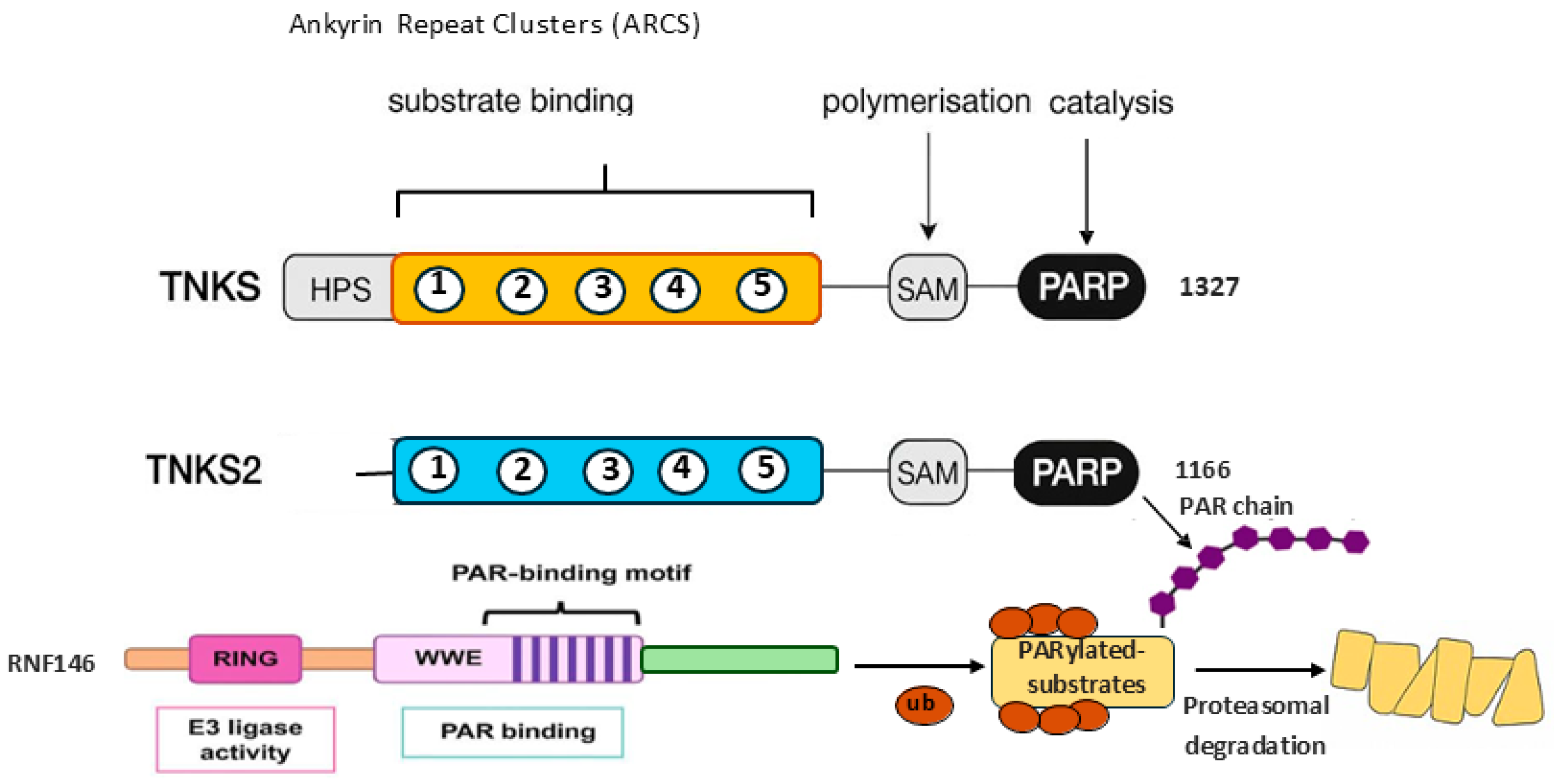
2. Structural Insights into Tankyrase-1 and Tankyrase-2
3. Regulatory Networks Governing Tankyrase Activity, Stability, and Turnover
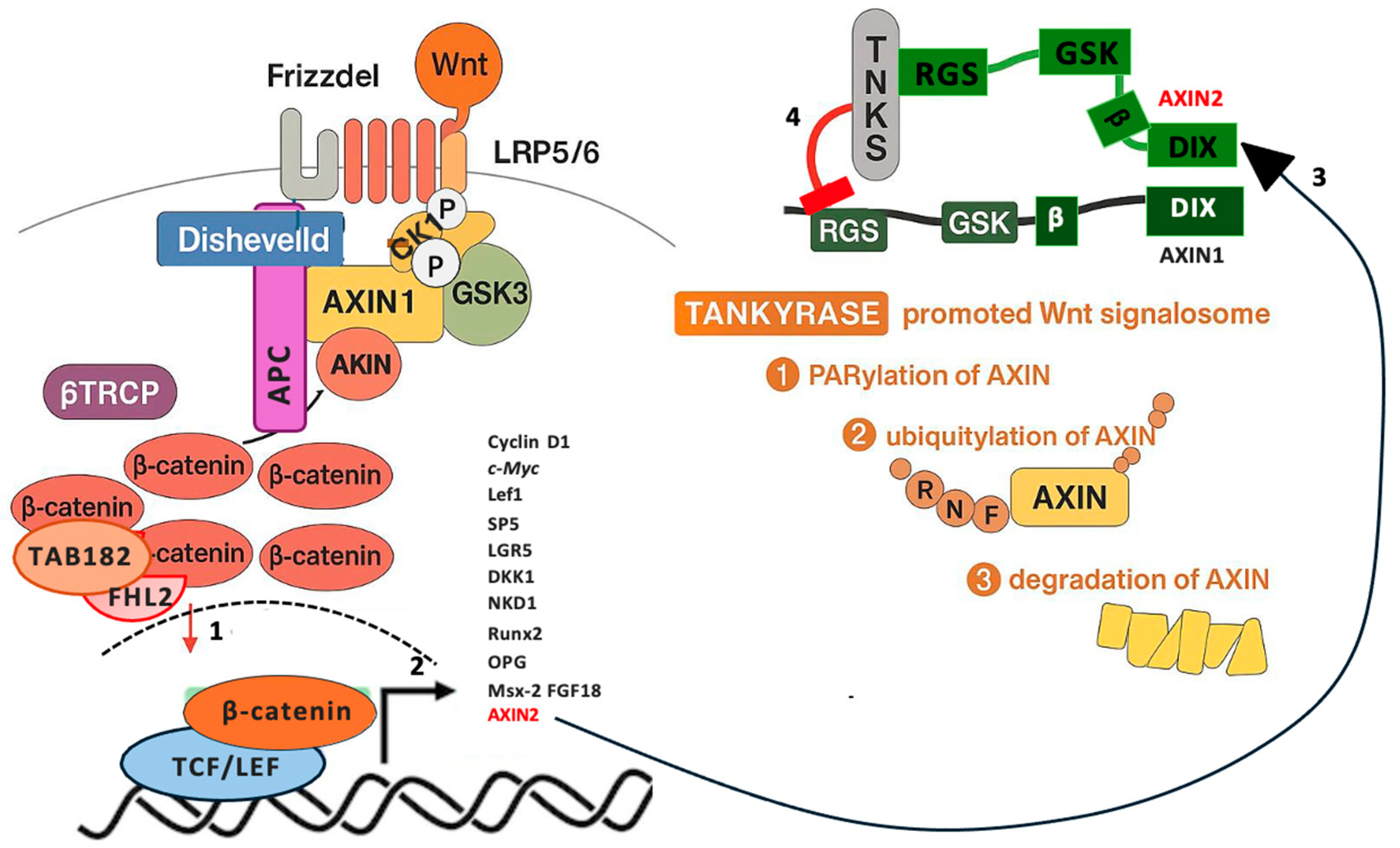
4. Tankyrase and the Wnt Signaling Pathway
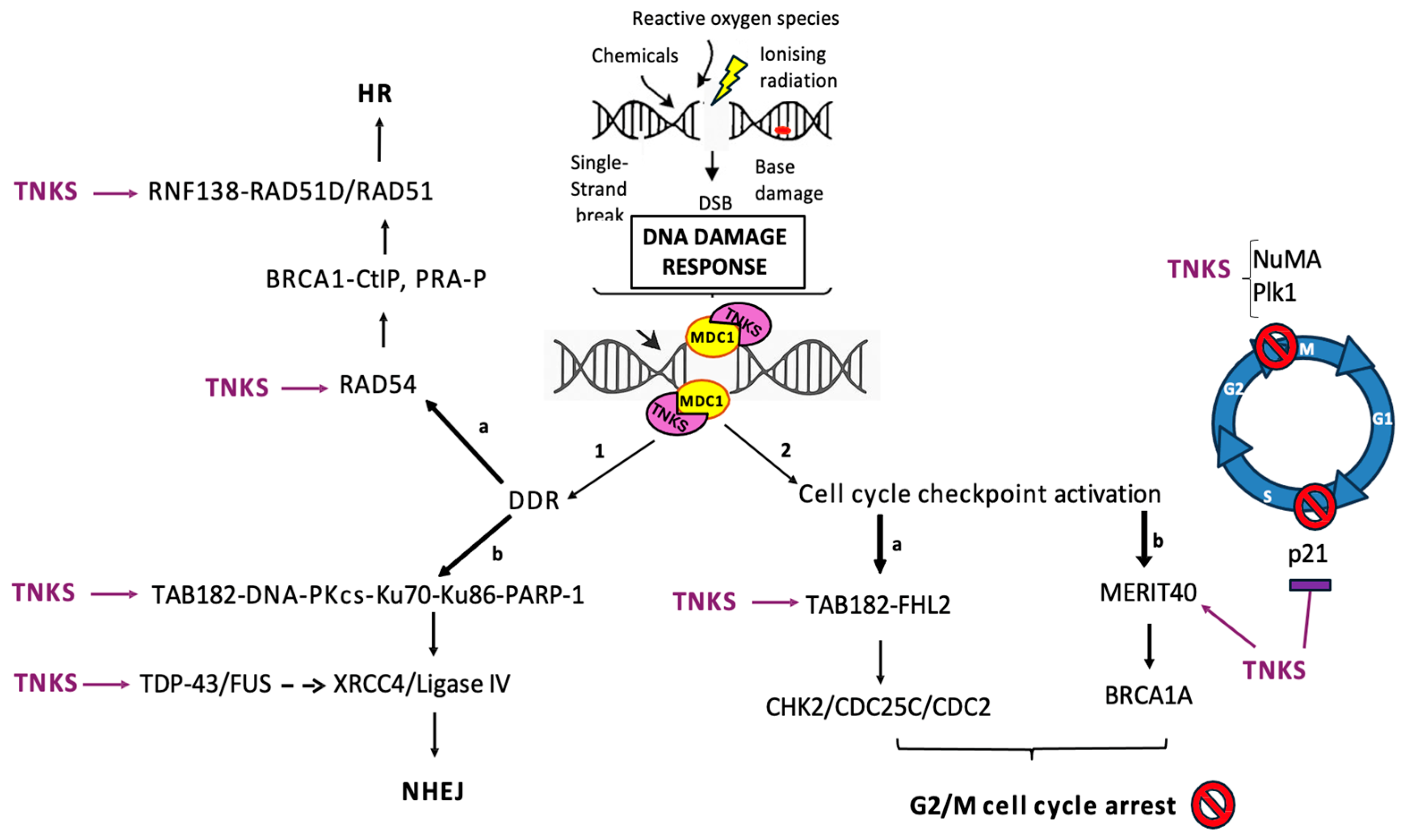
5. Tankyrase and DNA Damage Repair (DDR) Pathways
6. Tankyrases, Viral Infection and Antiviral Response
7. Tankyrases and Apoptosis and Autophagy
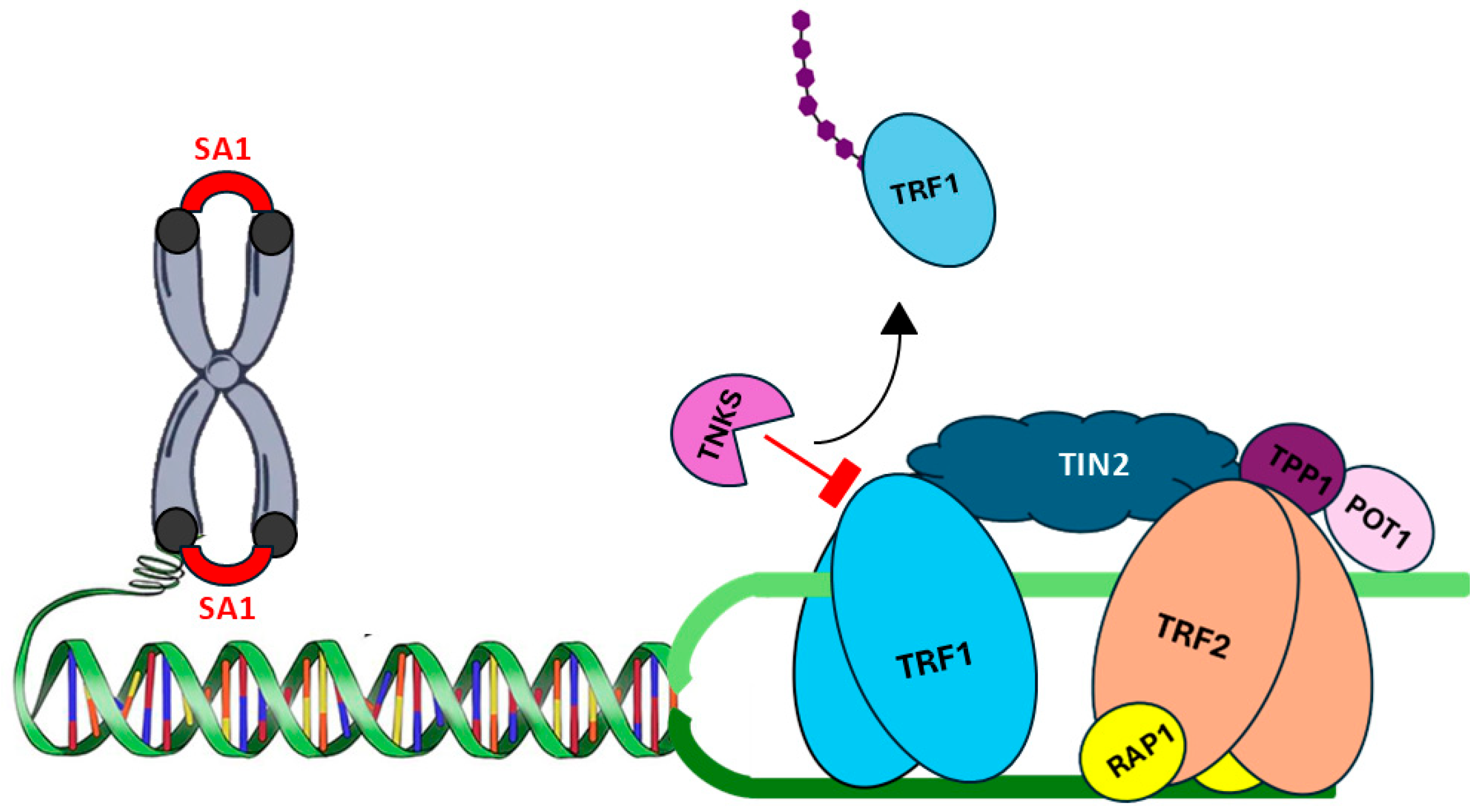
8. Tankyrase and Telomere Maintenance
9. Tankyrase, the Proteasome and Protein Degradation
10. Tankyrases and Glucose Metabolism
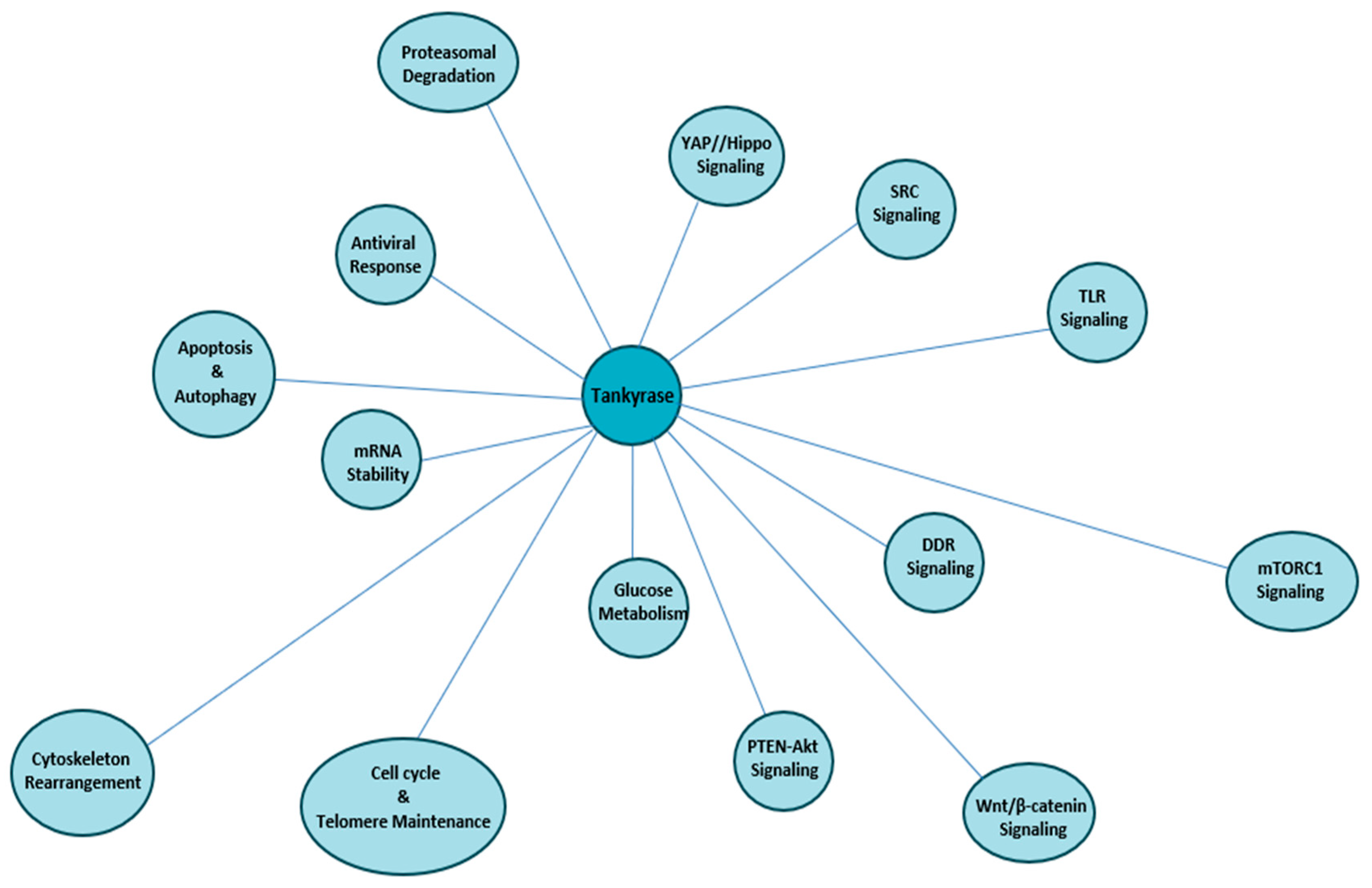
11. Tankyrase as a Central Regulator of Cellular Signaling Networks
12. Tankyrase Involvement in Disease and Tankyrase Inhibitors
13. Concluding Remarks
Supplementary Materials
Author Contributions
Funding
Institutional Review Board Statement
Informed Consent Statement
Data Availability Statement
Conflicts of Interest
Abbreviations
| Akt | Protein kinase B |
| ALS | Amyotrophic Lateral Sclerosis |
| ALT | Alternative Lengthening of Telomeres |
| AMOT | Angiomotin |
| AMOTL | Angiomotin-like |
| AMPK | AMP-associated kinase |
| APC | Adenomatous polyposis coli gene/protein |
| ARC | Ankyrin repeat cluster |
| ARD | Ankyrin repeat domain |
| ARTD | ADP-ribosyltransferase domain |
| ARH3 | ADP-ribosylhydrolase 3 |
| ART | ADP-ribosyltransferase |
| ATG | Autophagy related gene |
| BAP | BRCA1-associated protein |
| Bcl2 | B-cell lymphoma 2 |
| Β-TrCP | Beta-transducin repeat-containing protein |
| BLM | Bloom syndrome protein |
| BRCA1 | Breast cancer gene 1 |
| BRISC | Brcc36 isopeptidase complex |
| CCR4-NOT | Carbon catabolite repression 4 (Ccr4)-negative on TATA-less |
| CD2AP | CD2-associated protein |
| CHFR | Checkpoint with forkhead and ring finger domains |
| CK1 | Casein kinase 1 |
| CNOT | (Ccr4)-negative on TATA-less |
| CPAP | Centrosome Assembly and Centriole Elongation Protein |
| CRC | Colorectal cancer |
| CtIP | C-terminal interacting protein binding protein |
| DDR | DNA damage response |
| DGCR8 | DiGeorge syndrome critical region 8 |
| DIAP1 | Death-associated inhibitor of apoptosis 1 |
| DNA-PKcs | DNA dependent protein kinase catalytic subunit |
| DS | Dyad symmetry |
| DSB | Double strand break |
| DTX | Deltex protein |
| DUB | Deubiquitinase |
| DVL | Dishevelled gene |
| E2F | E2 promotor binding factor |
| EBV | Epstein–Barr virus |
| ESCC | Esophageal squamous cell carcinoma |
| FADD | Fas-associated death domain protein |
| FBP17 | Formin binding protein 17 |
| FHL2 | Four-and-a-half LIM-only protein 2 |
| FTD | Frontotemporal Dementia |
| FUS | Fused in Sarcoma |
| GLUT4 | Glucose uptake 4 |
| GMD | GDP-mannose 4,6-dehydratase |
| GRB14 | Growth factor receptor-bound protein 14 |
| GSK3 | Glycogen synthase kinase-3 |
| GSV | GLUT4 storage vesicles |
| HCC | Hepatocellular carcinoma |
| HH4 | Human herpesvirus 4 |
| HR | Homologous recombination |
| HSV-1 | Herpes simplex virus-1 |
| HuR | Human antigen R |
| IAP | Inhibitor of apoptosis |
| IAV | Influenza A virus |
| ICP0 | Infected cell protein 0 |
| IFNB1 | Interferon β1 |
| IL6 | Interleukin 6 |
| ISG56 | Interferon stimulated gene 56 |
| JNK | c-Jun N-terminal kinase |
| LKB1 | Liver kinase B1 |
| LLPS | Liquid–liquid phase separation |
| MAPK | Mitogen-activated protein kinase |
| MAR | Mono(ADP-ribose) |
| MAVS | Mitochondrial antiviral signaling protein |
| Mcl-1 | Myeloid cell leukaemia 1 |
| MDC1 | Mediator of DNA Damage Checkpoint 1 |
| MERIT40 | Mediator of RAP80 Interaction and Targeting 40 |
| MND | Motor Neuron Disease |
| mTORC1 | Mammalian target of rapamycin complex 1 |
| NHEJ | Non-homologous end joining |
| NKD | Natural killer cell deficiency protein |
| NLS | Nuclear localization signal |
| NuMA | Nuclear Mitotic Apparatus Protein 1 |
| OriP | Origin of replication P |
| PAR | Poly(ADP-ribose) |
| PARG | Poly (ADP-ribose) glycohydrolase |
| PARP | Poly(ADP-ribose) polymerase |
| PCP | Planar cell polarity |
| PEX | Pexophagy |
| PI31 | Proteasomal Inhibitor of 31kD |
| Plk1 | Polo-like kinase 1 |
| POT1 | Protection of telomere 1 |
| PP1 | Protein phosphatase 1 |
| PTEN | Phosphatase and tensin homologue |
| RAP1 | Repressor/Activator Protein 1 homologue |
| RAP80 | Receptor-associated protein 80 |
| Rb | Retinoblastoma protein |
| RBP | RNA-binding protein |
| RIP1 | Receptor interacting protein 1 |
| RIPK1 | Receptor-interacting protein kinase 1 |
| RNF | Ring finger protein |
| SA1 | Cohesin subunit 1 |
| SAM | Sterile alpha motif |
| SARS-CoV-2 | Severe acute respiratory syndrome coronavirus 2 |
| SeV | Sendai virus |
| SH3BP2 | SH3 domain binding protein 2 |
| SRC | Sarcoma proto-oncogene |
| SSB | Single strand break |
| T2DM | Type 2 diabetes mellitus |
| TAB182 | Tankyrase 1 binding protein 1 of 182kDa |
| TAK1 | TGFβ-activated kinase 1 |
| TBM | Tankyrase binding motif |
| TCF/LEF | T cell factor/lymphoid enhancer factor |
| TDP-43 | Transactive response DNA binding protein of 43KDa |
| TERRA | Telomeric repeat containing RNA |
| TIN2 | TERF-interacting nuclear factor 2 |
| TLR | Toll-like receptor |
| TNKS | Tankyrase |
| TNKS1 | Tankyrase 1 |
| TNKS2 | Tankyrase 2 |
| TRADD | TNF receptor-associated death domain protein |
| TRAF2 | TNF receptor-associated factor 2 |
| TRF1 | Telomeric repeat factor 1 |
| TRIR | Telomerase RNA Component Interacting RNase |
| UIM | Ubiquitin-Interacting Motif |
| USP25 | Ubiquitin specific protease 25 |
| UTR | Untranslated region |
| VISA | Virus-induced signal adaptor |
| Wnt | Wingless and Int-1 |
| WRN | Werner syndrome protein |
| XRCC4 | X-ray repair cross-complementing group 4 |
| YAP | Yes-associated protein 1 |
References
- Amé, J.C.; Spenlehauer, C.; De Murcia, G. The PARP superfamily. Bioessays 2004, 26, 882–893. [Google Scholar] [CrossRef] [PubMed]
- Smith, S. The world according to PARP. Trends Biochem. Sci. 2001, 26, 174–179. [Google Scholar] [CrossRef]
- Huang, S.-M.A.; Mishina, Y.M.; Liu, S.; Cheung, A.; Stegmeier, F.; Michaud, G.A.; Charlat, O.; Wiellette, E.; Zhang, Y.; Wiessner, S. Tankyrase inhibition stabilizes axin and antagonizes Wnt signalling. Nature 2009, 461, 614–620. [Google Scholar] [CrossRef] [PubMed]
- Smith, S.; de Lange, T. Tankyrase promotes telomere elongation in human cells. Curr. Biol. 2000, 10, 1299–1302. [Google Scholar] [CrossRef]
- Nagy, Z.; Kalousi, A.; Furst, A.; Koch, M.; Fischer, B.; Soutoglou, E. Tankyrases promote homologous recombination and check point activation in response to DSBs. PLoS Genet. 2016, 12, e1005791. [Google Scholar] [CrossRef] [PubMed]
- Ha, G.; Kim, H.; Go, H.; Lee, H.; Seimiya, H.; Chung, D.; Lee, C. Tankyrase-1 function at telomeres and during mitosis is regulated by Polo-like kinase-1-mediated phosphorylation. Cell Death Differ. 2012, 19, 321–332. [Google Scholar] [CrossRef] [PubMed]
- Li, N.; Wang, Y.; Neri, S.; Zhen, Y.; Fong, L.W.R.; Qiao, Y.; Li, X.; Chen, Z.; Stephan, C.; Deng, W. Tankyrase disrupts metabolic homeostasis and promotes tumorigenesis by inhibiting LKB1-AMPK signalling. Nat. Commun. 2019, 10, 4363. [Google Scholar] [CrossRef] [PubMed]
- Levaot, N.; Voytyuk, O.; Dimitriou, I.; Sircoulomb, F.; Chandrakumar, A.; Deckert, M.; Krzyzanowski, P.M.; Scotter, A.; Gu, S.; Janmohamed, S. Loss of Tankyrase-mediated destruction of 3BP2 is the underlying pathogenic mechanism of cherubism. Cell 2011, 147, 1324–1339. [Google Scholar] [CrossRef] [PubMed]
- Guettler, S.; LaRose, J.; Petsalaki, E.; Gish, G.; Scotter, A.; Pawson, T.; Rottapel, R.; Sicheri, F. Structural basis and sequence rules for substrate recognition by Tankyrase explain the basis for cherubism disease. Cell 2011, 147, 1340–1354. [Google Scholar] [CrossRef]
- DaRosa, P.A.; Klevit, R.E.; Xu, W. Structural basis for tankyrase-RNF146 interaction reveals noncanonical tankyrase-binding motifs. Protein Sci. 2018, 27, 1057–1067. [Google Scholar] [CrossRef] [PubMed]
- DaRosa, P.A.; Wang, Z.; Jiang, X.; Pruneda, J.N.; Cong, F.; Klevit, R.E.; Xu, W. Allosteric activation of the RNF146 ubiquitin ligase by a poly (ADP-ribosyl) ation signal. Nature 2015, 517, 223–226. [Google Scholar] [CrossRef]
- Mariotti, L.; Templeton, C.M.; Ranes, M.; Paracuellos, P.; Cronin, N.; Beuron, F.; Morris, E.; Guettler, S. Tankyrase requires SAM domain-dependent polymerization to support Wnt-β-catenin signaling. Mol. Cell 2016, 63, 498–513. [Google Scholar] [CrossRef] [PubMed]
- Zhang, Y.; Liu, S.; Mickanin, C.; Feng, Y.; Charlat, O.; Michaud, G.A.; Schirle, M.; Shi, X.; Hild, M.; Bauer, A. RNF146 is a poly (ADP-ribose)-directed E3 ligase that regulates axin degradation and Wnt signalling. Nat. Cell Biol. 2011, 13, 623–629. [Google Scholar] [CrossRef]
- Azarm, K.; Smith, S. Nuclear PARPs and genome integrity. Genes Dev. 2020, 34, 285–301. [Google Scholar] [CrossRef] [PubMed]
- Waaler, J.; Machon, O.; Tumova, L.; Dinh, H.; Korinek, V.; Wilson, S.R.; Paulsen, J.E.; Pedersen, N.M.; Eide, T.J.; Machonova, O. A novel tankyrase inhibitor decreases canonical Wnt signaling in colon carcinoma cells and reduces tumor growth in conditional APC mutant mice. Cancer Res. 2012, 72, 2822–2832. [Google Scholar] [CrossRef] [PubMed]
- Xu, Y.-R.; Shi, M.-L.; Zhang, Y.; Kong, N.; Wang, C.; Xiao, Y.-F.; Du, S.-S.; Zhu, Q.-Y.; Lei, C.-Q. Tankyrases inhibit innate antiviral response by PARylating VISA/MAVS and priming it for RNF146-mediated ubiquitination and degradation. Proc. Natl. Acad. Sci. USA 2022, 119, e2122805119. [Google Scholar] [CrossRef]
- McGurk, L.; Gomes, E.; Guo, L.; Shorter, J.; Bonini, N.M. Poly (ADP-ribose) engages the TDP-43 nuclear-localization sequence to regulate granulo-filamentous aggregation. Biochemistry 2018, 57, 6923–6926. [Google Scholar] [CrossRef]
- Wahlberg, E.; Karlberg, T.; Kouznetsova, E.; Markova, N.; Macchiarulo, A.; Thorsell, A.-G.; Pol, E.; Frostell, Å.; Ekblad, T.; Öncü, D. Family-wide chemical profiling and structural analysis of PARP and tankyrase inhibitors. Nat. Biotechnol. 2012, 30, 283–288. [Google Scholar] [CrossRef]
- Martino-Echarri, E.; Brocardo, M.G.; Mills, K.M.; Henderson, B.R. Tankyrase inhibitors stimulate the ability of tankyrases to bind axin and drive assembly of β-catenin degradation-competent axin puncta. PLoS ONE 2016, 11, e0150484. [Google Scholar] [CrossRef] [PubMed]
- Hottiger, M.O.; Hassa, P.O.; Lüscher, B.; Schüler, H.; Koch-Nolte, F. Toward a unified nomenclature for mammalian ADP-ribosyltransferases. Trends Biochem. Sci. 2010, 35, 208–219. [Google Scholar] [CrossRef] [PubMed]
- Demény, M.A.; Virág, L. The PARP enzyme family and the hallmarks of cancer part 1. Cell intrinsic hallmarks. Cancers 2021, 13, 2042. [Google Scholar] [CrossRef]
- Bhardwaj, A.; Yang, Y.; Ueberheide, B.; Smith, S. Whole proteome analysis of human tankyrase knockout cells reveals targets of tankyrase-mediated degradation. Nat. Commun. 2017, 8, 2214. [Google Scholar] [CrossRef] [PubMed]
- Haikarainen, T.; Krauss, S.; Lehtio, L. Tankyrases: Structure, function and therapeutic implications in cancer. Curr. Pharm. Des. 2014, 20, 6472–6488. [Google Scholar] [CrossRef] [PubMed]
- Jessop, M.; Broadway, B.J.; Miller, K.; Guettler, S. Regulation of PARP1/2 and the tankyrases: Emerging parallels. Biochem. J. 2024, 481, 1097–1123. [Google Scholar] [CrossRef]
- Morrone, S.; Cheng, Z.; Moon, R.T.; Cong, F.; Xu, W. Crystal structure of a Tankyrase-Axin complex and its implications for Axin turnover and Tankyrase substrate recruitment. Proc. Natl. Acad. Sci. USA 2012, 109, 1500–1505. [Google Scholar] [CrossRef]
- Li, B.; Qiao, R.; Wang, Z.; Zhou, W.; Li, X.; Xu, W.; Rao, Z. Crystal structure of a tankyrase 1–telomere repeat factor 1 complex. Struct. Biol. Cryst. Commun. 2016, 72, 320–327. [Google Scholar]
- Eisemann, T.; McCauley, M.; Langelier, M.-F.; Gupta, K.; Roy, S.; Van Duyne, G.D.; Pascal, J.M. Tankyrase-1 ankyrin repeats form an adaptable binding platform for targets of ADP-ribose modification. Structure 2016, 24, 1679–1692. [Google Scholar] [CrossRef]
- Sowa, S.T.; Bosetti, C.; Galera-Prat, A.; Johnson, M.S.; Lehtiö, L. An evolutionary perspective on the origin, conservation and binding partner acquisition of tankyrases. Biomolecules 2022, 12, 1688. [Google Scholar] [CrossRef]
- Pollock, K.; Ranes, M.; Collins, I.; Guettler, S. Identifying and validating Tankyrase binders and substrates: A candidate approach. In Poly (ADP-Ribose) Polymerase: Methods and Protocols; Springer: Berlin/Heidelberg, Germany, 2017; pp. 445–473. [Google Scholar]
- Pollock, K.; Liu, M.; Zaleska, M.; Meniconi, M.; Pfuhl, M.; Collins, I.; Guettler, S. Fragment-based screening identifies molecules targeting the substrate-binding ankyrin repeat domains of tankyrase. Sci. Rep. 2019, 9, 19130. [Google Scholar] [CrossRef]
- Clements, C.M.; Shellman, S.X.; Shellman, M.H.; Shellman, Y.G. TBM Hunter: Identify and Score Canonical, Extended, and Unconventional Tankyrase-Binding Motifs in Any Protein. Int. J. Mol. Sci. 2023, 24, 16964. [Google Scholar] [CrossRef]
- Zamudio-Martinez, E.; Herrera-Campos, A.B.; Muñoz, A.; Rodríguez-Vargas, J.M.; Oliver, F.J. Tankyrases as modulators of pro-tumoral functions: Molecular insights and therapeutic opportunities. J. Exp. Clin. Cancer Res. 2021, 40, 144. [Google Scholar] [CrossRef]
- Vivelo, C.A.; Ayyappan, V.; Leung, A.K. Poly (ADP-ribose)-dependent ubiquitination and its clinical implications. Biochem. Pharmacol. 2019, 167, 3–12. [Google Scholar] [CrossRef]
- Smith, S.; de Lange, T. Cell cycle dependent localization of the telomeric PARP, tankyrase, to nuclear pore complexes and centrosomes. J. Cell Sci. 1999, 112, 3649–3656. [Google Scholar] [CrossRef] [PubMed]
- Chang, W.; Dynek, J.N.; Smith, S. TRF1 is degraded by ubiquitin-mediated proteolysis after release from telomeres. Genes Dev. 2003, 17, 1328–1333. [Google Scholar] [CrossRef] [PubMed]
- Dregalla, R.C.; Zhou, J.; Idate, R.R.; Battaglia, C.L.; Liber, H.L.; Bailey, S.M. Regulatory roles of tankyrase 1 at telomeres and in DNA repair: Suppression of T-SCE and stabilization of DNA-PKcs. Aging 2010, 2, 691. [Google Scholar] [CrossRef] [PubMed]
- Zou, L.-H.; Shang, Z.-F.; Tan, W.; Liu, X.-D.; Xu, Q.-Z.; Song, M.; Wang, Y.; Guan, H.; Zhang, S.-M.; Yu, L. TNKS1BP1 functions in DNA double-strand break repair though facilitating DNA-PKcs autophosphorylation dependent on PARP-1. Oncotarget 2015, 6, 7011. [Google Scholar] [CrossRef] [PubMed]
- Chi, N.-W.; Lodish, H.F. Tankyrase is a golgi-associated mitogen-activated protein kinase substrate that interacts with IRAP in GLUT4 vesicles. J. Biol. Chem. 2000, 275, 38437–38444. [Google Scholar] [CrossRef]
- Zimmerlin, L.; Zambidis, E.T. Pleiotropic roles of tankyrase/PARP proteins in the establishment and maintenance of human naive pluripotency. Exp. Cell Res. 2020, 390, 111935. [Google Scholar] [CrossRef] [PubMed]
- Matsumoto, Y.; Rottapel, R. PARsylation-mediated ubiquitylation: Lessons from rare hereditary disease Cherubism. Trends Mol. Med. 2023, 29, 390–405. [Google Scholar] [CrossRef]
- Perrard, J.; Smith, S. Multiple E3 ligases control tankyrase stability and function. Nat. Commun. 2023, 14, 7208. [Google Scholar] [CrossRef] [PubMed]
- Yan, K.; Ponnusamy, M.; Xin, Y.; Wang, Q.; Li, P.; Wang, K. The role of K63-linked polyubiquitination in cardiac hypertrophy. J. Cell. Mol. Med. 2018, 22, 4558–4567. [Google Scholar] [CrossRef]
- Wei, H.; Yu, X. Functions of PARylation in DNA damage repair pathways. Genom. Proteom. Bioinform. 2016, 14, 131–139. [Google Scholar] [CrossRef]
- Reber, J.M.; Mangerich, A. Why structure and chain length matter: On the biological significance underlying the structural heterogeneity of poly (ADP-ribose). Nucleic Acids Res. 2021, 49, 8432–8448. [Google Scholar] [CrossRef] [PubMed]
- Harrision, D.; Gravells, P.; Thompson, R.; Bryant, H.E. Poly (ADP-ribose) glycohydrolase (PARG) vs. poly (ADP-ribose) polymerase (PARP)–function in genome maintenance and relevance of inhibitors for anti-cancer therapy. Front. Mol. Biosci. 2020, 7, 191. [Google Scholar] [CrossRef]
- Bisht, K.K.; Dudognon, C.; Chang, W.G.; Sokol, E.S.; Ramirez, A.; Smith, S. GDP-mannose-4, 6-dehydratase is a cytosolic partner of tankyrase 1 that inhibits its poly (ADP-ribose) polymerase activity. Mol. Cell. Biol. 2012, 32, 3044–3053. [Google Scholar] [CrossRef]
- Li, J.; Wang, W. Mechanisms and functions of pexophagy in mammalian cells. Cells 2021, 10, 1094. [Google Scholar] [CrossRef]
- Pillay, N.; Mariotti, L.; Zaleska, M.; Inian, O.; Jessop, M.; Hibbs, S.; Desfosses, A.; Hopkins, P.C.; Templeton, C.M.; Beuron, F. Structural basis of tankyrase activation by polymerization. Nature 2022, 612, 162–169. [Google Scholar] [CrossRef]
- Seimiya, H.; Muramatsu, Y.; Smith, S.; Tsuruo, T. Functional subdomain in the ankyrin domain of tankyrase 1 required for poly(ADP-ribosyl)ation of TRF1 and telomere elongation. Mol. Cell. Biol. 2004, 24, 1944–1955. [Google Scholar] [CrossRef] [PubMed]
- De Rycker, M.; Price, C.M. Tankyrase polymerization is controlled by its sterile alpha motif and poly(ADP-ribose) polymerase domains. Mol. Cell. Biol. 2004, 24, 9802–9812. [Google Scholar] [CrossRef]
- Riccio, A.A.; McCauley, M.; Langelier, M.-F.; Pascal, J.M. Tankyrase sterile α motif domain polymerization is required for its role in Wnt signaling. Structure 2016, 24, 1573–1581. [Google Scholar] [CrossRef] [PubMed]
- Karlberg, T.; Markova, N.; Johansson, I.; Hammarstrom, M.; Schutz, P.; Weigelt, J.; Schuler, H. Structural basis for the interaction between tankyrase-2 and a potent Wnt-signaling inhibitor. J. Med. Chem. 2010, 53, 5352–5355. [Google Scholar] [CrossRef]
- Narwal, M.; Venkannagari, H.; Lehtio, L. Structural basis of selective inhibition of human tankyrases. J. Med. Chem. 2012, 55, 1360–1367. [Google Scholar] [CrossRef] [PubMed]
- Lehtiö, L.; Chi, N.W.; Krauss, S. Tankyrases as drug targets. FEBS J. 2013, 280, 3576–3593. [Google Scholar] [CrossRef]
- Ruf, A.; Mennissier de Murcia, J.; De Murcia, G.; Schulz, G.E. Structure of the catalytic fragment of poly (AD-ribose) polymerase from chicken. Proc. Natl. Acad. Sci. USA 1996, 93, 7481–7485. [Google Scholar] [CrossRef] [PubMed]
- Vyas, S.; Matic, I.; Uchima, L.; Rood, J.; Zaja, R.; Hay, R.T.; Ahel, I.; Chang, P. Family-wide analysis of poly (ADP-ribose) polymerase activity. Nat. Commun. 2014, 5, 4426. [Google Scholar] [CrossRef] [PubMed]
- Lüscher, B.; Ahel, I.; Altmeyer, M.; Ashworth, A.; Bai, P.; Chang, P.; Cohen, M.; Corda, D.; Dantzer, F.; Daugherty, M.D. ADP-ribosyltransferases, an update on function and nomenclature. FEBS J. 2022, 289, 7399–7410. [Google Scholar] [CrossRef]
- Zhou, Z.-d.; Chan, C.H.-s.; Xiao, Z.-c.; Tan, E.-K. Ring finger protein 146/Iduna is a poly (ADP-ribose) polymer binding and PARsylation dependent E3 ubiquitin ligase. Cell Adhes. Migr. 2011, 5, 463–471. [Google Scholar] [CrossRef]
- Ahel, D.; Hořejší, Z.; Wiechens, N.; Polo, S.E.; Garcia-Wilson, E.; Ahel, I.; Flynn, H.; Skehel, M.; West, S.C.; Jackson, S.P. Poly (ADP-ribose)–dependent regulation of DNA repair by the chromatin remodeling enzyme ALC1. Science 2009, 325, 1240–1243. [Google Scholar] [CrossRef]
- Gibson, B.A.; Kraus, W.L. New insights into the molecular and cellular functions of poly (ADP-ribose) and PARPs. Nat. Rev. Mol. Cell Biol. 2012, 13, 411–424. [Google Scholar] [CrossRef]
- Teloni, F.; Altmeyer, M. Readers of poly (ADP-ribose): Designed to be fit for purpose. Nucleic Acids Res. 2015, 44, 993–1006. [Google Scholar] [CrossRef]
- Altmeyer, M.; Neelsen, K.J.; Teloni, F.; Pozdnyakova, I.; Pellegrino, S.; Grøfte, M.; Rask, M.-B.D.; Streicher, W.; Jungmichel, S.; Nielsen, M.L. Liquid demixing of intrinsically disordered proteins is seeded by poly (ADP-ribose). Nat. Commun. 2015, 6, 8088. [Google Scholar] [CrossRef]
- Callow, M.G.; Tran, H.; Phu, L.; Lau, T.; Lee, J.; Sandoval, W.N.; Liu, P.S.; Bheddah, S.; Tao, J.; Lill, J.R. Ubiquitin ligase RNF146 regulates tankyrase and Axin to promote Wnt signaling. PLoS ONE 2011, 6, e22595. [Google Scholar] [CrossRef]
- Chang, W.; Dynek, J.N.; Smith, S. NuMA is a major acceptor of poly (ADP-ribosyl) ation by tankyrase 1 in mitosis. Biochem. J. 2005, 391, 177–184. [Google Scholar] [CrossRef]
- Chang, P.; Coughlin, M.; Mitchison, T.J. Tankyrase-1 polymerization of poly (ADP-ribose) is required for spindle structure and function. Nat. Cell Biol. 2005, 7, 1133–1139. [Google Scholar] [CrossRef] [PubMed]
- Wang, Z.; Michaud, G.A.; Cheng, Z.; Zhang, Y.; Hinds, T.R.; Fan, E.; Cong, F.; Xu, W. Recognition of the iso-ADP-ribose moiety in poly (ADP-ribose) by WWE domains suggests a general mechanism for poly (ADP-ribosyl) ation-dependent ubiquitination. Genes Dev. 2012, 26, 235–240. [Google Scholar] [CrossRef] [PubMed]
- Wang, W.; Li, N.; Li, X.; Tran, M.K.; Han, X.; Chen, J. Tankyrase inhibitors target YAP by stabilizing angiomotin family proteins. Cell Rep. 2015, 13, 524–532. [Google Scholar] [CrossRef]
- Kim, M.K. Novel insight into the function of tankyrase. Oncol. Lett. 2018, 16, 6895–6902. [Google Scholar] [CrossRef] [PubMed]
- Broadway, B.J.; Pollock, K.; Cronin, N.; Rottapel, R.; Sicheri, F.; Guettler, S. Phosphorylation as a candidate regulatory mechanism for effector recruitment to tankyrase. R. Soc. Open Sci. 2025, 12, 250824. [Google Scholar] [CrossRef]
- Christian Wigley, W.; Fabunmi, R.P.; Lee, M.G.; Marino, C.R.; Muallem, S.; DeMartino, G.N.; Thomas, P.J. Dynamic association of proteasomal machinery with the centrosome. J. Cell Biol. 1999, 145, 481–490. [Google Scholar] [CrossRef]
- Xu, D.; Liu, J.; Fu, T.; Shan, B.; Qian, L.; Pan, L.; Yuan, J. USP25 regulates Wnt signaling by controlling the stability of tankyrases. Genes Dev. 2017, 31, 1024–1035. [Google Scholar] [CrossRef]
- Loh, K.M.; van Amerongen, R.; Nusse, R. Generating cellular diversity and spatial form: Wnt signaling and the evolution of multicellular animals. Dev. Cell 2016, 38, 643–655. [Google Scholar] [CrossRef]
- Chae, W.-J.; Bothwell, A.L. Canonical and non-canonical Wnt signaling in immune cells. Trends Immunol. 2018, 39, 830–847. [Google Scholar] [CrossRef]
- MacDonald, B.T.; Tamai, K.; He, X. Wnt/β-catenin signaling: Components, mechanisms, and diseases. Dev. Cell 2009, 17, 9–26. [Google Scholar] [CrossRef]
- Ishitani, T.; Kishida, S.; Hyodo-Miura, J.; Ueno, N.; Yasuda, J.; Waterman, M.; Shibuya, H.; Moon, R.T.; Ninomiya-Tsuji, J.; Matsumoto, K. The TAK1-NLK mitogen-activated protein kinase cascade functions in the Wnt-5a/Ca2+ pathway to antagonize Wnt/β-catenin signaling. Mol. Cell. Biol. 2003, 23, 131–139. [Google Scholar] [PubMed]
- Topol, L.; Jiang, X.; Choi, H.; Garrett-Beal, L.; Carolan, P.J.; Yang, Y. Wnt-5a inhibits the canonical Wnt pathway by promoting GSK-3–independent β-catenin degradation. J. Cell Biol. 2003, 162, 899–908. [Google Scholar] [CrossRef] [PubMed]
- Clevers, H.; Nusse, R. Wnt/β-catenin signaling and disease. Cell 2012, 149, 1192–1205. [Google Scholar] [CrossRef]
- Cadigan, K.M.; Peifer, M. Wnt signaling from development to disease: Insights from model systems. Cold Spring Harb. Perspect. Biol. 2009, 1, a002881. [Google Scholar] [CrossRef] [PubMed]
- Willert, K.; Nusse, R. Wnt proteins. Cold Spring Harb. Perspect. Biol. 2012, 4, a007864. [Google Scholar]
- Liu, L.-J.; Xie, S.-X.; Chen, Y.-T.; Xue, J.-L.; Zhang, C.-J.; Zhu, F. Aberrant regulation of Wnt signaling in hepatocellular carcinoma. World J. Gastroenterol. 2016, 22, 7486. [Google Scholar] [CrossRef]
- Ranes, M.; Zaleska, M.; Sakalas, S.; Knight, R.; Guettler, S. Reconstitution of the destruction complex defines roles of AXIN polymers and APC in β-catenin capture, phosphorylation, and ubiquitylation. Mol. Cell 2021, 81, 3246–3261.e11. [Google Scholar] [CrossRef]
- van Kappel, E.C.; Maurice, M.M. Molecular regulation and pharmacological targeting of the β-catenin destruction complex. Br. J. Pharmacol. 2017, 174, 4575–4588. [Google Scholar] [CrossRef] [PubMed]
- Powell, S.M.; Zilz, N.; Beazer-Barclay, Y.; Bryan, T.M.; Hamilton, S.R.; Thibodeau, S.N.; Vogelstein, B.; Kinzler, K.W. APC mutations occur early during colorectal tumorigenesis. Nature 1992, 359, 235–237. [Google Scholar] [CrossRef]
- Fearnhead, N.S.; Britton, M.P.; Bodmer, W.F. The abc of apc. Hum. Mol. Genet. 2001, 10, 721–733. [Google Scholar] [CrossRef]
- Wang, Q.; Li, L.; You, L.; Wang, S.; Han, L.; Wang, B.; Yao, L.; Lu, Y.; Mender, I.; Flusche, A.M. Role of tankyrase scaffolding in the β-catenin destruction complex and WNT signaling. bioRxiv 2025. [Google Scholar] [CrossRef]
- Gao, A.; Su, Z.; Shang, Z.; He, C.; Miao, D.; Li, X.; Zou, S.; Ding, W.; Zhou, Y.; Sun, M. TAB182 aggravates progression of esophageal squamous cell carcinoma by enhancing β-catenin nuclear translocation through FHL2 dependent manner. Cell Death Dis. 2022, 13, 900. [Google Scholar] [CrossRef]
- Ohishi, T.; Yoshida, H.; Katori, M.; Migita, T.; Muramatsu, Y.; Miyake, M.; Ishikawa, Y.; Saiura, A.; Iemura, S.-I.; Natsume, T. Tankyrase-binding protein TNKS1BP1 regulates actin cytoskeleton rearrangement and cancer cell invasion. Cancer Res. 2017, 77, 2328–2338. [Google Scholar] [CrossRef]
- Lau, N.-C.; Kolkman, A.; van Schaik, F.M.; Mulder, K.W.; Pijnappel, W.P.; Heck, A.J.; Timmers, H.T.M. Human Ccr4–Not complexes contain variable deadenylase subunits. Biochem. J. 2009, 422, 443–453. [Google Scholar] [CrossRef] [PubMed]
- Chalabi Hagkarim, N.; Ryan, E.L.; Byrd, P.J.; Hollingworth, R.; Shimwell, N.J.; Agathanggelou, A.; Vavasseur, M.; Kolbe, V.; Speiseder, T.; Dobner, T. Degradation of a novel DNA damage response protein, tankyrase 1 binding protein 1, following adenovirus infection. J. Virol. 2018, 92, e02034-17. [Google Scholar] [CrossRef] [PubMed]
- Lebensohn, A.M.; Dubey, R.; Neitzel, L.R.; Tacchelly-Benites, O.; Yang, E.; Marceau, C.D.; Davis, E.M.; Patel, B.B.; Bahrami-Nejad, Z.; Travaglini, K.J. Comparative genetic screens in human cells reveal new regulatory mechanisms in WNT signaling. Elife 2016, 5, e21459. [Google Scholar] [CrossRef]
- Liu, C.; Li, Y.; Semenov, M.; Han, C.; Baeg, G.-H.; Tan, Y.; Zhang, Z.; Lin, X.; He, X. Control of β-catenin phosphorylation/degradation by a dual-kinase mechanism. Cell 2002, 108, 837–847. [Google Scholar] [CrossRef]
- Luo, W.; Peterson, A.; Garcia, B.A.; Coombs, G.; Kofahl, B.; Heinrich, R.; Shabanowitz, J.; Hunt, D.F.; Yost, H.J.; Virshup, D.M. Protein phosphatase 1 regulates assembly and function of the β-catenin degradation complex. EMBO J. 2007, 26, 1511–1521. [Google Scholar] [CrossRef] [PubMed]
- Kim, S.-E.; Huang, H.; Zhao, M.; Zhang, X.; Zhang, A.; Semonov, M.V.; MacDonald, B.T.; Zhang, X.; Abreu, J.G.; Peng, L. Wnt stabilization of β-catenin reveals principles for morphogen receptor-scaffold assemblies. Science 2013, 340, 867–870. [Google Scholar] [CrossRef] [PubMed]
- Wang, W.; Liu, P.; Lavrijsen, M.; Li, S.; Zhang, R.; Li, S.; van de Geer, W.S.; van de Werken, H.J.; Peppelenbosch, M.P.; Smits, R. Evaluation of AXIN1 and AXIN2 as targets of tankyrase inhibition in hepatocellular carcinoma cell lines. Sci. Rep. 2021, 11, 7470. [Google Scholar] [CrossRef]
- Figeac, N.; Zammit, P.S. Coordinated action of Axin1 and Axin2 suppresses β-catenin to regulate muscle stem cell function. Cell. Signal. 2015, 27, 1652–1665. [Google Scholar] [CrossRef]
- Wu, Z.-Q.; Brabletz, T.; Fearon, E.; Willis, A.L.; Hu, C.Y.; Li, X.-Y.; Weiss, S.J. Canonical Wnt suppressor, Axin2, promotes colon carcinoma oncogenic activity. Proc. Natl. Acad. Sci. USA 2012, 109, 11312–11317. [Google Scholar] [CrossRef] [PubMed]
- Bernkopf, D.B.; Hadjihannas, M.V.; Behrens, J. Negative-feedback regulation of the Wnt pathway by conductin/axin2 involves insensitivity to upstream signalling. J. Cell Sci. 2015, 128, 33–39. [Google Scholar] [CrossRef]
- Liu, L.; Silke, J. AXIN 2 is a non-redundant regulator of AXIN 1 stability and β-catenin in colorectal cancer cells. FEBS J. 2025, 292, 990–994. [Google Scholar] [CrossRef]
- Croy, H.E.; Fuller, C.N.; Giannotti, J.; Robinson, P.; Foley, A.V.; Yamulla, R.J.; Cosgriff, S.; Greaves, B.D.; von Kleeck, R.A.; An, H.H. The poly (ADP-ribose) polymerase enzyme Tankyrase antagonizes activity of the β-catenin destruction complex through ADP-ribosylation of Axin and APC2. J. Biol. Chem. 2016, 291, 12747–12760. [Google Scholar] [CrossRef]
- Wang, R.; Xie, H.; Yang, L.; Wang, P.; Chen, M.-M.; Wu, H.-Y.; Liao, Y.-L.; Wang, M.-Y.; Wang, Q.; Gong, X.-X. Naked cuticle inhibits wingless signaling in Drosophila wing development. Biochem. Biophys. Res. Commun. 2021, 576, 1–6. [Google Scholar] [CrossRef]
- Gao, R.; Ma, L.-Q.; Du, X.; Zhang, T.-T.; Zhao, L.; Liu, L.; Liu, J.-C.; Guo, F.; Cheng, Z.; Huang, H. Rnf25/AO7 positively regulates wnt signaling via disrupting Nkd1-Axin inhibitory complex independent of its ubiquitin ligase activity. Oncotarget 2016, 7, 23850. [Google Scholar] [CrossRef]
- Lindahl, T. Instability and decay of the primary structure of DNA. Nature 1993, 362, 709–715. [Google Scholar] [CrossRef]
- Hoeijmakers, J.H. Genome maintenance mechanisms for preventing cancer. Nature 2001, 411, 366–374. [Google Scholar] [CrossRef]
- Caldecott, K.W. Single-strand break repair and genetic disease. Nat. Rev. Genet. 2008, 9, 619–631. [Google Scholar] [CrossRef]
- Bryant, H.E.; Schultz, N.; Thomas, H.D.; Parker, K.M.; Flower, D.; Lopez, E.; Kyle, S.; Meuth, M.; Curtin, N.J.; Helleday, T. Specific killing of BRCA2-deficient tumours with inhibitors of poly (ADP-ribose) polymerase. Nature 2005, 434, 913–917. [Google Scholar] [CrossRef] [PubMed]
- Zhang, H.; Zha, S. The dynamics and regulation of PARP1 and PARP2 in response to DNA damage and during replication. DNA Repair 2024, 140, 103690. [Google Scholar] [CrossRef]
- Palazzo, L.; Ahel, I. PARPs in genome stability and signal transduction: Implications for cancer therapy. Biochem. Soc. Trans. 2018, 46, 1681–1695. [Google Scholar] [CrossRef] [PubMed]
- Ismail, I.H.; Gagné, J.-P.; Genois, M.-M.; Strickfaden, H.; McDonald, D.; Xu, Z.; Poirier, G.G.; Masson, J.-Y.; Hendzel, M.J. The RNF138 E3 ligase displaces Ku to promote DNA end resection and regulate DNA repair pathway choice. Nat. Cell Biol. 2015, 17, 1446–1457. [Google Scholar] [CrossRef] [PubMed]
- Han, C.; Liu, Y.; Wan, G.; Choi, H.J.; Zhao, L.; Ivan, C.; He, X.; Sood, A.K.; Zhang, X.; Lu, X. The RNA-binding protein DDX1 promotes primary microRNA maturation and inhibits ovarian tumor progression. Cell Rep. 2014, 8, 1447–1460. [Google Scholar] [CrossRef]
- Yard, B.D.; Adams, D.J.; Chie, E.K.; Tamayo, P.; Battaglia, J.S.; Gopal, P.; Rogacki, K.; Pearson, B.E.; Phillips, J.; Raymond, D.P. A genetic basis for the variation in the vulnerability of cancer to DNA damage. Nat. Commun. 2016, 7, 11428. [Google Scholar] [CrossRef]
- Kang, H.C.; Lee, Y.-I.; Shin, J.-H.; Andrabi, S.A.; Chi, Z.; Gagné, J.-P.; Lee, Y.; Ko, H.S.; Lee, B.D.; Poirier, G.G. Iduna is a poly (ADP-ribose)(PAR)-dependent E3 ubiquitin ligase that regulates DNA damage. Proc. Natl. Acad. Sci. USA 2011, 108, 14103–14108. [Google Scholar] [CrossRef]
- Sbodio, J.I.; Lodish, H.F.; Chi, N.-W. Tankyrase-2 oligomerizes with tankyrase-1 and binds to both TRF1 (telomere-repeat-binding factor 1) and IRAP (insulin-responsive aminopeptidase). Biochem. J. 2002, 361, 451–459. [Google Scholar] [CrossRef]
- Seimiya, H.; Smith, S. The telomeric poly (ADP-ribose) polymerase, tankyrase 1, contains multiple binding sites for telomeric repeat binding factor 1 (TRF1) and a novel acceptor, 182-kDa tankyrase-binding protein (TAB182). J. Biol. Chem. 2002, 277, 14116–14126. [Google Scholar]
- Cao, Y.; Gao, A.; Li, X.; Min, H.; He, C.; Sun, X.; Ding, W.Q.; Zhou, J. Elevated TAB182 enhances the radioresistance of esophageal squamous cell carcinoma through G2-M checkpoint modulation. Cancer Med. 2021, 10, 3101–3112. [Google Scholar]
- Tan, W.; Guan, H.; Zou, L.H.; Wang, Y.; Liu, X.D.; Rang, W.Q.; Zhou, P.K.; Pei, H.D.; Zhong, C.G. Overexpression of TNKS1BP1 in lung cancers and its involvement in homologous recombination pathway of DNA double-strand breaks. Cancer Med. 2017, 6, 483–493. [Google Scholar]
- Colombrita, C.; Zennaro, E.; Fallini, C.; Weber, M.; Sommacal, A.; Buratti, E.; Silani, V.; Ratti, A. TDP-43 is recruited to stress granules in conditions of oxidative insult. J. Neurochem. 2009, 111, 1051–1061. [Google Scholar] [CrossRef] [PubMed]
- Ederle, H.; Funk, C.; Abou-Ajram, C.; Hutten, S.; Funk, E.B.; Kehlenbach, R.H.; Bailer, S.M.; Dormann, D. Nuclear egress of TDP-43 and FUS occurs independently of Exportin-1/CRM1. Sci. Rep. 2018, 8, 7084. [Google Scholar] [CrossRef] [PubMed]
- Rhine, K.; Dasovich, M.; Yoniles, J.; Badiee, M.; Skanchy, S.; Ganser, L.R.; Ge, Y.; Fare, C.M.; Shorter, J.; Leung, A.K. Poly (ADP-ribose) drives condensation of FUS via a transient interaction. Mol. Cell 2022, 82, 969–985.e11. [Google Scholar]
- McGurk, L.; Gomes, E.; Guo, L.; Mojsilovic-Petrovic, J.; Tran, V.; Kalb, R.G.; Shorter, J.; Bonini, N.M. Poly (ADP-ribose) prevents pathological phase separation of TDP-43 by promoting liquid demixing and stress granule localization. Mol. Cell 2018, 71, 703–717.e9. [Google Scholar]
- McGurk, L.; Rifai, O.M.; Bonini, N.M. TDP-43, a protein central to amyotrophic lateral sclerosis, is destabilized by tankyrase-1 and-2. J. Cell Sci. 2020, 133, jcs245811. [Google Scholar] [CrossRef] [PubMed]
- Mitra, J.; Guerrero, E.N.; Hegde, P.M.; Liachko, N.F.; Wang, H.; Vasquez, V.; Gao, J.; Pandey, A.; Taylor, J.P.; Kraemer, B.C. Motor neuron disease-associated loss of nuclear TDP-43 is linked to DNA double-strand break repair defects. Proc. Natl. Acad. Sci. USA 2019, 116, 4696–4705. [Google Scholar] [CrossRef]
- Fang, M.; Deibler, S.K.; Nana, A.L.; Vatsavayai, S.C.; Banday, S.; Zhou, Y.; Almeida, S.; Weiss, A.; Brown, R.H.; Seeley, W.W. Loss of TDP-43 function contributes to genomic instability in amyotrophic lateral sclerosis. Front. Neurosci. 2023, 17, 1251228. [Google Scholar] [CrossRef]
- Hill, S.J.; Mordes, D.A.; Cameron, L.A.; Neuberg, D.S.; Landini, S.; Eggan, K.; Livingston, D.M. Two familial ALS proteins function in prevention/repair of transcription-associated DNA damage. Proc. Natl. Acad. Sci. USA 2016, 113, E7701–E7709. [Google Scholar] [CrossRef]
- Sama, R.R.K.; Ward, C.L.; Bosco, D.A. Functions of FUS/TLS from DNA repair to stress response: Implications for ALS. ASN Neuro 2014, 6, 1759091414544472. [Google Scholar] [CrossRef]
- Rulten, S.L.; Rotheray, A.; Green, R.L.; Grundy, G.J.; Moore, D.A.; Gomez-Herreros, F.; Hafezparast, M.; Caldecott, K.W. PARP-1 dependent recruitment of the amyotrophic lateral sclerosis-associated protein FUS/TLS to sites of oxidative DNA damage. Nucleic Acids Res. 2014, 42, 307–314. [Google Scholar] [CrossRef]
- Singatulina, A.S.; Hamon, L.; Sukhanova, M.V.; Desforges, B.; Joshi, V.; Bouhss, A.; Lavrik, O.I.; Pastré, D. PARP-1 activation directs FUS to DNA damage sites to form PARG-reversible compartments enriched in damaged DNA. Cell Rep. 2019, 27, 1809–1821.e5. [Google Scholar] [CrossRef]
- Modafferi, S.; Farina, S.; Esposito, F.; Brandi, O.; Di Salvio, M.; Della Valle, I.; D’Uva, S.; Scarian, E.; Cicio, G.; Riccardi, A. DNA damage response defects induced by the formation of TDP-43 and mutant FUS cytoplasmic inclusions and their pharmacological rescue. Cell Death Differ. 2025, 32, 2309–2322. [Google Scholar] [CrossRef] [PubMed]
- Portz, B.; Lee, B.L.; Shorter, J. FUS and TDP-43 phases in health and disease. Trends Biochem. Sci. 2021, 46, 550–563. [Google Scholar] [CrossRef]
- Jung, M.; Kim, W.; Cho, J.W.; Yang, W.H.; Chung, I.K. Poly-ADP ribosylation of p21 by tankyrases promotes p21 degradation and regulates cell cycle progression. Biochem. J. 2022, 479, 2379–2394. [Google Scholar] [CrossRef] [PubMed]
- Galarreta, A.; Pasti, V.; Vornberger, J.; Imhof, R.; Oppikofer, M.; Altmeyer, M. Identification of CNOT1-CCR4-NOT as a suppressor of 53BP1-p53-p21 signaling. Cell Rep. 2025, 44, 116090. [Google Scholar] [CrossRef]
- Morita, M.; Suzuki, T.; Nakamura, T.; Yokoyama, K.; Miyasaka, T.; Yamamoto, T. Depletion of mammalian CCR4b deadenylase triggers elevation of the p27 Kip1 mRNA level and impairs cell growth. Mol. Cell. Biol. 2007, 27, 4980–4990. [Google Scholar] [CrossRef] [PubMed]
- Matveeva, E.A.; Mathbout, L.F.; Fondufe-Mittendorf, Y.N. PARP1 is a versatile factor in the regulation of mRNA stability and decay. Sci. Rep. 2019, 9, 3722. [Google Scholar] [CrossRef]
- Lydersen, B.K.; Pettijohn, D.E. Human-specific nuclear protein that associates with the polar region of the mitotic apparatus: Distribution in a human/hamster hybrid cell. Cell 1980, 22, 489–499. [Google Scholar] [CrossRef]
- Compton, D.A. Focusing on spindle poles. J. Cell Sci. 1997, 111, 1477–1481. [Google Scholar] [CrossRef]
- Abugable, A.A.; Liao, C.; Antar, S.; Dowson, M.; El-Khamisy, S.F. ADP-ribosylation of NuMA promotes DNA single-strand break repair and transcription. Cell Rep. 2025, 44, 115737. [Google Scholar] [CrossRef]
- Luna-Maldonado, F.; Andonegui-Elguera, M.A.; Díaz-Chávez, J.; Herrera, L.A. Mitotic and DNA damage response proteins: Maintaining the genome stability and working for the common good. Front. Cell Dev. Biol. 2021, 9, 700162. [Google Scholar] [CrossRef]
- Tripathi, E.; Smith, S. Cell cycle-regulated ubiquitination of tankyrase 1 by RNF8 and ABRO1/BRCC36 controls the timing of sister telomere resolution. EMBO J. 2017, 36, 503–519. [Google Scholar] [CrossRef] [PubMed]
- Yu, H.; Robertson, E.S. Epstein–Barr virus history and pathogenesis. Viruses 2023, 15, 714. [Google Scholar] [CrossRef] [PubMed]
- Nowalk, A.; Green, M. Epstein-barr virus. Microbiol. Spectr. 2016, 4. [Google Scholar] [CrossRef]
- Deng, Z.; Lezina, L.; Chen, C.-J.; Shtivelband, S.; So, W.; Lieberman, P.M. Telomeric proteins regulate episomal maintenance of Epstein-Barr virus origin of plasmid replication. Mol. Cell 2002, 9, 493–503. [Google Scholar] [CrossRef]
- Deng, Z.; Atanasiu, C.; Zhao, K.; Marmorstein, R.; Sbodio, J.I.; Chi, N.-W.; Lieberman, P.M. Inhibition of Epstein-Barr virus OriP function by tankyrase, a telomere-associated poly-ADP ribose polymerase that binds and modifies EBNA1. J. Virol. 2005, 79, 4640–4650. [Google Scholar] [CrossRef] [PubMed]
- Knipe, D.; Heldwein, E.E.; Mohr, I.; Sodroski, C. Herpes simplex viruses: Mechanisms of lytic and latent infection. Fields Virol. 2021, 7, 235–296. [Google Scholar]
- Li, Z.; Yamauchi, Y.; Kamakura, M.; Murayama, T.; Goshima, F.; Kimura, H.; Nishiyama, Y. Herpes simplex virus requires poly (ADP-ribose) polymerase activity for efficient replication and induces extracellular signal-related kinase-dependent phosphorylation and ICP0-dependent nuclear localization of tankyrase 1. J. Virol. 2012, 86, 492–503. [Google Scholar] [CrossRef] [PubMed]
- Bamunuarachchi, G.; Yang, X.; Huang, C.; Liang, Y.; Guo, Y.; Liu, L. MicroRNA-206 inhibits influenza A virus replication by targeting tankyrase 2. Cell. Microbiol. 2021, 23, e13281. [Google Scholar] [CrossRef] [PubMed]
- Bamunuarachchi, G.; Vaddadi, K.; Yang, X.; Dang, Q.; Zhu, Z.; Hewawasam, S.; Huang, C.; Liang, Y.; Guo, Y.; Liu, L. MicroRNA-9-1 attenuates Influenza A virus replication via targeting tankyrase 1. J. Innate Immun. 2023, 15, 647–664. [Google Scholar] [CrossRef]
- Kaminker, P.G.; Kim, S.-H.; Taylor, R.D.; Zebarjadian, Y.; Funk, W.D.; Morin, G.B.; Yaswen, P.; Campisi, J. TANK2, a new TRF1-associated poly (ADP-ribose) polymerase, causes rapid induction of cell death upon overexpression. J. Biol. Chem. 2001, 276, 35891–35899. [Google Scholar] [CrossRef] [PubMed]
- Wang, Y.; Zhang, Y.-J. Tankyrase 2 promotes lung cancer cell malignancy. World J. Clin. Oncol. 2024, 15, 755. [Google Scholar] [CrossRef]
- Lu, H.; Lei, Z.; Lu, Z.; Lu, Q.; Lu, C.; Chen, W.; Wang, C.; Tang, Q.; Kong, Q. Silencing tankyrase and telomerase promotes A549 human lung adenocarcinoma cell apoptosis and inhibits proliferation. Oncol. Rep. 2013, 30, 1745–1752. [Google Scholar] [CrossRef][Green Version]
- Wessel Stratford, E.; Daffinrud, J.; Munthe, E.; Castro, R.; Waaler, J.; Krauss, S.; Myklebost, O. The tankyrase-specific inhibitor JW 74 affects cell cycle progression and induces apoptosis and differentiation in osteosarcoma cell lines. Cancer Med. 2014, 3, 36–46. [Google Scholar] [CrossRef]
- Tian, X.-H.; Hou, W.-J.; Fang, Y.; Fan, J.; Tong, H.; Bai, S.-L.; Chen, Q.; Xu, H.; Li, Y. XAV939, a tankyrase 1 inhibitior, promotes cell apoptosis in neuroblastoma cell lines by inhibiting Wnt/β-catenin signaling pathway. J. Exp. Clin. Cancer Res. 2013, 32, 100. [Google Scholar] [CrossRef]
- Martins-Neves, S.R.; Paiva-Oliveira, D.I.; Fontes-Ribeiro, C.; Bovee, J.V.; Cleton-Jansen, A.-M.; Gomes, C.M. IWR-1, a tankyrase inhibitor, attenuates Wnt/β-catenin signaling in cancer stem-like cells and inhibits in vivo the growth of a subcutaneous human osteosarcoma xenograft. Cancer Lett. 2018, 414, 1–15. [Google Scholar] [CrossRef]
- Schoumacher, M.; Hurov, K.E.; Lehár, J.; Yan-Neale, Y.; Mishina, Y.; Sonkin, D.; Korn, J.M.; Flemming, D.; Jones, M.D.; Antonakos, B. Inhibiting Tankyrases sensitizes KRAS-mutant cancer cells to MEK inhibitors via FGFR2 feedback signaling. Cancer Res. 2014, 74, 3294–3305. [Google Scholar] [CrossRef]
- Bae, J.; Donigian, J.R.; Hsueh, A.J. Tankyrase 1 interacts with Mcl-1 proteins and inhibits their regulation of apoptosis. J. Biol. Chem. 2003, 278, 5195–5204. [Google Scholar] [CrossRef]
- Bae, J.; Leo, C.P.; Hsu, S.Y.; Hsueh, A.J. MCL-1S, a splicing variant of the antiapoptotic BCL-2 family member MCL-1, encodes a proapoptotic protein possessing only the BH3 domain. J. Biol. Chem. 2000, 275, 25255–25261. [Google Scholar] [CrossRef]
- Feng, Y.; Li, Z.; Lv, L.; Du, A.; Lin, Z.; Ye, X.; Lin, Y.; Lin, X. Tankyrase regulates apoptosis by activating JNK signaling in Drosophila. Biochem. Biophys. Res. Commun. 2018, 503, 2234–2239. [Google Scholar] [CrossRef]
- Bilak, A.; Su, T.T. Regulation of Drosophila melanogaster pro-apoptotic gene hid. Apoptosis 2009, 14, 943–949. [Google Scholar] [CrossRef]
- Yao, R.-Q.; Ren, C.; Xia, Z.-F.; Yao, Y.-M. Organelle-specific autophagy in inflammatory diseases: A potential therapeutic target underlying the quality control of multiple organelles. Autophagy 2021, 17, 385–401. [Google Scholar] [CrossRef]
- Zientara-Rytter, K.; Subramani, S. Autophagic degradation of peroxisomes in mammals. Biochem. Soc. Trans. 2016, 44, 431–440. [Google Scholar] [CrossRef]
- Li, X.; Han, H.; Zhou, M.-T.; Yang, B.; Ta, A.P.; Li, N.; Chen, J.; Wang, W. Proteomic analysis of the human tankyrase protein interaction network reveals its role in pexophagy. Cell Rep. 2017, 20, 737–749. [Google Scholar] [CrossRef] [PubMed]
- Smith, S.; Giriat, I.; Schmitt, A.; De Lange, T. Tankyrase, a poly (ADP-ribose) polymerase at human telomeres. Science 1998, 282, 1484–1487. [Google Scholar] [CrossRef] [PubMed]
- De Lange, T. Shelterin: The protein complex that shapes and safeguards human telomeres. Genes Dev. 2005, 19, 2100–2110. [Google Scholar] [CrossRef] [PubMed]
- Seimiya, H. The telomeric PARP, tankyrases, as targets for cancer therapy. Br. J. Cancer 2006, 94, 341–345. [Google Scholar] [CrossRef]
- Okamoto, K.; Iwano, T.; Tachibana, M.; Shinkai, Y. Distinct roles of TRF1 in the regulation of telomere structure and lengthening. J. Biol. Chem. 2008, 283, 23981–23988. [Google Scholar] [CrossRef]
- Phatak, P.; Burger, A. Telomerase and its potential for therapeutic intervention. Br. J. Pharmacol. 2007, 152, 1003–1011. [Google Scholar] [CrossRef]
- Maresca, C.; Dello Stritto, A.; D’Angelo, C.; Petti, E.; Rizzo, A.; Vertecchi, E.; Berardinelli, F.; Bonanni, L.; Sgura, A.; Antoccia, A. PARP1 allows proper telomere replication through TRF1 poly (ADP-ribosyl) ation and helicase recruitment. Commun. Biol. 2023, 6, 234. [Google Scholar] [CrossRef] [PubMed]
- Muoio, D.; Laspata, N.; Fouquerel, E. Functions of ADP-ribose transferases in the maintenance of telomere integrity. Cell. Mol. Life Sci. 2022, 79, 215. [Google Scholar] [CrossRef] [PubMed]
- Harvey, A.; Mielke, N.; Grimstead, J.W.; Jones, R.E.; Nguyen, T.; Mueller, M.; Baird, D.M.; Hendrickson, E.A. PARP1 is required for preserving telomeric integrity but is dispensable for A-NHEJ. Oncotarget 2018, 9, 34821. [Google Scholar] [CrossRef] [PubMed]
- Ye, J.Z.-S.; De Lange, T. TIN2 is a tankyrase 1 PARP modulator in the TRF1 telomere length control complex. Nat. Genet. 2004, 36, 618–623. [Google Scholar] [CrossRef]
- Bisht, K.K.; Daniloski, Z.; Smith, S. SA1 binds directly to DNA through its unique AT-hook to promote sister chromatid cohesion at telomeres. J. Cell Sci. 2013, 126, 3493–3503. [Google Scholar]
- Remeseiro, S.; Cuadrado, A.; Carretero, M.; Martínez, P.; Drosopoulos, W.C.; Canamero, M.; Schildkraut, C.L.; Blasco, M.A.; Losada, A. Cohesin-SA1 deficiency drives aneuploidy and tumourigenesis in mice due to impaired replication of telomeres. EMBO J. 2012, 31, 2076–2089. [Google Scholar] [CrossRef]
- Canudas, S.; Houghtaling, B.R.; Kim, J.Y.; Dynek, J.N.; Chang, W.G.; Smith, S. Protein requirements for sister telomere association in human cells. EMBO J. 2007, 26, 4867–4878. [Google Scholar] [CrossRef]
- Sze, S.; Bhardwaj, A.; Fnu, P.; Azarm, K.; Mund, R.; Ring, K.; Smith, S. TERRA R-loops connect and protect sister telomeres in mitosis. Cell Rep. 2023, 42, 113235. [Google Scholar] [CrossRef] [PubMed]
- In, S.; Renck Nunes, P.; Valador Fernandes, R.; Lingner, J. TERRA R-loops trigger a switch in telomere maintenance towards break-induced replication and PrimPol-dependent repair. bioRxiv 2025. [Google Scholar] [CrossRef] [PubMed]
- Hershko, A.; Ciechanover, A. The ubiquitin system. Annu. Rev. Biochem. 1998, 67, 425–479. [Google Scholar] [CrossRef] [PubMed]
- Baumeister, W.; Walz, J.; Zühl, F.; Seemüller, E. The proteasome: Paradigm of a self-compartmentalizing protease. Cell 1998, 92, 367–380. [Google Scholar] [CrossRef]
- McCutchen-Maloney, S.; Matsuda, K.; Shimbara, N.; Binns, D.; Tanaka, K.; Slaughter, C.; DeMartino, G. cDNA cloning, expression, and functional characterization of PI31, a proline-rich inhibitor of the proteasome. J. Biol. Chem. 2000, 275, 18557–18565. [Google Scholar] [CrossRef]
- Bader, M.; Benjamin, S.; Wapinski, O.L.; Smith, D.M.; Goldberg, A.L.; Steller, H. A conserved F box regulatory complex controls proteasome activity in Drosophila. Cell 2011, 145, 371–382. [Google Scholar] [CrossRef]
- Cho-Park, P.F.; Steller, H. Proteasome regulation by ADP-ribosylation. Cell 2013, 153, 614–627. [Google Scholar] [CrossRef]
- Micheau, O.; Tschopp, J. Induction of TNF receptor I-mediated apoptosis via two sequential signaling complexes. Cell 2003, 114, 181–190. [Google Scholar] [CrossRef]
- Liu, L.; Sandow, J.J.; Leslie Pedrioli, D.M.; Samson, A.L.; Silke, N.; Kratina, T.; Ambrose, R.L.; Doerflinger, M.; Hu, Z.; Morrish, E. Tankyrase-mediated ADP-ribosylation is a regulator of TNF-induced death. Sci. Adv. 2022, 8, eabh2332. [Google Scholar] [CrossRef]
- Wang, J.-S.; Wu, D.; Huang, D.-Y.; Lin, W.-W. TAK1 inhibition-induced RIP1-dependent apoptosis in murine macrophages relies on constitutive TNF-α signaling and ROS production. J. Biomed. Sci. 2015, 22, 76. [Google Scholar] [CrossRef] [PubMed]
- Podder, B.; Guttà, C.; Rožanc, J.; Gerlach, E.; Feoktistova, M.; Panayotova-Dimitrova, D.; Alexopoulos, L.G.; Leverkus, M.; Rehm, M. TAK1 suppresses RIPK1-dependent cell death and is associated with disease progression in melanoma. Cell Death Differ. 2019, 26, 2520–2534. [Google Scholar] [CrossRef] [PubMed]
- Kim, M.K.; Dudognon, C.; Smith, S. Tankyrase 1 regulates centrosome function by controlling CPAP stability. EMBO Rep. 2012, 13, 724–732. [Google Scholar] [CrossRef] [PubMed]
- Bai, Y.; Agustinus, A.S.; Yomtoubian, S.; Meydan, C.; McNally, D.R.; Yoffe, L.; Hubisz, M.J.; Tranquille, M.; Pramod, S.; Hong, C. Epigenetic regulation of chromosomal instability by EZH2 methyltransferase. Cancer Discov. 2026, 16, 135–154. [Google Scholar] [CrossRef]
- Li, P.; Huang, P.; Li, X.; Yin, D.; Ma, Z.; Wang, H.; Song, H. Tankyrase mediates K63-linked ubiquitination of JNK to confer stress tolerance and influence lifespan in Drosophila. Cell Rep. 2018, 25, 437–448. [Google Scholar] [CrossRef]
- Zhong, L.; Ding, Y.; Bandyopadhyay, G.; Waaler, J.; Börgeson, E.; Smith, S.; Zhang, M.; Phillips, S.A.; Mahooti, S.; Mahata, S.K. The PARsylation activity of tankyrase in adipose tissue modulates systemic glucose metabolism in mice. Diabetologia 2016, 59, 582–591. [Google Scholar] [CrossRef]
- Bryant, N.J.; Govers, R.; James, D.E. Regulated transport of the glucose transporter GLUT4. Nat. Rev. Mol. Cell Biol. 2002, 3, 267–277. [Google Scholar] [CrossRef]
- Lamb, C.A.; McCann, R.K.; Stöckli, J.; James, D.E.; Bryant, N.J. Insulin-regulated trafficking of GLUT4 requires ubiquitination. Traffic 2010, 11, 1445–1454. [Google Scholar] [CrossRef]
- Keller, S.R. The insulin-regulated aminopeptidase: A companion and regulator of GLUT4. Front. Biosci. 2003, 8, s410. [Google Scholar] [CrossRef]
- Sadler, J.; Lamb, C.; Welburn, C.; Adamson, I.; Kioumourtzoglou, D.; Chi, N.; Gould, G.; Bryant, N. The deubiquitinating enzyme USP25 binds tankyrase and regulates trafficking of the facilitative glucose transporter GLUT4 in adipocytes. Sci. Rep. 2019, 9, 4710. [Google Scholar] [CrossRef]
- Su, Z.; Deshpande, V.; James, D.E.; Stöckli, J. Tankyrase modulates insulin sensitivity in skeletal muscle cells by regulating the stability of GLUT4 vesicle proteins. J. Biol. Chem. 2018, 293, 8578–8587. [Google Scholar] [CrossRef] [PubMed]
- Eisemann, T.; Langelier, M.-F.; Pascal, J.M. Structural and functional analysis of parameters governing tankyrase-1 interaction with telomeric repeat-binding factor 1 and GDP-mannose 4, 6-dehydratase. J. Biol. Chem. 2019, 294, 14574–14590. [Google Scholar] [CrossRef] [PubMed]
- Li, N.; Zhang, Y.; Han, X.; Liang, K.; Wang, J.; Feng, L.; Wang, W.; Songyang, Z.; Lin, C.; Yang, L. Poly-ADP ribosylation of PTEN by tankyrases promotes PTEN degradation and tumor growth. Genes Dev. 2015, 29, 157–170. [Google Scholar] [CrossRef] [PubMed]
- Bosetti, C.; Galera-Prat, A.; Schmidt, A.; Pääkkönen, J.; Manninen, A.; Lehtiö, L. Re-evaluation of PTEN as an ADP-ribosylated tankyrase binding partner. FEBS J. 2025, 292, 4611–4630. [Google Scholar]
- Cicchetti, P.; Mayer, B.J.; Thiel, G.; Baltimore, D. Identification of a protein that binds to the SH3 region of Abl and is similar to Bcr and GAP-rho. Science 1992, 257, 803–806. [Google Scholar] [CrossRef]
- Matsumoto, Y.; Dimitriou, I.D.; La Rose, J.; Lim, M.; Camilleri, S.; Law, N.; Adissu, H.A.; Tong, J.; Moran, M.F.; Chruscinski, A. Tankyrase represses autoinflammation through the attenuation of TLR2 signaling. J. Clin. Investig. 2022, 132, e140869. [Google Scholar] [CrossRef]
- Wang, H.; Lu, B.; Castillo, J.; Zhang, Y.; Yang, Z.; McAllister, G.; Lindeman, A.; Reece-Hoyes, J.; Tallarico, J.; Russ, C. Tankyrase inhibitor sensitizes lung cancer cells to endothelial growth factor receptor (EGFR) inhibition via stabilizing angiomotins and inhibiting YAP signaling. J. Biol. Chem. 2016, 291, 15256–15266. [Google Scholar] [CrossRef] [PubMed]
- Li, Y.; Zhang, X.; Liu, N.; Liu, R.; Zhang, W.; Chen, L.; Chen, Y. RNF166 promotes colorectal cancer progression by recognizing and destabilizing poly-ADP-ribosylated angiomotins. Cell Death Dis. 2024, 15, 211. [Google Scholar] [CrossRef]
- Troilo, A.; Benson, E.K.; Esposito, D.; Garibsingh, R.-A.A.; Reddy, E.P.; Mungamuri, S.K.; Aaronson, S.A. Angiomotin stabilization by tankyrase inhibitors antagonizes constitutive TEAD-dependent transcription and proliferation of human tumor cells with Hippo pathway core component mutations. Oncotarget 2016, 7, 28765. [Google Scholar] [CrossRef]
- Mizutani, A.; Seimiya, H. Tankyrase promotes primary precursor miRNA processing to precursor miRNA. Biochem. Biophys. Res. Commun. 2020, 522, 945–951. [Google Scholar] [CrossRef]
- Kuusela, S.; Wang, H.; Wasik, A.A.; Suleiman, H.; Lehtonen, S. Tankyrase inhibition aggravates kidney injury in the absence of CD2AP. Cell Death Dis. 2016, 7, e2302. [Google Scholar] [CrossRef]
- Fuchs, U.; Rehkamp, G.; Slany, R.; Follo, M.; Borkhardt, A. The formin-binding protein 17, FBP17, binds via a TNKS binding motif to tankyrase, a protein involved in telomere maintenance. FEBS Lett. 2003, 554, 10–16. [Google Scholar] [CrossRef]
- Lyons, R.J.; Deane, R.; Lynch, D.K.; Ye, Z.-S.J.; Sanderson, G.M.; Eyre, H.J.; Sutherland, G.R.; Daly, R.J. Identification of a novel human tankyrase through its interaction with the adaptor protein Grb14. J. Biol. Chem. 2001, 276, 17172–17180. [Google Scholar] [CrossRef]
- Mubaid, S.; Sanchez, B.J.; Algehani, R.A.; Skopenkova, V.; Adjibade, P.; Hall, D.T.; Busque, S.; Lian, X.J.; Ashour, K.; Tremblay, A.-M.K. Tankyrase-1 regulates RBP-mediated mRNA turnover to promote muscle fiber formation. Nucleic Acids Res. 2024, 52, 4002–4020. [Google Scholar] [CrossRef] [PubMed]
- Hagkarim, N.; Hajkarim, M.; Suzuki, T.; Fujiwara, T.; Winkler, G.; Stewart, G.; Grand, R. Disruption of the Mammalian Ccr4-Not Complex Contributes to Transcription-Mediated Genome Instability. Cells 2023, 12, 1868. [Google Scholar] [CrossRef] [PubMed]
- Chalabi Hagkarim, N.; Grand, R.J. The regulatory properties of the Ccr4–Not complex. Cells 2020, 9, 2379. [Google Scholar] [CrossRef]
- Karimaian, A.; Majidinia, M.; Baghi, H.B.; Yousefi, B. The crosstalk between Wnt/β-catenin signaling pathway with DNA damage response and oxidative stress: Implications in cancer therapy. DNA Repair 2017, 51, 14–19. [Google Scholar] [CrossRef]
- He, S.; Tang, S. WNT/β-catenin signaling in the development of liver cancers. Biomed. Pharmacother. 2020, 132, 110851. [Google Scholar] [CrossRef]
- He, K.; Gan, W.-J. Wnt/β-catenin signaling pathway in the development and progression of colorectal cancer. Cancer Manag. Res. 2023, 15, 435–448. [Google Scholar] [CrossRef]
- White, B.D.; Chien, A.J.; Dawson, D.W. Dysregulation of Wnt/β-catenin signaling in gastrointestinal cancers. Gastroenterology 2012, 142, 219–232. [Google Scholar] [CrossRef] [PubMed]
- Zhao, H.; Ming, T.; Tang, S.; Ren, S.; Yang, H.; Liu, M.; Tao, Q.; Xu, H. Wnt signaling in colorectal cancer: Pathogenic role and therapeutic target. Mol. Cancer 2022, 21, 144. [Google Scholar] [CrossRef]
- Ng, L.F.; Kaur, P.; Bunnag, N.; Suresh, J.; Sung, I.C.H.; Tan, Q.H.; Gruber, J.; Tolwinski, N.S. WNT signaling in disease. Cells 2019, 8, 826. [Google Scholar] [CrossRef] [PubMed]
- Xue, C.; Chu, Q.; Shi, Q.; Zeng, Y.; Lu, J.; Li, L. Wnt signaling pathways in biology and disease: Mechanisms and therapeutic advances. Signal Transduct. Target. Ther. 2025, 10, 106. [Google Scholar] [CrossRef]
- Ni, B.; Sun, M.; Zhao, J.; Wang, J.; Cao, Z. The role of β-catenin in cardiac diseases. Front. Pharmacol. 2023, 14, 1157043. [Google Scholar] [CrossRef] [PubMed]
- Li, D.; Sun, J.; Zhong, T.P. Wnt signaling in heart development and regeneration. Curr. Cardiol. Rep. 2022, 24, 1425–1438. [Google Scholar] [CrossRef] [PubMed]
- Mousavi, S.M.; Jalali-Zefrei, F.; Shourmij, M.; Tabaghi, S.; Davari, A.; Khalili, S.B.; Farzipour, S.; Salari, A. Targeting Wnt Pathways with Small Molecules as New Approach in Cardiovascular Disease. Curr. Cardiol. Rev. 2025, 21, e1573403X333038. [Google Scholar] [CrossRef]
- Hermans, K.C.; Blankesteijn, W.M. Wnt signaling in cardiac disease. Compr. Physiol. 2015, 5, 1183–1209. [Google Scholar] [CrossRef]
- Azhdari, M.; Zur Hausen, A. Wnt/β-catenin and notch signaling pathways in cardiovascular disease: Mechanisms and therapeutics approaches. Pharmacol. Res. 2025, 211, 107565. [Google Scholar] [CrossRef]
- Faraji, N.; Ebadpour, N.; Abavisani, M.; Gorji, A. Unlocking Hope: Therapeutic advances and approaches in modulating the Wnt pathway for neurodegenerative diseases. Mol. Neurobiol. 2025, 62, 3630–3652. [Google Scholar] [CrossRef]
- Albrecht, L.V.; Tejeda-Muñoz, N.; De Robertis, E.M. Cell biology of canonical Wnt signaling. Annu. Rev. Cell Dev. Biol. 2021, 37, 369–389. [Google Scholar] [CrossRef]
- Das, B.; Das, M.; Kalita, A.; Baro, M.R. The role of Wnt pathway in obesity induced inflammation and diabetes: A review. J. Diabetes Metab. Disord. 2021, 20, 1871–1882. [Google Scholar] [CrossRef]
- Spitzner, M.; Emons, G.; Schuetz, K.B.; Wolff, H.A.; Rieken, S.; Ghadimi, B.M.; Schneider, G.; Grade, M. Inhibition of wnt/β-catenin signaling sensitizes esophageal cancer cells to chemoradiotherapy. Int. J. Mol. Sci. 2021, 22, 10301. [Google Scholar] [CrossRef] [PubMed]
- Huang, D.; Wang, J.; Chen, L.; Jiang, W.; Inuzuka, H.; Simon, D.K.; Wei, W. Targeting the PARylation-dependent ubiquitination signaling pathway for cancer therapies. Biomolecules 2025, 15, 237. [Google Scholar] [CrossRef] [PubMed]
- Ciccia, A.; Elledge, S.J. The DNA damage response: Making it safe to play with knives. Mol. Cell 2010, 40, 179–204. [Google Scholar] [CrossRef] [PubMed]
- Jackson, S.P.; Bartek, J. The DNA-damage response in human biology and disease. Nature 2009, 461, 1071–1078. [Google Scholar] [CrossRef]
- Solberg, N.T.; Waaler, J.; Lund, K.; Mygland, L.; Olsen, P.A.; Krauss, S. TANKYRASE inhibition enhances the antiproliferative effect of PI3K and EGFR inhibition, mutually affecting β-CATENIN and AKT signaling in colorectal cancer. Mol. Cancer Res. 2018, 16, 543–553. [Google Scholar] [CrossRef]
- Schatoff, E.M.; Goswami, S.; Zafra, M.P.; Foronda, M.; Shusterman, M.; Leach, B.I.; Katti, A.; Diaz, B.J.; Dow, L.E. Distinct colorectal cancer–associated apc mutations dictate response to tankyrase inhibition. Cancer Discov. 2019, 9, 1358–1371. [Google Scholar] [CrossRef]
- Zhang, J.; Si, J.; Gan, L.; Guo, M.; Yan, J.; Chen, Y.; Wang, F.; Xie, Y.; Wang, Y.; Zhang, H. Inhibition of Wnt signalling pathway by XAV939 enhances radiosensitivity in human cervical cancer HeLa cells. Artif. Cells Nanomed. Biotechnol. 2020, 48, 479–487. [Google Scholar] [CrossRef]
- Wu, X.; Luo, F.; Li, J.; Zhong, X.; Liu, K. Tankyrase 1 inhibitior XAV939 increases chemosensitivity in colon cancer cell lines via inhibition of the Wnt signaling pathway. Int. J. Oncol. 2016, 48, 1333–1340. [Google Scholar] [CrossRef]
- Aoyagi-Scharber, M.; Gardberg, A.S.; Yip, B.K.; Wang, B.; Shen, Y.; Fitzpatrick, P.A. Structural basis for the inhibition of poly (ADP-ribose) polymerases 1 and 2 by BMN 673, a potent inhibitor derived from dihydropyridophthalazinone. Struct. Biol. Cryst. Commun. 2014, 70, 1143–1149. [Google Scholar] [CrossRef]
- McCabe, N.; Cerone, M.; Ohishi, T.; Seimiya, H.; Lord, C.; Ashworth, A. Targeting Tankyrase 1 as a therapeutic strategy for BRCA-associated cancer. Oncogene 2009, 28, 1465–1470. [Google Scholar] [CrossRef]


Disclaimer/Publisher’s Note: The statements, opinions and data contained in all publications are solely those of the individual author(s) and contributor(s) and not of MDPI and/or the editor(s). MDPI and/or the editor(s) disclaim responsibility for any injury to people or property resulting from any ideas, methods, instructions or products referred to in the content. |
© 2026 by the authors. Licensee MDPI, Basel, Switzerland. This article is an open access article distributed under the terms and conditions of the Creative Commons Attribution (CC BY) license.
Share and Cite
Chalabi Hagkarim, N.; Grand, R.J. Tankyrases and Their Binding Proteins: Origins of Their Roles in Diverse Cellular Pathways. Cells 2026, 15, 348. https://doi.org/10.3390/cells15040348
Chalabi Hagkarim N, Grand RJ. Tankyrases and Their Binding Proteins: Origins of Their Roles in Diverse Cellular Pathways. Cells. 2026; 15(4):348. https://doi.org/10.3390/cells15040348
Chicago/Turabian StyleChalabi Hagkarim, Nafiseh, and Roger J. Grand. 2026. "Tankyrases and Their Binding Proteins: Origins of Their Roles in Diverse Cellular Pathways" Cells 15, no. 4: 348. https://doi.org/10.3390/cells15040348
APA StyleChalabi Hagkarim, N., & Grand, R. J. (2026). Tankyrases and Their Binding Proteins: Origins of Their Roles in Diverse Cellular Pathways. Cells, 15(4), 348. https://doi.org/10.3390/cells15040348